






Abstract
Midlife in dense urban contexts often confronts adults with chronic constraints and role obligations that challenge dignity and well-being. This study examined whether amor fati, an agentic stance of affirming acceptance toward one’s fate, is associated with flourishing, subjective happiness, and suicidal ideation beyond positive and negative affect, and how it compares with culturally familiar Chinese adversity-overcoming beliefs. Community adults in Hong Kong (N = 263; ages 31–59 years) completed measures of amor fati, Chinese adversity beliefs, positive and negative affect, flourishing, subjective happiness, and suicidal ideation. Hierarchical regression analyses indicated that both belief systems were associated with higher flourishing and subjective happiness and lower suicidal ideation after accounting for affect; however, Amor fati showed the more consistent unique associations across outcomes. Findings are consistent with the view that acceptance may support coherence and connection under constraint, with striving potentially functioning best when sequenced after acceptance. Results suggest that an acceptance-before-striving stance may be beneficial for midlife well-being in Hong Kong and similar high-constraint urban contexts. Practice implications may include cultivating consent to reality without resignation, values-guided narrative work, and culturally humble negotiation of duty and agency.
Introduction
In contemporary urban life, middle-aged adults often carry sustained demands that accumulate over time, including financial pressure, work instability, health concerns, and caregiving responsibilities. Midlife is therefore a role-dense period in which multiple responsibilities converge, and key stressors are not always readily modifiable in the short term (Infurna et al., 2020; Lachman, 2015). The hectic lifestyle in Hong Kong illustrates the pressures of a high-intensity ecology: steep living costs, long working hours, and strong social expectations, which render midlife well-being a pressing issue for research and practice. Public health surveillance indicates that suicide remains a persistent concern across adulthood, strengthening the need for protective models that speak not only to risk and symptoms but also to how individuals relate to enduring life conditions that are difficult to change (Hong Kong Jockey Club Centre for Suicide Research and Prevention, 2024). Grounded in a humanistic-existential perspective, the present study examines whether amor fati and Chinese beliefs about overcoming adversity are distinctively associated with flourishing, subjective happiness, and suicidal ideation among Hong Kong middle-aged adults, beyond positive and negative affect (Wong, 2011).
The Mental Health Crisis in Middle-Aged Adults
Public health data underscore the relevance of midlife mental health. Globally, middle-aged adults have been identified as a vulnerable demographic for suicide and related outcomes (Gondek et al., 2024; Qin et al., 2022; Wang et al., 2023). In Hong Kong, suicide rates have risen by approximately 32% across 4 decades (Hong Kong Jockey Club Centre for Suicide Research and Prevention, 2024; C. T. Yang & Yip, 2021). Despite growing interest in lifespan development, empirical attention has disproportionately focused on youth and older adults, leaving midlife comparatively underexamined, in terms of psychosocial vulnerabilities and protective factors (Lachman, 2015). Attending to the well-being of individuals in midlife is crucial, as it offers insight into how people navigate the distinctive demands of this stage: an area that remains notably underexplored in existing research.
Hong Kong is a theoretically informative setting for examining stance-level resources because it is a predominantly Chinese society shaped by rapid modernization and sustained engagement with Western institutions and globalized norms. Midlife adults commonly navigate the intersection of market-driven urban demands with enduring Confucian-heritage role obligations (e.g., family responsibility, diligence, and face-related self-appraisal), which can heighten responsibility, intensify self-evaluative pressure, and shape how distress is interpreted and whether help-seeking feels permissible (Chiu & Siu, 2022; Ku et al., 2022). Under such conditions, questions of meaning, dignity, and agency may become especially salient, and protective orientations that support both safety and well-being may be particularly consequential (Wong, 2011).
A Humanistic-Existential Lens: Amor Fati as Agentic Acceptance
From a humanistic-existential perspective, mental health is shaped not only by the elimination of hardship but also by the stance individuals adopt toward hardship. In this context, we emphasize the concept of amor fati, which literally means “love of fate” in Latin. Amor fati refers to an agentic form of acceptance toward life’s givens, including suffering and limitation (Chang, 2024a; Nietzsche, 1908/1968). Importantly, this acceptance is not passive resignation. Rather, it involves consenting to reality as it is, which can reduce friction with what cannot be immediately changed and free psychological energy for values-guided action (Wong, 2011). In this way, amor fati resonates with logotherapeutic and existential-positive perspectives, which emphasize that meaning can be discovered not in spite of adversity, but through it (Chang, 2024a; Wong, 2011).
Conceptually, amor fati can be positioned among acceptance-related existential orientations, but it is distinguishable from several adjacent constructs. First, it differs from fatalism or resignation, which may imply low agency or passive disengagement; by contrast, amor fati emphasizes an affirmative stance toward life’s givens while preserving responsibility for one’s response (Chang, 2024a; Nietzsche, 1908/1968). Second, it is not equivalent to optimism or positive outcome expectancy, because it does not require anticipating favorable futures; rather, it involves affirming life “as it is,” including hardship (Chang, 2024a, 2025a). Third, while it shares overlap with mindfulness- and acceptance-based approaches in its emphasis on consenting to uncontrollable experience, amor fati is more explicitly framed as existential affirmation and can be understood as compatible with acceptance-and-action models that link acceptance to values-consistent behavior (Hayes et al., 2011). On this basis, plausible antecedents include a greater tolerance of uncontrollability and a propensity for accommodative coping, whereas associated outcomes may include reduced self-critical rumination and regret, greater coherence in life narrative, and better psychological adjustment; these are offered as theoretically grounded propositions rather than mechanisms tested in the present study (Chang, 2024b; Wong, 2011).
Consistent with this distinction, rather than prioritizing discomfort avoidance, amor fati encourages the integration of hardship into a cohesive and dignified life narrative. By affirming life even in difficulty, individuals may preserve authenticity, presence, and responsibility (Chang, 2025a). In urban contexts such as Hong Kong, where midlife is often marked by dense obligations and limited control, amor fati may offer a psychologically plausible stance-level resource that warrants empirical examination.
Beyond Risk-Only Frames: Positive Endpoints of Mental Health
Acceptance-based existential orientations, such as amor fati, are best evaluated within a conception of mental health that extends beyond symptom reduction. From a humanistic standpoint, mental health is not merely the absence of distress but also the presence of positive functioning. Accordingly, we assessed positive endpoints using flourishing and subjective happiness, broad indicators of valued functioning and lived well-being (Diener et al., 2010; Huta & Ryan, 2010; Lyubomirsky & Lepper, 1999; Ryff & Keyes, 1995). Positive psychology frameworks, including Broaden-and-Build Theory and well-being science, emphasize cultivating strengths and adaptive orientations that foster well-being, while remaining attuned to cultural context (Chan et al., 2024; Fredrickson, 2001; Seligman, 2002).
In Hong Kong, research has linked subjective happiness and related positive well-being indicators to lower suicide-related risk, underscoring the value of examining positive functioning alongside suicidal ideation (Kwok et al., 2023). Accordingly, the present study evaluates amor fati and Chinese adversity beliefs in relation to suicidal ideation as well as flourishing and subjective happiness, while accounting for positive and negative affect. This framing also aligns with a growing empirical literature that has operationalized amor fati as a measurable orientation and examined its associations with well-being and distress.
What We Know About Amor Fati: Emerging Evidence and Reach
Recent scholarship has moved beyond philosophical discussion to operationalize amor fati as a measurable existential orientation. Across adult samples, higher amor fati has been associated with lower depressive symptoms and suicidal ideation, as well as indicators of better adjustment, including under chronic stress and major life transitions (Chang, 2024b, 2025a). Cross-national findings further suggest that these associations are not limited to WEIRD populations (Chang, 2025a), and studies in Asian contexts indicate that amor fati can show robust links with both hedonic and eudaimonic well-being, sometimes exceeding more familiar positive psychology constructs (Chan et al., 2025).
Evidence on amor fati within Hong Kong populations is emerging but remains limited. To date, published work in Hong Kong has focused primarily on younger groups. For example, research with Hong Kong emerging adults found that amor fati was positively associated with both subjective happiness and flourishing beyond positive and negative affect (Chan et al., 2025). However, parallel evidence in Hong Kong midlife remains scarce, even though midlife role density and chronic constraints may make acceptance-oriented stances particularly salient.
Taken together, this evidence supports treating amor fati as an empirically studied stance-level resource rather than a purely philosophical abstraction. It also motivates examining amor fati alongside culturally embedded orientations such as Chinese adversity beliefs to clarify their comparative and potentially complementary associations with midlife mental health.
Culture-Embedded Adversity Beliefs: A Complementary Orientation
In addition to acceptance-based existential orientations, Chinese cultural traditions provide well-developed scripts for responding to hardship. Rooted in Confucian and Taoist traditions of moral cultivation, perseverance, and role responsibility, Chinese adversity beliefs construe hardship as formative for character and virtue (Wong, 2009). Empirical work has linked endorsement of adversity-as-development to resilience and psychological adjustment in Chinese contexts (Shek et al., 2021). In Hong Kong, where rapid modernization coexists with enduring collectivist obligations, these beliefs may shape how stress is appraised and how effort is mobilized (Chiu & Siu, 2022; Ku et al., 2022).
Conceptually, however, Chinese adversity beliefs and amor fati differ in emphasis. Chinese adversity beliefs foreground striving and transformation, whereas amor fati prioritizes acceptance of life’s givens. From a humanistic vantage point, both may be valuable, but under different conditions. Acceptance may safeguard dignity and coherence when control is limited, whereas striving may be most adaptive once values are clarified and affect is stabilized (Wong, 2011). This complementarity motivates a direct empirical comparison of whether acceptance-oriented and striving-oriented stances show distinctive associations with suicidal ideation and positive well-being outcomes in midlife.
Accordingly, we advance an acceptance-before-striving thesis tailored to role-dense midlife. Acceptance, reflected in amor fati, may establish presence, coherence, and dignity under constraint. Striving, reflected in cultural adversity beliefs, may then proceed as a wise effort aligned with clarified values and realistic leverage.
Study Objectives and Hypothesis
Despite growing interest in existential and culturally grounded strengths, several gaps remain. Middle-aged adults in urban Chinese contexts are underrepresented in stance-level mental health research, defined here as work on relatively stable orienting beliefs or existential attitudes (e.g., acceptance-based vs. striving-based schemas) that shape appraisal and values-guided action beyond transient affective states. In addition, few studies have examined amor fati and Chinese adversity beliefs in the same model while spanning both positive mental health outcomes (flourishing, subjective happiness) and suicide-related risk (suicidal ideation). It also remains unclear whether these stances show distinctive associations with these outcomes beyond positive and negative affect, which are robust correlates of well-being and distress.
To address these gaps, we examined the relative contributions of amor fati and Chinese adversity beliefs to flourishing, subjective happiness, and suicidal ideation among Hong Kong adults, while statistically accounting for positive and negative affect. Specifically, we asked:
To what extent do positive and negative affect relate to suicidal ideation, flourishing, and subjective happiness in midlife?
Do amor fati and Chinese adversity beliefs show distinctive associations with these outcomes beyond affective states?
When considered simultaneously, which stance (amor fati or Chinese adversity beliefs) shows the more consistent unique association with lower suicidal ideation and higher well-being?
We hypothesized that both stances would be favorably associated with mental health, but that amor fati would show more consistent unique associations across outcomes after accounting for affect. By examining existential acceptance alongside culturally embedded striving within the Hong Kong midlife context, this study contributes to a more nuanced humanistic understanding of stance-level resources that may support well-being and safety under constraint, and it offers practice-relevant implications for supporting authenticity, connection, and responsible agency in midlife.
Methods
Participants and Procedures
Adults residing in Hong Kong (N = 263) aged 31 to 59 years (M = 37.00, SD = 5.42; 38.8% women) were recruited between August 2024 and January 2025 through convenience and snowball sampling (e.g., community groups, social media, alumni networks). Eligibility required (a) Hong Kong permanent residency, (b) age 31–59, and (c) sufficient Chinese literacy to complete a self-administered survey. Individuals self-reporting a history of severe mental health conditions that could compromise comprehension or validity were excluded via a screening question.
Ethical approval was granted by the affiliated university’s Research Ethics Committee, Saint Francis University. Participants reviewed an online information sheet and provided consent electronically before beginning the survey. Items were presented sequentially (forced progression) to minimize missingness, though participants could withdraw at any time without penalty. Immediately after the suicidal-ideation items, respondents were shown contact information for local crisis hotlines and mental health centers. No personal identifiers were collected, and IP addresses were not stored.
An a priori power analysis using G*Power (Faul et al., 2009) for hierarchical regression (test of R2 change) with medium effect size (f2 = 0.15), α = .05, and 1 − β = .80 indicated that a sample of approximately 55 participants would be sufficient to detect the incremental contribution of belief variables beyond affect. The achieved sample (N = 263) provided more than adequate power for the planned models.
Measures
All questionnaires were administered in Chinese. Measures with established Chinese versions were presented using published Chinese translations. For the Amor fati Scale (AFS), we produced a Traditional Chinese version via forward-back translation. A bilingual translator fluent in English and Traditional Chinese completed the forward translation; an independent bilingual translator completed the back translation; and discrepancies were reviewed and resolved with input from a bilingual academic reviewer to optimize semantic equivalence.
The Positive and Negative Affect Schedule
The Positive and Negative Affect Schedule (PANAS) is a 20-item measure of affect (Watson et al., 1988) comprising two 10-item subscales assessing positive affect (PANAS-P; e.g., “attentive,” “active”) and negative affect (PANAS-N; e.g., “afraid,” “ashamed”). Participants rated the extent to which they generally experienced each affective state on a 5-point Likert-type scale (1 = very slightly or not at all, 5 = extremely). Subscale scores were computed by averaging items within each subscale, with higher scores indicating higher positive or negative affect. A Chinese version of the PANAS has been examined and used in Chinese samples (Huang et al., 2003). In the present study, internal consistency was good for both positive affect (α = .87) and negative affect (α = .90).
Amor Fati Scale
The AFS is a 6-item measure designed to assess amor fati as an existential affirmation of life (Chang, 2025b). Participants rated each statement on a 7-point Likert-type scale (1 = extremely disagree, 7 = extremely agree), with higher mean scores indicating higher levels of amor fati. Sample items include “I love the way my life has been” and “I embrace how fulfilling my life has been.” As noted above, because a widely established Traditional Chinese version of the AFS is not yet available, we prepared a Traditional Chinese version using a forward-back translation procedure to optimize semantic equivalence. The internal consistency of the AFS was excellent in the present sample (α = .92). Prior work using the AFS in a Hong Kong sample of emerging adults has also reported good internal consistency, providing additional support for its use in this context (Chan et al., 2025).
Chinese Cultural Beliefs About Adversity Scale
The Chinese Cultural Beliefs About Adversity (CBA) scale (Shek et al., 2003) was administered to gauge participants’ endorsement of culturally rooted attitudes toward hardship in the Chinese context. This scale consists of nine items, each presenting a traditional Chinese saying about adversity. Seven items represent positive cultural beliefs, such as the notion that adversity can foster personal growth, and two items reflect more fatalistic or negative perspectives regarding hardship. Participants rated each item on a 6-point Likert-type scale (1 = strongly disagree, 6 = strongly agree). Consistent with prior work in Hong Kong (Shek, 2005), the two negatively worded items were reverse-scored before computing the mean, with higher scores indicating stronger endorsement of positive CBA. Internal consistency in the present sample was acceptable (α = .80).
Subjective Happiness Scale
The Subjective Happiness Scale is a 4-item measure of global subjective happiness (Lyubomirsky & Lepper, 1999). Two items ask respondents to rate themselves using absolute and relative judgments, and two items present brief descriptions of happy and unhappy persons, asking respondents to indicate the degree of fit. Items are rated on a 7-point scale, with higher scores indicating greater subjective happiness (Lyubomirsky, 2001). The Chinese version has demonstrated acceptable psychometric performance in Hong Kong community data (Nan et al., 2014). The internal consistency in the present sample was good (α = .84).
Flourishing Scale
The Flourishing Scale (FS) is an 8-item measure of positive human functioning that assesses domains such as supportive relationships, competence, purpose, and engagement (Diener et al., 2010). Items are rated on a 7-point Likert scale (1 = strongly disagree, 7 = strongly agree), with higher total scores indicating higher flourishing. Evidence supports the reliability and construct validity of a Traditional Chinese version in a community sample (Tong & Wang, 2017). The internal consistency in the present sample was excellent (α = .90).
Frequency of Suicidal Ideation Inventory
The FSII is a 5-item measure designed to assess the frequency of suicidal thoughts over the past 12 months (Chang & Chang, 2016). Each item prompts respondents to indicate how frequently they have experienced specific suicidal cognitions over the past 12 months on a 5-point Likert-type scale (1 = never, 5 = almost every day). Total scores range from 5 to 25, with higher scores reflecting a greater frequency of suicidal ideation. Prior work in a Chinese sample reported good internal consistency for the FSII (α = .85; Du et al., 2022), and the present study also reported good internal consistency (α = .90).
Sociodemographic Variables
Sociodemographic characteristics included age, gender, education level, and employment status. Perceived health status was assessed with a single self-rated health item rated on a 5-point scale (1 = poor to 5 = excellent). These variables were collected for sample description and considered as potential covariates in analyses of mental health outcomes (Au et al., 2017).
Data Analysis
Analyses were conducted using SPSS 25 in three sequential steps. First, descriptive statistics revealed the sociodemographic characteristics of the sample. Next, Pearson correlation analyses examined the associations between study variables. Finally, we performed three separate hierarchical linear regression analyses to investigate the relationships between predictors and mental health outcomes (i.e., suicidal ideation, flourishing, and subjective happiness).
Given established associations between affect and both well-being and suicide-related outcomes (Fredrickson & Cohn, 2008; Lee et al., 2020; Y. Yang et al., 2021), we controlled positive and negative affect to provide a stricter test of whether amor fati and Chinese adversity beliefs show distinctive associations with suicidal ideation, flourishing, and subjective happiness beyond contemporaneous affective tone. Accordingly, in each hierarchical regression, PANAS positive and negative affect were entered in Block 1, Chinese Cultural Beliefs About Adversity (CBA) in Block 2, and amor fati (AFS) in Block 3 to evaluate incremental variance explained.
Results
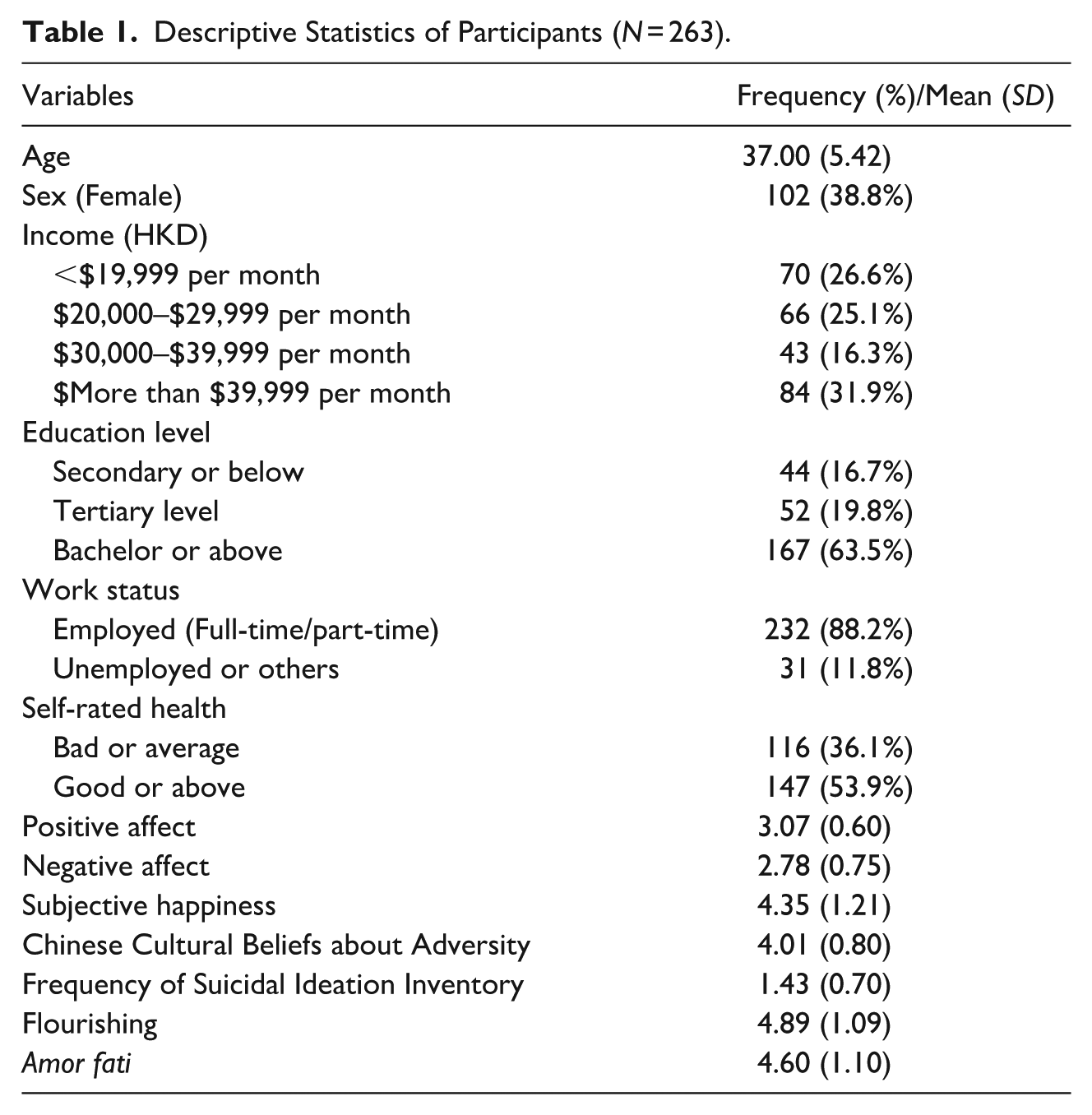
Table 1 summarizes the demographic and descriptive statistics of the sample. The final sample consisted of 263 middle-aged adults (aged 31–59 years; M = 37.00, SD = 5.42), including 161 men (61.2%) and 102 women (38.8%). The majority of the participants (58.1%) held a bachelor’s degree or higher, were employed (88.2%), and reported earning HKD19,999 or less per month (approximately USD1,300). Furthermore, 53.9% of the sample rated their health as good or above.
Descriptive Statistics of Participants (N = 263).
Correlation Analyses
Table 2 shows the results of the correlation analyses between study variables and mental health outcomes. The association patterns were all in the expected direction. Except for positive affect, which was weakly negatively associated with negative affect (r = −.23, p < .001) and suicidal ideation (r = −.22, p < .001), all other pairs were moderately or strongly correlated. Specifically, subjective happiness and flourishing demonstrated a strong positive correlation (r = .72, p < .001). Furthermore, amor fati was strongly associated with both subjective happiness (r = .68, p < .001) and flourishing (r = .68, p < .001).
Correlation Table Among Research Variables With Mental Health Indicators.
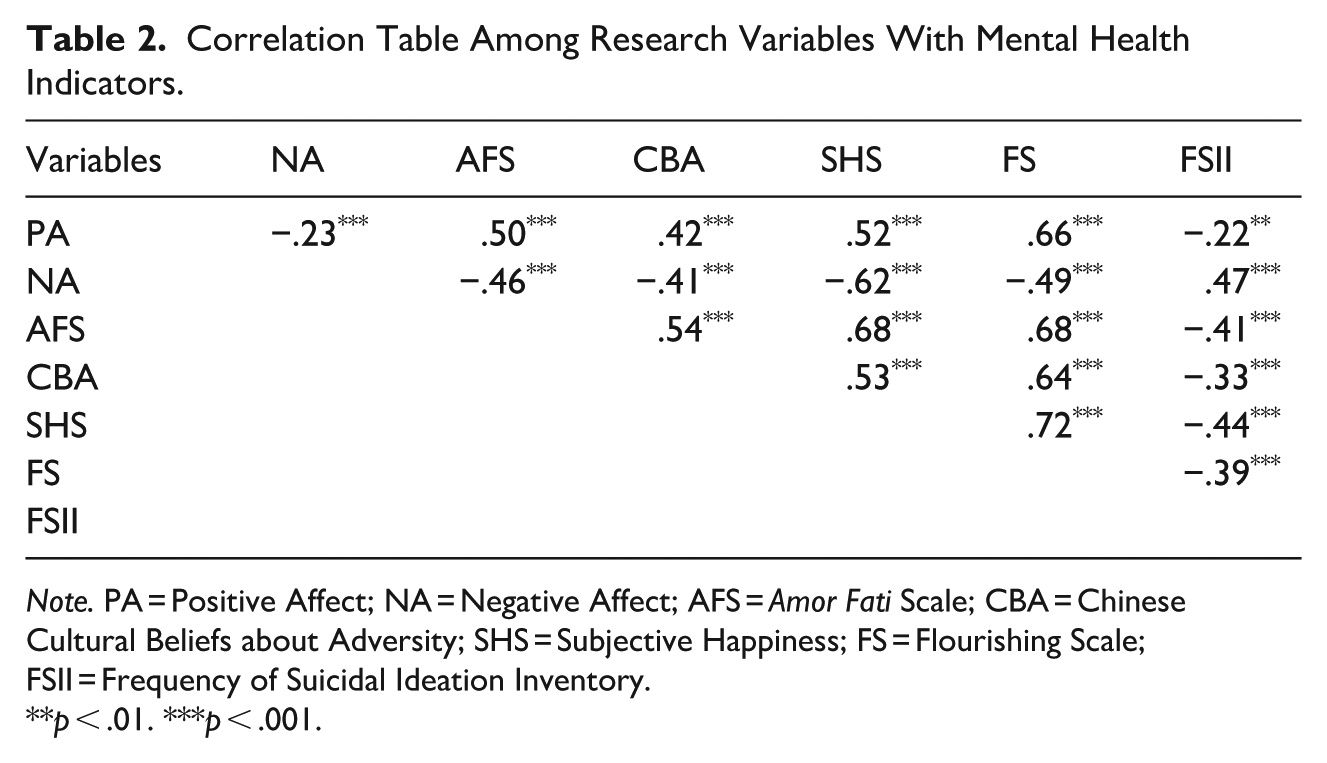
Note. PA = Positive Affect; NA = Negative Affect; AFS = Amor Fati Scale; CBA = Chinese Cultural Beliefs about Adversity; SHS = Subjective Happiness; FS = Flourishing Scale; FSII = Frequency of Suicidal Ideation Inventory.
p < .01. ***p < .001.
Hierarchical Regression Analyses
Table 3 summarizes the results of the hierarchical regression analyses predicting each mental health outcome (i.e., suicidal ideation, flourishing, and subjective happiness).
Results of Hierarchical Regression on the Factors Associated With Mental Health Outcomes (N = 263).
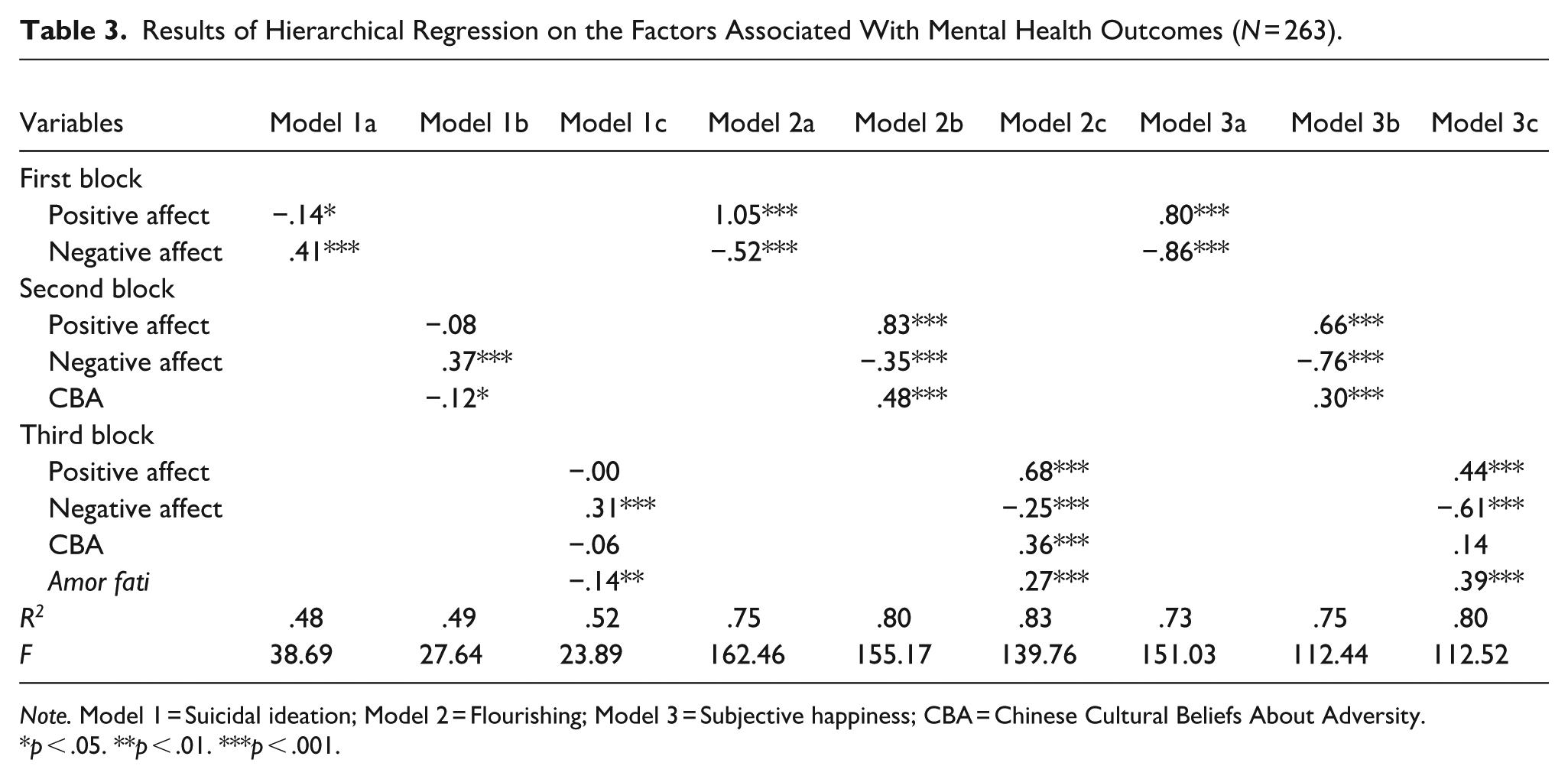
Note. Model 1 = Suicidal ideation; Model 2 = Flourishing; Model 3 = Subjective happiness; CBA = Chinese Cultural Beliefs About Adversity.
p < .05. **p < .01. ***p < .001.
Suicidal Ideation
In Model 1a, both positive affect (b = −0.14, p = .035) and negative affect (b = 0.41, p < .001) were significantly associated with suicidal ideation. Adding the CBA in Model 1b explained an additional 2% of the variance, with the effect of positive affect becoming non-significant. Finally, the addition of amor fati in Model 1c accounted for an additional 3% of the variance in suicidal ideation and was significantly and negatively associated with suicidal ideation (b = −0.14, p = .002), making the CBA a non-significant predictor of suicidal ideation and suggesting the unique role of amor fati in relation to suicidal ideation.
Flourishing
In Model 2a, positive and negative affect together accounted for approximately 56% of the variance in flourishing. By adding the CBA in Model 2b, an additional 9% of the variance was explained. When amor fati was subsequently entered into Model 2c, it contributed an additional 4% of unique variance beyond affectivity and the CBA. Among all predictors, positive affect (b = 0.68, p < .001) contributed most to flourishing.
Subjective Happiness
Model 3a revealed that positive affect (b = 0.80, p < .001) and negative affect (b = −0.86, p < .001) significantly predicted subjective happiness. The inclusion of the CBA in Model 3b accounted for an additional 3% of the variance. Furthermore, when amor fati was added in Model 3c, it explained an additional 7% of the variance in subjective happiness. Interestingly, the CBA became a non-significant predictor when amor fati was included in the model.
Discussion
This study examined midlife mental health in Hong Kong through a humanistic-existential lens and found that amor fati, an agentic stance of accepting and affirming one’s fate, was consistently associated with greater flourishing and happiness and lower suicidal ideation, even after accounting for day-to-day affect and culturally embedded beliefs about overcoming adversity. For a demographic navigating dense role obligations and chronic constraints, these findings suggest that stance-level orientations toward what cannot be readily changed may provide psychological ballast that symptom reduction alone cannot supply. In short, when life affords limited leverage, the way one meets reality matters.
Consistent with recent empirical work linking amor fati to psychological adjustment and suicide-related outcomes (Chang, 2024b, 2025a), our findings suggest that amor fati can be treated as a measurable stance-level orientation rather than a purely philosophical abstraction. In our Hong Kong midlife sample, amor fati was uniquely associated with lower suicidal ideation and higher flourishing and subjective happiness, even after accounting for positive and negative affect. This pattern is consistent with the interpretation that amor fati reflects an enduring orientation toward life’s givens that is not reducible to contemporaneous mood, and that it may support coherence and values-guided action under constraint. By affirming life in its entirety, including its hardships, amor fati provides a stabilizing framework through which individuals can integrate adversity into a coherent life narrative. Therefore, for Hong Kong’s middle-aged adults, who often face enduring financial stress, caregiving burdens, and occupational demands, amor fati may help sustain dignity and coherence amid challenges that are difficult to resolve.
Comparison of Amor Fati With Chinese Adversity Beliefs
The study also sheds light on culturally embedded beliefs about adversity, which have long been recognized as an important resource in Chinese societies. Rooted in Confucian and Taoist traditions, these beliefs emphasize perseverance, transformation, and the cultivation of virtue through hardship (Wong, 2009; Shek, 2004, 2005; Shek et al., 2021). Previous studies have shown that such beliefs can foster resilience and psychological adjustment, particularly among younger populations such as adolescents and emerging adults (Shek, 2005; Shek et al., 2003). However, in the present study, adversity beliefs were less strongly linked to midlife well-being compared to amor fati. One interpretation is that striving-based schemas are more effective when stressors are controllable, but may be less adaptive under structural constraints such as chronic caregiving demands or economic limitations. Under these conditions, persistence alone can lead to diminishing returns, exhaustion, or even self-critical rumination (Ntoumanis & Sedikides, 2018; Ntoumanis et al., 2014). In contrast, acceptance-based orientations reduce resistance to what cannot be changed, conserve psychological resources, and clarify values that can then guide more strategic forms of effort.
Acceptance-Before-Striving as a Dialectical Sequence
From this perspective, amor fati and adversity beliefs should not be viewed as mutually exclusive but as complementary components of a dialectical process. The present findings support an “acceptance-before-striving” model, whereby existential acceptance (amor fati) provides the ground for coherent presence, and striving becomes most adaptive once this foundation has stabilized affect and clarified values. This sequence reflects long-standing distinctions in coping research: accommodative strategies such as acceptance, reappraisal, and meaning-making are often more beneficial under uncontrollable stress, while problem-focused strategies are most effective when challenges are manageable (Cheng et al., 2014). Contemporary models of regulatory flexibility similarly highlight the importance of disengaging from unattainable goals and redirecting energy toward feasible pursuits (Bonanno & Burton, 2013; Wrosch & Scheier, 2020). Theoretically, amor fati serves as a stabilizing stance that integrates suffering into a meaningful life narrative (Wong, 2011), while adversity beliefs provide a cultural script for sustained striving. When woven together, these orientations offer a dialectical framework in which acceptance grounds effort, and effort affirms acceptance.
Theoretical Contributions
This integration carries theoretical significance for both existential psychology and cultural psychology. By examining amor fati and Chinese adversity beliefs side by side, the study illustrates that acceptance-oriented existential orientations and culturally embedded schemas can be examined within the same analytic framework, allowing clearer comparison of their distinctive and potentially complementary associations with midlife mental health. The findings suggest that acceptance-based beliefs may have greater generalizability across contexts, particularly under conditions of constraint, while culturally specific beliefs maintain relevance in contexts where change is possible. This contributes to broader efforts in humanistic psychology to expand the focus from alleviating symptoms to understanding the stances through which individuals live with adversity (Wong & Wong, 2012). Moreover, the dual impact of amor fati—its association with both the reduction of suicidal ideation and the enhancement of positive outcomes such as flourishing and happiness—responds to calls in positive psychology to conceptualize mental health as a dual continuum, encompassing both the absence of distress and the presence of positive functioning (Diener et al., 2010; Huta & Ryan, 2010).
Implications for Practice and Mental Health Promotion
These findings also carry practical implications for clinical and community work. Interventions that foster existential acceptance may be particularly beneficial in Hong Kong and similar urban Asian settings where midlife stressors are pervasive and often uncontrollable. Clinical approaches such as Acceptance and Commitment Therapy (Hayes et al., 2011, 2013), mindfulness-based practices (Kabat-Zinn, 2003), and meaning-centered or narrative therapies (Wong, 2012) could be adapted to explicitly emphasize the cultivation of amor fati. Such interventions might encourage clients to acknowledge the aspects of life that cannot be altered, practice consent to reality without resignation, and clarify core values that can guide purposeful action. At the community level, public mental health programs could incorporate acceptance-oriented education into workshops, seminars, and workplace initiatives. By balancing traditional emphases on perseverance with tools of acceptance, such programs could help adults sustain both psychological safety and authentic growth in contexts where striving alone is insufficient.
Limitations and Future Directions
Although this study advances understanding of protective factors for mental health among middle-aged adults in Hong Kong, several limitations should be noted. First, the cross-sectional design precludes causal inference and temporal ordering; longitudinal research is needed to clarify directionality. Second, we did not test explanatory mechanisms. Future studies should assess theoretically relevant mediators and moderators, such as meaning in life, psychological flexibility, coping and emotion-regulation processes, rumination, and stressor controllability, to clarify how stance-level orientations relate to well-being and suicidal ideation. Third, the use of convenience and snowball sampling limits generalizability. The findings should be interpreted as specific to Hong Kong middle-aged adults in this recruitment context, and associations may vary across sociodemographic and contextual groups (e.g., socioeconomic position, health status, caregiving burden, access to services). The study was not designed or powered to test subgroup differences. Future research should use stratified or probability-based sampling and multi-site designs to examine demographic and contextual variability and strengthen equity relevance.
Conclusion
In summary, this study suggests that amor fati was closely associated with lower suicidal ideation and higher flourishing and happiness among Hong Kong’s middle-aged adults, even when affective states and culturally embedded adversity beliefs were taken into account. By situating acceptance and striving within a dialectical sequence, the findings point to existential affirmation as a stabilizing ground from which culturally valued perseverance can unfold more wisely. This work contributes to humanistic psychology by underscoring the importance of stance-level meanings in sustaining dignity, coherence, and connection in the mid of life’s unalterable givens. Practically, cultivating acceptance as a foundation for thoughtful striving may offer a humane and culturally sensitive pathway to resilience and well-being in midlife.
Footnotes

Ethical Considerations
Ethical approval was obtained from the research ethics committee of Saint Francis University in accordance with the guidelines and procedures for ethical review regarding human research (REC Ref. no.: HRE230262).
Consent to Participate
Informed consent was obtained from all study participants.
Author Contributions
All authors contributed to the study conception and design. Material preparation, data collection, and analysis were performed by Q.L.H. and S.C.Y.C. E.C.C. supervised the findings of this work. The first draft of the manuscript was written by Q.L.H. and S.C.Y.C., and reviewed and edited by E.C.C. All authors read and approved the final manuscript.
Funding
The authors received no financial support for the research, authorship, and/or publication of this article.
Declaration of Conflicting Interests
The authors declared no potential conflicts of interest with respect to the research, authorship, and/or publication of this article.
Data Availability Statement
Materials (print-out of an electronic survey, questions, and questionnaire items) used in the survey are not openly available. These can be obtained from the corresponding author upon request. No aspects of the study were pre-registered.*