







Abstract
As the regulator established to promote, monitor and enforce compliance with the Fair Work Act 2009 (Cth) (FW Act), the Fair Work Ombudsman (FWO) plays a critical role in testing and clarifying the application of the FW Act and taking steps to ensure the integrity of the Australian workplace relations framework. The FWO engages in a wide range of activities designed to achieve these aims. An important function includes commencing civil litigations. The FWO litigates for a range of reasons, but primarily to achieve deterrence. However, many cases brought by the FWO on new and emerging issues have also shaped areas of workplace relations law and contribute to wider compliance by the regulated community more broadly. This article explores and highlights some examples of the way the FWO has addressed emerging enforcement challenges and shaped and tested the law through litigation. These include matters relating to accessorial liability; the general protections under Part 3-1 of the FW Act; and obtaining a wider range of orders in compliance proceedings.
Introduction
The Fair Work Ombudsman (FWO) is an independent statutory office established under the FW Act (s 681). The FWO is supported by the staff of the Office of the Fair Work Ombudsman (ss 696 and 697). The FW Act confers upon the FWO a number of functions including (among others) to monitor and enforce compliance with the FW Act, an industrial instrument made under it or certain contractual entitlements (s 682).
The FWO engages in a wide range of education and enforcement activities (see e.g. Office of the Fair Work Ombudsman, 2015–2016), part of which is the commencement of number of civil litigation matters each year, usually in the Federal or Federal Circuit Courts (see e.g. Fair Work Ombudsman, 2015–2016: 22). The FWO has a number of objectives in commencing litigation and takes into account a range of considerations in deciding to litigate, set out in the FWO’s Litigation Policy (Office of the Fair Work Ombudsman, 2013).
The FWO’s approach to litigation is continually evolving in response to a range of factors, including emerging challenges in securing compliance and developments in the law itself. Among the many reasons why the FWO may decide to litigate in a particular case is to motivate compliance, deter non-compliance and test and clarify the boundaries of the relevant law (Office of the Fair Work Ombudsman, 2013: 4). The FWO also considers it appropriate to hold individuals accountable for contraventions in which they are involved (Office of the Fair Work Ombudsman, 2013: 6). Additionally, since its inception in 2009, the FWO has been proactive in testing the application and scope of FW Act provisions where it is in the public interest to do so. Current particular areas of focus for the FWO include promoting accountability and deterrence by taking a broad approach to accessorial liability; taking steps to clarify the scope of protections under Part 3-1 of the FW Act to avoid unduly restrictive application of the provisions; and, where there is apparent risk in a particular case that the alleged wrongdoer will not satisfy orders for underpayments and penalties, seeking remedies designed to maximise compliance outcomes. We explore in the following some key cases in this respect.
Increasing accountability for contraventions: Putting the accessorial liability provisions to work
Section 550 of the FW Act is directed toward attaching liability for contraventions to individuals or entities who are involved in contraventions by other entities or individuals. The section reads as follows: 550 Involvement in contravention treated in same way as actual contravention
A person who is involved in a contravention of a civil remedy provision is taken to have contravened that provision. A person is involved in a contravention of a civil remedy provision if, and only if, the person:
has aided, abetted, counselled or procured the contravention; or has induced the contravention, whether by threats or promises or otherwise; or has been in any way, by act or omission, directly or indirectly, knowingly concerned in or party to the contravention; or has conspired with others to effect the contravention.
The type of provision exemplified by s 550 is, of course, not unique to the FW Act. Similar provisions appear in a range of other Commonwealth statutes and are utilised by regulatory agencies operating in a range of enforcement spheres, such as regulation of corporations (see e.g. s 79 of the Corporations Act 2001 (Cth)).
Why is the FWO testing the scope of s 550?
The FWO has increased its focus on s 550 in commencing litigation. In 2015–2016, 92% of proceedings filed by the FWO named, in addition to the primary alleged contravenor, at least one entity or individual as an accessory liable pursuant to s 550 (Office of the Fair Work Ombudsman, 2015–2016: 2). The reasons the FWO takes this step, where there is sufficient evidence to do so, include:
deterring individuals and entities involved in contraventions from future involvement in contraventions, by making them personally answerable for their conduct; sending a message to the regulated community that liability extends beyond the legal employer of affected workers; preventing conduct from going without remedy where a corporate entity is abandoned, liquidated or simply has insufficient funds to meet its obligations, to recover unpaid amounts and ensure serious contraventions do not go unpunished; and bringing about compliance within supply chains or addressing issues arising from complex outsourcing arrangements, particularly those involving low skilled work.
The FWO’s approach to s 550
Commonly, accessories include officers of a corporate entity who are the directing mind and will of the entity. The courts have, however, accepted that s 550 applies more broadly. This has resulted in declarations of personal liability in relation to, and imposition of civil penalty orders upon, a range of other persons involved in contraventions. Examples include:
human resources managers (FWO v Oz Staff Career Services Pty Ltd & Ors [2016] FCCA 105 and Fair Work Ombudsman v Centennial Financial Services Pty Ltd & Ors [2010] FMCA 863); day to day managers (Fair Work Ombudsman v Liquid Fuel Pty Ltd & Ors [2015] FCCA 2694, Fair Work Ombudsman v Jay Group Services Pty Ltd & Ors [2014] FCCA 2869 and Fair Work Ombudsman v I Luv Pty Ltd & Ors (unreported) (BRG498/2016)); administration and payroll managers (Fair Work Ombudsman v Ross Geri Pty Ltd & Ors [2014] FCCA 959 and Fair Work Ombudsman v WY Pty Ltd, Chong Yew Chua and Ning Yuan Fu (unreported) (BRG786/2016)); associated corporate entities (Fair Work Ombudsman v Jetstar Airways Ltd [2014] FCA 33 and Fair Work Ombudsman v Yogurberry World Square Pty Ltd [2016] FCA 1290); and corporate entities in supply chains (Fair Work Ombudsman v South Jin Pty Ltd (in liq) [2015] FCA 145, Fair Work Ombudsman v GRI Global Pty Ltd (in liq) & Anor (unreported) (BRG1151/2014) and Fair Work Ombudsman v Al Hilfi [2015] FCA 313).
Testing the boundaries of s 550
Two recent matters, Fair Work Ombudsman v Yogurberry World Square Pty Ltd [2016] FCA 1290 and FWO v Oz Staff Career Services Pty Ltd & Ors [2016] FCCA 105, are examples of the FWO’s work in the area of s 550.
Yogurberry
Yogurberry involved four Korean backpackers, working pursuant to subclass 417 (Working Holiday) visas. They were employed by Yogurberry World Square Pty Ltd (YWS), a Yogurberry franchise in World Square Shopping Centre, Sydney. An FWO investigation uncovered underpayments, unlawful deductions from wages, and various pay slip and record-keeping failures.
Upon investigation, it became apparent that YWS and the World Square Store were controlled by YBF Australia Pty Ltd (YBF), the Yogurberry brand’s Australian head office. YBF originally ran the World Square store and employed its staff until late 2013, when YBF no longer operated the World Square store but instead created a complex set of group companies run by various members of the Oh family. Despite the interposition of YWS, YBF continued to control the activities of the World Square store through its shareholders Mr Young Seok Oh and his wife, Mrs Soon Ok Oh. From January 2015, Mr and Mrs Oh’s son, Mr Taek Oh, took over as CEO of Yogurberry and had control over the YWS employees through CL Group Pty Ltd (CL), an entity of which he was a director. Mrs Oh was a shareholder of YBF and director of CL Owner Pty Ltd (a company which owned YWS and CL). However, Mrs Oh admitted that she was a de facto director of YWS, YBF and CL and the person who made decisions on behalf of all three companies (notwithstanding that her husband and children were on record as directors of those companies) (Figure 1).
Relationships between corporate entities and individuals in FWO v Yogurberry World Square Pty Ltd [2016] FCA 1290.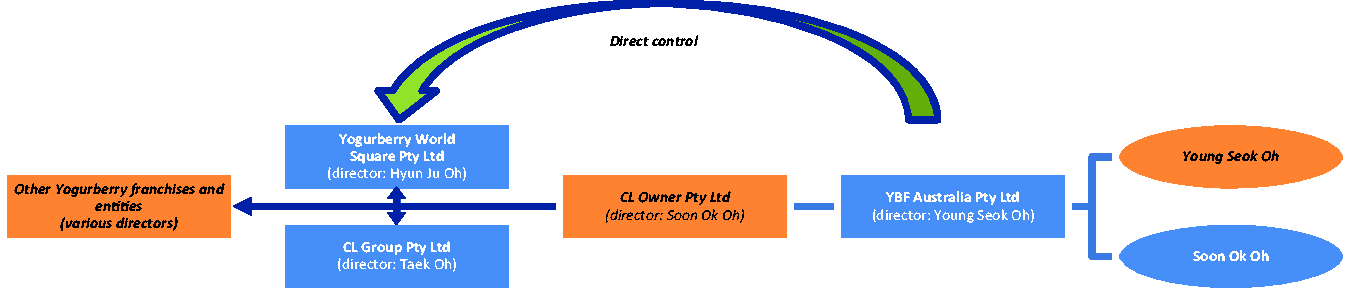
The FWO commenced proceedings against YWS, YBF, CL and Mrs Oh for various contraventions. All respondents eventually admitted liability and the matter proceeded by way of the parties filing a Statement of Agreed Facts (SOAF). Flick J handed down penalties of $146,000, nearly half of which were imposed on the accessories, including YBF. In addition to penalties, his Honour agreed to orders requiring YBF and CL to undertake an audit to assess wage and record-keeping requirements for all employees engaged within Yogurberry stores (both franchised and company-owned). His Honour found that such audits were appropriate where the full extent of the contraventions were unknown or where an audit could ‘identify the deficiencies of a respondent which need to be remedied’.
While Yogurberry proceeded by way of a SOAF, it is an important case that flags the very real potential for those in a franchising or supply chain to be liable for the conduct of others in the chain. In the light of recent high-profile cases involving non-compliance in franchised businesses (Fair Work Ombudsman, 2016), the FWO will continue to explore the limits of s 550 in this respect and will consider similar orders to the audit where appropriate. Should legislative amendments be made to the FW Act in relation to liability of franchisors who are involved in contraventions by franchisees (as foreshadowed in the 2016 Election Policy of the current government), the FWO will take steps to apply these where possible.
FWO v Oz Staff
This contested matter involved an employer, Oz Staff Career Services Pty Ltd (in liq.) (Oz Staff), making unlawful deductions from the wages of cleaners it employed and hired out to third-party entities. In response to a targeted audit conducted by the FWO, which included a focus on deductions from wages, the employer created, and then presented to the FWO, false pay records in an attempt to conceal the unlawful deductions. The FWO brought proceedings against Oz Staff, alleging that the company’s director (Mr Blom) and the human resources manager (Mr Linossi) were knowingly concerned in Oz Staff’s contraventions pursuant to s 550.
Both Mr Blom and Mr Linossi initially denied accessorial liability for all contraventions and asserted their right to claim penalty privilege, electing not to call any evidence at the close of the FWO’s case. Mr Blom had admitted involvement in the deductions practices at the beginning of the trial.
The FWO argued that the Court was entitled to infer, based on the combined weight of the evidence presented of the accessories’ roles in the business, participation in the matters subject of the FWO’s investigations and prior engagement with the regulator, that they possessed the requisite knowledge of the material facts comprising the disputed contraventions and were intentional participants (relying on the principles set out in cases such as Australian Competition and Consumer Commission (ACCC) v Air New Zealand Ltd [2014] FCA 1157, Transport Industries Insurance Co. Ltd v Longmuir (1997) 1 VR 125 and United Group Resources Pty Ltd v Calabro (No 5) [2011] FCA 1408).
His Honour Judge Burchardt found Mr Blom and Mr Linossi were involved in the creation and production of the false records, and further that Mr Linossi was involved in the deduction practices. In relation to Mr Linossi, in the absence of him propounding an alternative hypothesis and in light of all of the circumstances, his Honour was prepared to infer that Mr Linossi knew the deductions were unlawful: He thus had knowledge of the constituent parts of the contravention, albeit that he may not have known which section of the FW Act, if any, was capable of being contravened. This state of knowledge, in my view, is sufficient, if nothing else, to constitute involvement within the meaning of s.550(2)(c) of the FW Act. A person who knows of the contravention and takes no steps to correct it is clearly in some way, at least indirectly, a person who has ‘in any way, by act or omission, directly or indirectly, knowingly concerned in or party to the contravention’ (at [150]).
In relation to Mr Linossi’s involvement in the false records contraventions, he stated that: I simply do not accept that the person running the Human Resources activities of the first respondent and intimately involved, as he clearly was, with Award matters was not aware not only that the deductions were being made but that the records which were forwarded to the applicant not showing those deductions were false and misleading. He was clearly involved within the meaning of s.550 of the FW Act (at [158]).
The outcome in FWO v Oz Staff demonstrates that a court will be prepared to draw inferences of knowledge where the FWO is able to present cogent circumstantial evidence of a person’s knowledge and involvement in the relevant contraventions. It also confirms that individuals who are in a position of knowledge and can influence a corporate entity’s contraventions, but who take no steps to correct them, may find that personal liability is attracted by their conduct. It reinforces the principle from Yorke v Lucas (1985) 158 CLR 661 that such persons need not know that the matters they have knowledge of amount to a contravention of the law. The Oz Staff case did not involve contraventions of an award, and therefore questions of whether knowledge of a particular instrument is required, such as arose in the matters of Potter v Fair Work Ombudsman [2014] FCA 187 and FWO v Devine Marine Group Pty Ltd [2014] FCA 1365, did not require consideration by the Court. The FWO is currently seeking to have that particular issue determined by a Full Court of the Federal Court.
How much protection is there in a ‘general protection’?
Part 3-1 of the FW Act contains a number of provisions directed to protecting workers and employers from a range of types of prohibited conduct. Part 3-1 includes the type of ‘freedom of association’ protections historically set down in Australian federal workplace law. It also contains some more novel protections. Examples include the s 351 protection against discrimination (previously, such protection was principally the domain of anti-discrimination laws, with limited unlawful termination protection in the federal workplace relations legislation) and the s 340 workplace rights protection as it operates in relation to complaints made by an employee to the employer. The prohibition on ‘sham contracting’ (misclassifying an employee as an independent contractor) also finds a home in Part 3-1.
What has the FWO achieved to date in relation to Part 3-1?
The FWO’s Litigation Policy clarifies that the FWO takes Part 3-1 contraventions particularly seriously (Office of the Fair Work Ombudsman, 2013: 11). The FWO has brought a number of Part 3-1 proceedings in recent years. Examples include matters relating to:
s 351 discrimination, including age and pregnancy discrimination (see e.g. Fair Work Ombudsman v Theravanish Investments Pty Ltd & Ors [2014] FCCA 1170 and Fair Work Ombudsman v Wongtas Pty Ltd (No 2) [2012] FCA 30); sham contracting (see e.g. Fair Work Ombudsman v Contracting Solutions Australia Pty Ltd [2013] FCA 7, Fair Work Ombudsman v Happy Cabby Pty Ltd & Anor [2013] FCCA 397, Fair Work Ombudsman v eCosway Pty Ltd [2016] FCA 296 and Fair Work Ombudsman v Australian Sales & Promotions Pty Ltd & Anor [2016] FCCA 2804); and freedom of association (see e.g. Maritime Union of Australia v Fair Work Ombudsman [2016] FCAFC 102).
Testing the boundaries of Part 3-1
In 2016, the FWO pursued two major cases which have had a significant effect in clarifying the law on Part 3-1. These are Maritime Union of Australia v Fair Work Ombudsman [2016] FCAFC 102 (MUA v FWO) (discussed also in Sutherland and Riley, 2017) and Fair Work Ombudsman v Quest South Perth Holdings Pty Ltd [2015] HCA 45 (FWO v Quest) (discussed also in Sutherland and Riley, 2016: 389–390). MUA v FWO considers whether adverse action taken by a union against employees may prejudice those employees in their employment. FWO v Quest considers whether interposition of a third party contracting entity may break the nexus between employer and worker for purposes of the sham contracting prohibition. Given the significant effect that union targeting of employees can have upon them in the workplace and the importance of ensuring effective protection from sham contracting, the FWO considered testing these matters critical to clarifying the scope of these statutory protections. In the FWO’s view, the outcome in each case was a construction that aligns with the intent of the relevant FW Act provisions. Importantly, both matters progressed to appeal and were considered by the Full Court of the Federal Court. In turn, FWO v Quest was considered by the High Court.
MUA v FWO
In June 2012, the FWO commenced proceedings in the Federal Court against the Western Australian branch of the Maritime Union of Australia (MUA) and one of its senior officials, William Tracey. In December 2011, the MUA, through Mr Tracey, organised for employees of Fremantle Port Authority (FPA) to take protected industrial action to support enterprise bargaining negotiations. A small number of employees elected to work during the strike. As a result, the strike failed to shut down Fremantle Port. Following the industrial action, Mr Tracey, authorised by Chris Cain, secretary of the Western Australian branch of the MUA, disseminated posters in public locations across the Fremantle Port Harbour facilities, naming four of these employees as ‘scabs’. The posters also named a fifth employee, who had not worked during the strike but who communicated for less than a minute with the incoming crew on the next shift.
Relevant provisions of the FW Act
Section 346 (c) of the FW Act states that: A person must not take adverse action against another person because the other person:
is or is not, or was or was not, an officer or member of an industrial association; or engages, or has at any time engaged or proposed to engage, in industrial activity within the meaning of paragraph 347(a) or (b); or does not engage, or has at any time not engaged or proposed to not engage, in industrial activity within the meaning of paragraphs 347(c) to (g).
Section 347(b)(iii) relevantly defines ‘industrial activity’ as including (among other things) a situation where a person elects to not participate in a lawful activity organised or promoted by an industrial association.
Section 342(1) of the FW Act defines ‘adverse action’. Relevantly, this includes action taken by an industrial association or an officer or member of that association that ‘has the effect, directly or indirectly, of prejudicing the person in the person’s employment or prospective employment’ (s 342(1)(7)(b)).
The FWO’s case and the MUA’s response
The application of s 346 in the context of the employer–employee relationship has been well tested. However, in the litigation leading to the MUA v FWO appeal, the FWO asked for the first time that a court consider whether action taken by a union in breach of s 346 could be ‘prejudicial’ within the meaning of s 342(1)(7)(b).
The FWO argued that the MUA and Mr Tracey, in organising publication and/or dissemination of copies of the ‘scab’ posters, took prohibited adverse action. This was because the action had the effect of prejudicing the affected employees in their employment and it was taken because the affected employees refused to engage in s 347 industrial activity (being the MUA-organised industrial action). The ‘prejudice’ asserted by the FWO was detriment to the affected employees’ emotional wellbeing at work and their ongoing relationships with colleagues. Further, the conduct led the employees to hold genuine fears for their safety and that of their families.
The FWO also alleged that the distribution of the scab poster was in breach of s 348 of the FW Act because it coerced the employees to participate in adverse action.
Mr Tracey and the MUA contended that there was no evident prejudice, direct or indirect, to the employment of the affected individuals. They relied on the authority of CFMEU v BHP Coal Pty Ltd (No 3) [2012] FCA 1218 (BHP Coal (No 3)). That matter concerned the dismissal of an employee who, while not at work, held up a sign while standing on a road outside the entrance of a workplace. That sign read: ‘No Principles Scabs No Guts’ and was held up as a protest in relation to employees who worked while protected industrial action was under way. One of the issues for resolution was whether display of the sign constituted taking adverse action against the employees within the meaning of Item 7(b) of s 342(1). Jessup J held that the concept of prejudicing an employee in their employment ‘covers not only legal injury but any adverse affection of, or deterioration in, the advantages enjoyed before the conduct in question’ (at [110]), but that the holding of the sign did not fall within Item 7(b) of s 342 of the FW Act, as what was required was for the prejudicial effect to occur in the employment. Here, there was no evidence of prejudice, direct or indirect, to any employee who continued to work during the period of industrial action (at [111]). These findings were not overturned in the appeals in relation to this matter.
Judicial consideration at first instance
At first instance, Siopis J of the Federal Court ruled in favour of the FWO, finding Mr Tracey liable for five separate counts (one for each employee) of adverse action for his role in organising and perpetrating the impugned conduct. The MUA was also found to be directly liable for the contraventions of Mr Tracey.
Siopis J held that the question of whether the adverse action has the effect of prejudicing an employee directly or indirectly in their employment is a question of fact (at [244]). He distinguished the matter from BHP Coal (No 3) by finding that:
a limited number of employees were specifically named as scabs in the scab poster; the scab poster was distributed widely, so that those who would not otherwise have known of the identity of each of the named employees and that they had worked during the strike were informed of these matters; the language of the poster was extreme, offensive, cruel and abusive; and the scab poster invited the reader to treat each of the named employees as devoid of human dignity (at [245]).
Siopis J made the finding that the scab poster action had the effect of prejudicing each of the affected employees in their employment because on discovering that each had been named in the scab poster, each felt emotional distress, anger and marginalisation in the workplace. They knew that their co-workers had been invited to regard them as unworthy of being treated with the respect and dignity that would otherwise be accorded to co-workers and fellow human beings. Further, after learning of the scab posters, the named employees became fearful that a co-worker, influenced by the content of the scab poster, would visit violence upon them, their families or their property. Prior to the dissemination of the poster, the employees had not been burdened by such distress or fear. As such, Siopis J concluded that Mr Tracey’s actions prejudiced each of the employees in their employment (at [252]–[255]).
In determining a contravention of s 346 of the FW Act, Siopis J also found that Mr Tracey took adverse action against each of the affected employees because they did not participate in the strike (at [263] and [279]). Finally, Siopis J held that the MUA was liable for the conduct of Mr Tracey and had therefore contravened s 346 of the FW Act (at 353).
Subsequently, penalties of $80,000 and $15,000, respectively, were imposed on the MUA and Mr Tracey. Four of the affected employees were awarded $20,000 in compensation each. The fifth employee, who did not work during the strike, was awarded $40,000 (Fair Work Ombudsman v Maritime Union of Australia (No 2) [2015] FCA 814).
The MUA and Mr Tracey appealed the liability, penalty and compensation decisions.
Judicial consideration: Full Federal Court
In two separate judgments, the Full Federal Court affirmed Siopis J’s decision.
In their majority judgment, Tracey and Buchanan JJ concluded that the poster was designed to ‘damage’ the employees (at [24]) and that Siopis J’s conclusions as to the effects upon the employees were ‘unassailable’ (at [20]). Tracey and Buchanan JJ went on to conclude that a consideration of ‘employment’ for the purpose of ascertaining whether there had been prejudice in employment should not be confined to any narrow consideration of a formal relationship with an employer or to physical or tangible benefits of employment (at [16]). In this case, the effects upon the employees were bound up with their employment and it would be ‘artificial’ to say that the prejudice to the employees was not in their employment (at [21]). Tracey and Buchanan JJ placed emphasis on the importance of non-pecuniary aspects that affect a person’s experience in employment (at [22]). Finally, Tracey and Buchanan JJ approved the compensation awarded by Siopis J as appropriately compensating the employees (at [30]).
In a separate judgment, Bromberg J affirmed Siopis J’s decision, but applied somewhat different reasoning. He noted that the fact that distress and fear were experienced at work seemed to him to have been the basis for Siopis J’s conclusion that, in each case, the affected employees were prejudiced ‘in’ their employment. However, he stated that the proper question was not whether the effect was experienced at work, but whether the advantage derived from the employment was prejudicially altered in a real and substantive way (at [70]).
Bromberg J concluded that the words ‘in the person’s employment’ did not require that the terms and conditions of the person’s employment must be adversely affected (at [55]). There must be a nexus between the effect of the adverse action and an advantage derived from, and enjoyed in, employment which that effect has prejudicially altered (at [59]). Emotional distress and fear of harm is capable of constituting a prejudicial alteration to an advantage derived from an employment (at [73]). In this case, the fears of the non-striking employees were sourced in the fact that they had performed their duties in accordance with their employment (at [77]), and so they were affected in their employment for s 342(1)(7)(b) purposes. Bromberg J held that conceptually, emotional distress and fear of harm is capable of constituting a prejudicial alteration to an advantage derived from an employment – that is, a safe working environment. Accordingly, while Bromberg J adopted a different analytical framework to Siopis J, he concluded that the findings made by Siopis J, that the affected employees suffered emotional distress and fear, which had prejudicial effects in their employment, were not in error. Bromberg J, however, felt the compensation awarded was excessive (at [166]).
The Court ultimately dismissed the appeal.
It has long been the view of the FWO that a person’s employment is not confined to the narrow relationship with an employer, but rather comprises the broader working environment and its accompanying social interactions and emotional wellbeing. MUA v FWO and the first instance decision in this matter make it clear that workers are to be protected from detriment in their employment as a result of a decision not to take industrial action, regardless of the source of that detriment (be it an employer or a union). The FWO’s decision to test the provisions explored in this case has resulted in a new precedent supportive of this position and which provides a foundation for future litigation exploring this concept. The FWO will continue to pursue actions of this type where appropriate factual scenarios arise.
FWO v Quest
FWO v Quest involved a ‘triangular’ arrangement between Quest South Perth Holdings Pty Ltd (Quest), a third party labour hire provider, Contracting Solutions Pty Ltd (Contracting Solutions), and three individuals styled as ‘independent contractors’. Quest operated a business providing serviced apartments. Quest, using the services of Contracting Solutions, facilitated the ‘conversion’ of three Quest employees (two housekeepers and a receptionist) from employees to independent contractors. The employees were purportedly converted by resigning from their employment with Quest. They were then engaged by Contracting Solutions as independent contractors. Contracting Solutions hired out the services of the ‘independent contractors’ to Quest to undertake the same work they had been performing when they were directly employed by Quest.
Relevant provisions of the FW Act
Sections 357 and 358 are designed to prohibit the disguising of genuine employment relationships as independent contractor relationships. Mischaracterisation of employment as independent contracting has a number of negative effects. This includes, for example, the disadvantaging of misclassified workers who do not receive entitlements otherwise due to employees under the FW Act. There may be a range of other consequences under other laws, such as tax laws.
Section 357 of the FW Act provides that:
A person (the employer) that employs, or proposes to employ, an individual must not represent to the individual that the contract of employment under which the individual is, or would be, employed by the employer is a contract for services under which the individual performs, or would perform, work as an independent contractor. Subsection (1) does not apply if the employer proves that, when the representation was made, the employer:
did not know; and was not reckless as to whether; An employer must not dismiss, or threaten to dismiss, an individual who:
is an employee of the employer; and performs particular work for the employer;
the contract was a contract of employment rather than a contract for services.
in order to engage the individual as an independent contractor to perform the same, or substantially the same, work under a contract for services.
The FWO’s case and the Quest’s response
It was the FWO’s view that the ‘independent contractors’ provided by Contracting Solutions to Quest were, in truth, at all times employees of Quest, working under an implied contract of employment with Quest. The FWO took this view because the workers were in relatively low-skilled occupations (housekeepers and a receptionist); the work performed by the workers did not change at all after their ‘conversion’ from employment to independent contracting; and both before and after ‘conversion’, the workers worked under the direction of Quest and had no control over their hours of work, method of work or remuneration. The evidence was that the employees felt pressured to resign and take up the new arrangements, or risk losing their employment altogether. The FWO accordingly contended that the arrangement was being misrepresented to the workers, in breach of s 357, and that the workers had been terminated by Quest and re-engaged by Quest to perform the same work as contractors, in breach of s 358.
Further, the FWO considered that the labour hire arrangement established by Quest with Contracting Solutions had been implemented with the express intention of assisting Quest to avoid its obligations as an employer. The FWO alleged that pursuant to s 550, each of Contracting Solutions, the Workplace Relations Manager for Contracting Solutions and the Manager of Quest were liable as accessories for the contraventions of ss 357 and 358 by Quest.
The respondents contended a genuine labour hire arrangement was in place. They argued that the employees voluntarily resigned from their employment to take up independent contracting arrangements because there were certain benefits of contracting that ‘attracted them to being independent contractors’ (at [20]).
Judicial consideration at first instance
At first instance, McKerracher J:
found no contravention in relation to the cleaners, on the basis that each entered into a contract of services with Contracting Solutions voluntarily and not as the result of threats or representations (at [235]–[245]); but found a breach of s 358 in relation to the receptionist, on the basis that the manager of Quest had told her that if she did not sign the necessary paperwork to become an independent contractor, she would not be paid (at [246]–[248]). McKerracher J accepted that this constituted a threat to dismiss the receptionist in order to engage her as an independent contractor to perform the same work.
The FWO appealed in relation to the housekeepers.
Judicial consideration: Full Federal Court
On appeal there were two decisions, one of North and Bromberg JJ and one of Barker J.
Broadly, in these judgments it was held that:
the arrangements to convert the housekeepers into independent contractors did not form binding or effective contracts; the true position in law was that there was an implied contract of employment between Quest and each of the housekeepers; and Quest had represented to the housekeepers that they were performing work for Quest as independent contractors of Contracting Solutions, not as employees of Quest.
Nevertheless, the Full Court of the Federal Court held that Quest’s representations were not actionable under s 357(1) of the FW Act. Justices North and Bromberg in their joint reasons, and Barker J in his separate judgment, held that s 357(1) applies only if an employer’s representation mischaracterises the contract of employment between the employer and employee as a contract of services made directly between them (at [101]–[102] and [307]). Quest’s representations did not contravene s 357(1) of the FW Act because they mischaracterised the contracts of employment between Quest and the housekeepers as contracts for services made through a triangular contracting arrangement involving a third party, not directly between Quest and the housekeepers/receptionists.
The FWO had significant concerns that the decision of the Full Court of the Federal Court may have the effect of creating a ‘loophole’, whereby employers could avoid liability under s 357 by interposing a third party or a notional entity, to engage employees including by way of ‘converting’ existing employees of the principal entity. The FWO decided to appeal.
Judicial consideration: High Court of Australia
The FWO was successful in obtaining special leave to appeal to the High Court. The High Court went on to hand down a swift and unanimous decision on 2 December 2015, upholding the FWO’s appeal and varying the order of McKerracher J at first instance to include contraventions of s 357(1) in relation to the two housekeepers.
The High Court determined that the language of s 357 does not confine the application of the provision only to circumstances where the misrepresented contract of services is described as being with the employer. The purpose of s 357 is to protect an individual who is, in truth, an employee, from being misled by his or her employer about his or her employment status. It is the status of an employee which attracts the existence of workplace rights. The High Court held that to confine the prohibited representation to the employer–employee relationship would give a capricious operation to s 357 (at [16]).
In reaching its conclusion, the High Court also found the legislative history did not support the notion that s 357 should be confined in the manner adopted by the Full Court (at [18]). Rather, the High Court noted that ‘the misrepresentation attributed to Quest was squarely within the scope of the mischief to which the prohibition in s 357(1) was directed and is caught by the terms’ (at [22]).
The FWO views the outcome in this case as aligned with the true intent of the relevant protections under the FW Act. On its proper construction, s 357 of the FW Act does not distinguish between sham contracting arrangements made directly between an employer and employee and via a triangular contracting arrangement. Had the decision of the Full Federal Court remained, it would have significantly compromised the capacity of the Part 3-1 sham contracting provisions.
Doing something different so that something different happens in the future: Seeking a wider range of orders
The Work Choices amendments to the former Workplace Relations Act 1996 (Cth) expanded the range of orders available to courts in relation to contraventions of civil remedy provisions (former s 807). This approach continues in s 545 of the FW Act. Traditionally, industrial cases involving underpayments of wages or award breaches attracted orders for underpayments and civil penalties only. The FWO has, however, increasingly sought a greater range of outcomes pursuant to s 545 in order to achieve greater accountability for non-compliance, ensure future compliance and promote general and specific deterrence. This focus has emerged in the face of developments including, for example, situations of repeated non-compliance. The FWO’s exploration of the possibilities offered by s 545 has resulted in active pursuit of a range of orders crafted to match the nature of the contravening conduct and compliance position of the contravenor(s), as well as civil penalties and orders for rectification of underpayments. The FWO also now explores other avenues, such as freezing orders, in appropriate cases.
Section 545 of the FW Act
Section 545 empowers the Federal Court and Federal Circuit Court (subject to certain limitations as to the time period in relation to which orders relating to underpayment may be made, costs and the quantum of pecuniary penalty orders (see ss 545(5), 546 and 570)) to make ‘any order the court considers appropriate’ if the court is satisfied that a person has contravened, or proposed to contravene, a civil penalty provision (s 545(1)). An order may be made on the court’s own initiative or on application (s 545(4)). Examples given in s 545 include an injunction or interim injunction (s 545(2)(a)), compensation for loss that a person has suffered because of the contravention (s 545(2)(b)) and an order for the reinstatement of a person (s 545(2)(c)).
The FWO’s approach to s 545
In appropriate cases, the FWO has sought and obtained:
injunctions restraining future breaches or involvement in such breaches (see e.g. Fair Work Ombudsman v Hair Industrie Erina Pty Ltd & Anor (unreported) (SYG1725/2014), Fair Work Ombudsman v James Nelson Pty Ltd & Anor [2016] FCCA 531, Fair Work Ombudsman v Step Ahead Security Services Pty Ltd & Anor [2016] FCCA 1482 and Fair Work Ombudsman v Grouped Property Services Pty Ltd [2016] FCA 1034). This enables the FWO to pursue an action for contempt of court at a later date if future breaches occur. This may include potentially seeking imprisonment of a non-compliant individual; orders requiring employers to notify the FWO of matters such as business acquisitions and employment of visa workers (e.g. Fair Work Ombudsman v Maroochy Sunshine & Anor, unreported); orders requiring employers to undertake, or appoint independent third parties to undertake, wage and entitlement audits (e.g. Fair Work Ombudsman v Yogurberry World Square Pty Ltd [2016] FCA 1290 and Fair Work Ombudsman v Mamak Pty Ltd & Ors [2016] FCCA 2104); orders requiring employers to undertake specified training in relation to their obligations under workplace laws, such as compliance training with an accredited workplace relations specialist or using the FWO’s online training centre (see e.g. Fair Work Ombudsman v Global Work and Travel Co. Pty Ltd & Ors [2015] FCCA 495); orders requiring employers to post notices in their workplaces regarding workplace entitlements and FWO contact details (see e.g. Fair Work Ombudsman v Mai Pty Ltd & Anor [2016] FCCA 1481); and orders requiring future job advertisements to contain information regarding the relevant modern award and the FW Act (e.g. Fair Work Ombudsman v WY Pty Ltd, Chong Yew Chua and Ning Yuan Fu (unreported) (BRG786/2016)).
The FWO’s approach to s 545: Ensuring rectification of underpayments
A key concern for the FWO in underpayment cases is securing rectification of underpayments for affected employees. This is not always straightforward. In many cases, a corporate entity employer is wound up or liquidated before payment is made. In view of this, the FWO decided to explore the limits of s 545 of the FW Act by requesting, in appropriate cases, that courts make corporate entities and their directors jointly and severally liable for rectification. Initial case law on this issue was equivocal (see Scott v Scala Bros Pty Ltd & Anor [2014] FCCA 2374 (casting doubt on such orders) and Sponza v Coal Face Resources Pty Ltd [2015] FCCA 1140 (in favour of such orders)).
FWO tested the issue in FWO v Step Ahead Security Services Pty Ltd & Anor [2016] FCCA 1482. In that case, the FWO alleged that Step Ahead Security Services Pty Ltd (SASS), a Queensland security company, had underpaid eight security guards and that the sole director was involved in SASS’ contraventions. The director was the sole director of two previous companies offering security services. Each of these companies was wound up, the second in circumstances where there were complaints of outstanding remuneration owed to employees that were not pursued following the employer’s deregistration (at [78]). In the circumstances, the FWO was concerned as to whether the underpayments to employees would be rectified and considered this an appropriate case to seek orders for joint and several liability.
The FWO’s application in Step Ahead required the Court to consider the limits of s 545 of the FW Act as regards to orders that could be made against an s 550 accessory. The FWO’s position was that ‘any order the court considers appropriate’ encompasses a compensation order against a person ‘involved in’ a contravention within the meaning of s 550 of the FW Act. This was despite the fact that, while s 545 of the FW Act does not put any limits on the court’s power, the Explanatory Memorandum to the Fair Work Bill 2008 (the EM) states (at [2177]) that: the clause does not result in a person involved in a contravention being personally liable to remedy the effects of the contravention. For example, where a company has failed to pay, or has underpaid, an employee wages under a fair work instrument, the director is not personally liable to pay that amount to the employee.
In Step Ahead, his Honour Judge Jarrett agreed with the position taken in Sponza that the language of s 545 was ‘clear and unambiguous’ (at [55]), and it was not appropriate to read down that language in light of the EM. Concluding that SASS and the director engaged in ‘calculated and deliberate’ conduct that amounted to ‘blatant disregard’ for Australian workplace law and the rights and entitlements of the SASS employees (at [23]), his Honour considered whether compensation orders should be made against the accessory, the director. In so doing, Jarrett J noted that the following considerations were relevant:
whether such an order is unnecessary given the capacity of the employer to make the compensation payments; the nature and extent of the accessory’s involvement in the contravention; any relevant public policy reasons; and the nature of the order sought, including whether the accessory is to be made solely liable, or jointly liable (at [69]).
His Honour ordered that SASS and the director were jointly and severally liable for rectifying the underpayments to the employees (at [80]), given the context of past liquidation of entities associated with the director, and also ordered that each respondent pay civil penalties, including in the director’s case a penalty of $51,400.
The FWO anticipates that as a result of this clarification of the law in Step Ahead, directors will be less inclined to put the employing company into liquidation to avoid back-payment of employees, particularly where they are the subject of investigations and litigations. This will, it is envisaged, go some way to ensuring employees receive their entitlements in underpayment situations. It is also hoped it acts more broadly as a deterrent, given that individual accessories may now be liable not just for civil penalties, but also for rectification of underpayments. Similar compensation orders have been obtained in several matters since, including for example, FWO v Chia Tung Development Corp Ltd & Anor [2016] FCCA 2777 and FWO v Sonisolar Pty Ltd & Anor [2016] FCCA 2027.
Moving beyond s 545: Freezing orders
A freezing order is an asset preservation order made by a court in its inherent jurisdiction, normally made ex parte. The purpose of freezing orders is to prevent a respondent dissipating or dealing with assets in a way that would frustrate or inhibit a pending or proposed court process and deprive the applicant of the fruits of any judgment obtained (see e.g. Jackson v Sterling Industries Limited (1987) 162 CLR 612). Such an order may be made before or after judgment is obtained. In the Federal Court, a freezing order may be made pursuant to s 23 of the Federal Court of Australia Act 1976 (Cth). The rules in relation to freezing orders are set out at Division 7.4 of Part 7 of the Federal Court Rules 2011 (Cth). An applicant must satisfy the court that it has a strong arguable case on an accrued or prospective course of action and that there is a real danger that any judgment would go wholly or partly unsatisfied (rule 7.35(4)(b)(ii) FC Rules).
In Fair Work Ombudsman v Grouped Property Services Pty Ltd [2016] FCA 1034, the respondents, Grouped Property Services Pty Ltd and National Contractors Pty Ltd and directors of those companies, had a history of liquidating companies and engaging in what appeared to be ‘phoenix’ activity. Given this history, the FWO was concerned that assets to satisfy judgment would become unavailable during the course of the proceeding. The FWO took the view that this was an appropriate case to seek interim freezing orders by way of interlocutory application after the proceeding was commenced. Justice Perram of the Federal Court granted interim freezing orders on 3 July 2014, preventing the respondents from disposing or diminishing the value of their Australian assets up to $308,604.23, being the full value of the underpayments alleged by the FWO. The orders were subsequently extended by Katzmann J on 18 July 2014. Justice Katzmann subsequently found in favour of the FWO in the substantive proceeding. Final orders are yet to be made.
Obtaining freezing orders is another strategy the FWO will continue to use where appropriate, in order to maximise prospects of success in its proceedings and of employees being properly compensated for loss they have sustained as a result of their employer’s non-compliance with the FW Act. Freezing orders were also obtained in the lead up to the final decision in Fair Work Ombudsman v Trek North Tours & Anor (No.2) [2015] FCCA 1801.
Conclusion: The FWO’s role in testing and clarifying Australian workplace laws
Litigation is just one of many activities undertaken by the FWO in order to fulfil the FWO’s statutory functions and a small proportion of those activities relative to the education and resolution functions performed. Litigation, however, has a particularly critical role in ensuring the effectiveness and integrity of the workplace relations system. Matters taken to court typically involve deliberate or systemic contraventions of the FW Act or industrial instruments and statutory minimums, loss or harm to vulnerable classes of workers or in industries notorious for non-compliance, and unfortunately, respondents who have ignored previous warnings to address issues of non-compliance in their workplace.
The outcomes of FWO litigation provide guidance and send strong messages to Australian workplace participants broadly (not just those subject of the litigation) as to their obligations and responsibilities (see e.g. Howe and Hardy, 2017). The FWO’s approach to litigation continues to be refined on an ongoing basis with a view to more effective promotion of accountability and deterrence of non-compliance. Key strategies currently include casting a wider net in terms of accountability for those involved in contraventions, and taking a broad range of steps to ensure recovery of worker entitlements and civil penalties where appropriate. In many cases, the FWO’s litigation activities also serve to clarify the scope of the workplace relations laws, or limitations within them. This has most recently been particularly the case in significant matters involving challenges to potentially restrictive interpretations of Part 3-1 protections. While the FWO’s approach will continue to evolve as particular compliance issues emerge and the law develops, the FWO in performing her functions remains committed to strategically focused litigation and continuing to explore and test the boundaries of the FW Act and associated laws.
Footnotes
Declaration of conflicting interests
The author(s) declared no potential conflicts of interest with respect to the research, authorship, and/or publication of this article.
Funding
The author(s) received no financial support for the research, authorship and/or publication of this article.