







Abstract
App-based transport has grown rapidly in Indonesia, and now provides work for over a million private commercial drivers. A large proportion of online drivers have joined self-organised community organisations that operate on a mutual aid logic, characterised by horizontal networks and strong social commitment. This mutual aid-based approach, which builds on a long tradition of associational behaviour in Indonesia’s large informal sector, has facilitated high levels of membership and member participation in small, geographically based driver communities. It is less well suited, however, to staging large-scale protests, negotiating with the app-based transport companies or engaging with government. Drawing on extensive qualitative fieldwork, this article argues that mutual aid-based organising has indeed proved an effective way to reach out to this group of non-traditional workers, but is not in itself enough to effect structural change. Ultimately, everyday forms of collectivism must be complemented by large-scale mobilisation, legal challenges and industrial action if drivers are to challenge the power of their pseudo-employers. To date, however, successful integration between driver communities and larger scale organisations has proven difficult in the face of external hostility and internal divisions.
Introduction
Online private commercial transport services have grown rapidly in Indonesia since 2014, and now provide employment for over a million drivers. The rapid uptake of app-based transport by consumers in Indonesia has been rivalled only by the intensity of collective engagement among these online drivers. This phenomenon may appear surprising given the fears of scholars and unionists globally that the rise of the gig economy would further fragment and deformalise the workforce, and by extension threaten union membership (see e.g. De Stefano, 2016b; European Federation of Food, Agriculture and Tourism Trade Unions (EFFAT), 2015; International Transport Workers' Union (ITF), 2016). Yet while online drivers’ blurry legal status means that they operate largely outside the parameters of the formal industrial relations system, this has not stopped them from self-organising in astonishing numbers. Indeed, the scale of online driver organising sits in stark contrast to the decrease in union membership density in formal sector occupations.
This article situates its analysis of online driver self-organising within a discussion of the logic of mutual aid and its application in the gig economy. A comparison of the different forms, purposes and strategies of driver communities, driver associations and conventional unions operating in the sector reveals that they are informed by different logics. The rapid growth of grassroots driver communities has been driven by a focus on member participation and support for each other on and off the job, drawing on a long tradition of mutual aid among conventional motorcycle drivers and other groups of informal sector workers in a context characterised by the absence of a welfare state. For their part, unions and driver associations have focused on achieving improvements in wages and working conditions using industrial action, collective bargaining and legal challenges, leveraging the opportunity presented by the emergence of the app-based transport companies which, alongside government, serve as a target for these actions.
There is no doubt that mutual aid-based forms of organising have led to enhanced mobilisational capacity and high levels of member participation, and mutual aid practices certainly explain why grassroots online driver communities have formed and flourished in Indonesia. But are these grassroots communities equipped to respond to the enormous power of the app-based transport companies? The Indonesian case confirms that mutual aid is a necessary but insufficient response in the face of legal uncertainty about drivers’ status as workers and increasing pressure from companies intent on winding back initially promising conditions in the industry.
The experience of online drivers suggests that their everyday forms of mutual aid-based collectivism must be complemented by organisations capable of employing strategies such as large-scale mobilisation, collective bargaining, industrial action and legal challenges if they are to challenge the power of the industry’s pseudo-employers. Efforts at scaling up community-based organisations into associations, let alone unions, have been hindered by anti-union tactics on the part of the companies, divisions within the movement, and a lack of willingness on the part of the unions to adapt their structures and function to incorporate the logic of mutual aid. Yet if drivers are to challenge broader structures, their everyday forms of collectivism must be complemented by the greater institutional capacity and larger scale strategies of these broader level organisations.
The logic of mutual aid
Organising approaches based on the logic of mutual aid – whereby members provide each other with support in all aspects of life rather than simply in the workplace – form the basis of many community organisations. Mutual aid also underpinned the predominant organising model among unions in Anglophone countries prior to the development of the welfare state, when workers relied on each other for support on and off the job. In addition to collective action over wages and conditions, unionists would visit fellow members who were sick or elderly, organise literacy programmes and death benefits, and provide information about job opportunities (Bacharach et al., 2001; Jarley, 2005; Wills and Simms, 2004). This model of collective responsibility between members meant the unions were largely horizontal in structure and required social, not just economic, participation (Lynd, 2015).
The mutual aid model of unionism began to lose ground from the early 20th century, when responsibility for welfare provision began to shift onto government and employers (Bacharach et al., 2001; Jarley, 2005; Wills and Simms, 2004). In the United States, government-sponsored social security programmes were first introduced by the Roosevelt administration. Unions later made rapid progress in negotiating employer provision of health insurance, overtime pay and other costs during World War II (Bacharach et al., 2001). In the United Kingdom, the Labour Party had established a welfare state and introduced several improvements in workplace and community life by the end of World War II (Wills and Simms, 2004). Similar changes in Australia meant the mutual aid model of organising had receded by 1950 (Weinbren and James, 2005). As a result of these developments in the provision of services, unions and their members no longer needed to function as welfare providers, shifting instead to the currently dominant servicing model, in which collective bargaining and political activity has become the work of professional union staff.
The global decline in union membership and power in recent decades has seen scholars and activists begin to question the effectiveness of the servicing model (Bronfenbrenner et al., 1998; Carter, 2006; Fairbrother and Yates, 2013). Among the critics are proponents of a return to the mutual aid-based model of unionism, who argue that – in an increasingly hostile environment that has resulted in conditions not dissimilar to those that initially gave rise to mutual aid-based models of organising (Bacharach et al., 2001) – it might encourage members to take greater responsibility and ownership over the unions (Jarley, 2005). A return to a mutual aid-based model would require unions to adopt a more horizontal structure that encourages collective action of the rank and file (Fine, 2015; Lynd, 2015) and to connect with workers’ interests beyond the workplace (Tapia et al., 2015; Wills and Simms, 2004).
These arguments have been strengthened by the increasing visibility of alternative labour movement organisations such as collectives and workers’ centres in advanced economies where unions have lost ground. These alternative structures vary considerably in form and function, but many of them have embraced the logic of mutual aid, organising in communities rather than workplaces (Fine, 2015), providing training and benefits that bind workers collectively (Haiven, 2006) and often having few or no paid staff (Heckscher and Carré, 2006). As Tapia (2013) has argued, community-based organisations can foster a degree of social commitment and shared responsibility that provides them with a greater ability than unions to mobilise members. At the same time, however, they are unlikely to achieve substantive change at the industrial or government level (Givan, 2007). And in the absence of the ability to effect structural change, quasi-unions will likely remain small (Heckscher and Carré, 2006). In short, as Tapia et al. (2015) conclude, ‘worker representation requires some kind of institutionalization to be effective’ (p. 176).
Another possibility would be to integrate community-based organisations into the labour movement in ways that leverage their mobilisational capacity. Increased articulation would provide unions with access to the benefits of mutual aid organising while also giving community-based organisations access to unions’ institutional power. In the United States, for example, some unions have worked with mutual aid-oriented workers’ centres on initiatives such as the minimum wage campaign ‘Fight for $15’ (Fine, 2015; Milkman, 2013). At the same time, community-based organisations may benefit from working with unions, with their established institutional roles. Increased articulation would thus provide unions with access to the benefits of mutual aid organising while also giving community-based organisations access to unions’ institutional power.
However, integration is not without its risks. Community organisations risk diluting the mutual aid logic that underpins their effectiveness in dealing with workers’ everyday concerns (Briskin and McDermott, 1993). Conversely, the adoption by unions of mutual aid-based tactics to engage with geographically dispersed, precarious workers – including workers in the gig economy – carries risks of diluting their institutional power (Haiven, 2006). The potential hazards for unions are potentially much greater in emerging economies of the Global South, where the need to reach out to non-standard workers is perhaps greatest but unions’ position is more fragile, and the resources available to them for expansion beyond formal sector workplaces virtually non-existent. Yet despite acknowledgement of these risks, little attention has been paid to attempts to scale up community-based organising among non-standard workers, particularly outside the advanced economies of the Global North.
Method
This study focuses on both online motorcycle drivers and online car drivers in order to better understand the implications of app-based platforms on different kinds of transport workers subject to different levels of regulation. In 2016–2017, when our fieldwork was conducted, app-based transport in Indonesia was dominated by three players that offered both motorcycle and car services. 1 Go-Jek, the market leader, is an Indonesian company founded in 2010. It began by offering a motorcycle taxi service, now called Go-Ride, and later expanded its scope to offer a range of different services, including in-home massages and cleaning, as well as a car service (Ford and Honan, 2017). Having first used telephone ordering and then Blackberry Messenger, Go-Jek launched its app in January 2015. Within a year the app had been installed by 10 million users, a figure that had risen to more than 35 million in early 2017 (Interview with Go-Jek Marketing VP, January 2016; Interview with Go-Jek representative, May 2017). By that time, more than 500,000 online drivers (motorcycle and car) were registered with the company in 50 cities across Indonesia (Interview with Go-Jek representative, May 2017). The second major player is Grab, a company founded in Malaysia in 2012, which entered the Indonesian market when it launched the GrabTaxi service in Jakarta in June 2014, followed by GrabBike and GrabCar in 2015. 2 Grab now operates in 100 cities in Indonesia, including Jayapura in Papua (Grab, 2017). Uber, which began operations in Jakarta in August 2014, was the third largest player at the time of our fieldwork, with operations in cities on Java, Bali, Sulawesi, Kalimantan and Sumatra. Initially only offering a car service, in April 2016 it introduced UberMotor, an app-based motorcycle taxi service which quickly eclipsed its car service (Pratama, 2016). However, its engagement was short-lived: in early 2018, Uber’s operations in Southeast Asia were acquired by Grab.
Summary of respondents.
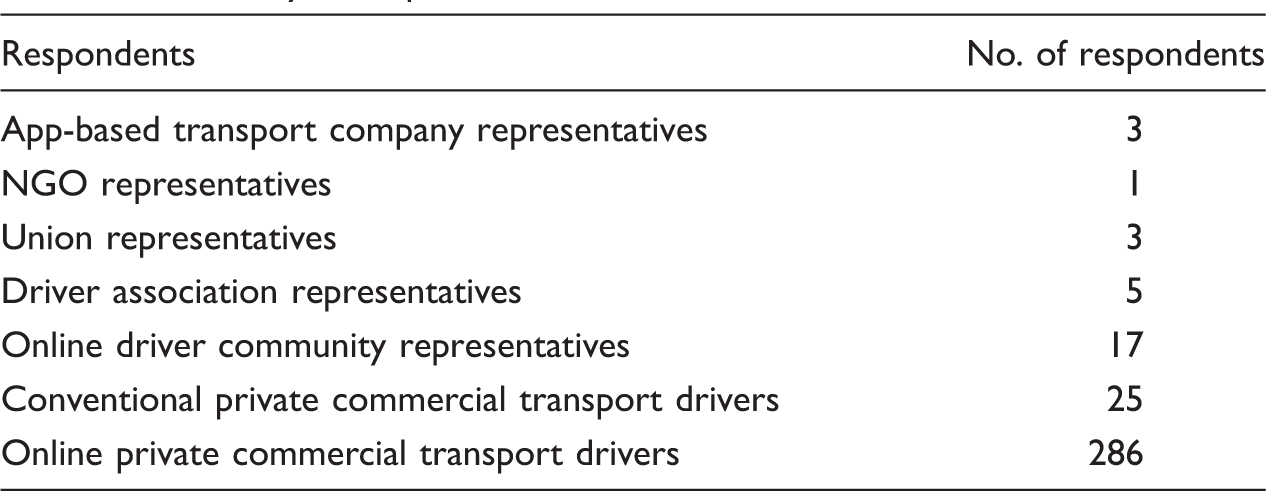
Structured individual and group interviews were conducted with app-based and conventional drivers primarily in Greater Jakarta, where the greatest number of drivers is concentrated, but also in the provincial capitals of Denpasar, Makassar and Yogyakarta. In total, we interviewed 241 randomly selected drivers – 216 working with Indonesia’s three largest transport app providers, and 25 conventional drivers – at a broad range of roadside locations. A number of these locations were in the industrial city of Bekasi, in the east of Greater Jakarta, which was specifically targeted because of its status as an industrial area characterised by relatively high union density and where driver organising has been particularly dense. Data collected through interviews were corroborated by information gathered in a web-based survey of 70 online drivers, sourced by sharing the survey link on 32 social media sites of Indonesian online driver communities, which posed the same questions.
The overwhelming majority of online drivers involved in the study were men, reflecting the gender distribution of the sector. Car drivers tended to be a little older than motorcycle drivers, but the majority in both categories were aged between 25 and 44. We asked online drivers about their background, their previous employment, their motivations for becoming app-based taxi-drivers; their experiences of working with app-based providers, including changes over time in their income and working conditions; how that experience compared with their previous employment and if they were involved in a driver organisation or a union, and if so why they had joined and how they had engaged. We asked conventional drivers about their views on changes in the sector, the impact of app-based transport on their income and working conditions, and whether they had been involved in conflict with online drivers.
In addition to the driver interviews, we conducted semi-structured interviews with representatives of Go-Jek, the market leader in app-based transport, and with the leaders of several driver organisations to capture differences in organising across different app-based transport companies and different modes of transportation. Respondents were identified through purposive sampling based on online searches, media articles and interviews with drivers. In addition, representatives of the two unions that have attempted to organise online transport workers were interviewed. The analysis of union involvement in the following focuses primarily on the Aerospace and Transportation Workers division of the Federation of Indonesian Metal Workers (Serikat Pekerja Dirgantara dan Transportasi Federasi Serikat Pekerja Metal Indonesia (SPDT-FSPMI)), as SPDT-FSPMI is the union that had made the greatest inroads into the app-based transport sector at the time the study was conducted. We also drew on policy documents and media coverage related to app-based transport platforms and driver organising for contextual information.
We analysed the interview data collected thematically to identify commonalities and differences in the form, aims and strategies of different driver organisations, focusing on different organisations’ use of mutual aid and structurally focused tactics targeting the state and pseudo-employers, and on the impact of those tactics. This approach allowed us to compare and contrast the strengths and weaknesses of different organisational forms, and to test the benefits and limits of mutual aid-based organising in the online transport industry. As the discussion of the three types of organisational forms below shows, there are multiple reasons for their existence, which can be condensed into two purposes – creating a sense of community for drivers and defending drivers’ interests. Driver communities operating on a mutual aid logic focus on the former, while the associations and unions seek to leverage these community structures to mount more structurally driven responses to conditions in the industry.
Different kinds of driver organising
Organisational types.
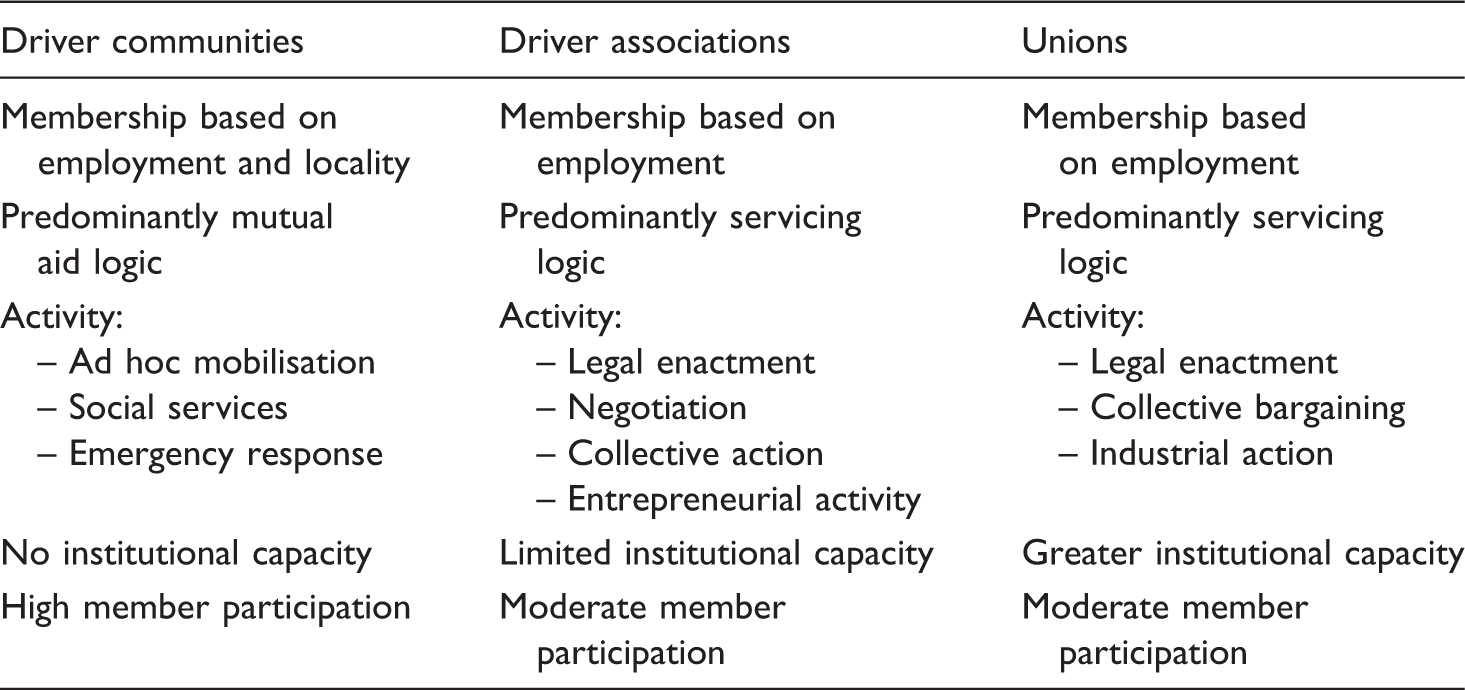
As noted in Table 2, the communities, associations and union each have different functions, strategies and abilities to effect change. The communities operate at the grassroots, while the associations and union are broader scale organisations. The communities have strong member participation, with drivers involved in the everyday functions of the organisation, including helping fellow drivers on the road in accidents and collecting money for those in need. The latter have a servicing logic in which members tend to have little engagement beyond attending occasional meetings or participating in demonstrations or collective action. The institutional position of the associations and unions mean they have a greater ability to engage with companies and government, be it through coordinating industrial action to pressure, or negotiating or using legal avenues to change policy and practice, but they rely on the membership and engagement of the communities to provide them with the mobilisational power and legitimacy in carrying out these activities.
Driver communities
Most prevalent are the neighbourhood-based driver communities, which usually limit their membership to either car or motorcycle drivers. Each community has a physical meeting place called a ‘base camp’. These base camps are areas on the side of a road or at a landmark or eatery, where the drivers will wait for orders, recharge their phones and hold meetings. They are also in constant contact through the WhatsApp messaging service.
Driver communities began to emerge in early 2015 and were initially concentrated in South Jakarta, forming organically as drivers met on the roadside. Over time they have become more formalised, setting up permanent base camps and creating names for their organisations and even logos and mottos that they have printed on banners, stickers and badges. The organisations began to spread and multiply as drivers set up communities closer to where they lived and worked (Interviews with driver community leaders, July–August 2017). At the time of our fieldwork, online drivers estimated that around 70% of drivers are members of a driver community, each of which consists of between 20 and 40 members (Interviews with drivers, May and July 2017).
Communities exist among both online motorcycle and car drivers, but they mostly organise separately. Some car drivers have become motorcycle drivers and vice versa, which has resulted in some communities having members from both modes of transport, but they tend to focus on one or the other. Initially the communities were also divided along company lines, with different communities existing for drivers of each of the companies. As drivers have increasingly moved between the different apps, either in search of a better income or because of suspensions, some of these barriers have broken down and several base camps now have mixed membership.
Networking between communities also developed out of necessity. Drivers quickly realised that it was not enough to only have contact with their own community, because they might need the help of other communities when dropping a passenger in another area of the city if they ran into trouble with angry conventional transport providers, if they had a traffic accident, or if they needed a place to rest and recharge their phones before making the journey home. This realisation led to the establishment of structures to facilitate coordination between different communities. Communities in each district appoint a district leader, and these leaders communicate via WhatsApp and hold regular meetings to discuss problems and developments in the industry. Each community also nominates a member to be part of a rapid response team (Unit Reaksi Cepat (URC)), which is responsible for assisting drivers on the road, for example if a driver has a road accident, if they experience conflict with conventional transport drivers or if their vehicle breaks down in the district (Interview with ADO leader, July 2017).
Driver communities may be unique in the sense that they are heavily networked both horizontally and vertically, but they draw on the examples of worker collectives in the informal transport sector, which are also based around the logic of mutual aid. Conventional motorcycle drivers have traditionally self-organised around local ranks (pangkalan), and might together agree on a standard fare, have shared repair equipment and, in some cases, have shared emergency funds (City Development Initiative for Asia (CDIA), 2011). In addition, online driver communities are strongest in industrial areas, where many drivers have experience with unions from previous or concurrent factory employment (Interviews with driver organisation leaders, July 2017).
Associations
In some areas, members of different communities come together to form driver associations, which are made up primarily of affiliated driver communities but also allow for individual membership. These associations are less geographically bounded than the communities and aim to become peak bodies representing drivers. They have largely formed around particular issues and the idea that drivers need a unifying, representative organisation to deal with government. Some of the associations now have members in several regions across the country, but none are yet truly national in scale.
The two key associations that focused on representation of online car drivers at the time of our research were the Online Drivers’ Association (Asosiasi Driver Online (ADO)) and the Online Drivers’ Communication Forum (Forum Komunikasi Pengemudi Online (FKPO)). ADO was first established in October 2016, when online drivers’ cars were being seized by the authorities in response to pressure from conventional taxi companies (Ford and Honan, 2017). Through forums on WhatsApp, drivers had been discussing the car seizures and aspects of Ministerial Regulation No. 32/2016, which would have required them to have their vehicles inspected and to register their cars with a company, mimicking requirements in the conventional taxi sector. After a demonstration on 20 August 2016, the online car drivers were granted an audience with Commission 5, the national parliamentary commission responsible for transportation. It was members of this commission who suggested that drivers form an association to more effectively put forward their views. A total of 40 driver communities subsequently came together to form ADO, which registered as an association with the Ministry of Law and Human Rights in March 2017 and now has over 10,000 members (mostly car drivers) in 11 provinces (Interview with ADO leader, July 2017).
FKPO had similar beginnings and, like ADO, ultimately aims to become the online driver equivalent of the conventional transport providers’ organisation (Organisasi Angkutan Darat, Organda), representing online transport drivers and acting as an advisor to government on policy related to them (Interview with FKPO leader, August 2017). FKPO – which as of August 2017 had 36 affiliated communities, mostly of car drivers, in Greater Jakarta – was established in 2015 by online drivers who felt unsafe in the face of demonstrations by conventional drivers and wanted greater legal protection from the government for app-based transport workers. In March 2017, FKPO formed the All Indonesia Organisation of Special Rental Vehicles (Organisasi Angkutan Sewa Khusus Seluruh Indonesia), with the aim of creating a more formal organisation in efforts to achieve a seat at the negotiating table with the government and the app-based transport companies.
There have also been several attempts to establish a formal umbrella organisation for online motorcycle driver communities. In this study we focused on three such organisations in Bekasi. The first of these is the Bekasi Online Motorcycle Patriots (Patriot Ojek Online Bekasi, Patogbesi), which formed in December 2015 in response to conflict between online and conventional motorcycle drivers with the aim of uniting GrabBike drivers in Bekasi. As the number of communities grew, Patogbesi rebranded itself as the Bekasi United Communication Forum (Forum Komunikasi Bekasi Bersatu (FKBB)), with the aim of bringing together more driver communities in September 2016 (Interview with Patogbesi leader, July 2017).
In December 2016, FKBB split over divided opinions on the outcome of a ‘no-bid’ action – where drivers switch off their accounts and do not take orders for the day (Interview with FKBB leader, July 2017). After the no-bid action, Patogbesi members withdrew from FKBB, claiming that it had not done enough to defend members whose accounts had been terminated for participating in the demonstration. By July 2017 only three base camps were affiliated with Patogbesi, while FKBB claimed the affiliation of 58 of 121 driver communities in Bekasi. Patogbesi later became part of forming a new association, Indonesian Online Bikers (Bikers Online Indonesia (BOI)), which aims to unite online motorcycle drivers from all three companies, initially concentrating on the Greater Jakarta Region (Interview with Patogbesi leader, July 2017).
A third key association in the district is Bekasi District Grab (Grab Kabupaten Bekasi (GKB)), which was established in May 2017 by drivers operating in Cikarang. Due to ongoing conflict with conventional motorcycle drivers, the association was forced to move its headquarters to another area of Bekasi soon after its establishment. Its number of base camps dropped from five down to one, and its membership from 300 to 100. At the time of our fieldwork, GKB had decided to join BOI with the hope that BOI would be able to help drivers get legal protection and therefore offer online drivers greater security against conventional drivers (Interview with GKB leader, July 2017).
Unions
A minority of driver communities have links to SPDT-FSPMI, the main union attempting to organise online drivers. FSPMI’s involvement in the transport sector is relatively new, although the Confederation of Indonesian Trade Unions (Konfederasi Serikat Pekerja Indonesia) – the confederation to which FSPMI is affiliated – has been involved in organising conventional drivers since 2002 (Interview with SPDT-FSPMI official, May 2017). FSPMI established SPDT in 2016 with the aim of expanding the union’s membership into the aerospace and transport sectors (FSPMI, 2017a, 2017b).
Not long after SPDT-FSPMI was established, an official began meeting with online motorcycle drivers at local eateries to discuss their problems. He then signed up to become a Go-Ride driver in order to gain a greater understanding of the difficulties drivers faced and to help with recruitment. Numbers slowly increased, and a group of Go-Jek drivers were officially registered as a branch of SPDT-FSPMI in October 2016. Member numbers have, however, remained modest. As of July 2017, the union represented 800 Go-Jek drivers, 200 Grab drivers and a small number of Uber drivers in Bekasi and Jakarta, most of whom are motorcycle drivers (Interview with SPDT-FSPMI Go-Jek branch official, July 2017).
SPDT-FSPMI’s recruitment has tended to focus on whole base camps, as officials see the structures and focus of the driver communities as complementing their own. The existence of driver communities also potentially mitigates the difficulties unions face in accessing informal sector workers, as union officials can pass information onto base camp leaders, who can then pass it onto their community members (Interview with FSPMI official, July 2017).
Organisational tactics
Driver communities focus most of their energy and resources on welfare and social activity. For the most part, they tend to deal with drivers’ most pressing needs and operate at a local level around physical safety, information sharing and social activities, as well as helping in the case of accidents. These mutual aid functions reflect the main reasons most drivers identified for joining and establishing organisations, namely defence from the threat of physical violence by conventional transport providers, help with vehicle or traffic incidents, information sharing and a sense of community. These grassroots organisations also seek to secure higher income and better working conditions by, for example, participating in demonstrations aimed at the companies or the government. On the whole, however, associations and unions – rather than driver communities – have been the primary actors focused on industry-wide issues such as defending income and working conditions, as well as responding to and demanding legislative changes to offer greater job security and conditions for online drivers.
Driver communities as vehicles for mutual aid
One of the major reasons the communities of drivers initially formed was to provide each other with protection. App-based transport caused significant disruption to conventional transport providers, and attacks on online drivers have resulted in mass conflict, sometimes characterised by physical violence, as occurred in Bogor and Tangerang in March and April 2017 (Farhan, 2017; Wahid, 2017). Several areas in Greater Jakarta are considered ‘red zones’ (zona merah), where online drivers avoid picking up passengers because of the risk of attacks by conventional transport workers (Ford and Honan, 2017). These red zones include bus terminals, train stations, airports and entrances to industrial parks. In addition, communities have provided some protection against these attacks through mobilisation and negotiation.
Many driver communities have mobilised in response to attacks from conventional drivers, turning many of the ‘red zones’ into places where online drivers can now operate. When news of an attack goes out on the WhatsApp groups, whole base camps mobilise to go to the driver’s aid. This tactic has also been used to respond to demonstrations by conventional transport providers. For example, when minibus (angkot) drivers held a demonstration in Bogor, online driver communities responded by driving en masse around Bogor as a show of force (Interviews with drivers, May 2017). Concern about escalating conflict has resulted in some local agreements being brokered between online driver communities and their counterparts in the conventional sector. For example, communities in Bekasi have negotiated agreements with groups of conventional drivers to allow online drivers to pick up and drop off passengers safely in agreed areas (Interviews, July 2017).
The driver communities are also important as a form of protection on the road in case of accidents. Although app-based providers provide insurance for drivers and passengers during logged trips, they take no responsibility for drivers who are between trips, or for the maintenance of their vehicles. As an UberMotor driver noted, ‘There is a serious physical risk with driving but when there is an accident, Uber doesn’t want to know about it’ (Interview, May 2017). The URC, described earlier, was formed to respond to accidents during these times. Whether it be a serious collision that requires someone to be taken to the hospital, or just a flat tyre, drivers can put the call out through WhatsApp, and the URC drivers in the area will respond. The URC operates primarily through the communities rather than the associations or union.
Another function of the communities that drivers identified as very important was provision of a forum for sharing information about the apps. Many of the drivers we interviewed talked about how difficult they found it to understand the rules of the apps, which frequently change. One Go-Jek driver explained his frustration: ‘The company isn’t transparent. They don’t say how much the subsidy is or how it is to be cut’ (Interview, February 2016). In the base camps and their online forums, drivers discuss changes to the bonus system, how the tariffs are calculated, where and how they can withdraw their earnings, and how they can maintain a good rating. Some of the associations have also aimed to provide this service by organising forums where management from the companies are invited to explain policy changes to the drivers.
While drivers embraced these communities for the clear benefits of protection and information sharing, there were also more socially oriented reasons they identified for joining. Drivers liked the feeling of family and brotherhood that they got from being part of a community. Socialising at base camps helped foster this sense of community, which was a priority for many of the drivers. Several of the base camps also organised weekend trips away together to relax and bond, while the monthly base camp meetings were another opportunity for members to socialise. Driver communities have also raised money in response to human tragedies or natural disasters. For instance, communities affiliated to the Bekasi-based Patogbesi raised around Rp.60 m (AU$6000) to help flood victims in Garut, another town in West Java (Interview with Patogbesi leader, July 2017). In another example, five basecamps in Jakarta collected money for a driver in Bandung whose daughter had eye cancer then made the 3-hour journey to personally deliver the money to the driver (Interviews with drivers, July 2017).
Tactics used by driver associations and SPDT-FSPMI
In contrast to driver communities, which focus primarily on mutual aid, driver associations and SPDT-FSPMI have focused primarily on industry-wide issues, drawing on long-established tactics including legal challenges, negotiation, large-scale demonstrations and no-bid actions, which operate in a similar way to a strike.
A key mobilisational tactic used by the driver associations has been to stage demonstrations and no-bid actions to respond to company regulation changes, such as decreases in tariffs, and to demand better conditions. There were at least 50 protests of Go-Jek drivers alone between September 2015 and February 2017 (Nastiti, 2017). In November 2015, hundreds of Go-Ride drivers demonstrated outside the company office in Jakarta when Go-Jek reduced the payment for drivers from Rp.4000 (AU$0.40) to Rp.3000 (AU$0.30) per kilometre. In a coordinated no-bid action, which functions like a strike, many more Go-Ride drivers refused to take orders for the day (Ford and Honan, 2017). In July 2017 GrabCar drivers demonstrated, demanding the company pay an incentive it had promised drivers at the end of the Muslim fasting month. They also demanded that it abolish its code of ethics, stop blocking drivers’ accounts without notice, and involve drivers in the making or changing of company policies (Lawi, 2017). In another case, UberMotor drivers organised two demonstrations in Jakarta in May 2017. Their list of 14 demands included higher fare prices, more extensive insurance coverage, a fairer bonus system, fewer customer discounts and greater company support for drivers in accidents (Buruh.co, 2017).
Many of these demonstrations and no-bid actions have fallen on deaf ears. However, some have resulted in negotiations with management. In one example, Go-Ride drivers in Bali who had been fined for ‘fictive orders’ (a practice used by drivers to maximise their access to subsidies and bonuses by using a second phone to make orders that they then accept on their Go-Ride account) had their fines reduced when they collectively surrounded the Go-Jek office in November 2015 (Interview with Go-Ride driver, January 2016). In another example, a no-bid action and demonstration outside the Grab office in Jakarta in December 2016 led to an agreement under which Grab management meets with the driver community leaders every 3 months. According to FKBB, these meetings have resulted in changes to Grab’s system, including a new section on the app explaining the bonus system, and drivers now being able to withdraw money from their accounts immediately (Interview with FKBB leader, July 2017).
Demonstrations around online car regulation have also had some success in advancing the drivers’ interests, particularly when used in conjunction with negotiation and legal challenges. In early 2016, the government issued Ministerial Regulation No. 32/2016 on Non-Route Public Transportation, which required online car drivers to register their vehicles under a company name, to have a special licence to operate public transport vehicles, and to have their vehicles inspected under the same process as rental and public transportation vehicles, among other conditions (Pos Kota, 22 August 2016). The regulation was due to be implemented on 1 October 2016. In August and September 2016, online car drivers protested against the regulation, claiming it was too burdensome. In response, the government re-issued a revised version of the regulation as Ministerial Regulation No. 26/2017 on Non-Route Public Transportation, which came into effect on 1 July 2017. SPDT-FSPMI has also made use of street-based demonstrations. In May 2017, it staged a protest in Jakarta demanding legal reform to recognise motorcycle drivers and give them greater protections. As a result of the mobilisation and subsequent negotiations with the government, the union was invited to provide input for legislation on motorcycle taxis (Interview, July 2017). To date, though, no such legislation has been created. Similarly, the union’s efforts to push the government to require the app-based transport companies to enter into tripartite negotiations have not yet succeeded.
Legal challenges have been another avenue explored by the driver associations. Following the protests of August–September 2016, a successful legal challenge saw the Supreme Court annul 14 of the articles in Ministerial Regulation No. 26/2017, sending the government back to the drawing board (Jakarta Post, 22 August 2017). The ADO utilised the space provided by the legal challenge to negotiate some changes to the regulation. On 24 October 2017, the Transport Minister passed Ministerial Regulation No. 108/2017 on Non-Route Public Transportation. Vehicles must still display a permit and pass a roadworthiness test, and the government will determine the quota of vehicles allowed to operate in each region as well as a minimum and maximum fare price (Jakarta Post, 30 October 2017). However, a number of ADO’s demands have been accommodated, including the use of a removable sticker rather than more permanent fixture on the car to indicate when a vehicle is being used for online transport, and adoption of alternative ways of showing safety test certification in place of the previous practice of attaching the certification to the numberplate, which drivers argued would damage their cars (Supriyanto, 2018).
ADO is not the only driver organisation to turn to the legal system. In April 2016, FKPO took the government to court in an attempt to get legislation to protect drivers (Margareth, 2016). The case was judged to be no longer relevant because it had been superseded by Ministerial Regulation No. 32/2016, but FKPO continued with its legal work (Interview with FKPO leader, July 2017). On 4 December 2017 it mounted another legal challenge, this time in the Constitutional Court against Article 151 of Law No. 22/2009 on Road Traffic and Public Transport. According to an FKPO representative, their aim was to gain legal recognition for online transport, which they considered important to counter local government moves to ban it in some regions (Interview with FKPO leader, July 2017). 3 FKBB has also explored legal options for improving conditions, including plans to take a case to the Supreme Court seeking recognition for drivers under Law No.13/2003 on Manpower. If they did take such action and won, it would entitle drivers to the same conditions as workers in the formal sector (Interview with FKBB leader, July 2017). FSPMI, which has effectively used legal challenges to further worker rights in formal sector occupations, separately considered mounting a similar legal challenge to have the drivers recognised as workers rather than partners (Interview with FSPMI officials, July 2017).
Barriers to articulation
The literature on mutual aid, while noting some instances of collaboration, has to date provided little in the way of detail regarding the difficulties in achieving greater articulation between organisations operating on different scales and different logics. Absent are detailed case studies that draw out the barriers to bridging the gap between the organisations operating on different levels, of the kind presented here.
As is often noted, the mutual aid logic attracts higher membership and fosters a sense of social commitment by focusing on more than just wages and workplace conditions (Bacharach et al., 2001; Jarley, 2005; Wills and Simms, 2004). This is evident in the Indonesian driver communities, with their high membership and active participation, which thrive because of their orientation to responding to everyday issues. Yet it has been the associations and unions that have been able to coordinate larger scale mobilisations, mount legal challenges and force the app-based transport companies and government to negotiate. The question is, then, whether online drivers can benefit from both kinds of organising.
In the case of these online drivers, this goal of greater integration of the organisations has proven to be elusive. Higher scale organisations may be better equipped to promote structural change, but their impact has been limited by the inability of the associations – and even more so of the union – to grow their membership bases. This state of affairs has both internal and external determinants. A key external factor is the threat of company retaliation. On the one hand, the emergence of app-based transport providers has given rise to employer-like entities in a sector formerly dominated by relatively small providers (in the case of car drivers) and large-scale informal employment (in the case of motorcycle drivers). The presence of these pseudo-employers has made collective action viable in a way that it has never been before. As noted earlier, the app-based transport companies have been the target of driver demonstrations, with demands focusing on mass termination of accounts, insurance, reductions in fares and changes in the bonus system that make targets harder to achieve. On the other hand, the hazy legal status of online drivers empowers app-based companies to act in ways that would be otherwise unacceptable.
Grab and Go-Jek both have policies prohibiting drivers from participating in demonstrations or other forms of action that are counter to the interests of the company (Go-Jek, 2017; Grab, 2016). In the case of Grab, drivers are formally prohibited from joining unions or registered associations (Grab, 2016). Because online drivers are positioned as ‘partners’ (mitra) rather than as ‘workers’ (buruh, pekerja or karyawan), they have limited protection under the labour code. Unlike standard employers, app-based transport companies have the capacity to terminate driver accounts – or, as Go-Jek describes it, ‘ending the partnership’ (putus mitra) – if a driver joins an association or participates in collective action. In one case, 15 drivers had delivered a letter to Grab management requesting negotiation on nine issues before holding a no-bid action and demonstration (Patogbesi, 2017). Although Grab ultimately made some concessions, the 15 drivers who delivered the letter all had their accounts either suspended or terminated following the demonstration (Interview with Patogbesi leader, July 2017). GrabBike drivers from a different driver community reported similar experiences, claiming that Grab representatives came to the base camps to record the names of drivers involved in a demonstration and later terminated their accounts (Interviews, May 2017).
A key internal factor is divisions between the organisations. Leaders of the associations and the union understand the importance of working with mutual aid-based grassroots communities and with each other (Interviews, July 2017). But, as the split in FKBB suggests, it has proved difficult to maintain a shared position between member communities. This split reflects a broader trend whereby the different associations tend to compete with each other rather than pulling together to win basic labour standards or collective bargaining rights. For example, ADO competes with FKPO for acknowledgement as the key representative organisation of online car drivers. There are similar problems in the relationship between the driver associations and the unions, underpinned by fear that the union is trying to displace the driver associations. In one case, a Patogbesi leader discouraged members from attending an SPDT-FSPMI demonstration because he believed that the union did not represent the interests of drivers, but was simply looking to bolster its membership (Interview with Patogbesi leader, July 2017). Such divisions have implications for their effectiveness and makes joining less attractive.
Internal difficulties have also arisen because of the different values and organisational logics inherent in a grassroots mutual aid-based communities and organisations that seek to engage in more structured ways with (pseudo-)employers and the state. This is particularly the case for the union, whose primary point of reference consists of the formal industrial relations processes and mechanisms in which it is embedded, rather than the lived experience of drivers. As one GrabBike driver observed, the way in which the communities reach out and take up issues affecting others is what differentiates them from unions, which generally restrict their aims to workplace-related issues (Interview, July 2017). In addition, SPDT-FSPMI has adopted a top-down organising strategy in which the communities serve as an intermediary that can pass information down to the drivers (Interview with FSPMI official, July 2017). It has not sought to embrace a more horizontal structure and mutual aid approach that would encourage greater rank and file collective action. These differences have consequences for recruitment. In another example, SPDT-FSPMI inflamed relations by choosing not to support some driver demonstrations, with union leaders criticising demonstrators for not holding the required government permits (Interview with FSPMI officials, July 2017).
Conclusion: The limits of mutual aid
The emergence of the app-based transport industry has resulted in the employment of over a million online private commercial drivers across Indonesia with common experiences and a common target for their demands. Drivers have responded by scaling up and modernising existing associational structures built around mutual aid, and in particular the pangkalan, but also by reaching beyond grassroots organising to establish or join driver organisations that act as pseudo-unions in their engagement with the app-based transport companies and with government. The extent of organising among Indonesia’s online drivers stands out against other sectors of the economy, in which union membership remains low or non-existent, flying in the face of accounts that position the gig economy as potentially heralding an end to worker collectivity (De Stefano, 2016a; ITF, 2016). Rather, in the case of motorcycle drivers in particular, the introduction of an online platform has acted as a vector of formalisation by providing a pseudo-employer against which workers can organise.
The presence of pseudo-employers in the form of the app-based transport companies has allowed driver associations and unions to push for improvements in drivers’ conditions and income using repertoires of action, including mass demonstrations, negotiations, strikes and legal action. Yet membership of these types of organisations remains low, with drivers largely gathered in mutual aid-based communities focused on meeting their daily needs. These communities are horizontal in structure, encourage member participation in activities and decision-making, and enable the drivers to provide each other, and others in society, with practical support and solidarity. The speed with which these grassroots, member-driven communities have grown suggests that a sense of belonging, welfare provision and participatory structures – all key features of the mutual aid-based approach – are important factors in increasing membership and member participation.
Through its close focus on online driver organising, this article has strengthened our understanding of the logic of mutual aid and its utility as an organising approach. Our findings extend the literature on the benefits and limits of mutual aid-based organising by identifying and explaining the barriers to scaling up from grassroots organisations to access the greater institutional capacity of driver associations or unions. They support findings in the literature in regard to the limitations of the mutual aid approach (Givan, 2007; Tapia et al., 2015). Mutual aid-based initiatives focus primarily on short-term solutions to immediate problems and have little, if any, impact on the structures of the industry. The latter requires use of repertoires of action traditionally associated with unions, such as large-scale collective action, negotiation and legal challenges. In short, the case of app-based transport workers in Indonesia suggests that a mutual aid-based approach is indeed necessary, but is not in itself sufficient to take advantage of the emergence of app-based transport companies in a previously far more fragmented field of employment. What is required is a greater degree of articulation between online driver communities and the more institutionalised organisational forms that characterise driver associations and especially unions.
The key question for theorists and practitioners, then, is how to overcome the difficulties associated with achieving this greater degree of articulation. An important feature of this conundrum is the fact that it is defined less by specific features of the gig economy and more by the challenging terrain in which the organisations operate and divisions within the movement. Scaling-up of driver organising in the Indonesian gig economy has been hindered by companies acting to prevent drivers from joining unions and participating in collective action, problems that beset efforts to organise workers in Indonesia’s formal sector workplaces. They also founder on internal divisions driven by competition between the organisations and differences in values and structure underpinned by the different organising logics, as does the Indonesian labour movement more generally. At the same time, however, the emergence of grassroots organisations among workers in the gig economy in Indonesia and elsewhere brings an urgency to the need to bridge the different levels and logics of organisation. This, in turn, means that this question of articulation between labour movement organisations at different scales is an increasingly salient and important topic for practitioners and theorists alike.
Footnotes
Declaration of conflicting interests
The author(s) declared no potential conflicts of interest with respect to the research, authorship and/or publication of this article.
Funding
The author(s) received no financial support for the research, authorship and/or publication of this article.