







Abstract
Within many coordinated market economies, labour unions have demonstrated to be key actors in shaping corporate social responsibility. Researchers have, however, paid surprisingly little attention to the role of unions in shaping corporate social responsibility strategies and responses in liberal market contexts. This article extends the emerging research on unions and corporate social responsibility through a case study which investigates union influences over corporate social responsibility within the liberal market context of Australia. We conceptualise the role of unions in corporate social responsibility in this context through an industrial relations lens with particular reference to collective bargaining. Drawing on qualitative data, the case study examines the Ford Motor Company’s recent closure of its Australian assembly operations which was hailed by a wide range of stakeholders as an exemplar of ‘best practice’ in their assistance of displaced workers. We conclude that, while highly socially responsible, Ford’s actions were far from voluntary but influenced by a combination of union influence and a ‘subsidised’ corporate social responsibility, where the state, unable and/or powerless to legislate good corporate social behaviour, chose to financially underwrite its cost to the firm. The study represents one of the first studies to demonstrate how unions shape corporate social responsibility strategies of firms in liberal market contexts and how ‘subsidised’ corporate social responsibility becomes an alternative political solution within such a context.
Keywords
Introduction
Restructuring, involving downsizing, right-sizing, de-layering, outsourcing, offshoring and the closure of underperforming facilities, is an unfortunate reality of modern business practices, which often results in personal, social and community hardship (Buffington, 2007; Milkman, 1997; Uchitelle, 2007). For workers, losing their jobs is often a ‘life transition’ event (McKee-Ryan and Kinicki, 2002; Snell et al., 2015) as they confront loss of income, pride and dignity, as well as a secure future and self-esteem (see Artazcoz et al., 2004; Vosler and Page-Adams, 1996). In the process of such restructuring, companies have often been criticised by workers, local communities, governments, unions and even other employers, for not doing enough to help impacted workers cope with the stresses associated with losing jobs and/or not assisting them to find alternative employment (see Freeman, 2009; Uchitelle, 2007). While corporate decisions to close a facility or downsize a workforce are typically made on the basis of a ‘business case’, there is often great diversity in how firms manage this restructuring and assist impacted employees and local communities. At face value, these divergent corporate behaviours force us to question approaches that treat firms as a ‘black box’ that is ‘conceptualised as a profit-maximising entity which reacts to external pressures and structural constraints’ (Brown et al., 2010: 25). The influences shaping corporate social behaviour in relation to restructuring and closure management, however, have not been widely considered in the academic literature. The literature that does exist tends to focus on the influence of corporate social responsibility (CSR) on a firm’s facility closure management behaviour (Forde et al., 2009; Freeman, 2009). The aim of this article is to advance our understanding of the influences shaping the management of facility closure through the adoption of an industrial relations lens, which considers the role of trade unions and collective bargaining agreements in influencing CSR in relation to closure management.
Research on the role and influence of trade unions on CSR is limited beyond a handful of European studies where unions are included as social partners in CSR consultations (see Harvey et al., 2017; Preuss et al., 2014). How trade unions can influence CSR practices in liberal market economies, where social partnership is not mandatory, has not been a consideration. In this article we explore this question both theoretically and empirically through a case study that examines the Ford Motor Company’s decisions and actions in the process of managing the closure of its plants in Australia. Ford’s closure of its Australian operations has been hailed by Ford employees, unions, government and community observers as an exemplar of socially responsible behaviour (Callan and Bowman, 2015; Snell et al., 2016). We argue that Ford’s response to closure is far from a management initiative, but the outcome of trade union influences and a state ‘subsidised’ CSR where the state, unable and/or powerless to legislate good corporate social behaviour, chose to financially underwrite its social responsibility to its soon-to-be retrenched workers.
The article is structured as follows. Following this introduction, the next section two presents a brief review of the key literature on the definition and construction of CSR, followed by an equally brief review of Human Resources (HR) literature on facility closure management and socially responsible restructuring. The study’s methods are then presented, followed by analysis of the context, process and outcomes in the Ford closure management case study. The final section concludes the discussion with a critical assessment of the salient motivations and influences behind Ford’s articular behaviour, and the role of trade unions and the state in subsidising Ford’s CSR practices and ensuring certain social outcomes.
CSR: Determinants and conceptualisation
CSR continues to be an elusive and contested concept in the academic literature (Brammer et al., 2012; Friedman, 1970; Okoye, 2009). As Okoye (2009) observes, the concept ‘means something but not always the same thing to everybody’ (p. 613). In its broadest meaning CSR is defined in terms of the way firms consider the impact of their operations on society and the environment and ‘affirm their principles and values both in their own internal methods, and processes and in their interaction with other actors’ (ILO, 2016: 3). Matten and Moon (2008), however, note that the conceptualisation and development of CSR has taken different forms because of different institutional influences. Within social democratic and coordinated market economies, the conceptualisation and determination of CSR is conditioned by institutional arrangements between government, employer associations and unions (see Hofman et al., 2017). It is not uncommon within these contexts for CSR to be mandated by government or negotiated between government and firms and other social actors, including unions. In these contexts, the role of the state, institutional arrangements and social actors are given greater consideration in understanding the CSR practices of firms. Delautre and Abriata (2018), for example, make the case that ‘unions and corporatist arrangements can indeed be seen as empowering elements for employees and can thus help to promote higher labour standards and corporate responsibility’ (p. 5). Preuss et al. (2014) represent one of the few comprehensive studies to explore the role of trade unions in CSR activities within this context (see also Preuss et al., 2006; Sobczak and Havard, 2015). They argue that trade unions in countries with a strong corporatist tradition are ‘drivers’ of CSR through formal participation in and consultation over CSR policies of firms and the monitoring of these commitments. Their findings suggest that unions often pursue ‘company-internal aspects, such as employee welfare and training or socially responsible industrial restructuring’ over external CSR concerns (e.g. environmental or community impacts) (Preuss et al., 2006: 266). In these European contexts, therefore, an understanding of CSR requires analysis to be extended beyond corporate leadership and strategy to include legal obligations and the role of the state as well as social partners (e.g. trade unions) and external actors (e.g. environmental organisations, local communities).
The conceptualisation of CSR in liberal market economies, however, is significantly different and associated with self-regulated corporate actions beyond those imposed by law, which meet social and environmental expectations (McWilliams and Siegel, 2001). Within this context, management initiative is considered the primary determinant of CSR as managers respond to changing social expectations and influences both internal and external to the firm (see Delautre and Abriata, 2018; Sheehy, 2015). The notion that CSR should be voluntary has coincided with the emergence and spread of the Thatcher–Reagan orchestrated global neo-liberal reforms which embraced self-regulation. Brammer et al. (2012) argue that, in pursuit of liberal market principles, Business School researchers and state policy actors have actively promoted the notions of corporate self-regulation and voluntary CSR presenting the firm as inherently capable of ‘initiating socially desirable behaviour’ (p. 5) without the need for state regulation (see also European Commission, 2001).
While empirical research on the role of trade unions in shaping CSR in liberal market economies is limited, academics have speculated that such contexts provide limited capacity for unions (or the state) to influence voluntary CSR policies, programmes and strategies of firms (Hofman et al., 2017; Preuss et al., 2014; Sobczak and Havard, 2015). Harvey et al. (2017), however, present a more nuanced position and argue that unions are well positioned to influence CSR deliberations: Trade unions occupy a distinctive position in the landscape of stakeholders in that they are at once and the same time internal stakeholders (a significant stake in the success, continuity and growth of businesses, formalised channels of voice and interaction) and external stakeholders (formal/structural independence from the firm, contrasting interests with the firm in some areas, somewhat narrower issue/advocacy interests). (p. 45)
Our study suggests that there are opportunities for unions to initiate CSR approaches through their role in collective bargaining. While the relationship between collective bargaining and CSR has not been explicitly explored by researchers, a range of studies have illustrated how unions have used the bargaining process to pursue a range of social and environmental goals (see Hampton, 2015; Markey and McIvor, 2019). A small body of research has also examined how unions have used the bargaining process to influence severance and the redundancy processes. Overwhelmingly, however, these studies have focused on how the particularities of institutional frameworks of coordinated economies within Europe have conditioned the collective bargaining responses of unions to redundancy (see Dekocker et al., 2011; Ozkan, 2019; Trampush, 2007). Our study draws inspiration from and seeks to advance research in relation to these studies by exploring how unions have used the bargaining process to advance socially responsible restructuring and facility closure management within the liberal market context of Australia. In this regard, our focus for CSR investigation is on how firms manage restructuring and the harmful impacts of job loss. However, it is also our contention that the CSR debate is being partially constrained by a somewhat limited and uncomplicated construction of the role of the state in relation to CSR. The state is either perceived as promoting a market-based self-regulation CSR approach, which is more prevalent in liberal market economies like the UK and US, characterised by shareholder-led corporate governance, or as one whereby CSR is imposed on firms through regulation and legal obligations, which is more commonly found in social democratic states like Germany and France, and state-led market economies like South Korea, which are more supportive of stakeholder-led corporate governance structures (e.g. Brammer et al., 2012; Campbell, 2007). As evidence from our study illustrates, the role of the state in influencing the CSR behaviour of firms is much more complex than this commonly recounted view suggests. Before presenting the case study, however, it is important to consider how CSR relates more specifically to a firm’s treatment of retrenched workers.
From ‘slash and burn’ to socially responsible restructuring
The management of facility closures and mass retrenchments has changed significantly over the past few decades as companies have had to re-evaluate the risks, benefits and social impacts associated with facility closure processes and approaches. During the 1980s, downsizing had become an increasingly common approach for managing operating costs and productivity (Carroll, 1984). The proliferation of redundancies by companies, and the brutality with which they dismissed workers, led some researchers to question company ‘addiction’ to mass retrenchment practices (see Buffington, 2007; Uchitelle, 2007) and the ‘slash and burn’ (Schmenner and Lackey, 1994) approach often adopted. The human and community costs of these business practices for the dismissed and the ‘survivors’ became major focal points for applied research (see Grunberg et al., 2000; Vosler and Page-Adams, 1996). A number of studies emerged which sought to identify better practices in managing layoffs (see Freeman, 2009; Leana and Feldman, 1995), from which we draw four general observations.
First, very little of the literature has focused on full closure scenarios. Instead it has mainly focused on the challenges associated with labour force reduction. Butler et al.’s (2009) and Hutton’s (1992) studies of a General Motor’s auto factory in Britain and Nissan’s assembly plant closure in Australia, respectively, represent some of the few studies on facility closure management. In their study, Butler et al. (2009) make the point that, ‘given the significance and the impact of a decision to close a factory, it was surprising to discover that there is limited literature on factory closure management’ (p. 671). Due to this fact, the literature discussed here includes a much broader array of studies related to redundancy management.
A second observation is that the specific role of HR departments in a company’s restructuring strategies has moved from a relatively peripheral position to one of active engagement with senior management in designing and implementing the redundancy management process (see Appelbaum et al., 1999; De Meuse et al., 1994). It is not uncommon, for example, for the more recent studies to advocate for the inclusion of HR professionals in the early strategic planning stages, particularly those in which workforce development or labour force reduction is intended (Cascio and Wynn, 2004; Freeman, 2009). Out of this discussion, the roles and responsibilities of HR departments in managing the human resource implications of workforce reduction exercises have emerged. One such role is managing employee morale throughout the restructuring process (see Butler et al., 2009).
The third related observation is that the literature focuses much more on ‘survivors’ rather than ‘victims’ of restructuring and company performance during and immediately post restructure. Much of this is in response to a series of ‘survivor syndrome’ studies that highlighted the behavioural consequences for those workers who remain employed but have to confront the stress of the redundancy exercise (see Leana and Feldman, 1995; Sahdev, 2003). One further observation, in relation to ‘victims’ of labour force reduction, is that, while numerous studies have examined the challenges that displaced workers and their families confront post retrenchment, few have examined their experiences in the immediate pre-retrenchment stage (Snell et al., 2015). In their study of the retrenchment process, Snell et al. (2016) point out that the type of assistance workers receive in the pre-redundancy stage can influence their chances of post-displacement reemployment.
Among the handful of contemporary studies, however, three dominant views are used to explain why some firms have opted to take more proactive and socially responsible approaches to managing closure. These studies tend to align with our earlier typology and discussion about CSR. Research emerging out of primarily European contexts explains firm adoption of socially responsible restructuring as an outcome of state-driven CSR expectations. For example, DeKocker et al. (2011) illustrate how European statutory obligations for employee representation shape firms’ approaches to restructuring and facility closure. Stuart et al. (2007), likewise, make the point that in many European countries, where social partnership is commonplace, broad-based stakeholder consultation is the expected approach to managing business closures. Other studies adopt a corporate-driven CSR perspective, which suggests that firms with a strong commitment to CSR principles are more likely to extend them into their restructuring and downsizing considerations (Forde et al., 2009). It is noted that in liberal market economies like the UK, US and Australia, there are comparatively few legal requirements placed upon employers with regards to restructuring and managing layoffs, leaving it to firms to decide (Doherty et al., 1993; Hutton, 1992; Segal et al., 2003).
Other research adopts a society-driven CSR approach to explain firm behaviour, which suggests that firms’ actions and decisions in managing restructuring are predominantly influenced by external pressure and, in some cases, internal self-interests. This view acknowledges the influence of trade unions, and local community and civil society groups in shaping the firm’s handling of restructuring (e.g. Pulignano and Stewart, 2012). Proponents of this perspective hail stakeholder group interventions as key to firms’ adoption of approaches that mitigate the negative social and economic impacts of restructuring (e.g. Frost, 2000).
While theoretically diverse, these different perspectives highlight the importance of context (e.g. national, firm or workplace) in understanding why particular restructuring management practices and approaches are adopted. Our study aligns most closely with the society-driven approach, but with some notable differences. Society-driven CSR approaches are heavily influenced by stakeholder theory, which typically overlooks the structural positioning and agency of different stakeholders in influencing firm behaviour. Trade unions, for example, are treated as a ‘stakeholder’ like many others. This overlooks the points raised previously about trade unions being both internal and external stakeholders, and how this distinctive positioning enables them to influence the restructuring behaviour of firms. In this regard, we adopt a more industrial relations-informed perspective. We consider how unions influence the restructuring behaviour of firms internally, through their role in the collective bargaining process, but also externally through their relationship with government, community and other social actors.
The study
The study adopts a qualitative methodology involving two stages. The first and most substantive stage was carried out in 2015, approximately 1 year prior to the final closure of Ford car manufacturing in Australia. The main objective of this stage was to develop an in-depth exploration of the structural and stakeholder influences conditioning Ford’s management of the closure process. During this stage field research was conducted, which included site observations, informal discussions with the various actors and formal semi-structured interviews with representatives from several organisations directly involved in the closure process. The field research was largely conducted at Ford’s stamping and engine plant in the City of Geelong. Table 1 provides an overview of the interview participants.
Interview participants.
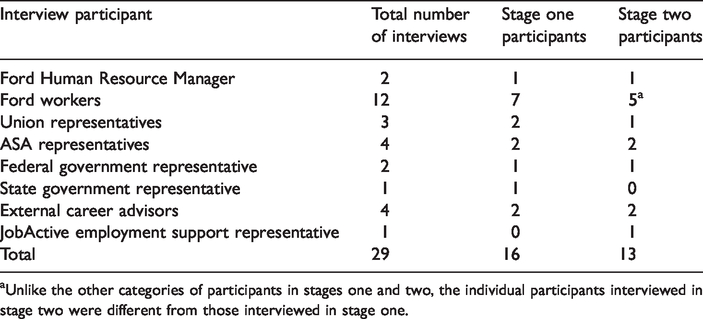
aUnlike the other categories of participants in stages one and two, the individual participants interviewed in stage two were different from those interviewed in stage one.
The second stage took place in 2016 towards the end of the closure process. In this stage, additional face-to-face interviews were conducted with Ford workers who had not been interviewed in stage one and follow-up interviews were conducted with stage one participants. Thus, although a head count of 22 participants were interviewed, the number of interviews was effectively 29 because of the follow-up interviews with repeat participants in stage two. Follow-up correspondence, particularly via emails and phone calls, continued until the final closure of the facility and were mostly captured in the form of written fieldnotes. All the interviews, each lasting approximately 60 minutes, were digitally recorded and formally transcribed. Once transcribed, the interview data and the fieldnotes were collated and coded following Strauss and Corbin (1998). The coding followed key themes, for example the closure process, trade unions, the role of government, employment displacement, worker assistance programmes, re-skilling, and so forth. For each of these themes, we interrogated different observations, views and experiences in what we coded as perspective nodes. Thus, while the themes formed the main (stem) nodes, the various perspectives formed the branch nodes.
The second stage of the research also involved a review of union-negotiated enterprise bargaining agreements (EBAs) in the manufacturing industry. We selected all 2018–2019 certificated agreements in the manufacturing industry involving firms with more than 100 employees for examination. The 95 EBAs identified within these parameters were then examined for their redundancy and closure provisions to determine how manufacturing workers’ unions used the bargaining process to influence employer behaviour during redundancy and closure situations.
Findings from the interview data analysis were examined against the observations made through the EBA analysis to further interrogate the influences shaping the closure process. This approach allowed us to achieve an in-depth, yet comprehensive, construction of the Ford closure case and the nature and extent of union influence in the process of managing displaced workers’ transition. We have referred to, and used data from, interviews and discussion fieldnotes to develop the summary case study, and used illustrative quotes to present the findings in a ‘logical sequence that connects the empirical data to the study's initial research questions and, ultimately, to its conclusions’ (Yin, 2003: 20).
The history and context of the Ford closure
In 2013, Australia’s three car manufacturers (GM Holden, Ford and Toyota) announced plans to cease manufacturing operations. By October 2017, all major auto industry manufacturing had ceased, with current estimates suggesting 16,000 jobs lost (Australian Government, 2019). In the lead up to these final closures, it was generally acknowledged that Australian auto industry workers would confront significant challenges in transitioning to new careers and job opportunities as a result of their industry-specific skills becoming redundant. Further, they had limited job experience outside the industry. There were also significant concerns about what the closures would mean for the communities surrounding the facilities, which had become dependent on the auto industry (see Worrall and Spoehr, 2014).
Like many countries, Australia took considerable pride in its auto industry, which dated back to the inter-war period of the 1920s (Knott, 2000). Although the end came swiftly, it was the culmination of a long period of decline involving earlier closures such as Leyland in 1974, Chrysler in 1981, Nissan in 1992 and Mitsubishi in 2008. Recent analysis shows that the industry survived as long as it did due to various forms of governmental support, such as tariff protections and financial assistance. However, these were gradually withdrawn (Clibborn et al., 2016; Department of Employment and Workplace Relations (DEWR), 2002), leaving the companies struggling to maintain international competitiveness and profitability. Beer (2018) observes that ‘The departure of car making in Australia was the product of many factors—shifts in technology, global economic change, the market trajectories of individual manufacturers—but none more important than transformations in government policy over the long term’ (p. 420). Although most tariff protections had been removed by 2005, the industry continued to benefit from several government support programmes, including the Automotive Industry Structural Adjustment Program and the Automotive Competitiveness and Investment Scheme, thus helping to sustain the remaining auto manufacturers. Even with the continued government support, however, the industry still faced significant challenges due to its relatively small domestic market, growing competition from imported automobiles, as well as relatively high input costs, especially the cost of labour. As Clibborn et al. (2016) and Beer (2018) observe, although labour unions and the prevailing industrial relations environment have been widely blamed for the outcome (Massola and Hawthorne, 2014; Potter, 2013), the demise of the industry was due to a complex combination of factors.
Government support for the auto industry became increasingly politicised. Conservative political leaders and some media commentators were becoming particularly scathing about the Julia Gillard Australian Labor Party (ALP)-led Government’s ongoing financial support of the industry (Cowan, 2014; Porter, 2016). In March 2014, the government’s Productivity Commission released an auto industry inquiry report, which supported these views by recommending that the auto companies should no longer receive additional government funding. The politically conservative Abbott Government, which came to power in September 2013, used the report to justify its decision to cut government financial support to the industry. This signalled the ultimate demise of the industry. Ford announced its intended closure of the Geelong and Broadmeadows plants in 2013 and 2014, respectively. Holden announced similar plans in 2014 followed by Toyota (Dowling, 2013). Although this was largely expected and inevitable, the Abbott Government faced charges of social callousness and economic recklessness in the media by the Federal opposition, state governments, unions and affected workers and communities. It is against this background that the car manufacturers, unions, Australian Federal Government and state governments came to develop a range of initiatives to support and assist auto industry workers. This article looks specifically at Ford’s approach to managing the closure of their operations, as the first in the final wave of closures. Their management of the process and the level of assistance given to their displaced workers are considered highly positive, with attempts to emulate it in the latter cases of Holden and Toyota (Snell et al., 2016). However, an interrogation of the evidence provides limited support for a corporate-led CSR approach to Ford’s facility closure. The proactive approach of trade unions in their collective bargaining with Ford and close relationship with the Federal Labor Government were the key influences shaping Ford’s closure response.
The Ford’s closure announcement
When Ford made the closure announcement on 23 May 2013, it came as a shock to its workers and the local Geelong community. The industry unions claimed that they were only notified about the closure 10 minutes before Ford’s official media announcement (ABC, 2013). In the closure announcement, Ford made it clear that it would ensure workers received their full entitlements under their collective agreement obligations and the Gillard Government, followed up by declaring that no workers would be left behind. In the days following the Ford closure announcement, Ford’s unions would work to ensure that Ford and the government upheld their commitments. Union industrial influence in the industry had grown alongside the industry’s expansion after the Second World War (Bramble, 1992; Clibborn et al., 2016). At Ford, several unions were represented, including the Australian Manufacturing Workers Union; the Electrical Trades Union; the Australian Workers Union; the National Union of Workers; the Australian Services Union; and the Association of Professional Engineers, Scientists and Managers Australia. They operated under the auspices of the Federation of Vehicle Industry Unions (FVIU) as a single bargaining unit. FVIU ensured that ‘inter-union issues and objectives were sorted out prior to negotiating with management’ (McPhail et al., 2015: 425). FVIA also ensured that the unions could be an effective voice when dealing with the company and government over the closure process. In this case, Ford’s union leaders joined with Geelong Trades Hall and the Australian Council of Trade Unions to raise community concerns about the impact of the closure on Geelong’s local economy and the likely difficulties in transitioning displaced workers. They also collectively worked with the Gillard Government to develop an assistance package for the region and its disadvantaged auto workers. On 1 June 2013, Prime Minister Gillard met with Ford unions, workers and their families at Geelong Trades Hall where she announced a $5.2 million Ford Transition Program – one of the most comprehensive assistance schemes for supporting retrenched workers in Australian history.
The Ford Transition Program
The Ford Transition Program (FTP) began with the establishment of a Task Force Group to coordinate the ‘transition’ activities of the various players, including Ford and auto supply chain companies, state and federal governments, unions, training providers and various other labour market intermediaries (LMIs). According to a government representative, the Task Force also served as a ‘circuit breaker’ for Ford as voices other than unions became involved in the process. The FTP soon followed with Ford and the unions, agreeing that the programme should be managed by Auto Skills Australia (ASA), the then tripartite national automotive industry training advisory body, but coordinated by Ford’s HR department. ASA was chosen for three main reasons. First, it had been established that skills analysis and re-skilling were going to be key in successful employment transition for the workers. Because ASA was the industry body responsible for developing guidelines for training and skills development in the auto sector, it was widely considered the appropriate body to perform this work. Second, ASA was a tripartite body in its constitution and operations. It had the mandate of government, and the trust and confidence of the unions as well as industry employers. In addition, it had a long-standing collaborative network with training providers. To these stakeholders, it was a neutral and competent body that could be trusted by all to deliver the best outcomes. Third, and in relation to neutrality and stakeholder confidence, the ASA as a body external to the company, and one that was well known by workers for their work, would neutralise any potential tensions and mistrust between the workers and the company. To the workers therefore, the ASA guaranteed a level of transparency in the process.
An FTP Steering Committee comprising Ford HR representatives, unions, ASA, the Victorian Government and Federal Government representatives was established and was responsible for overseeing the delivery of the FTP and ensuring inclusive facility closure management. Reference groups made up of Ford HR representatives, unions and ASA staff were also formed at the plant level to resolve shopfloor matters and provide detailed information and guidance to the Steering Committee. The primary objective of the programme was to work with workers and relevant stakeholders to develop and implement a comprehensive employment transition programme (Drill and White, 2014). Much of the actual work of the programme, however, was outsourced to the union-endorsed outplacement support company known as TWFS, with ASA being responsible for the overall management of the programme.
It was recognised at the onset that, faced with job loss and in need of new employment, the major challenges that Ford workers would confront were three-fold: identifying potentially suitable occupations to move to; identifying where jobs were emerging within these occupations; and making sure they possessed, and could clearly articulate, the skills required to access these jobs. Interviews with workers on site revealed great anxiety about what would happen to them after the Ford closure and whether they would find new jobs. In one such interview, one worker’s concern was about the value of his skills: ‘the skills I have got, who is going to recognise them?’ (production worker 2). Others worried not just about finding suitable work but about the transition into these jobs, having worked for Ford for so long: … the biggest concern that I have is that, will I be able to break out of the system or the mould that I'm in at the Ford Motor Company, the way we go about our business that I've been doing, coming to work every day. If I go into a new business and, what are their expectations and all those sorts of things. (Production worker 1) Some of the people here have been here nearly 40 years doing the same job, and they’re the people that I’m concerned about, in their late 50s without any particular qualification, where I just hope that some employers external to Ford can accommodate where they’re at. I don’t know. I hope they can.
At the time of completing the research project, a large number of Ford workers, in the initial redundancy batches, had found alternative work, and those who were left in the final months of the plant were confident that they would get work. The TWFS case managers were still progressing with the remaining workers in the process, which was described by the majority of the workers interviewed as very positive. The views expressed by a process worker who had worked for Ford for nearly 33 years are illustrative of worker appreciation: I’ve been pretty lucky that there’s been real assistance in there, trying to make sure that the people understand that you need to start to figure out what your plan A is, have you got a plan B, have you thought about a resume, by the way? … and ASA organised seminars as well and people come in to talk to us about possible jobs. There’s a level of calmness to the place because of all these different programs that the Ford Motor Company and Ford in Transition Program is providing. There are seminars that we go to, to learn about the job market. There are seminars to that are talking about if there is anything vocational training people can do to increase their resume … . (Ford HR Manager)
At face value Ford’s management of the closure and support for the soon-to-be retrenched workers was an exemplar in CSR. Explaining why Ford adopted such a comprehensive approach to supporting its soon-to-be retrenched workers, however, requires applying a more thorough industrial relations lens. The Ford Australia Enterprise Agreement negotiated with unions in 2012 is particularly important in explaining Ford’s behaviour, as it obligated Ford to provide considerable assistance to retrenched workers compared to other manufacturing industry EBAs. Union-negotiated EBAs in the manufacturing industry commonly contain redundancy provisions for job search entitlements (i.e. paid time off for seeking other employment) and redundancy payments based on years of service, but little beyond this. Ford’s unions, however, had become accustomed to waves of retrenchments in the Australian auto industry for quite some time and had become effective in bargaining for greater assistance. The 2012 Ford Australia Enterprise Agreement, for example, entitled retrenched workers to not only generous severance pay bonuses based on years of service (i.e. 5 weeks of full pay per year of service capped at 90 weeks, excluding the notice period), time off to seek employment and retention bonuses for those who remained with the company until closure, but also additional employee assistance provisions. It required the company to ‘… as far as practicable, investigate and implement processes and activities that facilitate … employees gaining an improved understanding and capacity to transition from employment with Ford’ (FairWork Australia, 2012). This included that Ford ensure that workers were provided with sufficient labour market information to assist in making informed and appropriate choices and decisions regarding employment transition. In addition, Ford was expected to provide extensive on-site career counselling as well as underwriting all accredited training activities that employees undertook, including providing the required time off work, financial support and facilitating Recognition of Current Competency assessment (see FairWork Australia, 2012 for full details). These provisions are quite distinct from other union-negotiated EBAs in the manufacturing industry.
Ford’s approach to facility closure in this particular circumstance, therefore, was the outcome of a negotiated agreement with unions that resulted in binding legal obligations for Ford under the collective agreement. Not only had the unions secured a specific series of clauses related to Ford’s responsibilities in supporting workers in the case of closure, but they had also managed to insert union rights to decide who would provide outplacement support for soon-to-be retrenched workers. The Auto Manufacturing Workers Union, the union with the largest membership at Ford, utilised this aspect of the Agreement to nominate the small union-friendly outplacement firm TWFS, with whom they had worked on previous auto retrenchments, to become involved in outplacement support. TWFS (2015) describes their approach as ‘beyond outplacement’, which ‘take participants beyond initial counselling, resume preparation and giving advice on how to undertake job search’ through to an intensive one-on-one case management model. In interviews, workers spoke proudly of these arrangements. One worker who had worked for Ford for nearly 30 years stated: I’m going to get a good package, the money’s going to be good … . In the EBA you need to be aware we’ve got a thing called outplacement, and the company has to spend $1000 towards it … TWFS, it’s a Melbourne company, they have to, we give them the $1000 that the company has to provide us and then they look for a job for us.
Discussion and concluding assessment
Outside of the European context, the role and influence of trade unions on CSR policies and practices has not been widely considered. This article has looked specifically at the influence of trade unions on facility closure management in a context where legal obligations placed upon firms to assist displaced workers are minimal. Numerous studies have highlighted that job loss from mass retrenchment events often results in socio-economic trauma for workers, which many struggle to recover from (Bailey et al., 2014; Beer, 2018; Clibborn et al., 2016). Acknowledgement of these unfavourable social outcomes has stimulated HRM and CSR scholars to make the case for more socially responsible approaches to managing facility closure (Freeman, 2009). Surprisingly, the role of trade unions in influencing business approaches to facility closure management has tended to be overlooked in this emerging CSR research area. Reference to trade union influences over social processes and outcomes of redundancy processes, however, does appear within the more industrial relations-inspired literature. Dekocker et al. (2011), for example, demonstrate how Belgian trade unions have used the corporatist institutional framework to influence workplace redundancies. Trampush (2007), likewise, has shown how unions in Denmark, France, Germany and the Netherlands use collective agreements to regulate and finance social benefits, including employment assistance for displaced workers. Our study builds on this emerging research area by identifying the potential role of unions located in non-European and more liberal market institutional contexts in influencing CSR and socially responsible restructuring.
In liberal market contexts, CSR is largely conceptualised as either corporate-led or society-driven. Those prone to more socially driven conceptualisations of CSR are typically influenced by stakeholder theory. Under this framework, trade unions are considered as simply one of a variety of ‘stakeholder’ influencers. This analysis fails to appreciate how unions are both internal and external ‘stakeholders’ and thereby better positioned to influence CSR deliberations than many other social actors (Harvey et al., 2017). What our empirical study of the Ford shutdown in Australia illustrates is that unions performed a significant role in influencing the company’s approach to closure as the internal industrial bargaining agent of its workforce and through its external relationship with the Federal Labor Government. We discuss each of these aspects in turn.
First, the collectively negotiated benefits related to plant closure ensured workers received considerable support in transitioning to new employment. Unions knew the industry was struggling, and had the foresight to negotiate collective agreement obligations specific to facility closure, which required Ford to aid soon-to-be retrenched workers, including skills assessment and recognition of prior learning, job search support, career counselling and advice, and ongoing outplacement support. On the whole, it was a comprehensive employee assistance programme which has been observed only in a limited number of cases, especially in some European countries, where social partnership is commonplace and often sanctioned by national and regional (EU) regulation (DeKocker et al., 2011). In a country like Australia where neo-liberal driven welfare reform policies have reduced the social safety net for displaced and unemployed workers, ‘welfare provisions’ in collective bargaining agreements can provide at least some level of enhanced protection and support for those covered by the agreement (see Trampush, 2007).
The Ford case, however, also highlights the ways Australia’s Federal Government came to underwrite many of their legal obligations to support their soon-to-be retrenched workforce. The $5.25 m direct funding to the FTP was provided to ensure that Ford workers were well supported to transition to ‘life after Ford’. Thus, in a monetary sense, the FTP cost the company very little. It was the opinion of the designated ASA manager of the FTP that, ‘… the money provided by the government [made] all the difference’, implying that without it there would have been no funds to deliver the same kind and level of assistance, and that the company would have, most likely, acted very differently in the extent of facilitation provided. In this sense, we argue that the Ford case represents a ‘subsidised’ CSR whereby a government generally committed to neo-liberal policies pays the firm to behave in a socially responsible manner. This is not to suggest that there were no costs to Ford in supporting the FTP. The FTP was both time-consuming and costly for the company as it required the company to make available on-site facilities for the interviews and career sessions for the workers and TWFS career assessors. More importantly, management had to give the employees sufficient paid time off work to attend these interviews, careers advise sessions and training sessions. As an illustration of the time required, one of the case managers explained that he had conducted 389 individual sessions with workers. From discussions with unions, the LMIs involved as well as the workers, it is clear that Ford did provide assistance beyond what was stipulated in the EBAs. For example, the EBAs stipulated that each worker was to be given up to one 30-minute session of on-site career counselling and up to two 30-minute sessions of Recognition of Current Competency assessment (FairWork Australia, 2012). But in an actual sense the workers were, according to case managers, provided far more time across many more sessions than obligated by the EBAs. Ford made facilities available for on-site case managers to conduct counselling sessions, installed computer stations around the facility to help workers develop and/or update their computer skills, and facilitated career fare sessions where potential employers were invited to show-case the job opportunities available to the soon-to-be displaced Ford workers. Through these provisions and activities, it is estimated that Ford provided over $1.68 m of in-kind support through their assistance to the FTP (ACIL Allen Consulting, 2017). These were, unquestionably, significant, albeit non-monetary, investments by Ford to assist its soon-to-be displaced workers to build the capacity to find work elsewhere after the closure, for which it received much praise and credit as a socially responsible company.
It is also important to note that the Ford closure had the unintended impact of setting the bar for Holden and Toyota’s handling of their shutdowns, which took place around the same time. Although Holden and Toyota’s collective agreements did not obligate these firms to provide the same level of support for workers in closure situations, Toyota and Holden did provide similar assistance for their soon-to-be displaced workers (see Snell et al., 2016). They also did this without the same level of government support. At the time of Holden and Toyota’s closure announcement, the Abbott Government was in power and less inclined to provide the same level of financial support for transitioning auto workers. Nonetheless, unions did insist that the companies support their workers in similar ways as occurred at Ford. It is estimated that Holden and Toyota each invested $15 m in providing employment assistance to their workers (ABC Radio, 2019). The combined influence of union pressure and the history of the FTP and the social-driven expectations emerging from it would have ultimately shaped these management decisions.
This brings us to our second point about union influences on CSR in their capacity as an ‘external’ stakeholder. Auto industry unions maintained a strong relationship with the Gillard Government, enabling them to lobby for government support for Ford workers and their families. Drawing a direct correlation between union lobbying and the actions of the Gillard Government in relation to the Ford closure, however, is overly simplistic and overlooks other government considerations and pressures. Australian governments had provided financial assistance to the auto industry for decades to keep them afloat and auto workers employed (Australian Government, 2014; DEWR, 2002). In some senses, government support for the FTP was a continuation of this funding, albeit for dramatically different purposes, ensuring a softer landing for Ford’s workers, especially in terms of mitigating their long-term unemployment. At the time of the Ford closure announcement, there was also an upcoming Federal election and the ALP government was facing an uphill task to retain power (which they ultimately lost). Disadvantaged workers and communities in the magnitude of the auto manufacturing closures would certainly ruin any chances that might have existed for re-election. Maintaining its core electorate support base – blue-collar workers – was therefore essential (as unions would have likely pointed out), which was seen as part of the reason why the government provided financial support for the FTP as well as a $50 million Automotive Innovation Fund aimed at supporting regional areas impacted by the closure in diversifying and attracting new investment.
What this study has demonstrated is that while Australia has strongly subscribed to the neo-liberal principles of labour market deregulation, free markets and minimal state regulation of corporate activity since the 1980s, unions continue to play a major role in influencing firm behaviour through the bargaining process and as a broader social actor (McManus, 2019). Ford did not act on the basis of free, voluntary and philanthropic-inspired versions of CSR. We find that, without the legal provisions negotiated and contained within the EBAs and established with the unions, the process, actions and outcomes would have been very different. Furthermore, even with the elaborate closure provisions in the EBAs in place, without the extensive funding provided by the government, the company would have had no motivation to engage beyond the minimum resources to meet its negotiated obligations.
From a CSR perspective, and to contribute to the theorisation of the concept, we therefore add one more potential motivation for or influence on firms’ CSR behaviour. The current literature highlights state-led CSR in coordinated economies and corporate-led (e.g. ethical and philanthropic motivations) and society-driven CSR in liberal market economies (Brammer et al., 2012; Carroll, 1999). However, we see an additional and rather influential motivation, particularly in liberal economies – state funding or what we refer to as ‘subsidised’ socially responsible behaviour, as in the Ford case. The implication of this is that, going forward as economies restructure and businesses close, relocate or downsize, we see three possible options for governments to encourage and/or ensure socially responsible corporate behaviour. The first one is to develop formal legislation that defines and comprehensively spells out socially responsible behaviour for companies (Brammer et al., 2012). The second option is to leave it up to market dictates and hope that companies, of their own volition, adopt socially responsible practices (Brammer et al., 2012). The third possible choice is to ‘subsidise’ corporate behaviour, which is a choice that is likely to be adopted by liberal market economies that recognise the flaws of market self-regulation but are unable and/or unwilling to legislate, as illustrated in the case discussed here. As demonstrated in our case study, trade unions have an influential role to play in these CSR deliberations, policy options and outcomes. Although the Ford unions played an influential role in favourable outcomes in this case, there are increasing questions about its replicability in future cases. As unions have declined in membership and, by extension, financial and political capacity, their power to influence such outcomes against ever growing employer power has diminished. How and to what extent unions may sustain or regain a significant level of influence is therefore a question for further debate in future research.
Footnotes
Declaration of conflicting interests
The author(s) declared no potential conflicts of interest with respect to the research, authorship and/or publication of this article.
Funding
The author(s) received no financial support for the research, authorship and/or publication of this article.
