







Abstract
This article examines the extent to which occupations within a sector differ in their experiences of employer-led flexibility and in their responses through collective power. Three occupations are analysed in the Irish education sector – academics, school teachers and school secretaries. It might be expected that higher-level occupations would have greater sources of occupational power to resist employer-led flexibility. We find varying levels of employer-led flexibility through non-standard employment across and within occupations. We conclude that trade unions have achieved varying levels of success in negotiating regulations on casualisation, but that the effectiveness of union responses is likely to be dependent on the particular conditions which gave rise to casualisation amongst occupations. In terms of the propensity for each occupation to have standard or non-standard employment over a lifetime of employment, we conclude that school teachers can be categorised as an ‘insider’ occupation, that school secretaries have evolved to an ‘outsider’ occupation, while lecturing academics are most at risk of transitioning from an insider to an outsider occupation.
Introduction
A key objective of employers’ human resource strategies is to achieve workforce flexibility whilst forms of flexibility have garnered significant academic attention. While there has historically been some focus on the impact of temporal or time-based flexibility, Blyton (1992) argued that it had received insufficient empirical investigation and was often subsumed under numerical flexibility. However, there has been a resurgence of research interest in working time flexibility (Campbell, 2017; Charlesworth and Heron, 2012; Craig and Brown, 2015; O’Sullivan et al., 2015, 2020). The extent to which an occupation has access to employer-led or worker-led flexibility is important because the former has a negative impact on workers’ perceptions of job quality, work–family conflict, and pay (Kossek et al., 2005; Rubery et al., 2005; Wood, 2016). Employer-led flexibility allows organisations to reduce costs by matching labour to demand and is associated with high schedule irregularity through variable and unpredictable hours (Lambert et al., 2019; Wood, 2016). Worker-led flexibility is generally beneficial to workers and is a strong predictor of ‘good flexibility outcomes’ such as work–family conflict and turnover intentions (Kossek et al., 2005: 251). The presence of employer-led or worker-led flexibility varies across occupations. Low-level occupations are more likely to work under the temporal requirements of employers and are less likely to have access to worker-friendly flexible arrangements than high-level occupations (Henly et al., 2006; Lambert and Waxman, 2005). Organisations can seek to maximise efficiencies and reduce costs by combining employer-led working time arrangements such as low-hours or zero-hours work, with numerical flexibility through non-standard employment arrangements such as temporary, part-time or agency working (Rubery et al., 2005). Occupations with a greater risk of non-standard employment have been classified as outsider occupations (Schwander and Häusermann, 2013). Historically, it could be argued that occupations in the public sector were insider occupations with strong unionisation protecting workers from many employer-led flexibility strategies such as non-standard employment and insecure working time arrangements. However, education has been increasingly described as a market commodity with government’s cutting expenditure as a response to ‘new public sector management’ strategies and the global financial crisis, leading to the casualisation of the education workforce (Bryson, 2004; Grummell et al., 2009; Merceille and Murphy, 2017). Within this context, this article examines the following research question: To what extent have different occupations in the Irish education sector experienced employer-led temporal and numerical flexibility? In analysing this question, the article explores how trade unions, as a key source of occupational power, have responded to challenges posed by employer-led flexibility as research indicates that trade unions face many obstacles in doing so (Campbell, 2010). This is important because it cannot be assumed that higher-level occupations, or those historically characterised as insider occupations, are immune to employer pressure and exposure to non-standard conditions and outsider status (Häusermann et al., 2015). Ireland presents an interesting case study to examine the collective power of occupations because the education sector has a comparatively high level of unionisation and should be well positioned to resist employer-led flexible work patterns. However, the strength of unions in protecting members was severely exposed by the depth of Ireland’s economic recession from 2008 and subsequent government austerity measures.
The contribution of this article lies in its response to a long-standing criticism of occupationally centred research that it has been dominated by studies of individual professions (Abbott, 1988). The article proposes that research on flexibility would benefit from a comparative analysis of occupations across education sub-sectors. By examining three occupations in one sector – tertiary-level lecturing academics, school teachers at primary and secondary levels, and school secretaries at primary and secondary levels – it explores the ways in which different occupations have experienced flexibility pressures and importantly, how they have responded to those pressures. In addition, much of extant research on casualisation and flexibility in education has focused on academics (Bryson, 2004; Kimber and Ehrich, 2015; May et al., 2013), with very little attention paid to teachers, especially substitute teachers, while other lower-level occupations such as school secretaries have been largely neglected.
The findings are based on a qualitative research design through interviews with key informed actors in the education sector. The article is structured as follows. The first section situates occupations within the conceptual framework of occupational power, and this is followed by a discussion of the central role of trade unions as a source of occupational power. The subsequent section reviews the extant literature on the increased marketisation of education internationally and the associated casualisation of occupations. A brief outline of the Irish context is provided, followed by an explanation of the methodology. The ‘Findings’ and ‘Discussion’ sections present the results and arguments regarding the differences in employer-led flexibility across the occupations and the role of occupational power in contesting imposed flexibility practices.
Occupations and labour market outcomes
Labour markets are partly segmented along occupational lines (Stolzenberg, 1975). Occupations are ‘social groups formed around positions in the division of labour’ (Weeden, 2002: 59). They are differentiated by their technical activities, skill and training requirements, levels of worker self-direction (Kalleberg and Sorensen, 1979), and the ideology of workers towards work and the conditions of work (Stolzenberg, 1975). A long-standing interest of employment studies concerns the differentiation of labour market rewards across occupations and research has examined the role of occupations in determining outcomes. Membership of an occupation can ‘serve as an important basis for collective action that is aimed at defining both material and social relationships’ (Tolbert, 2006: 329). This collective action can stem from workers having a sense of identity and a common set of economic interests with others in the occupation (Tolbert, 2006; Weber, 1978). Some occupations have a greater degree of economic power than others to advance their economic interests stemming from tightening labour markets and skill scarcity, centrality in the labour process, and social power such as collective strength (Form and Huber, 1976; Kalleberg and Sorensen, 1979). Social power refers to the generation of increased income and control over conditions of work through actions directed at the regulation of the market (Form and Huber, 1976). Differences in occupational power reflect differences in the ability of the occupation, through material or organisational resources, to defend itself against the incursions of others and to maintain or obtain advantages in labour market outcomes (Form and Huber, 1976; Kalleberg and Sorensen, 1979). Thus, workers’ collective ability to preserve authority over their occupation can lead to a favourable labour market position (Child and Fulk, 1982). Occupational control can be exerted in multiple spaces so that an occupation that controls the terms of work can also control the content of work (Simpson, 1985).
There are varied sources of occupational power. The preservation of authority can stem from an occupation having specialised knowledge that is socially valued (Child and Fulk, 1982). Occupations can use specialised knowledge as a basis for organisation and to improve their bargaining position (Rubery, 1978). Occupational control can also emerge from the proactive actions of an occupation to secure greater economic strength. It has long been recognised that a significant source of power for occupations is social closure, whereby they can ‘increase their rewards by excluding others from access to their resources’ (Bol, 2014: 10). Closure theory predicts ‘that the greater the extent of closure characterising an occupation, the higher the occupation’s rewards’ (Weeden, 2002: 60). Occupations achieve closure and therefore improve rewards by restricting the supply to the occupation, such as through requirements for qualifications or licensing, and creating demand for work (Drange and Helland, 2018; Weeden, 2002). Thus, closure theory suggests that some occupations position themselves better than others to establish conditions that ensure greater rewards. While closure theory has been applied to craft occupations (Bol, 2014), it has been more frequently studied in relation to higher-level occupations. Professions, as knowledge-based categories of occupations (Evetts, 2003), have been viewed as effective in creating ‘market shelters’ against competition (Klein, 2016). Strong occupational control can also lead to an occupation attracting prestige, which concerns ‘collective beliefs about a job’s worthiness’ (Kougioumtzis et al., 2011: 116). Prestige can be important because these social judgements in the labour market influence rewards of occupations (Reder, 1955; Taeuber et al., 1966). In summary, the extent of an occupations’ power stems from the occupations’ ability to harness organisational resources and protect its interests in the labour market.
Collective organisation and working time
Lower-level occupations are less likely to have specialised knowledge than higher-level occupations and have less capacity to exercise occupational control by restricting the supply of labour through educational qualifications. However, trade unions can enhance an occupation’s collective capacity to exert social power over working time and temporal flexibility. From the middle of the 20th century, unionisation became a more prominent method of occupational control amongst higher-level occupations because of increasingly restrictive administrative rules and greater managerial control of the terms of employment (Child and Fulk, 1982). Historically, employers sought control over working hours as part of the employer–labour exchange and this element of employer control has persisted. Given the legal constraints, particularly in Europe, on the length of the working week, the organisation of working hours is arguably for employers an expanding source of worker flexibility and an increasingly contested part of the employment relationship. While trade unions effectively curtailed the length of the working week during the 20th century, there has been mixed contemporary evidence on their role in influencing working time. Some studies find that unions constrain flexibility demanded by employers (Carré et al., 2012), while others note their structural power deficiencies particularly in low-level occupations (Wood, 2016). It might be expected that higher-level occupations are better equipped to contest the imposition of employer-led forms of flexibility, and therefore have greater capacity to maintain insider status over time.
Generally, individuals are categorised as either insiders or outsiders through an examination of their labour market status at a point in time, but an alternative conceptualisation employs a longer-term perspective focusing on labour market risks faced by groups. This insider–outsider conceptualisation focuses on the propensity of occupational groups ‘to experience different forms of atypical employment in an employment biography’ (Schwander and Häusermann, 2013: 249) or a lifetime of employment. This conception of insider–outsider status has been applied in political economy research because, it is argued, considering the risk of atypical employment or unemployment over a lifetime of work provides a more holistic assessment of the labour market vulnerability of occupational class groups (Rovny and Rovny, 2017; Schwander and Häusermann, 2013). This article does not aim to measure labour market risk through the comparative quantitative designs, as political economy studies have done, but it explores the potential utility of this insider–outsider conceptual lens to qualitatively consider changes in occupational risks. We analyse how structural factors and collective power impact employment conditions and influence the extent to which three occupations have been able to maintain their historical insider status and the extent to which those occupations are likely to experience further risk and transition to outsider status.
Flexibility in education occupations
Occupations in education historically benefited from favourable terms and conditions associated with public sector jobs including worker-friendly flexibility arrangements, and arguably protected them from private sector practices such as the casualisation of labour (Nadolny and Ryan, 2015). However, a body of research internationally points to the marketisation of education resulting in more assertive management, greater performance management, intensification of work, degrading of work, reduced worker autonomy, lower pay, and more casualised insecure jobs (Brown et al., 2010; Bryson, 2004; Pick et al., 2012; Wilson, 1991).
The majority of research on casualisation in education has focused on academics in universities, particularly in the US, UK, and Australia with some studies on Europe (Lopes and Dewan, 2014). Historically in higher education, academics were considered elite occupations with significant discretion and autonomy and favourable working conditions. For example, Wilson (1991) remarked of academics that ‘in virtually no other field of employment are employees normally employed on contracts which seek neither to control attendance or hours of work’ (p. 253). However, changes in education management practices have led to greater managerial control of conditions, such as hours, and a growing reserve of casual academics (Kimber, 2003; Nadolny and Ryan, 2015; Wilson, 1991). While some research indicates that casual academics may be satisfied with their employment status (Brown and Gold, 2007), many studies highlight the negative outcomes of casual work on academics with regard to pay, conditions, careers and psychological well-being (Brown et al., 2010; Courtois and O’Keefe, 2015; Lopes and Dewan, 2014).
School teaching has been termed a semi-profession (Simpson, 1985). The more limited body of research on casual teachers refers to their employment in temporary arrangements as ‘block relief’ (Bamberry, 2011) and casual substitute employment paid on an hourly basis. Edigheji (1999) highlights that temporary contract teachers are mostly female and argues that they should be categorised as part of a secondary labour market which attracts ‘no professional status and little prestige’ (p. 40). Research points to casual substitute teachers being labelled as an ‘itinerant’ and ‘incompetent’ workforce (Charteris et al., 2017: 512; Krasas Rogers, 2001). They are less likely to be unionised and are vulnerable to inferior conditions of employment (Krasas Rogers, 2001). Bamberry (2011) considered temporal flexibility in a small qualitative study and found that while some teachers expected that more casual work would deliver positive flexibility for family commitments, the reality was that they had little control over the number and scheduling of hours.
There is a paucity of research on the role of the school secretary, who provides clerical services such as reception duties, managing student attendance records and helping manage school finances. There is limited research on employer-led temporal flexibility amongst school secretaries. One study found that the regularity of working hours was a benefit of the school secretary role (Kernoff Mansfield et al., 1991). There is scant research on temporal flexibility amongst secretarial and clerical occupations more generally, but studies highlight other prominent issues, including proletarianisation of their work, low pay, social isolation, low prestige, few promotional opportunities and high demands (Glenn and Feldberg, 1977; Hertting et al., 2003).
The Irish context
Terms and conditions for most employees in the Irish education sector are regulated through legislation, collective agreements that are either public sector-wide or education specific, and through decisions from employment law cases taken by unions. Union density was much higher in education (61%) than nationally (25%) in 2015 (Central Statistics Office, personal communication). The unionisation rate in education in Ireland was comparatively higher than other Anglo-Saxon liberal economies such as Australia (34%), New Zealand (41%) and the UK (52%) (Department for Business, Innovation and Skills, 2016; Pekarek and Gahan, 2016; Ryall and Blumenfield, 2016). Unions are particularly strong at primary and secondary levels; three of the ten largest trade unions in the country are occupational-based unions which represent teachers at these levels. Ireland presents an appealing case to examine because the strength of unions has been severely tested by the country’s rollercoaster economic fortunes. Ireland had some of the highest growth rates in the Organisation for Economic Co-operation and Development (OECD) during the early 2000s, but this was followed by a deep recession from 2008 during which the country underwent ‘the largest budgetary adjustments seen anywhere in the advanced economic world in modern times’ (Whelan, 2013: 10). The data for this article were gathered in 2015 when the country was recovering economically and unions sought to claw back terms and conditions reduced during the recession. Unusually for a liberal economy, Ireland had a system of centralised bargaining from 1987 to 2009, and while this collapsed during the recession, public sector pay and conditions continued to be primarily negotiated through centralised agreements between unions and the government.
Methodology
The methodology was primarily qualitative based with an interview design used to gain an understanding of the emergence of temporal flexibility in different occupations in the education sector and union responses to flexibility measures. The data for the article are drawn from a wider study on low-hours work and zero-hours work which was commissioned by the Irish government in 2015. In Ireland, zero-hours work is usually provided through so-called ‘if and when’ contracts where there are no guaranteed hours and there is no compensation available to a worker if no hours are provided by an employer. Similar employment arrangements in other countries are zero-hours contracts in the UK, on-demand casuals in Australia, and zero-hours or casual contracts in New Zealand (O’Sullivan et al., 2019). Low hours work in Ireland can take the form of ‘hybrid if and when’ contracts, where a worker is provided some guaranteed hours but additional hours are provided on an ‘on demand’ basis. Similar arrangements elsewhere include 336-hour contracts in the UK and minimum-hour arrangements in Australia (O’Sullivan et al., 2019). As part of the Irish study, the government required an examination of working time practices in the education sector and trade unions, employer organisations and government departments were invited to participate in data collection. Each participating organisation chose their representatives for interview and most offered a small number with the exception of the Education and Training Boards (ETBs), which manage and operate secondary-level schools, and they requested that a larger number of representatives engage in the data collection. The organisations which participated in data collection are identified in Table 1. The findings are based on 12 interviews with 34 interviewees with informed knowledge of employment relations in the education sector (Table 1). Senior officers in trade unions and employer bodies were interviewed and, as these bodies are occupationally based, the officers have detailed knowledge of employment arrangements in the sector and the factors influencing the extent of employer-led flexibility. Officials from government departments responsible for public expenditure, and education and skills, were interviewed because they set education policy, and education is primarily funded by the state. Respondents were asked to identify employment arrangements characterised by low and non-guaranteed hours, the factors contributing to those arrangements, the impact on workers, and to discuss policy measures relating to the protection of workers. Interviews lasted between 40 and 90 minutes and were recorded. In line with thematic analysis, the authors familiarised ourselves with the data, generated initial codes, and searched for themes based on their frequency and ‘keyness’ (Braun and Clarke, 2008). Given the importance of context and employment status in the discussion on temporal flexibility, the article analyses the specific employment arrangements used in the three occupations along the dimensions of regularity of employment (standard and non-standard) and hours of work, which refer to the variability of hours in number and scheduling (Zeytinoglu et al., 2009). We exclude from the analysis worker-led forms of flexibility such as flexi-time and job sharing.
Stakeholders interviewed.
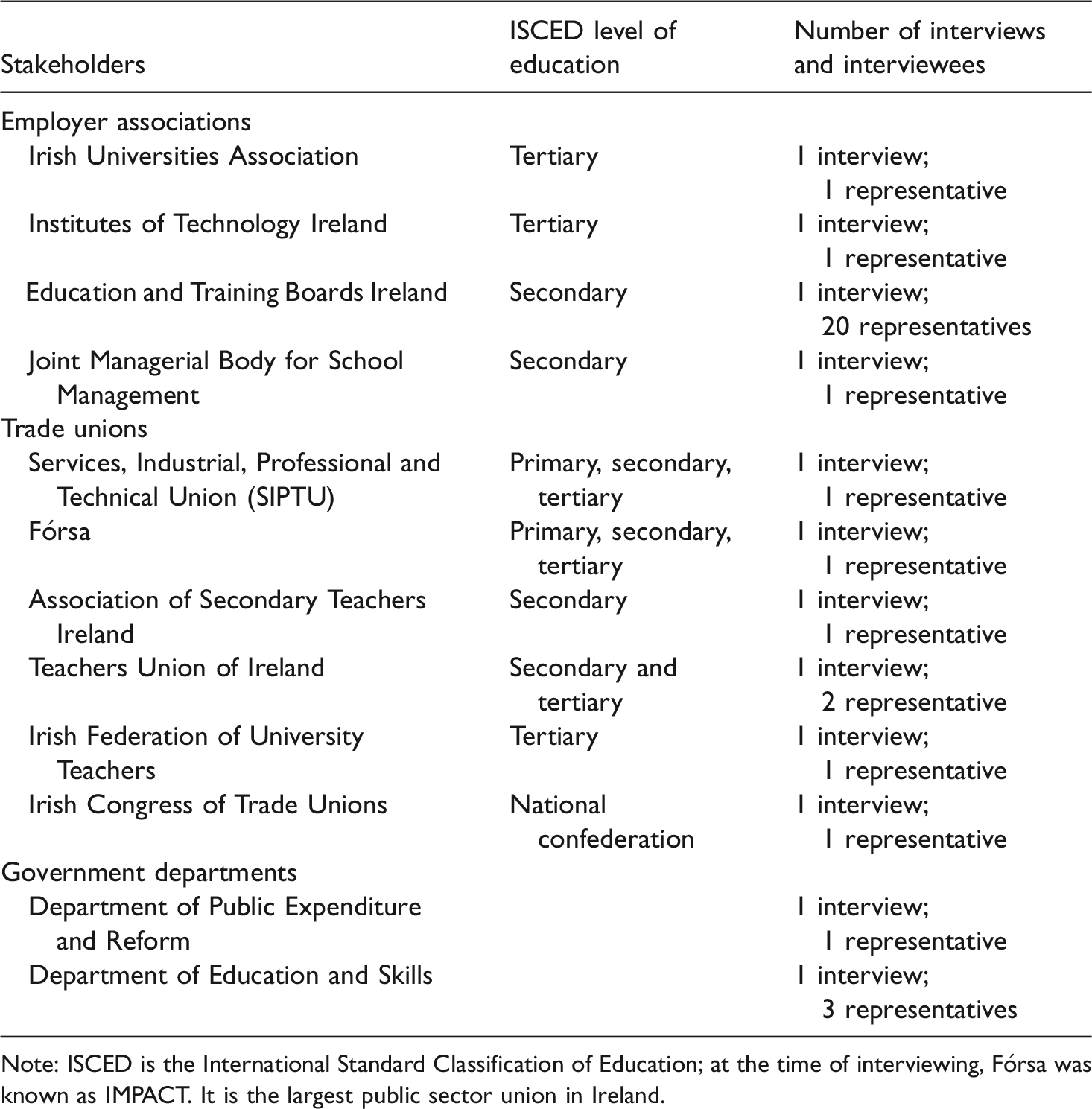
Note: ISCED is the International Standard Classification of Education; at the time of interviewing, Fórsa was known as IMPACT. It is the largest public sector union in Ireland.
Findings
Teachers
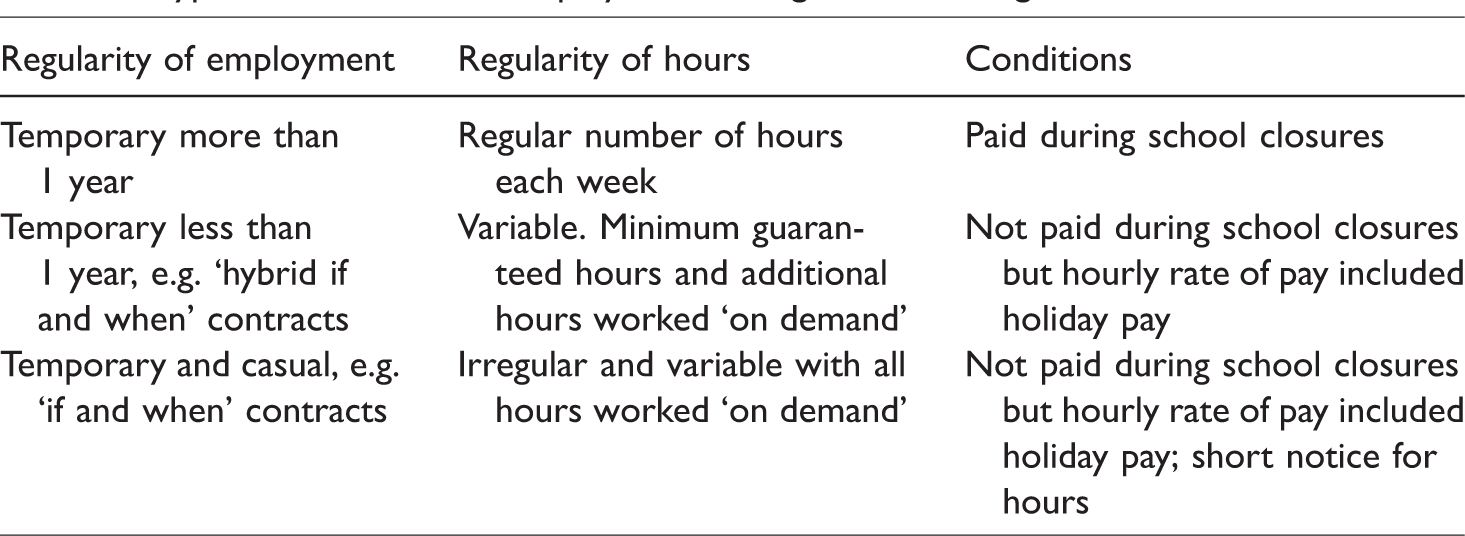
Historically, schools offered standard employment of full-time permanent positions to new teachers; however, interviewees noted a shift away from this practice towards more non-standard employment, typically temporary and part-time employment. According to interviewees, no permanent teachers at secondary level had been recruited since 2001, suggesting that this practice could not be solely attributed to the overall economic health of the country given the economic boom in the early to mid-2000s. Union interviewees argued that the contemporary career path for many teachers involved a series of temporary contracts with a low number of hours, and teachers working in multiple schools to boost working hours and income. Teachers worked with the aspiration that one school would offer full-time permanent employment in the future. A number of types of non-standard part-time employment arrangements were identified in interviews (Table 2). Trade union interviewees were particularly critical of the ‘if and when’ and ‘hybrid if and when’ contracts, which had significant negative implications for teachers because they involved unpredictable hours and short advance notice. Teachers were under no obligation to accept ‘on demand’ hours offered through either type of contract, and trade union and employer association interviewees acknowledged that a teacher’s refusal of hours generally did not preclude them from being offered hours again in the future.
Types of non-standard employment arrangements amongst teachers.
Non-standard employment amongst teachers was much more prevalent in secondary-level than primary-level schools. In the former, an estimated 35% of teachers were employed on a part-time and/or temporary basis, while the corresponding figure at primary level was 9% (Ward, 2014).
Employer interviewees identified a number of factors contributing to non-standard employment at secondary level, specifically temporary contracts with either a regular number of hours or a variable number of hours. The first factor, argued by The Joint Managerial Body and the ETBs, was that schools needed labour flexibility to fulfil curriculum (subject) requirements, and that subjects can change depending on the demands of parents, students, and the government. A second factor identified related to employment legislation, in particular the Protection of Employment (Fixed-Term Work) Act 2003. This transposed into Irish law the EU Directive on Fixed Term Work 1999, which aimed to help achieve a better balance between ‘flexibility in working time and security for workers’ (Council Directive 1999/70/EC). The 2003 Act stipulates that an individual can only be employed on successive fixed-term contracts for a maximum of 4 years, after which time they should be given a contract of indefinite duration unless there are objective grounds for not doing so. Employer representatives claimed that because of this worker entitlement, school management had become increasingly cautious about recruitment decisions and used temporary contracts essentially as probationary periods before they became obliged to offer indefinite employment to a particular teacher. The major implication of the legislation for a teacher in obtaining a contract of indefinite duration is that while it offers longer-term security of employment, it does not provide a right to increased working hours. For example, a teacher who worked 5 hours a week at the time they received a contract of indefinite duration would still only be entitled to 5 hours work on an indefinite basis. Unsurprisingly, trade unions highlighted the critical role and power of the school management, in particular principals, in establishing the regularity of employment and hours in the period leading up to a contract of indefinite duration. A third factor noted by employer representatives was the oversupply of teachers, particularly from private colleges, and the knock-on effect that fewer hours were available for existing teachers. While union interviewees acknowledged this was an issue in some subject areas, they also argued that some school management used timetabling as an ‘excuse’ (ASTI interviewee) to facilitate a strategy of having a pool of casually employed teachers with fragmented hours and to increase the productivity of these teachers. Unions claimed that this strategy reinforced managerial power, and that young teachers in insecure employment were vulnerable and willing to undertake additional duties in the hope of gaining more security of working hours.
School secretaries
The majority of schools have Catholic patronage so, historically, nuns undertook much of the clerical and teaching work. As the clerical role widened, the government Department of Education and Skills began a scheme in the late 1970s under which it directly employed school secretaries as public service clerical officers on civil service pay scales. However, the direct employment of school secretaries in the public sector has rescinded as successive governments have shifted the responsibility for hiring secretaries onto individual schools. According to interviewees, approximately 95% of school secretaries were employed directly by schools with the remaining 5% still directly employed by the government. The consequence was that the regularity of employment, hours and pay is the responsibility of individual schools rather than the government. Trade union representatives noted that while large schools may have two or three secretaries on full-time hours, smaller schools may employ secretaries on low-hours, varying in number and scheduling, and these secretaries may have to work in multiple schools to increase their hours. In contrast, the minority of secretaries still directly employed by the Department of Education and Skills are classified as public servants and are often employed on permanent full-time contracts. The government has essentially outsourced the employment of secretaries to schools and this has placed the largely female workforce in a vulnerable position for two reasons. The first is that secretaries employed by schools are not classified as public servants and therefore are not entitled to standardised public servant terms and conditions. The second reason is that the funding for school secretaries’ hours and pay is not ring-fenced. Schools are reliant on ‘ancillary services grants’ from the government to pay secretaries, but this grant can vary yearly and the grants must also pay for a range of costs including building maintenance and heating. The net effect is that secretaries ‘rates of pay and hours of work can vary enormously between schools for doing the same work’ (Fórsa interviewee). Those on temporary contracts are usually unemployed during school closures and have to access state unemployment benefits. The acute vulnerability of school secretaries was evident during the economic recession when the government introduced legislation (Financial Emergency Measures in the Public Interest Act (No. 2) 2009) that allowed it to reduce all public servants’ pay. The Department of Education and Skills (2010) instructed schools that secretaries would be defined as public servants ‘solely for the purposes of the Act’ so their pay was reduced, but it also made clear that this categorisation ‘would not alter their employment status in any other respect’. This excluded the possibility of secretaries accessing the pay scales and superior conditions of public servants. In addition, school grants that were frozen or decreased forced schools to cut secretaries’ working hours.
Lecturing academics
Most academics in tertiary education are employed in universities and institutes of technology. There are a number of differences between the two providers. institutes of technology have traditionally been teaching-led rather than research-led so that academic staff have more teaching hours and lower proportions have PhDs in comparison to their equivalents in universities. There are also considerable differences in the level of standard employment. In 2015, three-quarters of lecturing staff in institutes were permanent and full time (Cush, 2016). In institutes, academics were much more likely to have full-time permanent positions or voluntary part-time employment if they lectured on ‘core’ state-funded programmes mostly for daytime students (Cush, 2016). A more precarious situation existed for the approximately 20% of institute academics who are employed in programmes but not classified as core and therefore not state-funded as almost all (90%) had involuntarily part-time hours and most were on temporary contracts (Cush, 2016). In comparison to institutes, universities had a much lower proportion of lecturing academics in standard employment (55%), with most of the remaining 45% in involuntarily part-time jobs (Cush, 2016). However, the data available on employment arrangements in tertiary education are wholly inadequate and underestimate non-standard working hours and non-standard contract types. Data exclude research staff and those employed as tutors, and the majority of universities have not released figures on their hourly paid staff. Only one university has done so and its figures suggest that hourly paid staff account for the majority (68%) of academics involved in lecturing (Cush, 2016).
A number of factors have contributed to the proliferation of lecturing academics on non-standard arrangements, particularly in universities. A key factor concerns the role of the state. After Ireland fell into deep recession from 2008, one of the government’s austerity measures was to introduce an Employment Control Framework to regulate employment numbers and terms and conditions of employment in some public sector areas like tertiary education (but not primary or secondary education). This framework led to a reduction of core staffing levels and an increase in the ratio of students to academic staff (Higher Education Authority (HEA), 2017). In addition, public sector-wide collective agreements negotiated during the economic recession contained a commitment by the government not to impose compulsory redundancies. Employer representatives argued that the commitment to no redundancies and the framework rules restricted tertiary-level employers’ ability to create standard employment for non-core staff and necessitated the use of hourly paid jobs to fill operational requirements. Employer interviewees also pointed to the general downward trajectory of state funding to tertiary institutions, while the student population has been increasing. Tertiary institutions have sought to expand their educational offerings, which are self-financing, and to increase non-state sources of finance, and these have restricted their capacity to employ people on permanent full-time arrangements. Trade unions argued that workers were being exploited ‘not for the purposes of profiteering but for the purposes of satisfying unreasonable constraints imposed externally’ (IFUT interviewee). However, the IFUT did not exonerate tertiary education providers and referred to the ‘wild west of external funding’, as well as criticising senior management for remaining silent on the issue of low-hours and zero-hours work. Trade union interviewees were highly critical of the nature of, and conditions attached to, non-standard employment arrangements. They pointed to a common arrangement of contracts with a low number of hours per week, which paid for teaching time but not preparation time, and these employees often lacked access to benefits such as sick leave, overtime pay, an incremental pay scale or pension. In institutes of technology, these hours would predominantly be scheduled during the ‘standard’ working day, whereas in universities, they are also scheduled during non-standard hours of evenings and weekends. Interviewees noted the emerging practices of ‘split shifts’ with hours allocated to academics in the mornings and afternoons, and a trend towards so-called ‘taxi-cab academics’ whereby they are forced to increase their hours by working across a number of universities. These practices were described as the ‘worst of worlds’, because even though an academic is not working full time, they may have to pay for a full day’s childcare (IFUT interviewee). The problem for employees of juggling and financing childcare is acute in Ireland because it has the highest childcare costs in the EU (Parliamentary Budget Office, 2019). The financial implications of insecure working hours were laid bare by a trade union officer: you’re at an age when you realise that all the decisions which mark out the economic sustainability of your lifestyle for the rest of your life are coinciding with the period in which people are most likely to be on low-hours and zero-hours. (IFUT interviewee)
Collective power and responses to employer-led flexibility
Trade union interviewees across the education sector were critical of employment arrangements that allowed employers to increase the pool of workers in insecure employment with variable or short-term working hours. Unsurprisingly, union officers argued that permanent full-time work should be the ‘norm’ and alternative non-standard arrangements should be exceptional and justifiable. Unions’ level of influence over employer-led flexibility has been variable across education. In teaching, unions negotiated an agreement with the Department of Education and Skills that has restricted the use of the most casual arrangement – ‘if and when’ contracts involving no guaranteed hours – to relief situations, such as to cover sick leave, and therefore such contracts cannot be used as a long-term arrangement for a teacher. In addition, and importantly, teachers on each type of non-standard employment arrangement, including casual teachers on ‘if and when’ contracts, have standardised rates of pay which increase after completing a certain numbers of hours. While such zero-hours type work is limited, there is much greater prevalence of low-hours of work through ‘hybrid if and when’ contracts or temporary contracts with regular hours. While trade unions did not prevent the widespread use of low-hours and temporary work in teaching, they have made efforts to reverse the trends. As part of negotiations on a public sector-wide collective agreement in 2013, trade unions demanded that the government improve employment security for teachers. In the Public Service Stability Agreement 2013–2016, the government agreed to establish an expert group to consider and report on the level of fixed-term and part-time employment in teaching, ‘having regard to the importance for teachers of employment stability and security …’ (Labour Relations Commission, 2013: 30). The agreement also provided that the expert group’s first task would be to report on reducing the qualification period for the granting of a contract of indefinite duration from 4 years (as per employment legislation) to 3 years. The subsequent expert group report in 2014 made a number of recommendations, including that the qualifying period for teachers to obtain a contract of indefinite duration should fall to 2 years’ continuous employment. In addition, it recommended that should a teacher be granted a contract of indefinite duration on less than full hours, but subsequently work additional hours for a full school year, the higher number of hours worked would form part of their indefinite contract, providing enhanced contractual security of hours. The government accepted these recommendations and they were brought into effect in 2015. Further collective agreements between the Department of Education and Skills and teaching unions resulted in schools being instructed to offer unassigned teaching hours to existing part-time teachers first before the hours could be advertised externally (Circular Letter 0059/2016). Thus, trade unions have responded to employer-led flexibility by successfully negotiating entitlements for enhanced security of employment and working time, and these rights are superior to those available to the general workforce under employment legislation.
Like in teaching, trade unions representing lecturing academics successfully negotiated a number of measures to tackle working time uncertainty and insecure work in the 2013 Public Service Stability Agreement. The Agreement provided for an expert group to consider fixed-term and part-time employment in lecturing and reduced the qualifying period for a contract of indefinite duration from 4 years to 3 years. The expert group reported in 2016 and, similar to teaching, recommended that the qualifying period for lecturers to obtain a contract of indefinite duration should fall further to 2 years’ continuous employment, and that additional lecturing hours should be offered to existing staff first.
With regard to school secretaries, trade union officers have demanded that their ‘public service role be acknowledged properly by their inclusion in nationally negotiated pay and conditions’ (Fórsa interviewee). However, there has been no discernible improvement on many issues. Union representatives noted that recruiting and organising secretaries was problematic given their nation-wide geographical dispersion and the fact that to date there has been little progress on their key concerns regarding insecurity of hours, insecurity of contracts, and lack of parity with public servants. Fórsa and SIPTU have engaged in a decade-long campaign to correct the ‘two-tier’ system in terms and conditions between secretaries employed by schools versus those employed directly by the Department of Education and Skills. The onset of the economic crisis in 2008 sank union demands for improved employment arrangements as the government introduced austerity measures, including cuts in funding to education. As the economy recovered, the government agreed in 2015 to engage with an arbitration process but only with respect to school secretaries’ pay. The process resulted in the Department of Education and Skills directing schools to increase secretaries’ pay rates and it agreed to facilitate this by augmenting the grants to schools, but there has been no progress on the issues of insecurity of hours and employment.
Discussion – Structural factors and collective power
The article has focused on the various employment arrangements emerging in education as a result of employer-led flexibility. Similar to trends in liberal market economies (LMEs) such as Australia, Canada, the UK and the US, we find evidence of casualisation amongst teachers and academics in Ireland. For example amongst tertiary education, particularly in universities, we are seeing a trend of core and periphery staff that Lopes and Dewan (2014) and Kimber (2003) noted in Australia and the UK. Reference was also made to taxi-cab academics in our research, a term used across many countries to describe academics who are juggling hours of work across a number of different institutions (Simbürger and Neary, 2016). With regard to teachers, particularly at secondary level, we find similar trends in Ireland to those of Australia and the US. We find evidence of teachers having little control over their hours of work (Bamberry, 2011), feeling segmented (Krasas Rogers, 2001), and seen as a willing and vulnerable pool of labour (Charteris et al., 2017). School secretaries arguably as an occupation have suffered the most as they lost their public servant status and their job has become increasingly contingent on government grants to the schools that employ them.
Since the collapse of centralised collective bargaining in Ireland in 2009, the Irish government has sought to determine terms and conditions of employment of public sector workers through a combination of legislation and public sector collective agreements. While the use of legislation to influence the regulation of the terms and conditions of public sector workers resonates with the experience within other LMEs such as the US, Australia and the UK, the continued commitment to collectively bargain at national level with public sector trade unions in Ireland is unique within the LME cluster of countries. For example, in the UK and the US there have been deliberate attempts to reduce collective bargaining for workers in the education sector (Freeman and Han, 2012; Stevenson, 2015). Furthermore, the Irish government initiated two major reviews into the terms and conditions of workers within the education sector noted earlier, leading to regulations of non-standard employment in teaching and lecturing. While there have been areas of dispute within the education sector, arguably the commitment to continue to engage in collective bargaining by the government has afforded some trade unions in Ireland an opportunity to challenge pressures for working time flexibility as compared to other LMEs.
There are also reasons to be sceptical about whether the specific regulations introduced will translate into actual protections for workers and we consider the limits of collective power. In particular, the extent to which an occupation can be protected from outsider status is quite dependent on the interplay between occupational power and structural factors. Each occupation operates in distinct ecosystems and their ‘markets’ influence the degree of employer-led flexibility. We consider each occupation in turn. Teachers have a number of sources of occupational power. There are restrictions on entry into the profession through qualifications, the knowledge of teachers has high social value, the occupation is of a large size and this facilitates the development of solidarity and they have structural power in terms of their indispensable role in education. Of the professions examined in this article, teachers have the most robust associational power as they are represented by strong occupational trade unions which have responded to issues of insecure employment and hours through political lobbying and collective bargaining with government, resulting in the measures to enhance entitlements on employment and hours. Structural factors within teaching have shaped the experiences of workers. We noted that non-standard employment is much higher amongst secondary teachers than amongst primary teachers. Unions identified the faster growth of student numbers at primary level and the absence of a requirement for teachers to have subject-specific expertise as key reasons for the lower prevalence of employer-led flexibility amongst primary-level teachers. At secondary level, management make scheduling decisions based on matching labour supply to service need. This, along with the oversupply of teachers in some subjects and managerial circumspection of hiring because of the regulatory context, has led to the normalisation of irregular and low working hours amongst teachers. Trade union representatives commented that this normalisation had sometimes become a ‘habit’ for school management rather than based on genuine need and they were optimistic that the new regulations on fixed-term work would reduce insecure employment.
Lecturing academics have an occupation that arguably has sources of occupational power at least as strong as teachers. There are significant barriers to entry into the occupation, particularly for university academics in terms of qualifications; there is a sizeable population of academics, who are geographically concentrated, though not as large as that of teachers; they have structural power by having critical positions in the provision of education and their specialised knowledge attracts social prestige. While there is an occupation-specific trade union, the IFUT, the profession has not exhibited the strength of teaching unions. The IFUT primarily represents university lecturing staff, while those from institutes of technology are represented by teaching and general unions, leading to fragmentation of representation. The sources of power that the occupation did possess did not lead to the prevention of casualisation and has led to a core workforce with continuity of employment and regular hours of work – and in some cases, a large peripheral workforce on temporary contracts with low and variable hours. The specific market differences between universities and institutes of technology shed light on the varying levels of non-standard arrangements. Academics in institutes of technology primarily teach on state-funded programmes and, with much less research activity than universities, there are fewer non-state sources of funding available. Where they have sought to expand funding sources, this has mainly been through additional teaching programmes, and academics on these programmes have non-standard arrangements. Universities on the other hand have much greater capacity to seek non-state funding, which has arguably further incentivised the state to reduce its funding responsibilities. As much of non-state funding is insecure, so too are employment arrangements. Universities have expanded funding through research and through a wide range of teaching programmes, which as noted earlier, are increasingly provided in the evenings. This trend echoes the expansion of non-standard hours work in other sectors and increasingly mirrors private sector norms. These structural changes suggest a pessimistic outlook about the extent to which the union-negotiated regulations on fixed-term workers will lead to positive changes for academics. Trade union representatives expressed little optimism about a reversal of the non-standard trajectory, because ‘there is no sense whatsoever that current management has any loyalty or commitment to the maintenance of the standard [permanent full-time job]’ (IFUT interviewee). While collective power has resulted in new protective measures that may help some workers, it has not changed structural issues. The diminution of the role of the state, along with managerial complacency and compliance, has contributed to increasingly segmented working conditions between universities and institutes of technology and to a greater risk of outsider status for academics in universities.
As a lower-level occupation, school secretaries have significant weaknesses in occupational power and this has impacted their capacity to address the precariousness of their jobs with insecure hours and employment. In particular, there are relatively low numbers in the occupation and individuals are geographically isolated – factors which have contributed to the absence of an occupation-specific trade union. A key weakness for school secretaries is that they lack the structural sources of power that teachers have and their relatively low numbers mean their voice has been lost in the public sector-wide negotiations with government. The fortunes of individual secretaries are dependent on the structural context. Large schools with substantial government grants are better placed to offer regular, secure hours, but as long as funding for secretaries hours and pay is sourced by grants and they are not classified as public servants, they occupy very insecure positions. There have been stronger indications of agency in recent years, with some large unions engaging in organising campaigns of secretaries and lobbying politicians, but this has occurred outside the framework of public sector-wide negotiations with the government, where issues of pay and conditions are primarily decided. It is unsurprising therefore that secretaries have been unable to contest successfully employer-led flexible working arrangements and, in the absence of the government changing their employment status to public servants, are likely to remain vulnerable to insecurity of hours and employment.
Conclusion
This study has sought to chart employment arrangements associated with employer-led flexibility and examine how trade unions representing occupations have responded to such flexibility demands. The article has contributed to the research on employer-led flexibility and marketisation of education in a number of ways. First, it has illustrated that high-skilled occupations have been as susceptible to employer-led flexibility as low-skilled occupations, resulting in involuntary non-standard employment with low and insecure hours. Second, it has reviewed how occupations could not resist managerially imposed flexibility, but their collective power through unions has had varying degrees of success in re-regulating non-standard employment. Third, the article has considered that enhanced regulations are not an automatic pathway to improved conditions for workers, but their effectiveness is dependent on the prevalence of structural factors that gave rise to non-standard employment.
Historically, academics, teachers and school secretaries engaged in professional occupations that could be categorised as ‘insider’ occupations with a high propensity for standard employment over a long-term employment trajectory (Rovny and Rovny, 2017; Schwander and Häusermann, 2013). The three occupations in this study were initially established as public sector employment with comparatively high security of employment and hours. Yet ‘labour market vulnerability is spreading’ and ‘a skilled white collar occupation is no guarantee of employment security and high income any more’ (Häusermann et al., 2015: 238). In the context of employer-led flexibility in education, school secretaries have transitioned to an ‘outsider’ occupation, with a low probability for standard employment throughout a life course, and weak sources of occupational power have not changed their labour market vulnerability. However, the state cannot completely disengage itself from obligations towards secretaries as it has to supplement their income through unemployment benefits when they have no working hours. As Rubery (2011) argues, neoliberal policies can contribute to new risks, which in turn increases demands on the state for social support. Yet the state may assess that the costs of unemployment benefit are a superior option financially to granting secretaries public servant status and incurring the costs of concomitant benefits such as secure hours, pension and sick leave entitlements. Despite the homogeneity of teaching as an occupation, different market contexts exist at primary and secondary levels, so that non-standard employment is concentrated at the secondary level. Teachers have maintained their ‘insider occupation’ status because interviews indicated that there is a strong possibility that they can progress from peripheral employment in the early years to standard employment arrangements. Evidence indicates that academics are most at risk of transitioning from an insider to an outsider occupation. Despite the improved entitlements to indefinite employment, these may have limited influence as occupational power has not altered the fact that the state has increasingly divested itself of responsibility, particularly in universities. In considering the insider–outsider dichotomy, it should be borne in mind that labour market disadvantages can be particularly acute for certain groups, such as women, who are more likely to experience labour market withdrawal and non-standard employment due to childrearing responsibilities (Schwander and Häusermann, 2013). Their vulnerability is likely to be heightened by their employment in occupations that have a higher risk of outsider status. Public sector employment and high-skilled occupations are not the sites of refuge from labour market risk they once were.
A limitation of this article was that the findings were based on interviews with representative organisations, and future research could incorporate the views and experiences of workers. In doing so, issues worthy of inquiry would be workers’ strategies in coping with financial insecurity, their interactions with management as they try to gain favour and secure more working hours, and the views of groups such as women who can encounter multiple sources of labour market risk, particularly in outsider occupations.
Footnotes
Declaration of conflicting interests
The author(s) declared no potential conflicts of interest with respect to the research, authorship and/or publication of this article.
Funding
The author(s) disclosed receipt of the following financial support for the research, authorship and/or publication of this article: Data collection for this article was part of a project funded by the Department of Jobs, Enterprise and Innovation.
