







Abstract
This study takes a mutual gains perspective to investigate how a labour‒management partnership (LMP) impacts organisational occupational and health safety (OHS) performance and creates a safe workplace. It develops a model linking employee psychological safety with a collaborative industrial relations (IR) climate and ultimately organisational OHS performance. The research context is China ‒ where LMP is driven by the Party-state in managing labour relations. To test the proposed linkage model, multi-level structural equation modelling is conducted, using matched employer‒employee data from 205 companies and 7229 employees in an industrial park in the Yangtze River Delta. The results support the use of the linkage model, demonstrating that partnership decision-making increases psychological safety, in turn developing a collaborative IR climate, ultimately reducing the number of accidents. This study contributes to partnership research by exploring the underlying mechanisms of how a partnership arising from the logic of neo-pluralism successfully delivers mutual gains for employees and employers in a non-pluralist context. It has wider implications for collaborative management and OHS management in a developing country.
Keywords
Introduction
Labour‒management partnership (LMP) is rooted in the neo-pluralist perspective on industrial relations (IR). This perspective acknowledges a difference of interests between management and labour while stressing the potential for accommodation and compromise through pro-active partnership approaches (Johnstone and Wilkinson, 2016). An example of an organisational collaborative management approach, LMP is an institutionalised arrangement in which management and unions (or workers themselves in non-unionised firms) work together to achieve shared goals and deliver mutual gains (Butler et al., 2011; Wilkinson et al., 2014). LMP incorporates a bundle of human resource (HR) practices (e.g. high commitment work practices) and employment relationship processes associated with partnership (Johnstone et al., 2009). Its practices include employee voice arrangements, such as direct participation, representative participation (with or without trade unions) and financial involvement (Saridakis et al., 2020). Its processes are those associated with organisational governance, at the centre of which are partnership decision-making and actor relationships of mutuality and reciprocity (Johnstone et al., 2009). These processes are a central means of institutionalising LMP across an organisation and a key measure to assess the viability and effectiveness of an LMP (Avgar et al., 2016).
Despite its conceptual promise, and extensive research over the past three decades (Avgar et al., 2016; Deery and Iverson, 2005; Kochan and Osterman, 1994), the extent to which LMP can deliver mutual gains for both firms and workers remains a contentious debate (Johnstone and Ackers, 2015; Saridakis et al., 2020). The debate is split broadly along ideological lines. IR radicals oppose any form of class collaboration, taking a pessimistic perspective from which they argue that, rather than achieving benefits for all parties, an LMP has a negative impact on unions, workers and their representatives and restricts union representative capacity (Kelly, 2004). Others take a constrained mutuality perspective, where the ‘balance of advantage’ is skewed towards employers although workers and unions are likely to derive some gains from partnership (Guest and Peccei, 2001: 231). These different perspectives of LMP are inextricably linked to IR frames of reference. Individuals with diverse frames of reference assign varying expectations to specific LMP arrangements (Budd et al., 2022); hence, there is a lack of consensus over the expected outcomes of an LMP, especially when the measurements for success are set unrealistically high. To assess LMP outcomes, Johnstone et al. (2009: 273) suggest ‘a need to reconsider the benchmarks for success, and to pay more attention to the expectations and perceptions of the actors themselves, and not just those of academic theorists’. For example, partnership decision-making may not always be joint decision-making between the union and management; rather, it is typically described as a ‘joint problem-solving approach’, characterised by early consultation and involving employees in decision-making (Johnstone et al., 2009).
Existing quantitative research largely focuses on the influence of LMP practices on partnership outcomes in the context of strong unions but weak institutional supports (Johnstone et al., 2009; Saridakis et al., 2020; Valizade et al., 2016). Few studies examine the LMP process (Avgar et al., 2016). This study seeks to contribute to the debate and extend prior research by investigating how LMP delivers mutual gains. It does so by examining (1) the underlying mechanisms with a focus on the employee experience and (2) organisational OHS performance as a key indicator of mutual gains for employers and employees. Drawing on signalling theory (Connelly et al., 2011; Guest et al., 2021; Spence, 1973), it proposes a linkage model that connects partnership decision-making and psychological safety to a collaborative IR climate and ultimately to OHS. China, a developing country where the government has initiated institutional experimentation for LMP according to an ideology of harmonious labour relations serves as the research context. Unlike the Anglo-Saxon countries where prior LMP research has been conducted, China has strong institutional support for LMP but relatively weaker power of enterprise trade unions (Chen, 2003; Friedman and Kuruvilla, 2015). The main LMP arrangements are democratic management (e.g. Worker and Staff Representative Congress (WSRC)), together with collective bargaining in union enterprises, and employer-led participation schemes (e.g. task-centred participation, employee attitudes survey and direct communication between senior management and employees). The nature of these arrangements is input democracy (consultation) rather than output democracy (joint decision-making) (Huang, 2022). Recent studies have reported the effectiveness of China's democratic management (Chen et al., 2022; Huang et al., 2016; Jing et al., 2022; Long et al., 2021). This is in contrast to earlier research on democratic management under Mao's regime and the democratising workplace reform of the 1980s. This research critiqued the WSRC and other practices as mere ‘window dressing’ (e.g. Chan and Unger, 2009; Chen, 1995; Cliver, 2009).
OHS is an important performance indicator for an LMP. In the absence of significant improvement in OHS performance, an LMP will not contribute to mutual gains and harmonious labour relations. The role of LMP in OHS prevention has been emphasised in International Labour Organization (ILO) conventions (e.g. ILO Convention 187 and Guidelines on occupational safety and health management systems, ILO-OSH 2001) and international standards (ISO 45001 and its predecessor OHSAS 18001) and is mandated by law in many countries (e.g. China's Work Safety Law). While case studies can provide extensive insight into the contextual conditions impacting on the ‘success’ or ‘durability’ of an LMP (Dobbins and Gunnigle, 2009), such as business profit (Choi and Peng, 2015), it is difficult to generalise about the dissemination or effectiveness of LMPs at delivering mutual benefits. Doing so requires quantitative analysis, and there needs to be more research into the effectiveness of LMPs (Saridakis et al., 2020), particularly their role in OHS prevention in China (Fan et al., 2020). China provides a unique context, with Chinese laws on OHS stressing efficiency over safety and prioritising production (Sun et al., 2014).
This study contributes to research into LMP and the ongoing question as to how it relates to employee safety (Jain et al., 2018) and organisational sustainability (Camuffo et al., 2017). First, this study contributes to the partnership literature by investigating the underlying mechanism through which an LMP leads to mutual gains and using the linkage model to connect partnership decision-making, employees’ psychological safety and collaborative IR to OHS performance. Second, this study contributes to OHS research by identifying the drivers in labour relations and by examining OHS in developing countries. The identification of a linkage model involving a collaborative management model as a key driver extends OHS performance management, a key element of corporate social responsibility (CSR) (Hart, 2010). Lastly, by examining an LMP, OHS and their underlying mechanisms in China, this study focuses on a developing countries context, which is often overlooked in IR research despite developing countries’ experience of rapid economic development and changing management strategy.
Literature review and hypotheses development
Linking partnership decision-making to employee psychological safety
Employees’ voice behaviour can be considered an investment decision made under conditions of uncertainty. Individual employees are likely to make a conscious assessment of the risks or potential negative outcomes associated with voice behaviours, making trade-offs between the risks and benefits when considering whether to speak to a person in a position of power or otherwise about a problem (Morrison, 2011, 2014). Significant costs, such as job loss, may be associated with voice behaviour if an employer considers the employees’ choice to voice their concerns as a threat to managerial authority or the interests of the organisation.
LMP has a key influence on employees’ voice perceptions and behaviours. Signalling theory (Connelly et al., 2011; Guest et al., 2021; Spence, 1973) posits that partnership decision-making sends signals to employees that they are valued by the organisation, and hence, employees are more likely to feel safe in speaking up. Signalling theory is inherently concerned with reducing information asymmetry between the organisation and employees. The clarity, frequency, reliability and intensity of a signal sent by the organisation determine the extent of the reduction in information asymmetry (Connelly et al., 2011). The establishment of LMP can help to send clear, frequent and reliable signals to employees via partnership meetings and a transparent communication process. When signallers (i.e. the organisation) send signals (i.e. involving employees or their representatives in decision-making), the receivers (i.e. employees) perceive positive and effective messages (Guest et al., 2021). In turn, employees feel that their contribution is valued, and they are more likely to have positive experiences at work (Alfes et al., 2020). These characteristics also send a stronger message to employees about management's commitment to employees’ wellbeing and their interest in mutually beneficial workplaces, as well as making clear the behaviours that are expected from employees. In organisations with partnership decision-making, employees are more likely to feel safe to voice their concerns ‒ psychological safety (O’Donovan and McAuliffe, 2020) ‒ a key driver for employee voice behaviours (Liang et al., 2012; Song et al., 2020), sometimes known as voice safety (Morrison, 2011).
Psychological safety for voice is a belief that engaging in risky behaviours, such as voice behaviours, will not lead to personal losses and retaliation (Detert and Burris, 2007: 872). Originally proposed by Edmondson (1999), psychological safety has been found to promote high-quality communication and high-level trust that leads to positive individual and team outcomes (Newman et al., 2017; O’Donovan and McAuliffe, 2020). Psychological safety has been studied at the individual (Detert and Burris, 2007; Gong et al., 2012; Kahn, 1990; Kark and Carmeli, 2009) and team levels (Edmondson, 1996, 2002, 2003; Huang et al., 2008; Liu et al., 2015; Tucker, 2007). When the organisation's structure and norms are supportive of employee voice (i.e. partnership decision-making), employees receiving signals may be more open to bringing up issues and participating in relevant decision-making (Brown et al., 2005). Through repeated opportunities and consistently positive responses (signals), an employee may come to realise it is safe to speak honestly with a supervisor despite an authoritative relationship (Detert and Treviño, 2010). Therefore, we anticipate a positive relationship between partnership decision-making and employee psychological safety.
The above analysis suggests that partnership decision-making serves to build and maintain psychological safety (O’Donovan and McAuliffe, 2020). Empirically, Avgar et al. (2016) find that the quality of the LMP process increases employees’ perceived trust and voice behaviours. McCarthy and Keller (2021) find LMP affects intraorganisational social processes. In developing countries such as China, where power distance is high and authoritarian paternalistic management is dominant, employees of organisations implementing LMP are invited to participate in the decision-making process. These organisations value employees’ input, which means that employees are more likely to trust management and feel safe in voicing their concerns. We therefore propose:
Partnership decision-making is positively associated with employee psychological safety.
Psychological safety and a collaborative IR climate
Signalling theory supports partnership decision-making as a way to help organisations send high-quality signals about management's commitment to involving employees in the decision-making process, thus increasing employees’ psychological safety. It also suggests that signal receivers (i.e. employees) may feed the information back in the form of countersignals to facilitate more effective signalling (Connelly et al., 2011). Hence, we expect that increased psychological safety stemming from partnership decision-making can reduce uncertainty (Tu et al., 2019) in the organisational context and generate improved relationships among management, employees and unions (Bashshur and Oc, 2015), that is, a more collaborative IR climate (Dastmalchian, 2008).
A collaborative IR climate is one characterised by high-quality communication (Pyman et al., 2010). Psychological safety is a key determinant of high-quality communication, employee voice and whistleblowing behaviours (Liu et al., 2015), all features of collaborative work to achieve a shared outcome (O’Donovan and McAuliffe, 2020). When employees feel psychologically safe to speak up, they are more likely to shape the norms that support a collaborative IR climate (Deery and Iverson, 2005; Wu and Lee, 2001). We therefore anticipate a positive relationship between psychological safety and a collaborative IR climate.
Psychological safety is positively associated with a collaborative IR climate.
When an employer has a collaborative management model, that is, partnership decision-making, employees feel safe to voice their concerns and make suggestions to mitigate risks. Hence, they are more likely to improve their relationship with the employer and unions, that is, develop a collaborative IR climate. Therefore, this study expects that psychological safety mediates the relationship between organisational partnership decision-making and an organisational collaborative IR climate.
Psychological safety mediates the relationship between partnership decision-making and a collaborative IR climate.
Linking a collaborative IR climate to organisational OHS performance
An organisational collaborative IR climate is characterised by high-quality actor relationships and is considered an enabling mechanism for the process of mutual gains (Valizade et al., 2016). This is because a high level of collaborative IR enables the goals of management and employees to be connected; management and employees actively and reciprocally participate in joint activities aimed at attaining mutual goals (Pyman et al., 2010). An adversarial IR climate, on the other hand, features hostility, aggression, resistance and apathy, where harmony, openness and responsiveness are absent (Dastmalchian, 2008; Dastmalchian et al., 1989). That is, the goals of management and employees are in conflict and the achievement of mutual gains is less likely.
Existing research shows that a collaborative IR climate can contribute to favourable organisational and labour relations outcomes, including efficiency (Boxall and Macky, 2009; Pyman et al., 2010), productivity and customer service (Deery and Iverson, 2005), good employee attendance and employees’ organisational commitment (Deery et al., 1999). Similarly, we argue that a collaborative IR climate can help to prevent OHS hazards and improve organisational OHS performance, a positive outcome for both organisations and employees. The collaborative IR climate for OHS performance at work has been defined and advocated by the ILO (ILO, 2011). In such a climate, the right to a safe and healthy working environment is respected at all levels, where governments, employers and workers actively participate in securing a safe and healthy working environment through a system of defined rights, responsibilities and duties, and where the highest priority is accorded to the principle of prevention. (ILO, 2011: 23)
Employees and management work jointly to prevent, identify, mitigate and report risks, as well as to seek solutions aimed at reducing workplace injuries, as required in the OHS management system (Esposito, 2021). Collaboration between management and labour reduces information asymmetry on OHS hazards and risks in the workplaces; management and employees in this environment tend to perceive their goal attainment as positively related and exhibit close collaboration.
In contrast, in an adversarial IR climate, employers may seek to maximise their short-term economic gains at the expense of OHS (Deery and Iverson, 2005). There may be tension between management and employees over the issue of OHS itself, including risk significance, evidence, risk evaluation and measurement, severity of health effects, appropriate standards and communication of risk information (Nelkin, 1985). Numerous studies examine the influence of an IR climate on the effectiveness of a representative OHS structure (Markey and Patmore, 2011) in developed countries, but few investigate its effects on the collaborative outcome, that is, the prevention of work-related hazards and reduction in accidents. Given these discussions and findings, we hypothesise the following:
A collaborative IR climate is positively associated with organisational OHS performance.
Overall, our study focuses on how LMP helps to deliver mutual gains for both employers and employees. Drawing on signalling theory, it theorises a linkage model, which is outlined in Figure 1.

Proposed research model.
Research context
China's IR is in a long experimentation process where IR actors are engaging with constant experimental approaches (Murray et al., 2020), creating institutional supports and contextual conditions to facilitate the partnership approach to manage labour relations and improve OHS performance. China began reforming its IR system in 2012, in response to escalating labour unrest and labour shortages (Choi and Peng, 2015). In 2012, for the first time, the 18th National Congress of the Communist Party of China (CPC) advocated a harmonious labour relationship as the ideology of China's IR system. In November 2013, the Third Plenary Session of the 18th Central Committee of the CPC passed ‘The Decision on Several Major Issues Regarding Comprehensively Deepening Reform’, which called for institutional experimentation with the labour relations coordination mechanism and the opening of channels for workers to effectively voice reasonable demands. The CPC Central Committee and the State Council issued ‘Opinions on Building Harmonious Labour Relations’ in 2015. It established the principle of LMP and cooperation for mutual gains, that is, ‘Coordinating and managing the relationship between promoting enterprise development and protecting the rights and interests of employees, mobilising the enthusiasm and initiative of both parties in the labour relationship, and encouraging the negotiation and collaboration between enterprises and employees’. In 2023, China's national IR tripartism advocated establishing an enterprise‒employee community with common interests, common causes and common destiny. In the Chinese context, LMP can be considered a form of institutional experimentation consistent with the Confucian virtue of beneficence, sometimes known as ‘caring for others’. LMP in China's workplaces is enabled by a party-state–driven, top–down approach to harmonious labour relations. Strong external institutional support is critical to the effectiveness of LMP, even when union power is strong, as it is, for example, in Anglo-Saxon countries (Dobbins and Gunnigle, 2009).
The current contextual conditions of China's IR are aligned with LMP. In earlier research, trade unions’ weak power and a pervasive authoritarian paternalism by management were found to impact HR practices, working as hurdles to LMP in China (Choi and Peng, 2015; Zhang et al., 2015). However, the power balance between capital and labour is altering due to increased labour discontent, a tight labour market, a new generation of workers (Choi and Peng, 2015) and the party-state's sympathetic attitudes towards labour discontent (Friedman and Kuruvilla, 2015). Both trade unions and management are adapting to these new contextual conditions. Since 2015, China's trade union, All China's Federation of Trade Unions (ACFTU), has undertaken reforms to increase its representative capacity, protect members’ interests and participate in managerial decision-making. Chinese employers have deliberately modified their management strategy from autocratic paternalism to a new paternalist managerial strategy known as ‘humanised management’ (Choi and Peng, 2015; Zhang et al., 2015). There may be a disparity between the rhetoric and practice of humanised management, diminishing its effectiveness in enhancing labour‒management relations, as shown in an early case study conducted in 2007 (Choi and Peng, 2015). LMP stems from the pluralist context, in which IR is characterised by voluntarist traditions (Dobbins and Gunnigle, 2009). LMP should achieve positive outcomes in a non-pluralist IR context with strong external institutional support and favourable conditions, such as that of China, although the extent to which mutual gains can be achieved is unknown in the Chinese context. Johnstone et al. (2010) argue that a way to measure LMP's success is to place it in the context of contemporary national labour relations.
Due to the rapid growth of the manufacturing industry in China, workers’ rights to safety at work are regarded as a key issue in labour relations (Chan and Gao, 2012; Chen and Chan, 2010; Wright, 2004). To attract foreign direct investment in the 1990s and early 2000s, some local governments in China relaxed labour standards and OHS control measures (Chen, 2003), creating OHS performance challenges (Pringle and Frost, 2003) and an appalling record of work safety (Chan and Gao, 2012; Wright, 2004). To contain and prevent OHS hazards and accidents, China has adopted two primary experimental approaches: (1) strengthening legislative and regulatory systems and (2) promoting a collaborative approach to OHS management. The first approach includes the establishment of a legal and regulatory regime of work safety (Wei et al., 2016). For example, fatality indicators (Chan and Gao, 2012) are included in local government leadership officials’ annual performance evaluation to reinforce the importance of safety at work. The second experimental approach has seen China's state and ACFTU developing cooperative and partnership forms of management, as manifested in the catchphrase, ‘harmonious labour relations’ (Friedman and Kuruvilla, 2015: 191), and principles of democratic management in enterprises (Huang, 2022; Huang et al., 2016).
Overall, China's IR is constantly changing, as strong institutional and contextual conditions are developed that facilitate the partnership approach to managing labour relations and OHS. The focus of this study is to examine how an experimental partnership approach can generate mutual gains. It seeks to do so by identifying the underlying mechanisms for an LMP‒organisational OHS performance link.
Methodology
Sampling method and data collection
The data in this study were collected from a unique project in partnership with one of the largest industrial and innovation parks in China. Based on an agreement with the regional labour and social security bureau, the first author was provided with a list of 752 companies and access to their HR managers. In accordance with local rules on trade unions and democratic management (such as those of Shanghai City and Jiangsu Province), companies with at least 100 employees are required to convene a WSRC and implement a system of information disclosure. The Congress is the principal mechanism for partnership decision-making in the workplace in China (Huang, 2022). To evaluate the effectiveness of LMP, this study selected companies with at least 100 employees. In addition, companies with over 100 employees may have consistent HRM policies and practices. To align with the focus of this study on management styles and behaviours, the research team chose to study only organisations with at least 100 employees. Based on this criterion, 701 companies were selected.
Two surveys were used in this study. The first surveyed organisations’ HR management about organisational performance, and the second surveyed employees about their perceptions of the IR climate and psychological safety in their organisation. We explained that our data collection would be confidential in the cover letter sent to the companies and employees and the data would be used for academic purposes. We used online survey software in China and sent out HR and employee surveys to the companies via e-mails, a webpage link and QR code. We asked the companies to print out the messages for the employee survey with the relevant QR code and post them in a prominent workplace location, such as a bulletin board, cafeteria or factory gate. To get to the survey, employees could either use their phones to scan the QR code or click the webpage link in the e-mail. Employees did not have to give any information that could be used to identify them, and they could quit the survey at any time.
Sample profile
A total of 315 companies returned the employer survey (45%), and the employee survey was completed by 7411 employees from 264 companies, which is an estimated response rate of 5%. 1 After matching employer and employee surveys, 232 employer‒employee surveys were matched with data from 232 HR managers and 7267 employees from 232 organisations. Of these, 16 companies only had 1 employee survey per company and 11 companies had 2 employee surveys per company. Using the exclusion criteria from Chuang et al. (2016), these companies and their employee data were deleted from the sample, leaving a total of 7229 employees from 205 organisations as the final sample.
In terms of sample profile (Table 1), firm sizes ranged from 100 to 7800 employees (M = 869, SD = 1109). Slightly over half (51%) of employees were women. In terms of age, 1% were younger than 20 years old, 46% were between 21 and 29, 43% were between 30 and 39, 9% were between 40 and 49, and 1% were older than 50. Regarding work tenure, 31% of respondents had less than 2 years’ tenure in the organisation, 34% had 2 to 5 years’ tenure, 26% had 6 to 10 years’ tenure, and 9% had over 10 years’ tenure. In terms of education, 11% of respondents had completed secondary school or below, 38% had earned a diploma or equivalent degree, 48% held a bachelor's degree, and 3% had a master's degree or PhD. Over half (59%) of respondents were front-line employees, 27% were line managers, 11% were middle managers, and 3% were senior managers or executives.
Sample profile.
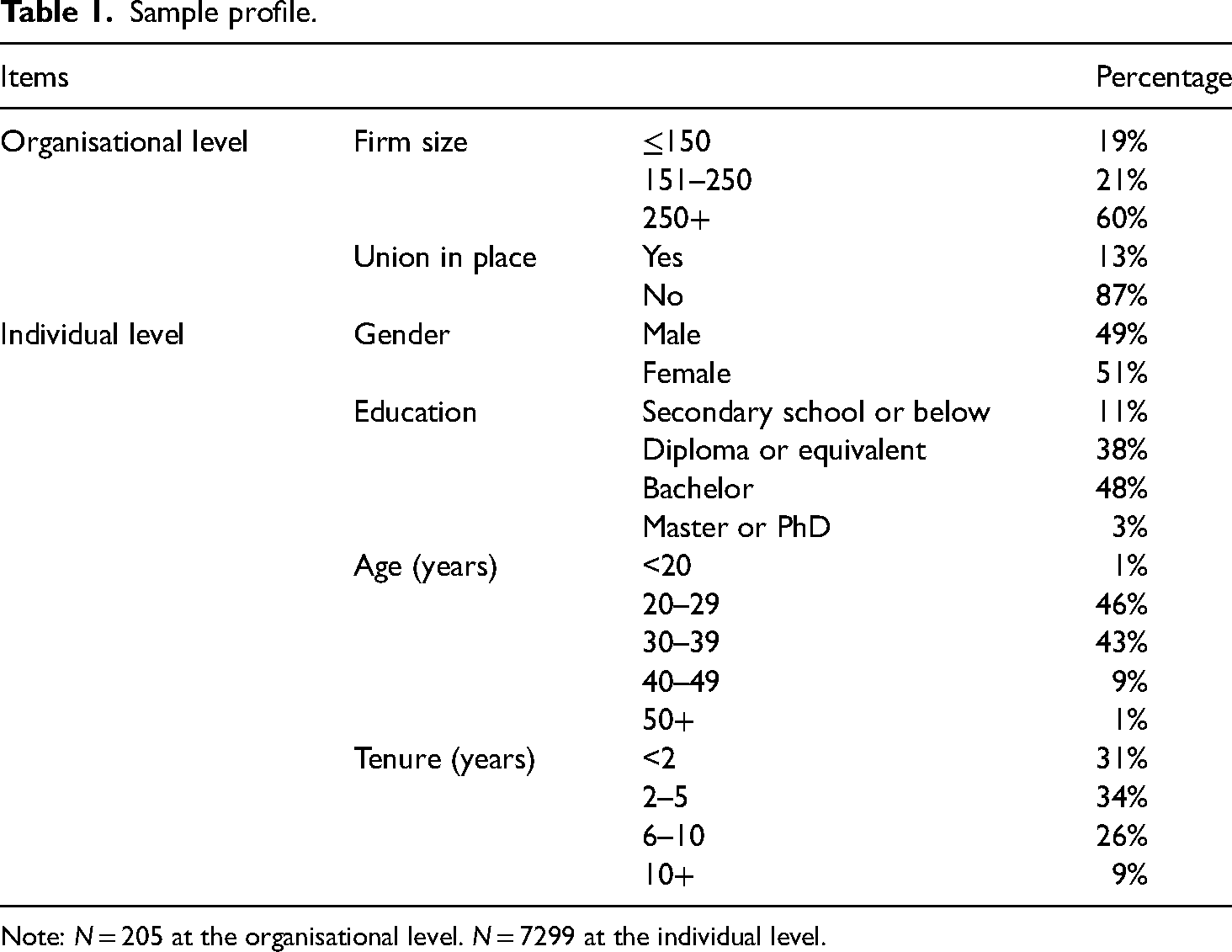
Note: N = 205 at the organisational level. N = 7299 at the individual level.
Non-unionised firms can implement LMP, as evidenced by the notable example of the John Lewis partnership (Cathcart, 2014), though the effectiveness of non-union partnership is subject to considerable debate among practitioners and scholars (Badigannavar and Kelly, 2005; Cullinane et al., 2014; Johnstone et al., 2010). In our research sample, 87% of organisations did not have unions but most had LMP. Among the sample of 205 organisations, 64% agreed that in their organisations, employee representatives participate in strategy-making and organisational management, and 90% agreed that in their organisations, employees and employee representatives have opportunities to participate in making decisions on work-related issues.
Measurements
Organisational OHS performance. Organisational OHS performance was measured by the number of work accidents occurring during the previous 12 months as reported by HR managers. China's official definition of work accidents refers to injuries, work-related death and acute poisoning incidents that occur during work. As the study focuses on organisational OHS performance, a positive impact of collaborative IR climate on organisational OHS performance would be associated with a negative link between collaborative IR climate and the number of accidents.
Collaborative IR climate. Three items were adapted from Pyman et al. (2010) to measure organisational collaborative IR climate. The three items captured the relationships between management and employees, between management and unions and between unions and employees. Employees were asked to indicate their agreement with statements about these relationships. One example item was ‘In general, relations between management and employees are good’. Employees’ experiences are reliable measures for determining effectiveness of workplace partnership activities (Valizade et al., 2016). For assessing internal consistency, we used Cronbach's alpha (Cronbach, 1951), one of the most widely used measures of reliability in the social and organisational sciences (Bland and Altman, 1997). When the alpha coefficient is equal to or above 0.70, the measurement scale is considered reliable. The Cronbach's alpha coefficient for collaborative IR climate was 0.94, exceeding the accepted threshold. Thus, the multi-item measurement of collaborative IR climate had very high reliability.
Psychological safety. Three items were developed primarily based on Morrison (2011) and Ashkanasy and Nicholson (2003). Employees were asked to what extent they agreed with the following statements regarding their psychological safety when speaking up: ‘I feel safe putting forward ideas for improvement’, ‘I feel safe raising personal grievances’, and ‘If I saw misconduct of other staff, I would feel safe reporting it’ (1 = strongly disagree; 5 = strongly agree). The Cronbach's alpha was 0.95.
Partnership decision-making. The partnership decision-making in this study is based on the multi-dimensional scale used by Kochan and Osterman (1994). In the organisation survey, HR managers were asked to indicate the extent of their agreement on two items: ‘In my organisation, employee representatives participate in strategy making and organisational management’ and ‘In my organisation, employees and employee representatives have opportunities to participate in making decisions on work related issues’ (1 = strongly disagree; 5 = strongly agree). The reliability was 0.70.
Control variables. A number of individual and organisational characteristic variables were controlled in the analysis. At the organisational level, firm size and union in place were controlled as these two factors may influence organisational performance. Firm size information was collected from the HR manager on the number of employees, and natural log algorithm was used to operationalise it. Union in place was collected from HR managers as to whether there is a union organisation in their company (1 = yes; 0 = no). At an individual level, gender, age, education, grade and tenure were used. Gender was based on a binary variable (1 = female; 0 = male). Age was measured via six categories (1 = <20 years old; 2 = 20‒29 years old; 3 = 30‒39 years old; 4 = 40‒49 years old; 5 = 50‒59 years old; and 6 = 60 years old and above). Education was measured via five categories (1 = primary school and below; 2 = secondary school; 3 = Bachelor or college degree; 4 = MA; and 5 = PhD). Grade was measured via four categories (1 = front-line employees; 2 = line manager; 3 = middle manager; and 4 = senior manager/executive). Union membership was measured by a binary variable (1 = yes; 0 = no). Tenure was measured based on four categories (1 = 0‒2 years; 2 = 2‒5 years; 3 = 5‒10 years; and 4 = 10 + years).
Common method bias and analyses
The data in this study were collected from multiple sources, which reduce concerns relating to common method bias (Podsakoff et al., 2003). However, psychological safety and collaborative IR climate were collected from the same source so to check for common method bias and construct validity, we conducted confirmatory factor analysis (CFA). Based on the nested nature of the data on psychological safety and collaborative IR climate, a multi-level CFA was conducted for these continuous variables including partnership decision-making, psychological safety and collaborative IR climate. The three-factor model showed a good model fit where the chi-square test of model fit (Χ2) was 416.05 with degree of freedom (df) of 31, p < 0.001, comparative fit index (CFI) was 0.97, the root mean square error of approximation (RMSEA) was 0.04, the standardised root mean square residual (SRMR) value for within was 0.03, and value for between was 0.02. For the Χ2/df values, <2.5 indicates good fit (Arbuckle, 2006). For the CFI value, >0.95 represents good fit (Bentler, 1990). For the RMSEA and SRMR, values <0.08 indicate a good model fit (Browne and Cudeck, 1993; Hu and Bentler, 1998). The fit indices for the multi-level CFA above all met the model fitness criteria except for Χ2/df value. As the Χ2/df value is very sensitive to large sample sizes (Hair et al., 2009), the value is acceptable considering the sample size of 7229 respondents. Therefore, LMP, psychological safety and collaborative IR climate are distinctive and valid.
Data for organisational collaborative IR climate were collected from individual employees nested in their organisations. As IR climate was theoretically proposed at an organisational level, empirical support is needed for using individual data at an organisational level in an aggregate manner. In this study, inter-rater agreement and reliability was assessed via Rwg and ICCs. For organisational collaborative IR climate, Rwg = 0.86 (mean) and 0.90 (median), exceeding the threshold value of 0.60 (James, 1982) or the more commonly acceptable value of 0.70 (LeBreton and Senter, 2008). ICCs were calculated using Mcgraw and Wong's (1996) formula with a one-way random-effects analysis of variance. High ICC values may only be obtained when there is both consensus and relative consistency in raters’ ratings (LeBreton and Senter, 2008). The threshold value for ICC (1) is 0.12, which is the median value reported by James (1982). The cut-off point for ICC (2), recommended by Glick (1985), is 0.60. In this study, the ICCs for collaborative IR climate were ICC (1) = 0.16 and ICC (2) = 0.88. These indices provide statistical support for the nested nature of data as well as the use of these data at an organisational level.
In this study, partnership decision-making and organisational OHS performance were collected from HR managers in organisations. Collaborative IR climate was based on the aggregation of individual employees nested in organisations. Individual perceived psychological safety relating to voice was collected from employees at an individual level. To capture the nested nature of the data, multi-level structural equation modelling (MSEM) was carried out in Mplus 8.0 to test the hypotheses.
Results
Table 2 presents the descriptive statistics of the core variables in this study, including the means, standard deviations and correlations. Figure 2 presents the results of the MSEM analysis.
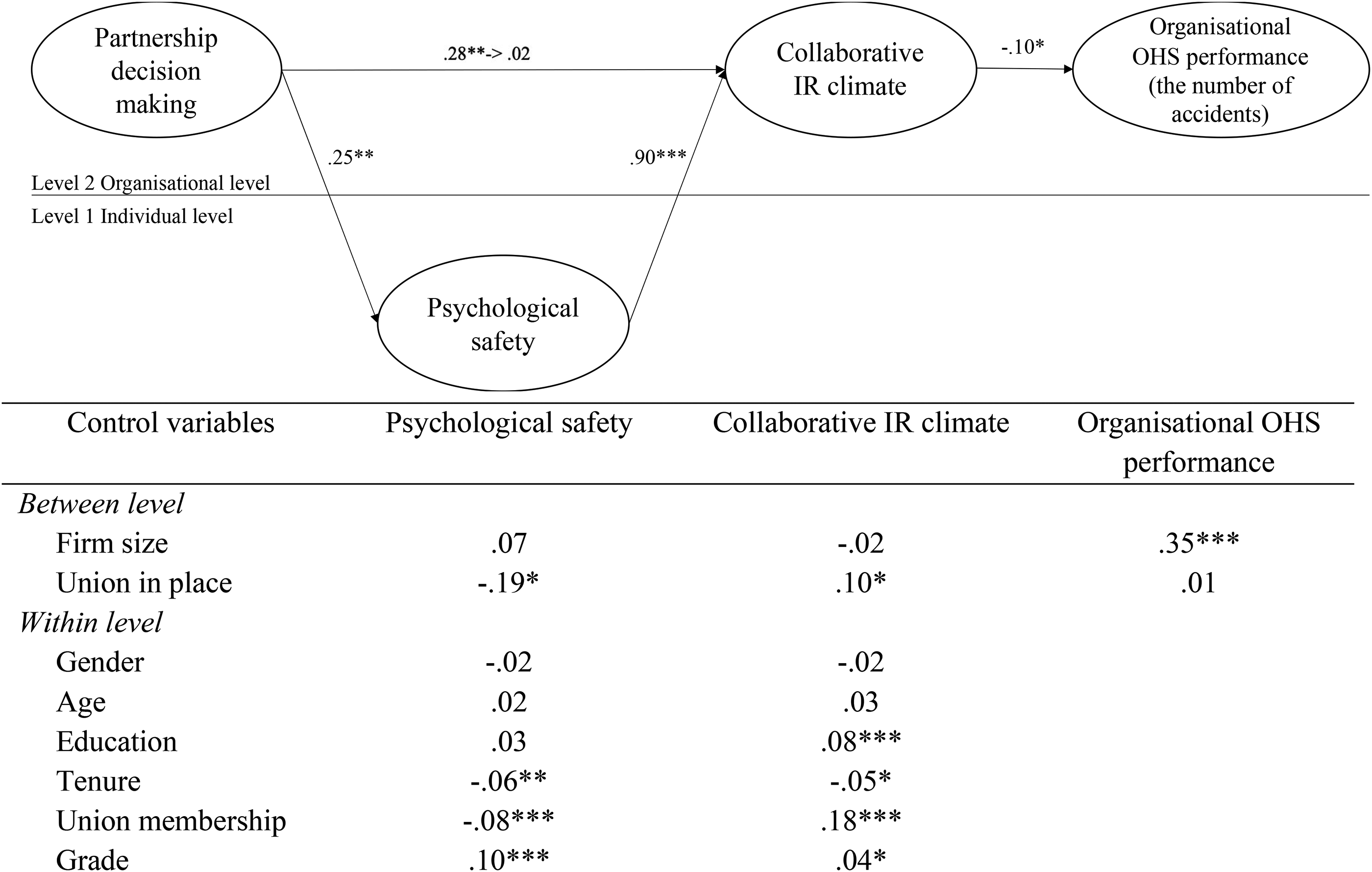
Multi-level structural equation modelling results.
Descriptive statistics.
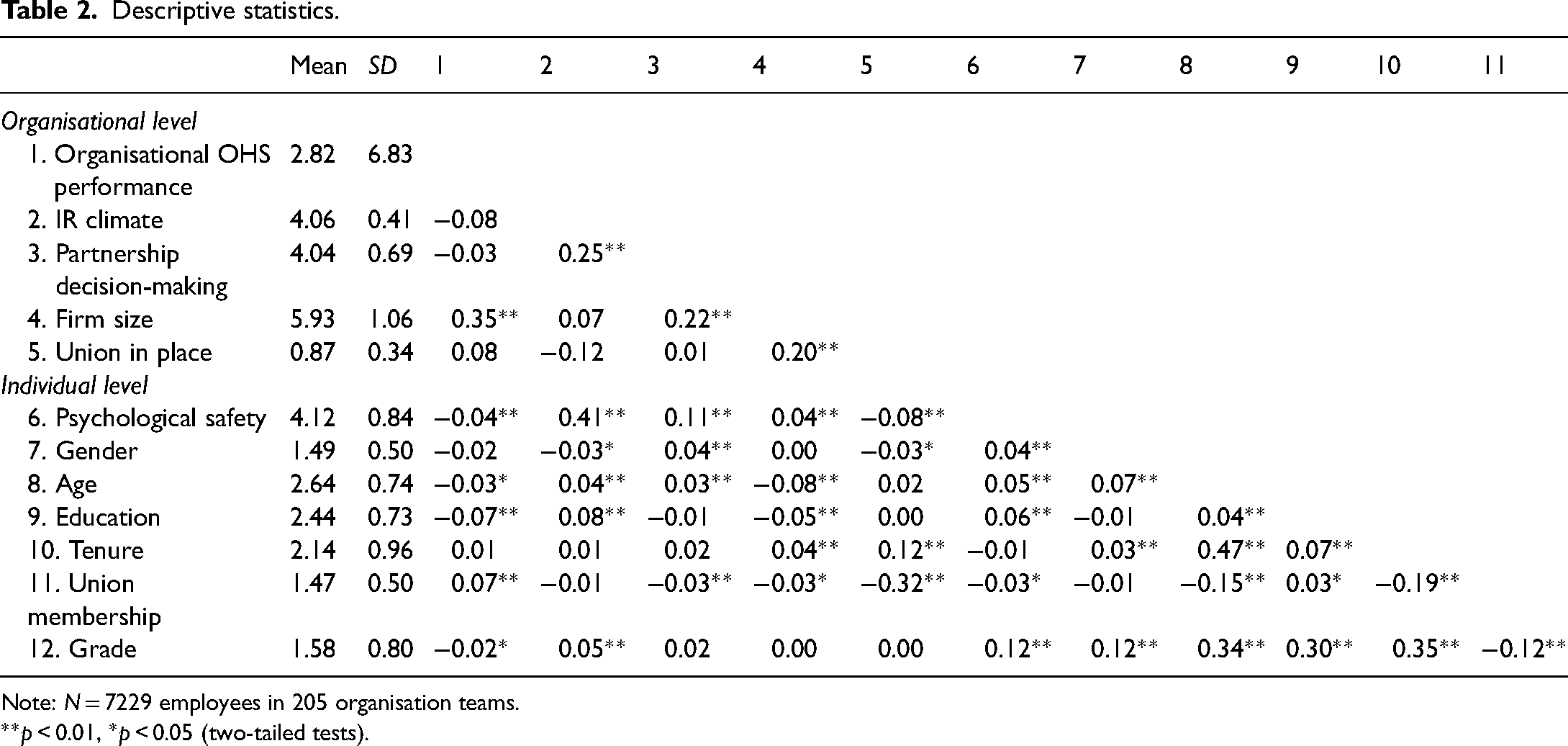
Note: N = 7229 employees in 205 organisation teams.
**p < 0.01, *p < 0.05 (two-tailed tests).
The model fit indices showed a good fit for the MSEM (X2 = 633.24; df = 74; CFI = 0.98; RMSEA = 0.03; SRMR = 0.02 within and 0.04 between). Hypothesis 1 proposed a positive link between partnership decision-making and psychological safety. The results shown in Figure 2 indicate that the coefficient of partnership decision-making on psychological safety is positive and significant (β = 0.25, p < 0.01), supporting Hypothesis 1. Hypothesis 2 proposed that psychological safety was positively linked to a collaborative IR climate. The results shown in Figure 2 show that the coefficient of psychological safety on IR climate is positive and significant (β = 0.90, p < 0.001), supporting Hypothesis 2.
Hypothesis 3 proposed that psychological safety would mediate the relationship between partnership decision-making and a collaborative IR climate. We calculated the indirect impact between partnership decision-making and a collaborative IR climate via psychological safety. The indirect impact was 0.16 (p < 0.001) with 99% confidence intervals ranged between 0.03 and 0.29, supporting a mediation model in which psychological safety mediated the relationship between partnership decision-making and IR climate. Therefore, Hypothesis 3 is supported.
Hypothesis 4 proposed a positive link between a collaborative IR climate and organisational OHS performance. This was supported by the negative impact of IR climate on the number of work-related accidents as an indicator of organisational OHS performance. The results in Figure 2 show that the coefficient of IR climate on organisational accidents is negative and significant (β = ‒0.10, p < 0.05), supporting Hypothesis 4.
Discussion
This study aimed to understand how LMP delivers mutual gains for both employers and employees. Drawing on signalling theory, it proposed and found support for a linkage model for partnership decision-making, psychological safety, a collaborative IR climate and OHS performance. The focus on partnership and its indirect impact on organisational OHS performance, as well as the study's location in the context of China, contributes to research on partnership, collaborative IR and OHS management, particularly in developing countries where non-pluralist IR and high-power distance predominate.
Research implications
This study has several research implications. First, it contributes to the debate on partnership and the mutual gains link by examining the mechanisms through which LMP affects employee experience and organisational outcomes. Partnership research has yet to understand how mutual gains are delivered (Avgar et al., 2016). This study finds that an LMP does not directly improve OHS performance but does so indirectly by developing positive employee experience, that is, psychological safety and a collaborative IR climate. The implementation of an LMP, as a signal of an organisation's commitment to collaboration, makes employees feel safe to speak up and reduces interpersonal risks. Hence, improving psychological safety is an enabler for organisational OHS performance via a collaborative IR climate. This relationship forms the so-called linkage model. This study thus extends the LMP research by identifying psychological safety and a collaborative IR climate as underlying mechanisms for LMP to deliver mutual gains for both employers and employees (Valizade et al., 2016; Wilkinson et al., 2014). In doing so, this study also contributes to an emerging stream of literature that ‘outlines the importance of positive employment relationships as part of the conditions under which partnership gains may be delivered and sustained’ (Valizade et al., 2016: 364‒365).
Second, this study contributes to OHS research by identifying key drivers in employment relations management, that is, LMP and a collaborative IR climate, particularly in the context of developing countries. This finding contributes to the OHS management literature by presenting ‘a thick processual description of what constitutes effective OHS management’ (Zanko and Dawson, 2012: 340). This study also reveals what constitutes preventative OHS management from a partnership perspective. Gallagher and Underhill (2012) and Fan et al. (2020) urge organisations to refocus systematically on a collaborative approach to preventing, detecting and controlling workplace risks and hazards. This is consistent with this study's finding that LMP increases psychological safety, which in turn develops a collaborative IR climate, ultimately delivering improved OHS performance. The identification of a linkage model involving a collaborative management model as a key driver thus extends OHS performance management, a key element of CSR (Hart, 2010).
Existing research on OHS has mainly focused on developed countries (e.g. Albrechtsen et al., 2019 in Norway; Houtman et al., 2020 in European countries; Liu, 2021 in Australia; Yanar et al., 2019 in Canada; Zacharatos et al., 2005 in Canada), with a few exceptions (e.g. Mohammadfam et al., 2017 in Iran). This study extends this literature by situating its investigation in a developing country context where employers’ tendency is to restrict employee voice and oppose trade union representatives and workers (Donaghey and Reinecke, 2018). In this context, workers may feel unsafe to voice their concerns individually about OHS issues, which may undermine organisational performance. By investigating how organisational ethical decision-making and psychological safety contribute to improved OHS performance in developing countries, this study contributes to research into OHS in developing countries.
Lastly, by focusing on LMP and OHS in a developing country context, this study provides additional support for the importance of LMP in OHS management. China is rapidly developing but has a high level of power distance and therefore limited joint decision-making between employers and employees. The limited research into OHS in China is focused on technical aspects of engineering systems and processes, workplace accidents and injuries due to unsafe working conditions (Zhu et al., 2010), mostly conducting post-accident analysis and typically not addressing concepts of pro-active prevention (Fan et al., 2020). Fan et al. (2020) call for organisations to focus instead on a collaborative approach to preventing, detecting and controlling workplace risks and hazards. In developing countries with high-power distance and hierarchical cultures, this entails overcoming barriers such as unequal distributions of power and employee silence (Kwon and Farndale, 2020; Pyman et al., 2016). For example, earlier studies (Chen, 2003; Pringle and Frost, 2003) note that trade unions play a limited role in OHS matters because they either are not present or their representation is weak, as well as due to an inability to organise workers in many foreign-owned enterprises and private companies in China. This study found that LMP reduces the number of work accidents and improves organisational OHS performance when China has strong institutional support for LMP and favourable contextual conditions. It identifies the possibility of ‘win–win’ partnerships at work in which an underlying mechanism creates a collaborative IR climate, leading to mutual gains for employers and employees in the form of improved OHS performance (Parboteeah and Kapp, 2008; Walters and Wadsworth, 2020). The study's findings reinforce the importance of partnership decision-making at the workplace level in managing OHS in developing countries. These findings therefore provide valuable insights into how developing countries use LMP arrangements in firms to prevent OHS hazards and risks.
Practice implications
Managers can learn some lessons from this study. First, this study found that the effectiveness of OHS management is influenced by the actor relationships between employees and organisations, that is, a collaborative IR climate. This finding echoes earlier studies on the benefits of a positive IR climate and related favourable organisational outcomes in the context of developed countries (e.g. Deery and Iverson, 2005). In a collaborative IR climate, the employer and employees can solve OHS issues jointly to improve OHS performance. This study thus suggests that organisations should focus not only on physical facilities, such as technologies, tools and systems, but also HRs, which are valuable assets for organisations.
In addition, this study found that LMP is a key enabler for the development of a collaborative IR climate. This finding is consistent with previous studies on the relationship between organisational structure and formation of IR climate (Dastmalchian et al., 1989; Pyman et al., 2010). In developing countries, where trade unions may be weak or absent, employers’ attitudes to designing employee voice mechanisms and involving employees in decision-making are critical for the formation of a collaborative IR climate in the workplace (Van Buren III and Greenwood, 2008). Thus, we recommend organisations adopt a partnership approach in managing people and improving LMP process management.
Lastly, this study identifies the important role of psychological safety derived from LMP in developing a collaborative IR climate. When the organisational structure and norms support employee involvement, organisations send a signal to employees that it is safe and effective to speak up, leading to the formation of a collaborative IR climate and a positive employment relationship. Psychological safety is of vital importance to achieving improved OHS (Yuan et al., 2020) and therefore enhanced organisational outcomes in developing countries.
Limitations and future research
This study has some limitations, which should be addressed in future studies. First, our survey data were collected mainly from organisations in the manufacturing industry in one industry park, and therefore, our sample may not be fully representative of Chinese enterprises and employees, and the findings may not be generalisable. We suggest that future studies collect data from other industries and regions in China. Second, it is important to note that the response rate among employees was relatively low. While it falls within the range reported in a meta-analysis of response rates for online surveys conducted by Wu et al. (2022), it is still important to acknowledge this relatively low response rate and strive for improvement in future studies. Several factors could potentially influence the response rate, such as participants’ awareness and trust in the confidentiality of survey results, which in turn can impact data quality. Wu et al. (2022) offer recommendations to enhance response rates, including targeting the defined population, pre-contacting potential participants, employing a combination of survey methods and utilising reminders. Therefore, we encourage future studies to give increased attention to response rates. 2 In addition, the employer‒employee survey in the current study is a cross-sectional data set, which limited causality between the variables. This study, however, has advanced previous work by incorporating both HR manager and employee data. Future studies could use longitudinal data to confirm the causality of the relationships. A related limitation associated with the quantitative survey method is that it does not allow in-depth investigation of LMP, the key variable in this study. The research focus of this study was to examine the indirect impact of LMP on OHS performance via psychological safety and a collaborative IR climate. The nature of the quantitative method means that we were not able to provide a contextual understanding or information about the composition and degree of formalisation of LMP. We thus call for future research to better understand how LMP is developed and/or sustained over time, especially after China's 2023 national IR tripartism initiatives to establish an enterprise‒employee community with common interests, common causes and a common destiny. Future research questions may ask 3 how organisational and social contexts influence the formation and operation of LMP and whether the functioning of LMP leads to tensions or conflicts of interest between employees and employers. In addition, this study used OHS performance to represent the mutual gains for employees and employers, influenced by LMP. In measuring OHS as the dependent variable, due to the limitation of data access, we only obtained data related to OHS performance at one point in time. To improve the robustness of the measure, we recommend future research adopt time series data reporting of the number of accidents over years, which would provide a more robust indicator. 4
Finally, our research focuses on LMP and its outcome within the boundary of the organisation. Beyond the enterprise level, future research may explore how external contextual factors facilitate the formation of LMP through a positive workplace compromise (Bélanger and Edwards, 2007; Wright, 2000) in developing countries. Stronger public policy and social arrangements are needed to support the conditions that generate greater fairness in the employment relationship. This can be achieved by nurturing partnerships to develop positive and sustainable outcomes for both management and employees (Van Buren III and Greenwood, 2008). In this way, the benefits and gains can outweigh the costs of developing workplace compromise over OHS issues and both parties are more likely to engage in a collaborative approach (Deery and Iverson, 2005).
Conclusion
Mutual gains have been a long-standing challenge for both employers and employees. This study investigates how partnership leads to improved organisational OHS performance and creates a safer workplace, achieving benefits for both parties. The focus on involving employees in the decision-making process and building psychological safety provides valuable insights into the mechanisms that support partnerships that lead to a collaborative IR climate and improved OHS performance. We encourage future research to further explore how partnerships can form a harmonious relationship between employees and management and achieve the shared goals of organisational stakeholders, particularly where LMP largely conceived in pluralist IR contexts is operationalised in non-pluralist contexts.
Footnotes
Declaration of conflicting interests
The author(s) declared no potential conflicts of interest with respect to the research, authorship, and/or publication of this article.
Funding
The author(s) received no financial support for the research, authorship, and/or publication of this article.
