







Abstract
With the rise of social media, unions are increasingly performing their identity on the digital scene. While this displacement has generated much academic speculation, the literature still largely ignores how unions concretely stage ‘who they are’ on social media. This article elaborates upon Goffman's approach to identity performance by analysing how eight Quebecois trade unions present themselves online. The findings highlight four types of online identity performance: self-caricaturing bureaucracy, fading service provider, opponent polarizing and community narcissizing identity performance. The article makes two main contributions to the literature. First, it enriches debates about unions’ use of social media by showing that digital technologies may not be considered as universally good, bad or neutral for unions’ online identities. Second, it contributes to discussions about the nature of unions’ identities by highlighting how communicational spaces help to shape them.
Introduction
With the rise of social media, unions are increasingly staging their identity on the digital scene. While the labour movement has been suffering from an identity crisis for around 40 years (Hyman, 2001), this displacement online raises some questions. Crafting an appealing identity is of vital importance for unions, as it helps them to create a robust sense of togetherness, recruit and retain members more efficiently, vilify opponents more vehemently and better highlight injustice to be fought against (Flesher Fominaya, 2010). In short, having a renewed identity can help unions to restore their lost power and legitimacy (Offe and Wiesenthal, 1980). With these challenges in mind, some consider the displacement of their identity performance on social media as an unprecedented opportunity for unions to redefine and update who they are and hence to reconnect with workers and sympathizers (Heckscher and McCarthy, 2014). However, some believe that the old, ossified unions will find it challenging to adapt to this new digital space. They speculate, somewhat pessimistically, that unions are likely to look like ‘dinosaurs in cyberspace’ (Frangi et al., 2020).
Despite the materiality of these issues, the peculiarities of unions’ online identities have not, as yet, been closely investigated, and how unions appear on social media is still largely ignored. Two bodies of work may shed some light on this question. A first group of studies indirectly explores how social media helps to shape unions’ online identities (Carneiro and Costa, 2022; Houghton and Hodder, 2021a; Pasquier et al., 2020). While these studies highlight some of the generic effects that social media has on these online identities, they fail to show the different ways in which unions stage ‘who they are’ on social media. Second, an extensive literature offers various typologies of union identities (Gumbrell-McCormick, 2013; Heery and Kelly, 1994; Hyman, 2001; Smale, 2020). While this work richly describes the variety of union identities, it is of little help in understanding how these identities are specifically performed in the digital space. Therefore, very little is known about how, both specifically and in different ways, unions present ‘who they are’ on social media. This article therefore aims to tackle the following question: how do unions perform their online identity?
To address this question, the article draws inspiration from Goffman (1959), who metaphorically compares identities to theatrical performances. According to Goffman, the staging of an actor's identity depends both on the social scene in which it is performed and the audience's reaction. This article assimilates social media to a new social scene and investigates the different ways unions perform their identity in the specific online context.
In doing so, it examines the identity performance on Facebook of eight Quebecois trade unions, following a predominantly qualitative mixed methods approach (Greene et al., 1989) which is based on social media data (6210 posts) and interviews with social media managers (SMMs). The research identifies four main types of unions’ online identity performance: self-caricaturing bureaucracy, fading service provider, opponent polarizing and community narcissizing identity performance.
The article makes two main contributions to the literature. First, it enriches debates about the unions’ use of social media by showing that digital technologies may not be considered as universally good, bad or neutral for union online identities. Second, it contributes to discussions about unions’ identities by highlighting how communicational spaces contribute to shape unions’ online identities.
Setting the scene: Social media as a digital stage for the performance of unions’ online identities
Two bodies of work shed some light on the concept of unions’ online identities: one is focused on the variety of union identities and the other on the specificities of these online identities. However, as shown below, none of them grasps both the variety and specificity of unions’ online identities.
Is there such a thing as a union's online identity?
A first strand of literature highlights the great diversity of union identities. Through many typologies, it suggests a number of characteristics by which unions can be classified: members’ sector of belonging (Clegg, 1979), members’ type of skills (Visser, 2012), unions’ political (Gumbrell-McCormick, 2013) or global orientations (Hyman, 2001) and even a mix of these various characteristics (Smale, 2020). However, whatever the categorization, this strand of literature relies on the assumption that unions only have one identity – no matter the context in which it is performed. It conceptualizes unions’ identities as unique: they are the ‘root structure’ of unions (Hodder and Edwards, 2015), their ‘very nature’ (Hyman, 2001) or their ‘stable characteristics’ (Gumbrell-McCormick, 2013). Therefore, according to this first strand of literature, there may be no such thing as a union's online identity.
Nonetheless, it is increasingly recognized that organizations – like individuals – may have different identities, which vary according to the space and the audience before which they are performed (Manning, 2008). With the ever-growing importance of social media as a communication space, specific forms of online organizational identities are said to discursively emerge (Dawson, 2018). As Dawson (2015: 33) puts it, ‘in fragmented ways, consisting of short posts, reposts, sharing links, and videos, the social media content (…) becomes the story of the organization’. To better understand how unions’ identities are specifically staged on social media, the article now turns to work at the intersection of digital technologies and unionism renewal.
Three theses about unions’ online identities
The bourgeoning academic discussion on the use of social media by unions (Geelan, 2021; Thornthwaite et al., 2020) has led to the formulation of three different theses about the specificities of unions’ online identities.
According to the first and dominant thesis, social media is universally neutral for unions’ identities as these digital technologies reflect rather than transform who unions are. In other words, while this thesis takes the view that unions’ identities shape their digital behaviour (Geelan, 2021; Geelan and Hodder, 2017; Martínez Lucio and Walker, 2005), it does not consider that digital technologies influence their online identities in return. Bellido de Luna (2022) embraces this techno-neutrality view when she concludes that the strong servicing identity of Chilean unions is reflected by their narrow use of social media and their limited ability to use these technologies innovatively. In a similar vein, in their study, Houghton and Hodder (2021b: 235) show ‘how a more militant, class-orientated union may use the Internet to reflect its identity’. Interestingly, while Houghton and Hodder (2021b) stick to the neutrality thesis, they also introduce a slight nuance which suggests that this online reflection of union identity only represents ‘a crude’ and ‘partial’ version – but they do not specify the transformations induced by social media. Another variation of this neutrality thesis assumes that digital technology does not fundamentally alter unions’ identities but helps to ‘strengthen’ identification with the union (Geelan, 2022; Hau and Savage, 2022; Wood, 2015).
The second thesis considers that social media aggravates the current identity crisis being experienced by unions and that they look like ‘dinosaurs on the Internet’ (Frangi et al., 2020). This view of unions as backward organizations derives from their enduring traditional top-down and leader-driven process of identity performance, which is ill-suited to the new digital context. According to Carneiro and Costa (2022: 18), when unions go online, they ‘reproduce an outdated “one-way” model of communication, using Facebook mostly to relay information rather than taking advantage of the interactive affordances of social media’. The communication style that unions use on social media therefore gives them an outdated online identity by highlighting their inability to adapt to the new and fast-changing social media environment.
The third and more optimistic thesis suggests that unions can take advantage of the unprecedented affordances that digital technologies offer (Hennebert et al., 2021) to positively transform who they are online. Such research suggests that social media can propel more horizontal and participatory processes of identity performance (Pasquier et al., 2020; Pasquier and Wood, 2018), thus supporting the emergence of a more inclusive and open-ended identity (Heckscher and McCarthy, 2014). Through these technology-supported processes, unions can move beyond their traditional class-based identity, driven by white, male manufacturing workers, which arguably lies at the heart of the current union identity crisis (Tapia et al., 2017).
In summary, the literature about the use of social media by unions highlights how technology can have a general effect on their identities. However, it still fails to distinguish its effects across the various union identities discussed earlier. In what follows, we elaborate on the work of Goffman (1959) to capture both the specificity and diversity of union online identity construction.
Unions’ identities on social media as staged performance
Goffman famously elaborates on the theatre metaphor to compare identities to staged performances. This metaphor underlines that identities are interactively and specifically performed in a given context. In recent years, some studies have used Goffman's approach to analyse how individuals stage their online identities (Bullingham and Vasconcelos, 2013; Marwick, 2013). These studies advance three critical aspects for studying the performance of online identities: role taking, dramatization and idealization. Interestingly, various organizational identity scholars (Manning, 2008; Sillince and Brown, 2009) demonstrate that these three dimensions of individual identity performances theorized by Goffman are also transposable to collective actors. This conceptual approach has notably been applied to counterpower and democratic organizations (Benford and Hunt, 1992), which have similar structures and purposes to those of unions. As Manning (2008: 687) explains, ‘an organization is an actor (…) that could create and disseminate impressions to its advantage. It could create a sustaining imagery to compete in an organizational environment. (…) It has to sustain its legitimacy in the present’. The article next presents these three aspects of identity performance and discusses how they can be applied to the study of unions’ online identities.
Role taking
First, Goffman suggests that the performance of identity involves selectively adopting a role or a ‘mask’ to project one particular aspect of self. For counterpower organizations such as labour unions, Flesher Fominaya (2010) suggests that four different types of role can be adopted. These roles are synthesized here as follows: member-centred roles (‘who the constituents are’), purpose-centred roles (‘what the organization fights for’), antagonist-centred roles (‘who it is fighting against’) and organization-centred roles (‘how we act collectively’).
How social media influences the type of online role endorsed by unions remains unclear. Some consider that the short-term and individualist orientation of social media tends to direct online identities to punctual causes and member-centred roles (Stewart and Schultze, 2019). Others, however, recommend resisting this trend. They advocate following more organization- or opponent-centred roles, which they consider to be the only ones capable of developing ‘a counter-hegemonic political project that truly challenges the existing order’ (Mouffe, 2013 cited in Decreus et al., 2014: 136).
Dramatization
Second, Goffman suggests that actors dramatize their roles when performing their identity. Dramatization has two main goals: to make the role credible and to make a positive impression on the audience (Bullingham and Vasconcelos, 2013). Actors will then constantly adjust their identity dramatization in response to the audience's reaction (Goffman, 1959).
On social media, dramatization is mainly performed through textual or non-textual cues such as emojis, visual communication and content (Bazarova et al., 2013). It is also driven by the unprecedented opportunities for the audience to interact. Audience contribution through ‘liking’ and ‘sharing’ significantly influences how organizations dramatize their online identity (Dawson, 2018).
Here again, the literature still largely ignores how unions dramatically stage their online identity. As an illustration, while some believe organizations are required to stage overly positive emotions online (Dawson, 2015), others suggest that social media favours cleaving, inflammatory and populist forms of staging when it comes to counterpower organizations such as unions (Gustafsson and Weinryb, 2020).
Idealization
Third, Goffman argues that identities are performed in accordance with perceived social norms through ‘idealization’. It has already been shown that specific social norms develop around the use of technologies (Marwick, 2013), as illustrated by the term ‘internet culture’. More precisely, each social media platform conveys specific social norms for how identities should be performed. For instance, Facebook invites its subscribers to ‘idealize’ a private self and LinkedIn encourages a more professional one (van Dijck, 2013). However, even within a single social media platform, there can be distinct and potentially conflicting social norms.
When it comes to unions, the literature still largely ignores which social norms are perceived as dominant or worth being conformed with on social media. Carneiro and Costa (2022), for example, suggest that the superficial and leisure-oriented norms of social media may well clash with the seriousness associated with unions. However, others consider that the new spirit of activism fuelled by social media (Bennett and Segerberg, 2012) fosters social norms such as inclusivity, egalitarianism and self-determination (Castells, 2012).
Finally, the literature suggests that role taking, dramatization and idealization are deeply imbricated: actors try to consistently perform their identity by aligning these three components. In what follows, this article applies the three-dimensional analytical framework inspired by Goffman (1959) to study how unions concretely perform their online identities.
Methodological backstage
Aligned with the research question, this article adopts a predominantly qualitative mixed methods approach (Greene et al., 1989) to analyse the online identity performance of eight labour unions from the Canadian province of Quebec.
Case selection
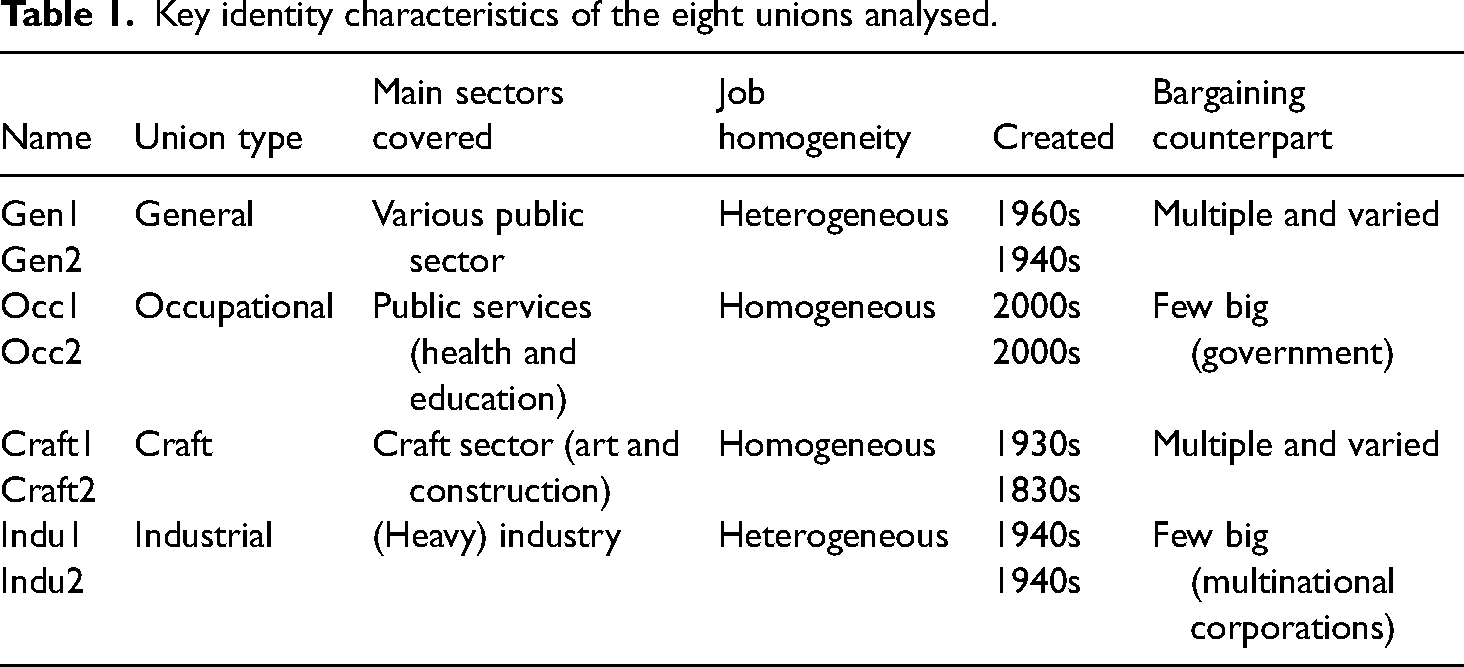
The eight unions were selected in pairs to cover the four main types of union commonly found in the literature (Clegg, 1979; Smale, 2020), namely craft, industrial, general and occupational unions (see Table 1). The paired unions also have comparable membership sizes and dates of creation. In addition, to guarantee a sound comparison, steps were taken to ensure that each union had had a SMM for at least 5 years.
Key identity characteristics of the eight unions analysed.
Data collection
In line with the premise that identity performance is both a conscious and unconscious process (van Dijck, 2013), two complementary sources of data were gathered: interviews with SMMs and unions’ communications on social media. Crossing these two sources enabled the analysis to be triangulated and expanded (Greene et al., 1989).
To begin with, eight semi-directed interviews with the SMMs were conducted to better understand how and why they used social media. The interviews lasted between 90 and 180 min, were recorded and then fully transcribed.
The focus for the digital data was on Facebook pages, as all the SMMs confirmed that they were by far the most important digital medium for their communications. They also all confirmed that Facebook was primary used to communicate with members, making it an organizational identity performance medium rather than an image performance medium (Hatch and Schultz, 2002). Netvizz was used to collect all the messages posted on the eight unions’ official Facebook pages over a period of 2 years (1 June 2016 to 31 May 2018). Choosing such a sufficiently long period ensured that the unions’ communications had not been overly impacted by specific events. It also enabled us to gather a substantial source of discourse that fairly reflects their organizational online identity (Brown, 2006). In total, 6210 posts were collected, ranging from 388 to 1121 posts per union (776 on average).
Data analysis
The data analysis was conducted in the following four steps.
Step one: Identifying the role adopted
The first step involved identifying which of the four roles was dominantly adopted by each union (organization-centred, purpose-centred, antagonist-centred or member-centred role).
To become familiar with the unions’ online identities, the first author and a research assistant started by reading the same 1256 posts (157 posts randomly selected per union) and both took extensive notes on each union's online identity. They then coded the purposes of these 1256 posts following the three-stage Gioia methodology (Gioia et al., 2013). In the first stage, the first author coded openly and inductively the purpose of the posts and sorted them into first-order codes. These descriptive first-order codes were identified through multiple iterations. In the second stage, the first author moved from open axial coding to more abstract and second-order theoretical categories (see Appendix D). Four categories of purpose emerged: visibilizing unions’ internal activities (organization-centred), influencing society (purpose-centred), confronting the employer (antagonist-centred) and informing and valorizing members (member-centred). In the third stage, once the codes were stabilized, both the first author and the research assistant coded the same set of 1256 posts to evidence their purpose. In cases of disagreement (289 occurrences, i.e. 22% of the posts), both coders engaged in a discussion until they reached an agreement about the purpose of the post.
The orientation of the unions’ roles in relation to their organization, their purpose, their antagonists and their members was further refined through content analysis of the whole data set (6210 posts). Detailed evaluation was carried out on the extent to which the unions were organization-centred by counting the proportion of posts which included the name of the union, its leaders and its executive functions. The extent to which they were member-centred was assessed by counting the proportion of posts which referred to members’ occupations, employment status and union membership. Finally, the extent to which they were antagonist-centred was evaluated by counting the proportion of posts which referred to the antagonist (employer, company, boss, municipality, etc.)
Finally, the Facebook data analysis was triangulated with the SMM interviews.
Step two: Analysing the dramatization
This second step entailed characterizing the identity dramatization by examining the variety and intensity of the emotional regimes used (see Appendix B). Emotional negativity was assessed by counting the posts that generated more than 7% of ‘sad’ or ‘angry’ reactions, and the use of humour was assessed by counting the posts which generated more than 5% of ‘fun’ reactions. Finally, the rhetorical style was assessed by counting the number of question marks, exclamation marks and emojis used (Bazarova et al., 2013).
Following this, the unions’ dramatization techniques were examined according to the type of content published online. Unions can use Facebook to push union-created content, to redirect users to their own website or to circulate external content. It was therefore important to pay attention to the proportion of external content shared by the unions without any comment by them.
Next, the audiences’ contributions to the dramatization (Dawson, 2018) were identified by focusing on the level and nature of the Facebook followers’ engagement. The level of engagement (active or passive audience) was assessed through the number of reactions (likes, angry, sad, laughing emojis, etc.) per 10,000 union members. This enabled the audiences’ contributions to dramatization to be classified as passive (low level of engagement), reactive (high level of engagement and low proportion of comments) or participatory (high level of engagement and high proportion of comments).
Step three: Analysing idealization
This step primarily consisted in inductively coding the interviews to identify the social norms perceived by the SMMs on social media. While some norms were perceived by actors across most unions, further analysis of the interviews revealed the dominant norms that specifically affected each union. To validate the relative importance of each of these perceived social norms and thus triangulate our interpretation, we relied on the notes taken by both the first author and the research assistant while reading the whole set of posts.
Step four: Creating a typology of online identity performance
After analysing each union's role taking, dramatization and idealization, the final step involved grouping their online identity performance. This complex task was conducted by going back and forth between Facebook data, the interviews and the literature. In line with Eisenhardt (1989), a comparison was made of the unions paired according to their type, followed by wider cross-union comparison. Four types of online identity performance eventually emerged from the analysis.
On stage: Four types of online identity performance
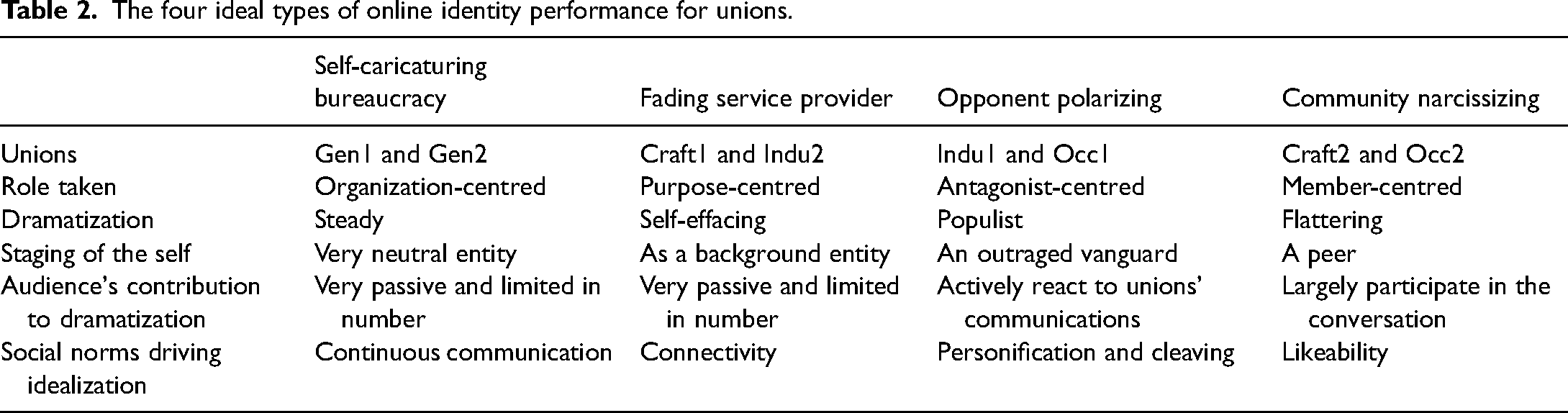
Four main types of online identity performances emerged from the findings. These can be described as self-caricaturing bureaucracy, fading service provider, opponent polarizing and community flattering identity performance (see Table 2). The four types are presented below.
The four ideal types of online identity performance for unions.
Self-caricaturing bureaucracy identity performance
The first type of online identity performance to emerge from the analysis is self-caricaturing bureaucracy identity performance (Gen1 and Gen2).
The bureaucratic organization-centred role
The term ‘bureaucratic’ is used to indicate that the focus of this online identity is on the union organization itself. This role was clearly assumed by the Gen2 SMM, who stated: Our focus (on social media) is on union life. We want to showcase the services that we deliver, our training, the union authorities (officials), our meetings and congresses.
This organization-centred identity was supported by the numerous references made to the union's name (about 46% of the posts) and the unparalleled tendency to communicate about the organization itself (37% of posts, compared to 11% in the sample). The bureaucracy metaphor also aims to underline the many commonalities with Weber's (1922) figure of the bureaucrat: an impersonal actor who steadily performs routine tasks. These unions communicated much more frequently about their functions than about individuals. As an illustration, 29% of their Facebook posts referred to executive functions (those of the president, vice president, treasurer or secretary), while only 3% referred to the individual names of union leaders. The post by Gen2 typically reflected this bureaucracy-centred role (see Figure 1(a)).
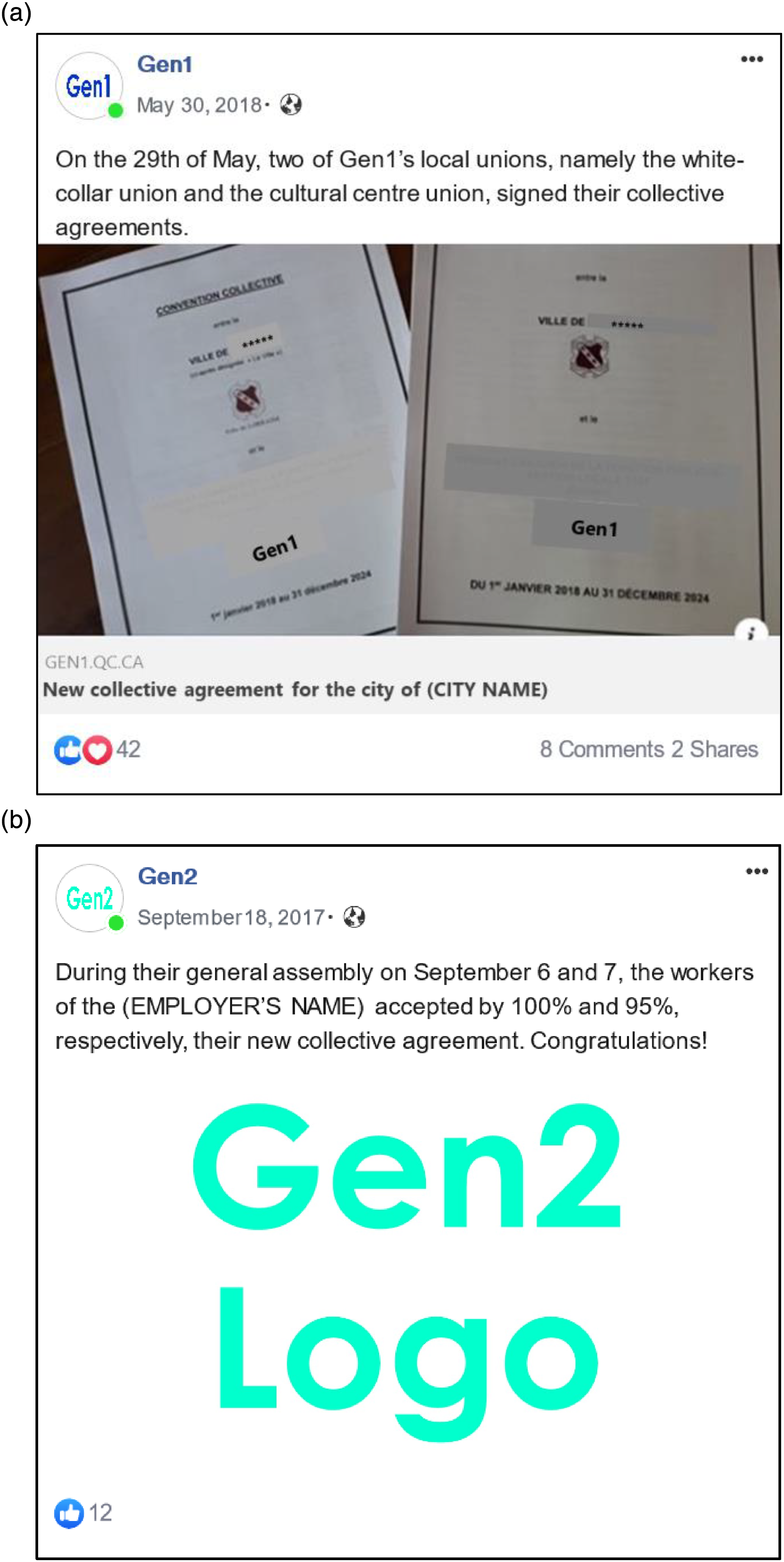
(a) Gen1 status. (b) Gen2 status.
The findings suggest that the dramatization of this bureaucracy-centred role helps to exaggerate its dominant traits, as shown below.
A self-caricaturing dramatization
This study suggests that social media theatricalization contributes to caricatural bureaucratic identity. This grotesque digital effect derives from highly repetitive and excessively neutral communications which, in turn, generate very few reactions from their disproportionately small audience. The bureaucratic caricature is exemplified by Gen1's post, which strongly recalls that of Gen2 above (see Figure 1(b)).
The first element which contributes to caricatural bureaucratic identity on social media is the steadiness and repetitiveness of the communications. About 40% of the Facebook posts referred to the union's everyday activities, such as executive meetings, training sessions, general assemblies and negotiation processes. These indistinct and repetitive posts created a litany of mundane facts which underlined the cyclical routine of the union machinery. In the end, the repetitiveness of these social media communications created a caricature of bureaucracy by portraying these unions as existing only by themselves and for themselves. The caricatural bureaucratic identity was further accentuated by the neutral tone of the communications, which resulted in a high level of audience passivity. Bureaucratic unions generated the lowest level of engagement by far.
The caricatural dramatization also derives from the unions’ ‘old-fashioned’ use of social media as a more traditional one-way, top-down communication channel. Typically, 34% of their Facebook posts aimed to redirect the audience to the unions’ website (against 13% in the sample) where their ‘official communiqués’ were posted. Using social media in this way demonstrates the inability of steadfast bureaucracies to evolve to take advantage of the new digital environment.
This caricatural identity is further accentuated by its very small online audience, as only 5% of the members of these unions followed their Facebook page. It is therefore reasonable to assume that their online followers were mostly members of the unions’ apparatus: delegates, stewards, staff, etc. This disproportionately small audience therefore reinforces the caricatural bureaucratic identity as it portrays these unions as organizations which operate for their own sake.
Finally, this caricatural dramatization relates to the unions’ perceived requirement to continuously communicate on social media.
An idealization driven by the ‘continuous communication’ norm of social media
The self-caricaturing dramatization strongly derives from repetitiveness. This article relates this repetitiveness to the ‘continuous communication’ norm, which the SMMs perceived as dominant. Indeed, all the communication professionals interviewed insisted that it was necessary to communicate very frequently, as summarized by Gen1 SMM: You have no option (to be on Facebook), because it is here. People no longer read newspapers. They go on Faceboook to read the news. Hence, I go on Facebook and buy ads to circulate our news. (….) And you have to feed it (the union Facebook page) otherwise, it is going to die…
Therefore, SMMs felt obliged to communicate as much as possible. According to this perceived rule of the social media game, it is the amount of online communication that determines its quality. However, bureaucratic unions may not have as many opportunities to ‘create news’ as other organizations, meaning that they communicate even when they do not have much to say, as clearly expressed by the Gen1 SMM: When we have not published anything new for three or four days, we go and look for older news. We call this practice ‘digging into the trash bin’. Because three or four days without any news, I think it is too long.
To conform to this continuous communication norm, bureaucracy-centric unions posted as frequently as the other types of unions (four times a week, against an average of five in the sample). However, by sticking to these implicit social media norms, the online narrative of bureaucratic unions starts to mimic a scratched record, with similar news about union routines being repeated over and over.
Fading service provider identity performance
The second online identity performance to emerge from the study is that of the ‘fading service provider’ (Craft1 and Indu2).
The ‘service provider’ purpose-centred role
These unions are referred to as ‘service providers’ to underline that the role they take online is primarily constructed around their purpose. This purpose-centred online identity is clearly articulated by Craft1 SMM, who saw social media as yet another tool for providing services to members: Our members are happy to have a union, but they are focused on their own work. (…) It is only a matter of interest: they are fully focused on their career. So, we (the union) are a tool for them. We provide them with very concrete tools to support their career.
This service-centred role is more clearly demonstrated by these unions’ use of social media, as about two-thirds (65%) of their Facebook posts aimed to serve members by providing them with professionally useful information – compared to an average of 24% in the sample. Most of the news shared on Facebook emanated from professional, business or mainstream media and related to business activity (e.g. launch of new products), job markets (job opportunities, skills updates, etc.) or to professional practices (see for instance Craft1 post in Figure 2(a)).
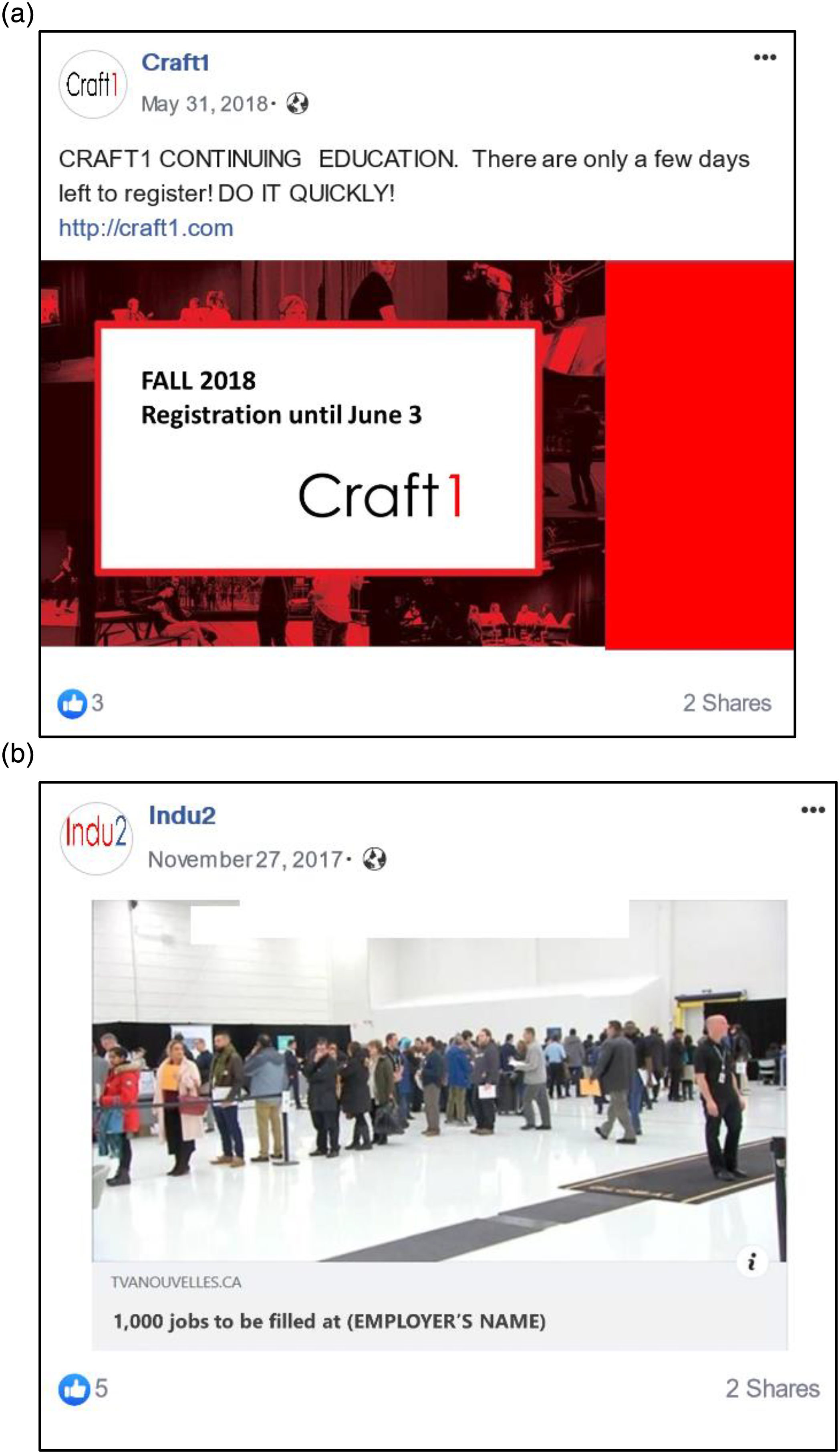
(a) Craft1 status. (b) Indu2 status.
This service-centred role is further evidenced by the disproportion between the numerous references made to the audience served (either as workers or professionals) and the quasi-absence of the union itself in the online communications. As an illustration, the union's name only appeared in approximately every 10 posts (against 33% in the sample).
This service provider dramatization on social media contributes to effacement of the unions’ identity, as shown below.
A ‘self-effacing’ dramatization
By performing their identity on social media, service provider unions arguably obscure their organizational identity due to a self-effacing dramatization. The fading effect derives from an online identity which is so discretely and neutrally performed that it tends to vanish (see for instance Indu2 post in Figure 2(b) as an illustration).
The main element that contributes to identity evanescence is the specific use of social media by fading service providers. Their online communications overwhelmingly comprised sharing external content (77% of posts). According to the principle of communicating vessels, the primacy given to the circulation of external content eventually overshadows the union itself. The union's disappearance is further reinforced by the significant proportion of posts (26%, against 8% in the sample) shared on Facebook without any introduction or comment from the union.
The self-effacing dramatization is further exacerbated by the highly neutral and factual tone of the communications, best evidenced by the quasi-absence of emojis and exclamation or question marks. The Facebook posts were almost never humorous and rarely expressed indignation or exasperation. The unions’ identities were further eclipsed by the rare references to their names, which appeared in only 13% of their Facebook posts, against 33% in the sample.
Finally, the self-effacing staging is strengthened by the limited contribution of the audience. This overall low level of engagement indicates that the audience acts as detached service consumers, strongly echoing the union's fading service provider identity.
This fading dramatization is related to the norm whereby social media should primarily be used to connect people and circulate information.
An idealization driven by the ‘connectivity’ norm
Self-effacing dramatization is related to the SMMs’ perceived compulsion to create a permanent connection with members by sharing news with them. This ‘connectivity’ norm was particularly salient with service provider unions as social media represents a means to create and maintain a permanent link with members: We want to tell our members that we are thinking of them. One way to evidence this is to actively inform them about what is going on in their industry. (Craft2)
However, their need to constantly connect with members can become a compulsive habit, as the Craft1 communication officer suggested: I am crazy about news and the web. As soon as I see something interesting, I tell our social media manager: share it. (…) So we publish job offers, news about public affairs… All these kinds of things are of strong interest to our members. So, I share them.
This constant need to share news to better serve the members may be detrimental to the unions’ online identity. The over-sharing of news may indeed eventually relegate the union to the very rear of the background.
Opponent polarizing identity performance
The third online identity performance to emerge from the study is ‘opponent polarizing’ performance (Occ1 and Indu1).
The antagonist-centred role
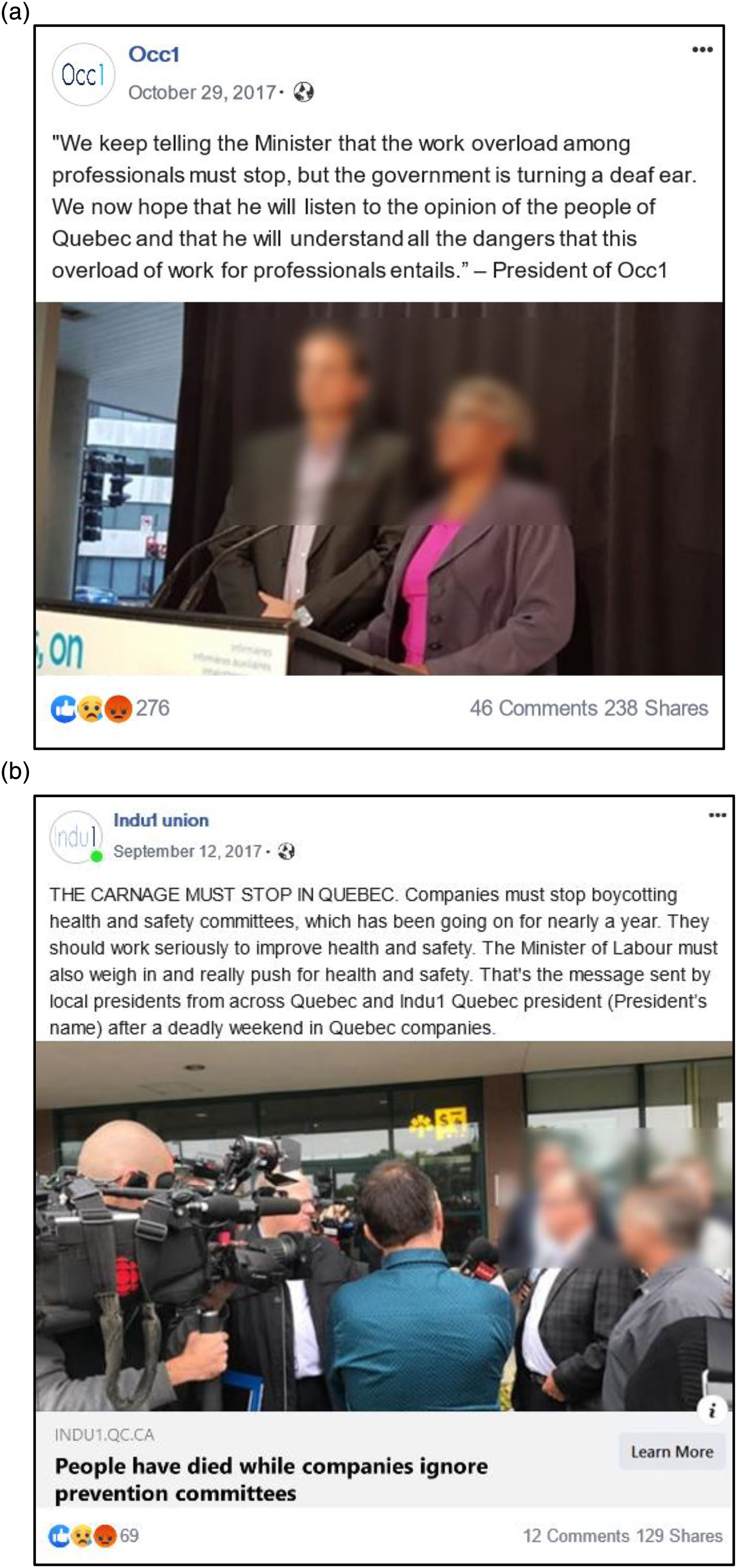
These unions were first identified as ‘opponents’ as the roles they took online were largely constructed by their contrast with their antagonists. Indeed, no other union type referred so frequently or so negatively to its bargaining counterparts (see Occ1 post in Figure 3(a) as an illustration).
(a) Occ1 status. (b) Indu1 status.
In no other cases were the union (64% of posts, as opposed to 33% in the sample), its executive (43%, as opposed to 15%), its leaders (15%, as opposed to 7%) and its antagonists (41%, as opposed to 34%) so frequently juxtaposed.
It is unsurprising that the main purpose of their online communications was to confront the employer (33%) and to influence societal debates (29%). The online content disseminated by these unions was generally directed at denouncing, for example, the employers’ attitude, the government's policies or the members’ working conditions. These unions also actively used social media to organize collective actions and to share images of these events (notably pictures and videos of picket lines and demonstrations).
The populist dramatization of antagonist-centred unions further exacerbates the union–adversary opposition, as discussed next.
A ‘populist’ dramatization
By performing their identity on social media, opponent unions arguably intensify the duality between ‘we’ (the union) and ‘them’ (the employer) due to populist dramatization. Populist dramatization entails upfront opposition between the union vanguard and its enemy, which is further exacerbated by the use of a negative and polarizing tone. Populist dramatization is illustrated, for example, by Indu1's communication (see Figure 3(b)), in which the union vehemently blamed big multinational corporations for neglecting its workers’ health and safety.
Opponent unions embrace populist dramatization by turning the omnipresent union and its leaders into a type of vanguard. The online staging of the self suggests a vanguard (as in ‘vanguard of the proletariat’) in the sense that it was presented as a small group of highly dedicated leaders engaged in the fight against their adversaries (the employer). The presentation of the union as a contention-oriented elite was further augmented by the voluminous and mostly supportive reactions of the unions’ followers – which were by far the highest (13 reactions per post and per 10,000 members, as opposed to 6 on average in the sample). As an illustration, Indu1 SMM made a clear link between the high volume of reactions and the conflict orientation of the union: We use social media for mobilization. A lot. A lot. A lot. As you mobilize, sometimes you have to accept being overwhelmed. You have to accept that you are creating a wave and that the wave at some point is bigger than you think, and that’s okay too.
It is important to note that this dramatization primarily prompted reaction rather than active participation. Although the number of reactions was very high, the number of comments remained standard and did not deviate from the median observed in the sample.
The second element which contributes to populist dramatization is the dominantly outraged online tone adopted. These unions’ emotional regimes were strongly oriented towards negativity, which contributed to union–employer cleavage. This polarizing stance was evidenced by the many exclamation marks used in the communications and the large number of negative reactions (anger/sadness) from the audience (15%, as opposed to 9% on average) as well as the lack of humorous reactions (1% of posts).
An idealization driven by the ‘personification and cleaving’ social media norm
This article relates populist dramatization to two different but connected social media norms, namely personification and cleaving.
Regarding the personification norm, union SMMs perceived social media in general – and Facebook in particular – as digital spaces designed for individual rather than organizational expression. Opponent-centred unions may therefore feel the need to give greater visibility to their leaders, who are staged as the main vehicle for the voices of the workers. This personification norm implied by social media was summarized as follows by Indu1 SMM: In your way of publishing on Facebook, people are expecting a more personal tone, a greater proximity.
The cleaving norm of social media derives from the perceived requirement to communicate in a brief and catchy manner. This perceived norm can be explained by the need to attract the attention of the readership in a communication space where text length is limited and where there is keen competition between publishers. Adopting a more cleaving stance may therefore be a natural option for opponent unions, as indicated by the Indu1 SMM: We are more activist, so we ask ourselves less questions (about the publication content).
This article contends that unions with an opponent identity may be strongly receptive to personification and the cleaving norms of social media as they may support their orientation towards contention. Their online identity therefore features populist dramatization characterized by a union–antagonist dualization and a more trenchant style of rhetoric.
Community narcissizing identity performance
The fourth type of online identity performance to emerge from the data is ‘community narcissizing’ identity performance (Craft2 and Occ1).
A ‘community’ member-centred role
These unions are referred to as ‘communities’ to indicate that their online role revolves around their membership. This member-centred ‘community’ identity was unambiguously endorsed by the Craft2 SMM, who stated that: We see Facebook as a community empowerment tool that gives our members the feeling that they are not alone, that they can make a difference.
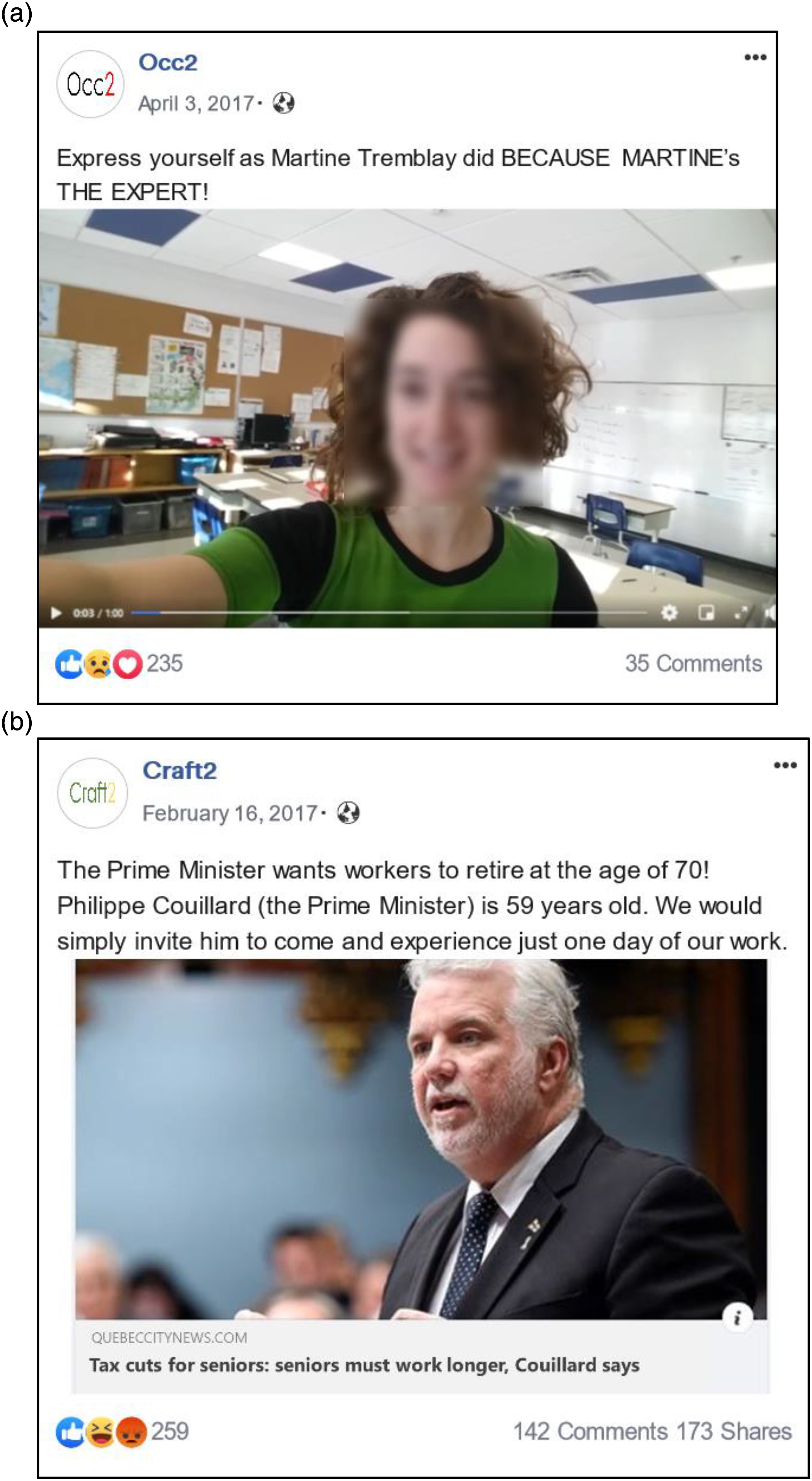
It was further strengthened by the frequent references to members’ professions (52% of posts), while the union itself was less frequently cited (23%). The community-centred identity was also supported by the purpose of the communications, which valorized the community (32% of posts), defended it (25%) and supported its wider contribution to society (34%), notably by encouraging its members’ self-expression (see the Occ2 post as an illustration in Figure 4(a)).
(a) Occ2 status. (b) Craft2 status.
The role which these unions embraced derives from the members’ strong identification with their profession, as explained by the Craft2 SMM: Our members on Facebook are very interested in one particular topic: their own career! So we directly talk about that.
While their online communications clearly indicate the community orientation of these unions, their flattering dramatization on social media contributes to narcissizing their identity.
A ‘flattering’ dramatization
Member-centred unions performed their identity through a flattering dramatization, understood as the celebration of an adulated collective identity. This flattering dramatization occurred through the great efforts of the SMMs to create a positive image of the audience to maximize its online participation. The community flattering staging is reflected in the Craft2 post, which also criticized the prime minister for being disconnected from the reality of the workplace and humorously recalled the bravery of the workers and their harsh working conditions (see Figure 4(b)).
Several elements contributed to this flattering dramatization. First, SMMs frequently reacted to events or news articles to compliment the union membership by positively underlining their skills, their courage or their professional merit. As the Craft2 SMM put it: We have a strong (occupational) identity. We focus a lot in our communications on that feeling of pride of our members. And within our industry, there are good reasons to be god-damned proud. So we publish about their reality and they are incredibly proud about that – this is crazy!
This flattering strategy was supported by an intense and varied staging of emotions, ranging from enthusiasm and humour when celebrating the community to anger or sadness when defending it against employers and/or the legislator. This emotionality was further conveyed by the frequent use of emojis or exclamation marks, which helped the union to stage its own feelings.
This flattering dramatization was also supported by the conversational tone adopted by these unions. The aim here was to encourage a sense of authentic friendship and workplace camaraderie in order to stimulate the community's ego. Multiple tactics were used to create the tone of a friendly online conversation. For example, SMMs sometimes referred to the union's membership as ‘la gang’ – a colloquial Quebecois term for a group of friends. Importantly, they also frequently asked questions to assess the mood or get the audience's opinion. This tactic specifically reflects the first-order importance of the audience (about 10% of posts contained a question mark). It is unsurprising that this flattering stance generated more comments than any other type of union.
Finally, this flattering dramatization is related to the perceived obligation to generate as many ‘likes’ as possible on social media.
An idealization driven by the ‘likeability’ social media norm
This article relates identity flattering to the SMMs’ perceived compulsion to generate as much engagement (and above all ‘likes’) from the audience as possible. This likeability norm is directly related to social media algorithms which boost the visibility of posts as audience engagement increases. Hence, the ability of SMMs to reach their audience directly depended on their skills in creating engaging online content, as one SMM stated: As soon as people comment, share or like, Facebook can see that your post is pretty popular. As Facebook's goal is to generate traffic, Facebook makes posts that generate engagement more visible. And the more it is shared, the more it is visible. (Indu1)
Naturally, SMMs aimed to disseminate their posts as widely as possible in order to reach their membership and beyond. This could lead them to prioritize a communication style and content with good engagement potential. In this regard, the SMMs agreed that the posts that generated the highest level of engagement were those which directly resonated with people's individual (work)life experience, as Occ2 SMM explained: I think that topics directly related to their occupation generate extremely high interactions. I do analyse the statistics about what is more engaging for the audience. And when publications speak directly to the members themselves, they share, and they also comment.
Finally, the race to visibility could make SMMs adopt a flattering communication style which helped to narcissize the union's online identity.
Playing the critique: Discussion about the performance of union online identities
The aim of this article was to investigate the diversity and specificity of unions’ online identities. To do so, the article elaborated an analytical framework inspired by Goffman (1959) and studied the online identity performance of eight Quebec unions. Four main types of identity performance emerged: self-caricaturing bureaucracy, fading service provider, opponent polarizing and community narcissizing identity performance. This typology led to three main contributions.
Contributions to the literature on unions and social media
The first contribution to the literature is to academic discussions about social media and unions.
Our findings sharply contrast with those who subscribe to the techno-neutrality thesis and believe that social media reflects rather than affects unions’ identities (Martínez Lucio and Walker, 2005). While we concur that some union characteristics constrain and direct how unions communicate on social media (Bellido de Luna, 2022), our findings strongly indicate that social media also shapes unions’ online identities in return. More precisely, our findings highlight how the technical features of social media and the cultural norms associated with them influence how unions perform who they are online. These findings suggest that online identity does not just represent a ‘crude’ and ‘partial’ version of union identity (Houghton and Hodder, 2021b); through the concept of role taking, they show that a union's online identity is actively constructed around a selected and actual facet of its ‘inner’ self.
This article also clearly departs from the other two theses, which consider the emergence of social media to be intrinsically good (Wood, 2015) or bad (Carneiro and Costa, 2022) for unions’ identities. The effects of social media are far from universal and can have contrasting outcomes depending on how the unions use social media.
The ‘opponent polarizing’ and ‘community narcissizing’ identity performances seem to generate overall positive effects for unions. The level of engagement that they generate strongly suggests that they strengthen members’ identification with unions (Geelan, 2022; Wood, 2015). However, these two types of performance also create some challenges for unions. It can be argued that ‘opponent polarizing’ has become attractive because it manages to renew the symbolic world of social justice and to narratively challenge the dominant symbolic world of the capitalist system. However, Gustafsson and Weinryb (2020) also warn against the detrimental effects of polarization on social democracy as it prevents the conditions for informed and reciprocal dialogue. Regarding the ‘community narcissizing’ identity performance, its dramatization is likely to boost collective self-esteem, but an excess of self-centrism can also prevent any form of critical reflexion (Hatch and Schultz, 2002) and can complicate interactions with union stakeholders.
In contrast, ‘self-caricaturing bureaucracy’ and ‘fading service provider’ identity performances on social media have overall negative consequences for unions. They each fail to engage online followers, indicating that these types of identity performance lead to disidentification with unions. These two unengaging identity performances highlight the social media threat that algorithmic invisibility poses to unions, an issue which is somewhat neglected in the literature. While the main risks associated with social media in the existing literature focus on unions looking ‘bad’ or ‘outdated’ online (Carneiro and Costa, 2022; Ward and Lusoli, 2003), this article suggests that digital technologies can pose an existential threat to them. This risk seems to be accentuated in the case of ‘fading service providers’, as the dramatization strategy further erases their online identity. Hence, unions may not just look like dinosaurs online; they may disappear altogether from the digital space as they are invisibilized by social media algorithms.
Finally, this work complements the two ‘optimistic’ and ‘pessimistic’ theses by offering an alternative approach to the process of union online identity performance. While the pessimistic thesis describes unions’ online identity performance as a purely top-down, non-participatory process similar to how they traditionally communicate offline (Carneiro and Costa, 2022), the optimistic thesis depicts their online identity performance as a much more horizontal and participatory process through which all members can easily contribute to defining the collective identity (Heckscher and McCarthy, 2014). Our approach, which is based on Goffman's concept of identity performance, thus suggests an alternative and somewhat intermediate view of online identity performance. While this identity performance approach clearly indicates a top-down process driven by union communication managers, it also reveals that this downward performance is also highly interactive, as communication managers adapt to the audience's participatory reactions. By so doing, this article refines our understanding of the respective roles that union leaders and members play in the dual, interactive process of unions’ online identity performance, where leaders propose a certain conception of union identity which is then confirmed (or not) by members. This process therefore creates a high-frequency but relatively poor-quality feedback loop for union identity performers, which raises questions about the stability of and self-confidence related to online identity.
Contribution to the literature on union identities
This article also contributes to academic discussions about the nature of union identities. It challenges the dominant assumption according to which unions would only have one single identity – no matter the context in which it is performed. Research already acknowledged that identities are not stable and enduring properties of union organizations. Dufour and Hege (2010) notably evidenced that different groups of members within unions interactively compete to define the collective identity (see also Murray et al., 2010). Union identities are now commonly considered as narrative constructions which may evolve through time (Gumbrell-McCormick, 2013). Nonetheless, beside rare exceptions (Bailey and Iveson, 2000), research still generally does not consider that union identities may also vary according to the space where they are performed (Hodder and Edwards, 2015). The present conceptualization of union identities as spatially situated has multiple implications for research.
First, this conceptualization invites to consider the narrative construction of union identity as influenced by both union key characteristics and the communicational space where it is performed. The present work highlights that online identities are constrained by unions’ key characteristics – such as their membership or their economic sector. Illustratively, our findings show that only unions characterized by a homogeneous membership may perform a ‘community flattering’ identity. Such an online identity performance indeed presupposes a shared experience of work by members, which is much more likely to happen when they perform similar jobs (Smale, 2020). Considering the role of these key characteristics in the identity performance process, it is not surprising that our typology largely echoes types of unionism already found in the literature and notably the models of bureaucratic (Turner, 2001), servicing (de Turberville, 2004), militant (Bacon and Blyton, 2004) or community unionism (Martínez Lucio and Perrett, 2009). But this article also highlights that union identities shall not be conflated with trade unions key characteristics as it is sometimes the case (see for instance Smale, 2020). It indeed brings into light that communicational spaces also significantly contribute to shaping union identity performance. Thus, this research interestingly shows that the effects of social media on union identities are far from univocal. The findings suggest that unions with similar key characteristics – such as their membership or their economic sector – may end up performing distinct online identities, as was notably the case of Craft1 and Craft2 or Occ1 and Occ2. Our work then importantly suggests that union online identities are shaped by the way union communication officers perceive social media affordances (Hennebert et al., 2021).
Second, this conceptualization of union identity as a situated performance bears important methodological consideration. Research focused on union identity has thus far mobilized a large variety of data to study this concept: live meetings (Dufour and Hege, 2010), official reports and interviews (Gumbrell-McCormick, 2013) or websites (Frangi et al., 2020; Smale, 2020). But it happens that these authors barely questioned how these different types of data might specifically shape the construction of union identities. This research then calls for a greater attention to the influence of the communicational space where union perform their identity.
Conclusion
This paper opens promising avenues for research. In particular, future research may investigate how the various identities performed by unions interact and influence each other. Does union online identity performance shape the narrative construction of union identity in other communicational spaces, as research conducted at the individual level would suggest (Marder et al., 2016)? Or are these different forms of identity performed independently, thus contributing to a layering of union identities?
The conceptualization of union identity as multiple rather than unique also brings a new and original perspective to the management of identity-related tensions. Identity construction has for long been identified as a ‘contested terrain’, with different actors competing to impose their view regarding ‘who we are as a union’. Do actors take advantage of these various identity performances to answer workers competing demands? If they do, how do they do so? Additionally, do these various and potentially contradictory forms of identity performance create new forms of tension that have been ignored by research so far? Further research could therefore seek to show how tragically – or dramatically – social media has a profound effect on unions’ ability to renew their different forms of organizational identity.
Footnotes
Declaration of conflicting interests
The author(s) declared no potential conflicts of interest with respect to the research, authorship, and/or publication of this article.
Funding
The author(s) disclosed receipt of the following financial support for the research, authorship, and/or publication of this article: This work was supported by the Fonds de Recherche du Québec-Société et Culture (grant number 2019-SE3-252995).
