







Abstract
Literature commonly links the role of informality in collective bargaining to industrial relations systems based on voluntarism and decentralized negotiation settings. According to this view, informal processes won’t exist or at best play a marginal role in institutionally strong industrial relations systems, where formal rules define the roles, rights and duties of actors in the system. Yet, even in highly regulated contexts, formal and informal mechanisms very often co-exist and complement each other to help reach agreements or solve conflicts among actors. A relational approach and social network analysis applied to the study of the retail sector in Italy, Netherlands and Spain allows to understand the role of informality in countries with different industrial relations regimes. The analysis shows the importance of informal interactions and events in all countries, irrespectively of the industrial relations regime, and confirms the positive contribution of relational approaches to the study of collective bargaining linking with the literature on the embeddedness theory and structural holes.
Keywords
Introduction
The role of informality in industrial relations has long been a subject of debate among scholars and practitioners. Some have argued that informality is an essential component of successful negotiation and collaboration (Dunlop, 1993) and a powerful tool for workers to challenge dominant structures in industrial conflict (Burawoy, 1979). While others have suggested that informality is basically linked to direct, decentralized and voluntarist bargaining systems (Barrett and Rainnie 2002; Kitching and Marlow, 2013; Markey and Townsend, 2013; Ram et al., 2001; Regalia, 1995). Nevertheless, informality can also be used to challenge institutionalized roles and norms, and to create alternative forms of interaction and negotiation. This begs the question of whether informal mechanisms replace or complement formality within collective bargaining processes.
In this vein, social network analysis is relevant to the research of informality due to its systematic way to study networks of formal and informal relations that exist within and between organizations. By analyzing these networks, we can gain a better understanding of the ways in which informality can affect the actor's behavior and outcomes of industrial relations (Gollbach and Schulten, 2000; Svensson and Öberg, 2005). That is, identifying the key players in terms of influence and information flow within a given network, and understanding the ways in which they can facilitate or hinder cooperation and collaboration. But also identifying the characteristics of the network structure. Overall, social network analysis provides a valuable tool for studying the role of informality in industrial relations beyond institutional roles.
This paper applies social network analysis to the study of collective bargaining processes in the retail sector in Italy, the Netherlands and Spain, to understand the role of informality to facilitate negotiations between trade unions and employer organizations in different industrial relations systems. By examining the networks of formal and informal ties that exist within and between organizations, we aim to shed light on the ways in which informality can affect the actors’ behavior and outcomes of industrial relations. The analysis serves to illustrate commonalities and differences in actors’ interactions within and between organizations beyond institutional roles. The article shows how informal ties and events can help to build trust and common ground between the parties, which can facilitate cooperation and collaboration. The paper also provides relevant theoretical insights to the industrial relations field, particularly showing evidence on the adequacy of applying a relational view to the study of collective bargaining, linking with the literature on the embeddedness theory (Granovetter, 1973) and structural holes (Burt, 2004). Finally, the paper also contains methodological insights on the relevance of mixed methods in network analysis, providing a well-defined and rigorous Social Network Analysis (SNA) strategy in order to explore collective bargaining networks, while complementing the quantitative network analysis with semi-structured interviews to interpret results.
The first and second section of the paper discuss the role of informality in industrial relations literature and its study by applying a relational approach. Section three then presents the methodology and the analytical strategy establishing a systematic way to implement social network analysis. Section four shows common patterns and differences between the three collective bargaining processes studied. This is then followed by the analysis of the differential (formal and informal) interaction between actors in the three networks under study and the concluding remarks of the study.
The role of informality in collective bargaining
In the study of informality, some of the most important sociologists have made significant contributions to our understanding of this concept and their implications to understand social interactions and structure. That is the case of Pierre Bourdieu (2008), who explored the ways in which informality can be used to challenge or subvert formal rules and norms; Erving Goffman (1956), who showed through his concept of “impression management” that informality plays a critical role in shaping people's relationships and interactions; And Mark Granovetter (2017), who emphasized the role of informal networks in shaping social and economic systems. Moreover, an increasing number of research prove that formal and informal aspects co-exist, and that informality does not strictly imply a focus on the micro level but can be understood as a form of interaction among actors enjoying relative freedom in interpretation of their roles’ requirements (Misztal, 2000: 8). Seen from this perspective, we understand that informal or non-formalized aspects can coexist with (and even need and complement) formal roles and mechanisms to articulate employers’ and workers’ demands establishing standards not only at company level, but also in macro level wage-setting negotiations (Brandl et al., 2023).
The study of informality in labor markets and employment, is understood as those activities not (sufficiently) covered by formal arrangements (Elgin, Kose and Ohnsorge, 2021; International Labour Organization, 2015), has been at the center of the decent work agenda of international organizations like the ILO. However, in this paper, we adopt a different approach and definition of informality, since the focus is not on forms of work that escape formal norms and regulations, but to the non-formalized interactions that take place between (representatives of) workers and employers beyond institutionalized roles with the implicit or clear purpose of regulating the terms and conditions of employment. Thus, distinguishing it from those formalized activities and relations within and between organizations determined by well-established rules (Mayntz, 1982).
Compared to the large number of works exploring and measuring informality in labor markets and employment, few works have so far tried to analyze its role and implications in the industrial relations field. Some relevant IR theorists addressed this subject: Dunlop conceived social partners organizations as communities interacting through formal and informal lines of communication (Dunlop and Whyte, 1950), thus emphasizing the importance of informal institutions in shaping the relationship between workers and employers (Dunlop, 1993). And Burawoy (1979, 1990), who, through his analysis of different factory regimes, explored how social support through informal ties can be a powerful tool for workers to challenge dominant structures, and to create alternative forms of social organization. But also, these informal ties could work as a form of adaptation to reproduce workers’ voluntary submission to the capital (Burawoy, 1990).
More recently, informality is generally linked to direct participation of employees non-mediated by representatives or collective actors (Eurofound, 2018; Markey and Townsend, 2013). On this subject, Marchington and Suter (2013) observed that informal non-union employees’ participation eases to detect certain patterns of work that improve customer service and job satisfaction, but also it can imply managers bias being more likely to discuss issues with specific trusted workers. Regalia (1995) already found in the Italian case the virtues of informality in the field of workplace industrial relations, but with clear costs in terms of procedural uncertainty and of unpredictability in the parties’ behavior. The literature has also associated informality aspects in industrial relations to small firms, particularly raising workforce engagement based on unwritten customs on the labor process (Barrett and Rainnie 2002; Kitching and Marlow, 2013; Ram et al., 2001), alternative processes of labor conflict resolution (i.e., ombudsman) (Katz et al., 2015), and the use of informal networks for trade union cooperation (Larsson, 2023).
Some of these aspects associated with informality are often common in collective bargaining systems based on voluntarism (Regalia and Regini, 2002). That is the case of liberal pluralism and transition economies systems, characterized by more decentralized collective bargaining processes and with limited collective employee's representation. The well-established cooperation in collective bargaining of Nordic organized corporatism and Central social partnership systems (together with higher union density and collective bargaining coverage) may suggest a stronger role of formal interactions and mechanisms. Even so, the informal yet regular participation of social partners in social and economic decision-making of the Austrian social partnership indicates still a potentially significant role of informality (Visser, 2008). Likewise, the formal and informal instruments mobilized within the strong multi-level and law-embedded collective bargaining structures of the banking sector in the also social partnership system of Luxembourg is a relevant instance (Vassil and Patrick 2016). And similarly, Den Butter and Mosch (2003) analyzed the importance of informal networks and trust in the Dutch industrial relations system and its macro-economic outcomes, while Akkerman (2005) found poor evidence on informal lobby activities replacing formal industrial relations in Netherlands. The controlled decentralization trend in Southern state-centered countries may involve a raise of informal interactions in company level negotiations. Yet, the Spanish case shows a very slight increase in the coverage of company-level agreements in recent years while sectoral wage-setting pre-eminence was lately re-established. In the case of Italy, social pacts made efforts since the 1980s to move from informality and adversarialism to an institutional and centralized model of negotiation (Regalia and Regini, 2002).
Even so, the coexistence of formal and informal aspects is not attached exclusively on the micro-level but can be a form of interaction between sectoral social actors. Since a relational approach, informal relations accompany many of the processes in employment relations, including collective bargaining (Martí et al., 2023). In this respect, examining the role of these informal mechanisms in different national industrial relations contexts should enlighten us on its role reinforcing, complementing or even replacing formal mechanisms of negotiation strongly established on the basis of institutionalized roles and mechanisms.
Applying a relational approach to industrial relations analysis
The network concept has become one of the most important buzzwords in social sciences in recent years. In some cases, the network concept has simply been used as a conceptual reference, or as metaphor (Knox et al., 2006). By contrast, other works have applied SNA methodology and tools more thoroughly. In the case of social sciences, SNA was traditionally an instrument used by sociologists to understand the changing face of societies, well-illustrated by Granovetter's weak ties theory (Granovetter, 1973, 1985). In the case of industrial relations studies, the network has been referred mostly as a theoretical framework or as a metaphor (Saundry et al., 2012; Fichter and Sydow, 2012), or even approaching theoretically to industrial relations as a hypercyclically constituted network of organizations (Rogowski, 2000). But few of them have applied the methodology in a systematic way, for example analyzing patterns of trade union recruitment and affiliation in Spain (Roca, 2016) or studying union delegate networks in Australia (Peetz et al., 2015). However, when it comes to analysing the network relations underpinning collective bargaining, we find several references to the network idea in transnational or cross-border collective bargaining (Gollbach and Schulten, 2000; Schulten, 2003) but hardly anything when it comes to collective bargaining at national level, with honorably exceptions (Öberg and Svensson 2002; Svensson and Öberg, 2005) exploring which actors are the most influential in labor market policy and mechanisms of coordination, paying particular attention to trust and power. Methodological difficulties as well as the dominance of institutionalist approaches to collective bargaining analysis are the main explanations for the lack of scholarly attention.
Under the general heading of policy networks, three related concepts have particularly developed that are relevant for the analysis of industrial relations. First, the concept of leadership networks has been used to name the type of relations between those occupying top positions, including information exchange, capacity to act collectively and discourse harmonization (Fransen et al., 2015; Hoppe and Reinelt, 2010). Second, the Advocacy Coalition Framework (ACF), defined as those settings characterized by multiple actors and levels of government that produces decisions despite high levels of uncertainty and ambiguity (Sabatier, 1988; Ingold, 2011). Finally, closely related to the policy network concept is the idea of network governance (Lewis, 2011; Sørensen and Torfing, 2007), which is particularly important for collective bargaining. Governance networks can be defined as “a relatively stable horizontal articulation of interdependent actors; who interact through negotiations which take place within a framework that is self-regulating (within limits); and which contributes to the production of public purpose” (Sørensen and Torfing 2007:9). By contrast, policy network can be defined as a social structure, comprising actors who interact in political processes across different levels rather than in what was formerly hierarchical policymaking (Coleman and Perl, 1999). Even though there is some degree of overlap between policy networks and network governance, a consensus seems to emerge on policy networks as key elements in network governance. In short, network governance rests on a recognition that policy is the result of governing processes that are not fully controlled by governments (network as a form of governance) (Lewis, 2011) whilst policy networks refer to the idea of interest intermediation within these governance networks.
In this vein, social network analysis is relevant to the study of informality because it provides a systematic way to study formal and informal ties and events that exist within and between organizations. By analyzing these networks, we can gain a better understanding of the ways in which informality can affect the actor's behavior and outcomes of industrial relations. That is, approaching to the way actors negotiate apart from their formal roles (relational embeddedness) and, likewise, how they negotiate according to their position in the formal structure (structural embeddedness) (Granovetter, 1985). But also, identifying the key players in terms of influence and information flow within a given network, and to understand the ways in which they can facilitate or hinder cooperation and collaboration within collective bargaining processes. The identification of these key actors in bargaining processes are related to the concept of “structural holes” (Burt, 2000), referring to the gaps or spaces between social networks or groups. These gaps can create opportunities for individual actors to gain unique access to information or resources that are not available to others (Burt, 2000). Individuals who are able to bridge these structural holes and connect otherwise untied groups can gain a competitive advantage by gaining access to new information and resources (Burt, 2017). Additionally, SNA provides us tools to identify potential strategies for improving its effectiveness, particularly through trust building processes. Overall, social network analysis provides a valuable tool for studying the role of informality in industrial relations beyond institutional roles.
Methodology: applying social network analysis to collective bargaining research
This paper analyzes collective bargaining processes as a network using a mixed methods design to explore the role of informal interactions and mechanisms in wage-setting and shed light on the following questions: How informal mechanisms complement or replace formal processes in collective bargaining? Are there differences across national industrial relations systems in the role of informality? How can those differences be explained? To answer these questions, the research selects the sector of retail as case study in Italy, Netherlands, and Spain. The countries are chosen taking into consideration the diversity of institutional contexts and constraints that may explain differences in degrees and forms of coordination.
Although Italy and Spain count with significant differences, both countries are generally categorized under the same industrial relations system, which entails high collective bargaining coverage within relatively centralized collective bargaining institutions and where the state plays an important role in regulating and coordinating employment relations (Eurofound, 2018: 39; Godino and Molina, 2022; Molina 2014). In this group of countries, sectoral agreements play a strong role and extensions are widely used (Garnero, 2020; OECD, 2017). But there is an important difference between both countries: while collective bargaining rules are heavily regulated in Spain, Italy presents a mostly voluntarist system, a key difference for our research. Likewise, the social partnership model of the Netherlands is characterized by centralized collective bargaining, a high degree of coordination, high collective bargaining coverage rates and the institutionalized involvement of social partners in policymaking (Eurofound, 2018: 37). In this model, sectoral collective bargaining also plays a key role, but they also leave significant room for lower-level agreements to set standards, either by limiting extensions or allowing opt-outs from sectoral collective agreements (Garnero, 2020; Godino and Molina, 2022; OECD, 2017).
For the purpose of this study, the main national collective agreement of the Italian retail sector is the bargaining process considered for the network analysis as far as it is the most relevant in terms of coverage. For similar reasons, the study focuses on the bargaining network of the National agreement of the large retail sector in Spain and the unified bargaining process of the two sectoral level collective agreements of the supermarket sector in the case of the Netherlands.
On methods used, a quantitative approach to SNA provided insightful relational evidence on coordination through the implementation of an online survey to members of the three sectoral collective bargaining networks. But it required previously the use of complementary qualitative evidence to contextualize the networks and understand their relational dynamics. That is, we followed a sequential design with two stages. The first stage was qualitative and helped to better understand the background aspects, identify actors and events of bargaining processes (as a part of the sampling strategy), and interpret SNA evidence. First, analyzing two types of documents: collective agreements (identifying actors involved and features negotiated), and actor's statements on these agreements and its processes of negotiation. Secondly, semi-structured interviews were held to key actors within these organizations: 7 in Italy (2 trade unionists and 5 employers), 5 in Spain (2 trade unionists and 3 employers) and 2 in Netherlands (one for each side). These interviews served to map the actors involved in the negotiation of the collective agreements over the last 4–5 years as well as the formal, informal and mixed coordination events taking place in this period. This would then help to reconstruct the bargaining network for each collective bargaining process in that period of time (particularly during the negotiation of each last sectoral collective agreement at national level). In this qualitative stage, 63 actors relevant actors were identified: 25 for Spain, 23 for the Netherlands and 15 for Italy.
The quantitative stage of the analysis consisted of the implementation of a network questionnaire (on-line in a first phase and then through telephone interviews in a second phase). The research stopped collecting responses when, after a period between three and four months (depending on the country), it became clear that the actors who had yet to respond the survey were not going to participate. The questionnaire was aimed at understanding the role of actors in relation to the collective bargaining process. For this reason, the survey contained within several types of questions: (a) network questions on the existence of contact with other actors in the network and its frequency and attributive questions on each alter regarding his/her perceived influence on collective bargaining; (b) questions regarding the attendance to relevant events of collective bargaining in each country; and (c) conventional questions about respondents’ characteristics and about their perception on collective bargaining; these last set of questions included aspects about the influence or power of different actors in the network; the predominant form of interaction among actors; the need to coordinate with other actors in the network before negotiations around collective agreements and the main challenges for coordination; the actual use of information provided by other actors in the collective bargaining network; and the quality of information provided by other actors in the collective bargaining network.
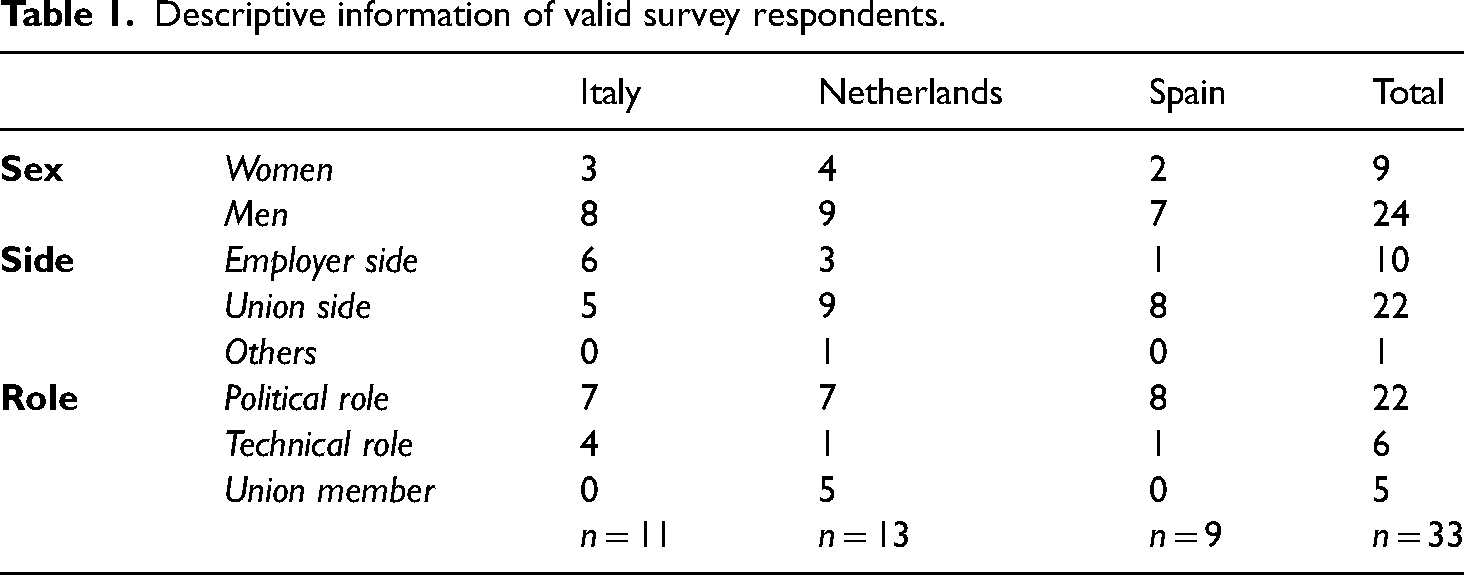
In the respondents to the survey, there is an overrepresentation of members of the union side, that is coherent with the initial fieldwork network, but also with the assumptions about the higher reluctance of employers to disclose information about bargaining processes and actors. Furthermore, most of respondents had a political role in the bargaining process, although with a higher participation of people with a technical role in Italy than the other countries. Finally, men represent most of survey respondents, also consistent with the initial network identified. While the qualitative fieldwork defined the initial network composition, the final network boundaries were delimited following a standardized rationale: network members are only those actors with a perceived influence on wage-setting higher than 1.5 according to respondents (median value from a minimum of 1 and a maximum of 5 in a Likert scale), obtaining 33 valid respondents (over 35 total respondents) and a response rate of 59% (Table 1). Although there is a lower response in the case of employers, the participation rate for those with higher perceived influence in the network is 60% in the Netherlands, 83% in Italy and 89% in Spain.
Descriptive information of valid survey respondents.
The analysis of collective bargaining coordination in one sector and three countries is accordingly made using two different ways of gathering network data. Firstly, one-mode networks have been created based on responses to the question “Please indicate the frequency you have met with each of these individuals, either physically, by phone or videoconference, during the last wage-setting process”. This frequency of interaction was measured on a scale from 0 to 4 (0 = never to 4 = very frequently). Secondly, two-mode networks have been obtained asking for the attendance of each actor to relevant events during the bargaining process. In this regard, we refer by events to any significant interaction for the collective bargaining in the sector, both formal and informal, whenever they occurred in the period under consideration and had a direct influence/impact on the wage-setting process in the sector. Although events at micro (company) level or macro (economy) could be included, the meso (sector) level is the predominant level in the events of the retail sector in each country. Likewise, we understand “interaction” as these relations maintained around collective bargaining in a more formalized context (e.g., a meeting previously agreed upon by all actors) or more informal (e.g., meet over coffee, a phone call, etc.). The adoption of this narrower approach to coordination is based on the methodological need to be able to trace back the whole network of actors involved in the bargaining.
Contact network data are analyzed also calculating several network indexes. On the first hand, density is understood as the number of edges divided by the maximum number possible (an edge is a tie between two actors of any frequency –i.e., any value excluding 0). The index reaches a maximum of 1 when every actor is tied to each other. Density is thus computed for unweighted data. This index was used as an indicator of global coordination, but also to explore trust relations. Secondly, degree centralization is a measure of how centralized is a graph in relation to the maximum attained degree. The index reaches a maximum of 1 when a single actor is tied to each other, and the others are only tied with the former (thus, indicating a maximum centralization). The index attains a minimum value of 0 when all actors have the same degree (thus, indicating minimum centralization). Degree centralization is also computed for unweighted data. It was used to explore the extent to which power remains dispersed within the network, or by contrast, it is concentrated in a relatively small number of actors who are key in the bargaining process. In third place, average ties strength are measures that take into account the weight of each tie (from 0 to 8). While frequency of contact was originally measured as a direct, valued tie between 0 and 4, data were symmetrized in the analysis stage computing the sum of responses of both actors involved in each tie (thus, reaching a maximum value of 8 if both actors perceive their contact as “very frequent”). For a valued network, it is the total of all values divided by the number of possible ties and can be interpreted as a measure of density that considers the weight of each tie. This measure has been computed for the overall network and within each side (employers and unions) and between sides. It served to gain insight into the level of cooperation, communication, and trust that exists between and within both sides.
The retail sector bargaining processes in Italy, The Netherlands and Spain
The retail is a strategic sector in the European economy, not only because of the size and employment it generates (21.5% of European companies and around 8% of European workforce in the sector (EuroCommerce, 2022; Eurostat, 2022)), but also because it is a good mirror for the great changes that are taking place in the global economy. Many analysts in the last years coined the concept of “retail apocalypse” (Burroni et al., 2020), namely the retail closures produced by the rise of e-commerce, together with other changes as outsourcing/offshoring dynamics in the supply chain and the automation of certain processes (warehousing, cash register, etc.). The retail sector presents sharp differences between retailers, depending mostly on the competitive strategies of firms and the sub-sector within which they operate, although is commonly a labor-intensive sector with low wages, a notable pay gap between women and men, and higher rates of temporary contracts. The sector is traditionally dominated by SMEs, but large companies are increasing.
The analysis of collective bargaining in the retail sector reveals the prevalence of multi-employer bargaining in the three countries studied. Another common characteristic is a higher fragmentation in interest representation, both in the union and the employer side. In Italy, this fragmentation is particularly important for employers, with five different organizations representing diverse enterprises interests, which differences rely mostly on company size. Even though there is one sectoral level collective agreement signed including the largest trade unions and employers in the sector, this fragmentation has led to the appearance of so-called pirate agreements. In order to tackle these social dumping strategies, trade unions have developed strong intra-organizational mechanisms to coordinate demands.
In the Netherlands there are two sectoral level collective agreements in the supermarket sector following a company size pattern, with one agreement for larger supermarket retailers and another for small and medium enterprises. Both collective agreements are negotiated at the same table, and they are identical except for (early) pension schemes. Their coverage is legally extended to the whole sector. Although the predominant form of wage-setting in the activity is the sectoral level, actors surveyed have pointed out to a number of retail companies as particularly important in setting a pattern for negotiations.
Finally, collective bargaining in the retail trade sector in Spain is also dualized along with company size. Whilst large retailers have their own sectoral collective agreement at national level, small retailers and other activities within the retail trade sector develop collective bargaining at several levels. Thus, the Spanish retail trade sector is characterized by a high number of sectoral agreements, signed for each subsector and changing in relation to the territorial coverage (national, regional or provincial), being our focus on the large retail bargaining process at national level.
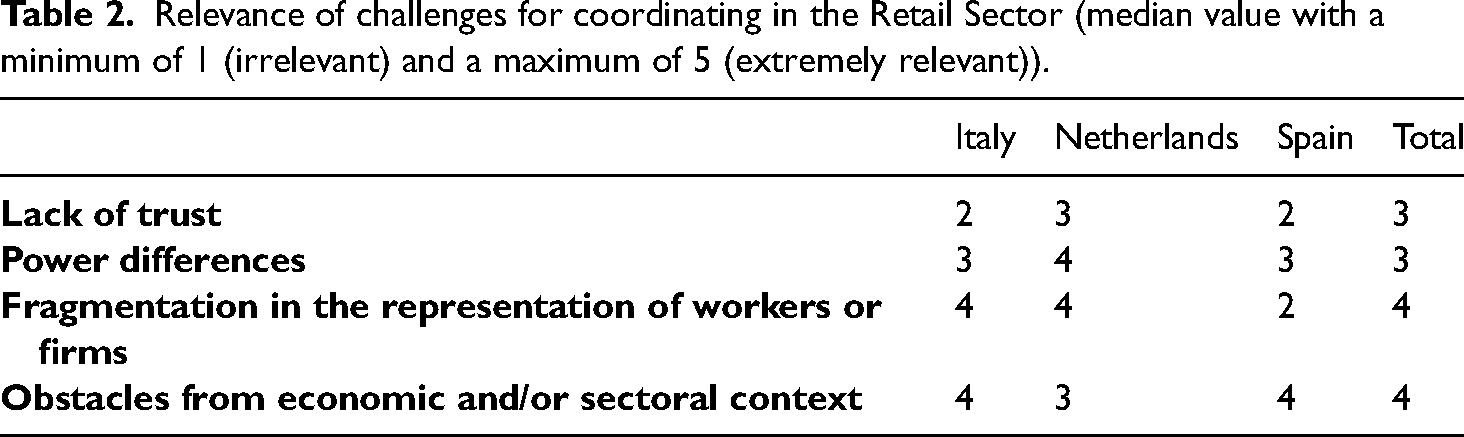
The fragmentation of interest representation contributes to explain the conflictual relations in the retail sector: it is highlighted as the main challenge for coordination in the Netherlands and the second most important in Italy. The separate bargaining of large and smaller retailers’ agreements explains the lesser incidence of fragmentation as an obstacle in Spain. The economic and sectoral context (i.e., losses and restructuring of companies during the great recession) are also key in Spain and Italy to explain these conflicts, while only Dutch actors give significant attention to the lack of trust between unions and employers as an obstacle for coordination (Table 2).
Relevance of challenges for coordinating in the Retail Sector (median value with a minimum of 1 (irrelevant) and a maximum of 5 (extremely relevant)).
Despite actors surveyed highlight diverse reasons behind these problems of negotiation, conflicts tend to be resolved using similar mechanisms in bargaining processes. That is, although formal multilateral meetings are the institutionalized form of collective negotiations, actors point out that informal multilateral meetings are the predominant form of interaction in bargaining processes (Table 3). Not only for internal cooperation within each side, but in direct negotiations between employers and unions.
Predominant form of interaction in bargaining processes (median value with a minimum of 1 (least important) and maximum of 4 (most important)).
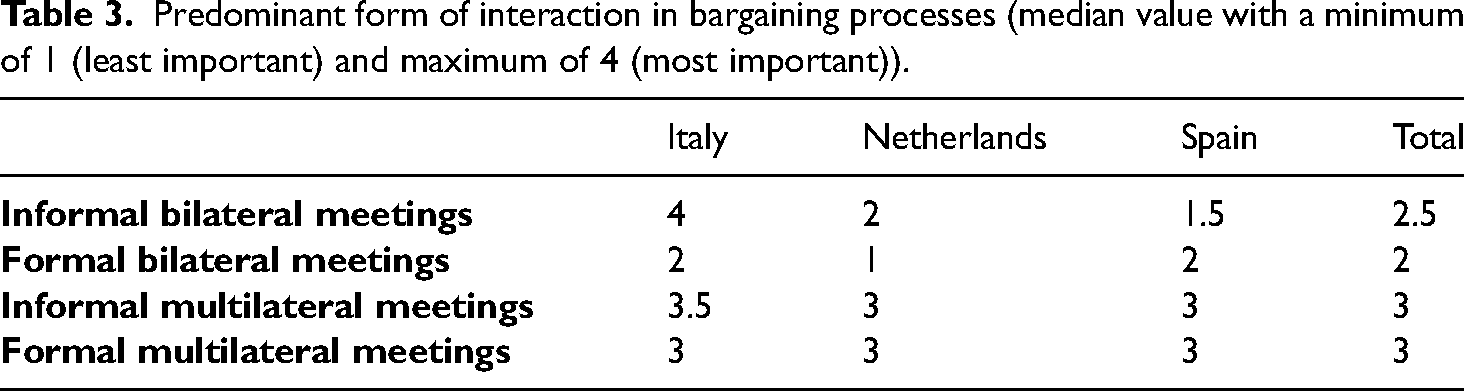
That is the case of Spain, where exploratory interviews revealed the importance of trust building processes amongst actors, particularly in the union side, due to the confrontation between traditional and corporate unions experienced in previous negotiations. A series of meetings (both formal and informal) among all trade unions preceded the negotiation with the employer side in order to reach common positions on conflictual aspects worsened in the previous agreement (in the context of the financial and economic crisis). The importance of these preparatory union meetings is shown in the short time (five months) it took to negotiate the collective agreement with employers. Moreover, having a unitary position on the union side, allowed unions to enjoy a stronger position vis-à-vis employers in the negotiation process. Nonetheless, informal bilateral meetings are also particularly relevant in negotiations in Italy (Table 3), where the relations among social partners were especially conflictual during the last contractual rounds of the negotiation process. Therefore, most of the issues were solved through informal (bilateral and multilateral) interactions.
Similarly, exploratory interviews to key actors in Italy revealed the importance of high intra-organizational coordination in both sides to tackle fragmentation challenges. First, unions faced confronted positions through regular informal meetings to build a unitary position before and after several negotiating tables of the sector. It is also the case of employers’ organizations, maintaining regular informal multilateral meetings to find some common positions despite their conflictual relations. That is indeed the task of the internal structures that the two largest EOs maintain to put together all member organizations variegated demands (Burroni et al., 2020).
In the case of the Netherlands, an independent chairperson was assigned to oversee and handle the bargaining process. The formal meetings were interrupted regularly to talk more informally in a slightly smaller group, reflected in the equal importance attributed to both formal and informal multilateral meetings (Table 3). Also, one-on-one meetings are seen as important to the process and as essential to get the process going again when things got more difficult (Been and Keune, 2020).
Bargaining networks analysis
As a general objective of this paper, we want to go beyond institutionalist explanations and explore how a relational approach could explain how informal interactions and mechanisms can complement or replace formal mechanisms. That is why we apply SNA to the study of collective bargaining coordination of the retail to provide evidence on the use of these mechanisms. The Figure 1 shows the contacts between people in the negotiation network of the three countries in the retail sector. The dots represent the actors involved in the negotiation process and the lines the frequency of the contact between each pair of actors. The contact between actors is calculated based upon the frequency of contact during the negotiation process. If actors had less than five contact moments (in an 8-point scale), the connection is removed from the network visualization so that only frequent connections are shown (although indexes in Table 4 are calculated considering all values).
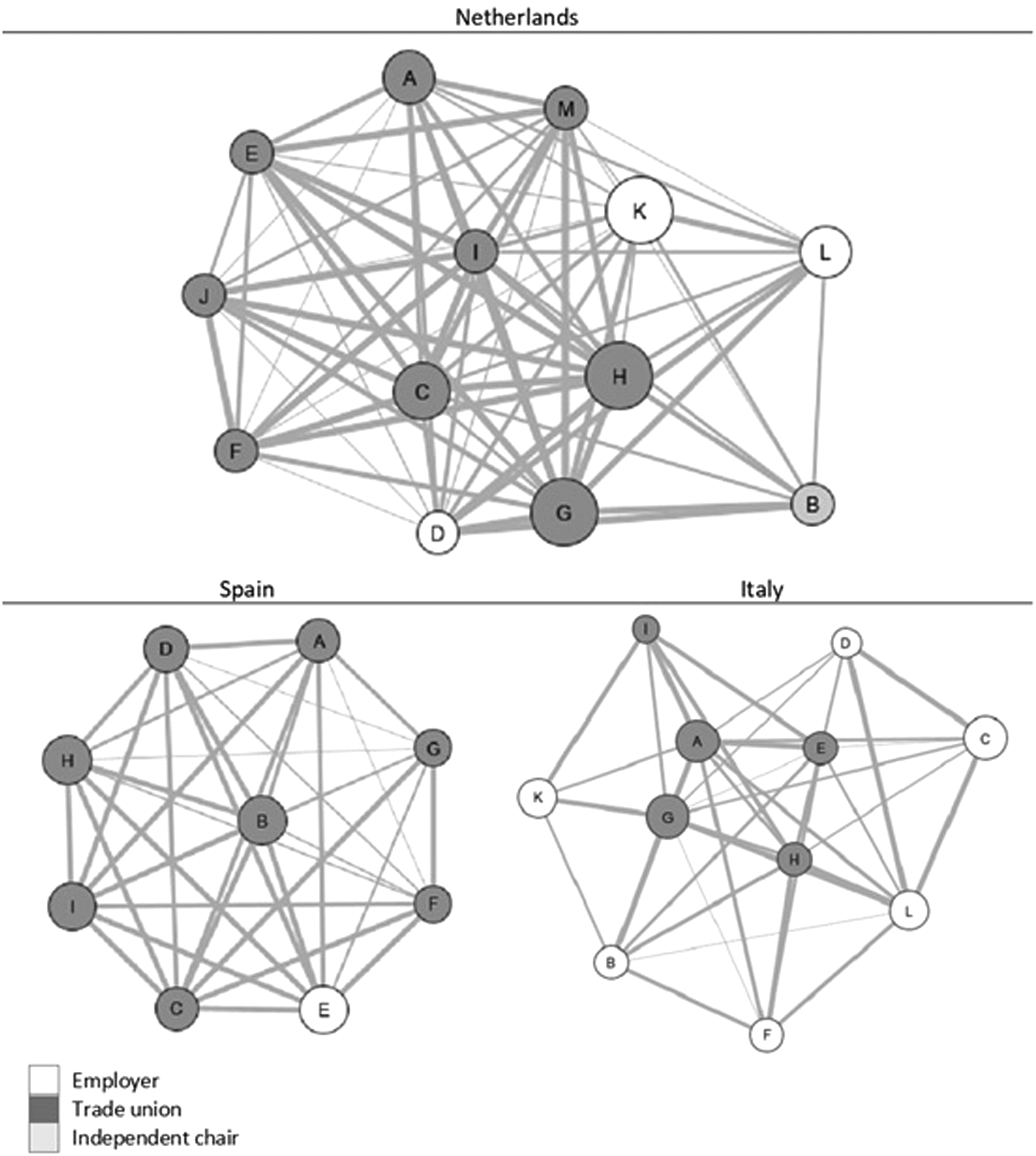
Contact networks in the retail sector (all frequencies of contact are included). Note: Node size reflects perceived influence. Line thickness represents the frequency of contact between actors. Actors anonymized (random assignment of letters).
General descriptors of the contact networks in the retail sector.
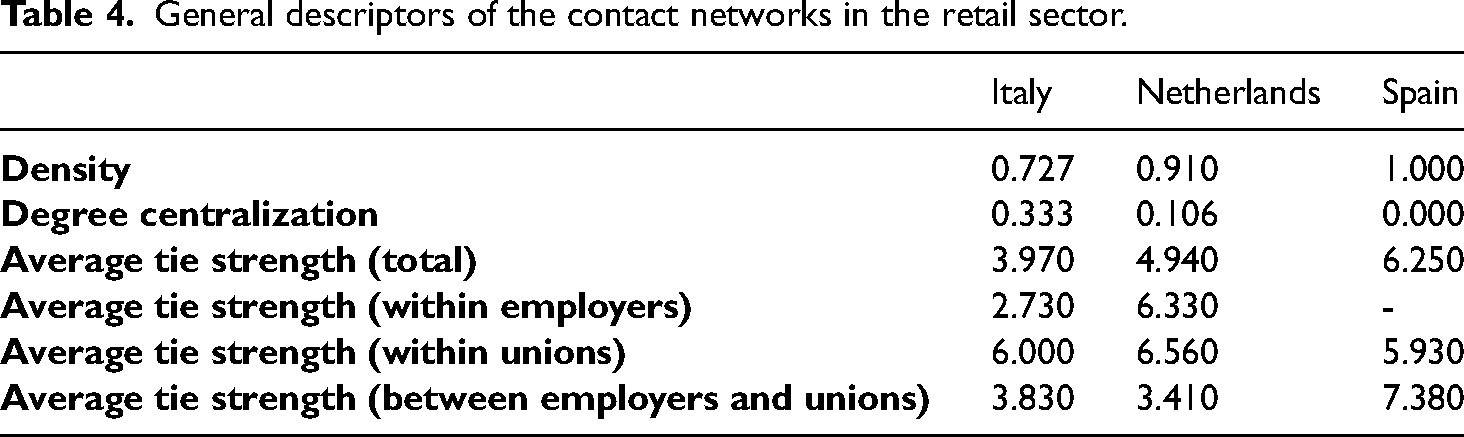
The analysis of contact networks in the three countries shows very different patterns. Spain emerges as the case where employers are less represented in the network. This is explained to some extent by the control by one organization of employer representation compared to the fragmentation existing in the other countries, being Italy a case in point (Figure 1). As a matter of fact, in Italy and the Netherlands, average tie strength within employers is lower compared to unions (Table 4). Trade unions are the actors with highest centrality degree in the bargaining networks of the Netherlands and Italy. In the Dutch case, it is also clear how within trade unions there are some actors playing a ‘bridging’ role with employers, and those are precisely the nodes with the highest betweenness centrality score. A similar pattern can be observed in the case of Italy, though with a lower density of relations. The shape of the two networks reflects different, but important role for trade unions as coordinators of collective bargaining in this sector; in the Dutch case, those trade unions with the highest centrality score, bridge the relationship between employers and other less important trade unions. In the Italian case, those trade union actors which are more central actually connect and serve as shortcuts to link with employers in the network. That explains why those actors with the highest centrality score are also those with the higher betweenness, showing those actors who have more influence on flows in the network. A different pattern can be observed in the Spanish case due to the predominantly union-based network. After many years of conflictual relations in the union side, for the first time a collective agreement brought together all trade unions represented in the sector. The interviews revealed a particularly important role for intra-union coordination and trust building (using formal and informal mechanisms), something that was achieved through a high density of relations and, notwithstanding differences on union size, avoiding any hierarchy on the union side and attaching all trade unions the same role in negotiations.
In this vein, it is particularly relevant that these actors playing a bridging role and with higher perceived influence in the network tend to give more importance to informal events as the predominant form of negotiation in the retail sector. That is the case of actor ‘B’ in Spain, who gives more importance to informal bilateral meetings than other actors (4 over a median value of 1.5 in Spain). Similar to ‘H’, the most central and influential actor in the Dutch network, who values informal multilateral events more than any other form of negotiation (3). The actor ‘I’, central but with less perceived influence, is also clearly oriented to value informal events as the predominant form of bargaining (3 for bilateral meetings over a median value of 2, and 4 for multilateral meetings over a median value of 3). For the contrary, the evidence of the Italian network does not show so clearly this trend with central actors in the network: while actors ‘G’ and ‘E’ conceive informal meetings as the key events during the bargaining process, ‘A’ and ‘H’ put more importance to formal multilateral events.
The differences in networks are confirmed by the descriptors showed in Table 4. The contact network in Spain has a density of 1, meaning that every actor is tied to each other, whilst it is lower for the case of Italy and to a lesser extent in the Netherlands. At the same time, a high density mirrors into a low degree of centralization of the bargaining network; it reaches 0 in the case of Spain, meaning that all actors have the same centrality (importance/role) in the network, and is higher in the cases of Italy and the Netherlands. However, it is important to consider that this occurs when there is a relationship, even if the frequency of contact is minimal. If the threshold for this calculation were higher, then the indices would have lower values.
As previously pointed out, unions play a key role in all retail bargaining networks, though in different ways. Because of this, average tie strength within unions is very high in the three countries. On the employer side, this indicator is also high in the Netherlands, but very low in Italy. This is consistent with the high degree of fragmentation on the Italian employer side, which would result in low intra-organizational coordination for employers. When it comes to inter-organizational coordination, the above analysis suggests a more important role in Spain, which is confirmed by the high average tie strength indicator between unions and employers, two times higher than Italy and the Netherlands.
As aforementioned, co-attendance networks provide information about interactions through attendance to formal and non-formal negotiation events, therefore providing complementary information to contact networks (i.e., each pair of actors are tied if they both attended the same event). Figure 2 contains sociograms for co-attendance networks in the three countries, showing first of all how those with a higher centrality score in the co-attendance network are in all countries the top event attenders plus other actors (See Figure 2). This means that attending events is a sufficient condition for being central in the network, but not a necessary one. Secondly, there is a lack of correspondence between top event attenders (that is, ‘E’ and ‘I’ in Italy, ‘D’ and ‘G’ in Netherlands, and ‘I’ and ‘C’ in Spain) and perceived influence (‘G’, ‘A’ and ‘C’ in Italy, ‘G’, ‘H’, and ‘K’ in Netherlands, and ‘E’, ‘H’, ‘B’ and ‘I’ in Spain). One possible explanation to this fact would be the existence of a clear division of roles between those actors with a more technical profile who attend most of the events in the bargaining process, and those with a more political role, whose involvement in the bargaining process is limited to the early (setting the agenda for negotiations) and final stages (signing the agreement). An alternative explanation would suggest the importance of non-formal events in the bargaining process and the existence of parallel processes, one formal involving the technical issues, and one informal where those with a political role within their respective organizations would participate. As informal meetings/interactions are more likely to happen among actors with a political role, this would also explain the lack of correspondence between event attendance and perceived influence.
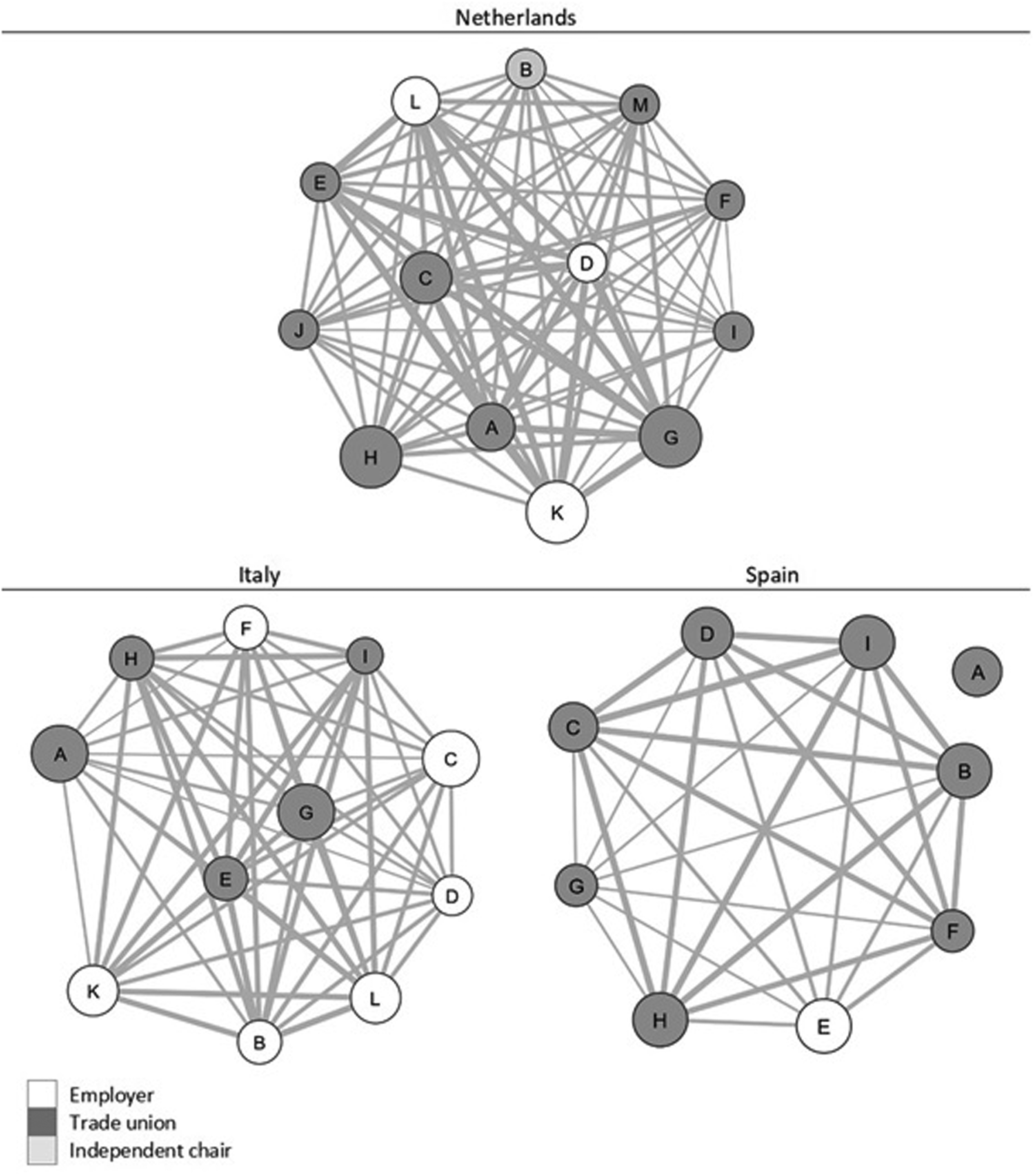
Co-attendance networks from affiliation data (weighted data). Note: Node size reflects perceived influence. Actors anonymized (random assignment of letters).
Particularly, those attending more events in Italy were not necessarily those with higher influence in wage-setting. Exploratory interviews revealed that one of the main employer organizations was influencing a minor union to reject other EOs demands and therefore diminish their power. That is, although some actors appear to attend more events and even benefiting from structural holes in the network, there are certain power relations not detected in the SNA, as a minor interaction between two actors can influence lately to the power balance in the bargaining process (Burroni et al, 2020). That is, informal meetings between two actors agreeing on a common but non-official position that complements the formal conflictual interactions between employer organizations in the bargaining process.
As for the Netherlands, the analysis also shows that there is no significant relation between the perceived influence of people and the number of formal events they attended. Indeed, although the negotiation process was described as rather standard, at the very last moment (just before the trade union representatives were going to ask their members to agree to the negotiated result) one of the largest unions refused to sign. This is a careful indication of the influence exercised outside the context of official meetings (Been and Keune, 2020) and also an example of how informal mechanisms of bargaining can replace in some respect to the result of formalized negotiation meetings. This negotiation process had a previous experience of cooperation, except for the union which finally refused to sign (as happened in previous negotiations). In this case, the result of informal interactions within one actor replaced formal and non-formal mechanisms to agree a common position. Also looking at formal roles and actual influence in the bargaining, there is a correspondence between official roles in the union side and the influence assigned to them, in contrast to the employers’ side (with more power held by the representative of an individual company). That is, besides being powerful in the negotiation process because of a formal position, actors can also be influential as a result of their position in the negotiation network. For example, these actors playing a bridging role can be really influential controlling information (Been and Keune, 2020).
Concerning large retail in Spain, actors involved in the collective bargaining process attended most of the events related to the negotiation. That shows a high level of commitment of those involved in the process, even actors with a political role in the negotiation or with more influence. Moreover, even though event attendance does not necessarily mean higher influence, in the case of Spain, given the low levels of rotation among those involved in the bargaining, there is a relationship between the degree of attendance and perceived influence. The dominant form of interactions during the bargaining process in Spanish large retail consisted of multilateral meetings, either formal or informal. As aforementioned, exploratory interviews revealed the importance of a trust building process amongst the union side actors to reach common positions through regular informal multilateral meetings, diminishing previous conflictual position prior formal meetings with the employer side. That is, complementing the success of formalized negotiations with the use of informal mechanisms in a context of high fragmentation in one of the actors’ side.
Concluding remarks
The objective of this article was to explore the role of informal mechanisms in shaping collective bargaining processes. More specifically, the study of the retail sector in Italy, Netherlands and Spain applying a relational approach serves to illustrate the common and different patterns in the way actors interact within and between organizations beyond institutional roles. Evidence presented shows how informality complements rather than substitutes formal ties and events. That is, organizing trust building actions through complementary formal and informal events to overcome previous conflictual positions, both within sides, to reach a unitary position, or between sides, to close differences. Moreover, whilst trusted relations in the network constitute a favorable condition for reaching agreements, an adequate division of tasks between actors with technical and political roles in the process can help to speed up the process, leaving those most influential actors, with political roles, mostly for informal events that generally facilitate unlocking negotiations and closing agreements. This role of informality is particularly relevant nowadays given the increasing fragmentation of employment relations (Huws, 2012; Marchington et al., 2005). There is also a common trend in how the bargaining process tend to revolve around unions. This is observed in different ways in the three countries analyzed, such as the high level of intermediation between union actors in Italy, the low presence of employers in the Netherlands or Spain, or the low tie strength between employers’ side actors in the Netherlands and Italy. This pattern mirrors to an extent the bargaining role of unions as the basis of their most influential and resilient power resource: the institutional capacity to regulate employment relations (Ibsen and Tapia, 2017; Rigby and García-Calavia, 2018). However, this does not imply employers not having influence: this is graphically observed in the case of ‘K’ in the Netherlands, as well as in the other countries where the areas of employers’ nodes are not significantly lower.
Nevertheless, there are also notable differences between countries. Informality tends to be perceived as a fundamental bargaining mechanism by key actors, those with greater centrality and power (perceived influence), in more institutionalized systems (Spain and the Netherlands). The data shows how those actors with greater influence, who are called upon to unlock the negotiation, are fully aware of the relevance of these informal mechanisms. For the contrary, in Italy's voluntarist system, the use of informality seems to be more normalized, not only to unlock conflictual situations. Thus, its relevance in bargaining is not perceived differently depending on the actor's position in the network, as its use is present throughout the bargaining process. The reason behind this can be attributed to the low level of institutionalization and, therefore, the absence of a clear definition of mutually accepted procedures in Italy's industrial relations system (Colombo and Regalia, 2016).
The paper provides relevant theoretical insights to the industrial relations field. In particular, the article offers evidence on the adequacy of applying a relational view to the study of collective bargaining, observing how actors can negotiate beyond their formal categories and, likewise, how these actors bargain and decide on the basis of available information about the position and mutual interaction between other actors in the bargaining network (Granovetter, 1985). Thus, the results show certain actors controlling access and information sharing in the network and intermediating interactions between confronted organizations. These are mainly union side's actors bridging the relations between employers and other (smaller) trade unions in the Netherlands and Spain; and coordinating confronted employers in Italy. Thus, these bridging nodes across the structural holes between confronted groups provide a vision of options otherwise unseen (Burt, 2000). So, they gain a relevant position in the network, such as information access and influence in the decision-making, while creating valuable connections and relationships that can benefit to the bargaining network as a whole (Burt, 2004), no matter the level of institutionalism or voluntarism of each industrial relations system. Furthermore, these bridging actors give more importance to informal events as the principal form of negotiation. That illustrates how the participation in informal discussion networks are key for the spread of certain ideas and demands within and between organizations (Burt, 2004).
Therefore, the paper contains evidence on how these “coffee and cigarettes” situations may contribute to create a more open and flexible environment for negotiations, which can make it easier for the parties to find creative solutions and overcome obstacles. However, there may be certain situations in which the use of informality can play the opposite role like the Italian case showed.
The paper also contains important methodological insights. Two major methodological flaws are common in works applying SNA, including those in industrial relations: a weak methodology guiding data collection and the lack of a mixed methodology that could enhance the explanatory power of network analysis. The objective of this paper is precisely to advance in the application of SNA through a well-defined and rigorous strategy in order to explore collective bargaining networks and its (different) outcomes across countries. Even though the SNA provides a very detailed description of the way actors negotiate, in-depth semi-structured interviews were key to design the initial bargaining network and to interpret SNA results, raising the relevance of mixed methods for the study of industrial relations. Notwithstanding this article presents exploratory research, it opens new perspectives on the field of industrial relations to apply a relational approach in order to identify non-formal conflict resolution processes, diverse trust sources or types of influence within a bargaining network.
Finally, it is important to highlight the limitations of this study. An important one emerges from the focus on three successful bargaining processes that achieved the signing of a collective agreement. This introduces a bias in the analysis. Further research should consider studying the factors behind processes where actors did not reach any agreement and adopted a conflictual approach. Another limitation to consider in future research is the lack of a cross-gender perspective that may observe possible downsides of the use of formal and informal mechanisms in male dominated bargaining processes, both assessing the influence of female negotiators and its role in the bargaining of gender equality clauses (Bourguignon and Coron, 2023; Martikainen, 2000).
Footnotes
Acknowledgements
The authors would like to thank the research team of the “Networked Coordination of Industrial Relations (NETWIR)”: Wike Been, Andrea Bottalico, Luigi Burroni, Maarten Keune, Liam Kneafsey, Anna Mori and Aidan Regan.
Declaration of conflicting interests
The authors declared no potential conflicts of interest with respect to the research, authorship, and/or publication of this article.
Funding
The authors disclosed receipt of the following financial support for the research, authorship, and/or publication of this article: This work was supported by the Directorate General for Employment, Social Affairs and Inclusion (European Commission), (grant number VS/2018/0023).
