







Abstract
We study whether the quality of the first job is lower for professional Asian nationals than for non-Asian nationals in the USA. With over a million professionals from Asia entering the US labor market in the past decade, a potential under placement may be both inefficient and discriminatory. We collected data on all newly hired assistant professors of management in research-intensive (R1) universities in the USA between 2010 and 2021. We focus on the quality of the university into which first hires are placed and examine whether first-job placement quality is lower for individuals who were born in East, South and Southeast Asia. We find that the quality and quantity of publication record are positively related to the quality of the placement and that Asian nationals have higher performance. However, Asian nationals are placed at lower-quality universities relative to their peers. Further, Asian nationals require a strong performance signal, in the form of first or second authorship on a publication to narrow the placement gap. Our results are explained by a combination of direct bias against applicants of Asian nationality and a requirement of a higher performance “burden of proof” from these applicants, compared to peers who are non-Asian nationals.
Introduction
The number of immigrants to the USA has steadily increased since the 1970s, with foreign-born workers accounting for approximately 17.5% of the US workforce in 2017 (Budiman, 2020). Since 2009, immigrants from Asian countries have outnumbered Hispanics, with China and India leading the countries of origin for new immigrants coming to the USA (Budiman, 2020). Immigrants from Asia are mostly professionals with a higher education level, on average, than US-born adults. For example, 80% of immigrants from India hold at least a bachelor's degree, compared to about one-third of US-born adults (Batalova et al., 2021) and Chinese immigrants are more than twice as likely to hold a graduate or professional degree than US-born adults (Echeverria-Estrada and Batalova, 2020). Accordingly, the share of Indian and Chinese professionals with H1-B visas (i.e. company-sponsored visa to hire skilled foreign workers) increased from 50% in 2000–2005 to 85% in 2017 (Kerr, 2013; USCIS, 2019). With the growing prominence of Asian nationals in the USA, especially in professional jobs, it is important to examine the labor force experience of this population and determine whether they face disadvantages in the US labor force. In this study, we focus on these immigrants’ initial labor force experience. In particular, we examine the quality of the organization where Asian nationals first work in the USA. We examine whether the organization is lower quality than that of a similar newly hired qualified individual who is not an Asian national. If professional Asian nationals in the USA face under-placement in their first job, it may represent an inefficient and potentially biased practice.
At a theoretical level, we seek to illuminate a hidden aspect of workplace bias: the quality of first job of professionals who are of Asian nationality. We do not study the quality of the job match or hiring practices per se, even though it is related to job match quality (Jovanovic, 1979) and hiring practices (Fernandez and Campero, 2017). Rather, we examine if non-Asian nationals (overwhelmingly US born) are consistently hired for higher quality jobs than Asian nationals. Several other aspects of nationality-based bias have been studied including hiring decisions (e.g. Baert et al., 2015; Laschever and Weinstein, 2021; Oreopoulos, 2011), wages (e.g. Bartolucci, 2014; Fackler et al., 2019; Rissing and Lee, 2022), and career mobility (e.g. Javdani and McGee, 2018), However, little research has focused on the potential bias of the quality of the initial placement.
It is important to study the first job placement of professional immigrants because professional workers’ career trajectory is related to the quality of their initial placement after completing their schooling (e.g. Altonji et al., 2016; Arellano-Bover, 2022; Oyer, 2006). Professional workers who are placed in lower-quality jobs when they are first hired are likely to experience persistent and long-term career losses (Arellano-Bover, 2022; Liu et al., 2016). Furthermore, if professional Asian nationals are systematically placed in lower-quality starting jobs, regardless of their productivity, this bias hurts the individual worker and is illegal (U.S. Equal Employment Opportunity Commission, 2022). Finally, such bias may place the USA at a disadvantage in the long run when recruiting top-talent professionals from the competitive global labor force market.
The lack of research on bias in placement quality can be explained by the inherent difficulty of observing such bias. In many occupations, an agreed upon ranking of the quality of the hiring organization is unavailable. Even when there is a ranking of organizations (e.g. Fortune 100 Best Companies to Work For), it is usually based on self-selection and the companies that apply to the ranking organization. Second, hiring decisions are often unobservable and subjective. As a result, bias in placement quality has rarely been studied, despite its importance. In this paper, we use unique data that allow us to estimate the quality of first placement, job performance at the time a hiring decision is made, and numerous other characteristics. We then estimate whether bias against professionals who are Asian nationals exists in terms of the quality of their first placement. We focus on immigrants from Asian countries because they comprise the largest share of professional immigrants in the USA. Their national origin is also distinguishable by their name, appearance, visa status, and often, by the location of their baccalaureate institution. In addition, past research on bias against immigrants has shown that bias against Asian nationals is much stronger than bias against Whites who arrive from other countries (Javdani and McGee, 2018).
To achieve this goal, we identified assistant professors in management and business administration departments in a subset of universities that are classified as research intensive (R1) in the USA (Carnegie Foundation for the Advancement of Teaching, 2021) and appear in the University of Texas Dallas’ Top 100 Business Schools Research Rankings (UTD100). These professionals were hired after completing their doctoral studies, between 2010 and 2021. We focus on this select group of universities because they are defined as highly research intensive and they prioritize potential candidates’ number of publications in highly ranked journals above all other measures when making employment decisions (e.g. Antecol et al., 2018). In addition, for most of these applicants, teaching quality can only be observed after hiring making it difficult to use teaching quality as a reliable measure. Using additional specifications, we account for the quality of the applicants’ publication record at the time of hiring as well as demographic characteristics. We then estimate whether candidates of Asian nationality are hired at lower-ranked universities for tenure-track positions. We account for the quantity and quality of their publication record, the ranking of their doctoral granting institution, their field of specialization, and demographic characteristics. We also test whether the returns on objective measures of performance, publications, their quality, and authorship order, differ between Asian nationals and other new hires in this group of R1 universities. We test both a direct preference for non-Asian nationality candidates in top US universities and whether Asian nationals reduce placement quality bias when they have a stronger publication record.
This study extends the findings of previous studies on biased hiring practices in several important ways. First, we focus on a dimension of hiring that is often hidden, by observing whether the match between the quality of the candidate and the hiring organization is consistently biased against Asian nationals. Second, we focus on an important population, professional immigrants to the USA. This population has received little attention in previous studies, even though it is an important population in large sectors of the US economy, most noticeably to industries that require STEM professionals and academic institutions of higher education.
Background
Workplace bias based on national origin
Workplace bias against people based on their national origin has been studied in multiple disciplines (e.g. Hosoda and Stone-Romero, 2010; Lynch, 2006; Wang and Kleiner, 2001). Importantly, studies have shown that not all foreign nationals are treated the same. Immigrants of a distinguishable national origin (e.g. Non-Western in Sweden, Åslund and Skans, 2012; North Africans in France, Pierné, 2013; Turkish in Germany, Weichselbaumer, 2020) are more likely to be discriminated against than immigrants of less distinguishable national origins (Buck et al., 2004; Zschirnt and Ruedin, 2016). At a societal level, studies have shown that the general population is likely to perceive immigration more negatively when immigrants are more distinguishable from the majority population, and when they surpass a certain critical mass (e.g. Asian and Hispanic immigrants in the US vs European immigrants, Buck et al., 2004; North African and Black African immigrants in France vs European immigrants, Simon and Lynch, 1999).
In the labor force context, social identity theory (Tajfel, 1978) is a useful theoretical framework to explain the mechanisms behind bias in hiring decisions. Social identity theory (SIT) has been used to explain labor market outcomes showing, for example, that social identity affects individual interactions and explains employment relations decisions (Akerlof and Kranton, 2000). Their findings add another layer of understanding to the economic analysis of exclusion. SIT suggests that the identity of native-born hiring managers in the USA (the majority) may be threatened when foreign-born people apply for a job. They may be particularly threatened if the foreign-born applicant is distinguishable within the US context (non-White) and have a numerical distinctiveness in the professional field, such as Chinese, Koreans, and Indians in the academic management field (Buck et al., 2004; Randel, 2002; Simon and Lynch, 1999; Zschirnt and Ruedin, 2016). As a result of an identity threat, hiring decisions may be biased, requiring applicants who are Asian nationals to meet a higher standard than their non-Asian nationality peers. It is important to note that such biased decisions may be made consciously and unconsciously (e.g. Hirsh and Cha, 2017; Morgan, 2008), making them more difficult to observe and address.
Workplace bias against people from Asia in the USA
The roots of exclusion and bias against immigrants from Asia can be traced back to the second half of the 19th-century and the early decades of the 20th-century when the sentiment of the majority of the public was to exclude and even expel immigrants from Asia, mostly of Chinese origin (Boswell, 1986; Wang, 1991). Indian-Asian immigrants began arriving to the USA in very small numbers in the early 19th century and were later limited by the Luce-Celler Act of 1946 to a yearly quota of 100 immigrants, making their numerical distinctiveness negligible. In 1965, the Immigration and Nationality Act removed all national origin quotas (Hanna and Batalova, 2020). Nevertheless, even after the 1965 Immigration Act was passed, Indian–Asian immigrants were not present in large numbers in the USA until the 1980s (United States Census Bureau, 2006), increasing from 206,000 in 1980 to 2,688,000 in 2019 (Hanna and Batalova, 2020).
While studies on social bias against Asian nationals are abundant, scant research has focused on workplace bias in hiring immigrants from Asia. Most research in the US context has focused on bias against people of Asian heritage (i.e. Asian-Americans) instead of Asian nationals. Further, studies on bias against Asian-Americans and Asian nationals often treat Asians within the “model minority” framework (e.g. Leonard and Levine, 2006) and are usually focused on one dimension of bias: the “bamboo ceiling” faced by Asian-Americans (e.g. Lu et al., 2020) and Asian nationals (e.g. Wu, 2021). Bias often prevents these groups from advancing to high-level managerial positions in corporate America. While these studies are important in highlighting bias against immigrants from Asia and Asian-American, they still take the “model minority” approach. In particular, they focus on whether Asian Americans have attained managerial and leadership roles in organizations rather than examining whether a more inherent bias against Asian nationals exists in terms of access to the labor market and the match between their performance and rewards.
The context of research-intensive universities in the USA
To study workplace bias against Asian nationals in the USA, we focus on management and business administration departments at top business schools in R1 universities in the USA. We focus on this context for several reasons. First, while the expected performance of traditional job applicants is very difficult to observe, especially for those joining the labor market for the first time, the academic job market in R1 universities is unique in that it allows the hiring department to observe the most important performance measures: the applicants’ number and quality of research publications. Publication quality is especially important in R1 business administration and management departments because almost all applicants have some publications on their curriculum vita (CV) when they apply for their first academic job. There is also general consensus about the ranking of the quality of management-related journals in which articles are published.
The academic context is also important because in traditional labor markets, a frequent explanation for the lower returns immigrants obtain is that they lack “cultural fit” with the organization (e.g. Bye et al., 2014; Rivera, 2012). Employers may justify lower quality placement and rewards given to immigrants, even when they possess the necessary observable skills (e.g. schooling and training), by discounting these skills (Treuren et al., 2021). For example, organizations may assume that immigrants lack adequate soft skills that facilitate interactions and communication among employees. While immigrants may lack cultural understanding that would allow them to work as effectively as native-born employees (Gibson and Zellmer-Bruhn, 2001) or may have lower English-language proficiency that would reduce their performance (Dustmann and Fabbri, 2003), these skills are likely less relevant in academic positions at R1 universities. R1 universities (Carnegie Foundation for the Advancement of Teaching, 2021) commonly value research more than other job responsibilities (e.g. service and teaching). They also financially support research by minimizing and devaluing other aspects of faculty positions, especially for young assistant professors (Ceci et al., 2014; Ceci and Williams, 2011; Duch et al., 2012; Odic and Wojcik, 2020). In addition, almost all applicants who apply for assistant professor positions in R1 business schools in the USA complete their schooling in US institutions. Thus, they are likely to have at least 4–6 years of immersion in the US culture with academic proficiency in English for communicating and writing research publications. In addition, most applicants’ doctoral training focuses on research skills with little or no teaching training or experience. As a result, teaching performance is an almost constant factor across all applicants. Finally, no inherent reason (beyond bias in evaluations) would differentiate the teaching quality of Asian nationals from that of their native-born peers.
We also chose new hires at R1 universities because several rankings of the quality of R1 business schools are published yearly. These rankings have considerable overlap, which allows us to observe the quality of placement of each new assistant professor. Finally, because almost all faculty in R1 universities post their CVs on their university's webpage, additional information that is unobservable in many labor markets can be observed in this context such as nationality, performance (publication quantity and quality), demographics, and academic pedigree (PhD granting institution).
Finally, starting a career at a lower-ranked research university in the USA may provide fewer resources to support faculty members’ research careers, given the significant variation in resources to support research. Faculty in lower-ranked universities are likely to have a higher teaching load, lower research funding, and a less selective group of graduate students (Fairweather and Beach, 2002). In addition, to further establish differences in career outcomes, we randomly chose three public universities in each category of rankings (i.e. 1–20, 21–40, 41–60, 61–80, and 81–100) on the University of Texas Dallas’ list of top 100 Business Schools list (Podsakoff et al., 2008) for a total of 15 schools yielding an overall sample size of 82 assistant professors. In each category, we recorded the salaries of all assistant professors. The mean salary at universities ranked from 1 to 20 was $202,511. The mean salary at universities ranked 21–80 was $183,172, and the mean salary at universities ranked 81–100 was $129,896. This comparison indicates that under placement in this context is likely to result in large wage differences.
In sum, the labor market of new assistant professors in R1 business and management departments allows us to observe the following factors: (1) the country of origin of new hires, (2) where they received their schooling, (3) the quality of their training (PhD granting institution and the business school ranking), (4) their performance at the time of the hiring decision (number of publications and different measures of the quality), and (5) the quality of placement (ranking of the hiring business school). By observing these factors, we can estimate whether assistant professors who are Asian nationals are hired at lower-ranking R1 universities than their non-Asian nationality peers, controlling for their performance at the time of hiring. We can also estimate whether the returns on different measures of productivity (i.e. placement quality) are different from those of their non-Asian nationality peers.
Method
Sample
Our initial screening included all assistant professors working in a management or business administration department in 131 R1 universities. Research intensive is defined as doctoral universities with very high research activity based on the Carnegie Classification, in the USA between 2010 and 2021. To further validate our identification and focus on R1 business schools (rather than all R1 universities), we used the University of Texas Dallas’ list of Top 100 Business Schools (Podsakoff et al., 2008) and the Financial Times list of business schools (Financial Times, 2016). These two lists were almost identical, so we decided to utilize the University of Texas Dallas’ Top 100 Rankings (UTD 100) of the business schools that hired new assistant professors between 2010 and 2021 to operationalize our dependent variable initial placement quality (discussed in detail below). We only included professors who received their first tenure-track position at a UTD 100 Business School. Overall, we identified 475 participants and searched for their CVs online. The final sample was 452 (95.2%).
To construct the dataset, we mined the data from their CVs, personal websites, profiles and postings on the schools’ websites, Google Scholar, ResearchGate, and LinkedIn. We also used these sources to collect the newly placed assistant professors’ demographic information (age when they were hired, race, sex, and nationality). We also identified information on when and where they received their first tenured positions; when and where they were granted their pre-doctoral and PhD degrees, their PhD major, and publications; and where and when the publications were published (i.e. years and journal). We only considered papers published in peer-reviewed journals and excluded book chapters, working papers, or book reviews because they are not peer-reviewed and are discounted in hiring decisions by business schools. We also excluded publications in proceedings, law reviews, and magazines (e.g. Fortune, Scientific American). We only included papers that were published up to and including the year the new assistant professors were hired, assuming that this publication record was visible to the hiring department at the time of the hiring decision. For example, for a participant who started their job in August 2017, we counted publications from 2017 or earlier because those publications, including papers that were published in the first year after being hired because conditionally accepted papers, for example, were most likely visible when the hiring decision was made in late 2016 or early 2017.
We coded the participant's sex and race based on their profile headshot picture posted on their university website, personal website, LinkedIn page, and ResearchGate page. The research team reached consensus on most of the decisions related to the participants’ sex and race while coding them based on the headshot photos. In the rare cases of disagreement, we obtained the data from other sources (e.g. personal networks, asking colleagues). Age was inferred indirectly if it was not observable. Specifically, we inferred the participant's age based on the year they received their bachelor's degree. We calculated their year of birth by subtracting 22 years from the year they received their bachelor's degree based on the assumption that most participants obtained their bachelor's degree in the 4 years following high school. Because military service at age 18 is mandatory in South Korea (for men) and Israel, we added 2 years to the age of Korean men, 2 years to the age of Israeli women, and 3 years to the age of Israeli men. If a participant's place of birth was not observable, we inferred their nationality based on the country in which they received their bachelor's degree.
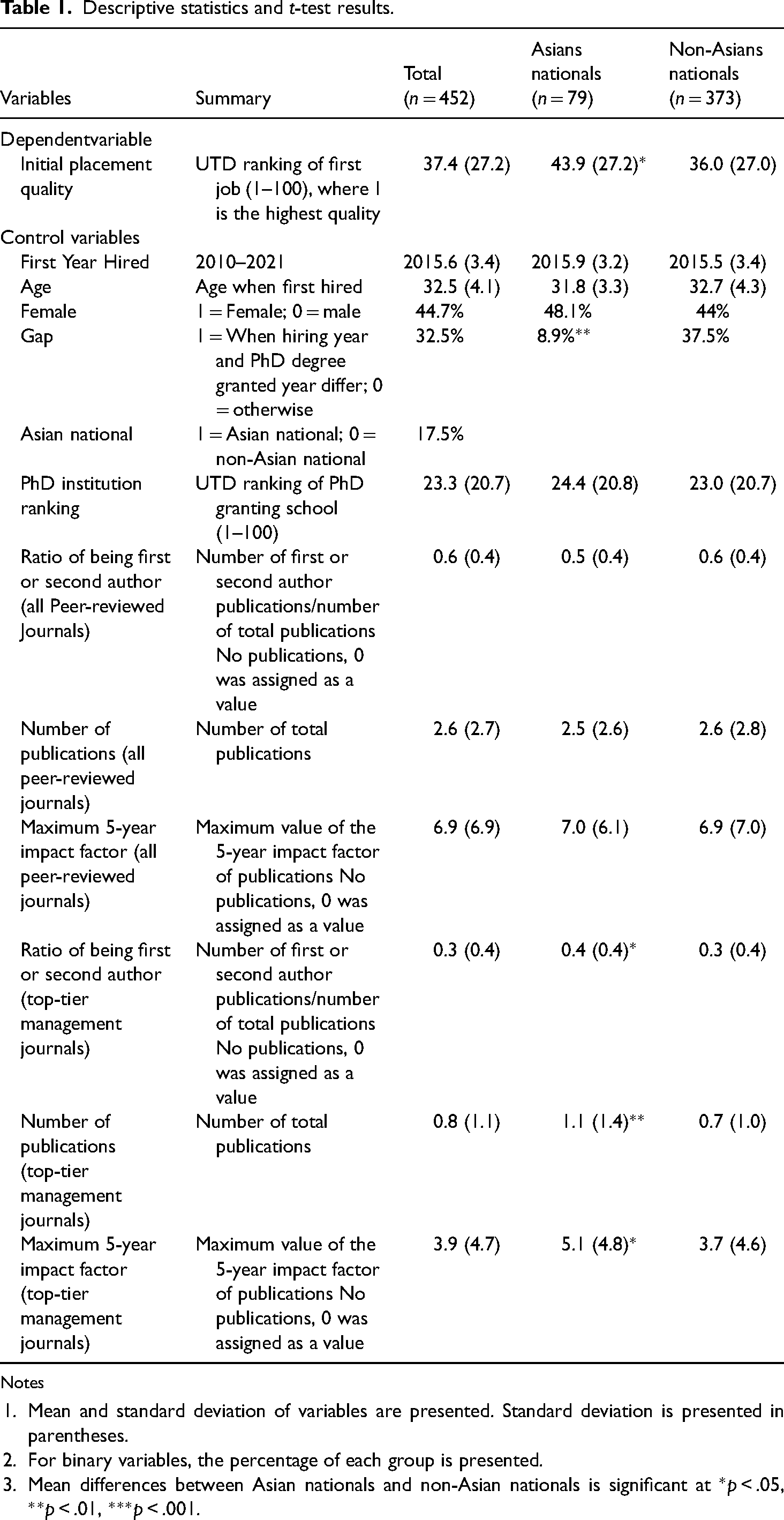
Descriptive statistics for all variables used in this study are summarized in Table 1. Table 1 also includes comparisons of the mean differences of each variable between Asian nationals and their non-Asian nationality peers.
Descriptive statistics and t-test results.
Notes
Mean and standard deviation of variables are presented. Standard deviation is presented in parentheses. For binary variables, the percentage of each group is presented. Mean differences between Asian nationals and non-Asian nationals is significant at *p < .05, **p < .01, ***p < .001.
Measures
Initial placement quality
We used the University of Texas at Dallas Top 100 Business School Research Rankings List (UTD 100) to operationalize the quality of the participants’ initial placement. UTD 100 has been utilized in previous research and is commonly identified as the most rigorous metric for ranking business schools (Mingers and Willmott, 2013; Saunders and Wong, 2011). It provides ordinal ranking scores of academic institutions based on the publication records of faculty in highly regarded business journals, which signifies the institutions’ relative quality in the field. Overall, business journals’ rankings are very close to rankings in other business school ranking lists such as the Association of Business Schools (ABS) and the Financial Times rating of business schools’ research (Mingers and Willmott, 2013). Each participant was assigned a UTD 100 Ranking value (1–100) based on the institution that hired them. The UTD 100 Rankings system is calculated based on a 5-year range, and we used the mid-range of the 5-year period. For example, if a participant received their first tenure-track position in 2016, we used the UTD 100 Rankings of 2014–2018. For participants that were hired in 2019, 2020, and 2021, we assigned the ranking value of UTD 100 rankings of 2017–2021. It is important to note that due to this coding scheme, a quantitatively “lower” ranking is superior to a “higher” quantitative ranking (e.g. being ranked 20 is qualitatively better than being ranked 30).
Asian nationality
We coded Asian nationality based on the institution where participants completed their bachelor's degree. The countries included all countries in East Asia (e.g. China, South Korea), Southeast Asia (e.g. the Philippines, Singapore), and South Asia (e.g. India). The participants with other nationalities (87% North American and 13% other) were coded as 0. We also used multiple comparisons between Asian nationals and US-born Whites and different categorizations of Asian nationals (see the Robustness checks section).
Performance measures
Quality and quantity of publications
We considered different operationalizations of each participant's number of publications. We created different measures ranging from a very inclusive measure (i.e. counting all publications in peer-reviewed journals) to a very exclusive measure (i.e. counting publications in a selective list of management journals). The publication record was obtained from each participant's CV. We describe the measures below.
Number of publications
This measure included all published papers in peer-reviewed journals, regardless of the discipline in which they were published or the quality of the journal. If the applicant did not have any publications up to and including the year they were hired, we assigned them the value of 0. Overall, publications were identified in 389 unique journals (see Appendix D).
Number of publications in top-tier management journals
This measure of the number of publications was the most selective. It included the 11 most prestigious journals in management and business administration (e.g. Academy of Management Journal, Academy of Management Review). If the applicant did not have any publications up to and including the year they were hired, we assigned them the value of 0. (See Appendix D for a list of journals.)
Maximum 5-year impact factor
For each participant, we calculated a qualitative measure of performance based on the impact factor of the journals in which they published their papers. For the 5-year impact factor for each journal, we calculated the number of citations in the Journal Citation Reports year divided by the total number of articles published in the previous 5 years. Then, we calculated the maximum value of the 5-year impact factor for each participant based on their publication record. Four types of impact factor measures were calculated based on the four measures of the quantity of publications (i.e. 5-year impact factor for all published work, top-tier management journals, core management journals, and management-domain journals).
Ratio of first or second author
While quantity (number of publications) and quality (impact factor of published work) are important attributes of applicants’ performance, hiring committees could also consider the authorship order since it is informative in the management field. Being the first author indicates the greatest contribution to the publication and being a second author indicates making a central and significant contribution to the publication. To create this variable, we took the number of publications of which each participant was the first or second author and divided it by the number of the participant's total publications. If the participant did not have any publications up to and in the year they were hired, we assigned the value of 0. Four measures were calculated based on the operationalizations of the quantity of the publications measure.
Control variable
Based on previous research on labor market exclusion and bias, we included several important control variables in our study. We controlled the sex and age of the participants but did not control their race due to the high correlation with nationality (r = .655, p < .001). Sex was coded as 0 for male and 1 for female. We also coded the discipline in which the participant completed their doctoral studies (1 = “Management,” 2 = “Sociology,” 3 = “Economics,” 4 = “Psychology,” 5 = “Others”). If participants had multiple PhD degrees, we coded their most recent PhD degree (five participants had multiple PhD degrees). We controlled the ranking of the institutions where they received their PhD degree, which was also calculated based on the UTD 100 list. Participants who matriculated in universities outside of this ranking system (outside of North America) were excluded from our sample (n = 4). Lastly, we included a Gap variable in our model, which indicated the difference between the hiring year and the year they earned their PhD degree (min = −2, max = 5). We included this variable to account for the effect of participants’ experience other than being a PhD student (e.g. visiting scholar) prior to their first assistant professor position. All models include a year of hiring dummy to capture the yearly effect such as the competitiveness of the job market in a given year.
Analytical strategy
We used two estimation methods, ordinary least-squares regression, and ordered logistic regression to test our hypotheses. In our analyses, we used a subset of the different performance variables we created. Specifically, in the main analyses, we only used performance measures (quantity of publications, impact factor measures, and authorship measures) based on the total number of publications (the least selective performance measure) and publications in top-tier management journals (the most selective performance measure). For robustness checks, we used two other quantitative performance measures related to the journals: core management journals and management domain. The difference in performance between Asian nationals and their non-Asian nationality peers was greatest when the performance was calculated based on top-tier management (TTM) journals. The difference in return on performance was greatest when the performance was calculated based on all peer-reviewed journals. Appendix B1 shows the results of the performance variables calculated based on the core management journals and Appendix B1 shows the management domain-related journals measures.
Hypothesis 1 postulates that there is a hiring bias against Asian nationals that appears as the difference in the initial placement quality between Asian nationals and their non-Asian nationality peers. Hypothesis 2 predicts that this bias is smaller as the performance of Asian nationals improves. To test Hypothesis 1, we included control and performance variables in all models and examined the statistical significance of the Asian nationality variable. To test Hypothesis 2, we mean-centered all performance variables (number of publications, ratio of being first or second author, and maximum 5-year impact factor, and PhD institution ranking), before creating the interaction terms with Asian nationality and entering the terms into the model. We first estimated equation (1) to capture the main effect of nationality (Hypothesis 1) and then estimated equation (2) to investigate the interaction between nationality and performance (Hypothesis 2). Age is estimated at the time of hiring, and Female indicates whether the hired individual is female (=1) or male (=0). Gap is the time between the year of graduation with a PhD and the year of hiring. Year dummy variables are used to control for the year of hiring, and Major dummy variables are used to control for the discipline of the graduating major. Perf includes four indicators of performance (number of publications/ratio of first author/maximum 5-year impact factor/PhD institution), and AsianNational indicates whether the hired individual is of Asian nationality (coded as 1) or non-Asian nationality (coded as 0).

Results
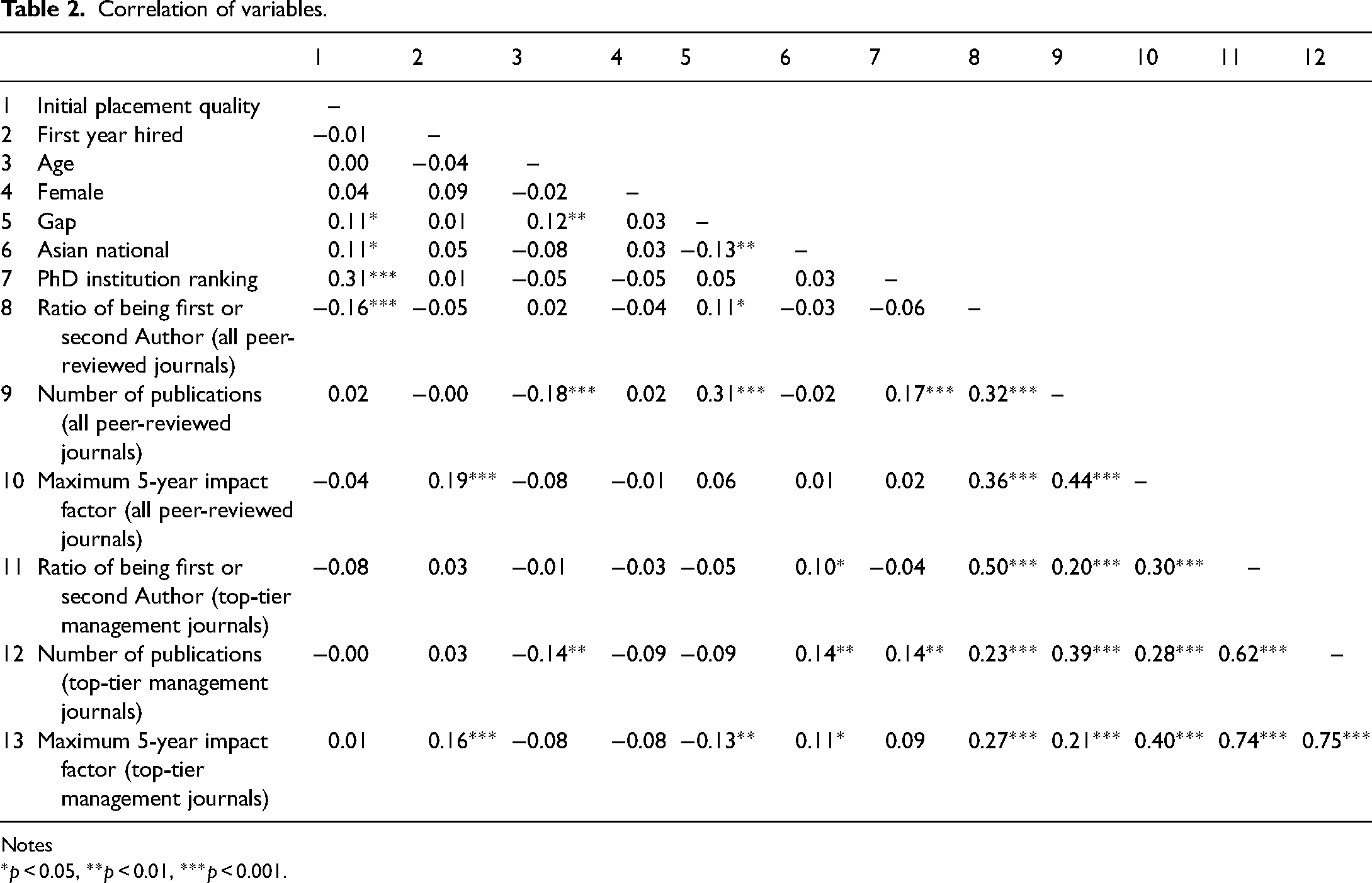
As shown in Table 1, 17.5% of the participants were of Asian nationality, supporting the notion that Asian nationals have gained critical mass in this labor market, and this group is highly observable. The raw difference in placement quality is significant (t = −2.37, p < .05), with the average placement quality of non-Asian nationals at 35.96 and at 43.91 for Asian nationals. No significant difference was found in the sex composition or the PhD granting institution ranking between the two groups. Non-Asian nationals are significantly older when hired (t = 2.43, p < .05) although the age gap is less than a year. As can be seen in Table 2, there is a significant correlation between the rankings of the PhD granting institution and placement quality (r = .31, p < .001) as well as between the ratio of being the first or second author across all publications in peer-reviewed journals and placement quality (r = −.16, p < .001). This finding provides further validity for these two performance measures. The correlation between Asian nationality and the ratio of being first or second author, the number of publications, and maximum 5-year impact factor calculated based on top-tier management journals are all positive and significant (r = .10, p < .05, r = .14, p < .01, and r = .11, p < .05, respectively). This result suggests that participants of Asian nationality are more likely than non-Asian nationals to publish papers in top-tier journals and are also more likely to be among the first or second authors of these papers. These results provide preliminary evidence that participants of Asian nationality are treated differently than their non-Asian nationality peers in terms of their placement quality, despite showing higher performance, on average.
Correlation of variables.
Notes
*p < 0.05, **p < 0.01, ***p < 0.001.
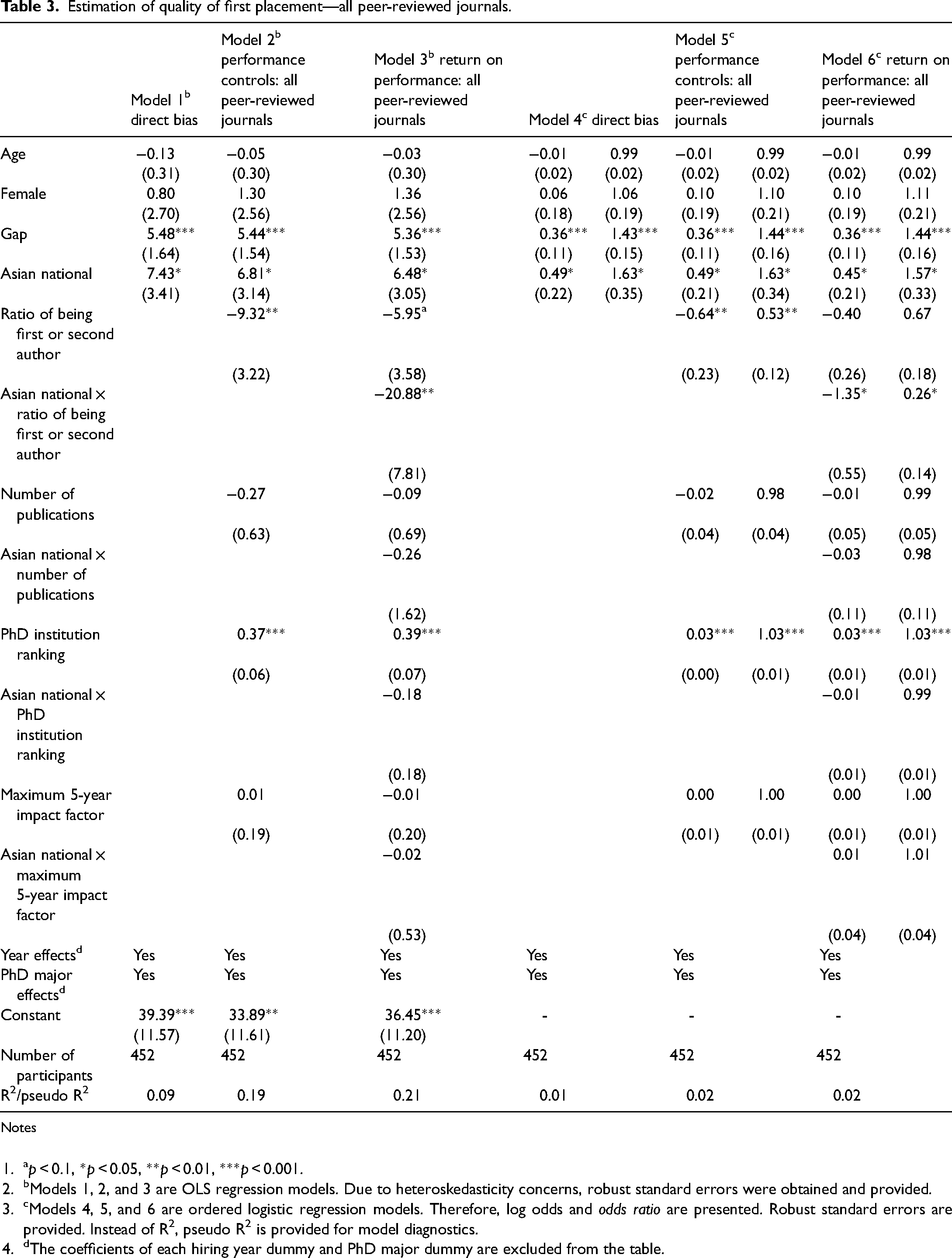
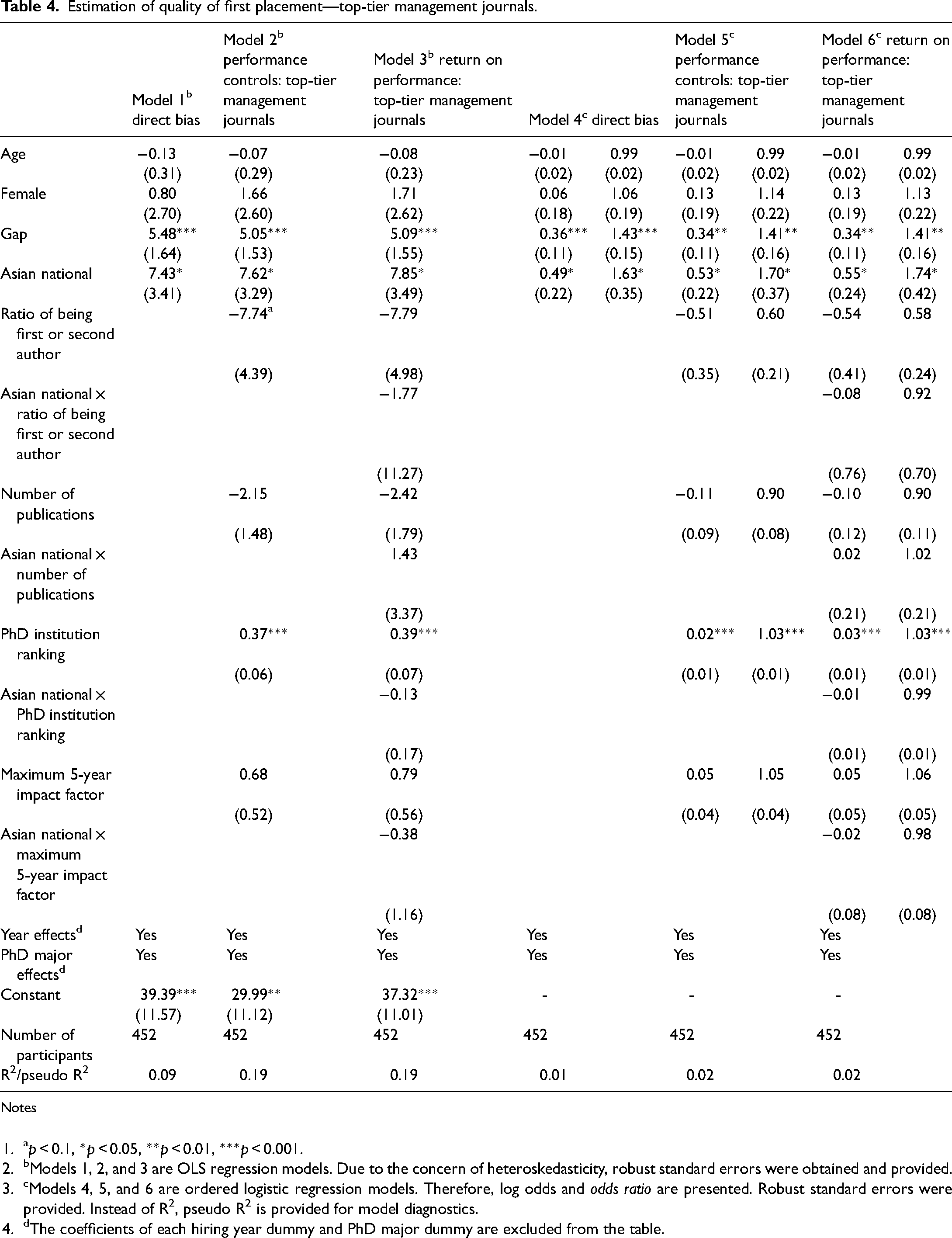
Tables 3 and 4 present the results of our analyses (models 1–3, OLS with robust standard errors; models 4–6, ordered logistic with robust standard errors). Age and sex across all models are not significantly related to initial placement quality, but the gap between participants’ PhD graduation date and their initial placement is significant and positive across all models, suggesting that individuals who were not immediately hired for an academic job after completing their doctoral degree were hired by a lower ranked institution, on average. We expected to observe a bias against participants of Asian nationality in initial placement quality, and using different specifications, we find support for this hypothesis. In both Tables 3 (based on all peer-reviewed journals) and 4 (based on top-tier management journals), we find that participants from Asia were placed at lower ranked universities compared to their non-Asian nationality peers. These results remain consistent after including three performance measures: rate of being first or second author, number of publications, and maximum 5-year impact factor in peer-reviewed journals (models 2 and 5). Across all models, we also find that the ranking of the PhD granting institution is an important predictor of placement quality. This finding suggests that the quality of the training the participants received and the status of the institution from which they graduated are associated with the quality of their initial placement.
Estimation of quality of first placement—all peer-reviewed journals.
Notes
ap < 0.1, *p < 0.05, **p < 0.01, ***p < 0.001. bModels 1, 2, and 3 are OLS regression models. Due to heteroskedasticity concerns, robust standard errors were obtained and provided. cModels 4, 5, and 6 are ordered logistic regression models. Therefore, log odds and odds ratio are presented. Robust standard errors are provided. Instead of R2, pseudo R2 is provided for model diagnostics. dThe coefficients of each hiring year dummy and PhD major dummy are excluded from the table.
Estimation of quality of first placement—top-tier management journals.
Notes
ap < 0.1, *p < 0.05, **p < 0.01, ***p < 0.001. bModels 1, 2, and 3 are OLS regression models. Due to the concern of heteroskedasticity, robust standard errors were obtained and provided. cModels 4, 5, and 6 are ordered logistic regression models. Therefore, log odds and odds ratio are presented. Robust standard errors were provided. Instead of R2, pseudo R2 is provided for model diagnostics. dThe coefficients of each hiring year dummy and PhD major dummy are excluded from the table.
We only find partial support for different returns on performance for Asian nationals. As can be seen in Tables 3 and 4, the returns for ratio of being first or second author are stronger for Asians, narrowing the initial placement quality gap, but this result is only significant in the specification that includes all peer reviewed articles (Table 3, models 3 and 6) and not when we only included ratio of being first or second author in papers published in top-tier management journals (Table 4, models 3 and 6). This result may be due to the low probability of being the first or second author across this very selective list of manuscripts.
Robustness checks
We conducted multiple robustness checks to examine the sensitivity of our results to different specifications. We focused on three categories of robustness checks: (a) different specifications of nationality, (b) different specifications of the measure of the quality and quantity of the publication record, and (c) different specifications of the initial placement quality.
Nationality specifications
In our main analysis, we included all assistant professors and divided them into two groups between those of Asian nationality (East Asia, mostly Korean; Southeast Asia, mostly Chinese; South Asia, mostly Indian) and all others (82.5% US born). We used this specification because individuals of Asian nationality are physically distinguishable and have a critical mass in terms of their participation in this labor market. However, we also wanted to test three more restrictive specifications. First, we tested Asian nationals against US-born Whites. Second, we tested our results with Asian nationals who are of Asian race (mostly Chinese and Koreans), excluding Indians and Pakistanis. This specification allows us to partially test the explanation that differences in placement quality are a result of language barriers. Although Asian nationals who are of Asian race in our sample were taught in English, published in English, and communicated in English throughout their doctoral studies, an argument can be made that their English proficiency is still relevant to their overall placement quality, even in R1 universities. Indian and Pakistani nationals, however, are highly likely to be proficient in English (e.g. Hall et al., 2020); therefore, this specification would partly allow us to examine this alternative explanation. Tables A1 and A2 in the Appendix show that the results remain significant: Asian nationality and Asian race only slightly increased in the effect size. Similar to our main analysis, we find that when all peer-reviewed publications are counted, Asian nationals receive stronger returns for being first or second authors, which allow them to narrow the placement gap.
Quantity and quality of publication record specifications
One explanation for our results may be that hiring committees in business schools in the USA do not consider all journals equally, and that some peer-reviewed journals are more important than others in making hiring decisions. If Asian nationals publish in a different group of journals than their non-Asian nationality peers, our results could be biased. To further test this conjecture, we adopted additional measures of the quantity and quality of the participants’ publication record to examine the sensitivity of our results to different specifications. In our main analysis, we used two specifications: total number of peer-reviewed publications (389 journals) and number of publications in top-tier journals (11 journals). As a robustness check, we added two alternative measures of quantity of publications.
The two additional categories of journals we developed to replicate our analyses are core management journals (CMJ) and management-domain journals (MDJ). To define these different groups, we reviewed the homepages of the journals for the description, aim, and scope of each journal and classified them accordingly. The core management journals include the top-tier journals and all other journals in the management field (91 journals). Sample journals are the Journal of Management Studies and Human Resource Management Review. If the applicant did not have any publications up to and in the year they were hired, we assigned them the value of 0. (See Appendix D for a list of these journals.) The management domain journals measure includes journals related to the management domain in adjacent fields such as psychology, sociology, or economics (222 journals). Examples include the American Psychologist and Journal of Economic Perspectives, and other core journals. If the applicant did not have any publications up to and in the year they were hired, we assigned them the value of 0. (See Appendix D for a list of these journals.)
After creating these alternative measures of journals, we adjusted our independent variable, (i.e. Ratio of being first or second author), and two control variables (i.e. number of publications and maximum 5-year impact factor). For example, when we only included core management journals in our dataset, we divided the number of core management journal publications in which the applicant was the first or second author by the number of their entire core management journal publications to calculate the ratio of being first or second author.
The main effect of Asian nationality and the interaction effect with ratio of being first or second author based on each specification both remain stable in our analyses. As can be seen in Tables B1 and B2 in the Appendix, Asian nationals, relative to non-Asian nationals, are still placed in lower ranked management schools after accounting for their performance when using the CMJ- and MDJ-based measures of performance. However, we only observe higher returns for being first or second author for Asian nationals in the MDJ-based specification. These results are consistent with our main analyses showing that Asian nationals are placed in lower ranked schools relative to their non-Asian nationality peers and that they receive higher returns on their publication record when a more inclusive measure of performance is used.
Initial placement quality specifications
Hiring universities may be categorized (both by applicants and by hiring committees) into groups of ten. For example, applicants may have considered some universities to be similar (e.g. top 10) even if the universities have a different ranking on the UTD 100 list. Therefore, we categorized the dependent variable of this study—the rankings of the initial placement schools—into groups of 10 by rank (e.g. 1–10, 11–20,…, 91–100), 20 (1–20, 21–40,…, 81–100) and groups of 25. We then analyzed the data using these different categorizations. All results were consistent with the main analysis. (Appendix Table C shows the results of the first categorization for each group of 10).
Discussion and conclusion
Immigration of professional workers to the USA has been studied extensively in the context of economic growth (e.g. Borjas, 2019), the impact on US-born workers (e.g. Ransom and Winters, 2021), and the debate on whether a skill shortage plagues the American economy (e.g. Cappelli, 2015). However, little is known about the labor market experiences of professional immigrants in the USA. To shed light on professional immigrant workers’ labor market experiences, this study investigated whether Asian nationals who earned their doctoral degree in management or a related field in the USA, are hired at a lower ranked university relative to their non-Asian nationality peers. We also investigated whether relatively lower placement quality is partly compensated by higher returns on strong signals of academic performance.
Participants included all assistant professors who were placed at the top 100 business schools in the USA between 2010 and 2021. The results suggest that conditioned on multiple measures of performance, Asian nationals are more likely to be placed at lower ranked universities relative to their non-Asian nationality peers, suggesting that hiring establishments may be biased against Asian nationals. However, we also find evidence that Asian nationals narrow the placement gap if they exhibit strong academic potential (i.e. first or second author on their publications). We find that the results do not change using different specifications of performance and performing different robustness checks.
Interpreting our main findings suggests that Asian nationals are discriminated against in hiring relative to their non-Asian nationality peers. We suggest that this bias is a result of the distinctiveness of Asian nationals in the academic labor market in terms of both their race and presence (about 17%). These findings are aligned with past research that has used social identity theory (Akerlof and Kranton, 2000), showing that immigrants are much more likely to be excluded or under placed in the labor market. Under placement is particularly evident when they are physically distinguishable from the stereotypical native (e.g. White majority) and when they surpass a certain critical mass so they are perceived as a potential threat to the majority group's identity (Åslund and Skans, 2012; Buck et al., 2004; Pierné, 2013; Weichselbaumer, 2020; Zschirnt and Ruedin, 2016).
The results of this study also have implications for understanding the industrial relations processes and institutions in the USA and their role in protecting Asian nationals from bias. The US employment relations system, which is less regulative and representative than its European counterparts (Pulcher et al., 2022), is likely to offer less protection for professional immigrant workers. For example, trade unions in the USA are relatively weak and less likely to diverge from the “business case,” and less likely to frame such bias as a social justice issue (e.g. Tapia and Turner, 2018). Workers are also left with few protections that are not HR-initiated. Title VII of the Civil Rights Act and the Equal Employment Opportunity Commission (EEOC) give workers in the USA limited protections against discrimination based on nationality or race. As a result, workers’ rights are embedded in one of the weakest systems of labor regulation in OECD countries (Ford, 2016). Furthermore, protection against discrimination in the USA is not strictly enforced by government agencies (Yang and Liu, 2021). Thus, there is a need for stronger enforcement combined with collaboration with worker organizations and employers to promote compliance (Yang and Liu, 2021).
Despite the strong evidence presented in this study, several additional explanations for our findings could be examined in future studies. First, it is possible that despite the nature of this labor market, bias against Asian nationals may be partially due to their English proficiency. However, in a “publish or perish” academic culture, this is not likely. In addition, because there is very little objective evidence of teaching quality for doctoral students, decisions made based on English proficiency (which only accounts for a part of teaching effectiveness) may also imply bias against Asian nationals (Fan et al., 2019). Second, it is possible that Asian nationals are more likely to accept the first job offer they receive while non-Asian nationals may wait for an offer from a higher ranked university. If true, these explanations are likely to only partly account for the significant bias against Asian nationals identified in our data. Finally, future studies in this area could observe the proportion of Asian nationals already working in the organization instead of newly hired Asian nationals. The effect may be associated with either reduced bias, if discrimination is the result of “fear of the unknown,” or increased bias, if fear of immigrants having a “critical mass” is the root of the underlying discrimination. These two contrasting effects suggest that more research is needed on how discrimination against professional immigrants can be reduced.
Supplemental Material
sj-docx-1-jir-10.1177_00221856231226270 - Supplemental material for Inefficiencies and bias in first job placement: the case of professional Asian nationals in the United States
Supplemental material, sj-docx-1-jir-10.1177_00221856231226270 for Inefficiencies and bias in first job placement: the case of professional Asian nationals in the United States by Amit Kramer, Kwon Hee Han, Yun Kyoung Kim and Karen Z. Kramer in Journal of Industrial Relations
Footnotes
Acknowledgments
The authors thank Prof Ryan Lamare for his comments and feedback on this research.
Declaration of conflicting interests
The authors declared no potential conflicts of interest with respect to the research, authorship, and/or publication of this article.
Funding
The authors received no financial support for the research, authorship, and/or publication of this article.

Supplemental material
Supplemental material for this article is available online.
Biographical notes
References
Supplementary Material
Please find the following supplemental material available below.
For Open Access articles published under a Creative Commons License, all supplemental material carries the same license as the article it is associated with.
For non-Open Access articles published, all supplemental material carries a non-exclusive license, and permission requests for re-use of supplemental material or any part of supplemental material shall be sent directly to the copyright owner as specified in the copyright notice associated with the article.
