






Abstract
This article seeks to advance our understanding of how business organisations articulate ideas about welfare policy – an aspect that remains underexplored in existing research. It does so by focusing on the European Union (EU) level, where social dialogue initiatives have spread since the 1980s. It looks at the three cross-sectoral EU employers’ organisations (EEOs) – the Confederation of European Business (BusinessEurope), Services of General Interest Europe (SGI Europe), and the European Association of Craft, Small and Medium-sized Enterprises (SMEunited) – and their positions across four social policy areas: pensions, vocational education and training (VET), labour market, and work–family reconciliation. Empirical material is drawn from position papers and semi-structured interviews with key organisational actors. The findings reveal a consistent neo-liberal and national orientation. Cost-containment is prioritised over increased social spending, and social investment is emphasised over social protection. EEOs support a soft regulatory role for the EU, with subsidiarity as a guiding principle. Their opposition to binding EU regulation reflects a broader preference for nationally driven policies that accommodate diverse member state contexts.
Introduction
Over the past several decades, the ideational turn has gained significant momentum in industrial relations scholarship (Carstensen et al., 2022; Lamare and Budd, 2022; McLaughlin and Wright, 2018; Morgan and Hauptmeier, 2021). In times of change and the progressive destabilisation of employment relations, ideas have attracted increasing scholarly attention. The ecological transition, digitalisation, and new forms of discrimination are all challenges for economic and social actors. In this context, ideas are crucial to the analysis as they fundamentally shape interests’ formation (Münnich, 2011).
Regarding the role of ideas held by business actors, while the literature has examined the influence of economic, industrial and employment relations ideas (Bell and Hindmoor, 2014; Culpepper, 2008; Lamare and Budd, 2022), we still know relatively little about the social policy ideas held by business and how they influence welfare state developments (Münnich, 2011; Paster, 2012, 2015), let alone at the supranational level. As Morgan and Hauptmeier (2021: 794) emphasise, the European Union (EU) is ‘a major context for the development of ideas and for their spread into member states’. For example, the authors highlight the Lisbon Agenda and its influence on national-level labour market reforms, such as the Hartz reforms in Germany and broader activation policies across the EU. They further argue that ‘more study of [the EU level] and in particular how it is connected to the national level is certainly required’. Our paper takes up this call by examining how European employers’ organisations (EEOs), as key EU-level business actors, contribute to shaping the ideas that underpin EU and European social policy. Therefore, we ask: What are the key social policy ideas promoted by EEOs, and how are these ideas articulated at the EU level? Though we do not delve into how these ideas ultimately influence national policies, this is an important first step. Understanding the ideational role of EEOs is, in fact, necessary for capturing how welfare state and industrial relations transformations are being constructed across multiple levels of governance, both national and supranational.
To situate our inquiry, it is important to recall the broader institutional and governance architecture within which EU-level industrial relations and social dialogue operate. Since the 1990s, European integration has progressively extended into employment and social policy through a combination of legislative provisions and soft coordination mechanisms such as the Open Method of Coordination and, more recently, the European Semester (Keune and Pochet, 2023). These instruments have created a hybrid governance regime where market integration has advanced more rapidly than social regulation, producing asymmetries between the economic and social dimensions (Marginson, 2017; Meardi, 2018). The resulting landscape is increasingly fragmented: collective bargaining coverage has declined, sectoral coordination has weakened, and the role of the social partners has become more uneven across member states. Nevertheless, the EU-level social dialogue (Articles 154–155 TFEU) – anchored in bipartite exchanges between the Confederation of European Business (BusinessEurope), Services of General Interest Europe (SGI Europe), the European Association of Craft, Small and Medium-sized Enterprises (SMEunited), and the European Trade Union Confederation (ETUC) – remains a key forum for articulating employers’ and workers’ ideas on social and labour issues, even if its outcomes are largely non-binding (Welz, 2008). Recent research emphasises that these governance arrangements both enable and constrain actors’ capacity to project their interests and ideas transnationally, thereby shaping the ideational space in which EU-level business organisations operate (Erne, 2015; Cino Pagliarello, 2023; Sørensen et al., 2021). Moreover, the legislative procedures under the Community method also witness different forms of lobbying on behalf of employers, workers, and other interest groups.
This article focuses on the three cross-sectoral EEOs and four social policy areas: pensions, vocational education and training (VET), labour market, and work–family reconciliation 1 . The selection of policy sectors is based on several key criteria. First, these four areas account for over 60% of social expenditure in each EU Member State, with pensions being the largest expenditure. Second, they address both ‘old’ social risks (such as pensions and unemployment) and ‘new’ social risks (including work–family reconciliation). Third, these sectors cover a broad range of issues, from labour market dynamics (unemployment benefits and active labour market policies) to the transition from education to employment.
Drawing on Campbel'’s (2004) typology of ideas, we conceptualise ideas as programmes, namely, policy prescriptions that help guide policy action. Specifically, we disentangle the ideational elements of welfare programmes through six key dimensions, organised across two levels: four at the national level and two at the supranational level. At the national level, the dimensions reflect critical aspects of welfare programmes, such as effort, provision, boundaries, and intervention logic. At the supranational level, the focus shifts to welfare regulation and harmonisation, highlighting the EU's role in dictating or supervising social policies.
The article finds that EEOs articulate a vision of welfare intrinsically connected to economic competitiveness and growth. Their proposed solutions prioritise economic efficiency, workforce employability, and cost reduction. By advocating for active labour market policies and resisting binding EU-level regulations, EEOs align their welfare policy ideas with the principle of subsidiarity, favouring soft law mechanisms and tailored national solutions. When we compare the different dimensions of welfare reforms, social investment, more than cost-containment, is a top priority for EEOs. These ideas proved stable over the decade under scrutiny, with no major changes in a period marked by major crises.
The article is structured as follows. After a brief literature review of how the main strands of literature in the fields of industrial relations and social policy have incorporated ideational elements in their frameworks, the “Ideas, business, and social policy” section presents our theoretical and analytical framework, focusing on the role of ideas in social policy. The “Research design” section discusses the research design, data, and methods. The “Empirical evidence” section presents the empirical findings, while the “Discussion” section discusses these findings in relation to relevant literature. Finally, the “Conclusion” section concludes.
Ideas, business, and social policy
Literature review
Different strands of literature have attempted to integrate, more or less explicitly, the role of ideational elements in their frameworks. Traditional industrial relations and welfare studies typically refer to the Power Resources Approach (PRA) (Korpi, 1983), claiming that social policy is understood as politics against markets (Esping-Andersen, 1985). From this perspective, because of cost concerns, business organisations are generally hostile to welfare expansion. Business are portrayed as antagonists or reluctant consenters to social policies – supporting them only tactically when pressure from other political actors, such as governments or parliaments, makes more generous alternatives likely (Korpi, 2006; Paster, 2012). This approach also suggests that, when opportunities arise, business will attempt to retrench welfare. While this strand of literature has consistently outlined the role of structural forces and ‘objective interests’, a more discursive interpretation tends to emphasise the role of ideational debates: employers’ preferences adapt to changing economic circumstances, provided that their own interests are shaped by new ideas gaining plausibility or legitimacy (Münnich, 2011).
In contrast to PRA, a growing body of literature contends that firms do not, under all circumstances, oppose social policies. According to the Varieties of Capitalism (VoC) approach, which focuses on (national) institutional complementarities among different spheres of a political economy (Hall and Gingerich, 2009; Hall and Soskice, 2001), employers may support welfare when it facilitates the kind of human capital formation necessary for firms to remain competitive. In fact, the literature on the welfare–skills formation nexus suggests that firms favour social protection policies that enable the development of market-specific skills (Fleckenstein and Seeleib-Kaiser, 2011; Rasmussen and Skorge, 2019). Other scholars outline the coexistence of different positions between industrial relations’ organisations. The latter are shaped by different ideological backgrounds that shape priorities and strategies (for trade unions, see Hyman, 2001).
As discussed by Colombo et al. (this issue), further works emphasise a neoliberal transformation characterised by long-term liberalisation trends in European political economies and the erosion of social and employment rights and industrial relations systems (Baccaro and Howell, 2017). 2 At the centre of this analysis is a diachronic view of institutional change driven by shifting power resources and ideological programmes. Ideas are increasingly recognised as shaping stakeholders’ positions – well beyond simple interest-based calculations (Tassinari et al., 2022). In this context, ideas associated with the social investment paradigm are not in contradiction to the neoliberal transformation but a component of it: a way to reinterpret social policy as a productive factor aligned with market rationales (Laruffa, 2018, 2021a, 2021b).
Building on these insights, the remainder of this section develops a theoretical and analytical framework that explicitly adopts an ideational stance to examine the role of business actors in contemporary social policy developments.
Theoretical and analytical framework
Scholars have long debated whether ideas or interests drive political action. Interests can be considered as not inherent or purely material but as actively shaped and interpreted through prevailing ideas and discourses (Béland, 2009; Schmidt, 2008). The way ideas are generated, debated, legitimised, and disseminated directly influences what actors perceive as their interests and the policy paths they pursue. Ideas help political and economic actors make sense of institutional and material conditions, especially under uncertainty and complexity, by providing normative and cognitive maps (Morgan and Hauptmeier, 2021; Münnich, 2011). In this vein, Münnich (2011: 277) explicitly states that ideas are a ‘substantive element of interest formation’.
This view aligns with a broader constructivist tradition in ideational analysis that challenges the strict separation between ideas and interests (Cox, 2001; Hay, 2006). As Hall (1986: 277) notes, ‘the ideas or perceptions of the relevant actors are not an exogenous variable but a component of their rational action as it is situationally determined’. In this sense, ideas are synonymous with actors’ perceptions of their own interests. Blyth (2002) similarly argues for breaking the analytical separation between ideas and interests, proposing that interests should not be seen as structurally given but rather as constructions of ‘wants’ shaped by beliefs and desires – namely, by ideas. This resonates with Heclo's (1994: 383) insight that ‘ideas tell interests what to mean’.
The ontological debate within ideational scholarship, therefore, reflects this tension: while rationalist approaches (e.g. Goldstein and Keohane, 1993) maintain a distinction between the ideational and the material, constructivist scholars reject this dualism. As Gofas and Hay (2010: 50–51) assert, ‘interests do not exist, but constructions of interests do’, emphasising that what matters is not some objective notion of actors’ ‘real’ interests, but how those interests are understood and enacted by the actors themselves. In line with a constructivist approach, we therefore do not draw a strict analytical distinction between ideas and interests.
Ideas have been defined in various ways, including as worldviews, public philosophies, identities, perceptions of interests, frames, beliefs, normative frameworks, paradigms, and policy solutions. These definitions span different levels of generality. For instance, Mehta (2011) views public philosophies, which are ideas about the purpose of government or public policy based on certain assumptions about the state and the market, as the most abstract and broad form of ideas. On the other hand, policy solutions – ideas offering specific means to solve problems and achieve goals – represent the most concrete and narrowly defined conception of ideas.
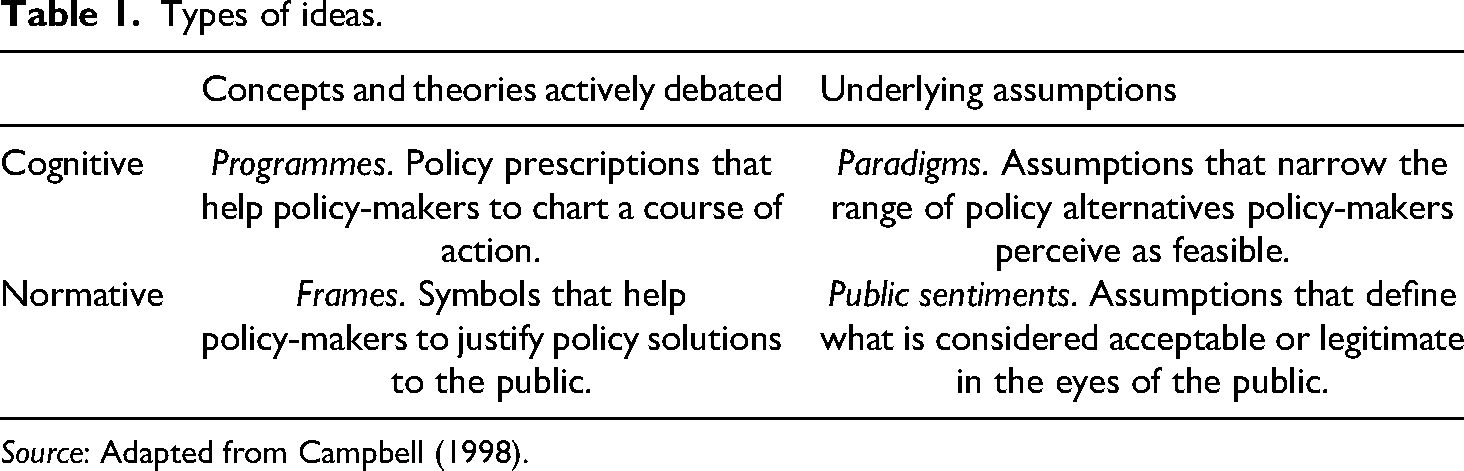
Campbell (1998, 2004) offers a seminal typology for understanding ideas. The author distinguishes between two key dimensions: first, the underlying assumptions that are largely unquestioned, and second, more explicit concepts and theories that are actively debated. While the former are often taken for granted, the latter are the subject of ongoing contestation. Additionally, Campbell differentiates between cognitive ideas, which specify cause-and-effect relationships, and normative ideas, which involve values and attitudes. By combining these distinctions, four types of ideas can be identified: paradigms, public sentiments, programmes, and frames (Table 1).
Types of ideas.
Source: Adapted from Campbell (1998).
Paradigms are cognitive assumptions that influence decision-making by narrowing the range of policy alternatives that elites perceive as feasible. Similarly, public sentiments are normative assumptions that restrict options by defining what is considered acceptable or legitimate in the eyes of the public. In policy debates, programmes or policy prescriptions are cognitive frameworks that guide policy action by offering solutions to problems. Frames, on the other hand, are normative concepts used by elites to justify these programmes to the public.
For the purposes of this paper, ideas are conceptualised as programmes. These ideas – or policy prescriptions – guide decision-makers and stakeholders in shaping courses of action by offering a roadmap that clarifies both the issues at hand and the steps needed to address them. This approach to understanding ideas has been particularly useful in examining social policy developments (Terlizzi, 2019; Terlizzi and Esposito, 2023).
To explore the specific ideas that business actors hold regarding social policies, we draw from Mares (2003), who provides a framework for understanding business attitudes toward social policies. The author conceptualises four ideal types. These range from the no social policy approach, where employers show no interest in addressing social needs, to the private social policy approach, where companies independently develop occupational welfare programmes based on employment status. The framework also includes the contributory social policy approach, where employers support policies funded through compulsory contributions, and the universalistic social policy approach, which involves financing through general taxation.
A different but complementary typology is proposed by Beramendi et al. (2015), focusing on the orientation of social policies. They distinguish between consumption-oriented policies, which help individuals cope with income loss due to circumstances such as old age, unemployment, or illness, and investment-oriented policies, which aim to equip individuals to succeed in the labour market. The latter category includes investments in education, child care, and active labour market policies, aligning closely with the concept of social investment (Hemerijck, 2018).
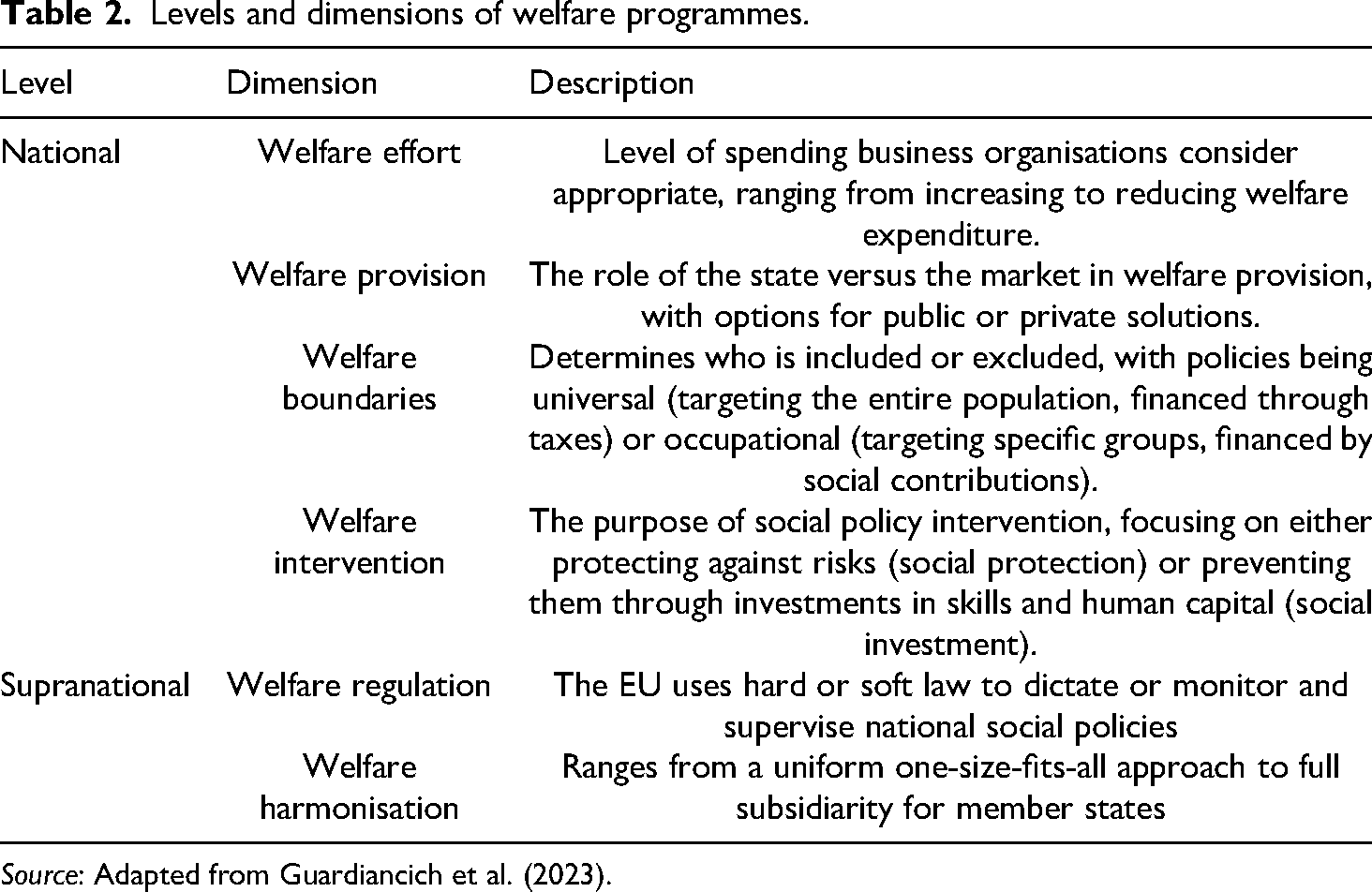
In addition, Beramendi et al. (2015) propose a framework to classify the goals of social policy reforms, identifying three main objectives: marketisation, which involves linking access to social policies to an individual's labour market status; segmentation, which stratifies access across different population groups based on factors such as contract type or economic sector; and inclusion, which, by contrast, seeks to broaden the range of beneficiaries. While Mares’ typology emphasises business attitudes, and Beramendi et al.'s focuses on policy orientations and goals, these frameworks can be seen as complementary, offering distinct but interconnected perspectives on the dynamics of social policy development. We therefore integrate Mares’ typology along with the two typologies proposed by Beramendi et al. into a single analytical framework (Table 2).
Levels and dimensions of welfare programmes.
Source: Adapted from Guardiancich et al. (2023).
Our framework is organised around four key dimensions. The first dimension concerns the welfare effort that employers and business organisations may consider appropriate. In terms of policy priorities, this can involve either increasing or reducing welfare spending. The second dimension pertains to the role of the state versus the market in welfare provision, with employers and business associations favouring public or private approaches to addressing social risks. The third dimension relates to solidarity welfare boundaries, determining who is included or excluded from a social policy intervention. Social policies may be universalistic, targeting the entire population and financed through taxation, or occupational, targeting specific occupational or social groups and financed through social contributions from potential beneficiaries. The fourth dimension focuses on the logic of welfare intervention, where social policies may aim either to protect against social risks, as in social protection, or to prevent them through investments in human capital, skills, and similar measures, as in social investment.
The dimensions presented above primarily concern the national level. However, given that we are dealing with EU actors, we also consider the supranational level, organised around two additional dimensions. First, welfare regulation refers to the EU's role in either imposing hard law or resorting to soft law to monitor and supervise national social policies. This regulatory dimension often revolves around legal debates among EEOs on whether the EU possesses sufficient competence in a given social policy area to justify the use of hard legislation. Second, welfare harmonisation ranges from adopting a one-size-fits-all approach across member states to embracing the principle of perfect subsidiarity, allowing member states full discretion in implementing social policies.
These six dimensions are not mutually exclusive. On the contrary, they overlap and interact, forming the essential ideational elements of welfare ideas (programmes). For instance, employers’ support for cutbacks in social protection spending, such as pensions, may coexist with a more favourable stance toward increased social investment. At the supranational level, these dimensions also interact with broader EU frameworks, where issues like the regulation of national welfare policies and the extent of harmonisation across member states play a role. For example, the EU's involvement in social policy regulation or its approach to harmonising policies can influence the degree of national discretion and the implementation of social policies.
With reference to the strands of literature in industrial relations and social policy mentioned in the literature review, we can expect EEOs to give different emphasis to different programmes. In line with PRA and the approach emphasising a neoliberal transformation, we should expect EEOs to prioritise cost-containment, privatisation, a limited regulatory role for the EU, as well as some support for social investment (e.g. active labour market policies). This is also what the literature that outlines the common neoliberal trends in the European political economies expects. In line with VoC, we should instead expect more mixed ideas with employers supporting social policies that facilitate the set of skills they need to be competitive (welfare-skill formation nexus). EEOs’ ideas should thus prioritise investments in skills and employability, with some convergence on social investment and public–private mixes in welfare provision. In these fields, because of the different positions of national employers, subsidiarity should be prioritised over one-size-fits-all strategies.
Research design
Case studies: BusinessEurope, SGI Europe and SMEunited
EU employers’ and workers’ organisations are among the collective actors whose constituencies are most affected by supranational social policy decisions (de Buck and Cerutti, 2017). The European social partners are involved in several coexisting decision-making modes promoted by the EU, ranging from European social dialogue, where their participation is highly structured, to legislative procedures under the Community method, where workers, employers and other interest groups resort to various types of lobbying (Guardiancich et al., 2023). 3 As opposed to the orientations of the labour movement, employers’ preferences over welfare are still a scarcely explored dimension of EU decision-making that needs to be unpacked (notable exceptions are represented by the work on social partners’ participation in the EU governance by Sabato et al. (2017); and in the field of education and employment policy by Sorensen and Dumay (2023).
BusinessEurope, SGI Europe and SMEunited are the three cross-industry employers’ organisations. Each of them organises the interests of a specific category of European employers. They are all based in Brussels. Together with the ETUC, they participate in European social dialogue as social partners recognised by the European Commission. BusinessEurope is considered Brussels’ most powerful lobby group, representing the interests of 40 federations including companies of all sizes in 35 EU and non-EU countries.
Often portrayed as the public sector counterpart of BusinessEurope, SGI Europe was founded in 1961 under the name European Centre of Employers and Enterprises (CEEP). SGI Europe represents enterprises providing services of general interest. Its members, 16 based in 17 EU member states, plus Turkey and the UK, are active in central and local administrations, healthcare, education, housing, waste management, energy, transport, water, environment, and communications. It moreover represents three sectoral federations: the European Broadcasting Union, the European Hospital and Healthcare Employers Association and the European Federation of Education Employers. SGI Europe has a dedicated social affairs and sustainability board.
SMEunited was founded as Union Européenne de l’Artisanat et des Petites et Moyennes Enterprises (UEAPME) in 1980 in Germany and then moved to Brussels in 1991. It was renamed as SMEunited in 2018. The organisation has circa 70 member organisations from over 30 EU and non-EU countries. Irrespective of its effective membership, SMEunited claims to speak on behalf of the 22.5 million SMEs in Europe that employ almost 82.4 million people.
Data and methods
As elucidated by Campbell (1998), programmatic ideas are commonly found in policy briefs, position papers or advisory memos to policymakers. In this article, we rely upon a total of 75 position papers (PPs) drafted by the three EEOs (see Table A.1 in the Appendix). BusinessEurope authored the majority of them, with 47 position papers (PP1–PP47), while SGI Europe (PP48–PP61) and SMEunited (PP62–PP75) contributed 14 each.
The analysis of position papers spans the period from 2012 to 2022 and was conducted using qualitative content analysis (Schreier, 2012) using NVivo. The coding units consisted of sentences or paragraphs (text passages), and the analysis involved a two-step coding process. First, we coded the documents according to the policy sectors they addressed (pensions, VET, labour market, and work–family reconciliation). Next, text passages were coded to identify key themes and issues within each policy sector. This coding proceeded inductively, letting categories emerge from the data (first-order categories). These categories were then clustered into macro-categories (second-order categories) (see Tables from A.2 to A.5 in the Appendix). Throughout the coding process, the authors have met several times. To ascertain convergence, on occasion of these meetings, they have debated the content of the position papers and the corresponding categories.
Finally, text passages were coded using the six analytical dimensions outlined in Table 2. Findings were further validated through interview data. Four semi-structured interviews were conducted from February to July 2022 (see Table A.7 in the Appendix). Participants were selected using purposive sampling (Patton, 2015) and included representatives from the three EU employers’ organisations as well as from the European Commission. The interview questions were open-ended and tailored to the specific profile of each interviewee.
Empirical evidence
In this section, we present the empirical evidence to firstly uncover the key themes and issues highlighted by employers’ organisations. We then explore the ideational elements of the welfare programmes they advocate, structured along our six analytical dimensions—spanning welfare effort, provision, boundaries, intervention logic, regulation, and harmonisation. By examining these dimensions at both the national and supranational levels, we illustrate how employers shape debates on social policy in the EU.
Key policies, themes, and issues
As illustrated in Figure 1, labour market-related issues significantly outweigh in the documents. Nearly 70% of all position papers address the labour market, followed by over 24% focusing on VET, and around 10% covering pension policy and work–family reconciliation. The different EEOs under scrutiny (the ones that represent large private firms; small and medium private enterprises; and employers in the services of general interest) prioritise the same policies.
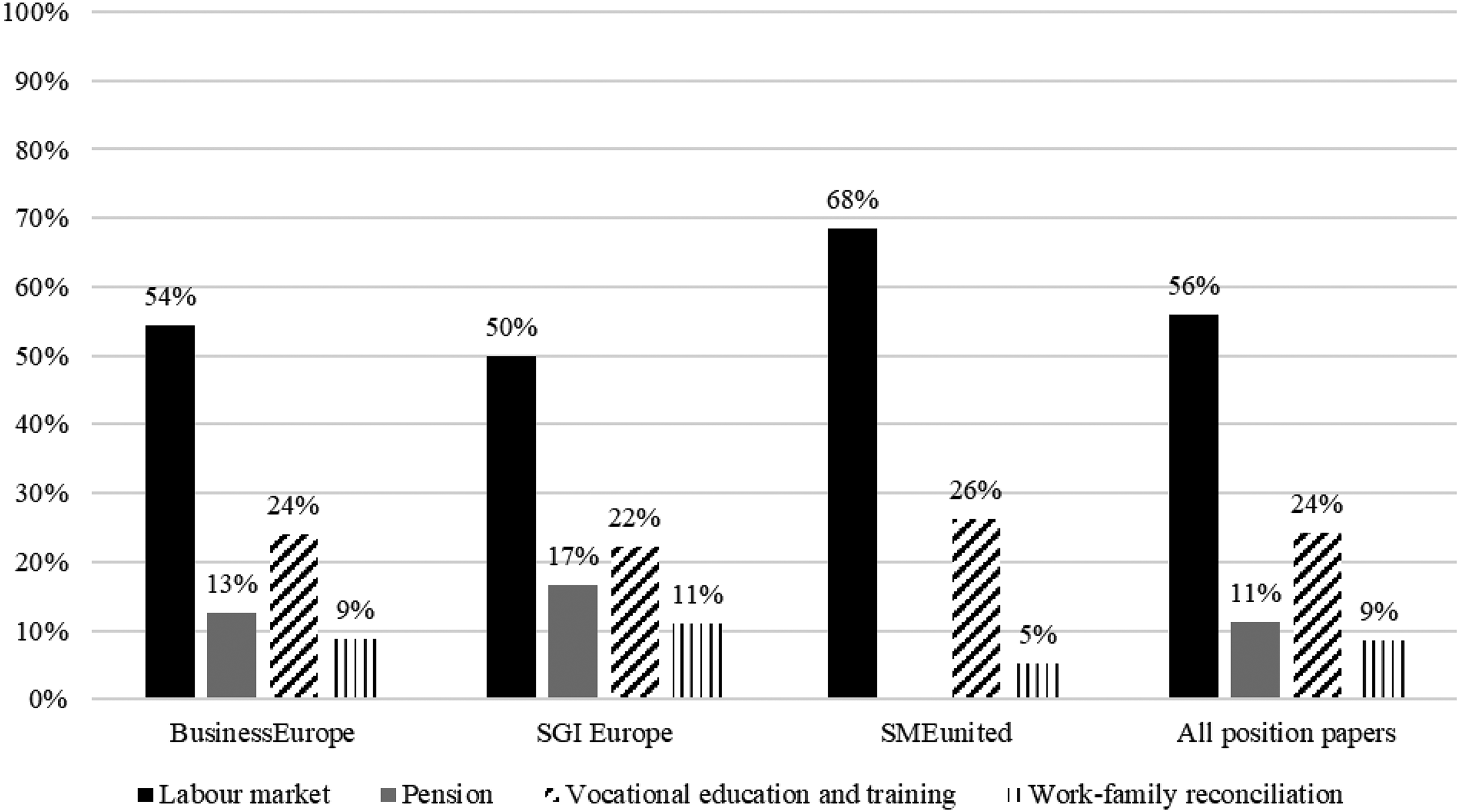
Policy sectors addressed in the documents. Source: Authors’ own elaboration.
The analysis of key themes and issues reveals distinct patterns across the four policy sectors, reflecting varying emphases by employers’ organisations (Figure 2). Regarding the labour market, the dominant concern (38%) revolves around achieving an optimal balance between labour market flexibility and security. This reflects a strong focus on flexicurity measures, reducing tax wedges, and facilitating worker mobility.
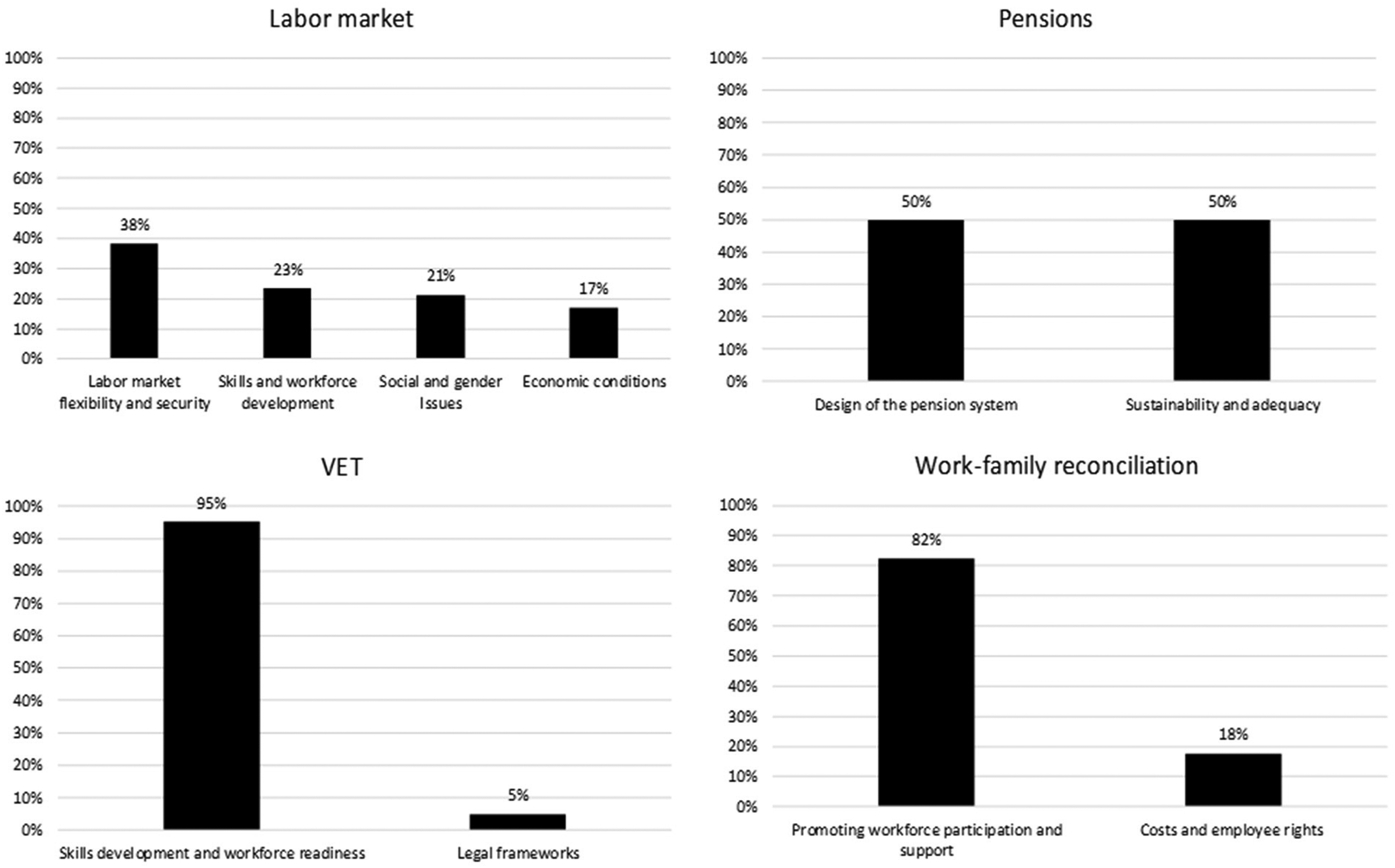
Key themes and issues. Source: Authors’ own elaboration.
As noted by BusinessEurope, policymakers should ‘prioritize reforms to achieve open, mobile and dynamic labour markets’ (PP22). Skills and workforce development (23%) also receive significant attention, with a strong focus on addressing skill gaps through active labour market policies (ALMPs) and promoting STEM (Science, Technology, Engineering, and Mathematics) skills.
To ensure the effectiveness of these efforts, ‘stronger partnerships with employers are necessary for ensuring the effectiveness and efficiency of ALMPs so as to facilitate the labour market integration of the long-term unemployed’ (PP13). Additionally, ‘greater emphasis on the role of ALMPs, complementary to passive labour market policies, in terms of the role that they can play in facilitating transitions between jobs, sectors and geographically’ (PP19), is crucial for enhancing the employability and mobility of workers across Europe. Social and gender issues (21%) highlight topics like the gender pay gap and youth unemployment. A significant factor in the gender pay gap is the influence of ‘gender roles, individual preferences and stereotypes’ (PP28), which have a determining effect on the existing division of labour. Addressing these cultural and societal factors is considered as crucial for bridging the pay disparity between men and women. Efforts to reduce this gap must go beyond legislative changes, focusing instead on ‘a cultural shift, rather than a legislative effort’ (PP28). Finally, concerns about economic conditions (17%) include debates on minimum wages, minimum income schemes, and managing labour shortages. For example, BusinessEurope argues that ‘the proposal on minimum wages is completely against the letter and spirit of the EU treaty on pay and collective bargaining’ (PP37).
For VET, the overwhelming focus on skills development and workforce readiness (95%) reflects employers’ strong emphasis on initiatives like promoting digital skills and STEM education, encouraging apprenticeships and traineeships, and leveraging digital learning platforms to meet skill needs. As BusinessEurope highlights, ‘strengthening the labor market relevance of VET is essential for helping companies to address their skills needs and in helping people to enter and progress in the workplace’ (PP30). Additionally, discussions occasionally touch on the rights of trainees relative to regular workers (5%). As highlighted in a position paper, whereas ‘traineeships play a valuable role in helping young people to gain work experience that can facilitate their path into employment, […] trainees, including those in open-market positions, should not have the same status as workers’ (PP48).
In the pension sector, attention is equally divided between the design of pension systems (50%) and their sustainability and adequacy (50%). This balance reflects dual priorities: structuring statutory, occupational, and private pensions to optimise their functions while ensuring long-term sustainability by promoting longer working lives. As highlighted by BusinessEurope, ‘longer working lives are the best way to ensure sustainability and adequacy of pension systems, in the context of increasing life expectancy’ (PP1). Additionally, EEOs emphasise the importance of balancing pension costs with adequate benefits to support individuals in their later years without compromising economic growth.
As for work-family reconciliation, the main concerns are centred on workforce participation and support (82%), with particular emphasis on women's employment and the role of childcare and eldercare facilities. As highlighted in a position paper, ‘the EU needs more and efficient childcare facilities with extended opening hours, as well as facilities for older people. This is where European and national policy efforts should concentrate to allow men and women to better reconcile work and family life’ (PP20). On the other hand, concerns also focus on the financial implications of increasing employee rights (18%), particularly the costs associated with expanding parental leave or flexible work arrangements.
EEOs’ welfare programmes and the role of the EU
At the EU level, EEOs are generally opposed to binding regulation, seeking instead the greatest degree of subsidiarity. This stance reflects a desire to maintain autonomy for national social partners and respect the diverse social policy and industrial relations traditions across EU Member States.
These aspects are particularly evident in relation to the European Pillar of Social Rights, a broad initiative launched in 2017 by the Juncker Commission. Despite its relatively limited enforcement capacity, as noted by Vesan et al. (2021) and Vesan and Corti (2021), EEOs expressed strong opposition to the Pillar's one-size-fits-all approach, which they argued overlooked the varied social policy traditions across Europe. Employers raised concerns that ‘the sole focus on ‘social rights’ is not the right approach’ (PP16), highlighting that the initiative risked increasing non-wage labour costs. As BusinessEurope pointed out, ‘putting forward principles, rights or initiatives that will increase non-wage labour costs across Europe is the wrong policy orientation. This will discourage enterprises to hire, and deteriorate labour market prospects for citizens, particularly those more at risk of being priced out of the labour market’ (PP22). Instead, EEOs emphasise the importance of focusing on better implementation of current frameworks. They argue that ‘there is already a strong social dimension in Europe. European employers are willing to discuss how to sustain and improve this in the future’ (PP16). To this end, the Pillar should act as a tool for reform rather than regulation, aiming to ‘pave the way for the design of benchmarks that can act as a compass for the necessary national reforms of labour markets’ (PP16). This perspective is rooted in the principle of subsidiarity, with EEOs stressing that many of the proposals within the Pillar would undermine national competences. As they noted, ‘most ideas […] would contradict the subsidiarity principle in the field of social affairs. Many of them would also run counter EU growth and jobs objectives’ (PP22). Employers consistently advocated for a focus on ‘enforcement of already existing social directives’ (PP22), citing the over 70 directives already in place as sufficient to address social challenges if properly implemented.
However, this aversion to regulation is not absolute. Employers are willing to engage in regulatory adjustments when existing frameworks require modifications, as evidenced in cases such as the Posting of Workers Directive and the IORP (Institution for Occupational Retirement Provision) Directive. Moreover, when EU-level solutions are seen as beneficial – such as the European Skills Agenda or the Youth Guarantee – employers have been more receptive to intervention, though they still critiqued specific provisions rather than rejecting regulation entirely.
At the national level, in the welfare intervention dimension, EEOs emphasise social investment over traditional social protection. Also, EEOs tend to focus on cost containment rather than advocating for increased spending. Their position reflects a preference for fostering policies that promote economic efficiency, particularly in sectors like pensions, labour market reforms, and skills development. ALMPs and initiatives like flexicurity receive greater attention than conventional social protection schemes such as old-age pensions or unemployment insurance. In the area of work-family reconciliation, for example, the primary aim is to enhance the employability of women by alleviating caregiving responsibilities. This reflects the broader goal of facilitating greater workforce participation while balancing the demands of family life. Similarly, reform debates centre on ensuring the sustainability of systems, promoting longer working lives, and maintaining cost-efficiency. Employers argue that ‘available financial resources should be spent in a productive way’ to support economic growth and competitiveness (PP5).
However, it is important to note some divergence in EEOs’ attitudes towards public spending on welfare, particularly in the context of global competitiveness. For instance, BusinessEurope is highly concerned about Europe's competitive position globally, given that non-wage labour costs are particularly high in the EU. This could place European business at a comparative disadvantage relative to companies in other advanced economies where labour costs are lower. As one representative noted, in Europe, we have social protection spending that is much higher than other countries around the world. We value social protection. We think it's important to invest in it. But at the same time, we need to be aware of the need to avoid putting our companies in Europe at a comparative disadvantage compared to companies in other advanced economies and globally that have less of such costs (INT4).
Further, it is emphasised that resources should be used effectively, ‘creating incentives for people to get to the labour markets and also to make sure that people who are working are better off when they work compared to when they receive benefits being inactive’ (INT4).
In contrast, SGI Europe takes a different stance, emphasising the positive role of publicly financed social protection systems in supporting the survival of European economies during the COVID-19 crisis. As an interviewee commented, ‘We have been one of the first to think that the COVID crisis was a stark reminder about how much we need public services. […] The COVID crisis demonstrates how much we need a strong skeleton of social protection systems’ (INT3)
EEOs also express a qualified preference for private over public welfare provision. They support public–private partnerships (PPPs), which they believe can enhance the efficiency of welfare systems. By leveraging resources from both the public and private sectors, EEOs argue that social policies can be delivered more effectively without the need for significant increases in public spending. For example, in the context of work–family reconciliation, employers advocate for greater cooperation between the public and private sectors to meet social needs while minimising financial strain on business (PP20). Similarly, in social protection schemes, EEOs emphasise the potential for PPPs to improve the delivery of services and ensure that public resources are used more efficiently: ‘Closer cooperation between the public and private sectors can contribute to a better use of public resources in the delivery of social policies, in particular through Public Private Partnerships’ (PP5). Finally, while employers tend to prefer occupational or private solutions to universal/public welfare, they do not entirely reject the latter. For example, in the area of complementary pensions, some EEOs advocate for greater flexibility in the provision of higher protection levels, suggesting that individuals should be able to voluntarily subscribe to these schemes (PP40). Similarly, in times of labour shortages, employers suggest the development of in-work benefits, which could provide workers with additional financial support while simultaneously benefiting employers by improving workforce stability: [I]f people are active, they don’t need support. And so the idea is to, through in-work benefits, encourage people to be as active as they can. Maybe they cannot work full time […] but maybe they will increase their working hours progressively and hopefully be as self-sufficient as possible with the support provided in this direction (INT4).
In summary, the ideational elements of welfare programmes promoted by employers are characterised by a clear preference for courses of action that prioritise social investment and, to a lesser extent, cost-containment; while seeking to minimise the regulatory burdens imposed by EU-wide legislation, favouring instead soft-law and harmonisation through subsidiarity (Figure 3; see also Table A.6 in the Appendix).
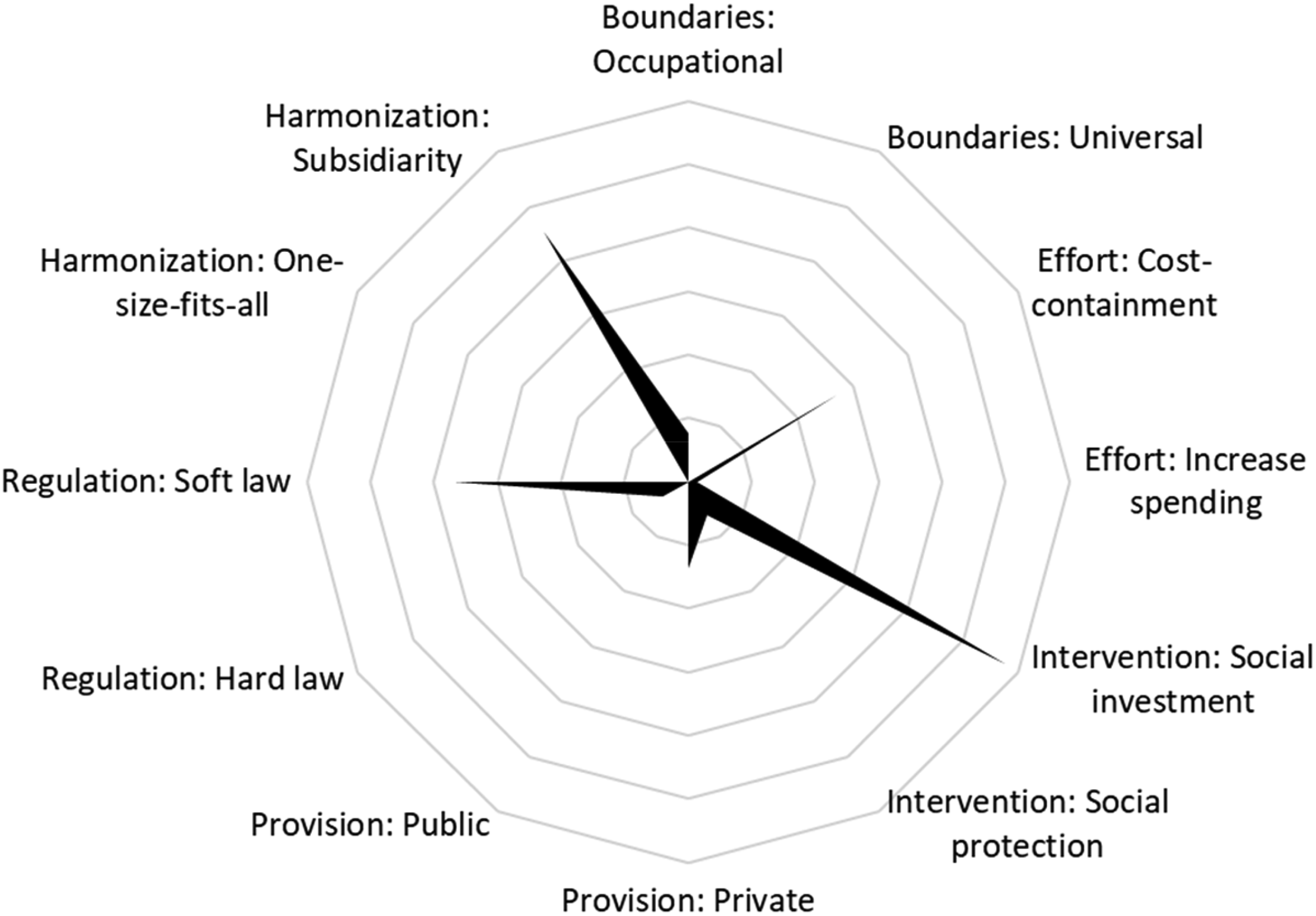
Ideational elements of EEOs welfare programmes. Source: Authors’ own elaboration.
Discussion
To situate our findings within the broader scholarly debate, we engage with the strands of literature discussed in the “Ideas, business, and social policy” section. The analysis of the key dimensions of welfare policy – welfare effort, provision, boundaries, intervention, regulation, and harmonisation – reflect a pattern consistent with the neoliberal transformation approach (Baccaro and Howell, 2017). Cost-containment is prioritised over increased public spending, and private provision is emphasised. The role of the EU is framed in terms of soft, rather than hard, regulation, with a clear emphasis on subsidiarity. This configuration aligns closely with the expectations of the contributions about the increased liberalisation of the political economies in Europe and, to some extent, also corresponds with the PRA assumptions (Korpi, 2006; Paster, 2012).
When comparing the various themes and dimensions, it becomes clear that social investment is strongly favoured – far more than cost-containment or privatisation, as one might expect from the PRA perspective. This trend is evident in sector-specific analyses. In labour market policy and VET, EEOs emphasise active labour market programmes and flexicurity, aimed at boosting employability through skills development. This aligns with the VoC approach, which emphasises the welfare-skills formation nexus (Fleckenstein and Seeleib-Kaiser, 2011), while also supporting the framing of social investment as a neoliberal-compatible programme (Laruffa, 2018). Even in the field of pensions, calls for financial sustainability are combined with concerns about adequacy and active ageing.
EEOs’ resistance to EU-level binding regulation further reflects the nature of their ideas. Their opposition aligns with a firm commitment to subsidiarity: the belief that social policy should be primarily shaped at the national level, allowing for tailored responses suited to diverse domestic contexts, in line with the VoC approach. Yet this does not amount to an outright rejection of EU involvement. Instead, EEOs express a preference for soft law mechanisms that promote benchmarking and best practices. This again reflects those insights which stress the importance of institutional diversity and the need for flexible, non-uniform solutions (Hassel, 2007; Hyman, 2001). EEOs also advocate for PPPs as a means of delivering welfare more efficiently without increasing public expenditure. Rather than supporting outright retrenchment, they promote new public–private mixes in service provision. In doing so, they seek to reconcile the goals of social protection and economic competitiveness – particularly in relation to the costs of employment in the global economy.
The findings also reveal differences among EEOs, especially regarding public spending and state responsibility. For example, BusinessEurope and SGI Europe express divergent views on some issues. This internal variation supports the expectation of differentiated employer preferences, based on economic sector, firm size, and institutional environment. Finally, our diachronic analysis suggests that EEOs’ positions have remained stable over time. We find no strong evidence of increasing support for public provision or for a more active EU role in social policy – not even in response to the pandemic. Nor is there evidence of greater emphasis on cost-containment or privatisation. What remains central is the social investment paradigm, which reflects continuity in the neoliberal transformation of welfare (Laruffa, 2018, 2021b).
Conclusion
This study has examined welfare policy ideas held by business actors in the EU. By analysing position papers and interview data, we explored how EEOs define their policy agendas in areas such as labour markets, VET, pensions, and work-family reconciliation. We have conceptualised ideas as programmes, namely policy prescriptions that guide policy action. The empirical evidence shows that the key themes and issues addressed in the position papers are labour market flexibility, skill development, and the reform of social protection systems. The proposed solutions focus on economic efficiency and labour market participation. By focusing on reducing labour market rigidities, increasing employability through skills development, and limiting non-wage labour costs, EEOs articulate a vision of welfare that is intrinsically connected to economic competitiveness and growth.
While this study has had a descriptive and interpretive aim, it also paves the way for more ambitious research. First, further research is needed in the analysis of the respective roles of contingent ideas and more stable ideational formations. In line with the work by Benassi and Vlandas (2016) and Tassinari et al. (2022), the question of how and why social partners address policy issues and define their priorities is crucial. Long-term ideological frames tend to interact with more contingent decisions on policy programmes. While it was not possible to address this issue in the present study, a more populated dataset and a longer period of observation would enable a more fine-grained analysis to capture both contingent factors (for instance, those related to major crises) and more enduring ideational patterns of welfare reform on the employers’ side.
A second issue that warrants greater attention concerns the interaction between employers, on the one hand, and EU institutions, on the other. We show a clear overlap between the priorities set by the EU in social and labour market policies and the issues that have been prioritised by EEOs (i.e. social investment and cost-containment, at least in some policy fields). In parallel, we have observed tensions between the EU and EEOs on the level of intervention by the EU institutions in welfare reforms and the application of the principle of subsidiarity. In this area, we still do not know whether the ideas of EEOs are shaped by European integration (in terms of structural constraints and/or contingent political opportunities) or, conversely, whether the former shape the EU agenda.
A third promising issue that deserves further investigation concerns the comparison between federal and confederal organisations at the EU level, and potentially at the national level. Our findings provide initial indications of a clear distinction between public and private employers in their welfare programmes. It remains to be seen whether this distinction reflects different normative backgrounds, divergent traditions in approaching industrial relations at the EU level, or whether there are additional lines of differentiation (in line, for instance, with the structural demarcation of employers’ organisations’ clusters identified by Pavolini, this issue). Research based on a larger set of documents and a more systematic tracing of the dialogue between and within EEOs could enable a more detailed reconstruction of the cleavages in the employers’ community.
Footnotes

Funding
The authors disclosed receipt of the following financial support for the research, authorship, and/or publication of this article: This research was supported by the European Commission DG Employment (No. VS/2020/0141).
Declaration of conflicting interests
The authors declared no potential conflicts of interest with respect to the research, authorship, and/or publication of this article.
Notes
Appendix
List of position papers and joint declarations.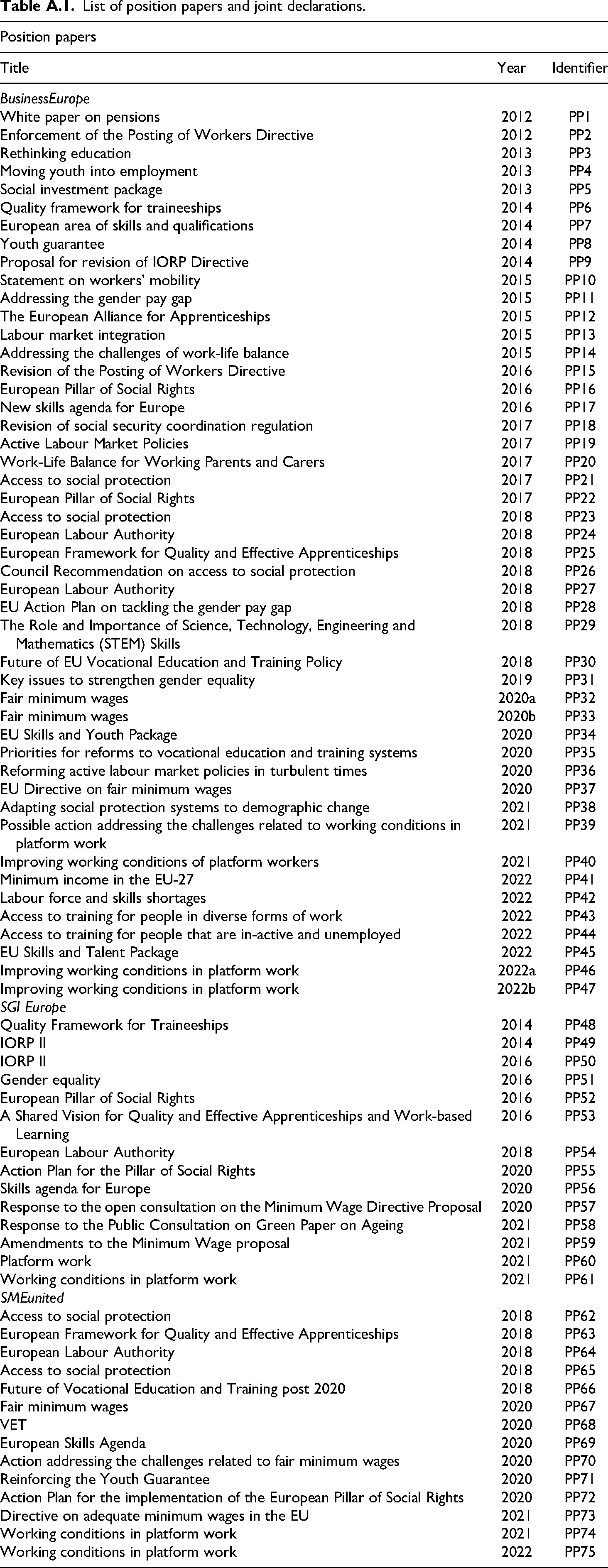
Position papers
Title
Year
Identifier
BusinessEurope
White paper on pensions
2012
PP1
Enforcement of the Posting of Workers Directive
2012
PP2
Rethinking education
2013
PP3
Moving youth into employment
2013
PP4
Social investment package
2013
PP5
Quality framework for traineeships
2014
PP6
European area of skills and qualifications
2014
PP7
Youth guarantee
2014
PP8
Proposal for revision of IORP Directive
2014
PP9
Statement on workers’ mobility
2015
PP10
Addressing the gender pay gap
2015
PP11
The European Alliance for Apprenticeships
2015
PP12
Labour market integration
2015
PP13
Addressing the challenges of work-life balance
2015
PP14
Revision of the Posting of Workers Directive
2016
PP15
European Pillar of Social Rights
2016
PP16
New skills agenda for Europe
2016
PP17
Revision of social security coordination regulation
2017
PP18
Active Labour Market Policies
2017
PP19
Work-Life Balance for Working Parents and Carers
2017
PP20
Access to social protection
2017
PP21
European Pillar of Social Rights
2017
PP22
Access to social protection
2018
PP23
European Labour Authority
2018
PP24
European Framework for Quality and Effective Apprenticeships
2018
PP25
Council Recommendation on access to social protection
2018
PP26
European Labour Authority
2018
PP27
EU Action Plan on tackling the gender pay gap
2018
PP28
The Role and Importance of Science, Technology, Engineering and Mathematics (STEM) Skills
2018
PP29
Future of EU Vocational Education and Training Policy
2018
PP30
Key issues to strengthen gender equality
2019
PP31
Fair minimum wages
2020a
PP32
Fair minimum wages
2020b
PP33
EU Skills and Youth Package
2020
PP34
Priorities for reforms to vocational education and training systems
2020
PP35
Reforming active labour market policies in turbulent times
2020
PP36
EU Directive on fair minimum wages
2020
PP37
Adapting social protection systems to demographic change
2021
PP38
Possible action addressing the challenges related to working conditions in platform work
2021
PP39
Improving working conditions of platform workers
2021
PP40
Minimum income in the EU-27
2022
PP41
Labour force and skills shortages
2022
PP42
Access to training for people in diverse forms of work
2022
PP43
Access to training for people that are in-active and unemployed
2022
PP44
EU Skills and Talent Package
2022
PP45
Improving working conditions in platform work
2022a
PP46
Improving working conditions in platform work
2022b
PP47
SGI Europe
Quality Framework for Traineeships
2014
PP48
IORP II
2014
PP49
IORP II
2016
PP50
Gender equality
2016
PP51
European Pillar of Social Rights
2016
PP52
A Shared Vision for Quality and Effective Apprenticeships and Work-based Learning
2016
PP53
European Labour Authority
2018
PP54
Action Plan for the Pillar of Social Rights
2020
PP55
Skills agenda for Europe
2020
PP56
Response to the open consultation on the Minimum Wage Directive Proposal
2020
PP57
Response to the Public Consultation on Green Paper on Ageing
2021
PP58
Amendments to the Minimum Wage proposal
2021
PP59
Platform work
2021
PP60
Working conditions in platform work
2021
PP61
SMEunited
Access to social protection
2018
PP62
European Framework for Quality and Effective Apprenticeships
2018
PP63
European Labour Authority
2018
PP64
Access to social protection
2018
PP65
Future of Vocational Education and Training post 2020
2018
PP66
Fair minimum wages
2020
PP67
VET
2020
PP68
European Skills Agenda
2020
PP69
Action addressing the challenges related to fair minimum wages
2020
PP70
Reinforcing the Youth Guarantee
2020
PP71
Action Plan for the implementation of the European Pillar of Social Rights
2020
PP72
Directive on adequate minimum wages in the EU
2021
PP73
Working conditions in platform work
2021
PP74
Working conditions in platform work
2022
PP75
Labour market: coding categories (number of coded text passages in parentheses).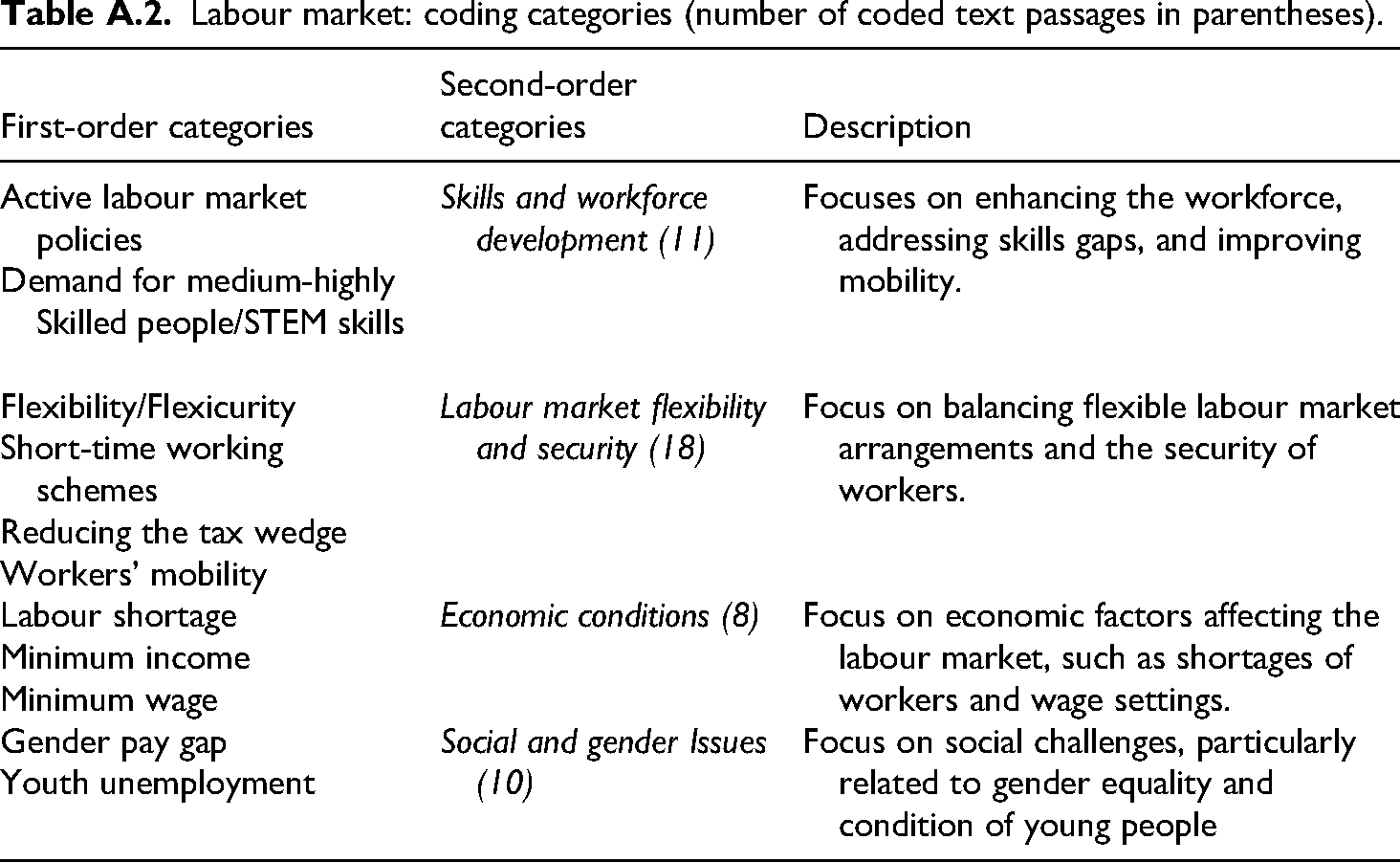
First-order categories
Second-order categories
Description
Active labour market policies
Skills and workforce development (11)
Focuses on enhancing the workforce, addressing skills gaps, and improving mobility.
Demand for medium-highly Skilled people/STEM skills
Flexibility/Flexicurity
Labour market flexibility and security (18)
Focus on balancing flexible labour market arrangements and the security of workers.
Short-time working schemes
Reducing the tax wedge
Workers’ mobility
Labour shortage
Economic conditions (8)
Focus on economic factors affecting the labour market, such as shortages of workers and wage settings.
Minimum income
Minimum wage
Gender pay gap
Social and gender Issues (10)
Focus on social challenges, particularly related to gender equality and condition of young people
Youth unemployment
Pensions: coding categories (number of coded text passages in parenthesis).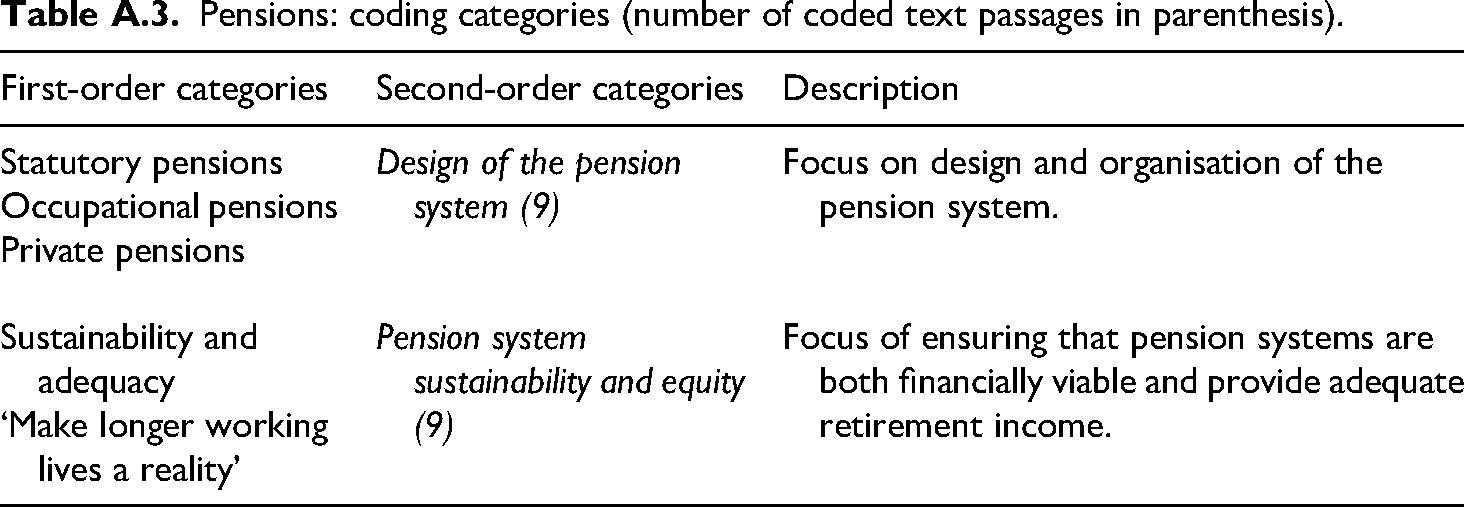
First-order categories
Second-order categories
Description
Statutory pensions
Design of the pension system (9)
Focus on design and organisation of the pension system.
Occupational pensions
Private pensions
Sustainability and adequacy
Pension system sustainability and equity (9)
Focus of ensuring that pension systems are both financially viable and provide adequate retirement income.
‘Make longer working lives a reality’
VET: coding categories (number of coded text passages in parenthesis)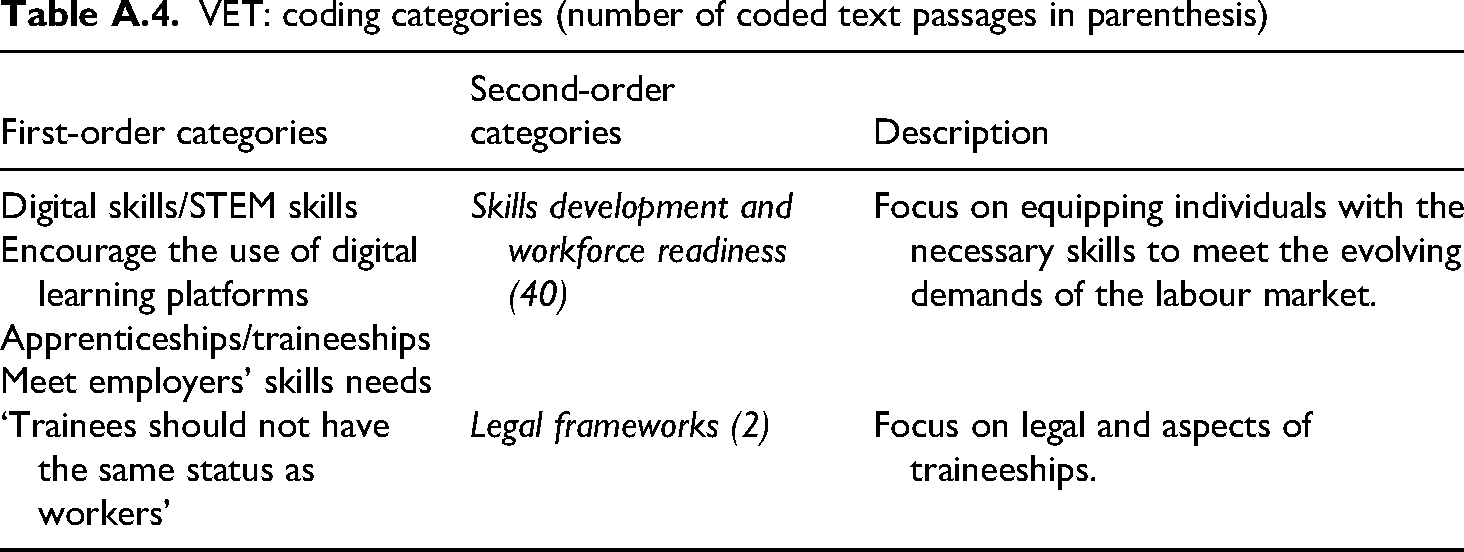
First-order categories
Second-order categories
Description
Digital skills/STEM skills
Skills development and workforce readiness (40)
Focus on equipping individuals with the necessary skills to meet the evolving demands of the labour market.
Encourage the use of digital learning platforms
Apprenticeships/traineeships
Meet employers’ skills needs
‘Trainees should not have the same status as workers’
Legal frameworks (2)
Focus on legal and aspects of traineeships.
Work-family reconciliation: coding categories (number of coded text passages in parenthesis)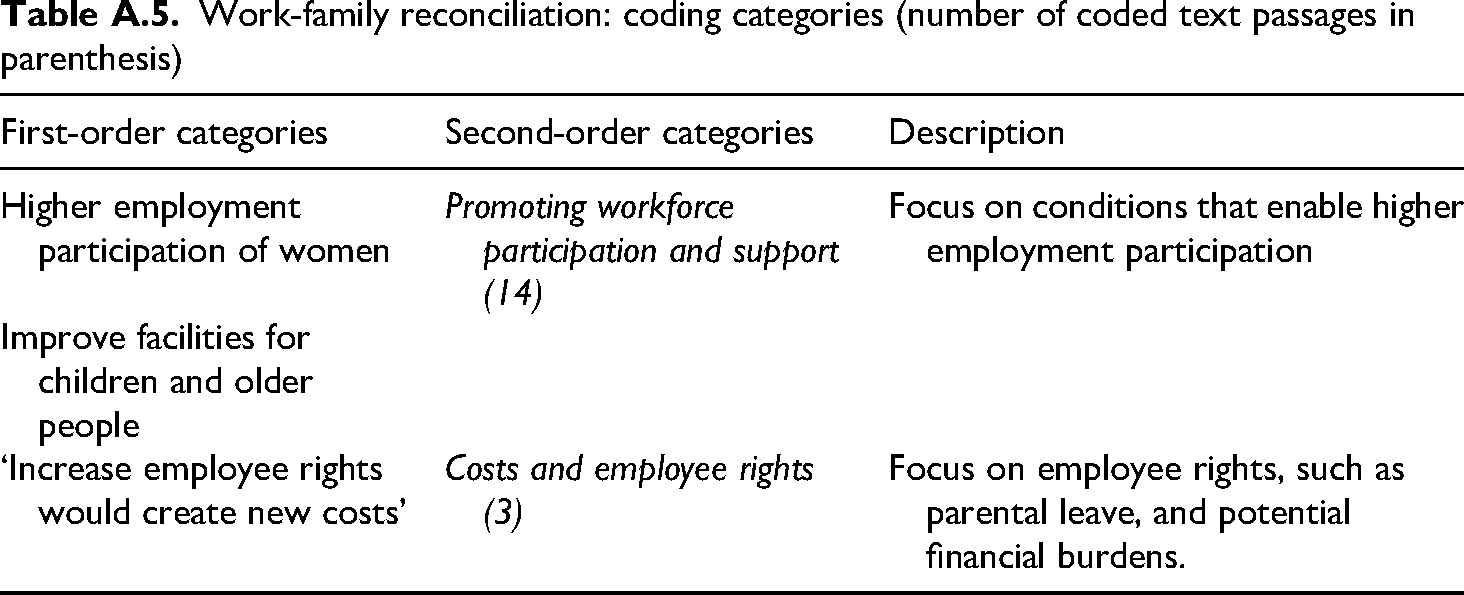
First-order categories
Second-order categories
Description
Higher employment participation of women
Promoting workforce participation and support (14)
Focus on conditions that enable higher employment participation
Improve facilities for children and older people
‘Increase employee rights would create new costs’
Costs and employee rights (3)
Focus on employee rights, such as parental leave, and potential financial burdens.
Ideational elements of EEOs welfare programmes: coded text passages (%)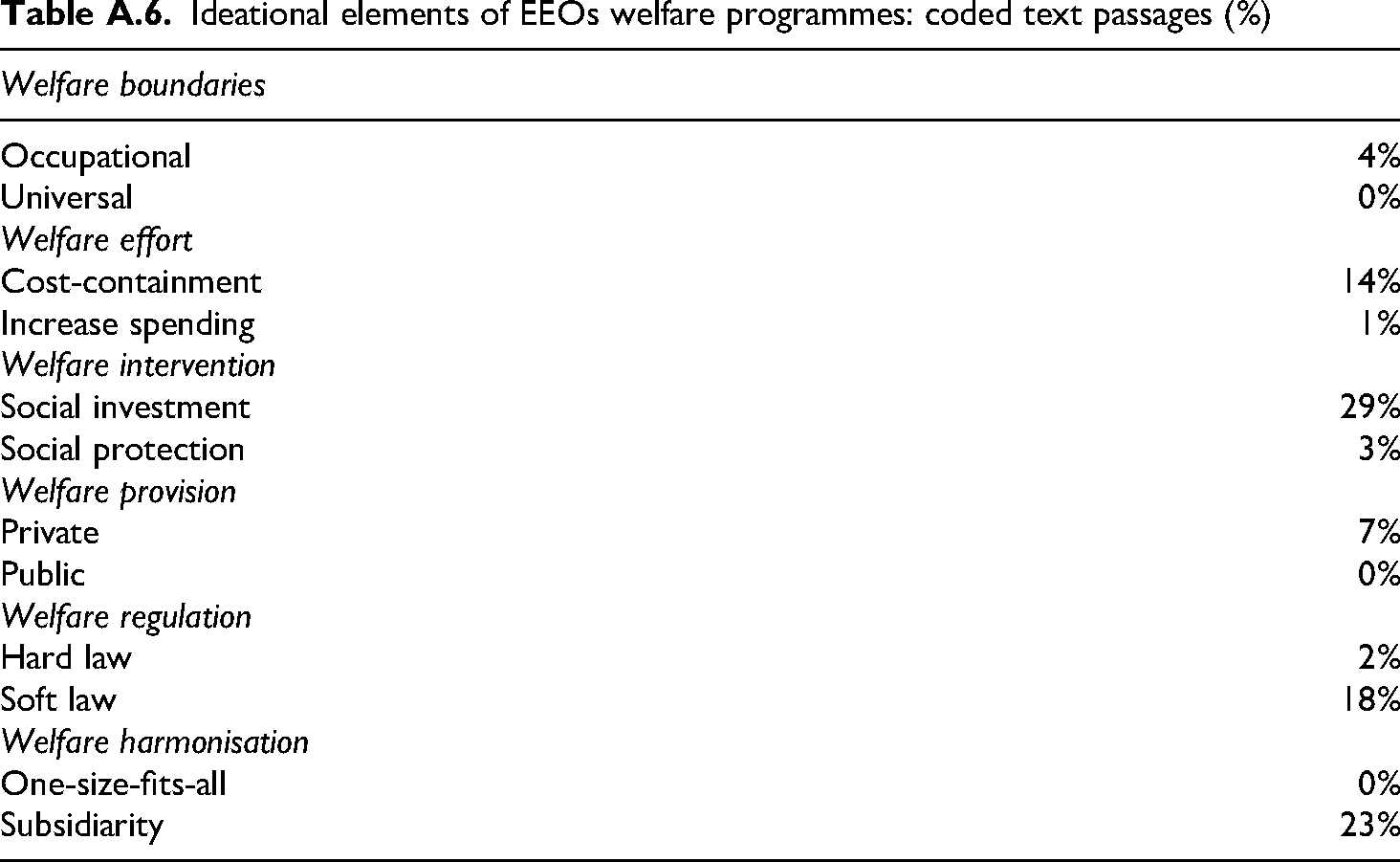
Welfare boundaries
Occupational
4%
Universal
0%
Welfare effort
Cost-containment
14%
Increase spending
1%
Welfare intervention
Social investment
29%
Social protection
3%
Welfare provision
Private
7%
Public
0%
Welfare regulation
Hard law
2%
Soft law
18%
Welfare harmonisation
One-size-fits-all
0%
Subsidiarity
23%
List of interviews
DG employment
16.02.2022
INT1
SMEunited
13.07.2022
INT2
SGI Europe
15.07.2022
INT3
BusinessEurope
12.07.2022
INT4