







Abstract
A synthesis and meta-analysis of the extant research on the effects of reading interventions delivered using social studies content for students with learning disabilities in kindergarten through Grade 12 is provided. A total of 27 studies met criteria for the synthesis, with 16 studies providing sufficient data for inclusion in the meta-analysis. Reading interventions implemented within the context of social studies have employed the use of graphic organizers, mnemonics, reading and answering questions, guided notes, and multicomponent comprehension instruction. The overall mean effect size for interventions included in the meta-analysis was 1.02, indicating that reading interventions delivered using social studies content have a substantial positive effect on outcomes among students with learning disabilities.
Beginning in the upper elementary grades, independently reading informational text to learn content and develop reading comprehension is a central aspect of content area instruction (Gajria, Jitendra, Sood, & Sacks, 2007). In middle and high school content area classes, students are assigned reading passages to learn concepts from text (Bulgren, Deshler, & Lenz, 2007). They must also apply newly acquired information to higher-order tasks to demonstrate understanding (Bulgren et al., 2007). Common assignments include asking students to compare and contrast information, generate inferences, and evaluate content (Bulgren et al., 2007). In essence, possessing the capacity to learn from informational text is a substantial attribute to long-term academic success (Cervetti, Jaynes, & Hiebert, 2009).
The importance of acquiring knowledge from informational text has garnered national attention. The Council of Chief State School Officers and the National Governors Association noted a special emphasis on literacy instruction using informational text in the Common Core State Standards (National Governors Association Center for Best Practices and the Council of Chief State School Officers, 2010). The standards, adopted thus far by 44 states, specify the literacy skills required for reading success in multiple disciplines and the need for establishing independent literacy skills throughout the content areas. This emphasis follows the National Assessment for Education Progress assessment guidelines for balancing the amount of informational text in the earliest grades and increasing the proportion of informational text throughout the grade levels. This emphasis on comprehension of informational text and intensified standards in content-area subjects poses a challenge for students of all levels and their educators (Bulgren et al., 2007).
Comprehension of informational text is important not only to meet current instructional standards. Comprehending informational text is also critical to developing a student’s background knowledge for related topics that will potentially be addressed in the future (Cervetti et al., 2009). The unique role of prior knowledge and its contribution to future learning was analyzed in a synthesis examining the contribution of prior knowledge to novel learning situations (Dochy, Segers, & Buehl, 1999). Analysis indicated that 30% to 60% of the variance on content knowledge outcomes was attributed to a student’s prior knowledge, thus providing evidence that knowledge and comprehension can be thought of as cyclical in nature (Dochy et al., 1999). The authors concluded that because prior knowledge plays such an integral role in novel learning environments, educators should embrace instructional practices and materials that support the facilitation of activating what was already learned. Cervetti et al. (2009) wrote, “Knowledge begets more knowledge” (p. 81), and only with comprehension come gains in background knowledge. Conversely, only with background knowledge comes robust understanding.
The social studies (i.e., history, geography, government) provide ideal subject areas to allow for bolstering students’ knowledge base through engaging and compelling content. Students are provided opportunities to view historical events from multiple perspectives, to empathize with others, articulate and defend points of view, and realize how historical events affect the world today (Gersten & Okolo, 2007; Okolo, Englert, Bouck, & Heutsche, 2007). The acquisition of social studies concepts often occurs through reading informational text sources (Bulgren et al., 2007). Students in social studies classes read textbooks, articles, and primary sources to acquire information that will be discussed, applied, and assessed in a variety of formats (Gersten, Baker, Smith-Johnson, Dimino, & Peterson, 2006). However, the tendency for social studies instruction to be a “textbook-based curriculum” (Okolo et al., 2007, p. 4) can pose a problem for students with learning disabilities (LD). These students often experience profound difficulty when reading content area textbooks for several reasons. First, these textbooks are frequently written at advanced readability levels, with poorly organized information and incoherent text structures. In addition, they contain concepts and information for which students with LD have inadequate background knowledge (Bulgren et al., 2007; Gersten & Okolo, 2007). In addition, more advanced comprehension activities such as articulating different points of view and comparing and contrasting new ideas can be difficult for students with LD (Bulgren et al., 2007).
Reading Instruction With Social Studies Content
Several authors have examined interventions and instructional practices to assist students with LD in better comprehending and learning from informational or content area text. Authors of a textbook chapter (Scruggs & Mastropieri, 2003) reviewed some instructional practices in social studies and science for students with LD and summarized instructional components that were linked to positive outcomes in learning new vocabulary and content. The practices included (a) clear instructional objectives (e.g., identifying purpose at the beginning of each lesson), (b) high levels of student engagement (e.g., sufficient time allotted for student practice and application), (c) concrete and meaningful learning opportunities (e.g., relevant content and discussion), (d) opportunities for active thinking, and (e) use of learning strategies (e.g., mnemonics). Although Scruggs and Mastropieri’s (2003) literature review chapter was informative in terms of explaining the interventions, the results were descriptive in nature and did not include effect sizes or tables as an element of the analysis.
Improving comprehension of informational text for students with LD was also the focus of a recent synthesis (Gajria et al., 2007). A total of 29 experimental and quasi-experimental studies from 1978 to 2005 that included a control group were included. The authors reported moderate to high effect sizes on comprehension across 29 studies for content enhancements such as mnemonic illustrations and visual displays, cognitive strategies such as self-questioning and paraphrasing, and multiple cognitive strategies. The synthesis described the critical components of effective interventions such as group size and location of instructional delivery. Similar to Scruggs and Mastropieri (2003), the authors reported that concrete content enhancement strategies such as mnemonics were effective for improving student comprehension as were explicit strategy instruction in main idea, self-monitoring, and text structure analysis (Gajria et al., 2007).
The purpose of this synthesis and meta-analysis is to analyze reading interventions designed for students with LD that are implemented using social studies text. This systematic review is relevant for several reasons. As mentioned previously, there is a renewed sense of consequence placed on reading informational text for understanding (National Governors Association Center for Best Practices and the Council of Chief State School Officers, 2010). The findings gleaned from this meta-analysis can be used to support the improvement of academic outcomes for students with LD, who often experience difficulty with learning from informational text, such as social studies text (Gersten et al., 2006). Through a clarification of findings from the extant literature, teachers can make informed instructional decisions based on evidence and researchers will be able to consider appropriate areas for future investigation.
Another purpose of this article is to expand on in three ways the reviews of literature that were previously conducted. First, the textbook chapter (Scruggs & Mastropieri, 2003) and synthesis (Gajria et al., 2007) conducted searches of extant literature that ended in 2002 (Scruggs & Mastropieri, 2003) and 2005 (Gajria et al., 2007). Our search represents a more extended period of time, from the first published through December 2010, and therefore contains several studies that were not identified in either of the previously described reviews. Second, Scruggs and Mastropieri (2003) wrote a chapter summarizing various science and social studies treatments designed to enhance science and social studies content acquisition among students with LD. The meta-analysis presented here differs in that we conducted a comprehensive search of all studies that investigate reading interventions that focus on improving reading for understanding that were delivered using social studies content. Third, Gajria et al. (2007) reviewed experimental or quasi-experimental group design studies that included a control group. This article includes multiple-treatment studies, single-group studies, and single-case research. Including single-case research is beneficial because these studies can be used to analyze the effectiveness of treatments and contribute to the identification of an intervention being labeled as evidence based if a treatment is replicated by different teams of researchers (Horner et al., 2005). The addition of single-group and single-case studies yielded a total of 12 studies to this synthesis. The inclusion of these additional studies provides a more comprehensive picture of the extant research germane to this contemporary topic.
In this study, we sought to address the following research questions: What features of research are reflected in this corpus of literature? What outcomes result from reading interventions delivered to students with LD using social studies content? What reading intervention types are most effective for students with LD when delivered within the social studies content area?
Method
Study Selection
Using both Web-based and library searches, we conducted a comprehensive literature search. We first performed an electronic search of the ERIC and PsycINFO databases to locate all published articles in this area through 2010. The following descriptors or root forms of descriptors were employed in various combinations: social studies, history, expository text, struggling readers, dyslex*, learning disab*. A total of 5,125 articles were initially located. We also searched reference sections of identified studies as well as previous synthesis and literature reviews (Gajria et al., 2007; Kim, Vaughn, Wanzek, & Wei, 2004; Scruggs & Mastropieri, 2003; Wanzek, Wexler, Vaughn, & Ciullo, 2010) to locate additional articles. Finally, to ensure all of the most recently published articles were identified for the years 2005–2010, we hand searched five major journals where either (a) syntheses of reading interventions implemented in social studies have previously been published or (b) related syntheses (e.g., Gajria et al., 2007) have been published (Journal of Learning Disabilities, Journal of Special Education, Learning Disabilities Research & Practice, Exceptional Children, and Social Studies and the Young Learner).
Studies were included in the synthesis if they met the following criteria:
Participants were students with LD. Studies with additional participants were included if at least 50% of the sample consisted of students with LD or data for these students were disaggregated.
Participants were students in kindergarten through 12th grade.
Studies employed treatment-comparison, multiple-treatment, single-case, and/or single-group designs.
Intervention included reading instruction within the context of social studies text or social studies content acquisition. Only interventions that were part of typical school programming were included, and thus, clinic, after school, and summer programs were excluded (e.g., McCormick & Cooper, 1991).
At least one outcome measure assessed social studies content learning or reading comprehension related to social studies concepts.
A total of 24 articles met selection criteria for the synthesis. Two articles (Bos & Anders, 1992; Higgins & Boone, 1990) included multiple studies, and thus the total number of studies included in this synthesis was 27.
Data Analysis
Coding procedures
Based on code sheets from previous intervention syntheses (Edmonds et al., 2009; Kim et al., 2004), an extensive coding document was created to organize pertinent information from each study. The code sheet addressed elements specified in the What Works Clearinghouse Design and Implementation Assessment Device (What Works Clearinghouse, 2008), a document used to evaluate the quality of studies.
The code sheet was used to document information on relevant study characteristics including participants, research design, study conditions, clarity of causal inference, and reported findings. Coding of participant information involved three forced-choice items (e.g., socioeconomic status, presence of exceptionality criteria) and two open-ended items related to age and/or grade level of participants as described in text, as well as description of participant risk type described in text. Design information for each study was recorded utilizing forced-choice items (e.g., research design, assignment, implementation fidelity). Intervention and comparison condition information was coded using 10 open-ended items (e.g., intervention site, person implementing, intervention session length, and duration) as well as a written description of each condition as presented in the text.
Information on clarity of causal inference was gathered using 9 items for experimental designs (e.g., sample sizes, attrition, plausibility of intervention contamination) and 11 items for quasi-experimental designs (e.g., equating procedures). Precision of outcome for the effect size estimation and statistical reporting was coded using seven forced-choice questions including information regarding assumptions of independence, normality, and equal variance. To calculate effect sizes, information on outcomes measures, direction of effects, and outcome data for all intervention and comparison conditions was recorded.
Interrater reliability was obtained by having five raters independently code a single article. Responses from the five raters were used to calculate the percentage agreement (i.e., agreements divided by agreements plus disagreements). Interrater reliability rates of 90% or higher for individual coding sheet sections (e.g., participant information, research design) were required before formal coding began. Reliability rates of 90% to 93% were achieved. All articles were double coded to ensure continued reliability of coding. To resolve any disagreements in coding for a given item, the two coders discussed the differences and reached a final decision by consensus.
Following completion of coding for all articles, the studies were summarized in table format. Table 1 includes information on study design and sample as well as characteristics of the specific intervention (e.g., personnel implementing and duration of intervention). Meanwhile, Table 2 provides a more detailed description of the specific intervention studied and the findings, including effect sizes where appropriate.
Summary of Study Characteristics by Study Design.
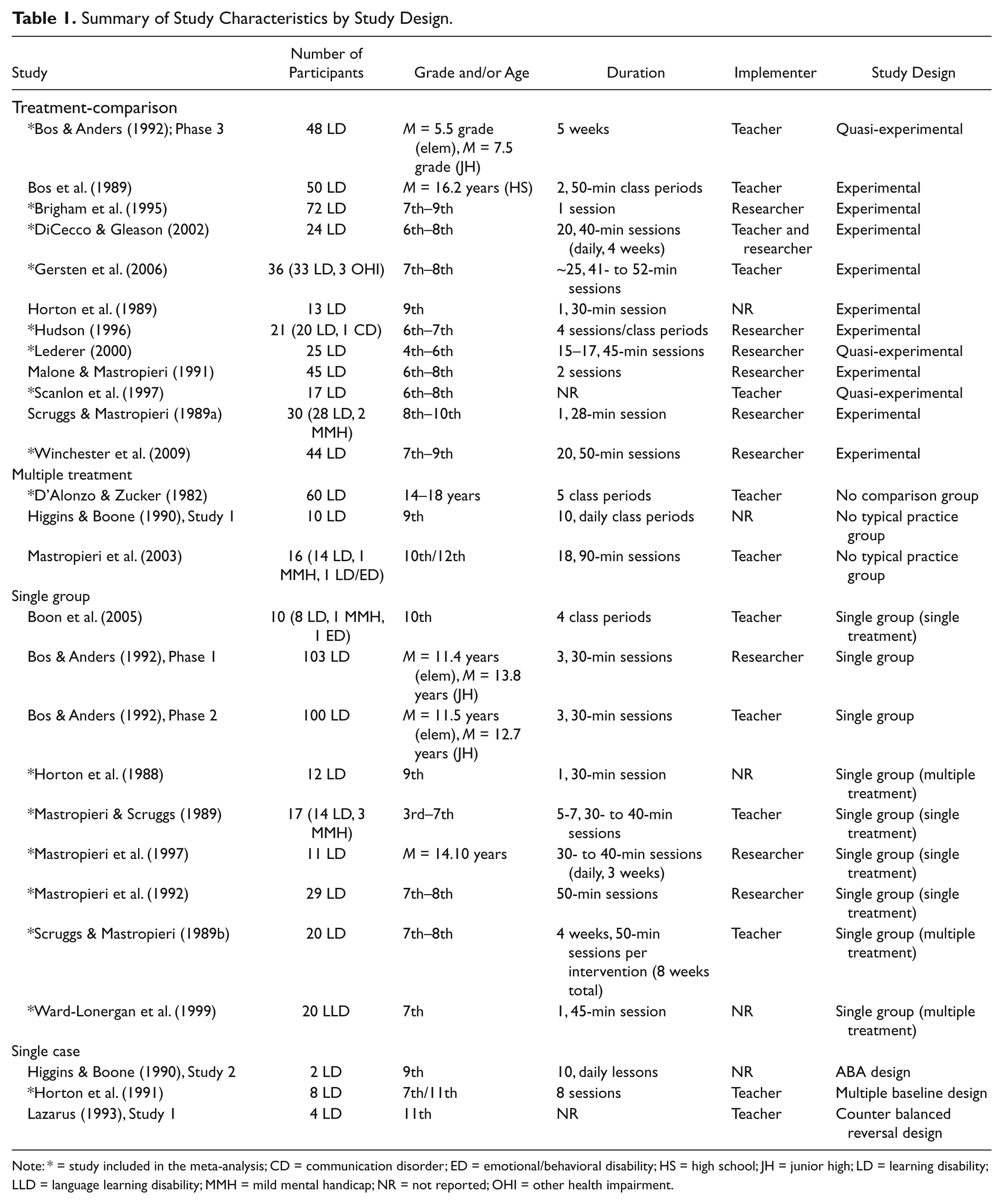
Note: * = study included in the meta-analysis; CD = communication disorder; ED = emotional/behavioral disability; HS = high school; JH = junior high; LD = learning disability; LLD = language learning disability; MMH = mild mental handicap; NR = not reported; OHI = other health impairment.
Outcomes by Study Design.

Note. * = study included in the meta-analysis. EL = elementary; ES = effect size; FU = follow up; HS = high school; JH = junior high; MC = multiple choice; MS = middle school; SS = social studies; wpm = words per minute
Meta-analysis
A meta-analysis was conducted on a subset of 16 studies that contained sufficient information to calculate standardized mean difference effect sizes and their error variances. Multilevel modeling was used to estimate the mean effect size and variance across studies and to determine the effect of moderator variables on effect size. Multilevel modeling is recommended for meta-analysis because it accounts for the nested structure of meta-analytic data and for variation at both the participant and study levels (Raudenbush & Bryk, 2002). In addition, it provides researchers the flexibility to include moderator variables in the model to explain heterogeneity in the variance between studies (Hox, 2002).
All but two of the studies included in the meta-analysis yielded multiple effect sizes because of their implementation of multiple outcome measures and/or multiple treatment and comparison groups. A multivariate multilevel model could not be implemented to accommodate multiple effect sizes in each study because the studies included in the meta-analysis failed to report the correlations between outcomes. The correlations are needed to compute the covariances that must be included in a multivariate multilevel model (Kalaian & Raudenbush, 1996). Instead, Cooper’s (1998) shifting unit of analysis approach was implemented. In this approach, effect sizes within studies are aggregated along the moderator variables of interest to provide a single estimate of the overall effect to include in the meta-analysis. Cooper states that this approach minimizes violations of the assumption of independence of the effect sizes while preserving as much of the data as possible. Effect sizes from follow-up and transfer measures were not included in the analysis because only two studies contained such measures.
Effects were calculated in HLM 7.0 (Raudenbush, Bryk, Cheong, Congdon, & du Toit, 2011) using restricted maximum likelihood estimation (RML). RML is considered a better choice for meta-analysis than full maximum likelihood estimation (FML) because of the importance of obtaining accurate estimates of variance between studies (Hox, 2002). Hox (2002) notes that estimates provided using RML have been shown to be superior to those provided by FML. A variance-known model was implemented as it is the appropriate type of multilevel model for meta-analysis (Hox, 2002; Raudenbush & Bryk, 2002). The Level 1 model was estimated first to provide the overall mean effect size and variance. It is stated as

where d j is the study effect size, δ j is the true effect size of d j , and e j is the sampling error that arises when using d j as an estimate of δ j .
The conditional analysis, which includes moderator variables as Level 2 predictors, is run if the variance between studies seen in the unconditional analysis is statistically significant. This model can be stated as

where γ0 is the mean effect size across studies, γ0 … γ p are the regression coefficients, W1 … W p are the moderator variables used as predictors of δ j , and u j is the residual random error of the Level 2 model.
The Level 2 (conditional) model is needed only when the variance observed in the unconditional model is significantly different from zero. The predictors included in the Level 2 model are implemented to attempt to explain the significant variance remaining in the Level 1 model.
Results
A total of 24 articles, comprising 27 studies (Bos & Anders, 1992, contains three studies; Higgins & Boone, 1990, contains two studies), are included in this synthesis and reflect a variety of study designs and independent variables. To address the first research question, we conducted a synthesis of study features (e.g., study design and use of random assignment). To address Research Questions 2 and 3, we conducted a meta-analysis of a subset of 16 studies that provided enough information to allow meta-analytic investigation. In the final section, we provide a narrative review of the 11 studies excluded from the meta-analysis.
Study Features
To address the first research question, we examined the study characteristics and design elements for the corpus of studies. Detailed information about each study is included in Tables 1 and 2.
Sample characteristics
A total of 19 studies reported sample sizes ranging from 4 to 103 students, with a mean of 36.9, a median of 29.0, and a mode of 17.0. Student grade level was reported in 25 studies and ranged from 3rd to 12th grade. Also, 13 studies investigated interventions in upper elementary through middle school (3rd through 8th grade), and an additional 8 studies investigated interventions in high school (9th through 12th grade) Four studies included students in both middle and high school.
Study design
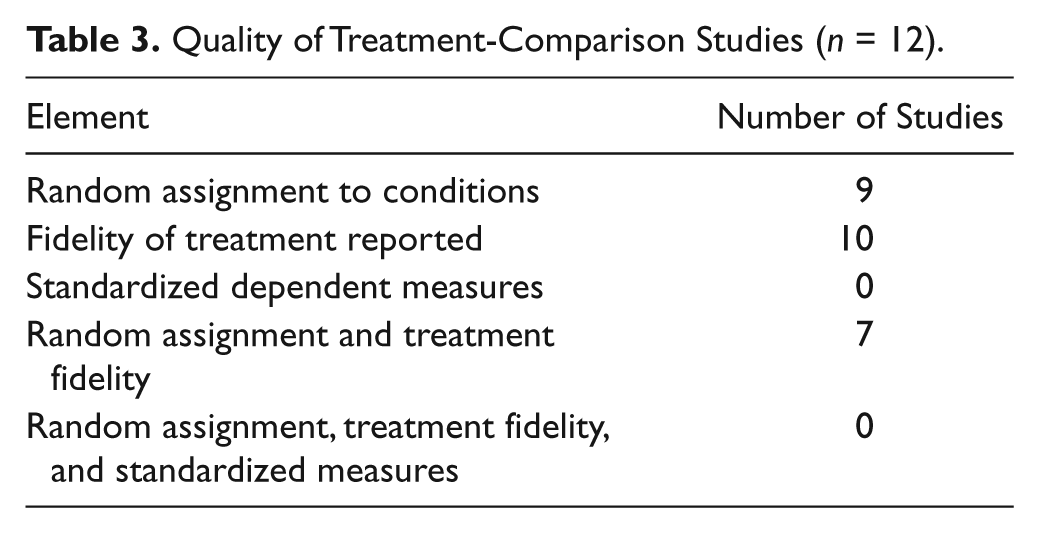
The corpus of studies included 12 treatment-comparison (9 were experimental in design), 3 multiple-treatment (2 were experimental in design, 1 included a no-treatment comparison condition), 9 single-group, and 3 single-case studies. In general, experimental studies provide the most reliable findings in part because of random assignment. The results of randomized controlled trials are considered to be the evidence of the highest standard, whereas quasi-experimental designed studies are more prone to overestimation of treatment effects (Concato, Shah, & Horowitz, 2006). The purpose of random assignment is to eliminate selection bias and to achieve balance between the intervention and comparison groups on factors that are correlated with outcomes (e.g., gender, disability status). Because randomization only helps to achieve balance and does not guarantee it, simple random assignment may not be adequate to balance the number of respondents assigned to the treatment and comparison groups with various important characteristics. This is true not only for studies with small sample sizes (i.e., fewer than 100 participants; Colon & Anderson, 1990). For example, simple random assignment may not ensure balanced assignment in a LD population, where more boys than girls are prone to be diagnosed with a LD. One way to aid in the balance of assignment is stratification. Indeed, two treatment-comparison studies reported stratified random sampling procedures based on gender (Gersten et al., 2006; Malone & Mastropieri, 1991). An additional seven treatment-comparison studies used simple random assignment procedures. Two studies did not report assignment procedures, and one study used a convenience sample, whereby intact classrooms were assigned to treatments.
Two other design elements increase the reliability of study findings—fidelity of treatment procedures and the use of standardized dependent measures with adequate validity and reliability estimates (Raudenbush, 2005; Shadish, 2002; What Works Clearinghouse, 2003). Ten studies reported fidelity of treatment, whereas no studies used standardized dependent measures. Table 3 contains a summary of the number of studies that met each of the three high-quality design element expectations for the treatment-comparison studies.
Quality of Treatment-Comparison Studies (n = 12).
Interventions
Studies were categorized based on the authors’ descriptions of the intervention (graphic organizers, mnemonics, read and answer questions, guided notes, multicomponent comprehension instruction, and other). Authors of 7 studies investigated the use of graphic organizers, whereas 6 studies examined mnemonics, 4 examined reading and answering questions, 3 examined guided notes, 3 examined multicomponent comprehension instruction, and 7 examined other interventions that did not fit into the categories mentioned prior. The distribution of intervention type by study design is reported in Table 4. In addition, Table 2 includes a description of each study’s treatment and comparison conditions.
Study Design by Intervention Type.
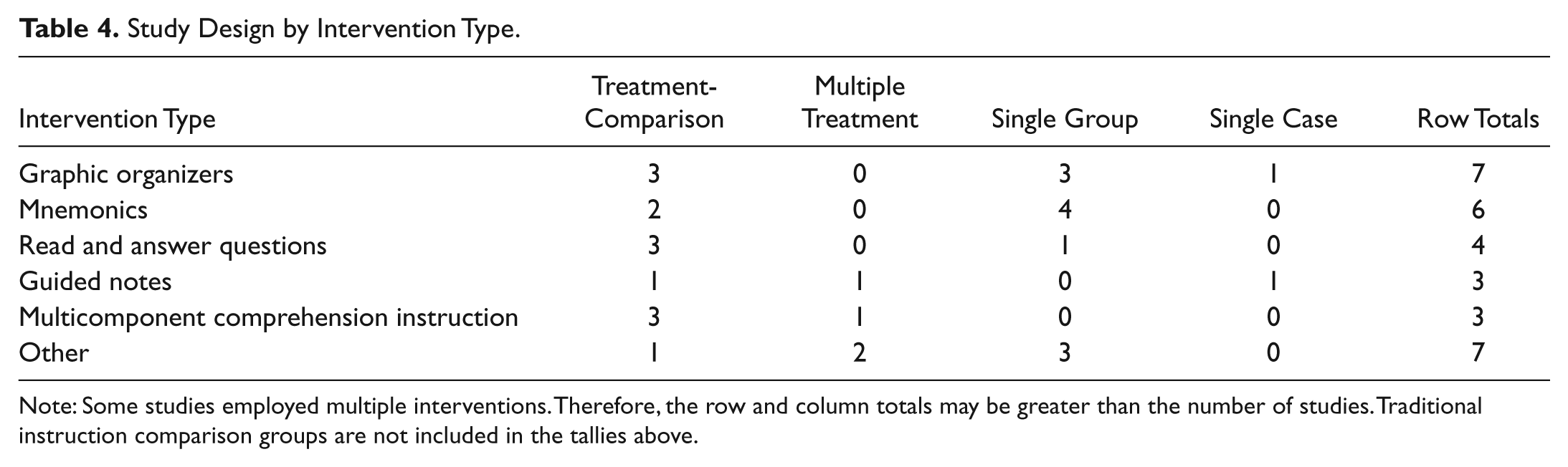
Note: Some studies employed multiple interventions. Therefore, the row and column totals may be greater than the number of studies. Traditional instruction comparison groups are not included in the tallies above.
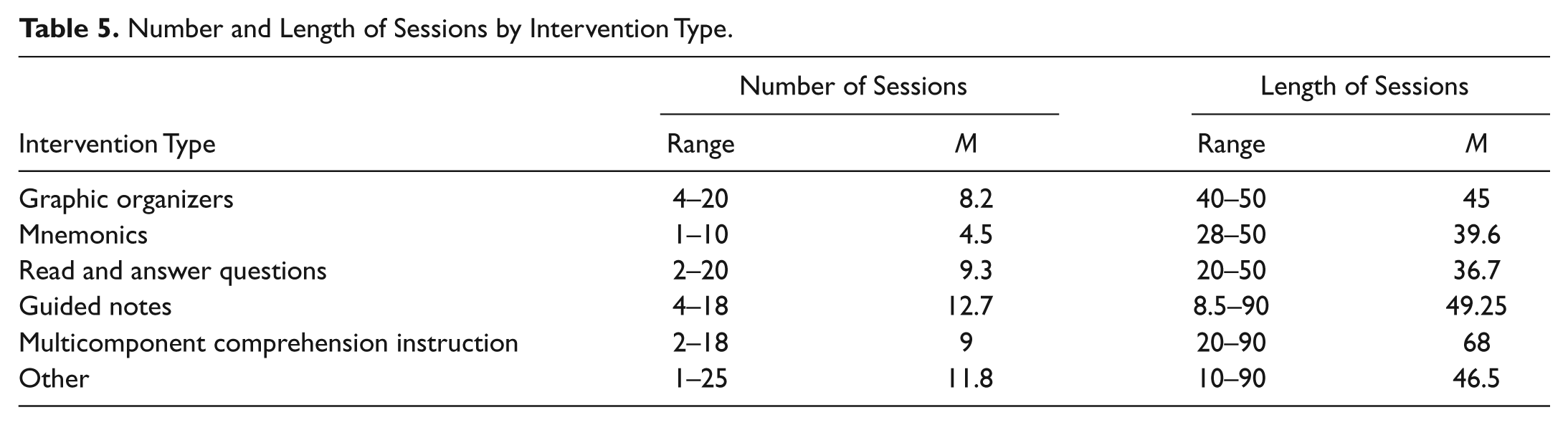
In all, 22 studies reported the number of intervention sessions, with a range of 1 to 25 and a mean of 8.5 sessions. In addition, 21 studies reported the length of each session, with a range of 8.5 to 90 minutes and a mean of 39.6 minutes. Among experimental studies, the number of intervention sessions averaged 9.4, whereas the length of sessions averaged 34.75 minutes. Session number and length are summarized by intervention type in Table 5 and by study in Table 1.
Number and Length of Sessions by Intervention Type.
Meta-Analysis
To address Research Questions 2 and 3, we conducted a meta-analysis of the 16 studies that contained enough information to calculate standard mean effect sizes and their error values.
Unconditional model
As shown in Table 6, the overall mean effect size for the interventions included in the meta-analysis was 1.02, t(15) = 6.59, p < .001. Based on this finding, reading interventions delivered using social studies content appear to have a substantial positive effect on outcomes among students with LD. The variance component in the unconditional model was statistically significant (0.22, p < .001), indicating that unexplained between-studies variation in effect sizes was present. Therefore, conditional models were analyzed to attempt to explain this variance.
Results From the Unconditional Model.

Conditional models
Six moderator variables were selected for inclusion in conditional models as predictors of effect size (see Table 7).
Results From the Moderator Analysis.
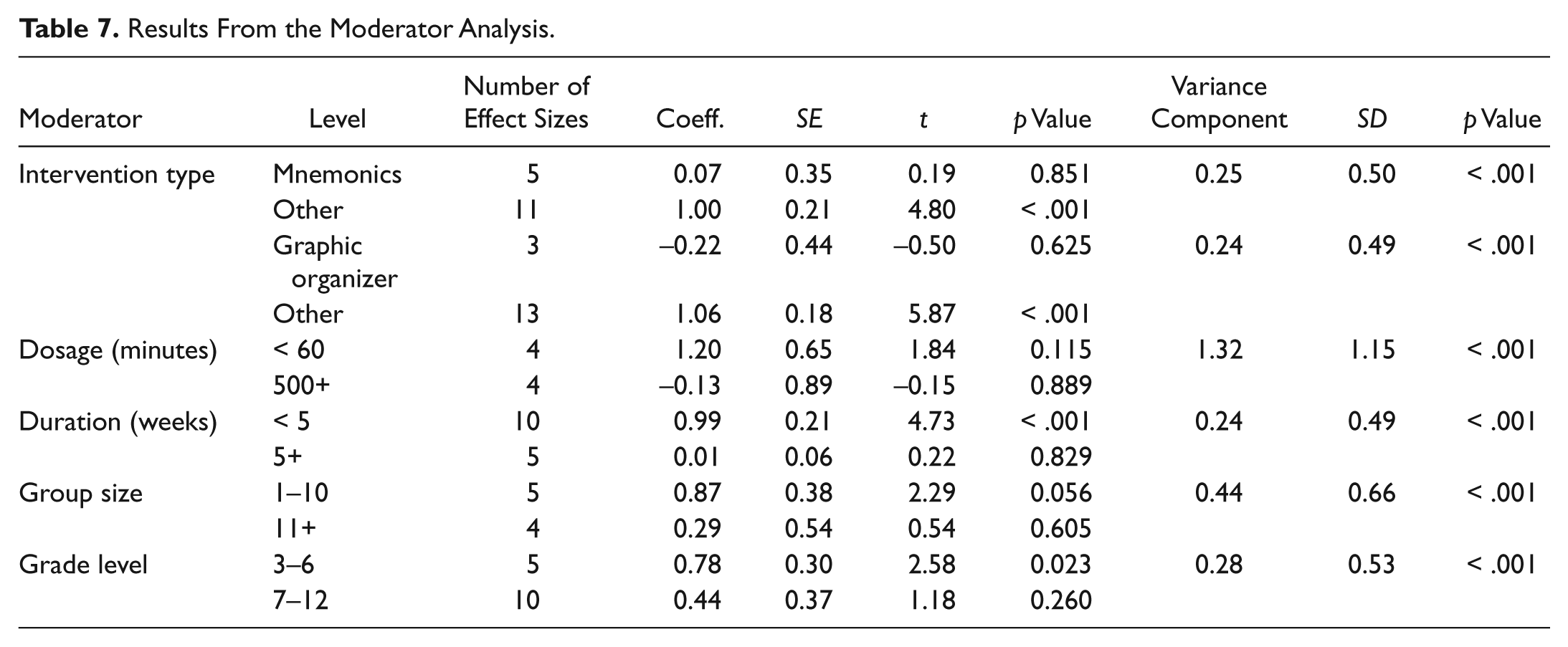
Two important points must be made concerning the information presented in Table 7. First, none of the moderators produced statistically significant increases or decreases in the mean effect size. As a result, any differences in effect size noted on these variables may be the result of chance variation between studies and not the effect of the moderator variable. In addition, all of the moderators produced a statistically significant increase in the between-studies variance that remained in the conditional model. This finding indicates that more variation between studies remained unexplained after adding the moderator variables to the analysis than was explained by any of the moderator variables. It is likely that the small number of studies that could be included in the models is at least partially responsible for these results. Too few studies (n = 4) provided enough information to allow for all of the moderator variables to be coded and included in the same model in hopes of explaining more variance through the use of multiple moderators. In other words, we were unable to examine the effects of multiple moderators on student outcomes. Despite these significant limitations, the results of the conditional models are described below in the interest of exploring the possible effects of the moderators.
The first two moderators involved intervention type. A total of 5 interventions that used a mnemonics approach were compared to the 11 studies that implemented other types of interventions. The use of a mnemonics intervention added 0.07 to the 1.00 mean effect for studies using other types of interventions. A similar moderator analysis was conducted for the 3 studies that used graphic organizers as their intervention strategy and the 13 studies that used other intervention types. Graphic organizers were found to result in a decrease of 0.22 in the overall effect size for other intervention types, which was 1.06. Similar analyses could not be conducted on interventions that used guided notes, read and answer questions, and strategy instruction because too few studies were available (n ≤ 2 for each type). Based on the available studies, no intervention type appears to be preferable to other types for social studies reading interventions.
The next three moderators included in the conditional models reflect the intensity of the intervention. The dosage of the intervention in total minutes of instruction was categorized as less than 60 total minutes (n = 4) or more than 500 total minutes (n = 4). Only one intervention’s dosage fell in between these values; it was dropped from the analysis to allow for greater clarity in detecting the effect of increased dosage. Results indicated that interventions that lasted less than 60 total minutes had a mean effect size of 1.20. Those lasting more than 500 total minutes resulted in a mean effect size that was 0.13 standard deviation units lower. Next, the duration of the intervention was examined as a moderator. A total of 10 studies had a duration of 4 weeks or less and 5 had a duration of 5 weeks or more. Extending an intervention longer than 4 weeks appeared to add very little, 0.01, to the mean effect of 0.99 for interventions that lasted 4 weeks or less. Finally, group size was examined as a moderator. In all, 5 studies had 10 or fewer students per group and 4 studies had 11 or more students per group. Studies with larger groups had an effect size that was 0.29 units larger than the mean effect size of 0.87 for smaller groups.
The final moderator that was modeled was grade level. In all, 5 studies included primarily students in Grades 3 to 6 and 10 studies included primarily students in Grades 7 to 12. Interventions for older students were associated with effects that on average were 0.44 units larger than the mean effect size of 0.78 for students in Grades 3 to 6. Again, it should be noted that no moderators were found to have a statistically significant impact on effect size, and none of the conditional models explained more variance between studies than the unconditional model. None of the moderator variables appear to result in significantly different treatment effects.
Review of Additional Studies
To further answer Research Questions 2 and 3, we synthesized the results from 11 studies that were not included in the meta-analysis. Information is organized by intervention type.
Mnemonics
One treatment-comparison study that was not included in the meta-analysis (Scruggs & Mastropieri, 1989a) provided students keywords paired with pictures representing content. Students in the control group were taught the same content but without the keyword strategy. Students in the treatment group outperformed students assigned to a control group on researcher-developed measures of both immediate and delayed recall of content. This finding is aligned with meta-analysis results indicating that mnemonic interventions implemented within social studies content are effective among students with LD.
Graphic organizer
Two multiple-treatment (Bos & Anders, 1992, Phase 1 and Phase 2), one treatment-comparison (Bos, Anders, Filip, & Jaffe, 1989), and one single-group study (Boon, Fore, Ayers, & Spencer, 2005) investigated the effects of graphic organizers on vocabulary and content knowledge. Bos and colleagues (Bos & Anders, 1992; Bos et al., 1989) conducted two studies comparing a semantic feature analysis method, where students completed a chart showing the relationship among concepts prior to reading, to either a dictionary method, where students copied definitions of the concepts from a dictionary prior to reading (Bos et al., 1989), or a teacher-directed definition and pronunciation routine (Bos & Anders, 1992). Results from both studies indicate that students who completed the graphic organizer outperformed students in the comparison groups on measures of content knowledge and vocabulary knowledge at both posttest and 1-month (Bos & Anders, 1992) or 6-month (Bos et al., 1989) follow-up. Boon and colleagues’ (2005) findings from a single-group study where students completed graphic organizers are convergent, with students making gains from pre- to posttest. Findings from these four studies align with the meta-analytic findings. Meta-analytic findings indicate that the use of graphic organizers (ES = 1.06) reduced the effect size of other interventions by 0.22 points. However, even after the adjustment is made, the effect size for graphic organizers is still high.
Other: Computer-based study guide
Two multiple-treatment (Higgins & Boone, 1990, Study 1; Horton, Lovitt, Givens, & Nelson, 1989) and one single-case study (Higgins & Boone, 1990, Study 2) investigated the effects of computer-based treatments on content knowledge. Higgins and Boone (1990, Study 1) randomly assigned students to one of three groups: (a) lecture only, (b) lecture plus computer study guide, and (c) computer study guide only. Students were taught using the different methods for 10 consecutive days and were given a posttest and a 2-week delayed follow-up test. At posttest, students in the lecture condition and the computer study guide condition outperformed students in the lecture plus study guide condition. However, at the 2-week follow-up, students in the lecture plus study guide group outperformed the others. Higgins and Boone (1990, Study 2) then conducted a single-case study of five students (two with LD) with the lowest posttest scores, providing them with 10 additional lessons using only the computer study guide. Both students with LD made gains over time. These two students averaged 41% and 48% correct on baseline quizzes. During intervention, the quiz means were 52% and 60%, respectively. Finally, Horton and colleagues (1989) asked students to read and take notes, read and complete a computer study guide, or participate in typical practice. On a posttest of content knowledge, students who read text and completed a computer study guide outperformed students in the typical practice and reading only groups. Thus, it seems that computer study guides are a promising practice for improving content acquisition among students with LD.
Multicomponent comprehension intervention
Mastropieri, Scruggs, Spencer, and Fontana (2003) used a multiple-treatment design to compare the effects of peer tutoring of comprehension strategy instruction (whole-class text reading, peer tutoring dyads with reciprocal reading and summarization practice, whole-class review) to a comparison group (whole-class text reading, independent completion of guided notes, whole-class review) on several measures of content knowledge. When tested on items from the instructional units, the peer tutoring group consistently outperformed the comparison group. This was not the case when tested on items not taught during the unit, where there was no difference between the two groups. In a similar study, Malone and Mastropieri (1991), compared a summarization training group to a summarization plus self-monitoring and a typical practice group. Like the previous study, students who participated in the summarization groups outperformed the typical practice group on measures of content knowledge.
Guided notes
One single-case study not included in the meta-analysis investigated the effects of a guided notes intervention on student outcomes (Lazarus, 1993). Here, students engaged in a counterbalanced design and completed teacher-prepared guided notes that contained main ideas and key terms during lectures and reading. This condition was counterbalanced with students completing the guided notes and also receiving a 10-minute independent review time. Baseline test scores of content knowledge ranged from 25% to 50%. During each phase of intervention, students receiving the guided notes plus review time outperformed students in the guided notes only group.
Discussion
This synthesis provides a description of 27 studies and a meta-analysis of a subset of these studies that used social studies text for the intervention, including a description of participants, design, intervention features, and whether the study met three design quality indicators. In addition, a meta-analysis was conducted on a subset of 16 studies to determine the features of reading interventions delivered in social studies content associated with improved student outcomes for students with LD.
The primary finding from this synthesis is that reading interventions utilizing social studies content are effective for students with LD, corroborating the findings of other recent syntheses (Gajria et al., 2007, Scruggs & Mastropieri, 2003). This finding is true across grade levels. However, results indicate that for older students (Grades 7–12), the effect size may be greater. It is encouraging that older students can benefit from the intervention in a similar way as younger students because the demands for students to learn from informational text, including social studies materials, increase as students progress in school (Gajria et al., 2007). In addition, the rigorous demands of social studies comprehension and learning (i.e., difficult text, advanced comprehension activities) highlight the need for practices that support and scaffold students, especially students with LD.
Results from the meta-analysis indicated that social studies reading interventions using social studies content have a large overall positive effect on content and comprehension outcomes among students with LD. Although the moderator analysis did not produce statistically significant increases or decreases in the mean effect size, the information gleaned from these analyses is valuable in exploring the types of interventions that may be effective for students with LD.
Of great interest are the characteristics of the effective interventions for students with LD. Studies in this synthesis utilized graphic organizers, mnemonics, read and answer questions, guided notes, multicomponent instruction, and other practices. Results of the meta-analysis indicate that overall effect sizes were high (1.00 for mnemonics vs. other intervention types and 1.06 for graphic organizers vs. other intervention types); however, none of the intervention types appear to be significantly more effective than the others. Other recent syntheses (Gajria et al., 2007; Scruggs & Mastropieri, 2003) have also reported moderate to high effect sizes for various types of interventions, including mnemonics, visual displays, and explicit strategy instruction. These syntheses, however, did not compare the impact of the intervention types to each other. Based on the findings of the current meta-analysis, it may be that intervention type per se is not as important as applying an organized, structured, text-based intervention to assist students with comprehending and learning social studies content.
Another important finding regarding reading interventions delivered in social studies content is the duration and intensity of the intervention. According to the meta-analysis, overall effect sizes were high: Interventions lasting less than 60 minutes total were associated with a mean effect size of 1.20 and interventions that lasted more than 500 minutes total were associated with a mean effect size of 1.07. Of particular interest is the duration of the intervention. Results showed that interventions lasting longer than 5 weeks yielded similar results as interventions of shorter duration. This finding that different amounts of treatment time resulted in similar outcomes is again consistent with other meta-analyses (Gajria et al., 2007; Mastropieri, Scruggs, Bakken, & Brigham, 1992; Swanson, 1999). A possible explanation for this finding may be that the duration of the intervention is closely tied to the intervention type. For example, a mnemonic strategy could be taught and utilized in a short period of time. However, a multicomponent strategy would take significantly more time to learn and implement.
A surprising finding of this meta-analysis was that larger groups (groups with 11 or more students) were associated with a larger effect size (ES = 1.16) than smaller groups (ES = 0.87). Gajria et al. (2007) were unable to analyze findings by group size because group sizes were not reported. At this time, we are unable to confirm the most effective group size for using social studies intervention for students with LD, though for younger students one-on-one interventions and those with very small groups are associated with higher reading outcomes than are interventions utilizing moderate to large group sizes (Elbaum, Vaughn, Hughes, & Moody, 1999; Wanzek & Vaughn, 2007).
For examining the quality of the treatment-comparison studies, no studies met all three quality criteria (i.e., random assignment to conditions, fidelity of treatment reported, and standardized dependent measures). Most reported fidelity and used random assignment, but none measured student outcomes with standardized measures. We do not feel this discounts in any way the findings of these studies. It does, however, indicate the need for studies such as these utilizing standardized measures. Although standardized measures of reading comprehension and vocabulary are readily available, such is not the case for standardized measures of social studies content.
Limitations and Implications for Future Research
The limited number of studies included in each intervention category precluded extensive examination of moderating effects of variables such as group size within intervention type. Each of these limitations limits the conclusions that can be drawn from this synthesis. Additional studies are needed that meet high-quality research study standards, including the use of random assignment and standardized measures and the reporting of fidelity of treatment procedures (Gersten et al., 2006; Malone & Mastropieri, 1991; What Works Clearinghouse, 2003). Although many studies in this synthesis utilized random assignment and reported fidelity, none used standardized student-outcome measures. Studies utilizing standardized measures that are reliable and valid are needed to evaluate the efficacy of reading interventions in social studies for students with LD. Closely tied to the use of standardized measures is the need for valid and reliable measures of social studies content learning.
In addition, several studies did not include adequate information to be included in the meta-analysis. Reporting of study information needs to be complete to allow for meta-analytic analysis. In the present synthesis, 24 articles, comprising 27 studies, were included. However, only 16 of these studies provided adequate information to calculate standard mean effect sizes and their error values. The reporting of this information is critical to synthesizing information across multiple studies.
Because of a small sample size, the meta-analysis in the present study was unable to address all the moderator variables. Additional studies are needed to address the types of interventions that are most effective for students with LD. Too few studies were available to conduct moderator analyses on the use of guided notes, strategy instruction, and read and answer questions. Therefore, studies on the effectiveness of these intervention types would be valuable. In addition, two thirds of the studies were in Grades 7–12. Additional studies in the lower grades (3–6) are needed as well.
In summary, these studies suggest that social studies content may be a valuable text type for improving comprehension and knowledge of students with LD. This synthesis also suggests that high-quality studies that include standardized outcome measures would be a valuable addition to the research literature.
Footnotes
Declaration of Conflicting Interests
The author(s) declared no potential conflicts of interest with respect to the research, authorship, and/or publication of this article.
Funding
This work was supported by an award granted to The Meadows Center for Preventing Educational Risk at The University of Texas at Austin by the Institute of Education Sciences, U.S. Department of Education, the Reading for Understanding Research Initiative, R305F100013. The opinions expressed are those of the authors and do not represent views of the Institute or the U.S. Department of Education.