







Abstract
This case study describes the culturally responsive instruction of one special education teacher with Latino English language learners (ELLs) with learning disabilities in an urban elementary school setting. This study was situated in a social constructivist research based framework. In investigating this instruction with ELLs, this study focused on how one teacher’s knowledge of culturally responsive pedagogy affected her special education instruction. Findings resulted in three major themes that were aligned with the current literature in this area: Cultural Aspects of Teaching Reading, Culturally Relevant Skills-Based Instruction, and Collaborative Agency Time. The results indicated that the success of special education with ELLs at the elementary education level might be dependent on how well the special education teacher integrates culturally responsive instruction with ELLs’ cultural and linguistic needs.
Keywords
In the American public education system (K–12), a large and growing number of students come from homes where English is their second language. These English language learners (ELLs) represent more than 5 million students, of which 75% are Spanish speaking (aka Latino ELLs; Planty et al., 2009). The challenges for many ELLs are not only overcoming a language barrier but also achieving academically. According to the Nation’s Report Card: Reading 2011 (National Center for Education Statistics, 2011), fewer than 10% of ELLs comprehend what they read at or above proficient levels. In addition, ELL students at risk for reading failure or who have been placed in special education are often the poorest readers in terms of decoding, word reading, and fluency (Swanson, Orosco, Lussier, Gerber, & Guzman-Orth, 2011). These students also demonstrate characteristics of inactive learners who do not monitor their learning effectively when their comprehension has broken down (August & Siegel, 2006; Chiappe, Siegel, & Wade-Woolsey, 2002; Geva, 2000; Sáenz, Fuchs, & Fuchs, 2005). Suggestions for addressing this reading achievement gap have focused on improving instructional quality for ELLs (August & Hakuta, 1998; August & Shanahan, 2006).
The Problem
The literature continues to indicate that there is a dearth of research addressing literacy instruction with ELLs in special education (Klingner, Artiles, & Mendez Barletta, 2006). In particular, there is limited research that examines the link between culture and teaching and learning to read. Moreover, it is important to note that one of the reasons this culturally responsive research has been slow in developing is the political nature of education (Cummins, 2007). As an example, in the late 1990s the political tide in favor of basic skills instruction created an instructional movement that omitted many ELLs’ cultural and linguistic experiences. Although evidence supports the value of culturally responsive literacy instruction, much less is understood about how teachers use this type of instruction in classrooms with ELLs (August & Siegel, 2006; Goldenberg, 2011; Klingner, Vaughn, Argüelles, Hughes, & Leftwich, 2004). Further research is needed in learning how special education teachers apply culturally responsive instruction with ELLs.
Although it would be important to understand how special education teachers apply skills-based instruction with ELLs, it may also be valuable to understand the contexts in which they teach, as it may not be enough for teachers to apply teaching in isolation of ELLs’ cultural and linguistic experiences. ELLs bring a wealth of cultural and linguistic knowledge into the classroom; however, many of them encounter a complex schooling process that separates their own personal learning experiences, which influences their acquisition of reading instruction (Snow, 2002). In this vein, ELLs may come from homes and communities that emphasize collectivist-learning approaches (interdependence, sharing, and collaboration). In contrast, the instruction they receive may promote more individualistic approaches (e.g., direct instruction) that mirror a dominant society’s learning patterns. As a result of this, ELLs may need to be provided with interactive teaching approaches (e.g., explicit instructional practices, small-group instruction) that support and strengthen their discourse and learning styles (Au, 2005; Cazden, 2001; Heath, 1983).
Furthermore, special education is based on the premise that to solve learning challenges and enhance reading achievement with ELLs, teachers must be able to apply research-based instruction that has been found to be effective. However, at this point in the literature, teachers seem to be confused about how to apply these practices to ELLs, as this instruction may not mesh with these learners’ cultural and linguistic experiences and learning styles and development. In the past, the idea of “evidence-based” practices has been mainly based on research conducted on English speakers learning to read in English (Goldenberg, 2011). As a result of this one-size-fits-all approach, many schools have deemphasized culturally responsive reading practices that may have enhanced learning to read for ELLs, thus, leaving teachers with little guidance on practices that appear to be promising with ELLs (Orosco, 2010).
Finally, although ELLs bring a wealth of social capital in the classroom, these students are often faced with (a) limited working knowledge of the dominant culture (Au, 2005), (b) instructional approaches that mirror a dominant society’s practices and perspectives (Cummins, 2000), (c) the lack of affirmation and use of these students’ rich cultural and linguistic capital in materials and reading passages (González, Moll, & Amanti, 2005), and (d) their teachers’ limited knowledge of culturally responsive practices and skills in drawing this knowledge out (Orosco & Klingner, 2010; Orosco & O’Connor, 2011). As a result of these factors, many special education teachers are challenged in helping ELLs make appropriate instructional connections and associations among their background knowledge, evidence-based practices, and information found in reading texts, thus affecting students’ comprehension development and making their teaching practices seem ineffective (Harry & Klingner, 2006).
Unless we are able to help special education teachers think about and address these issues, special education may resemble its past ineffectiveness. The goal of this study was to examine what special education instruction looked like for Latino ELLs with learning disabilities when taught by an effective bilingual special education teacher.
Conceptual Framework
This study was grounded within a social constructivist theoretical framework. From this culturally responsive structure, teachers go beyond “just plain good teaching” that omits students’ cultural and linguistic experiences, in which they make the concentrated effort in the classrooms to incorporate students’ language, history, literature, and other cultural aspects of a particular racial or ethnic group to instructionally engage students’ belonging to that group in authentic student-centered learning (Orosco & Klingner, 2010; Orosco & O’Connor, 2011). That is, learning is an actively reciprocated process between the special education teacher and students; one is constantly shaping the other, bound by the socially inherited knowledge that contains students’ cultural and linguistic capital necessary to mediate comprehension (Vygotsky, 1962, 1978). Next, teachers should provide ELLs with instruction that wraps around their cultural and linguistic experiences. Finally, teachers should ground their practice within a social constructivist framework that attempts to not only transfer knowledge (e.g., rote memorization) to their students but also provide instruction that fosters their critical-thinking skills.
The first notion stipulates that from the sociocultural perspective, special education practitioners can develop an educational context that is grounded in the belief that ELLs be provided with high-quality instruction, which incorporates these learners’ cultural and linguistic experiences (Baca & Cervantes, 2003). One type of instructional method found effective in integrating this type of social capital is interactive teaching (e.g., reciprocal teaching and small cooperative learning groups), which allows teachers to integrate students’ cultural and linguistic knowledge with basic reading skills (Genesse & Riches, 2006). Next, it is important for special education teachers to realize that many ELLs come from homes that emphasize collaborative-based approaches to learning, such as interdependence, sharing, and collaboration (Orosco & O’Connor, 2011). Finally, from a sociocultural perspective, special education teachers are presented with the opportunity to understand the complex cultural and linguistic contexts that influence learning disabilities. It means explicitly connecting instruction with home and community practices and understanding and validating students’ discourses and learning styles that may sometimes conflict with teachers’ assumptions of what counts as literate practice (Au, 2005; Cazden, 2001; Heath, 1983; Rogoff, 2003). Although teachers need not be “insiders” in a particular group to offer culturally responsive instruction, they should make an effort to learn about the cultures represented in their classrooms, respect students’ values, make connections, and view differences as strengths, not deficits (Ladson-Billings, 2009).
In summary, culturally responsive teaching can help special education teachers provide theory to evidence-based approaches that have been found effective for reading development. Special education teachers may need to connect sociocultural theory with skills-based practices in fostering ELLs’ reading comprehension development. Learning appears to be enriched when it occurs in contexts that are socially and linguistically meaningful and students’ languages and experiences are centrally included in classroom curricula and activities (Orosco & Klingner, 2009; Villegas & Lucas, 2002). Previous research suggests that classroom instruction benefits from being socioculturally affirming and culturally responsive (Gay, 2000; Ladson-Billings, 2009; Nieto, 1999, 2002). In the current study, this conceptual framework provided a lens for describing and understanding the instruction of one bilingual special education teacher. It served to underlie interpretations of this study’s findings.
Research on Teaching ELLs With Learning Disabilities
Previous research has indicated that culturally responsive teaching approaches can have a powerful effect on ELLs’ reading skills and knowledge development because they provide cognitive determinants (e.g., instructional engagement, contextualization, oral language development, and collaboration) that (e.g., August & Hakuta, 1998; August & Shanahan, 2006) (a) include direct and explicit instruction that provides modeling and oral language development with evidence-based reading components that draw from ELLs’ relevant schemas, background knowledge, and native language; (b) provide questioning support that assists students in answering questions about reading passages, feedback to students regarding their answers, and opportunities for students to ask and answer questions about challenges they encounter during reading (Jiménez, García, & Pearson, 1995; Kamps et al., 2007); and (c) provide engaging and motivating collaborative practices, which not only get students involved in all reading activities but also allow them to practice skills-based instruction by teaching these to one another in small groups (e.g., Calhoon, Al Otaiba, Greenberg, King, & Avalos, 2006; Klingner & Vaughn, 1996; Sáenz et al., 2005).
Although there is limited number of studies addressing literacy instruction conducted with ELLs in special education settings, one theme that has emerged from the literature is the importance of providing intensive, interactive reading approaches that focus on connecting literacy lessons and ELLs’ sociocultural knowledge. As an example, Lopez-Reyna (1996) and her research team studied a special education elementary classroom for Latino ELLs in the Midwest and found that the teacher’s reductionist teaching approach resulted in these students showing little growth in acquisition of oral language and literacy skills and diminished engagement with academic tasks. As a result of this, the researchers developed an intervention that helped change the teacher’s sole focus on a skills-driven orientation to an intervention that focused on an interactive reading skills approach (i.e., connections between literacy lessons and students’ cultural and linguistic knowledge). Results indicated that students made great improvement in literacy knowledge. In a similar study, Ruiz (1989) described a student (Rosemary) in a bilingual special education classroom whose standardized tests and English compositions on teacher-selected topics indicated a marked academic delay of 3 years and severe writing difficulties. However, in other classroom contexts Rosemary did quite well (e.g., wrote well on self-selected topics in native language, was a leader, and used detailed academic language) when allowed to draw from her cultural and linguistic experiences. The implication from this study was that special education teachers might need to match their instruction with ELLs’ cultural and linguistic needs. In another study, Bos, Anders, Filip, and Jaffe (1989) conducted a small-group experimental study with 42 ELLs (English–Spanish) with learning disabilities (LD) that focused on vocabulary acquisition and reading comprehension development. In this study, these learners were assigned to one of four instructional groups (control, semantic mapping, semantic feature analysis, semantic and syntactic feature analysis) and received a 3-day intervention of social studies vocabulary. Instruction was in the students’ preferred language, and the intervention focused on providing three interactive strategies (semantic mapping, semantic feature analysis, semantic and syntactic feature analysis). Results supported the use of a sociocultural model that focused on student–teacher interaction and emphasized the relationship of students’ cultural and language experiences to active processing of reading knowledge.
Another major theme that has emerged from the literature is instruction that has provided collaborative approaches to reading. As an example, in an instructional method called Collaborative Strategic Reading (e.g., Klingner & Vaughn, 1996), 26 LD ELLs (English–Spanish) in seventh and eighth grade were provided instruction that integrated reciprocal teaching strategies with their cultural and linguistic capital. In this approach, students were allowed to engage collaboratively in small groups in reading-related strategic discussion and assisted one another in comprehending word meaning, deriving main ideas, asking and answering questions, and relating this to their own personal capital. And when students did not have the relevant knowledge, they were assisted and encouraged to generate questions for clarification in small-group collaboration with a teacher’s facilitated dialogue. In another similar collaborative reading approach, Sáenz et al. (2005) tested her Peer Assisted Learning Strategies (PALS) approach that combined peer tutoring with effective instructional reading practices for 132 Spanish-speaking ELLs with LD in Grades 3 through 6. Teachers were randomly assigned to PALS and contrast groups that focused on teacher-led reading instruction rather then peer-mediated instruction. PALS sessions were conducted three times (35 minutes) per week for 15 weeks. Postintervention assessment scores indicated that PALS students outperformed contrast students on reading comprehension because it provided greater opportunities for ELLs to receive comprehensive input, produce comprehensible output, and negotiate meaning through peer-mediated instruction. Finally, in another promising small group intervention, Avalos, Plasencia, Chavez, and Rascón (2007) used modified guided reading (MGR) that explicitly taught reading skills and strategies three to five times per week (20–30 minutes per session) using leveled text to 13 middle school ELLs. MGR utilizes an introduction and a shared reading of the guided reading (GR) text, teacher prompts focusing on word recognition while students read, word work focusing on decoding, and a written response to the text. After 9 months of working with these students, postintervention assessment findings indicated positive gains in favor of this small group reading approach that built on the knowledge, skills, and strategies that the students already possessed.
In summary, the sociocultural literature is indicating that interactive reading approaches can have a powerful effect on ELLs’ reading skills and cognitive development if teachers provide them with (a) instructional approaches that build on students’ home and community experiences and make connections with prior learning, (b) differentiated instruction to meet students’ various learning needs, and (c) teacher and student joint collaboration activities. Although the literature is emerging with ELLs, we still need to learn which types of culturally meaningful reading materials and instructional approaches are most effective and how best to support special education teachers so that they can provide optimal instruction. Implementing culturally responsive instruction may be challenging for teachers to learn and implement. A major challenge in this effort is visualizing what such approaches might look like since there has been a dearth of studies addressing literacy instruction with ELLs in special education settings.
Purpose of the Study
The purpose of the study was to describe the culturally responsive pedagogy of one urban bilingual special education teacher with Latino ELLs with LD. In investigating this teaching with Latino ELLs, this research focused on how this teacher’s knowledge of culturally responsive pedagogy affected her instruction for Latino ELLs with reading disabilities. In particular this study investigated the following questions:
What were the features of her instruction with Latino ELLs who were having reading difficulties, and what did this instruction look like?
To what extent did instruction appear to match ELLs’ cultural and linguistic learning needs?
How did the teacher’s instructional beliefs, judgments, and professional development support instruction with Latino ELLs?
Method
Strategy of Inquiry
The strategy of inquiry for this study was a qualitative case study (Stake, 2005). The case study approach is a research method that can be applied in classrooms in which observed instructional behaviors and actions are void of any type of control and manipulation by the researcher. Within this paradigm, case studies can be a valuable descriptive tool that can provide an in-depth understanding about classrooms that are implementing evidence-based practices in culturally responsive instruction. According to Stake (2005), the case study approach allows the researcher to (a) bind the case by conceptualizing the focus of the study; (b) select the phenomena, themes, or issues (i.e., the research questions to emphasize); (c) triangulate key observations for interpretations; and (d) develop generalizations about the case.
Setting and Participants
Cesar Chavez (CC) elementary school is part of a large southwestern urban school district. This school’s population consisted of 624 students (91% Hispanic [all Latino ELLs], 6% African American, 1% White, 1% Asian, and 1% other). The school was considered a high-poverty school, as it had approximately 95% of its population in the free and reduced-price lunch program. The term Latino English language learner is used because the student population had been identified as coming from Latin America decedents (e.g., Mexican, Mexican American), and these students were acquiring English as a second language. Only 17% of the school’s Latino ELLs were reading at a basic proficient level. CC functioned as a K–5 ESL program with native language programming at all grade levels in Spanish that supported newcomers and emerging English learners. Pseudonyms are used for all people, places, and programs referenced in this article.
The teacher, Mrs. Villa, was selected by school district recommendation because (a) she had displayed strong teaching skills based on school leadership evaluations and annual increases in student reading achievement, (b) she was implementing special education instruction applying ESL and bilingual methods, (c) she had received professional and graduate training (master of arts) in special education with an emphasis in ESL and bilingual methods and was a state certified ESL/bilingual special education teacher, and (d) she had taught low socioeconomic status Latino ELLs with or without LD for 14 years. School district administration allowed her to provide bilingual services in special education (depending on individualized education program [IEP] need) to help further support reading comprehension development in the native language. It is important to note that during the year this study was conducted, the school principal cited that she had made gains from fall to spring on the Woodcock–Muñoz Language Survey (WMLS; Woodcock, 2005; average English composite score gain per special education student is given) in Grades 3 (10.73), 4 (8.55), and 5 (7.53) and (average Spanish composite score gain per special education student who was assessed in Spanish is given) in Grades 3 (12.73), 4 (9.35), and 5 (8.73).
Mrs. Villa had her own special education resource room, and her instructional sessions were provided in small groups (4–5 students with similar IEP reading needs) and lasted for an average duration of 30 minutes per session depending on the grade level or levels she was teaching and time allocation required by students’ IEPs. All her students were Latino ELLs. She instructed a total of 35 students per day depending on the learning need or needs. Although the researchers did not have access to the students’ IEPs because of privacy concerns, Mrs. Villa indicated that 20 of her 35 students were on an IEP for an LD related to language and reading deficits and the other 15 students were closely monitored for displaying the same type of learning challenges. These 15 students were in the process of being placed in special education for LD (e.g., reading comprehension challenges).
Data Collection
Observations
A qualitative classroom observational method was employed as the primary means of describing and analyzing classroom reading instruction. The classroom teacher was observed 12 times (1 hour per observation) over a period of 1 year (fall, winter, spring) by a two-member bilingual research team. All classroom observers had received graduate level ESL/bilingual reading pedagogy training, and the first author had received his PhD in bilingual special education. The purpose of these observations was to describe reading instruction for Latino ELLs. Descriptive field notes were taken to capture how instruction was being implemented, what reading practices were being used, and how ELLs’ background knowledge was being accounted for during the instructional process. Through descriptive notes, the researchers recorded the physical environment and instructional engagement activities. Using analytical notes, the researchers recorded impressions and questions or issues that needed further investigating (Atkinson & Delamont, 2005).
Interviews
The participant was interviewed for 30 to 45 minutes at the beginning, middle, and end of the study. The interview was guided by a protocol of questions (e.g., Describe your reading instructional philosophy? What are the greatest challenges ELLs encounter when learning to read in school? What challenges do you face in teaching these students to read?) that sought to understand how the participant interpreted CRT with ELLs (Seidman, 2006). By prompting the participant to share her instructional experiences, educational, and professional development, these critical reflections not only explicated her thinking about CRT but also established the conditions for her teaching reflections. By asking the participant to discuss her instructional reading philosophy, this dialogue not only allowed her to describe her CRT methods but also allowed us to confirm or disconfirm other research data that were collected.
Artifacts and documents
Documents related to CRT, such as literacy curricula, school demographics, and professional development documents, were collected. Document analysis of classroom materials, literacy lesson plans, and student work provided the physical evidence to support this study. A specific focus was put on the analysis of instructional materials and classroom observations to see if they coincided with what the teacher documented in interviews.
Data Analysis
Data were coded applying Strauss and Corbin’s (1998) inductive analysis process. The researchers communicated periodically (e.g., in person, via email and telephone) to discuss emerging codes and emerging themes as data analysis progressed simultaneously during data collection. Each code was developed in consideration of the study’s research questions guided by the theory and literature and then was operationalized with a clear definition of which data could and would not fit into a particular code (Harry, Klingner, & Sturges, 2005). As codes were revised, all previously reviewed data were then recoded to reflect any modifications that were made.
The first step included chunking the data from initial interviews and observations and open coding. Field notes from classroom observations were analyzed line by line and as a whole by examining the types of instructional activities and interactional patterns. Nine codes emerged. As this study progressed, data codes went through multiple iterations that were continuously refined and modified as necessary. Preliminary codes with minimal data were collapsed or deleted, and others were created when there were sufficient data to support a new code. As an example, two codes that were developed and then later combined because the further evidence collected did not support them were phone calls home to parent and communication with local business. These communication codes became community involvement and family involvement. For instance, when a student of Mrs. Villa was struggling to afford eyeglasses, she would call a local Hispanic business for support, and thus a discrete code emerged called community collaboration. In turn, for this type of support, the student’s mother decided to volunteer in the classroom as a token of gratitude and took part in some of the literacy activities observed (see the findings section for a descriptive example), and thus a discrete code emerged as family collaboration. As additional data were collected, inductive analysis continued and the initial codes were iteratively refined to six codes, which reflected emerging patterns of convergence and divergence (Strauss & Corbin, 1998).
Next, discrete codes were grouped into conceptual categories that reflect commonalities among codes. This is called “axial coding,” reflecting the concept of clustering the open codes to specific “axes” or points of intersection. Axial coding in this study consisted of specifying a category in terms of the conditions that give rise to it; the context (its specific set of properties) in which it is embedded; the action and/or interaction by which it is handled, managed, or carried out; and the consequences of those strategies. As an example from above, the community involvement and family involvement codes were clustered into a category called family involvement and community involvement. At this stage, the properties were identified interpretively through the lens of the researcher (Harry et al., 2005).
The final step was “selective coding,” meaning that at this point we handled various code clusters in a selective fashion, deciding their relation to each other and what stories they told (Harry et al., 2005). This is known as “thematic” building. For example, the family involvement and community involvement categories became part of the Collaborative Agency Time theme. As interrelations between themes became apparent, a coherent story began to emerge. As an illustration, in the Collaborative Agency Time theme, the causal condition was teacher involvement with families and local community, the actions were teacher engagement with these entities, and the consequences or phenomena were that students improved their engagement (e.g., mom volunteering in classroom), which fostered their reading comprehension development.
Reliability and Validity
This study followed several strategies (engagement, observation, participant debriefing, member checking, thick description) to improve on the reliability and validity of the study (LeCompte & Schensul, 1999; Wolcott, 2001). Triangulation of qualitative data sources was consistently compared and cross-checked with information derived at different times and by different means. As an example, during periodic meetings, the authors discussed findings, put forward ideas, educated guesses, and possible themes (Glaser & Strauss, 1967). The interaction between the authors and the participant was ongoing and recursive. We believed that our diverse backgrounds, training, and views on conducting reading research ultimately allowed for deeper and thorough analysis of our data. The first author specialized in bilingual special education and had been a teacher in this area. The second author brought to this study an extensive research background in effective reading instruction at the elementary level. In addition, the first author met periodically with the participant and discussed the findings (e.g., review of classroom artifacts and observations) of the study; she provided her perspective and expertise developed over her years of teaching service. The benefit of this triangulation was that it ensured the accuracy and credibility of this study’s data. All these strategies were incorporated and served as guiding principles throughout this study. It was through this synthesis and analysis of these varied research strategies that the themes and conclusions of the study evolved.
Limitations
Qualitative research at times imposes limitations associated with access to participants. Because of time constraints, there was not full and complete access to the participant and her classroom, which made it impossible to capture the full instructional experience in her classroom. Although the descriptive and interpretive work gave this study strength, it also prevented it from being free from bias because all observations and analyses are filtered through one’s worldview, values, and perspectives (Denzin & Lincoln, 2005). By acknowledging this throughout the duration of this research, an attempt was made to remain disinterested in the actual conduct and outcomes of the research so that, as much as possible, personal interests would not become a source of bias when conducting the study or interpreting data.
Findings
The findings include the following three themes: Cultural Aspects of Teaching Reading, Culturally Relevant Skills-Based Instruction, and Collaborative Agency Time. These themes were interrelated and functioned to create a culturally responsive teaching model. The portrait that resulted from this study was that Mrs. Villa was able to provide culturally responsive instruction that promoted student reading development (e.g., instructional engagement, oral language development, and reading comprehension development).
Description of CC Elementary School
CC elementary school is situated within a budding metropolitan city in the Southwest. CC has its roots in a multigenerational Mexican American Spanish-speaking culture. This injection of tradition gives the CC neighborhood its vibrant and distinct character today. In fact, you can spend the day in the neighborhood and feel that you are in Mexico. This community celebrates bodas (weddings), quinceañeras (a celebration of a girl’s 15th birthday, symbolizing a transition from childhood to young womanhood), and cumpleaños (birthdays) with piñatas that shows support and pride and preserves their Mexican and Mexican American cultural heritage. And of course, the CC neighborhood has a wealth of great Mexican taquerías (taco shops) and mercados (markets) that also helped to reinforce the community’s strong cultural and linguistic ties.
Instructional Approach
Mrs. Villa followed an interactive teaching approach that integrated students’ background knowledge seamlessly with skills-based instructional practices. That is, she applied collaborative skills-based instruction that reinforced students’ home and community structures that encouraged them to draw on their personal experiences in their own words as they related their thoughts to discussion in reading content. Mrs. Villa served a very high proportion of ELLs with LD daily; because of this she provided small-group instruction to students who had similar IEP requirements. In addition, because of her bilingual abilities, she taught students to read in either English or Spanish depending on students’ IEP language requirements. Her reading core consisted of various pieces of literature through a standards-based curriculum (Houghton Mifflin, 2009) that revolved around southwestern cultural themes such as Diego: Bigger Than Life (Bernier-Grand, 2009), Jalapeño Bagels (Wing, 1996), and Too Many Tamales (Soto, 1993).
Cultural Aspects of Teaching Reading
Mrs. Villa believed that instruction needed to be rooted in students’ cultural and linguistic experiences and heritages. She had been raised in the southwestern part of the United States and was quite familiar with the southwestern Hispanic culture and language. The times when she was observed she provided clear, direct, and explicit instruction that incorporated students’ cultural and linguistic backgrounds and at the same time addressed individual differences with culturally relevant material that was appropriate for students’ reading and language levels. She emphasized the importance of working with students’ background knowledge and applying the cultural aspects of teaching reading with Latino ELLs. During one interview, she explained to us her rationale for using this background knowledge: “From the time these kids are born, they are learning to read. Their experiences are the foundations of their literacy development. Because of this, I try to provide them with the instructional moorings that navigates them through troubling learning waters.” In addition, because she was bilingual, school district administration allowed her to teach in Spanish. Her school principal, Mrs. Janice, thought that native language was the best way resource her students could get. Mrs. Janice said, “Although we are primarily an ESL program, I let Mrs. Villa use Spanish because our emerging ELLs can draw on prior knowledge to begin to learn about content and new concepts in their native language.”
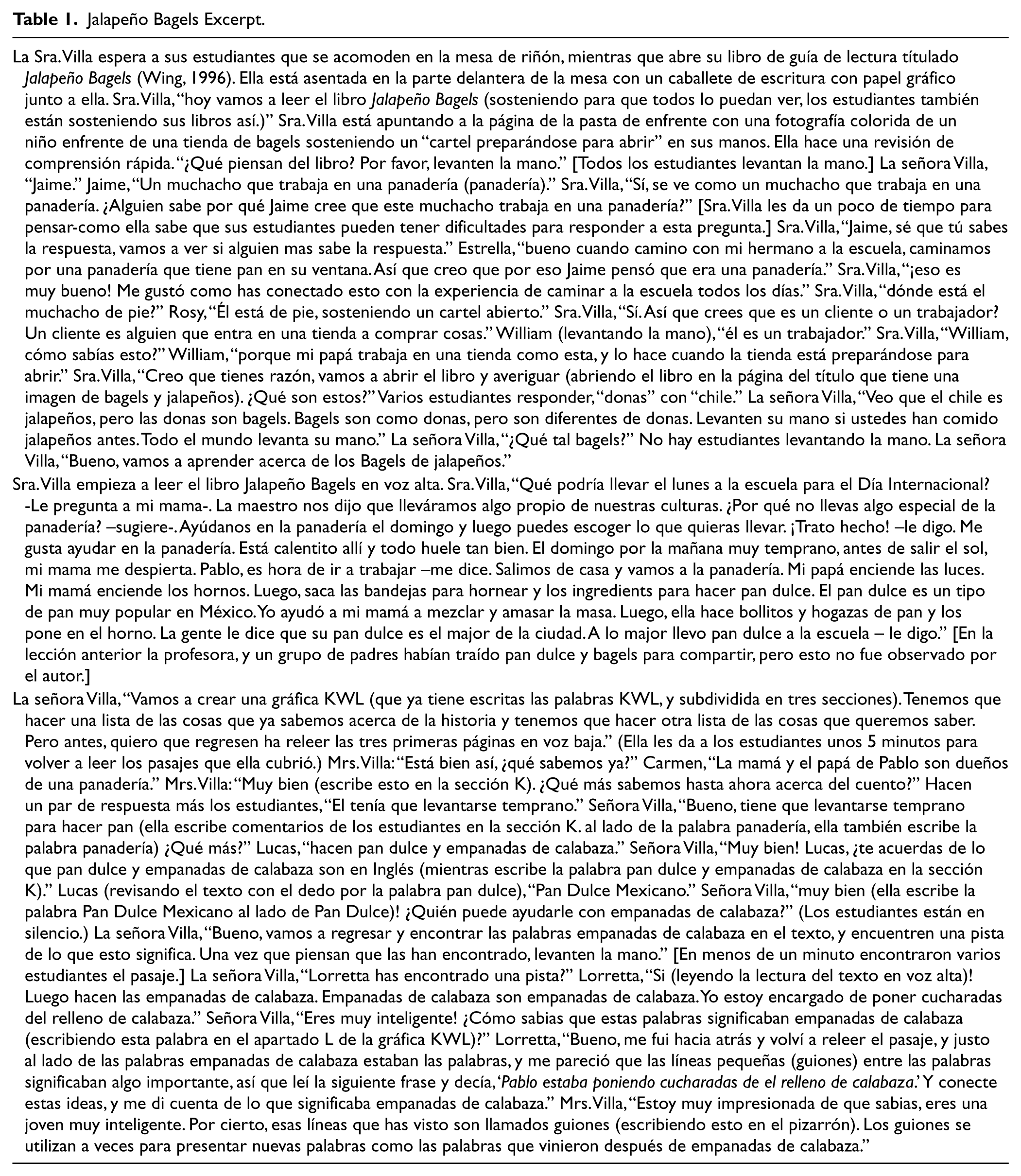
In the read-aloud example in Table 1 (Jalapeño Bagels Excerpt; see Appendix A for an English translation), Mrs. Villa was with a group of third grade LD students’ who were struggling with reading comprehension problems (WMLS reading comprehension levels in Spanish ranged from 2.1 to 2.5). Their IEPs recommended native language instruction (i.e., Spanish). In this excerpt, she uses students’ native language with culturally relevant text in activating students’ background knowledge to improve their reading comprehension and to set the purpose for future reading development.
Jalapeño Bagels Excerpt.
In another reading session, after reading and discussing the story Jalapeño Bagels, Mrs. Villa continued to provide direct and explicit native language instruction in activating students’ background knowledge to improve their vocabularies and oral language development skills. The Spanish excerpt in Table 2 (Jalapeño Bagels Excerpt 2; see Appendix B for an English translation) was with a third grade group of Latino ELLs with LD prior to beginning a GR activity; Mrs. Villa had written on chart paper some difficult vocabulary that the students would encounter during reading. In this abbreviated oral language development passage, Mrs. Villa connects unknown words with students’ everyday experiences, which helped to deepen their understanding of the text they were about to read during GR.
Jalapeño Bagels Excerpt 2.
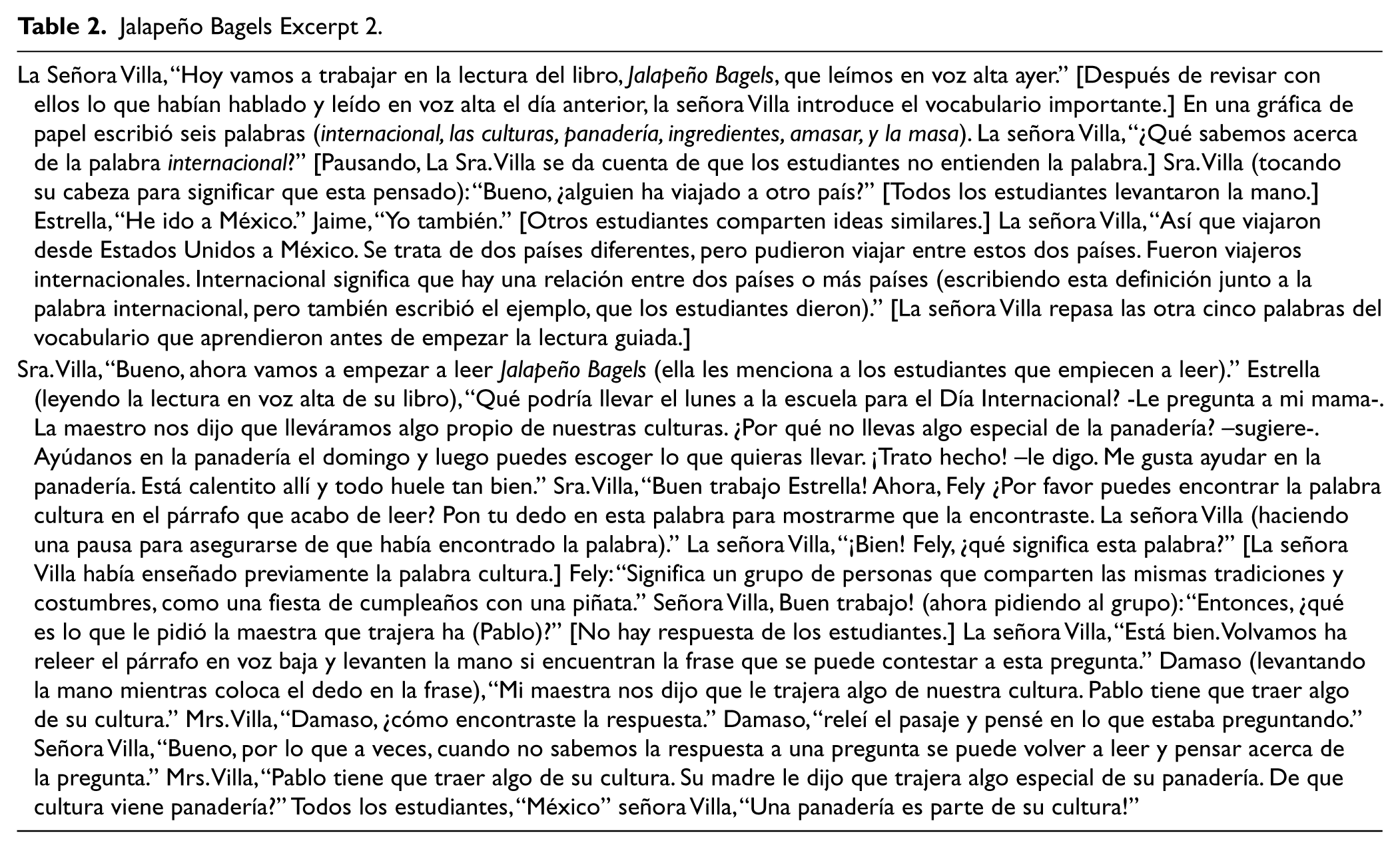
In summary, the goal of Mrs. Villa’s culturally responsive instruction was not only to give the students the opportunity to maximize their reading comprehension development but also to use this cultural capital in helping them to feel confident that they could learn and be successful readers. Mrs. Villa put an emphasis on the cultural aspects of teaching because she believed she needed to match her teaching to students’ learning needs (Au, 2005). Her bilingual instruction provided the oral language foundation for their literacy development (Jiménez et al., 1995). As an example (see Tables 1 and 2), she provided daily opportunities for students to respond to reading comprehension passages in Spanish because she believed their first language (L1) served as the cognitive input that allowed these learners to internalize and use their own thinking as a bridge to connect to new reading knowledge (Cummins, 2000).
Culturally Relevant Skills-Based Instruction
On a daily basis, Mrs. Villa provided culturally relevant skills-based instruction to her students with extended oral language opportunities to apply what they already knew. This intensive, interactive instruction focused on teaching seven core reading elements (e.g., phonological awareness, phonics, reading fluency, vocabulary, comprehension, oral language, and motivation; August & Hakuta, 1998; August & Shanahan, 2006; O’Connor & Vadasy, 2011). Classroom conversations and dialogue was the means for mediating these skills by scaffolding students’ interaction with reading passages and a way to incorporate students’ cultural and linguistic experiences into the conversation (Jiménez & Gersten, 1999). During an interview, Mrs. Villa emphasized this inquiry: “I always try to make an effort to draw upon students’ cultural and linguistic capital during instruction, as background knowledge is fundamental to developing reading comprehension.” During classroom observations, Mrs. Villa provided strong instructional evidence that backed these statements. In the excerpt in Table 3, Mrs. Villa and her five students in fourth or fifth grade (WMLS English reading levels 2.9–3.6; English proficiency level of Early Advanced) are reading and discussing a story, Diego: Bigger Than Life (Bernier-Grand, 2009). These students were in the process of being identified with LD. Diego: Bigger Than Life was one of many culturally relevant materials Mrs. Villa used to acknowledge the legitimacy of her students’ cultural heritage, but it also provided them with a mediated bridge between their experiences and the academic requirements of the school. In this example, she is using an interactive read-aloud with culturally relevant material that not only validates these students’ sociocultural experiences but also provides the necessary social context that connects skills-based instruction with student background knowledge in fostering their oral language, vocabulary, and comprehension development.
Diego Bigger Than Life Excerpt.
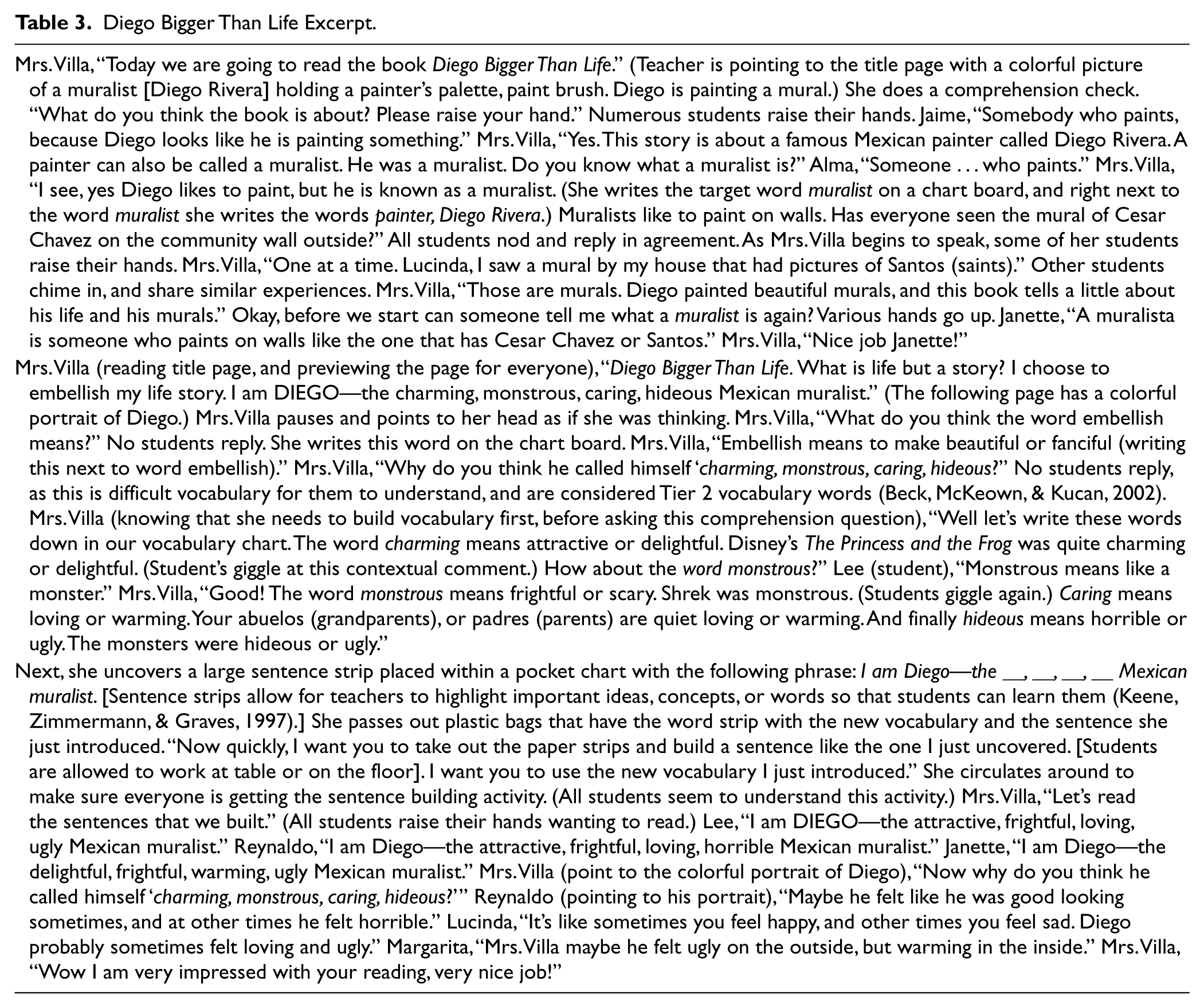
In conclusion, Mrs. Villa made learning to comprehend less daunting, as her everyday culturally responsive instruction provided layers of research-based reading instruction that was suited to meet her students’ background experiences (August & Hakuta, 1998; August & Shanahan, 2006). In the example in Table 3 she used a storybook read-aloud with focus words with varied levels of discussion and linkage to children’s everyday experiences to improve their understanding of text (Orosco & O’Connor, 2011). She selected instructional activities, techniques, and materials that provided students with direct and relevant experiences in developing comprehension skills by giving them the words necessary to make meaning of text (Genesse & Riches, 2006; Goldenberg, 2011).
I try to provide these students with research based instruction. I am learning that the instruction found effective in helping monolingual English-speaking students learn to read, benefit my ELLs as well. However, I say this with caution as I have learned that this type of instruction must be differentiated to make it culturally relevant skills-based instruction. (Interview with Mrs. Villa)
Collaborative Agency Time
Mrs. Villa clearly understood that the socially and cultural developed knowledge the students brought from home provided a powerful linguistic nexus in associating new information with prior knowledge (Orosco & O’Connor, 2011). Mrs. Villa said, “These children come from competent and knowledgeable households. Their parents, communities, and life experiences have given them so much knowledge. I can use these cognitive resources to make me a better teacher, and my students better readers.” In addition, because Mrs. Villa knew conditions for her students to be successful were often lacking (e.g., poverty, parent job stability, access to basic resources), she made an extra effort to reach out to parents and family, helping them to help their children (e.g., helping a parent who could not afford eyeglasses for her child; González et al., 2005). Once she reached out to parents, it seemed that they were more positive, cooperative, and receptive in her classroom. In the example in Table 4, a parent whose child Mrs. Villa helped to find eyeglasses agreed to bring in food, which not only helped to reinforce Mexican American family tradition during the holidays but also helped to reinforce the lesson. Mrs. Villa called this instruction time Collaborative Agency Time.
Too Many Tamales Excerpt.

To close, Mrs. Villa provided culturally responsive instruction that recognized the central role of culture in learning to read and provided instruction that was responsive to ELLs’ varying reading practices, oral language needs, and the funds of knowledge they brought from home (González et al., 2005; Klingner & Soltero-Gonzales, 2009). Finally, Mrs. Villa provided elaborate teaching and clear modeling of culturally responsive instruction and consistently checked for understanding, which allowed for students to respond spontaneously and fluidly because they could make cultural connections utilizing their individual knowledge and experiences with skills-based practices (Au, 2005).
Discussion
This case study described the instruction of one bilingual special education teacher (Mrs. Villa) with Latino ELLs with LD in an urban elementary school. This study was situated within a social constructivist framework. In examining the instruction for this teacher, we focused on how one teacher’s knowledge of culturally responsive pedagogy affected her special education instruction. Findings resulted in three themes (Cultural Aspects of Teaching Reading, Culturally Relevant Skills-Based Instruction, and Collaborative Agency Time) that were intertwined and functioned to create reading instruction that operated under a culturally responsive teaching framework. These themes empowered, validated, and affirmed the individual worth of each student and facilitated their reading achievement (Ladson-Billings, 2009).
Unfortunately, way too often ELLs do not encounter similar schooling experiences like the one described above (Orosco, 2010; Orosco & Klingner, 2010). The majority of special education programs do not focus on culturally responsive teaching such as bilingual development, oral language development, and motivation. In contrast to this deficit-based education, this study’s teacher, Mrs. Villa, demonstrated how to authenticate ELLs’ cultural and linguistic experiences and also legitimized it by seeking to improve their educational outcomes through culturally responsive skills-based methods (Au, 2005; August & Hakuta, 1998). Furthermore, she received ESL and bilingual professional development around how ELL cultural and linguistic experiences conform to learning, thus giving her the ability to create a more culturally encompassing classroom and motivating pedagogy (Gere, Buehler, Dallavis, & Haviland, 2009). Finally, along these empowerment lines, she was able understood that although these students brought a wealth of knowledge into the classroom, they were also the group with the most challenges (e.g., living in low-income neighborhoods, diminished allocation of school resources, and inferior school facilities; Kozol, 2006). As a result of this, she tried to provide skills-based instruction that fostered creativity, independence, and engagement, which form the basis for comprehension (Snow, 2002).
The ELL reading literature indicates that teachers who provide a balance among basic and higher-order thinking skills, direct and explicit instruction, oral language development, and student-based collaborative approaches instruction can significantly affect reading development (e.g., August & Hakuta, 1998; August & Shanahan, 2006). In this study, Mrs. Villa provided ELLs with clear, direct, and explicit differentiated instruction that intertwined with biographical, collaborative, and skills-based approaches to facilitate their use of reading content commensurate with their skills and language abilities (Hoover, 2009; Lachat, 2004). In other words, this teacher’s instruction was responsive to students’ cultural and linguistic learning needs. In addition, she provided instructional pacing with skills-based pedagogy both in the L1 and in the second language (L2), which improved not only their basic reading skills but also their oral language development (August & Hakuta, 1998; August & Shanahan, 2006). Oral language development has been found to be critical to developing strong reading comprehension skills (Herrera, Perez, & Escamilla, 2010).
In addition, the literature has documented that many special education teachers are not qualified or trained to address ELLs’ academic needs (Orosco & Klingner, 2009; Zehler et al., 2003). In contrast, it was quite evident in this study that Mrs. Villa had a strong working knowledge of bilingual and ESL reading pedagogy because of her professional development (master’s with an emphasis in ESL and bilingual special education). Thus, because of her teaching skills, she could provide an educational context that met ELLs’ learning needs. That is, because of her strong teaching preparation, this teacher was able to integrate culturally responsive teaching with skills-based practices in a special education program quite easily, thus providing not only an educational context that met her students’ cultural and linguistic needs but also a skills-based education (Orosco & Klingner, 2009).
Finally, sociocultural theory may give special education teachers a framework for understanding how to address ELLs’ cultural and linguistic needs (Vygotsky, 1962, 1978). This theory provides the critical lens that learning is enhanced when it occurs in contexts that are socially and linguistically meaningful and students’ cultural experiences are centrally included in classroom curricula and activities (Orosco, 2010). Because of this theory, in this study Mrs. Villa provided culturally responsive instruction that focused on looking more broadly at the quality and appropriateness of instruction and determining how to differentiate instruction in best supporting her students, rather then solely focusing on their learning deficits (Harry & Klingner, 2006; Orosco & Klingner, 2010). She embodied the spirit of culturally responsive instruction: that teachers should respect students’ values and view their cultural and linguistic differences as strengths, not deficits (Au, 2005; Cazden, 2001; Gay, 2000; Nieto, 1999, 2002; Rogoff, 2003).
In summary, the evidence from this study suggests the critical importance of special education teachers providing direct explicit instruction with ELLs that promotes not only L2 but also L1 development. In addition, the findings suggest that teachers can create exemplary contexts for instruction if they understand the conditions (e.g., understanding students’ home and community experiences) within which reading development takes place for ELLs. And by doing this, they can provide an instructional context that gives their students the opportunity to discuss, read, and write about experiences in L1 or L2 through a culturally relevant curriculum (Goldenberg, Rueda, & August, 2006). Finally, and most important from the evidence presented in this study, through observation of student interactions and small group instruction, teachers can become familiar with not only their students’ cultural and linguistic differences but also the cultural and linguistic experiences that influence students’ motivation and reading development. This knowledge might allow teachers to understand contextual variables that contribute to the effectiveness of a culturally responsive approach, increase awareness of implementation challenges, and provide them information about the circumstances under which and the students with whom cultural practice is most likely to be successful (Klingner & Edwards, 2006).
Implications for Policy, Practice, and Research
Policy
The instructional evidence from this study suggests that special education policy can be effective if special education teachers are provided culturally responsive professional development. As an example, the teacher in this study seemed to teach ELLs effectively because she understood the similarities and differences between L1 and L2 acquisition and reading processes. And because of this, she was able to provide culturally responsive instruction and curriculum that reflected students’ background knowledge. Therefore, school policy may need to be developed that provides teachers with culturally responsive professional development, which has been found effective with ELLs (Orosco & O’Connor, 2011).
Practice
In addition, the literature also continues to indicate that many special educators are not well prepared (e.g., with relevant reading content knowledge, training, and professional development) to address ELLs’ learning needs (Sullivan, 2011). Special education personnel are quite accustomed to providing skills-based interventions that emphasize learning commonalities between ELLs and their English-only students, downplaying important language differences, giving these teachers a “one-size-fits-all approach” mentality (Orosco, 2010). High-quality professional development would show teachers not only the L1 and L2 reading similarities but also differences that knowledgeable teachers take into account when teaching ELLs to read. In addition, this professional development would need to wrap around collaboratively based culturally responsive instruction that provides teachers with models for (a) learning effective ELL differentiated instructional approaches, (b) understanding the bilingual language acquisition process and how it affects learning to read in two languages, and (c) building on ELLs’ sociocultural experiences (Au, Raphael, & Mooney, 2008; Orosco, 2010; Orosco & O’Connor, 2011).
Research
Finally, this study suggests that much can be learned from descriptive research. Although experimental studies are important and can serve to demonstrate the effectiveness of instructional approaches (e.g., phonics-based instruction), the nature of experimentation (i.e., seeking quantification to promote replication and produce generalization) is to downplay experiences so as to control for variance (Cummins, 2007; Newman & Cole, 2004). Consequently, these contextual constraints may limit or weaken ecological validity (Bronfenbrenner, 1981), thus diminishing the quality of experimental generalization. Descriptive research can be used to support scientific inferences by providing an in-depth understanding of which practices might be effective with students (Orosco & Klingner, 2010).
Conclusion
Schools should provide culturally responsive professional development to general education teachers, but this training should be provided to special educators as well. Specifically, special education teachers will need to be provided with professional development that gives them access to multiple strategies and instructional approaches found effective with ELLs. The success of special education for ELLs may be dependent on how well teachers provide cultural and linguistic instructional supports to ELLs.
Footnotes
Appendix A
Appendix B
Authors’ Note
Dr. Malka Margalit served as action editor on this journal article.
Declaration of Conflicting Interests
The author(s) declared no potential conflicts of interest with respect to the research, authorship, and/or publication of this article.
Funding
This article is based on a study funded by the U.S. Department of Education, Cognition and Student Learning in Special Education (USDE R324A090092), Institute of Education Sciences, awarded to Michael J. Orosco and H. Lee Swanson.