







Abstract
In this longitudinal study, we investigated the role of word reading and mathematical difficulties measured in 9th grade as factors for receiving educational support for learning in upper secondary education in Grades 10 to 12 (from ages 16 to 19) and furthermore as predictors of dropout from upper secondary education within 5 years after compulsory education. In addition, we studied the role of school achievement in Grades 9 and 11 in this prediction. The participants of this study were members of one age group of 16-year-old ninth graders (N = 595, females 302, males 293) in a midsized Finnish city, who were followed for 5 years after completing compulsory education. The path model results, where the effects of gender, educational track, and SES were controlled, showed, first, that students with academic learning difficulties received educational support for learning particularly in the 11th grade. Second, academic learning difficulties directly affected school achievement in the 9th grade, but no longer in the 11th grade. Third, mathematical difficulties directly predicted dropout from upper secondary education, and difficulties in both word reading and mathematics had an indirect effect through school achievement in Grades 9 and 11 on dropout.
Although success for all students starting upper secondary education requires students to adjust socially and intellectually to a different educational system, this adjustment becomes even more complex for students with learning difficulties. Whether or not a student graduates is an essential personal and economic issue worldwide. The European Commission (2010) has set the aim of an early school leaving rate (including dropout) of less than 10%. This aim applies to Finland, as part of the European Union; in Finland, this aim was already achieved in 2004 in vocational education, and in general upper secondary academic education the drop-out rate has been approximately 4% during the past decade. However, in Finland, the drop-out rate in vocational education seems to be on the increase; in the school year 2008–2009 the figure was 8.5% (Statistics Finland, 2011), and in 2009–2010 it was 9.1% (Statistics Finland, 2012a).
At the same time, the importance of education for employment has increased enormously, which highlights the importance of school completion (Reschly & Christenson, 2006). In Finland, youth unemployment has increased in recent years from 16.5% in 2007 to 20.1% in 2010 (Statistics Finland, 2012b). Having an upper secondary education with a diploma clearly decreases the risk of future unemployment caused by educational exclusion (Jahnukainen & Järvinen, 2005; NCVER, 2011); it seems that those who complete upper secondary education with a diploma are more likely avoid unemployment, but it also seems that completion of a postschool qualification is needed when it comes to finding a full-time permanent job. Diplomas also help youth avoid the predicament of ending up among a portion of young people, “outsiders,” who have been left out, and are out of reach of social institutions and services (Test, Fowler, White, Richter, & Walker, 2009).
In the present study, the term academic learning difficulties is used in a context where word reading and mathematical skills are measured by screening tests among students in general education classes. The term difficulties is used because, according to Mazzocco (2007), in mathematics there is an essential difference between the terms disability and difficulty; although the term disability is more severe and suggests a biologically based disorder, the term difficulty represents a broader construct and includes a much wider range of performance, thus including performance in the below-average to low-average ranges of standardized achievement tests (Gersten, Jordan, & Flojo, 2005). In reading, the terms reading disability (Siegel & Smythe, 2005) and reading difficulty (Vaughn et al., 2008) have been used in parallel. In the present study, the term reading difficulty is used in consistency with the term mathematical difficulty; in addition, on the basis of the tests used (see the method section), the classification of learning disabilities was not possible.
In Finland, in general upper secondary academic education students must be supported in a way that gives them an equal opportunity to graduate. Students who temporarily fall behind in their studies, or whose study abilities have been weakened because of injury, sickness, or insufficiency, and also students who need mental or social support are entitled to special support for their learning (Finnish National Board of Education, 2003). In vocational education, special needs education has to be organized for those students who have disabilities or delayed development, a disturbed emotional life, sickness, or for other reasons need special support; in addition, an individualized education program has to be drawn to organize these students’ teaching (Ministry of Education, 1998). For these reasons, educational support for learning has been available in both educational tracks, and has been offered by either a subject or special needs education teacher. Finnish schools and teachers have very high autonomy in planning how educational support for learning is to be organized; they are trusted to do their very best as educational professionals (Välijärvi et al., 2007). Teachers can choose to work with students separately or with small groups in separate classrooms, or they can teach simultaneously with students in the same classroom. Because of this, the line between support in classrooms and special needs education teaching is very narrow.
Academic Learning Difficulties
Inaccurate and/or dysfluent word recognition and problems with decoding and spelling abilities are the key factors in dyslexia (Lyon, Shaywitz, & Shaywitz, 2003). Especially in consistent orthographies (as in German or Finnish), problems with reading fluency seem to be quite stable in defining poor word reading skills throughout compulsory education (Landerl & Wimmer, 2008), and this persists even into adulthood (Shaywitz & Fletcher, 1999). Dyslexia negatively affects the lives of dyslexic students in many ways; for example, they tend to be underachievers as they have to compensate for poor word reading skills by working harder, which results in longer workdays and increased pressure (Undheim, 2009). Consequently, dyslexic students, boys more often than girls, tend to choose a lower educational trajectory than nondyslexic students (Savolainen, Ahonen, Aro, Tolvanen, & Holopainen, 2008). Word reading difficulties affect about 3% to 10% of students. There are some discrepancies in the results of earlier studies on gender differences in reading difficulties because of the definition of reading difficulty used; some studies have shown that more boys than girls are classified as poor readers throughout Grades 1 to 8 (Badian, 1999), and some that there are no differences between girls and boys in the incidence of reading difficulty (Siegel & Smythe, 2005). In addition, it has been stated that the greater variance in reading performance may be the reason for the higher prevalence of reading difficulties in boys (Hawke, Olson, Willcut, Wadsworth, & DeFries, 2009). Word reading difficulties are persistent and affect adult life, including employment opportunities (Maughan et al., 2009).
Also, in mathematics, especially in arithmetic, fluency and ease in basic calculation are very important skills for solving math problems (Calhoon, Emerson, Flores, & Houchins, 2007). Deficits in calculation fluency interfere with a student’s ability to participate in the discussion during lessons and understand, for example, more complex algebraic concepts (Gersten et al., 2005). All in all, difficulties in mastering computational skills during the early grades of compulsory education will culminate in difficulties in learning advanced mathematics (Mabbott & Bisanz, 2008). Poor quantitative skills (e.g., calculation, numerical estimation, and measurement) negatively affect not only success in school, but also multiple areas of everyday life in adulthood (e.g., dealing with money, measurement, etc.; McCloskey, 2009). Hence, coping with mathematical difficulties in adulthood comes down to all three areas of mathematics, that is, arithmetic, algebra, and geometry. Therefore, in this article, difficulties in mathematics include all three areas. In the etiologies of math abilities and disabilities, gender differences have not been found (Kovas, Haworth, Petrill, & Plomin, 2007; Robinson & Lubienski, 2011); differences existing between girls and boys relate to self-confidence rather than skills in mathematics (Meelissen & Luyten, 2008). The prevalence of mathematical difficulties (arithmetic, algebra, and geometry) varies because of the definition used; for example, the cumulative incidence of dyscalculia in students up to 19 years old varies between 5.9% and 13.8% according to the formula used (Barbaresi, Katusic, Colligan, Weaver, & Jacobsen, 2005).
Obviously, prolonged academic learning difficulties can prevent or hinder the ability to access educational content. Academic learning difficulties still impair school achievement at the ages of 16 to 21 (Scanlon & Mellard, 2002) and increase the risk of dropping out of education (Bear, Kortering, & Braziel, 2006). Also, the educational background of parents may widen the achievement gap between students with well-educated parents and those with poorly educated parents, even up to 8th grade (Luyten & ten Bruggencate, 2011); hence, low socioeconomic status (SES) may also increase the risk of dropout for students with poorly educated parents. Clearly, dropout from education does not happen suddenly—it is more like a process of gradual disengagement that continues for several years before dropout itself occurs (Kortering & Christenson, 2009). The need for educational support because of academic learning difficulties is obvious, and therefore the role of the existing support system for keeping students on track of education is within our research interest. Longitudinal studies over educational tracks have not been published, especially regarding how academic learning difficulties measured in secondary education interrelate with received educational support for learning later (e.g., in postsecondary education), and with dropout from upper secondary education.
Current Study
In Finland, since the 20th century the leading principle in education has been to provide equal opportunities to all children and adolescents and to remove obstacles to learning, especially for the least successful students (Välijärvi et al., 2007). This reform means that development is also going on in both upper secondary education tracks (Finnish National Board of Education, 2003; Ministry of Education, 2002). In this study, only 35% of all 595 participants had not received educational support for their upper secondary education studies (e.g., support in general, for studying Finnish, for studying mathematics, for studying foreign languages, and for writing essays or reports in science), yet it is unclear how this educational support reaches those students with academic learning difficulties.
In the present study, our first and most essential aim was to investigate to what extent academic learning difficulties (measured in the 9th grade) were the reason for educational support for learning in Grades 10 to 12 and what role academic learning difficulties and educational support played in predicting dropout from upper secondary education. From earlier studies, we know that students with academic learning difficulties need support throughout their education (Tunmer & Greaney, 2010). On that basis, we first hypothesized that academic learning difficulties would be a strong reason for educational support during Grades 10, 11, and 12 (Hypothesis 1). Second, since we know that the dropout risk caused by academic learning difficulties can be reduced by adequate support (Dunn, Chambers, & Rabren, 2004), we expected that educational support for learning would decrease the risk of dropping out of upper secondary education (Hypothesis 2). Nevertheless, we assumed that academic learning difficulties would increase the risk of dropout (Hypothesis 3).
Our second aim was to examine the role of school achievement in the 9th and 11th grades in this prediction. As previous research has stated that the educational level achieved in adulthood is strongly affected by both reading skills (Deshler & Hock, 2007) and math performance level (Delazer, Girelli, Granà, & Domahs, 2003), we assumed that school achievement in Grades 9 and 11 would play a role as a mediator for academic learning difficulties in the prediction of dropout from upper secondary education (Hypothesis 4).
We were also interested in the respective effects of educational track, gender, and parents’ educational background. In this study, we expected that students in both educational tracks would receive similar educational support for their studies and no differences would occur in receiving educational support (Hypothesis 5). This is because, although the majority of students with academic learning difficulties (especially those with more severe difficulties) were enrolled in vocational education, at the same time studies in the academic track are considered more academically challenging, resulting in a similar requirement for support in both educational tracks.
Because earlier studies have shown that gender differences at the age of 16 are not that significant either in reading skills (Limbrick, Wheldall, & Madetaine, 2010) or in mathematics (Royer & Walles, 2009), we hypothesized that gender would have no role as a predictor of received educational support for learning or dropout (Hypothesis 6). As parents’ educational background has been shown to affect their children’s school achievement (Dubow, Boxer, & Rowell, 2009), we assumed, first, that mother and father’s low educational background would increase the risk of dropout and, second, that mother and father’s high educational background would positively affect the state of studies (Hypothesis 7). Highly educated parents value education and tend to have a more positive attitude toward education than parents with lower education, which may lead to higher expectations of success for their children, which in turn may have a positive effect on the school achievement of their children.
Method
Participants
This study is part of a 5-year longitudinal research project named Staying on Track of Learning, which started in 2004 in Finland (Holopainen & Savolainen, 2006). The participants were part of a normative, whole age group of adolescents (N = 595; 302 females, 293 males; age M = 15.9 years) who were in the 9th grade in a midsized Finnish city in the spring of 2004. In Finland, compulsory basic education takes 9 years; children enter compulsory basic education as first graders the year they turn 7 years old, and they graduate the year they turn 16 years old. The majority of participants were Finnish speakers, whereas only 1.2% (n = 7) used some other mother tongue. This is in line with the figures at the national level (Statistics Finland, 2006).
Consent to participate in the study and to use information from school registers was requested from the parents of the participants, whose educational background was as follows: Approximately 33% of the participants’ mothers and 35% of the participants’ fathers either had no education beyond comprehensive school or had a vocational school degree; about 33% of mothers and 27% of fathers had a polytechnic or vocational college degree or a master’s degree or higher. Information about educational background was missing for 34% of mothers and 38% of fathers. The information was missing completely at random among both genders and the two educational tracks (Little’s MCAR test: χ2 = 1.43, df = 2, p = .490) and among students with academic learning difficulties (Little’s MCAR test: χ2 = 2.11, df = 2, p = .348).
At the beginning of the research, the participants were in 9th grade (age M = 15.9 years), facing the transition to either upper secondary general education (hereafter “academic track”) or to vocational education (hereafter “vocational track”). In the Finnish educational system, students apply for a place in an upper secondary education school of their choice, either in the academic track or the vocational track; the selection is made mainly on the basis of the student’s grade average. In education programs where suitability for the vocation is essential or the number of applicants is large, entrance examinations and/or aptitude tests are also used. The academic track is considered to be the more academically demanding education; it is all-round education by its nature and gives students qualifications for further studies either in universities or polytechnic schools (Finnish National Board of Education, 2011). From the vocational track, students achieve a vocational qualification and in addition eligibility for higher education, for example polytechnic education, which in turn gives them a qualification to apply to universities (Finnish National Board of Education, 2012).
In this study, 59.5% of the participants (of them 67.8% girls and 50.9% boys) were enrolled in the academic track and 40.5% of participants (of them 32.2% girls and 49.1% boys) had selected the vocational track. The difference between vocational track students and academic track students was significant both in word reading difficulties (χ2 = 25.87, df = 1, p = .000) and in mathematical difficulties (χ2 = 74.35, df = 1, p = .000); the majority of the students with academic learning difficulties (76% of those with word reading difficulties, and 72% of those with mathematical difficulties) were enrolled in the vocational track. Information about the transition to upper secondary education was missing for 25 participants (18 girls, 7 boys). Nationwide, in 2004, 54.1% of students started academic track studies and 38.4% began vocational track studies. A 5.0% minority did not start any secondary education studies immediately after completing compulsory education, and a 2.5% minority continued with a further school year in compulsory education (Statistics Finland, 2005).
Procedure and Measures
Procedure
The data used in this study were gathered on a yearly basis, starting in February 2004 at the first stage of the research project. At that time, in 9th grade, mathematical and reading skills were assessed. All testing was conducted in groups at the students’ own schools by their Finnish language or special needs education teachers, who were trained for the testing. Nonattendance at school on testing day resulted in sample size variations of the tests (Table 1). Information on school achievement in the 9th grade was acquired for 592 and in the 11th grade for 521 participants; and furthermore, information on the state of studies in 2009 was received for 554 participants (276 females, 278 males). Information on the state of studies in 2009 was missing for 43 participants (28 females, 15 males); of these 43 participants, 25 (16 females, 9 males) were in the vocational track and 18 (12 females, 6 males) were in the academic track.
Descriptive Statistics and Mean Level Education Differences of Measured Difficulties, School Achievement, Educational Support for Learning, Parents’ Educational Background, and the State of Studies in 2009.
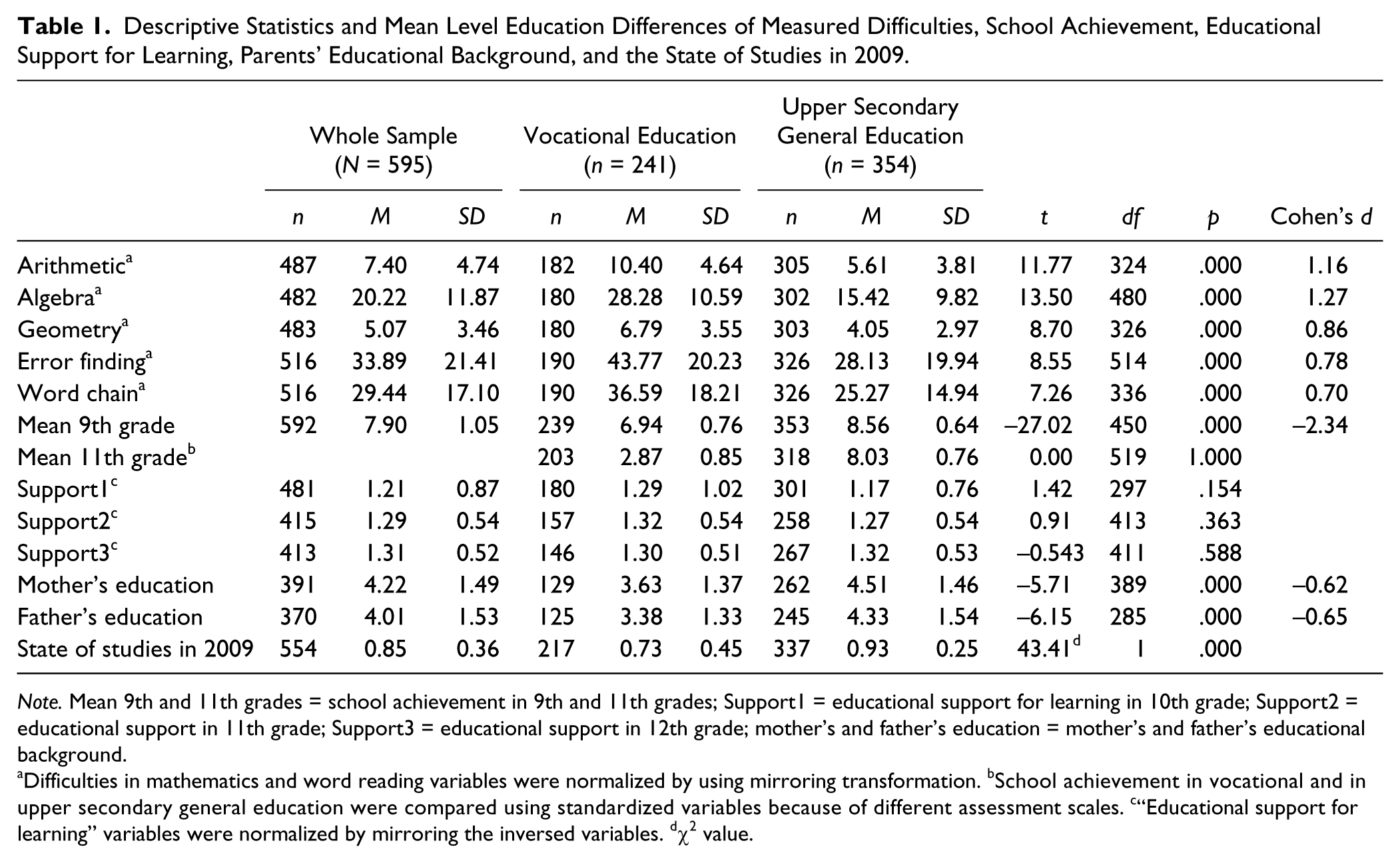
Note. Mean 9th and 11th grades = school achievement in 9th and 11th grades; Support1 = educational support for learning in 10th grade; Support2 = educational support in 11th grade; Support3 = educational support in 12th grade; mother’s and father’s education = mother’s and father’s educational background.
Difficulties in mathematics and word reading variables were normalized by using mirroring transformation. bSchool achievement in vocational and in upper secondary general education were compared using standardized variables because of different assessment scales. c“Educational support for learning” variables were normalized by mirroring the inversed variables. dχ2 value.
Word reading
Difficulties in word reading were assessed by a normative reading test measuring reading accuracy and fluency for youth and adults (Holopainen, Kairaluoma, Nevala, Ahonen, & Aro, 2004). Word reading was assessed with two tests: an error-finding test and a word-chain test. The error-finding test (n = 516; 258 females, 258 males) consisted of 100 words that had one spelling error each. These errors had to be found and marked with a vertical line. The test score was the total number of items marked correctly in 3.5 min. The word-chain test (n = 516; 258 females, 258 males) consisted of 100 words that had been written in clusters of four words without spaces in between. The words in these clusters had to be separated by a vertical line. The test score was the total number of items separated correctly in 1.5 min. The reliability (Cronbach’s alpha) of the word reading tests was good at .834.
Mathematics
Mathematics skills were assessed by a normative test, MAKEKO (skills in mathematics; Ikäheimo, Putkonen, & Voutilainen, 2002), which is a screening test for a particular age group, but is also a normative test, because it includes a borderline of concern (Hautamäki & Kuusela, 2004); for this age group, the cut-off score for mathematical difficulties is 50 (50% of the maximum scores; Ikäheimo et al., 2002). In the present study, the version for students at the end of 8th grade or at the beginning of 9th grade was used, and the test score was the total number of items correctly calculated without any time limitations. The test consisted of 100 very basic mathematical tasks in numeracy, arithmetic, algebra, and geometry; for the present study, three sum variables were created, according to the study by Taipale (2009; see examples of the tasks in the appendix). The sum variable arithmetic (n = 487; 246 females, 241 males) consisted of four subproblems, the sum variable algebra (n = 482; 243 females, 239 males) consisted of 16 subproblems, and the sum variable geometry (n = 483; 243 females, 240 males) consisted of three subproblems. Two subproblems (verbal mental arithmetic and the concept of number sense) were excluded because they could not be categorized purely as arithmetic, algebra, or geometry. The reliability (Cronbach’s alpha) for arithmetic was moderate at .644, whereas it was good for algebra and geometry at .868 and .737, respectively.
Received educational support for learning
Received educational support for learning was measured by a questionnaire in the 10th, 11th, and 12th grades. All participants were asked how much support they had received within the last 30 days for studies in general, for studying Finnish, for studying mathematics, for studying foreign languages, and for writing essays or reports in science on a 5-point scale (1 = not at all, 2 = 1–2 hr, 3 = 3–4 hr, 4 = 5–6 hr, 5 = more than 7 hr). The immediate 30-day period was used because the inquiry about received educational support was very detailed, and because of that, it would be very difficult to remember the longer period about what kind of educational support one had received.
For the present study, three variables were formed: support1 was the average value of the five support variables in the 10th grade, support2 was the average value of the five support variables in the 11th grade, and support3 was the average value of the five support variables in the 12th grade. The reliability of these variables was good (Cronbach’s alpha .839, .854, and .795, respectively).
School achievement
Information from the school register was used to extract data on the school achievement levels of all 9th graders (n = 592; 300 females, 292 males). Grades in the Finnish school system in compulsory school are grade-specific, based on teachers’ assessments of active participation during lessons and on exam results in each subject. Examinations that affect grades are made by teachers, and they range between 4 (lowest) and 10 (highest); possible national tests do not influence the grades. The calculated grade point average of all comprehensive school subjects (e.g., math, Finnish, English, Swedish, biology, history, physical education, etc., a total number of 13 subjects) taught in the 9th grade was used as the indicator of school achievement in the 9th grade.
Information from the school register was also available to obtain data on the school achievement level of 11th graders (n = 521; 256 females, 265 males). Grades in vocational education range between 1 (lowest) and 5 (highest), and the calculated grade point average of those subjects that are common to all students (e.g., math, Finnish, English, Swedish, physics, chemistry, art and culture, and society, business and working life knowledge) within the first 2 years of vocational education was used as the indicator of school achievement. Grades in upper secondary general education range between 4 (lowest) and 10 (highest), and the calculated grade point average of students’ grades for accomplished courses (e.g., courses in math, Finnish, English, Swedish, biology, history, etc., a total number of 18 possible subjects) within the first 2 years in upper secondary general education was used as the indicator of school achievement. These calculated grade point averages in the 11th grade were standardized, and after that a common school achievement variable for the 11th grade was formulated by summing up those standardized values.
State of studies in 2009
Information on the state of studies in 2009 from upper secondary education (n = 554; 276 females, 278 males) was collected from the school registers. In Finland, studies in upper secondary education take a minimum of 3 years in both education tracks (from age 16 to 19). In the present study, the year 2009 was used as the time point to examine the state of studies to include all students who had graduated from upper secondary education within 5 years after compulsory education (n = 472; 240 females, 232 males). Students who did not to graduate within that time were considered as dropouts (n = 82; 36 females, 46 males), according to the study by Lundetræ (2011). Information about the state of studies was collected from 2007, 2008, and 2009. The state of studies in 2009 variable was assigned two values: 0 = dropout, 1 = graduated.
Statistical Method
As a preliminary procedure, the skewed variables of received educational support for learning (i.e., support1, support2, support3) were normalized using transformation methods within SPSS (Version 17.0). Next, these variables along with measured skills (word reading and mathematics) were transformed into variables that express learning disability by mirroring (i.e., subtracting the achieved scores from maximum scores). Finally, all transformed variables were standardized.
Statistical analyses were carried out with the Mplus (Version 6.11) program (Muthén & Muthén, 2010). The path model was analyzed with the standard missing at random method, which uses all the data that are available to estimate the model without imputing data. The model was estimated using the weighted least square parameter estimates using a diagonal weight matrix (WLSMV) method, as it consisted of continuous latent and continuous and discrete observed variables. Since the outcome variable (state of studies in 2009) is dichotomous, the estimation used probit regression. Parameters were added to the model on the basis of their modification indices, and nonsignificant paths were deleted on the basis of their t-values.
The effects of educational track, gender, and parents’ educational background on the model were examined using chi-square difference tests. Because of the estimation method, WLSMV, the difference testing was done by using the DIFFTEST option within the Mplus program. In this multisample model, factor loadings, variances, and path coefficients were first constrained to be equal for both samples and thereafter set free if indicated so by the modification indices. On account of the sensitivity of the chi-square test statistic to a large sample size, a comparative fit index (CFI) and Tucker–Lewis index (TLI) with values greater than .95, root mean square error of approximation (RMSEA) with a value less than .06, and weighted root mean square residual (WRMR) with a value less than .90 were essential indices while good model fit was determined.
Results
Descriptive statistics and the results of the independent samples t tests for mean-level educational pathway differences at the age of 16 are presented in Table 1. Students in the vocational track showed significantly more mathematical and word reading difficulties than students in the academic track, and the effect sizes were high in every field of mathematical and word reading difficulties. Compared to vocational track students, academic track students had significantly higher school achievement in the 9th grade, and the high effect size emphasized the size of this difference. Of interest, in the 11th grade the differences in school achievement had vanished between vocational and academic track students; furthermore, there were no differences in received educational support for learning (immediate 30-day period) between students in either track. It was noteworthy that the parents’ educational background of vocational track students was lower than in the academic track, and the effect size was quite high (Cohen’s d with mother’s educational background at −0.62, and with father’s educational background at −0.65).
Attention must also be paid to the fact that from the participants of this study, 40.5% moved up to the vocational track and 59.5% progressed to the academic track. Of interest, but not surprising (see Statistics Finland, 2011), between the two tracks, the difference in the state of studies in 2009 was significant (χ2 = 43.41, df = 1, p = .000); of the vocational education students, 27.2% had not finished their studies in 2009 (5 years after completing compulsory education) and 72.8% had graduated by 2009, whereas of the academic track students, 6.8% had not finished their studies in 2009 and 93.2% had graduated by that time. Hence, there were more dropouts in the vocational track than in the academic track, and among these vocational education dropouts, the proportion of females was significantly larger than expected (χ2 = 8.76, df = 1, p = .003).
The correlations between the variables of word reading and the sum variables of mathematics, educational support for learning during upper secondary education, school achievement in the 9th and 11th grades, and parents’ educational level are presented in Table 2. Correlations between the sum variables of mathematical difficulties and between the variables of word reading difficulties were strong in both tracks; instead, correlations between the sum variables of mathematical difficulties and the variables of word reading difficulties remained moderate in the academic track, and in the vocational track only word-chain test and arithmetic modestly correlated. School achievements in Grades 9 and 11 strongly correlated in both tracks, and correlations between school achievements in both grades and geometry and word reading difficulties were moderate in both tracks. Of interest, arithmetic and school achievement in the 11th grade correlated significantly stronger in the academic track than in the vocational track (z = −3.05, p < .001). Educational support for learning in the 11th and 12th grades correlated, but quite modestly, with school achievements in Grades 9 and 11; there were more significant correlations between the sum variables of mathematical difficulties and educational support during upper secondary education in the vocational track than in the academic track. The correlation between mother’s educational background and father’s educational background was quite strong. Of interest, mother’s educational background correlated only with educational support in the 10th grade in the vocational track, but father’s educational background correlated modestly with all sum variables of mathematical difficulties, the word-chain test, and school achievements in Grades 9 and 11.
Intercorrelations Among the Five Fields of Learning Difficulties, Educational Support for Learning During Upper Secondary Education, School Achievement in 9th and 11th grades, and Parents’ Educational Level.
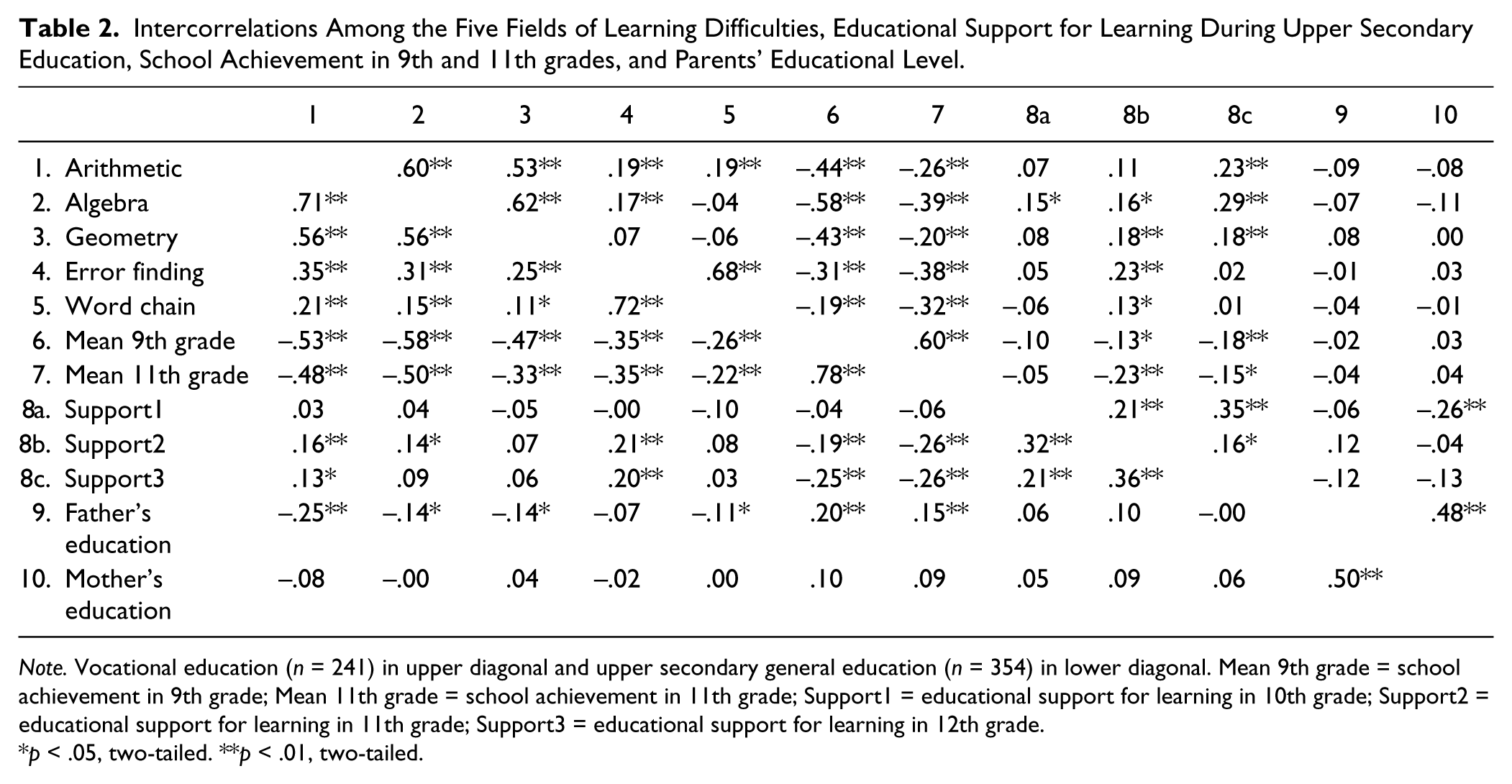
Note. Vocational education (n = 241) in upper diagonal and upper secondary general education (n = 354) in lower diagonal. Mean 9th grade = school achievement in 9th grade; Mean 11th grade = school achievement in 11th grade; Support1 = educational support for learning in 10th grade; Support2 = educational support for learning in 11th grade; Support3 = educational support for learning in 12th grade.
p < .05, two-tailed. **p < .01, two-tailed.
At first, to build a path model to answer our research questions, a measurement model was created. According to Holopainen et al. (2004), the two measures of reading (error-finding task and word-chain task) both measure accuracy and fluency, and a factor named “word reading difficulties” was formed. The three sum variables of mathematical difficulties (arithmetic, algebra, and geometry) loaded on a factor named “mathematical difficulties.”
To answer the first research question, a path model was created to investigate to what extent students with academic learning difficulties received educational support for learning during Grades 10, 11, and 12. It was surprising that students with word reading difficulties (standardized coefficient = .13, t = 2.13) and with mathematical difficulties (standardized coefficient = .17, t = 2.45) received support for learning in the 11th grade because of their academic learning difficulties, but that was not the case in the 10th or 12th grades. A very interesting finding was that mathematical difficulties directly predicted the state of studies in 2009 (standardized coefficient = –.39, t = −5.89); the more students had difficulties in mathematics, the more likely they had dropped out of education.
Despite the fact that academic learning difficulties affected the received educational support for learning only in the 11th grade, received educational support for learning, as a structure, was a continuum, yet not very strong, that started in the 10th grade and went on to the 12th grade. The received educational support for learning in the 10th grade had a direct effect on the received educational support for learning in the 11th grade (standardized coefficient = .27, t = 6.97), and on the received educational support for learning in the 12th grade (standardized coefficient = .18, t = 4.28). Furthermore, the received educational support for learning in the 11th grade had a direct effect on the received educational support for learning in the 12th grade (standardized coefficient = .27, t = 5.17). In this model, the received educational support for learning in the 12th grade directly explained and predicted the state of studies in 2009 (standardized coefficient = –.22, t = −2.88), indicating that in spite of the received educational support for learning, those students with academic learning difficulties still remained at risk of dropping out of education.
The model was controlled to be equal first for females and males, and second for vocational and academic tracks; no gender differences or differences between the two tracks were found. The effects of parents’ educational background were controlled by adding them at the same time in the model. Of interest, the effect of the father’s educational background was twofold; first, low father’s educational background was a risk factor; namely, the lower the father’s educational background was, the more the child showed word reading difficulties (standardized coefficient = –.18, t = −3.26) and mathematical difficulties (standardized coefficient = –.29, t = −4.92). On the other hand, high father’s educational background was a supportive factor; the higher the father’s educational background was, the more the child received educational support for learning in the 11th grade (standardized coefficient = .16, t = 2.36). In addition, father’s educational background had a positive indirect effect via school achievement in the 9th and 11th grades on the state of studies in 2009 (total indirect standardized coefficient = .11, t = 3.57), indicating that the higher the father’s educational background was, the more likely the child was to have graduated by 2009. The final model to answer the first research question (Figure 1) fitted the data well; on account of the sensitivity of the chi-square test statistic to a large sample size, mainly the indices of CFI, TLI, RMSEA, and WRMR were used in the evaluation of model fit. These indices were all excellent, .99, .98, .02, and .61, respectively.
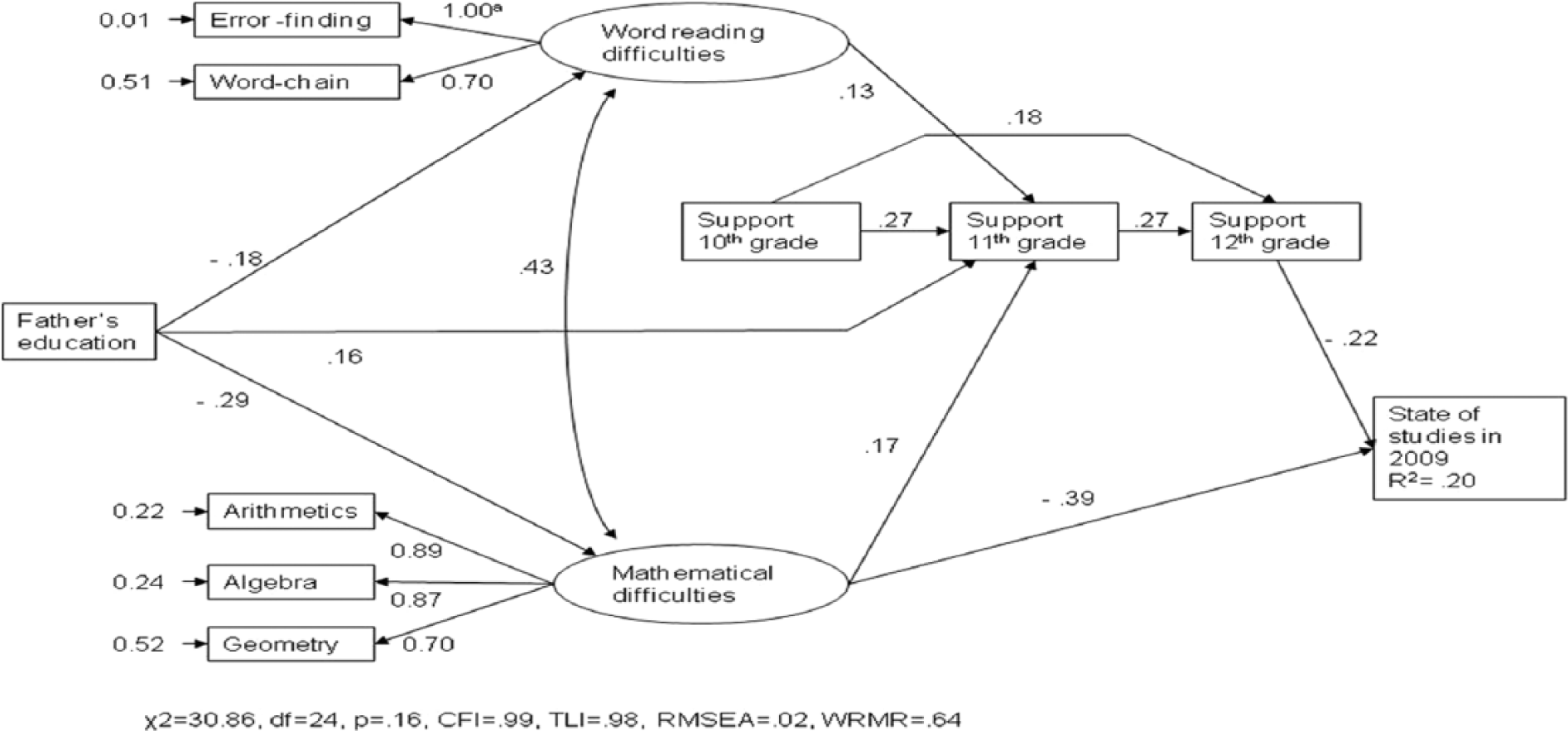
Structural equation model of academic learning difficulties explaining received educational support for learning in 10th grade (n = 481), in 11th grade (n = 415), and in 12th grade (n = 413), and predicting graduation within 5 years after compulsory education (n = 554).
Next, school achievements in the 9th and 11th grades were added to the model to answer the second research question. This caused the model to change so that the direct effect from received educational support for learning in the 12th grade to state of studies in 2009 vanished, and the direct effect on state of studies in 2009 emerged from both school achievement in the 9th grade (standardized coefficient = .27, t = 3.41) and school achievement in the 11th grade (standardized coefficient = .40, t = 5.36). Direct effects from word reading difficulties (standardized coefficient = .14, t = 2.40) and from mathematical difficulties (standardized coefficient = .12, t = 1.96) on the received support for learning in the 11th grade remained in the model, although the effect from mathematical difficulties became somewhat weaker than in the first model. Also, the direct path from received educational support for learning in Grade 11 to Grade 12 weakened (standardized coefficient = .17, t = 3.94). An interesting and very important finding was that difficulties in both word reading and mathematics had an indirect effect through school achievement in the 9th and 11th grades on state of studies in 2009, specifically on dropout, difficulties in word reading total indirect standardized coefficient at –.12 (t = −4.57), difficulties in mathematics total indirect standardized coefficient at –.32 (t = −6.57). This indicates that academic learning difficulties measured in the 9th grade at the age of 16 have quite serious long-term consequences on whether or not a student graduates. With mathematical difficulties these consequences are even stronger than with word reading difficulties.
Difficulties in word reading and mathematics, and father’s educational background, also explained the received educational support for learning in the 11th grade in this model. Furthermore, the continuum of the structure of received educational support for learning stayed unbroken between Grades 10 and 11 (standardized coefficient = .28, t = 6.72), and between Grades 11 and 12 (standardized coefficient = .17, t = 3.72). In addition, received educational support for learning in the 10th grade directly affected the support received in the 12th grade (standardized coefficient = .20, t = 5.04). In spite of the clear consequences of learning difficulties in word reading and mathematics for learning and for dropout, to our surprise, the received educational support for learning during upper secondary education did not explain and predict the state of studies in 2009.
Finally, the effects of gender, educational track, and parents’ educational background on the second model were controlled. No differences between females and males or between the two tracks were found, and the effects of father’s educational background were similarly twofold as in the first model. The final model fit the data well (Figure 2) with excellent indices of CFI, TLI, RMSEA, and WRMR (.99, .99, .02, and .59, respectively), and, on the whole, the model explained 34% of the dropouts from upper secondary education within 5 years after completing compulsory education.
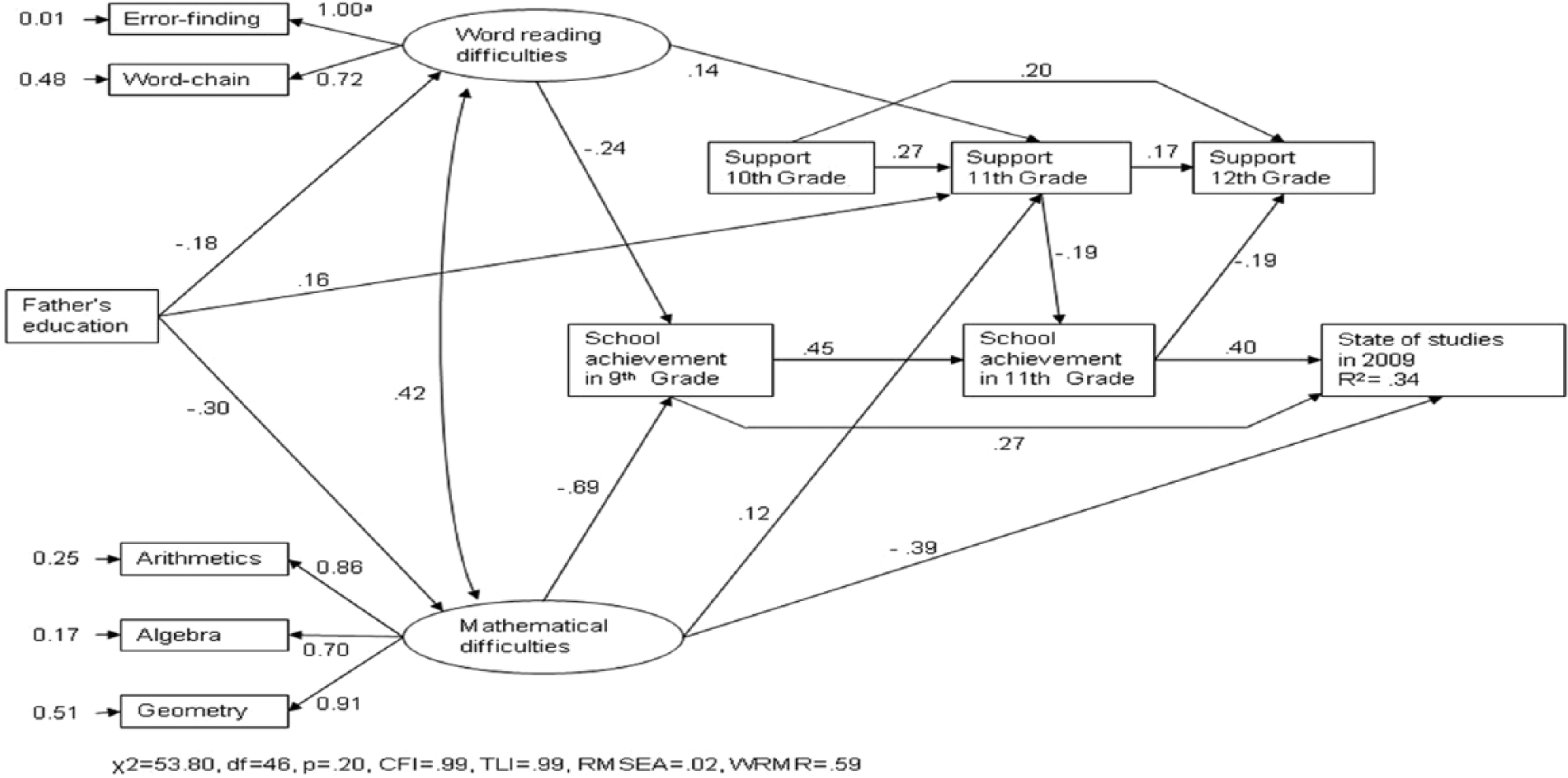
Structural equation model of academic learning difficulties explaining received educational support for learning in 10th grade (n = 481), in 11th grade (n = 415), and in 12th grade (n = 413), and predicting state of studies in 2009 when school achievement was included in the model (n = 554).
Discussion
The main purpose of the present study was to investigate to what extent academic learning difficulties (difficulties in word reading and mathematics) measured in the 9th grade were the cause of educational support for learning in Grades 10 to 12, and to determine the role of academic learning difficulties and educational support in predicting dropout from upper secondary education. Our longitudinal study showed that support given cannot effectively enough break the negative educational trend that leads to dropping out from upper secondary education. Of all dropouts, 43% had academic learning difficulties, which implies that other kinds of support besides educational support are needed for those with academic difficulties, and also for other students. The results are discussed in more detail below.
The results demonstrated that difficulties in both word reading and mathematics were directly seen as a focus of the received educational support for learning in the 11th grade, but not consistently during the whole upper secondary education, meaning that Hypothesis 1 was only partially supported. Yet, the findings of the latest research on support (see Kortering & Christenson, 2009; Shaywitz & Fletcher, 1999; Tunmer & Greaney, 2010) stress the fact that academic learning difficulties should be the reason for educational and other kinds of support (e.g., general student counseling, teaching of learning strategies), and it has to be consistent, of high quality (with a student’s individual needs as a basis for support), and involve a wide range of elements of support to be effective and produce better results in learning. Successful interventions include more than just training for a single task, skill, or subject; they pay attention, for example, to students’ motivation, feelings of belonging to the school, and how teachers’ practices may facilitate students’ learning (Kortering & Christenson, 2009). The findings of the present study strongly imply that the received educational support for learning because of academic learning difficulties was inconsistent and obviously started too late, if ever, as about 25% of those students with academic learning difficulties reported not receiving educational support for their learning during upper secondary education. This conclusion is confirmed by the consequences of those academic learning difficulties in the present study: 37% of students with word reading difficulties and 22% of those with mathematical difficulties had not finished their studies in 2009. Furthermore, information about state of studies in 2009 was available from 554 participants in this study; of them 14.8% (n = 82) were dropouts, and of them 43% (n = 35) had academic learning difficulties. These drop-out rates fail to achieve the aim of European Commission (2010) concerning early school leaving rate of less than 10%; it also seems that the drop-out rates may still be on the increase also in Finland (Statistics Finland, 2011, 2012a).
From earlier studies we know that with adequate educational support the risk of dropout can be reduced (Dunn et al., 2004; Shaywitz & Fletcher, 1999). In our study, a positive finding was that the system of educational support for learning was available in both tracks, but in spite of received educational support for learning, those students with academic learning difficulties remained at risk of dropping out of upper secondary education. Thus, Hypothesis 2 was partially supported.
An extremely interesting finding in our study was the role of difficulties in both word reading and mathematics as predictors of dropout. In the present investigation, word reading and mathematical difficulties were allowed to compete equally in the prediction of dropout, and as a result, mathematical difficulties had a direct effect on dropout from upper secondary education within 5 years of completing compulsory education and, at the end, explained about 15% of it. Therefore, Hypothesis 3 was partially supported. In addition, difficulties in word reading and mathematics both indirectly affected the state of studies in 2009, specifically dropout, through school achievement in the 9th and 11th grades, which were strong predictors of graduation within 5 years after compulsory education per se. Although the risk of academic learning difficulties for dropping out of education is known from earlier studies (see Bear et al., 2006), and the negative effects of mathematical difficulties (see McCloskey, 2009), and of word reading difficulties (see McNulty, 2003) on adult life are well documented, the findings of these far-reaching direct and indirect effects on dropout of academic learning difficulties measured in the 9th grade, and of the stronger role of mathematical difficulties than word reading difficulties in this prediction were surprising. However, it has to be kept in mind that in this study we did not examine other factors, for example, motivation or behavioral and/or attention problems, which could affect whether a student graduates or not; nor did we measure intelligence. And furthermore, to take part in a discussion about the role of intelligence and educational success (see Deary, Strand, Smith, & Fernandes, 2007), intelligence seems to be more important for success in mathematics than it is for word reading skills (Geary, 2011). But on the other hand, the effect of the general intelligence factor g has been found to be indirect through other specific abilities, rather than direct, on mathematic achievement (Taub, 2008) and on word reading skills (Floyd, Keith, Taub, & McGrew, 2007). Participants in the present study were one age group of students in public compulsory education schools; special education schools or classes were not included, and the distribution of intelligence can therefore be kept as normal including students with mildly lower than average intelligence up to gifted students. To conclude, we assume in accordance with the study by Siegler (2012) that it is more earlier knowledge of mathematics, rather than intelligence that explains the role of mathematics in our study.
School achievements in both the 9th and 11th grades were quite strong predictors of state of studies in 2009, specifically graduation. In addition, the educational support for learning lost its role as a predictor of dropout when school achievement in Grades 9 and 11 was included in the model. School achievement worked as a mediator for academic learning difficulties in prediction of dropout from upper secondary education, but, to our surprise, mathematical difficulties also directly predicted that occurrence. Hence, these results partly supported Hypothesis 4, and as an outcome, academic learning difficulties together with school achievement explained 34% of dropouts within 5 years of completing compulsory education.
In Finland, the academic track is considered as more academically demanding; thus, it was not a surprise that skills in every test in mathematics and word reading in the 9th grade, along with school achievement in the 9th grade, were significantly better among academic track students than vocational track students. The majority of students with academic learning difficulties were enrolled in the vocational track, namely 75.7% of those students with difficulties in word reading and 71.7% of those with difficulties in mathematics. In both tracks, all students are socially, educationally, and intellectually in a new and demanding situation requiring support, which can also be seen in our results. The same path model could be built for females and males and for vocational and academic track students. In this light, the fact that both Hypothesis 5 (the effect of educational track on educational support) and Hypothesis 6 (the role of gender) received support was not surprising.
Parents’ educational background was found to be a quite robust and independent index of SES; its positive effects have been shown to be independent of other indices of SES, for example, occupation, value of housing, etc. (Dubow et al., 2009). According to the results of PISA 2003 (Kupari, 2005), both mother and father’s educational backgrounds were very much connected to achievement level in mathematics and science among 15 year olds. Because of this, in our study, the effect of parents’ educational background was investigated separately for mothers and fathers. Of interest, the results revealed partial support for Hypothesis 7 (the role of parents’ educational background on support and state of studies); father’s educational background, but not mother’s educational background, had a direct but quite modest effect on the received educational support for learning in the 11th grade, and it also indirectly predicted the state of studies in 2009, namely graduation. The effect of father’s educational background was twofold. It was a risk factor; namely, the lower the father’s educational background was, the more likely the student was to have academic learning difficulties, and the effect was stronger for mathematical than word reading difficulties. But then, it was also a supportive factor; namely, the higher the father’s educational background was, the more likely the student was to have finished their studies by 2009. This effect was indirect through school achievements in the 9th and 11th grades. In the present study, father’s educational background directly affected received educational support for learning in the 11th grade, indicating that the higher the father’s education was, the more the student received educational support for learning. This finding coincides with the results of studies on parental involvement (see Chen & Gregory, 2009) as a predictor of improvement, for example, in children’s academic outcomes. Also, parents’ educational background has been found to predict both the educational and occupational aspirations of their children in a way that results in more education by age 19 and higher levels of adult educational attainment (Dubow et al., 2009). This seems to be the case in this study as well; the reason for our finding could be that fathers with higher education value education, are interested and involved in their offspring’s education, and encourage their children with their studies and expect good results. In turn, this may result in more easily made educational support requests to teachers from fathers, and from students themselves.
In summary, the results highlight the fact that academic learning difficulties measured in compulsory education have alarmingly far-reaching consequences, both direct and indirect, on adolescents’ lives. The combination of persistent academic learning difficulties (McCloskey, 2009; McNulty, 2003), constant struggle with one’s studies (Undheim, 2009), and inadequate educational support for learning (Kortering & Christenson, 2009) clearly increase the risk of dropping out of upper secondary education. These long-term consequences must be taken into account if we truly want to decrease high drop-out rates (see European Commission, 2010) and ensure that young people with academic learning difficulties are able to avoid the negative educational trends that may lead to dropout and future unemployment. It is obvious that a reform of the educational system is needed because an increasing number of students with learning difficulties are entering postsecondary education, which means that they do not get enough support for their academic learning difficulties in compulsory basic education. Future longitudinal studies are required to clarify the support system in upper secondary education, and to examine the role of other learning difficulties (e.g., academic learning difficulties in parallel with behavioral/attention problems) as a predictor of drop out.
Limitations
At least four limitations have to be taken into account in any effort to generalize the results of this study. First, even though the sample size was relatively large, the sample comprised one age group in only one Finnish city, and thus the results should be generalized with caution. Second, this study was carried out in the Finnish school system. Therefore, the results can only be compared with the results of studies carried out in a similar education system. Third, intelligence tests were not carried out. We know that intelligence influences school achievement (Deary et al., 2007), and there is also evidence that, specifically in mathematics, earlier knowledge of mathematics predicts later overall mathematics achievement (Siegler, 2012); therefore, the results of this study should be generalized with caution. Fourth, information about the received educational support was asked from students themselves; it would have increased the reliability of the results concerning educational support if this information had been asked from teachers and parents, too. In addition, received educational support information was asked from the previous 30 days before the questionnaire, so it may not be the whole truth of the received support during the school year. For these reasons, the results of received educational support should be generalized with caution. Fifth, in this study, information about parents’ educational background was gained from the participants, but as Sirin (2005) points out, although information gained from older students is found to be quite accurate, it is perhaps more accurate to collect SES data from parents themselves. In addition, the response rate was low concerning parents’ educational background. Thus, the results of the effects of parents’ educational background should be generalized with caution.
Footnotes
Appendix
Authors’ Note
Portions of this article were presented at the 13th Biennial Conference of the European Association for Research on Adolescence (EARA), August 2012, Island of Spetses, Greece.
Declaration of Conflicting Interests
The author(s) declared no potential conflicts of interest with respect to the research, authorship, and/or publication of this article.
Funding
The author(s) disclosed receipt of the following financial support for the research, authorship, and/or publication of this article: The preparation of this article has been partially supported by the Staying on Track of Learning research project, funded by the Academy of Finland (SA 213486). The first author has a doctoral student position at the Finnish Doctoral Programme in Education and Learning and received funding from the program in 2012.