






Abstract
Several studies have reported high comorbidity for reading disability (RD) and psychiatric disorders. The aim of this study was to investigate the comorbidity of subthreshold and full psychiatric disorders with RD while comparing subgroups based on age of RD recognition (early vs. late). We analyzed data from 130 children with RD and 82 typically developing children aged 7 to 18 years. RD was assessed with the Dyslexia Differential Diagnosis Maastricht-Hungarian Standard Test. Psychiatric diagnoses were based on the Mini International Neuropsychiatric Interview Kid. Chi-square tests were used for group comparisons of the prevalence of subthreshold and full disorders. A higher proportion of children in the RD group were assessed as having internalizing or externalizing disorders. When subthreshold and full diagnoses were considered together, the prevalence of internalizing but not externalizing pathology was higher in the RD group than the control group. The prevalence of internalizing pathology was similar in the early and late RD subgroups, but externalizing pathology was more common in the late RD subgroup. When subthreshold and full diagnoses were considered together, mood disorder and externalizing pathology were more prevalent in the late RD subgroup than the early RD subgroup. This study demonstrated that early recognition of RD may play a role in determining comorbid psychopathology and should therefore be an educational and clinical priority. Clinicians should routinely screen children with RD for comorbid disorders, including subthreshold pathology.
Reading disability (RD) is a developmental disorder characterized by specific impairments in single-word reading, reading fluency, and reading comprehension, which are not caused by neurological deficits, impairments in general intelligence, inadequate education, or sensory defects in vision and hearing (Lyon, Shaywitz, & Shaywitz, 2003; Wagner, Torgesen, & Rashotte, 1994). In the Diagnostic and Statistical Manual of Mental Disorders–Fifth Edition, RD is classified as a neurodevelopmental disorder, within the more general category “specific learning disorders,” qualified by the description “with impairment in reading” (American Psychiatric Association, 2013).
Early contact to specialists (i.e., before the age of 7 years, in preschool or first grade) and prompt effective interventions are critical to achieving good outcomes in children with RD (Horn & Packard, 1985; Törő & Balázs, 2015). Early intervention depends on recognition of early signs of RD (Compton, Fuchs, Fuchs, & Bryant, 2006; Felton & Pepper, 1995; Scarborough, Neuman, & Dickinson, 2009; Vellutino, Scanlon, Small, & Fanuele, 2006).
Several recent studies suggested that the prevalence of psychiatric disorders was higher in individuals with RD than those without RD (Boetsch, Green, & Pennington, 1996; Levy, Young, Bennett, Martin, & Hay, 2013; Maughan, Rowe, Loeber, & Stouthamer-Loeber, 2003; Murray & Greenberg, 2006; Wadsworth, DeFries, Willcutt, Pennington & Olson, 2015). Comorbidity with internalization disorders was reported to be 21.4% to 51.4% (Knivsberg & Andreassen, 2008; Riddick, Sterling, Farmer, & Morgan, 1999; Willcutt & Pennington, 2000), and comorbidity with externalization disorders was 19.6% to 24.3% (Germanò, Gagliano, & Curatolo, 2010; Gilger & Kaplan, 2001; Knivsberg & Andreassen, 2008; Maughan & Carroll, 2006; Willcutt & Pennington, 2000).
Of the externalizing disorders associated with RD, attention-deficit/hyperactivity disorder (ADHD) has attracted most attention (Alves, Casella, & Ferraro, 2016; Germanò et al., 2010; Gillis, Gilger, Pennington, & DeFries, 1992; Levy et al., 2013; Miranda-Casas, Meliá-de Alba, Marco-Taverner, Roselló, & Mulas, 2006; Semrud-Clikeman et al., 1992; Willcutt & Pennington, 2000). Prevalence of ADHD in children with RD has been estimated at 6.0% to 39.0% (Semrud-Clikeman et al., 1992). Children with RD and comorbid ADHD usually have more academic difficulties than do children with only one of the two pathologies (Miranda-Casas et al., 2006). Willcutt and Pennington (2000) found that after controlling for ADHD, RD was not significantly associated with other externalizing disorders, such as oppositional defiant disorder and conduct disorder. Furthermore, longitudinal studies have shown that RD increases the risk of conduct disorder in later development (Maughan, Pickles, Hagell, Rutter, & Yule, 1996; Williams & McGee, 1994).
The association between RD and internalization disorders has received less research attention (Beitchman & Young, 1997), and some of the data in this area are controversial. Internalizing disorders were reported to be more prevalent in individuals with RD than in the typical population (Boetsch et al., 1996; Murray & Greenberg, 2006; Stewart, Benner, Martella, & Marchand-Martella, 2007; Willcutt & Pennington, 2000). For individuals with RD, the reported prevalence of anxiety was 9.9% to 25.0% (Carroll, Maughan, Goodman, & Meltzer, 2005; Knivsberg & Andreassen, 2008; Willcutt & Pennington, 2000), and the reported prevalence of depression was 2.3% to 29.0% (Carroll et al., 2005; Goldston et al., 2007; Knivsberg & Andreassen, 2008; Willcutt & Pennington, 2000). Willcutt and Pennington (2000) reported a positive association between RD and symptoms of anxiety or depression even after controlling for comorbid ADHD, but Miller, Hynd, and Miller (2005) suggested that children with RD were not at increased risk for internalizing psychopathology. The Pittsburg Youth Study found that preadolescent boys with RD reported more depressed mood than preadolescent boys without RD, but this effect was not observed in adolescent boys (Maughan et al., 2003).
Recently, subthreshold psychopathology—symptoms that are insufficient to fulfill diagnostic criteria of classification systems, such as the Diagnostic and Statistical Manual of Mental Disorders–Fifth Edition (American Psychiatric Association, 2013) and International Classification of Diseases–Tenth Revision (World Health Organization, 1992)—has attracted considerable research attention. Studies have shown that even subthreshold psychopathology has a negative impact on functioning and is associated with an increased risk of developing a full symptom disorder (Bertha & Balázs, 2013; Balázs & Keresztény, 2014).
To date, no study has focused on comorbid subthreshold psychopathology in children with RD, nor have we found any published research comparing full-syndrome or subthreshold psychopathology in children whose RD was recognized early and late.
In this study we aimed to address these gaps in the literature by investigating the prevalence of subthreshold and full externalizing and internalizing disorders in children with RD and by comparing groups based on age when RD had been diagnosed and when the intervention had been started for it (early or late; i.e., before or after 7 years of age).
Our hypotheses were as follows:
Hypothesis 1: The prevalence of psychiatric disorders (according to the criteria of classification systems) is higher in the group of children with RD than in the control group.
Hypothesis 2: The prevalence of subthreshold psychiatric disorders is higher in the group of children with RD than in the control group.
Hypothesis 3: The prevalence of psychiatric disorders is higher in the late RD subgroup than in the early RD subgroup (i.e., children whose RD or the risk/early warning signs of RD were diagnosed after vs. before the age of 7 years, respectively).
Hypothesis 4: The prevalence of subthreshold psychiatric disorders is higher in the late RD subgroup than in the early RD subgroup (i.e., children whose RD or the risk/early warning signs of RD were diagnosed after vs. before the age of 7 years, respectively).
Methods
Participants
RD and control cases were recruited through the Department of Children and Family Services, Vecses City Local Government. In both groups (RD and control groups), an inclusion criterion was that children had to be between 7 and 18 years old, with no history of intellectual disability. An additional inclusion criterion was the diagnosis of RD according to a computer-based dyslexia test (for the RD group) or the lack thereof per the same test (for the control group). Current or previous treatment for psychological or psychiatric problems was an exclusion criterion for the control group. In both study groups, an exclusion criterion was mental retardation according to the medical history.
Participation was voluntary. Parents and children >14 years old gave written consent after receiving written and oral information about the project. Children <14 years old also received written and oral information about the project. The study was approved by the Ethical Committee of the Ministry of Human Capacities of Hungary.
Measures
Dyslexia Differential Diagnosis Maastricht-Hungarian Standard Test computerized dyslexia battery
To verify RD, we used the shortened version of the Dyslexia Differential Diagnosis Maastricht-Hungarian Standard Test (3DM-H; Tóth, Csépe, Vaessen, & Blomert, 2014). The 3DM-H is the Hungarian standardized adaptation of the Dutch 3DM dyslexia battery (Blomert & Vaessen, 2009); both tests have been applied in large-scale international reading studies and helped to reveal the similar developmental characteristics of typical and reading-disabled children in European orthographies (e.g., Landerl, Ramus, Moll, & Schulte-Körne, 2013; Moll, Ramus, & Landerl, 2014; Vaessen et al., 2010; Ziegler et al., 2010).
The 3DM-H is fully computerized: the instructions, the presentation of stimuli, and the recording of the responses, as well as the evaluation. The computer records both the speed and the accuracy of the response. The battery consists of several subtests. In the present study, we used the Reading, Spelling, Phoneme Deletion, Rapid Automatized Naming, Letter-Sound Matching, and Letter-Sound Discrimination subtests—which form the Reading, Spelling, Phoneme Awareness, Rapid Automatized Naming, and Letter-Sound scales, respectively. The scales can be further aggregated into the cognitive reading and spelling (CRS) index. Raw scores are transformed into T scores, ranging from 20 to 80, with a mean of 50 (SD = 10). T scores are controlled for the child’s school grade. Interpretation of the T scores are presented in Table 1.
3DM-H Test: Normative Values and Their Interpretation.
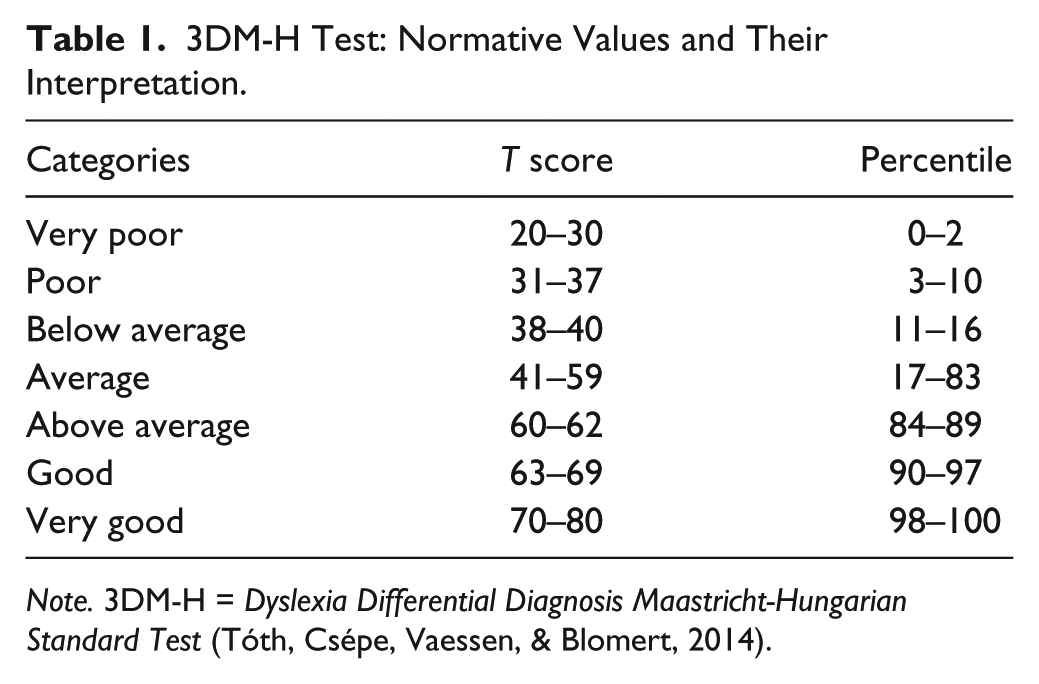
Note. 3DM-H = Dyslexia Differential Diagnosis Maastricht-Hungarian Standard Test (Tóth, Csépe, Vaessen, & Blomert, 2014).
All scales have excellent psychometric properties, as shown by the high reliability coefficients (scales: test-retest, r > .91; CRS index: test-retest, r = .98) and several validation studies conducted on the standardization sample (n > 800) and further samples of disabled children (n > 200). Excellent sensitivity and specificity of the Hungarian version have been reported by Tóth et al. (2014). In the manual of the original version (Dutch 3DM), the authors reported very high correlations between the 3DM reading scores and the results on the EMT (r = .83–.91) and Klepel (r = .66–.85) reading tests (both tests are well-known reading tests in the Netherlands). The Spelling subtest of the 3DM correlated highly (r = .61) with the PI Dictation Test (a standardized Dutch spelling test), despite that fact that the PI Dictation Test session was undertaken (on average) 48 days before the 3DM testing session. In Hungary, the computerized version of the 3DM-H Spelling subtest showed high correlation with the dictation version (r = .73; the dictation test was conducted ~97 days after the computer testing). In both 3DM versions, the Verbal Memory Span subtests correlated with the Wechsler Intelligence Scales for Children–Fourth Edition digit span results (r = .40–.43 in the Dutch sample and r = .35–.53 in the Hungarian sample).
Both manuals reported highly similar results for the hierarchical regression tests in which the additional explanatory power of the 3DM indicator subtests was investigated. In the first model (baseline), the 3DM reading and spelling scores were regressed on two IQ tests (in the Dutch sample, Raven Progressive Matrices and RAKIT; in the Hungarian sample, Wechsler Intelligence Scales for Children–Fourth Edition Block Design and Vocabulary subtests) and the 3DM Choice Reaction Time subtest. The explained variances were low, as expected (e.g., for the reading fluency of high-frequency words, the authors reported R2 = 0.05 in the Dutch sample and R2 = 0.08 in the Hungarian sample). In the second model, in which the verbal indicator subtests were included (3DM Phoneme Awareness, Rapid Automatized Naming, Letter-Sound, and Verbal Memory Span subtests), the R2 measures increased considerably (R2 = 0.40 in the Dutch sample and 0.48 in the Hungarian sample). In general, almost all reliability and validation studies conducted with the Dutch and Hungarian versions showed highly similar patterns, which highlights the quality of the Hungarian adaptation.
Following the instructions of the test authors, we considered children with a T score <40 on the CRS index of the battery and on at least two main indicators (Reading, Spelling, Phoneme Awareness, Letter-Sound, Rapid Automatized Naming scales) to be dyslexic, thereby forming the RD group.
Mini International Neuropsychiatric Interview Kid
We assessed psychiatric pathology with the modified version of the Hungarian Mini International Neuropsychiatric Interview Kid (MINI Kid; Balázs et al., 2004; Lecrubier et al., 1997; Sheehan et al., 1997; Sheehan et al., 1998; Sheehan et al., 2010). The MINI Kid is a short, comprehensive, structured diagnostic interview that assesses 25 child psychiatric disorders per the Diagnostic and Statistical Manual of Mental Disorders–Fourth Edition (DSM-IV; American Psychiatric Association, 1994): mood disorders, anxiety disorders, substance use disorders, Tourette’s disorder, ADHD, oppositional defiant disorder, conduct disorder, psychotic disorders, eating disorders, trauma-related disorders, and pervasive developmental disorder. The original MINI Kid has a branching structure, but the modified version assesses all symptoms, which enables evaluation of subthreshold pathologies.
During the validity studies of the MINI Kid, 226 children aged 6 to 17 years were enrolled (Sheehan et al., 2010). To assess the concurrent validity, the Schedule for Affective Disorders and Schizophrenia for School Aged Children–Present and Lifetime Version was administered as well. In the case of 57 children interrater reliability data were collected and in the case of 83 children, test-retest reliability data. Sheehan et al. (2010) reported good to excellent concordance for the diagnoses of any mood disorders, anxiety disorders, substance use disorders, ADHD, behavioral disorders, and eating disorders (area under curve = .81–.96, κ = .56–.87) and medium to psychotic disorder (area under curve = .94, κ = .41). Sensitivity was very good to excellent (.61–1.00) for 15 of 20 disorders and acceptable (>.4) in the case of 5 disorders. Specificity was excellent (.81–1.00) for 18 of 20 disorders and very good (>.73) for the remaining 2 disorders (hypo/manic episode, ADHD). Interrater and test-retest were very good to excellent (κ = .64–1.00) for all disorders except dysthymia (κ = .41).
The high quality of the Hungarian translation of the MINI Kid was ensured with a multistep translation procedure, including initial translation, back translation, harmonization, and pilot study (Balázs et al., 2004). During the validation study, the MINI Kid was administered to 112 children aged <18 years; two interviewers interviewed 51 children, and in the case of 31 children, the interview was repeated a second time within 48 hours. Each subject who completed the MINI Kid got a best-estimate diagnosis from an independent psychiatrist as well. In the case of those disorders that were diagnosed in a sufficient number of cases (to calculate the interrater reliability, the test-retest reliability, and the sensitivity and specificity), the results support the reliability of the MINI Kid from good to excellent, except in the case of test-retest reliability for generalized anxiety disorder, for which kappa was .36.
Children aged <13 years were interviewed with their parents, but children aged ≥13 years were assessed unaccompanied. Interviewers underwent a thorough standardized training procedure before the study, and their work was subject to regular oversight.
Demographic Questionnaire
A structured interview was performed to determine demographic data characteristics—for example, parents’ education and economic activity, family structure, early adaptation, and the age when the risk/early warning signs of RD had been diagnosed and when the intervention had been started for it.
Definition of Subthreshold Disorders
Categorization of subthreshold pathology was carried out via the same procedure as in our previous study (Balázs, Bitter, Lecrubier, Csiszér, & Ostorharics, 2000): We selected the key symptoms of the disorders from the DSM-IV, and each subthreshold condition was defined with the exclusion of the Axis I disorder from which it was derived.
Definition of Early and Late RD Groups
The early RD group was defined when RD or its risk had been defined and some intervention started before the age of 7 years, while the late RD group was defined when it had happened after 7 years. In Hungary, there is routine screening for the increased risk/early signs of learning difficulties (e.g., delayed graphomotor skills, delayed speech and language development) at the ages of 5 to 6 years in preschool. These children are offered special education.
Statistics
The prevalence of full and subthreshold internalizing and externalizing disorders is reported. Group comparisons of pathologies (RD group vs. control group; early vs. late RD) were carried out through chi-square tests. To explore the effect of RD severity on comorbidity within the RD group, we compared groups of children categorized as having below average, poor, and very poor 3DM-H CRS index scores.
Results
Sample
There were 130 children in the RD group and 82 in the control group. There were no differences between the control group and RD group in terms of mean age (RD: 10.23 years, SD = 2.12; control: 9.66 years, SD = 2.12) or gender distribution (RD, girls = 40.0%; control, girls = 39.0%). Demographic characteristics and anamnestic data are shown in Table 2.
Demographic and Anamnestic Characteristics of the Study Groups.
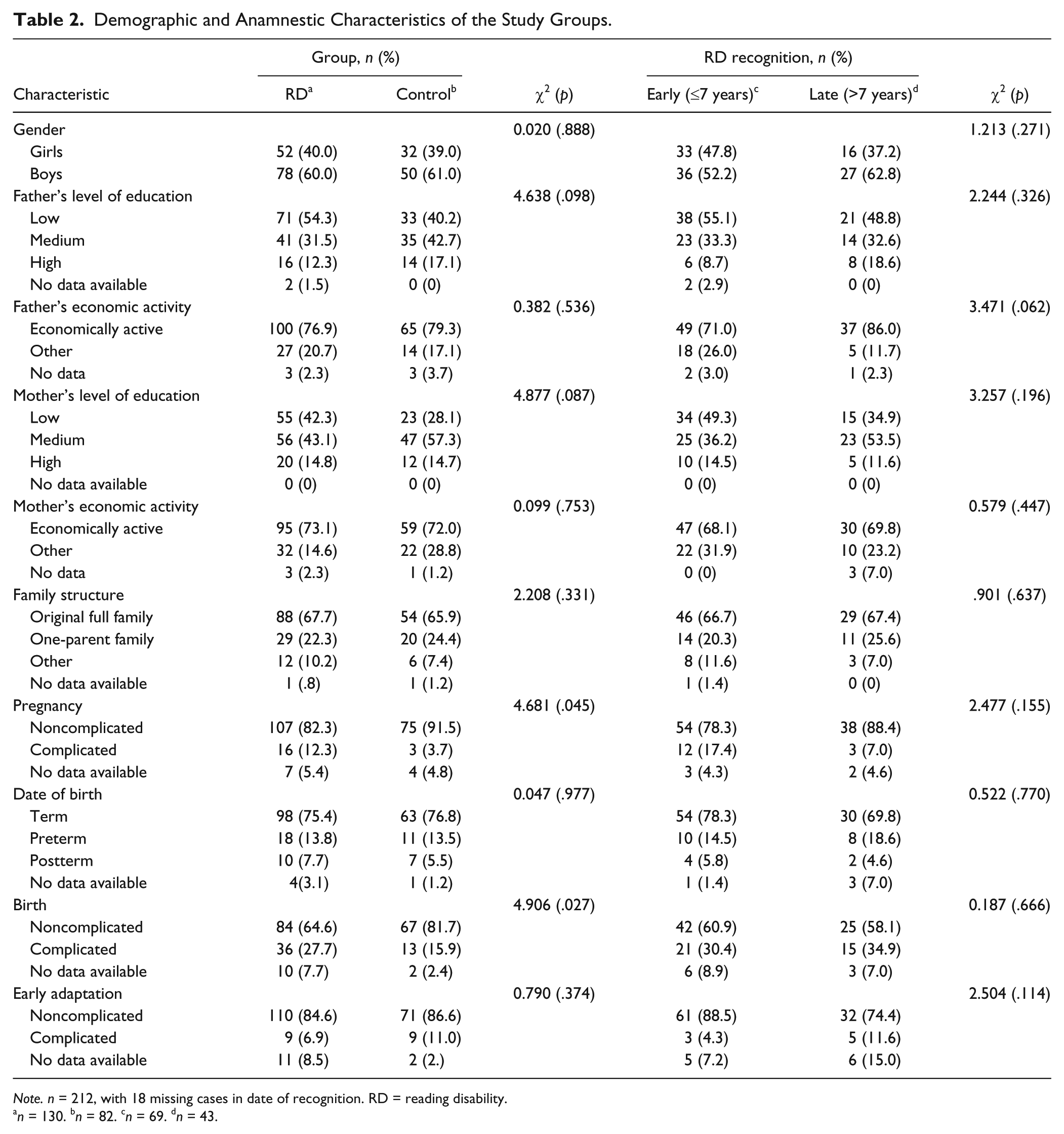
Note. n = 212, with 18 missing cases in date of recognition. RD = reading disability.
n = 130. bn = 82. cn = 69. dn = 43.
The RD and control groups did not differ in terms of age, t(212) = 1.912 p = .057, gender, father’s or mother’s level of education, father’s or mother’s economic activity, or family structure. Prevalence of prematurity and early development was similar in the two groups, but parents of children with RD reported a higher prevalence of complications during pregnancy and birth, although the effect sizes were small (φ = .153 and φ = .157, respectively).
In the RD group, 3DM-H CRS index scores ranged from 22 to 39 (M = 34.10, SE = .39). The T scores of 28 children (21.5%) were ≤30, indicating very poor reading and spelling skills; for 64 children (49.2%), they were between 31 and 37, indicating poor reading and spelling skills; and for 38 children (29.3%), they were 38 or 39, indicating below-average performance.
In the control group, 3DM-H CRS index scores ranged from 41 to 79 (M = 58.22, SE = 1.05). T scores for the majority of children (41 ≤ T ≤ 59, n = 49, 59.8%) were categorized as average performance; for 8 children (9.8%), they fell between 60 and 62, indicating above-average reading and spelling skills; for 14 children (17.1%), they ranged between 63 and 69, indicating good reading and spelling skills, and for 11 children (13.4%), they were ≥70, indicating very good reading and spelling skills.
First and Second Hypotheses: Subthreshold and Full Psychiatric Comorbidity of RD
Frequencies of subthreshold and full diagnoses according to MINI Kid for both groups are shown in Table 3.
MINI Kid Full and Subthreshold Diagnoses in the Study Groups.
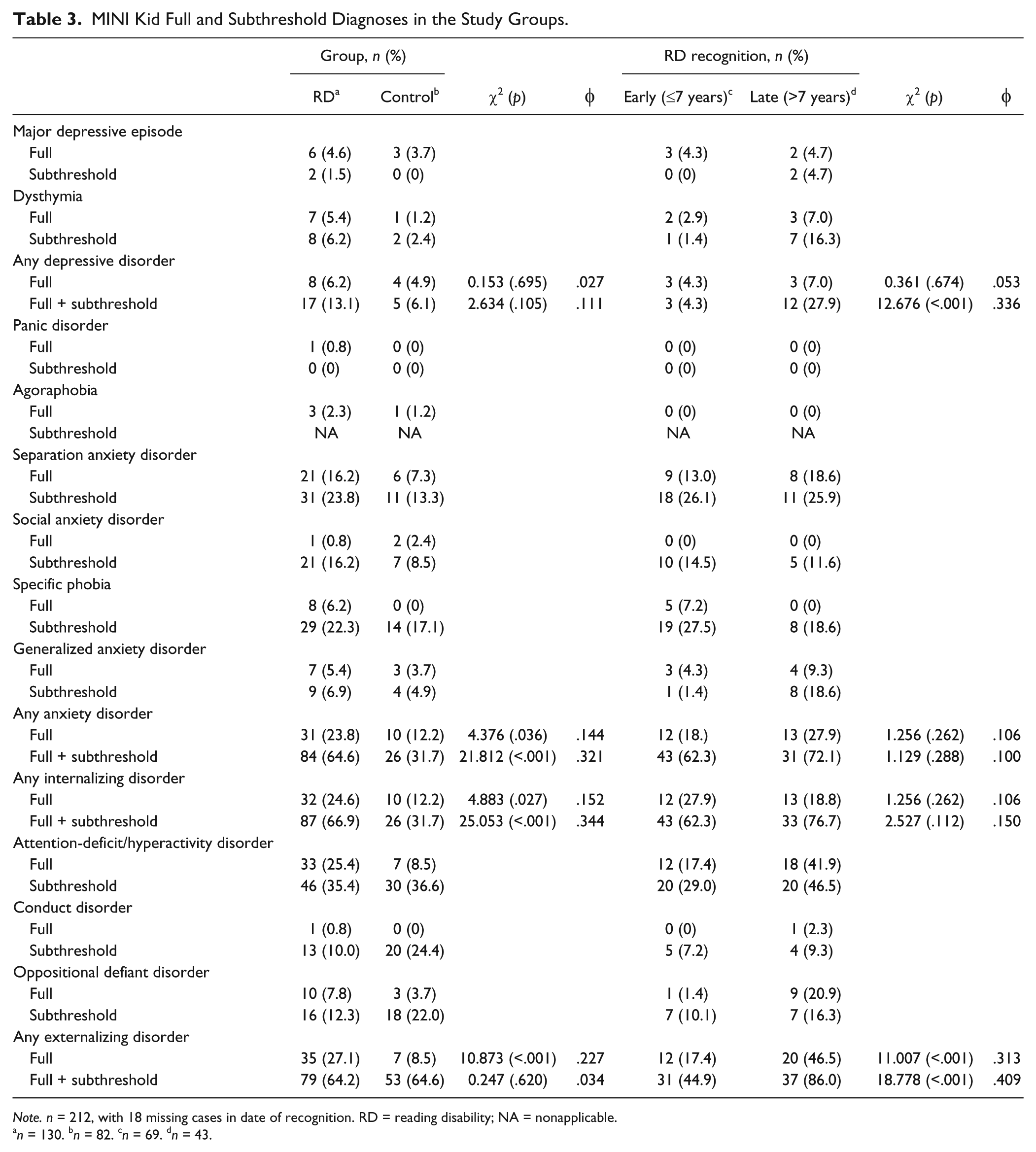
Note. n = 212, with 18 missing cases in date of recognition. RD = reading disability; NA = nonapplicable.
n = 130. bn = 82. cn = 69. dn = 43.
Older children had more subthreshold (rho = .196 p = .004) and full (rho = .219 p = .001) diagnoses than younger children. There was no gender difference for any of the mood or anxiety disorders, but boys were more frequently diagnosed with externalizing disorders (boys, n = 32, 25.0%; girls, n = 10, 12.0%), χ2(1) = 5.298, p = .021, φ = .158.
There was a difference in MINI Kid diagnoses of internalizing and externalizing disorders between the RD and control groups, χ2(2) = 10.894, p = .004, Cramer’s V = .227. Eighty-two children (63.6%) in the RD had no diagnosis; 16 (12.4%) had one diagnosis; and 31 (24.0%) had two or more MINI Kid diagnoses. Sixty-nine children (84.1%) in the control group had no MINI Kid diagnosis; 6 (7.3%) had one diagnosis; and 7 (8.5%) had two or more diagnoses.
Anxiety and internalizing and externalizing disorders were more prevalent in the RD group (Table 3). When subthreshold and full diagnoses were considered together, anxiety and internalizing diagnoses, but not externalizing diagnoses, were more frequent in the RD group than in the control group (Table 3).
To explore the effect of RD severity on comorbidity within the RD group, we compared groups of children categorized as having below-average, poor, and very poor 3DM-H CRS index scores. There were no significant differences in the three groups in MINI Kid diagnoses of internalizing and externalizing disorders, χ2(2) = .025, p = .988, Cramer’s V = .014, and χ2(2) = .956, p = .620, Cramer’s V = .086, respectively. Similarly, no differences among the three groups were found when subthreshold conditions were also included—any full or subthreshold internalizing and externalizing disorders: χ2(2) = .242, p = .886, Cramer’s V = .042, and χ2(2) = 3.019, p = .221, Cramer’s V = .153, respectively.
Third and Fourth Hypotheses: Early and Late RD Subgroups
The early recognition RD subgroup was younger than the late recognition RD subgroup (M = 9.93, SD = 2.23; M = 10.98, SD = 1.87, respectively), t(110) = 2.575 p = .011, but the two subgroups did not differ in terms of gender, father’s or mother’s level of education or economic activity, or family structure (see Table 2). There were also no subgroup differences in complications during pregnancy and birth, prematurity, or early development.
There were subgroup differences in number of MINI Kid internalizing and externalizing diagnoses, χ2(2) = 6.861, p = .032, Cramer’s V = .248. Fifty children (72.5%) in the early RD subgroup had no diagnosis; 8 (11.6%) had one diagnosis; and 11 (15.9%) had two or more. Twenty-one children (48.8%) in the late RD group had no diagnosis; 7 (16.3%) had one diagnosis; and 15 (34.9%) had two or more.
Frequencies of MINI Kid subthreshold and full diagnoses in the early and late RD subgroups are shown in Table 3. The prevalence of anxiety and mood disorders was similar in the two subgroups, but the prevalence of externalizing disorders was higher in the late RD subgroup (Table 3). When subthreshold and full diagnoses were considered together, the prevalence of mood and externalizing diagnoses was higher in the late RD subgroup than the early RD subgroup.
Discussion
Our findings are consistent with early research demonstrating the importance of recognizing and providing appropriate treatment for RD comorbidities (Boetsch et al., 1996; Germanò et al., 2010; Gilger & Kaplan, 2001; Maughan et al., 2003; Murray & Greenberg, 2006; Willcutt & Pennington, 2000). In our sample, more than one third of children with RD had at least one psychiatric comorbidity, and almost one fifth had more than one psychiatric comorbidity. Our first hypothesis was supported. There was a higher prevalence of psychiatric disorders in the RD group than in the control group, but surprisingly, almost one-sixth of the control group—consisting by definition of children without any history of psychological or psychiatric treatment—had at least one psychiatric disorder according to a structured interview. This result suggests that introduction of a more sensitive secondary prevention system among children should be considered. Particular attention should be given to screening children with RD for potential psychiatric comorbidity.
Our second hypothesis was partly supported: the prevalence of both subthreshold and full internalizing disorders was higher in the RD group than the control group. The prevalence of full anxiety disorders and the combined prevalence of full and subthreshold anxiety disorders were higher in the RD group than in the control group. About one quarter of RD children had at least one anxiety disorder, and if subthreshold conditions were included, this proportion increased to two thirds. We conclude that children with RD experience more stress than their typically developing peers as they try to meet the expectations of parents, teachers, and peers.
Interestingly, our second hypothesis was partly not supported: Similar proportions of children in the RD and control groups exhibited some externalizing symptoms, but a higher proportion of children in the RD group fulfilled the criteria for an externalizing disorder.
These results are in line with previous findings (Willcutt & Pennington, 2000) and reinforce the need to screen children with RD for symptoms of both internalizing and externalizing disorders with tests sufficiently sensitive enough to detect subthreshold symptoms of internalizing disorders, particularly anxiety disorders.
To our knowledge this study is the first to compare subthreshold and full psychiatric disorders in children with RD where the family contacted a specialist early (<7 years) or late. In both RD subgroups (early and late recognition), the percentage of children with comorbid psychiatric disorders was very high: More than half the children late RD subgroup and more than one quarter of the children in the early RD subgroup had at least one comorbid disorder. Our third hypothesis was supported: Our data also show that the prevalence of psychiatric disorders according to DSM-IV criteria was higher in children whose RD was recognized late (>7 years) than in children whose RD was recognized before the age of 7 years. These results emphasize the importance of early recognition of RD and reinforce the importance of training teachers in kindergarten, preschool, and grade school to recognize the early symptoms of RD and persuade the parents of affected children to seek professional help. Psychologists and support staff working in these institutions can also play an important gatekeeper role.
Our fourth hypothesis was supported as well: Our results showed that a higher proportion of children in the late RD subgroup than in the early RD subgroup had subthreshold or full externalizing disorder. This finding indicates that where RD is not recognized until a child is of school age, it is associated with an increased risk of comorbid externalizing psychopathology, probably due to the negative social and self-evaluative consequences of academic underachievement.
We also found that subthreshold depression was more prevalent in the late RD subgroup than the early RD subgroup. We know from previous studies that subthreshold psychopathology increases the risk of developing full disorders (Bertha & Balázs, 2013), but recognition of subthreshold symptoms can prevent subsequent development of more severe psychopathology. We suggest that clinicians pay special attention to subthreshold symptoms of depression, particularly in children with an RD that was not recognized until they were of school age.
Though not the focus of this research, it is interesting to note that age of recognition of RD was not related to differences in parental education or economic activity. Similarly, it is important to highlight that parents of children with RD reported significantly more complications during pregnancy and birth than parents in the control group, although the effect sizes were small. Previous research has shown that children born prematurely tend to have lower scores on reading tests than their full-term peers (Andrews et al., 2010; Hack et al., 1994). Our results underline the importance of long-term follow-up of this high-risk population.
The limitations of this study must be taken into account. The design was cross sectional, so we cannot make causal inferences on the basis of these data. Longitudinal data will be needed to explore the associations reported here. Moreover, we used a convenient sample, which restricts the generalizability of our findings. Further research based on representative samples is needed to replicate our findings. The level of the IQ was not measured, although an exclusion criterion was mental retardation in the medical history. Additionally, although the MINI Kid screens for multiple child psychiatric disorders, it does not cover all of them—for example, language and motor difficulties. The kappa value of test-retest reliability of the generalized anxiety disorder section of the MINI Kid was low (Balázs et al., 2004); however, generalized anxiety disorder is being characterized with fluctuation. Children in the late RD subgroup were older than children in the early RD subgroup, and this may have biased our comparison of the prevalence of the various psychiatric disorders in these two subgroups. We note, however, that the prevalence of the various internalizing and externalizing disorders was not uniformly higher in the late RD subgroup, so such a bias is unlikely to have had a significant impact on our results.
In conclusion, we want to highlight the clinical importance of our study: (a) Professionals who treat children with RD should routinely screen for comorbid internalizing and externalizing disorders, including subthreshold psychopathology, and (b) early recognition of RD may be essential to improving psychological outcomes in later development.
Footnotes
Acknowledgements
For the continuous support, we thank to the whole team of the Vecsés City Local Government Department of Children and Family Services, Vecsés, Hungary.
Declaration of Conflicting Interests
The author(s) declared the following potential conflicts of interest with respect to the research, authorship, and/or publication of this article: Judit Balázs has received a speaker honorarium from Eli Lilly and Company, and she is a member of the Advisory Board of Eli Lilly and Company.
Funding
The author(s) disclosed receipt of the following financial support for the research, authorship, and/or publication of this article: This work was partly supported by OTKA (Hungarian Scientific Research Fund grant K108336). Judit Balázs was supported by the János Bolyai Research Scholarship of the Hungarian Academy of Sciences.