







Abstract
Research involving monolinguals has demonstrated that language impairment can be noticed in the early years and tends to persist into adolescence. More recently, research has begun to address the challenges of identifying and treating Developmental Language Disorders (DLD) in English Language Learners (ELLs). Developmental patterns of DLD are not necessarily consistent over time, and we hypothesized that some monolinguals and ELLs go “under the radar” in lower grades but their language difficulties become more pronounced in later years, as syntactic demands increase, hence “late-emerging DLD”. This longitudinal study examined (a) the existence of late-emerging DLD in Grades 4-6 in English-speaking monolinguals and ELLs, and (b) the Grade 1 and 3 cognitive and language profiles that predict late-emerging DLD. This study involved monolinguals (n = 149), and ELLs (n = 402) coming from diverse home language backgrounds. Cognitive (working memory, phonological short-term memory, processing speed), language (vocabulary and syntax), and word reading skills were assessed annually from grades 1 to 6. Separate parallel analyses in the monolingual and ELL samples confirmed that late-emerging DLD exists in both groups. In comparison with their typically developing peers, late-emerging DLD can be identified as early as Grade 1 based on poorer performance on phonological awareness, naming speed, and working memory.
Keywords
Language impairments are associated with poor academic achievement and require sensitive and timely identification and provision of relevant intervention and accommodation. Language impairments typically persist across the lifespan, although their expression may change over time (American Speech-Language-Hearing Association [ASHA], 2017; Farnia, 2018). Individuals with developmental language disorders (DLD) “have difficulties in the acquisition and use of language components such as phonology, morphology, syntax, semantics, and pragmatics across different modalities” (ASHA, 2017; Bishop, Snowling, Thompson, Greenhalgh, & The CATALISE Consortium, 2017). These general observations about DLD have been made in relation to both monolingual (e.g., Rice & Hoffman, 2015) and bilingual children (e.g., Kohnert, 2010). Research on DLD has shown that language problems that persist into adolescence impact negatively not only academic achievement but also interpersonal relations, friendship-making, and socioemotional problems (Beitchman et al., 1999; Conti-Ramsden & Botting, 2008).
DLD in First and Second Language Learners
Studies involving DLD in children whose home language is the societal language, hereafter L1, have demonstrated relationships between difficulties in syntactic and semantic skills and underlying cognitive processes such as auditory perception and working memory (Bishop, 2004; Van Daal, Verhoeven, & van Balkom, 2004). In addition, research involving first language (L1) learners has documented the relationship between deficits in vocabulary and DLD (e.g., Archibald & Gathercole, 2006; Jackson, Leitao, & Claessen, 2016), as well as between deficits in syntax and DLD (e.g., Joanisse & Seidenberg, 2003). In addition, evidence for the confluence of linguistic and cognitive problems in DLD has been documented in studies involving children whose home language is different from the societal language, hereafter L2 (e.g., Kohnert, Windsor, & Ebert, 2009; Leonard et al., 2007; Paradis, 2010).
When considering DLD among L2, nagging methodological problems exist about the adequacy of assessment instruments normed for L1 children for use with L2 children and about the potential for systemic bias related to overidentification of L2 children as having language or reading difficulties (e.g., Brown & Parekh, 2013; Cummins, 1984; Grimm & Schulz, 2014; Klingner, Artiles, & Barletta, 2006; Solari, Petscher, & Folsom, 2012). At the same time, underidentification of L2 with language and reading difficulties has also been demonstrated in a Canadian study involving English-language learners (ELLs) in Grades 1 and 2 (Limbos & Geva, 2001). Underidentification is often tied to well-intentioned, but not necessarily well-supported beliefs, attributing children’s academic difficulties to lack of L2 proficiency. Recently, a number of U.S.-based developmental studies have shown that underidentification is more likely to take place when ELLs are in the lower grades, but that in higher grades overidentification of ELLs is more likely (e.g., Artiles, Rueda, Salazar, & Higareda, 2005; Samson & Lesaux, 2009). To be equitable, similar to their L1 peers, the source and nature of academic difficulties of L2 children who experience persistent difficulties in developing their L2 language or reading skills should be recognized by the school system so that they receive additional relevant school support.
Where biases are minimized, one would expect the prevalence rates of DLD to be similar, regardless of L1 or L2 status (Geva & Farnia, 2012; Grimm & Schulz, 2014). Clearly, assessing learning disabilities in general and DLD in particular is complex (Klingner, Artiles, & Barletta, 2006). One of the methodological recommendations to avoid over- and underidentification has been to compare children’s performance in relation to their linguistic reference group (Farnia & Geva, 2011; Geva, Xi, Garrison-Massey, & Mak, 2019).
Longitudinal research designs make it possible to study typical and atypical language development patterns across ages and to uncover early cognitive processing factors that underlie these patterns. Some recent studies have focused on developmental markers of DLD that can be noticed early in development and that persist in different forms, into adolescence (e.g., Tomblin, Zhang, Buckwalter, & O’Brien, 2003).
Rationale for the Present Study
The impetus for the present study is based on two bodies of research. The first comes from a handful of studies that modeled growth in reading comprehension in English as L1, hereafter EL1, school children (e.g., Catts, Bridges, Little & Tomblin, 2008; Holahan et al., 2018; Parrila, Aunola, Leskinen, Nurmi, & Kirby, 2005) and English as L2 learners, hereafter ELL (e.g., Farnia & Geva, 2013; Mancilla-Martinez et al., 2011; Nakamoto, Lindsey, & Manis, 2007). These studies found that growth on reading comprehension is nonlinear, with steeper development in the early school years, followed by subsequent deceleration. Theoretically, the nonlinear patterns of reading comprehension growth could be associated with a change in the nature of the construct of reading comprehension and a concomitant shift from reliance on a combination of word recognition skills with relatively simple language demands in the early school years to a more complex and more demanding comprehension tasks in later years. More demanding comprehension tasks require the integration of a variety of complex cognitive, metacognitive, and language skills (Chall, 1996; Perfetti & Hart, 2001; Spencer & Wagner, 2017). In addition, it is possible that the nonlinear pattern of reading comprehension is associated with developmental changes in the nature of the underlying skills essential for text comprehension. These two scenarios are likely complementary.
Indeed, attention to developmental changes in the nature of component processes that contribute to reading comprehension is receiving increasing attention (e.g., Barnes & Cain, 2017; Geva & Farnia, 2012). In a longitudinal study, Farnia and Geva (2013) found that distinct reading comprehension trajectories of EL1 and ELL children were uniquely associated with phonological short-term memory and syntax. These findings suggest that subtle difficulties in syntactic skills become more pronounced around Grade 4, probably due to an increase in the syntactic complexity of texts. This increase in syntactic processing demands may lead to more noticeable and distinct difficulties in reading comprehension around Grade 5. Such findings provide the rationale for studying late-emerging DLD and its precursors.
The second body of research providing impetus for this study comes from research focusing on DLD, and in particular, late-emerging DLD. With a few exceptions (e.g., Snowling, Duff, Nash, & Hulme, 2016; Zambrana, Pons, Eadie, & Ystrom, 2014), studies on late-emerging DLD are rather rare and focus on young monolingual English-speaking children. These studies provide evidence for the existence of “persistent,” “resolving,” and “late-emerging” DLD.
Study Purpose and Research Questions
The findings discussed above suggest that developmental patterns of language impairment are not always consistent over time. To the best of our knowledge, no studies examined late-emerging DLD with L2 or ELL school children. To examine systematically the feasibility of this line of thinking, it was first necessary to find support for the hypothesis that late-emerging DLD exist and that the profile of this group can be distinguished from that of children with persistent DLD or reading disability (RD) associated with decoding difficulties (Snowling & Hulme, 2012). Next, it was necessary to compare the cognitive profiles of late-emerging DLD with those of a matched group of typically developing (TD) children. This was essential to support the hypothesis that subtle, yet systematic differences exist between late-emerging DLD and TD children in the lower grades, when the difficulties of the late-emerging DLD are not yet salient. This study addressed two questions: (a) Does “late-emerging” DLD exist? and (b) What is the profile of early cognitive and language skills (i.e., soft warning signs) that characterizes late-emerging DLD and sets this group apart from a matched group of TD ELLs?
Method
School Context
Canadian cities attract a large number of immigrants and refugees who reflect a mosaic of ethnic and linguistic diversity. In the large metropolitan city where this research was conducted, one can find at least 140 languages spoken in schools (Statistics Canada Census, 2016). Classrooms in these urban areas reflect the constantly changing immigration trends and include children from a vast array of home language backgrounds. Children who are newcomers to English-speaking Canada and speak a language other than English at home are designated as English as a second language (ESL) students. For up to 2 years, they are withdrawn daily for 30 to 40 min of intensive English language instruction delivered by specially trained ESL teachers. For the remainder of the day, they are placed in regular classrooms. Regular classroom teachers provide additional language support as needed (Ontario Ministry of Education, 2007).
We did not have access to individual demographic data of the families. Instead, we captured demographic data reported by Statistics Canada (2001) on the basis of postal codes of neighborhood in which schools involved in the project were located. According to the 2001 Canadian Census, about 58% of families living in the neighborhoods in which the participating schools were located reported a language other than English or French (the two Canadian official languages) as the language spoken at home. About 91% were first-generation immigrants. The median income of families was lower than the median for the metropolitan area where the research was conducted. There was substantial variation in the level of education of adults ranging from a few years of elementary school to at least a bachelor’s degree (Statistics Canada Census, 2006).
Design
The design was multicohort cross-sequential. It involved 35 classrooms in 14 schools across four boards of education in a large multiethnic and multilingual metropolis in Canada. Schools were from mixed catchment areas, and EL1 and ELL children were drawn from the same classes. In four successive years, we recruited children in Grade 1 and assessed them annually for six consecutive years. Testing batteries assessed cognitive (working memory, phonological awareness, naming speed, phonological short-term memory), language (receptive vocabulary, syntactic skills), and word reading skills (pseudoword and real word reading).
Participants
The sample included 402 ELL and 149 EL1 children. There were 205 girls and 197 boys in the ELL group, and 90 girls and 59 boys in the EL1 group. Mean age in the Fall of Grade 1 was 6 years and 6 months (SD = 3.41) and 6 years and 4 months (SD = 3.77) for the EL1 and ELL groups, respectively. The following languages were present in the ELL sample (number of males in parentheses): Portuguese 92 (40 males), Punjabi 133 (77 males), Tamil 52 (24 males), Cantonese 44 (23 males), Urdu 27 (11 males), Hindi 15 (10 males), Guajarati 13 (four males), Mandarin 6 (three males), Greek 3 (one male), Vietnamese 3 (0 males), Italian 2 (0 males), Persian 2 (one male), Laotian 1 (0 males), Macedonian 1 (0 male), Sinhalese 1 (0 males), Assyrian 1 (one male), Bengali 1 (one male), Pashto 1 (one male), and Spanish 1 (one male). Information on ELL status and home language was confirmed by triangulating three information sources: classroom teacher designation, school records, and parent questionnaires. These sources confirmed that the participants used their home language daily outside school. These sources also confirmed that none of the participants was diagnosed as having any learning disability such as RD or DLD.
Measures
With the exception of the nonverbal ability task, we used raw scores in the analysis even when we used standardized tests (e.g., digit span, vocabulary). The rationale for this approach was that ELLs were not included in the standardization of these measures, and therefore the norms do not reflect reliably the performance of ELLs.
Nonverbal ability
The Matrix Analogies Test (MAT; Naglieri, 1989), a standardized measure of nonverbal reasoning, was administered in Grade 2.
Working memory
The Digit Span Backwards subtest of the Wechsler Intelligence Scale for Children–Third Edition (WISC-III; Wechsler, 1991) assessed working memory. The test developers report an internal consistency reliability of .80. In the present study, the test–retest reliability of this task was .69 and .67 for ELL and EL1 students, respectively. We administered the test annually in Grades 1 through 6.
Phonological short-term memory
To minimize the effect of word-likeness of nonwords derived from English words (Snowling, Chiat, & Hulme, 1991), we used a pseudoword repetition task, based on Hebrew morphology. The task consists of 27 increasingly longer Hebrew-like pseudowords (Farnia & Geva, 2011). Each correctly repeated nonword received a score of 1. The internal consistency (Cronbach’s α) was .73 and .70 for ELL and EL1, repectively. We administered the test annually in Grades 1 through 6.
Naming speed
The letter naming subtest of Denckla and Rudel’s (1976) Rapid Automatization Naming Test was used (see Note 1). The speed of the naming metric was the number of correct letters named per second. We administered the test annually in Grades 1 through 6.
Phonological awareness
Phonological awareness was measured with a 25-item task adapted from the Auditory Analysis Task developed by Rosner and Simon (1971) (see Note 1). To minimize a potential confound of language proficiency with the ability to carry out the task, vocabulary items with lower frequency were replaced by high-frequency words. The internal consistency for this test was .92 and .89 for ELL and EL1, respectively. We administered this test in Grades 1 through 6.
Vocabulary
The Peabody Picture Vocabulary Test–Revised (PPVT-R; Dunn & Dunn, 1981) was used to assess receptive vocabulary. The internal consistency for this test was .92 and .93 for ELL and EL1, respectively. We administered this test in Grades 1 through 6.
Receptive syntax
We used an adapted and abbreviated version of the Grammaticality Judgment Task (Johnson & Newport, 1989) to test syntactic knowledge. The task consists of 40 sentences: 20 syntactically correct (e.g., ‘‘The man burned the dinner.’’) and 20 syntactically incorrect (e.g., ‘‘Last night the books falled off the shelves.’’). After listening to each item, participants had to say whether the sentence was said ‘‘the right way’’ or ‘‘the wrong way.’’ The total score reflected the number of correctly judged sentences. The internal consistency of the task was .77 and .80 for ELL and EL1, respectively. We administered this test in Grades 1 through 4.
Expressive syntax
We used the Formulated Sentences subtest from the Clinical Evaluation of Language Fundamentals–Third Edition (CELF-3; Semel, Wiig, & Secord, 1995) to assess expressive syntax. The test consists of 22 items that require children to create progressively more complex sentences. Depending on semantic and syntactic correctness, items are assigned a score between 0 and 2. The internal consistency of the task was .77 and .80 for ELL and EL1, respectively. We administered the test in Grades 5 and 6.
Syntactic complexity
We derived a syntactic complexity measure from the Test of Written Language–Third Edition (TOWL-3; Hammill & Larsen, 1996, Form A). Writing samples were scored on various criteria. The syntactic complexity score was based on the total number and type of sentences (i.e., complex/compound, simple, incorrect/run-on) in each writing sample. Students received a weighted score of 2 for correct complex/compound sentences, a weighted score of 1 for correct simple sentences, and a score of 0 for incorrect/run-on sentences. The formula used to calculate the syntactic complexity score was: (number of correct complex/compound sentences × 2 [weight] × total number of sentences in the writing sample/100) + (number of correct simple sentences × 1 [weight] × total number of sentences in the writing sample/100). This procedure takes into consideration the proportion of complex and simple sentences in relation to the length of the text produced by each participant and puts all scores on the same scale, thereby enabling comparison across participants. We administered the Test of Written Language in Grades 4 and 6. The intraclass correlation coefficients (reliability) ranged from .84 to .87.
Word reading
We used the reading subtest of the Wide Range Achievement Test–Third Edition (WRAT-3; Wilkinson, 1993) to assess children’s ability to read accurately single words. The internal consistency of the task was .91 and .94 for ELL and EL1, respectively. We administered this test in Grades 1 through 6.
Procedures
Information letter and consent forms (in English and children’s home language) were sent to all families. Only students who assented and whose parents indicated consent were included in the study. In each data collection wave, the test battery was administered over four sessions by trained research assistants. Data collection took place in the spring of each school year.
Results
All measures had normal distributions and nonsignificant skewness and kurtosis.
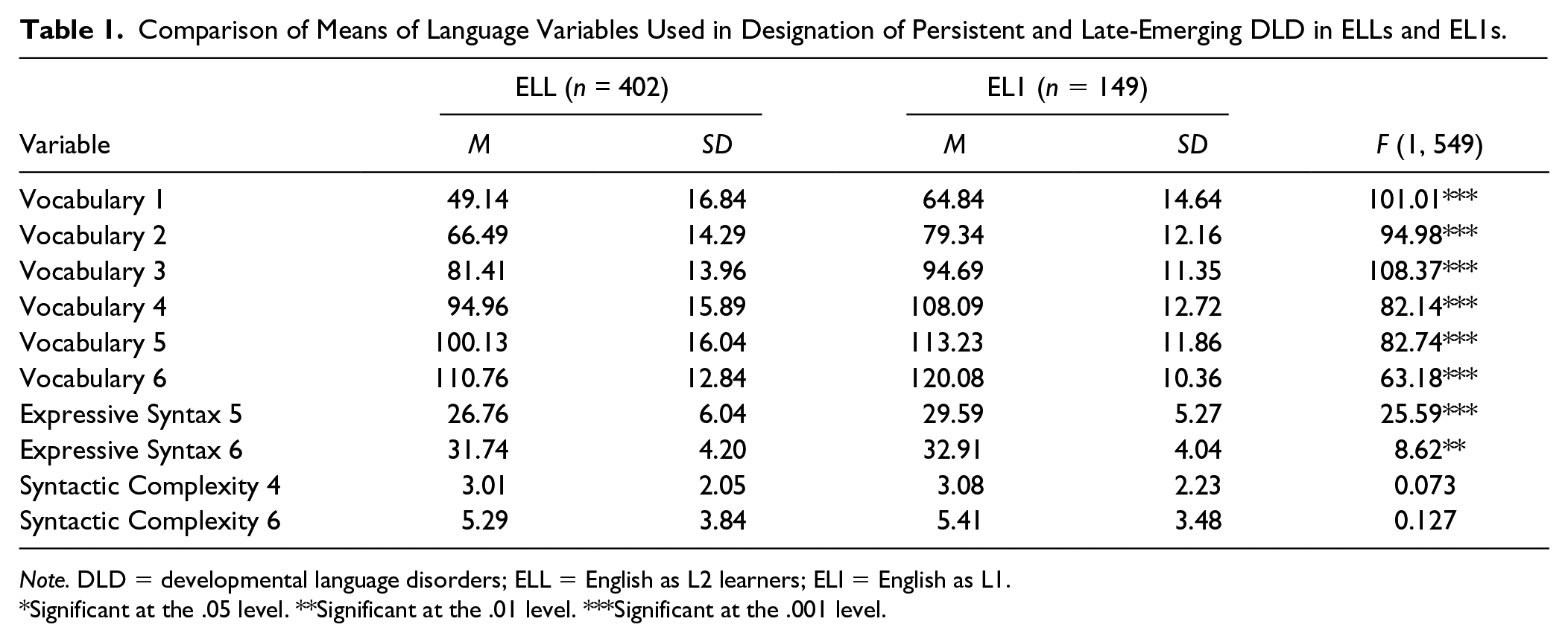
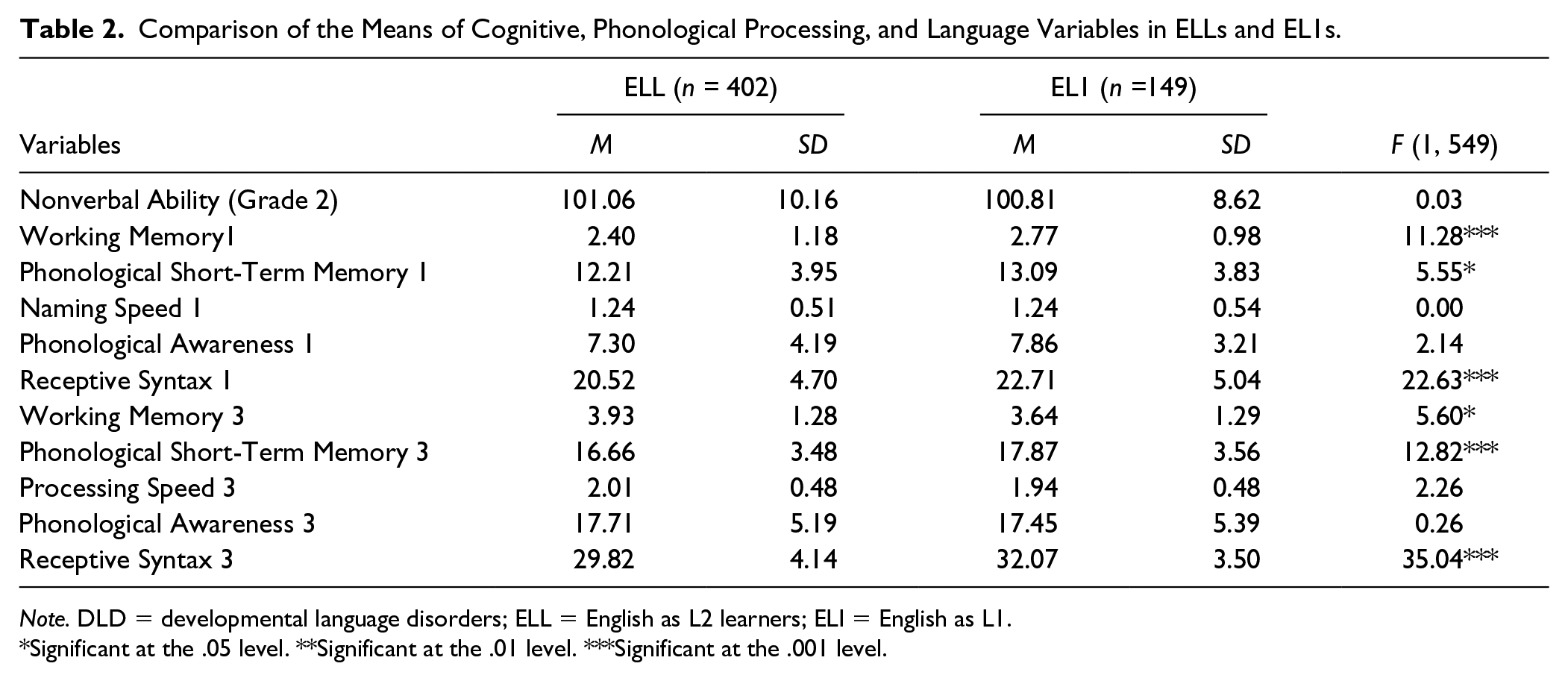
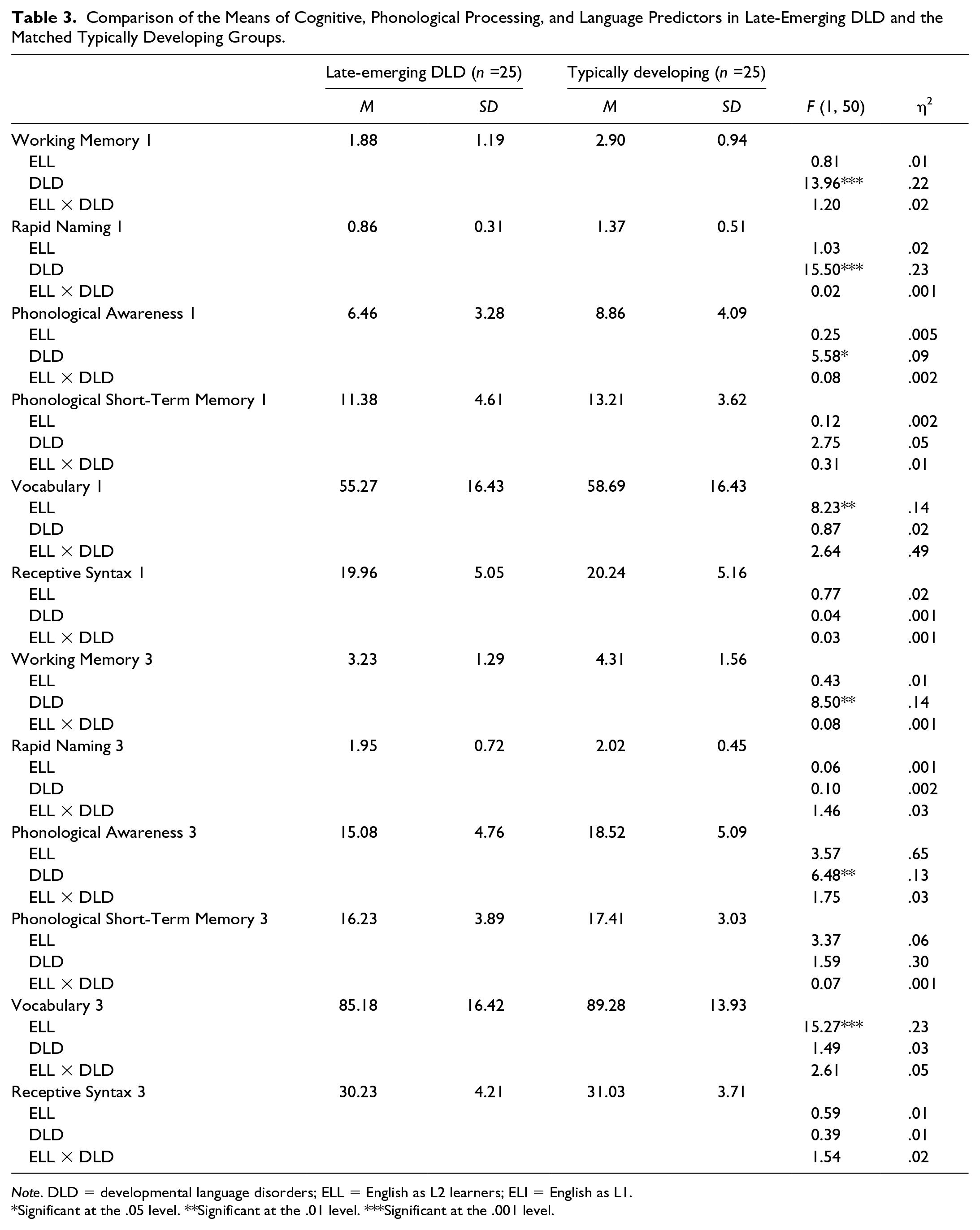
Table 1 presents means, standard deviations, and group differences for the variables that we used to designate ELL and EL1 children at risk of persistent and late-emerging DLD and reading difficulties. Table 2 presents means, standard deviations, and ELL–EL1 differences in variables that we used as predictors of late-emerging DLD. Table 3 summarizes means, standard deviations, and group differences in effect sizes of the predictor variables for the late-emerging DLD and matched TD groups.
Comparison of Means of Language Variables Used in Designation of Persistent and Late-Emerging DLD in ELLs and EL1s.
Note. DLD = developmental language disorders; ELL = English as L2 learners; ELI = English as L1.
Significant at the .05 level. **Significant at the .01 level. ***Significant at the .001 level.
Comparison of the Means of Cognitive, Phonological Processing, and Language Variables in ELLs and EL1s.
Note. DLD = developmental language disorders; ELL = English as L2 learners; ELI = English as L1.
Significant at the .05 level. **Significant at the .01 level. ***Significant at the .001 level.
Comparison of the Means of Cognitive, Phonological Processing, and Language Predictors in Late-Emerging DLD and the Matched Typically Developing Groups.
Note. DLD = developmental language disorders; ELL = English as L2 learners; ELI = English as L1.
Significant at the .05 level. **Significant at the .01 level. ***Significant at the .001 level.
Minimizing Over- and Underidentification of DLD Among ELLs
Table 1 indicates that the ELL and EL1 groups differed from each other consistently on the vocabulary and syntactic language measures. Therefore, designation of ELL and EL1 children as being at risk of RD, persistent or late-emerging DLD, or any combination of the above was based on analyses carried out separately within the EL1 and ELL samples. The strategy of defining the subgroups in relation to EL1 or ELL language status helps to prevent overidentification of ELLs as having an impairment and to minimize erroneous designation of TD ELLs as having an impairment when in fact their performance merely reflects typical L2 performance.
The intent of this article is to demonstrate empirically that just as it is the case with EL1 children, it is possible to identify a group of ELLs with late-emerging DLD, who do not have reading difficulties or persistent DLD. In what follows, we describe the processes we used to designate children as having RD, persistent DLD, and late-emerging DLD.
Group Designation
Designation as being at risk of RD
Children whose scores were at least 1 SD below the mean on word reading 4 to 6 times out of six assessment waves across Grades 1 through 6 were defined as being at risk of having RD. Eight percent (n = 32) of the ELL sample and 7.4% of the EL1 sample (n = 11) were classified as RD. The rates of RD in the ELL and EL1 groups were not statistically different, χ2(1) = 0.50, p = .49.
Designation as being at risk of persistent DLD
There is research evidence that children with DLD demonstrate deficits in vocabulary (McGregor, Oleson, Bahnsen, & Duff, 2008). Therefore, we used the annual performance on the measure of receptive vocabulary to designate persistent DLD. We used a stringent criterion for designation; children whose scores were at least 1 SD below the mean on receptive vocabulary 4 to 6 times out of six assessment waves across Grades 1 to 6 were considered persistent DLD. The percentage of persistent DLD was not identical in the ELL and EL1 groups. Thirty-three (8.2%) of the children in the ELL sample and one child (0.7%) in the EL1 sample were identified as having persistent DLD. The rates of persistent DLD in the ELL and EL1 groups were statistically different, χ2(1) =10.66, p < .001.
Designation as being at risk of late-emerging DLD
The designation of late-emerging DLD was based on two syntactic measures: expressive syntax and the (written) syntactic complexity scores. Children in Grades 4 through 6 whose expressive syntax scores and/or syntactic complexity scores were at least 1 SD below the mean on two assessment waves were designated as late-emerging DLD. To illustrate, a child whose performance on the expressive syntax in Grade 4 and on the Grade 5 syntactic complexity was at least 1 SD below the reference group mean (ELL or EL1) would be designated as late-emerging DLD. Similarly, a child whose performance on expressive syntax in Grades 4 and 6 was at least 1 SD below the reference group mean would also be designated as late-emerging DLD. The percentage of participants designated as late-emerging DLD was not identical in the ELL and EL1 groups, with 3.0% (n = 12) and 9.4% (n = 13) for ELL and EL1 samples, respectively. The rates of late-emerging DLD in the ELL and EL1 groups were statistically different, χ2(1) = 9.94, p = .003.
It is important to note that as the focus of this article is on late-emerging DLD, children with double or multiple deficits (e.g., RD and persistent DLD, or any combination of RD and/or persistent DLD, with late-emerging DLD) were removed from subsequent analyses. Summary statistics regarding the comparison of means of cognitive, phonological processing, and language predictors of late-emerging DLD in the ELL and EL1 groups appear in Table 2.
In order to establish the accuracy of designation as late-emerging DLD, we matched the participants identified as late-emerging DLD (n = 25) with randomly selected TD children matched on gender and ELL/EL1 (ELL(TD) = 12 and EL1(TD) =13) status.
The low incidence of language difficulties reported in samples such as the one in the present study makes it difficult to obtain an adequate sample size and achieve appropriate statistical power. Small sample size and low statistical power reduce the chance of detecting a true effect (false negatives). Underpowered studies are also likely to produce low positive predictive value, and when there is a true effect, it is possible that the magnitude of the effect is overstated (e.g., Button et al., 2013). To reduce the possibility of such biases and to produce more precise estimates of statistical values, we considered two procedures. We pooled the ELL and EL1 samples with and without late-emerging DLD and employed bootstrapping procedure in a binary logistic regression with a focus on predictors of late-emerging DLD. The results of the bootstrapped models were similar to the results established under the original logistic regression. We are reporting both the confidence intervals (CIs) for the odds ratios (ORs) that exponentiate the confidence limits, and the bias-corrected (BCa) CIs associate with the bootstrapping procedures that provide the CIs on the original scale.
Was Designation as Late-Emerging DLD Accurate?
We conducted multiple logistic regression analyses (forward-stepwise) to predict the accuracy of identification of children with late-emerging DLD. Results of the model indicated that the overall identification of children with late-emerging DLD was 84% accurate using baseline Grade 1 predictors and 78% accurate using Grade 3 predictors.
The first set of analyses confirmed that late-emerging DLD exist not only among EL1 but also among ELLs. We next hypothesized that if late-emerging DLD exist, we should be able to find soft signs of risk status on cognitive, phonological processing, and language skills. To this end, we compared the performance of late-emerging DLD and TD children on Grade 1 and Grade 3 predictor variables (i.e., working memory, phonological short-term memory, rapid naming, phonological awareness, receptive vocabulary and syntactic skills).
Table 3 summarizes the results of multivariate analysis of variance. We examined the main effects of language status (ELL/EL1) and group designation (late-emerging DLD) and the interaction effect of language status and late-emerging DLD on cognitive, phonological processing, and language predictor variables in late-emerging DLD and the matched TD groups. Although both groups performed within the average range, the means of the late-emerging DLD were significantly lower than the means of the matched TD group on Grade 1 naming speed and on Grade 1 and 3 working memory and phonological awareness. In other words, the late-emerging DLD group consisted of a group of children, who, in comparison with their TD peers, showed subtle signs of struggling with aspects of phonological processing (naming speed and phonological awareness) and working memory. As expected, results also indicated that in Grade 1, EL1 children had better English vocabulary skills than their ELL peers. However, there were no interaction effects with late-emerging DLD. That is, lower performance on vocabulary did not contribute to the designation of the children as having late-emerging DLD.
What Are the Warning Signs of Late-Emerging DLD in ELL and EL1?
We used ORs to determine the contributions of Grade 1 and Grade 3 cognitive, phonological processing, and language variables to determine the warning signs of the late-emerging DLD. As noted earlier, due to power restrictions, the OR analyses were conducted for the pooled sample of ELL and EL1 with and without late-emerging DLD. To statistically control for language status, we included the ELL/EL1 variable in the first block. The second block included cognitive variables (nonverbal ability, working memory, phonological short-term memory), the third block included phonological processing skills (naming speed and phonological awareness), and the fourth block included language variables (vocabulary, syntax).
Grade 1 predictors of late-emerging DLD
The omnibus test of model coefficient indicated that the Grade 1 logistic regression model reliably distinguished between children with and without late-emerging DLD, χ2(7) = 27.94, p < .001. The model explained between 43% (Cox & Snell R2) and 57% (Nagelkerke R2) of the variance. The results also indicated that regardless of the language status (ELL/EL1), late-emerging DLD can be identified as early as Grade 1 on the basis of performance on working memory and naming speed. Working memory reliably and uniquely distinguished between children with and without late-emerging DLD, χ2(Wald)(1) =5.38, p = .02. The log-odds values of working memory (β = 0.22; 95% CI: [0.06, 0.79]) indicated that by each unit decrease in working memory, the likelihood of being classified as having late-emerging DLD increased by 0.22. The bootstrap BCa CI for working memory was [−9.04, −0.62], p < .01. In addition, naming speed reliably and uniquely distinguished between children with and without late-emerging DLD, χ2(Wald)(1) = 7.48, p <.01. The log-odds values of naming speed (β = 0.03; 95% CI: [0.002, .36]) indicate that with each unit decrease in naming speed children are more likely to be classified as having late-emerging DLD by 0.03. The bootstrap BCa CI for naming speed was [−16.17, −1.63], p < .001.
Grade 3 predictors of late-emerging DLD
The omnibus test of model coefficient indicated that the logistic regression model reliably distinguished between children with and without late-emerging DLD, χ2(6) =15.92, p < .02. The model explained between 27% (Cox & Snell R2) and 36% (Nagelkerke R2) of the variance. The results of logistic regression indicated that late-emerging DLD can be identified in Grade 3 on the basis of performance on working memory. Working memory in Grade 3 reliably and uniquely distinguished children with and without late-emerging DLD, χ2 (Wald)(1) = 3.61, p < .05. The log-odds values (β = 0.50; 95% CI: [0.25, 1.02]) indicated that with each unit decrease in working memory children are more likely to be classified as having late-emerging DLD by 0.50. The bootstrap BCa CI for working memory was [−2.09, −0.06], p < .04.
Discussion
Late-Emerging DLD in EL1 and ELL Children
The first objective of this study was to establish that some ELL and EL1 children who may seem otherwise TD in terms of their cognitive, language, and word reading skills have in fact late-emerging DLD, which becomes discernible in later years. Findings of the present study replicate and extent research of a handful of studies demonstrating late-emerging DLD among EL1 children (e.g., Snowling et al., 2016; Zambrana et al., 2014). The key finding of this study is that similar to EL1 children, it is possible to identify a small group of ELL children whose language difficulties become more salient around Grade 4.
Regardless of the language status, children with late-emerging DLD do not appear to have difficulties with vocabulary knowledge in the early school years. This finding is in line with the Procedural Deficit Hypothesis (Ullman & Pierpont, 2005). This hypothesis stipulates that while the declarative knowledge of vocabulary of children with late-emerging DLD remains intact throughout, they demonstrate difficulties in processing rule-based grammatical structures (Lum, Conti-Ramsden, Page, & Ullman, 2012; Nation, 2016).
An interesting and unexpected finding was that the incidence of late-emerging DLD was higher in the EL1 sample than in the ELL sample. This finding can be explained in terms of two related factors—socioeconomic status (SES) and the cognitive effects of becoming bilingual. As discussed earlier, the ELL and EL1 samples came from schools with a median income lower than the median income of the metropolis. However, given Canadian immigration policies that favor educated skilled workers (Government of Canada, 2001), we speculate that the education level of the parents of ELL children in our sample might be higher than that of parents of the children in the EL1 sample. Therefore, from an SES perspective, it is possible that ELLs who come from middle-class immigrant families benefit from a variety of opportunities to improve their English language skills beyond the school boundaries. Relatedly, exposure to the societal language and the pressure to quickly narrow the language proficiency gap with their monolingual peers provide ELLs with multiple opportunities for activation of their cognitive resources. Perhaps, the constant stimulation and activation of procedural memory systems that underlie the rule-based grammatical structures minimizes the incidence of late-emerging DLD in this group compared with their EL1 peers. For a similar explanation, see Calvo and Bialystok (2014).
Warning Signs of Late-Emerging DLD
This study demonstrates that while both ELL and EL1 children who end up with a designation of late-emerging DLD perform in the average range on an array of cognitive, phonological, and language measures, they perform relatively more poorly than their matched, TD peers on these tasks. Moreover, it appears that already in the primary grades it is possible to distinguish late-emerging DLD from TD children, regardless of the EL1/ELL status on the basis of rapid naming and working memory.
The finding that naming speed is associated with late-emerging DLD is in line with recent conceptualizations of persistent DLD. Research has shown that naming speed is associated with growth rate of grammar (e.g., Yoder, Molfese, Murray, & Key, 2013), and that it is a marker of language impairment (e.g., Katz, Curtiss, & Tallal, 1992; Lahey & Edwards, 1996; Weckerly, Wulfeck, & Reilly, 2001).
Support for the finding that working memory is associated with late-emerging DLD comes from neurolinguistic studies pointing to a network of interconnected neural structures that involve the frontal/basal ganglia circuits and that underlie learning as well as motor, cognitive, and grammar skills (Leonard, McGregor, & Allen, 1992; Tallal et al., 1996; Ullman & Pierpont, 2005). There is evidence that interconnected neural networks that reside in similar brain regions are involved in the processing of syntactically complex sentences (e.g., Ben-Shachar, Palti, & Grodzinsky, 2004; Santi & Grodzinsky, 2007) and in phonological working memory (e.g., D’Esposito, 2007; Paulesu, Frith, & Frackowiak, 1993). These neural networks are responsible for processing and manipulation of information and are supported by multiple neural pathways. Additional discussion of this domain is beyond the scope of this article.
Implications for Future Research and Clinical Practice
As noted above, the syntactic measure we administered in Grades 1 through 4 lacked specificity, and therefore persistent DLD designation was based only on the vocabulary measure. We acknowledge that basing the persistent DLD designation on one measure is far from ideal. At the same time, we suggest that the stringent criterion of designation as persistent DLD based on four to six measurement waves across Grades 1 to 6 mitigates this methodological challenge. Additional longitudinal research with other vocabulary and syntactic measures is needed to establish the strength and replicability of this interpretation.
Given that the language demands of academic tasks increase over the school years, it would be important to include measures of figurative and pragmatic language in the assessment batteries. Instructional interventions targeting late-emerging DLD need to be developed and researched, and relevant training of gatekeepers (teachers, speech and language pathologists, and school psychologist) evaluated.
The present study has shown that in the primary grades rapid naming and working memory are markers of potential late-emerging DLD. It is important to note that these markers are not unique to poor performance associated with late-emerging DLD. Additional longitudinal population studies are required to establish accurate identification of late-emerging DLD and to examine the sensitivity and specificity of its markers. These studies must assess fine-tuned genetic, cognitive, language, and neurobiological factors that can distinguish late-emerging DLD from other latent developmental difficulties.
Footnotes
Acknowledgements
We thank the staff and children at the Peel Board of Education, the Toronto District School Board, the Toronto Separate School Board, and the York Region Separate School Board of Education for their patience and cooperation. We also thank the project managers and research assistants, all of whom played an important role in completing this longitudinal study.
Declaration of Conflicting Interests
The author(s) declared no potential conflicts of interest with respect to the research, authorship, and/or publication of this article.
Funding
The author(s) disclosed receipt of the following financial support for the research, authorship, and/or publication of this article: This research was supported by grant 410-96-0851 from the Social Sciences Research Council of Canada and a grant from the Ontario Ministry of Education to the second author.