







Abstract
Seventy-six general education and 67 special education teachers working in the same 66 elementary schools were surveyed about their beliefs about writing. Each teacher taught writing to one or more fourth-grade students receiving special education services, including students with learning disabilities. Survey findings indicated that general education teachers believed that they were better prepared to teach writing than special education teachers, and they were more positive about their own efforts to learn to teach writing. General education teachers also held more positive attitudes about teaching writing and their own capabilities as a writer than their special education counterparts. Furthermore, general educators were more likely than special educators to indicate that writing developed through effort and process, and less likely to think that writing knowledge came from experts. Beliefs about adequacy of preparation to teach writing predicted teachers’ beliefs about their level of knowledge to teach writing, efficacy to overcome students’ writing difficulties, and attitudes toward teaching writing. Recommendations for future research and implications for practice are presented.
Writing is an essential tool in the world today. People use writing to communicate, record information, to persuade others, create imaginary worlds, express emotions, and to heal psychological wounds (Bazerman et al., 2017). Teaching writing improves students’ reading skills (Graham & Hebert, 2011), and writing about material read or presented in class enhances students’ learning (Bangert-Drowns et al., 2004; Graham, Kiuhara, & MacKay, 2020).
Although children’s development as writers depends on many factors (Rijlaarsdam et al., 2012), it is commonly assumed that schooling plays a critical role in this process. This assumption is consistent with the broader contention that “Teachers are among the most, if not the most, significant factors in children’s learning” (Cochran-Smith & Zeichner, 2005, p. 1). This is true for students in general education as well as students receiving special education services, including students with learning disabilities (LD; Kauffman et al., 2017). Despite the importance of teachers to students’ learning, research on teachers and teaching, especially teachers of students with LD, is not as common as it should be (Billingsley & Bettini, 2017). Even so, the shortage of research on teachers and teaching writing is particularly lacking (Graham, in press).
Teacher Beliefs
An area of investigation receiving increased attention among educational researchers is the study of teachers’ beliefs (e.g., Chan & Elliott, 2004; Klassen et al., 2011). Teachers’ beliefs can explain as well as predict teachers’ classroom practices (Fives & Buehl, 2012). What teachers believe filters how they evaluate their actions and where they focus their attention (Nespor, 1987). Beliefs also influence how educators conceptualize the task of teaching and the actions taken to address students’ needs (Bandura, 1977).
The current study examined beliefs about the act of writing and teaching writing held by fourth-grade teachers (special and general education) who provided writing instruction to students with disabilities, including students with LD. There is a small, but growing corpus of research investigating teachers’ beliefs about writing. These previous studies examined general educators’ beliefs about (a) their preparation to teach writing (Brindle et al., 2016; De Smedt et al., 2016; Dockrell et al., 2016; Gilbert & Graham, 2010; Rietdijk et al., 2018; Simmerman et al., 2012), (b) self-efficacy to teach writing (e.g., Brindle et al., 2016; De Smedt et al., 2016; Graham, Hsiang, et al., in press; Graham, Harris, Fink, & MacArthur, 2001; Hsiang et al., 2020; Hsiang & Graham, 2016; McMaster et al., 2020; Rietdijk et al., 2018), (c) attitudes about teaching writing (Cutler & Graham, 2008; De Smedt et al., 2016; Dockrell et al., 2016; Ekholm et al., 2018; Gilbert & Graham, 2010), and (d) epistemological beliefs about writing development and knowledge (e.g., Brindle et al., 2016; Hsiang et al., 2020; McCarthy & Mkhize, 2013; McMaster et al., 2020; Ritchey et al., 2015). Only one study to our knowledge studied special education teachers’ beliefs about writing. This investigation (Graham et al., 2021) included teachers of children who were deaf and/or hearing impaired.
Exploring Teacher Beliefs: The Present Study
This investigation examined if special and general education teachers hold different beliefs about writing and teaching writing. Each participating teacher in this study taught writing to one or more fourth-grade children with disabilities (i.e., LD, emotional behavioral difficulties, other health impairments). Depending on the school district where these teachers taught, 38% to 51% of the students with disabilities they instructed were identified as LD. Students with LD experience considerable difficulty writing, as do other students writing difficulties (Graham et al., 2016; Graham, Hebert, et al., 2020). For example, in a recent meta-analysis (Graham et al., 2017), students with LD scored lower than their typically developing classroom peers on every measure of writing administered (e.g., scores for writing quality were a full standard deviation lower). Improving writing outcomes for students with LD requires that both general and special educators are well prepared to teach writing to these students, hold positive views about their efficacy to teach them to write, possess positive attitudes about writing, and believe that their students can acquire strong writing skills. These teacher attributes are essential if teachers, general and special, are to maximize the writing capabilities of students with LD and other students with disabilities.
The general and special educators in the current study taught in the same schools, providing a degree of control for the influence of contextual factors. We specifically queried the two groups of teachers about their beliefs about: (a) their preparation for teaching writing, (b) their knowledge about teaching writing generally, and (c) to students with disabilities. We further assessed teachers’ (d) self-efficacy to teach writing, (e) attitudes about teaching writing, (f) attitudes about their own writing, and (g) epistemological beliefs about writing development and knowledge (including implicit beliefs about the malleability of students’ writing).
We were unable to identify previous investigations that assessed teachers’ implicit beliefs about the malleability of students’ writing (Limpo & Alves, 2014). The measure devised for the current study was based on an assessment developed by Dweck and her colleagues (Dweck & Leggett, 1988; Molden & Dweck, 2006). This measure was designed to assess one’s implicit theories about the nature of intellectual ability. An individual who holds an incremental theory sees intelligence as malleable, whereas a person who holds an entity theory considers intelligence as a fixed capability. We administered both Dweck’s measure assessing implicit beliefs about intelligence and our congruent measure assessing implicit beliefs about writing to the participating teachers in this study. This administration allowed us to determine if the two constructs were distinct.
The present study also explored if teachers’ beliefs about their preparation and training to teach writing (in general and for students with disabilities) predicted beliefs about their knowledge to teach writing to students with and without disabilities, efficacy to teach writing, attitudes toward teaching writing and their own writing, epistemological beliefs about writing development and knowledge, and implicit theories about the malleability of writing and intelligence. Preparation to teach is one of the few teacher characteristics consistently related to students’ academic performance (Cochran-Smith & Zeichner, 2005). Our analyses examined whether beliefs about the adequacy of preparation to teach writing accounted for unique variance in each teacher belief presented above for all participating teachers collectively. The extent to which this relationship statistically differed by teacher type (special and general) was also investigated.
Research Questions
This study included two research questions:
Available evidence on teacher efficacy supports the proposition that teachers’ beliefs influence how they teach writing to their students. For example, general educators who are more efficacious about their capabilities to teach writing and possess a more positive attitude about teaching this skill spend more time providing writing instruction (De Smedt et al., 2016; Rietdijk et al., 2018). Likewise, epistemological beliefs about writing are positively related to how often general educators apply specific writing practices (Brindle et al., 2016; Graham et al., 2021). Most students with disabilities spend the majority of their school day in the general education classroom (Pullen et al., 2017) but also receive instruction from a special education teacher in this context, a resource room for a portion of the day, or both. Thus, it is important to examine the writing beliefs of both special and general education teachers who teach these students to write (as was conducted in this study).
It is equally important to identify factors that potentially influence teachers’ beliefs about writing, especially malleable factors. Thus, we concentrated on teachers’ beliefs about their preparation to teach writing in this study because teachers who believe they are better prepared spend more time teaching writing and asking students to write (Brindle et al., 2016; Gilbert & Graham, 2010). Teachers’ beliefs about the adequacy of their preparation should also be related to other beliefs they hold about writing, as beliefs are interwoven and connected one to another (Fives & Buehl, 2012). For example, teachers who believe they are better prepared to teach writing are more likely to possess a positive attitude toward teaching it.
This study focused on special and general education teachers who taught writing to fourth-grade students with a disability, including students with LD. Since we examined teachers’ beliefs about writing development, including implicit theories about the malleability of writing, the investigation focused on teachers working with older elementary grade students. By fourth-grade students had ample time to develop and diverge as writers, providing teachers with the opportunity to make more informed judgments about writing development and its malleability.
Predictions
The Writer(s)-within-Community model (WWC, 2018a, 2018b) was the theoretical framework that guided our investigation. This model proposed that the teaching of writing is simultaneously and interactively shaped by the community (classroom) in which it occurs as well as the cognitive resources (including beliefs) of teachers and students that are part of said community.
In the WWC model, teachers play an especially prominent and central role in classes where writing or the teaching of writing occurs (Graham, in press). They consciously and deliberately establish purposes for writing and the teaching of writing in their classes. This includes the value placed on writing, norms for judging students’ written products, audiences for reading students’ writing, social practices writing is used to support, motivations for writing, and writing identity/stance the class takes. Teachers decide their own and students’ roles within the classroom (e.g., writer, collaborator, mentor), and the amount of responsibility and power exercised by community members, including themselves. They make decisions about the types of tools used to produce writing and how the resulting artifacts and products will be shared. Teachers structure the physical arrangement of their class and the social environment of their community, including establishing rules and routines for promoting social collaboration, sense of belonging and affiliation, and how power and autonomy are perceived and acted upon. They apply instructional actions and practices to meet the writing and teaching goals established. Over time, teacher and students create a collective history for the operation of the class.
According to the WWC model (Graham, in press), teachers’ actions are influenced by their beliefs about writing and the teaching of writing. These beliefs can affect virtually any action a teacher takes. For instance, teachers’ attitudes toward writing may determine how much effort is devoted to teaching it. Beliefs about how writing develops may affect what actions and instructional tools are applied when teaching writing. Beliefs about the malleability of writing capabilities may determine how much effort is devoted to teaching the most vulnerable writers.
Even so, a writing community and its members do not operate in a vacuum, as they are affected and constrained by institutional, political, historical, social, and cultural factors (Graham, 2018a, 2018b) This is clearly evident when considering general and special education teachers. As Zigmond and Kloo (2017) indicated, general and special education are different in multiple ways, including purpose (entitlement for all vs. eligibility for students meeting specific criteria), governance (state/local authority vs. federal statutes), curriculum (local/state dictates vs. individualized educational program), instructional orientation (group vs. individual), roles (generalist vs. specialist), and preparation (content specialist vs. instructional specialist).
As a result, we anticipated that special and general education teachers would evidence differences in their beliefs about their preparation and knowledge to teach writing in general and to students with disabilities, efficacy to teach writing, attitudes toward teaching writing (and their own writing), epistemological beliefs about writing development and writing knowledge, and implicit theories about the malleability of writing. To illustrate, special educators may believe they are less prepared than general educators to teach writing in general, but more prepared to teach writing skills to students with LD, based on their assumed roles (generalist vs. specialist). Similarly, they may feel less efficacious than general educators about their capabilities to teach writing generally, but more efficacious about their capabilities to overcome students’ writing difficulties as a consequence of their preparation (e.g., explicit instruction). Furthermore, special educators may be more likely than general educators to view writing development as fixed and writing as less malleable because they are focused on a select few who experience difficulties mastering writing, like students with LD (Graham et al., 2017).
The WWC model also proposed that teachers hold a variety of beliefs that influence their instructional actions in the classroom. These beliefs operate singularly and interactively. For example, teachers’ attitudes toward writing instruction may be positively or negatively influenced by their beliefs about their preparation to teach writing. Teachers who believe they are inadequately prepared to teach writing are less likely to hold a positive attitude toward teaching this skill compared with teachers who believe they are adequately prepared. They are also likely to believe they are less knowledgeable about how to teach writing. Consequently, we hypothesized that teachers’ beliefs about their preparation to teach writing would account for statistically significant variability in the other writing beliefs assessed. Moreover, we expected that the observed relationships between preparation and beliefs about knowledge, efficacy, attitudes, epistemology, and implicit theories of writing would differ for special and general education teachers. This prediction was based on the multiple aforementioned ways that special and general education differ as delineated by Zigmond and Kloo (2017).
Method
Participants
The special and general education teachers (N = 143) in this study were from 12 school districts and 66 elementary schools in a large Southwestern U.S. state. The general education teachers all taught Grade 4, and there was at least one or more students with a high incidence disability in their classroom during writing instruction, including students with LD. The special education teachers also taught writing to at least one or more fourth-grade students with a high incidence disability. All teachers were part of a larger project examining how fourth-grade students with disabilities are taught by special and general education teachers in the same schools.
There were 76 general education teachers who participated in the study, and 67 special education teachers. Thirty-eight percent of the special education teachers held a bachelor’s degree, and the remaining special educators had completed a master’s degree (62%). Similarly, 35% and 65% of general education teachers had a bachelor’s and master’s degree, respectively. Collectively, both the special education and general education teachers had considerable teaching experience. The special education teachers had taught for an average 12.28 years (SD = 9.76; range 1–33 years) and the general education teachers for 9.16 (SD = 9.76; range 1–27) years. Although there was no statistically significant difference between special and general education teachers’ educational level (p = .73), special education teachers had more classroom experience than their general education counterparts (p = .02).
On average, the special educators reported teaching 18.14 (SD = 9.23; range 2–40 children) students with disabilities. The general educators were teaching 9.04 (SD = 3.81; range 1–18 children) students with disabilities, a figure that includes teachers providing writing instruction to multiple classrooms (i.e., departmentalized instruction) and clustered-inclusion classrooms with higher-than-average special education caseloads. Seventy percent (N = 47) of the special educators provided writing instruction to one or more Grade 4 students with disabilities in the context of a general education classroom (inclusive setting), whereas the remaining 30% of special educators provided this service in a resource room. The general education teachers noted they taught planning, revising, editing, spelling, grammar, and sentence skills weekly to several times a week. Special education teachers did this monthly to weekly.
Eighty-three percent of the special education teachers indicated they held a certificate to teach students with disabilities. The remaining special education teachers were all certified as elementary grade teachers, but were eligible to teach special education due to receiving emergency, or provisional certification (which included teachers in charter schools). Eighty-eight percent of general education teachers were certified to teach at the elementary level. The remaining general education teachers held teaching certificates in multiple areas, including arts, gifted education, special education, and administration.
Just 5% and 7% of special education teachers reported taking one or two courses on teaching writing in college, respectively, whereas 8% of general educators noted they had taken one course and another 14% had completed two writing courses. Nineteen percent of special education teachers indicated that writing was taught as part of their field experience (e.g., student teaching, internship); 29% of general education teachers reported this was the case. Most special education teachers indicated that their college preparation involved only one (51%) or two courses that included some content on writing instruction (11%). This was the case for the majority of general education teachers; 36% and 18% of teachers reported taking one or two courses with some writing instruction content, respectively.
Procedure
Participating teachers completed an electronic survey. The survey took approximately 20 to 30 min to complete, and teachers were paid US$200 for completing the survey and participating in the larger study. The survey first asked teachers to provide personal information (e.g., educational degree). The survey included multiple scales assessing beliefs about preparation to teach writing in general and to students with disabilities, perceived knowledge of teaching writing in general and to students with disabilities, efficacy for teaching writing, attitude toward writing and writing instruction, and epistemological beliefs about writing and writing development. Teachers received a detailed email explaining the purpose of the survey, and were asked to answer questions honestly. The teachers were told their responses would not be shared with other school personnel and would remain anonymous.
Measures
The first section of the survey was used to identify instructional area (general or special education), certification to teach, number of years spent teaching, number of students with special education needs currently taught, and highest educational level. Teachers were also queried about course work and practicum experiences involving writing.
Preparation to teach writing
The survey included 10 questions asking about teachers’ preparation to teach writing derived mostly derived from Brindle et al. (2016). Each item included a four-point Likert-type scale where teachers rated their overall level of preparedness: none (score of 1.0), minimal (score of 2.0), adequate (score of 3.0), and extensive (score of 4.0). Factor analysis of these 10 items, using an oblique rotation, yielded a three-factor solution accounting for 72% of the variance. One item (preservice preparation to teach writing in general) did not load at 0.40 or greater on any factor and was dropped from the analysis. The first factor, general writing preparation, included five items, accounting for 45% of the variance (eigenvalue = 4.53; coefficient α = .90). The five items and factor loadings were writing preparation overall (0.88), in-service preparation in general (0.54), and preparation to teach informative (0.89), narrative (0.91), and persuasive writing (0.79). The second factor, writing preparation to teach students with disabilities, included two items that accounted for 17% of the variance (eigenvalue = 1.65; coefficient α = .72). The two items and factor loadings were preservice (0.88) and in-service preparation (0.67) to teach writing to students with disabilities. The third factor, personal writing preparation, included two items, accounting for 10% of the variance (eigenvalue = 1.05; coefficient α = .70). These items and factor loadings were personal preparation to teach writing in general (0.65) and to students with disabilities (0.87).
Knowledge of teaching writing
General knowledge of writing instruction
We developed a 33-item scale designed to assess teachers’ beliefs about their knowledge to teach writing. Each item began with “I know how to. . .” followed by an aspect of writing instruction (e.g., “teach spelling effectively”). The items assessed knowledge of teaching writing skills, processes, knowledge, and motivation (e.g., “I know how to effectively teach how different types of text are organized”); supporting students’ writing efforts (e.g., “I know how to provide students with effective feedback on their writing”) and creating a conducive classroom environment (e.g., “I know how to construct a writing atmosphere that is supportive of students’ efforts”); and application of effective instructional procedures (e.g., “I know how to state effectively to students the purpose of a writing lesson so that they understand it”). The genesis for items on teaching/promoting, supporting students’ writing, and creating a conducive classroom environment was a meta-analysis and synthesis of writing instructional research by Graham et al. (2015). The foundation for the effective instructional procedures items was based on historical features of explicit instruction (Hughes et al., 2017), a systematic review on effective instructional practices for students with LD (Vaughn et al., 2000), and a select review of specialized instructional principles (Vaughn & Linan-Thompson, 2003). Each item was accompanied by a six-point Likert-type scale where teachers indicated if they strongly disagreed (1.0) to strongly agreed (6.0).
A factor analysis of the 33-items, with an oblique rotation, yielded a two-factor solution accounting for 73% of the variance. Four items (knowledge of teaching typing, using technology to teach writing, teaching capitalization/punctuation, and grouping students) were removed before running the analysis due to low communality (less than .20). Two items double loaded on factors (i.e., knowledge to effectively assign homework; knowledge of teaching students to use multiple sources of information when writing), and were also dropped. The first factor, general knowledge of writing instruction, included 25 items, accounting for 67% of the variance (eigenvalue = 18.04; coefficient α = .98). Items and factor loadings were conferencing (0.72), creating a supportive writing atmosphere (0.86), teaching planning strategies (0.82), teaching revising strategies (0.72), teaching text organization (0.76), promoting motivation (0.80), teaching grammar (0.69), teaching vocabulary (0.61), teaching editing strategies (0.80), providing feedback (0.85), teaching sentences (0.80), explain why writing skills are important (0.91), model writing skills/strategies (0.92), provide practice (0.94), provide good examples of how to apply skills/strategies (0.94), activate background knowledge (0.88), connect writing lessons (0.97), state purpose of writing lesson (0.91), use model text to guide writing (0.85), ask open ended questions about writing (0.88), foster writing discussion (0.88), teach narrative writing (0.82), teach informative writing (0.92), teach persuasive writing (0.73), and facilitate use of word processing (0.55).
The second factor, knowledge of teaching text transcription skills, included two items, accounting for 6% of the variance (eigenvalue = 1.63; coefficient α = .83). The two items and factor loadings were teaching handwriting (0.87) and teaching spelling (0.82).
Knowledge of writing instruction for students with disabilities
We created an 11-item scale, based on a measure designed by Graham et al. (2003) to assess teachers’ beliefs about adapting writing instruction to meet students’ needs. Each item began with “I know how to. . .,” followed by an aspect of instruction (e.g., “teach writing skills”). Each item was accompanied by the same six-point Likert-type scale used to assess general knowledge of effective writing instruction. A factor analysis of the items yielded a single factor solution, accounting for 83% of the variance (eigenvalue = 9.11; coefficient α = .98). The items and factor loadings were develop a writing lesson so that it is effective with students who receive special education services (0.91); select, adapt, or modify core writing curriculum (0.92); make adaptations (0.93); create alternative writing assignments (0.88); alter current writing assignments (0.88); teach writing skills (0.93); teach writing strategies (0.91); work with other school personnel (0.84); develop effective writing instruction for Individualized Education Program objectives (0.94); develop systems for monitoring writing progress (0.89); and make spontaneous instructional adaptations (0.87).
Teachers’ self-efficacy for teaching writing
We administered the efficacy scale for teaching writing taken from Graham et al. (2002). This measure includes eight items, and each item was accompanied by a six-point Likert-type scale where teachers indicated if they strongly disagreed (score of 1.0) to strongly agreed (score of 6.0). A factor analysis of the eight items, using an oblique rotation, produced a two-factor solution. The first factor, efficacy to overcome writing difficulties (eigenvalue = 3.96, accounting for 49% of the variance; coefficient α = .83) included the following five items and factor loadings: knows how to increase student retention of information not remembered (0.74), can help students with the most difficult writing problems (0.63), can adjust a writing assignment for a student experiencing difficulty (0.70), knows how to redirect disruptive behavior during writing time (0.63), and can accurately assess if a writing assignment was at the correct level of difficulty for a student experiencing difficulty (0.72). The second factor, general efficacy to teach writing (eigenvalue = 1.19, accounting for 15% of the variance; coefficient α = .80) included the following three items and factor loadings: improve writing by finding better ways of teaching it (0.40), knows the steps for teaching a writing concept so it can be mastered quickly (0.99), and can exert extra effort to help students write better (0.70).
Attitude toward writing
Seven items assessed teachers’ attitude toward writing (e.g., I like to write) and their attitude toward teaching writing (e.g., I enjoy teaching writing). These items were based on a scale developed by Brindle et al. (2016). Each item was accompanied by the same six-point Likert-type scale applied with self-efficacy (higher scores represented a more positive attitude). A factor analysis of these items, using an oblique rotation, produced a two-factor solution, accounting for 86% of the variance. The first factor, attitudes toward teaching writing, accounted for 69% of the variance (eigenvalue = 4.68; coefficient α = .96) and included these four items and factor loadings: enjoy teaching writing (0.82), teaching writing gives me personal satisfaction (0.97), teaching writing makes me feel good (0.92), and teaching writing is its own reward (0.96). The second factor, attitude toward writing, accounted for 17% of the variance (eigenvalue = 1.18; coefficient α = .87), and included the following three items and factor loadings: I like to write (0.85), I am a good writer (0.94), and I write often (0.76).
Epistemological beliefs
Epistemological beliefs about writing knowledge and development
The epistemology scale developed by Hsiang et al. (2020) assessing teachers’ beliefs about writing knowledge and development. The 27 items administered in this study were designed to assess the following four dimensions of epistemological beliefs about writing: (a) writing development is innate or fixed, (b) writing development occurs through effort and process, (c) writing knowledge is certain, and (d) writing knowledge comes from experts and authority figures. Teachers responded to each of item with a six-point Likert-type scale, with scores ranging from strongly disagree (1.0) to strongly agree (6.0). Higher scores provided a more positive response.
A factor analysis of the 27-item scale, with an oblique rotation, yielded a four-factor solution accounting for 55% of the variance. Two items were eliminated from the analysis due to low communality scores (i.e., writing success is related to time spent writing; I believe the best way to teach writing is to follow school or district guidelines). Two items that double loaded on multiple factors were eliminated (i.e., knowledge about teaching writing is certain and does not change; I sometimes doubt that the ideas about writing in textbooks are correct), and another item that loaded on no factor was dropped from the analysis (i.e., people should put their heart fully into becoming the best writer they can become).
The first factor, writing knowledge and development, are fixed accounted for 21% of the variance (eigenvalue = 3.34; coefficient α = .73) included following six items and factor loadings: Good writing today will be good writing tomorrow (0.49); if two people score writing differently one of them is wrong (0.74); knowledge about writing is certain and does not change (0.60); people cannot do much about how well they write (0.66); writing ability is fixed at birth (0.57); good writers don’t have to learn to write (0.57). The second factor, writing development depends on effort/process, accounted for 17% of the variance (eigenvalue = 2.79; coefficient α = .70) included the following four items and factor loadings: No limit to how good a writer can become (0.72); becoming a good writer takes a lot of effort (0.67); if one tries hard enough they can become a good writer (0.66); one can become a good writer with practice (0.73). The third factor, writing knowledge comes from experts, accounted for 10% of the variance (eigenvalue = 1.56; coefficient α = .73) included the following items and factor loadings: I still believe in what experts say about teaching writing even if it differs from what I know (0.83); I have no doubt what experts say about teaching writing is correct (0.81); experts know more about teaching writing than I do (0.69). The fourth factor was not used in any further analyses, as coefficient alpha was .44, making it unreliable. It included three items: some people are born good writers (0.52); how well you write depends mostly on effort (0.55); and some people are born with writing talents (0.78), accounting for 7% of the variance (eigenvalue = 1.14).
Implicit theories of the malleability of intelligence and writing
Teachers were also administered a measure designed by Dweck (1999) assessing implicit theories about the malleability of intelligence (incremental vs. entity views). The scale included six items (e.g., you can always greatly change how intelligent you are), and teachers responded to an item using a six-point Likert-type scale, with scores ranging from strongly disagree (1.0) to strongly agree (6.0). After reversing the scores for the three negatively worded items, higher scores indicated an agreement that intelligence is changeable.
Teachers were also administered a six-item scale measuring teachers’ beliefs about the malleability of writing. This included the same six items, but the word writing capabilities was substituted for intelligence. The malleability writing scale was administered in a separate section of the survey than the malleability of intelligence scale.
A factor analysis of the 12 items included in these two measures, using an oblique rotation, yielded a two-factor solution, accounting for 64% of the variance. The first factor included the six intelligence items (see above), accounting for 43% of the variance (eigenvalue = 5.22; coefficient α = .91). These items and factor loadings were: (a) you can learn new things, but you can’t really change your basic intelligence (0.56); (b) you have a certain amount of intelligence, and you can’t really do much to change it (0.56); (c) you can always greatly change how intelligent you are (0.95); (d) your intelligence is something that you cannot change very much (0.96); (e) no matter how much intelligence you have, you can always change it quite a bit (0.66); and (f) no matter who you are, you can change your intelligence a lot (0.84). The second factor included the six writing items, and it accounted for 20% of the variance (eigenvalue = 2.56; coefficient α = .84). The factor loadings for the six items that substituted the term writing capability for intelligence were: 0.85 (Item 1), 0.90 (Item 2), 0.57 (Item 3), 0.56 (Item 4), 0.63 (Item 5), and 0.49 (Item 6). The correlation between the scales measuring malleability of intelligence and writing was 0.36. Thus, the two scales measured distinct but slightly correlated constructs.
Analysis Procedures
Scores for each measure of teachers’ beliefs were based on the average score for all items for that measure (e.g., average of all items for attitudes toward teaching writing). Table 1 includes means and standard deviations for each measure by teacher type and across all teachers. To determine if special education and general education teachers differed in their beliefs about writing (RQ1), a multivariate analysis of variance (MANOVA) was conducted. The independent variable was type of teacher (special education vs. general education). The outcome variables included teachers’ scores for the following 15 beliefs: general writing preparation, writing preparation for students with disabilities, personal preparation, general knowledge of writing instruction, knowledge of teaching text transcription, knowledge of writing instruction for students with disabilities, general efficacy for teaching writing, efficacy for overcoming writing difficulties, attitude toward teaching writing, attitude toward writing, writing knowledge/development is fixed, writing development depends on effort/process, writing knowledge comes from experts, malleability of intelligence, and malleability of writing. Findings indicated a statistically significant effect for type of teacher on the MANOVA, Roy’s Largest Root, F(15, 112) = 6.392, p < .001. The follow-up regression analyses are presented in Tables 2, 3, and 4. For each belief, we examined if there was a difference between special education and general education teachers in Step 1 of the analyses presented below. The only exception involved beliefs about preparation, which are presented in text.
Teacher Beliefs About Writing.
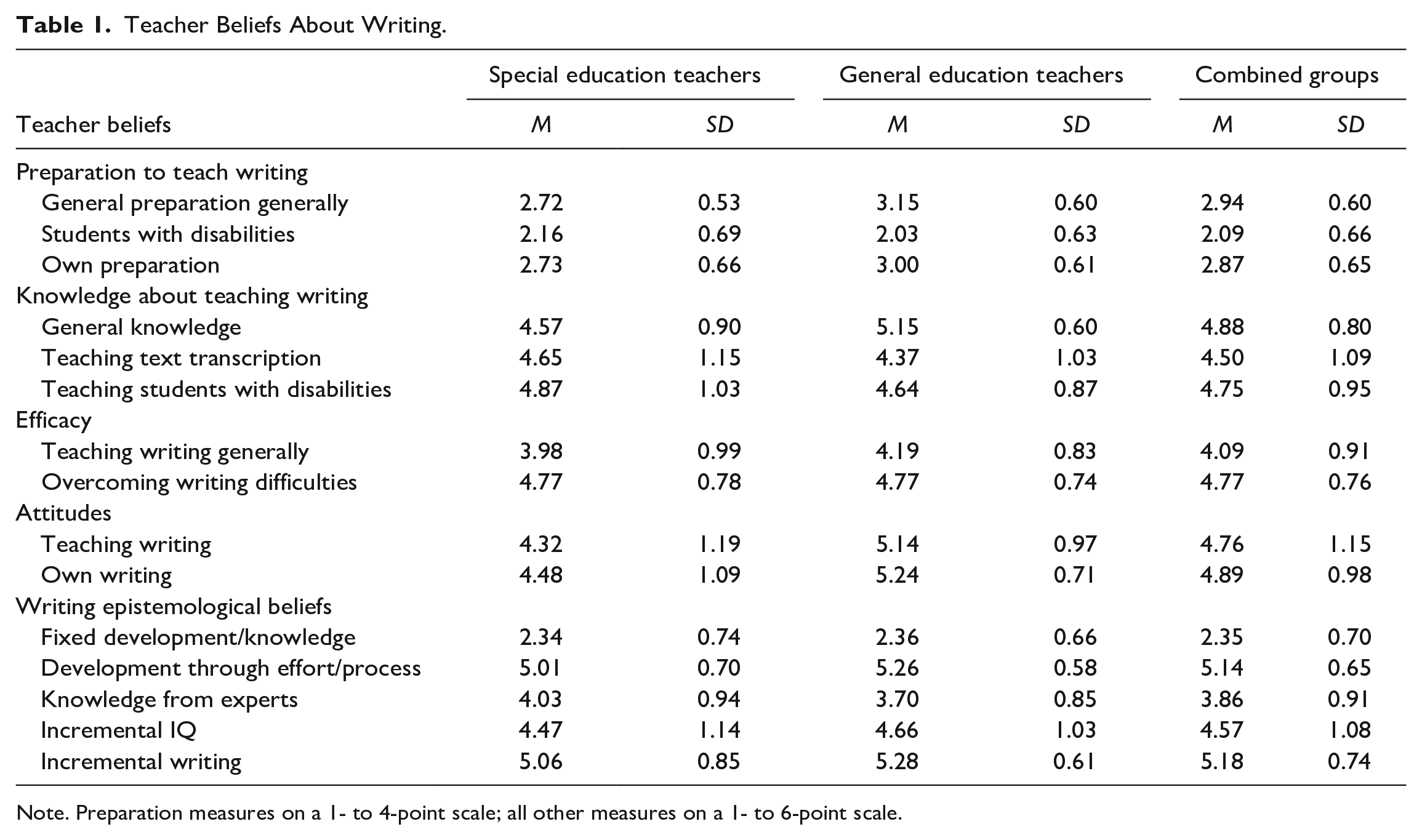
Note. Preparation measures on a 1- to 4-point scale; all other measures on a 1- to 6-point scale.
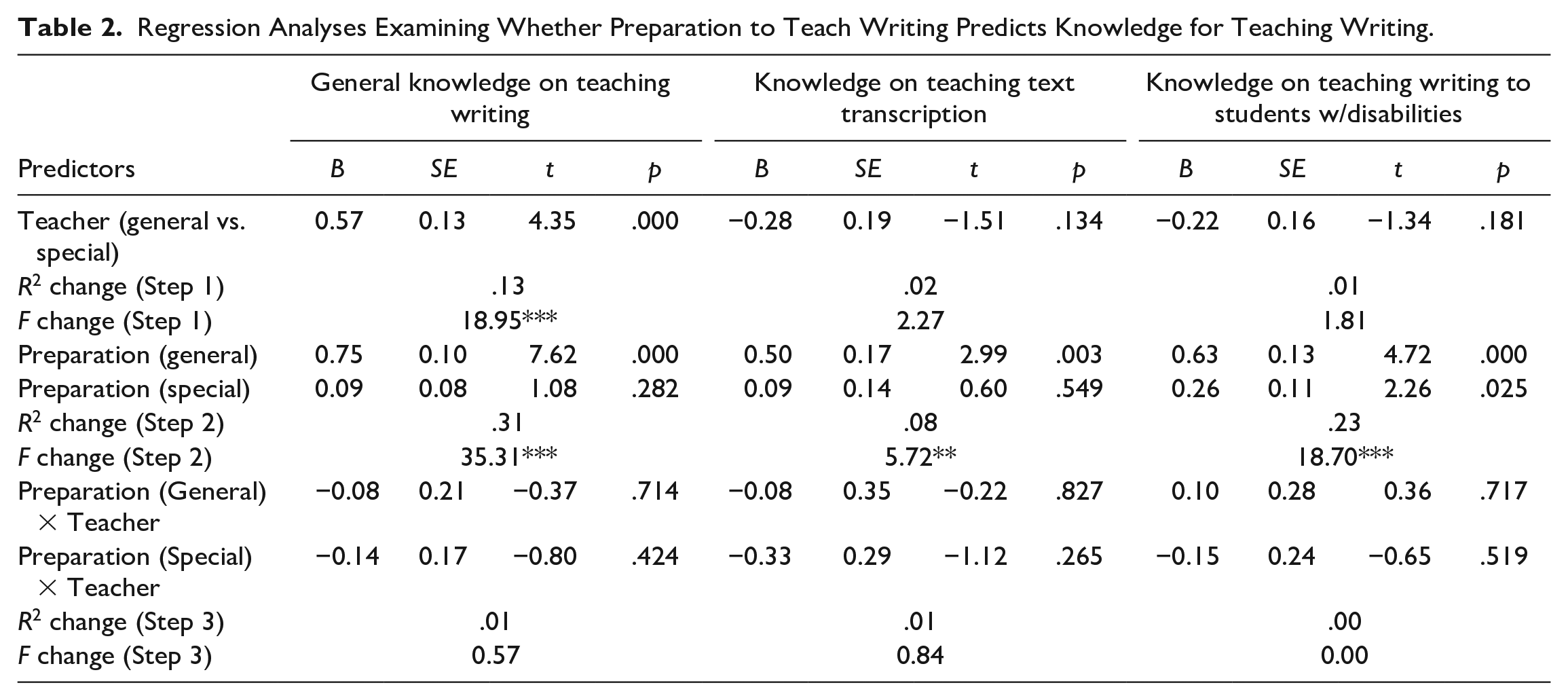
Regression Analyses Examining Whether Preparation to Teach Writing Predicts Knowledge for Teaching Writing.
Regression Analyses Examining Whether Preparation to Teach Writing Predicts Efficacy and Attitudes for Teaching Writing.
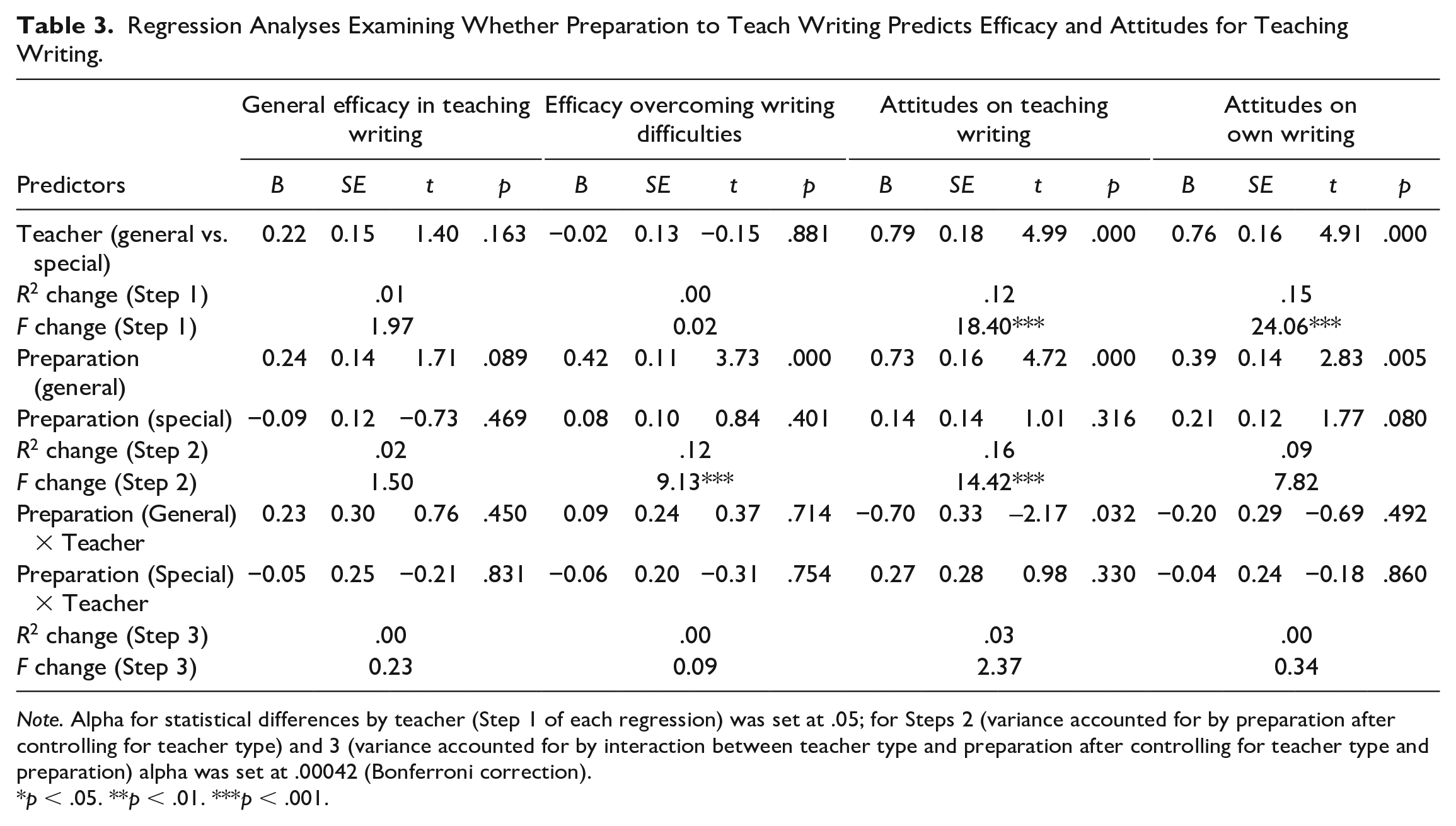
Note. Alpha for statistical differences by teacher (Step 1 of each regression) was set at .05; for Steps 2 (variance accounted for by preparation after controlling for teacher type) and 3 (variance accounted for by interaction between teacher type and preparation after controlling for teacher type and preparation) alpha was set at .00042 (Bonferroni correction).
p < .05. **p < .01. ***p < .001.
Regression Analyses Examining Whether Preparation to Teach Writing Predicts Beliefs About Writing and Development.
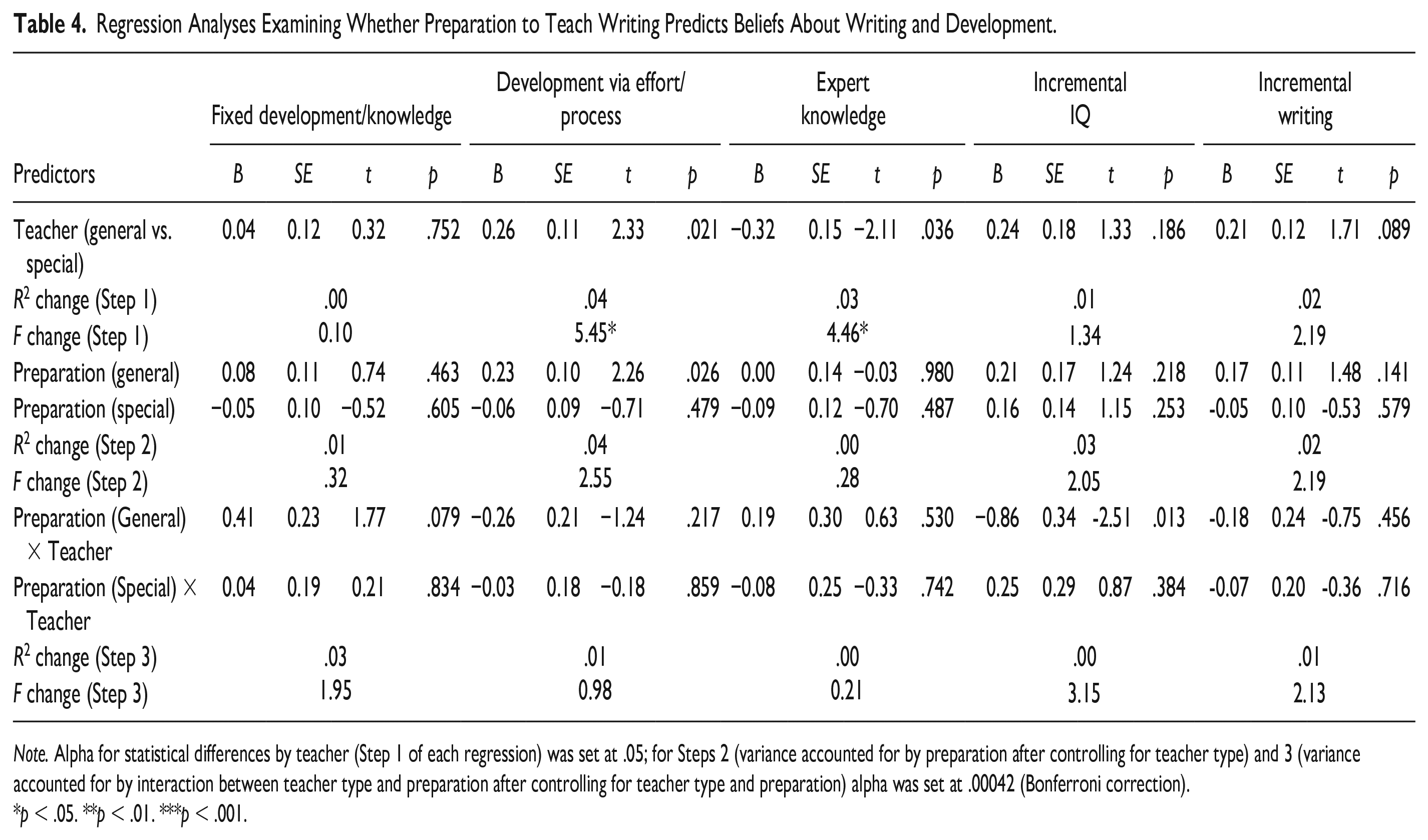
Note. Alpha for statistical differences by teacher (Step 1 of each regression) was set at .05; for Steps 2 (variance accounted for by preparation after controlling for teacher type) and 3 (variance accounted for by interaction between teacher type and preparation after controlling for teacher type and preparation) alpha was set at .00042 (Bonferroni correction).
p < .05. **p < .01. ***p < .001.
To examine if individual differences in beliefs about preparation to teach writing accounted for variance in teachers’ beliefs (RQ2) about knowledge to teach writing (i.e., general knowledge of writing instruction, knowledge of teaching text transcription, knowledge of writing instruction for students with disabilities), efficacy to teach writing (i.e., general efficacy for teaching writing, efficacy for overcoming writing difficulties), attitudes toward writing (i.e., attitude toward teaching writing, attitude toward writing), epistemological beliefs about writing knowledge and development (writing knowledge/development is fixed, writing development depends on effort/process, writing knowledge comes from experts), and malleability of intelligence and writing, we ran 12 hierarchical regression analyses. For each of these beliefs (e.g., general efficacy to teach writing), type of teacher (special and general) was entered at Step 1; general writing preparation and preparation to teach writing to students with disabilities were entered as a block at Step 2; and the interaction between type of teacher and general writing preparation as well as the interaction between type of teacher and preparation to teach writing to students with disabilities were entered as a block at Step 3. This allowed us to determine if the two preparation measures accounted for unique variance in the targeted belief once teacher type was first controlled (Step 2), and then to determine if there was an interaction between teacher type and type of preparation (Step 3). The p value was set at .00042 (.05/12) for Steps 2 and 3 results to control for Type 1 errors. If a significant interaction was obtained for any writing belief, follow-up regression analyses were conducted with each teacher type separately.
Results
Differences in Special and General Education Teachers’ Beliefs About Writing
Preparation to teach writing
Forty-seven percent of special education teachers indicated their general writing preparation was adequate/extensive (i.e., an average score of 3.0 or greater), whereas 52% and 19% of these teachers expressed the same beliefs about their own preparation to teach writing and their preparation to teach writing to students with disabilities, respectively. For general education teachers, 69% and 71% indicated their general writing preparation and their personal preparation, respectively, were adequate/extensive, but only 14% expressed this same belief about their preparation to teach writing to students with disabilities.
Average scores for the special teachers on the four-point scale for the three measures of preparation were in the minimal preparation range (see Table 1). This was also the case for general education teachers, except for general preparation to teach writing with an average score (3.15). General education teachers expressed a greater belief in their general writing preparation, F(1, 138) = 19.724, p < .001, and personal preparation to teach writing, F(1, 141) = 6.395, p = .013, than did special education teachers, but there was no statistically significant difference in their belief about their preparation to teach students with disabilities, F(1, 141) = 1.561, p = .214.
Knowledge about teaching writing
Eighty-two percent of special education teachers indicated they slightly to strongly agreed they were knowledgeable about effective writing instruction in general, whereas 84% and 82% of these teachers expressed the same beliefs about their knowledge to teach transcription skills and provide writing instruction to students with disabilities. For general education teachers, 96%, 76%, and 84% of them indicated they were knowledgeable about writing instruction in general, teaching text transcription skills, and writing instruction for students with disabilities, respectively. General education teachers indicated they were more knowledgeable about writing instruction in general than special education teachers, but there was no statistically significant differences between the two sets of teachers in beliefs about knowledge to teach text transcription skills and writing instruction for students with disabilities (see Tables 2 and 3).
Efficacy to teach writing
Fifty-one percent and 85% of special education teachers indicated they slightly to strongly agreed they were efficacious about their capabilities to teach writing in general and to overcome their students’ writing difficulties, respectively. For general education teachers, 71% and 86% expressed the same level of confidence for teaching writing in general and overcoming writing difficulties, respectively. There were no statistically significant differences between special and general teachers on these two efficacy measures (see Tables 2 and 3).
Attitudes toward writing
Seventy-three percent and 75% of special education teachers indicated they slightly to strongly agreed they liked to teach writing and were positive about their own writing, respectively. For general education teachers, 89% and 95% expressed the same attitudes toward teaching writing and their own writing, respectively. General education teachers were more positive than special education teachers about both attitudes (see Tables 2 and 3).
Epistemological beliefs about writing development and knowledge
Only 3% of special and general education teachers indicated they slightly to strongly agreed that writing knowledge/development is fixed. They did not statistically differ in this belief (see Table 4). Forty-nine percent of special education and 41% of general education teachers agreed writing knowledge comes from experts. Special education teachers were more likely to express this belief (see Table 4). Both special and general education teachers attributed writing development to effort/process, but general education teachers were more likely to express this belief than special education teachers (see Table 4).
Implicit theories about the malleability of intelligence and writing
Sixty-seven percent and 88% of special education teachers indicated they slightly to strongly agreed (i.e., an average score of 4.0 or greater) that intelligence and writing are malleable, respectively. For general education teachers, 79% and 97% expressed the same beliefs about intelligence and writing, respectively. There were no statistically significant differences between the two groups of teachers about these beliefs (see Table 4).
Summary
General education teachers were more positive than special education teachers about their general preparation to teach writing as well as their own preparation. They also indicated they were more knowledgeable about how to teach writing generally, expressed more positive attitudes toward teaching writing and their own writing, and were more likely to believe that writing development was a consequence of effort and process than their special education counterparts. In contrast, special education teachers more strongly believed that knowledge about writing came from experts.
Does Preparation to Teach Writing Predict Teachers’ Beliefs About Writing?
Tables 2, 3, and 4 present the results from the 12 regression analyses examining if beliefs about knowledge for teaching writing, efficacy, attitudes, and epistemological beliefs were related to teacher type (Step 1; discussed above), if each belief was related to preparation to teach writing once teacher type was first controlled (Step 2), and if there was an interaction between preparation and teacher type (Step 3).
As can be seen in Tables 2, 3, and 4, teacher preparation to teach writing (i.e., preparation to teach writing generally and to students with disabilities) accounted for statistically significant variance in teachers’ scores for five of the 12 beliefs assessed after teacher type (general and special) were first controlled (see Step 2 of each regression analysis). Preparation to teach writing accounted for 31% of variance in general knowledge to teach writing, 8% of variance in knowledge of teaching text transcription skills, 23% of variance knowledge of teaching writing to students with disabilities, 12% of variance in efficacy to overcome writing difficulties, and 16% of variance in attitude toward teaching writing. In each of these instances, teachers’ beliefs about their general preparation to teach writing accounted for statistically significant unique variance, whereas beliefs about preparation to teach writing to students with disabilities accounted for statistically significant unique variance in teachers’ beliefs about their knowledge to teach writing to students with disabilities and writing difficulties.
Collectively, the two interactions (General Preparation to Teach Writing × Teacher Type and Preparation to Teach Writing to Students With Disabilities × Teacher Type) did not account for statistically significant variance in any of the 12 analyses examining teacher beliefs (see Step 3 in Tables 2, 3, and 4). In no instance did the collective interaction between teacher type and preparation to teach writing in general and to students with disabilities specifically account for >3% of variance in any of the 12 beliefs assessed.
Summary
Teachers’ beliefs about preparation to teach writing, in general and to students with disabilities, did predict their stated knowledge about teaching writing generally, teaching text transcription skills, and teaching writing to students with disabilities as well as their efficacy to overcome writing difficulties and their attitude toward teaching writing. The predictive value of beliefs about preparation did not differ by type of teacher: general and special.
Discussion
Teachers’ beliefs influence how they interpret classroom experiences, frame instructional tasks or teaching problems, and shape their pedagogical actions (Bandura, 1977; Fives & Buehl, 2012; Nespor, 1987). Unfortunately, little is known about the beliefs teachers hold about teaching writing, especially the beliefs of special educators, including those who teach students with LD. Based on the WWC model of writing (Graham, 2018a, 2018b), we anticipated that special and general education teachers would hold different beliefs about writing and teaching writing. Our findings were generally consistent with this prediction, as the writing beliefs of special and general educators participating in the current study differed in important ways.
General educators believed that they were better prepared than special educators to teach writing generally, and they were more positive about their own efforts to learn how to teach this skill. They were also more likely to report that they were more knowledgeable about how to teach writing effectively, and held more positive attitudes about teaching writing and their own writing capabilities than their special education peers. Finally, general education teachers placed greater emphasis than special education teachers on the idea that writing developed through effort and process, but they were less likely to think that writing knowledge came from experts, placing greater emphasis on the importance of their own knowledge about writing.
These findings raise multiple concerns about special education teachers’ beliefs about writing and writing instruction. This includes the beliefs of special education teachers who teach students with LD, which included the special educators in this study. It is not unreasonable to expect that specialists working with children experiencing problems learning academic skills like writing should believe they are better trained and more knowledgeable, more positive about teaching and their teaching capabilities, more likely to believe that development is flexible and malleable, and more likely to believe they are a pertinent source of knowledge about teaching than general educators who are prepared and expected to fill a more general teaching role (Zigmond & Kloo, 2017). Undoubtedly, any parent whose child with LD is provided services by an educational specialist would agree with this assessment. Moreover, and contrary to our hypotheses, special and general educators did not statistically differ in their beliefs about their preparation and knowledge to teach writing to students with disabilities, efficacy for teaching writing, beliefs about the fixed nature of writing development/knowledge or the malleability of writing and intelligence.
For special education teachers who teach students with LD to serve effectively as a specialist in a complex academic domain like writing, they need to be well prepared and knowledge about how to teach writing in general and to children who experience difficulty learning how to write (Graham, Harris, & Larsen, 2001). This should be reflected in their beliefs, as such beliefs influence how much time and the types of instruction teachers devote to teaching writing (e.g., Brindle et al., 2016; Graham et al., 2021; Margarida et al., 2016). Moreover, if special education teachers are to maximize the success of students with disabilities as writers, they need to be positive about writing and their desire and capabilities to teach it. Students who experience difficulty with writing are more likely to respond positively to teachers who are efficacious and enjoy teaching writing (Graham & Harris, 2002b), while teachers’ with a greater sense of self-efficacy and more positive attitudes have a stronger impact on students’ academic growth (Ekholm et al., 2018; Zee & Koomen, 2016).
It is further important that special education teachers expect and project the belief that each child they teach, including students with LD, will become a strong writer (Graham & Harris, 2002a). Such beliefs are more likely when teachers assume that development is malleable and not fixed (Dweck, 1999). Teachers who have a growth mindset believe that learning can improve as a result of effort, increasing the possibilities that they transmit such beliefs to their students. Just as importantly, such epistemological beliefs predict how frequently teachers, special and general, employ effective writing practices (Graham, Harris, Fink, & MacArthur, 2001; Hsiang et al., 2020). Finally, because special education teachers act as a resource to general education teachers, serving as an instructional expert (Zigmond & Kloo, 2017), it is important that they are particularly positive about their writing and teaching writing beliefs, as it harder to place much faith in the advice of a specialist who is less positive than you are.
Additional research is needed to replicate our findings that special and general education teachers evidenced different beliefs about writing and writing instruction. This includes extending such investigations to middle and high school special and general education teachers as well as special education teachers working with other populations of students with disabilities (e.g., autism, intellectual disabilities). Assuming that similar findings are obtained in future investigations, it is important to explore why special and general education teachers hold different beliefs about writing. This includes determining if differences are due to the divergent roles and responsibilities of these two types of teachers (e.g., specialist vs. generalist or individual vs. group instructional orientation; Zigmond & Kloo, 2017) as well as differences in how they are prepared to teach writing and to teach in general. Moreover, beliefs are malleable (Fives & Buehl, 2012), and research is needed to identify procedures that help both special and general education teachers develop more positive beliefs about writing and teaching it.
Epistemological Beliefs
On a more favorable note, the special and general education teachers in this study expressed positive and relatively strong epistemological beliefs about writing development and knowledge. They moderately agreed that writing development was a consequence of effort/process and that writing as well as intelligence were malleable. They also moderately disagreed that writing development/knowledge was fixed. This is particularly encouraging, as it suggests that these beliefs may not lead special and general education teachers to set low expectations for students’ writing development. Additional research is needed, however, to better explore this proposition, as our epistemological measures were not directly focused on students with disabilities, and we did not specifically examine teachers’ expectations for these children.
Special and general education teachers in this study had similar epistemological beliefs about writing development being fixed and that writing knowledge comes from experts as did teachers in other studies in the United States and the Greater China region (Graham et al., 2021; Graham, Hsiang, et al., in press; Hsiang et al., 2020). However, they placed greater emphasis on the contention that writing development was a consequence of effort/process than elementary grade teachers of children who were deaf and hard of hearing in a prior investigation (Graham et al., 2021) and primary grade general education teachers in studies involving teachers in the United States, Taiwan, and Shanghai (Graham, Hsiang et al., in press; Hsiang et al., 2020). Thus, future research is needed to further examine such similarities and differences, exploring if they are related to teachers’ roles, instructional situations, characteristics of the students they teach, and cultural differences. Research is also needed to explore how such epistemological beliefs about writing develop and how they can be modified in a positive fashion.
Beliefs about preparation and knowledge to teach writing
Special and general education teachers’ beliefs about their preparation to teach writing were not particularly positive. Both groups of teachers reported they received minimal preparation to teach writing to students with disabilities, and they rated their own efforts to increase their preparation as minimal. Although general education teachers indicated their general preparation to teach writing was adequate, special education teachers rated this preparation as minimal. These outcomes were consistent with previous studies showing that elementary grade teachers often view their preparation as inadequate (e.g., De Smedt et al., 2016; Rietdijk et al., 2018) or both inadequate and adequate depending on whether they are describing their preservice, in-service, or personal preparation (e.g., Gilbert & Graham, 2010). They differ, however, from the findings from a study with teachers of deaf and hard of hearing children where participating teachers indicated their preparation was exceptional or adequate.
Both special and general education teachers in this study slightly agreed they possessed knowledge of effective writing practices for teaching writing to students with disabilities and teaching text transcriptions skills. General education teachers moderately agreed that they were knowledgeable about teaching writing in general, but special education teachers professed only slight agreement with this proposition. Given that so many of the participating teachers were certified to teach students in their respective area (83% and 88% of special and general education teachers, respectively), had completed an advanced degree (62% and 65% of special and general education teachers, respectively), and were experienced teachers (mean years teaching of 12.28 and 9.76 years, respectively), it seems unlikely that these specific markers of teachers’ development can adequately or fully explain why beliefs about preparation and knowledge were so modest. A more likely explanation involves how little emphasis was placed on writing in teachers’ preservice teacher preparation programs. The vast majority of teachers (over 80%) reported they had never taken a college course dedicated specifically to teaching writing or a practicum where writing was emphasized (over 70% of teachers). The lack of preservice preparation to teach writing reported by teachers in this study is not an anomaly. Similar findings have been reported in other investigations (see Brindle et al., 2016; Myers et al., 2016).
Poor preservice preparation is not the only possible explanation for teachers’ modest beliefs about their preparation and knowledge to teach writing in this study. Participating teachers rated their own efforts to better prepare themselves to teach writing as minimal. This stands in contrast to national studies where teachers were more positive about their personal efforts to become better writing teachers (e.g., Gilbert & Graham, 2010). In any event, research is needed to determine if enhanced preservice, in-service, and personal efforts for learning how to teach writing can result in a positive change in teachers’ beliefs about the adequacy of their training and the strength of their knowledge to teach writing generally and to students with disabilities specifically. Furthermore, our measures of knowledge to teach writing were based on self-report. It is possible that one or both groups of teachers over-rated what they actually know. There is an urgent need for measures that test knowledge more directly.
Efficacy beliefs and attitudes
Special and general education teachers in this study slightly agreed that they were confident about their capabilities to teach writing in general and to overcome students’ writing difficulties. Participating special education teachers’ efficacy scores were less positive than general education teachers’ scores in several other studies (Cutler & Graham, 2008; Gilbert & Graham, 2010), but consistent with teachers’ self-efficacy scores in the majority of available studies (e.g., Brindle et al., 2016; De Smedt et al., 2016; Rietdijk et al., 2018), including a study with teachers of students identified as deaf and hard of hearing (Graham et al., 2021).
Special education teachers’ in our study slightly agreed they liked to teach writing and write. This was consistent with the only other study we located examining such attitudes with other teachers of children with disabilities (i.e., Graham et al., 2021). General education teachers in contrast moderately agreed that they liked to teach writing and write. This differs from most previous studies (e.g., Brindle et al., 2016; De Smedt et al., 2016; Gilbert & Graham, 2010) where these general education teachers slightly agreed with such sentiments (see Cutler & Graham, 2008 and Dockrell et al., 2016 for exceptions).
Additional research is needed to explore why special and general education teachers are not more positive about efficacy for teaching writing, and special education teachers possess lukewarm attitudes toward teaching writing and their own writing. This includes studies designed to examine possible mechanisms for increasing such beliefs. A particularly promising approach is to provide teachers with additional instruction in how to teach writing, as previous studies have shown that professional development (Dillard, 2004) and method courses (Oh, 2011) on literacy instruction can enhance efficacy to teach writing. We suspect that such instruction will positively boost teachers’ attitudes.
Preparation to Teach Writing Predicts Teachers’ Beliefs About Writing
Based on the WWC model of writing (Graham, 2018a, 2018b, in press), we anticipated that teachers’ beliefs about preparation (generally and for students with disabilities specifically) would account for statistically significant variability in the other writing beliefs assessed in this study. We further expected these associations would be differentially affected by type of teacher (special and general).
The first proposition, beliefs about preparation predict other beliefs about writing, was supported, providing evidence consistent with the WWC tenet that beliefs about writing are interrelated. Participating teachers’ beliefs about preparation predicted teachers’ beliefs about their level of knowledge to teach writing generally, efficacy to overcome students’ writing difficulties, attitudes toward teaching writing and their own writing, and beliefs about the malleability of writing and intelligence. Although these outcomes are correlational, they are consistent with recommendations made earlier that improving preparation to teach writing may enhance other beliefs like efficacy, attitudes, and knowledge of effective writing practices. We anticipate that such instruction would have both direct and indirect effects on teacher beliefs, as increased preparation would enhance teachers’ beliefs about their preparation, which in turn would influence other beliefs about writing such as efficacy, attitudes, and so forth. Research is needed to test this proposition with both special and general education teachers.
The second proposition, that associations between beliefs about preparation and other writing beliefs are moderated by teacher type, was not supported in this study. There were no instances where this was the case in the 12 analyses conducted.
The findings from the current study generally support propositions in the WWC model (Graham, in press) about teachers and their beliefs. Consistent with and supporting the model, teachers whose experiences differed in terms of contextual factors involving purposes, roles, and governance expressed different beliefs about preparation, efficacy, attitudes, and epistemology. Also, consistent with and supporting the WWC model, beliefs about preparation predicted beliefs about knowledge of how to teach writing, efficacy to overcome writing difficulties, and attitude toward teaching writing. However, our findings made it clear that teachers who experience different contextual factors did not differ on all of their beliefs about writing. Furthermore, while one type of belief (i.e., preparation) may predict other beliefs about writing (e.g., knowledge), this was not always the case. Finally, relationships between beliefs may be unrelated to contextual differences between teachers, as special and general education teachers evidenced similar relationships between how preparation predicted other writing beliefs. Additional research is needed to replicate the current findings, but they do illustrate that a more nuanced WWC model is likely to emerge as more investigations are undertaken.
Limitations
Although the study included over 140 teachers, these teachers were not randomly selected from the general population as they were included within a larger multi-year study. The study was also based on self-report data, which assumes that teachers can and did accurately report what they believed. There is evidence that teachers can accurately answer questions about how they teach literacy (e.g., Bridge & Hiebert, 1985), which suggests that teachers should also be forthcoming when answering questions about their literacy beliefs. We further included special and general education teachers working on writing with students with disabilities in the same schools. Although our sampling criteria provided some control for the influence of context when comparing teachers’ beliefs, it did and cannot control for all contextual differences between the two groups of teachers. These aforementioned issues should be considered when interpreting the findings of this investigation.
Practical Implications
Caution must always be taken when drawing practical implications from exploratory data sources (i.e., descriptive and correlational). Nevertheless, the initial findings reported here raise some concerns. Notably, close to 80% of the special and general education teachers in this study did not take a single course in college on how to teach writing or focus on writing instruction within their preservice field experiences. Concerns such as these about preservice education to teach writing are not new (see Brindle et al., 2016; Myers et al., 2016). If students with and without disabilities are to receive writing instruction that addresses their needs, colleges of education must ensure that their graduates have been trained to effectively provide evidence-based writing instruction. Improving preservice teachers’ skill sets for teaching writing will require a commitment to providing adequate coursework (i.e., a course focused on writing instruction similar to preparation in other academic domains) or more strategic practicum experiences teaching writing. Teacher preparation programs have considerable courses and accreditation requirements, but the well-documented need to improve writing performance in U.S. schools indicates a sense of urgency around initiatives to improve writing instruction. As Graham (2019) noted, we need better systems for preparing teachers to teach writing, and this includes the improvement of preservice preparation programs. If university programs cannot meet this challenge, then school districts have the responsibility that all teachers acquire the skills needed to provide children with the writing instruction they deserve.
A second concern involves our findings that special education teachers expressed fewer positive beliefs than their general education counterparts on multiple aspects of writing and writing instruction. These findings are particularly troubling, as special education teachers operate as instructional experts and consultants in schools (Zigmond & Kloo, 2017), directly teaching academic skills to students with disabilities and providing advice and instructional assistance to general education teachers as well. Negative beliefs about preparation, lukewarm convictions about teaching capabilities, meager delights in the prospect of teaching, and tepid views of one’s own knowledge is not a prescription for success for special education teachers, the students they serve, or the general education teachers they advise.
Although general education teachers had more positive attitudes about writing and writing instruction than special education teachers in multiple areas, they also evidenced considerable room for growth. They expressed negative views about the adequacy of their preparation to teach writing to students with disabilities, and they only slightly agreed they possessed knowledge of instructional writing practices for teaching writing to these students. They were negative about the adequacy of their personal preparation to teach writing, and only slightly confident in their capabilities to teach writing in general or overcome writing difficulties.
The beliefs that teachers of children, in general, and students with LD, in particular, bring to the classroom are important determinants of students’ success. They influence how teachers interpret classroom events as well as frame and determine the instructional actions they take (Bandura, 1977; Fives & Buehl, 2012; Nespor, 1987). Preservice and in-service preparation not only needs to provide teachers with the knowledge and skills needed to teach writing and other academic skills effectively, it is essential that these programs help teachers develop positive beliefs about the subjects they teach, their preparation and teaching capabilities, and their students’ abilities to learn and grow. This requires that such programs, ones for special and general education teachers, devote more time and effort to these endeavors. We believe that this is time well spent, as illustrated by studies of teacher efficacy, which show that more self-efficacious teachers are better teachers whose students are more motivated and evidence higher scores on academic assessments (Zee & Koomen, 2016).
Finally, we developed several new measures for this study. This included the measures assessing knowledge of teaching writing and the measure assessing implicit theories about the malleability of writing. We also subjected the 11 writing preparation items from Brindle et al. (2016) to factor analysis. This had not been done before. Additional research is needed to verify the factor structure and reliability of these instruments. The factor analysis of attitude toward writing and teaching writing was consistent with previous investigations (Brindle et al., 2016; Graham, Hsiang et al., in press; Hsiang et al., 2020). However, the items on the self-efficacy scale have resulted in a one-factor structure in some studies (e.g., Brindle et al., 2016) and a two-factor structure in others (e.g., Graham, Hsiang et al., in press), as it did here. Likewise, the factor structure of the writing epistemology scale has evidence that some differences in factor structure depended on who completed it (e.g., students from the United States and China; Graham, Hsiang, et al., in press). As a result, additional research is needed to further explore the structure and reliability of these scales and possible explanations for observed differences.
In summary, the findings from this study raise substantial concerns about the preparation to teach writing general and special education teachers receive in their preservice program. The study also provided evidence that special education teachers are less positive than their general education counterparts about their preparation to teach writing, attitudes toward teaching writing, their own writing capabilities, and the belief that writing develops through effort and process. These issues must be addressed by the profession if students with and without disabilities are to receive the writing instruction they deserve.
Footnotes
Declaration of Conflicting Interests
The author(s) declared no potential conflicts of interest with respect to the research, authorship, and/or publication of this article.
Funding
The author(s) disclosed receipt of the following financial support for the research, authorship, and/or publication of this article: The research reported here was supported by the Institute of Education Sciences, U.S. Department of Education, through Grant R324A170086 to the Texas State University. The opinions expressed are those of the authors and do not represent the views of the Institute or the U.S. Department of Education.
