







Abstract
In this article, we introduce the term vulnerability to achievement stressors, which refers to differentially low achievement when shifts in the educational environment “stress” or threaten the capacity of an individual or a group of individuals to make academic progress. We also introduce a methodological framework for assessing vulnerability to achievement stressors. Vulnerability to achievement stressors in students with learning disabilities (LD), relative to students without disabilities, is illustrated with two achievement stressors: (a) the shift in learning standards codified in Common Core State Standards, specifically the increase in complexity of the fourth-grade fractions curriculum, and (b) the COVID-19 pandemic, which decreased instructional structure by disrupting in-person teaching. Because these illustrations were embedded within randomized controlled trials, each with an inclusive instruction condition and an intensive intervention condition, they also provide the basis for concluding that intensive intervention is more effective than inclusive instruction for addressing students with LD’s vulnerability to achievement stressors and for narrowing their persistently severe achievement gaps.
Keywords
Over the past 20 years, two related education reforms, both emphasizing inclusion for students with disabilities in the public education system, were implemented in the United States. The first reform increased the amount of time students with disabilities spend in general education classroom instruction. The second reform increased these students’ participation in the general education accountability system. The hope has been that implementation of these related inclusive education policies will narrow the achievement gap for students with disabilities.
Toward that end, substantial investment in professional development designed to support teachers’ inclusive practices has occurred during the same decades. This includes high levels of funding for technical assistance centers supported by the U.S. Department of Education Office of Special Education Program (e.g., https://swiftschools.org/). It also includes many school districts contracting with commercial enterprises for workshops and follow-up consultation (e.g., https://coteach.com/services/) and special education professional organization training opportunities on inclusive practices (e.g., https://exceptionalchildren.org/topics/co-teaching).
Yet, despite widespread professional development, analyses of district, state, and national databases reveal that the achievement gap among students with disabilities has held steady or widened during two decades of inclusive reform. This includes students with learning disabilities (LD) who represent 32% of the school-age disability population (National Center for Education Statistics, 1992–2023). Students with LD are the focus of the present article.
We begin this article by summarizing recent evidence that the achievement gaps of students with LD remain unacceptably severe in the era of inclusive education, which indicates the need for intervention structure and intensity beyond what can be provided via present-day inclusive instruction practices. We then turn our attention to a novel source of evidence that students with LD require intensive intervention: vulnerability to achievement stressors. We begin the second and main section of this article by explaining this concept, in which (a) achievement stressors refers to shifts in the educational environment that “stress” or threaten the capacity of an individual or a subgroup of individuals to make academic progress and (b) vulnerability refers to differentially low achievement when such stressors occur. Then, we explain a three-criterion methodological framework for investigating vulnerability to achievement stressors among students with LD and illustrate the use of that framework. Given this special issue’s focus on inclusive education for students with LD, this illustration highlights differential vulnerability to the shift in learning standards codified in Common Core State Standards (CCSS and subsequently as Career- and College-Readiness Standards) among students with LD who received inclusive education without intensive intervention.
In the third section, we provide a second illustration designed to expand readers’ understanding of vulnerability to achievement stressors and the framework for investigating it, beyond the context of inclusive education. In the second illustration, we focus on the achievement stressor caused by the COVID-19 pandemic (in this article, referred to as the pandemic), which decreased instructional structure by disrupting in-person teaching with long periods of remotely delivered instruction and differentially affected students with LD. In the final section, we issue a call to action with respect to intensive intervention for students with LD.
Persistent Achievement Gaps Despite Inclusive Reform
One way to evaluate whether inclusive education has improved students with LD’s access to the general education curriculum and their learning is to examine achievement gaps between students with versus without LD over the past two decades, an era in which the education of students with LD has increasingly relied on inclusive practices. In this context, inclusive instruction is the foil against which the effects of intensive intervention are contrasted. A constant or widening achievement gap would signal that inclusive instruction does not improve access to the general education curriculum or student outcomes. A narrowing achievement gap would suggest that inclusive practices deliver access in ways that support learning for this population.
Inclusive practices typically feature Universal Design for Learning, which involves practices that simultaneously address the needs of all learners. A frequently used illustration of University Design is sidewalk ramps at street intersections. This permits simultaneous access for individuals in wheelchairs, parents with strollers, and so on, without negative consequences for individuals without special needs. A classroom example is to read aloud text to the whole class during word problem or science instruction. Inclusive practices also include individually prescribed accommodations specified in Individual Education Programs (e.g., calculators during mathematics, assistive devices to mark answers, scribes to write student responses, extra time or scheduling breaks). Inclusive practices sometimes also include instructional adaptations or differentiation, which increase the level of instructional support to individual students. This includes, for example, co-teaching (as co-teachers’ schedules permit) or the use of peer or cross-age tutors.
Unfortunately, despite substantial investment in professional training for teachers’ use of such inclusive practices, the literature to date indicates that, regardless of whether disabilities are combined into a single category or disaggregated by disability type, achievement gaps persist over the time frame in which inclusive policies and practices have gained dominance. Cross-sectional analyses of various district, state, and national assessments indicate that the academic performance of students with LD has stagnated at very low levels.
For example, the large achievement gaps between students with disabilities (primarily represented by students with LD who take the regular state assessment) and students without disabilities are revealed in every National Assessment of Education Progress (NAEP) report from 2004 to 2022. According to recent NAEP data (2022), the percentage of fourth-grade students with disabilities scoring at or above basic was 26 in reading and 42 in mathematics, compared with 67 in reading and 79 in mathematics for students without disabilities. Achievement gaps are similarly large at eighth grade: 30% scoring at or above basic in reading and 22% in mathematics for students with disabilities, but 74% in reading and 66% in mathematics for students without disabilities.
This pattern is echoed in analyses focused specifically on students with LD. Using longitudinal data from the Early Childhood Longitudinal Study–Kindergarten Cohort (ECLS-K), Morgan et al. (2011) compared achievement gaps and growth trajectories in reading and mathematics for students with LD or speech or language impairments compared with students without disabilities. In both reading and mathematics, the initial achievement gap between these students and those without disabilities at spring of kindergarten increased by the spring of fifth grade. This demonstrates a Mathew effect, in which the rich get richer and the poor get poorer. Any compensatory effects, in which the achievement gap between the groups narrowed, were short lived. When the longitudinal growth trajectories of reading and mathematics achievement were extended to eighth grade in Mattison et al. (2023), the achievement gap between students with LD and those without disabilities persisted: Students with LD lagged behind by at least one standard deviation (SD). Approximately 75% of students with LD performed at or below the 17th percentile in both reading and mathematics, and the achievement of 50% of students with LD declined in both reading and mathematics from first to eighth grade.
More direct evidence examining the trends across students with disabilities’ academic performance and their inclusive placement suggests that relying on general education classroom instruction to meet the needs of students with LD has proven ineffective. D. Fuchs, Mirowitz et al. (2023) considered reading achievement data from the National Center for Education Statistics, in coordination with placement data from the Office of Special Education Program, to describe trends across 9 years (1998–2015). Although the proportion of students with disabilities who spent more than 80% of the school day in the general education classroom increased steadily and significantly over time, the proportion of students with disabilities meeting or exceeding a basic level of reading performance decelerated (despite a positive trend). Thus, the placement-performance gap widened. Even among the states with the strongest accelerating trends for general education classroom placement, the pattern of reading performance was at best inconsistent. Some states showed a positive trend; others showed no growth; and others showed an initially positive trend that decelerated over the years.
Given the persistent and unacceptably large achievement gaps of students with LD revealed on various nationally representative datasets during the era of increasing reliance on inclusive practices, students with LD appear to require instruction beyond the Universal Design, accommodations and adaptations, and co-teaching general education classrooms can offer. In fact, numerous studies have documented the insufficiency of general education instruction. For example, Kurz et al. (2014) provided professional development to 38 general and special educators in the use of an online teacher log for monitoring opportunities to learn. This included instructional time (e.g., allocated time, engaged time, instructional time), content coverage (e.g., general education curriculum standards, Individualized Education Program), and instructional practices (e.g., providing guided feedback, eliciting think aloud, providing reinforcement, assessing student knowledge) at both class and student levels. Students with disabilities who were fully included in general education classrooms experienced less time on the general curriculum standards, more time on non-instructional activities/tasks, and less content coverage than their classmates without disabilities.
The National Longitudinal Transition Study-2 examining school and classroom experiences of students with LD reported similar findings (Schiller et al., 2008). Based on a nationally representative sample of students with LD, 41% of students with LD in general education classrooms received no modifications to their general education program. Only 4% of students with LD received substantial modifications. The majority of students with LD received general education instruction with relatively few and minor accommodations, such as shortening assignments and allowing additional time (L.S. Fuchs, Fuchs et al., 2015). This cannot address these students’ need for effective instructional practices.
Vulnerability to Achievement Stressors: More Evidence That Students With LD Require Intensive Intervention
We now turn our attention to vulnerability to achievement stressors, a novel source of evidence that students with LD require instructional intensity and structure beyond what can reasonably be actualized via inclusive education’s universal design, accommodations, and adaptations. We also explain a three-criterion methodological framework for conducting analyses to investigate vulnerability to achievement stressors. Then, we illustrate the use of this framework. This illustration highlights students with LD’s differential vulnerability to the shift in learning standards codified in Common Core State Standards (CCSS and subsequently as Career- and College-Readiness Standards), a context highly relevant to students with LD who receive inclusive education without intensive intervention.
We discuss students with LD’s differential vulnerability to the shift toward more challenging learning standards as evidence that students with LD require intensive intervention. We also consider whether such intensive intervention provides students with LD some protection against this achievement stressor. A lens into this important question was possible because the randomized controlled trials (RCTs) from which the illustration’s data were derived included students with LD who were randomly assigned to an inclusive education condition (the RCTs’ control groups) as well as students with LD who were randomly assigned to receive an intensive intervention condition. We also highlight how findings may be construed in the context of the broader U.S. policy of standards-based reform (i.e., challenging academic standards and testing accountability for all students) and how results of our illustration echo a large-scale analysis on the effects of alignment with challenging standards for students with versus without disabilities.
A Methodological Framework for Investigating Vulnerability to Achievement Stressors as Evidence Students With LD Require Instructional Intensity and Structure
The term life stressors is used in public health to include life change events, crises, or trauma (see Schneiderman et al., 2005). In that context, the relation between life stressors and health outcomes is characterized as an interaction between the severity, chronicity, and number of stressors on one hand and an individual’s biological and psychology profile, coping mechanisms, and resources on the other hand.
The same is likely in the case for achievement stressors, a term we use to refer to shifts in the instructional environment that may occur due to planned education reform policies or unanticipated naturally occurring events that shift or disrupt an instructional environment and threaten the learning of an individual or subgroups of individuals or the broad populations. When an individual’s or a subgroup’s learning is compromised, while the learning of other subgroups is affected less, is affected not at all, or may even be enriched by the achievement stressor, the individual or the subgroup of students who experience declines in learning demonstrate vulnerability to the achievement stressor (i.e., a moderation effect or interaction). Figure 1 provides a visualization of this phenomenon.
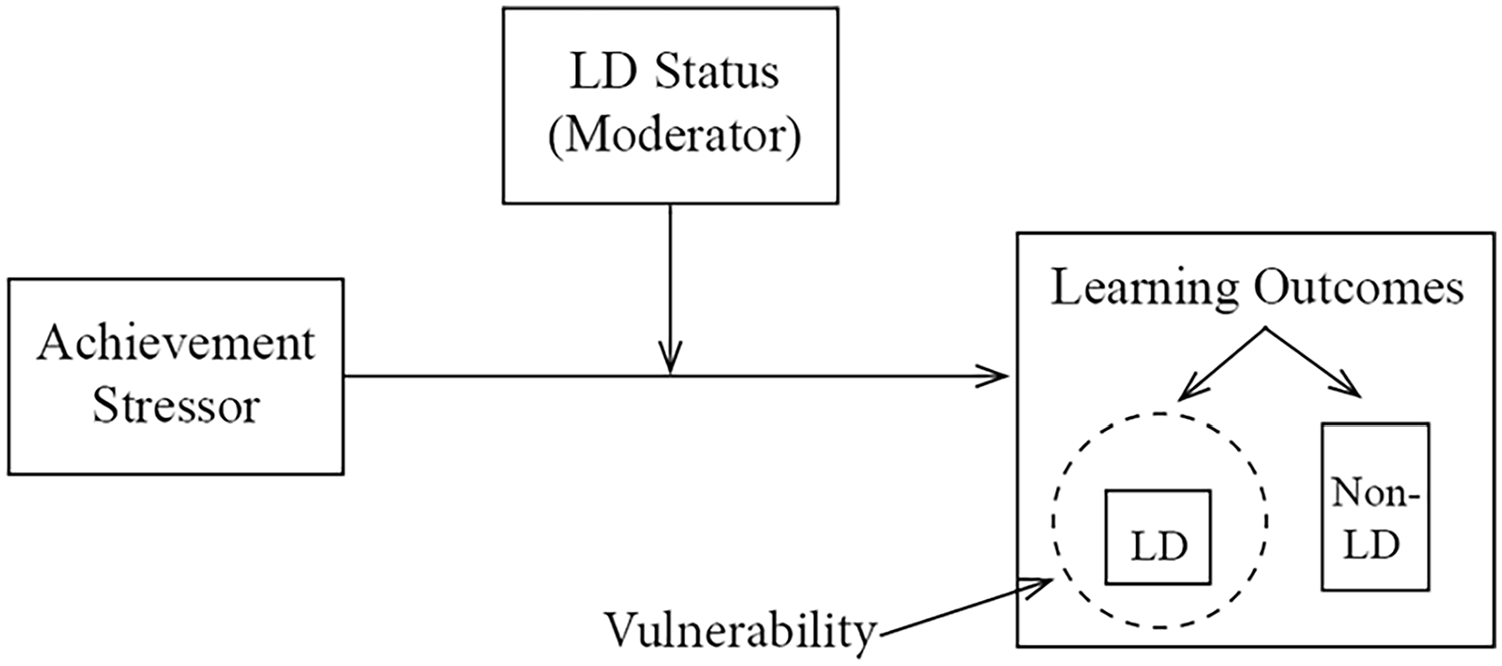
Visualization of the Concept of Vulnerability to Achievement Stressors
Figure 2 provides a visualization of a three-criterion methodological framework for investigating vulnerability to achievement stressors as evidence students with LD require instructional intensity and structure. The first methodological criterion requires a clear delineation in time between the pre-achievement stressor instructional environment phase versus the achievement stressor phase. The second methodological criterion requires similarly identified groups of students or the same students in the pre-achievement stressor instructional environment phase and in the achievement stressor phase. When focusing on students with LD, this requires similarly identified groups of students with LD or the same students with LD in the pre-achievement instructional environment phase and in the achievement stressor phase. It also requires similarly identified groups of students without LD or the same students without LD (i.e., the contrast condition) in both phases. The third methodological criterion requires the same or conceptually analogous learning data in both phases for students with LD and for those without LD.
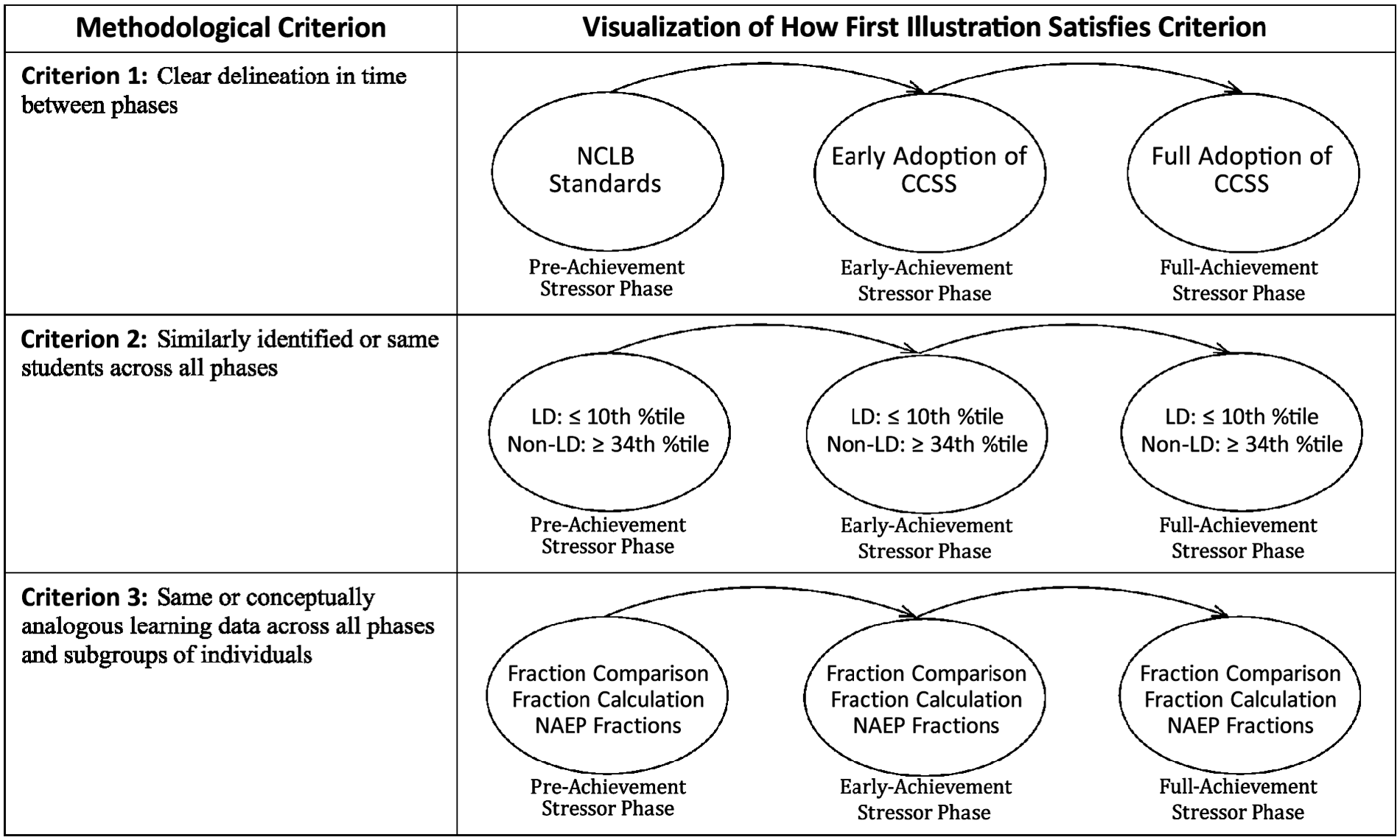
Three-Criterion Methodological Framework for Investigating Vulnerability to Achievement Stressor and First Illustration’s Example
An LD Student Achievement Stressor Rooted in Two Related Policy Initiatives: Inclusive Education and Standards-Based Reform
To help readers understand this methodological framework for investigating students with LD’s vulnerability to achievement stressors, we illustrate the framework with an analysis conducted to investigate effects of an achievement stressor rooted in inclusive education and standards-based reform.
Context, Database, and Analytic Sample
Standards-based reform in the United States occurred in a series of waves starting in the Reagan era and persisted through the Obama administration, with a series of identifiable start dates to initiatives sponsored under different administrations. A common theme and value across these initiatives was that high standards result in stronger student outcomes and that this principle applies to all students. Financial support for states to develop or align with more challenging standards and to provide accountability data, disaggregated by student subgroups, were also common features across initiatives. The nature of the standards and the level of financial support for supporting teachers’ implementation of evidence-based instructional strategies to help students meet the accountability demands differed by initiative.
We focus here on a late-stage initiative within this 30-year policy reform focused on standards-based reform: the 2009 federal policy initiative Race to the Top, which provided large federal grants to states to incentivize and support CCSS adoption. Our analytic sample was drawn from Tennessee, an early (2010) Race to the Top grantee and adopter of CCSS. The analysis, which was reported in depth in L. S. Fuchs, Fuchs et al. (2015), describes the differentially deleterious outcomes of this standards-based reform on fourth-grade students with LD, relative to fourth-grade classmates without LD, over the 3-year period when CCSS took hold.
Data for this 2015 analysis were derived from three parallel RCTs conducted in three consecutive years: 2010–2011, the pre-achievement stressor phase in which schools still implemented No Child Left Behind goals; 2011–2012, early-phase adoption of the achievement stressor; and 2012–2013, full adoption of the achievement stressor. Figure 2 represents the clearly delineated timing for the analysis (methodological criterion 1) in the first row.
For details of this analysis, see L. S. Fuchs, Fuchs et al. (2015). For primary reports on the three RCTs that contributed data to the 2015 analysis, see L. S. Fuchs, Fuchs et al. (2013, 2014, 2016). See Table 1 for quick access to summary information on the measures reported in L. S. Fuchs, Fuchs et al. (2015). Note that the 2015 analytic sample was a subset of students who participated in the full RCTs. This is because the 2015 stressor analysis focused on students with LD, selected to reflect this population: students with intellectual ability in the broadly normal range but severely low mathematics performance (at or below the 10th percentile). By contrast, the larger RCTs’ target population was at-risk students: those scoring at or below the 34th percentile. However, in line with methodological criterion 2, students with LD for the analysis of vulnerability to achievement stressors were selected according to the same criterion in all three phases of the 2015 analysis. This is also the case for classmates without LD, who were selected for the vulnerability analysis in the same way for all three phases of the analysis: those scoring at or above the 34th percentile. This methodological criterion 2 is reflected in Figure 2’s second row. With respect to methodological criterion 3, also shown in Figure 2’s third row, the 2015 analytic measures were the subset of measures common to all three RCTs.
First Illustration: Pre- and Posttest Fraction Performance by Achievement Stressor Phase and RCT Treatment Condition.
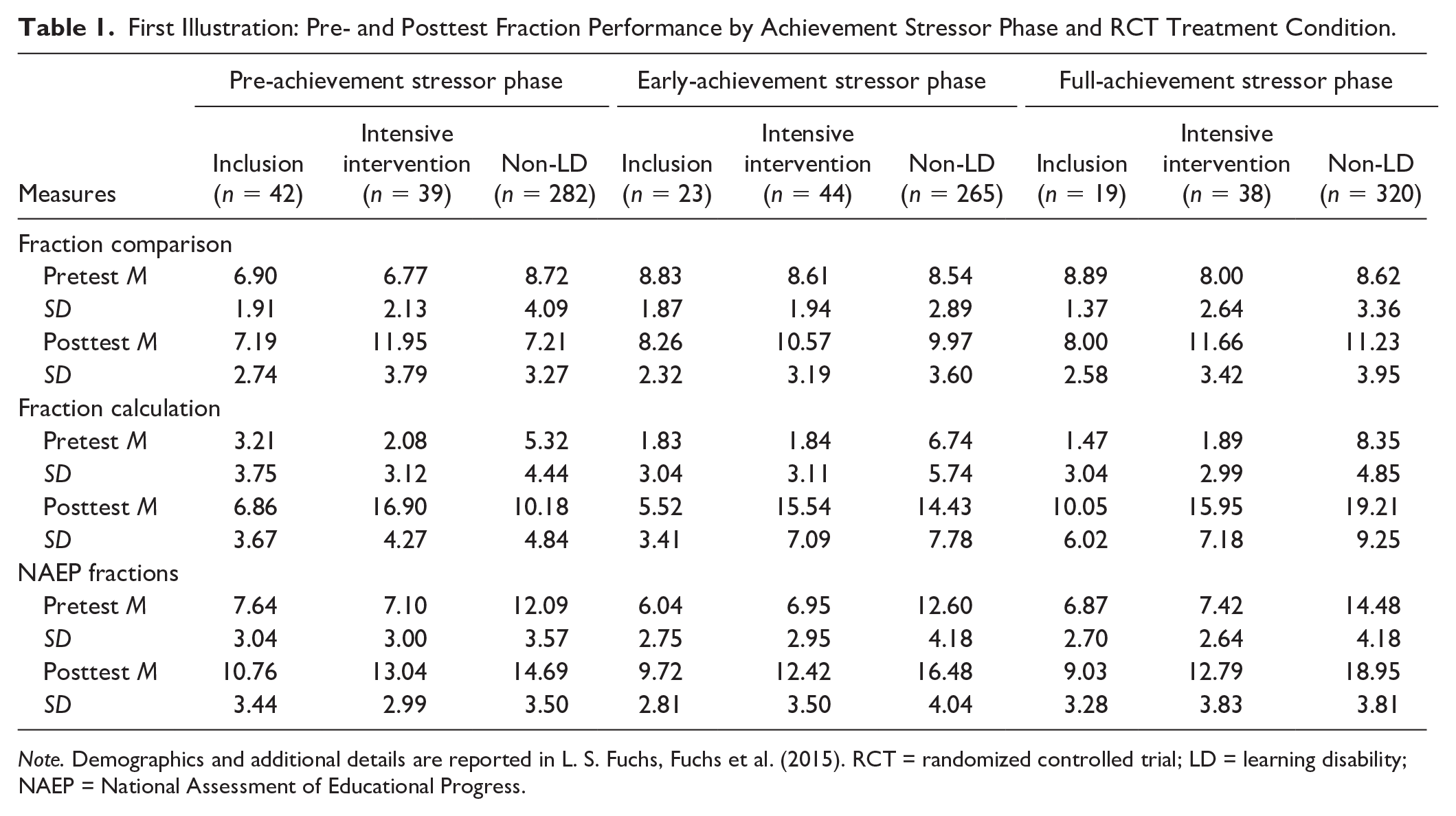
Note. Demographics and additional details are reported in L. S. Fuchs, Fuchs et al. (2015). RCT = randomized controlled trial; LD = learning disability; NAEP = National Assessment of Educational Progress.
Here, we reconsider the previously reported 2015 analytic findings through the lens of vulnerability to achievement stressors; that is, whether students with LD and those without LD experienced the achievement stressor in differential ways. As shown in Figure 1’s Learning Outcomes box, this vulnerability is reflected in the amount of learning between students with LD relative to non-LD students over the time frame when the achievement stressor took hold.
The Inclusive Instruction Condition, The Intensive Intervention Condition, and a Follow-Along Sample of Non-LD Students
In each of the three RCTs, fourth graders with LD were randomly assigned to inclusive instruction (n = 84 over three RCTs) or intensive fractions intervention (n = 121 over the same three RCTs). Each RCT also included a follow-along sample of non-LD students (n = 867 over three RCTs). Students with LD (inclusive instruction vs. intensive intervention) and follow-along non-LD classmates were assessed on the same measures of fractions knowledge after each RCT’s intervention period ended.
Students with LD in the intensive fractions intervention condition received Fraction Face-Off! (L. S. Fuchs, Schumacher et al., 2015), also known as Super Solvers (L. S. Fuchs et al., 2019), in small groups of two to four students, three times per week for 30 to 35 min for 12 weeks. This intensive intervention is based on evidence-based principles of intensive instruction and focuses on fraction magnitude understanding via comparing, ordering, and placing fractions on number lines. This was a major emphasis within CCSS.
Students with LD in the RCTs’ inclusive education control group received general education mathematics instruction: No students received what could be considered intensive intervention from the school, and they spent more than 80% of their school day in the regular classroom, where they participated in the core Tier 1 mathematics program. The core program increasingly addressed CCSS fractions learning standards, including fraction magnitude understanding across the three RCTs. General education instruction was aligned with district initiatives to support inclusive education for students with LD. This included implementing Universal Design for Learning, providing accommodations, and promoting strong collaboration between general and special education teachers. In Year 1, the fractions curriculum aligned with initial state standards from No Child Left Behind (2002). In Year 2, teachers were directed to move toward CCSS; by Year 3, teachers were required to address CCSS. As CCSS was implemented across Years 2 and 3, the complexity of fractions coverage and challenge gradually increased.
Using fraction operations standards as an example of CCSS’s increasing complexity, initial fractions standards on operations from the No Child Left Behind included “Solve problems involving fractions using all four arithmetic operations” and “add and subtract fractions with like and unlike denominators and simplify the answer.” By contrast, CCSS involved less content coverage (fraction division was not addressed) but greater depth. Common Core State Standards on fraction operations included “understand addition and subtraction of fractions as joining and separating parts referring to the same whole”; “decompose a fraction into a sum of fractions with the same denominator in more than one way” and “justify such decompositions using a visual fraction model”; and “understand a multiple of a/b as a multiple of 1/b and use this understanding to multiply a fraction by a whole number” and “represent fraction multiplication with a visual fraction model.”
Vulnerability to the Achievement Stressor Among Students With LD in Inclusive Instruction
As CCSS adoption took hold, the achievement stressor, the fractions standards’ increasing depth and challenge, produced dramatically improved fraction performance for non-LD classmates. Over the 3 years, these students’ year-end fraction scores increased more than one standard deviation (SD) on each fraction measure. This suggests that No Child Left Behind’s fraction standards (the pre-achievement stressor phase) were insufficiently challenging for non-LD classmates, and non-LD classmates responded well to CCSS’s increased challenges (the achievement stressor phase).
By contrast, the performance of students with LD who experienced the same achievement stressor and received the same inclusive fractions instruction (with inclusive supports) did not improve over time. For this reason, the mean posttest achievement gap for students with LD in the inclusive condition increased over this time frame: Performance was 0.64 SD below non-LD classmates at end of Year 1 (when No Child Left Behind standards were intact), but grew to 1.10 SD below non-LD classmates at end of Year 2 (when teachers were encouraged to move to CCSS) and increased to 1.47 SD below non-LD classmates at end of Year 3 (when teachers were required to fully implement CCSS).
The doubling magnitude of achievement gaps among students with LD as the achievement stressor took hold reveals the vulnerability of students with LD to achievement stressors. It also demonstrates that the general education inclusive fractions instruction, with its accommodations and adaptations, co-teaching, and Universal Design for Learning, were not sufficient to address the academic needs of students with LD.
Intensive Intervention to Mitigate Vulnerability and an Essential Form of Instruction for Students With LD
Because each RCT randomly assigned students with LD to an inclusive education condition (the RCTs’ control groups) and an intensive intervention condition, we consider whether such intervention provides students with LD some protection against achievement stressors, that is, permitted them greater resiliency during the achievement stressor phase. The mean effect sizes favoring the posttest performance of intervention students over inclusive students were large, ranging from 1.11 to 1.89 depending on the fraction measure.
As would be expected, therefore, the achievement gaps of students with LD who received intensive fractions intervention, with respect to non-LD classmates, were dramatically smaller than the gaps of inclusive students with LD. In fact, in Year 1, the posttest performance of students with LD who received intensive fractions intervention exceeded that of non-LD classmates by 0.79 SD in Year 1, before the achievement stressor—more challenging fourth-grade fraction standards—had been introduced. The reason for superior fractions performance over non-LD classmates’ performance likely resides with the intervention’s intensive instructional structure as well as its innovative adoption of fraction magnitude as its major focus, a focus that was also strongly reflected in CCSS.
More pertinent to this article’s focus, in Year 2, as teachers moved toward CCSS adoption, the mean post-intervention achievement gap for students with LD who received intervention, relative to non-LD classmates, was substantially smaller than for inclusive students with LD (0.23 SD vs 1.10 SD below non-LD classmates). By Year 3, when CCSS was fully adopted, the gap for students with LD who received intervention increased to 0.62 SD but was still dramatically less severe than for inclusive students with LD (1.47 SD). In these ways, intensive fractions intervention addressed the needs of students with LD more effectively than inclusive instruction and served as a buffer against the achievement stressor.
Understanding Vulnerability to Standards-Based Reform Achievement Stressor for Students With LD in the Context of the Broader U.S. Standards-Based Reform
As mentioned, standards-based reform in the United States involved establishing uniformly challenging learning standards for all students; administering accountability-based assessments aligned with those standards to virtually all students, including those with disabilities generally and students with LD specifically; and disaggregating performance by subgroups. The assumption is that access to a uniform set of challenging standards will increase student achievement for all students, including those with disabilities.
For students with disabilities generally and students with LD specifically, standards-based reform is conflated with the inclusive education movement, for the purpose of ensuring that these students have full access to the general education curriculum (i.e., the learning standards). One important marker of the field’s early interest in the inclusion of students with disabilities in standards-based reform and full access to the general education curriculum through inclusive education is the 1997 National Research Council’s report, Educating One and All: Students with Disabilities and Standards-Based Reform (available at http://nap.nationslscademiies.org/5788).
This report recognized the importance of the Individual with Disabilities Education Act’s legal framework, which values individualization of learning goals for students with disabilities. Yet, the report’s “guiding principles are that all students have access to the same challenging standards-based reform and general education curriculum and that policy makers and educators are held publicly accountable for every student’s performance” (p. 2). To address this tension, the report concluded that “adaptations will be required for some students with disabilities, particularly those with significant cognitive disabilities [italics added]” (p. 2) for whom life skills must be addressed. An inherent assumption in this conclusion is that the standards goals are valued for students with LD. Moreover, as standard-based reform evolved, uniformity in learning standards has increasingly been interpreted as appropriate for all students with disabilities.
Even so, the scientific basis for the policies discussed in this report lagged behind policy. For this reason, in 2015, the Institute for Education Sciences (IES) established the Center on Standards, Alignment, Instruction, and Learning (C-SAIL) to document, support, and evaluate state, district, and classroom efforts to implement Race to the Top standards. C-SAIL’s multi-method research program had a broad focus on teachers’ use and judgments of the appropriateness and effectiveness of uniform standards; effects of teacher alignment with standards on academic outcomes; and large-scale analysis of the effects of challenging on NAEP outcomes.
Most relevant to this article’s focus on students with LD’s vulnerability of achievement stressors, IES charged C-SAIL to disaggregate effects for students with disabilities. Although the charge was not for students with LD specifically, the way in which C-SAIL defined disability—those participating in the regular high-stakes assessments and deemed appropriate by their teachers to benefit from the general education curriculum—meant that students in the C-SAIL research program were overwhelmingly students with LD.
C-SAIL’s large-scale NAEP analysis (Song et al., 2022) provided a test of the vulnerability of students with disabilities to the standards-based reform achievement stressor. The analysis meets this article’s methodological criterion 1 by framing 2010 as the year, in which most states adopted the more challenging standards framed in Race to the Top. The authors divided states into what we refer to as achievement stressor states versus non-achievement stressor states. Achievement stressor states had relatively weak standards prior to Race to the Top standards (so the 2010 breakpoint was viewed as a stressor). Non-achievement stressor states already had challenging learning standards prior to adoption (so the 2010 breakpoint was not viewed as a stressor). Methodological criterion 2 was satisfied with NAEP’s deliberate and consistent plan across time to assess representative samples of students with and without disabilities across both phases. Methodological criterion 3 was met with NAEP’s systematic sampling plan for creating parallel forms of the assessment over both phases.
Using eight consecutive years of state-level NAEP data in reading and mathematics at Grades 4 and 8, with the 2010 representing the distinguishing breakpoint, Song et al. (2022) found generally non-significant differences between the pre-academic stressor states versus academic stressor states in reading and mathematics and at Grades 4 and 8 for students without disabilities. That is, more rigorous standards, the academic stressor, did not improve or compromise achievement for students without disabilities.
By contrast, for students with disabilities, most differences favored the non-academic stressor states, especially in the later years as Race to the Top implementation took hold. That is, more rigorous standards, the academic stressor, had a deleterious effect on achievement for students with LD; they demonstrated differential vulnerability to the achievement stressor. This echoes our first illustration’s findings that students with LD are differentially affected by this achievement stressor.
Vulnerability to Achievement Stressors as Evidence Students With LD Require Intensive Intervention: Beyond Inclusive Education and Standards-Based Reform
Our second illustration of vulnerability to achievement stressors as evidence of students with LD’s need for intensive intervention is offered to expand readers’ understanding of vulnerability to achievement stressors and the framework for investigating it beyond the context of inclusive education. With this second illustration, we focus on the achievement stressor caused by the pandemic, which decreased instructional structure by disrupting in-person teaching with long periods of remotely delivered instruction.
Data Sources, Achievement Stressor Timing, and the Investigative Framework’s Methodological Criteria
The data for this pandemic analysis’ LD sample were drawn from a single RCT conducted with multiple year-long cohorts of second graders. The purpose of that RCT was to assess the effects of intensive intervention on transfer between reading comprehension and mathematical problem solving in students with comorbid difficulty across both domains (see L. S. Fuchs et al., in press for the full RCT report). The 2023 pandemic analysis we summarize here was reported in depth in D. Fuchs, Mirowitz et al. (2023). See Table 2 for quick access to summary information on the key measures used in the second illustration.
Second Illustration: Descriptive Statistics on Key Measures by Achievement Stressor Phase and RCT’s Protective Effect Data.
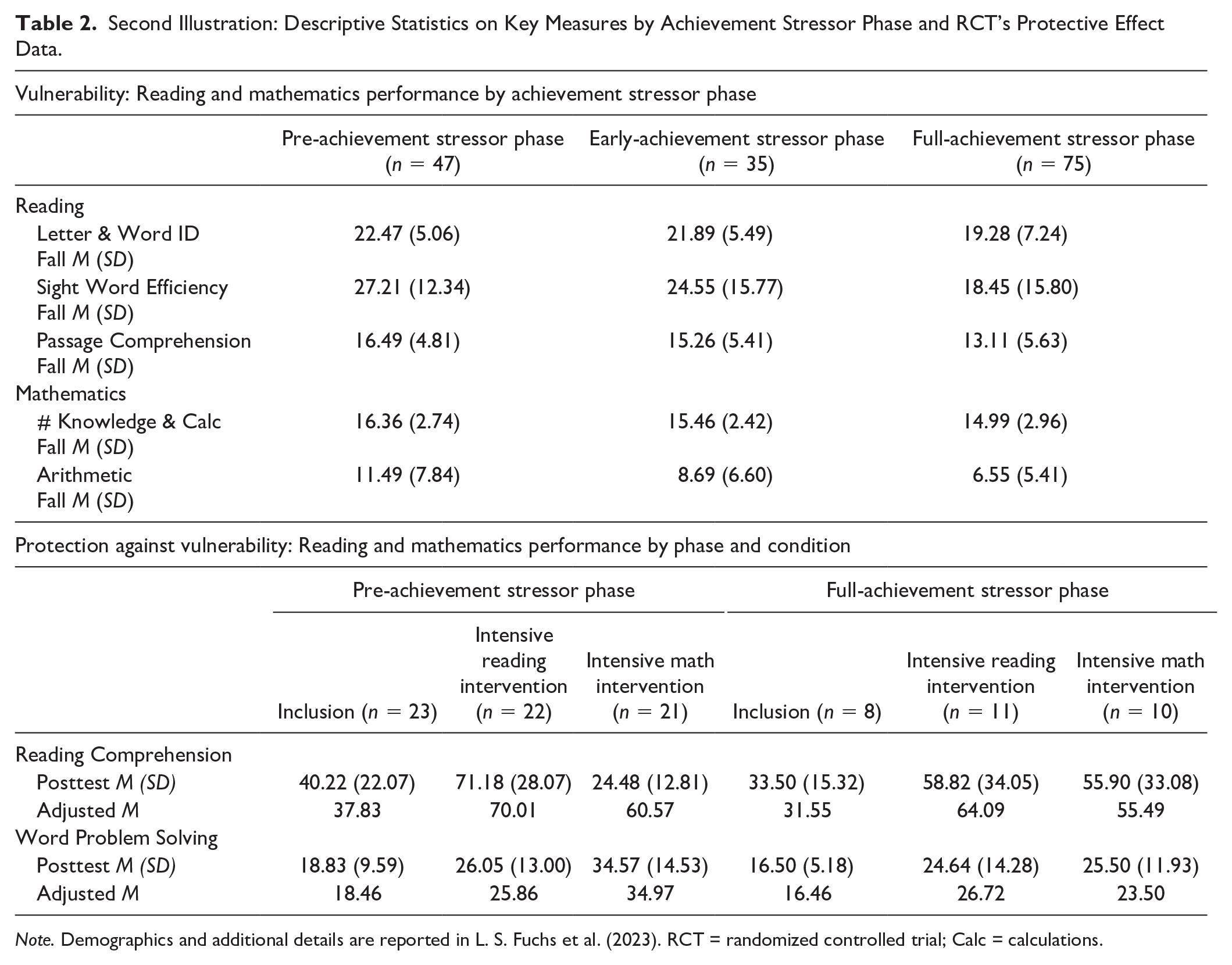
Note. Demographics and additional details are reported in L. S. Fuchs et al. (2023). RCT = randomized controlled trial; Calc = calculations.
The first cohort in the pandemic analysis entered the RCT at the start of the 2019 school year (pre-pandemic before school closures, that is, pre-achievement stressor phase). The second cohort entered the RCT at the start of the 2020 school year (after the initial, long-term school closure, that is, early-achievement stressor phase). The third cohort entered the RCT at the start of the school year following the 2020–2021 school year (a year following the initial 2020 closure, after the achievement stressor had taken full effort and alternating periods of in-person and remotely delivered instruction the subsequent school year, that is, full-achievement stressor phase). The analysis’ clearly delineated time frame for distinguishing the pre-achievement stressor phase versus the stressor phases satisfies the investigative framework’s methodological criterion 1.
Across these three cohorts, the LD sample comprised 157 students who were identified for participation in these three cohorts of the larger RCT. Each of the cohorts relied on parallel study-entry screening procedures, thereby satisfying the investigative framework’s methodological second criterion. Learning disabilities participants in the pandemic analysis were selected to reflect the population of students with LD: those with intellectual ability in the broadly normal range but severely low academic performance on the targeted academic domains. Students with LD who scored at or below the 25th percentile in reading comprehension and mathematical problem solving were eligible to enter the RCT, but the 2023 analytic sample’s actual performance was at or below the 10th in both domains. The use of same assessments across both phases, which indexed word recognition and reading comprehension, as well as number knowledge and calculations, satisfy methodological criterion 3.
To assess vulnerability of the pandemic achievement stressor among students with LD, the analysis compared learning loss in the LD sample to learning loss among students without disabilities. To index learning loss in students without disabilities, we relied on Kuhfeld et al.’s (2022) large-scale report, which described reading and mathematics performance for the general population of learners broadly defined (5.4 million students in the United States) at the same three time points, pre-achievement stressor, early-achievement stressor, and full-achievement stressor phases, which also satisfy the methodological criterion 1. Parallel methods for identifying students with LD in the pre-academic stressor and academic stressor phases, and for sampling non-LD students satisfy the investigative framework’s methodological criterion 2. Kuhfeld et al. used general reading and mathematics assessments (i.e., Measure of Academic Progress Growth; MAP; NWEA, 2017) collected at Grades 3 to 8. The use of the same outcome measures within the LD and within the non-LD sample on the same academic domains satisfies methodological criterion 3.
Achievement Stressor
The pandemic achievement stressor decreased instructional structure with its extended school closures that occurred from March 14, 2020, to the end of that academic school year in the Metropolitan-Nashville Public Schools where the RCT took place. In the subsequent school year, alternating periods of closures occurred from August to mid-February. Because performance measurement in the LD sample occurred near the start of the school year, before random assignment to the RCT conditions took place, all 157 students who entered the RCT’s three cohorts contributed data, regardless of the RCT condition to which they were later assigned.
The start-of-school year performance of these 157 students with LD reflects the schools’ instructional environment at three different time points: for cohort 1 in the pre-achievement stressor phase; for cohort 2 in the early-achievement stressor phase (after the extended closure that ran from March 14, 2020, through the rest of the school year); for cohort 3 in the full-achievement stressor phase (after students had experienced the initial 2020 extended closure and after the intermittent school closures in 2020–2021). The same is the case for the non-LD comparison sample. This permits the opportunity to describe the magnitude of students with LD’s mathematics and reading achievement gaps between these three time points, relative to non-LD students between these three time points.
In a nationally representative survey of K–5 teachers, Namkung et al. (2022) reported evidence that the pandemic achievement stressor’s school closures decreased school structure and support for students with LD. In the pre-academic stressor phase, 72% of students who needed extra support in mathematics, reading, or writing received such support; by contrast, during the 2020–2021 academic stressor school year, only 45%. Teachers also reported less academic skills instruction for students with disabilities in this school year and judged remote instruction to be less effective for students with disabilities than for students without disabilities.
Vulnerability to the Achievement Stressor Among Students With LD
From the pre-achievement stressor phase (the fall 2019 cohort) to the early-achievement stressor phase (the fall 2020 cohort), students with LD showed non-statistically significant mean declines of −0.11 SD to −0.24 SD in reading and mean declines of −0.34 SD and −0.38 SD in mathematics. By the full-achievement stressor phase (the fall of 2021 cohort), however, the declines in both reading and mathematics had grown and were significant, ranging from −0.49 SD to −0.63 SD in reading and from −0.48 SD to −0.77 SD in mathematics.
By contrast, according to Kuhfeld et al. (2022), among non-LD students (the general population), mathematics declines from the pre-achievement stressor phase (the fall 2019 cohort) to the early-achievement stressor phase (the fall 2020 cohort), ranging from −0.12 SD to −0.18 SD. These grew to −0.21 to −0.27 SD at the full-achievement stressor phase (the fall 2021 cohort). By contrast, reading performance was mixed from the pre-achievement stressor phase (the fall 2019 cohort) to the early-achievement stressor phase (the fall 2020 cohort), depending on grade: It ranged from a decline of −0.02 SD at grades 3, 4, and 6 to an increase of +0.05 SD at grade 5. Declines ranging from −0.09 SD to −0.18 SD were reported from the pre-achievement stressor phase (the of 2019 cohort) to the full-achievement stressor phase (the fall 2021 cohort).
This suggests that declines for students with LD were strikingly more severe than for non-LD students. In reading, the general population of third-grade students (closest to the LD sample’s second grade) revealed growth of +0.05 SD from the pre-achievement stressor phase (fall of 2019) to the early-achievement stressor phase (fall of 2020). In the full-achievement stressor phase (fall of 2021), although the general population of third graders showed a decline of −0.18 SD, this decline contrasts sharply with a mean decline of −0.57 SD for students with LD at the later-achievement stressor phase (fall of 2021). That is, learning loss among students with LD was three times larger than that of the general population. In mathematics, Kuhfeld et al.’s general population of third graders showed a decline of −0.12 SD from the pre-achievement stressor phase (fall of 2019) to the early-achievement stressor phase (fall of 2020), which further declined to −0.25 SD at the full-achievement stressor phase (fall of 2021). That is, learning loss in mathematics for students with LD was two to three times larger than in the general population.
Intensive Intervention to Mitigate Vulnerability and an Essential Form of Instruction for Students With LD
The next question is whether intensive intervention offered protective value for students with LD during the pandemic’s achievement stressor. The RCT provides insight into this question because students with LD in the RCT’s 2020–2021 cohort were randomly assigned to an inclusive education condition (the RCT’s control group) and an intensive intervention condition. (Random assignment occurred after fall performance was measured in the vulnerability to achievement stressor analysis.)
As noted, the larger purpose of the multi-cohort RCT was to assess the effects of intensive intervention on transfer between reading comprehension and mathematical problem solving among students with comorbid difficulty across both domains (see L. S. Fuchs et al., in press, for the full RCT report). Students were randomly assigned to three conditions: inclusive instruction, reading comprehension text-structure intervention (Vanderbilt Second-Grade Pirate Reading; L. S. Fuchs & Seethaler, 2019b), or mathematics word-problem solving text-structure intervention (Vanderbilt Second-Grade Pirate Math; L. S. Fuchs & Seethaler, 2019a).
These interventions were designed in parallel fashion and delivered one-to-one, three times per week for 30 min for 15 weeks. Both interventions are based on principles of intensive instruction; focus on text-structure instruction (passages without numbers for Vanderbilt Pirate Reading; mathematics word-problems for Vanderbilt Pirate Math); and include a minor focus on foundational skill in the relevant domain (word reading in Vanderbilt Pirate Reading; calculations in Vanderbilt Pirate Math) and a minor focus on explicit transfer instruction (e.g., the meaning of transfer). But neither intervention teaches domain-specific text-structure strategies in the transfer domain.
Note that for the 2020–2021 cohort, the RCT’s interventions were delivered remotely (see L. S. Fuchs et al., 2023, for more information). To provide insight into whether intensive intervention offered protective value for students with LD during the pandemic’s achievement stressor, we focus on the RCT’s 2020–2021 cohort. From the start of this school year through mid-February, the participating district alternated between periods of in-person versus remote schooling. During periods of remote schooling, the RCT’s tutors delivered intervention remotely on a video-conference platform. Remote sessions represented approximately half of the 45 intervention sessions. Meanwhile, during this full-achievement stressor phase, students with LD in the RCT’s inclusive education control group received the general education reading and mathematics instructional program: remotely during school closures; in-person when schools were open.
Despite the intervention being delivered remotely, post-intervention reading and mathematics performance of students with LD who were randomly assigned to intensive intervention was dramatically superior compared with students with LD randomly assigned to inclusive instruction. In this cohort, effects were significant for both intervention conditions on acquisition and transfer outcome measures, and effect sizes were large.
In this 2020–2021, full-achievement phase cohort, for the reading intervention condition versus the inclusive instruction condition, intervention’s acquisition effect size (on the reading comprehension outcome) was 1.17; the transfer effect size (on the word-problem solving outcome) was 0.90. For the word-problem solving intervention condition versus inclusive instruction, the intervention’s acquisition effect size (on the word-problem outcomes) was 0.73; the transfer effect size (on reading comprehension outcome) was 0.89.
Thus, intensive intervention better addressed the academic needs of students with LD than inclusive education, even when intervention was delivered remotely and was contextualized by the pandemic’s academic stressor. (Note that effect sizes in the full RCT [L. S. Fuchs et al., in press], which are based on the full set cohorts, differ from the effect sizes in the preceding paragraph, which are based on one cohort: 2020–2021.)
A Call to Action
Students with LD’s vulnerability to achievement stressors is a novel source of evidence that inclusive education with its accommodations and adaptations, co-teaching, and Universal Design for Learning is not sufficient to address the academic needs of students with LD. Moreover, addressing these students’ needs more successfully requires intensive intervention. Over the past 30 years, research funded by the Office of Special Education Programs (U.S. Department of Education), the National Center on Special Education Research (Institute of Education Sciences in the U.S. Department of Education), the National Institute of Child Health and Human Development (National Institutes of Health), and the National Science Foundation has supported development of such interventions with strong efficacy for students with LD. These intensive interventions dramatically improve the academic outcomes of students with LD, while substantially narrowing these students’ achievement gaps (L. S. Fuchs et al., 2021; Vaughn et al., 2022). This includes students with LD in reading, in mathematics, and across both reading and mathematics.
Nevertheless, as L. S. Fuchs and D. Fuchs et al., (2015) explained, policymakers and educators overestimate inclusive education’s capacity to support the needs of students with LD. Many policymakers, school and district leaders, and teachers also believe students with LD are not permitted to leave the general education inclusive classroom for intervention. Advocacy is needed to increase understanding that students with LD are entitled to intensive intervention outside the classroom and that intensive intervention is a necessary component of these students’ educational programs. Policy work and systems-level research is needed to determine the necessary finances, school structures, working conditions, non-traditional approaches to personnel development, and mandates to ensure that evidence-based intensive intervention, with fidelity of implementation, is delivered in schools. At the same time, policymakers and educators must recognize that education reforms designed to improve academic outcomes of all students can have negative impacts on students with LD. We should be proactive and integrate support for intensive intervention at the outset of future educational reforms or school disruptions. This is necessary to ensure a free and appropriate education for students with LD.
Footnotes
Declaration of Conflicting Interests
The author(s) declared no potential conflicts of interest with respect to the research, authorship, and/or publication of this article.
Funding
This research was supported by Grants R324D130003 and R324R200003 from the National Center on Special Education Research in the Institute on Education Sciences in the U.S. Department of Education to Vanderbilt University; by Grant R324A220268 by the National Center on Special Education Research to the University of Delaware; and by Grants 2 P20 HD075443 and 1 R01 HD097772 from the Eunice Kennedy Shriver National Institute of Child Health & Human Development in the National Institutes of Health to Vanderbilt University. The content is solely the responsibility of the authors and does not necessarily represent the official views of the National Center on Special Education Research, the Institute of Education Sciences, the U.S. Department of Education, the Eunice Kennedy Shriver National Institute of Child Health & Human Development, or the National Institutes of Health.
