







Abstract
When advertising products to consumers, firms sometimes conceal key aspects in an effort to arouse consumer curiosity. This research investigates when and how visual concealment tactics may benefit or hurt aesthetic product evaluations. The authors propose that when consumers are only able to view a portion of an aesthetic product, assessments of its appeal will be influenced by two interrelated mechanisms: curiosity to see the item completed and inferences about the item’s fully disclosed appearance. The authors show that heightened curiosity triggers feelings of positive affect that are transferred to the product itself, a process that may inflate preferences and choice likelihoods for products beyond what would occur if the full image were known. This transference effect, however, has an important boundary: it works only when initial consumer inferences about the appeal of the product are positive or emotionally congruent with the positive affect triggered by curiosity. The key implication is that, ironically, the products likely to benefit most from concealment tactics are those that have the least to hide. The authors provide evidence for these effects and the underlying mechanism using six experiments that manipulate concealment in a variety of task settings.
One of the oldest tactics marketers use to arouse consumer interest in innovations is the “peekaboo” ploy: deliberately withholding from view some of the aspects or attributes of a product in the hope of generating curiosity. In its 2010 ad campaign for the new Audi A3, for example, DDB Milan developed print ads that showed only the rear third of the vehicle, enticing the viewer to imagine the whole. 1 In 2016, Honda used a similar ad campaign for its all-new Ridgeline, in which the firm circulated a print ad showing the silhouette of the truck in a dark room. 2 Similar tactics are routinely used by other car manufacturers every time a new generation of a model is introduced. Likewise, Menon and Soman (2002) observe that web marketers often lure consumers into learning about new products by using “teaser” web page designs that withhold key attribute information—pages created to pique curiosity that can be resolved by clicking through additional pages. Finally, online retailers increasingly make implicit concealment decisions when determining how much of a product to depict on their websites, which can range from a few static images to an interactive, 360-degree view.
When might marketers benefit from concealing a product’s image? Despite the pervasiveness of such tactics in practice, the answer is far from clear. On the one hand, if the marketer is confident that consumers will intuitively find a product attractive, there would seem to be little benefit in keeping its looks under wraps; while concealment may trigger curiosity and, in turn, interest, whatever positive gain comes from this may fall far short of that which could be realized by full disclosure. Likewise, the tactic could backfire if consumers suspect that it is a deceptive ploy being used to draw their attention to a product that, in all likelihood, will be nothing special when finally revealed. On the other hand, if curiosity piqued by the ad serves as a source of positive affect that is generalized to the product itself, even attractive products could benefit from some concealment, gaining a “curiosity bonus” that boosts product attraction beyond what it would have been if the full appearance had been revealed. Unfortunately, there is little prior theoretical or empirical work that might help marketers know when visual concealment tactics should be applied—and, if so, how they should optimally be implemented.
The purpose of this work is to take a step toward this goal by reporting the findings of a theoretical and empirical investigation into the effects of concealment tactics on product evaluations. Our work centers on a hypothesis that visual concealment triggers two interrelated psychological processes that, when combined, drive consumer evaluations about the attractiveness of a product. The first is a curiosity effect that acts as an inverted U-shaped function of the percentage of the product that has been revealed: the more that is revealed, the greater the drive to see it completed; however, beyond a certain point—when curiosity has been satisfied—the drive wanes. The second is an inference effect, whereby consumers infer how appealing the product will be from the fragments that are revealed: the more promising the fragments, the more positive the inference. We posit that curiosity serves as an independent source of positive affect that interacts with this inference, such that the more positive the inference about the likely appeal of the whole, the more the affect piqued by curiosity will be transferred to the product itself. This interaction yields a prediction about when concealment tactics are likely to be most successful: they will work best when applied to products for which consumers hold the most positive expectations about the appeal of the fully revealed design, or, ironically, those that have the least to hide. Conversely, product designs that foster lower expectations—those that have the most to hide—would find little gain from such tactics.
The present work makes important theoretical and practical contributions to our knowledge of how strategically making information available to consumers may influence preference (e.g., Ge, Brigden, and Häubl 2015; Ge, Häubl, and Elrod 2012; Menon and Soman 2002; Peracchio and Meyers-Levy 1994). For example, work by Ge, Häubl, and Elrod (2012) shows that delaying the presentation of some favorable information about a product until after consumers have prescreened all of the available options can increase preference for this product. Relatedly, Ruan, Hsee, and Lu (2018) find that first creating and then resolving uncertainty can generate a net positive experience. Furthermore, Ge, Brigden, and Häubl (2015) show that when consumers are nudged toward discovering an option through search rather than finding it readily available at the beginning of the decision-making process, they may derive higher preference from the newly discovered option. Thus, these prior findings show that the timing in which an option or information about an option is discovered may influence preference. The current research moves the needle further and shows that not only delaying but concealing altogether the presentation of certain amounts of favorable visual information about a product may lead to a boosting effect on preference. We propose that this occurs as a result of curiosity and positive affect associated with what the item will look like when completely revealed.
Notably, this research also enhances our understanding of how curiosity may help shape product preference in the domain of visual aesthetics, as previous work on the interplay between curiosity and product preference has mostly focused on verbal information. Furthermore, while previous work has shown that curiosity may lead to higher quality and quantity of search, which may increase subsequent preference for a product (Menon and Soman 2002), we show that the positive role that curiosity exerts on product preference goes beyond mere search, as positivity may directly boost preference. In addition, the present work extends findings in the advertising domain by Peracchio and Meyers-Levy (1994), who show that cropping peripheral (but not central) parts of a familiar ad (e.g., a woman in a beer commercial or a truck in a jeans commercial, rather than the products themselves) may lead to higher preference for the advertised product due to positive affect experienced as a result of resolving incongruity. Our work examines the effect of concealment in the visual aesthetics context and shows that, in some cases, concealing important features of a product may indeed lead to higher aesthetic preference for the item as a result of curiosity and positivity, even if curiosity is left unresolved. This notion is consistent with recent work showing that unresolved curiosity may influence preference and behavior, such as leading consumers to make more indulgent choices across other domains (e.g., Wang and Huang 2018; Wiggin, Reimann, and Jain 2019). In this case, we show that the positive affect generated by unresolved curiosity not only leads to indulgent choices across other domains but also may improve preference toward the item that is the object of curiosity.
Finally, this article makes an important contribution to the literature on visual aesthetics, as its findings run counter to prevalent findings in this area of work. Specifically, prior research has shown that aesthetic appreciation is a form of sensory gratification (Davey 1989); thus, any factors that improve processing ability, such as making an item perceptually fluent (Reber, Schwarz, and Winkielman 2004) or easier to delineate from the visual field (Marr 1981; Ramachandran 1990), should lead to enhanced aesthetic perceptions. In this research, we document a case in which, instead of facilitating visual processing, partially impairing it may lead to improved aesthetic evaluations due to a boosting effect of curiosity and positive affect.
We organize the article in three sections. In the next section, we develop our theoretical hypotheses based on prior research on curiosity and the transmission of positive affect. We then describe the results of one field study and five laboratory studies that test the theoretical predictions and hypothesized mechanism in a variety of task settings. We find support for our hypotheses as well as evidence that there may be a universal “ideal” proportion of exposure that maximizes consumer preference toward visually aesthetic products: across a variety of stimulus domains, we find that curiosity and positivity are maximized when approximately one-half to two-thirds of the object has been revealed. We conclude with a discussion of the implications of the work for both consumer behavior research and its applicability to marketing.
Theoretical Framework
Curiosity
A fundamental feature of human cognition is curiosity—the drive or desire to gather new knowledge about our environment and seek order in sensory perceptions. Curiosity is defined as an intrinsic motivation to obtain and process new information (Hunt 1963; Kupor and Tormala 2015; Loewenstein 1994; Olson, Camp, and Fuller 1984; Peters 1978). While many factors have been hypothesized to drive feelings of curiosity, perhaps the most well-known is that curiosity is piqued when there is a “closeable” knowledge gap—a modest difference between the amount of product information directly observed by the consumer and the amount of information that a consumer would ideally like to have or need (Loewenstein 1994; Menon and Soman 2002).
What is the ideal size of this “knowledge gap”? While there is presumably no precise answer to this question, Loewenstein (1994) hypothesizes that the intensity of curiosity acts as a continuous nonlinear function of the size of the gap, becoming most intense when a person sees a desired knowledge level as being just “a hair away.” Consistent with this account, people are most interested in knowing the words that they feel are at the tip of their tongue, and contestants in trivia challenges are more eager to find out the capitals of more U.S. states if they already know most of the state capitals than if they know only a few (Loewenstein 1994). As such, feelings of curiosity might be seen as obeying a “goal-gradient” rule similar to that observed in other behavioral drive contexts, such as the increasing tendency for individuals to exert effort into completing the requirements of frequent-user programs as the target approaches (e.g., Hull 1934; Kivetz, Urminsky, and Zheng 2006; Nunes and Drèze 2006).
But while the “tip of the tongue” rule may be appropriate for verbal stimuli, whether it applies to visual stimuli has not been largely investigated. One reason that it might not apply is that our visual systems have evolved to instinctively “fill in the blanks” of partially concealed objects so that we see them as complete; if a quarter of a circle is covered, our mind’s eye sees it as a complete circle (e.g., Sekuler and Palmer 1992). Because of this, one might conjecture that, for visual stimuli, curiosity may be piqued only when comparatively small portions of the object have been revealed—enough to create a desire to see the whole, but not so much that our visual systems see it as a whole. We aim to better understand the dynamics between visual concealment and curiosity as well as the downward consequences this relationship may involve.
Curiosity and Positive Affect
For the marketer, of course, an effort to conceal visual aspects of a product with the intention to trigger consumer curiosity is of limited success if it helps draw attention to the stimulus but fails to boost attitudes toward it. Implicit to such tactics, therefore, is the hope that the curiosity piqued by a partially revealed product will generate some form of positive affect, which will, in turn, then be transferred onto the featured product.
How likely is this to occur? On one hand, there is good reason to suspect that at least the first part of this process—curiosity boosting positive affect toward the product—may hold. For example, in a study of how consumers assess advertisements in which familiar, secondary objects of the ad (e.g., jeans, a truck) have been cropped, Peracchio and Meyers-Levy (1994) found that when participants were highly motivated to process ads, the more ambiguous cropped ads were the more favorably evaluated. They proposed that the enhanced affect did not come from the ambiguous nature of the ads, per se, but rather from the positive affect that emerged from resolving that ambiguity—akin to the positive boost one expects to feel when suddenly solving a puzzle or seeing an ambiguous image come into focus. We posit that in some cases, concealment may also generate positive affect even if consumers are unfamiliar with concealed, central items and are unable to fully resolve ambiguity. We argue in favor of a process different from the resolution of ambiguity. Specifically, we propose that when subjects are exposed to a moderately concealed, visually attractive item that plays a central role as the object of evaluation, curiosity may emerge. We propose that this curiosity will then generate positive affect, which will be subsequently transmitted to the evaluation of the item.
Previous work has related a moderate level of incongruity to curiosity and positive affect, the latter surging from the anticipation of resolving such incongruity. Specifically, Berlyne (1960) and Hebb (1949, 1955) proposed that people experience pleasantness when there is moderate incongruity in their environments. Similarly, Hunt (1963, 1965) posited that curiosity reflected a search for a moderate level of cognitive incongruity that, in turn, was motivated by a desire for positive affect. White (1959) also proposed that curiosity is motivated by a desire for positive affect. Thus, all this work suggests that consumers derive positive affect from a moderate level of incongruity and curiosity. In this work, we take that proposition further and argue that the moderate incongruity and curiosity generated by a moderately concealed, visually attractive item may also generate positive affect, which may be transmitted to the object of evaluation.
The notion that curiosity as a result of uncertainty can be related to positive affect has been further supported by more recent work. For example, Wilson et al. (2005) showed that uncertainty following a positive event prolongs the pleasure it generates. In addition, recent findings have proposed that the information that must be obtained to satisfy curiosity can be seen as a reward for which consumers are willing to expend considerable economic or time resources (e.g., Kang et al. 2009; Marvin and Shohamy 2016). This reward-approaching behavior is ignited by the feelings of interest and pleasure associated with the anticipation of obtaining the missing information (Litman, Hutchins, and Russon 2005). Indeed, higher levels of curiosity have been linked to higher responsiveness to reward (Carver and White 1994; Kashdan 2009; Kashdan, Rose, and Fincham 2004). In fact, the link between curiosity and the positive affect associated with the desire for satisfying it may lead consumers to make more indulgent choices across unrelated domains even when curiosity is left unsatisfied (e.g., Wang and Huang 2018; Wiggin, Reimann, and Jain 2019). Similarly, the present research also suggests that the positive affect generated by curiosity can have downstream consequences on behavior even when curiosity is left unsatisfied. Specifically, rather than showing that unsatisfied curiosity and its related positive affect may lead to indulgent choices across other domains, we demonstrate that curiosity and its related positive affect may influence how consumers evaluate the item that is the source of such curiosity and positive affect.
Curiosity, Positive Affect, and Product Evaluation
While the link between curiosity and positive affect has been well documented, whether consumers will transfer the feelings of positive affect that come with piqued curiosity to the product itself is less clear. For example, most consumers are likely well aware that concealment tactics are often used by marketers as a “gimmick” to lure consumer interest. Given this, while concealment might be quite successful in drawing consumer attention to a product and piquing curiosity, it also could activate persuasion knowledge that would deteriorate consumer attitudes toward the product (Freistad and Wright 1994). Alternatively, theories of feelings as information (e.g., Schwarz and Clore 1983, 2003) suggest that consumers might, in fact, have difficulty decoupling the curiosity-related positive affect they experience from their feelings toward the object of the curiosity—a transference that would strictly boost attitudes.
One way that these divergent predictions could be reconciled is by hypothesizing that the transference of the positive affect to the product depends on the congruence of the consumer’s curiosity with their initial expectations about the likely overall appeal of the completed product image. Research on mood-congruent judgment (e.g., Bower and Forgas 2000; Forgas and Eich 2012) finds that when people are in a given mood state (e.g., experiencing the positive affect triggered by an ambiguous image), they are more likely to attend (and assimilate) stimuli cues that are most congruent with that state. By extension, the more positive a consumer’s initial inferences about the likely appeal of a given product based on fragments, the more likely they may be to assimilate these positive expectations with the positive feelings they are experiencing from curiosity to see it completed. In contrast, if the initial expectations are discordant, there would be no assimilation, and whatever positive emotions that might be triggered by curiosity would not be transferred to the product itself.
In this research, we focus on testing two theoretically novel aspects: the influence of visual concealment on curiosity and positive affect and the influence that these mechanisms have on aesthetic preference. This yields two central empirical predictions about how partial revelation of a product will affect consumer judgments. The first directly follows from assumptions made from prior work on curiosity not related to visual stimuli (e.g., Loewenstein 1994): there should be an inverted U-shaped relationship between the percentage of a visual image that has been revealed and consumer curiosity about seeing it completed. What is empirically uncertain, however, is whether there might exist an “ideal” percentage of revelation that holds across contexts. Previously we noted that for verbal stimuli (e.g., remembering lists), curiosity is hypothesized to be piqued when only a small unknown fragment remains (Loewenstein 1994); however, research on visual occlusion (e.g., Sekuler and Palmer 1992) suggests that for visual stimuli, curiosity may be highest when a smaller proportion is revealed.
The second prediction is more nuanced and holds greater implications for marketers. We have hypothesized that consumers’ initial beliefs about the likely attractiveness of the product when fully revealed would determine whether the positive affect piqued by curiosity would be transferred to the product itself—the greater the emotional congruence, the greater the transference. This, in turn, yields the possibility that the most attractive products—the ones that have the least to hide—could be the ones that would benefit the most from holding something back. Specifically, when something has been held back, the positive expectations that consumers have for the likely appeal of the completed product image would receive an extra “boost” from transference of the positive affect triggered by curiosity. As such, in the same way that we would predict an inverted U-shaped relationship between the percentage of a product that has been revealed and curiosity, there would be a similar inverted U for judgments of product attractiveness—but only for product images that show promise of being attractive.
Overview of Studies
We test these predictions in a series of six laboratory-controlled studies that employed multiple versions of concept cars, computer-generated human faces, and sneakers as stimuli and that relied on within-subject (Study 1) and between-subjects (Studies 2 to 6) designs; choice (Studies 1 and 2) and evaluations (Studies 3 to 6) dependent measures; and undergraduate (Studies 1 and 2), Amazon’s Mechanical Turk (MTurk; Studies 3 to 5), and real-life (Study 6) subjects. Study 1 used a concept-cars evaluation context to test the hypothesized inverted U-shaped effect between visual concealment and curiosity, while Studies 2 to 6 aimed to provide evidence for the proposed theoretical mechanism and to shed light on potential boundary conditions for the effect. Studies 2 and 3 also replicated the effect using computer-generated human faces as stimuli. The use of these stimuli allowed us to rule out the alternative explanation that the effect may be due to different levels of attractiveness between the concealed and revealed parts of the stimuli. Study 3 tested our prediction associated with the product attractiveness boundary condition. Studies 4 and 5 delved more deeply into the role that curiosity and positive affect have on aesthetic preference. Both studies achieve this using different mediation techniques and across different product categories. Studies 5 and 6 also provided support for the generalizability and marketing applicability of the findings by introducing a new type of visual concealment manipulation and product stimulus that is relevant to electronic commerce. Furthermore, Study 6 was a field study performed with real-life social media users that further provided support for the ecological validity of our findings.
Study 1
The goal of Study 1 was to provide an initial test of the prediction that there would be an inverted U-shaped relationship between visual concealment and curiosity. To test this, we included a measure of interest to assess curiosity (e.g., Loewenstein 1994; Menon and Soman 2002). We also included a choice measure as an initial assessment of preference. Our prediction was tested in a marketing-related setting using futuristic car images.
Method
One hundred ninety undergraduate students participated in this computer-based experiment. Participants were told that the objective of the study was to explore the relationship between vision and the use of computers. We used images of futuristic cars as experimental stimuli in the study for two reasons. They allowed us to test the effect in a familiar marketing setting because car manufacturers often use teaser ads that unveil just a fragment of a vehicle as a tactic to generate interest in their new designs. Furthermore, we used futuristic car models as these are unknown to the general population, so our participants had no prior exposure to them that could have biased their evaluations. Three car models were used: an Audi Rosemeyer, a concept Chrysler Imperial, and an unidentified, futuristic pickup truck (for the complete image of each car plus the sample fragment sequence for Audi Rosemeyer, see Figure 1, Panel A).

Stimuli used in Study 1.
The study used a 3 × 5 mixed design (car models: Audi Rosemeyer, Audi futuristic pickup truck, and concept Chrysler Imperial; fragment size: 1/6, 2/6, 3/6, 4/6, 5/6) with the concept car as the between-subjects variable and the fragment size as the within-subject factor. There were five levels for the fragment size manipulation, each presented individually in the sequence and followed by measures of curiosity and choice. Fragments were created by splitting each picture into six horizontal pieces. In all of our studies, we always kept the most important stimuli features to be presented in the latter fragments, as this manipulation allowed each incremental fragment to gradually contain a higher amount and quality of information. This helped rule out the potential alternative explanation that the inverted U-shaped effect was observed as a consequence of showing the most important features of the item at the peak point of the sequence. The first fragment would show one-sixth of the picture. The second fragment would add another sixth to the first one to complete one-third of the image. The third fragment would add another sixth to complete one-half of the picture. Fragments four and five followed this incremental pattern so that they would respectively show two-thirds and five-sixths of the complete image. We used the same presentation sequence for all car models.
Participants were allowed to observe each fragment for up to ten seconds. After each image fragment was presented, participants answered two questions: (1) “On a 1 to 10 scale, how interested are you to see the completely revealed image?” (1 = “not interested at all,” and 10 = “very interested”) and (2) “What would you rather get, the complete image revealed or a candy bar?” The first question aimed to measure consumer curiosity while the second measured preference for the revealed stimulus. Participants completed a practice run with a different image before the focal task to ensure familiarization with the procedure.
Results
Curiosity
We performed a mixed analysis of variance (ANOVA) with the car model as the between-subjects factor and the size of the fragment as the within-subject variable based on stated interest in having the complete image revealed. Because we predicted an inverted U-shaped relationship between curiosity for the image fragment presented and the size of the fragment received, we expected that the results of the curiosity measure would be in line with this pattern. As we expected, fragment size was statistically significant (F(4, 748) = 84.52, p < .0001). There was no effect of car model (F(2, 187) < 1, n.s.). Table 1 provides all means by fragment size. We conducted post hoc comparisons to confirm the hypothesized inverted U effect. The most curiosity was found with the 4/6 fragments (M = 4.92), which was significantly higher than the means for the 1/6, 2/6, 3/6, and 5/6 fragments (M = 1.58, 4.18, 4.45, and 4.09, respectively; ps < .0001).
Cell Means for Study 1.

*Differences between the 4/6 fragment and other fragment sizes are significant at the p < .05 level.
Choice
We conducted a multinomial logistic regression on choice between candy bar and seeing the whole image with the fragment size and car model as the independent variables. There was a significant effect of fragment size (χ2 = 14.64, p < .01) and not for car model (χ2 = 1.65, p > .40). Post hoc comparisons were conducted to test the hypothesized inverted U-shaped relationship between fragment size and choice. The effect peaked at the 4/6 fragment condition, where 51.05% of subjects preferred to see the complete image. This was significantly higher than the extremes at the 1/6 (χ2 = 3.96, p < .05) and 5/6 conditions (χ2 = 9.78, p < .002). The choice share for the 1/6, 2/6, 3/6, and 5/6 fragments were 42.11%, 47.37%, 48.95%, and 41.58%, respectively. Thus, participants’ choice for the complete product continuously increased from seeing the 1/6 fragments to the 4/6 fragments but decreased afterward, consistent with our prediction.
Discussion
Study 1 provided initial support in favor of the effect of visual concealment on curiosity and preference. We did this by using a relevant choice paradigm and marketing relevant stimuli with concept car images. We conducted a subsequent experiment in which we replicated the effect using a different product category and a between-subjects paradigm. Furthermore, this study allows us to rule out the alternative explanation that the observed effect is due to differences in attractiveness between the concealed and the unconcealed stimuli. In addition, in this new study, we included the complete image as one of our conditions, which allowed us to demonstrate that the effect is so robust that it may lead consumers to prefer an aesthetically pleasing item when it is partially, as opposed to fully, revealed.
Study 2
Study 1 provided support for the effect using a within-subject design. We observed that curiosity and choice for the whole product initially increased as larger fragments were presented but eventually waned as fragment size increased beyond a certain level, which we attributed to the evaporation of the preference boost sparked by curiosity. While the data are encouraging, one natural concern arises. It is possible that the inverted U-shaped response curve was driven—at least in part—by the use of a within-subjects design, where the decline in curiosity given larger proportions could have reflected task boredom (or satiation) or demand effects rather than a decline in curiosity, per se.
In Study 2, we aimed to address this concern with a between-subjects design. In this study, we also tried to clearly demonstrate the effect of visual concealment on aesthetic preference using a different product category with computer-generated human faces from the University of Regensburg and the University of Rostock in Germany. These faces were created on the basis of evaluations of thousands of real faces from opposite-sex participants. As a result of this, these institutions were able to generate what could be considered ideally attractive faces. The rigorous scientific procedure with which the stimuli were developed allowed us to be certain that each aspect of the images employed, either revealed or concealed, was reliably attractive. This further helped us rule out the potential alternative explanation that the effect may have been due to different levels of attractiveness between the concealed and unconcealed faces’ fragments. To be consistent with the process used to develop the images, we followed the procedure to have opposite-sex subjects rate male or female faces depending on their gender. This procedure also allowed us to avoid potential noise created by the fact that some subjects may not have been as reliable or involved when judging the attractiveness of faces of their same gender as compared with faces of their opposite gender.
Furthermore, unlike Study 1, Study 2 included a condition in which participants were exposed to the complete image, which allowed us to demonstrate that the documented effect is so robust that it leads a partially concealed, aesthetically pleasing item to be perceived as more attractive than its fully revealed counterpart.
Method
Two hundred seventy-seven students participated in the study for partial course credit. The study used a 2 × 6 between-subjects design (gender: male or female; fragment size: 1/6, 2/6, 3/6, 4/6, 5/6, and 6/6 [complete images]). Each participant was shown a set of two facial images from the opposite sex—one reference image that was shown in its entirety and a target image that was shown in different fragment levels. Faces were used as stimuli to provide a stimulus context that was likely to be of high interest to the subject population. These computer-generated facial images are shown in Figure 2.

Target stimuli used in Study 2.
As Figure 2 illustrates, the first image was shown in its entirety and was used as a reference component in the choice task. The second, which corresponded to a different person, was presented in one of six possible fragment levels that were varied between subjects. As in Study 1, fragments were created by splitting each target image into six horizontal panels. The one-sixth fragment revealed the top panel, the one-third fragment added the bottom panel, the one-half fragment added the second lowest, the two-third fragment included the third lowest, while the five-sixth fragment added the second highest (for sample illustrations, see Figure 3). This setup can be considered conservative, as in any of the incomplete images, participants were not shown the panel containing the eyes, which are the most important features of a face. The highest fragment level corresponded to the whole image, where participants viewed both facial images in their entirety.

Choice stimuli used in Study 2.
After seeing both images, participants made three binary choices: “Which of these people would you prefer to meet?,” “Which of these people would you prefer to go on a date with?,” and “Which of these people is more attractive?” The first two questions measured preference in general while the last question more specifically tapped into aesthetic evaluation. We expected that participants would prefer the fragments that were of moderate size as compared with those in the extremes of fragmentation. Furthermore, we expected that moderately sized fragments would be preferred over the target face when fully presented.
Results
We analyzed responses on the three dependent measures—meeting, dating, and perceived attractiveness—through separate logistic regressions with fragment size and gender as the independent variables. We found gender to be nonsignificant in all cases (ps > .40) and do not discuss it further. We plot cell means for the three responses in Figure 4.

Effect of fragment size on evaluations of target faces in Study 2.
Meeting
There was a significant effect of fragment size on desire in meeting (χ2 = 32.85, p < .0001). The means were consistent with our prediction (M1/6 = 9.09%, M2/6 = 10.87%, M3/6 = 24.53%, M4/6 = 69.39%, M5/6 = 35.0%, and M6/6 = 40.0%). Pairwise comparisons showed that the peak was found in the 4/6 fragment level, which was significantly higher than all the other fragment levels (ps < .001). Note that when both facial images were fully shown (i.e., in the 6/6 fragment condition), participants showed a directional preference in all measures for the reference image, which suggests that the target image was not intrinsically more appealing than the reference image and cannot explain the higher preference when it was partially revealed. Furthermore, this demonstrates that we showed support for the effect in a conservative setting.
Dating
Again, there was a significant effect of fragment size on preference for dating (χ2 = 30.07, p < .0001). The means were consistent with our prediction (M1/6 = 6.82%, M2/6 = 8.70%, M3/6 = 24.53%, M4/6 = 67.35%, M5/6 = 35%, and M6/6 = 35.56%). Pairwise comparisons showed that the peak was found in the fourth presentation level, which was significantly higher than all other fragment levels (ps < .001).
Attractiveness
The logistic regression revealed a significant effect of fragment size on perceptions of attractiveness (χ2 = 34.58, p < .0001). The means were consistent with our prediction (M1/6 = 11.36%, M2/6 = 13.04%, M3/6 = 22.64%, M4/6 = 63.27%, M5/6 = 32.5%, and M6/6 = 28.89%). Consistent with the meeting and dating results, pairwise comparisons demonstrated that the peak was found in the 4/6 fragment level, which was significantly higher than all other fragment levels (ps < .001).
Discussion
Study 2 provides further support in favor of the effect of visual concealment on product preference. It does this through a between-subjects design that allows us to rule out alternative explanations such as task boredom (or satiation) or demand effects. In addition, this study provided support for the robustness of the effect, as it showed that participants preferred the target image when presented in a moderately sized fragment than in full. Furthermore, the design employed in this study was a conservative one, as empirical findings demonstrated that participants in fact directionally preferred the reference image as compared with the target image, and still the effect of visual concealment on preference persisted. So far, we have shown support for most of our predictions. We conducted a subsequent experiment in which we provided support for our remaining prediction that the effect of visual concealment on preference will not hold for stimuli that are not visually appealing due to the lack of curiosity these evoke.
Study 3
The objective for Study 3 was to provide a test of a boundary condition for the effect associated with stimulus attractiveness: the inverted U-shaped relationship between fragment size and preference observed in Studies 1 and 2 is predicted not to be present in the case of fragments with negative valence that do not evoke curiosity and positive inferences. We tested this prediction using computer-generated faces from the same institutions as in Study 2, with the addition that in this study we also included stimuli classified as unattractive.
Method
One hundred ninety-eight students participated in this within-subject design in exchange for course credit. The stimuli used were the target attractive faces from Study 2 and two additional computer-generated unattractive faces (one male and one female) from the same source (for the stimuli, see Figure 5).
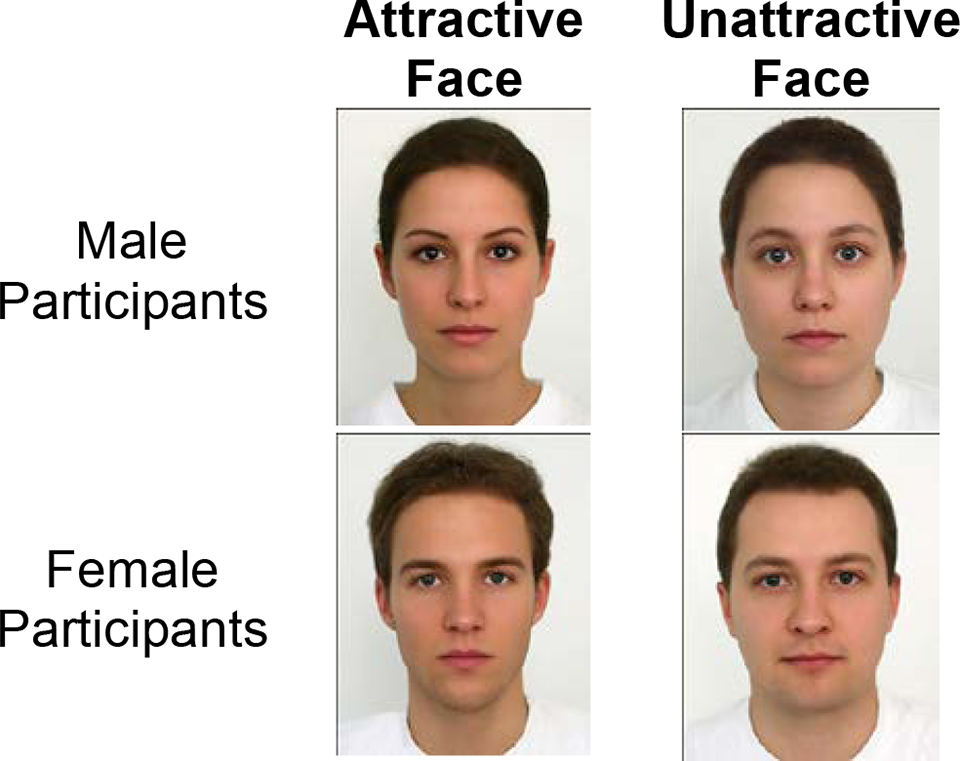
Stimuli for Study 3.
The design was a 2 × 2 × 5 mixed factorial (gender: male or female; attractiveness: low or high; fragment size: 1/6, 2/6, 3/6, 4/6, and 5/6) with face attractiveness and gender as the between-subjects factors and fragment size as the within-subject factor. Consistent with Study 2 and with the procedure these institutions used to develop the stimuli, all participants were exposed to faces of the opposite sex. After the presentation of each fragment, participants were administered the preference question, which consisted of choosing between receiving a candy bar and seeing the complete image revealed.
Results
We propose that the inverted U-shaped relationship between fragment size and preference for the whole image only exists for attractive stimuli but not for unattractive stimuli. As a preliminary test for this prediction, we first submitted all choice data to a repeated measures analysis using PROC CATMOD in SAS with attractiveness and gender as between-subjects factors and fragment size as a within-subject factor. As predicted, the analysis revealed a significant attractiveness × fragment size interaction (χ2 = 23.05, p = .0001) as well as a significant main effect of attractiveness (χ2 = 15.22, p < .0001). Fragment size was not significant (χ2 = 4.74, p > .30), nor was gender (χ2 < 1, p > .90). Figure 6 illustrates the mean preference for the fragment image as a function of fragment size and attractiveness of the target face.

Effect of fragment size and target attractiveness on preference for target face in Study 3.
Next, we analyzed the data using the same procedure for the attractive and unattractive face conditions separately. In the attractive face condition, we expected to replicate the inverted U-shaped relationship between fragment size and preference, whereas in the unattractive face condition, such effect was not predicted. For the attractive face condition (N = 87), the data revealed a significant effect of fragment size (χ2 = 14.49, p < .01). Post hoc comparisons indicated that the 4/6 fragment size condition produced the nominally highest preference for the target image (49.4%), which was significantly higher than the 1/6 or 2/6 conditions (M = 28.7% and 31.0% respectively; ps < .001) but not statistically different from the 3/6 or 5/6 conditions (M = 44.8% and 46.0% respectively; ps > .16). Thus, the effect found in the attractive condition was directionally consistent with the first two studies. In the unattractive condition (N = 111), the analysis revealed a significant main effect of fragment size (χ2 = 11.36, p < .05). But here, preference for the target image was the highest for the 1/6 fragment (24.3%) and declined as the fragment size increased. As a result, preference for the target image was significantly lower when fragment size was 3/6 or larger (M3/6 = 16.2%, M4/6 = 15.3%, M5/6 = 18.0%; ps < .05). This pattern of results for attractive and unattractive fragments is consistent with our predictions.
Discussion
Study 3 provided support in favor of our prediction, that is, that the effect of visual concealment on preference does not hold for unattractive stimuli, as these are less likely to evoke curiosity and positive inferences. Through the first three studies, we have shown consistent support for the hypothesized inverted U-shaped effect between visual concealment and preference and part of its underlying mechanism using within- and between-subjects designs and a wide array of choice and rating scales, dependent measures, and multiple versions of concept cars and computer-generated human faces. The next three studies aim to delve more deeply into our proposed underlying mechanism and additional boundary conditions. Specifically, while we have provided some hint that the effect is associated with curiosity, going forward, we delve more deeply into the mechanism and directly test if visual concealment indeed generates curiosity toward a partially revealed stimulus, which then leads to positive affect related to how aesthetically pleasing the item would be if completely revealed.
Study 4
Study 4 aimed to provide mediation support in favor of the proposed theoretical mechanism. Because we predicted that the effect of visual concealment on preference is influenced by a curiosity drive that generates positive affect toward the stimulus and leads consumers to make positive evaluations of it, in this design, we estimated a mediation analysis that tested the serial process involving curiosity and positive affect associated with the stimulus.
Method
One hundred fifty-two MTurk workers participated in this experiment in exchange for monetary compensation. The design employed was between subjects and, as in Study 1, at the beginning of this experiment, participants were asked to view an image of the concept car Audi Rosemeyer and answer some questions associated with this experience. Half of participants saw an image in which half of the vehicle was visually concealed while the other half saw an image in which the car was fully revealed. After participants viewed the image, they were again asked to respond to rating measures on a nine-point scale. Among others, these questions probed them about how much they liked the vehicle and how aesthetically pleasing the concept car was. These two questions intended to measure aesthetic preference for the concept car images. We also included measures on how positive consumers felt overall, how positive they felt that the car would look as attractive in person as they thought, and how curious they were about seeing the car in person. The first two questions aimed to shed light onto what type of positive affect was observed while the third question pertained to curiosity. We also included a question asking participants how likely they would be to buy the concept car they saw. This measure intended to show that this effect also influences purchase-related behavioral intentions.
Results
Curiosity
We performed a t-test with visual concealment as the independent factor and curiosity as the dependent variable. As we expected, participants in the visual concealment condition were more curious about seeing the concept car in person than those in the no-visual-concealment group (Mconceal = 5.69 vs. Mno conceal = 4.53; t(150) = 2.66, p < .01).
Overall positive affect
We performed a t-test with visual concealment as the independent factor and the positivity manipulation check as the dependent variable. We expected that there would not be an effect of visual concealment on overall positive affect, as this manipulation was intended to specifically influence positivity associated with what the target stimulus would look like in person. We confirmed that this was the case, as visual concealment did not influence overall positive affect (Mconceal = 5.46 vs. Mno conceal = 5.34; t(150) < 1, n.s.).
Stimulus positive affect
We performed a t-test with visual concealment as the independent factor and the positive affect measure as the dependent variable. As we expected, participants in the visual concealment condition experienced more positive affect toward the stimulus than those in the no-visual-concealment group (Mconceal = 5.82 vs. Mno conceal = 4.55; t(150) = 3.21, p = .002).
Preference
We combined the liking and aesthetics dependent variables to create a preference index (r = .92). We performed a t-test with visual concealment as the independent factor and the aesthetic preference composite score as the dependent variable. As expected, participants in the visual concealment condition found the concept car model to be more aesthetically appealing than those in the no-visual-concealment group (Mconceal = 5.65 vs. Mno conceal = 4.00; t(150) = 3.75, p < .0001).
Likelihood to buy
We performed a t-test with visual concealment as the independent factor and the likelihood of purchase measure as the dependent variable. As expected, subjects in the visual concealment condition expressed higher likelihood to buy the car than those in the no-visual-concealment group (Mconceal = 4.38 vs. Mno conceal = 3.24; t(150) = 2.70, p < .01).
Mediation by curiosity and stimulus positive affect
We predicted that the effect of visual concealment on aesthetic preference would be driven by a two-stage process involving curiosity and stimulus positive affect. To confirm this, we tested for serial mediation using Model 6 (Hayes 2013) and found that the visual concealment manipulation had a significant indirect effect on aesthetic preference through a serial process involving curiosity and stimulus positive affect (β = −.38, 95% confidence interval [CI]: [−.13, −.73]). Furthermore, we performed a regression analysis including visual concealment, curiosity, and stimulus positive affect as independent variables and the aesthetic preference composite as the dependent factor and showed that both mediators, curiosity (β = .42, 95% CI: [.30, .54]) and stimulus positive affect (β = .55, 95% CI: [.41, .68]), were significant while visual concealment was not (β = −.47, 95% CI: [−.97, .04]). In addition, we found that the correlation between the curiosity and positive affect mediators (r = .57), and these with relation to the dependent variable (r = .65 and r = .68, respectively), was moderate, which provides further reliability to our results. This series of findings provides support in favor of our proposed underlying mechanism.
Discussion
Study 4 provided direct support in favor of our proposed theoretical mechanism by providing a serial mediation analysis that supports our hypothesis. Study 4 also sheds light on the potential managerial relevance of the effect by showing that it may positively influence purchase likelihood. While this study provides initial mediation evidence in favor of our mechanism, it has the limitation that it only included two fragment conditions, one in which half of the stimulus was revealed and another one in which it was revealed in its entirety. To provide a more comprehensive test of our mechanism, we ran a subsequent study in which we included six fragment conditions.
Furthermore, while Study 4 provided support in favor of the managerial relevance of the effect by showing it may influence purchase likelihood, in a new study, we introduced an additional product category with sneakers, a product type that is relevant to digital commerce. Furthermore, in this new study, we manipulated visual concealment in a different way. While the first four studies focused on visual concealment tactics, in the following study we instead used a product presentation manipulation that is more relevant to electronic commerce.
Study 5
Study 5 had several objectives. First, it built on the initial mediation evidence provided in Study 4 to provide more robust support for the theoretical account through a more comprehensive design and mediation analysis. Specifically, in this design we exposed participants to six visual concealment levels and showed that higher levels of curiosity and positive affect led to higher aesthetic preference as a consequence of the manipulation. To perform this comprehensive analysis, we relied on nonlinear mediation techniques (Hayes and Preacher 2010). In addition to its theoretical importance, this study introduced a different type of visual concealment manipulation that provided evidence for the generalizability of the effect and marketing relevance. While in the first four studies we employed visual concealment tactics consistent with teaser ads, in this study we introduced a visual concealment approach that is more relevant to digital commerce. In this case, instead of cropping parts of images, we showed participants a different number of snapshots or angles of a product like the images shown by internet stores such as Amazon, Zappos, and so on. Thus, in this case, we did not conceal visual information about the product by blocking or cropping parts of the image but instead concealed certain visual aspects of the stimuli by presenting different snapshots of the product that, depending on the condition, revealed different amounts of visual information. The fact that we were able to replicate the effect in this new setting demonstrates that the present research also has important implications for electronic commerce, as online marketers often face the decision of how many images of their items they should display on their websites or social media pages to generate more favorable evaluations.
In addition, this study provided evidence for the effect using a new product category. Studies 1 and 4 relied on novel cars as stimuli, a product category that typically relies on visually concealed teasers. In contrast, Studies 2 and 3 employed computer-generated human faces with the objective to rule out the alternative explanation associated with different levels of attractiveness between the revealed and concealed fragments. In the present study, we instead used sneakers as stimuli, a popular product category in digital commerce. This product category, along with the visual concealment manipulation, was used to provide more realism to the design.
Finally, while this design is relevant to digital commerce, it may also raise some concerns. Specifically, it is possible that merely showing snapshots of a product may not make it as apparent that some pieces of information are being withheld from view, as was the case with the visual concealment manipulation. Given this, we featured the corresponding snapshots of the product in each condition within a matrix consisting of six boxes. Which of the six boxes were populated depended on the number of images of the product that were supposed to be featured according to the condition as well as random assignment. Thus, the use of the matrix was intended to help participants realize that one snapshot of the product was not being presented and that they needed to make their evaluations with incomplete information.
Method
Five hundred seventy-three MTurk workers living in the United States participated in this study in exchange for monetary compensation. The design contained six between-subjects conditions that varied based on the number of product images that participants were exposed to (number of images: one, two, three, four, five, and six). Unlike prior studies where each visual concealment condition exposed participants to a set image that featured a particular amount of the product, in this case each visual concealment condition presented a particular number of images which were randomly selected. Thus, the visual concealment manipulation consisted of providing one to six snapshots of different angles of the sneakers. This ruled out the alternative explanation that the effect was due to the specific images being presented and not to the amount of visual concealment per se. The product used for this study was a Nike shoe. Figure 7 illustrates the different snapshots of the product consumers viewed.

Stimuli for Study 5.
Participants were told that in this study they would be asked about their opinions associated with running shoes. After seeing the images based on the conditions they were randomly assigned to, participants were asked questions such as “How attractive is the product?” and “How aesthetically pleasing is the product?” on a nine-point scale. These two questions were intended to measure aesthetic preference for the product. We also included measures on how curious participants were about seeing the product in person and how positive participants felt that the shoes would look as attractive in person as they thought. These measures corresponded to our proposed mediators.
Results
Curiosity
We performed a one-way ANOVA with visual concealment as the independent factor and the curiosity measure as the dependent variable. As expected, there was a significant effect of visual concealment (F(5, 567) = 4.09, p = .001). Because our theory proposes that a moderate amount of visual concealment will lead to more curiosity, we compared the peak of the trend, which occurred at four images of revelation, with the two extremes of the sequence. As expected, we found that curiosity was higher when four images of the item were revealed (M4 = 5.02) as compared with only one (M1 = 3.56; F(5, 567) = 7.98, p = .005) or when the product was completely revealed (M6 = 4.05; F(5, 567) = 7.09, p < .01). Figure 8 illustrates the means for all conditions across the different factors investigated in Study 5.

Effect of visual concealment on curiosity, stimulus positive affect, and preference in Study 5.
Stimulus positivity
We performed a one-way ANOVA with visual concealment as the independent factor and the stimulus positivity measure as the dependent variable. As we expected, there was a significant effect of visual concealment (F(5, 567) = 5.49, p < .0001). Because our theory proposes that a moderate amount of visual concealment will lead to more curiosity and subsequent positive affect about what the stimulus will look like if completely revealed, we compared the peak of the trend, which again took place at four images of revelation, with the two extremes of the sequence. As expected, we found that positivity was higher when four images of the item were revealed (M4 = 5.97) as compared with only one (M1 = 4.31; F(5, 567) = 10.17, p < .005) or when it was completely revealed (M6 = 4.91; F(5, 567) = 22.99, p < .0001).
Aesthetic preference
We combined the attractiveness and aesthetics dependent variables to create an aesthetic preference index (r = .86). We performed a one-way ANOVA with visual concealment as the independent factor and the aesthetic preference index as the dependent variable. As expected, there was a significant effect of visual concealment (F(5, 567) = 5.60, p < .0001). Because our theory proposes that a moderate amount of visual concealment will maximize aesthetic preference more than if the item was completely revealed, we compared the peak of the trend, which again took place at four images of revelation, with the two extremes of the sequence. As expected, we found that aesthetic evaluation was higher when four images of the item were revealed (M4 = 5.83) as compared with only one (M1 = 4.24; F(5, 567) = 24.77, p < .0001) or when it was completely revealed (M6 = 4.97; F(5, 567) = 9.91, p < .005).
Mediation by curiosity and stimulus positive affect
Our prediction proposed that the nonlinear effect of visual concealment on aesthetic preference will be driven by a two-stage serial process involving curiosity and stimulus positivity.
As a test of the nonlinear indirect effect, we extended Hayes and Preacher’s (2010) nonlinear indirect model with a single mediator to a nonlinear indirect model with two serial mediators. In a nonlinear indirect model wherein the indirect effect of variable X on Y through a single mediator M is nonlinear, the parameter of interest is the instantaneous indirect effect of X on Y through M. This parameter, denoted as θ, quantifies the change in the endogenous variable Y through the mediator M as the exogenous variable X is changing and can be estimated as the product of the first partial derivative of the function of M with respect to X and the first partial derivative of the function of Y with respect to M (Hayes and Preacher 2010). Based on the same logic, we derived the instantaneous indirect effect of visual concealment on preference through two serial mediators, curiosity and positive affect, as the product of three terms, namely (1) the first partial derivative of the function of curiosity with respect to visual concealment, (2) the first partial derivative of the function of positive affect with respect to curiosity, and (3) the first partial derivative of the function of preference with respect to positive affect. Specifically,

where θ = the instantaneous indirect effect of visual concealment (X) on preference (Y) through curiosity (M1) and positivity (M2).
We estimated θ at three levels of visual concealment (1 SD below the optimal point, the optimal point, and 1 SD above the optimal point). We identified the optimal point of visual concealment by setting the first derivative of the equation related to preference with respect to visual concealment to zero (optimal visual concealment = 4.06, slightly above the mean of 3.61). We found that θlow = .236 (95% CI = [.106, .374]), θoptimal = .006 (95% CI = [−.063, .072], n.s.), and θhigh = −.176, (95% CI = [−.360, −.006]). These estimates suggest that increasing visual concealment from a low level to a moderate level would slightly increase preference through the effect of the increase in curiosity and, subsequently, positive affect. At the optimal concealment, preference reaches the maximum level. However, an increase of visual concealment beyond the optimal point of visual concealment would actually lead to a deterioration of preference through its effect on curiosity and then positive affect. Finally, we found that the correlation between the curiosity and positivity mediators (r = .60) and these with relation to the dependent variable (r = .64 and r = .66, respectively) was moderate, which provides further reliability to our results.
Discussion
Study 5 provided further support in favor of our proposed theoretical mechanism involving curiosity and positive affect associated with the target stimulus. While Study 4 provided initial mediation support for this theorizing, its design had the limitation of only including two visual concealment conditions. In this case, we used nonlinear mediation techniques and provided support for the effect across six levels of visual concealment.
Furthermore, in this study visual concealment was manipulated in a different way, which did not involve the cropping of images but instead consisted of showing a different number of images showcasing different angles of the product. Each visual concealment condition showed a different number of randomly selected images, which also helped alleviate the alternative explanations related to the specific image shown in each visual concealment condition in past studies. In addition, the use of the matrix to cue participants that some snapshots of the product may be missing helped address the concern that this new manipulation may not have made it apparent to participants that some angles of the product were being concealed.
In addition, given the visual concealment manipulation used, this study is different from the first four designs as it transcended the advertising teaser tactic environment through the use of a visual concealment manipulation that is more in line with digital commerce environments. This provides support for the effect being relevant to this growing area of commerce. Relatedly, this study introduced the use of a new product category, sneakers, a product type consumers often buy from online retailers.
After establishing additional mediation support for the effect and its underlying mechanism and establishing its validity for marketing relevant contexts such as teaser advertising tactics and online commerce operations, we ran a final study in which we more convincingly showed the ecological validity of the effect. This study was run on a real-life advertising environment, Facebook, and we showed that the manipulation of visual concealment can affect preference in this social media setting involving real consumers.
Study 6
Study 6 aimed to further demonstrate the managerial relevance of the effect. While the previous studies have used managerially relevant stimuli such as teaser images of products (like those found in advertising settings) or different snapshots of items (like those prevalent in e-commerce) as well as substantially important dependent variables such as choice and likelihood of purchase, all these studies were conducted in laboratory-controlled environments. This final study departs from that approach, as it was conducted in a real-life social media environment with real users, specifically on Facebook. The product advertised was also a real-life shoe model that had not been launched to the market yet, which allowed us to test the effectiveness of the manipulation with a product that was unfamiliar to consumers. The fact that we replicated the basic paradigm of the phenomenon in a relevant real-life environment provides support for the importance of this effect while complementing several rigorously conducted laboratory studies that establish the nature, boundary conditions, and underlying mechanism behind the effect.
Method
The study was conducted during a 48-hour period in a five-mile radius within the center of the city where the university is located. The item used was the recently released shoe model Adidas ZX 4000 4D, which became available in May 2019, and the study was conducted in April 2019. This means that consumers were unfamiliar with the item at the moment of the experiment. We were able to obtain official images from an Adidas press release ahead of the market launch of the product. Given the limitations posed by using rare official images of a yet to be released shoe model, the image used for the low-concealment condition did not involve the display of white socks along with the shoes, while those used for the high- and moderate-concealment conditions did. However, the pattern of results obtained was consistent with prior studies, which suggests that this detail was not the driver of the results.
Because the product was a shoe model mostly purchased by younger consumers, the age range of users exposed to the item on Facebook was from 18 to 29 years old. The product was unisex, so the study included both men and women. The budget for the study was $300, which determined the reach that the advertising would have to consumers in the area.
This design had three between-subjects conditions (visual concealment: high, moderate, and low). In this case, the visual concealment manipulation consisted of presenting an image that differed in how much of the product was concealed. All participants were exposed to one image of the product, but how much of it was revealed depended on the condition in which they were randomly assigned. We used this new manipulation because of space and number-of-image limitations, as the study consisted of a Facebook ad, which involved certain restrictions. However, this gave us the opportunity to provide further support for the effect in a somewhat different real-life paradigm. We pretested the images with a similar population (N = 455) to ensure that the visual concealment manipulation worked as intended. Specifically, we first asked participants to estimate on an 11-point scale how much of the featured shoe was revealed in the image. We then asked them to estimate what percentage of the featured shoe was revealed in the image. See Figure 9 for the images.

Stimuli for Study 6.
The study consisted of featuring an ad of the product to Facebook users. The ad included an image of the product and the text “Click if you like this innovative shoe model!” We assessed preference for the item by counting the number of Facebook users who chose to click on the item across conditions. We predicted that the advertisement featuring moderate concealment would be selected more often, as consumers would find it more aesthetically attractive. It is worth mentioning that this study represented a conservative test for our effect, as real-life consumers often click less than 1% of the ads they are exposed to online. For example, Facebook’s average click-through rate is .9% (Irvine 2019).
Results
Manipulation checks
As we predicted, participants in the medium-visual-concealment condition (Mmed = 5.66) thought that the image revealed more of the product than those in the high-visual-concealment condition (Mhigh = 4.52; t(452) = 5.90, p < .0001) and less than those in the low-visual-concealment condition (Mlow = 7.48; t(452) = 9.43, p < .0001). Consistent with that, participants in the medium-visual-concealment condition (Mmed = 54.11%) thought that the image revealed a higher percentage of the product than those in the high-visual-concealment group (Mhigh = 43.74%; t(452) = 4.75, p < .0001) and less than those in the low-visual-concealment condition (Mlow = 71.53%; t(452) = 7.94, p < .0001).
Preference
The Facebook ad reached a total of 12,804 screens randomly divided across conditions. Consistent with previous findings on low click-through rates online, the ad was chosen only 83 times (.65%). Of these clicks, 26.5% were in the high-concealment condition, 44.6% were in the medium-concealment condition, and 28.9% were in the low-concealment condition. Despite the low click-through rate and the limited budget for the study, we found support for our hypothesis. We performed z-tests that included the number of clicks and the number of screens reached per condition. As expected, we found that the click-through rate was higher in the medium-visual-concealment condition (Mmed = .90%) than in the high-visual-concealment condition (Mhigh = .51%; z = 2.12, p = .03) and the low-visual-concealment condition (Mlow = .55%; z = 1.93, p = .05). Furthermore, there was no difference in click-through rates between the low- and high-visual-concealment conditions (z < 1; n.s.). Because our hypothesis is that the medium-visual-concealment condition would generate higher preference than the other two conditions, we collapsed the latter and compared them with the medium-visual-concealment condition (z = 2.43, p = .01).
Discussion
This last study further demonstrates the managerial relevance for the effect of visual concealment on preference. While Studies 1 through 5 included real-life products, relevant forms of visual concealment (teaser ads, e-commerce images), and meaningful dependent variables (choice, likelihood of purchase), they had been constrained to laboratory-controlled environments. Study 6 establishes the managerial relevance of the effect as well as its ecological validity, as it consisted of a real-life advertisement presented to active users of the social media platform Facebook. What is perhaps more surprising is that we found evidence for the effect despite the fact that click-through rates of online advertisements are notably low and that the budget for the reach of the ad was limited to $300. This, along with the fact that the effect has been replicated in a number of studies using a varied set of stimuli and experimental paradigms, provides robust evidence for the effect.
General Discussion
The present research examines how the partial visual concealment of product images influences preference associated with a novel aesthetic product. Drawing on prior research on curiosity (Hunt 1963; Kupor and Tormala 2015; Loewenstein 1994; Olson, Camp, and Fuller 1984; Peters 1978), we hypothesized that visual concealment associated with a visually attractive item would enhance aesthetic evaluation as a function of curiosity and positive affect about what the stimulus would look like if completely revealed. This led to the prediction that moderately concealing visually attractive items would generate higher aesthetic evaluations than if these were completely revealed. This would occur as a result of a boosting effect of curiosity and accompanying positive affect toward the stimulus. This hypothesis was supported using data from five laboratory studies and one field study where participants were shown partial or full images of a target stimulus (concept cars, human faces, and sneakers) and indicated their aesthetic preference associated with it. A surprising regularity in the data is that curiosity and preference were consistently maximized when approximately one-half to two-thirds of an attractive product was revealed to study participants, a level that reveals enough of the whole to support favorable inferences yet still leaves enough room for a boosting effect of curiosity and positive affect toward the stimulus.
Theoretical Contributions
The present findings enhance our knowledge of the stream of work investigating how marketers should administer product information to generate more positive consumer reactions. While previous work has shown that tactics such as temporarily withholding attractive information about a product in the prechoice stage and revealing it at a later point in time (Ge, Häubl, and Elrod 2012) or even withholding the existence of an option of interest altogether and allowing it to be discovered in later stages of the decision-making process (Ge, Brigden, and Häubl 2015) may lead to higher preference associated with these options. In this case, we show that preference not only can be positively influenced by strategically revealing information but also can be improved as a result of enhancing the effect of curiosity and positive affect by concealing some of the information associated with a product altogether. Thus, our findings hold several implications for how marketing managers might better use concealment tactics to enhance consumer preference for products and services. For example, perhaps the most salient finding is the idea that concealment might work best in settings where it would seem least needed: when selling highly aesthetic goods. Here, we find repeated evidence that the most attractive products benefit by holding something back.
The research also makes an important contribution to the area of visual aesthetics. Previous work in this area has traditionally demonstrated that aesthetic reaction is more favorable when consumers are able to appropriately perceive and appreciate the visual properties of an item (Hekkert 2006). In fact, the first response consumers experience when exposed to an object is that of aesthetic appreciation (Bloch 1995), as aesthetic reaction takes place in a fleeting way (Arnheim 1974; Bloch 1995; Leder et al. 2004; Veryzer and Hutchinson 1998). Yet we make the counterintuitive finding that partially concealing a visually attractive item may lead to disproportionately favorable aesthetic perceptions if (1) consumers are able to appreciate enough of the item to infer what the whole will look like and (2) enough of the item is concealed to elicit curiosity and positive affect.
The present work also enhances our understanding of one of the five facets of visual perception (Sample, Hagtvedt, and Brasel 2019), specifically, shape. While prior work has demonstrated the role of shape completeness on preference for homogeneous items for which every single fragment is constant (Sevilla and Kahn 2014), the present research adds to our understanding of how completeness influences preference in cases where each piece of the stimulus is heterogeneous.
Finally, while our work was initially motivated by an applied problem in advertising design and online retailing, we suggest that this research also contributes to a deeper understanding of the effect that curiosity has on consumer and human behavior as a whole. While previous work has shown that curiosity sparks consumer interest and leads to a desire to acquire and process novel information (e.g., Kupor and Tormala 2015; Loewenstein 1994), which may subsequently lead to higher preference (Menon and Soman 2002), the present research goes a step further and shows that curiosity may directly result in higher aesthetic preference even in cases when the possibility of obtaining additional information is not available. Our results demonstrate that this boosting effect of curiosity on aesthetic preference is influenced by positive affect about what the object would look like if viewed in full. This finding is in line with literature on consumer behavior showing that, in some contexts, people are prone to making optimistic product evaluations in the absence of complete product information. Some of these contexts have included unexpected color or flavor names (Miller and Kahn 2005), unfamiliar brands (Posavac et al. 2004), and new services (Folkes and Patrick 2003). In the present work, we show a similar effect in the domain of aesthetically relevant products. However, the present findings are not as straightforward and seem at odds with extant literature on consumer inference. Specifically, early work on the effect of missing attribute information (e.g., Huber and McCann 1982; Meyer 1981) showed that consumers tend to discount their product assessments when information about sensitive attributes such as price or quality is withheld. In this case, we are able to show that, in the context of visual concealment of aesthetically relevant items, withholding product information may generate favorable aesthetic responses if it triggers enough curiosity and positive affect among consumers.
Future Research Directions
An important avenue of future research is to explore the degree to which this same idea extends to nonaesthetic goods such as software, where what is being held back is not visual access to the whole but access to functionality. Just as we find that there is an “ideal” percentage of a visual image to reveal (about two-thirds, in our case), there may be similar ideal points in the optimal design of trial packages for software or other functional goods—points at which assessments of the fraction exceed that of the whole. Relatedly, the present findings suggest that the highest level of curiosity may not always take place when consumers are just “one hair away” from reaching full information (Loewenstein 1994), and that this may vary across different marketing domains.
Similarly, another direction for future work would be to investigate how the present findings might generalize to homogeneous product stimuli where a small fragment fully reveals the value of the whole. A good example of such a context is food samples, in which what is being concealed is not the product itself (e.g., a one-ounce Hershey’s sample provides the same objective information about the product as a three-ounce sample) but rather the hedonic experience of multiple periods of consumption (how one will feel eating another one-ounce bar after a three-ounce taste). In future work, it would be interesting to explore whether the pattern of curiosity and positive affect observed here generalizes to such stimulus domains. For example, it would be fruitful to inquire whether the documented effect would apply to food sampling. Retailers often invite consumers to taste samples of their products (e.g., Costco, Kroger). If the present effect applies to homogeneous stimuli, it is possible that finding the ideal sample size in this domain may also lead to relatively more favorable taste perceptions and likelihood of adoption. We leave the study of the multidimensionality of the effect for such homogeneous stimuli to future research, as the effect would likely be explained by different mechanisms such as learning and satiation and not curiosity.
Footnotes
Acknowledgments
The authors would like to thank Son Lam for his help in earlier versions of this work.
Associate Editor
Gerald Häubl
Declaration of Conflicting Interests
The author(s) declared no potential conflicts of interest with respect to the research, authorship, and/or publication of this article.
Funding
The author(s) received no financial support for the research, authorship, and/or publication of this article.