







Abstract
When customers journey from a need to a purchase decision and beyond, they rarely do so alone. This article introduces the social customer journey, which extends prior perspectives on the path to purchase by explicitly integrating the important role that social others play throughout the journey. The authors highlight the importance of “traveling companions,” who interact with the decision maker through one or more phases of the journey, and they argue that the social distance between the companion(s) and the decision maker is an important factor in how social influence affects that journey. They also consider customer journeys made by decision-making units consisting of multiple individuals and increasingly including artificial intelligence agents that can serve as surrogates for social others. The social customer journey concept integrates prior findings on social influences and customer journeys and highlights opportunities for new research within and across the various stages. Finally, the authors discuss several actionable marketing implications relevant to organizations’ engagement in the social customer journey, including managing influencers, shaping social interactions, and deploying technologies.
Many consumer decisions do not occur in isolation but rather within an interactive context of social relationships and societal concerns, often facilitated by technology. In a paradox of modern society, then, the more that technology allows us to connect with others, the more fragmented society becomes, with increasing alienation and disconnection (Lin et al. 2016). Modern marketing came of age in postwar America, in a familiar milieu featuring nuclear families, physical retail locations, mass-printed catalogs, and broad consumer segments. Consumers decided what to buy on the basis of one-way communications from advertisers and two-way interactions with friends and neighbors. Capturing the zeitgeist, Granovetter (1973) based his theory of social influence on the assumption of people living “in a community marked by geographic immobility and lifelong friendships” (p. 1375), in which social ties are created by distinct and often predictable social contexts.
Today, much has changed. Nuclear families have given way to single-parent and blended family households, physical stores and printed catalogs have been replaced by online retailers that use algorithm-powered interactive tools, and personalization has supplanted segment-based targeting. Digital technology has vastly expanded the contexts within which people socialize, allowing them to form and maintain relationships beyond limits circumscribed by geography. Artificial intelligence (AI) agents, such as Amazon’s Alexa and Apple’s Siri, play increasingly relational roles in consumers’ daily lives, complementing and even substituting for other social interactions (Novak and Hoffman 2019). Thus, it seems inevitable that consumer decision making should evolve along with these technological and social changes. Consequently, it is vital for marketers and researchers alike to acknowledge, investigate, and delineate these fundamental shifts. This article takes on this challenge and examines the changing and pervasive role of social influence throughout the consumer decision-making process.
We approach the challenge of understanding social influence on consumer decision making from the perspective of customer journeys, which break decisions into a series of steps that constitute a path to purchase and beyond. These “journeys” (or, when a drop-off is expected in the number of people across successive steps, “funnels”) were recognized at least as far back as the late 1800s, when marketing experts decomposed the effectiveness of advertising into a series of staged effects. The most influential of these early stepwise models evolved into the AIDA framework—Awareness, Interest, Desire, and Action—and is still popular in both academic settings and marketing practice (Strong 1925).
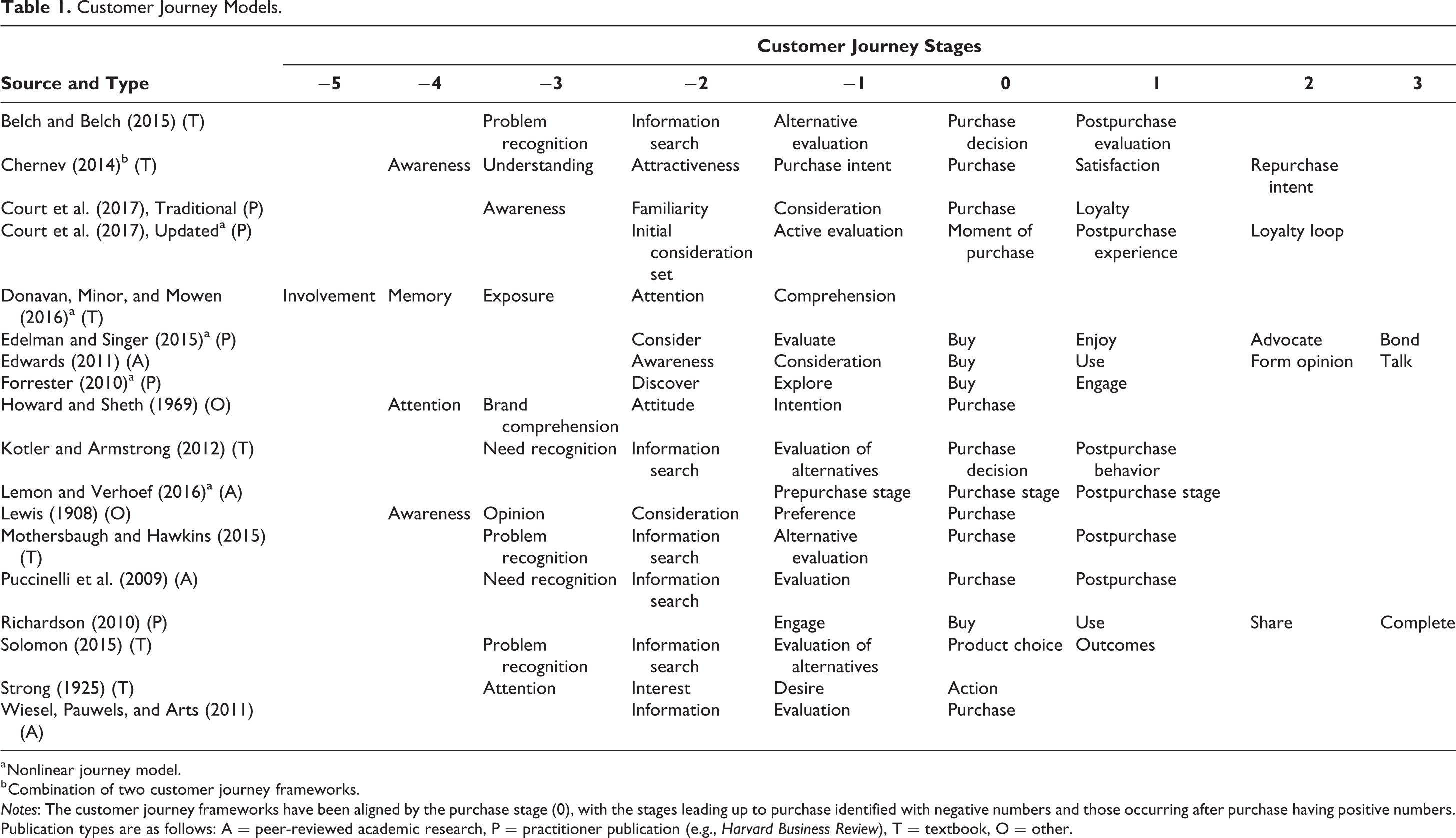
Over time, depictions of the customer journey, commonly referred to as customer journey maps, have become more complex and specialized, with additional stages and extensions added both before and after the purchase. Recent contributions include conceptualizing a nonlinear customer journey (Court et al. 2009), emphasizing the various stakeholders who “own” different touchpoints along the journey (Lemon and Verhoef 2016), and identifying a set of journey archetypes that acknowledge the diverse cognitive and behavioral states that motivate purchases (Lee et al. 2018). Others have argued that more than constituting simply a path to purchase, customer journeys are depictions of the entire customer experience (Puccinelli et al. 2009) or even paths to achieving life goals (Hamilton and Price 2019). In depicting the customer journey, these maps delineate the factors that may influence consumers along their decision-making process. Table 1 contains a cross-section of customer journey frameworks proposed by experts from the worlds of academic research, marketing practice, and marketing education. Although by no means exhaustive, the compiled list of journey frameworks emphasizes the different approaches adopted in the literature.
Customer Journey Models.
a Nonlinear journey model.
b Combination of two customer journey frameworks.
Notes: The customer journey frameworks have been aligned by the purchase stage (0), with the stages leading up to purchase identified with negative numbers and those occurring after purchase having positive numbers. Publication types are as follows: A = peer-reviewed academic research, P = practitioner publication (e.g., Harvard Business Review), T = textbook, O = other.
One common feature of these journey frameworks is that they are individual customer journeys, focusing on isolated consumers as the decision-making unit (DMU). When prior research has accommodated social influences in the customer journey, it has done so in a general way, either by emphasizing the importance of social factors without articulating those influences within the specific stages of the journey, or by viewing them as part of the set of broader environmental conditions throughout the journey. For example, Verhoef et al. (2009) consider the “social environment” as one of seven primary factors influencing customer experience. Puccinelli et al. (2009) incorporate social influences by acknowledging social cues as part of the atmospherics of a retail experience along with other elements such as design and ambiance. Lemon and Verhoef (2016) identify “social/external” as one category of touchpoints in the prepurchase, purchase, and postpurchase stages of their model. In all these cases, the authors endorse the importance of social influence but treat it as an independent factor or as one of several broad influences that can affect the journey.
A more recent depiction, the “needs-adaptive” shopper journey model (Lee et al. 2018), de-emphasizes the multistage journey model in favor of a more fluid set of “states” consumers may experience. By using differences in the movement among these states, the authors identify journey archetypes of common purchase situations. Consistent with previous work, this model acknowledges “peer-to-peer/social” influences as one of the “groups of factors that influence a consumer’s shopping process” (p. 279). However, it also allows for a more specific approach for incorporating social influences by identifying several archetypes that are inherently social: the “joint journey,” the “social network journey,” and the “outsourced journey.” Lee et al. (2018) also acknowledge that social influences can play a role even in archetypes not explicitly centered on social influence (e.g., “retail therapy journey” and “learning journey” both implicitly incorporate social influences). This customer-journey-as-archetype model provides a novel way of characterizing customer experiences and produces new insights. While these archetypal journeys clearly recognize the importance of social influences on the customer journey, the approach is deliberately divorced from previous work defining a customer journey as a set of defined stages. In this article, we suggest that returning to the classic customer journey model to investigate social influences can help generate complementary insights for researchers and practitioners.
With the exceptions noted previously, we believe that the core premise of existing frameworks is fundamentally decontextualized from social influences. This lack of focus on social influence in the customer journey stands in stark contrast to research documenting the many ways in which social contexts influence customer decisions. For example, consumers trade off their own preferences for those of the group (Ariely and Levav 2000) and consider how their purchases will be perceived by others (Berger and Heath 2007). The influence of social others is also relevant in business-to-business (B2B) contexts (Sheth 1973), including in sales interactions (Agnihotri et al. 2016) and in relationship marketing (Morgan and Hunt 1994). Thus, a somewhat surprising gap exists in the literature, as researchers have independently studied individual customer journeys and various aspects of decision making in social contexts but have left customer journeys in a social context largely unexamined.
In this article, we present the “social customer journey” and introduce the notion of “traveling companions” (or social others on the journey), who interact, directly or indirectly, with the decision maker through one or more phases of the journey. The introduction of these companions allows us to highlight not merely how they might influence the decision maker, but also how the companions’ own journeys may be influenced in turn. The goal of this article is not to create a more “accurate” journey map by accounting for a wider set of customer decisions, nor to provide a complete review of research on social influences in decision making. Instead, we highlight key insights about social influences throughout the customer journey and identify promising areas for new research and marketing insight by reflecting on a customer journey made increasingly complex by the ways in which it is affected by others. We also emphasize the interactive nature of customer journeys. Just as individuals are influenced by social others, those others, as individuals, groups, and even society as a whole, are influenced by the journeys of the individuals around them.
The Social Customer Journey
While consumers have long sought input from others in their decision making, particularly from those who are socially close, new technologies and societal changes have significantly altered the manner in which and extent to which purchases are influenced in some way by others. Moreover, the advent of online platforms and social media has changed the very definition of social closeness. The opinions of anonymous others and the aggregated ratings of groups of others are readily available in ways previously unimaginable. Consequently, even people who are seemingly socially distant may exert a powerful influence on one’s decisions. For example, consumers easily and eagerly ask their Facebook “friends,” whom they may never have met in person, for input into what restaurant to dine at while on vacation, and they actively seek out recommendations from quasi-celebrity “mommy bloggers” about what diaper bag to buy. After a purchase, consumers frequently share information about product performance, even for mundane purchases, on retailer websites and social media, potentially influencing the decision making of others with their ratings and reviews. The rise in the use of email lists and online industry forums, and greater participation in professional social networks, facilitated by technologies like LinkedIn, mean that social influences are increasingly as likely to affect business decision making as consumer decision making.
We employ a linear six-step journey (depicted in Figure 1) that builds on the greatest points of similarity from previous models: motivation, information search, evaluation, decision, satisfaction, and postdecision sharing. We acknowledge that the linear depiction does not fully capture the dynamics of decision making, as consumers may iterate between stages or drop out at any stage to restart the journey later. Moreover, nonlinear journey frameworks are useful in emphasizing the ongoing relationships consumers have with brands and retailers rooted in repeat purchases (Court et al. 2009; Lemon and Verhoef 2016). We represent these nonlinear paths with the circular loops in the figure. However, the linear model we use to frame this discussion provides a parsimonious and generalizable foundation for our analysis.
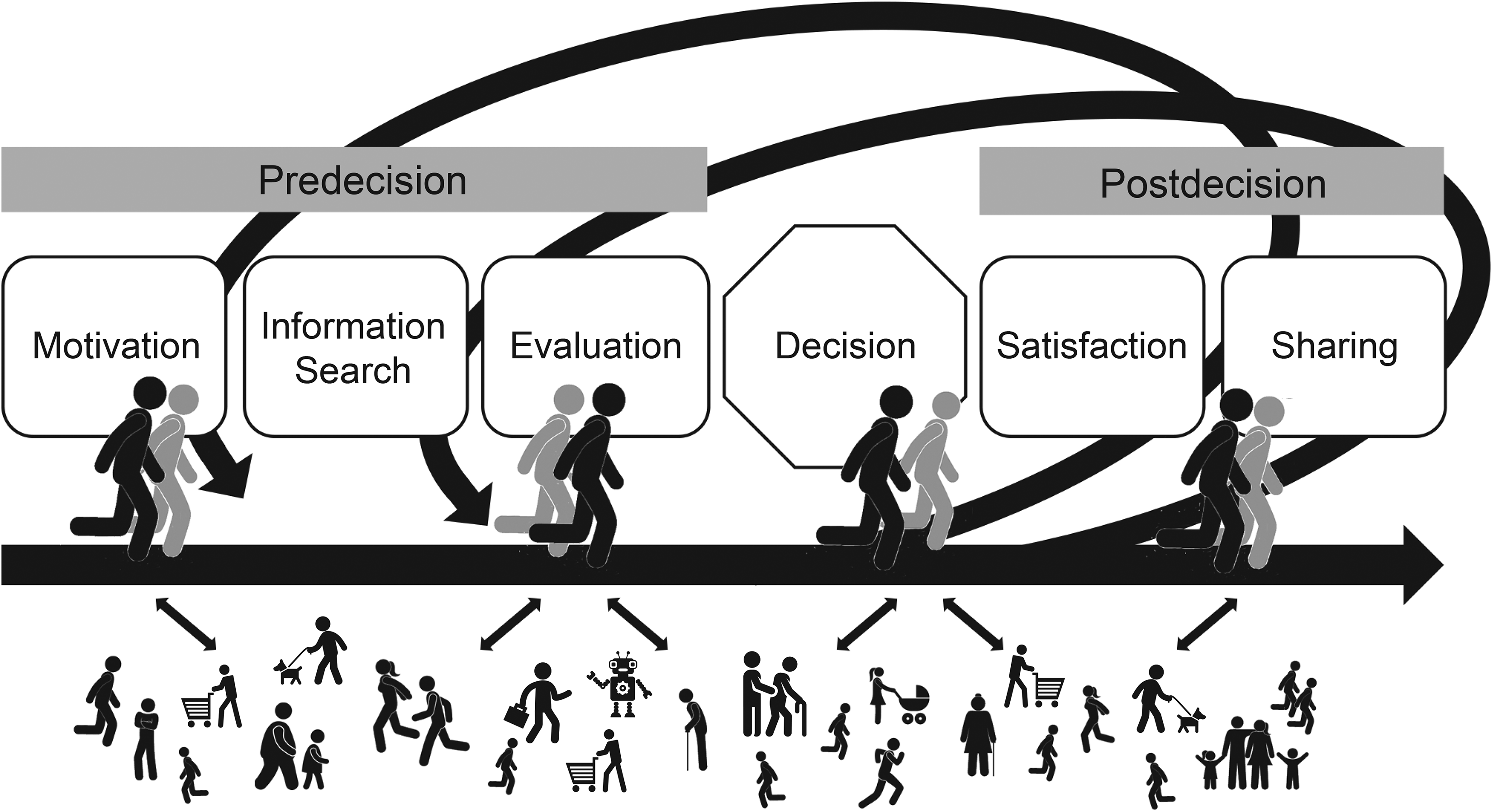
The social customer journey.
Our journey model extends the customer journey framework in two critical ways. First, it introduces the notion that social others (i.e., traveling companions), individually or in aggregate, can influence an individual customer’s decision journey at various stages, while also themselves being influenced by that customer. This is depicted in the figure by the individuals and groups below the solid line. The bidirectional arrows emphasize that social influences flow in both directions as these social others are on their own journeys. Second, it recognizes that some customer journeys occur for a DMU of more than one individual, depicted by the black and gray figures moving together in a joint journey.
Social Distance and the Social Customer Journey
Social others can play many different roles in a social customer journey (e.g., a face-to-face interaction with a close friend who raves about a new restaurant vs. the likes and glowing reviews of anonymous customers on social media and review sites). To help understand and characterize these various roles and influences, we propose a continuum of social others based on the closeness of others to the DMU. Social distance, as we are conceptualizing it here, can be affected by many social relationship dimensions, but we highlight five that are especially relevant to marketing researchers: number of social others, extent to which the other is known, temporal and physical presence, group membership, and strength of ties (see Figure 2). We suggest that these dimensions converge to form a global sense of social distance, but that not all dimensions need to be on the extreme ends of the continuum for the social other to be interpreted as overall more proximal or distal. Rather, we suggest that a preponderance of the factors will determine how close the social other is perceived to be.

Social distance considerations for the social customer journey.
“Proximal social others” are typically specific, individuated others that provide distinct, discrete, articulated inputs to the focal customer’s journey. They tend to be close—in terms of temporal and physical proximity—members of the customer’s in-group and have strong ties to the focal consumer. For example, a consumer’s evaluation of a potential vacation destination may be influenced by inputs from a proximal social other, such as a single, close friend representing one well-known, physically present in-group member with strong social ties.
“Distal social others” can be larger groups or the whole of society, whose members may not be individuated, present, temporally proximal, or even known to the consumer. When a distal other is a single individual, this individual will tend to be someone the consumer does not know personally, such as a YouTube tutorialist or an anonymous review writer. The same vacation-planning consumer may also be influenced by distal social others, including the reviews of hundreds of others on a travel website representing many, relatively unknown, not physically present social others with only weak social ties and unlikely membership in a readily identifiable in-group.
This social distance continuum and the dimensions highlighted in Figure 2 are consistent with existing theories of social influence. Brewer and Gardner (1996) model the self-concept with three levels of representation: personal, relational, and collective. The personal self reflects the self as an individual differentiated from others; the relational self reflects one’s self view vis-à-vis one’s close relationships, often in dyadic or small-group contexts; and the collective self suggests an even broader social perspective, viewed through the lens of group membership. Our view of social others parallels Brewer and Gardner’s view of the self, in which others exist on a continuum that moves from very proximal (personal) through increasing separation (relational) to very distal others (collective). Our framework also shares elements with construal level theory (Trope and Liberman 2010), which suggests that psychologically proximal versus distal objects, events, or people are viewed in more concrete versus abstract terms, respectively. Other people may be perceived as more proximal to or distal from the self; for example, in-groups are viewed as more proximal than out-groups, and those with close ties are viewed as more proximal than those with weak ties (Gilbert 1998). Finally, our framework incorporates elements from social impact theory (Latane 1981), which suggests that the degree of impact from the social environment depends on the size (i.e., number of people), immediacy (i.e., physical or temporal proximity), and strength (i.e., importance to the individual) of the group. The size and immediacy dimensions are incorporated directly as dimensions of social distance, with small (large) size and greater (lesser) immediacy being consistent with the proximal (distal) end of the continuum. We draw on these models, as they all highlight how the perceived social distance between the self and others affects decision making.
Importantly, this social distance distinction leads to meaningful differences in how social influence affects a customer’s journey. One straightforward proposition is that more proximal social others will have a stronger influence on customer journeys than more distal social others. Prior research supports this perspective, as social others with whom one shares strong ties have been shown to be influential (Brown and Reingen 1987). While we acknowledge that this may generally be the case, we also seek to highlight some sources of possible exceptions to this rule: (1) the importance of more distal social influences in certain contexts; (2) changes in perceived social distance, along one or more of the dimensions, often brought about by technological changes; and (3) the nature of, rather than simply the magnitude of, the roles that proximal and distal social others may play.
The importance of distal influences
Some research suggests that under some circumstances, distal influences can be more powerful than proximal ones. For example, Duhan et al. (1997) found that consumers with high subjective knowledge, or those who encounter instrumental cues, tend to seek recommendations from more distal social sources. Adding a further nuance, Kim, Zhang, and Li (2008) found that preference for socially proximal sources was moderated by temporal distance, while Zhao and Xie (2011) showed that others’ recommendations are most persuasive when their social distance aligns with the temporal distance of the decision itself. More generally, powerful normative influences often reflect the preferences of diffuse, unknown others.
Changes in perceived social distance
Changes in the actual or perceived nature of one or several of the social distance dimensions can move the social other from the more distal toward the more proximal end of the continuum, and vice versa. Relatedly, the perceived distance from social others is malleable. For example, reviewers may be perceived as similar to the consumer (Naylor, Lamberton, and West 2012), which would narrow the perceived social distance between the consumer and a typically distal social other, potentially increasing their influence (Gershoff, Mukherjee, and Mukhopadhyay 2003). Similarly, influence as a function of changes in perceived social distance is an idea that must increasingly be applied to nonhuman social companions, such as Amazon’s Alexa and Apple’s Siri (Novak and Hoffman 2019). As technology evolves, these entities will increasingly take on the person-roles of information gatekeepers, experts, and possibly even decision makers (a type of outsourced journey, per Lee et al. 2018). As they become more familiar and proximal—in our homes, in our cars, and on our persons—these AI agents may be seen as more proximal social others by some consumers.
Differing roles of proximal versus distal social others
Finally, we suggest that the precise roles of social others may change along with differences in perceived social distance. A friend may provide valuable information about a product, but the friend’s social closeness to the consumer may exert influence in other ways, such as by serving as a basis for social comparison or because the consumer desires to maintain a good relationship with that friend. Reviewers are more distal in social connection, and their impact is likely to be more informational. Yet as some or all of the social distance factors begin moving toward the more proximal or the more distal end of the continuum, corresponding changes in the respective roles may also change.
The Special Case of Joint Journeys
While technology and other societal forces have considerably broadened where and how traveling companions can influence the customer journey, perhaps the most fundamentally social journey is one wherein two or more consumers journey together. With respect to our social distance continuum, when a certain threshold is surpassed, social others may become incorporated into the DMU itself, creating a joint journey characterized by interdependence in most or all stages of the customer journey. This results in a pluralized DMU (see Figure 1, black and gray figures), where two or more people travel on a “joint decision, joint consumption” journey together (Gorlin and Dhar 2012). Decision making in such situations is qualitatively different because the members of the DMU have interdependent utilities (Hartmann et al. 2008), and the individual members of the DMU may, at each stage of the journey, base their own responses on the responses of the other. Consequently, joint journeys are complex and distinct from individual journeys because of the relationship dynamics that must be managed (Simpson, Griskevicius, and Rothman 2012).
Joint journeys were a key focus in early consumer research, with an emphasis on the family as the DMU (Davis 1970; Sheth 1974). For example, Burns and Granbois (1977) investigated how husband–wife dyads arrived at decisions involving the purchase of a family car. They found that the members of this dyad can vary in expertise, experience, and preferences, and their levels of involvement and empathy dictate their interactions across the stages of the decision process to arrive at a joint decision that is mutually acceptable. Since this early research, joint journeys have received sporadic interest (e.g., Corfman and Lehmann 1987); however, they have recently begun to reemerge as an important area of study both in dyads (e.g., Dzhogleva and Lamberton 2014) and in family units (e.g., Epp and Price 2008; Thomas, Epp and Price 2020). In a B2B context, decision making can be viewed through the lens of the joint customer journey as there are often several individuals playing a role in the decision-making process (Sheth 1973). We present the joint journey as a special case of the social customer journey and highlight the specific considerations these journeys entail.
Traveling the Social Customer Journey
We next discuss the effect of traveling companions at each stage of the social customer journey. As mentioned, a large literature has examined the effects of social influence on consumer decision making (for reviews, see Kirmani and Ferraro 2017 and Kristofferson and White 2015), but most of that research has not been framed within the customer journey. In what follows, we provide selected research insights that are relevant to the specific stage of the social customer journey, placing emphasis on insights highlighting proximal versus distal social influences. We also discuss research relevant to the special case of the joint journey. For each stage, we offer ideas for how viewing the customer journey through a social lens can generate new research, and we provide more detailed research questions in Table 2, including those related to both bidirectional and cross-stage effects.
Emerging Research Questions from the Social Customer Journey.

Motivation
Social others often shape the motivations that initiate a customer journey. Consumers are frequently motivated by interactions with and observation of proximal and distal others. From feeling the need to “keep up with the Joneses” to seeing a friend’s gushing review on Facebook to reading a celebrity’s social media post about a new exercise regimen, decision journeys are often inspired by in-person or virtual contact with others. While small groups of well-known others are likely to exert direct influence over what motivates a consumer to begin a journey, distal others have an increasingly powerful impact as technology allows one’s circle of influential others to expand beyond geographic proximity. In this section, we discuss social drivers of behavior that are primarily based on the proximal versus distal nature of the social other as key considerations for the motivation stage.
Proximal social others as motivational drivers
Consumers are motivated to affiliate with others and may do so by matching the consumption behavior of others (e.g., Tanner et al. 2008). For example, what or how much one chooses to eat is often motivated by wanting to associate with social others more than one’s own physiological need (McFerran et al. 2010). That desire to affiliate depends on social distance; for example, consumers form stronger connections with brands that are associated with in-groups as opposed to out-groups (Escalas and Bettman 2003). Yet consumers also make purchases as a way to differentiate from others (Chan, Berger, and Van Boven 2012), particularly in product categories that convey identity (Berger and Heath 2007). Consumers are less likely to choose products that are associated with out-groups. For example, White and Dahl (2006) showed that men had more negative evaluations of, and were less inclined to choose, a product associated with a female reference group. In short, the desire to affiliate or dissociate may be as dominant a motivation as addressing the underlying functional need (e.g., food, clothing, shelter), highlighting the importance of social motivation in understanding customer behavior.
Consumers are also motivated to engage in identity signaling, and they do so through the consumption of brands, products, and experiences that contain cultural meanings or associations with social status, traits, and aspirations (Kirmani and Ferraro 2017; Oyserman 2009). For example, choice of feature-rich products can signal wealth, technological skills, and openness to new experiences (Thompson and Norton 2011). Even if consumers are motivated to pursue a purchase for functional or other benefits, they may leverage the consumption opportunity for identity signaling. For example, consumers who are motivated to consume in an environmentally responsible manner may also use that consumption to signal how virtuous they are (Griskevicius, Tyber, and Van den Bergh 2010). The desire to signal status transcends socioeconomic boundaries. Ordabayeva and Chandon (2011) found that social competition can lead to increased conspicuous consumption among consumers of low socioeconomic status. While most signaling via consumption is likely done to influence proximal others, we expect that such signaling may be especially effective among distal others, as proximal others will tend to have more existing knowledge of the consumer.
Distal social others as motivational drivers
Distal social others may also have a significant impact on consumer decision making, especially on the altruistic or prosocial motivations of consumers (Chaney, Sanchez, and Maimon 2019; Oyserman 2009). For example, consumers may be motivated to consume (or not consume) for purposes of the greater good, and their decisions may include various forms of environmentally responsible consumption (Haws, Winterich, and Naylor 2014), as illustrated by recent interest in discontinuing the usage of single-use plastics (Madrigal 2018). In such cases, motivational influences can come from abstractly defined groups of social others and yet have a strong impact on one’s own motivation for both adoption and disadoption of certain products or practices. Businesses are not immune from this kind of distal social pressure. Firms’ decisions to source sustainably, to support (or not support) LGBTQ communities, or to force environmental, safety, or ethical standards on their suppliers are all examples of distal social influence on managers’ motivations.
An intriguing example of how distal social groups can influence motivation relates to the role of political orientation in consumer decision making (Crockett and Wallendorf 2004; Jost 2017). Ordabayeva and Fernandes (2018) showed that political ideology affects how consumers differentiate from others, such that conservatives are more likely to choose products signaling hierarchical status whereas liberals are more likely to choose products signaling uniqueness. Mohan et al. (2018) found that higher CEO-to-worker pay ratios were associated with lower consumer purchase intentions, but only among Democrats and independents. Kim, Park, and Dubois (2018) found that political ideology affects the relative motivation of maintaining status versus advancing status in the preference for luxury goods. In particular, political conservatives are more motivated by status maintenance in their consumption of luxury goods than are political liberals.
Social media platforms have increased the general revelation of one’s political beliefs as well as the intermixing of consumer decision making and politics. Bringing political views and related social causes to the forefront and aligning such views with influencers or brands may change the perceived social distance of the traveling companion vis-à-vis the alignment with one’s own political viewpoint. Interesting questions arise as to how consumers navigate conflicts between, for example, existing brand preferences and alignment with their social networks’ political ideologies.
Motivation in joint journeys
When the DMU has more than one member, there are unique opportunities for understanding the social nature of the customer journey because joint decision making introduces the need to negotiate different, often conflicting, motivations. Each member of the DMU must be on board with the motivation to engage in a specific journey, which means that individual members may need to persuade one another. Often this occurs in family settings in which DMUs share a collective identity and goals (Thomas, Epp, and Price 2020). This situation introduces roles for pro-relationship behaviors (e.g., Dzhogleva and Lamberton 2014), such as empathy (Burns and Granbois 1977), as well as pitfalls involving power (Corfman and Lehmann 1987), which may even influence future decision journeys in unrelated domains. In a B2B context, decision making often formalizes and codifies the split motivations of a DMU. When a major purchase is under consideration, the motivations of employees representing purchasing, engineering, legal, and operations may be at odds (e.g., minimizing cost vs. maximizing reliability). A particularly interesting question relates to how conflicting motivations among individual members of a joint journey DMU are reconciled, and what marketers can do to facilitate and influence that reconciliation.
Emergent research areas
Viewing the motivation phase of the social customer journey with an emphasis on both proximal and distal others can lead to exciting research avenues with clear implications for researchers and practitioners. At the more distal level, cultural values affect the form that needs take (e.g., functional vs. symbolic) as well as the means consumers use to fulfill those needs (e.g., luxury vs. nonluxury car). Social media brings to light new and conflicting views about what is desirable, raising interesting research questions. When are desires more influenced by distal groups rather than by proximal influences? How does the consumer reconcile situations in which those closest to the consumer provide motivational inputs that are in opposition to larger but more distal societal norms? Some motivational conflicts may lead to journey abandonment instead of continuation, whereas others may involve a choice between two different journey paths. As Louro, Pieters, and Zeelenberg (2007) found, perceived progress toward one goal can motivate people to pursue alternative goals if the focal goal is close. The factors determining perceived progress are contextually dependent, making this a fruitful area for future research. The converse direction of influence is also worth considering. The motivation of the decision maker may exert its own influence on the social other. People infer the motivation of others from observable cues (Cheng, Mukhopadhyay, and Williams 2020), and an actor who signals a high level of motivation may well motivate observers to set off on their own journeys.
In addition to the influence of social others on a consumer’s motivations, these traveling companions can also influence when and how motivation leads to action. It is possible, even likely, that traveling companions can spur decision makers to the next stage of the journey. If so, which companions are most likely to move a consumer from the motivation stage to the information search stage and beyond? Motivations stemming from proximal social others might lead to quicker movement than motivations arising from distal others; understanding when this is and is not the case is important. The precise genesis of one’s socially inspired motivations is likely to influence how one goes about continuing a customer journey.
Information Search
Information search involves accessing memory and the external environment for relevant product information. A large literature from economics and marketing suggests that consumers search for product information until the costs of acquiring additional information exceed the benefit of that additional information. New technology has made information search less costly and allowed consumers to access a wealth of new information sources. Information acquired from social others through word-of-mouth has long been an important source of product information and is often viewed as less biased than information coming from a firm (Friestad and Wright 1994). For many purchases, other customers have now become the go-to source for product information. Technology has enabled the collation of word-of-mouth communications beyond those of physically close others. Of course, information search may still entail talking to proximal others, such as family, friends, and neighbors, but increasingly, consumers first turn to information proffered by distal others via effectively anonymous product reviews or recommendations by social media influencers (Chen 2017). The level, type, sequence, and amount of search varies dramatically, and understanding this variation has been emphasized in prior research (e.g., Diehl 2005; Honka and Chintagunta 2017). We suggest that a deeper understanding of how various proximal and distal social inputs shape the search process is crucial in expanding overall understanding of this stage. In highlighting relevant issues at the intersection of social influence and information search, we emphasize the importance of the nature and sources of social information as key areas of consideration.
Nature of social information
Not only has technology dramatically changed consumers’ ability to search for information by enabling access to practically infinite sources of information, it has also changed the nature of the information on offer. Consumers may still access traditional sources of independent information (e.g., Consumer Reports), but they also may access personalized recommendations and evaluative information presented by countless distal consumers through product reviews. Recent research reflects the importance of product reviews within the customer journey. Key findings suggest that online reviews do not necessarily converge with independent expert reviews, such as those provided by Consumer Reports, and that consumers heavily weight average reviewer ratings without appropriately accounting for the sample size (De Langhe, Fernbach, and Lichtenstein 2015). Consequently, the inferences that consumers draw as they encounter and process this information directly affect the relative weight given to it in the evaluation stage. Consumers also draw inferences even in the absence of explicitly offered information, such as when social others display their preferences on platforms such as Pinterest. Even silence, particularly from a proximal social other, may be construed as assent or dissent with the decision maker’s own opinion, despite the social other not having intended to play an active role in the decision-making process (Weaver and Hamby 2019).
Sources of social information
The idea that the silence of one’s traveling companions can influence a customer’s journey highlights the profound shifts in information search brought about by technology. Technology has helped blur the barriers between unknown sources, representing weak ties, and known sources, representing strong ties. This shift has led to the rise of interest groups focused on specific topics, to which people with similar tastes turn to find information, but it has also led to the rise of echo chambers, where people gain comfort from others holding similar opinions (Shore, Baek, and Dellarocas 2018) and where negative opinions lead to more negative opinions (Hewett et al. 2016). However, technology has also resulted in information searches that are broader and more open-ended, with consumers crowdsourcing inputs from social networks and thereby incorporating social others who previously would not have had any input on that journey. Finally, the opinion leaders and market mavens of times past are increasingly being replaced by social media influencers who cultivate fame by providing product information through blogs and other online platforms (Hughes, Swaminathan, and Brooks 2019).
Information search in joint journeys
As Sheth (1974) and Burns and Granbois (1977) demonstrate, DMU members vary in expertise. They have a priori access to different information, and such differences will naturally manifest in the information search stage. Joint information search raises the possibility of an expanded knowledge base or one that is acquired more efficiently. However, it also raises the possibility that decision-relevant information will not be equally well understood by all members, creating asymmetries. Furthermore, joint decision making may change the nature of the information acquired. Members of the DMU may seek different types of information regarding choice options when they anticipate having to defend their evaluations or persuade partners than when they are gathering information for an independent decision. They may also change their reliance on various traveling companions to increase persuasiveness within the DMU; for example, they may have personally been persuaded by a social media influencer, whereas they believe that a decision partner may be more influenced by a perceived expert, and thus they may adjust their own search accordingly. Similarly, information gathering in a B2B decision setting may be motivated by the need to defend one’s preferred option against the anticipated arguments of others in the DMU with a different set of preferences.
Emergent research areas
Although a large literature has addressed information search, we suggest that the focus on social influence opens opportunities to expand that research further. One drawback of easy access to information from social others is a sense of information overload, and with more information comes more variation in the nature and valence of the information. How do consumers sift and integrate this information, and what role does social distance play in determining the type of information that is most impactful? It is likely that consumers will turn to different sources of information for various inputs, such that certain social others become the go-to source for certain product categories or types of information. We further expect that the ease of access to multiple influencers, ironically, may serve as an impediment to information gathering, as the proliferation of experts makes information search seem never truly complete. Just as “Sale!” signs become less effective when too many items in a category have them (Anderson and Simester 2001), the simplifying heuristic of seeking out an expert’s opinion can lose its simplifying power when dozens of experts’ opinions must be weighed against each other.
Because technology has reduced search costs, it is likely to generate feelings of an incomplete information search. Thus, understanding how and when the information obtained from various proximal and distal social others propels a consumer on to the evaluation stage deserves further attention. Hildebrand and Schlager (2019) find that exposure to information on Facebook leads to more conventional feature choices, as looking at Facebook makes social others more salient, thereby increasing fear of negative evaluation from those others. Given that consumers acquire product information via Facebook, this may affect how they evaluate the possible options. Do social information sources further blur the line between information search and evaluation as others tend to simultaneously provide information and recommendations? Is the form of social influence different for specific social sources (e.g., informational from proximal others and normative from distal others), and how do consumers organize and categorize this information?
Evaluation
Perhaps the most influential aspect of the role of traveling companions in evaluation relates to the actual inputs provided by those companions. But the manner in which information is interpreted is often influenced by whom the information comes from. Persuasion models, such as the elaboration likelihood model (Petty, Cacioppo, and Schumann 1983), identify influencer characteristics that drive persuasion, including credibility and likability. We suggest, however, that distal or proximal others could be more or less persuasive, depending on contextual factors. In highlighting relevant issues at the intersection of social influence and evaluation, we first emphasize important evaluations of the source itself (e.g., credibility, liking) and then the information obtained as key areas of interest.
Evaluation of the source
Given the emergence of new social sources of information, including social media influencers, it is important to reconsider classic notions of what makes a source persuasive. Credibility, trustworthiness, likability, and attractiveness have been examined in many consumer contexts for their role in shaping evaluations of a source. Extensive research on the customers' perceptions of salespeople has yielded relevant insights. For example, attractive or likable salespeople are more persuasive because they are seen as less likely to have an ulterior motive, compared with their unattractive or disliked counterparts (Reinhard, Messner, and Sporer 2006). Furthermore, an attractive celebrity endorser positively affects brand attitudes under low involvement (Petty, Cacioppo, and Schumann 1983), or under high involvement when attractiveness is relevant to the product category (Kahle and Homer 1985).
In the online environment, mechanisms for establishing credibility for distal influencers include inputs such as the number of likes, followers, or reviews. As consumers regularly interact with bloggers and social media influencers, those relationships become more familiar and thereby more proximal, potentially enhancing credibility. However, this credibility can also be altered when firms become involved, for example, through sponsored posts. Recent findings suggest that greater blogger expertise has stronger effects for raising awareness than for spurring product trial, and expertise has differential effects based on the specific online platform (e.g., Facebook vs. a blog; Hughes, Swaminathan, and Brooks 2019).
Evaluation of the information
Although they are closely intertwined, the evaluation of the source of social information and of the information itself can be different, such that the nature of the social information customers receive can influence the evaluation of that specific product information. Learning about an attribute from multiple sources might increase the perceived importance of that attribute; for example, hearing from several friends that a movie has surprising twists might increase the importance of plot complexity in evaluating information about the movies currently showing. Structured customer evaluations (e.g., Audible.com encourages customer ratings and feedback along several specific dimensions) are likely to increase the importance of comparable attributes relative to anecdotal word-of-mouth, which might privilege noncomparable attribute information. For informationally complex products, customers can simplify the choice by evaluating the overall customer rating to the exclusion of nearly all other information. Increasingly, information in the form of aggregate customer reviews serves as a substitute for specific attribute information. Interestingly, moderately positive reviews have been found to be more persuasive than extremely positive ones because they are perceived to be more thoughtful, thereby enhancing credibility (Kupor and Tormala 2018). Social influence operating through social norms can also affect how attribute information is weighted. Attributes that might have received little attention in the past, including whether something has a small carbon footprint, is cruelty-free, or is made from recycled materials, can drive choice when social norms change what is important to customers. Firms have proven to be especially sensitive to changes in these norms, both downstream, as a way of enticing customers, and upstream, as a criterion for selecting among vendors.
We expect social distance to further moderate the way social influence affects the evaluation of information. While social norms are a distal social influence, previous research suggests that when these norms are filtered through socially proximal exemplars, the effects on how information is evaluated can be even more influential. For example, in the context of green consumption, Allcott and Rogers (2014) found that energy usage was affected by information about the energy consumption of one’s neighbors, and Goldstein, Cialdini, and Griskevicius (2008) showed that hotel guests’ reuse of towels was affected by the towel usage behavior of other hotel guests. These findings suggest that combinations of distal social influences (e.g., norms) and proximal influences (e.g., neighbors, previous occupants) might be especially powerful in influencing information evaluation.
Evaluation in joint journeys
Multiple members of a DMU exerting influence on the outcome opens the door to new factors influencing the evaluation process, including the perceived fairness of the decision-making process and the weighting of outcomes of past journeys. Members of a DMU may track who “won” in past decision journeys and use this history to “equalize gains” this time around (Corfman and Lehmann 1987). As Greenhalgh and Chapman (1995) put it, the relationship between the parties is not a “constraint on utility maximization,” which causes a “deviation from the base state of independent or autonomous decision making” (p. 170). Rather, joint utility maximization is the “central explanatory concept” for understanding the decision-making process.
These interesting dynamics have led to research on how evaluation is affected by the relative standing of individuals within the DMU. When members within a DMU differ in their preferences, the weight that each member’s preferences receive is based on influence within the DMU (Lowe et al. 2019). Garbinsky and Gladstone (2019) found that couples who pooled finances in a joint bank account were more likely to choose utilitarian products when spending from that joint account than when spending from a separate account, due to the need to justify the decision. Members of DMUs also have individual, relational, and collective identities that ebb and flow over time (Epp and Price 2008). Hence, individual preferences may change when members consider their collective identity as a part of the DMU. For example, looking at joint decisions relating to self-control (e.g., spending, healthy eating), Dzhogleva and Lamberton (2014) found that dyads with a member low in self-control tended to make decisions reflecting reduced self-control because the member high in self-control relinquished that self-control to maintain harmony within the dyad.
Emergent research areas
Social others have a significant impact on how consumers formulate and evaluate consideration sets based on both who they are and what information they provide. Much is known about this process, but key questions remain. For example, how does social distance affect the evaluation and weighting of information on product attributes? As is the case with the entirety of the customer journey, conventional wisdom may suggest that those closest to the consumer have the greatest influence, but the familiarity of close others may make perceived biases, particularly those relevant to evaluation, more transparent to the consumer. This is especially relevant in the presence of conflicting opinions about product alternatives. When would a more credible, but distal, social other fare better against a less credible but proximal one? Furthermore, one’s close social group may hold a contrary evaluation of a product compared with the wisdom of thousands of reviewers on Amazon. In such instances, people must grapple with clear trade-offs between going with the views of their smaller and more proximal in-group or those of a larger, but less known and more distal group of social others. Consumers may well develop heuristics to deal with such situations, and understanding precisely what these heuristics are deserves further attention.
As highlighted by Hughes, Swaminathan, and Brooks (2019), new technology has moved the power of endorsements from traditional celebrities to social media influencers. We see significant opportunities to examine how credibility, trustworthiness, likability, and attractiveness are established for these influencers, and how the intent, content, and platform all combine to drive the effectiveness of these sources. Appel et al. (2020) view characteristics of influencers as key variables in how brands will choose to use them for conveying their messages. Relatedly, how do consumers apply persuasion knowledge (Friestad and Wright 1994) when evaluating the potential usefulness or truthfulness of other consumers’ articulated experiences or opinions, and does social distance affect the level of scrutiny?
We also see opportunities for research related to the role of AI-based recommendation agents in this stage of the social customer journey (Kumar et al. 2016). These AI agents are designed to learn from the customer’s expressed preferences in concert with aggregated data on choice patterns. Such algorithms should improve with usage and, ideally, be able to accurately predict preferences. What might be the optimal consideration set size provided by an AI agent? Could the set consist of just one option? The better an algorithm performs, the more likely it is to serve as a substitute rather than a complement to human social influence. Thus, the reverse may also be possible: the more a consumer sees an AI agent as a traveling companion, the more likely the consumer is to rely exclusively on its evaluations. The effect of social closeness of AI agents on advice acceptance is a fascinating area for future investigation as it will likely affect perceptions of credibility and trustworthiness and differ across contexts; for example, within health care, patients are concerned with how AI agents account for their unique circumstances (Longoni, Bonezzi, and Morewedge 2019), but in other product categories, such as entertainment or music, advice from the AI agent may be more readily accepted.
Decision
A decision is the culmination of the predecision stages, suggesting that the decision reflects all the social influences encountered thus far. Lee et al. (2018) proposed dividing what was typically considered a single stage into two separate states: “decide: to make up one’s mind about whether to buy, and if so, which particular brand or product to purchase” and “purchase: to buy a brand or product item that one has decided upon” (p. 280). We consider this a useful distinction. From the perspective of the current framework, we argue that traveling companions influence both the decide state, as they can shape whether and what to buy, and the purchase state, as they can play a key role at the point of purchase. In highlighting relevant issues at the intersection of social influence and decision, we emphasize the role of physical and felt social presence at the time of purchase.
Physical presence of social others
Much research has examined how the physical presence of social others at the point of purchase can affect the outcome. Such presence makes their influence more proximal and may affect consumers because of self-presentational or other concerns. For instance, Kurt, Inman, and Argo (2011) found that male consumers tend to spend more when they shop with a friend than when they shop alone, and Ashworth, Darke, and Schaller (2005) showed that the likelihood of using coupons decreased in the presence of others. In both cases, the physical presence of others activated a desire to avoid appearing cheap. Impression management at the point of purchase is not limited to situations involving known others. Even the mere presence of others can affect the experience of various emotions, including embarrassment, at the point of purchase (Argo, Dahl, and Manchanda 2005; Dahl, Argo, and Manchanda 2001). More generally, from a marketer’s perspective, the crowding or social density of one’s surroundings can have both positive (e.g., increased brand attachment; Huang, Huang, and Wyer 2018) and negative (e.g., decreased purchase intentions; Zhang et al. 2014) effects on consumers. The presence of others may also be relevant at the time of purchase as social others may provide valuable product information or express their own preferences. Such “moment of truth” social inputs may well override prior inputs gathered in the predecision stages because of their proximity to the purchase. For example, the presence of others during a grocery shopping trip is associated with increased in-store decision making (Inman, Winer, and Ferraro 2009) and a more positive shopping experience (Lindsey-Mullikin and Munger 2011).
Felt presence of social others
Just as technology has changed the role of social influence in the predecision stages, it has also enhanced the felt presence of social others at the point of purchase. As noted by Roggeveen, Grewal, and Schweiger (2020) in discussing social factors in retail contexts, consumers may connect virtually through FaceTime or other technologies to get live insights from others who are not physically present with them. In the online context, firms use tactics that explicitly highlight felt social presence by noting other consumers’ interest in a product (e.g., “30 other customers have booked this today,” “5 people are viewing this right now!”). Such tactics may trigger scarcity concerns or make salient that a product is highly desirable (He and Oppewal 2018). Technology has also enabled a subtler use of social influence as firms leverage information about the decisions of social others (e.g., electricity usage of neighbors; Allcott and Rogers 2014) to influence decision making and short-circuit the “last mile problem” in a customer’s journey, whereby the final transition from evaluation to action fails (Soman 2015). Furthermore, we suggest that AI agents can be viewed as a form of felt social presence at the point of purchase, particularly in online shopping environments.
Decisions in joint journeys
In a joint journey, the decision is influenced by both the individual and joint utilities of the DMU members. The more closely members of the DMU have traveled together along the predecision phases of the journey, the more straightforward the decision phase will likely be. However, because the decision is the stage of ultimate commitment, it might also be the stage where disagreements or misaligned motives and preferences come to a head. Indeed, different members of the DMU may use different evaluation models (e.g., one spouse uses a lexicographic model, while the other spouse uses a weighted-additive model), and these differences would only become evident at this stage. If so, negotiations might cause the DMU to return to any of the previous stages of the journey.
Furthermore, the point of the actual purchase has special significance in many joint journeys given that such decisions often have significant financial or other implications, so decisions about the timing and mechanism of purchase also become important. Joint decision journeys may be especially likely to evoke risk aversion at the decision stage, relative to solo customer journeys. The old B2B sales aphorism, “Nobody ever got fired for buying IBM,” speaks to the perceived importance of sticking with “safe” decision options—the status quo option or the dominant brand—when employees know they will eventually have to justify their decisions to more powerful members of the DMU.
Emergent research areas
An excellent review by Argo and Dahl (2020) synthesizes findings of social influences in retail contexts. They draw important distinctions between active and passive social influences and then further distinguish (within passive influences) those aimed at a focal recipient versus those merely witnessed by other customers. The authors provide keen insights about future research directions that fit primarily within the decision stage of our social customer journey. We also note opportunities to focus on other specific decision contexts wherein social influences are likely to be powerful, including decisions about experiences, financial decision making, and decisions in health care settings. Furthermore, given that much of the research about the impact of present social others is in physical contexts, we see opportunities for understanding the impact of present and virtual traveling companions in online consumption contexts.
The decision may also be influenced by anticipation of others’ responses to the choice. More proximal traveling companions might naturally be expected to have a greater influence on the current decision than more distal others—even those who may have played an important role at earlier stages in the journey, as closer others are more likely to see the consumer using the product. Yet clearly the breadth of the audience that can be made aware of one’s decision has expanded through the same technologies discussed throughout. Thus, once the decision has been made and executed, traveling companions will play a key role in how the focal consumer uses and evaluates the product.
Nonhuman entities are increasingly entering the retail space, changing the nature of what social presence means. Wang et al. (2007) found that the use of social cues on online retail sites led consumers to rate the websites as more helpful and intelligent, and Mende et al. (2019) found increased food consumption in response to the discomfort felt from being served by a robot. This raises questions about whether and how robots and other technological devices will serve as surrogates for humans in the retail space. We expect that these devices will tend to be perceived as distal “others”; however, this will likely change as their physical proximity and ubiquity—in our homes, on our wrists—are likely to shift perceptions, making them seem more proximal. Important questions emerge about how and when these technologies will serve as substitutes or complements to the influences of human others. It seems likely that consumers will begin to substitute artificial social others for the flesh-and-blood variety for purchases that are especially embarrassing, that are ephemeral or low-stakes, or that are beyond the technical expertise of the customer to evaluate.
Satisfaction
Traveling companions are likely to play a crucial role in how consumers experience a product in terms of both usage and evaluation. One’s own evaluations and potential postpurchase regret may be influenced by the evaluations of others; for example, receiving compliments on one’s new haircut or watching one’s family enjoy an escape room experience can directly enhance one’s own satisfaction with those purchases. In addition, technology has significantly expanded the types of social others that consumers might draw on as they consume and evaluate acquired products. In highlighting relevant issues at the intersection of social influence and satisfaction, we emphasize the effects of consuming with others and learning from others as key areas of consideration.
Satisfaction from consuming with others
Prior research has demonstrated how joint consumption, even when the decisions are made independently, affects evaluation of experiences (Lowe and Haws 2014). For example, experiencing something in the presence of others can lead to emotional contagion, whereby individuals share more consonant emotions than when experiencing the same thing independently, leading to enhanced enjoyment or dissatisfaction (Ramanathan and McGill 2007). On the other hand, recent research suggests that consumers overestimate how much they will enjoy an activity engaged in with another person versus alone. Specifically, Ratner and Hamilton (2015) demonstrated that consumers often feel inhibited from engaging in hedonic activities alone, especially when these activities are observable by others, as they anticipate that others will make negative inferences about them. As it turns out, consumers enjoy the activity just as much whether it is undertaken alone or with another person.
Satisfaction based on inputs from others
Even when consumers do not consume a product jointly, others may have a significant influence on usage and satisfaction. Consumers care about why others choose the same option that they did and even experience reduced confidence in their own decisions when others arrive at the same decision for different reasons (Lamberton, Naylor, and Haws 2013). Furthermore, social others help consumers to more fully experience the goods and services they have chosen. For products that require learning, the role of traveling companions in this learning process is crucial in influencing usage and satisfaction. A consumer who purchases an Instant Pot cooker on the basis of a friend’s recommendation may ask that friend for usage tips and recipes, or the consumer may look to social media (i.e., distal others) for that information. How-to videos garnered more than 42 billion views in 2018 alone (Marshall 2019.) Technology has likely made acquiring usage information from distal others less costly in terms of time and effort than acquiring the information from proximal others. Furthermore, information from distal others may be more useful as they may offer more varied and possibly less biased inputs on usage.
Satisfaction in joint journeys
In the case of joint journeys, the decision and often the consumption are experienced as a joint DMU. Yet the members’ individual assessments of satisfaction may vary. These satisfaction assessments could pertain to both the outcome and the process: dissatisfaction with the process or even with the other members of the DMU may well manifest itself in the individual’s level of satisfaction with the product or service and/or even in unrelated future journeys embarked on by the DMU. Furthermore, each member may obtain usage information and tips from different social sources or may invest varying amounts of time and effort in using a product, thereby leading to different experiences.
Emergent research areas
The many ways traveling companions can affect postdecision satisfaction remain largely open for investigation. When does consumption influenced by distal (vs. proximal) others result in greater satisfaction? This question would depend on whether expectations are set differently depending on who is observing the consumption and also on whether feedback about the experience would be shared or not. In some contexts, the act of consumption, not just the feedback, is shared. How does “virtual” joint consumption, where independent experiences feel shared because the individuals know that others are concurrently having similar experiences, affect satisfaction? And when does shared consumption enhance versus detract from satisfaction? Much of the extant research on joint consumption has focused on food, but opportunities are available for research in new settings such as online gaming or online exercise classes, where joint consumption occurs virtually. Likewise, technology has changed what were previously solitary experiences (e.g., watching a sporting event at home) into things that can be jointly experienced and evaluated via real-time online discussions, leading to the question of the circumstances in which consumers seek shared consumption versus individual experiences. The rise of access-based products, for which a consumer pays per usage, in an increasing number of industries (e.g., clothing, boats) raises new questions about satisfaction with products that have been used by many others. Some research points to psychological benefits of consuming previously owned and used products (e.g., Sarial-Abi et al. 2017), but there are likely cases where the opposite occurs, and further research could shed light on both the costs and benefits.
Finally, as consumers seek out how to use new products, how do others affect that learning and satisfaction? The degree of collaboration in expectation setting, perceived togetherness in consumption, and the extent to which the feedback is shared publicly versus experienced privately should all influence satisfaction with joint consumption experiences. As consumers evaluate their satisfaction with products in the context of the social influences discussed previously, they are likely also to be developing a sense of how willing they might be to share their experiences with others, raising interesting questions such as when consumption, influenced by others, is more likely to lead to postdecision sharing.
Postdecision Sharing
Sharing experiences through postpurchase word-of-mouth is an inherently social process. Consumers have always been able to tell friends, neighbors, and coworkers about their purchases and consumption experiences. However, a qualitative shift has occurred in the relative ease with which a consumer can share opinions with large audiences, both known and unknown, through social media and product review platforms. Some of the motivations that compel the customer to share experiences with others, including social affiliation and identity signaling, may have motivated the entire customer journey. But the motivations to share may be different from the motivations that lead to the purchase decision, and must be considered independently. We also highlight the importance of the expanding audiences with which consumers share their product experiences.
Reasons for sharing
Prior research suggests that the reasons for sharing product experiences and the consequences thereof are wide-ranging. We suggest that social distance may influence the likelihood that product experience will be conveyed and the form that this sharing will take. In general, consumers are more likely to share experiences for which they have stronger attitudes, positive or negative (Akhtar and Wheeler 2016); however, this likelihood may depend on social distance (e.g., Chen 2017). One reason that consumers share consumption experiences is that sharing serves as a mechanism for identity signaling. Before social media, consumers conveyed their identity through readily observable material purchases, such as clothing or a car. Now, people convey identity through what they post, including their tastes in music, books, and food, as well as via the brands and influencers that they follow. Unlike the offline context, where product choices are limited by personal (e.g., income) or contextual (e.g., audience size) factors, online sharing allows consumers more freedom to carefully curate the identities they convey through discussion or display of products and experiences, whether or not they actually own or use them. In this way, technology has brought distal others closer and given them the opportunity to be included in a focal customer’s journey. Ironically, this has happened even though many people use social media to express themselves at a distance, not communicating directly with targeted recipients (Buechel and Berger 2018).
Consistent with the increased ease of sharing of experiences and opinions is an increased potential for some of this shared information to be less objective or sincere. In research conducted prior to mass use of social media, Sengupta, Dahl, and Gorn (2002) found that consumers may conceal that they purchased a product at a regular price when it is important to be perceived as a smart shopper. Concomitantly, technology has facilitated the phenomenon of humblebragging (Sezer, Gino, and Norton 2018), a form of insincere sharing that is common on social media. Clearly, one’s motives for sharing affect what is shared and to whom the sharing is targeted.
Audiences for sharing
Consumers also share their product experiences to affiliate with others, and who these others are affects the nature of the sharing. For example, consumers are more likely to share negative product experiences with friends to connect emotionally, whereas they are more likely to share positive product experiences with strangers to give a better impression of themselves (Chen 2017). Furthermore, the nature of what is shared changes with audience size: people are more other-focused and share more useful content with one person (i.e., narrowcasting) but are more concerned with not looking bad when sharing with larger audiences (i.e., broadcasting; Barasch and Berger 2014). Sharing may have additional unintended consequences as well. For example, Motyka et al. (2018) demonstrate that consumers providing reviews feel an emotional boost from the enhanced social connectedness they experience that then leads them to buy impulsively.
Another form of postdecision sharing is done within brand communities, in which people bond over their common affiliation with a brand (Muniz and O’Guinn 2001). It is likely that the more socially close one feels to a community of brand loyalists, the more likely one is to become an advocate for the brand, as strong relationships with community members enhance identification with the community, leading to further engagement. Yet negative effects of brand community membership have been identified, as communities exert pressure to conform to rules and practices (Algesheimer, Dholakia, and Herrmann 2005). Zhu et al. (2012) found that participation in a brand community can lead to riskier financial decision making because members perceive that others in the community will help and support them if the decision turns out poorly. Furthermore, reputations are built within the community and affect how community members engage with each other (Hanson, Jiang, and Dahl 2019). In sum, technology has significantly increased the number of potential audiences and communities with which consumers can share their consumption experiences.
Sharing in joint journeys
As with information search, it is likely that members of a joint DMU will engage in postdecision sharing as individuals rather than as a pluralized DMU. For example, presumably most reviews are composed by single individuals, even if the decision was the result of a joint journey. It is also likely that sharing behaviors in joint journeys are less tightly coupled within the DMU than predecision cognitions and behaviors are. Although a joint DMU needs to reach some form of consensus before a decision is made, members of the DMU may go their separate ways in evaluating the experience and sharing those opinions. Alternatively, some joint journeys might culminate in social pressure to align in terms of evaluations and sharing, potentially reducing the likelihood of sharing widely. Consider a family vacation wherein multiple members of the family participated in the motivation, information gathering, decision, and consumption phases of the trip. They may feel subsequent pressure to come to a consensus evaluation of the vacation, and to share stories that are consistent and complementary across the family DMU.
Emergent research areas
Many interesting questions emerge regarding postdecision sharing, including how consumers curate their consumption experiences for others. Identity signaling depends on the audience (Berger and Ward 2010), and thus many opportunities are available to examine the distance between the focal consumer and the audience, and how that distance affects sharing. How does a consumer’s likelihood of sharing and the type of information shared vary with the stage of the listener’s customer journey? What level of detail might consumers provide about experiences to different types of traveling companion? When do consumers refrain from sharing even the best or worst experiences because they fear a negative response from others? When and with whom might consumers be more likely to share less certain evaluations? Related questions concern the venue or medium through which consumers share. Different platforms facilitate different types of communication. Consumers writing a review on Amazon, calling out a brand on Twitter, or telling a customer experience story on Reddit will be operating in environments with different norms of communication and different capabilities facilitated by the platform. Recent research has found that the interface through which consumers write reviews (smartphone vs. computer) affects the emotionality of the content (Melumad, Inman, and Pham 2019) such that the more constrained nature of smartphones leads to shorter but more emotional reviews. Parallel research investigating how customers’ postconsumption sharing is influenced by where they choose to share is likely to uncover similarly interesting findings.
Questions arise as to whether postdecision sharing enhances or hurts consumers’ well-being. For example, postdecision sharing can bolster affiliation and deepening of relationships—Appel et al. (2020) identify social media as a vehicle for combating loneliness—but social media usage can also trigger feelings of envy and isolation (Lin et al. 2016). Additional questions relate to how consumers curate their consumption experiences for impression management. Interestingly, consumers may, at times, desire to elicit negative responses from others. For example, consumers may share their consumption experiences to offend others, allowing them to enhance a normatively negative self-identity (Liu et al. 2019). The topics of lying and humblebragging about purchases also lead to interesting research questions, such as whether the propensity to engage in these actions varies with social distance. If consumers suspect misrepresentation by social others, this suspicion could reduce the persuasiveness that one’s postdecision sharing has on others’ information search and evaluation. Today’s virtual communities are places where consumers discuss not just brands but all aspects of life (e.g., healthy eating, raising kids). This raises interesting questions about how community members bring brands into community discussions. Finally, bringing the discussion full circle, how is a consumer’s sharing motivated by a personal motivation to trigger a customer journey for a traveling companion?
Advancing Research and Practice Through the Social Customer Journey
Customer journey frameworks are among the few concepts that lie squarely at the intersection of marketing theory and practice. Their utility to both practitioners and researchers has led to the creation of a wide range of alternative formulations, of increasing complexity. The debate over the shape and length of customer journeys has obscured the fact that these frameworks have tended to take the perspective of individual consumers, operating independently. Without denying the usefulness of that approach, we suggest that such a focus fails to capture a rich variety of consumer decisions that are inherently social in nature. In fact, we suggest that most consumer decisions involve some form of traveling companion. We highlighted two social lenses to layer on the classic decision-making journey: (1) we introduced the notion that various social others, individually or in aggregate, influence a given individual customer’s decision journey at the various stages while themselves being influenced by that customer, and (2) we recognized that some customer journeys occur within a DMU of more than one individual, and that these joint journeys are also influenced at various stages by traveling companions. We pointed to representative examples of social influence effects from prior research and identified a variety of research opportunities within each of the key stages in the decision journey.
Additional Areas for Future Research
Transcending the specific research questions that are pertinent where discussed, several broader emergent themes also provide further opportunities for meaningful research. This section highlights key additional considerations about the nature of social influence, bidirectional social influence effects, and cross-stage social influences as key categories of future research, and we provide further specifics in Table 2.
Nature of social influence
Our focus has been on the role that the social distance between the focal consumer and traveling companions plays in the way that those traveling companions affect the customer journey. We recognize that an important additional layer for examining the role of social influence lies in considering the nature of the social influence. Social influence will vary in ways beyond social distance, some of which we have touched on already. For example, influence exerted by a social other may be normative or informational. Moreover, the influence attempt may be intended or unintended, whereby the consumer either is specifically targeted or is an incidental recipient of persuasive information from social others. Influence may be direct, with the social other being in physical or virtual proximity to the customer, or indirect, operating through third parties. Indeed, the influence may even be implicit, in that it is perceived by the focal customer without any intention to influence on the part of the social other (see Argo and Dahl 2020 for similar distinctions). These important differences in the very nature of the social influence may change the path of a journey as the consumer moves forward or turns back to revisit prior stages. These distinctions also raise questions about whether consumers in collectivistic cultures are more interested in exerting, or are more susceptible to, social influence, than consumers in individualistic cultures. Each of these considerations adds nuance to the research questions highlighted throughout.
Bidirectional social influence effects
The bidirectional arrows between the focal consumer and the traveling companions in Figure 1 are intended to emphasize that as consumers experience social influence, they simultaneously influence the customer journeys of their companions. This bidirectional influence may take many forms, including a simple back-and-forth conversation about a product between friends that initiates customer journeys for both or the posting of a review by one customer at the end of a journey intended to help distal others during the early stages of their own journeys.
The bidirectionality of social influence throughout the customer journey can also be seen in the way individuals react to distal, macro-level social forces, which in turn affect the contributions individual consumers make to their social networks and society as a whole. For example, Walasek, Bhatia, and Brown (2018) found that income inequality was related to the sharing stage of the customer journey, with luxury brand mentions on Twitter more likely in geographic regions with high inequality, potentially motivating customer journeys in those regions and reinforcing the cycle. Arguably, the burgeoning sharing economy (Price and Belk 2016) is further evidence of the bidirectionality of social influence in the customer journey. The move from ownership to consumer-to-consumer rental transactions breaks down the traditional roles of buyer and seller, facilitating two-way social influence throughout the customer journey. We view these as interesting examples, but many questions regarding how macro-level social factors, such as inequality, corruption, and aging populations, interact with individual customer journeys remain.
The bidirectional nature of social influence might be further extended and used to understand the creation of consumption norms for groups of people and even entire societies. Consider how norms regarding single-use straws have changed over time, with consumers moving away from usage of nonbiodegradable, single-use straws to usage of reusable or biodegradable straws or to abandoning the category entirely (Madrigal 2018). These norms have changed as the result of the decision journeys of many individuals influencing other individuals and groups until, ultimately, a shift in society’s path is detectable. We propose that one may treat shifts in norms as the “decision” a cultural group has reached after a societal-level journey through motivation, information search, and evaluation to a collective decision. From this perspective, just as social others can affect the journey of individuals, so too do the aggregated journeys of individuals affect the journey of societies in the establishment of new social norms, practices, and laws.
Cross-stage influences
As mentioned, traveling companions may influence one or multiple phases of the customer journey. For example, the same person(s) or group(s) may enter one’s journey at just one stage, play a role in the entire journey, or stroll in and out of the journey at various stages, all while separate companions do likewise. Numerous emerging questions are based on how either the same or different sources of social influence at the various stages of the customer journey merge to influence the decision process. For instance, will a customer motivated by general social trends (i.e., distal others) be more likely to advocate for a product after purchase than if the motivation had come from a single, proximal other? How does sharing with traveling companions affect the time until one starts another, similar journey, motivated in part by the desire to share again? Furthermore, when does the motivation to eventually share the outcome initiate a journey? When consumption satisfaction is low, do consumers change the way in which they attend to their traveling companions in the next journey?
Another cross-stage insight afforded by the social lens is that traveling companions may catalyze a customer’s progress from one stage of a journey to the next. We highlighted several of these possibilities in the discussion of the individual stages, and we present additional questions probing these cross-stage influences in Table 2. A traveling companion may provide a tipping point in moving the focal customer from information search to evaluation of the options or by pressuring the focal customer to instead slow down and reconsider the motivations for the journey and the information gathered thus far. A business leader’s initial motivation to investigate some particular technology or strategy could be based on the social influence of friends or competitors, but these social influences could also be the impetus to move from information gathering to more serious evaluation of the options, or from evaluation to purchase. Interesting questions relate to the form of these tipping points and how they are affected by the social distance of others as well as companions’ desire to play either a transient or more pervasive role in the customer journey. Other interesting questions relate to how expectations of others’ reactions at the sharing stage affect how the focal customer goes about gathering information and evaluating the alternatives.
Marketing Implications
Although the main objective of this article was to cast a new light on customer journeys in order to spur fresh research, viewing the customer journey in its social setting clearly has implications for marketers throughout the journey stages, particularly in the areas of new product development, communication and sales strategies, online and in-store technologies, and B2B sales.
Table 3 highlights some practical questions and insights for each of the social customer journey stages. Key managerial issues across the entire social customer journey involve how and when to become involved in what might otherwise be only consumer-to-consumer interactions. Considerations might include when and how firms should respond to negative customer reviews or social media callouts, when to highlight a social media influencer who is implicitly or explicitly endorsing one’s product, how to manage sponsored blog posts, and when to provide corrective information when consumers are exposed to unfavorable product information by their peers. Of particular interest to marketers, social influence may be used to nudge consumers from evaluation to decision. As discussed, technology has increased the number of opinions that bear on a customer’s journey and has even begun to provide a decision-support system wherein the customer and AI agent together reach a final decision. Firms must carefully consider their usage of AI technologies, attending specifically to the social implications.
Emerging Implications for Marketing Practice.

Notes: This table summarizes and expands on implications of the social customer journey framework. The questions are intended as a starting point for managers looking to apply the insights discussed in the article.
Finally, firms must continue to find new ways to gather, analyze and use information collected from online and peer-to-peer communications to develop useful metrics to understand the changing motivations, decision heuristics, and satisfaction assessments of customers. Promising research in this area continues apace; Ordenes et al. (2017) demonstrate a text analysis tool to examine the sentiment of online reviews, and Van Laer et al. (2019) propose examining the effectiveness of various story lines captured with reviews. New methods for effectively creating usable knowledge from the abundance of socially developed information is critical for marketers.
Concluding Remarks
With the hyperconnectivity brought about by technology, and the concomitant rise of social influences in consumer decision making, the conceptualization of customer journeys as paths populated by individual consumers traveling alone can be limiting from the perspective of generating ideas for substantive research. We opened this article with a discussion of recent research that has identified negative effects of technology on the social milieu. Our analysis of social influences on the customer journey presents a picture that we hope is more positive. The increasingly social nature of the customer journey has the potential to influence and improve people’s lives in many ways. Accordingly, we hope that this article will inspire new avenues of research into topics that matter to both managers and researchers.
Footnotes
Author Contributions
All authors contributed equally.
Declaration of Conflicting Interests
The author(s) declared no potential conflicts of interest with respect to the research, authorship, and/or publication of this article.
Funding
The author(s) disclosed receipt of the following financial support for the research, authorship, and/or publication of this article: The fourth author gratefully acknowledges financial support from the HKUST endowed professorship.
