







Abstract
Social norms shape consumer behavior. However, it is not clear under what circumstances social norms are more versus less effective in doing so. This gap is addressed through an interdisciplinary meta-analysis examining the impact of social norms on consumer behavior across a wide array of contexts involving the purchase, consumption, use, and disposal of products and services, including socially approved (e.g., fruit consumption, donations) and disapproved (e.g., smoking, gambling) behaviors. Drawing from reactance theory and based on a cross-disciplinary data set of 250 effect sizes from research spanning 1978–2019 representing 112,478 respondents from 22 countries, the authors examine the effects of five categories of moderators of the effectiveness of social norms on consumer behavior: (1) target behavior characteristics, (2) communication factors, (3) consumer costs, (4) environmental factors, and (5) methodological characteristics. The findings suggest that while the effect of social norms on approved behavior is stable across time and cultures, their effect on disapproved behavior has grown over time and is stronger in survival and traditional cultures. Communications identifying specific organizations or close group members enhance compliance with social norms, as does the presence of monetary costs. The authors leverage their findings to offer managerial implications and a future research agenda for the field.
Keywords
Social norms shape consumer behavior. Defined as “rules and standards that are understood by members of a group, and that guide and/or constrain social behavior without the force of laws” (Cialdini and Trost 1998, p. 152), social norms influence various forms of everyday consumption, including food choices (Pliner and Mann 2004), responses to new products (Homburg, Wieseke, and Kuehnl 2010), and loyalty (Lee, Murphy, and Neale 2009). For example, signs in a hotel stating that other hotel guests reuse their towels increase towel reuse (Goldstein, Cialdini, and Griskevicius 2008). Social norms are often leveraged by marketers and policy makers to encourage various socially approved behaviors, such as conserving energy (Schultz et al. 2007, 2018), complying with product recalls (Pagiavlas et al. 2021), and making tax payments (Cabinet Office UK 2012). They are also used to discourage socially disapproved behaviors, such as polluting the environment (White, Habib, and Hardisty 2019) and smoking or excessive alcohol or drug use (Wechsler et al. 2003).
The academic literature examining social norms has produced conflicting findings (Lapinski and Rimal 2005; Schultz et al. 2007, 2018). Some studies report large-scale favorable results for using social norms to curb socially disapproved behaviors (Burchell, Rettie, and Patel 2017). Rice and Haines (2003), for example, report a significant reduction (13%) in the prevalence of impaired driving among students. However, some campaigns encouraging socially approved behaviors have backfired. For example, Schultz et al. (2007, 2018) find that social norms for energy preservation can increase energy consumption. These mixed findings suggest contingent effects of social norms on behavior. A second reason for mixed findings is that some research studies actual behavior, while other research examines behavioral intentions. A final reason for mixed findings may lie in the fact that the country context introduces cultural factors into the study of norms that are important to their impact.
Our article looks across a wide range of research on social norms across behaviors, time, and cultures to resolve these conflicting findings and to synthesize the extant literature on social norms. Specifically, we investigate the effects of social norms on actual consumer behavior and identify moderators of these effects, using reactance theory as a theoretical lens (Brehm 1966; Rosenberg and Siegel 2018). We contend that the effectiveness of social norms varies with the level of consumer reactance they trigger (Brehm 1966); norms that are less likely to trigger reactance are more likely to be effective.
We conduct a meta-analysis that examines the effects of five categories of moderators of the effectiveness of social norms on consumer behavior, matching central factors that may induce reactance. Specifically, we examine how the relationship between social norms and behaviors depends on (1) social approval or disapproval of behavior and other target behavior characteristics, (2) communication factors, (3) consumer costs, (4) environmental factors (e.g., culture, time), and (5) methodological characteristics (e.g., type of sample, study).
We collected 250 effect sizes from 136 articles published between 1978 and 2019 across different fields (e.g., marketing, psychology, health, environmental studies), representing 112,478 respondents from 22 countries. In conducting this research, we encountered several meta-analyses related to social norms. However, most prior meta-analyses focus on a single behavior, such as condom usage (Sheeran, Abraham, and Orbell 1999), or else investigate limited set of communication factors, such as whether the norm is descriptive or injunctive (Melnyk et al. 2019; Rivis and Sheeran 2003). Moreover, most include consideration of behavioral intentions rather than actual behavior, which is our focus. Finally, some prior meta-analysis focus on studies that use a specific theoretical framework, such as the theory of planned behavior (Albarracin et al. 2001; Manning 2009), which limits their generalizability.
We aim to go beyond these insights by investigating critical moderators that have not been addressed in prior research. We not only study the new moderator of socially approved versus disapproved behavior but also examine new and managerially actionable moderators, such as target behaviors, communication factors, and consumer costs. Importantly, this study investigates behaviors (observed or reported) rather than intentions and covers consumer behaviors across domains, regardless of the theoretical framework used in primary studies. With this comprehensive approach, we establish that social norms have significant impacts on behavior, but the effect varies systematically according to the influence of a wide range of moderators.
This research makes several contributions across domains. First, we go beyond previous meta-analyses and contribute to theories of reactance and social influence by uncovering previously overlooked moderators and establishing several new empirical generalizations. Second, for social norms marketing (Goldstein, Cialdini, and Griskevicius 2008; White and Simpson 2013), we specify the effects of social norms for a broad spectrum of consumer behaviors and detail how practitioners and government officials can utilize actionable moderators, such as using appropriate communication elements for certain behaviors, countries, and consumers. This should improve their success rate which has been mixed to date.
Third, we contribute to the literature on cross-cultural marketing (Rajavi, Kushwaha, and Steenkamp 2019; Samaha, Beck, and Palmatier 2014; Van der Lans, Van Everdingen, and Melnyk 2016) by establishing how cultural differences can determine the effects of social norms on both socially approved and disapproved behaviors. Finally, we develop a comprehensive research agenda, based on insights from our meta-analysis.
Theoretical Background
Social Norms
Social norms are a shared understanding among members of a society about which behaviors are permitted, forbidden, or obligatory (Crawford and Ostrom 1995). They result from exposure to and observations of others’ behavior and act as a “social proof,” whereby consumers follow the actions or opinions of others, in the belief that “If everyone is doing it, it must be a sensible thing to do” (Cialdini, Reno, and Kallgren 1990, p. 1015). Social norms serve as decision shortcuts for choosing how to behave in a given situation (Cialdini and Goldstein 2004).
One of their distinctive features is that social norms are shared, which implies the existence of some group through which they spread (Cialdini and Trost 1998). Humans maintain social harmony by complying with the social order and developing coping strategies to “fit in” (Lin, Dahl, and Argo 2013) or “copy the successful” (Henrich and Boyd 2001). Consequently, humans have an almost automatic propensity to learn social norms (Nolan et al. 2008). Yet, this propensity does not necessarily result in compliance with them (Ostrom 2000).
The reason is that unlike laws, social norms are informal—they regulate behaviors without formal enforcement (Hechter and Opp 2005), so consumers have the freedom to follow or violate social norms (Cialdini and Trost 1998). Accordingly, their impact on behavior stems from two evolutionary desires: (1) for social acceptance or affiliation and (2) for avoiding negative social outcomes such as social exclusion (Bellezza, Gino, and Keinan 2013; Lin, Dahl, and Argo 2013). As people are free to comply, and are inclined to do so, understanding why they do not comply is key for identifying systematic differences in reactions to social norms.
Social Norms and Reactance
Despite consumers’ natural inclination to comply with social norms, research consistently shows that attempts at influence that cite social norms can evoke psychological reactance (Brehm 1966; Rosenberg and Siegel 2018). Reactance stems from individuals cherishing their autonomy and freedom of choice. As Brehm and Cole (1966, p. 420) explain, “For a given individual at a given time, there is a set of behaviors in which he believes he is free to engage. Any reduction or threat of reduction in that set of free behaviors arouses a motivational state, ‘reactance,’ which is directed toward reestablishment of the lost or threatened freedom.” If consumers believe their freedom to engage in a specific behavior is threatened, this evokes reactance, which enhances the attractiveness of the threatened behavior.
Reactance theory is useful for approaching the vast, heterogeneous literature on social norms because it provides a broad theoretical lens for investigating the influence of diverse factors, including behavioral, communication, consumer, and environmental factors (Rosenberg and Siegel 2018). Thus, we build on the key antecedents of reactance: consumer expectations of freedom and the extent of the freedom threat (Rosenberg and Siegel 2018) to understand the drivers of systematic differences in the effects of social norms on behavior.
Expectations of freedom
Consumers do not perceive all their behaviors as freedoms (Brehm and Brehm 1981), so reactance is contingent on an expectation that the person can freely choose among different behavioral alternatives (Clee and Wicklund 1980). Thus, consumers likely exhibit reactance to social norms that appear to undermine their freedom (Brehm and Cole 1966). If they lack expectations of freedom in the first place, social norms should trigger less reactance (Rosenberg and Siegel 2018). Several studies affirm that consumer reactance to attempts to influence decreases if an experimental manipulation lowers their perceptions of choice freedom (Fitzsimons and Lehmann 2004; Kivetz 2005).
Freedom threat
A social influence attempt that implies that someone is trying to reduce freedom represents a threat (Brehm 1966). This threat of social norms is exacerbated if the norms exert greater pressure for change (Brehm and Brehm 1981). The threat level tends to reflect the way a social norm is communicated (Rosenberg and Siegel 2018), so more forceful messages prompt more reactance (Kronrod, Grinstein, and Wathieu 2012; Zemack-Rugar, Moore, and Fitzsimons 2017). For example, research suggests reduced compliance with messages that advocate teetotalling rather than limited drinking (Bensley and Wu 1991). Yet, freedom threats may also stem from barriers to performing a behavior, such as consumer costs. When costs are a barrier to free choice, the aroused reactance is directed at maintaining the threatened behavior and therefore increasing its desirability (Clee and Wicklund 1980).
Conceptual Framework
Building on reactance theory, we identify different groups of moderators driving behavioral compliance with social norms, as shown in Figure 1. These moderators include target behavior characteristics, communication factors, consumer costs, and environmental factors.
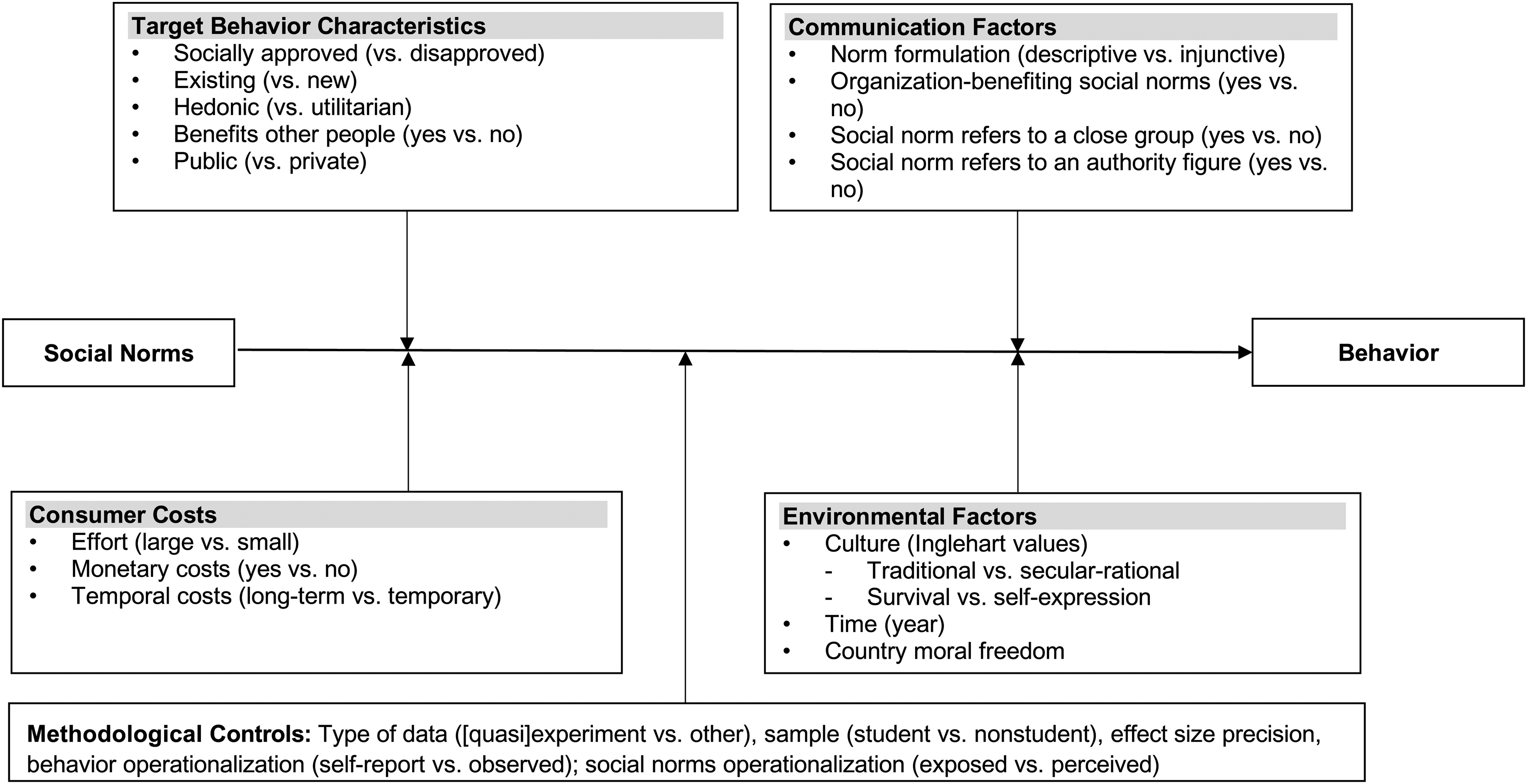
Conceptual framework: Factors that influence the effect of social norms on behavior.
Target Behavior Characteristics
The effects of social norms may vary across behaviors because characteristics inherent to the behavior influence perceptions of the freedom to perform it and threat to that freedom.
Social approval/disapproval of behaviors
Societies have developed social reinforcement mechanisms that encourage some behaviors and discourage others (Herman, Roth, and Polivy 2003; Mead et al. 2010). We define socially approved behaviors as being explicitly encouraged by society (e.g., recycling, volunteering), socially acceptable (e.g., carpooling), and/or perceived as appropriate by society (e.g., using condoms). We define socially disapproved behaviors as being explicitly discouraged (e.g., smoking), socially unacceptable (e.g., littering), and/or perceived as inappropriate (e.g., binge drinking). A socially approved behavior evokes positive reinforcement via social outcomes, such as inclusion, acceptance, and affiliation (Cialdini and Goldstein 2004). A socially disapproved behavior instead induces negative reinforcement via social consequences, such as social exclusion, alienation, or ridicule (Lin, Dahl, and Argo 2013). Social approval versus disapproval of behaviors is thus a crucial factor that has implications for consumers’ expectations of their freedoms to perform them.
Performing a socially disapproved behavior is potentially more damaging to society as a whole than failing to perform an approved behavior (Henrich et al. 2010). Thus, to maintain social order, societies tend to be more punitive of disapproved behaviors (Fehr and Gächter 2002; Henrich and Boyd 2001). In contrast, not adopting an approved behavior is less harshly punished and sometimes can even bring positive benefits, such as elevation in inferred social status (Bellezza, Gino, and Keinan 2013). Thus, consumers are less likely to perceive social norms regulating socially disapproved behaviors as limitations to their freedoms, which diminishes reactance and increases compliance with social norms discouraging these behaviors. Yet, social norms targeting socially approved behaviors are seen as freedom limitations, causing more reactance and reduced compliance. Thus, we expect social norms pertaining to socially disapproved behaviors to be more effective than those pertaining to socially approved behaviors (H1).
Existing versus new behaviors
Existing behaviors are already performed by consumers, at least sometimes, in contrast to entirely new behaviors. Consumers already have exercised their freedom to perform the existing behaviors, so they may feel less threatened when encouraging existing behaviors and their reactance to social norms that target existing behaviors may be relatively low. In contrast, targeting a new behavior may represent a stronger threat to freedom and, thus, induce reactance and decrease compliance. Consistently, for example, compliance with hand-washing advice has been higher than compliance with mask-wearing advice during COVID-19 and other infection outbreaks (Dzisi and Dei 2020; Teasdale et al. 2014). Hand washing is an existing behavior and engrained into daily routines, whereas mask wearing was new for most consumers and generated more reactance. Therefore, we expect social norms pertaining to existing behaviors to be more effective than those pertaining to new behaviors (H2).
Hedonic versus utilitarian behaviors
Hedonic behaviors are those driven by pleasure-related goals and are evaluated primarily on the benefits related to enjoyment, taste, aesthetics, and symbolic meaning. Utilitarian behaviors, instead, are driven by functionality goals and are performed and evaluated primarily on the basis of functional, instrumental, and practical benefits (Chitturi, Raghunathan, and Mahajan 2008). Social norms can pertain to both types, including utilitarian behaviors such as banking (e.g., “Most millennials use online banking”) and hedonic ones such as buying cosmetics (e.g., “12 makeup bag must-haves”). But their effectiveness is not clear a priori. On the one hand, reactance to social norms might be higher for hedonic behaviors because consumers have a stronger desire to perform those behaviors as part of their sense of freedom (Miller et al. 2006). Consumers can leverage social norms to justify a desirable behavior for themselves and enhance their perceptions of freedom to perform it. For example, the justification that “everyone’s doing it” is common for hedonic behaviors (Green 1991) and can increase perceived freedom for engaging in these behaviors. On the other hand, indulging in a hedonic behavior often prompts a sense of guilt, making it harder to justify (Melnyk, Klein, and Völckner 2012; Okada 2005), which may reduce consumers’ perception of freedom. With these opposing predictions, we treat the effects of social norms on hedonic versus utilitarian behaviors as an empirical question.
Behaviors benefiting other people
Some behaviors benefit other people directly (e.g., donating to charity), whereas others have indirect benefits (e.g., recycling). Social norms stem from group considerations, so consumers’ willingness to enact their freedom may decrease if they realize that others will be negatively affected by their social norm violations (Staunton et al. 2014). Correspondingly, behaviors that have negative implications for others yield lower reactance levels (Feldman-Summers 1977). We therefore expect that when others benefit from the behavior, this will enhance the effect of social norms on that behavior (H3).
Public versus private behaviors
We define public behaviors as those that are performed in public or can be observed by others (e.g., using public transport), in contrast to private behaviors (e.g., reducing energy consumption at home). Private behaviors are not subject to others’ scrutiny, so consumers’ perception of freedom threat to perform them may be relatively low, which should decrease reactance (Rosenberg and Siegel 2018). This argument would imply that compliance with social norms regulating private (vs. public) behaviors should be higher. Yet, for public behaviors, reactance may also be reduced but for a different reason. Specifically, consumers are often concerned with how others perceive them (Lewis 2013), which reduces their willingness to enact their freedom and, in turn, reduces reactance. This would suggest higher compliance with social norms regulating public (vs. private) behaviors. Given these two opposing predictions, we refrain from making a directional hypothesis about this variable.
Communication Factors
The use of social norms can trigger reactance because communication factors influence the perceived threat to behavioral freedom (Bensley and Wu 1991; Rosenberg and Siegel 2018). We consider several communication factors, such as how the norm is formulated as well as whether it benefits an organization, references specific groups, and includes explicit sanctions or rewards.
Norm formulation
Social norms can be formulated as descriptive or injunctive. Descriptive norms describe typical behaviors of some relevant group and signal which behaviors are most popular (Cialdini, Reno, and Kallgren 1990; Schultz et al. 2007). Injunctive norms instead prescribe certain behaviors and indicate what the target consumer should or should not do. For example, a list of “bestsellers” represents descriptive norms, but “ten must-read books” lists communicate injunctive norms. As injunctive norms convey explicit demands, which consumers likely perceive as forceful threats to their freedom, they should generate more reactance than descriptive norms (Mann and Hill 1984; White, Habib, and Hardisty 2019). Consumers exposed to descriptive norms instead may come up with reasons for the behavior of the majority and adjust their own behavior accordingly, without much reactance (Schultz et al. 2007). Therefore, we expect a stronger impact of descriptive (vs. injunctive) social norms on behaviors (H4).
Organization-benefiting norms
We define social norm communications that reveal a specific entity, such as a firm or government body, which would benefit from compliance with the social norm, as organization-benefiting social norms. For example, “my friends subscribed to the university’s gym program” would benefit the gym if the target consumer complied with this behavior. While specific entity matters, overall, social norms that refer to organizations tend to be more concrete and specific because they activate situational factors (i.e., where and when the norm applies) (Aarts and Dijksterhuis 2003). Such specificity and concreteness diminish the general threat to freedom for consumers by limiting it to the particular situation, which lowers their reactance (Goldstein, Cialdini, and Griskevicius 2008). We thus expect organization-benefiting social norms to be more effective than those that do not mention organizations (H5).
Close group members
Communications about social norms often specify close group members—that is, people who are genetically related (e.g., family) or similar (e.g., close friends)—rather than refer to an abstract group (e.g., fellow citizens, people). Evolutionary predictions of social cooperation highlight kinship mechanisms. Namely, a request that activates a kin care motive reduces reactance and promotes compliance without expectations of reciprocation (Griskevicius and Kenrick 2013; Henrich and Boyd 2001). The closer the relationship is, the less reactance consumers are likely to experience, enhancing norm compliance (Miller et al. 2006; Silvia 2005). Thus, we expect social norms referring to a close group member to be more effective than social norms referring to abstract or distant groups (H6).
Authority figures
Communications around social norms often refer to authority figures, or individuals who can exercise power over others, formally or informally (e.g., superiors, experts, government officials, teachers), to enhance compliance. Milgram’s (1974) famous studies show that formal orders from an authority figure (real or perceived) increase obedience. Yet, because social norms are informal, being required to do something by an authoritative source may make the threat to freedom more salient and trigger reactance (Balliet, Mulder, and Van Lange 2011). For example, expert recommendations may lead to reactance and diminish compliance (Fitzsimons and Lehmann 2004). For these reasons, we expect social norms referring to authority figures to be less effective than those that do not refer to authority figures (H7).
Explicit sanctions and rewards
The sanctions and rewards associated with noncompliance and compliance with social norms might be either implicit, meaning they are indirect and left for consumers to infer, or explicit, meaning they are clearly stated. If sanctions and rewards are explicit, they might diminish behavioral compliance because they make the persuasive nature of the social norm message salient (Petty and Cacioppo 1979) and threaten freedom expressly (Kivetz 2005). Both aspects increase the perceived threat to freedom to perform the behaviors and reactance (Balliet, Mulder, and Van Lange 2011). Thus, we expect social norms that specify potential sanctions (for failing to comply) (H8) or potential rewards (for complying) (H9) to be less effective than social norms that do not make those consequences explicit.
Consumer Costs
The costs incurred to perform a behavior can create barriers. For example, social norms may direct consumers to buy an electric car, which is considerably more expensive than a regular car. We believe such costs will increase consumer reactance (Rosenberg and Siegel 2018). However, the direction of the cost effect is not clear a priori (see Clee and Winklund 1980). On the one hand, a high cost may signal the desirability or status of the behavior, thereby motivating compliance. On the other hand, a high cost may dissuade consumers from attempting the behavior. Given these two opposing forces, we refrain from making directional hypotheses about costs, including costs associated with effort, money, and time.
Effort
We define “effort costs” as the amount of physical or mental resources consumers must invest to comply with social norms. Some behaviors require more effort (e.g., exercising), others less (e.g., not littering). Social norms that require more effort demand greater behavioral change. They may either increase compliance by increasing the attractiveness of the effortful behavior or decrease compliance by decreasing the attractiveness of the effortful behavior (by derogating it because of reduced attainability) (Clee and Wicklund 1980). Which of these two forces is stronger is an empirical question.
Monetary costs
Consumers may incur additional monetary costs to comply with social norms. For example, buying organic rather than conventional food requires more monetary resources. However, reusing a hotel towel does not result in monetary costs. Monetary costs constitute a direct barrier to free choice because consumers must sacrifice extra resources to comply. When social norms regulate costly behaviors, the monetary costs may imply a greater threat to the freedom to engage in this behavior, enhancing the attractiveness of this option and increasing compliance with such social norms (Clee and Wicklund 1980). Yet, monetary costs may also emphasize the unattainability of the option, which would reduce compliance. Thus, we treat the effect of monetary costs on compliance with social norms as an empirical question.
Temporal costs
Compliance with social norms may require long-term (e.g., adhering to a healthy eating program) or temporary (e.g., reusing hotel towels) commitment. The temporal costs barrier is greater for behaviors with long-term commitments because these social norms impose more behavioral constraints than those that require only temporary commitments. Thus, on the one hand, consumers may also have stronger resistance to losing an option with potential longer-term consequences (Kivetz 2005), which would increase compliance with social norms regulating longer-term behaviors. On the other hand, perceived unattainability of behaviors is also greater if they persist, now and into the future, rather than if they involve a single instance, which could decrease compliance with social norms involving longer-term commitment. Thus, we treat the effect of temporal costs on compliance with social norms as an empirical question.
Environmental Factors
Consumers form freedom expectations through socialization in a specific cultural environment at a particular time (Miron and Brehm 2006). Culture shapes expectations by providing a logic for acting both housed in members’ knowledge and beliefs and observed in members’ behaviors (Stephan and Uhlaner 2010). In some cultures, the range of approved behaviors is wide, and behavioral transgressions of social norms are tolerated. Other cultures allow a narrower range of behaviors and exhibit lower tolerance for deviations from social norms (Melnyk, Giarratana, and Torres 2014; Van der Lans, Van Everdingen, and Melnyk 2016). Consumer reactance and compliance to social norms should thus differ systematically across cultures (Savani et al. 2015).
To account for cultural differences, we adopt Inglehart’s cultural framework (Inglehart and Baker 2000) with two bipolar dimensions: traditional versus secular-rational and survival versus self-expression values. These dimensions have clear implications for reactance to social norms because they influence tolerance for transgressions (traditional–secular-relational) and the range of approved behaviors (survival–self-expression). Moreover, these dimensions are measured regularly, which enables us to account for cultural dynamics (Tung and Verbeke 2010). 1
Traditional versus secular-rational
This dimension contrasts traditional societies, in which religion is very important, and secular-rational societies, in which it is not (Inglehart and Baker 2000). Traditional societies also emphasize deference to authority, absolute standards, cultural protectionism, and national pride, and they generally exhibit less tolerance for transgressions of social norms. Secular-rational societies reflect opposing values. We expect the effect of social norms on behavior to be stronger in cultures closer to the traditional (vs. the secular-rational) pole (H10) because they effectively restrict consumers’ awareness and expectations of freedom, which should decrease reactance.
Survival versus self-expression
This dimension reflects transitions from industrial to postindustrial societies (Inglehart and Baker 2000). Survival societies emphasize economic and physical security and familiar norms to maximize the predictability of others’ behaviors, which results in a relatively narrow range of behaviors that may be perceived as freedoms. Consumers in survival societies have low expectations of personal freedoms and identify less freedom to be threatened (Iyengar and Lepper 1999). In contrast, self-expression values emphasize variety, imagination, and tolerance of outgroups. As societies move toward self-expression, people generally become freer to make choices for themselves (Van der Lans, Van Everdingen, and Melnyk 2016), which enhances their reactance to social norms and decreases compliance. In cultures that value self-expression, noncompliance with social norms may even signal the person’s freedom to be unique, which is valued by consumers of these societies (Griskevicius et al. 2006; Van der Lans, Van Everdingen, and Melnyk 2016). In contrast, in survival cultures, violation of social norms is more likely to jeopardize economic or physical security (Herrmann, Thöni, and Gächter 2008), diminishing perception of these behaviors as freedoms. Thus, we expect the effect of social norms on behavior to be stronger in cultures close to the survival (vs. the self-expression) pole (H11).
Time
The human propensity to comply with social norms has resulted from evolutionary processes (Griskevicius and Kenrick 2013). Therefore, the effect of social norms on behaviors should be stable throughout the short time (in evolutionary terms) marketers have been using them as a persuasion strategy. Yet research into conformity to social pressures also indicates some changes over time, including studies that document that conformity in the United States has declined (Bond and Smith 1996), increased (Lamb and Alsifaki 1980), or fluctuated (Larsen 1990) due to changes in social media and the cohesiveness of society, among other things. Thus, the effectiveness of social norms over time is an empirical question.
Moral freedom
Cultures also vary in moral freedom, which reflects the extent to which people make their own moral choices rather than being influenced by state intervention (Álvarez, Kotera, and Pina 2020). We expect the effect of social norms on behavior to be stronger in countries lacking moral freedom (H12), because of the lower expectations of freedom in those countries.
Interaction Effects
The interaction of social approval/disapproval and the environmental factors
Thus far, our discussion has focused on main effects. However, consumers do not learn social norms in isolation; instead, they become aware of freedoms to perform certain behaviors through socialization in a particular culture and by observing different behaviors over time (Miron and Brehm 2006). To the extent that different societies shape consumer awareness of social norms, we expect the effects of the behavior being socially approved versus disapproved to be moderated by environmental characteristics (i.e., culture and time).
Specifically, with respect to the traditional versus secular-rational cultural dimension, we note that participation in a world religion makes punishments for socially disapproved behaviors more salient to people (Henrich et al. 2010). In Christianity, seven of the Ten Commandments start with the phrase “you shall not.” In Judaism, of 613 mitzvot in the Torah, 365 (60%) forbid bad behaviors. Islam explicitly specifies an extended list of behaviors that are haram, or forbidden (Mathewes 2010). Thus, in traditional cultures, where religion is more important, reactance to social norms that target socially disapproved (vs. approved) behaviors might be lower, because many of these behaviors already have been forbidden by religions. Thus, we expect the stronger effect of social norms on behaviors in traditional cultures to be especially pertinent for socially disapproved (vs. approved) behaviors (H13).
With respect to the survival versus self-expression cultural dimension, engaging in socially disapproved behaviors in survival cultures is more likely to jeopardize economic or physical security (Herrmann, Thöni, and Gächter 2008), diminishing perception of these behaviors as freedoms. In contrast, in societies leaning toward the self-expression pole, engaging in disapproved behaviors would be more tolerated (Inglehart and Baker 2000). Thus, we expect that the effect of social norms on behaviors in survival cultures is especially strong for socially disapproved (vs. approved) behaviors (H14).
As to the effect of time, we expect that social media might enhance the effects of social norms by exposing consumers to more regular reinforcements pertaining to a wider range of socially approved and disapproved behaviors (Berger and Milkman 2012). Social media enables consumers to share content and feedback in real time, much of which remains available indefinitely and can be tracked by other parties (Hennig-Thurau et al. 2010). Exposure to norm violations in such settings triggers exhibitions of moral outrage, as manifested in the notion of a “cancel culture,” whereby social media users shame and punish perpetrators of bad behaviors, signaling that such behaviors are not tolerated (Crocket 2017). These developments imply that, over time, engaging in socially disapproved behaviors is stigmatized more severely than not engaging in socially approved behaviors (Fehr and Gächter 2002), which reduces expected freedom to perform socially disapproved behaviors. Thus, we expect a stronger, more positive impact of social norms on socially disapproved (vs. approved) behaviors over time (H15).
Other interactions
In addition to the aforementioned hypothesized interaction effects, given the importance of the fundamental distinction between social norms regulating socially approved versus disapproved behaviors, we also explore additional interactions. Specifically, we investigate the interaction between social approval/disapproval and the target behavior characteristics, communication factors, and consumer costs. When these interactions are significant, we return to them in the discussion and highlight theoretical and managerial insights.
Methodological Characteristics
Systematic differences in the methodologies used by studies may cause variation in the reported effects (Bijmolt and Pieters 2001). We control for (1) type of data ([quasi]experiment vs. other), (2) whether a sample involves students or regular consumers, (3) whether participants were exposed to (vs. indicated their perceptions of) social norms, and (4) whether participants’ behavior was self-reported (vs. observed). Finally, to account for publication bias, which arises when the effect sizes in published studies are not representative of the entire population of effect sizes (Borenstein et al. 2009), we control for (5) the association between the strength and the precision of the effect sizes (Stanley and Doucoulagios 2012). More details follow.
Methodology
Sample
To identify relevant studies of the impact of social norms on consumer behaviors, we retrieved references from Google Scholar, Online Contents National, PsycINFO, and the Web of Science up to March 2019. We searched for keywords such as “norm,” “social norms,” and “social pressure” (for the full list of keywords, see Web Appendix A). We also checked the websites of the Social Science Research Network, the National Social Norms Resource Center, and Higher Education Center for Alcohol and Other Drug Abuse and Violence Prevention for relevant studies. We posted requests for unpublished manuscripts and working papers on the online academic platform ELMAR. Finally, we examined all cross-references from applicable documents. The procedure resulted in articles from five research domains: psychology (35.2%), health (34.4%), marketing (10.4%), food and nutrition (10.8%), and the environment (9.2%).
Our dependent variable is the strength of the relationship between social norms and consumer behavior in the studies, which constitutes their observed effect sizes. We selected Pearson’s product-moment correlation coefficient to measure effect sizes, because most studies operationalize both social norms and the target behavior as continuous variables. The consumer behaviors investigated in these eligible studies refer to the purchase, consumption, use, or disposal of products, services, material objects, or consumption experiences (e.g., buying organic products, subscribing to a gym, adopting mobile banking, donating). We exclude studies that focus on (1) aggregate entities (e.g., countries, societies) rather than individual consumers; (2) behaviors unrelated to consumption, such as social perceptions or interpersonal relations (e.g., stereotypes); (3) criminal behaviors, because the influence of the law would be confounded with the influence of social norms; and (4) consumers with impaired autonomy, such as workers making job-related decisions who must follow organizational policy, patients who rely extensively on others to make medical decisions (Meyers 2004), or people whose addictions limit their decision-making ability (Leshner 1997). Furthermore, to be included an eligible study must (1) examine actual behaviors, reported or observed (rather than intentions); (2) contain enough information to calculate the correlations between social norms and behaviors; and (3) support computations of the unconfounded effects of social norms. To illustrate (3), we excluded studies that collapsed the impacts of social norms and marketing promotion (e.g., Zhang et al. 2014) or injunctive and descriptive social norms (e.g., Keizer, Lindenberg, and Steg 2008).
The final sample thus consists of 252 effect sizes extracted from 137 articles, comprising 177 studies over the period 1978–2019. Web Appendix B lists the articles, effect sizes, and moderator values. The sample sizes of the primary studies range from 28 to 44,108 (median = 269), so that they produce a total of 112,929 unique respondents from 22 countries. Three of the 252 effect sizes have studentized residuals that are greater than 2.57 (Viechtbauer 2010); two of them (r = −.19, n = 353; r = .71, n = 451) are influential, in that they lie outside the prediction interval (i.e., range of plausible values for any individual effect size) and cannot be explained by small sample sizes (Borenstein et al. 2009). We remove them from the subsequent analyses, leaving 250 effect sizes from 136 articles, based on 112,478 unique respondents. (As we detail in Web Appendix C, the primary studies provide an explanation for the extreme values of these outliers; the results are robust for including them in the analysis.)
Variable Coding
Two independent coders (blind to the hypotheses) coded the moderators and cataloged the technical information (e.g., sample size). The intercoder agreement was 94.8%, and any disagreements were resolved through discussion.
Effect sizes
We retrieved zero-order correlations, measuring the association between social norms and the target behavior, from the studies’ correlation matrices or else converted statistics (e.g., F-value, t-value, p-value, χ2) into r (see Borenstein et al. 2009; Lipsey and Wilson 2001). If partial correlations were available, we also retrieved them from the studies. (The results are robust whether we use partial or zero-order correlations as measures of effect sizes.) We transformed the correlations into Fisher’s z-scores (Borenstein et al. 2009) to satisfy the assumptions of normal distributions and known sampling variance of the effect sizes to estimate the model (for details, see the “Model” section). 2 In turn, we estimate the meta-analytic regression model with Fisher’s z-scores as the dependent variable. We obtain the mean effect sizes, confidence intervals, predicted values, and plots by back-transforming Fisher’s z-scores into correlation coefficients to facilitate interpretation (for details, see Web Appendix D). For robustness, we perform the analyses also by using the correlation coefficients. The effect sizes are coded such that a positive sign indicates a positive change in behavior (i.e., increase in socially approved or decrease in disapproved behaviors). 3
Moderators
Table 1 shows the coding scheme for all the moderators. We mean-centered all continuous moderators and all dummy variables involved in interactions (Raudenbush and Bryk 2002). We retrieve scores for the cultural dimensions from the World Values Survey (Inglehart et al. 2014) for each effect size, using the country and year of publication of each study. For the time variable, the code reflects the year of publication. 4 The precision of the effect size estimate is measured as the inverse of its standard deviation (Stanley and Doucoulagios 2012). If a publication bias is present, retrieved small sample studies are more likely to yield stronger effect sizes than those that are not retrieved, which implies a negative relationship between precision and effect size. By controlling for precision, the effects can be estimated more accurately (Ferguson and Brannick 2012).
Coding Scheme for the Moderators of Social Norms–Behavior Effects.
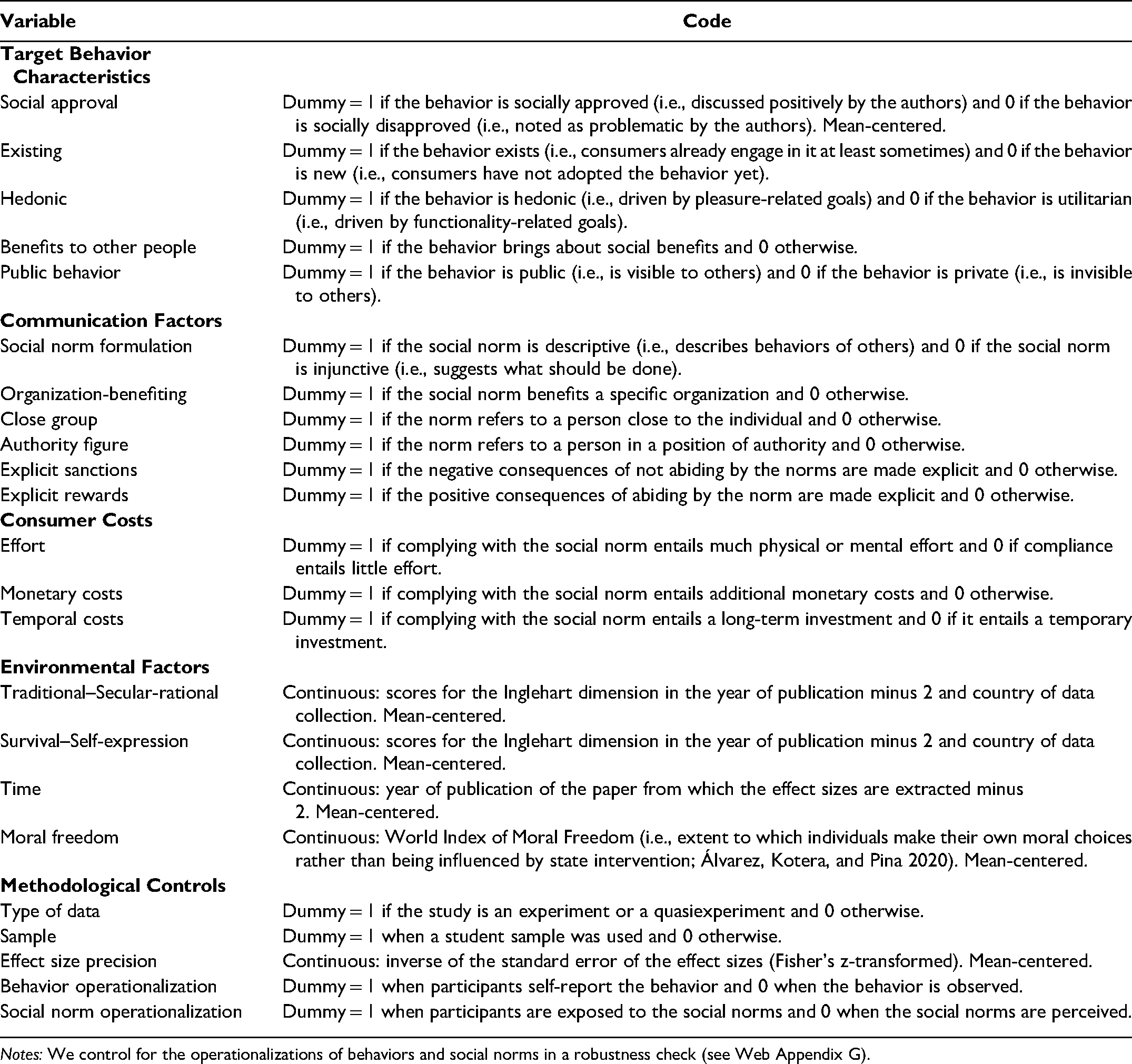
Notes: We control for the operationalizations of behaviors and social norms in a robustness check (see Web Appendix G).
Meta-Analytic Model and Estimation
To test the conceptual framework in Figure 1, the model should account for the structure of the data, because the effect sizes are nested within samples that are nested within articles, which could lead to correlated errors. We specify a mixed-effects meta-regression model using a multilevel parameterization (Van den Noortgate et al. 2015) in which (1) observed effect sizes are assumed to be a normally distributed random sample from the population of true effect sizes; and (2) the variance distribution of true effect sizes can be explained by random effects at the effect size, sample, and article levels, to account for data nesting, and by the fixed effects of the moderators. Thus, the effect size i extracted from sample j in article u is modeled as follows:
Effect Sizeiju = β0 + β1 Social approvaliju + β2 Existing behavioriju + β3 Hedoniciju + β4 Benefit peopleiju + β5 Public behavioriju + β6 Norm formulationiju + β7 Organization-benefitingiju + β8 Close groupiju + β9 Authority figureiju + β10 Explicit sanctionsju + β11 Explicit rewardsiju + β12 Effortiju + β13 Monetary costsiju + b14 Temporal costsiju + β15 Traditional–secular-rationalu + β16 Survival–self-expressionu + β17 Timeu + β18 Moral freedomu + β19 Social approvaliju × Traditional–secular-rationalu + β20 Social approvaliju × Survival–self-expressionu + β21 Social approvaliju × Timeu + β22 Type datau + β23 Sampleju + β24 Effect size precisioniju + δu + εi + γju + φiju,
where δu
Results
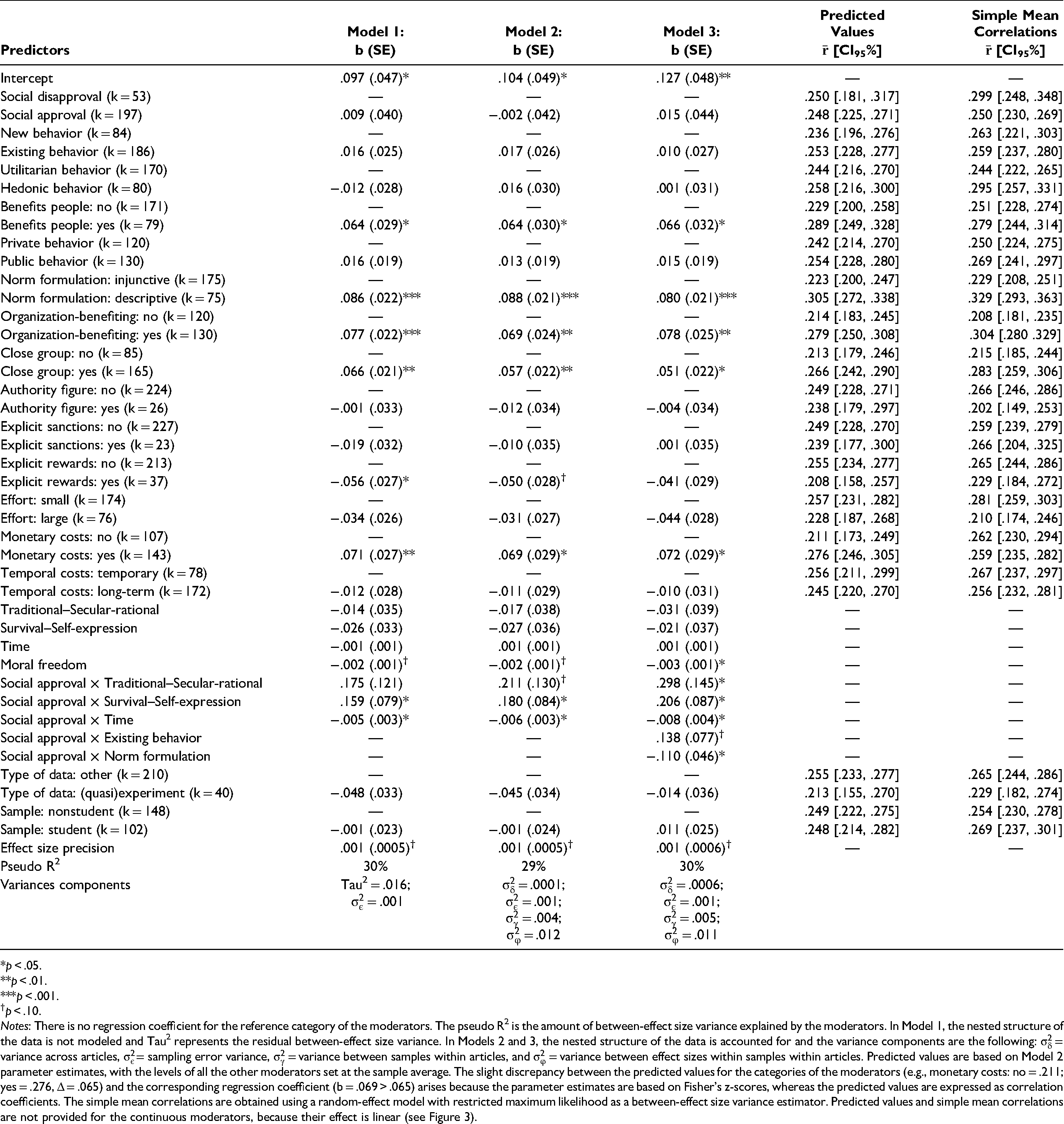
We first present the grand mean effect size and the distribution of individual effect sizes. Next, we present the results of the meta-regressions testing for the moderators. To provide evidence without the multilevel specification, Model 1 does not account for the nested data structure. The hypothesized moderators (H1–H15) are then tested with Model 2, which accounts for the nested structure. We note that the findings of Model 1 versus Model 2 are very similar (see Table 3), despite their different approaches to nesting. Drawing on Model 2, Table 3 also presents predicted effect sizes for each level of the categorical moderators with all the other moderators set at their sample average (Bijmolt, Van Heerde, and Pieters 2005) as well as simple mean correlations. The predicted values and simple mean correlations do not differ substantially, suggesting a good balance of moderator conditions across studies (Keller and Lehmann 2008). Model 3 adopts an iterative approach to identify additional significant interactions between socially approved versus disapproved behaviors and target behavior characteristics, consumer costs, and communication factors, and we discuss its results where relevant.
Grand Mean Effect Size and Distribution of Effect Sizes
Overall, social norms have a positive, small to medium impact on behaviors (i.e., the grand mean effect size is positive and significant, with
The distribution of individual effect sizes, shown in Figure 2, reveals that they range from r = −.22 to r = .63 (M = .249, Mdn = .240, SD = .152), and 67% of them fall within a .10–.40 interval. Multicollinearity is not a concern. The largest bivariate correlation, r = .54, is between monetary costs and socially approved behaviors. The variance inflation factors are 3.73 or less for all variables. Table 2 provides the correlation matrix and descriptive statistics.
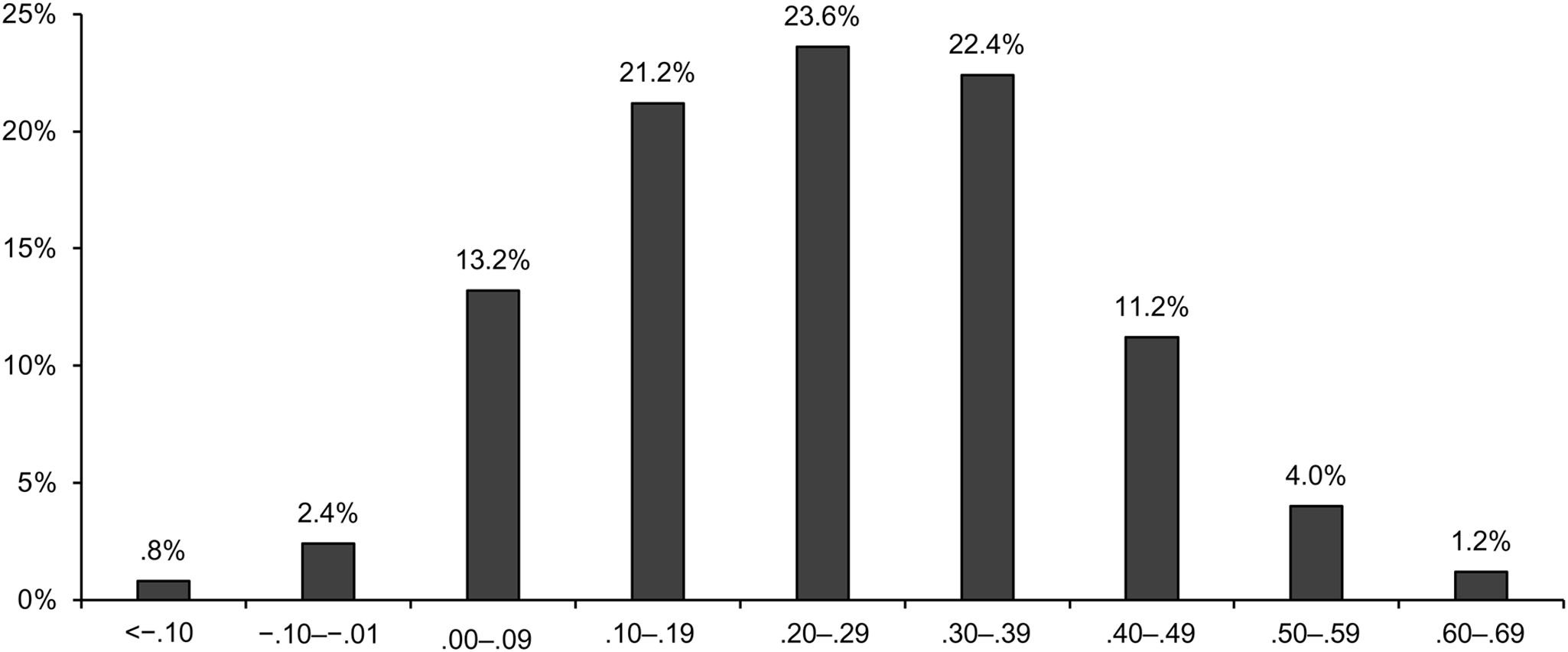
Social norm–behavior effect size frequency distribution (k = 250).
Bivariate Correlations and Descriptive Statistics for the Social Norm–Behavior Effect and Moderators.
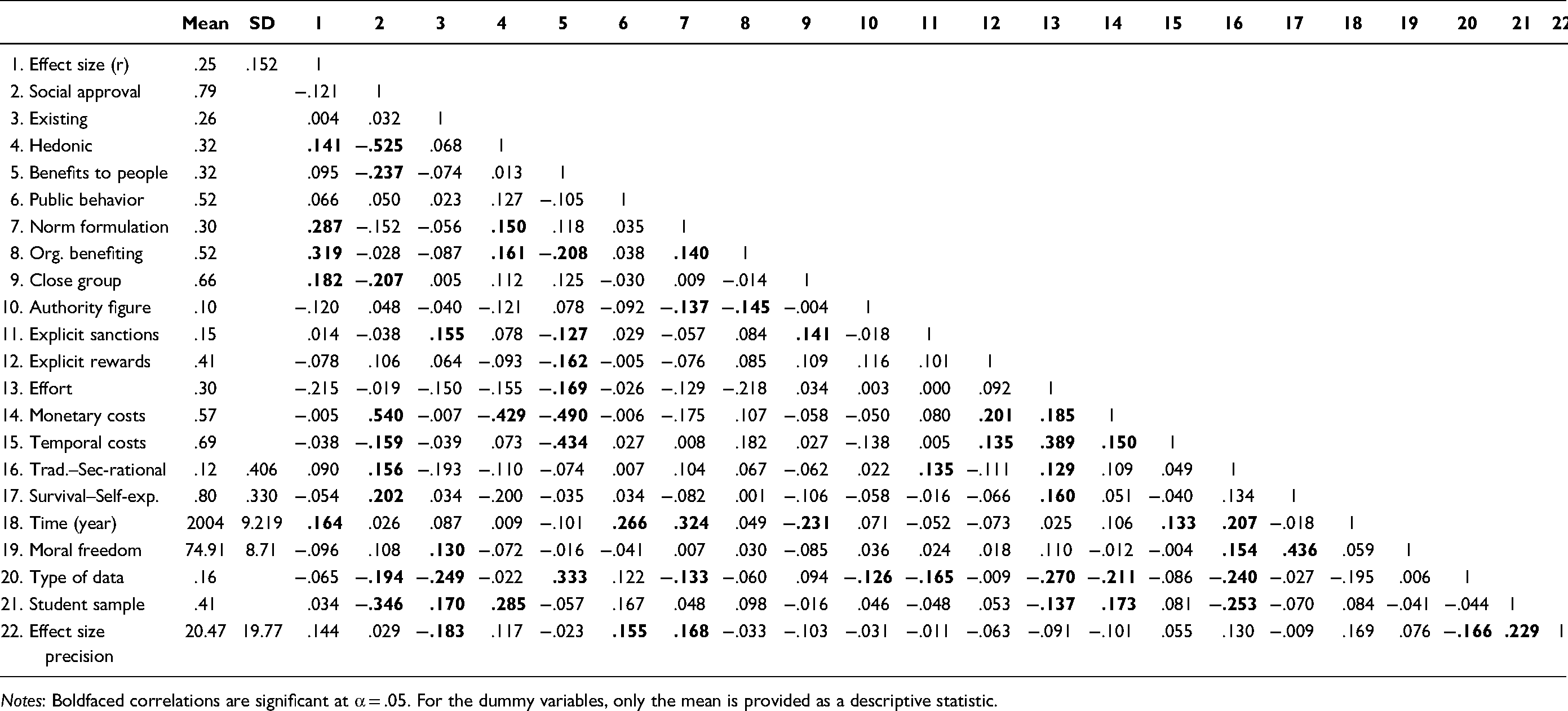
Notes: Boldfaced correlations are significant at α = .05. For the dummy variables, only the mean is provided as a descriptive statistic.
Target Behaviors Characteristics
Social approval/disapproval
Contrary to H1, social norms are not more effective for disapproved (vs. approved) behavior (b = −.002, p = .957). Although the insignificant main effect suggests that social norms are equally effective for approved and disapproved behaviors overall, this variable is involved in several interactions with other moderators, as we discuss next.
Existing versus new
The effect of existing (vs. new) behavior is not significant (b = .017, p = .514); thus, H2 is not supported. However, according to Model 3, this variable interacts with the social approval of behavior at marginal significance (b = .138, p = .072). Figure 3, Panel A, shows that when targeting socially approved behaviors, social norms tend to be more effective in encouraging existing (predicted
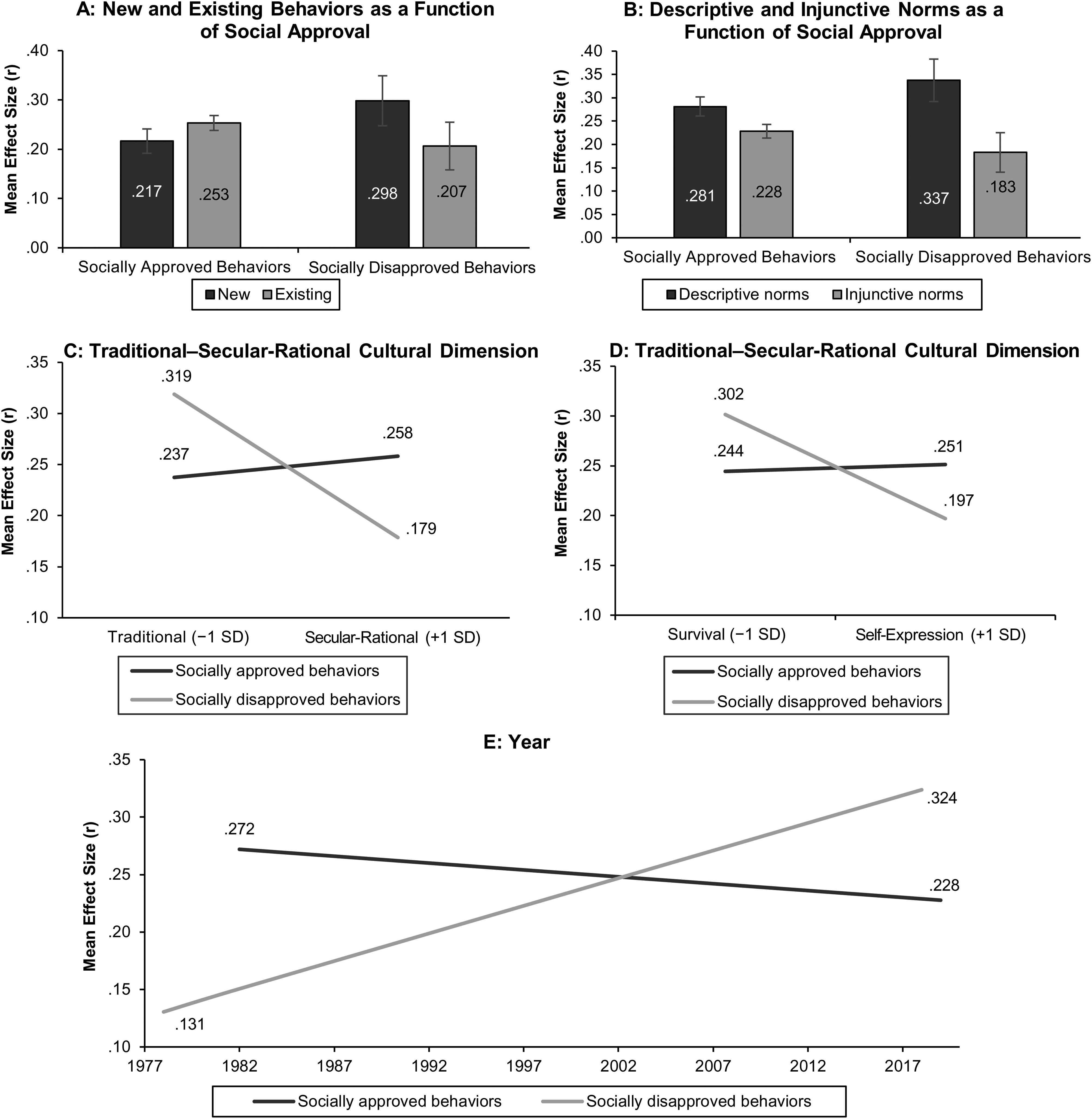
Social norm–behavior effect sizes for socially approved and disapproved behaviors as a function of focal moderators.
Hedonic versus utilitarian
The impact of social norms does not differ across hedonic and utilitarian behaviors (b = .016, p = .599). This finding is not surprising given the two opposing forces (desire and guilt) driving hedonic behaviors.
Benefits to people
Social norms are more effective when behaviors benefit others (predicted
Public behavior
The effect of public behavior is not significant (b = .013, p = .500), suggesting that social norms are equally effective for public and private behaviors.
Communication Factors
Norm formulation
In support of H4, descriptive norms have stronger effects on behavior (predicted
Organization-benefiting
In support of H5, social norms are more effective when they benefit an organization (predicted
Close group
In support of H6, social norms are more effective if they refer to a close group member (predicted
Authority figure
The effectiveness of social norms is not impeded by references to an authority figure (b = −.012, p = .729), in contrast to H7.
Sanctions and rewards
The effect of social norms does not depend on the presence of explicit sanctions (b = −.010, p = .767), disconfirming H8. However, social norms with explicit mentions of rewards (predicted
Consumer Costs
Effort
The amount of effort required to comply with social norms does not have a significant effect on compliance (b = −.031, p = .255). This finding is consistent with the idea that there are two opposing forces behind this effect that counteract each other.
Monetary costs
Social norms exert stronger effects on behavior when compliance entails monetary costs (predicted
Temporal costs
Social norms seem to be equally effective for behaviors requiring a long-term or a temporary investment, as temporal costs are nonsignificant (b = −.011, p = .706).
Environmental Factors
Traditional–secular-rational
The traditional–secular-rational cultural dimension does not have a main effect on the effectiveness of social norm (b = −.017, p = .643), which fails to support H10. 5 However, we find some support for H13 because the interaction with the social approval of behaviors is positive and marginally significant (b = .211, p = .104). Figure 3, Panel C, shows that the impact of social norms on socially disapproved behaviors is somewhat weaker in more secular-rational cultures, whereas their impact on socially approved behaviors remains stable across the traditional–secular-rational dimension.
Survival–self-expression
The effect of this cultural dimension is negative, as we expected, but it is not significant (b = −.027, p = .448), which does not support H11. However, in support of H14, its interaction with the social approval of behaviors is positive and significant (b = .180, p = .033). Thus, consistent with our expectations, social norms are less effective for socially disapproved behaviors in cultures closer to the self-expression pole, whereas their effectiveness for socially approved behaviors is stable across the survival–self-expression dimension (Figure 3, Panel D).
Time
The effect of time is not significant (b = .001, p = .956), but its interaction with the social approval of behaviors is negative and significant (b = −.006, p = .036), in support of H15. Social norms have become more effective over time at curbing socially disapproved behaviors, while their influence on socially approved behaviors remains stable (Figure 3, Panel E).
Moral freedom
The national level of moral freedom lowers behavioral compliance at a marginal level of significance (b = −.002, p = .094), in support of H12.
Methodological Characteristics
The studies in our meta-analysis yield the same results regardless of the type of data (b = −.045, p = .189) and whether they rely on student samples (b = −.001, p = .986). We obtain similar results if we control for whether the studies operationalize social norms using exposure or perception (note that we exclude this control variable in the main model because of multicollinearity but address it in supplementary analyses). Precision has a positive, marginally significant effect (b = .001, p = .082); therefore, effect sizes greater than the mean might be missing, which suggests that publication bias is not an issue.
Robustness Checks
To confirm that our results are robust, we first perform a series of diagnostic tests (Web Appendices E and F) to rule out publication bias; they reconfirm the positive influence of effect size precision in the meta-regression model. Next, we performed analyses based on 16 alternative model specifications. In Tables A1 and A2 in Web Appendix G, we present the results when we adopt alternative methodological choices: (1) including theoretical moderators only; (2) adding two demographic controls—the primary study participants’ mean age and the percentage of men; (3) accounting for effect sizes coming from marketing journals; (4) estimating the meta-regression parameters with t-tests instead of z-values; (5) estimating the model including the two outliers (k = 252); (6) using the raw effect sizes—r and the variance of r—rather than Fisher’s z transforms; (7) relying on partial instead of the zero-order correlation, if both measures could be retrieved from the primary study; and (8) controlling for the operationalization of the behavior (self-reported vs. observed) and for the operationalization of social norms (exposed vs. perceived) instead of controlling for the type of data. Across these methodological choices, the results remain consistent with the findings of the main models (Table 3).
Meta-Regression Results.
*p < .05.
**p < .01.
***p < .001.
p < .10.
Notes: There is no regression coefficient for the reference category of the moderators. The pseudo R2 is the amount of between-effect size variance explained by the moderators. In Model 1, the nested structure of the data is not modeled and Tau2 represents the residual between-effect size variance. In Models 2 and 3, the nested structure of the data is accounted for and the variance components are the following:
In Table A3 (Web Appendix G), we also rule out the effects of four alternative moderators: (9) whether the target behavior entails environmental benefits, (10) whether the target behavior has social and physical consequences for the individual, and (11) whether the norm features a promotion or prevention frame. None of these alternative variables is significant.
Finally, Table A4 (Web Appendix G) presents the results when we include additional country controls based on (12) country-level gross domestic product and population density, as well as (13) Hofstede’s (vs. Inglehart’s) cultural dimensions. The results again remain similar to those from the main models. Further, to account for a potential cultural invariance bias, we control for (14) the language spoken in the country of the data collection and (15) whether the study was conducted in an Asian country; (16) we also model the nesting of articles within countries. The stable regression coefficients suggest that cultural invariance does not affect the results. Across all 16 alternative models, the magnitudes, signs, and significance of the parameter estimates are consistent and aligned with our main findings, which strengthens our conclusions and affirms the robustness of the effects obtained in the main model.
Summary
By meta-analyzing the extant empirical evidence, our research provides new evidence for the effects of social norms on consumer behavior. On average, social norms significantly influence behavior and their effect (
Hypotheses and Empirical Questions.
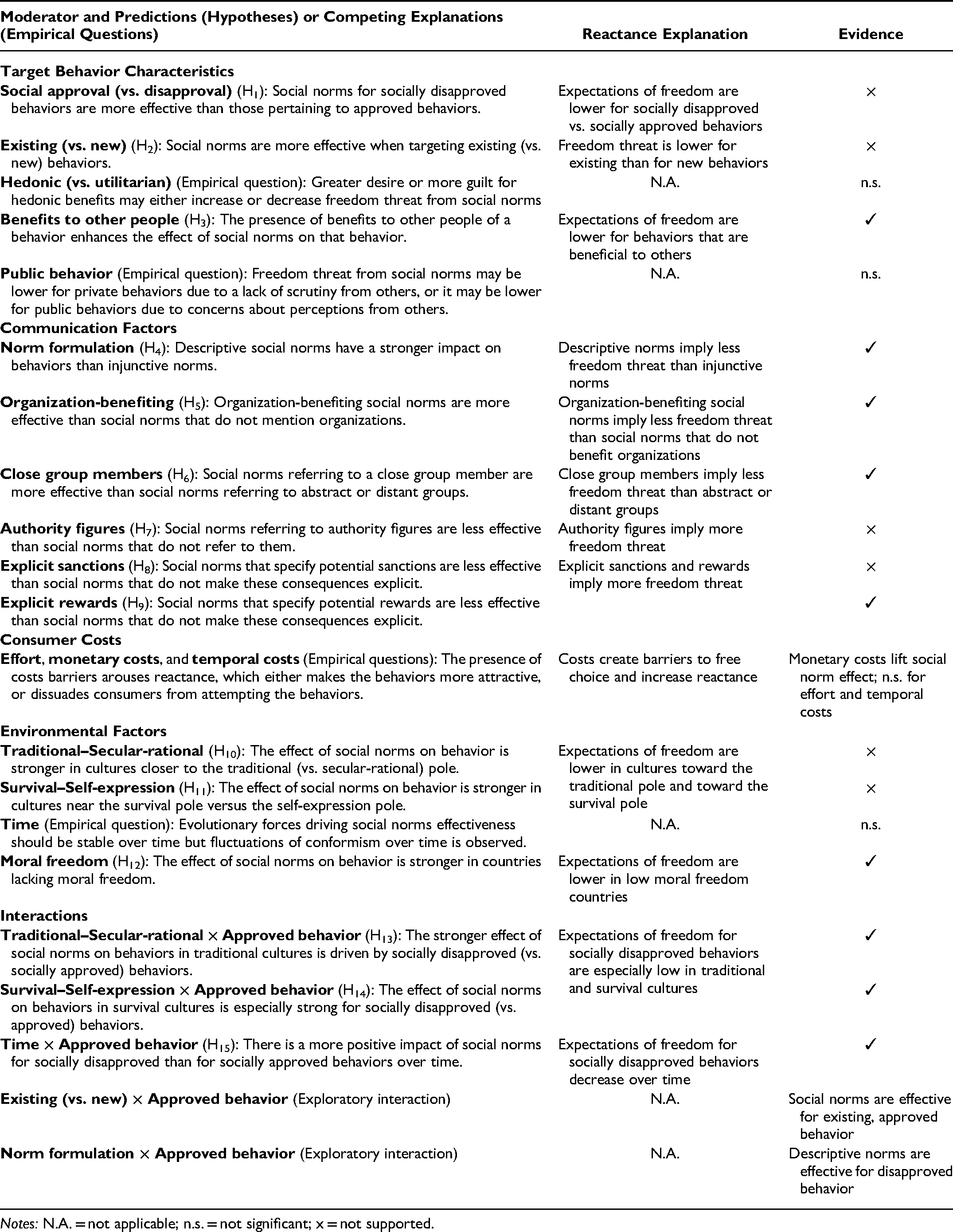
Notes: N.A. = not applicable; n.s. = not significant; x = not supported.
Theoretical Implications
Our results go beyond previous meta-analyses by uncovering previously overlooked boundary conditions of the effects of social norms on consumer behavior using reactance theory as our theoretical lens. While our meta-analysis provides important insights about whether and how social norms can influence behavior, any meta-analysis is limited to the factors included in available primary studies. Those gaps also open avenues for future research, as discussed next.
The Role of Social Approval/Disapproval on Social Norms
Key insights
We reveal that the effects of social norms on behavior differ systematically for behaviors that are socially approved versus disapproved in the presence of certain environmental factors. We find that the effects of social norms on socially disapproved behaviors have increased over time and are particularly strong in survival (vs. secular-rational) and traditional (vs. self-expression) cultures. In contrast, the effects of social norms on socially approved behaviors are more stable across cultures and time.
Future research
The critical difference in social norm effectiveness for regulating socially approved versus disapproved behaviors establishes the need to investigate drivers of this difference. In the process of adopting socially approved behaviors, consumers might glean benefits beyond the direct consequences of complying with norms. For example, does compliance promote positive emotions, due to an enhanced sense of belonging, acceptance, or well-being, independent of the benefits of adopting the behavior? And do consumers suffer negative emotions (e.g., guilt) when they engage in socially disapproved behaviors, and do social norms reinforce these emotions? Another issue is how legal mandates affect behaviors, both when they contradict social norms of disapproved behaviors (e.g., using cell phones while driving) and when they reinforce approved behaviors (e.g., driving below the speed limit).
Implications for Social Influence Literature
Key insights
We shed new light on several unexplored moderators of the effects of social norms on consumer behavior and thereby contribute to the literature on social influence (Cialdini and Goldstein 2004; White, Habib, and Hardisty 2019; White and Simpson 2013). For example, social norms have stronger effects on behaviors that benefit others, but they are weaker for already existing socially disapproved behaviors. Social norms are equally effective for private and public behaviors, for hedonic and utilitarian behaviors, for behaviors requiring much versus little effort, and for behaviors requiring long-term versus temporary commitment. Importantly, monetary costs do not deter consumers; on the contrary, they make them more likely to comply with social norms regulating costly behaviors, in line with the reactance theory explanation that barriers enhance behaviors’ desirability.
Future research
The intriguing finding that private behaviors are just as likely to be influenced by social norms as public ones suggests new research avenues. Perhaps consumers overestimate the extent to which they are monitored by others because of the spotlight effect (Gilovich, Husted, and Savitski 2000). If so, social norms could be effective in nonsocial settings, where they traditionally have been perceived as less influential. Further, finding that social norms are equally effective for hedonic and utilitarian behaviors highlights the need to clarify the roles of desire and guilt as underlying processes. Teasing out these effects could also help enhance communication strategies (e.g., downplaying or emphasizing desire and guilt). Yet, the lack of effect of some behavioral characteristics might also be due to selection; for example, researchers may be inclined study situations in which they expect social norms to matter. Thus, testing the effects of social norms in situations where they a priori seem less relevant is insightful. Studying the effectiveness of social norms when behavioral autonomy is impaired (e.g., employees making decisions on behalf of firms) is also intriguing. Finally, research could address behaviors consumers adopt to distinguish themselves from the group (e.g., to enhance authenticity; Nunes, Ordanini, and Giambastiani 2021) and the leadership behaviors they display to encourage others to go against current social norms (e.g., boycotting, brand sabotaging; Kähr et al. 2016).
Implications for Marketing Communications Literature
Key insights
We contribute to marketing communication research by identifying communication strategies that enhance the effectiveness of social norms in several ways. First, several commonly used social norm communication factors appear to be ineffective, such as referring to authority figures or specifying explicit sanctions; the same is true for rewards, which even seem to hinder social norms’ effectiveness. Second, formulating norms as descriptive (vs. injunctive), organization-benefiting, and/or referring to close others enhance the effect of social norms on behaviors. Further, our exploratory results suggest that injunctive norms are especially weak when targeting disapproved behaviors, which is consistent with reactance theory. To discourage socially disapproved behaviors, injunctive norms tend to be proscriptive (“you should not”) rather than prescriptive (“you should”). Proscription represents a greater threat to freedom than prescription, so it prompts more reactance to injunctive norms (Bergquist and Nielsson 2016). Instead, socially disapproved behaviors can be better curbed by descriptive norms.
The finding that organization-benefiting social norms enhance compliance contributes to the emerging stream of research that examines how situational factors influence the effectiveness of social norms (Aarts and Dijksterhuis 2003; Goldstein et al. 2008). While which type of organization benefits should matter as well, on a broader level, our results suggest that organization-benefiting social norms, because they are situation-specific, enhance compliance.
Future research
More research is needed for boundary conditions for the effectiveness of different communication strategies. For example, there are multiple avenues for future research on the impacts of sanctions and rewards. First, reward size and reward type (e.g., material vs. nonmaterial; Melnyk and Bijmolt 2015) might be important. Second, rewards or sanctions may not exert effects past a ceiling level of the impact of social norms when many consumers are “uninfluenceable.” Third, research should identify ways to account for consumer needs and boost perceptions of the benefits of following and the costs of not following social norms without triggering reactance.
Boundary conditions under which injunctive norms are more effective than descriptive ones (e.g., the level of ambiguity, the source of the norm: “Why fight city hall?”) should be addressed. Further, because norms are group-specific, research could explore how group exclusivity should be communicated. Social norms linked to homogeneous exclusive groups (“Harvard students recycle”) might evoke less reactance because they distinguish group members from outsiders while also satisfying the need to belong (Bhattacharya, Rao, and Glynn 1995). The effect of group exclusivity on behavior might be stronger if the communication contrasts ingroup versus outgroup norms (“Harvard students, unlike [vs. similar to] MIT students, recycle”). Relatedly, communicating the size of the group that shares social norms could also enhance social norms’ influence (Henrich and Boyd 2001).
Finally, most of the primary studies in our meta-analysis predated social media, but our results suggest that social media may have disrupted the influence of social norms on behavior. Online interactions enable consumers to develop friendships with people they have never met in real life, so further research might investigate how social norms evolve on social media. For example, how does the immediate, often permanent feedback available through social media shape the effects of social norms on online behaviors? Consumers might not just comply with social norms but also try to become agents of influence by spreading the norm further on social media. Future research should investigate which factors facilitate such efforts (Lisjak, Bonezzi, and Rucker 2021), and the role of social norms in interpersonal relationships in general. Finally, future research should address the interaction between social norms and marketing-mix instruments, particularly promotion.
Implications for Social Reactance Literature
Key insights
Our results inform discussions on reactance (Brehm 1966; Rosenberg and Siegel 2018) and the role of intrinsic versus extrinsic behavioral motivations (Deci, Koestner, and Ryan 1999). The nonsignificant effect of public behavior implies that consumers follow social norms even if their behavior is not observable to others. Further, while effort may impede social norms’ effectiveness, the monetary costs of behavior enhance it, suggesting that consumer effort and temporal costs are a greater barrier to compliance than monetary costs. These results, together with the finding that explicit sanctions and rewards do not help, suggest that complying with social norms may be a more intrinsically motivated activity than previously believed.
Future research
Follow-up research should investigate other barriers that may incite reactance and ways to circumvent them. Noting our finding that monetary costs enhance social norm compliance, we call for research that specifies the boundary conditions of this effect. More research is needed to clarify what makes costly behavior attractive to consumers. For example, costly behaviors may help signal status (Griskevicius, Tybur, and Van den Bergh 2010).
Research should address the relative explanatory power of alternative mechanisms parallel to reactance that might influence the effect of social norms on behaviors. For example, the literature identifies other potential mechanisms, such as self-efficacy (Bandura 1982), sense of belonging (Baumeister and Leary 1995), internalization (Scott 1971), and justification of behaviors (Green 1991).
Contributions to Practice
The findings offer insights for marketers and public policy makers by identifying effective (and some commonly used but ineffective) strategies for enhancing the impact of social norms on consumer behavior. In contrast to conventional wisdom (Bearden and Etzel 1982), our results suggest that the influence of social norms can prompt private acceptance. Thus, marketers and policy makers can leverage social norms to encourage both private and public behaviors.
Communication Strategies
The content of the communication should feature descriptive rather than injunctive forms of social norms (i.e., describe what [most] people actually do rather than what they should do 6 ). Further, we recommend that marketers should avoid specifying explicit sanctions and rewards associated with social norms. Instead, strategies that highlight benefits to others or consumer freedom (e.g., a communication with a postscript “The choice is yours”; Bessarabova, Fink, and Turner 2013) may mitigate reactance and thus be more effective for inducing the target behavior.
Practitioners might worry about highlighting a specific organization when communicating about social norms, but our results suggest that referring to a specific firm, governmental body, or nongovernmental organization can make communications about social norms more influential. Social norms are also more powerful when they cite people who are perceived as close to the target consumers. Thus, practitioners should target social norm communication toward nano-influencers on social media, with their smaller, more engaged audiences. In contrast, our results indicate that references to authority figures when using social norms do not affect consumer behavior.
In communicating norms, marketers can acknowledge the monetary costs associated with the targeted behaviors. Although monetary costs are a financial barrier, they seem to also increase the desirability of the behavior, so social norms can be particularly effective for promoting costly behaviors like donations or buying (more expensive) organic food. Further, social norms are equally effective irrespective of required effort, and the time investment in complying.
Cultural Differences Between Countries
Socially approved versus disapproved behaviors
The impact of social norms on socially disapproved behaviors varies significantly depending on the country of implementation, but it is more stable for socially approved behaviors. Social norms have stronger influences on socially approved than disapproved behaviors in secular-rational and self-expression cultures. These findings have important public health implications when group behavior is essential. To encourage mask wearing in most Western countries, for example, public officials should communicate that wearing a mask is a socially approved behavior that close others adopt. In most survival countries, the communications should highlight that not wearing a mask is socially disapproved.
Cultural profiles
To specify the net effect of culture at the country level, we estimate the impact of social norms in countries with different cultural profiles. We calculate the predicted effect sizes for socially disapproved and approved behaviors in Figure 4 for eight countries that represent different regions of the world. We use descriptive norms as a base category and country scores on Inglehart dimensions from the latest wave of the World Values Survey.
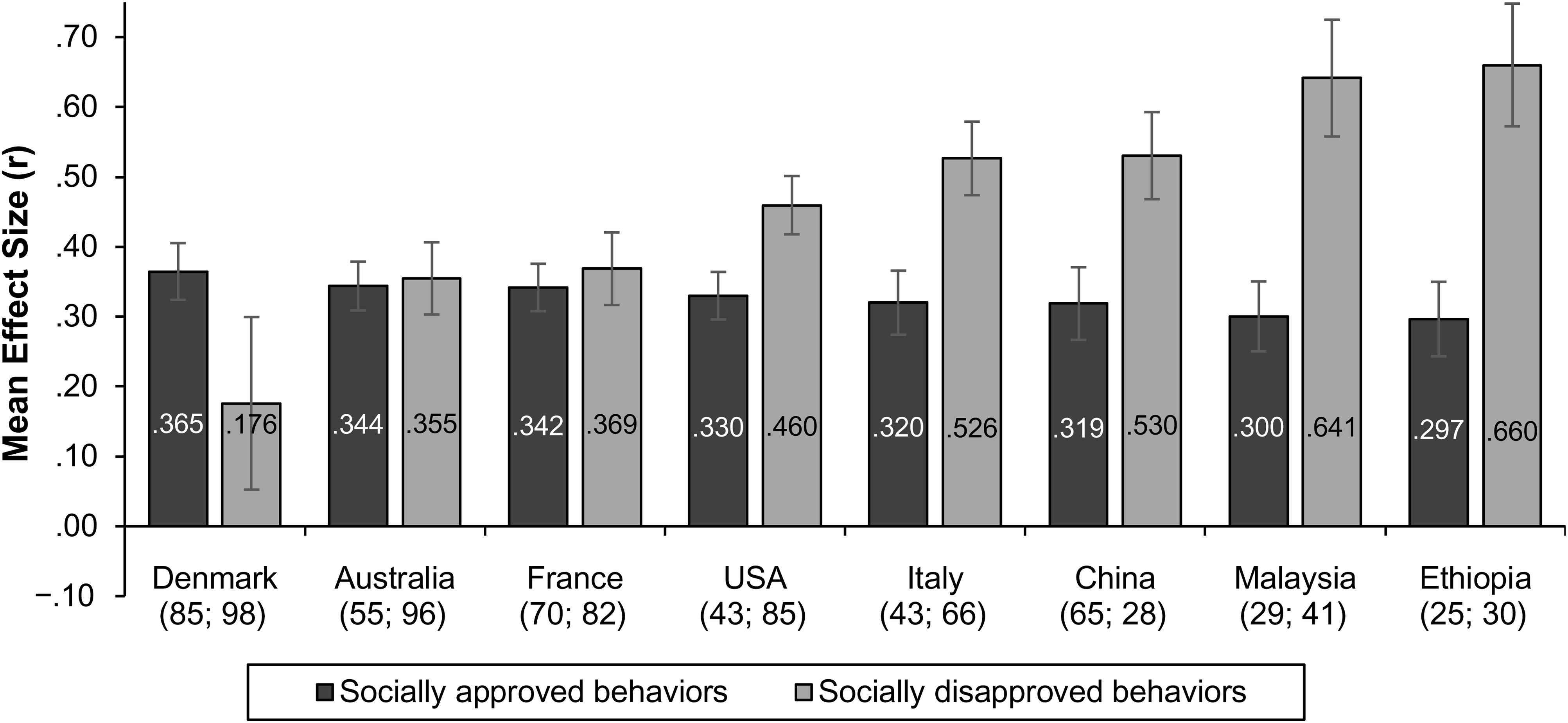
Predicted current effect sizes (Pearson’s product moment correlations) of descriptive norms for socially approved and disapproved behaviors, by global regions.
In Scandinavian countries such as Denmark (eight effect sizes), which score high on secular-rational values (85th percentile) and high on self-expression values (98th percentile), the mean effect size for socially approved behaviors is
In Western European (e.g., France) and Commonwealth (e.g., Canada, United Kingdom) countries with medium to high scores on both dimensions (but lower than Scandinavia), social norms are equally effective regardless of the social approval of behavior. For example, in Australia (20 effect sizes), a country with average secular-rational values (55th percentile) and high self-expression values (96th percentile), the impact of social norms on approved behaviors (
In contrast, in the United States (104 effect sizes), which is more traditional (43rd percentile for secular-rational) and has high self-expression values (85th percentile), the effect of social norms on socially disapproved behaviors (
Interestingly, we find the same pattern in Southern Europe (e.g., Italy) and China, even though these areas represent relatively high secular-rational (65th percentile) and low self-expression values (28th percentile). In these regions, social norms’ effectiveness is greater for disapproved behaviors (
Finally, in countries with strong traditional and survival values, such as most African and Muslim-majority countries, social norms’ impact on disapproved behaviors is much stronger than on approved behaviors. Consider Ethiopia (25th and 30th percentiles), where the mean effect size for disapproved behaviors (
Conclusion
This extensive meta-analysis shows that social norms significantly impact behavior and uncovers novel contingencies of this effect. We hope the proposed research agenda, which reflects our comprehensive investigation of the extant literature, sparks additional research in the fascinating ways in which social norms shape (or do not shape) consumer behavior.
Footnotes
Acknowledgments
The authors thank Harald J. van Heerde, Wayne Hoyer, and Gary L. Lilien for their feedback on earlier versions of the manuscript.
Associate Editor
Don Lehmann
Declaration of Conflicting Interests
The author(s) declared no potential conflicts of interest with respect to the research, authorship, and/or publication of this article.
Funding
The author(s) received no special funding for the research, authorship, and/or publication of this article.

Notes
References
Supplementary Material
Please find the following supplemental material available below.
For Open Access articles published under a Creative Commons License, all supplemental material carries the same license as the article it is associated with.
For non-Open Access articles published, all supplemental material carries a non-exclusive license, and permission requests for re-use of supplemental material or any part of supplemental material shall be sent directly to the copyright owner as specified in the copyright notice associated with the article.
