






Abstract

We are excited, honored, and grateful to assume leadership of Journal of Marketing (JM), the most cited, broadest, and most read marketing academic journal in the world. JM aims to connect marketing stakeholders with scholars who have fresh, bold, and rigorous ideas and whose research offers novel contributions. As we assume the editorship of JM, we are thankful to the previous editorial team of Christine Moorman, Harald van Heerde, Page Moreau, and Robert Palmatier for their superhuman efforts in galvanizing the journal and enhancing its impact in the marketing discipline. We are also thankful to the 30 past editorial teams that have served JM since 1936. The vision and strategies of each team, and the concomitant evolution of the intellectual community, have continually strengthened JM's standing as a premier research outlet for the marketing discipline.
Before we share our editorial strategy and initiatives, we want to highlight the important role played by journals in determining the influence of marketing scholarship. We believe that marketing scholarship can serve as a positive source of energy and spark necessary change for a wide range of stakeholders. Specifically, we propose that journals can serve the discipline much like catalysts serve chemical reactions—and we see ourselves fostering and promoting this role.
Good chemical catalysts act as substrates within which constituent elements encounter and interact with one another. Likewise, we envision a JM that can facilitate transfer of knowledge among its producers and consumers and, in so doing, drive deeper engagement among its multiple stakeholders. Good catalysts draw attention to elements that have a unique power to alter other elements, generate light, or spark processes. Good catalysts accelerate reactions. They provide alternative, robust pathways for the adoption and implementation of solutions that emerge from the processes they foster. Further, good catalysts take part in chemical reactions without being consumed in the process. Likewise, journals such as ours are poised to serve as accelerators for constructive dialogue and engagement among participants, free of agenda or bias. If we manage JM so as to catalyze our connected stakeholders, we can anticipate the reactions and processes that unfold in the field that will uncover unique ways in which society at large uses marketing scholarship.
Importantly, positioning JM as a catalytic agent is consistent with the ambition of marketing scholarship to not only support the marketing academic community but also advance a broader community of stakeholders, including practitioners, policy makers, and the world at large. In a rapidly changing, postpandemic, technology-led environment, this is more critical than ever before.
Optimizing JM as a Catalytic Agent
JM's formal mission to “develop and disseminate knowledge about real-world marketing questions useful to scholars, educators, managers, policy makers, consumers, and other societal stakeholders around the world” is designed to facilitate knowledge transfer among a wide set of stakeholders. To develop JM's role as a catalyst, rather than just a disseminator, we will pursue three main objectives, articulated in the following sections.
Offering Useful Responses to Important Marketing Problems
JM is positioned as the broadest premier journal in marketing, taking pride in covering a panoply of topics. While this breadth will be maintained organically due to the diverse nature of our discipline, a good catalyst will be particularly sensitive to elements that have the greatest potential to create useful reactions and thereby be relevant to a wide range of audiences. To this end, we will encourage authors to research, review teams to support, and Associate Editors to nurture work on important problems, or those “marked by or indicative of significant worth or consequence” 1 that, at present, lack robust solutions.
The push to consider important and unsolved real-world problems is not new for JM. As Kerin (1988, p. 1) notes in his editorial, JM is open to authors who seek to “stimulate new research or thinking on a substantive issue not previously addressed.” In his editorial, Rust (2006, p. 1) identifies how the “applied orientation for the field ties academic thought in marketing to the real world, either directly or indirectly.” However, we propose that JM can do more in this regard. If we follow through, we should see evidence that (1) we have reached a larger number of stakeholders, (2) we have reached stakeholders with an increasingly important status in society, and (3) we are able to document a larger magnitude of expected behavioral change in these stakeholders (e.g., Kohli and Haenlein 2021).
We propose that at JM, the importance of work is largely driven by the usefulness of its findings in solving a given audience's problems. As such, we suggest that authors writing for JM begin research projects with an “audience-backward” perspective (Van Heerde et al. 2021). That is, first identify the correct target audience for the research (not only an academic audience but also other audiences; e.g., managers/senior executives, consumers, citizens, governments). 2 Then, from this audience's perspective, formulate the research problem for which a “how” or a “why” is currently unclear. Following this approach will help authors appreciate the stakeholder's circumstances and stimulate self-reflection about the potential utility of the research to the target audience. If we begin with an audience's needs, whether we speak to our audience using experimental, qualitative, quantitative, or conceptual approaches matters far less than our ability to answer their question with insight and rigor.
We also propose that papers published in JM build future theoretical frameworks and test the limits of past scholarship. To better understand the importance of useful theoretical knowledge in marketing, consider the economic historian Joel Mokyr (2002), who distinguishes between “omega” and “lambda” knowledge. According to Mokyr, omega knowledge carefully observes and explains decontextualized phenomena. For example, omega knowledge in marketing might describe firms’ responses to changes in society, explain psychological processes underlying creativity, or offer a theoretical account predicting the outcome of a new firm's entry into a certain type of market. However, it is not necessary that omega knowledge be directly applied to solve a problem—and undervaluing such research because it is not used in this way would be misguided. Rather, it is the job of lambda knowledge producers to transform omega knowledge into concrete prescriptive approaches, accessible techniques, shareable inventions, problem-driven pragmatic insights, and other practical applications, as well as to raise questions that inform future production of omega knowledge. By doing this, lambda knowledge enlarges the significance and reach of omega's work. Further, lambda knowledge informs and is informed by omega knowledge—the application of our findings in the real world should allow for theoretical advances, raise new questions, show the limits of prior thought, and spark new inquiries. We propose that embracing this latter focus will help JM serve as a practical knowledge-generating device for marketing stakeholders.
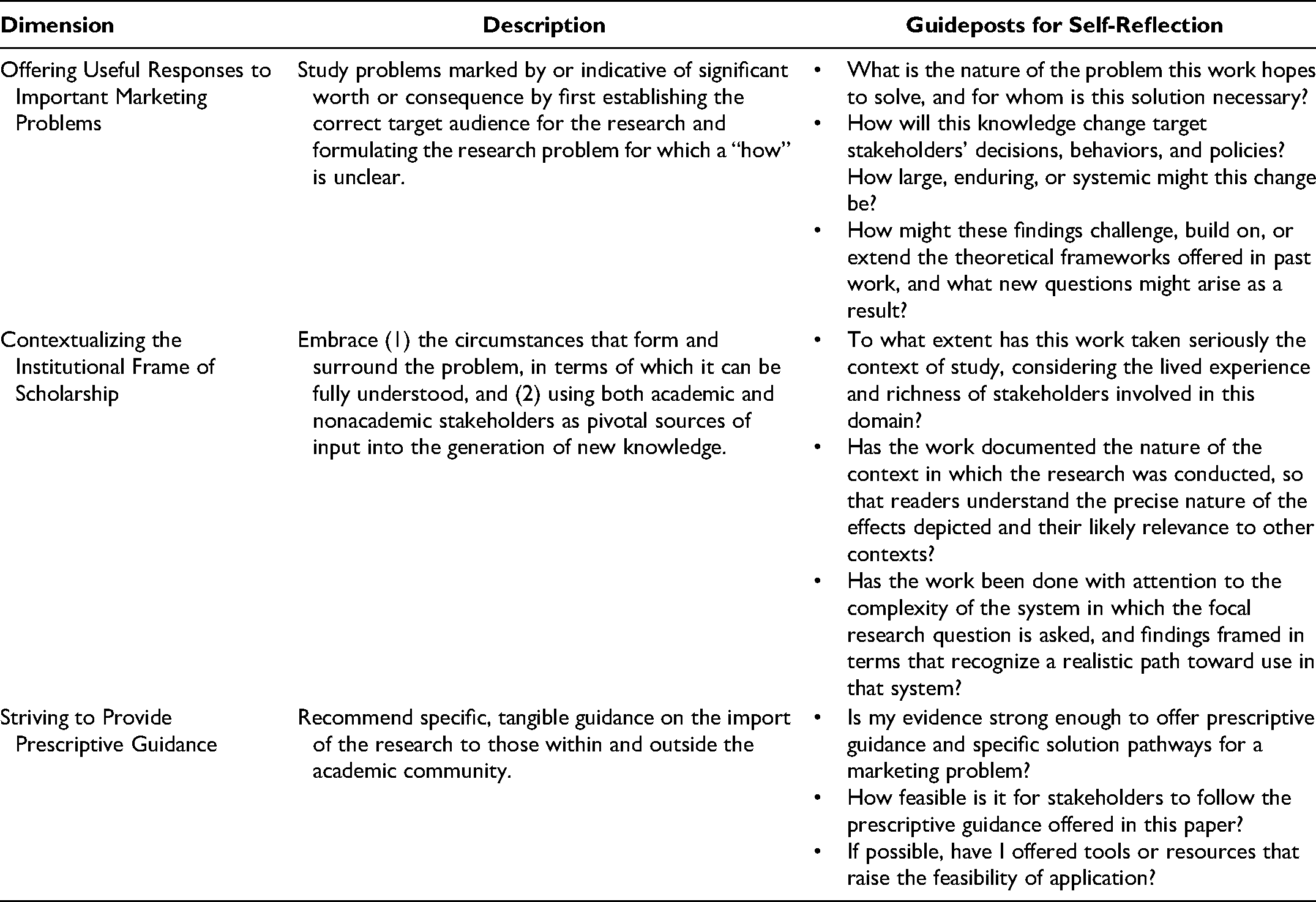
We offer the following guideposts for authors and reviewers to evaluate the usefulness and importance of JM submissions both before they submit their work to JM and during various stages of the review process:
What is the nature of the problem this work hopes to solve, and for whom is this solution necessary? How will this knowledge change target stakeholders’ decisions, behaviors, and/or policies? How large, enduring, or systemic could this change be? How might these findings challenge, build on, or extend the theoretical frameworks offered in previous research—and what new questions arise, or might arise, as a result?
We summarize the guideposts in Table 1. We hope that thinking through these questions will (1) prompt authors to establish this characteristic in their work and (2) enable review teams to better evaluate the success with which this objective is achieved.
Promoting Catalysis Through Marketing Scholarship: Self-Reflection for Authors and Reviewers.
Contextualizing the Institutional Frame of Scholarship
A good catalyst facilitates the transmission of energy among different elements. Often, scientific research presumes that this is best done by abstraction—that is, removing a phenomenon from the messy world in which it exists, so that cleaner relationships can be observed and translated into general statements about similar phenomena. In our context, however, this transmission of energy can be facilitated by acknowledging the social and economic ecosystem that shapes the marketing problem and solution.
For example, Narayan and Kankanhalli (2021) investigate how rural consumers in India shift their expenditures toward branded consumption when they migrate to urban areas. The authors find that factors such as household income and mobile phone ownership affect household consumption of branded products. The authors provide rich institutional details about (1) how a migrant is defined as per Indian census rules, (2) the importance of economic and social remittance for recent migrant-sending households in Indian villages, and (3) the definition of first-degree and second-degree neighbors in densely populated villages. This, in turn, provides important guidance and information to enable them to elegantly develop their conceptual and empirical framework and weave in the circumstances that inform this framework. Their institutional immersion in household neighborhood geography allows them to develop an instrumental variable that satisfies both the criteria of exclusion and relevance. From a practical standpoint, the contextualized framework helps demonstrate the complex interplay of the factors that affect household consumption and catalyze practical implications for brand marketers regarding marketing resource allocation in 650,000 villages in India.
We encourage authors to provide deep and immersive documentation of the setting where their research is focused and, where necessary, to work with scholars from other fields to help frame their research question and extrapolate meaningful implications of their contributions. We also encourage authors to highlight the diversity of the applicability of their findings and insights to help provide a wide epistemic base for the adoption of the useful and prescriptive guidance. Such contextualization continues to elevate JM's position as a forum for generating new theory, new frameworks, and new predictions for scholars and practitioners, especially when empirical insights are unavailable (Varadarajan 1996).
3
We offer the following guideposts for authors to critically evaluate whether their research objective and execution are effectively contextualized:
To what extent has this work taken seriously the context of study and considered the lived experience and richness of stakeholders in this domain? Has the work documented the nature of the context in which the research was conducted, so that readers understand the precise nature of the effects depicted and their likely relevance to other contexts? Has the work been done with attention to the complexity of the system in which the focal research question is asked, and are the findings framed in terms that recognize a realistic path toward use in that system?
Striving to Provide Prescriptive Guidance
A ripe environment for catalytic influence is present when the reaction pathways for the agents involved in the interaction are specified: it cannot simply be that something happens, but that we know how it happens and how it can be changed. Accordingly, it is important for authors, when possible, to articulate prescriptive guidance to help stakeholders leverage the usefulness of the findings and achieve their objectives. Although marketing academic research has the potential to offer rich prescriptive guidance for a multitude of stakeholders outside of the natural academic habitat—including academics from other disciplines, managers, senior executives, consumers, citizens, and government agencies—we often stop short of recommending the use of specific, tangible decision tools or methods, either within or outside the academic community. Without prescription of this type, marketing scholarship cannot be tested and refined.
Yang, Zhang, and Kannan (2022) offer an excellent example of the type of prescription that may not only raise a research's impact but also fuel further knowledge development. These authors use social media users’ brand engagement data to uncover underlying market structure. Importantly, they offer an online tool that provides an interactive visualization of market structure among brands, which allows managers to understand their closest competitors across a range of categories (e.g., beauty, sporting goods). This tool gives guidance about the ways managers can most effectively compete within a market. Because managers can use this tool, knowledge is transferred across stakeholders. As they learn from this tool, their experience can form the basis of new knowledge. If we are to offer prescriptive guidance, we must take seriously the risks and costs associated with these recommendations. Asking a firm to reallocate portions of its marketing budget, a customer to change their household shopping habits, or a regulator to choose one policy recommendation over another introduces the possibility of opportunity costs, changed relationships, and unintended consequences. It is our responsibility to frame recommendations in terms of both costs and benefits.
To highlight prescriptive guidance arising from scholarship, we urge authors to consider and identify what executable instructions they can provide based on their findings. For example, one could offer guidance to firms on serving a diverse consumer base during societal unrest, fostering creativity in high-tech product development, or adaptively responding to a new competitor's entry. More generally, one could think of guideposts such as,
Is my evidence strong enough to offer prescriptive guidance and specific solution pathways for a marketing problem? How feasible is it for stakeholders to follow the prescriptive guidance offered? Can I provide an analysis that suggests that the benefits obtained will outweigh the costs? Have I offered tools or resources that raise the feasibility of application?
Designing a Catalytic Community: A Shared Commitment
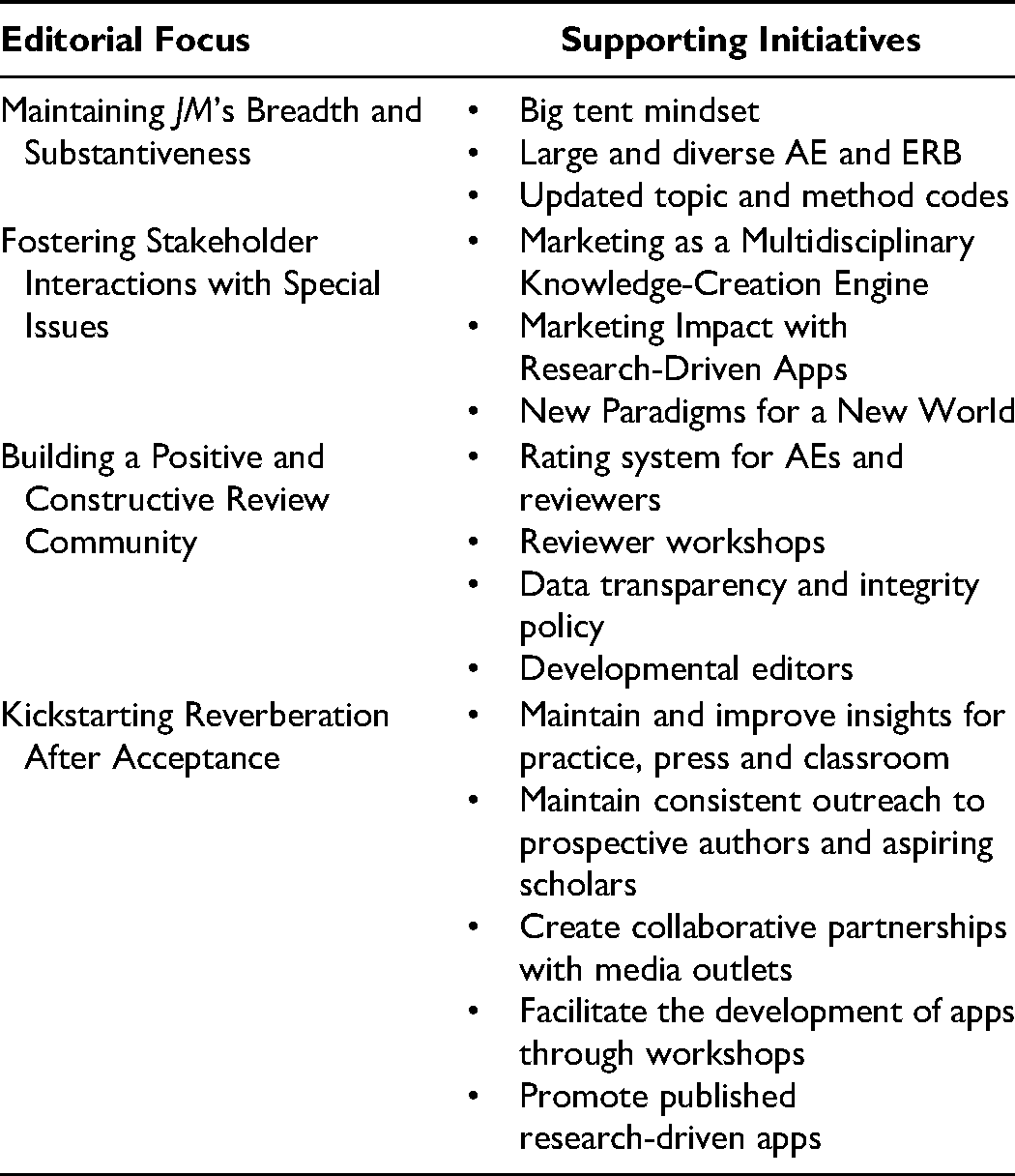
There is no way that JM can play this role without a commitment from the community in which the catalysis is intended to occur. We ask the JM community to support us in preserving and further developing the elements we see as critical for our role: continuity, curation, constructiveness, and celebration. We describe each of these dimensions next, with reference to specific initiatives and special issues designed to invite participation. Table 2 summarizes formative aspects of each dimension.
Achieving Catalysis: Our Editorial Focus and Supporting Initiatives.
Maintaining JM's Breadth and Substantiveness
The prior editorial team stressed the importance of JM's “big tent” position: to be marketing's most inclusive journal open to any type of marketing scholarship (Moorman et al. 2019). The previous team also stressed the importance of ecological value, or “the degree to which research reflects and is relevant to marketing as it exists and evolves among marketing stakeholders and marketing ecosystems” for the discipline (Van Heerde et al. 2021, p. 1). Our focus on creating catalytic knowledge embraces these ideas. We encourage articles to take on novel problems, with diverse data and approaches, and move beyond well-established areas and well-known concepts.
To support JM's promise of being the most inclusive journal in the discipline, we have maintained the size and diversity of JM's team of Associate Editors (AEs), and Editorial Review Board (ERB). JM's AE and ERB community is the largest of all the major journals in the discipline. We have recruited this community as a signal of our openness to align the composition of the review team to process papers that (1) take fresh perspectives on new or neglected topics as well as (2) apply new perspectives and methods to existing topics. We have further revised JM's topic and methods codes to account for a wider range of manuscripts, including those that cover recent developments in the marketplace.
Finally, we will maintain JM's strong historical tradition of publishing conceptual papers, with an emphasis on articles that generate indigenous and contextualized knowledge. We will make a concerted effort to align the composition of our editorial teams to process such papers.
Fostering Stakeholder Interactions via Special Issues
To spur interactions among the many stakeholders served by JM, we are launching three special issues. First, as a means of expanding the boundaries of the marketing academic discipline, we have announced an initiative titled “Marketing as a Multidisciplinary Knowledge-Creation Engine,” edited by our team. Many of the marketing challenges we face present problems that require multiple disciplinary lenses. For example, studying the cultural underpinnings of authenticity (Thompson and Kumar 2022) or scraping web data with precision and integrity (Boegershausen et al. 2022). For these and other complex problems, using only a marketing lens may result in incomplete and suboptimal solutions. Against this backdrop, articles submitted to this initiative should (1) focus on substantive topics and adopt a multidisciplinary perspective, (2) make a case for why a multidisciplinary perspective offers an important contribution, and (3) ideally be driven by a coauthor team wherein at least one author has their primary appointment in a marketing department and at least one other author has their primary appointment outside a marketing department.
Second, as a means of enhancing the prescriptiveness of our research, we are launching a special issue titled “Marketing Impact with Research-Driven Apps,” edited by Pradeep Chintagunta, Rajdeep Grewal, Detelina Marinova, Rik Pieters, and Shrihari Sridhar. Given the typical form and function of academic publications in the discipline, the target audience of marketing academic research (consumers, investors, firms, frontline/middle/senior management, policy makers, and other marketing scholars and students) face barriers to understand and adopt research findings. These barriers limit the impact of marketing academic research. This special issue emphasizes the integration of research-driven apps into academic articles to enhance understanding, consumption, adoption, and ongoing usage of research findings. A research-driven app is an online interactive tool that provides a deeper understanding of the usability of the research contribution. It serves as a dynamic computational supplement to a research manuscript, thereby adding form and function to the otherwise static nature of a research publication. Rather than adding an app to the end of an otherwise traditional research manuscript (problem, idea, intended contribution, theory, data, findings, conclusions, discussion, recommendations, and future research), the intended usability and implementation of the research findings into an online interactive tool should be a focal point from the outset of research until submission of the manuscript. In this way, developing apps for marketing academic research may stimulate a solution-based mindset among marketing scholars that is reflected in their research output. For example, Warren et al. (2021) find that academic writing can be difficult to understand due to practices such as abstraction, use of technical language, and passive writing. The authors call for scholars to overcome the curse of knowledge, and they provide an app and a tutorial to authors to recognize and repair unclear writing. Accordingly, submissions to the special issue should include a new section titled “App Implementation.” In this section, the author(s) should (1) describe the problem solved by the app and how it supplements the research contribution of the manuscript, (2) define the audience or the end users targeted by the app and the usefulness of the app to this audience beyond the current situation or available (software or other) solutions, and (3) provide a secure, anonymous, and relatively permanent link to the app, with appropriate instructions on how to use the app and interpret the results.
Finally, we are launching a special issue titled “New Paradigms for a New World,” which will ask marketing scholars to reimagine the world of marketing in the wake of recent significant disruptions. These disruptions to marketing practice—ranging from the COVID pandemic; the impact of new technological advances such as artificial intelligence, the metaverse, and virtual reality; and the recognition of vast social and economic disparities as well as political divisions across the globe—have resulted in fundamental changes in consumer behavior and in how marketing is organized and conducted. The special issue will challenge our existing frameworks and assumptions and introduce new frameworks to address these changes. Submitted articles should not only describe the present landscape but also help set theoretical foundations for future study. As such, they should strive to achieve one or more of the following: (1) create new theories or frameworks to reframe how we view specific phenomena, (2) examine previously underexplored theoretical relationships or processes, (3) identify new mediators or moderators of existing relationships or processes that reflect these disruptions, (4) extend previously demonstrated effects/frameworks to incorporate these disruptions, (5) create new theories in “white spaces,” where there is no theory to explain specific phenomena, or (6) develop new constructs to reflect/represent new phenomena when existing constructs are not available.
Building a Positive and Constructive Review Community
A catalyst cannot perform its function if it destroys or distorts the elements with which it interacts. Rather, it should find and maximize the power inherent in each. This organic sense of conceptual and methodological care is important to preserve by incentivizing reviews that are constructive and thorough as well as choosing a sensible mix of reviewers and AE for every manuscript as a first step.
Authors submit a paper and go through years of review so that we can help them improve their work, not bury or unrecognizably alter it. We will maintain JM's encouragement to AEs and reviewers to instill a “not wrong” mindset when it comes to rigor. This approach calls for gatekeepers to be humble and accepting of the notion that no paper is perfect, and “perfect” should not become the enemy of “good.” Moreover, in line with Kohli and Haenlein (2021), we ask that reviewers consider if the probability of wrong conclusions from a piece of research is acceptably low. This shifts the reviewer mindset from exclusively focused on method to a combination of method and substance.
Second, we will encourage the reviewer community to embrace a solution-oriented mindset when improving the rigor of a manuscript. This requires the reviewer, AE, and editor to put themselves in the author's shoes, then provide reparative, specific strategies to address flaws with the current state of the research. Examples of a solution-oriented mindset include (1) spotting an experimental confound and addressing how to control for it; (2) noting if the logic for a hypothesis does not make sense, pointing out where the logic breaks down, and suggesting possibilities for how to address it; and (3) raising concerns with the use of an instrument and, if possible, offering feasible alternative instruments. We will also maintain the annual feedback system where the Coeditors rate the AEs and the AEs in turn rate the reviewers on constructiveness and thoroughness, while maintaining turnaround times.
Third, less experienced reviewers tend to be negatively inclined, an issue that is endemic to the marketing discipline. We intend to conduct reviewer workshops open to all ad hoc reviewers and ERB members of JM. In this workshop, attendees will not only receive advice on the tenets of writing a good review from stellar AEs and past Editors but also go through simulated review scenarios in small groups. Through this active engagement, we hope that attendees will enter into a self-reflection process that should increase their preparedness to incorporate the lessons into their future efforts and lead to positive and constructive community-building.
Fourth, as a commitment to transparency, we are in the early stages of putting in place a data transparency policy. For JM, the reason for such a policy is clear: if we are to make strong prescriptions, our conclusions need to be based on the soundest evidence possible. When undergirded in this way, authors should have greater confidence in their conclusions. As such, this data transparency and integrity initiative will also allow authors to write marketing implications sections that are bolder, more directly prescriptive, and realistic.
Finally, because of disparity in experience and access to relevant resources, some scholars, particularly outside North America, might face greater challenges in navigating the desk reject hurdle at JM. Yet, such underrepresented authors often bring new perspectives and tackle previously overlooked but significant problems faced by large populations across the world. Guided by the catalytic function of JM, we aim to provide such scholars additional support for success in the form of developmental feedback and constructive instructions from more advanced scholars (whom we denote as “Developmental Editors”) even if the papers are desk rejected, while setting expectations about what it will take for a paper to enter the review process at JM.
Kickstarting Reverberation After Acceptance
Fireworks are among the most visible catalyzing agents—and their connection to celebration is not, for JM, accidental. The previous editorial team and AMA Support Center team have achieved great success by celebrating the work published in the journal, which allows us both to recognize the efforts of author and review teams and to expand the impact of our research beyond the academic audience.
To ensure celebration at JM, we will continue to complement each focal piece of scholarship (i.e., articles) with a range of retelling strategies to increase its academic and nonacademic impact. Accordingly, we will continue using Scholarly Insights to translate the work published in JM into practical implications for practitioners and policy makers, and maintain a press release archive and posting strategies on LinkedIn and Twitter to generate awareness among a wide range of JM audiences. In addition, we will work to create collaborative partnerships with media outlets (e.g., Harvard Business Review, Sloan Management Review, The Conversation, Forbes) and encourage them to look for original scholarly content from authors and leverage a current story (related to arts, corporations, government, politics and policy, sports, or society) to offer a fresh and scientific view. We will supply authors with a summary of the content prepared by the JM team to help them create these pitches for journalistic outlets.
JM's Insights in the Classroom aims to extend the reverberation of the content in JM articles by asking authors to think about their papers from an instructional perspective for adoption in class sessions involving practicing or soon-to-be marketing practitioners. Again, we will continue to work with the AMA Support Center team to enhance the modality and tone of the content, to make them even more effective and accessible to instructors in marketing.
Propelled by the Marketing Impact with Research-Driven Apps special issue, we will host research-driven apps published in JM and/or emanating from articles published in marketing academia on the JM website. The objective of the website will be to disseminate these apps to target constituents (i.e., practitioners, researchers, policy makers, and authors) who aim to employ this newly generated lambda knowledge in their work. In addition, we will host app-development workshops, featuring tutorial sessions conducted by research-driven app experts to enable participants to build their own apps for their research.
Our Hope for the Future: JM as an Ecosystem of Interactions
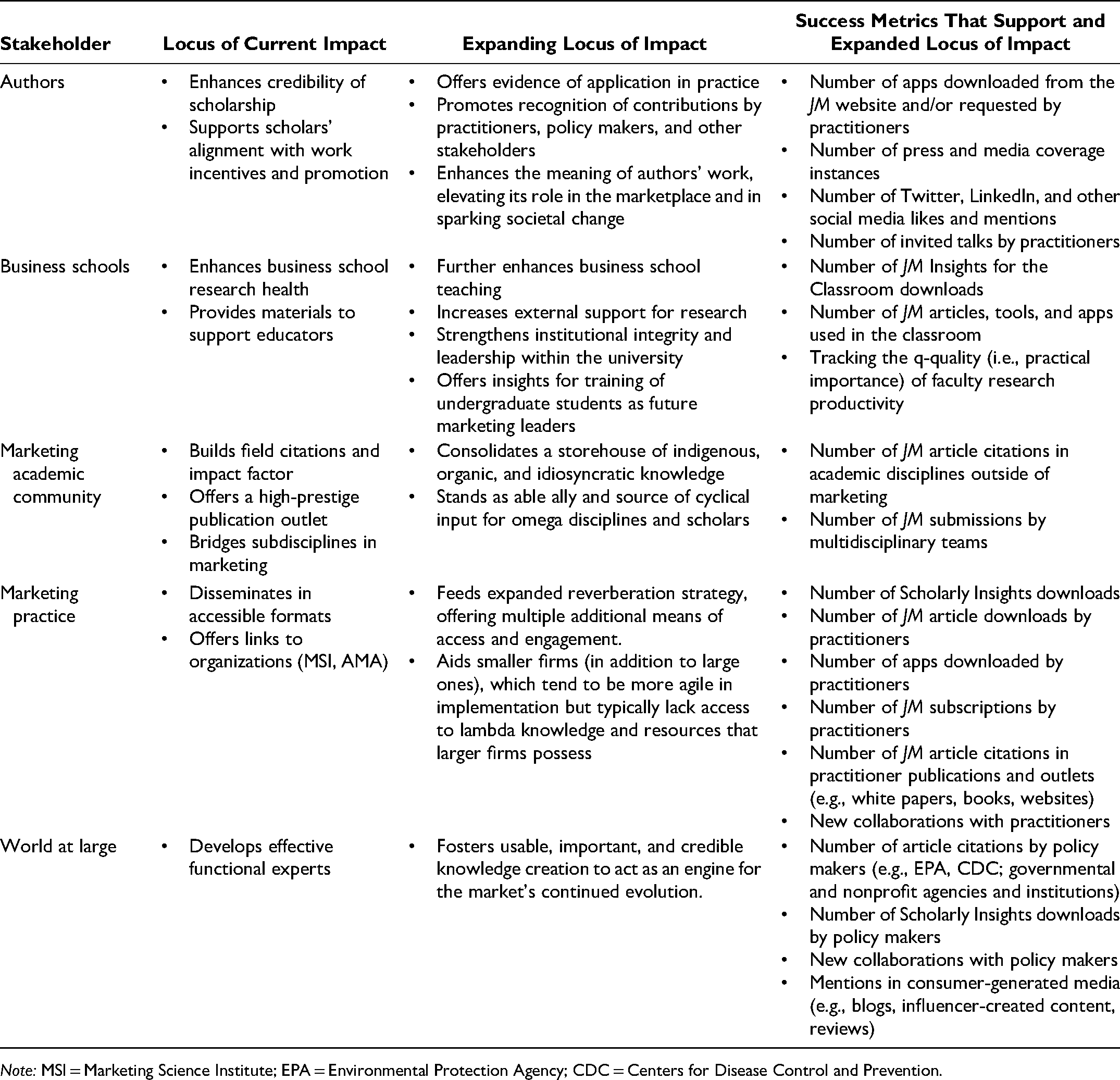
The need for greater change is constant, and our hope to collectively push our boundaries of influence should also be a constant. Table 3 summarizes the success metrics that could reflect that marketing scholarship is expanding its locus and providing greater illumination.
Expanding Stakeholder Impact.
Note: MSI = Marketing Science Institute; EPA = Environmental Protection Agency; CDC = Centers for Disease Control and Prevention.
As a leading marketing journal, JM impacts authors by serving as a signal of the credibility of an author's body of scholarship. By our dissemination efforts and resulting impact factor, we also add value by building the academic reputation of authors. However, many business schools are now asking not only about academic impact but also whether faculty can provide evidence of their work's societal impact. By focusing on how JM can speed up progress, our goal is to help authors find evidence of this societal impact—that is, by creating engagement with nonacademic audiences, positioning authors as sources of practical insights, and having a more established seat at the table in times of societal need. As Table 3 shows, we might begin to measure this impact by citations (within and beyond marketing journals and in practitioner-focused publications), downloads, popular press mentions, social media engagement, use in the classroom, and further submissions to JM.
Turning to business schools, JM is at present primarily seen as a mechanism to improve the r-quality (rigor) of faculty research productivity and thereby improve a business school's research health or ranking. At the same time, we recognize that business schools are under increasing pressure from students, alumni, and administrations both to prepare students for the current marketplace and to prove their institutional value. By being a catalytic influence, JM and the marketing discipline can collectively improve the q-quality (i.e., practical importance) of faculty research productivity. The q-quality of the research expands the impact of research on business schools by positively impacting teaching health, external support, and institutional integrity (Stremersch, Winer, and Camacho 2021).
What about JM's impact on the marketing discipline? A routinized approach in which our journals are judged against other journals within and outside the discipline includes analyses such as journal citations, impact factors, and inclusion in prestigious compilation of journal lists curated by third parties and accreditation bodies (e.g., Key et al. 2020; Varadarajan 2020). These metrics are reflective of the current outcome or state of influence of our journals, rather than the systems and processes that generate said influence. A focus on being a catalytic influence can make JM a storehouse of indigenous, organic, and idiosyncratic knowledge and thereby serve as an able ally for such inventions in omega disciplines, as well as a source of knowledge export to others. Indeed, Kohli (2009, p. 1) encourages “organic (indigenous) innovation in marketing—that is, ideas, concepts, and theories that are new to the world, not just to marketing, and further our understanding of marketing issues.” As Table 3 shows, we might begin to measure this impact by article downloads, citations within and across disciplines, and citations in practice-oriented journals.
JM has a critical and impactful role in shaping the minds of marketing practice through the facilitation of improved decision making in for-profit and nonprofit organizations. As an academic community, we frequently share our academic work with practitioners to engage with, learn from, and shape their views. JM currently uses Scholarly Insights and several other retelling strategies to encourage readership and to enhance our ability to shape and influence marketing practice. Yet, agents who practice marketing seldom claim to even read marketing journals. A sustained emphasis on conducting audience-backward research could result in knowledge transfer from marketing practitioners to form the basis of useful and generalizable theories (e.g., Zeithaml et al. 2020) and insights from marketing scholarship to permeate the day-to-day beliefs and actions of marketing practitioners. As Table 3 shows, we might begin to measure this impact by the number of practice-oriented publications that carry our findings and the use of our research by practitioners.
Finally, what about JM's impact on the world at large? For much of the past three decades, marketing scholars have focused on getting marketing “a seat at the table” to help legitimize the value of marketing for the firm, avoid alienation (Lehmann 2004), and demonstrate that marketing-focused C-suite executives deliver financial performance and credibility to the firm (Germann, Ebbes, and Grewal 2015). Through an emphasis on being a catalytic influence, we can recognize the impact of marketing beyond the firm, on topics such as sustainability and climate concerns, economic and social empowerment, health and well-being, and marketing in subsistence economies (Chandy et al. 2021). Thus, we can expand the role of marketers from being functional experts to effective instruments of customer value, thereby becoming increasingly relevant to consumers, practice, society, and government. As Table 3 shows, we might begin to measure this impact by the number of article citations by policy makers (e.g., Environmental Protection Agency, Centers for Disease Control and Prevention, governmental and nonprofit agencies and institutions), research emerging due to collaborations with policy makers, and mentions in consumer-generated media (e.g., blogs, influencer-created content, reviews).
Conclusion
As we join the lineage of 30 past Editors in Chief and their teams, we see that they have treated their responsibility with humility, selflessness, patience, and utmost integrity and have influenced the next generation of scholars and practitioners. They have published work ambitious in its scope yet grounded in its application. They have fostered and encouraged a community that crosses methodological, topical, and geographic boundaries. And in so doing, they have maintained a delicate balance of continuity and renewal strategies (Stewart 1999).
We begin our editorial journey with a hope to continue this tradition and to embrace the goal to promote catalysis in marketing scholarship. We recognize and sincerely value the efforts of a large team who ensure that JM's mission is accomplished on a daily basis. These include the members of the AMA staff who work with JM (T.J. Anderson, Jess Barselow, Hannah Finkelstein, Michelle Kritselis, Marilyn Stone, and Matt Weingarden), JM staff and students who support the production of Scholarly Insights and JM Insights in the Classroom content (led by Holly Howe and Demi Oba), the ad hoc reviewers and ERB members who work tirelessly to help authors succeed, the AEs who take a leadership role and vested interest in the impact of articles, the Advisory Board, and AMA's VP of Publications (Ron Hill), who will help us lead and guide JM through the next three years. We look forward to serving with vigor and invite you to join us!
Footnotes
Acknowledgments
The authors greatly appreciate the input of Ron Hill, Ajay Kohli, Christine Moorman, Rik Pieters, Marilyn Stone, Matt Weingarden, and Manjit Yadav on previous versions of this editorial.
Declaration of Conflicting Interests
The author(s) declared no potential conflicts of interest with respect to the research, authorship, and/or publication of this article.
Funding
The author(s) received no financial support for the research, authorship, and/or publication of this article