







Abstract
A circular economy is a “closed-loop” system designed so that products flow back into the production cycle after use. With many companies implementing take-back programs as part of their sustainability strategy, a fundamental shift in consumption has occurred, with consumers considering disposal during and even before purchase decision making. Eight experiments reveal that consumers indicate a greater willingness to pay for circular program products. An increase in psychological ownership underlies the difference in product valuation. Specifically, the additional disposal control uniquely afforded by circular products increases the capacity of circular take-back program products to evoke psychological ownership. The process explanation is directly tested through mediation. Experimentally manipulating antecedents of psychological ownership (i.e., disposal control and psychological ownership) provides further support for the conceptual framework.
Keywords
The world has generally operated as a linear economy, in which raw materials are assumed to be abundant, collected without regard for any environmental consequences, and then transformed into products that are used until they are finally disposed of as waste. This approach is largely to blame for the environmental crisis facing the world today (Urbinati, Chiaroni, and Chiesa 2017). Contributing to this crisis is the fact that people consume more than they need and dispose of products inefficiently (Environmental Protection Agency 2019; Sun and Trudel 2017; Trudel and Argo 2013). A viable alternative to a linear economy is a circular economy. A circular economy is a “closed-loop” model in which products flow back into the production cycle after use (i.e., through recycling, donating, reselling, refurbishing, and reusing) to minimize waste generation and negative environmental externalities (Stahel 2016).
Governments worldwide view a circular economy as part of the solution to the climate crisis. Many are actively enacting policies to stimulate a circular economy in their countries by implementing extended producer responsibility (EPR; Xiang and Ming 2011), “an environmental policy approach in which a producer's responsibility for a product is extended to the post-consumer stage of a product's life cycle” (Organisation for Economic Co-operation and Development 2023). For example, the European Union has adopted this policy for product categories of electronics, batteries, and vehicles, consequently putting the responsibility for the end-of-life disposal of these products on the firms that produce them. British Columbia is requiring producers to take full responsibility for the residential recycling of packaging and printed paper (EPR Canada 2017). Independent of regulation, companies such as Apple, Adidas, Dell, and IKEA are implementing circular principles by initiating take-back strategies that allow consumers to bring products back to them to be put back into the production cycle. For example, using in-store promotions, clothing retailer H&M encourages consumers to participate in its circular take-back program by returning their used clothes to the retailer. Depending on the type of clothing and its condition, H&M donates the clothing to charity, recycles it, or reuses it to make new clothing to sell. IKEA has committed to being 100% circular by 2030 and has implemented a take-back scheme promoted extensively in stores (IKEA 2023). Beyond the environmental benefits, circular take-back programs also provide advantages for firms. A circular economy can decrease supply chain risk by increasing the security and price stability of a company's supply chain through the use of recovered materials (Gaustad et al. 2018). Circular programs may additionally allow firms to develop new markets, gain new customers, and build their brands and reputations as environmentally friendly and innovative organizations (Ellen MacArthur Foundation 2013; Urbinati, Chiaroni, and Chiesa 2017).
While a circular strategy presents a fundamental shift in thinking for firms, it is also a shift in thinking for consumers from a linear model to a closed-loop model in which disposal is inherent in every purchase decision. A circular economy requires consumers to think of disposal at acquisition and to be active in “closing the loop.” The natural question that arises for managers is the impact of circular programs on purchase behavior and whether consumers value circular programs. To provide insight into this question, we obtained a proprietary data set from a reverse logistics company that serves Fortune 500 companies and their consumers by facilitating circular take-back programs. The data set included 5,198 visits and basket transactions by 2,368 consumers as well as take-back/return data, from September 15, 2015, to June 4, 2020. Web Appendix A provides a complete description, methods, and analysis. We analyzed how much consumers spent on each visit, accounting for within-subject random effects and controlling for category and seasonality. Analysis of the log-transformed basket sale amount revealed that customers spent more after they became aware of the circular program (b = .065, SE = .008, t = 7.895, p < .001). The data also showed that customers spent more on their second visit than on the initial visit, when they were not aware of the program (b = .038, SE = .01, t = 4.15, p < .001), and more on their third visit than on the second visit (b = .040, SE = .01, t = 3.36, p < .001), before spending leveled off. While understanding the limitations of these data is important (i.e., we only had information on consumers who opted into the circular take-back program and did not have a control group), and we are careful not to make any strong claims because of selection issues and the correlational nature of these findings, the data suggest that consumers value circular take-back programs and that they spend more as they become aware of the program.
To further explore the preliminary results of the observational field data, this research directly tests the relationship between circular take-back program products and valuation. We ground our theory in the waste aversion and psychological ownership literature and introduce a new product affordance—namely, disposal control—that allows circular products to garner greater capacity for psychological ownership. Eight experiments show that consumers ascribe higher valuation to circular program products. Underlying this difference is an increase in psychological ownership over the product. In line with this process explanation, manipulating antecedents of psychological ownership (i.e., whether the product is purchased for the self or someone else) influences the difference in valuation for circular program products over regular products. Substantively, our studies explore design considerations for implementing circular programs and provide a deeper understanding of the opportunities and challenges facing managers.
Theoretical Background
Waste Aversion
Waste aversion is the tendency to avoid wasting resources such as money, time, or materials. According to prior research, people are strongly averse to creating waste, and wastefulness is aversive enough to motivate people and influence consumer behavior (Arkes 1996; Bolton and Alba 2012; Donnelly et al. 2017; Sun and Trudel 2017; Trudel and Argo 2013). Wastefulness in the context of a circular economy occurs when a product (e.g., resources, materials) is not fully used. Prior research has focused on the negativity and anticipatory emotions of consumers’ aversion to the wasting of money (Arkes 1996) or the wasting of unused product utility (Bolton and Alba 2012; Okada 2001). For example, the thought of trashing resources is aversive enough to decrease waste through anticipatory guilt and effectively limit consumption (Sun and Trudel 2017). Bolton and Alba (2012) find that consumers were more likely to rent a product for $100 than to buy the same product for $100 if they only planned to use it once, because of their aversion to unused utility when purchasing. In each of these examples, the anticipated negative association and guilt with wasting and its influence on behavior provide evidence that waste aversion is a forward-looking phenomenon and that consumers often anticipate unused utility or wastefulness as a future consequence at the time of purchase.
In contrast with other corporate social responsibility and brand purpose initiatives (e.g., when a company donates to charity or social causes), circular take-back programs are advertised in combination with specific products, often forcing consumers to think about the disposal of these products at acquisition. This may have a positive or a negative effect on consumer behavior. For example, making consumers think about disposal at purchase may remind them of how easily they satiate on products (Redden 2008), decrease self–brand connection (Escalas and Bettman 2005) or attachment to the products (Trudel 2019; Trudel, Argo, and Meng 2016), and decrease valuation. However, we make the opposite prediction. Because circular take-back programs are linked to specific products, we propose that the opportunity to participate in a circular program increases psychological ownership and, in turn, product valuation. We base our hypothesis on the idea that circular programs uniquely afford increased perceived control over the disposal of a product. As most people are waste averse, they should find having increased control over how a product is disposed of important. Moreover, this increased control over disposal is a valuable affordance because it allows consumers to avoid the self-threat of being wasteful and enables a product to be used more fully (Bolton and Alba 2012; Trudel, Argo, and Meng 2016).
Psychological Ownership
Psychological ownership is the feeling of emotional attachment to an object that may or may not be supported by formal ownership (Brenner et al. 2007; Sen and Johnson 1997; Strahilevitz and Loewenstein 1998; Thomson, MacInnis, and Park 2005). People can feel ownership over tangible objects (Shu and Peck 2011), intangible objects (Atasoy and Morewedge 2018), organizations (Pierce, Kostova, and Dirks 2001), and ideas (Baer and Brown 2012). In general, feelings of psychological ownership occur when a person experiences a product and depend on how well a product allows the individual to intimately know it, control it, and self-invest in it (for reviews, see Kirk, Peck, and Swain [2018], Morewedge [2021], Morewedge et al. [2021], Peck and Luangrath [2023], and Pierce, Kostova, and Dirks [2003]). More specifically, feelings of ownership increase with familiarity, control, and intimate connection with a product.
Central to our investigation, prior research has established physical control as an antecedent of psychological ownership (Atasoy and Morewedge 2018; Morewedge 2021; Peck and Luangrath 2023; Peck and Shu 2009). Moreover, control is both a characteristic of ownership (Snare 1972) and a route to achieving it (Csikszentmihalyi and Halton 1981). For example, physically controlling a product by touching and holding it increases psychological ownership of the product at purchase (e.g., Peck and Shu 2009). Research has also found that consumers feel little sense of psychological ownership over digital goods because of the lower perceived control over digital goods compared with equivalent physical goods (Atasoy and Morewedge 2018). While altering, touching, and even merely holding goods can increase psychological ownership through increased control even before a person owns a product (e.g., Peck and Shu 2009), other kinds of control can also increase psychological ownership through affordances from the product (Baxter, Aurisicchio, and Childs 2015). Moreover, the experience of control does not necessarily have to be physical; even the mere perception of control is sufficient to evoke a sense of ownership (Peck and Luangrath 2023).
Disposal Control as a Product Affordance and Antecedent to Psychological Ownership
Affordances are what a product offers consumers, that is, what it provides or makes possible (Gibson 1986; Norman 1988). An affordance, however, is not a “property” of an object; rather, it is defined in relation to the opportunities it provides; for example, a door affords opening, but not for a toddler who cannot reach the handle (Gibson 1986). In the context of psychological ownership, affordances play an important role in facilitating feelings of ownership by providing consumers with opportunities to intimately know a product, control it, and self-invest in it (Kirk, Peck, and Swain 2018). That is, feelings of ownership are dependent not only on the individual but also on the affordances the product itself provides (Gibson 1979). As noted by Mardon, Denegri-Knott, and Molesworth (2022), despite being well theorized in other domains, the concept of affordances has not received extensive attention within consumer research. However, some recent studies have begun to draw attention to theories of affordances (Borghini, Sherry, and Joy 2021; Hoelscher and Chatzidakis 2021; Kozinets, Ferreira, and Chimenti 2021). Key to our research inquiry is the work of Baxter, Aurisicchio, and Childs (2015), which identifies 16 affordance principles that are important to consumers and that lead to increased feelings of psychological ownership even if they are not immediately used. Five of the 16 principles are affordances associated with opportunities to increase control: (1) the opportunity to manipulate objects through space (spatial control), (2) the opportunity to arrange object settings (configuration control), (3) the opportunity to use the object when desired (temporal control), (4) the opportunity to decide the rate at which to use products (rate control), and (5) the opportunity to alter the object during usage (transformation control). Moreover, each affordance principle is likely to have a magnitude component. For example, Kirk and Swain (2018) report that consumers who were able to interact with a product using its multiple affordances reported greater feelings of control and psychological ownership than those who were only able to interact using a single affordance. That is, the greater spatial, configuration, temporal, rate, and transformation control that a product affords will lead to increased capacity for the product to garner feelings of ownership (Baxter, Aurisicchio, and Childs 2015). In summary, similar to how physical products afford consumers the opportunity to hold and touch them, other affordances that provide the opportunity for consumers to use products how, where, when, and at the rate desired may increase psychological ownership by affording additional control over products (Baxter, Aurisicchio, and Childs 2015).
We argue that waste aversion, the additional control over product disposal afforded by circular programs, and psychological ownership are strongly related. Because consumers are waste averse, they are motivated to be efficient in their disposal and to conserve resources for the future. Circular program products afford consumers the opportunity to avoid waste by increasing control over the disposal of a product. Thus, waste aversion makes having control over disposal an important and valued product affordance. We call this affordance principle disposal control and define it as the ability to reduce wastefulness and increase control over the full life cycle of the product by having more control over the disposal process. We argue that the additional disposal control afforded by circular program products increases feelings of psychological ownership over the product in the same way that increasing the number of affordances of products increases control and psychological ownership. Disposal control, like other affordances designed to increase control, can lead to increased feelings of psychological ownership even if not immediately experienced (Baxter, Aurisicchio, and Childs 2015; Morewedge 2021).
Consistent with prior work that has found that imagined use, or imagined future ownership, can increase feelings of ownership (Peck, Barger, and Webb 2013; Zajonc 1968), consumers do not need to immediately experience the disposal control afforded by circular programs to imagine themselves avoiding waste and to feel more ownership of the product. This is in line with the notion that consumers’ imagined affordances shape their perceptions of a product without the need to experience the affordance (Mardon, Denegri-Knott, and Molesworth 2022; Nagy and Neff 2015) and lead to increased feelings of ownership (Kirk, Peck, and Swain 2018). For example, Mardon, Denegri-Knott, and Molesworth (2022) show that the misalignment between imagined affordances of digital products with experienced affordances influences psychological ownership over digital objects. The present work extends this literature by demonstrating experimentally how product affordances can effectively enhance psychological ownership in the tangible context of product disposal and circular take-back programs.
Hypotheses and Empirical Evidence
This research asks whether consumers value circular program products. We predict that consumers will have a higher valuation (willingness to pay [WTP]) for circular program products than for regular products. We expect that underlying the difference in product valuation between regular and circular take-back program products is an increase in the capacity for circular take-back programs to evoke psychological ownership over a product. This is consistent with prior research that shows that, in many cases, people extend psychological ownership and attachment to goods before owning them, which in turn increases their valuation (Atasoy and Morewedge 2018; Kim and Johnson 2014; Reb and Connolly 2007; Sen and Johnson 1997). Thus:
We base our theory on the notion that circular programs afford consumers an additional opportunity for control (i.e., disposal control) that increases the capacity for psychological ownership. Disposal control is a novel product affordance that increases psychological ownership—the psychological closeness to a product—because it gives consumers additional control over disposal and waste. Given that physical and other forms of control are essential antecedents to psychological ownership (e.g., Atasoy and Morewedge 2018; Baxter, Aurisicchio, and Childs 2015; Peck and Luangrath 2023; Peck and Shu 2009), we expect the additional disposal control that circular program products afford consumers to lead to increased feelings of ownership. The theoretical model is presented in Figure 1.
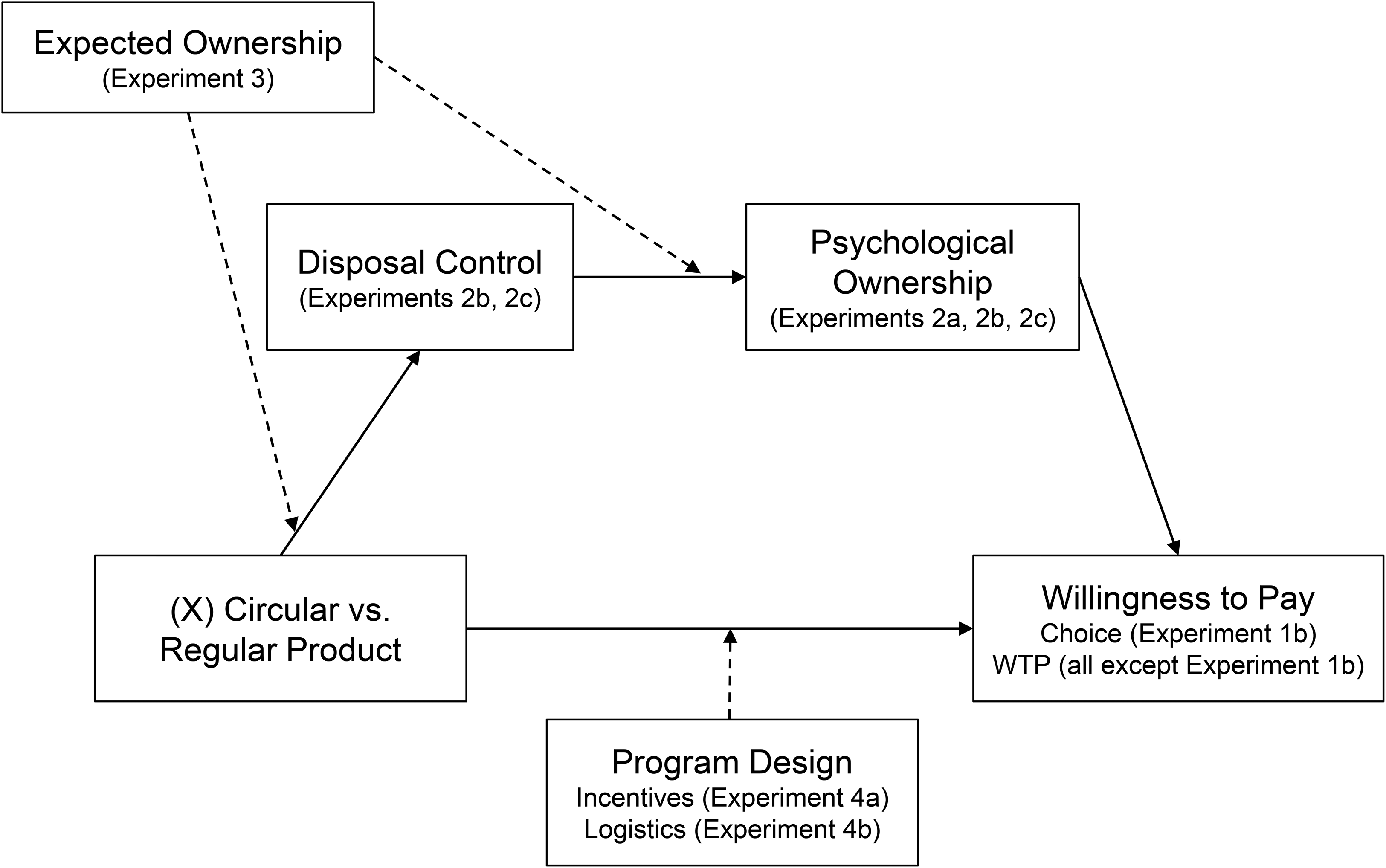
Theoretical Model.
We test our main effect hypothesis, H1, through actual behavior and incentive-compatible experiments eliciting consumers’ WTP (Experiments 1a and 1b). We rule out alternative explanations (Experiment 2a) and test our proposed theoretical model using mediation (H2). In Experiments 2b and 2c, we measure perceived disposal control and directly test it as an antecedent to psychological ownership (H3a and H3b). In Experiment 3, we manipulate disposal control and psychological ownership to demonstrate support for our proposed process through moderation. In Experiments 4a and 4b, we test two design considerations and provide evidence of the main effect under different scenarios in which consumers currently encounter circular take-back programs (i.e., with and without incentives; and with take-back to the store or with home pickup). Data collection, methodology, and analysis plans were preregistered for all studies. All stimuli are similar to that used in Figure 2 and based on current retailers’ in-store advertising of circular programs and are included in Web Appendix B. Web Appendix C shows how price ranges for each study were determined.
Across experiments, we also asked participants about their loyalty to the brand. We hypothesized and consistently found that implementing circular programs also resulted in greater loyalty to the brand. Although loyalty is an important metric for brands and the long-term outlook of firms, and we preregistered loyalty as an additional dependent variable for all our studies, in our analyses, we concentrate on valuation. We present all the loyalty analyses in Web Appendix D and no longer discuss loyalty in our methods or results.
Experiment 1a: Increased WTP for Circular Program Products
The empirical package includes three studies with substantive outcomes by using incentive-compatible and probabilistically consequential outcomes. In Experiment 1a, we endow students with $5 and ask them to pay what they want for a circular program (vs. regular) pen to capture real purchase behavior. We predict that consumers value the same product more if it is part of a circular program.
Method
We secured a booth in a university's student union building and recruited 200 students (Mage = 21.27 years, SD = 4.14; 49.0% female, 50.5% male, .5% other; preregistration: https://aspredicted.org/n4mj5.pdf) as they walked by. We told participants that they would receive $5 for use to purchase a product (i.e., a pen) that they would evaluate as part of the experiment. We randomly assigned participants to one of the two between-subjects conditions, which manipulated the presence of a circular program (regular product vs. circular program product) using the firm's advertising. Participants first received a handout with the product advertisement and a short survey on a single page. They were then handed the pen and instructed to use it to complete the survey and to test it before deciding how much they would pay for it. Next, they were asked to indicate their WTP for the pen using their $5 budget and were told that they could spend or keep as much of the $5 as they chose and would receive whatever they retained after buying the pen.
Results
In support of our main effect prediction (H1), the analysis revealed that participants paid more for the circular program product ($3.63, SD = 1.94) than for the regular product ($2.61, SD = 1.46; F(1, 198) = 17.57, p < .001, d = .59). Age and gender did not significantly influence valuation in this experiment, nor did they influence any of the analyses in the studies that follow; thus, we do not discuss them further. Experiment 1a provides preliminary evidence that consumers ascribe greater valuation to a circular program product than to a regular product. Students paid more for a circular pen than for a regular pen. In Experiment 1b, we replicate the main effect of valuation for circular products by manipulating price and using choice as a dependent variable.
Experiment 1b: Increased WTP for Circular Program Products (Choice Scenario)
Method
This experiment provides evidence of the main effect through an alternative dependent variable to WTP, namely, the choice between two products: one at a higher price with a circular program and one at a lower price without a circular program. Three hundred one CloudResearch participants (Mage = 39.72 years, SD = 11.79; 57.2% female, 41.8% male, 1% other; preregistration: https://aspredicted.org/c27qj.pdf) took part in this incentive-compatible study. As in Experiment 1a, we told participants that they had a budget for the study ($20 in this case) that they could use to buy one of two T-shirts. They were informed that they would be entered into a draw and that the winner would receive the chosen T-shirt and the $20 less the price of the T-shirt (adapted from Becker, DeGroot, and Marschak [1964]).
Participants read a scenario that contained an advertisement for a T-shirt. We selected plain white T-shirts from H&M and Zara because we considered them interchangeable and did not expect brand differences. We randomly assigned participants to one of three between-subjects choice conditions: (1) a “regular product, same price” condition, which served as our control condition and included product images of the H&M and Zara T-shirts, both priced at $10.15; (2) a “regular product, higher price for Zara” condition, which served as a comparison condition with the Zara T-shirt at a higher price ($11.90) and the H&M T-shirt at a lower price ($10.15); and (3) a “higher price for the Zara circular T-shirt” condition, in which the higher-priced Zara T-shirt ($11.90) was advertised as a circular program product, and the lower-priced H&M T-shirt ($10.15) was not. Participants had to choose one of the two options. The order in which brands were presented was randomized. In this and all studies onward, participants were based in the United States and responded to demographic questions (i.e., age and gender) at the end.
Results and Discussion
Logistic regression revealed that, in comparison with when the prices were the same for both T-shirts, the odds of choosing the Zara T-shirt decreased by 61% (95% CI = [.21, .73]) when it was more expensive than the H&M T-shirt. However, the odds of choosing the Zara T-shirt increased by 167% (95% CI = [1.51, 4.73]) when it was more expensive and advertised with the circular program. While 41.4% of participants chose Zara in the “regular product, same price” condition, this proportion decreased to 21.8% in the “regular product, higher price for Zara” condition (Pearson χ2 = 8.93, p = .003). However, this proportion increased to 65.3% in the “higher price for the Zara circular T-shirt” condition, which was significant in comparison with the “regular product, same price” condition (Pearson χ2 = 11.51, p < .001) and in comparison with the “regular product, higher price for Zara” condition (Pearson χ2 = 38.98, p < .001). The results show that considering circular disposal at acquisition through circular programs can positively influence the valuation of products. This experiment reveals that consumers are willing to pay a higher price for a product advertised with a circular program than for a similar lower-priced product that does not have a circular program.
The results from Experiments 1a and 1b provide initial support for H1. As with most main effect studies, possible alternative explanations need to be addressed. First, consumers’ increased valuation of circular program products may be due to (1) a green or prosocial warm glow (Iweala et al. 2022) not unique to circular programs; (2) brand effects not specific to circular program products; (3) higher quality perceptions of products that can be reused, donated, or recycled; (4) a novelty effect in which consumers value new and innovative programs; (5) the convenience that take-back programs offer; and/or (6) perceived costs to the company, since research on dual entitlement (e.g., Kahneman, Knetsch, and Thaler 1986) posits that higher prices are legitimate and expected when firms are striving to maintain profitability in the face of higher direct costs. These possibilities are directly tested as alternative explanations in a mediation model in Experiment 2a.
Experiment 2a: Underlying Mechanism: Mediating Role of Psychological Ownership
Method
By directly measuring psychological ownership along with other feasible explanations (i.e., quality, convenience, novelty, wastefulness perceptions, environmental responsibility, and perceived program cost to the company), Experiment 2a tested whether psychological ownership is a viable process explanation for the effect of the circular program on valuation (H2). We randomly assigned 300 CloudResearch participants (Mage = 39.92 years, SD = 11.87; 47.7% female, 52% male, .3% other; preregistration: https://aspredicted.org/59k3i.pdf) to one of two between-subjects conditions (regular product vs. circular program product). Participants read a shopping scenario that was similar to that described in the previous experiments and included an advertisement about an IKEA armchair that they were considering buying (see Figure 2). After reading the scenario, participants indicated their WTP (in U.S. dollars) for the product from $0 to $350. We measured psychological ownership using a seven-point scale (1 = “extremely disagree,” and 7 = “extremely agree”; adapted from Fuchs, Prandelli, and Schreier [2010] and Peck and Shu [2009]) that asked participants how much they agreed or disagreed with the following statements: “I would feel a strong sense of closeness to this product,” “I would feel a high degree of personal ownership over this product,” and “This product would incorporate a part of myself.” We also asked participants, in random order, how much they agreed or disagreed with the following items as alternative process explanations: “This product is high quality,” “This product is convenient,” “This product is novel,” “This product is wasteful,” “This product is environmentally conscious,” and “This product is costly to the company.”
Sample Study Stimuli.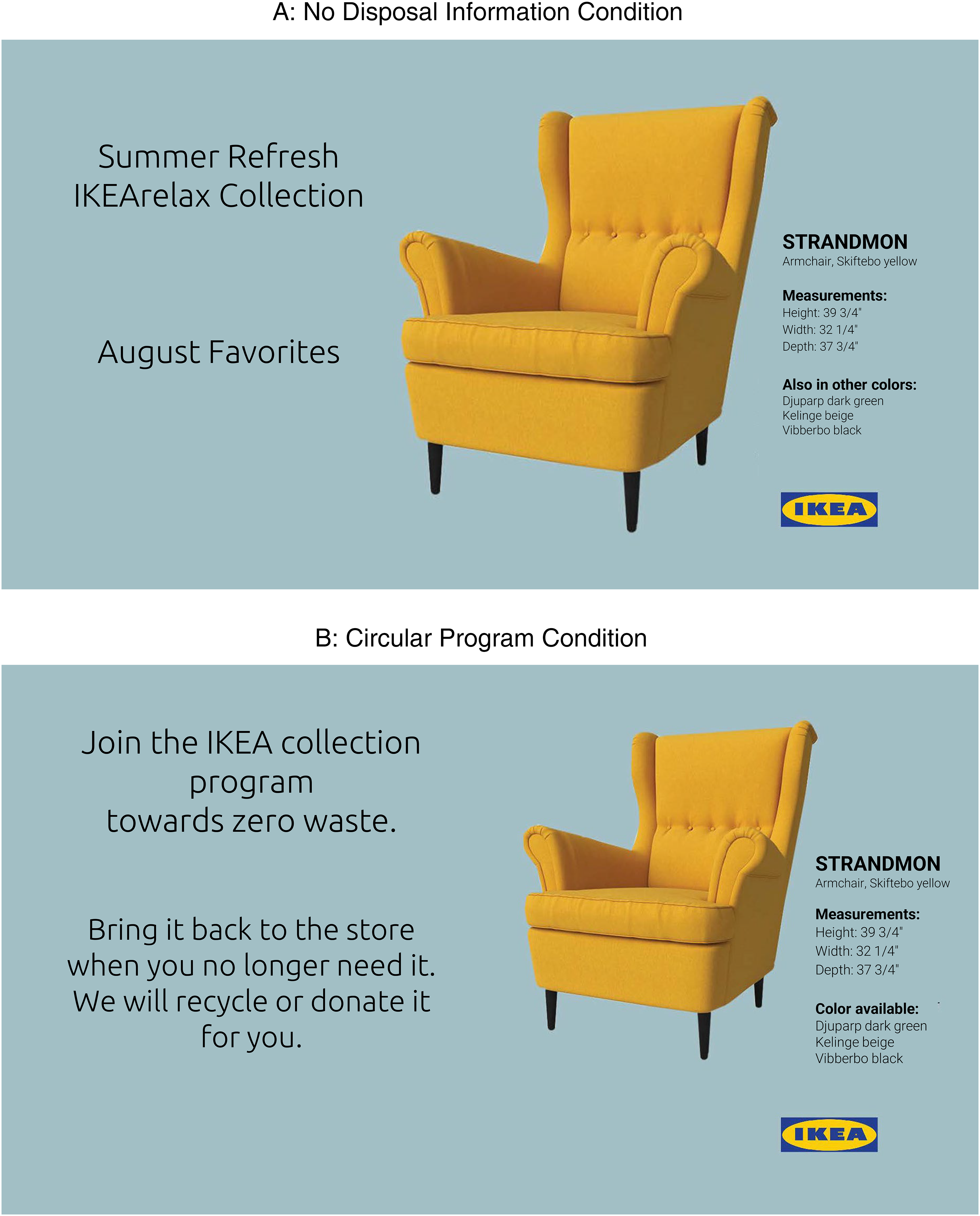
Results and Discussion
WTP
A one-way analysis of variance (ANOVA) provided further support for H1. Participants were willing to pay more for the IKEA circular program armchair ($142.69, SD = 68.98) than the regular armchair ($127.15, SD = 65.86; F(1, 298) = 3.99, p = .047, d = .22).
Psychological ownership
Further supporting our theory, the ANOVA revealed that participants felt more psychological ownership (α = .85) over the circular program armchair (4.65, SD = 1.19) than over the regular armchair (4.21, SD = 1.57; F(1, 298) = 7.29, p = .007, d = .32).
Alternative process variables
We conducted a multivariate analysis of variance on the dependent variables, which revealed significantly higher means when comparing participant responses in the circular program condition with those in the regular product condition in terms of quality (MCircular = 4.90, SD = 1.09; MRegular = 4.40, SD = 1.44; p < .001, d = .39), convenience (MCircular = 5.41, SD = 1.01; MRegular = 5.01, SD = 1.19; p = .002, d = .36), environmental responsibility (MCircular = 5.21, SD = 1.20; MRegular = 3.95, SD = 1.18; p < .001, d = 1.05), and perceived cost to the company (MCircular = 3.42, SD = 1.34; MRegular = 3.09, SD = 1.31; p = .034, d = .25). Perceptions of novelty were not different across conditions (p = .255), whereas perceptions of wastefulness were lower in the circular program condition (2.50, SD = 1.33) than in the regular product condition (2.91, SD = 1.42; p = .010, d = .29).
Mediation analysis
To assess mediation, we conducted a bootstrapping analysis (5,000 iterations; PROCESS Model 4, Hayes 2013) with WTP as the dependent variable, the circular program product condition as the independent variable, and psychological ownership as the mediator. This analysis revealed a significant indirect effect (βCircular = 6.97, SE = 2.92; 95% CI = [1.81, 13.35]); that is, the circular program increased consumer WTP through psychological ownership (H2). The mediation analysis also revealed a nonsignificant direct effect (95% CI = [−6.08, 23.24]), revealing an indirect-only mediation through psychological ownership.
To directly investigate the role of psychological ownership relative to other alternative explanations, we conducted another mediation analysis, simultaneously testing for alternative mediators. A mediation analysis (5,000 iterations; PROCESS Model 4, Hayes 2013) with WTP as the dependent variable, circular program product condition as the independent variable, and psychological ownership as well as all other potential process explanations as the mediators showed that the predicted indirect effect was significant for psychological ownership but not for the other alternative mediators (H2). Table 1 summarizes the results of the parallel mediation.
Parallel Mediation Results (PROCESS Model 4).
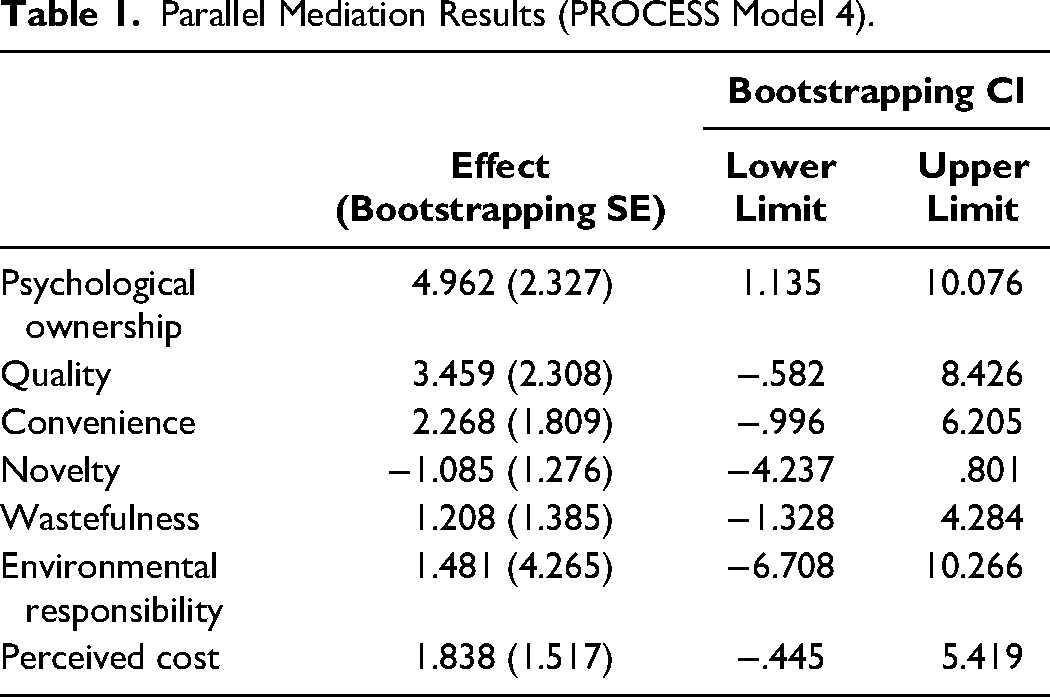
Overall, participants in the circular program condition reported greater WTP for the armchair because they experienced more psychological ownership over the product, which in turn made them willing to pay more for it. The direct effect of the circular program on WTP was not significant, indicating indirect-only mediation through psychological ownership on WTP while controlling for perceptions of quality, convenience, novelty, wastefulness, environmental responsibility, and perceived program costs (βCircular = 1.66, SE = 8.36; 95% CI = [−14.77, 18.11]) (Zhao, Lynch, and Chen 2010).
Experiment 2b: Disposal Control as an Antecedent to Psychological Ownership
Affordances play an important role in facilitating feelings of ownership by providing consumers with opportunities to have additional control over products. Control over a product is a well-established antecedent to psychological ownership (Baxter, Aurisicchio, and Childs 2015; Morewedge 2021). Our theoretical argument posits a strong relationship between waste aversion, the additional disposal control afforded by circular programs, and psychological ownership. Experiment 2b measures control and psychological ownership to determine whether people ascribe greater valuation to circular goods because circular programs engender a sense of increased control over a product, which in turn evokes psychological ownership.
Method
Three hundred one CloudResearch participants (Mage = 39.98 years, SD = 12.07; 47.5% female, 51.2% male, 1.3% other; preregistration: https://aspredicted.org/7jg8e.pdf) took part in this incentive-compatible experiment (Becker, DeGroot, and Marschak 1964). We told participants that one person would receive a bonus based on the following instructions: They had a $30 budget to use to buy a T-shirt, and a random price between $0 and $30 would be generated at the end of the study. If the random price was lower than the amount they were willing to pay, they would buy the T-shirt, and the price would be deducted from their $30 bonus. If the random price was higher than the amount they were willing to pay, they would not buy the T-shirt, and nothing would be deducted from their $30 bonus.
We randomly assigned participants to one of two between-subjects conditions (regular product vs. circular program product) that included a shopping scenario and an advertisement for a For Days branded T-shirt. Participants indicated their WTP (in U.S. dollars) using a slider scale within a price range for the product ($0 to $30). We measured “control” using a single-item measure that asked participants how much they agreed or disagreed with the following statement: “I feel I have a lot of control over this product” (1 = “extremely disagree,” and 7 = “extremely agree”). We measured psychological ownership using the same three-item scale as in Experiment 2a.
Results and Discussion
WTP
In support of H1, the analysis revealed that participants were willing to pay more for the circular program T-shirt ($11.90, SD = 6.07) than for the regular T-shirt ($10.11, SD = 5.79; F(1, 299) = 6.83, p = .009, d = .30).
Control and psychological ownership
Analyses revealed that participants felt more control over the circular program T-shirt (5.05, SD = 1.49) than over the regular T-shirt (4.09, SD = 1.64; F(1, 299) = 27.77, p < .001, d = .61). Participants also felt more psychological ownership (α = .80) over the circular program T-shirt (4.62, SD = 1.47) than over the T-shirt without the circular disposal information (3.89, SD = 1.41; F(1, 297) = 19.57, p < .001, d = .51).
Mediation analysis
We conducted a mediation analysis (5,000 bootstrapped iterations; PROCESS Model 4, Hayes 2013) with WTP as the dependent variable, circular program product condition as the independent variable, and psychological ownership as a mediator. We found the predicted indirect effect (βCircular = 1.08, SE = .27, 95% CI = [.58, 1.65]). The direct effect of the circular program product on WTP was not significant, indicating indirect-only mediation through psychological ownership on WTP (βCircular = .69, SE = .66; 95% CI = [−.61, 2.01]) (Zhao, Lynch, and Chen 2010), thus successfully replicating the previous mediation study and providing additional support for H2. We also conducted the same mediation analysis (5,000 bootstrapped iterations; PROCESS Model 4, Hayes 2013) with control as the only mediator. In this case, the analysis of the indirect effect uncovered no significant results (βCircular = .42, SE = .23; 95% CI = [−.02, .89]), which suggests the vital role of psychological ownership, rather than merely control, in the boost in valuation.
Serial mediation analysis
A bootstrapping analysis of serial mediation (5,000 iterations; PROCESS Model 6, Hayes 2013) tested the proposed conceptual model and included disposal control as an antecedent to psychological ownership. The model included WTP as the dependent variable, circular program condition as the independent variable, and disposal control and psychological ownership as serial mediators (M1: disposal control, M2: psychological ownership). In support of H3a, participants in the circular program condition reported greater WTP (βCircular = .71, SE = .19, 95% CI = [.37, 1.13]; see Figure 3) for the T-shirt because they experienced more control and, in turn, more psychological ownership over the product (H3b). The direct effect of the circular program product on WTP was not significant, indicating indirect only mediation through disposal control and psychological ownership on WTP (βCircular = .87, SE = .68; 95% CI = [−.46, 2.20]) (Zhao, Lynch, and Chen 2010).
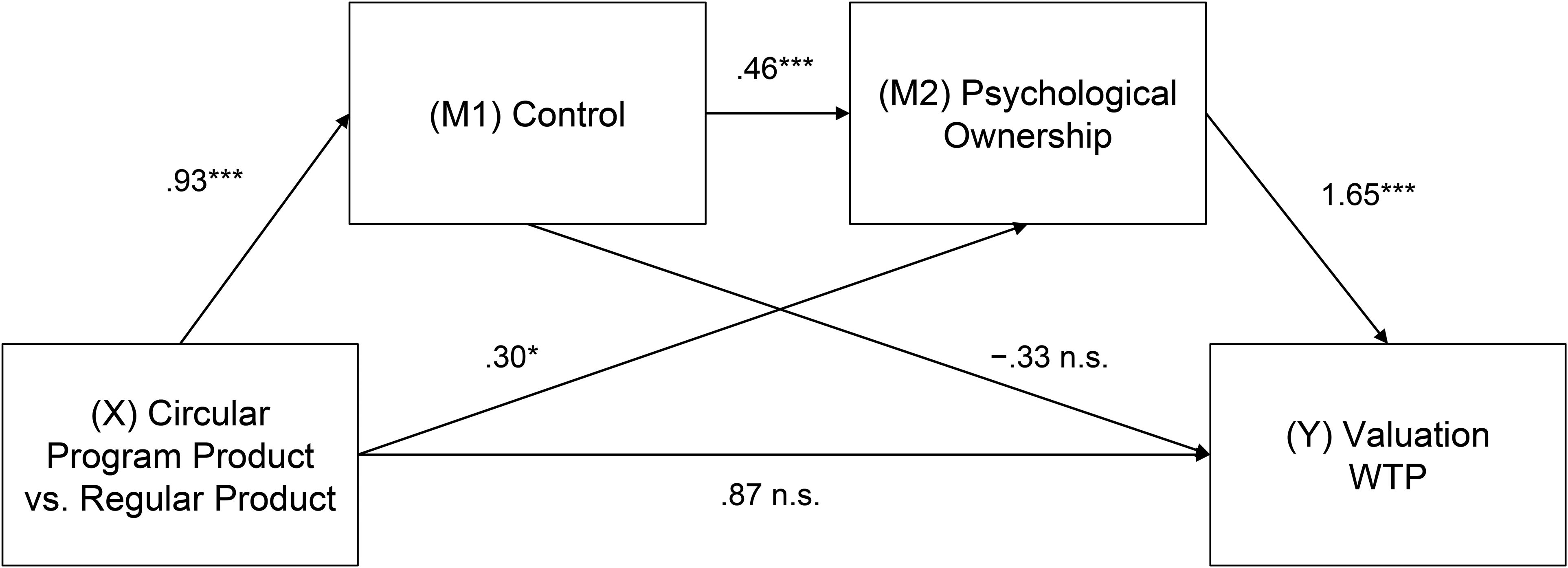
Serial Mediation Model (PROCESS Model 6).
When the preceding bootstrapping analysis (5,000 iterations; PROCESS Model 6, Hayes 2013) was conducted with reversed order of the mediators (M1: psychological ownership, M2: disposal control), the indirect effect was not significant (βCircular = −.13, SE = .11, 95% CI = [−.36, .07]), providing evidence for the theoretical model as conceptualized.
We replicated the serial mediation in another experiment with a three-item measure of disposal control, asking for WTP after disposal control and psychological ownership and using a different product, an IKEA sofa (Web Appendix E). Overall, Experiment 2b demonstrates the unique product affordance of disposal control that circular products provide and its role in increasing consumers’ capacity for feelings of ownership over products.
Experiment 2c: Comparing Circular Program Products with Curbside Recycling
Affordances are what a product offers consumers. For psychological ownership, affordances facilitate feelings of ownership by providing consumers with opportunities to self-invest in the product, intimately know it, and control it. Our theory is grounded in the notion that circular program products afford consumers a unique form of control over the disposal of a product, which increases the capacity for feelings of ownership and valuation. Experiment 2c tests the notion of disposal control as a unique product affordance of circular take-back programs and compares them with municipal recycling programs.
Prior research has shown that control must be intrinsically linked to the target product to influence feelings of psychological ownership (Baxter, Aurisicchio, and Childs 2015; Morewedge 2021). While municipal recycling programs offer generalized control over multiple categories of waste, circular take-back programs are focused on a specific product. Thus, this link between affordance and the product should evoke higher control over the product when it is part of a circular program. Moreover, Davis (2020; see also Davis and Chouinard 2016) proposes that affordances are shaped by consumers’ perception of the product's ability to offer an action in addition to what the product already enables. In this sense, circular programs afford additional disposal control, beyond what is expected in a regular product condition and with municipal recycling, by increasing additional disposal and more tangible options. Therefore, consistent with the extant research that has shown that control must be intrinsically linked to the product (Baxter, Aurisicchio, and Childs 2015; Morewedge 2021) and that multiple affordances are more valued than a single affordance (Davis 2020; Davis and Chouinard 2016; Kirk and Swain 2018; Nagy and Neff 2015), we expect that consumers will value products more when disposal control is afforded by circular program products in comparison to when municipal recycling programs are available for the same product.
Method
Three hundred CloudResearch participants (Mage = 41.24 years, SD = 12.59; 56.0% female, 42.7% male, 1.3% other; preregistration: https://aspredicted.org/6p8fx.pdf) read a scenario that contained an advertisement about a particular consumer product (a tea set with a glass pitcher and cups) that they were looking to buy. In this experiment, we used a lesser-known brand (i.e., Tea + Linen) to account for possible preconceived impressions of the brand's environmental responsibility. We randomly assigned participants to one of three between-subjects conditions (regular product vs. circular program product vs. product that was 100% recyclable in the current curbside recycling system). After reading the scenario and viewing the advertisement, participants indicated their WTP (in U.S. dollars) for the product from $0 to $70. We measured disposal control using a single-item measure of control that asked participants how much they agreed or disagreed with the following statement: “I feel I have a lot of control over this product” (1 = “extremely disagree,” and 7 = “extremely agree”). We measured psychological ownership using a seven-point scale (1 = “extremely disagree,” and 7 = “extremely agree”; adapted from Fuchs, Prandelli, and Schreier 2010; Peck and Shu 2009) that asked participants how much they agreed or disagreed with the following statements: “I would feel a strong sense of closeness to this product,” “I would feel a high degree of personal ownership over this product,” and “This product would incorporate a part of myself.”
Results and Discussion
WTP
A one-way ANOVA on the dependent variable WTP revealed significant differences across conditions (F(2, 297) = 4.21, p = .016,
Disposal control and psychological ownership
Analyses revealed significant differences in disposal control across conditions (F(2, 297) = 9.24, p < .001,
Mediation analysis
We conducted a mediation analysis (5,000 bootstrapped iterations; PROCESS Model 4, Hayes 2013) with WTP as the dependent variable, the three product conditions as the independent multicategorical variable where the regular product was the reference condition, and psychological ownership as a mediator. We found the predicted indirect effect (H2) in the circular program condition (βCircular = 1.06, SE = .56, 95% CI = [.08, 2.30]) but not in the 100% recyclable in the current recycling system condition (βRecycling = .61, SE = .57, 95% CI = [−.39, 1.83]). The indirect effect was significant when the circular program was set as the reference condition and compared with the 100% recyclable in the current recycling system condition (βRecycling = −1.87, SE = .65, 95% CI = [−3.26, −71]).
Serial mediation analysis
We conducted a bootstrapping analysis of serial mediation (5,000 iterations; PROCESS Model 6, Hayes 2013) with WTP as the dependent variable, the three circular program conditions as the independent variable, and disposal control and psychological ownership as serial mediators (M1: disposal control, M2: psychological ownership), finding support for the serial mediation predicted in H3b and replicating the findings in Experiment 2b. Indirect effects proved to be significant only in the circular program condition in comparison to the regular product condition (βCircular = 1.11, SE = .41, 95% CI = [.41, 2.01]) but not for the 100% recyclable in the current recycling system condition (βRecycling = −.30, SE = .39, 95% CI = [−1.13, .41]). The direct effect of the circular program product on WTP was not significant, indicating indirect-only mediation through disposal control and psychological ownership on WTP (p = .29]) (Zhao, Lynch, and Chen 2010). The indirect effect was significant when the circular program was set as the reference condition and compared with the 100% recyclable in the current recycling system condition (βRecycling = −1.41, SE = .46, 95% CI = [−2.42, −.62]).
The results show that participants had higher WTP for the tea set because they experienced more control in the circular program and, in turn, more psychological ownership over the product. Moreover, the results suggest that the additional disposal control provided by circular programs, beyond that of municipal recycling, allows for greater feelings of ownership over the product and increased valuation.
Experiment 3: Manipulating Psychological Ownership and Disposal Control
Experiment 3 directly manipulates disposal control and psychological ownership by manipulating whether the product is purchased for the self or someone else. The possibility of ownership, imagined or otherwise, is necessary for experiencing psychological ownership (Atasoy and Morewedge 2018; Ericson and Fuster 2011; Peck and Luangrath 2023; Sharma, Tully, and Cryder 2021). Consequently, the greater valuation ascribed to circular program products should disappear when people do not expect to own or keep the good (e.g., when buying it for someone else). Conceptually, affordances are only important if one can take advantage of the opportunities that they afford (Mardon, Denegri-Knott, and Molesworth 2022), so possession (even if imagined) is a necessary condition for increased disposal control and psychological ownership (Peck and Luangrath 2023; Pierce, Kostova, and Dirks 2003). Therefore, if someone is buying a product for someone else, we do not expect the feeling of either disposal control or psychological ownership to emerge, thus eliminating increases in valuation for circular products that we observe when buying for the self.
Method
We randomly assigned 807 CloudResearch participants (Mage = 40.25 years, SD = 11.76; 48.4% female, 50.6% male, 1% other; preregistration: https://aspredicted.org/9vk9a.pdf) to a 2 (circular program: regular product vs. circular program product) × 2 (purchase target: buying for the self vs. other) between-subjects design. Participants read a product (i.e., a backpack from EIKEN) purchase scenario and indicated their WTP for the backpack. The procedure is similar to those in the previous experiments, except that in this experiment, we manipulated control and psychological ownership by telling half the participants that they were buying the backpack as a gift for someone else. A pretest (see Web Appendix F) confirmed that participants feel lower control (Mother = 3.67 vs. Mself = 6.13, p < .001) and psychological ownership (Mother = 2.92 vs. Mself = 5.19, p < .001) over a product when they are buying a product for someone else in comparison to a product they are buying for themselves. Participants reported their WTP on a scale from $0 to $80.
Results and Discussion
Univariate analyses revealed a significant circular program × purchase target interaction (F(1, 803) = 5.314, p = .021,
Across a variety of products and brands, results consistently show how a novel product affordance—disposal control—influences psychological ownership and product valuation. In all our studies, we opted to use ecologically valid stimuli. However, consumers in the marketplace may come across circular take-back programs that vary from the preceding scenarios in terms of incentives and available options for bringing back the product. In particular, some companies offer incentives through product discounts for participating in the take-back program (e.g., Target), but others do not (e.g., IKEA). Moreover, some companies offer product pickup through reverse logistics service providers (e.g., Adidas) while others do not (e.g., H&M). The investigation of these scenarios is important for managers, given that these design considerations may influence firm costs and valuation. We test these program design choices next.
Experiment 4a: Design Considerations for Circular Programs: Incentives
Many circular programs offer incentives to consumers to bring their products back. For example, Target offers a discount on the next purchase when consumers give back their old infant car seats. WTP may increase with incentives because, on top of a greater sense of psychological ownership, the pain of paying may be reduced through product discounts and residual costs (Ailawadi and Neslin 1998; Lee et al. 2019). Conversely, WTP may be reduced if intrinsic motivation is a key contributor, as the extrinsic reward of the discount would crowd out the intrinsic motivation to see oneself in a positive light (Andrews et al. 2014; Frey and Oberholzer-Gee 1997). In this experiment, we test whether the decision to provide incentives has a positive influence, a negative influence, or no influence on consumers’ valuation of products.
Method
Three hundred one CloudResearch participants (Mage = 39.04 years, SD = 11.72; 64.5% female, 35.2% male, .3% other; preregistration: https://aspredicted.org/u4rd3.pdf) read a scenario that contained an advertisement about a T-shirt. We randomly assigned participants to one of the three between-subjects conditions (regular product vs. circular program product without discount vs. circular program product with discount). The “regular product” and “circular program product without discount” conditions were consistent with our manipulations in the previous studies. In the “circular program product with discount” condition, the advertisement also included text stating that the company would give 10% off the next purchase for participating in the take-back program. After participants read the scenario, we asked them for their WTP (in U.S. dollars) for the T-shirt on a scale from $0 to $30.
Results and Discussion
A one-way ANOVA revealed a significant effect of the condition (F(2, 298) = 12.34, p < .001). Participants were willing to pay more for the circular program T-shirt ($14.36, SD = 6.14) than for the regular T-shirt ($10.62, SD = 4.89; p < .001, d = .67). Similarly, participants were more willing to pay in the “circular program with a discount” condition ($13.63, SD = 5.84) than in the “regular product” condition ($10.62, SD = 4.89; p < .001, d = .56). Finally, the results revealed no differences across circular program conditions (i.e., either with or without a discount) (p = .365, d = .12).
The results suggest that offering discounts for participation in circular programs may be an unnecessary cost to firms. Consumers do not consider the cost of the discount in their valuation of circular programs and are not willing to pay more for products with incentives. However, this experiment does not allow us to estimate whether the discount increases or decreases participation rates. If the discount does increase participation in the program, the additional cost may be justified. Future research could investigate whether participation increases with discount incentives and calculate the environmental impact of increases in participation.
Experiment 4b: Design Considerations for Circular Programs: Reverse Logistics
Another circular program design choice that firms need to consider is whether to provide reverse logistics for products or to require consumers to return products to the store. For example, H&M promotes a take-back program that requires consumers to bring their products back to the store. By contrast, Adidas has promoted a circular program in which it arranges for a reverse logistics company to pick up unwanted products from consumers’ homes. Consumers likely perceive firms’ picking up products as more convenient for the consumer and more costly for the firm when providing pickup (confirmed in a pretest: Web Appendix G). Does this perception influence valuation of circular programs? In this experiment, we compare product valuation across both types of programs.
Method
We randomly assigned 444 CloudResearch participants (Mage = 37.64 years, SD = 11.84; 60.1% female, 39.9% male; preregistration: https://aspredicted.org/x8jr9.pdf) to one of the three between-subjects conditions (regular product vs. circular with logistic costs vs. circular without logistic costs). All participants read a scenario in which they were shopping for a table at Target and came across a table that they liked with an in-store advertisement. Participants in the “regular product” condition saw an advertisement that was similar to the ads used in our other experiments. In the “circular with logistic costs” condition, the advertisement included information about the circular program the retailer had implemented and indicated that the company would arrange for the product to be picked up from the consumers’ homes when they no longer wanted it. In the “circular without logistic costs” condition, the advertisement included information about the circular program the retailer had implemented and indicated that the program required consumers to bring the product back to the retailer when they no longer wanted it. Participants then provided their WTP (in U.S. dollars) for the product ($0 to $200).
Results and Discussion
A one-way ANOVAs on the dependent variable WTP revealed significant effects of circular program presence (F(2, 441) = 8.55, p < .001,
The results of this experiment suggest that offering reverse logistics in circular programs is an unnecessary cost to firms. Consumers are willing to pay the same amount for a circular program product regardless of whether the program provides reverse logistics or requires the consumer to return the product. However, we are cautious not to undersell the benefits of reverse logistics in circular programs as this may depend on several factors, including product type, size, ease of return, distance, and effort. In summary, as circular programs become more prevalent, design considerations that afford disposal control should be given priority.
General Discussion
Across a variety of products and using externally valid take-back program promotional materials, this research shows that people ascribe more valuation to circular program products. The increase in valuation is due to a product affordance that is unique to circular program products: disposal control. Such control does not in itself increase valuation; rather, it increases the capacity for a circular economy product to evoke psychological ownership.
Theoretical Contributions
Our research makes at least three contributions to the literature on product valuation and product disposal. First, the majority of research on product valuation has focused on how product features, ownership, and contextual factors influence consumers’ valuation of products (e.g., Atasoy and Morewedge 2018). While existing literature has shown differences in valuation for products that consumers want or already own, our findings reveal that consumers attach greater valuation to products they can dispose of through a circular take-back program than to the same products without a circular program.
Second, a wealth of research has shown that control over products through physical (Atasoy and Morewedge 2018; Peck and Luangrath 2023; Peck and Shu 2009) or contextual (Baxter, Aurisicchio, and Childs 2015; Kirk and Swain 2018) interactions can increase feelings of psychological ownership and valuation. The current research contributes to existing theory by identifying a novel product affordance, disposal control, that uniquely increases the capacity of products to garner feelings of psychological ownership. Product affordances designed to increase control were previously thought to increase control over how, when, and at what rate an object is used (Baxter, Aurisicchio, and Childs 2015). Disposal control has nothing to do with control over product usage. Disposal control is control over the product when consumers are finished using the product. The link between waste aversion and disposal control makes this product affordance important and able to evoke greater psychological ownership.
Third, research on product disposal has largely investigated the impact of factors influencing disposal behaviors (e.g., Donnelly et al. 2017; Trudel and Argo 2013; Trudel, Argo, and Meng 2016; Winterich, Nenkov, and Gonzales 2019). Our results inform the growing literature on disposal decision making and, more generally, the literature on sustainability (Donnelly et al. 2017; Reczek, Trudel, and White 2018; Sandberg 2021; Sun and Trudel 2017; Trudel 2019; Trudel and Argo 2013; Trudel and Cotte 2009; White, Habib, and Hardisty 2019) by providing additional evidence that disposal can influence purchase behavior. Finally, our research contributes to an evolving theory of disposition and brings the circular economy into the fold. By doing so, we hope to introduce some fruitful areas for future research and stimulate research in this area.
Implications for Marketing Strategy and Practice
In the United States, several states have implemented EPR laws, which require manufacturers to take responsibility for the end-of-life management of their products, including their disposal and repurposing. These states include California, Connecticut, Maine, Oregon, and Vermont. The EPR programs in these states cover a range of products, such as electronics, batteries, fluorescent lamps, mattresses, packaging, and rugs, among others (Product Stewardship Institute 2023). Although circular take-back programs may be an effective tool for reducing waste, policy makers may face challenges in implementing them. These include a potential lack of political will and a lack of stakeholder engagement from consumers and companies. For example, policy makers may not see circular take-back programs as a high-priority issue if they sense a lack of consumer awareness or support. Additionally, manufacturers may resist circular take-back programs if they increase costs or reduce profits. Manufacturers may also argue that it would be necessary to pass costs on to consumers, making their products less competitive in the market. Some EPR regulations, such as the California Used Mattress Recovery & Recycling Act (i.e., Senate Bill 1294; CalRecycle 2016) require manufacturers to charge consumers a fee at the time of purchase and remit the collected fees to the relevant association that supports the EPR program. As a result, manufacturers may have concerns about potential consumers’ resistance to price increases associated with these fees. This research provides some insight into these concerns by demonstrating that consumers are willing to pay a higher price for products that are part of a circular take-back program compared with regular products. Policy makers can leverage the findings of this research in various ways: (1) when policy makers see that consumers value circular program products, they may be more inclined to support such policies, which can lead to increased investment in regulatory frameworks, infrastructure, and financial incentives to support such programs; and (2) policy makers can use these research findings to promote policies and encourage companies to not only participate in these programs but also advertise their products as part of them and provide them with guidelines on how to do so. When companies are informed that consumers value circular program products, they may be more willing to invest in them, creating a potential positive cycle of engagement, in which consumer demand and corporate engagement reinforce each other.
Companies may be hesitant to implement circular take-back programs due to reasons beyond costs, such as infrastructure complexity, liability issues, competitiveness concerns, and uncertain consumer demand. This research attends to this issue by providing a deeper understanding of the circular take-back strategy and design guidelines for their implementation, including making the circular take-back programs product-specific. Making the take-back program product-specific, meaning that consumers can directly return the product they no longer need to the manufacturer or retailer, gives consumers more control over the disposal, as opposed to relying on a broader curbside recycling system to handle it. Finally, our research suggests easing cost concerns by providing some evidence that the implementation of the take-back program does not seem to require product discounts or convenient pickup services for consumers to value circular products more. Overall, the findings of this research provide some initial understanding of the potential benefits associated with such programs and how to utilize them for successful implementation.
Future Research Directions
Our main finding is that consumers value circular program products more than regular products. We found that this difference in valuation is the result of increased disposal control and subsequent feelings of psychological ownership. Given that consumer behavior, especially in the area of sustainability, may be influenced by multiple variables, and since perceptions of circular take-back programs may vary over time depending on how companies continue implementing these programs, we anticipate future research on this topic to be fruitful and necessary. In this sense, we point to four different important areas of future research. These are explained subsequently and summarized in Table 2.
Areas of Future Research.
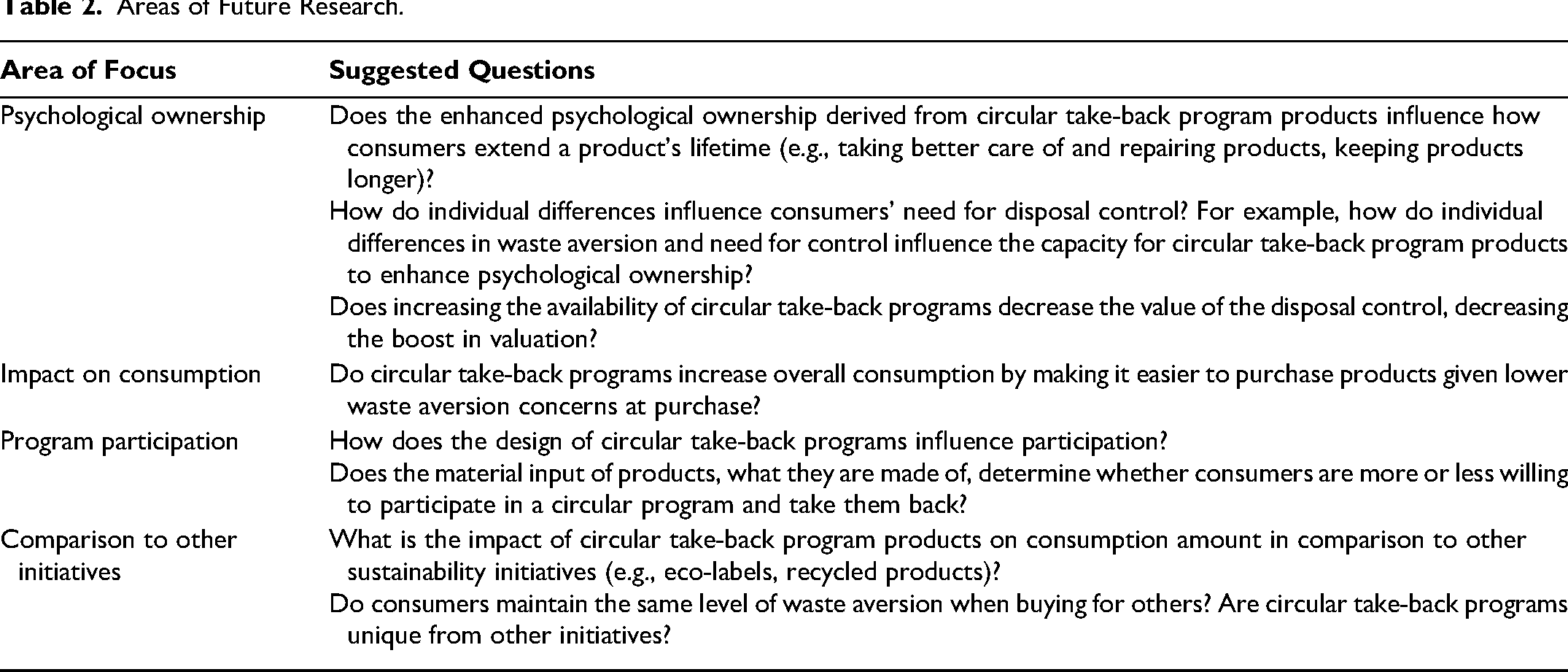
Future research could investigate other effects of circular programs, including how circular programs influence consumers’ attitudes related to the usage, care, and repair of products. For example, since psychological ownership has been shown to lead to stewardship (Peck et al. 2021) and prosocial behavior (Jami, Kouchaki, and Gino 2020), circular take-back program products may incentivize consumers to take better care of products and extend their useful life, reducing waste even further. As a result, circular programs may not only reduce waste and environmental impact but also foster a more sustainable consumption pattern, in which products are taken better care of, are repaired, and are used for longer. Moreover, although this and prior research has generally approached consumption with a focus on attributes of the product or context being studied, neglecting how affordances may manifest differently for different consumers (Hoelscher and Chatzidakis 2021; Kozinets, Ferreira, and Chimenti 2021; Mardon, Denegri-Knott, and Molesworth 2022). Therefore, future research should look at individual differences that minimize or amplify the effect of circular take-back programs on valuation. For example, consumers higher (vs. lower) in waste aversion or consumers higher (vs. lower) in need for control may be more likely to value disposal control and have higher psychological ownership over products as a result.
Conversely, future research should investigate conditions under which consumers do not value circular program products or situations when a circular program might result in negative externalities. For example, circular programs might decrease waste aversion to the point that consumers use products less and return them sooner. This could occur because consumers are more willing to try out a new product if they know that they can easily dispose of it sustainably at the end of its life. Overall, future research should investigate whether circular programs increase consumption by making it easier or more appealing for consumers to buy given that waste concerns are lowered, resulting in more frequent purchases and higher consumption rates.
Our results additionally suggest the possibility of reduced waste aversion when buying for someone else or maintenance of waste aversion concerns but passing the responsibility to others. Future research should draw definitive conclusions and investigate how waste aversion concerns vary when buying for the self in comparison to buying for someone else, in addition to how waste aversion impacts gift recipients.
Future research could also investigate participation in take-back programs and the net costs of the program relative to other investments in the environment. For instance, researchers could investigate how the design of take-back programs, such as the ease of returning products, the level of incentives offered, or the transparency of the take-back process, affects consumers’ willingness to participate in the programs. Additionally, researchers could explore the potential trade-offs and synergies between take-back programs and other environmental initiatives such as eco-labeling and assess the overall effectiveness of different programs on improving environmental outcomes. By examining these factors, researchers could provide insights into how to optimize take-back programs and make them more effective. Investigations into products made from circular inputs are another potentially fruitful avenue for future research. For certain product categories or certain materials, products made with circular inputs may lead to decreased quality perceptions, whereas for others, they may lead to increased quality perceptions (e.g., Bolton and Drew 1991; Diehl, Kornish, and Lynch 2003). For example, for product categories in which consumers place a premium on newness, such as electronics or fashion, products made from circular inputs may be less desirable than products made from virgin materials. In contrast, for product categories in which durability is valued, such as building materials or furniture, products made from circular inputs may be perceived as higher in quality because they have passed the test of time. Moreover, products made from high-quality circular inputs may be perceived as comparable or superior to products made from virgin materials. Understanding how consumers’ quality perceptions vary across product and input categories is important for designing effective take-back programs, and it can also help businesses identify opportunities for differentiation within the circular economy.
Perceptions of quality would then likely influence how products are used and for what purposes. A past product life (i.e., the use of materials that once belonged to someone else) may make it more difficult for consumers to connect with products (e.g., Dommer and Swaminathan 2013; Escalas and Bettman 2005; Paharia et al. 2011) or even change the meaning of the products themselves (Richins 1994). For example, consumers may treat circular products more roughly or use them in less demanding or less visible contexts. Moreover, products made with circular inputs may be perceived as more ethical and creative, leading consumers to use them as a conversation starter and a self or social signal. From a policy perspective, many governments worldwide are actively setting policies (e.g., EPR) to stimulate a circular economy in their countries. Future research could investigate whether the effects we unveil in this research hold when governments mandate the affordance provided by circular products and with the proliferation of circular programs. Requiring manufacturers to implement take-back programs could increase the visibility of circular products and potentially shift consumers’ preferences toward more circular consumption patterns or could make these programs so widely available that consumers do not experience the additional valuation provided by the affordance of disposal control. Will consumers value circular programs in the same way as programs proliferate and become more general and less product- or brand-specific?
Supplemental Material
sj-pdf-1-jmx-10.1177_00222429231196576 - Supplemental material for Affording Disposal Control: The Effect of Circular Take-Back Programs on Psychological Ownership and Valuation
Supplemental material, sj-pdf-1-jmx-10.1177_00222429231196576 for Affording Disposal Control: The Effect of Circular Take-Back Programs on Psychological Ownership and Valuation by Anna Tari and Remi Trudel in Journal of Marketing
Footnotes
Associate Editor
Lisa Bolton
Declaration of Conflicting Interests
The authors declared no potential conflicts of interest with respect to the research, authorship, and/or publication of this article.
Funding
The authors received no financial support for the research, authorship, and/or publication of this article.
References
Supplementary Material
Please find the following supplemental material available below.
For Open Access articles published under a Creative Commons License, all supplemental material carries the same license as the article it is associated with.
For non-Open Access articles published, all supplemental material carries a non-exclusive license, and permission requests for re-use of supplemental material or any part of supplemental material shall be sent directly to the copyright owner as specified in the copyright notice associated with the article.
