







Abstract
Online word of mouth (WOM) is a critical driver of consumer purchases; however, relatively few researchers have sought to understand how a company's characteristics might impact aggregate WOM valence (e.g., average star ratings of online reviews). The authors examine the effects of one such attribute—company size—and how it impacts WOM valence through individuals’ decisions regarding whether to engage in WOM. In four field studies, the authors find a negative relationship between company size and WOM that persists when controlling for the quality of consumers’ experience with the company. Subsequent experiments show that this effect occurs because consumers are more empathetic toward smaller companies. This empathy increases their desire to help smaller companies, which in turn increases the likelihood that they share WOM about a smaller company following a high-quality experience and decreases this likelihood in the case of a low-quality experience. Larger companies can mitigate the negative effect on aggregate WOM valence by responding frequently to WOM posts and employing language that evokes empathy—for example, by using emotional words, providing personalized responses, and addressing consumers by name.
Online word of mouth (WOM) is a critical driver of consumer purchases (Ipsos 2024). Existing research documents the financial impact of consumers’ sharing online (Babić Rosario et al. 2016; Rust et al. 2021) and what drives them to do so (Hennig-Thurau et al. 2004). While recent literature has highlighted the impact of company size on consumers’ perceptions of products (Woolley, Kupor, and Liu 2023; Yang and Aggarwal 2019), it is unclear how company size may affect aggregate online WOM valence (“WOM valence” for ease of exposition)—that is, the average rating of online reviews or the sentiment of social media posts about a company. The existing literature makes dueling predictions about whether the effect of company size on WOM valence is positive or negative, and importantly, either direction has implications for managers.
Supporting a positive effect of size on WOM valence, research finds that consumers consider high market share an indicator of superior offerings (Bhattacharya, Morgan, and Rego 2022) and prefer to bask in the reflected glory of larger companies 1 (Cialdini et al. 1976). Consumers view larger companies more favorably when products are complex (Woolley, Kupor, and Liu 2023), when risk is high (Tezer, Bodur, and Grohmann 2020), and when consumers lack agency (Beck, Rahinel, and Bleier 2020). However, there is also reason to believe that smaller companies might fare better in WOM valence than larger ones: Consumers tend to favor underdogs (smaller brands with stories of struggle and determination; Paharia et al. 2011) and perceive smaller companies as friendly (Kervyn, Fiske, and Malone 2022). Additionally, lower market share has been linked to higher satisfaction (Rego, Morgan, and Fornell 2013), and consumers prefer smaller companies for simpler products (Woolley, Kupor, and Liu 2023).
The aforementioned studies provide arguments for either a positive or a negative effect of company size, but they have focused on satisfaction and perceptions of quality. However, aggregate WOM valence differs in that it reflects not only the quality of an experience but also whether consumers share WOM about the experience (Schoenmueller, Netzer, and Stahl 2020). If company size affects the likelihood of an individual to share about a high-quality (vs. low-quality) experience, we would expect an effect of size on WOM valence.
In what follows, we hypothesize and find that there is a negative effect of company size on WOM valence. This aggregate effect occurs because individual consumers are more (less) likely to share about high-quality (low-quality) experiences with smaller versus larger companies. This differential likelihood to share is driven by a serial process: Consumers feel greater empathy toward smaller companies, which in turn leads to a greater desire to help them. Because this effect is driven by feelings of empathy toward companies, factors that influence empathy can mitigate the effect of size on aggregate WOM valence.
This work makes important theoretical contributions that lead to managerial implications. First, it contributes to recent work that has examined the effects of company size (Beck, Rahinel, and Bleier 2020; Paharia, Avery, and Keinan 2014; Woolley, Kupor, and Liu 2023; Yang and Aggarwal 2019) by showing that company size influences not only consumers’ perceptions of products but also their willingness to share evaluations. Second, this study contributes to research on WOM (Babić Rosario, De Valck, and Sotgiu 2020; Hughes, Swaminathan, and Brooks 2019) by illustrating that company size interacts with company experience quality (“experience quality” for ease of exposition) to affect individuals’ likelihood to share WOM (Moe and Schweidel 2012; Schoenmueller, Netzer, and Stahl 2020), ultimately producing a negative effect of company size on aggregate WOM valence. Third, it contributes to the literature examining the motivations of sharing (Babić Rosario, De Valck, and Sotgiu 2020) and the impact of empathy on consumer perceptions (Allard, Dunn, and White 2020) by showing that feelings of empathy toward a company influence consumers’ desires to help it and in turn drive individual consumers’ likelihood to share WOM. Fourth, it extends the literature on WOM response strategies (Allard, Dunn, and White 2020; Herhausen et al. 2023) and language cues in customer interactions (Marinova, Singh, and Singh 2018) by showing that empathetic response strategies can help larger companies mitigate the negative effect of size on WOM valence.
These findings have important implications for practitioners. The effect of company size may mislead analysts (Netzer et al. 2012; Rust et al. 2021) and consumers (De Langhe, Fernbach, and Lichtenstein 2016), who rely on WOM to assess performance and quality, particularly when comparing companies of different sizes. Further, understanding how company size affects WOM valence highlights the value of response strategies as a tool to mitigate the negative effect for large companies (Allard, Dunn, and White 2020; Herhausen et al. 2023) and the importance for smaller companies to avoid issues that reduce empathy, such as corporate social irresponsibility (CSI). Next, we review research on company size, empathy, and WOM before formulating our hypotheses.
Background and Theoretical Development
Company Size
Companies vary greatly in size: On the smaller end of the continuum, they typically have low revenue, a small number of stores, limited resources, few employees, and a small customer base. Conversely, on the larger end, the opposite is true. A company's size helps determine its strategy in the marketplace (Laforet 2008) and influences consumers’ perceptions of product quality (Woolley, Kupor, and Liu 2023). In this work, we consider how consumers’ perceptions of a company's size impact their WOM behavior about the company. As consumers have no direct knowledge of company size, it is a latent construct. Consumers form judgments based on environmental cues, including revenue (Hashmi et al. 2020), market share (Buzzell, Gale, and Sultan 1975), number of employees (Woolley, Kupor, and Liu 2023), globalness/localness (Thompson and Arsel 2004), and number of stores (Morgan 1993). As each measure reflects the underlying construct, they are correlated. For instance, Woolley, Kupor, and Liu (2023) find sales and employees to be correlated (r = .68). Hashmi et al. (2020) find correlations among employees, sales, market value, and assets. In Study 1a, we find that perceived sales correlate with number of customers (r = .73) and company awareness (r = .89), and in Study 2, we also find a correlation between perceived sales and number of stores (r = .65).
Research points to positive outcomes for larger companies such as favorable consumer attitudes and preferences: Studies on the effect of “basking in reflected glory” (Cialdini et al. 1976, p. 366) suggest that people seek to identify with larger, successful entities. Larger companies tend to be acknowledged as quality leaders (Bhattacharya, Morgan, and Rego 2022) and are objects of positive attitudes (Carpenter and Nakamoto 1989). They also experience better outcomes when creating complex products (Woolley, Kupor, and Liu 2023), when purchases involve risk (Tezer, Bodur, and Grohmann 2020), and when consumers lack agency (Beck, Rahinel, and Bleier 2020).
However, research also documents similar positive outcomes for smaller companies: They can highlight competition with larger competitors (Paharia, Avery, and Keinan 2014) or their underdog status (Kirmani et al. 2017; Paharia et al. 2011) to increase sales. Further, they are viewed more favorably when producing low-tech products (Woolley, Kupor, and Liu 2023), benefit more from brand activism (Hydock, Paharia, and Blair 2020), and are perceived as more authentic when engaging in corporate social responsibility (Jung, Bae, and Kim 2022). Market share can also negatively affect satisfaction (Rego, Morgan, and Fornell 2013). Moreover, consumers typically associate smaller companies with communal traits, such as ethicality, kindness, and understanding (Yang and Aggarwal 2019), which can lead to increased empathy.
Empathy
Empathy plays a central role in social interactions and encompasses both emotional and cognitive aspects, enabling people to understand and feel others’ distress (Coke, Batson, and McDavis 1978). Empathy involves not only understanding another's emotional state but also experiencing a vicarious emotional response to their situation (Coke, Batson, and McDavis 1978). As consumers form similar relationships with companies as they do with people (Hydock, Chen, and Carlson 2020), empathy guides these interactions.
Several streams of research suggest that consumers feel more empathy toward smaller companies than toward larger ones. Smaller companies are perceived to be more authentic, fostering the belief that they have a better understanding of consumers compared with their larger counterparts (Kervyn, Fiske, and Malone 2022). Consumers expect less communal behavior from larger companies than from smaller ones due to the perceived greater power and dominance of the former in the marketplace (Yang and Aggarwal 2019). Additionally, underdogs elicit empathy through narratives that resonate with consumer values (Kirmani et al. 2017; Paharia et al. 2011).
Research shows that empathy motivates helping behavior (Coke, Batson, and McDavis 1978). Consumers’ empathetic feelings toward smaller companies spur them to exert influence through their purchasing decisions to help these entities (Paharia, Avery, and Keinan 2014). Because consumers tend to perceive smaller companies as having fewer available resources, they are more likely to see them as being in greater need (Thompson and Arsel 2004). Finally, empathy triggers a desire to restore fairness by responding in a way that supports smaller companies (Allard, Dunn, and White 2020).
Empathy particularly influences consumer behavior when services (vs. products) are offered; when consumers’ consumption goals are process-oriented (vs. outcome-oriented); and for relational (vs. transactional) outcomes, such as WOM (Palmatier et al. 2006).
Word of Mouth
WOM valence positively predicts product consumption and sales (Babić Rosario et al. 2016) as well as firm value (Huang 2018), and it serves as a critical tool for marketers to understand their customers (Rust et al. 2021). Recent years have seen the emergence of new information sources, such as influencers and generative artificial intelligence tools; however, online WOM remains the most trusted source for consumers (Ipsos 2024). Given its importance, researchers have sought to understand the factors that influence the volume and valence of WOM communications. Sharing among consumers serves as a means of establishing connections with other consumers and companies (Hennig-Thurau et al. 2004), and companies can drive WOM through promotional efforts (Hughes, Swaminathan, and Brooks 2019).
One way in which consumers can help a company is by sharing positive WOM, and existing research shows that customers are often motivated to engage in WOM communication to give the company “something in return” (Hennig-Thurau et al. 2004; Hydock, Chen, and Carlson 2020). However, limited research exists regarding the effect of company size on WOM. Some studies suggest that while consumers intend to share more WOM about smaller companies, they actually share more about larger ones (He, You, and Chen 2020). Other research finds that consumers prefer to share more WOM about small companies’ corporate responsibility and large companies’ irresponsibility (Jung, Bae, and Kim 2022).
Building on the literature on company size, empathy, and WOM, we contend that at the company level, the effect of company size on aggregate WOM valence is negative. This aggregate effect can be explained by a selection mechanism at the consumer level, whereby an individual consumer's likelihood to share WOM is a function of both company size and experience quality (see Figure 1). Specifically, consumers are more empathic toward smaller companies, and this empathy increases their desire to help, which they achieve by sharing more WOM about high-quality experiences and less WOM about low-quality ones. In other words, individual consumers are more likely to share WOM following high-quality experiences with smaller companies and less likely to share WOM following low-quality experiences with smaller companies. When aggregated at the company level, individuals’ greater (lesser) likelihood to share high-quality (low-quality) experiences about smaller companies results in a negative effect of company size on WOM valence. Formally,
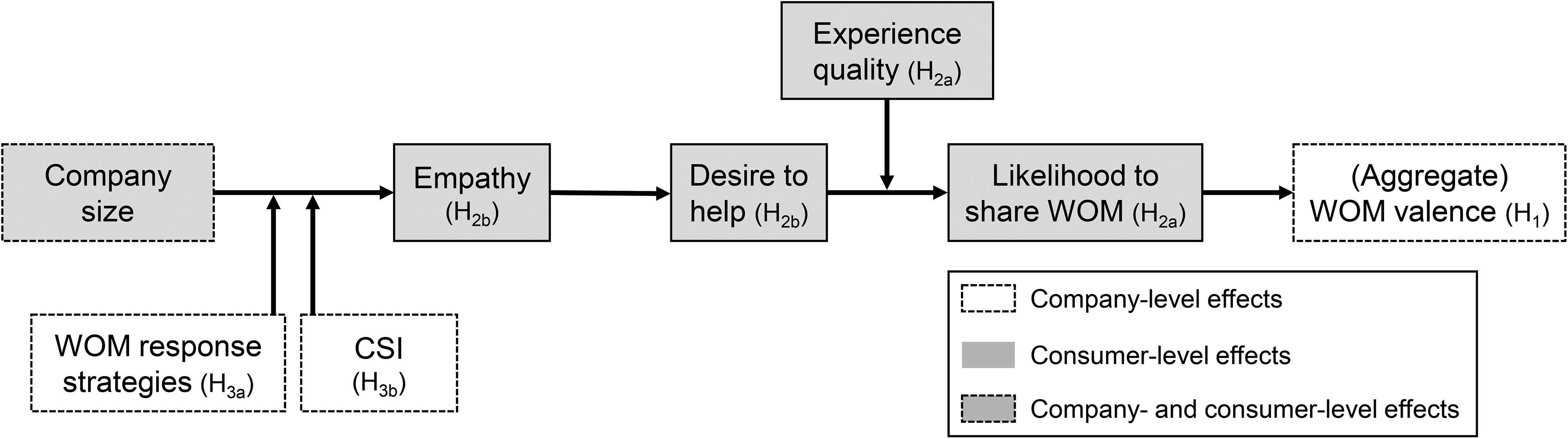
Conceptual Framework.
Notably, we hypothesize in H2a and H2b that consumers’ desire to help smaller companies impacts their likelihood to share WOM based on a company's size, a process we refer to as a selection mechanism. However, it is also possible that consumers help smaller companies by adjusting the valence of their individual WOM to be more positive (or less negative) for smaller companies, even when the actual experience quality remains constant. We refer to this as an adjustment mechanism (Moe and Schweidel 2012). As an example, when a consumer has a negative experience (which might warrant a one-star rating) with a small company, the selection mechanism suggests that they may choose not to post the rating at all, while the adjustment mechanism suggests they might adjust up and give the small company a two-star rating. While both mechanisms could potentially explain the negative effect of company size on aggregate WOM valence, our findings support the selection mechanism.
In H2b, we note that the effect of company size on aggregate WOM valence is driven by consumers’ empathy toward smaller companies. Therefore, other factors that impact empathy should moderate the effect of company size on aggregate WOM valence. 2 Because consumers have more empathy toward small companies, factors that increase empathy will disproportionately benefit larger companies, while factors that decrease empathy will disproportionally harm smaller companies.
While several factors could increase empathy toward companies and in turn mitigate the negative effect of company size on WOM valence, we focus on WOM response strategies given their inherent connection to online WOM (Allard, Dunn, and White 2020; Herhausen et al. 2023). Specifically, we identify WOM response strategies that should increase empathy and disproportionately benefit larger companies. Humans exhibit greater empathy toward those they feel closer to (Kardos et al. 2017), and several response strategies can enhance perceptions of closeness: high responsiveness (Labrecque 2014), emotional language in responses (Packard, Li, and Berger 2024), personalized responses (Kruikemeier et al. 2013), and the use of consumers’ names (Nuttin 1987). Simply put, response strategies that induce empathy should mitigate the negative effect of company size to the benefit of large companies.
We also examine the moderating role of CSI issues (i.e., corporate behavior perceived as neglectful or harmful to society, such as environmental pollution, poor employment conditions, and tax evasion). Like WOM response strategies, CSI is managerially relevant and is an important driver of online WOM (Hansen, Kupfer, and Hennig-Thurau 2018; Jung, Bae, and Kim 2022). As CSI issues can reduce consumers’ empathy toward a company (Shea and Hawn 2019), and consumers have more empathy for smaller companies, CSI issues should mitigate the negative effect of company size to the detriment of smaller companies.
To test these hypotheses, this article follows a multimethod framework, which is summarized in Table 1. We present observational data (Studies 1 and 2) that provide evidence of the predicted negative effect of company size on WOM valence (H1) across four real-world contexts: Yelp, Amazon, Twitter (now known as X), and Instagram. In Study 1a, we analyze the text of online reviews and find further support for the effect of company size on empathy (H2b). In Study 2, we examine the distribution of individual consumers’ WOM and aggregate WOM valence and provide initial support for H2a. We then report six behavioral studies (Studies 3a, 3b, 3c, 3d, 4a, and 4b) demonstrating that individual consumers feel more empathy toward smaller companies, leading to a stronger desire to help, which subsequently increases their likelihood (not) to share WOM about a high-quality (low-quality) experience (H2a and H2b).
Overview of Studies.
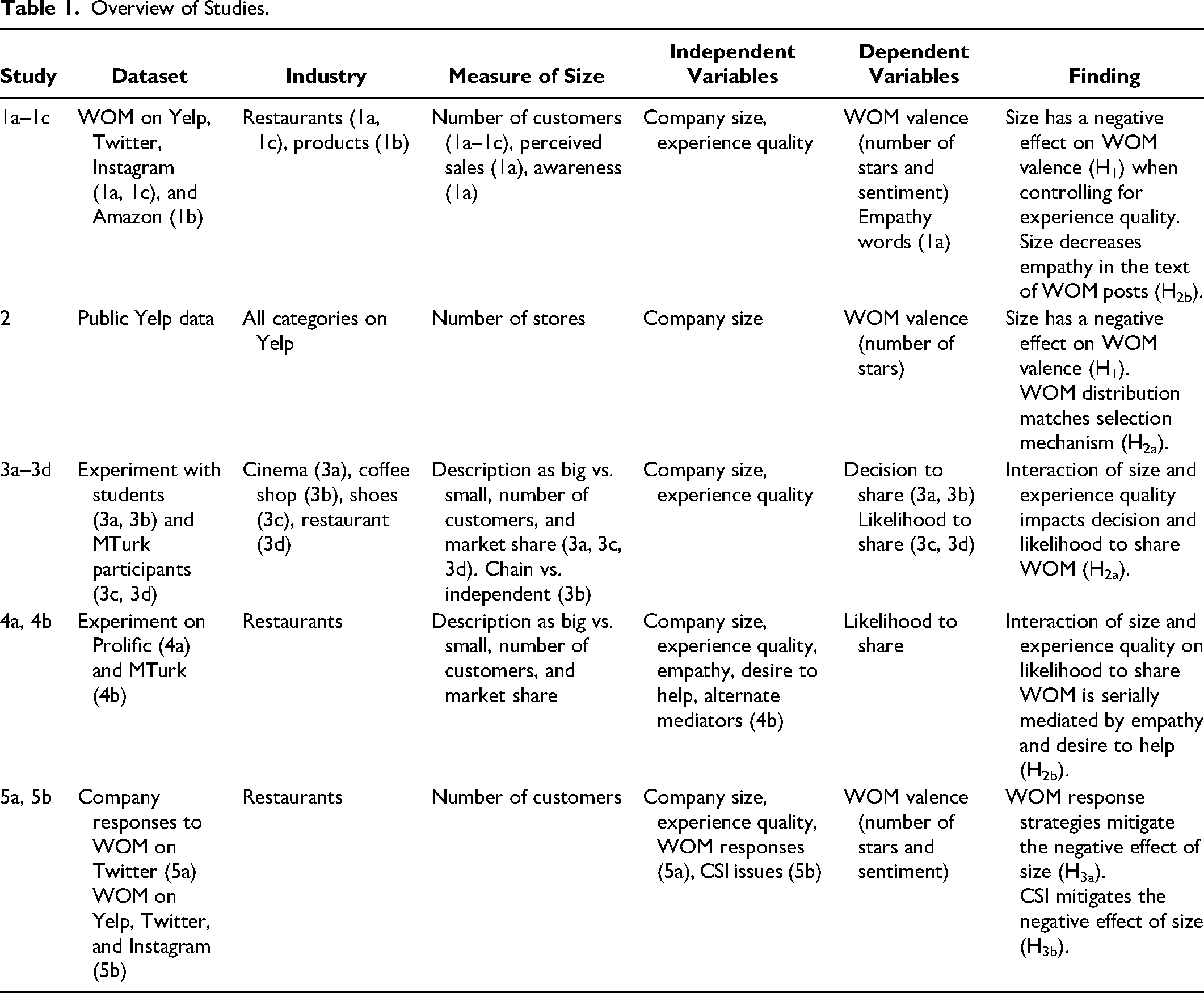
In Study 5a, we demonstrate that larger companies can mitigate the negative effect through response strategies (responsiveness, emotional language, response personalization, and the use of audience names) that elicit empathy toward the company (H3a). In Study 5b, we show that the effect is further mitigated in the presence of CSI issues (H3b).
Study 1: The Effect of Company Size in the Field
The aim of Study 1 is to investigate how company size affects WOM valence (H1). To examine this relationship, we collected information on company size from YouGov and information on WOM valence (i.e., online reviews and social media posts referring to the company) from Yelp (Studies 1a and 1c), Twitter (Study 1a), Instagram (Study 1a), and Amazon (Study 1b). The samples capture chain restaurants on Yelp (Studies 1a and 1c) and various product categories on Amazon (e.g., clothing, appliances, and technology; Study 1b). For the analyses, each observation represents a company, described by its size and the aggregate valence of all its WOM posts within one year. We include only companies for which we were able to collect at least 30 WOM posts. 3 Further, in Study 1a, we analyze the text of online reviews to investigate the role of empathy (H2b). Studies 1a and 1b follow a between-company design (i.e., one observation per company), and Study 1c uses a panel data structure with multiple years of observations for each company (i.e., multiple observations per company). The samples are summarized in Table 2.
Sample Characteristics for Study 1.
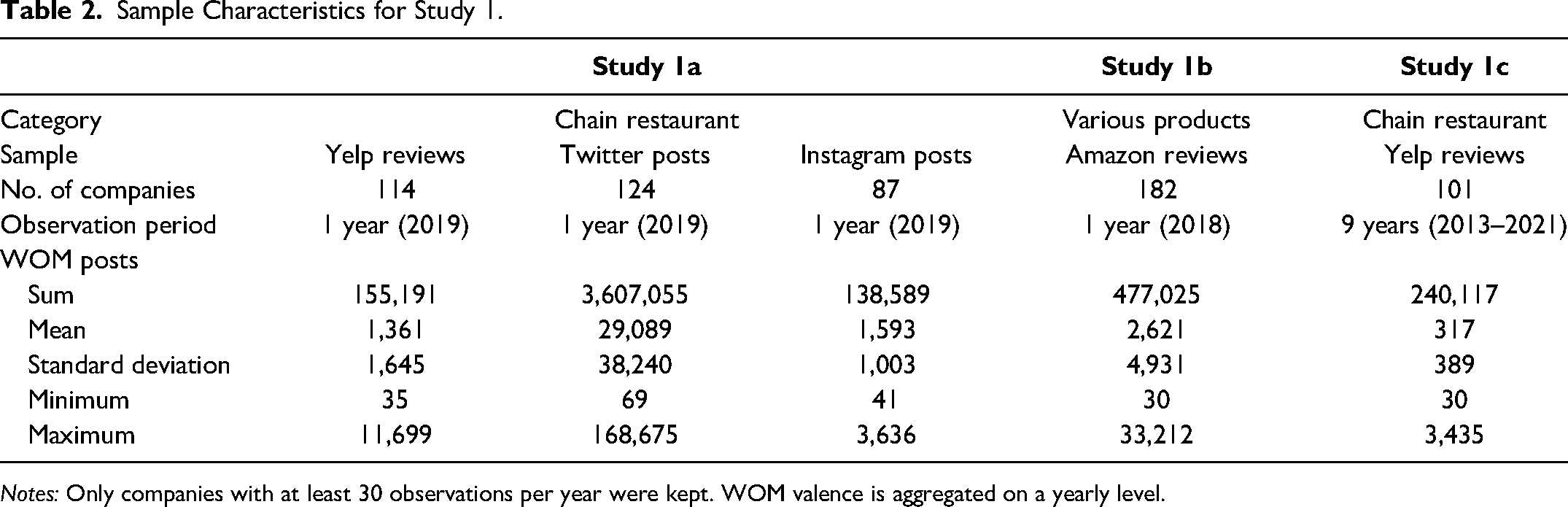
Notes: Only companies with at least 30 observations per year were kept. WOM valence is aggregated on a yearly level.
For each study, we collected market research data on consumers’ company evaluations to control for differences in the experience quality, ensuring that the observed effects of company size on WOM valence are not simply due to experience differences between larger and smaller companies (Rego, Morgan, and Fornell 2013). To gather this information, we used the YouGov BrandIndex (see Web Appendix A for details), which compiles daily interviews with a representative sample of consumers in the United States. The BrandIndex includes measures of consumers’ company evaluations (a measure of companies’ experience quality) and the number of companies’ current customers (a measure of company size).
Study 1a: Effect of Company Size on WOM Valence Across Platforms
In Study 1a, we investigate the relationship using a sample of 135 companies from the chain restaurant industry that are tracked by YouGov. We focus on the between-company effect of company size on WOM valence across different WOM formats (consumer reviews on Yelp and social media posts on Twitter and Instagram) to examine the existence and generalizability of the proposed relationship. By focusing on chain restaurants, the analysis benefits from variations in company size and circumvents the confounding factors that may arise when comparing large national companies with small, local, independent ones.
Sample
The sample includes smaller chains, such as Noah's Bagels, Champps, and Cosi; medium-sized companies, such as Einstein Bros. Bagels, Cold Stone Creamery, and Bonefish Grill; and larger companies, such as McDonald's, Burger King, and Starbucks (see Web Appendix B for a full list). Using the “chain restaurant” category enables us to examine WOM across different platforms, including both social media and review sites. For each of the 135 restaurant chain companies tracked by YouGov, we collected online reviews from Yelp. 4 Next, we collected English-language 5 social media posts from Twitter and Instagram, where users either linked to a company (i.e., directly sent the post to the company by using @[company account name] in the post; Rust et al. 2021) or tagged a company (i.e., used a company-related hashtag by including #[company hashtag] 6 in the text of the post; Klostermann et al. 2018). We kept all companies with at least 30 WOM posts (i.e., at least 30 reviews or posts on social media in the respective year) in the sample to ensure a meaningful measure of WOM valence. We collected this number of WOM posts for 114 companies on Yelp, 124 companies on Twitter, and 87 companies on Instagram.
Variables
The dependent variable for Study 1a, as well as for Studies 1b and 1c, is aggregate WOM valence. We use two measures of WOM valence: the mean numeric review score (i.e., number of stars between one and five) in the Yelp data and the mean text sentiment score of all WOM posts that the company received in the respective year on Twitter and Instagram. To calculate sentiment, we use the VADER (Valence Aware Dictionary and Sentiment Reasoner) dictionary for short social media text (Hutto and Gilbert 2014), which returns a continuous value between −1 and +1 according to the sentiment of the text. Posts in our data have an average of 17.93 words (SD = 13.83) on Twitter and 32.90 words (SD = 35.09) on Instagram. We also report alternative sentiment measures using the BERTweet language model but focus on scores from VADER, as they explain the most variance. We z-standardize WOM valence (i.e., subtract the mean and divide by the standard deviation) to facilitate comparison across online reviews with star ratings and social media posts with textual sentiment. We find that WOM valence is distributed normally between companies, using a Kolmogorov–Smirnov test (p ≥ .120) with a low skewness (≤.405), and therefore use ordinary least squares regression to estimate the model.
The independent variable in Studies 1a, 1b, and 1c is company size. We use YouGov's BrandIndex current customer metric (the share of respondents who indicated they were customers) as our primary operationalization of size. To provide a robustness check of our results, we also use two other operationalizations of size. First, we surveyed consumers from the United States to create a measure of perceived size. Each participant evaluated 30 randomly selected companies from those included in Study 1a. Participants first confirmed their familiarity with the company and were then asked to evaluate the company's sales relative to those of competitors in the restaurant chain industry on a seven-point Likert scale (1 = “far below average,” and 7 = “far above average”). For each company, we collected an average of 46.56 (SD = 16.21) observations and calculated the mean of the responses as an indicator of perceived company size. We find perceived company size to be strongly correlated with number of customers (r = .73). Second, we find that brand awareness from the YouGov data (i.e., portion of customers indicating awareness of the company) correlates with the number of customers (r = .66) and perceived company size (r = .88).
In Study 1a, as well as Studies 1b and 1c, we use YouGov's brand perception scale (see Web Appendix A for further details) as a measure of the experience quality that a company offers (i.e., quality of consumer experiences aggregated at the company level). As these data are collected from a representative sample in the United States, this enables us to demonstrate that the effect of company size on WOM valence stems from differences in company size rather than quality differences that are confounded with company size (Rego, Morgan, and Fornell 2013). For chain restaurant companies, company size and company quality are positively correlated (r = .085), indicating that larger companies tend to offer higher experience quality on average.
Company size and experience quality are z-standardized in the model to compute standardized beta coefficients, which helps compare the effect of company size and experience quality both within and between different models. We standardize both variables before removing companies with fewer than 30 observations from the samples. We aggregate company size, experience quality, and WOM valence at a yearly level and use a one-year time lag for company size and experience quality to eliminate reverse causality (i.e., the effect of WOM valence on company size). Table 3 summarizes the variables for Study 1a, 1b, and 1c.
Variable Description, Descriptive Statistics, and Correlations.
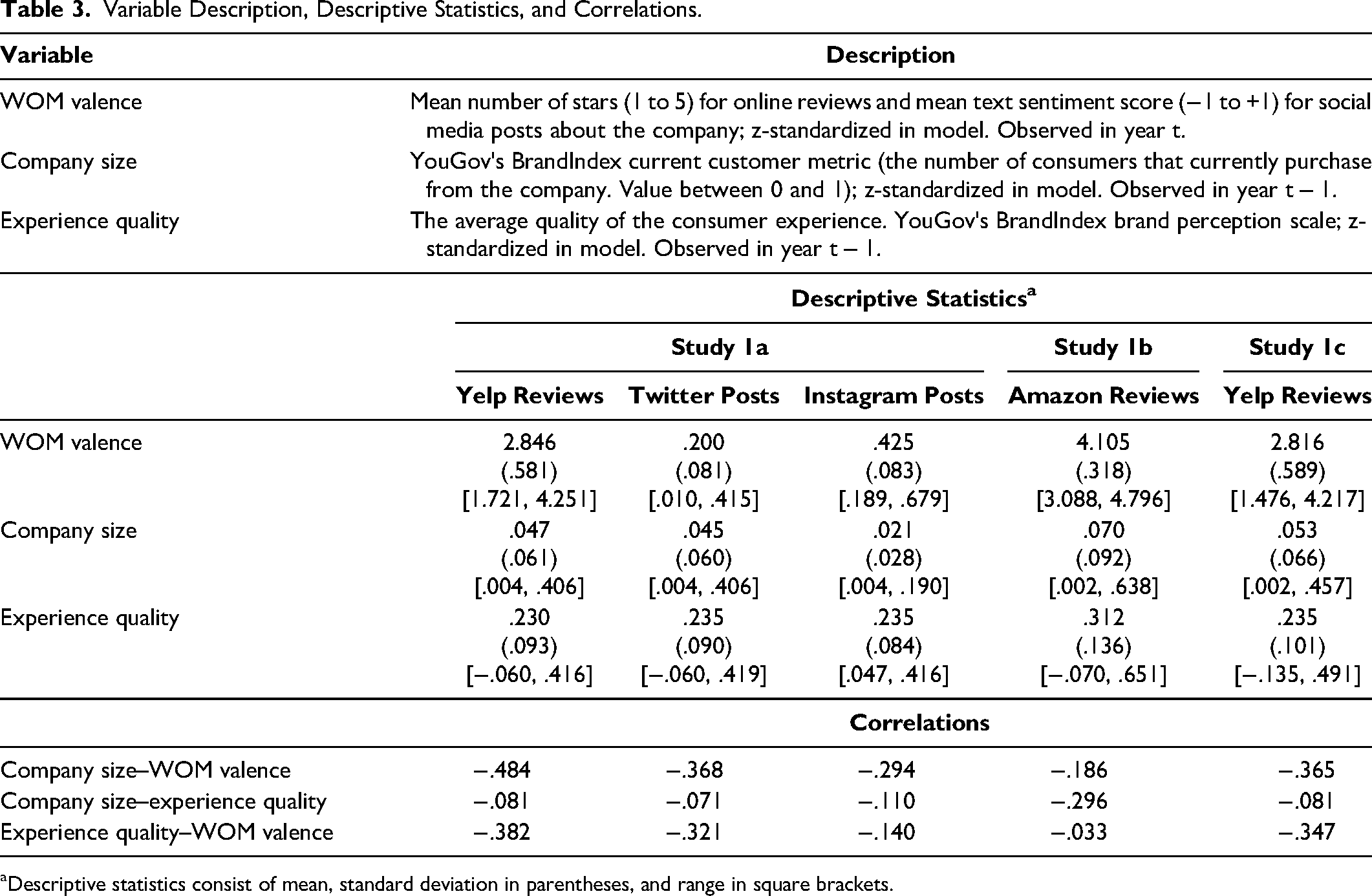
Descriptive statistics consist of mean, standard deviation in parentheses, and range in square brackets.
Results and discussion
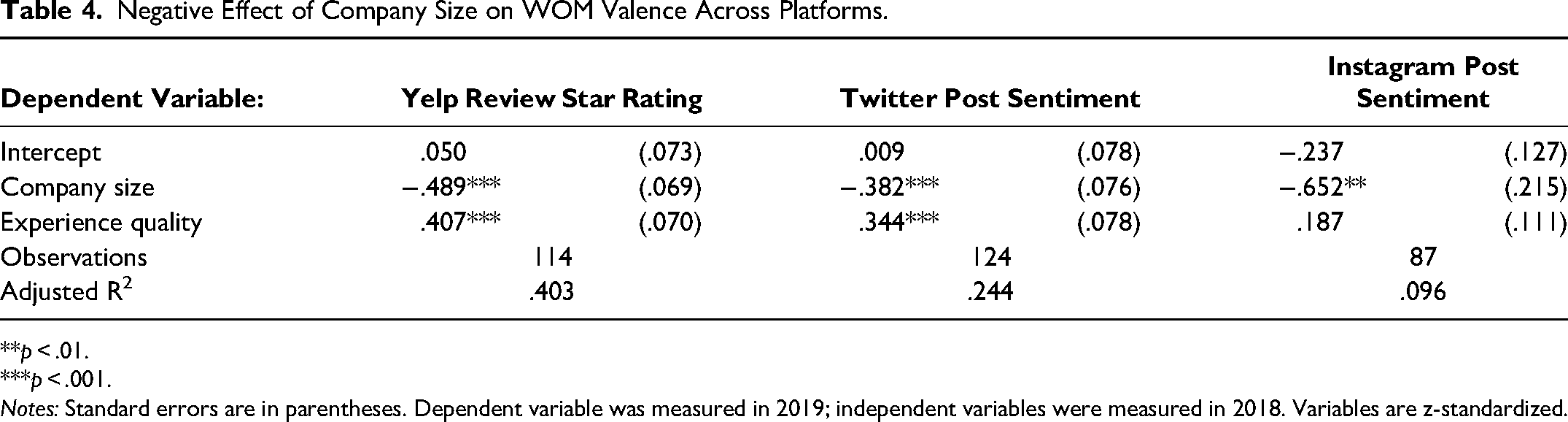
We regress WOM valence on company size and experience quality for each platform, with the results summarized in Table 4. As expected, experience quality positively influences WOM valence; companies positively evaluated in representative market research samples receive more favorable WOM. This effect is strongest for online reviews on Yelp (.407, p < .001) and weaker (or not significant) for social media.
Negative Effect of Company Size on WOM Valence Across Platforms.
**p < .01.
***p < .001.
Notes: Standard errors are in parentheses. Dependent variable was measured in 2019; independent variables were measured in 2018. Variables are z-standardized.
Critically, and consistent with H1, we find the expected negative effect of company size across all models, with standardized beta coefficients of −.489 (p < .001) on Yelp, −.382 (p < .001) on Twitter, and −.652 (p < .01) on Instagram, indicating moderate to large effect sizes. Notably, the explained variance in WOM valence is highest for Yelp (R2 = .403) and lower for Twitter (R2 = .244) and Instagram (R2 = .096). One reason for this might be that analyzing text sentiment on social media, especially on Instagram, where texts are accompanied by images, induces more noise compared with analyzing the number of stars on online review platforms. Another reason could be that online review platforms focus primarily on product evaluation, whereas WOM on social media varies greatly in content (Klostermann et al. 2018). Using a single model with the three samples combined (n = 325; R2 = .249), we find a negative effect of company size (−.432, p < .001) and a positive effect of experience quality (.328, p < .001). Next, we report the results for alternate measures for company size and a series of robustness checks.
Alternate measures for company size
In our primary analysis, we use the number of customers to operationalize company size. To demonstrate generalizability across different measures of company size, we first test the model using perceived size (i.e., sales) from the survey, which correlates with number of customers (r = .73). The results are shown in Web Appendix C, Table W2. We find similar results showing a significant negative effect of company size on WOM valence for Yelp (−.480, p < .001), Twitter (−.449, p < .001), and Instagram (−.263, p < .05). We use awareness of a company as a third operationalization of company size to demonstrate the robustness of our work. Greater awareness correlates with perceptions of size (r = .88) as well as number of customers (r = .66). When using the YouGov BrandIndex data on awareness (M = 50.7%, SD = 27.5%; range 6.9% to 92.7%), we find similar results, with a negative effect of company size on WOM valence for Yelp (−.538, p < .001), Twitter (−.464, p < .001), and Instagram (−.312, p < .01; see Web Appendix C, Table W3, for details).
Robustness
We conduct a series of additional analyses to test the robustness of our model. First, we replace the dictionary-based sentiment detection with a deep learning sentiment detection model, the BERTweet-base sentiment model by Pérez, Giudici, and Luque (2021). All models show a significant negative relationship between company size and WOM valence (see Web Appendix D, Table W5, for details).
Second, one might argue that YouGov's BrandIndex may not accurately reflect the actual experience quality of the consumers in our samples. For example, we find a correlation between company size and experience quality of .087 on average, whereas Rego, Morgan, and Fornell (2013) report a negative correlation of −.333 between market share and customer satisfaction. We therefore conduct a sensitivity analysis, in which we test how the correlation between company size and experience quality affects our estimate for the effect of company size on WOM valence. We find that company size has a significant negative effect on WOM valence in nearly all simulated scenarios (see Web Appendix E for details).
Third, previous literature shows that online review ratings become more negative with higher review volume (Moe and Schweidel 2012). In addition to our hypothesis, one could argue that consumers feel more efficacious when companies have fewer reviews (i.e., a negative review would hurt a company more when there are not so many other reviews) such that the likelihood to share about a low-quality experience decreases. As company size is positively correlated with WOM volume (i.e., number of reviews) in our data from Yelp (r = .584), the negative effect of company size on WOM valence might be driven by review volume. In a model in which we control for WOM volume, company size still has a significant negative effect on WOM valence (−.403, p < .001; see Web Appendix F, Table W9, for details).
Fourth, we remove outliers of company size (Web Appendix F, Table W10) and WOM valence (Web Appendix F, Table W11). In both models, the effect of company size remains significant, and effect sizes increase (see Web Appendix F, Table W10).
Exploring the theoretical process through text analysis
While we test the theorized process in more detail in Study 4, analyzing the text of WOM posts could provide a first indication of whether empathy explains the relationship between company size and WOM valence. Assuming that increased empathy toward smaller companies drives the likelihood to share about high-quality experiences and not to share about low-quality experiences with smaller companies, one would expect consumers to be more likely to express empathy in WOM posts about smaller (vs. larger) companies. To test this assumption, we use a modified version of the empathy dictionary (Herhausen et al. 2023; see Web Appendix G for details) and count how often these words occur in the Yelp reviews of each company, relative to the number of words used in the respective reviews. The dictionary indicates acceptable convergence with human raters (two raters, n = 150 reviews, intercoder agreement = .846, average r = .484). We focus on Yelp reviews, as they contain more text than social media posts. We find that an increase in company size has a negative effect on the share of words related to empathy (−.248, p < .01) when controlling for experience quality (.246, p < .01; see Web Appendix G Table W12, for detailed results). In other words, consistent with H2b, consumers used fewer empathic words when reviewing larger companies.
Study 1b: Effect of Company Size on WOM Valence Across Categories
In Study 1b, we test the generalizability of the negative effect of company size on WOM valence across different product categories using Amazon reviews to demonstrate applicability to a product (vs. service) domain. While the sample differs (see Table 3), we parameterize the same model as in Study 1a.
Sample
To collect Amazon reviews for the companies tracked by YouGov, we first downloaded the Amazon review data provided by Ni, Li, and McAuley (2019) for different categories. 7 For each category, a metafile that links product IDs to brand names and a review data file that links reviews to product IDs were provided. First, we extracted the names of the companies and matched them with the YouGov company names if their lowercase names were identical. In total, 438 YouGov company names were matched with company names in the Amazon dataset. Then, we extracted all reviews that refer to a product that is associated with one of the companies in the YouGov data. At the time of downloading, the dataset captured reviews up to October 1, 2018. We therefore consider all reviews between October 1, 2017, and October 1, 2018. We aggregate the number of stars on a yearly level. We remove all companies with fewer than 30 reviews, leaving 182 companies in the data. The sample represents a range of product categories, including electronics, clothing, and consumer packaged goods. The sample includes relatively smaller companies (Olympus, Rotozip, and Marmot), medium-sized companies (Canon, Bosch, and Reebok), and very large companies (Samsung, Google, and Apple; see Web Appendix H for a list).
Variables
Variables are defined as detailed in the primary analysis of Study 1a. We find a positive correlation between company size and experience quality (r = .296), indicating that, on average, there were more high-quality experiences for larger (vs. smaller) companies. Having documented the robustness of our effect across multiple operationalizations of size in Study 1a, we use only the number of customers in Studies 1b and 1c.
Results and discussion
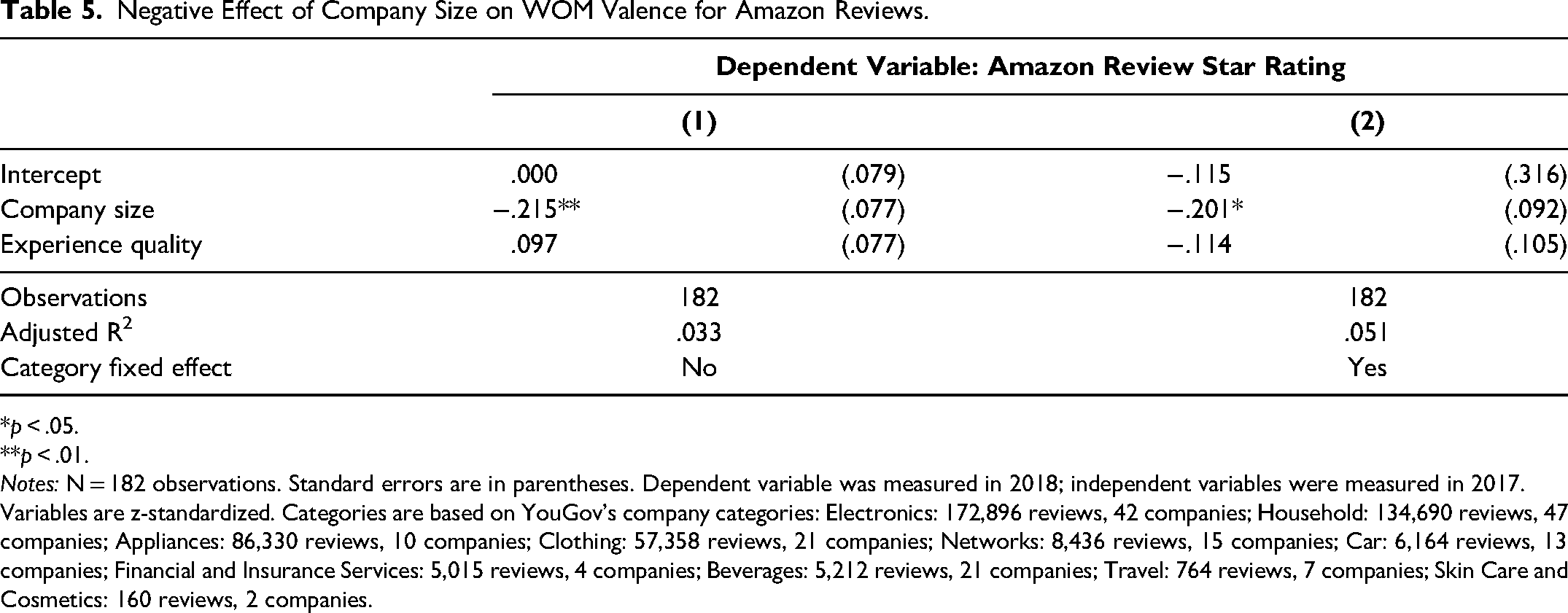
We again regress WOM valence on company size and experience quality, with the results summarized in Table 5. Experience quality has a positive but not significant effect on WOM valence (.097, p > .10). Most critically, we again find a significant negative relationship between company size and WOM valence (−.215, p < .01), supporting H1. We further test a model with category fixed effects (see Table 5, Model 2) to account for category-specific variance in company size (e.g., car companies might be larger than clothing companies). Once again, we find a negative effect of company size on WOM valence (−.201, p < .05).
Negative Effect of Company Size on WOM Valence for Amazon Reviews.
*p < .05.
**p < .01.
Notes: N = 182 observations. Standard errors are in parentheses. Dependent variable was measured in 2018; independent variables were measured in 2017. Variables are z-standardized. Categories are based on YouGov's company categories: Electronics: 172,896 reviews, 42 companies; Household: 134,690 reviews, 47 companies; Appliances: 86,330 reviews, 10 companies; Clothing: 57,358 reviews, 21 companies; Networks: 8,436 reviews, 15 companies; Car: 6,164 reviews, 13 companies; Financial and Insurance Services: 5,015 reviews, 4 companies; Beverages: 5,212 reviews, 21 companies; Travel: 764 reviews, 7 companies; Skin Care and Cosmetics: 160 reviews, 2 companies.
Notably, the explained variance for product reviews on Amazon (R2 = .051) is lower than that for chain restaurant reviews on Yelp in Study 1a (R2 = .403). One reason might be that the effect of company size is more pronounced for services than for products, as empathy plays a more significant role in interactions with service personnel than in online orders (Palmatier et al. 2006). Study 1b illustrates the generalizability of the effect of company size. In Study 1c, we extend the generalizability by examining the effect of changes in company size over time.
Study 1c: Within-Company Effect of Company Size on WOM Valence
While Studies 1a and 1b consistently show a negative effect of size on WOM valence in a between-company design, unobserved effects (e.g., branding strategy or legal entity) that might confound size and WOM valence could bias the estimate. Therefore, the aim of Study 1c is to show how changes in company size over time influence WOM valence over time, controlling for company-constant and time-constant unobserved effects as well as company-specific time-varying unobserved effects (e.g., a change in the product assortment) through a lagged dependent variable (Germann, Ebbes, and Grewal 2015).
Sample
We downloaded the public Yelp 8 dataset, which, relative to the dataset from Study 1a, has the advantage of including observations for multiple years. We matched store names in the dataset with company names from Study 1a. For 101 of the 135 chain restaurant companies from Study 1a, we were able to find at least one store in the Yelp dataset. YouGov began tracking the number of current customers (i.e., our measure for company size) in 2012. In line with Studies 1a and 1b, we measure company size and evaluations from the year prior to WOM valence to account for potential reverse causality effects. Our panel includes up to nine yearly observations per company (2013 to 2021). All companies were operationally active during the entire observational period, which makes it unlikely that the observed effects are biased by the survival of companies with more positive WOM valence. We removed observations with fewer than 30 reviews per company per year. Our sample includes 757 observations across 101 companies, with each company having between two and nine yearly observations. The number of observations per year ranges from 69 to 97.
Variables
All variables are operationalized in the same way as in Studies 1a and 1b. In 54% of the company-year observations, we observe an increase in company size compared with the previous year, indicating that our sample captures both growing and shrinking companies.
Results
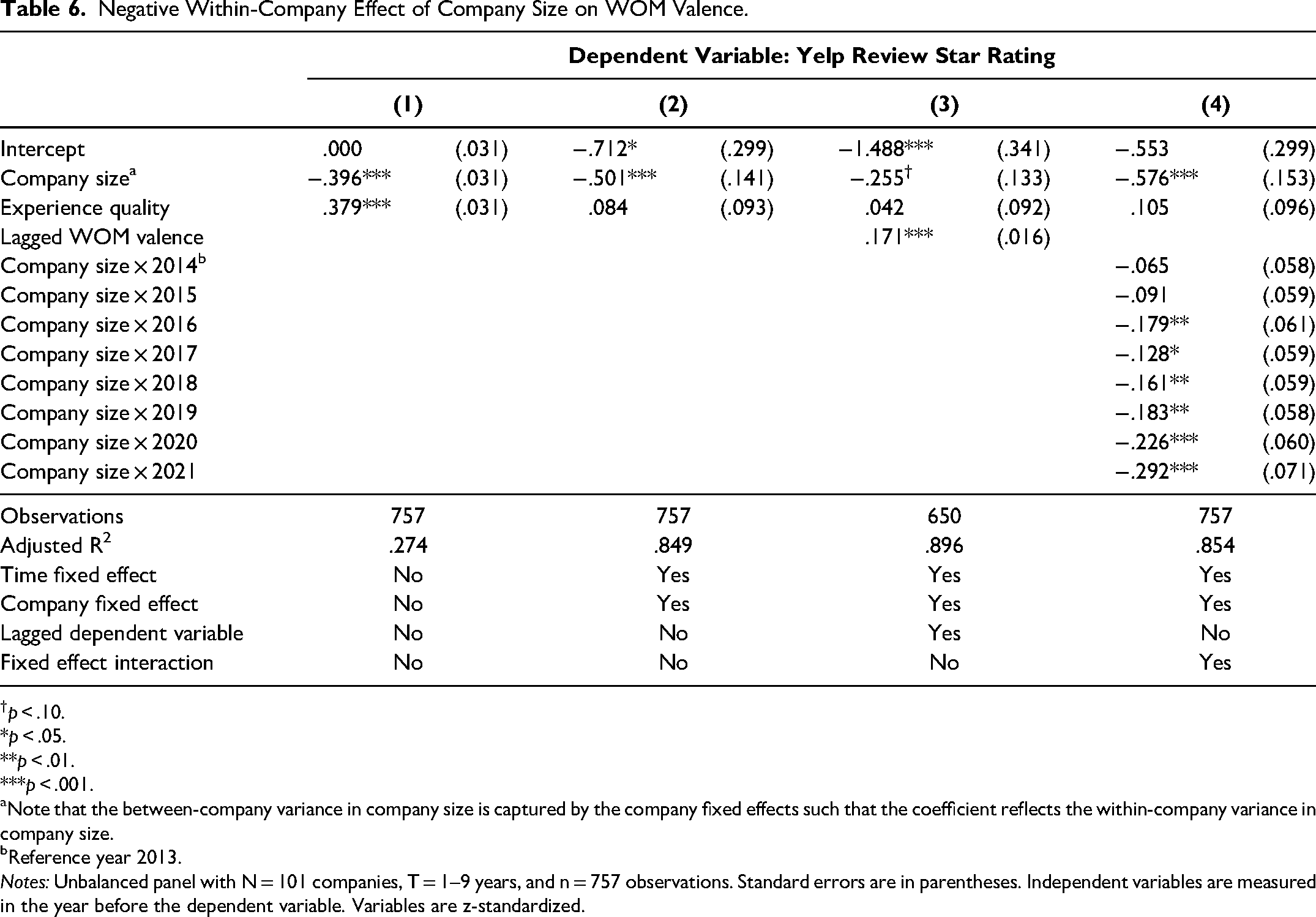
The results are summarized in Table 6. We estimate four models with (1) no fixed effects, (2) both company and year fixed effects, (3) both company and year fixed effects with a lagged dependent variable, and (4) both company and year fixed effects with an interaction of the year fixed effect and company size to evaluate whether the effect of company size on star rating differs across years. In the first model, we replicate the negative effect of company size on Yelp ratings (−.396, p < .001), which is similar in magnitude to the results in Study 1a (−.489, p < .001; see Table 4, “Yelp Review Star Rating” column). Even when including company and year fixed effects (Model 2), we find that size has a negative within-company effect on WOM valence (−.501, p < .001). Further, changes in company size still have a marginally significant effect (−.255, p < .10) when a one-period lag of WOM valence as an independent variable is added to the model (Model 3).
Negative Within-Company Effect of Company Size on WOM Valence.
p < .10.
*p < .05.
**p < .01.
***p < .001.
Note that the between-company variance in company size is captured by the company fixed effects such that the coefficient reflects the within-company variance in company size.
Reference year 2013.
Notes: Unbalanced panel with N = 101 companies, T = 1–9 years, and n = 757 observations. Standard errors are in parentheses. Independent variables are measured in the year before the dependent variable. Variables are z-standardized.
A Durbin–Watson test for panel models rejects the assumption of serially correlated errors (DW = 2.106, p = .912). We find that lagged WOM valence positively influences current WOM valence (.171, p < .001). In support of H1, we find that when companies grow (decline) in size, WOM valence becomes more negative (positive). In Model 4, we observe that the magnitude of the negative effect of company size increased around 50% over time, from −.576 in 2013 to −.868 in 2021 (Figure 2).
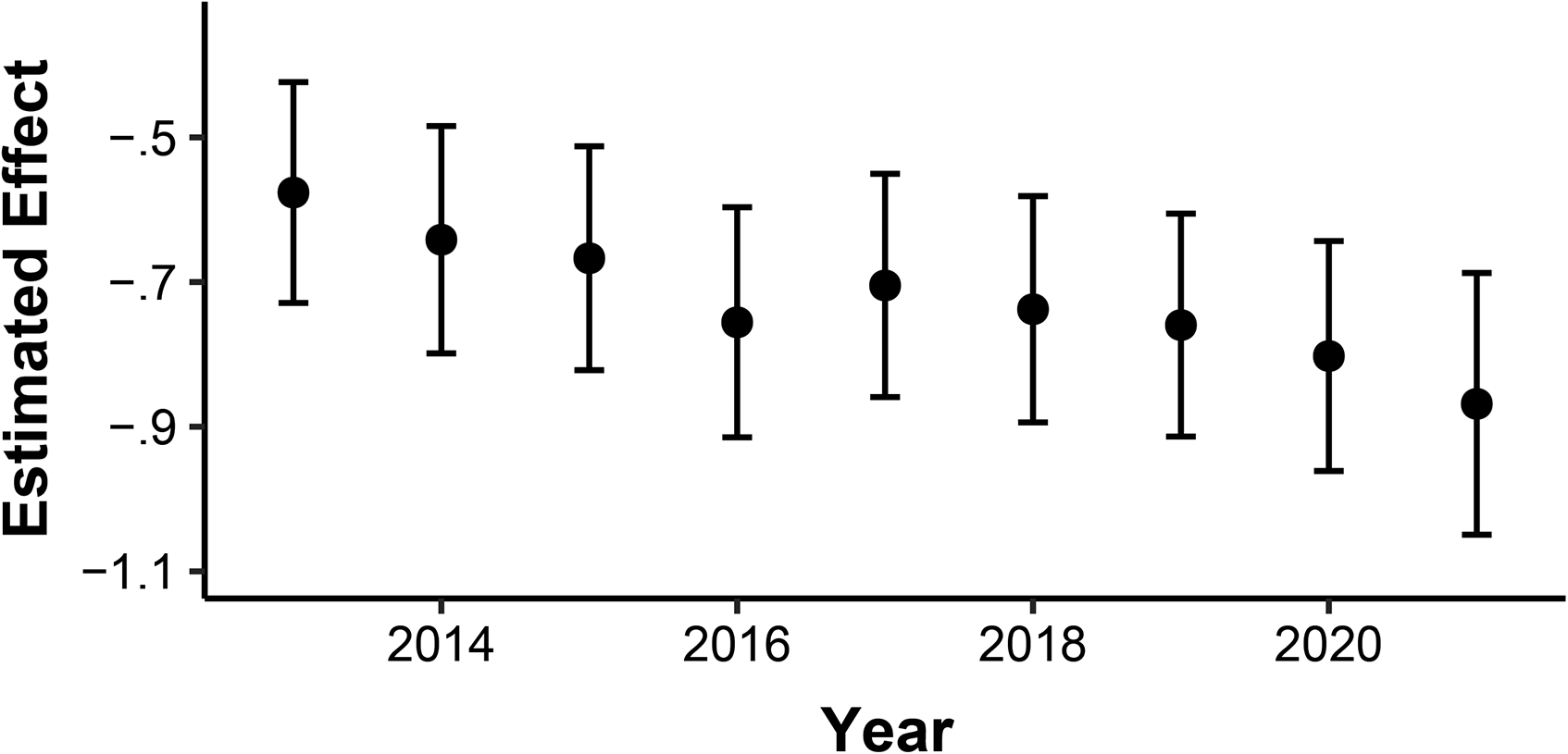
Estimated Effect of Company Size by Year.
The increased size of our effect over time suggests that larger companies are either unaware of this effect or do not know how to mitigate it, highlighting the managerial relevance of our findings. Interestingly, the COVID-19 pandemic did not affect this trend as one might have expected, given that consumers prefer larger companies when lacking agency (Beck, Rahinel, and Bleier 2020).
Discussion
Study 1 provides strong evidence for the proposed negative effect of company size on WOM valence. This effect is robust and generalizable, observed while controlling for experience quality, for both reviews and social media posts across multiple product categories with multiple operationalizations of size and both within and between companies.
Study 2: Generalizability and Support for the Mechanism in the Field
While Study 1 shows a negative effect of company size on WOM valence, it includes only companies tracked by YouGov, excluding very small companies, such as independent restaurants, and limiting the total number of companies investigated. In Study 2, we examine the relationship between company size and WOM valence (H1), again using the public Yelp dataset, which offers a large sample of companies, a significant range in size, and various industries.
We also provide initial evidence for our supposition that company size impacts consumers’ likelihood to share WOM by examining the distribution of ratings (H2a). Using an analytic model, we generate competing predictions based on two mechanisms: a selection mechanism following H2a, which suggests that company size impacts the likelihood to share WOM as a function of experience quality, and an alternative adjustment mechanism, whereby company size causes consumers to adjust WOM valence as a function of experience quality.
Sample
We again use the public Yelp dataset but, unlike in Study 1c, include all companies in the data. When we downloaded the data in May 2024, it contained approximately seven million reviews for approximately 150,000 stores. As each store has a name (e.g., “CVS Pharmacy” or “Bertolino's Pharmacy”), we treat all stores with the same name as one company. For example, there are 345 stores named CVS Pharmacy, while only one store is named Bertolino's Pharmacy, so we treat CVS Pharmacy as a company of size 345 and Bertolino's Pharmacy as a company of size 1. Following this aggregation, we observe 114,117 companies, of which 38,354 have at least 30 reviews (6,090,521 reviews, 87% of the full dataset), which we again use as a threshold.
Variables
We operationalize company size by counting the number of stores operated by the company in the dataset (Yang and Aggarwal 2019). In the sample, 84% of the companies have a single location, while only .3% (109) of the companies have more than 50 stores, such as Starbucks (724 stores), CVS Pharmacy (345 stores), and Enterprise Rent-A-Car (232 stores). To test the validity of this measure, we look at the chain restaurant companies from Study 1 and find that the number of stores strongly correlates with the survey measure of company size (r = .650). WOM valence is calculated as the average number of stars of all reviews at the company level. On average, companies receive 3.765 stars (SD = .721). Variables are z-standardized in the model. The Yelp dataset includes more than 1,000 category labels. We use the 50 most frequent categories, labeling the rest as “others,” to estimate the effect across categories. The most frequent categories are restaurants (16%), food stores (5%), nightlife (3%), bars (3%), and beauty (2%). We z-standardize company size on a category level, as the number of stores might depend on the category (e.g., hotel companies have fewer stores than chain restaurant companies).
Results and Discussion
We first estimate a linear model regressing star rating on company size and find a significant negative effect of company size on WOM valence (−.105; p < .001). While the effect size is smaller than in Study 1, note that owing to the high number of very small companies, one standard deviation in size equals only 9.62 more stores. Figure 3 illustrates the effect of number of stores on review rating, comparing small and large companies. The median rating for a small company with one store is 3.92, while for larger companies with more than 50 stores, it is 2.78, which represents a decrease of more than one star. These results support H1 and extend Study 1 by showing that the effect occurs between very small and large companies.
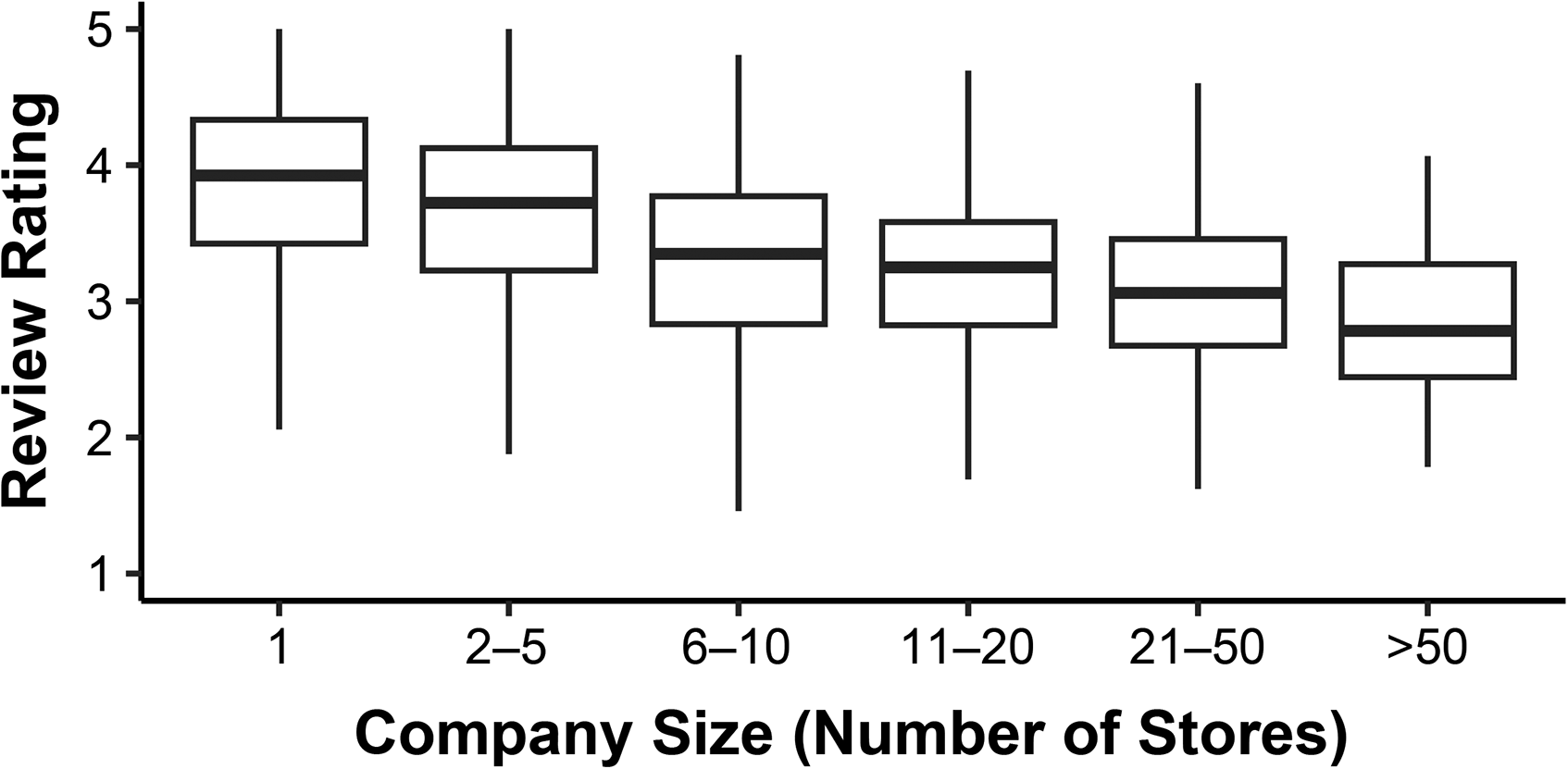
Box Plots for Review Rating by Company Size.
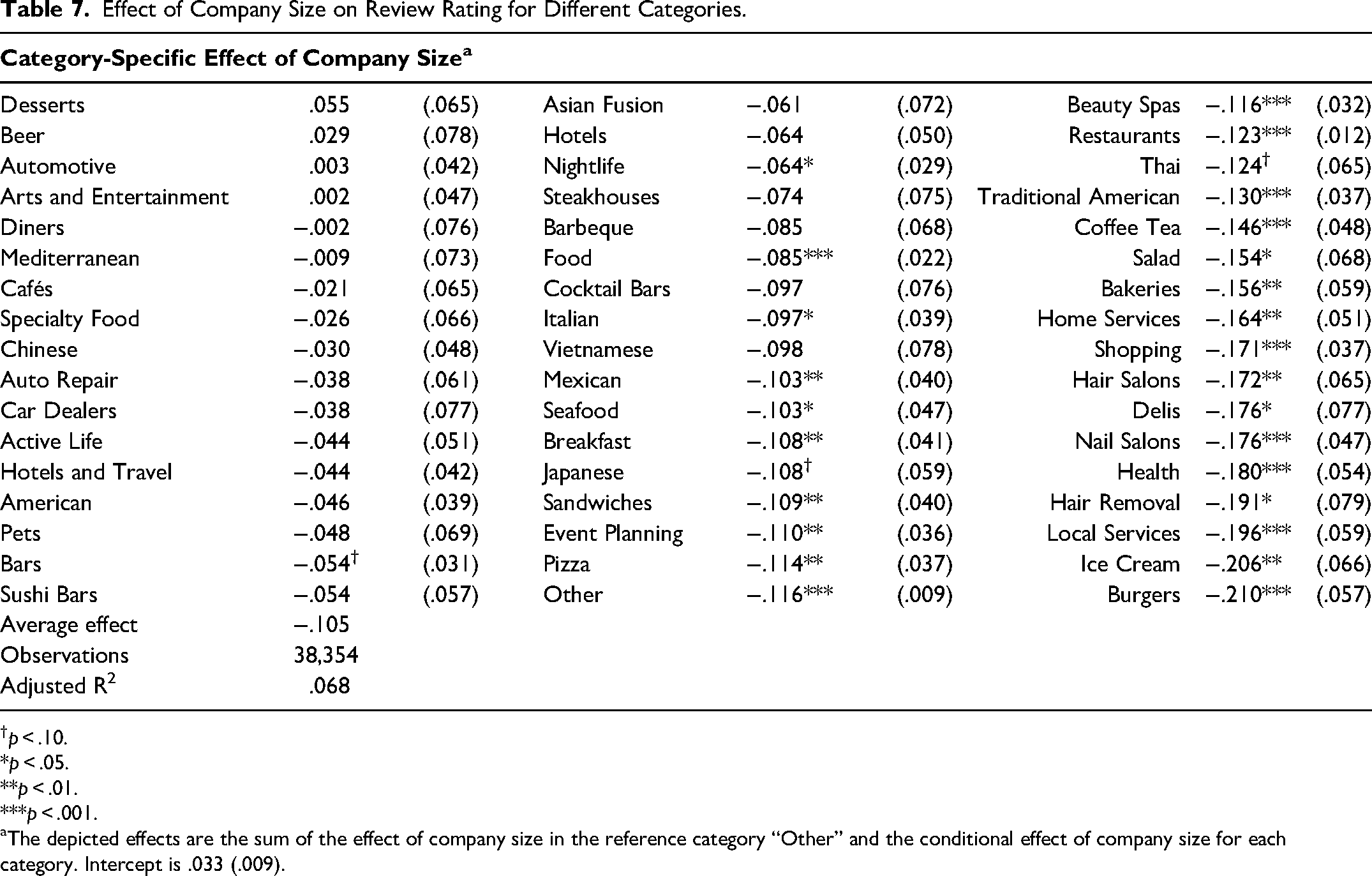
Next, we investigate how the effect differs between categories. We regress review rating on company size along with an interaction term of company size and a category fixed effect. The results are depicted in Table 7. Aside from Desserts, Beer, Arts and Entertainment, and Automotive, all other categories show a negative effect of company size on WOM valence. Among the categories with strong negative effects are Local Services, Hair Removal, and Health, showing that our results extend from the restaurant chains investigated in Study 1 to other product categories.
Effect of Company Size on Review Rating for Different Categories.
p < .10.
*p < .05.
**p < .01.
***p < .001.
The depicted effects are the sum of the effect of company size in the reference category “Other” and the conditional effect of company size for each category. Intercept is .033 (.009).
Comparing the Selection and Adjustment Mechanism
While Studies 1 and 2 consistently show a negative effect of company size on aggregate WOM valence, they do not explain why this effect occurs. In H2a, we propose a selection mechanism, whereby company size impacts consumers’ likelihood to share WOM as a function of experience quality (i.e., they decide whether or not to share). Another explanation could be an adjustment mechanism, whereby consumers adjust the valence of their WOM based on company size (e.g., adjusting ratings upward or downward for smaller and larger companies, respectively; Moe and Schweidel 2012). Both mechanisms predict a negative effect of company size on WOM valence, but analytically modeling the distribution of reviews following each mechanism points to a difference (Figure 4).
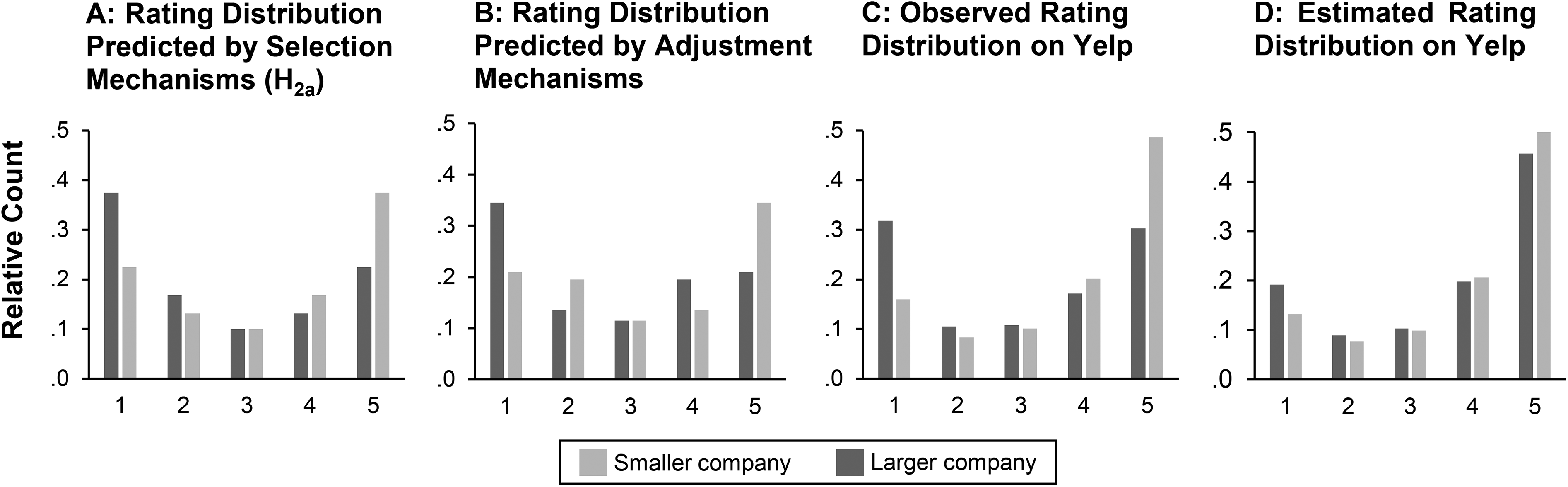
Predicted Versus Observed Distribution of Review Ratings.
Consider the following to see why: Both models predict the total number of customers who rate a company xr ∈ (1, 2, 3, 4, 5) of size y ∈ (s, l) as a function of their true experience xe ∈ (1, 2, 3, 4, 5) and company size. Both also assume an extremity bias f(xr), whereby customers are more likely to share extreme experiences than moderate experiences (Hydock, Chen, and Carlson 2020; Schoenmueller, Netzer, and Stahl 2020). The total number of customers who share an experience N(xr,y) is a function of the probability that each individual customer who has an experience with a company P(xe,y) gives a review. According to the selection mechanism, the number of reviews at each rating point for larger and smaller companies is determined by N(xe,y) × P(xe,y) = {N(xe,y) × f(xr) + Iy × k(x)}, where Iy is an indicating function {Iy = 1 if y = s; Iy = −1 if y = l}, and k(x) = c ×⋅ m − xm, where c is a scaler and m is the scale median (see Figure 4, Panel A). According to the adjustment mechanism, the total number for each bin will be the product {N(xe,y) × P(xe,y)}, where P(xe,y
l
) = f(xr) + a(f(xr + 1)) ×
Following H2a, the selection mechanism posits that consumers are more likely to share about high-quality and less likely to share about low-quality experiences with smaller companies. Accordingly, the model predicts a smooth U-shaped pattern with an asymmetry, such that there is a greater frequency of positive reviews for smaller companies and more negative reviews for larger companies. The adjustment model posits that consumers adjust upward the rating that they provide for a given experience with a smaller company and adjust downward for larger companies. Owing to the combination of the underlying U-shaped distribution of reviews as well as the upward shift of ratings for smaller companies and the downward shift for larger companies, the adjustment mechanism predicts a jagged U-shaped pattern. The jagged U-shaped pattern reflects the prediction of more extreme negative reviews (one star) for larger than smaller companies, but more moderate negative reviews (two stars) for smaller companies. The inverse would be true for smaller companies: more extreme positive reviews (five stars) but not more moderate positive reviews (four stars; see Figure 4). Notably, this differential pattern holds across model parameters when assuming a U-shaped distribution of WOM.
To test these two mechanisms, we constructed a dataset of the relative count of reviews at each rating level (one to five stars) for each company. We plotted the predicted rating distribution for the selection mechanism (Figure 4, Panel A), the adjustment mechanism (Figure 4, Panel B), and the observed rating distribution (Figure 4, Panel C) for smaller companies (i.e., ten or fewer locations) and larger companies (i.e., more than ten locations). We also conducted an ordinary least squares regression analysis (see Web Appendix I, Table W13) on the relative count of reviews as a function of company size and rating (as a categorical variable) and then plotted the predicted frequency of each rating for smaller and larger companies (two standard deviations below and above the mean, respectively; Figure 4, Panel D). As shown, the observed and predicted distributions align with the selection mechanism, supporting H2a.
Study 3: Behavioral and Scenario Experiments
Building on Study 2, in Study 3, we manipulate company size and experience quality to provide causal support for H2a, showing that after a high-quality (low-quality) experience, consumers are more (less) likely to share WOM about a smaller company.
Study 3a: The Effect of Experience Quality and Size on Sharing (Product Taste)
In Study 3a (preregistered at https://aspredicted.org/D9J_DJ5), the participants tasted a low-quality popcorn that was attributed to a small (vs. large) cinema and a high-quality popcorn that was attributed to a large (vs. small) cinema. The participants evaluated both products and were asked whether they wanted the reviews to be posted anonymously.
Methods
A convenience sample of 50 participants (students at the campus of a large university; power analyses for all experimental designs are reported in Web Appendix J) completed the study without compensation via a pen-and-paper questionnaire. In the study, company size and quality were manipulated within participants over two trials. For each participant, quality (high/low) and size (small/large) were randomly selected without replacement (if the first trial was low-quality, small cinema, then the other was high-quality, large cinema). In the large and small size conditions, participants were told that the popcorn was produced by a large (3,511 seats in 14 rooms) or small (237 seats in 2 rooms) local cinema, respectively. In the high-quality condition, participants tasted packed popcorn from a national brand, and in the low-quality condition, participants tasted store-brand, microwave popcorn; the original packaging was not present (see Web Appendix K for pretest results). Participants first tasted both products. Next, they saw the name and description of each company (the cinema is a big/small player in the cinema industry owing to its high/low market share and big/small customer base) and evaluated each product on a five-star scale (M = 3.32, SD = 1.16). Each participant evaluated two products in a mixed design with randomized order: In one condition, participants evaluated a low-quality product from a small company and a high-quality product from a large company; in the other condition, participants evaluated a low-quality product from a large company and a high-quality product from a small company. For each product, the participants then read, “We can post a review with your evaluation anonymously on your behalf on Google reviews,” and were able to respond yes or no (decision to share). The participants also reported whether they had visited the cinema (see Web Appendix K for questionnaire details).
Results and discussion
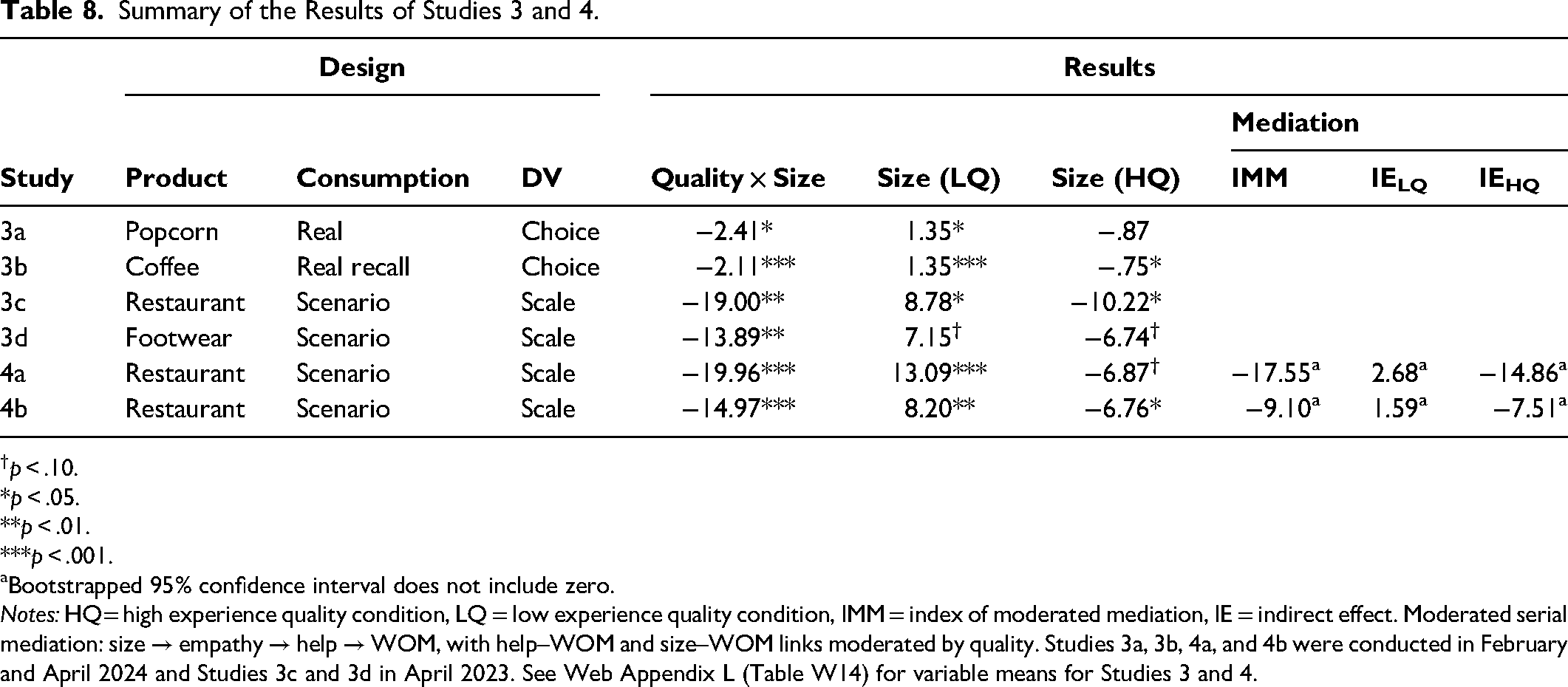
A logistic regression with participant random effects to account for repeated measures revealed an interaction of size (smaller = 0, larger = 1) and experience quality (low = 0, high = 1) on decision to share (b = −2.41, z = −2.34, p < .05; see Web Appendix L for variable means by condition for all experiments). For the high-quality product, more consumers decided to share WOM about the smaller company (Msmall = 79%, Mlarge = 61%; b = −.93, z = −1.32, p > .1). For the low-quality product, fewer consumers decided to share about the smaller company (Msmall = 27%, Mlarge = 58%; b = 1.49, z = 2.16, p < .05). Figure 5 depicts this interaction effect for Study 3a and subsequent studies.
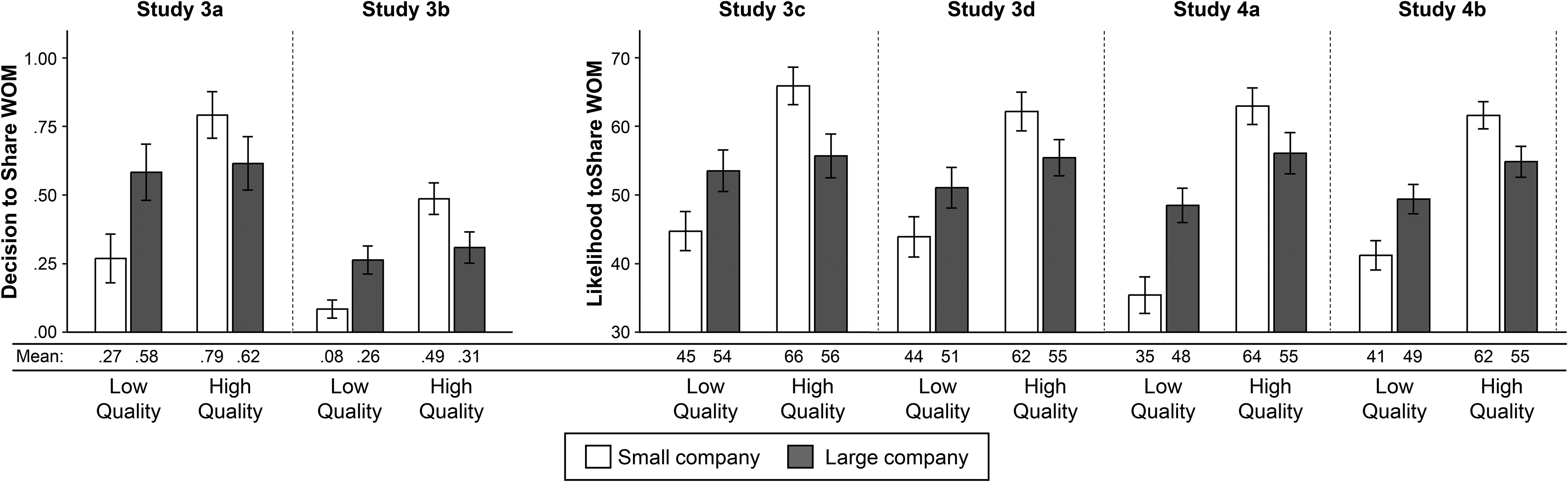
Mean Likelihood to Share WOM by Company Size and Experience Quality.
Verifying our manipulation, there was a positive effect of experience quality on ratings (b = 1.40, t(96) = 7.51 p < .001). There was no effect of size on ratings (b = −.07, t(96) = −.41, p > .1), countering a potential adjustment mechanism. In Study 3a, we find support for the interaction of company size and experience quality on consumers’ decision to share WOM in a study with real products and companies and when implying that participants’ reviews would actually be posted. In Study 3b, we investigate whether this effect holds for real consumption experiences.
Study 3b: The Effect of Experience Quality and Size on Sharing (Experience Recall)
In Study 3b (preregistered at https://aspredicted.org/XRF_HBT), we asked the participants to recall a real positive or negative experience with a real small or large coffee shop. We next asked them to write a review and then asked whether they would like us to post it anonymously.
Methods
Two hundred ninety-one participants (Mage = 20.48 years, SDage = 10.96; 55.33% female, 44.33% male, .3% nonbinary) from a student sample completed a 2 (company size: larger vs. smaller) × 2 (experience quality: high vs. low) fully between-subjects study in exchange for course credit. Nineteen participants who did not have a coffee shop experience were piped out of the study. To manipulate company size and quality, the participants were asked about a time when they had a positive or negative experience at either a large chain or small independent coffee shop. They rated the company on a five-star scale (M = 3.74, SD = 1.25). Finally, the participants read, “Using the business name and location you provided, we can post your review anonymously on your behalf. Would you want us to post the review for you?” (Yes, No; see Web Appendix M for questionnaire details).
Results and discussion
A logistic regression revealed a significant interaction of company size (smaller = 0, larger = 1) and experience quality (low = 0, high = 1) on decision to share (b = −2.11, z = −3.46, p < .001). In the high-quality condition, more consumers decided to share online about the smaller company (Msmall = 49%, Mlarge = 31%; b = −.75, z = −2.16, p < .05). In the low-quality condition, fewer consumers decided to share about the smaller company (Msmall = 8%, Mlarge = 26%; b = 1.35, z = 2.71, p < .001). Verifying our manipulation, we find a positive effect of experience quality on ratings (b = 1.72, t(288) = 16.56, p < .001); we also find a negative effect of size on ratings (b = −.26, t(288) = −2.55, p < .05).
In Studies 3a and 3b, we find support for the interaction of company size and experience quality on consumers’ decision to share about a company when consuming a real product from a local company and when recalling their real experiences. However, the focus on real stimuli introduces the possibility of confounds (e.g., preexisting expectations or biases). Accordingly, in Studies 3c and 3d, we use fictitious companies and manipulate experience quality to rule out alternative explanations.
Studies 3c and 3d: The Effect of Experience Quality and Size on Likelihood to Share
Study 3c methods
Three hundred ninety-five participants (Mage = 40.25 years, SDage = 12.50; 55.4% female, 44.6% male) from Amazon Mechanical Turk (MTurk) completed a 2 (company size: larger vs. smaller) × 2 (experience quality: high vs. low) fully between-subjects study posted on CloudResearch in exchange for $.40. To manipulate company size, the participants first read that Foodaza, a fictional company, was either a larger company with a high market share or a smaller company with a low market share (see Web Appendix N for full stimuli and measures). To manipulate experience quality, the participants read that Foodaza offered a high- or low-quality experience. They indicated how likely they would be to share online WOM about Foodaza using three items (e.g., “Review your experience online”) on a 100-point scale (M = 54.93, SD = 30.16, α = .91) and provided the rating that they would give on a five-star scale (M = 3.72, SD = 1.63).
Study 3c results
Linear regression revealed a significant interaction of company size (smaller = 0, larger = 1) and experience quality (low = 0, high = 1) on the likelihood to share (b = −19.00, t(391) = −3.22, p < .01). In the high-quality condition, consumers were more likely to share online about the smaller company (Msmall = 65.90, Mlarge = 55.68; b = −10.22, t = −2.47, p < .05), while in the low-quality condition, consumers were less likely to share online about the smaller company (Msmall = 44.74, Mlarge = 53.52; b = 8.78, t = 2.09, p < .05). Further details are depicted in Figure 5 and Table 8. Verifying our manipulation, we find a positive effect of experience quality on ratings (b = 2.83, t(392) = 34.79, p < .001). In contrast to Study 3b, size has a positive effect on ratings (b = .18, t(392) = 2.21, p < .05).
Summary of the Results of Studies 3 and 4.
p < .10.
*p < .05.
**p < .01.
***p < .001.
Bootstrapped 95% confidence interval does not include zero.
Notes: HQ= high experience quality condition, LQ = low experience quality condition, IMM = index of moderated mediation, IE = indirect effect. Moderated serial mediation: size → empathy → help → WOM, with help–WOM and size–WOM links moderated by quality. Studies 3a, 3b, 4a, and 4b were conducted in February and April 2024 and Studies 3c and 3d in April 2023. See Web Appendix L (Table W14) for variable means for Studies 3 and 4.
Study 3d summary
In Study 3d, we extend our investigation from a service context (restaurants) to a product context (a shoe purchase with the fictional company Footform), following the procedure and design of Study 3c (method and result details are reported in Web Appendix O). Our analysis, summarized in Figure 5 and Table 8, again supports our hypotheses.
Discussion of Study 3
Four experiments with different settings, summarized in Table 8, demonstrate the interaction between company size and experience quality. Supporting H2, consumers are more likely to share online WOM about smaller companies when the quality of the consumer experience is high and less likely when it is low.
After introducing the selection mechanism in H2a, we note that it is possible that company size impacts aggregate WOM valence by causing consumers to adjust the rating that they give as a function of size (adjustment mechanism). However, building on the analytic model from Study 2, the results of Studies 3a–3d suggest that this is not the case: Study 3a reveals a null effect; Studies 3c and 3d show positive effects; and only Study 3b, in which the participants recalled an experience, shows a negative effect of size on ratings.
Study 4: Mediating Mechanism
In Studies 4a and 4b, we test whether individual consumers feel more empathy toward smaller companies, resulting in a greater desire to help them by sharing WOM about a high-quality experience or not sharing WOM about a low-quality experience. In Study 4b, we further test a selection of potential alternative mediating processes.
Study 4a: Serial Mediation Through Empathy and Desire to Help
In Study 4a (preregistered at https://aspredicted.org/KMX_782), we again manipulate company size and the quality of consumer experiences while also testing our proposed moderated serial mediation process. Specifically, we argue that consumers are more empathetic toward smaller companies, which leads to a greater desire to help them. In turn, they are relatively more (less) likely to share WOM about a high-quality (low-quality) experience with smaller companies.
Methods
Four hundred forty-one participants (Mage = 42.15 years, SDage = 14.10; 37.87% male, 61.69% female, .45% nonbinary) from Prolific (U.K. pool) completed the study for $.35. Procedures and stimuli followed those of Study 3c, with the addition of the hypothesized mediators: empathy (M = 3.59, SD = 1.78, α = .95; Kirmani et al. 2017) and desire to help (M = 4.93, SD = 1.44, α = .92). Several attention/manipulation checks were included. Participants’ likelihood to share served as the dependent variable (M = 51.17, SD = 30.01, α = .86). Rating data were not collected (see Web Appendix P for questionnaire details).
Results and discussion
We first examined the effect of company size and experience quality on likelihood to share, which revealed a significant interaction (b = −19.96, t(437) = −3.67, p < .001). As in Studies 3a–3d, the interaction reflects that in the high-quality (low-quality) condition, consumers were more (less) likely to share online about the smaller company (see Table 7). In Web Appendix P, we report an analysis excluding the participants who failed the attention checks, with a similar pattern of results.
With respect to the mediators, both empathy (Msmall = 4.12, Mlarge = 3.06; b = −1.06, t = −6.53, p < .001) and desire to help (Msmall = 5.38, Mlarge = 4.48; b = −.90, t = −6.90, p < .001) are lower for larger companies. Next, we conducted a custom serial mediation analysis using Hayes's PROCESS macro (see Figure 6) with a single serial mediating pathway (company size → empathy → desire to help → WOM), whereby the effect of desire to help and the direct effect of company size on WOM were moderated by experience quality. The analysis revealed a moderated mediating effect (index of moderated mediation [IMM] = −17.55, 95% CI: [−25.45, −11.07]; see Figure 6), with full mediation in the high-quality condition (indirect effect [IE] = −14.86, 95% CI: [−21.58, −9.42]) and partial mediation in the low-quality condition (IE = 2.68, 95% CI: [.28, 5.41]). In short, consumers showed increased empathy toward the smaller company, leading to a stronger desire to help by sharing more (less) about high-quality (low-quality) experiences with the smaller company (see Web Appendix L, Table W14, for the means of the mediators by condition).
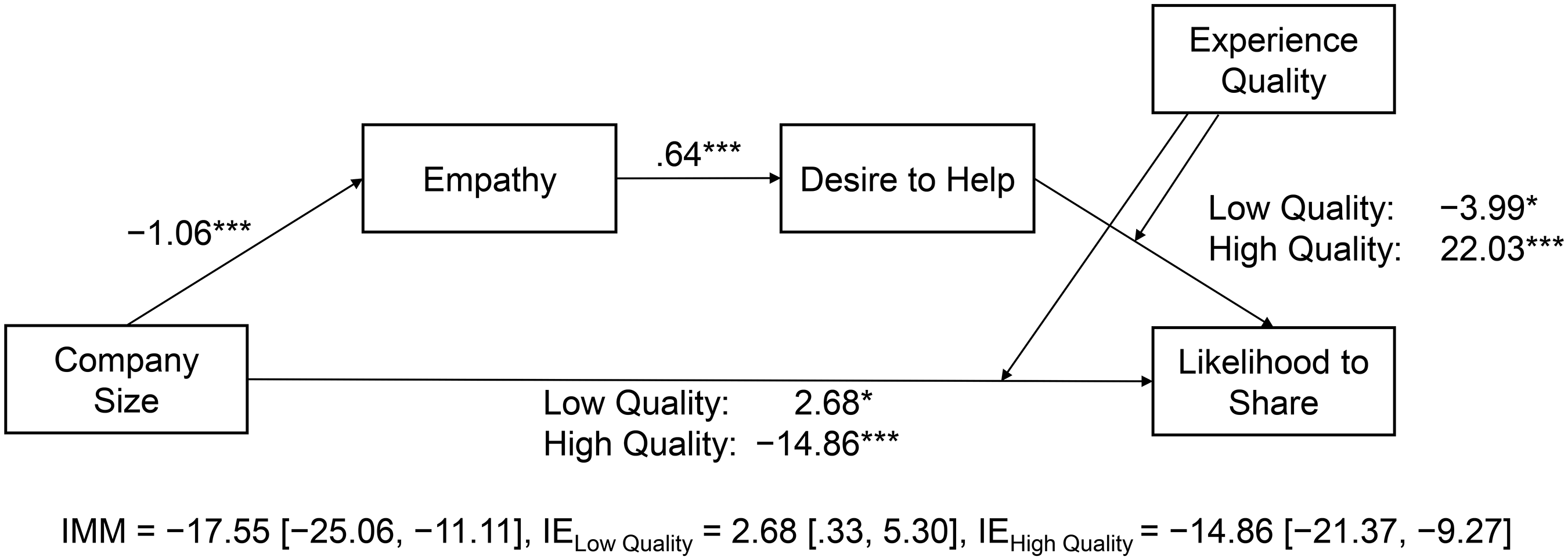
Moderated Serial Mediation.
Study 4b: Alternative Mechanisms
Methods
In Study 4b (preregistered at https://aspredicted.org/CY7_3TF), we followed the design of Study 4a (see Web Appendix Q for details) while also measuring a selection of alternative mediating mechanisms: perceptions of warmth (M = 4.41, SD = 1.91, α = .98) and competence (M = 4.35, SD = 2.23, α = .99; Halkias and Diamantopoulos 2020), underdog positioning (M = 4.15, SD = 1.27, α = .78; Paharia et al. 2011), perceptions of power (M = 3.95, SD = 1.53, α = .89), reflectiveness of the service (M = 4.67, SD = 1.21, α = .81), ease of communication (M = 5.05, SD = 1.40, α = .89), brand trust (M = 4.14, SD = 1.71, α = .95; Delgado-Ballester, Munuera-Aleman, and Yague-Guillen 2003), and identification with the brand (M = 2.50, SD = 1.65).
Results
In Table 8, we report an overview of the analysis of the effect of company size and experience quality on ratings that mirrors the previous studies. Table 8 additionally includes an overview of the focal mediation results supporting our hypothesis, which mirrors Study 4a (see Web Appendix R for all mediation results).
Here, we focus our reporting on the tested alternative processes. Because we hypothesized a moderated serial mediation process (see Figure 6) and included eight potential alternative mechanisms, there was both an abundance of possible models to test and limitations in terms of how many mediators could be tested in parallel. Accordingly, we tested what seemed to be plausible alternative explanations while working around limitations. First, using Hayes's PROCESS Model 15 (which allowed us to simultaneously test all mechanisms in a moderated parallel mediation model), we analyzed company size as the independent variable, likelihood to share as the dependent variable, experience quality condition as the moderator, and all measured mediators as parallel mediating variables. The analysis revealed a moderated mediating effect of the desire to help (IMM = −8.65, 95% CI: [−13.37, −4.80]; IEHigh Quality = −4.73, 95% CI: [−7.77, −2.30]; IELow Quality = 3.92, 95% CI: [1.75, 6.61]), but no other variables explained our results.
To test which mechanisms might be driving the desire to help, we returned to the moderated serial mediation model used in Study 4a. We included empathy (our predicted mediator), trust, identification, warmth, and competence as parallel mediators in the first step of the serial mediation model; desire to help was included as the second step. The set of alternative mediators included in parallel with empathy was selected because of psychological mechanisms that might explain why consumers want to help a company (and because PROCESS limits the number of parallel mediators in a serial model). In contrast, the other measures reflect downstream company perceptions or positioning (power, underdog, reflectiveness of quality, and communication ease). The model revealed only serial mediation through empathy (IMM = −4.56, 95% CI: [−6.72, −2.70]; IEHigh Quality = −3.71, 95% CI: [−5.46, −2.21]; IELow Quality = .84, 95% CI: [.20, 1.60]; see Web Appendix R).
Study 5: Moderating Effects
In Study 5a, we test whether larger companies can actively mitigate the negative effect by employing WOM response strategies that induce empathy from consumers (H3a). In Study 5b, we test whether the number of CSI issues moderates the effect of company size such that WOM valence is less positive for smaller companies with more CSI issues.
Study 5a: The Moderating Effect of WOM Response Strategy
Study 5a investigates how larger companies can actively mitigate the negative effect of company size on WOM valence. Following H3a, we expect that a WOM response strategy that builds empathy will disproportionately benefit larger companies, which receive lower levels of consumer empathy, to reduce the negative effect of company size on WOM valence. We therefore investigate the moderating role of number of responses to WOM and the language used in these responses.
Sample
We collected all response tweets (Ntotal = 94,502; Mper company = 4,692; SD = 11,370) from company accounts in response to consumer-generated tweets that mention the company, which were included in the Twitter data of Study 1a. Response tweets are tweets from a company that replied to a user, identified as beginning with @[username].
Variables
We compute a single measure of responsiveness averaging three metrics (Cronbach's α = .68) that signal responsiveness. The first metric is the number of tweets that are responses, which are visible to consumers on a company's account (Mper company = 4,693; SD = 11,370; rcompany size = .772). The second metric is the number of response tweets divided by the number of WOM posts, representing the portion of WOM responded to (Mper company = 13%; SD = 13%; Min = 0; Max = .561; rcompany size = .232). The third metric is the number of responses divided by the total number of company tweets (Mper company = 73%; SD = 31%; Min = 0; Max = 1; rcompany size = .400).
To measure the emotionality of the response tweet language, we use Linguistic Inquiry and Word Count (LIWC), which has been frequently applied in the field of company–consumer communication (Packard, Li, and Berger 2024). For each company, we aggregate all response tweets into a document, which is then analyzed using the Affect dictionary from LIWC. Emotionality is weakly correlated with size (r = −.048).
To measure personalization in response language, we compute how different the words in a company's response are from the words in the preceding response using Jaccard similarity (Berger et al. 2020). When consumers observe company replies in chronological order on Twitter, lower levels of personalization are reflected in the use of similar words across subsequent responses. Jaccard similarity is defined as the size of the intersection (i.e., set of words used in both responses) divided by the size of the union (i.e., set of all words used in any of the two responses). We average the Jaccard similarity for all responses at the company level and multiply the similarity by −1 to compute personalization. Personalization is weakly correlated with company size (r = .009).
To count the number of personal names, we account for the fact that they can also be used as common words (e.g., “merry” is a name and an adjective). Therefore, we extract named entities using a spaCy model (en_core_web_lg; https://spacy.io/models/en). For each extracted person name, we check to see whether it is included in the NLTK (Natural Language Toolkit) list of all names. If it is, we count the word as a name and, at the company level, divide the number of names by the number of responses to measure how likely a company is to refer to its customers by name. Number of personal names is weakly correlated with company size (r = .084). See Web Appendix S for variable descriptives and correlations.
Results
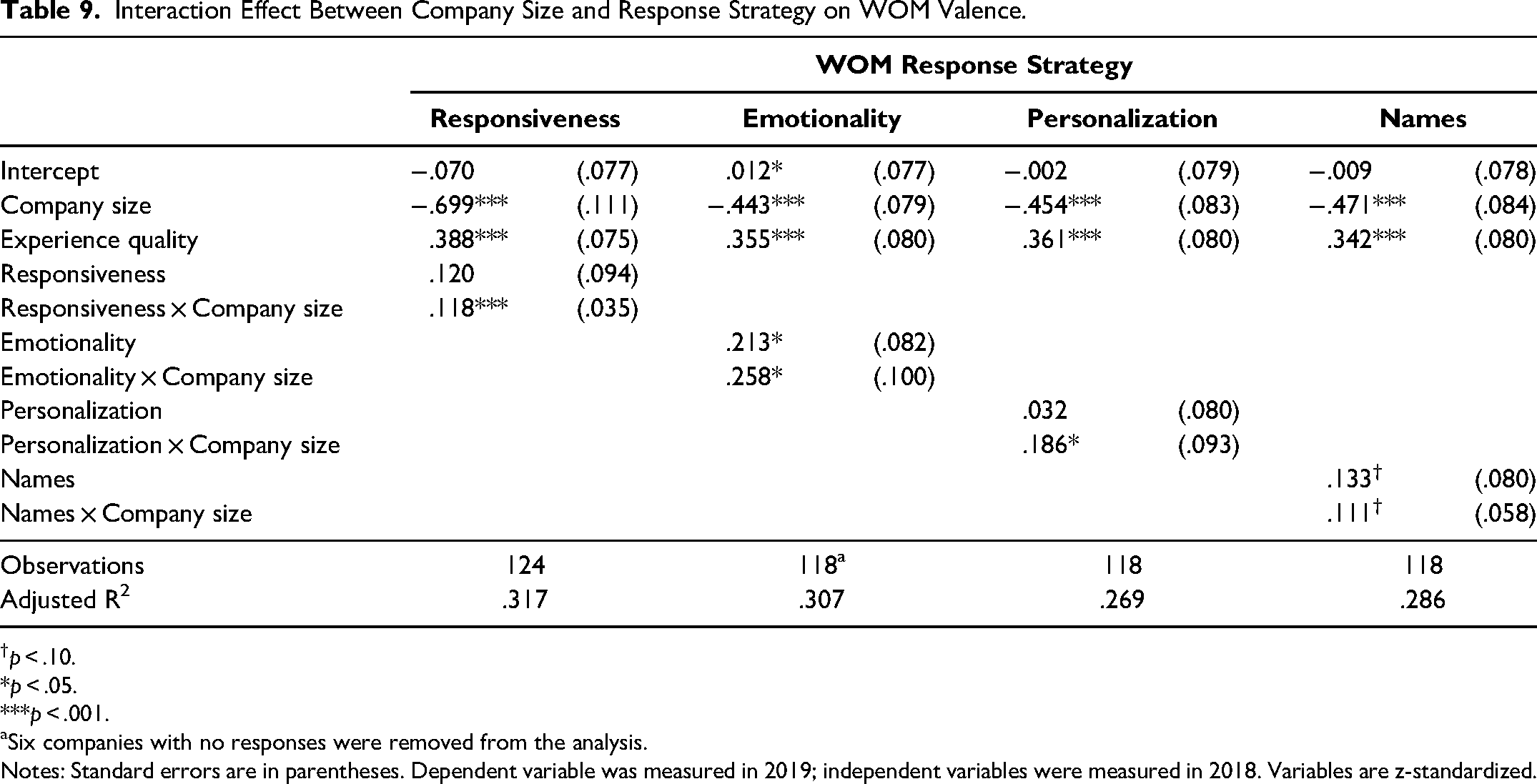
As shown in Table 9, responsiveness has a positive, yet not significant, effect on WOM valence (.120, p > .10). In support of H3a, we find the predicted positive interaction between company size and responsiveness (.118, p < .001). A company with one standard deviation above the mean of responsiveness reduces the negative effect of company size on WOM valence by 17%, from −.669 to −.581. We find similar patterns for the separate measures of responsiveness (see Web Appendix S for these results, descriptive statistics, and correlations). We also find a positive interaction effect between the proposed language cues and company size, indicating that the negative effect of company size on WOM valence is mitigated for companies that employ these language cues (see Table 8). For emotional language, a one-standard-deviation increase attenuates the negative effect of company size by .052 (p < .05). Emotional language also has an unconditional direct effect on WOM valence (.043, p < . 05). Higher personalization in company responses further attenuates the negative effect of size (.038, p < .05) but has no significant unconditional effect (.007, p > .1). Using personal names has a marginally significant positive interaction effect (.022, p < .10) and a marginally significant unconditional effect (.027, p < .10). These results support H3a by showing that language cues that drive empathy in WOM responses can potentially mitigate the negative effect of size on WOM valence.
Interaction Effect Between Company Size and Response Strategy on WOM Valence.
p < .10.
*p < .05.
***p < .001.
Six companies with no responses were removed from the analysis.
Notes: Standard errors are in parentheses. Dependent variable was measured in 2019; independent variables were measured in 2018. Variables are z-standardized.
Study 5b: The Moderating Effect of CSI
While our studies show that smaller companies receive more positive WOM valence as consumers are more empathetic toward them, factors that decrease empathy might disproportionally harm smaller companies. Following H3b, we test whether the negative effect of company size on WOM valence is mitigated by CSI issues.
To measure CSI, we collected environmental, social, and governance issue data from RepRisk. This dataset captures the number of negative CSI issues faced by a company. We observe between 0 and 80 CSI issues (M = 2.193, SD = 7.651) per company and a positive correlation with company size (r = .643). We use the same data and models as reported in Study 1a but include an interaction effect of company size × CSI.
As expected, CSI has a significant negative effect on WOM valence for Yelp reviews (−.445, p < .05) and Twitter posts (−.404, p < .05). In support of H3b, we find the predicted positive interaction between company size and CSI for Yelp reviews (.096, p < .01) and Twitter posts (.107, p < .001). We find directionally consistent but statistically insignificant results for Instagram (see Web Appendix S, Table W23, for details). A company having one standard deviation above the mean of CSI issues reduces the negative effect of company size on WOM valence by 19%, from −.502 to −.406, for Yelp reviews and by 23%, from −.460 to −.353, for Twitter posts. These results support H3b by showing that a high number of CSI issues can mitigate the benefits for smaller companies (i.e., mitigate the negative effect of size on WOM valence).
General Discussion
In this work, we demonstrate that company size has a negative effect on WOM valence. This effect arises because consumers are more (less) likely to share about high-quality (low-quality) experiences with a smaller company. The differential likelihood is driven by consumers’ empathy; they are more empathetic toward smaller companies, which increases their desire to help and, in turn, their propensity to share positive and withhold negative WOM about these smaller companies. These results are robust across product categories, WOM formats (i.e., online reviews and social media posts), and platforms (i.e., Yelp, Amazon, Twitter, and Instagram), and they occur both between and within companies. We support our hypotheses through 12 studies, including analyses of observational data and experiments.
Additionally, we show that larger companies can counteract the negative effect through their WOM response strategies that induce empathy, which large companies otherwise lack. This can be done through increased responsiveness, affective language (e.g., “We are very happy/sorry to hear this”), personalized responses (i.e., using different words to reply to different WOM posts), and addressing consumers by name. For smaller companies, a high number of CSI issues mitigates the benefits of company size on WOM valence.
Theoretical Contribution
This research makes several theoretical contributions to the literature on company size and online WOM. First, we identify a negative effect of company size on WOM valence, adding to existing literature on the influence of company size on product preferences (Beck, Rahinel, and Bleier 2020; Paharia, Avery, and Keinan 2014) and quality perceptions (Woolley, Kupor, and Liu 2023).
Second, within the literature on WOM, we extend its focus on antecedents (Babić Rosario, De Valck, and Sotgiu 2020) by highlighting consumers’ likelihood to share positive versus negative experiences. By showing that consumers are more (less) likely to post about high-quality (low-quality) experiences with smaller companies, we illustrate that company size affects WOM and complement prior research on customers’ tendencies to share positive (vs. negative) experiences (Moe and Schweidel 2012; Schoenmueller, Netzer, and Stahl 2020).
Third, we demonstrate that the negative effect of company size on WOM valence is mediated by consumers’ empathy toward the company. By examining how empathy mediates this relationship, our research adds to previous studies exploring the reasons behind sharing behaviors (Babić Rosario, De Valck, and Sotgiu 2020).
Managerial Implications
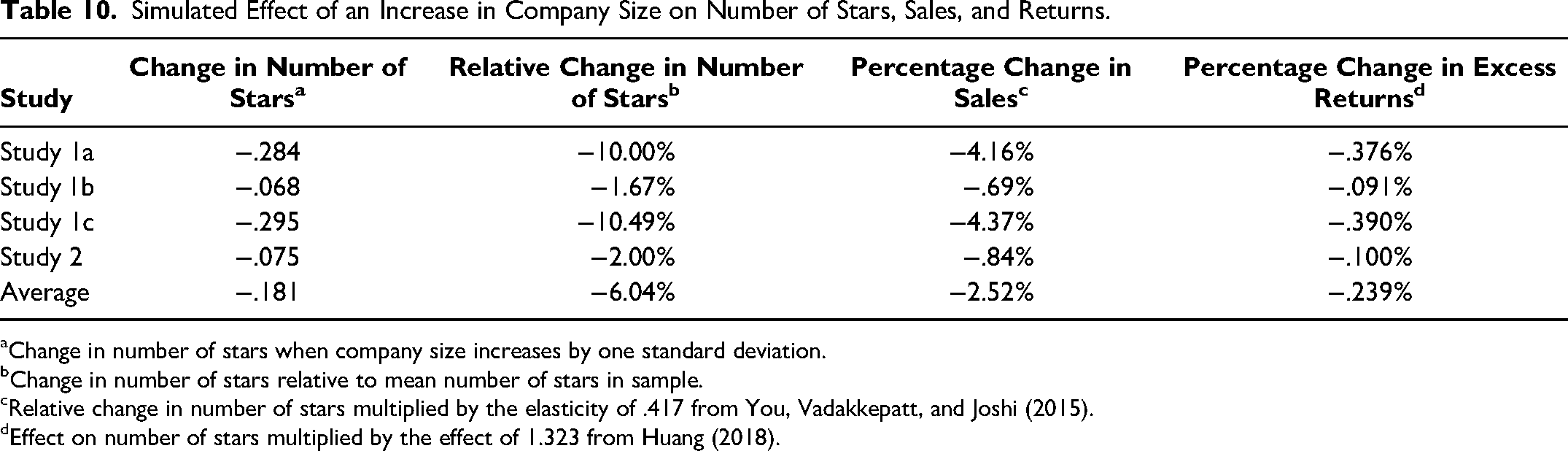
To illustrate the managerial importance of the negative effect of company size on WOM valence, we simulate the dollar value of changes in company size. We use the WOM valence-sales elasticity estimated in the meta-study by You, Vadakkepatt, and Joshi (2015). The results, which are depicted in Table 10, show that, on average, a one-standard-deviation increase in company size leads to a 6.04% decrease in star rating and is associated with a sales decrease of around 2.52%, which is substantial. Notably, the magnitude of change differs across industries: In the chain restaurant industry (Study 1a), we find a sales decline of around 4.16%, while for products on Amazon (Study 1b), we find a less strong effect of .69%. A reasonable explanation for these differences might be that empathy plays a stronger role in service versus product offerings (Palmatier et al. 2006).
Simulated Effect of an Increase in Company Size on Number of Stars, Sales, and Returns.
Change in number of stars when company size increases by one standard deviation.
Change in number of stars relative to mean number of stars in sample.
Relative change in number of stars multiplied by the elasticity of .417 from You, Vadakkepatt, and Joshi (2015).
Effect on number of stars multiplied by the effect of 1.323 from Huang (2018).
In addition to its effect on customer purchase decisions and sales, WOM valence might affect investor decisions and firm value. As shown by Huang (2018), online reviews contain novel information about companies, such that an unexpected increase of one star in online reviews explains a 1.323 percentage point increase in excess stock returns. Combining this estimate with ours, a one-standard-deviation increase in size can decrease a rating by up to .295 stars (Study 1c), which would translate into a −.390 change in excess stock return (see Table 10).
In light of the magnitude of this effect, its increase over time (Study 1c), and the process we document in this research, our work has several implications for managers. First, given the negative effect of company size and the role of empathy in driving this effect, we suggest that larger companies can especially benefit from WOM response strategies that promote empathy. Based on the estimates from Study 5a, a one-standard-deviation increase in the respective strategy can mitigate the negative effect of company size on WOM valence by around 58% (emotional language), 41% (personalization), 24% (addressing consumers by name), or 17% (responsiveness). Although these strategies may seem easy to execute, 5% of the companies in our data had never answered a tweet, companies responded to only 13% of the tweets they received on average, and 10% never addressed a consumer by name, indicating space for improvement based on our results. These findings add to the recent research on the managerial importance of effective response strategies (Allard, Dunn, and White 2020; Herhausen et al. 2023).
Second, this work implies that smaller companies face the risk of harming their WOM if they act in a way that reduces consumers’ empathy toward them. Accordingly, we contend that it is equally important for smaller companies to avoid issues that may reduce consumers’ empathy toward them as it is for larger companies to implement strategies that foster it. Based on Study 5b, a one-standard-deviation increase in CSI issues mitigates the positive effect for small companies (i.e., the negative effect of company size) by 19% (Yelp) to 23% (Twitter). This extends the findings by Jung, Bae, and Kim (2022), which show that consumers share more WOM about larger companies’ CSI issues.
While we focus on response strategies and CSI as managerial drivers of empathy, the literature highlights additional drivers. For example, corporate social responsibility initiatives (Shea and Hawn 2019), underdog positioning (Kirmani et al. 2017; Paharia, Avery, and Keinan 2014), and highlighting unfair negative WOM (Allard, Dunn, and White 2020) could foster empathy. In addition to avoiding CSI issues, satisfying communion expectations (Yang and Aggarwal 2019) or avoiding controversy (Hydock, Paharia, and Blair 2020) might help smaller companies maintain consumers’ empathy toward them.
Third, we suggest that inferences of quality based on WOM valence could be biased if company size is not considered. To illustrate this bias, we look at two restaurant chain companies from Study 1a: In-N-Out has a star rating of 4.03 and is relatively small (−.06 SD in company size). Chick-fil-A has a star rating of 3.36 and is relatively large (+2.43 SD in company size). Assuming that Chick-fil-A was the same size as In-N-Out, we would predict that its star rating would be 4.06, indicating that the difference between these competitors is entirely explained by the difference in size. Accordingly, managers should account for company size when using WOM to infer quality over time (Rust et al. 2021) or when comparing themselves with competitors (Netzer et al. 2012). Similarly, consumers should be aware of this effect when making decisions based on WOM valence (De Langhe, Fernbach, and Lichtenstein 2016).
Future Research
First, although not hypothesized, we find evidence that the negative effect of company size on WOM valence is more pronounced for services than products. For example, the effect is greater in Studies 1a and 2c (restaurants) than in Studies 1b and 2d (Amazon, footwear). This may indicate a greater importance of empathy in service-oriented (vs. product-oriented) industries, wherein the interaction between customers and employees significantly shapes customers’ overall experiences.
Second, while we begin to investigate the relationship between company size and online WOM in this work, consumers communicate their experiences in various ways, such as face-to-face, by contacting a company, through blogs, and on community platforms (e.g., Reddit). While prior research has begun investigating how different postpurchase channels can impact the ways in which consumers articulate their experiences (Hydock, Chen, and Carlson 2020), future research should consider how company size affects these decisions.
Supplemental Material
sj-pdf-1-jmx-10.1177_00222429251320603 - Supplemental material for The Effect of Company Size on Aggregate Word-of-Mouth Valence
Supplemental material, sj-pdf-1-jmx-10.1177_00222429251320603 for The Effect of Company Size on Aggregate Word-of-Mouth Valence by Jan Klostermann, Anne Mareike Flaswinkel, Chris Hydock and Reinhold Decker in Journal of Marketing
Footnotes
Acknowledgments
The authors gratefully thank Alexander Max, Michelle D. Steward, Marc Fischer, Nicola Bilstein, Franziska Völckner, and members of the Scientific Commission Marketing of the German Academic Association for Business Research (VHB), as well as participants of research seminars at University of Cologne, University of Notre Dame, Copenhagen Business School, Tulane University, and Sabanci University, for their helpful comments on earlier versions of this article.
Coeditor
Detelina Marinova
Associate Editor
Jacob Goldenberg
Declaration of Conflicting Interests
The authors declared no potential conflicts of interest with respect to the research, authorship, and/or publication of this article.
Funding
The authors received no financial support for the research, authorship, and/or publication of this article.

Notes
References
Supplementary Material
Please find the following supplemental material available below.
For Open Access articles published under a Creative Commons License, all supplemental material carries the same license as the article it is associated with.
For non-Open Access articles published, all supplemental material carries a non-exclusive license, and permission requests for re-use of supplemental material or any part of supplemental material shall be sent directly to the copyright owner as specified in the copyright notice associated with the article.
