






Abstract
Recent advances in live-streaming technology have empowered millions of amateur content creators to broadcast live video over the internet, sharing events and experiences with consumers as they happen. Despite the growing popularity of live streams, little research has examined how liveness may affect viewers’ experiences and behaviors. The current research addresses this gap and uses the context of amateur music performances to investigate how, when, and why viewing live streams (vs. equivalent or identical prerecorded video) can enhance presence, connection, enjoyment, and engagement. The authors find evidence of a mere liveness effect on consumer experiences: Simply knowing that an online video stream is live causes viewers to feel more connected to streamers. This effect is facilitated by an elevated sense of presence, or “being there,” in events that are viewed in real time. Critically, this effect also drives a liveness lift for online streamers; viewers of live (vs. prerecorded) streams enjoy the content more, choose to continue watching longer, and are more willing to follow and subscribe to the streamers’ channels. These findings have clear substantive implications: Marketers, platform developers, and content creators can enhance consumer connection, enjoyment, and engagement by going live.
Recent technological advances have facilitated a boom in live streaming. Platforms such as Twitch, TikTok, YouTube, Facebook, and Instagram now offer billions of users the unprecedented opportunity to stream their experiences—and to view others’ experiences—in real time, as they occur. Consumers have rapidly embraced this new technology. Across all platforms, viewers spent approximately 34 billion hours viewing live-streaming content in 2024 (Market Growth Reports 2025), and 28.3% of internet users worldwide report watching live-streaming content on a weekly basis (Kumar 2025). Together, this has contributed to a global market valued at over $107 billion (Zion Market Research 2025).
In the present research, we investigate how the defining feature of live streams—that they allow viewers to watch others’ experiences unfold in real time—may influence viewers’ experiences and behaviors. We focus on the experience of social connection and its downstream consequences for enjoyment and engagement with streamers and their channels, in the context of live streams by amateur musicians. We find evidence of a mere liveness effect for viewers: Simply believing one is watching events live makes viewers feel more connected to social agents on the other side of the screen. This effect drives a liveness lift for streamers: Live (vs. prerecorded) streams elicit heightened enjoyment and engagement from viewers. The implications of this effect are particularly relevant in the current digital age, where consumers increasingly rely on technology to fulfill their social needs. Our research suggests that going live can benefit consumers by facilitating feelings of connection and benefit streamers by motivating engagement.
Our work is the first to experimentally investigate how the knowledge—or belief—that one is watching events live influences consumers’ real viewing experiences. A small but growing body of research on live broadcasting has begun to explore consumers’ expectations as well as the effectiveness of different live-streaming strategies for increasing sales and viewer retention. To our knowledge, however, no extant research has directly tested how liveness itself influences evaluations of real viewing experiences. In our research, we show that watching live streams (vs. prerecorded videos) can increase feelings of social connection, and that this effect cannot be explained by other features of live streams such as differences in content or indeterminacy.
Our research also contributes to a deeper conceptual understanding of the factors that influence social connection online. We provide evidence that presence, or the sense of “being there” in the world on the other side of the screen, drives the effect of liveness on social connection. Although the concept of presence features prominently in discussions of new technologies (e.g., virtual reality, the metaverse), it has been largely unstudied in marketing (for a recent exception, see Harz, Hohenberg, and Homburg [2022]). Our investigation highlights the importance of presence in promoting users’ sense of connection online and provides novel experimental evidence that liveness facilitates this experience.
Our findings suggest that live streaming may help bring the promise of a truly “connected” world one step closer to reality by allowing users to feel more connected to others, even when they are not physically together in the same place. Moreover, our research has implications not just for consumers but also for marketers and platform developers who wish to gain consumers’ attention and increase engagement. In a world where consumers are spending more of their daily lives online, live streaming presents a novel opportunity for consumers to feel socially connected—and for brands and performers to facilitate this sense of connection.
Background
Social Connection, Offline and Online
People seek out social connection not only in close relationships but also in brief, fleeting interactions—both offline (Baumeister and Leary 1995; Sandstrom and Dunn 2014) and online (Heinonen 2011; Riedl et al. 2013). In digital contexts, the desire for social connection plays a central role in driving engagement with social media platforms like Facebook and X (formerly Twitter), which facilitate reciprocal interactions between consumers and creators (Heinonen 2011; Riedl et al. 2013). Intriguingly, the desire to connect has also been found to drive engagement with media and information sources like YouTube and Wikipedia, where direct interactions are relatively uncommon (Shao 2009). This pursuit of social connection in virtual spaces is consistent with consumers’ beliefs that online platforms can remove barriers between individuals and promote feelings of intimacy, even when users are separated by vast distances (Tamir and Ward 2015).
Mirroring consumer motivations and demand, online platforms often incorporate design features intended to facilitate feelings of social connection. Consistent with research indicating that simply being aware of other users in mediated environments can promote a sense of connectedness (Rettie 2003), platform developers have invested in a variety of features—including status updates (Dabbish and Kraut 2008), availability indicators (Nardi, Whittaker, and Bradner 2000), visible representations of other users, and location information (Riedl et al. 2013)—to increase users’ feelings that they are sharing the same environment with others even when they are not directly interacting. In our research, we investigate whether real-time viewing can similarly enhance feelings of social connection from otherwise identical online media.
Live Broadcasting and Live Streaming
Prior research on live broadcasting and live streaming spans disciplines such as communications, human–computer interaction, marketing, and psychology. In early theoretical work, communications scholars suggested that live broadcasting serves as a promise to viewers regarding the “realness” of the content they are watching (Bourdon 2000). More recent survey research on human–computer interaction extended these ideas, finding that live streams are seen as providing an unedited view into the lives of content creators (Tang, Venolia, and Inkpen 2016). Most relevant to the current research, these surveys have also revealed that the desire for social connection is a reliable predictor of time spent viewing live streams (Haimson and Tang 2017; Hilvert-Bruce et al. 2018). However, this survey research does not (and cannot) speak to whether live viewing enhances feelings of social connection. In parallel to this research on users’ perceptions and motivations, research in marketing and psychology has begun to examine the implications of live broadcasts and live streams for consumer experiences and choice (see Table 1).
Prior Research on Live Broadcasts and Live Streams.
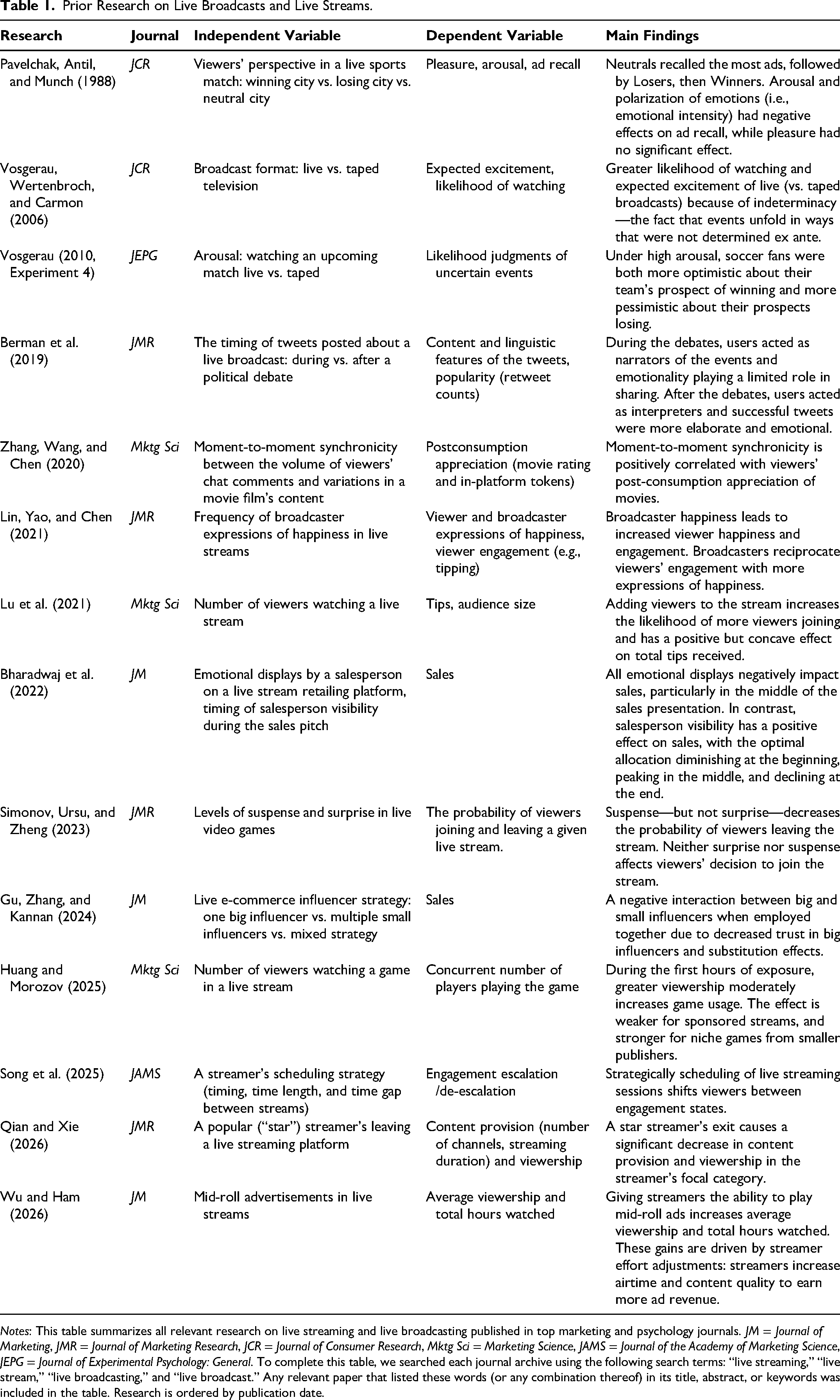
Notes: This table summarizes all relevant research on live streaming and live broadcasting published in top marketing and psychology journals. JM = Journal of Marketing, JMR = Journal of Marketing Research, JCR = Journal of Consumer Research, Mktg Sci = Marketing Science, JAMS = Journal of the Academy of Marketing Science, JEPG = Journal of Experimental Psychology: General. To complete this table, we searched each journal archive using the following search terms: “live streaming,” “live stream,” “live broadcasting,” and “live broadcast.” Any relevant paper that listed these words (or any combination thereof) in its title, abstract, or keywords was included in the table. Research is ordered by publication date.
This empirical research can be grouped into several general topic areas. In the context of live streaming e-commerce platforms, researchers have examined the effectiveness of various factors in promoting sales and tipping behavior, ranging from influencers’ popularity (Gu, Zhang, and Kannan 2024) and emotional displays (Bharadwaj et al. 2022; Lin, Yao, and Chen 2021) to the size of the audience (Lu et al. 2021). In the gaming and entertainment context, recent work has examined how streaming schedules (Song et al. 2025), advertisements (Wu and Ham 2026), audience size (Huang and Morozov 2025), and top streamers’ participation (Qian and Xie 2026) influence content creation, audience behavior and viewership, and game use. A related stream of research has highlighted the role of suspense and arousal in driving viewers’ judgments and their willingness to engage with, and recall, live content and advertisements (e.g., during sports events and reality television shows; Pavelchak, Antil, and Munch 1988; Simonov, Ursu, and Zheng 2023; Vosgerau 2010; Vosgerau, Wertenbroch, and Carmon 2006), while other work has investigated the unique types of comments consumers write during the live consumption of movies (Zhang, Wang, and Chen 2020) and political debates (Berman et al. 2019).
In relation to our research question, Table 1 highlights two notable gaps in the literature. First, no empirical work has investigated the experiential consequences of liveness itself. Of the 14 papers returned by our literature search, only two manipulate live versus prerecorded viewing modes. In their seminal research on indeterminacy and live television, Vosgerau, Wertenbroch, and Carmon (2006) asked participants to imagine watching competitive events (e.g., a soccer match, a reality dating show) either live or prerecorded, then to report their anticipated excitement and likelihood of watching the program. Their results provide evidence that indeterminacy, or the sense that events are unfolding in ways that have not been decided beforehand, helps explain why live television is often more exciting than prerecorded broadcasts. For example, people expected to feel more excited when watching a live (vs. prerecorded) dating show when they were told the events were spontaneous, but not when they were told the events were scripted (and thus decided beforehand). This association between indeterminate live content and excitement was harnessed in the experimental design of the second paper manipulating viewing mode (Vosgerau 2010), which used expectations regarding live versus prerecorded viewing to influence arousal related to an upcoming sporting event, then measured betting preferences. Although our experiments also manipulate live versus prerecorded viewing modes, the focus of our work is quite different. We examine a theoretically distinct mechanism (presence) and effect (social connection) of viewing live content and investigate people's real viewing experiences. 1
A second gap in the literature is the absence of research investigating the implications of live viewing for social connection. We believe that this important outcome has become more relevant and significant in the live viewing experience over the last decade due to a radical transformation in the live-streaming marketplace. Previously reserved for only large and commercial media outlets, online platforms have made broadcasting oneself live widely available to the general public and fueled the rapid global growth of peer-to-peer live streaming. In contrast to prototypical live television broadcasts, which focus on centrally produced content calibrated for mass appeal, online video-sharing sites like YouTube often appeal to niche audiences (Tang, Venolia, and Inkpen 2016) and focus on sharing the experiences of “you,” the individual (Van Dijck 2007). For example, amateur musicians often stream from their living rooms or home studios, reinforcing the feeling of direct, unfiltered access to the performer (Ruberg and Lark 2021). We conjecture that these distinctive features of online streams, which converge on themes of intimacy, may facilitate feelings of social connection, particularly when content is viewed live.
Sources of Social Connection from Live Streams
In practice, live streaming platforms may offer multiple pathways for enhancing social connection. First, as we theorize further in the next section, liveness itself may enhance viewers’ feelings of connection to the social entities that appear in the videos they are watching. That is, viewers may feel more socially connected to streamers—those who create and share their own content on peer-to-peer streaming sites—when watching content live (vs. prerecorded). Second, the salience of other simultaneous viewers may enhance viewers’ feelings of connection to these other viewers when they are watching content at the same time. Although these two features of live streaming may covary, we consider liveness and the salience of other simultaneous viewers to be distinct constructs. Our research focuses on the effects of liveness itself, which we argue is the most essential aspect of live streaming. However, we also consider the potential influence of other simultaneous viewers in some of our studies, both by including measures of this source of social connection (in Experiments 2 and 3a) 2 and by manipulating the number of current viewers shown to participants (in Experiment 3b). We also discuss potential practical implications of both sources of social connection in the “General Discussion” section.
The Present Research
The present research examines how watching live (vs. prerecorded) online video influences consumers’ viewing experiences and engagement behaviors. From a theoretical perspective, our primary interest is in the effect of mere liveness—the belief that events are being viewed in real time, as they occur—on feelings of connection toward those appearing on the other side of the screen (“streamers” hereinafter). From a practical perspective, we test the extent to which enhanced social connection from mere liveness generates a liveness lift for streamers of online content. To our knowledge, our research is the first to experimentally investigate whether and how liveness enhances consumers’ feelings of social connection, enjoyment, and engagement.
We argue that liveness facilitates feelings of connection to streamers by enhancing viewers’ subjective sense of presence, or “being there,” in the streamer's experience (Slater et al. 2000). Technologies enhance presence when they allow users to experience the “illusion that a mediated experience is not mediated” (Lombard and Ditton 1997)—that they are experiencing events as if they were actually there, despite not being physically present. Recently, research in communications and human–computer interaction has begun to document design features that make consumers feel present in the world on the other side of the screen, such as spatialized sound (Kern and Ellermeier 2020) and avatar customization (Waltemate et al. 2018). These bottom-up design features enhance presence by changing the content of the experience—allowing users to do things they previously could not.
In the context of online live streams, we posit that top-down beliefs and expectations regarding liveness may serve a similar function as the bottom-up design features studied in previous research, causing viewers of live (vs. prerecorded) broadcasts to feel more present in the events on the other side of the screen. For the vast majority of human history, people could only experience events in real time if they were physically present where the events occurred. Even in the modern world, the everyday experience of observing one's immediate surroundings reinforces the notion that viewing events in real time involves being physically colocated with them. This consistent pairing between the temporal and spatial dimensions of presence may result in an “overlearned” association between the two dimensions (Biliciler, Raghunathan, and Ward 2022), such that witnessing events at the same time they occur evokes the experience of being in the same physical space in which they are occurring. The experience of presence may be further facilitated by implicit associations between liveness and authenticity; viewing events as they happen leaves little to no room for editing, reshooting, or otherwise interfering with the broadcast, which may remove psychological barriers to the suspension of disbelief (Bourdon 2000). Consistent with this logic, communications scholars have speculated—but not empirically validated—that knowing that an event is being viewed live may facilitate the illusion that one is immediately present in the scene, witnessing the spontaneous development of events firsthand (Lombard and Ditton 1997). Analogous to extant research indicating that presence is enhanced when consumers feel as though they are experiencing events in a real place (Usoh et al. 2000), we therefore suggest that consumers will feel more present when they believe they are experiencing events in real time.
The more people feel transported to the worlds on the other side of the screen, the more they may feel that they are sharing space—and experiences—with the social entities they are watching (Nowak 2001). Prior research in the offline world has shown that minimally shared experiences—those where consumers are both physically and temporally copresent, but do not interact with each other—can increase feelings of social connection (Bhargave and Montgomery 2013; Haj-Mohamadi, Fles, and Shteynberg 2018). In the digital world, the illusion of presence may facilitate similar feelings of social connection. Prior research has documented that consumers can derive feelings of social connection from one-sided digital “interactions” with celebrities, influencers, and fictional characters (Tamir and Ward 2015) and often think of these illusory relationship partners as if they were “real” friends (Reeves and Nass 1996). We argue that liveness, by facilitating the experience of presence, can amplify these feelings.
Taken together, we expect that when viewers feel more present—as if they are “really there” with the streamer in the moment—they will be more likely to feel that they are sharing the experience with the streamer. Just as physical copresence fosters social connection, enhancing subjective presence in computer-mediated environments should increase viewers’ feelings of connection to streamers.
To the extent that these predictions are supported, we expect that viewing live (vs. prerecorded) content will create a liveness lift for streamers—that is, liveness will enhance viewers’ enjoyment of and engagement with streamers’ content and channels. Feelings of belongingness and social connection predict happiness and other positive emotions (Baumeister and Leary 1995), and even minimal social interactions with people on the periphery of one's social group make people feel happier (Sandstrom and Dunn 2014). For example, experiencing more social contact during a virtual ball-toss game predicts both higher self-reported enjoyment and increased activity in the brain's reward system (Kawamichi et al. 2016). In digital environments, users who feel socially connected are also more likely to follow influencers on social media (Kim and Kim 2022) and to like and share their content (Khan 2017). Consistent with this research, we posit that watching live (vs. prerecorded) content enhances both enjoyment and engagement by fostering a stronger sense of social connection.
Prior research suggests that providing rich visual detail helps viewers more easily simulate and mentally enter a mediated environment. For example, media that provides both audio and visual stimuli produces a greater sense of presence than audio-only media (Lombard and Ditton 1997). Similarly, higher-resolution images (Reeves et al. 1999) and more photorealistic imagery of characters (Zibrek and McDonnell 2019) have been shown to increase viewers’ sense of “being in” the virtual worlds they were watching. This is because rich visual information provides more detail about the world on the other side of the screen, making it easier for viewers to feel “transported,” much like narrative transportation during reading (Green 2021). In contrast, when visual information is limited or sparse, it becomes more difficult for viewers to mentally construct the environment and imagine themselves within it.
In the context of live streaming, the most important visual detail is often the streamer themselves, who serves as the focal point of the video. We predict that when viewers lack visual information about who is on the other side of the screen, it becomes more difficult for them to feel present in the mediated environment. This logic is supported by research in adjacent domains showing that providing more visual information about a social agent in digital environments enhances telepresence (i.e., users’ sense of being transported to the mediated environment). For instance, people report stronger feelings of presence when interacting with another person represented by a visual avatar versus no image at all (Nowak and Biocca 2003), or when navigating a website that features a digital human agent (Choi, Miracle, and Biocca 2001). Similarly, interacting with an embodied assistant, rather than a voice-only one, can enhance spatial presence (Kim et al. 2018). Following this prior work, we expect that the effect of watching live streams on presence (and thus social connection and its downstream consequences) will depend on the extent to which the stream provides visual information about the streamer, attenuating when visibility of the streamer is limited (see Figure 1).
.
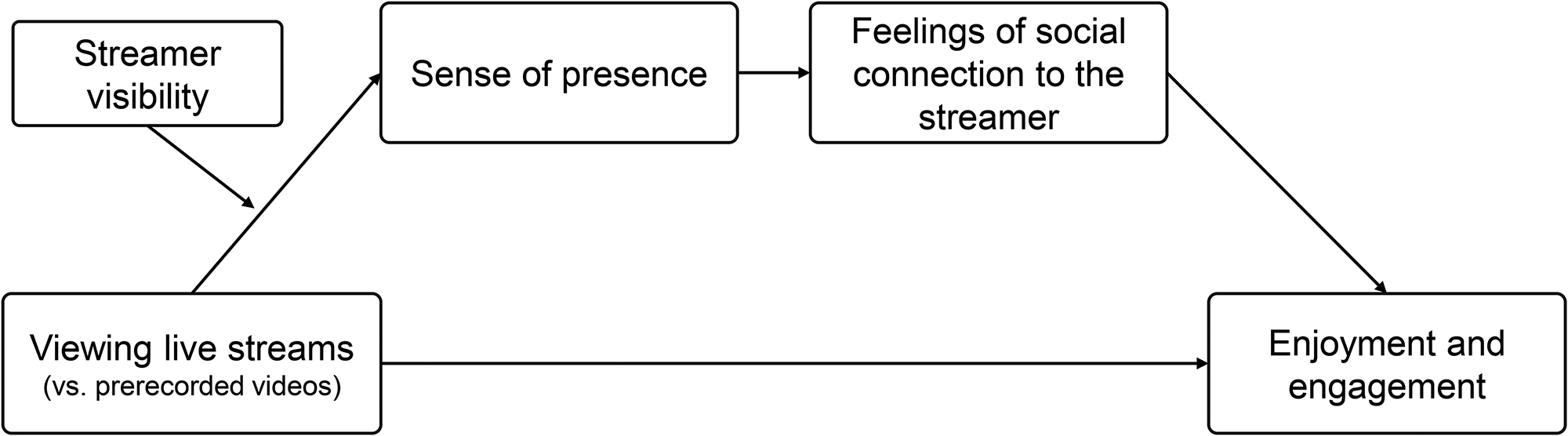
Conceptual Model.
Overview of Experiments
Across five experiments, we examine how watching live (vs. prerecorded) videos impacts viewing experiences. Experiment 1 tests the effects of watching live videos on social connection and enjoyment in a naturalistic setting. Participants in this experiment engage in the same viewing experience that millions of people engage in every day by watching real live and prerecorded videos of their choosing on Twitch, one of the world's most popular live-streaming platforms. Through a collaboration with a major video streaming band, Experiment 2 introduces a tightly controlled paradigm to isolate the effect of mere liveness by ensuring that all participants view identical content while manipulating only their belief about whether the video is live or prerecorded. The experiment also distinguishes the mere liveness effect from the effect of indeterminacy. Experiments 3a and 3b build on this design by disentangling the effect of watching live content from the effect of having salient simultaneous viewers. These experiments also investigate the mediating role of presence in driving viewers’ feelings of connection toward the streamer. Finally, Experiment 4 tests a theoretically and practically relevant boundary condition: whether the positive effects of liveness depend on the visibility of the streamer.
Across these experiments, we examine how the mere liveness effect may create a liveness lift. We investigate downstream consequences of live viewing including viewers’ enjoyment of the experience (Experiments 1 and 2), their willingness to continue watching the video (Experiments 3a, 3b, and 4), and a range of consequential engagement intentions (following the streamer on social media, subscribing to their channel, joining their fan community, and watching more of their content; Experiments 2, 3a, and 3b). All data, code, materials, and preregistrations 3 are available on OSF (https://osf.io/h6sd2/overview?view_only=053a47273d614c97b92724c3f9e5ca12).
Experiment 1: Viewing Live Streams on Twitch
Experiment 1 examines consumers’ real-world viewing experiences on Twitch, one of the largest live streaming platforms in the world, with 30 million daily active users (Shewale 2024). Participants are randomly assigned to watch either a live stream or prerecorded video on Twitch's music channel, one of the most popular on the platform. Participants in both conditions watch videos with very similar content (all prerecorded videos were originally streamed live) and quality (videos in both conditions are ordered according to view count). Most importantly, although participants are free to choose their own videos, our key variable of interest—whether the videos are live or prerecorded—is manipulated between subjects.
Method
Participants and design
Six hundred thirty-four Amazon Mechanical Turk participants (46.1% female, 52.7% male, .8% other, .5% prefer not to say; Mage = 40.19 years) completed the experiment in exchange for monetary compensation. Participants in Experiment 1 were randomly assigned to a stream-mode condition (live, prerecorded) in a between-subjects design.
Procedure
Participants in both conditions were told that they would be watching a short video on Twitch. Participants in the live condition followed a link to the “Live” page of the Twitch music channel, where all of the available video options were currently streaming live. Participants in the prerecorded condition followed a link to the “Videos” page of the same channel, where previously live videos (streamed during the preceding week) remain available for on-demand viewing. Thus, all participants were shown videos with similar content and quality; the only consistent difference between conditions was whether the viewing options were currently live (live condition) versus previously live (prerecorded condition).
Participants could choose to watch any video they wanted on the linked page, where videos were organized based on view count, with the most popular videos being featured first. Participants were instructed to watch the video of their choice for 1–2 minutes, 4 then return to the survey to provide feedback on their viewing experience.
After watching the video, participants responded to a two-item measure of enjoyment (“How much did you enjoy watching the video?” and “How excited were you while watching this video?”; α = .88) and a three-item measure of social connection (“To what extent did you feel like watching this video was a shared experience?,” “How connected did you feel while watching the video?,” and “How alone did you feel while watching the video?” (reverse-coded); α = .81). All responses were measured on 100-point Likert scales.
Results
All effects were tested using a one-way ANOVA with stream mode (live vs. prerecorded) as a between-subjects factor.
Social connection
As predicted, participants who watched live streams felt more socially connected (M = 56.67, SD = 27.71) than participants who watched prerecorded videos (M = 49.61, SD = 27.71; F(1, 632) = 10.28, p = .001, η2 = .016).
Enjoyment
Participants who watched live streams also enjoyed the experience more (M = 48.76, SD = 28.39) than participants who watched prerecorded videos (M = 43.53, SD = 29.03; F(1, 632) = 5.26, p = .022, η2 = .008). A bootstrap mediation analysis (10,000 samples; PROCESS Model 4) revealed that the effect of stream mode on enjoyment was mediated by social connection (indirect effect = 4.365, SE = 1.376; 95% CI: [1.696, 7.062]).
Discussion
Experiment 1 provides evidence from a real-world viewing platform that watching live streams (vs. equivalent prerecorded videos) predicts enhanced feelings of social connection and enjoyment. This experiment was designed to be high in mundane realism and ecological validity. Participants watched real videos on the popular video-streaming platform Twitch, just as millions of people do every day. One downside of studying experiences in this naturalistic setting was that we could not precisely control what videos people chose to watch. Although we have no reason to suspect that the content selected by participants in the live condition was inherently more connecting or enjoyable than the content in the prerecorded condition—in fact, view count data indicate that the video options in the prerecorded condition were more popular than those in the live condition—the design of Experiment 1 cannot rule out this possibility. We address this concern in our next experiment.
Experiment 2: Viewing Live Streams, Controlling for Video Content and Quality
The primary goal of Experiment 2 was to further test the findings from Experiment 1 using a more controlled experimental design in which all participants watch identical content. To combine the realism of Experiment 1 with the control required to accomplish our goals, we partnered with an R&B cover band, which allowed us to compare identical live and prerecorded video streams and investigate the effect of stream mode on viewers’ experiences. Participants in this two-part study were randomly assigned to watch the exact same video either live as it happened (on YouTube Live) or prerecorded the day after it was performed (on YouTube).
Experiment 2 also examines whether the effects of watching live streams on social connection and enjoyment vary as a function of indeterminacy. Prior research has highlighted the importance of indeterminacy in driving expected enjoyment of live television (Vosgerau, Wertenbroch, and Carmon 2006) and of suspense in driving viewer retention during live esports matches (Simonov, Ursu, and Zheng 2023). The present research investigates a novel route by which live content may enhance enjoyment: through social connection. Theoretically, this mechanism operates independently of indeterminacy or suspense. To test this prediction, Experiment 2 included an indeterminacy manipulation modeled after prior research: Participants were told either that the events in the video had been practiced and planned in advance or that they were spontaneous and unplanned (Vosgerau, Wertenbroch, and Carmon 2006). According to our theory, the effect of liveness on social connection and enjoyment should persist regardless of the indeterminacy of the events depicted in the video.
Finally, Experiment 2 further explores the source(s) of enhanced social connection from watching live streams. The defining feature of live streams is that they are live; they allow viewers to witness events and experiences in real time, as they occur. We theorize that liveness can enhance viewers’ connection to the streamers whose experiences they are viewing. In practice, watching live streams may also involve heightened awareness of other simultaneous viewers; for example, the real-world platform that we use to deliver our study stimuli—YouTube—displays a dynamic viewer count and chat box for live streams, but not for prerecorded videos. Thus, it is reasonable that these platform features could enhance viewers’ connection to other viewers. In Experiment 2, we test this possibility by including separate (exploratory) measures for social connection to the streamer and to other viewers.
Method
Participants and design
Nine hundred seventy-four Prolific participants were recruited in part 1 of the experiment, and 662 participants (68.0%) returned to complete part 2 in exchange for monetary compensation (55.6% female, 43.2% male, .9% other, .3% prefer not to say; Mage = 34.92 years). Participants were randomly assigned to condition in a 2 (stream mode: live, prerecorded) × 2 (event indeterminacy: determinate, indeterminate) between-subjects design.
Procedure
The experiment was conducted in collaboration with Sunny and the Black Pack, a popular R&B band which streams regularly to its 50,000+ followers on YouTube, Reddit, Twitch, Facebook and Instagram. The band agreed to stream one of their live musical performances at a specific time on YouTube’s “Live” page and to make the video of the live stream available to us the following day on YouTube. This allowed participants to watch the exact same video in the live and prerecorded conditions, and to do so in a real-world viewing environment.
The experiment was conducted in two parts. In part 1, participants were recruited for the study and randomly assigned to return within a specified time window during the following week. Participants were not informed of their assigned stream mode at this stage; they were simply instructed to return and watch a special broadcast at either 1:30 p.m. the following Monday (live condition) or 1:30 p.m. the following Tuesday (prerecorded condition). This two-part study design enabled us to recruit all participants at the same time (for part 1), while also randomly assigning participants to watch the exact same video either live or prerecorded (in part 2). In part 2 of the study, participants watched part of a musical performance by Sunny and the Black Pack. The band streamed live on YouTube from 1:30–4:00 p.m. on Monday, and the rebroadcast was available during the same times on Tuesday. Accordingly, participants could only complete part 2 of the study during these time windows. 5
Prior to watching the performance, participants were randomly assigned to one of two event indeterminacy conditions. Following Vosgerau, Wertenbroch, and Carmon (2006), participants in the determinate condition were told that almost everything in the video had been planned in advance, whereas participants in the indeterminate condition were told that almost everything in the video was spontaneous and had not been planned in advance. Participants then followed a link to a real video on YouTube (see Figure 2). Participants in the live condition watched Sunny and the Black Pack perform their music live between 1:30 and 4:00 p.m. on Monday, whereas those in the prerecorded condition watched the exact same video content during the same time window on the following day, after the live stream had ended. 6

Screenshot of Sunny and the Black Pack's Video, Experiment 2.
All participants were instructed to watch the video for at least one minute before returning to the study to report on their viewing experience. 7 After watching the video, participants responded to measures assessing the extent to which they felt connected to the streamer (“How close did you feel to Sunny, the lead singer in the video while watching it?” and “How connected did you feel to Sunny, the lead singer in the video while watching it?”; α = .95), and the extent to which they felt connected to other viewers (“How close did you feel to other viewers while watching this video?” and “How connected did you feel to other viewers while watching this video?”; α = .96). They also reported their enjoyment (α = .89) using the same items as in Experiment 1, as well as their engagement intentions (“How likely are you to subscribe to Sunny and the Black Pack's YouTube channel?” and “How interested are you in following Sunny and the Black Pack on social media?”; α = .93). Participants also responded to a six-item scale measuring their perceived indeterminacy of the video (e.g., “The events in the video developed spontaneously,” “No one in the video knew what was going to happen”; α = .88; see the Web Appendix). All responses in this study were measured on 100-point scales. Participants perceived the events as more indeterminate in the indeterminate condition (M = 61.64, SD = 22.59) than in the determinate condition (M = 26.50, SD = 18.38; F(1, 658) = 486.52, p < .001) and there was no effect of stream mode (F(1, 658) = .168, p = .682).
Results
All effects were tested using a two-way ANOVA with stream mode (live vs. prerecorded) and event indeterminacy (determinate vs. indeterminate) as between-subjects factors.
Social connection
The difference in social connection to the streamer between the live and prerecorded conditions was not statistically significant (F(1, 658) = 2.33, p = .128, η2 = .004). However, the result was directionally consistent with the theorizing, with participants in the live condition reporting higher connection (M = 51.34, SD = 28.54) than those in the prerecorded condition (M = 48.02, SD = 27.60). There was no effect of event indeterminacy (F(1, 658) = .45, p = .503) on connection to the streamer, and no significant interaction (F(1, 658) = .49, p = .484).
Participants who watched the video live felt more socially connected to other viewers (M = 41.12, SD = 27.82) than those who watched the video prerecorded (M = 28.70, SD = 25.03; F(1, 658) = 36.32, p < .001, η2 = .052). There was no effect of event indeterminacy on connection to other viewers (F(1, 658) = .08, p = .783), and no significant interaction (F(1, 658) = 3.18, p = .075).
Enjoyment
Participants who watched the video live enjoyed it more (M = 57.15, SD = 27.49) than participants who watched the same video prerecorded (M = 51.76, SD = 25.91; F(1, 658) = 6.69, p = .010, η2 = .010). There was no effect of event indeterminacy on enjoyment (F(1, 658) = .00, p = .982), nor was there a significant stream mode × event indeterminacy interaction (F(1, 658) = .09, p = .766). Planned contrasts revealed that the effect of stream mode was significant in the determinate condition (Mlive = 57.49, SD = 28.26; Mpre = 51.48, SD = 25.97; F(1, 658) = 4.16, p = .042, η2 = .006) and marginally significant in the indeterminate condition (Mlive = 56.82, SD = 26.79; Mpre = 52.05, SD = 25.92; F(1, 658) = 2.62, p = .106, η2 = .004). A bootstrap parallel mediation analysis (10,000 samples; PROCESS Model 4) revealed that the effect of stream mode on enjoyment was mediated by feelings of social connection to other viewers (indirect effect = 1.420, SE = .489; 95% CI: [.538, 2.476]), and not by feelings of connection to the streamer (indirect effect = 2.291, SE = 1.505; 95% CI: [−.616, 5.218]).
Engagement intentions
Participants were marginally more likely to follow the band on social media when they watched them perform live (M = 33.82, SD = 30.89) than prerecorded (M = 29.56, SD = 29.14; F(1, 658) = 3.39, p = .066, η2 = .005). There was also a marginally significant effect of indeterminacy, such that participants in the determinate condition reported a greater willingness to follow the band (M = 33.96, SD = 31.69) than participants in the indeterminate condition (M = 29.60, SD = 28.34; F(1, 658) = 3.43, p = .065, η2 = .005). The interaction was not significant (F(1, 658) = .69, p = .406). A bootstrap parallel mediation analysis (10,000 samples; PROCESS Model 4) revealed that the effect of stream mode on engagement was mediated by connection to other viewers (indirect effect = 2.636, SE = .808; 95% CI: [1.213, 4.352]), and not by connection to the streamer (indirect effect = 1.956, SE = 1.274; 95% CI: [−.548, 4.472]).
Discussion
Experiment 2 provides further evidence that viewing live (vs. prerecorded) online videos enhances feelings of social connection and increases enjoyment and engagement intentions during actual viewing experiences. These effects operate independently of indeterminacy, which has been shown in prior research to drive viewers’ expected excitement of live broadcast television (Vosgerau, Wertenbroch, and Carmon 2006). In Experiment 2, participants watching live content felt more connected and enjoyed the experience more, even when the events were known to be determined in advance. These results provide evidence of a previously untested alternative pathway by which liveness may enhance enjoyment: not by capitalizing on uncertainty and suspense, but by fostering a sense of connection.
Experiment 2 also offered improved experimental control (participants watched the exact same content either live or prerecorded) while still preserving ecological validity (participants watched a real performance by a real band on a major video-streaming platform). Interestingly, the socially connecting benefits observed in this experiment stemmed from connection to other simultaneous viewers, but they did not reach significance for connection to the streamer. We conjecture that this may be due in part to design features on YouTube’s Live page, such as view counters and chat boxes, that increase the salience of other viewers when people watch content live. Though the effects of these design features are obviously important, we note that they are conceptually distinct from the effects of liveness, or real-time viewing. In addition, watching experiences with other viewers is not unique to live streaming. For example, platforms like Netflix, Hulu, and YouTube offer synchronous coviewing modes that allow users to watch prerecorded content simultaneously with other remote users. Since our theory focuses on the effect of real-time viewing on social connection, we designed our next two experiments to isolate this effect by leveraging some of the coviewing features mentioned previously to hold the salience of other simultaneous viewers constant across stream modes.
Experiments 3a and 3b: Viewing Live Streams, Controlling for the Salience of Other Viewers
We designed experiments 3a and 3b to further isolate the experiential consequences of liveness itself and test whether the most essential feature of live viewing (i.e., watching events unfold in real time) can enhance social connection and engagement. To achieve this, we utilize a novel viewing platform, developed for the purposes of this research, that allows us to hold all features of the viewing environment constant across stream-mode conditions. Most notably, we include a view counter showing the number of simultaneous viewers currently watching the video and program this counter to be identical in the live and prerecorded conditions. Experiment 3a holds the number of other viewers constant across conditions, whereas Experiment 3b manipulates the number of simultaneous viewers to examine the robustness of the liveness effect across audiences of different sizes. Our viewing platform also controls for all other potential differences that could have emerged from participants viewing content directly on Twitch or YouTube (e.g., a chat), while still maintaining experimental realism. Under these conditions, we expected to find that watching content live will enhance social connection to the streamer, but not to other viewers.
These experiments also test our hypothesized mechanism for the effect of liveness: viewers’ subjective sense of presence in the events on the other side of the screen. We predicted that when viewers believe a broadcast is live (vs. prerecorded), they will feel more present in the world on the other side of the screen, and this greater sense of “being there” will facilitate feelings of connection to the streamer. In essence, we suggest that a heightened sense of presence will make viewers feel more like they are sharing streamers’ experiences, not just observing them.
Finally, Experiments 3a and 3b build on the previous enjoyment and engagement intention measures by also examining viewers’ consequential consumption choices. After watching their video, participants are given the opportunity to continue watching more of the same video or to switch to a completely different viewing experience. We predicted that viewers will be more likely to continue watching live streams than prerecorded videos.
Experiment 3a Method
Participants and design
The experiment was conducted in two parts. Five hundred ninety-five participants were recruited on Prolific in part 1 of the experiment, with 398 participants (66.9%) returning to complete part 2 the following day in exchange for monetary compensation (49.0% female, 49.5% male, 1.3% other, .3% prefer not to say; Mage = 39.64 years). Participants were randomly assigned to a stream-mode condition (live, prerecorded) during part 2 in a between-subjects design.
Procedure
Experiment 3a used a two-part design similar to that of Experiment 2. In part 1, we recruited active users of live-streaming technologies (i.e., participants who watch live streams at least once a month) and instructed them to return the following day to watch a “special broadcast” and complete the study. In part 2 (the next day), participants were informed that the video they were about to watch is by a pop artist called Lena Carter. Participants were randomly assigned to one of the two stream-mode conditions. Participants in the live condition were told that the video would be streaming live, and that everything they are about to see is happening right now. In contrast, participants in the prerecorded condition read that the broadcast was a recorded video, and that everything they are about to see was recorded in advance and had already occurred. The live and prerecorded videos were matched clips from the same segment of the song “Tonight,” featuring close-ups of the artist singing for 57 seconds.
Next, participants were automatically directed to the viewing platform to watch the musician. On the viewing platform, the prerecorded video appeared with no additional features. For the live video, a small live icon—modeled after YouTube’s “live” icon—appeared whenever participants hovered over the video with the mouse (a design feature that mimics the live icon on video-streaming platforms like YouTube and Twitch; Figure 3, element 1). Additionally, a video progression marker appeared at the end of the time bar, indicating that it was impossible to fast-forward the video because it was streaming live in that moment (Figure 3, element 2). The video interface also displayed the current date in the bottom left corner (Figure 3, element 3), further reinforcing that the content was being streamed in real time.
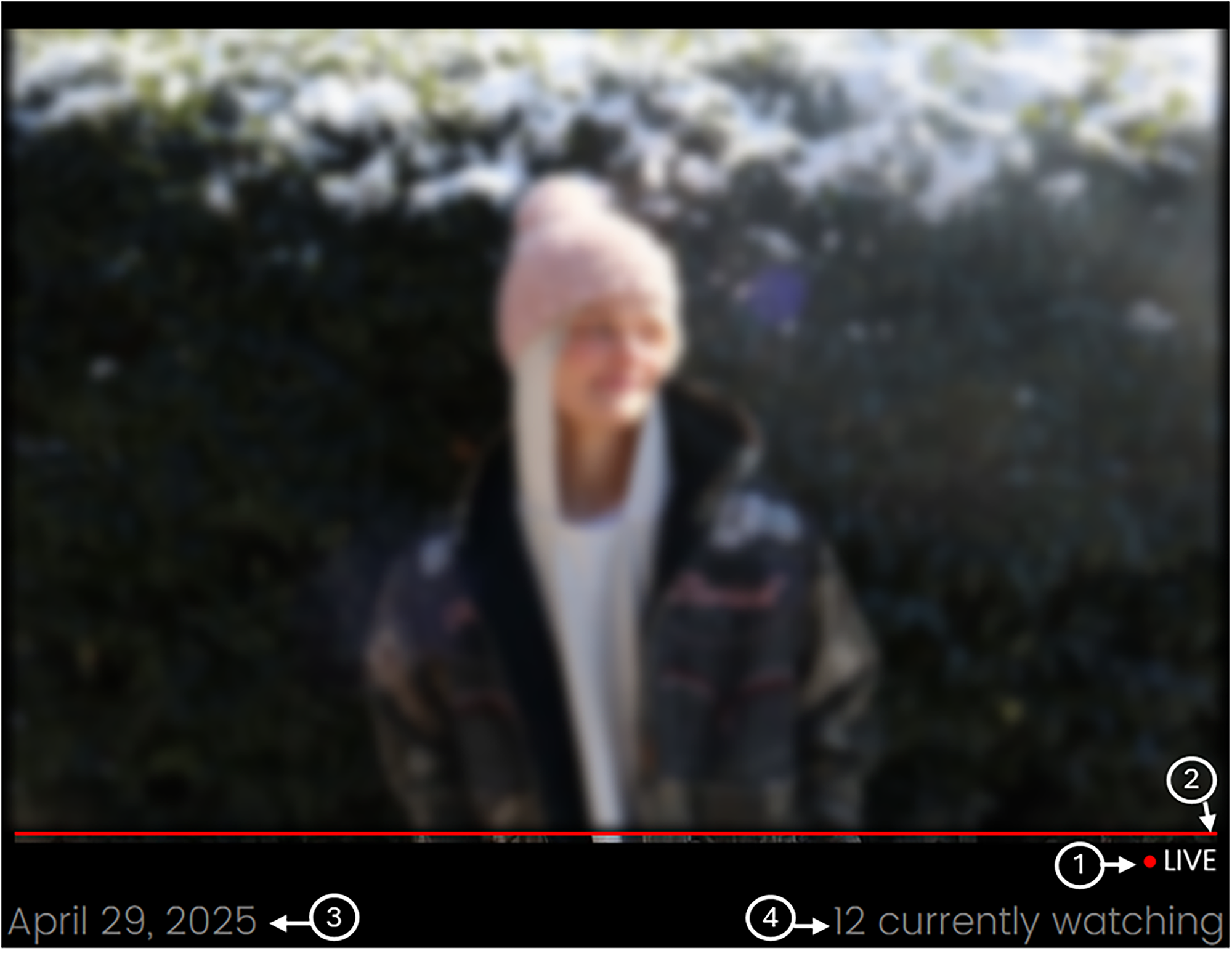
Screenshot of the Live Stream Condition, Experiment 3a.
To hold the salience of other simultaneous viewers constant across conditions, the viewing platform also included a view counter below the video, which was modeled after the Twitch view counter (Figure 3, element 4). The view counter noted the number of people who were “watching now,” with the number changing periodically to indicate between 8 and 12 current viewers throughout the duration of the video. At any point in the video, the view counter indicated the same number of current viewers in both stream-mode conditions.
After watching the video, participants reported their feelings of social connection toward the streamer (α = .97) using the same items as in Experiment 2. They also reported their feelings of social connection toward other viewers (α = .98), though we did not predict significant differences on this measure. Next, we assessed consequential postviewing consumption choices. Participants learned that they would “spend two more minutes watching another short video” at the end of the study and were told “you may choose to continue watching the video you just watched, or you may watch a two-minute clip from the Simpsons.” Participants indicated their choice on a scale ranging from 1 (“Definitely watch a short clip from an old episode of The Simpsons”) to 7 (“Definitely return to the [stream/video] I just watched”). Participants also completed several measures to capture their intentions to engage further with the streamer: their willingness to (1) watch more videos by the streamer, (2) join the streamer's fan community, (3) follow the streamer on social media, and (4) subscribe to the streamer's channel (α = .97).
Finally, to test our proposed underlying mechanism, participants indicated the extent to which they felt present in the world on the other side of the screen by responding to a three-item presence scale (adapted from Usoh et al. [2000]). Participants were asked, “While watching the video, which was strongest on the whole, your sense of being in the event, or of being elsewhere?,” “While watching the video, how often did it feel like reality for you?,” and “When you think back on your experience, do you think of it more like images that you saw, or more as an event you attended?”; α = .89). All responses in this study were measured on seven-point scales.
Experiment 3a Results
All effects were tested using a one-way ANOVA with stream mode (live vs. prerecorded) as a between-subjects factor.
Social connection
Participants who believed the video was streaming live felt more connected to the streamer (M = 4.90, SD = 1.66) than those who watched the prerecorded video (M = 4.18, SD = 2.04; F(1, 396) = 14.82, p < .001, η2 = .036). In contrast to Experiment 2, stream mode did not affect viewers’ connection to other viewers, when the salience of other viewers was held constant (Mlive = 3.62, SD = 2.03; Mpre = 3.34, SD = 2.11; F(1, 396) = 1.83, p = .177).
Consequential viewing choice
Participants who believed the video was streaming live reported a greater willingness to continue watching the video (M = 4.71, SD = 2.55) than participants who watched the prerecorded video (M = 4.06, SD = 2.65; F(1, 396) = 6.23, p = .013, η2 = .015). A bootstrap mediation analysis (10,000 samples; PROCESS Model 4) revealed that the effect of stream mode was mediated by viewers’ feelings of social connection toward the streamer (indirect effect = .539, SE = .142; 95% CI: [.262, .823]).
Engagement intentions
Participants who believed the video was streaming live also reported a greater willingness to engage further with the streamer (M = 4.36, SD = 2.05) than participants who watched the prerecorded video (M = 3.59, SD = 2.20; F(1, 396) = 13.22, p < .001, η2 = .032). A bootstrap mediation analysis (10,000 samples; PROCESS Model 4) similarly revealed that the effect of stream mode was mediated by viewers’ feelings of social connection toward the streamer (indirect effect = .666, SE = .169; 95% CI: [.334, 1.000]).
Presence
Participants reported a greater sense of presence when they believed they were watching the video live (M = 5.19, SD = 1.55) versus prerecorded (M = 4.17, SD = 1.84; F(1, 396) = 35.59, p < .001, η2 = .082). A serial mediation analysis (10,000 samples; PROCESS Model 6; stream mode → presence → social connection → engagement) revealed that presence mediated the effect of stream mode on social connection to the streamer and subsequent engagement (consequential viewing choice: indirect effect = .588, SE = .133; 95% CI: [.345, .866]; engagement intentions: indirect effect = .609, SE = .116; 95% CI: [.394, .849]).
Experiment 3b Method
Participants and design
Three hundred ninety-five Prolific participants (50.4% female, 48.1% male, 1.5% other; Mage = 41.07 years) completed the experiment in exchange for monetary compensation. Participants were randomly assigned to condition in a 2 (stream mode: live, prerecorded) × 4 (simultaneous other viewers: 0, ∼10, ∼100, ∼1,000) between-subjects design.
Procedure
The study followed a similar design to Experiment 3a. All participants watched the same song segment from a pop artist, with participants in the live condition being told that the video was streaming live, and participants in the prerecorded condition being told that the video had been recorded previously.
The number of simultaneous other viewers was manipulated by changing the view counter that appeared below the video (see Figure 3). As in Experiment 3a, the view counter noting the number of people who were “watching now” varied periodically throughout the duration of the video. In the ∼1,000 (∼100; ∼10) other viewers condition, the view counter fluctuated every 6 seconds indicating that 997, 999, 1,001, 1,003, 1,001, 1,003, 998, 996, 999, 1,000 (99, 98, 99, 100, 102, 103, 101, 99, 99, 100; 9, 9, 10, 11, 12, 12, 10, 10, 9, 8) other viewers were currently watching the video. In the 0 other viewers condition, the view counter always indicated that only one person (i.e., the participant) was currently watching the video.
After watching the video, participants reported their feeling of social connection to the streamer (α = .97), their postviewing choice, their willingness to continue engaging with the streamer (α = .97), and their sense of presence (α = .87), using the same items as in Experiment 3a.
Experiment 3b Results
All effects were tested using a two-way ANOVA with stream mode (live vs. prerecorded) and simultaneous viewers (0, ∼10, ∼100, ∼1,000) as between-subjects factors.
Social connection
Participants felt more socially connected to the streamer when they believed the video was streaming live (M = 4.92, SD = 1.58) than when it was prerecorded (M = 4.00, SD = 2.00; F(1, 387) = 26.21, p < .001, η2 = .063). The results also revealed a significant effect of simultaneous viewers (F(3, 387) = 2.99, p = .031, η2 = .023), such that viewers felt most connected to the streamer when no other viewers were watching (M = 4.90, SD = 1.89), followed by the ∼100 other viewers (M = 4.47, SD = 1.81), ∼10 other viewers (M = 4.27, SD = 1.89), and ∼1,000 other viewers (M = 4.23, SD = 1.80) conditions. Importantly, there was no significant stream mode × simultaneous viewers interaction (F(3, 387) = .37, p = .778).
Planned simple contrasts revealed that watching the live (vs. prerecorded) video significantly increased viewers’ feelings of connection to the streamer even in the presence of ∼1,000 other viewers (F(1, 387) = 7.93, p = .005, η2 = .020), ∼100 other viewers (F(1, 387) = 10.57, p = .001, η2 = .027), and ∼10 other viewers (F(1, 387) = 5.39, p = .021, η2 = .014). The effect was marginally significant when viewers watched the video alone (F(1, 387) = 3.43, p = .065, η2 = .009).
Consequential viewing choice
Participants who believed the video was streaming live were more likely to choose to continue watching it rather than switch to a different video (M = 5.19, SD = 2.27) compared with those who believed it was prerecorded (M = 3.59, SD = 2.65; F(1, 387) = 40.19, p < .001, η2 = .094). There was no significant main effect of the number of other viewers on postviewing choice (F(3, 387) = 1.35, p = .258) and no significant stream mode × simultaneous viewers interaction (F(3, 387) = 1.06, p = .367).
Planned simple contrasts revealed that watching the live (vs. prerecorded) video significantly increased postviewing choice behavior even in the presence of ∼1,000 other viewers (F(1, 387) = 12.17, p < .001, η2 = .030), ∼100 other viewers (F(1, 387) = 18.51, p < .001, η2 = .046), and ∼10 other viewers (F(1, 387) = 9.46, p = .002, η2 = .024). The effect was marginally significant when viewers watched the video alone (F(1, 387) = 3.31, p = .070, η2 = .008). A bootstrap mediation analysis (10,000 samples; PROCESS Model 4) revealed that the effect of stream mode was mediated by feelings of social connection toward the streamer (indirect effect = .732, SE = .154; 95% CI: [.440, 1.048]).
Engagement intentions
Participants who believed the video was streaming live reported a greater willingness to engage further with the streamer (M = 4.11, SD = 1.98) than those who watched the prerecorded video (M = 3.30, SD = 2.14; F(1, 387) = 15.31, p < .001, η2 = .038). The results also revealed a significant effect of the number of other simultaneous viewers (F(3, 387) = 4.84, p = .003, η2 = .036). Engagement intentions were highest in the 0 other viewers condition (M = 4.38, SD = 2.22), followed by ∼100 other viewers (M = 3.56, SD = 1.99) and ∼10 other viewers (M = 3.51, SD = 2.17), and lowest in the ∼1,000 other viewers condition (M = 3.39, SD = 1.88). Importantly, there was no significant stream mode × simultaneous viewers interaction (F(3, 387) = .54, p = .653).
Planned simple contrasts revealed that watching the live (vs. prerecorded) video significantly increased engagement intentions in the presence of ∼1,000 other viewers (F(1, 387) = 4.02, p = .046, η2 = .010) and in the presence of ∼100 other viewers (F(1, 387) = 8.56, p = .004, η2 = .022). The effect was marginally significant in the presence of ∼10 other viewers (F(1, 387) = 3.15, p = .077, η2 = .008) and nonsignificant, though directionally positive, in the 0 other viewers condition (F(1, 387) = 1.28, p = .260, η2 = .003). A bootstrap mediation analysis (10,000 samples; PROCESS Model 4) revealed that the effect of stream mode was mediated by connection toward the streamer (indirect effect = .854, SE = .170; 95% CI: [.521, 1.186]).
Presence
Participants who believed the video was streaming live reported a stronger sense of presence in the world on the other side of their screen (M = 5.16, SD = 1.54) than those who watched the prerecorded video (M = 4.05, SD = 1.83; F(1, 387) = 44.50, p < .001, η2 = .103). The results also revealed a significant effect of the number of other simultaneous viewers on presence (F(3, 387) = 4.15, p = .006, η2 = .031). Presence was highest in the 0 other viewers condition (M = 5.07, SD = 1.56), followed by ∼10 other viewers (M = 4.57, SD = 1.81), ∼100 other viewers (M = 4.52, SD = 1.80), and ∼1,000 other viewers (M = 4.27, SD = 1.86). Importantly, there was no significant stream mode × simultaneous viewers interaction (F(3, 387) = 1.23, p = .299).
Planned simple contrasts revealed that watching the live (vs. prerecorded) video significantly increased feelings of presence even in the presence of ∼1,000 other viewers (F(1, 387) = 9.50, p = .002, η2 = .024), ∼100 other viewers (F(1, 387) = 24.24, p < .001, η2 = .059), and ∼10 other viewers (F(1, 387) = 9.54, p = .002, η2 = .024), and 0 other viewers (F(1, 387) = 5.13, p = .024, η2 = .013). Serial mediation analyses (10,000 samples; PROCESS Model 6; stream mode → presence → social connection → engagement) revealed that presence mediated the effect of stream mode on social connection to the streamer and subsequent engagement (consequential viewing choice: indirect effect = .469, SE = .120; 95% CI: [.258, .728]; engagement intentions: indirect effect = .656, SE = .115; 95% CI: [.440, .892]).
Experiments 3a and 3b Discussion
Experiments 3a and 3b isolate the effect of liveness on consumer experiences. Both experiments control for all features of the platform and hold the salience of other simultaneous viewers constant. Under these carefully controlled conditions, we find that watching content live enhances connection to the streamer and increases engagement.
Taken together with our previous results, these findings suggest that the positive effects of watching live streams on feelings of connection to other viewers are caused by differences in the salience of other viewers—not by liveness itself. When the number of simultaneous viewers was permitted to vary across conditions (in Experiment 2), viewing live streams caused people to feel more connected to other viewers; however, when the number of simultaneous viewers was held constant (in Experiment 3a), connection to other viewers was not sensitive to stream mode. These results also provide converging evidence that the effect of watching live streams on social connection to the streamer is caused by liveness itself, not by the salience of other viewers.
The findings from Experiments 3a and 3b also provide further insight into the underlying mechanism driving the effects of liveness on social connection and enjoyment. Consistent with our theorizing, participants who believed the video was streaming live felt more present in the events on the other side of the screen and, in turn, more connected to the person whose experience they were watching (i.e., the streamer).
Experiment 4: Streamer Visibility Moderates the Effect
Experiments 1–3b provided evidence that watching a live stream (vs. a prerecorded video) increases viewers’ feelings of connection to the streamer, and that this effect is mediated by heightened feelings of presence. In Experiment 4, we test a theoretically motivated moderator of this effect: the visibility of the streamer.
Building on prior research showing that rich visual information enhances presence by making it easier to mentally simulate and enter a mediated world (Nowak and Biocca 2003; Reeves et al. 1999), it follows that the presence-enhancing benefits of live streams will be attenuated when visual information about the streamer is limited. That is, because the streamer is the focal point of the live stream, their visibility plays a key role in helping viewers simulate the experience and feel “transported” into it. When this visual information is absent, it becomes harder to mentally construct the social environment, weakening the effect of liveness on presence and, ultimately, on social connection and its consequences. Experiment 4 tests this prediction by comparing the benefits of watching live (vs. prerecorded) videos when only the musician's hands on the keyboard were shown versus when the musician's face was prominently featured.
Method
Participants and design
Nine hundred forty-five Prolific participants (49.7% female, 49.5% male, .4% other, .3% prefer not to say; Mage = 40.20 years) took part in the study in exchange for monetary compensation. Participants were randomly assigned to condition in a 2 (stream mode: live, prerecorded) × 2 (streamer visibility: high, low) between-subjects design.
Procedure
The stream mode manipulation was identical to the previous two studies. In the high-streamer-visibility condition, participants watched the same videos of the pop artist used in Experiments 3a and 3b, prominently featuring the streamer's face while she sang. In the low-streamer-visibility condition, participants watched a video of the exact same section of the song being played on a keyboard, with only the musician's hands visible. To create this video, we hired a professional musician to record themselves playing the artist's song on a keyboard, with the video only showing the musician's hands (i.e., no face was in the video; see Figure 4). To ensure that the audio remained constant across conditions, we overlaid the new video (low visibility) with the original audio track from the high-visibility condition.
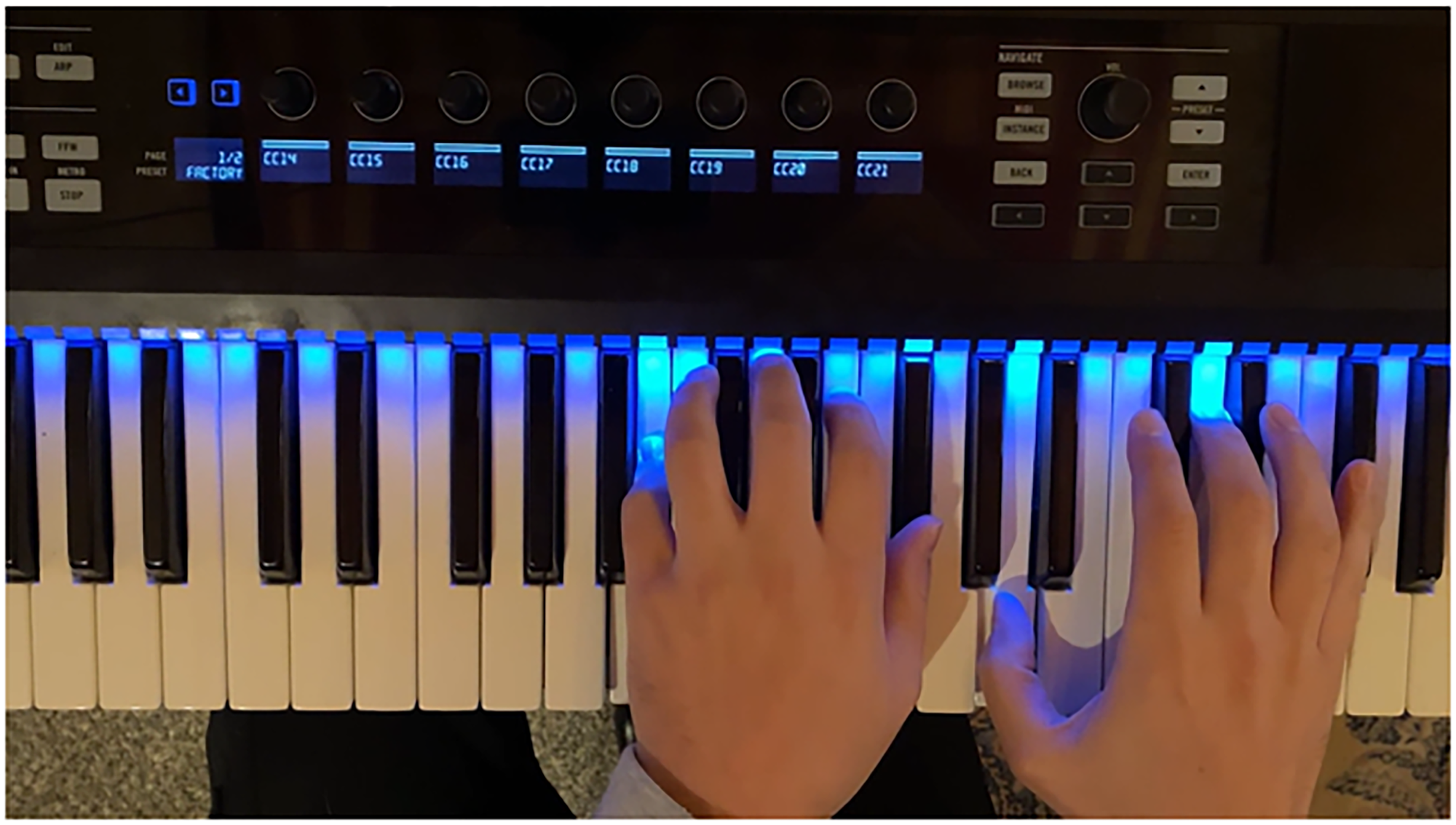
Screenshot of the Low Visibility Condition, Experiment 4.
After watching the video, participants reported their feeling of social connection to the streamer (α = .97), their postviewing choice, and their sense of presence (α = .87) using the same items as in Experiments 3a and 3b.
Results
All effects were tested using a two-way ANOVA with stream mode (live vs. prerecorded) and streamer visibility (high vs. low) as between-subjects factors.
Social connection
Participants felt more socially connected to the streamer when they believed the video was streaming live (M = 4.74, SD = 1.78) than when it was prerecorded (M = 4.20, SD = 1.96; F(1, 941) = 20.37, p < .001, η2 = .021). Importantly, this effect was qualified by a significant stream mode × streamer visibility interaction (F(1, 941) = 4.45, p = .035, η2 = .005). In the high-streamer-visibility condition, participants who watched the video live felt significantly more socially connected to the streamer (M = 4.94, SD = 1.69) than those who watched a prerecorded video (M = 4.13, SD = 2.01; F(1, 941) = 21.93, p < .001, η2 = .023). In contrast, in the low-streamer-visibility condition, the socially connecting benefits of liveness were reduced (Mlive = 4.59, SD = 1.83; Mpre = 4.30, SD = 1.89; F(1, 941) = 2.89, p = .089, η2 = .003; see Figure 5).
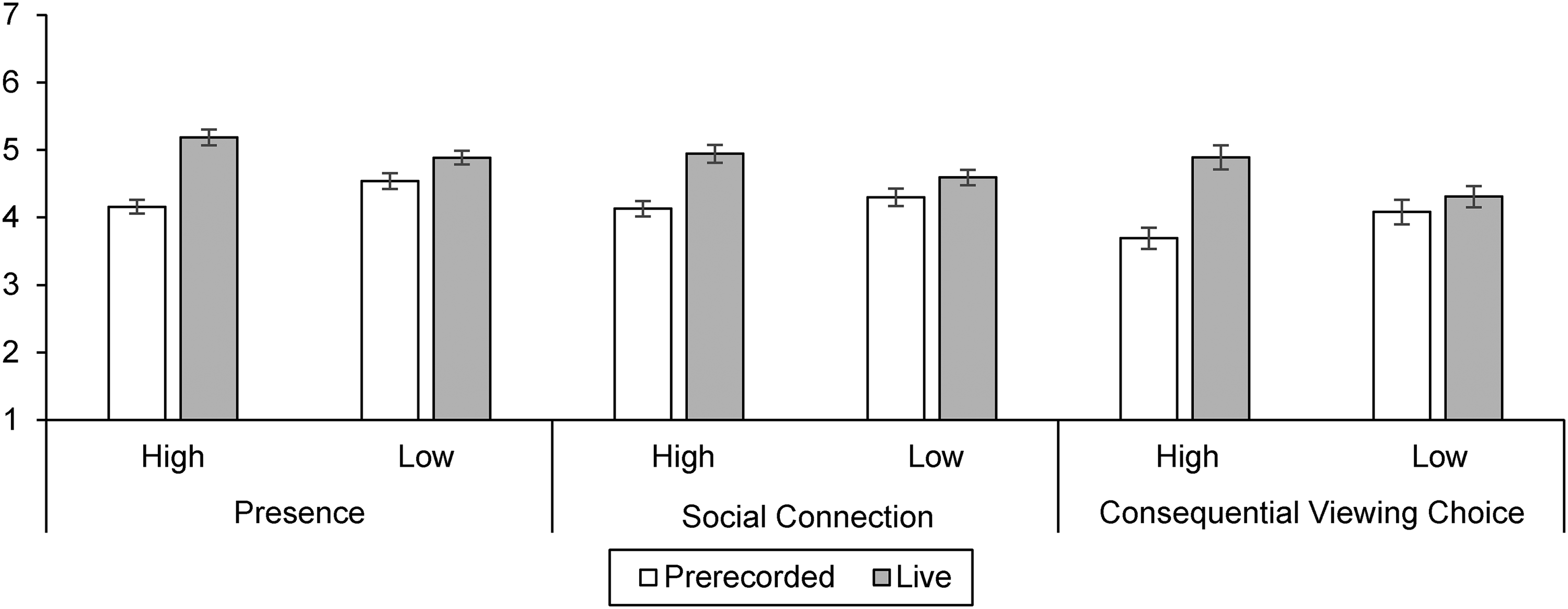
The Effects of Stream Mode and Streamer Visibility, Experiment 4.
Consequential viewing choice
Participants who believed the video was streaming live were more likely to choose to continue watching it than switch to a different video (M = 4.56, SD = 2.52) compared with those who believed it was prerecorded (M = 3.86, SD = 2.61; F(1, 941) = 17.97, p < .001, η2 = .019). Importantly, this effect was qualified by a significant stream mode × streamer visibility interaction (F(1, 941) = 8.32, p = .004, η2 = .009). In the high-streamer-visibility condition, participants were significantly more likely to choose to continue watching more of the video they had just watched when they thought it was streaming live (M = 4.89, SD = 2.46) than when they watched the video prerecorded (M = 3.69, SD = 2.61; F(1, 941) = 25.37, p < .001, η2 = .026). In contrast, in the low-streamer-visibility condition, the impact of liveness on postviewing choice was not significant (Mlive = 4.31, SD = 2.55; Mpre = 4.08, SD = 2.60; F(1, 941) = .92, p = .338, η2 = .001).
Presence
Participants who believed the video was streaming live reported a stronger sense of presence in the world on the other side of their screen (M = 5.01, SD = 1.58) than those who watched the prerecorded video (M = 4.32, SD = 1.76; F(1, 941) = 39.28, p < .001, η2 = .040). Importantly, this effect was qualified by a significant stream mode × streamer visibility interaction (F(1, 941) = 9.76, p = .002, η2 = .010). In the high-streamer-visibility condition, participants who watched the video live reported significantly greater presence (M = 5.19, SD = 1.46) than those who watched the prerecorded video (M = 4.16, SD = 1.78; F(1, 941) = 44.10, p < .001, η2 = .045). In the low-streamer-visibility condition, the impact of liveness on presence was attenuated (Mlive = 4.88, SD = 1.65; Mpre = 4.54, SD = 1.72; F(1, 941) = 4.94, p = .027, η2 = .005).
Moderated mediation
A bootstrap moderated mediation analysis (10,000 samples; PROCESS Model 8) revealed that the mediated effect of stream mode on viewers’ postviewing choice through social connection was significantly moderated by streamer visibility (moderated mediation index = .382, SE = .180, 95% CI: [.034,.728]). The indirect effect was significant in the high-streamer-visibility condition (indirect effect = .599, SE = .129, 95% CI: [.349, .852]), but not in the low-streamer-visibility condition (indirect effect = .218, SE = .128, 95% CI: [−.029, .472]).
A serial moderated mediation analysis (10,000 samples; PROCESS Model 85) revealed that the mediated effect of stream mode on postviewing choice through presence and social connection was moderated by streamer visibility (index of moderated mediation = .246, SE = .088, 95% CI: [.086, .432]). The serial indirect effect (stream mode → presence → social connection → engagement) was significant in the high-streamer-visibility condition (indirect effect = .370, SE = .080, 95% CI: [.225, .534]) and weaker, though still significant, in the low-streamer-visibility condition (indirect effect = .124, SE = .060, 95% CI: [.016, .251]).
Discussion
Experiment 4 tested a theoretically motivated boundary condition of the liveness effect: the visibility of the streamer. We observed that when viewers could clearly see a streamer's face, those who believed the video was live (vs. prerecorded) reported greater presence, felt more socially connected to the streamer, and were more likely to continue watching the video. However, these effects were significantly attenuated when the visibility of the streamer was limited (i.e., when only their hands were shown).
These findings support our theorized mechanism: Rich visual information about the streamer increases the degree to which liveness enhances social connection because it facilitates the experience of presence. When the streamer's face is visible, viewers can more easily simulate the important information about the world on the other side of the screen and can thus more easily transport themselves into this world. This experience of presence, in turn, facilitates feelings of social connection. When important visual information is missing, mentally constructing the social world on the other side of the screen is more difficult, and the effect of liveness on presence and social connection is weakened. We discuss potential practical implications of these findings for content creators and streamers next.
General Discussion
The current research examines how mere liveness can enhance feelings of social connection for viewers of online video streams. We study consumers’ viewing experiences of amateur music performances both on popular real-world streaming platforms (Experiments 1 and 2) and in carefully controlled environments (Experiments 3a, 3b, and 4) and consistently find that viewers of online live streams feel more socially connected than viewers of identical or equivalent prerecorded videos. Viewers of live streams feel more socially connected toward the streamer, whose content they are watching in real time (Experiments 1, 3a, 3b, and 4), as well as toward other viewers who are watching content at the same time as them (particularly when the salience of other viewers is enhanced through platform design features; Experiment 2). The socially connecting benefits of liveness operate independently of indeterminacy (Experiment 2) and persist across audiences of different sizes (Experiments 3a and 3b), providing evidence that liveness predicts feelings of social connection to streamers.
Our research also provides evidence that the enhanced social connection fostered by liveness creates a liveness lift, facilitating a variety of downstream evaluations, intentions, and behaviors with positive implications for streamers. Enhanced social connection underpins the higher levels of enjoyment experienced by viewers of live (vs. prerecorded) online video (Experiments 1 and 2). The feeling of social connection also motivates consumers’ willingness to watch more content by the streamer, follow and subscribe to their channels, and join fan communities after watching live videos (Experiments 2, 3a, and 3b). Critically, this motivation also carries over into real consequential choice: When choosing between watching more or switching to an unrelated viewing option, those who watched live videos were more likely to choose to continue watching the same content (Experiments 3a, 3b, 4).
Finally, our research identifies presence as a mechanism supporting the socially connecting benefits of live viewing. Watching events unfold in real time enhances viewers’ sense of “being there” in the world on the other side of the screen, which facilitates feelings of connection to the social entities who inhabit this world (Experiments 3a, 3b, and 4). Supporting this idea, Experiment 4 shows that the benefits of liveness are moderated by the provision of important visual detail—specifically, the visibility of the streamer. When viewers could clearly see the person on the other side of the screen, liveness significantly increased presence, which in turn led to enhanced social connection and engagement; however, when the visual representation of the streamer was limited (i.e., only their hands were shown), the benefits of liveness were significantly reduced.
Theoretical Contributions
These findings contribute to a nascent but rapidly growing body of research on live viewing experiences. Prior work has examined various factors that affect consumer behavior within live-streaming contexts, such as influencer characteristics and content production choices, audience size, and the role of suspense, arousal, and indeterminacy (see Table 1); however, no prior research has investigated the experiential consequences of liveness itself. To our knowledge, our research is the first to explore the effects of liveness on consumers’ real viewing experiences. We isolate mere liveness from other features commonly associated with live viewing (e.g., indeterminacy, the increased salience of other viewers) and find novel evidence that real-time viewing enhances feelings of social connection. Further, we show that this effect of liveness on experiences has downstream consequences for intentions and behavior.
Our work also contributes to research that investigates the nature of online social connection. Prior research has shown that simple platform features—such as user photos, presence indicators, and location cues—can shape people's perceptions of social presence, even in the absence of direct interaction (Rettie 2003; Riedl et al. 2013). We build on these findings by documenting a new and previously unexplored driver of social connection in virtual environments. Though live streams may not suffice to fulfill consumers’ needs for close, intimate relationships (e.g., Turkle 2011; Weiss and Schneider 2014), our findings suggest that simply knowing one is watching another's experience unfold live, in real time, can make viewers feel closer to those whose experiences they are watching.
Our findings also highlight the central importance of feelings of presence, or “being there” in consumers’ online experiences. Although digital technologies allow consumers to access an enormous variety of previously unavailable experiences, their true promise may lie in making these experiences feel real—subjectively transporting them to events and allowing them to feel as if they are really sharing in what unfolds on the other side of the screen. The importance of presence in virtual environments has received substantial attention in research on communications and virtual reality (Lombard and Ditton 1997; Usoh et al. 2000) and has more recently been identified by practitioners. For example, during Meta's launch event for its Metaverse, the words “presence” and “present” were mentioned 26 times in 90 minutes (CNET Highlights 2021). We believe that understanding the antecedents and consequences of consumers’ sense of presence will become increasingly important as consumers spend more of their time online and demand more from their technology-mediated experiences. Our research is among the first to introduce this construct to the marketing literature (see also Harz et al. 2022).
Practical Implications
We find that mere liveness creates a liveness lift, enhancing enjoyment of content and engagement with streamers and their channels. These results carry important practical implications for firms and marketing practitioners seeking to increase consumer engagement with their content and platforms. Given the vast assortment of content available today, failing to engage with users means that a platform cannot effectively advertise, sell products or services, or collect valuable data (Hilvert-Bruce et al. 2018). Thus, streaming platforms featuring amateur or creator-driven content may wish to capitalize on the liveness lift by encouraging streamers to produce live (vs. prerecorded) videos. Several platforms have already invested heavily in this approach: For instance, Meta paid more than $50 million to encourage streamers to produce live content when it launched Facebook Live (Seetharaman and Perlberg 2016).
Our findings also have important implications for producers of online content. In today's attention economy, the ability to engage viewers is critically important for content creators. Our research shows that viewers of live (vs. prerecorded) content are more likely to keep watching that content, as well as to follow, subscribe to, and join a streamer's fan community. These forms of engagement suggest that going live can help streamers foster sustained relationships with their audiences. Our research also provides some guidance for how content creators might maximize the benefits of liveness: by ensuring that streamers are clearly visible in their videos. We note that streamers in other content domains not investigated in our research already follow this practice; for example, many video game streamers use overlays or split-screen tools to show their facial reactions alongside their gameplay. Our findings may provide some psychological insight into the benefits of this practice: Seeing the streamer—especially their face—helps viewers feel more present in the moment and deepens their perceived connection to the streamer.
Finally, our findings have practical implications for consumers themselves. Consumers frequently use the internet to connect with others, and social motivations underlie a wide array of online behaviors (Riedl et al. 2013). The COVID-19 pandemic brought these motivations to the forefront, as people turned to technology to fulfill their social connection needs while social distancing and working remotely. In April 2020, viewers spent 3.93 billion hours watching live streams, nearly double the hours spent in April 2019 (Chase 2020). While the initial surge in live-streaming consumption may have been driven by pandemic-related restrictions, the trends observed during this period appear to be part of a larger, ongoing shift in consumer behavior (Twitch Tracker 2024). Our findings underscore one important explanation for the enduring relevance of these technologies in the postpandemic world: Simply knowing one is watching an event in real time can, at least in the moment, make viewers feel more connected.
Limitations
Our investigation of live streaming utilized the context of amateur musical performances on peer-to-peer platforms. We thus cannot make strong claims about the extent to which our findings will generalize to other types of content, other audience treatments, or other mediums. We elaborate on these limitations and their implications for theory and practice next.
Content type limitations
Because our research focused on amateur performers, we cannot say whether the effects of liveness on connection and engagement will generalize to more professionally produced content. Like many peer-to-peer streams, the videos in our studies conveyed a sense of intimacy and authenticity; in these settings, we found that feeling more present enhanced viewers’ feelings of connection to the streamer. It remains unclear, however, whether similar effects would emerge in contexts such as highly choreographed performances or professionally produced celebrity streams. To the extent that professional polish undermines the experiential qualities that support feelings of connection to amateur streamers, creators with access to high production quality may actually benefit from tempering that polish—for example, by using a personal smartphone (rather than professional cameras) or by streaming from home (rather than a studio). At the same time, creators operating in more formal or high-stakes environments could face reputational risk from prioritizing unvarnished authenticity over refined production. Indeed, the optimal balance between intimacy and polish will likely vary across content types, making it important for creators and platforms to calibrate production choices to their goals and audiences.
On the other end of the spectrum, it is also unclear whether the effects documented in our research will generalize to content domains that already convey high levels of personal intimacy. For example, when streamers broadcast their personal daily activities, liveness could produce competing effects. It is possible that the intimate nature of these streams could create a ceiling effect on connection; when content itself engenders strong feelings of connection, liveness may offer limited additional benefit. It is also possible that the mundaneness of this content heightens the salience of stream mode (mundane details from the past seem even more like “yesterday's news”), thereby amplifying differences between live and prerecorded viewing experiences. Taken together with our preceding discussion of the potential pitfalls of professionalism, these considerations suggest that practitioners should exercise caution when attempting to harness the benefits of liveness for content at either extreme of the intimacy spectrum.
For some types of content, the consequences of liveness may also depend on viewers’ goals. For example, “how-to” streams (e.g., cooking or DIY tutorials) may attract viewers whose primary motivation is to acquire new information or skills. To the extent that social connection is irrelevant for viewers with explicitly nonsocial motivations, it is possible that these viewers may not experience enhanced social connection when viewing live, or that increases in social connection will not have the same downstream effects on enjoyment and engagement. Streamers of skill-based content should thus consider the possibility that knowledge-focused viewers will not experience the same liveness lift documented in our studies.
Audience limitations
Our research provides preliminary evidence that audience factors can play an important role in the effects of liveness; specifically, we find that heightened salience of simultaneous viewers during live streaming can increase feelings of social connection to those viewers (Experiment 2). However, our research cannot speak to how different audience depictions and interactions may influence the effects we found. For example, we did not examine the role of direct exchanges between streamers and viewers (e.g., via chats, comments, tokens). It is straightforward to predict that viewers who directly interact with a streamer should experience increased feelings of connection to the streamer. However, the consequences of watching a streamer interact with other viewers are less clear; although these interactions could amplify perceptions of liveness and foster a sense of community, they may also leave some viewers feeling overlooked, thereby reducing the socially connecting benefits of live viewing. This limitation is particularly consequential as it suggests that actions streamers take to make viewers feel included could backfire by making others feel excluded. Content creators and platforms may therefore benefit from calibrating how prominently audience feedback is displayed, or from using features that enable streamers to respond to viewers privately, as well as publicly.
Relatedly, our studies did not examine streams where a physical in-person audience is visible on the other side of the screen (e.g., plays, concerts). Streamers of these sorts of events should consider the risk that remote viewers could compare their experience with that of the in-person audience, potentially dampening their own feelings of presence. Alternatively, an in-person audience could provide an additional source of connection for remote viewers, thereby strengthening the effects of liveness on social connection. Further investigation of these trade-offs can help inform editing and production decisions, allowing content creators to emphasize or downplay the in-person audience depending on whether they aim to heighten remote viewers’ sense of presence or foster a feeling of communal participation.
Medium limitations
Our exploration focused on online peer-to-peer live streams and cannot speak directly to the effects of liveness in traditional broadcast media such as live television. In addition to typically featuring high production value, live television frequently features suspenseful and unpredictable events (e.g., competitive gaming, sports, reality-style content)—a sharp contrast with the type of amateur content used in our studies. Although indeterminacy did not moderate the effects of live streaming in the contexts we investigated, we agree with prior research suggesting that indeterminacy may play a central role in shaping more suspenseful, or eventful, viewing experiences (Vosgerau, Wertenbroch, and Carmon 2006). Given these clear differences from our experimental context, further testing is critical before applying lessons from our research to broadcast television. We also do not expect that our findings will generalize to live radio; the reduced sensory richness of this (audio-only) medium may constrain viewers’ ability to imagine themselves in the mediated environment and limit the benefits of liveness in auditory experiences.
Presence measurement limitations
A core argument of our article is that liveness facilitates the experience of presence, which in turn allows for enhanced feelings of connection with social entities on the other side of the screen (e.g., streamers). We measured presence using the Slater–Usoh–Steed (Usoh et al. 2000) presence questionnaire, a self-report measure frequently used in communications and human–computer interaction research to capture the subjective sense of “being there” in technology-mediated environments. This measurement approach could be strengthened by incorporating more recent and comprehensive measures that complement and validate viewers’ self-reported evaluations. For example, the effect of presence could be further tested with physiological measures like heart rate and skin conductance (e.g., Slater et al. 2022), behavioral measures like physical reactions to on-screen events, and cognitive measures like recall and secondary-task response times (e.g., Campbell et al. 2021). In addition to providing confidence in self-reported experiences, these measures may also be inherently meaningful in contexts intended to arouse or educate.
Our measure of presence was also selected to match our theoretical focus on presence-as-transportation. However, we note that presence is a multifaceted construct that may also encompass factors such as the perceived realism of the mediated environment or the sensory immersion it affords. We did not measure these facets of presence and cannot make claims about them. The possibility that liveness also facilitates other facets of presence could have important implications for certain types of content creators. For example, presence-as-realism may be especially important in professionally produced live events, encouraging investment in high-quality visuals. In contrast, sensory immersion may be more critical in formats like virtual-reality streams, where the goal is to fully engage viewers’ perceptual systems.
Future Research Directions
Our research identified positive effects of mere liveness on presence, social connection, enjoyment, and engagement in the context of amateur music performances streamed on peer-to-peer platforms. A ripe area for future research is testing the extent to which these effects generalize to other content domains, audience treatments, and mediums. As noted in the “Limitations” section, theory sometimes provides conflicting predictions regarding how variations in these dimensions might moderate the effects of liveness; empirical evidence can provide answers.
Future research could provide deeper insight into each of the effects documented in our experiments. Beginning with presence, our final experiment provides preliminary evidence that the effect of liveness on presence is moderated by the ease with which one can feel transported to the world on the other side of the screen. Future work could further test this idea and its implications for harnessing the benefits of liveness. For example, liveness may more effectively enhance presence when videos provide sufficient visual detail (e.g., streaming from a furnished living room vs. a blank wall) and when the detail is easy to mentally simulate (e.g., streaming from a real physical location vs. a virtual world). More nuanced investigations of broadcaster visibility could also prove valuable. Though theoretically informative, our visibility manipulation in Experiment 4 (full face vs. hands only) represents a relatively extreme contrast. It would be interesting to examine the effects of subtler variations, such as alternating camera positions or the use of continuous versus partial overlays depicting the streamer's face alongside other content. Moreover, visibility may matter more when the performer's expressiveness and reactions constitute part of the appeal (e.g., music, gaming), compared with domains where the activity is the focal point (e.g., cooking, crafts). Further research into these factors could provide actionable guidance for creating content that evokes a strong sense of presence in viewers.
Our research focused on when and how liveness can enhance feelings of connection with live streamers by facilitating presence; however, liveness could also enhance connection through other mechanisms. For example, researchers could examine whether perceived differences in streamer self-disclosure contribute to viewers’ feelings of social connection from watching live streams; because live content cannot be edited or withheld after the fact, streamers may appear more transparent and self-disclosing when they are live—qualities that can foster connection independently of presence by making viewers feel as though they are seeing the streamer's “true self” (Collins and Miller 1994; Sprecher and Hendrick 2004).
Moreover, presence may have different consequences in different contexts. Enhancing presence in streams of sports or games may not facilitate connection at all, but instead elevate arousal by heightening viewers’ sense of indeterminacy and suspense (Simonov, Ursu, and Zheng 2023; Vosgerau, Wertenbroch, and Carmon 2006). In contexts such as academic lectures and political rallies, heightened presence may alter memory, comprehension, or persuasion. And in contexts that elicit disgust or fear, such as medical training or natural disasters, presence may backfire by making the content even more aversive. Future research into the effects of “being there” for different types of streaming content will help streamers and marketers understand when streaming live is best aligned with their strategic goals.
Our research focused on how connection enhances enjoyment and engagement, but—as with presence—connection may produce different outcomes in other contexts. In live shopping settings, stronger connection to the streamer could increase trust and shape purchase decisions. In live “streamathons” for charitable causes, it may elicit empathy and increase donation amounts. In a live budgeting webinar, greater connection with a potential financial advisor may make viewers more likely to save or to seek their professional guidance. Each of these possibilities is theoretically plausible, but none have yet been tested.
Future work could also provide a more comprehensive understanding of how mere liveness (the focus of the current research) interacts with other features of viewing platforms. Perhaps most critically, research can examine the relationship between real-time viewing and the salience of other viewers by exploring design features that amplify one over the other. In addition to chats and view counters, live-streaming platforms could further enhance the salience of other viewers by incorporating their images or videos of their reactions as they watch the content. Based on the results of Experiment 2, it is plausible that such design features could increase viewers’ feelings of connection toward other viewers, perhaps at the expense of their connection to the streamer.
Finally, future work should investigate what criteria are necessary and sufficient for a viewing experience to feel live. Some content is not conducive to fully live presentation—for example, creators of training videos may bristle at the idea of rehashing the same content for different viewers ad infinitum, and viewers of a baking tutorial are unlikely to spend an hour watching pie turn golden-brown. Could a hybrid approach (e.g., live commentary layered on a prerecorded training video, real-time Q&A after a recorded movie, a live final reveal capping a taped tutorial) help create a feeling of liveness for content that cannot be fully live?
The consumption of peer-to-peer live-streaming content is a burgeoning marketplace phenomenon that is largely unstudied within the marketing literature. As consumers spend an increasing share of their time in technology-mediated environments, understanding how liveness shapes experience and behavior becomes increasingly important—not only for viewers, but also for creators, brands, and platforms that design and deliver this content. Our research is the first to systematically investigate the effects of mere liveness on consumer experiences, and the first to examine how these effects can create a liveness lift for streamers. As an initial foray into these phenomena, our work raises many more questions than it can answer, but it also lays the groundwork for answering these questions in the future.
Supplemental Material
sj-pdf-1-jmx-10.1177_00222429261421488 - Supplemental material for The Liveness Lift: Viewing Live Streams Creates Connection and Enhances Engagement in Amateur Music Performances
Supplemental material, sj-pdf-1-jmx-10.1177_00222429261421488 for The Liveness Lift: Viewing Live Streams Creates Connection and Enhances Engagement in Amateur Music Performances by Nofar Duani, Alixandra Barasch and Adrian F. Ward in Journal of Marketing
Footnotes
Coeditor
Cait Lamberton
Associate Editor
Connie Pechmann
Data Availability

Consent to Participate
Respondents gave written consent before starting the experiments.
Declaration of Conflicting Interests
The authors declared no potential conflicts of interest with respect to the research, authorship, and/or publication of this article.
Ethical Considerations
The studies in this paper received ethical approval from New York University’s institutional review board (approval #FY2019–2388) on December 4, 2018, and from University of Southern California’s institutional review board (approval #UP-23-00778) on August 29, 2023.
Funding
The authors received no financial support for the research, authorship, and/or publication of this article.
Notes
References
Supplementary Material
Please find the following supplemental material available below.
For Open Access articles published under a Creative Commons License, all supplemental material carries the same license as the article it is associated with.
For non-Open Access articles published, all supplemental material carries a non-exclusive license, and permission requests for re-use of supplemental material or any part of supplemental material shall be sent directly to the copyright owner as specified in the copyright notice associated with the article.
