






Abstract
Brands use factory tours, visitor centers, and other behind-the-scenes encounters to share their histories and operations. These backstory performances are fragile events that must balance revealing and concealing. This article defines “brand backstories” as selectively disclosive narratives offering a curated set of brand content, and conceptualizes brand backstory performances as spatially embedded enactments that invite consumers into a staged version of what feels like a backstage. Drawing on dramaturgical theory, the authors examine how brands negotiate the tension between showcasing transparency and retaining control during backstory performances. A multimethod investigation centered on four primary backstory sites identifies three interdependent dimensions of the backstory performance (staging performance elements, orchestrating the characters, and tailoring the script) that together modulate consumers’ experience of transparency. Backstory experiences must be skillfully delivered, stimulating, and safe to optimize perceived transparency. This research reframes brand transparency from a property that brands possess to a narrative experience they perform. It shows how contemporary brand storytelling depends on carefully curated and staged encounters that are calibrated to the optimal dosage of revelation to make insider status feel real without surrendering control.
Keywords
Consumers increasingly expect brands to “open their doors” and show how products are made, who makes them, and what a brand stands for (Narsey and Russell 2013). This expectation fuels a rapid expansion of behind-the-scenes brand performances worldwide. In France alone, more than 3,500 firms now open their production sites to the public, attracting over 20 million visitors annually (Guide du Routard 2025). Regional initiatives such as Indus’3Days bring together over 80 companies each year, from food manufacturers and craft ateliers to industrial plants, demonstrating cross-category appetite for backstory access. In the United States, iconic tours like the Herr's snack food factory tour draw hundreds of thousands of visitors annually, illustrating the commercial appeal of these encounters. Industry reports show that purchases after a backstory experience are on average twice as high as in standard retail environments, with 60% of visitors reporting increased loyalty (Entreprise et Découverte 2020). The business case for “opening up” appears compelling. Yet, these experiences are remarkably easy to get wrong.
Review platforms show visitors expressing disappointment when attempts to perform transparency in immersive brand experiences falter. They comment that so-called expert guides have little factual information to share about the sourcing of products or a company's history, and that exhibits feel more like advertisements than educational experiences. Across our sites, we observe moments where attempts to perform transparency in immersive brand experiences falter. A visitor's probing operational question causes a guide to freeze and deflect, shifting the experience from revelatory to evasive. A viewing window reveals a pristine but inactive workspace, undermining the sense of authenticity and making the “behind the scenes” appear staged. In other cases, necessary safety restrictions are interpreted by visitors as signs of concealment. These breakdowns expose a central managerial problem: Brand backstories are not straightforward demonstrations of openness but precarious performances that must continuously balance revealing and concealing.
This reveal–conceal tension is at the heart of the managerial challenge. While backstory experiences promise transparency, firms must simultaneously protect proprietary production processes, maintain hygiene and safety, preserve brand image, and avoid divulging mundane or unflattering operational realities (Broad 2016; Fan and Christensen 2024). Too much control and the experience feels staged or overly choreographed, diminishing authenticity (Beverland and Farrelly 2010); too much access and the brand risks violating safety protocols, disclosing sensitive information, or destabilizing the narrative. Paradoxically, authenticity in backstory performances is sustained as much by strategic concealment (i.e., protecting what might undermine the narrative) as by revelation (Simmel 1906). Managing the productive interplay between openness and concealment defines the difficulty of performing transparency (Birchall 2021; Cronin 2020; Simmel 1906). How, then, can brands strategically construct backstory performances that navigate the tension between revealing and concealing to foster a sense of insider access?
Existing research explains how brand narratives transport audiences through textual or mediated stories (Escalas 2007; Van Laer et al. 2019) but provides limited guidance on disclosure (what to reveal and what to conceal) when the story is performed and experienced in branded spaces. Spatial branding research demonstrates how environments shape consumer experiences and meaning making (Borghini et al. 2009; Visconti et al. 2010), yet this research often treats space as a backdrop rather than a strategic mechanism for managing visibility, secrecy, and impression formation. What remains missing is an explanation of how firms perform transparency through selective revelation and strategic omission, one that can succeed or falter depending on how they manage access.
This article addresses this gap by conceptualizing staged brand backstories as dramaturgical performances of curated transparency (Fan and Christensen 2024; Goffman 1959). We define brand backstories as selectively disclosive narratives offering a curated set of brand content and introduce brand backstory performances as spatially embedded enactments that invite audiences into what feels like a backstage while preserving organizational control. Drawing on multimethod data from four primary backstory sites across distinct industries, we investigate how firms negotiate the tension between concealing and revealing when constructing and performing brand backstories (the backstory performance) and how consumers experience transparency in this context (the backstory experience).
Our research makes three contributions. First, we introduce and define brand backstories as a specific type of brand narrative characterized by the promise of privileged, revelatory information about the brand, and brand backstory performances as the spatially embedded, immersive and staged enactments of these backstories. While they share features with other narrative forms (e.g., origin stories, flagship stores), brand backstory performances hinge on what consumers can and cannot see within brand-controlled spaces. They are uniquely defined by the strategic choreography of what is revealed, what remains concealed, and how the boundary between frontstage and backstage is managed.
Second, we advance narrative, branding, and consumer-space theory by reframing transparency not as a unidimensional, “more-is-better” construct but as a strategically crafted and potentially performed interplay between revelation and concealment. Building on dramaturgy (Goffman 1959), performativity research (Dion and Borraz 2017), and the sociology of secrecy (Simmel 1906), we conceptualize backstory environments as places in which firms choreograph curated transparency, managing visibility and shaping what counts as “authentic.” This reframes space from a symbolic backdrop (Borghini et al. 2009) to an active participant in crafting and constraining transparency.
Third, we offer a dramaturgical model that explains how firms perform transparency through three interdependent dimensions—staging performance elements, orchestrating the characters, and tailoring the script—and how these are shaped by three optimizing forces (skillful delivery, stimulating content, safety). Crucially, we foreground the frictions and breakdowns that destabilize backstory performances: moments when guides overdisclose, visitors probe sensitive areas, staging appears artificial, or safety restrictions are interpreted as secrecy. By highlighting these failure points, we provide managerial guidance regarding how to navigate the inherent tensions and risks of curated transparency, explaining why backstory performances can falter and how firms can anticipate and respond to rupture moments.
Literature Review
We conceptualize brand backstory performances as multisensory, spatial enactments staged in brand-controlled environments that invite audiences to feel as though they are stepping “backstage.” Understanding these staged brand backstories requires an analytical lens that attends to the spatial and performative dynamics of storytelling as an experience. This requires integrating three key literatures: brand storytelling, consumer space and spatial branding, and dramaturgy/performativity.
Brand Backstory Performances Within the Brand Narrative Landscape
Key characteristics of brand backstory performances
Figure 1 positions brand backstory performances relative to other brand narrative forms along two key dimensions that affect narrative experience: the level of backstage disclosure on the horizontal dimension and the level of spatial embeddedness of the experience on the vertical dimension. Backstage disclosure refers to the degree of consumer access to information that is typically private and withheld from public view (Birchall 2021); spatial embeddedness refers to the degree to which consumers experience the narrative through spatial navigation (Van Laer and Orazi 2024).
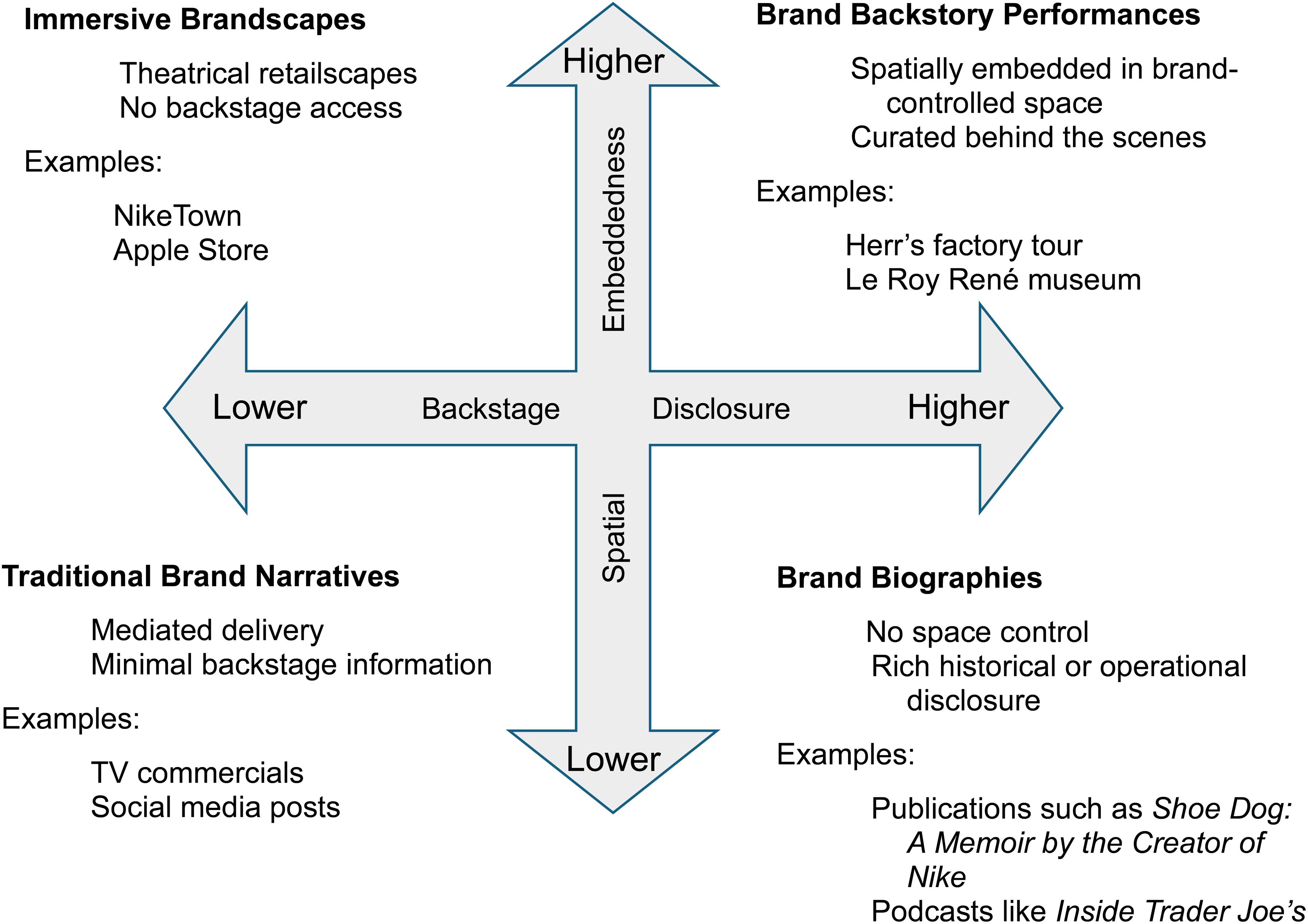
Situating Brand Backstory Performances Within the Brand Narrative Landscape.
Brand backstories promise high backstage disclosure experiences that offer privileged access to information typically concealed from public view. Whether through factory tours, visitor centers, or brand museums, brand backstory performances stage these backstories in space. In contrast, narratives like brand biographies are low on spatial embeddedness because they communicate through symbolic cues rather than spatial navigation. Brand backstory performances share a high level of spatial embeddedness with theatrical retailscapes, which are also enacted in brand-controlled immersive spaces. However, unlike backstory performances, retailscapes are low on backstage disclosure as they do not reveal operational processes (Kozinets et al. 2004).
Traditional brand narratives (e.g., television commercials, social media posts) tend to be characterized by low backstage disclosure and low spatial embeddedness as they rely on mediated content rather than spatial experience. A rich body of research explores how traditional brand narratives persuade, focusing on story content and persuasive structure (Kamleitner, Thürridl, and Martin 2019; Paharia et al. 2011; Wang et al. 2019). Grounded in narrative persuasion theory, past work shows that well-crafted stories can transport consumers and generate trust, loyalty, and brand attachment (Chen and Bell 2022; Orazi et al. 2025; Oschatz and Marker 2020; Van Laer et al. 2014, 2019) but does not fully account for narratives characterized by both high spatial embeddedness and high backstage disclosure.
The secrecy/transparency conundrum in backstories
Brand backstories feature the tension between revealing and concealing as a core dramaturgical dynamic. Research on secrecy suggests that this conceal–reveal tension should not be resolved but held open, remaining in the aporia between secrecy and transparency (Birchall 2021). Whereas traditional branding often relies on concealment and, as Broad (2016) notes, the “production of ignorance,” backstories represent a strategic narrative and potential performance of openness that necessarily reveals as much as it conceals. Managing brand backstories, then, is fundamentally about managing ambiguity, coproducing visibility and concealment in ways that create and sustain authenticity (Brown, McDonagh, and Shultz 2013).
Research on brand authenticity identifies specific cues through which consumers infer genuineness, including indexical and iconic links to valued people, places, or histories (Grayson and Martinec 2004), as well as perceived sincerity of intent and the downplaying of overt commercial motives (Beverland and Farrelly 2010). Yet, the sociology of secrecy literature suggests a paradox in how authenticity operates in backstory settings: Strategic withholding, not total disclosure, is what sustains perceived genuineness (Cronin 2020; Simmel 1906). When brands conceal profit margins and marketing calculations while foregrounding craft and heritage, they perform what Beverland and Farrelly (2010) identify as the downplaying of commercial motives in favor of perceived sincerity and moral intent. Conversely, overdisclosure can undermine authenticity by making the experience feel contrived or overly managed, thereby reducing perceived genuineness (Rose and Wood 2005). We argue that what makes a backstory performance resonate as authentic is not the volume of information shared but the strategic calibration of what is revealed and what remains appropriately hidden. How to strategically calibrate this reveal, however, remains an open question.
Brand Backstory Performances are Spatially Embedded
Brand backstory performances deliberately stage the interplay between transparency and secrecy, creating spatial encounters where audiences feel they are crossing a boundary into restricted territory. Consumer researchers have long examined how space shapes experience and brand meaning, showing that spatial design and sociomaterial dimensions guide how consumers experience retail stores, themed brandscapes, and immersive consumption experiences. These environments serve as material backdrops and symbolic stages that guide consumers’ movement, interaction, and meaning making (Peñaloza 1998). For example, the sociomaterial layout of retail environments structures how brand narratives are enacted and received (Welté, Badot, and Hetzel 2021). Borghini et al. (2009) document how spatial arrangements in the American Girl retailscape, such as deliberately designing physical zones to cue different narratives (e.g., heritage, transformation), invite participants to act out narrative roles. These spaces integrate multiple narrative threads and cultural meanings and cohere the brand's storyline across spatial zones. Similarly, Dion and Borraz (2017) document how lighting, layout, and décor intertwine with the performance of sales personnel to perform luxury and reinforce brand meaning.
Beyond retail, the spatial-narrative interplay shapes how consumers experience public or fantastical spaces. Urban environments are transformed into narrative stages through aesthetic practices like street art (Visconti et al. 2010), and extraordinary entertainment experiences (e.g., live-action role plays) rely on carefully designed sensory and symbolic cues to support narrative immersion (Orazi and Van Laer 2023). Spatial embeddedness, defined as the dynamic interplay between material objects and imagination, enables consumers to exercise narrative agency (i.e., the ability to control the development of the story, characters, and plot, with lasting changes to the narrative world; Van Laer and Orazi 2024). Across these contexts, space emerges as an active participant in the storytelling process, anchoring brand identity, guiding behavior, and communicating meaning (Diamond et al. 2009; Giovanardi and Lucarelli 2018; Peñaloza and Gilly 1999). Brand backstories extend this insight by staging the narrative within brand-controlled spaces (e.g., production facilities, headquarters, retail stores) where the experience is framed as a privileged, insider encounter. In doing so, space shifts from a supporting narrative stage to a performative affordance that both enables and constitutes the performance itself. These spaces must convey legitimacy, originality, and proficiency (Nunes, Ordanini, and Giambastiani 2021) while also shielding proprietary operations and sensitive information. This tension between revealing and concealing unfolds in spaces that simultaneously invite access and maintain control, navigating the boundary between public and private. Next, we turn to dramaturgical theory to understand how brands stage this delicate balance.
Performance of Brand Backstories
Drawing on Goffman's (1959) distinction between frontstage and backstage, we conceptualize brand backstory performances as performed access: encounters that invite consumers into a seemingly backstage space that is made visible yet remains carefully controlled. Although consumers may perceive these experiences as unrehearsed exposures of brand operations, they are instead symbolic performances of transparency, carefully choreographed to foster intimacy while maintaining authority.
The tension between revealing and concealing lies at the heart of backstory performance. Work in the sociology of secrecy helps illuminate this dynamic. Simmel (1906) shows how the controlled circulation of information creates distinctive social dynamics (i.e., trust, intimacy and exclusion) that are highly relevant to staged brand encounters. More recently, Cronin (2020) emphasizes that secrecy is not the opposite of transparency but part of what makes it possible, since any performance of openness necessarily rests on simultaneous acts of concealment. As Morin (1992) argues, transparency and secrecy are not opposites but coconstitutive and interdependent: Revealing something necessarily obscures something else. This shifts the analytical focus from what brands show to how they manage the tension between revealing and concealing. Baudrillard (1988) makes a similar point, noting that any performance of truth or openness is inherently selective. In the context of branding, Fan and Christensen (2024) observe that practices of transparency often generate new forms of secrecy. Brand backstories operate through this logic of curated transparency: They create the feeling of insider access without surrendering strategic control.
The marketplace, too, has long been understood as a site of performance. Deighton (1992) frames consumption as a dramatistic encounter wherein brands stage different kinds of performances, from fantasy spectacles to naturalistic presentations. Brand backstories fall into this latter category: They aim to appear unrehearsed and authentic, even though they are highly orchestrated. The factory tour, the heritage exhibit, and the office walk-through all perform authenticity through careful spatial and narrative design.
Performative dynamics extend beyond space to include human actors. Employees, tour guides, and executives serve as characters who animate the brand and facilitate interaction. As Üstüner and Thompson (2012) show, service workers in luxury retail enact class-coded scripts that reinforce the brand's positioning. Kozinets et al. (2004) describe how architecture, décor, and staff behaviors work together to create immersive retail spectacles. In backstory performance settings, such characters humanize the brand, translate technical processes into emotionally resonant stories, and foster an atmosphere of inclusion while staying within a carefully bounded script.
Importantly, audiences are not just passive observers in these performances. Fischer-Lichte (2008) and Bishop (2013) describe performance as a cocreated event, where meaning emerges in real time through interaction and spatial navigation. Consumers ask questions, interpret symbols, and respond emotionally to the experience. Yet, even in participatory formats, the structure remains asymmetrical. As Beeman (1993) notes, well-executed performances often serve to reinforce, rather than disrupt, existing power hierarchies.
In short, brand backstory performances are structured encounters that dramaturgically simulate access while preserving control. They rely on spatial cues, human interaction, and selective disclosure to create the illusion of transparency. Understanding brand backstory performances through this lens helps us explain how brands manage the core tensions that shape backstory enactments and affect consumers’ experience of transparency.
Research Objectives
Building on this framework, we investigate how brands perform backstories that create the feeling of privileged access while retaining narrative and operational control. These staged backstories do not expose the true behind-the-scenes work, nor are they purely frontstage performances. Instead, they occupy what we call a performed backstage, an intermediate zone where access is carefully granted and staged. This raises our central research question: How do brands strategically construct and optimize the backstory performance to deliver the illusion of transparency?
Drawing on Goffman's dramaturgical framework and its applications in brand performance (Deighton 1992; Grayson and Martinec 2004), we conceptualize brand backstory performances as dramaturgical enactments that stage transparency. We develop a theoretical model of how brands perform transparency through three interdependent dimensions—staging performance elements, orchestrating the characters, and tailoring the script—that together simulate being “let in.” We adopt a triangulated investigation across four brand contexts that connects the staging of these dramaturgical dimensions to the organization's strategic and artistic goals on one hand and the market's reception of the performance on the other.
We show that backstory performances must be skillfully delivered, stimulating, and safe to achieve their intended impact. That is, these performances succeed when they lead audiences to believe they have crossed a boundary into a normally restricted private space with unfettered access to operational and/or heritage content, while, in reality, the experience of transparency remains carefully controlled. This invitation into the illusion of intimacy transforms the encounter from mere storytelling into a site of relational transformation. By focusing on this performative dynamic, our approach shifts brand narrative research from storytelling to story performing. It foregrounds the organizational work of staging the storytelling encounter and extends spatial branding research by examining how physical environments are used performatively to simulate access. We highlight how brands choreograph narrative, space, and interaction to simulate the experience of transparency, without providing it fully.
Method
Our dataset consists of a qualitative, longitudinal investigation of four backstories, following the tradition of market-oriented ethnography (Arnould and Wallendorf 1994). To understand how brand backstories are staged and experienced, we triangulated data from three vantage points: (1) the performance stage (the physical exhibition space where the backstory performance takes place), (2) the organizational backstage (the firm's internal planning and strategizing behind the performance), and (3) the audience perspective (the reception and interpretation from visitors and cultural agents) (see Figure 2).
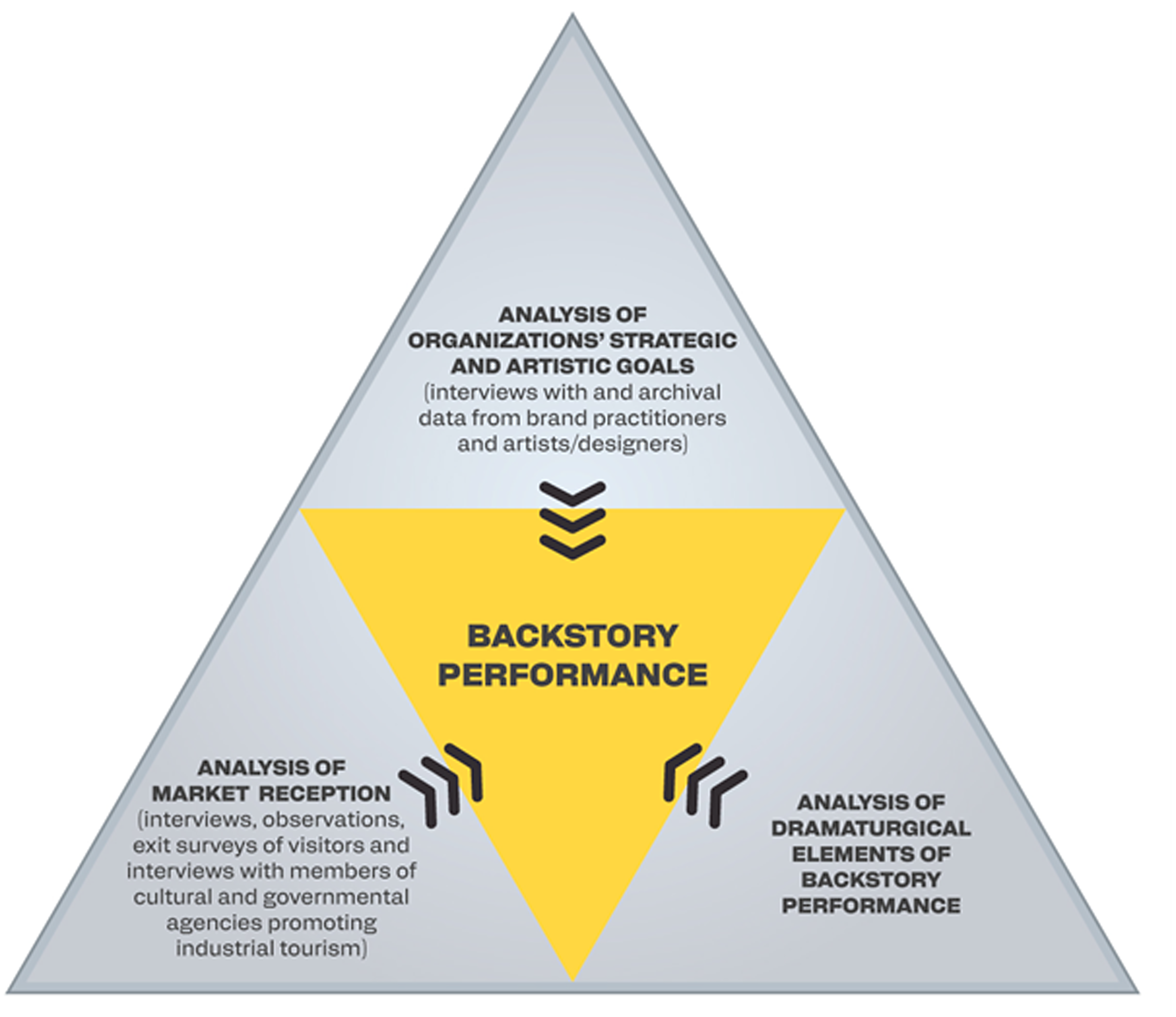
Triangulated Methodological Approach.
Data collection and analysis combined visual-spatial mapping, in-depth interviews, field observations, and archival materials (Bowen 2009). Across the four sites, we conducted 20 practitioner interviews (e.g., brand managers, curators, creative directors, tour guides; see Table 1) and 39 visitor interviews (see Web Appendix A), 1 and we analyzed approximately 4,000 survey responses provided by partner organizations (see Web Appendices B and C). Archival materials, including project charters, exhibit plans, tour scripts, and backstage manuals, were used to reconstruct how the performances were designed and refined over time. Multiple visits to each site enabled us to observe the dramaturgical dimensions of the performance and document audience engagement.
Practitioner Informants, Consumer Data, and Research Data Sources
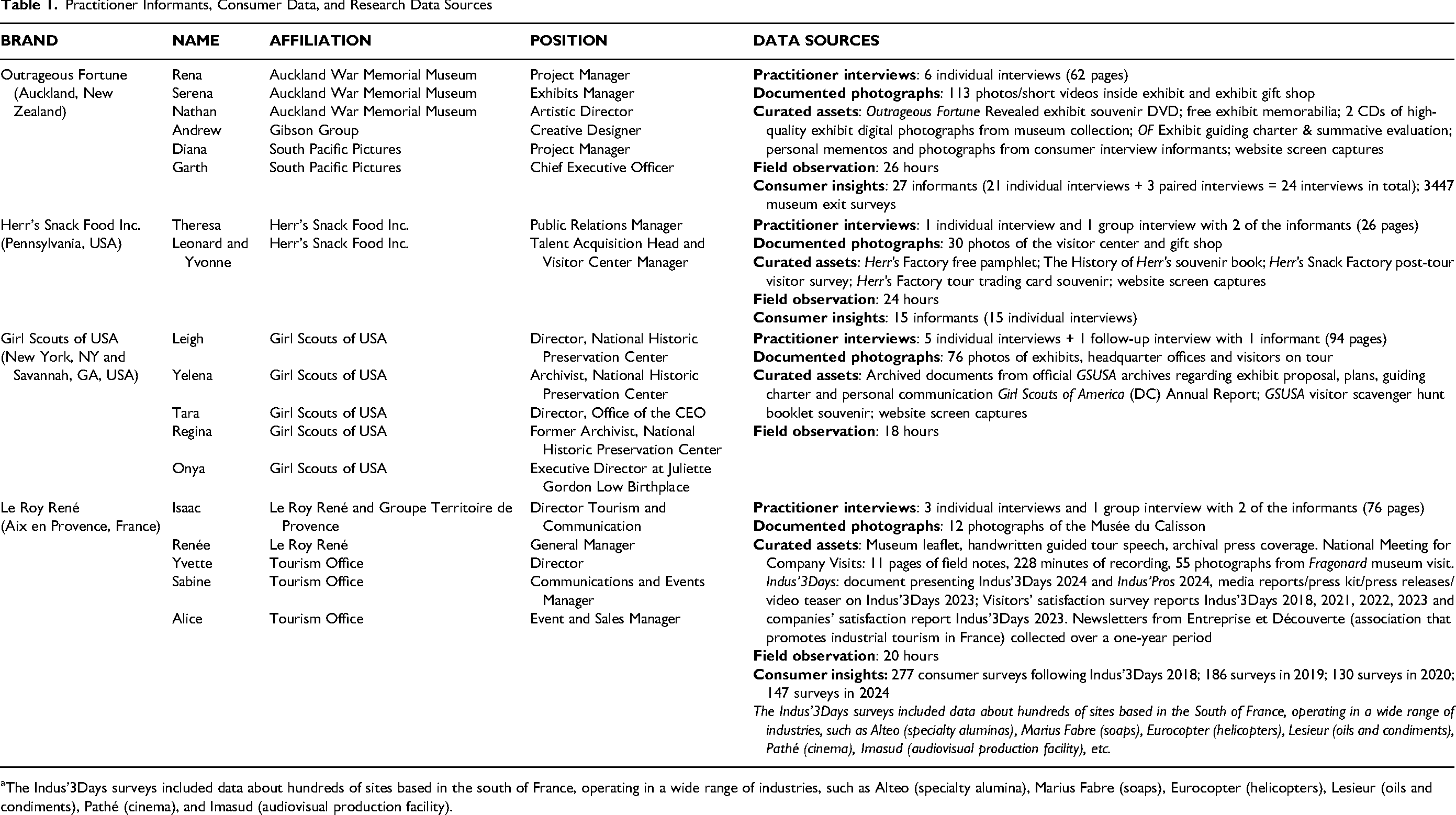
The Indus’3Days surveys included data about hundreds of sites based in the south of France, operating in a wide range of industries, such as Alteo (specialty alumina), Marius Fabre (soaps), Eurocopter (helicopters), Lesieur (oils and condiments), Pathé (cinema), and Imasud (audiovisual production facility).
Research Sites
Our sample offers a variety of backstories that cut across product categories and vary in staging spaces. Over a 16-year period, we document four brand backstories: an entertainment brand, two fast-moving consumer goods brands, and a nonprofit organization. These backstory experiences vary in duration (one-time event or ongoing), location (off-site museum, on-site museum, or brand headquarters), and creators involved in their design and staging. Practitioners involved in the creation, management, and marketing of brand backstory performances provide access to historical documents and curatorial practices, such as backstory creation manifestos and documents detailing project scope, dramaturgy, and audience reception.
Outrageous Fortune television series museum exhibit
Outrageous Fortune is a New Zealand drama series whose popularity and cultural impact led the Auckland War Memorial Museum to stage a six-month exhibit celebrating the iconic series. The exhibition promised a behind-the-scenes look at the series, revealing real-life headlines, scripts, and the series’ main studio set, which visitors could experience as a real living room (Web Appendix D). Outrageous Fortune illustrates how a media brand leverages a temporary museum space to transform production work into an immersive backstory (Narsey and Russell 2013).
Herr's snack food factory tour
Herr's is a U.S. snack food manufacturer that stages a factory tour at its original Pennsylvania plant. Visitors watch a short film about the brand's history and follow a guided route through the production floor that showcases processes from ingredient sourcing to packaging and offers tasting opportunities. The Herr's tour exemplifies a classic industrial backstory set in a working manufacturing site, emphasizing operational transparency and local roots.
Girl Scouts of the USA
Girl Scouts of the USA is a nonprofit youth organization founded in 1912 and noted for its strong culture of community building. Its backstory performance was set at its national headquarters in Manhattan as a guide-led tour of the national archives, featuring key documents and artifacts and concluding with a visit to the CEO in her office (Web Appendix D). A related heritage site in Savannah, Georgia (birthplace of Juliette Gordon Low, the Girl Scouts’ founder), extends this backstory through a more traditional historic house museum. Together, these sites show how nonprofit organizations use backstories to connect mission, history, and leadership.
Le Roy René calisson museum exhibit and factory tour
Le Roy René is a Provence-based confectionery brand that produces calissons (a traditional French candy made from ground almonds and candied fruit) and operates the Musée du Calisson adjacent to its factory. The upstairs museum traces the company's history with historical photos and artifacts (see map, Web Appendix D), while windows overlook the factory floor, allowing visitors to observe production below. Guided tours further disclose work practices, machinery, and ingredients. Le Roy René participates in Indus’3Days, a regional industrial tourism initiative that encourages companies to open their doors to the public. We also interviewed employees at the tourism office that coordinates this initiative, which enabled us to collect data from many other sites across the region. These sites illustrate how backstory performances are embedded within broader institutional efforts to promote economic discovery and controlled access to production spaces.
Analysis Process
Analysis proceeded iteratively, guided by performativity and dramaturgical lenses (Szatkowski 2019; Turner and Behrndt 2017). Web Appendix E presents this performativity-informed coding process flow. We examined how performances were communicated through architecture, spatial arrangements, and display forms, as well as in discursive commentary. Interviews and archival documents were analyzed using constant comparison (Glaser and Strauss 1967; Lincoln and Guba 1985) to identify themes related to staging, scripting, and character work. Practitioner insights were compared with consumer accounts to trace where the performance succeeded, faltered, or was reinterpreted. Triangulating across these data sources enabled us to connect organizational intentions, spatial enactments, and audience interpretations into an integrated dramaturgical model of the brand backstory performance (Figure 2).
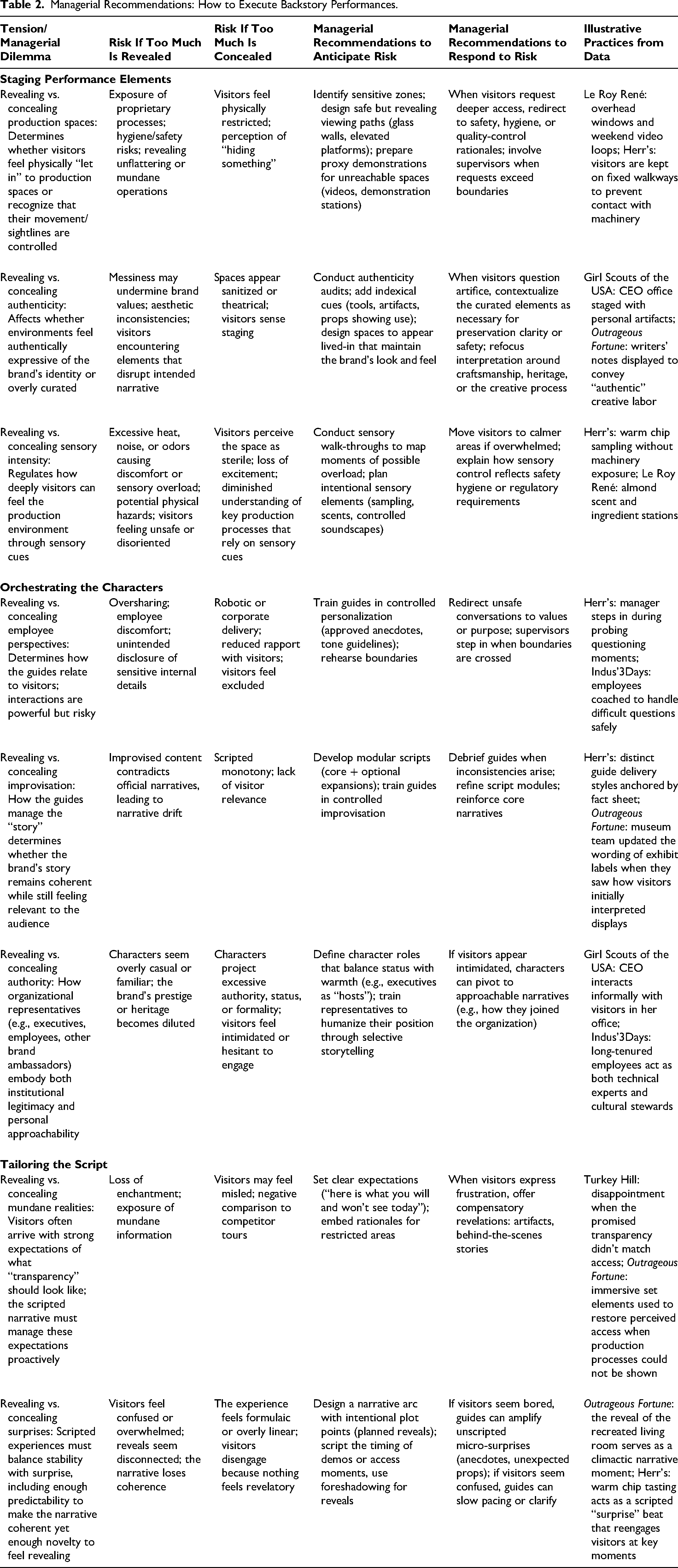
Managerial Recommendations: How to Execute Backstory Performances.
Findings
Our analysis of this comprehensive dataset reveals how to construct and optimize the backstory performance to achieve its promise of a revelatory behind-the-scenes experience. In this article, the performed backstage refers to the structural and dramaturgical configuration through which access is staged, whereas the illusion of transparency describes the experiential outcome for consumers when these performances successfully simulate insider access. Extending Goffman's (1959) binary frontstage–backstage framework, we reveal a more complex staging framework that includes a performed backstage between the frontstage and backstage, where a curated performance of transparency simulates the true behind-the-scenes backstage. As Figure 3 conveys, consumers’ experience of the illusion of transparency in a brand backstory performance requires the strategic optimization of three key dramaturgical elements.
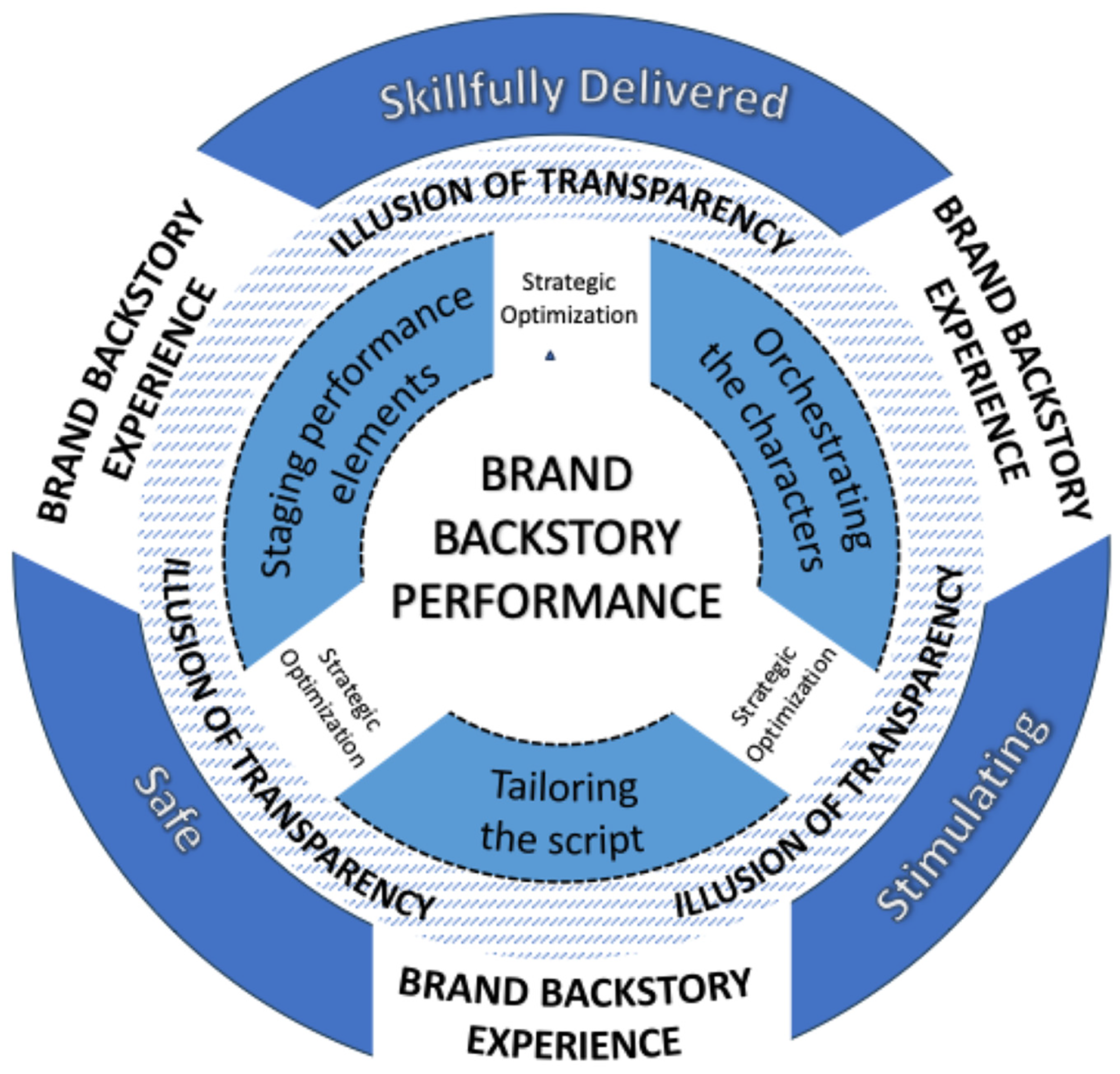
The Interplay of Brand Backstory Performance and Brand Backstory Experience.
We begin this section by presenting the three dimensions that emerge as essential in a backstory performance: staging performance elements (including selecting symbolic locations, crafting controlled visibility, selecting objects as access proxies, and coordinating seamless performance), orchestrating the characters (deploying employees as authenticity agents, shaping tour guides as intimacy creators, and engaging the audience as coperformers), and tailoring the script (managing strategic omissions and unveiling strategic disclosures). We then discuss how these dimensions must be strategically optimized to enable skillfully delivered, stimulating, and safe backstory experiences. These three key criteria for success are depicted in the external concentric circles in Figure 3. Skillful delivery refers to the smooth execution of the backstory through well-managed theater logistics and ensemble readiness. Stimulating content involves creating sensory-rich environments and maintaining high performance energy. Safety encompasses implementing physical safeguards, protecting information, and carefully calibrating what is disclosed to consumers. Backstory performances are likely to fall flat if their strategic staging is not optimized on all three criteria. Web Appendix F provides additional verbatim excerpts illustrating these performance dimensions and optimizing forces.
Together, these findings illustrate how brands can perform backstories that stage the illusion of transparency. The strategic optimization of performance enables consumers to believe that they are accessing the true backstage, even if they never truly see behind the scenes.
Executing the Backstory Performance
Staging performance elements
Our findings illustrate that brands are not providing unvarnished access; instead, they carefully cultivate a performance of transparency while skillfully concealing the true behind-the-scenes work. Building on Pine and Gilmore's (2011) work on staging experiences in consumer settings, several staging elements emerge as key to simulate access behind the scenes: selecting symbolic locations, crafting controlled visibility, selecting objects as access proxies, and coordinating seamless performance.
Selecting symbolic locations
The geographic or institutional setting in which a brand backstory performance unfolds conveys essential physical and symbolic meanings. Locations are not neutral backdrops: They are active components of the performance. In addition to the type of location, entry point and sequence of access choreograph the experience. Whether situated in corporate towers, manufacturing facilities, or cultural institutions, brands harness the symbolic capital of location to project different aspects such as openness, legitimacy, or exclusivity (Peñaloza 1998).
Consider the Girl Scouts Headquarters, located in a high-rise building in Manhattan. The setting immediately connotes prestige, stability, and institutional authority, yet the brand uses this powerful location to project a welcoming, mission-driven front. Visitors would move from the archives to the CEO's office, symbolically progressing from historical foundations to executive-level access. In this way, the brand creates an illusion of privileged access, while the prestigious setting and carefully orchestrated progression underscore the scarcity and special nature of accessing spaces normally off-limits to outsiders.
At Herr's Snack Factory, staging of access is deliberate. Visitors begin in a small theater, where they view a film that frames the company's legacy. Then, they are led onto the factory floor to observe live production (Web Appendix D, H4 to H10). This progressive spatial reveal deepens the sense of intimacy and transparency while maintaining control over what is disclosed and when. Similarly, setting the Outrageous Fortune exhibit in the Auckland War Memorial Museum (see Web Appendix D, OF1) framed the experience as serious and educational. The museum lent cultural legitimacy and historic depth to the brand narrative. Yet this gravitas came at a cost: As Andrew, a museum creative designer, puts it, “It looked like a serious exhibition and they’re in a museum … they don’t feel like they’re being invited to touch things.” The authenticity gained from the location's institutional prestige reinforced distance, preserving the aura of exclusivity by limiting engagement.
Crafting controlled visibility
Once inside the backstory space, consumers must feel that they are granted visibility into internal operations, spaces, and processes. While access can signal transparency, in brand backstory contexts it is often carefully curated to create the illusion of scarcity, even when the site is open to the general public, and to suggest unfettered access, even as the space remains tightly controlled. Leigh, director of the Girl Scouts’ National Historic Preservation Center, describes how the Girl Scouts’ building was designed to suggest openness: “I love the fact that the general public can walk in this building and see it without going to another floor. So the awareness is right in your face.” Here, openness is visually suggested, but what is visible has been selectively chosen. The layout enables impression management, shaping what consumers notice. A manager in the electric power generation industry underscores this strategic curation more directly: “You don’t have to show everything. There are ‘secret’ things, difficult places. There is transparency but we don’t show everything” (field notes from the National Meeting for Company Visits, the annual meeting of Entreprise et Découverte, a French national association dedicated to company visits and know-how tourism). Visitors are made to feel they are getting privileged access, even when parts of the experience remain clearly off-limits, sometimes literally marked with ropes, signs, or controlled paths.
At Le Roy René, spatial design reinforces this illusion. Visitors view the production workshop through large windows positioned above the factory floor (Web Appendix D, RR10). As Renée, Le Roy René’s general manager, explains, “You have a direct view of the workshops. … Even though we don’t enter the workshops, we have real visibility into the work of our employees.” Across sites, spatial features such as glass walls and strategic sightlines simulate transparency while maintaining control, echoing how luxury brands use lighting and layout to performatively reinforce meaning (Dion and Borraz 2017).
Whether accessed physically or virtually, the backstory stage must therefore be constructed to simulate transparency while maintaining control over what consumers see. Access appears rare and valuable but is in fact orchestrated to balance visibility and brand protection. In other words, total transparency is not the brand's goal, but rather the appearance of access is. In contrast to prior spatial branding research that examines how environments support brand narratives (Borghini et al. 2009; Peñaloza 1998), backstory performances use space performatively to construct the illusion of transparency while maintaining control.
Selecting objects as access proxies
Objects such as costumes, videos, or set pieces can function as access proxies, providing curated insights into brand operations (Web Appendix D). These objects serve as symbolic access points, offering selective glimpses into the production process, creative labor, or personal spaces. They can function as stand-ins for authenticity, enabling brands to suggest transparency while still controlling the consumer's line of sight. In this way, objects operate as simulated proxies for access. As Baudrillard (1988) argues, in the logic of simulation, representations can come to replace the real; what matters is not actual transparency, but the appearance of it. Props suggest behind-the-scenes access without exposing operational complexities or full truths. Nathan, the museum’s artistic director, describes how they selectively curated what was shown to the public during the Outrageous Fortune exhibition: “That's why we showed makeup, obviously prop making, why we showed all the costumes. … We didn’t show any of the camera work, we didn’t show anything about lighting because those are technical issues.” Here, the choice of objects (costumes and makeup) emphasizes character and artistry, while deliberately omitting more functional, less glamorous elements of the production. By resembling mental templates of the real products or operations, objects serve as markers of iconic authenticity (Grayson and Martinec 2004).
Coordinating seamless performance
Coordinating seamless performance refers to the behind-the-scenes systems and personnel that enable brands to maintain a polished, responsive backstage performance. For consumers to perceive their access as seamless or spontaneous, brands engage in continuous, often invisible coordination. These hidden systems manage transparency, ensuring that what feels open is in fact carefully curated.
At Herr's, Leonard, head of talent acquisition, describes the backstage coordination tools used to manage the visitor experience: “We all also have communication radios … I can come out and answer questions and help with any problems.” Here, transparency is actively maintained through internal communication systems that keep the performance smooth and disruptions contained. Leonard monitors consumer reactions in real time, especially when transparency is pushed too far: “Usually, if they have a visitor who's so inquisitive to the point where the tour guide is starting to shut down a little, that's when I come into play, and I can speak with that visitor directly.” Brand representatives serve as buffers, stepping in when curiosity threatens to pierce the illusion. In this way, backstage coordination is logistical as well as protective, allowing consumers to believe they are behind the scenes instead of in the liminal backstage.
Orchestrating the Characters
Characters are the second fundamental dimension in the backstory performance. Our findings reveal how employees, tour guides, and sometimes the audience can serve as characters in the performance to help stage transparency.
Deploying employees as authenticity agents
Employees can play a central role in backstory performances as narrative agents who embody transparency and invite connection. Placing employees in direct contact with visitors signals openness while carefully curating the encounter to feel authentic. For example, Tara, director of the CEO’s office, describes the CEO's participation in the Girl Scouts tour (see Web Appendix D, GS11 and GS12) as essential: The CEO office is absolutely mandatory on the tour … they get a chance to really interact with her and see that she's just a normal person … she works for them and asks them questions about what they like and don’t like.
Giving visitors face-to-face access to leadership symbolically collapses Girl Scouts hierarchy, positioning its most powerful figure as approachable. Even though this contact is clearly scripted and likely infrequent, the performance is successful because it makes the exceptional feel ordinary. While Goffman (1959) associates intimacy with personal disclosure and emotional closeness, brand backstories instead rely on performed ordinariness, making high-status figures appear accessible and “normal” to reduce perceived distance without generating true emotional intimacy. This moment creates the appearance of intimacy, produced through careful staging. This effort to make the CEO's office feel “real” illustrates how authenticity in backstory performances is carefully staged rather than naturally occurring. Such curation aligns with research on the appeal of the real and staged authenticity (Rose and Wood 2005), where seemingly unfiltered access is deliberately crafted to evoke trust.
Elsewhere, employees are framed as credible truth-tellers. Tourism office director Yvette describes the decision to have a line-level employee conduct a specialty alumina production tour as a source of honesty and realism: “He said he wouldn’t tell them it wasn’t true, that the company didn’t pollute … but he would explain why. … Thus, an exchange is created, and people understand.” Here, transparency is performed not through full disclosure, but through empathic explanation. The employee becomes a translator of organizational complexity, positioned as someone with both technical knowledge and moral authority. The visitor may still disagree with the company's practices, but their stance becomes softened by the performance of honesty. Employees are participants in the story's construction, shaping how transparency is enacted in the moment. To facilitate this authentic performance, the employees may receive strategic support. Yvette explains that her team at the tourism office tries to make the visit less intimidating for employees: “We are there with them. There's always someone at each visit. … So they’re not alone.” They do a practice run beforehand, giving advice on what might interest visitors and encouraging employees to share anecdotes. This preparation reassures workers while preserving the spontaneous quality that makes these encounters feel genuine and often leads to reciprocal exchanges as, in Yvette’s words, “the employees listen to the visitors’ questions … they realize what questions people might have about their own company, and vice versa.” This blurred boundary between performers and audience creates an autopoietic feedback (Fischer-Lichte 2008): Employees and visitors influence the contours of the performance through ongoing interaction. These reciprocal exchanges can be energizing for employees themselves, as customer interactions become sources of emotional regeneration rather than depletion (Cayla and Auriacombe 2025).
Leveraging tour guides as intimacy creators
When featured, tour guides can serve as the facilitators of the brand backstory, delivering its key themes, responding to visitors, and embodying the performance of transparency. But while their role may appear spontaneous or personal, it is often highly choreographed. Brands train tour guides not only in facts and storytelling but in how to deliver those facts with personality and variation, allowing each guide to offer what feels like a distinct and exclusive experience. Leonard at Herr's explains: We train them in … the basics of their spiel … but we want them to make it their own tour in a way. … So, pretty much every time you come take this tour, if you have a different guide, it's gonna be a different tour.
This structured variation creates the impression that each tour is one-of-a-kind. In contrast to Goffman's (1959) conception of intimacy requiring personal disclosure, brand backstory performances achieve perceived intimacy through structured personalization and performed spontaneity rather than authentic revelation. Personalization becomes a strategy of performed scarcity: Even when the content is consistent, the guide's delivery makes it feel rare.
From the visitor's perspective, this personalization is experienced as intimacy and inclusion. Melanie, a visitor to Herr's, reflects on her interactions with the tour guide: “You actually feel like you’re part of a family.” Here, the guide is not just a source of information but a bridge into the brand's inner sanctum, a character who transforms the visitor from observer to insider. By blurring the line between professional delivery and personal rapport, tour guides play a critical role in sustaining perceived intimacy and the illusion of openness (Welté, Cayla, and Cova 2022).
Engaging the audience as coperformers
As in other performance contexts studied in prior research (Bishop 2013; Fischer-Lichte 2008), backstory audiences are not passive observers; they are often deliberately positioned as active participants, invited to interpret, question, and emotionally connect with the experience. Brands curate not just what is shown, but how it is received, crafting performances that prioritize resonance. As Nathan explains, the Outrageous Fortune backstory design was intentionally visitor-centric to engage the audience at all points of the self-paced experience (Web Appendix D, Outrageous Fortune map): “Our collective internal job came about always checking what's it going to do for the visitor. How is it really going to connect with the visitor?” The backstory's focus is not simply on disclosing operations but on shaping an experience that lands meaningfully with the consumer.
The audience is drawn into the performance as a cocreator, with the ability to probe, reflect, and engage. Our survey data support this dynamic: Over 85% of Outrageous Fortune exhibition visitors indicated they were interested in behind-the-scenes production, and more than 60% reported enjoying exploring the set and props (see Web Appendix B). Visitors described feeling like they were “part of it,” as though previously inaccessible content had been opened to them. Similarly, in the Indus’3Days event, 64% of respondents reported participating actively by asking questions and observing their surroundings, while 73% reported learning more than expected about the manufacturing process (see Web Appendix C). The backstory space functions as a liminal zone, blurring boundaries between insider and outsider (Schechner 2017; Turner 1998). This in-between space becomes a site of relational transformation where new forms of engagement emerge through the act of revelation itself.
Tailoring the Script
“Script” refers to the structured narratives that shape what is revealed and what is withheld in a backstory performance. Our findings show that brands strategically script disclosures to emphasize authenticity while maintaining control, often privileging emotional resonance over technical transparency. In doing so, script becomes a tool for performing openness, offering curated glimpses that feel revelatory without exposing the full backstage.
Managing strategic omissions
Scripted messaging plays a critical role in maintaining the illusion of transparency: a controlled performance that appears open while deliberately omitting sensitive or operationally complex information. Isaac at Le Roy René articulates this balance clearly: “Our goal is to be as transparent as possible without revealing our manufacturing secrets, that's clear, and without getting into controversies either.” Theresa from Herr's explains of the tour guides, “There is a script and they know what they’re allowed to tell … we just don’t give out information there.” Other elements, such as where raw materials come from, which stores stock the product, or how much is paid for shelf space, are never discussed. Even the founder's proximity to the tour is concealed: As Theresa notes, “We never tell people that Mr. Herr is next door. We don’t want somebody to come back and knock on the door.” These decisions reflect not just information control but a strategic curation of narrative.
This selective approach is evident in how brands choose which parts of the production process to share. Nathan explains, We asked ourselves … is it our job to tell the making of it? But we can’t just do that. … Our job was to say how the making contributes to that point of reality of the characters. That's why we showed makeup, costumes. … But we didn’t show any of the camera work or lighting because those are technical issues.
In other words, the story is designed to feel emotionally authentic and theatrically real even as key operational elements remain hidden. Unlike in retail spaces that stress seamless and immersive brand narratives with abundant cues to deepen the brand story (Welté, Badot, and Hetzel 2021), the backstory performance must emphasize not only what is shown, but what is withheld. Backstories require a simultaneous performance of disclosures and omissions.
This balance is difficult. If scripting leans too far into spectacle, consumers express disappointment, as in the words of Danielle, who visited both Herr's and the Turkey Hill ice cream backstory. Regarding her Turkey Hill experience, she says: “I thought it was gonna be, okay, you do this with this and the creamer goes in here or the chocolate goes in here. It was just a movie … it wasn’t actually showing them the behind the scenes.” As Deighton notes (1992), dramatistic performances fail if audiences recognize the staging. Performances of transparency can also falter when audiences detect that the access granted is more simulated than sincere. Several visitors signal these fractures. Such reactions show that audiences are not passive recipients but active interpreters who can resist, reinterpret, or puncture the illusion of transparency, revealing the negotiated nature of the performance.
Unveiling strategic disclosures
Brands do not share everything, but what they do share is carefully curated to perform authenticity, convey values, and evoke connection. In some cases, backstories reveal operational details that signal efficiency, ethics, and stewardship. As Theresa describes: “We recycle all the steam … we feed our cattle which are on our farm … we irrigate the farm … we are good stewards of our money.” These facts do not offer unfiltered access to production but rather serve as strategically chosen narratives that promote a specific brand identity and values. They are designed to impress and reassure consumers.
Other forms of disclosure focus on the sensory and human texture of the brand. A manager at the National Meeting for Company Visits notes: “You need to be able to tell a story. Share the smells of the workshop, shake hands, etc. … we tell who we are, what we do.” These touchpoints shape how visitors experience the brand's essence, both in terms of functional processes and its cultural or moral character. In this way, brands craft performances not just of what happens behind the scenes, but of who they are as organizations. This aligns with findings by Ravasi, Rindova, and Stigliani (2019), who show how firms use material memory and sensory cues in corporate museums to construct identity narratives that connect past, present, and future. Through these curated performances, history becomes a resource for branding as an active mode of organizational self-expression.
Visitors often respond to these narratives by expressing emotional connection and loyalty. Melanie, a visitor to Herr's, explains, “Now with all the history behind it, all the hard work and moral good people that they are, that makes me all the more supportive of the brand.” The content of what is shared, whether eco-efficiency facts, human stories, or family values, works not only to impress or inform, but to influence behavior. In short, what is shared is not just information, but a carefully shaped story designed to foster a positive brand image. A press release on company visits documents that “purchases are on average twice as high as in a store without a prior visit,” and “60% of visitors become loyal consumers of the brand,” leading to the conclusion that “visitors build an attachment to the company and commit to the brand in the long term” (Entreprise et Découverte 2020, p. 3; our translation from French). This and similar press releases signal that the emotional resonance cultivated in brand backstory performances translates into measurable business outcomes.
Optimizing the Brand Backstory Experience
Figure 3 conveys our findings to show that the performance dimensions discussed previously must be strategically optimized to enable a skillfully delivered, stimulating, and safe experience. When any one of these three dimensions falters, the illusion of transparency breaks down and the experience risks feeling flat, forced, or inauthentic.
Although these three forces emerge inductively from our multisite analysis, each aligns with well-established theoretical perspectives that explain why they are necessary for sustaining a convincing performance of curated transparency. Skillful delivery reflects core insights from service quality research, which shows that reliability, responsiveness, and seamless execution are foundational to audience perceptions of competence and trust (Parasuraman, Berry, and Zeithaml 1991; Parasuraman, Zeithaml, and Berry 1988). Stimulation is supported by experiential and sensory design frameworks demonstrating that immersive encounters depend on sustained sensory engagement and novelty (Pine and Gilmore 2011). Safety resonates with research on psychological safety and boundary regulation, which emphasizes that people engage more openly and interpret experiences more favorably when risks are contained and access is carefully managed (Edmondson 1999; Fan and Christensen 2024; Simmel 1906). We next turn to our findings regarding how to calibrate the performance along these three important dimensions.
Skillful delivery
Skillful delivery refers to the executional quality of the backstory performance: how well the performance is organized, paced, and delivered in real time. While brands may carefully design staging, character orchestration, and scripts, the impact of these elements ultimately depends on how they are calibrated and enacted during the experience itself. Even compelling content can fall flat if it is poorly executed. Visitors notice when logistics are sloppy, tours are delayed, guides are disengaged, or physical discomfort detracts from immersion. Our data show that two aspects are particularly important: theater logistics (e.g., signage, timing and meeting points) and ensemble readiness (e.g., the tour guide's professionalism).
Theater logistics
Logistical missteps can interrupt even the most engaging content. Poor signage, unclear meeting points, or long periods of standing in uncomfortable environments can make visitors feel confused or frustrated. One Indus’3Days visitor recalls: The imprecision of the meeting point (the bus stays at the entrance of the Best Western whereas I had been told it would enter the parking lot) and the schedule: We had been warned that the time was moved up but we waited nearly half an hour before leaving in case others had not been informed.
Ensemble readiness
Visitors are highly attuned to how well-informed, organized, and present their guides seem. The absence of a clear welcome, confusing or contradictory information, or poor time management can erode the coherence of the experience. One Indus’3Days visitor describes a poorly coordinated visit: [They] sent a young woman to “welcome” us who not only arrived very late, but then spent the entire time glued to her smartphone. … Her absence delayed the start … the visit ended up being rushed. … We didn’t have time to properly absorb the information or ask questions.
The visitor's frustration centers on the lack of professionalism and breakdown of timing and pacing, which are hallmarks of an unskillfully delivered performance. Whether missteps are due to unclear messaging or poor timing, these examples show how skillful delivery is about maintaining a tone of professionalism and attention throughout the encounter, which is necessary for a backstory performance to succeed.
Stimulating content
Stimulation refers to the degree to which the backstory content is novel, sensorially engaging, and memorable. Performances that lack stimulation because they feel outdated, irrelevant, or confusing undermine the brand's effort to construct a compelling narrative by bringing consumers “backstage.” A stimulating performance demands fresh, sensorially rich content combined with high performance energy.
Sensory richness
Visitors quickly disengage when the content feels dated, disconnected, or lacking in narrative coherence. Cybil critiques a portion of the Outrageous Fortune exhibit (Web Appendix D, OF6 and OF7) for being jarring and out of place: “It almost looked like a high school kid's construction. … It seemed contrived and disconnected from the show itself. So I didn’t spend much time there.” Here, the experience is not only visually underwhelming but violates the visitor's expectation of internal consistency and creative quality. By contrast, stimulating content that is visually rich can generate fascination (Borghini, Sherry, and Joy 2021). Raewyn, a Herr's visitor, explains: It was well presented … you could see through, you know, get a good look, an up close sort of view of all machines and the actual production … you’re learning about something that you don’t realize. … It was more interesting and … different to your day-to-day life. … It made it cool.
Consumer exit surveys reflect these qualitative impressions. Among Outrageous Fortune visitors, nearly two-thirds (63%) describe the experience as “fun” and 28% describe it as “exciting,” indicating that the content was not only informative but emotionally engaging (Web Appendix B). Visitors express interest in detailed material choices, like props and set design that help bring the show's narrative world to life. At Indus’3Days, participants highlight the value of seeing real-time demonstrations and visual exhibits, reinforcing the importance of vivid, tactile content.
Performance energy
Stimulation depends on the energy of the performance. Customer interactions can energize or drain employees (Cayla and Auriacombe 2025). In backstory performances, poor performance energy triggers a damaging spiral: When employees deliver inauthentic energy, audiences perceive the performance as fake, which may intensify the emotional drain on employees. Several visitors flag moments where content delivery felt scripted or disconnected. One Indus’3Days visitor describes a speaker who seemed out of sync with the topic: “The miner who guided the mining aspect of the site … made peremptory assertions about outdated notions regarding alternative energies. … I felt like I was in a miners’ union meeting.” Here, the speaker's tone and content felt inauthentic and led to alienation rather than immersion. Similarly, Guy, a Herr’s visitor, criticizes a nearby factory tour for offering little more than video screens and free samples: “It's not a real chocolate factory tour. … I can watch that on TV if I wanted. It wasn’t very impressive or memorable.” This echoes Baudrillard's (1988) notion of the simulacrum: a representation that imitates reality so completely that it replaces the real, yet fails to satisfy. In this case, the simulation of a factory experience, detached from live processes or tangible labor, feels inauthentic and unconvincing. When the illusion of scarcity is paired with a flat or disconnected experience, the performance of transparency collapses into disappointment.
Safety
Our findings further show that, in addition to stimulating and skillfully delivered content, backstory performances must be optimized for safety. Safety refers to practices that protect visitors’ physical, cognitive, and emotional well-being throughout the backstory performance. Backstory performances must balance openness with caution, protecting consumers from discomfort, employees from unwanted exposure, and the brand from reputational or legal risk. Safety operates across three interconnected domains: physical safeguards, information protection, and disclosure calibration.
First, visitors are physically excluded from certain spaces, not because the brand is hiding something, but because of health, hygiene, or security risks. At regulated sites such as power plants or food manufacturing facilities, visitor safety and product integrity take priority. Sabine explains: It's delicate to bring people behind the scenes in these places … just like with food processing companies, where you need to have shoe covers … because you wouldn’t want to contaminate products that are in the process of being manufactured.
These physical safeguards are necessary constraints that reinforce the credibility of the brand: A backstory performance that exposes visitors to danger would open the brand to substantial risk.
Second, backstories must protect information such as trade secrets, internal processes, and employee privacy. At times, however, visitors may misinterpret these precautions as excessive or inconsistent. George reflects on his visit to Herr's: “I didn’t understand why you couldn’t [take pictures] … I get not taking photos of employees … but … I don’t think there's any trade secret going to be violated.” Guy accepts not photographing employees to protect their privacy but rejects the idea of photos having the capacity to reveal trade secrets, implying he understands Herr's is curating details.
Calibration of the performance requires addressing this tension between brand protection and visitor expectation. Brands must manage what gets shared externally and protect their assets, as Herr’s visitor Olivia states: “I understand that some things, you know they’re not going to want to show because the competitors would find out about it. I understand that.” At the same time, visitors may want to capture memories, validate access, or share their experience. A well-performed backstory ensures that consumers accept that operational secrecy is a legitimate constraint.
Finally, perhaps most subtly, safety operates at the level of emotion and attachment, through disclosure calibration. Audiences sometimes prefer not to know certain things: about how food is processed, how characters are constructed, or how illusions are maintained. In the Outrageous Fortune exit surveys, a visitor laments that a too-revealing exhibit disrupted their sense of enchantment, noting that it “kind of dissolved the whole fairytale of this family.” Reflecting on the backstory tours in central Pennsylvania, Herr’s visitor Randell comments on overstimulating or overly commercialized elements: “You’ll go on a ride and the thing lets you out at a gift store … your adrenaline's pumped and you’re like hey, buy something now … maybe that's overstimulating to me, maybe too much.” When performances feel too commodified or reveal undesired truths, visitors disengage, not because they did not get enough access, but because they got more than they wanted. Researchers of magic show that a certain aura of mystery ensures audiences’ feelings of awe, wonder, and envy when watching magic trick performances (Krell and Dobson 1999; Kuhn 2019). A well-performed backstory is calibrated to the optimal dosage of revelation.
General Discussion
How can brands invite consumers “backstage” while maintaining control over what is revealed? This research addresses the question through the concept of brand backstories and their performances. Drawing on a longitudinal, multiperspective investigation centered on four primary case studies, we show how brands stage these encounters to create the illusion of transparency while preserving organizational control. Extending Goffman's (1959) dramaturgical framework, we identify three core performance dimensions of staging performance elements, orchestrating the characters, and tailoring the script that together simulate behind-the-scenes access without relinquishing operational secrecy. Triangulating strategic planning, dramaturgical analysis, and consumer experience, our findings reveal that effective backstory performances must be skillfully delivered (through seamless theater logistics and ensemble readiness), stimulating (offering sensory richness and authentic performance energy), and safe (protecting physical well-being, sensitive information, and emotional boundaries).
Theoretical Implications
This article contributes to research on brand storytelling in three major ways. First, we introduce brand backstories as crafted, selectively disclosive narratives that promise privileged insights. While prior research examines how mediated stories shape consumer beliefs through transportation and related mechanisms (Paharia et al. 2011; Van Laer et al. 2014, 2019), brand backstories constitute a specific subtype of brand narrative distinguished by their performance of curated transparency: that is, by the strategic choreography of what is revealed, what remains concealed, and how audiences are guided to interpret selective disclosures. Backstory performances extend narrative theory by shifting attention from how stories are mentally processed to how they are physically navigated, spatially enacted, and coconstructed in real time (Orazi and Van Laer 2023). Drawing clearer boundaries around what counts as a backstory is important because past research treats the concept loosely, making it hard to see the distinctive tension between what brands show and what they deliberately hold back. When transparency is reduced to simply “more or less openness,” we lose sight of the careful performance involved in managing visibility, or the illusion of transparency, which in turn makes it harder for the field to explain authenticity and how transparency is staged. The backstory expands narrative scholarship beyond cognitive engagement to include the embodied, agentic, and interactional dynamics that arise when consumers move through brand-controlled spaces and negotiate what counts as “authentic.”
Second, we contribute to literature at the intersection of narrativity, branding, and consumer space by theorizing space as a performative affordance rather than a symbolic backdrop. Prior research shows how retail environments, themed spaces, and brandscapes shape meaning (Borghini et al. 2009; Peñaloza 1998; Visconti et al. 2010; Welté, Badot, and Hetzel 2021), and recent scholarship highlights how narratives can be embodied and spatially embedded (Van Laer and Orazi 2024). Our dramaturgical lens advances this research by demonstrating that spatial elements produce the illusion of transparency through controlled visibility, guided pathways, sensory cues, and access-proxy objects. These affordances enable brands to create the illusion of transparency, to stage intimacy while carefully regulating what consumers can see. Importantly, we show that authenticity in these performances emerges from the management of ambiguity (Brown, McDonagh, and Shultz 2013) and selectively chosen indexical cues (Beverland and Farrelly 2010). Spatial control enables brands to negotiate the tension between accessibility and protection, advancing understanding of how material environments shape perceptions of transparency and authenticity.
Third, we develop a dramaturgical model of how staging elements, character orchestration, and narrative scripting work together to produce the performed backstage. Building on Goffman's (1959) frontstage/backstage distinction and Deighton’s (1992) work on marketplace drama, we show how firms choreograph the illusion of insider access. This framework contributes to marketing research on performative branding (Dion and Borraz 2017; Grayson and Martinec 2004; Sherry et al. 2001) by identifying the specific levers through which brands manage the reveal–conceal tension central to curated transparency. Our work extends theories of intimacy in branding (Stern 1997; Welté, Cayla, and Cova 2022) by showcasing the role of encounters that reduce perceived distance and make high-status figures (e.g., CEOs, founders) appear accessible. This performed ordinariness in well-staged brand backstories does not require the emotional disclosure traditionally required in performance (Goffman 1959) to simulate intimacy. Finally, by presenting transparency and secrecy not as opposites but as interdependent (Broad 2016; Cronin 2020; Fan and Christensen 2024; Simmel 1906), our model explains why backstory performances are inherently fragile and why moments of rupture reveal the delicate balance on which perceived transparency and authenticity depend. These rupture points also reveal that audiences are not passive spectators but active agents who resist, reinterpret, or puncture the performance when cues feel misaligned or overly curated. Recognizing the role of audience agency underscores that curated transparency is not simply staged by firms but negotiated in real time, reinforcing the theoretical claim that transparency performances are continuously cocreated.
Managerial Implications
For brand managers, our findings offer actionable guidance for executing engaging backstory performances as well as for navigating the frictions that make them difficult to stage. As we have outlined, backstories are not about full transparency but about managing the reveal–conceal tension at the heart of curated transparency. Brands must determine which elements of their operations or history can be made visible, and which should remain protected. Table 2 outlines how different staging choices (symbolic locations, controlled visibility, access-proxy objects) can be used to create the feeling of access while preserving operational, reputational, or safety boundaries. Designing a backstory experience is thus a matter of orchestrating visibility in ways that support authenticity without destabilizing the performance.
Second, character orchestration becomes critical when these tensions surface. Guides, employees, and leadership figures must be trained in factual accuracy as well as boundary management: how to respond to challenging questions, how to reframe restricted zones, and how to redirect moments when the illusion of transparency begins to fracture. These interpersonal performances help audiences interpret selective disclosure as trustworthy rather than evasive. Table 2 further highlights how character deployment can either strengthen or weaken the experience depending on how well employees are prepared to handle rupture moments.
Third, executional quality is essential because breakdowns are inevitable. Even well-designed backstories falter when logistical seams become visible: empty workspaces, staging delays, inconsistent scripts, or improperly framed safety restrictions. Managers must therefore monitor for signs that the balance between access and control is slipping. Crafting the experience requires harmonizing staging, scripting, and character delivery so that disclosure feels meaningful. The performance succeeds when managers can sustain the illusion of transparency even in the face of disruptions.
Fourth, although our cases focus on physical environments, these insights extend directly to digital backstories. Virtual tours, livestreamed walk-throughs, and interactive content must likewise curate visibility, anticipate breakdowns, and manage how audiences interpret boundaries. Digital formats may reduce some safety constraints but heighten others, such as real-time questioning or uncontrolled screen capture. Applying dramaturgical principles to digital environments requires designing how interaction unfolds and how concealment is justified.
Finally, backstory performances involve real organizational and reputational risk. Not all brands can or should open their backstage, and Table 2 highlights how transparency must be calibrated to avoid revealing harmful or mundane realities that undermine trust. In industries where operations evoke moral or ethical concern, attempts at transparency may invite scrutiny. Even in less sensitive categories, backstories are resource-intensive, requiring ongoing investment in infrastructure, personnel, training, and coordination. Managers must weigh these costs against the potential gains in attachment and loyalty.
Ultimately, successful backstory performances depend on a brand's ability to anticipate, absorb, and learn from moments of disruption. Managers who understand these tensions, and who design performances to navigate rather than eliminate them, will be better equipped to use curated transparency as a strategic asset.
Ethical Considerations
The strategic construction of curated transparency raises important ethical questions. Brands should ensure their backstory performances provide consumers with genuine insights into company values, processes, or heritage, rather than serving as purely decorative experiences designed to manipulate perceptions. The key distinction lies in protecting legitimate operational secrets (e.g., trade processes, employee privacy, safety protocols) while genuinely educating consumers about meaningful aspects of the brand's operations and heritage. However, backstory performances cross ethical boundaries when they deliberately mislead consumers about material aspects of fundamental operations, working conditions, or environmental impact, or when they conceal practices that could harm consumer health, safety, or well-being. The framework we present should not enable “transparency washing” (i.e., performances that create false impressions while concealing problematic realities). Responsible brands must ensure that strategic omissions do not distort customers’ understanding of issues material to their well-being, particularly those involving potential consumer risks or harms.
Limitations and Future Research
This study identifies a wide range of consumer responses to brand backstory performances, but future research is needed to understand the mechanisms that systematically drive these outcomes. Our findings suggest that backstories may shape consumer–brand relationships along a continuum of self–brand connection (Escalas and Bettman 2005), from distant appreciation to deep loyalty and identity integration. However, we do not establish causal links between specific performance dimensions and these outcomes, nor do we test how the reveal–conceal tensions of curated transparency shape movement along this continuum.
This variation raises promising directions for future research. One important avenue is to investigate how specific dramaturgical dimensions such as guide interaction, spatial design, or scripting shape where consumers land on this continuum. Do emotionally immersive formats (e.g., guided tours, sampling, live demonstrations) generate stronger brand attachment than observational ones? Future work could also explore individual-level differences, such as brand affinity, narrative orientation, or openness to experience, that influence receptivity to transparency performances. In addition, longitudinal studies could clarify whether identity-aligned outcomes persist over time and what conditions sustain them.
Another fruitful direction involves the medium of delivery. As brands experiment with virtual factory tours, interactive brand environments, or hybrid formats, research is needed to understand how digital embodiment, presence, and interactivity affect persuasion and consumer connection. Future research should also examine cultural and generational variation in how consumers interpret and respond to transparency efforts. Expectations around authenticity, access, and brand intimacy may differ across audiences. Our dataset hints at such cultural variations; for example, one Indus’3Days visitor critiques what they perceive as overly commercial practices: Offer a small gift box with different treats to help people discover or rediscover them! This would build more loyalty than waiting for us to make purchases after saying goodbye to us at the back of the shop. … We’re not Americans! This sales method is a bit out of place.
With regard to generalizability, our four primary sites were selected to maximize variation in industry, geography, and staging format, but they are not representative of all branding contexts. We studied organizations willing and able to stage curated access to their operations. Brands in more controversial or tightly regulated industries (e.g., meat, energy) may find transparency performances riskier or ethically fraught. Moreover, category differences may shape the salience of specific dramaturgical dynamics; for example, safety concerns may be heightened in fast-moving consumer goods or industrial contexts, while intimacy cues may play a larger role in nonprofit or cultural settings. Furthermore, while our data offer rich insights, they are interpretive in nature. They pave the way for quantitative studies to test the relationships suggested in our framework across broader populations and contexts.
Conclusion
Our research shows that staged brand backstories function as performances of curated transparency, where brands stage selective revelation to create the feeling of insider access while maintaining control. By conceptualizing backstories as spatial, performative narratives, we extend prior work on brand storytelling, consumer space, and dramaturgy. Our model highlights how staging, character work, and scripting jointly optimize the balance between revealing and concealing. For managers, the key implication is that effective backstories depend not on full transparency but on anticipating ruptures, preparing guides for challenging moments, and calibrating disclosure to sustain trust without overexposure.
Supplemental Material
sj-pdf-1-jmx-10.1177_00222429261422755 - Supplemental material for The Brand Backstory and the Strategic Performance of Transparency
Supplemental material, sj-pdf-1-jmx-10.1177_00222429261422755 for The Brand Backstory and the Strategic Performance of Transparency by Cristel Antonia Russell, Anne Hamby, Stephanie Feiereisen and Hope Jensen Schau in Journal of Marketing
Footnotes
Acknowledgments
This article is inspired by Vanisha Narsey’s dissertation at the University of Auckland, New Zealand, conducted under the supervision of the first author.
Coeditor
Cait Lamberton
Associate Editor
Ashlee Humphreys
Declaration of Conflicting Interests
The authors declared no potential conflicts of interest with respect to the research, authorship, and/or publication of this article.
Funding
The authors disclosed receipt of the following financial support for the research, authorship, and/or publication of this article: The first author received support from the University of Auckland for the New Zealand data collection portion of this research. The authors received no financial support for the other data collection research sites, authorship, and/or publication of this article.

Data Availability Statement
The data that support the findings of this article are publicly available through the JM Dataverse (https://doi.org/10.7910/DVN/GLAPIX).
Notes
References
Supplementary Material
Please find the following supplemental material available below.
For Open Access articles published under a Creative Commons License, all supplemental material carries the same license as the article it is associated with.
For non-Open Access articles published, all supplemental material carries a non-exclusive license, and permission requests for re-use of supplemental material or any part of supplemental material shall be sent directly to the copyright owner as specified in the copyright notice associated with the article.
