







Abstract
In this article, the authors examine the role of person brands in shaping emergent markets. Using ethnographic and archival data from the early online news market, they find that person brands use their social, cultural, and symbolic capital to create a unique organizational identity, establish a founding myth, and mobilize resonance with early followers. These organizational assets are carried forward in the emergent market to build cultural-cognitive, normative, and pragmatic legitimacy in a context where these factors are yet to be established. While prior research in marketing has investigated the market-driving effects of firms, consumers, and intermediaries, the findings yield insight into the role of specific people—person brands as institutional entrepreneurs—in driving emergent markets. These findings inform managers and other stakeholders in emergent markets as to how to strategically manage the organizational identity, founding myths, and audience resonance built by person brands in order to carry these assets forward as the market further develops.
In this article, we investigate the role of person brands—well-known people who have gained social and cultural meaning through marketing communications (Thompson 2004)—in shaping emergent markets where the norms, values, and practices of exchange have yet to be firmly established. Instances of market shaping by person brands have been observed in the automotive (Yates 1983), personal computing (Waldrop 2001), aviation (Barlett and Steele 2004), and fashion (Picardie 2017) industries. For example, in the early PC market, Steve Jobs, the visionary ex-hippie, and Bill Gates, the relentless workaholic, shaped consumer perceptions of personal computers through distinct personal and brand identities. Their contrasting personas created compelling origin stories that resonated with consumers, helping define what a PC was and what it could do (Cringely 1996a, 1996b). Similarly, Thomas Edison and Nikola Tesla influenced public understanding of the market for electricity, with Edison seen as the reliable inventor and Tesla as the eccentric genius—traits that shaped perceptions of their competing technologies (Jones 2004). As institutional entrepreneurs (Battilana, Leca, and Boxenbaum 2009; DiMaggio 1988; Garud, Jain, and Kumaraswamy 2002; Maguire and Hardy 2017)—those who play an active role in institutional change—these key players potentially help shape the foundations of an emergent market. Understanding the importance of these types of individuals in emergent markets can help firms develop an inimitable competitive advantage, achieve strong differentiation, and collectively build legitimacy for the early market as it attempts to gain understanding with consumers and approval in society.
Person brands have symbolic resources—charisma, cultural resonance, and myth-making abilities—that other types of institutional entrepreneurs may lack and that play a vital role in communicating the meaning of a new market to consumers and the broader public. Person brands can be powerful attractors of financial capital, consumer support (Wieser, Luedicke, and Hemetsberger 2021), and other resources that are valued in emergent markets. Yet, although we know their importance to established markets (Parmentier, Fischer, and Reuber 2013), we do not know how they shape emergent markets, in which their influence may be different because the “rules of the game” are not yet established. For these reasons, we ask: How do person brands shape emergent markets?
We study this question in the market for online news from 1996 to 2012. Through ethnographic and archival analysis to understand organizational- and market-level patterns, we study how person brands shaped their organizations and, in turn, forms of legitimacy of the early market. We find that although the conditions for online news may have been made by technology, the precise establishment of the market’s norms, values, and practices is shaped by its early person brands, who leveraged social, cultural, and symbolic capital to give the market its distinct flavor. We find that person brands use social capital to create organizational identities that form market positions and build category legitimacy. They craft founding myths that spread widely, establishing new market norms and values. They also meaningfully engage audiences through cultural and symbolic capital, inspiring participation that solidifies market segments and secures financial and social legitimacy. We use these findings to derive insights for building and managing these valuable assets as the market matures.
This research makes three key contributions to understanding market development and person brands. First, by exploring the role of person brands in shaping emergent markets, we deepen insights on market-driving strategies, strategies in which firms choose to play a leading role in shaping the market rather than understanding and responding to consumer needs (Jaworski, Kohli, and Sahay 2000; Kumar, Scheer, and Kotler 2000). Creating and controlling symbolic resources that are unique and differentiating can be key when firms choose to pursue a market-driving approach. While some firms build these resources through status (Humphreys and Carpenter 2018), collaboration with other firms (Maciel and Fischer 2020), or complexifying practices (Dolbec, Arsel, and Aboelenien 2022), another critical resource may be the social and cultural power of a person brand within the organization who also acts as an ambassador for the market overall. By studying person brands, we provide insight into another reservoir of symbolic capital that firms and the emergent market can tap for legitimacy and continued competitive advantage.
Second, we develop theorization of person brands as a specific type of institutional entrepreneur. While organizational research has long recognized the role of institutional entrepreneurs (Battilana, Leca, and Boxenbaum 2009; DiMaggio 1988), it has not attended specifically to the power potentially held by person brands who have additional cultural and symbolic resources to shape consumer and public perception of the market. While person brands may have many attributes of institutional entrepreneurs, like social connections and financial capital, we illustrate how their additional brand resources are used to create a distinct organizational identity, establish and disseminate powerful myths, and attract like-minded audiences that constitute symbolic resources for both firms and the market.
Finally, while previous research has focused on how individual person brands build value (Fournier and Eckhardt 2019; Parmentier and Fischer 2021), we examine a constellation of person brands to understand their collective influence. We find that they create meaning through structured, semantic relationships that reflect shared social ties and values and help collectively shape market perceptions through the organizations they personify. By analyzing multiple person brands together, we reveal how their combined symbolic capital helps secure legitimacy in an emergent market—highlighting a key outcome of their influence in markets.
We first review the prior work on emergent markets and market driving to understand how early markets become established and examine the role that individual people might play in shaping them. We then discuss person brands as a form of institutional entrepreneur and draw on theories of social, cultural, and symbolic capital to examine their potential influence on both organizations and broader market structures. After outlining our data and methodology in the online news market, we present our findings on how person brands deploy forms of capital to shape their organizations and legitimacy of the emergent market. We then offer managerial implications and discuss the applicability of these dynamics across other industry contexts.
Theoretical Background
Market Driving in Emergent Markets
Emergent markets
To understand how emergent markets are shaped, we draw from organizational theory and studies of legitimacy. In this stream of research, markets are “concrete exchange structures between producers and consumers” (Weber, Heinze, and DeSoucey 2008, p. 529; see also Humphreys 2010). An emergent market is one in which exchange structures, including cultural-cognitive and normative beliefs, are not yet institutionalized (Aldrich and Fiol 1994; Dowling and Pfeffer 1975; Suchman 1995). Early in market formation, norms, values, and practices are up for negotiation as key players and firms establish shared social understandings (Aldrich and Fiol 1994; Berger and Luckmann 1966; Maguire, Hardy, and Lawrence 2004; Santos and Eisenhardt 2009), and cultural categories often evolve alongside emergent markets (Grodal, Gotsopoulos, and Suarez 2015; Khaire and Wadhwani 2010; Navis and Glynn 2010; Rao, Monin, and Durand 2003). A market ceases to be emergent when these norms, values, and practices become relatively stable (Johnson, Dowd, and Ridgeway 2006). Examples of once-emergent markets include electric vehicles (Kennedy, Pozner, and Raffaelli 2015), health services for new diseases (Maguire, Hardy, and Lawrence 2004), digital cameras (Grodal, Gotsopoulos, and Suarez 2015), and new types of financial services (Jacobides 2005). Niche markets, nascent industries, and proto-fields all refer to settings where exchange structures and shared social understandings are still forming, aligning directly with our conceptualization of emergent markets. Following work in organizational theory, we refer to online news as an emergent, or early, market (Fligstein 1997; Fligstein and McAdam 2012; Greenwood and Suddaby 2006; Lehenkari 2006).
Most markets grow out of, or have key relationships with, existing markets (Abbott 1988; Grodal, Gotsopoulos, and Suarez 2015), and some new market niches can become full-fledged markets of their own (Navis and Glynn 2010). For example, the market for electric vehicles grew out of the traditional car market (Park, Lim, and Cho 2018). We consider a market distinct to the degree that its “concrete exchange structures between producers and consumers” (Weber, Heinze, and DeSoucey 2008, p. 529) are different from other markets. The lack of concrete exchange structures between producers and consumers, the unformed experiences and expectations of consumers, and an influx of new firms prompt us to consider online news as an emergent market between 1996 and 2012 (Jacobson 2025).
To succeed, emerging markets need to establish some level of cultural-cognitive, normative, pragmatic, and regulatory legitimacy (Ertimur and Coskuner-Balli 2015; Humphreys 2010; Suchman 1995). Cultural-cognitive legitimacy is the degree to which an emerging market is understood by consumers (Bitektine 2011; Humphreys and Latour 2013). Normative legitimacy is the degree to which the emerging organization or market is accepted by stakeholders such as consumers, investors, and the general public—its congruence with other norms and values in society (Huff, Humphreys, and Wilner 2021; Suchman 1995). Pragmatic legitimacy is the degree of financial and logistical support provided to a company, in the form of a strong consumer base or other practical use in society (Ertimur and Coskuner-Balli 2015). Lastly, regulatory legitimacy is the degree to which an organization or market is legally sanctioned (Humphreys 2010). While these types of legitimacy can be mutually supportive, they represent distinct elements of social support for institutions (Scott [1995] 2014). Markets are emergent to the degree to which these types of legitimacy are unsettled and not yet firmly established among social actors in the field (Johnson, Dowd, and Ridgeway 2006; Scott [1995] 2014). Although many markets experience change over time and legitimacy can remain incomplete, a market is no longer emergent when some of these elements have been established (Johnson, Dowd, and Ridgeway 2006; Scott [1995] 2014; Suchman 1995).
Market driving
Prior marketing research examines how firms shape markets through a market-driving approach (Jaworski, Kohli, and Sahay 2000; Kumar, Scheer, and Kotler 2000)—actively influencing market needs rather than merely responding to them. Firms may drive markets through technological innovation (Gatignon and Xuereb 1997), status (Humphreys and Carpenter 2018), interfirm collaboration (Maciel and Fischer 2020), ideological differentiation (Ertimur and Coskuner-Balli 2015), and practice complexification (Dolbec, Arsel, and Aboelenien 2022). These strategies often reshape market norms and values (Humphreys 2010) while enabling firms to assert ideological and taste positions that reflect their organizational identities (Dolbec, Arsel, and Aboelenien 2022; Ertimur and Coskuner-Balli 2015; Maciel and Fischer 2020). Central to this process are symbolic resources. For example, Bikram Choudhury influenced the development of the U.S. yoga market by promoting a fitness-oriented brand narrative rooted in his personal recovery story (Ertimur and Coskuner-Balli 2015). Similarly, the evolutions of third-wave coffee and wine were driven by shifts in meaning led by influential producers and critics (Dion, Carpenter, and Humphreys 2025; Dolbec, Arsel, and Aboelenien 2022; Humphreys and Carpenter 2018). In emerging markets, organizational and market legitimacy evolve together, as perceptions of each are deeply intertwined (Freeman, Carroll, and Hannan 1983; Hannan and Freeman 1977; Maciel and Fischer 2020; Navis and Glynn 2010). Patterns in early markets often persist, imprinting initial patterns on later market stages (Stinchcombe 1965). Indeed, during this pivotal period, the market can be shaped by the actions and identities of a few key individuals or organizations who establish the market (Hardy and Maguire 2017). As Hardy and Maguire (2017) note, “Emerging fields may then be particularly conducive to institutional entrepreneurship, as considerable advantages can be derived for those who succeed in influencing the way in which the field eventually becomes structured” (p. 204). Building on this perspective, we investigate how person brands leverage symbolic resources to shape legitimacy within emerging markets.
Person Brands as Institutional Entrepreneurs
To understand how individuals and organizations shape emergent markets, we draw on theorizing about institutional entrepreneurs—actors who initiate and actively participate in institutional change (Battilana, Leca, and Boxenbaum 2009; DiMaggio 1991). We view person brands as a particular type of institutional entrepreneur, those who have elevated cultural and symbolic resources and choose to play an active role in shaping an institution. Human, or person, brands are “well-known persona[s] who [are] the subject of marketing communications efforts” and have been shown to enhance consumers’ feelings of autonomy and relatedness to the brand and others (Thomson 2006, p. 104). Starting from attachment theory, scholars have researched how consumers form attachments to people—who themselves become brands—through exposure in a media system (Dyer 1979; Fournier and Eckhardt 2019; Parmentier, Fischer, and Reuber 2013).
Person brands are both biographical people and brands—constellations of meaning—and these two elements form interdependencies, as the actions of biographical people can affect their brand value (Fournier and Eckhardt 2019; Parmentier, Fischer, and Reuber 2013). Person brands both perform work and are “worked on” as symbolic entities in a culture (Dyer 1979; Gamson 1994). Person brands are common as leaders of organizations in fashion (Picardie 2017), technology (Isaacson 2014), and media (Byron 2002) and exist in a diverse array of markets such as real estate (Tuccille 1985), automotive (Iacocca 1984), and investment (Buffett 2009; Hagstrom 2024). While person brands, by definition, are well-known, the amount and degree of their influence depend on their economic, cultural, and symbolic resources in a particular field.
Institutional entrepreneurs are “interested actors” who leverage resources to create or transform institutions (Maguire, Hardy, and Lawrence 2004). Person brands represent a distinctive subset of such actors because their accumulated prestige, honor, or celebrity provides heightened symbolic resources that confer cultural and social power (Bourdieu 1993; Parmentier, Fischer, and Reuber 2013). Although not all person brands engage in institutional change, those who do can be especially influential in restructuring markets. Prior research has examined who becomes an institutional entrepreneur, the conditions that enable such entrepreneurship, and, to a lesser extent, how institutional change is enacted, showing that social position and identity—including personal biography—shape the likelihood of becoming an institutional entrepreneur (Lounsbury and Glynn 2001; Maguire, Hardy, and Lawrence 2004; Rao, Monin, and Durand 2003).
While some research has investigated how institutional entrepreneurs leverage social capital to change institutions (Fligstein 1997), other research has looked at how institutional entrepreneurs deploy cultural resources. Rindova, Pollock, and Hayward (2006), for example, find that celebrity firms—those that attract positive public attention on a large scale—can channel public attention through “dramatized reality,” leading to increased attention and interest, particularly when they break norms. For example, Apple became synonymous with design and innovation, Tesla with “sexy” electric vehicles (Higgins 2021; Vance 2015), and Virgin with a sleek airline image (Branson 2014). Rindova, Pollock, and Hayward (2006) emphasize that “the media play a central role in the process of celebrity creation because they control both the technology and content of information disseminated” (p. 51). Lounsbury and Glynn (2001) also discuss how cultural entrepreneurs use status to secure early financial resources but do not examine the broader market implications or evaluate these ideas in practice.
Research on institutional entrepreneurs often emphasizes organizational over market-level impact. Scholars have explored how personal biography helps entrepreneurs form alliances (Maguire, Hardy, and Lawrence 2004; Maclean, Harvey, and Suddaby 2024). Maclean, Harvey, and Suddaby (2024) show how Conrad Hilton's personal biography facilitated alliance-building and advancing organizational goals. Luri, Kaliyamurthy, and Farmer (2023) similarly highlight how marketplace “heroes” create and mobilize utopian narratives, and Cayla et al. (2025) note how influencers can drive market innovation through stories. As we will discuss, elements like charisma and myth-making are key to how person brands shape markets. In studying person brands as institutional entrepreneurs, we evaluate how the types of symbolic resources they uniquely hold, in conjunction with their social capital, help shape not only the organization but also the norms, values, and practices of an emerging market.
Social, Cultural, and Symbolic Capital of Person Brands
To understand how person brands shape organizations and, in turn, emergent markets, we draw from the concepts of social, cultural, and symbolic capital that person brands may have at their disposal (Bourdieu 1986). Social capital is “the aggregate of the actual or potential resources … linked to possession of a durable network” (Bourdieu 1986, p. 248). Social capital has not only quantity (i.e., number of connections) but also quality (i.e., who those connections are with), and person brands may use social capital to imbue their brands with specific meaning. For example, previous work finds that social capital gives influencer person brands value (Beichert et al. 2024; Brooks, Drenten, and Piskorski 2021; Mardon, Cocker, and Daunt 2023). There is interdependence between the person and the brand, with person brands performing actions to build and maintain social capital but also becoming symbolically defined by their social capital as a brand (Fournier and Eckhardt 2019).
Cultural capital consists of “cultural competencies” used to gain and maintain social advantage (Bourdieu 1986; Goulding 2008; Holt 1998). It can be embodied in tastes and values, objectified in ownership of material objects, and institutionalized in the form of credentials and awards (Bourdieu 1986, p. 242). The cultural capital of person brands may lie in embodied tastes that help them guide organizational decisions such as hiring, product design, and culturally resonant strategic positioning. For example, when a person brand joins a top fashion house, they refresh its identity and form aesthetics according to their vision (Parmentier and Fischer 2021). Economic capital refers to financial resources directly convertible into money. We did not include economic capital as part of our empirical study because in the early days of online journalism there were relatively low barriers to entry. Starting a blog or online news outlet required minimal financial resources compared with print or broadcast media. This democratization meant that symbolic differentiation—not funding—determined influence.
Person brands also possess symbolic capital—“accumulated prestige, celebrity, [and] consecration of honor” (Bourdieu 1993, p. 7)—which arises when their economic, social, or cultural capital is widely recognized as legitimate and respected (Bourdieu and Wacquant 1992, 2013; Üstüner and Thompson 2012). In essence, symbolic capital reflects the value that others assign to their status, authority, or achievements within a given field. In other words, while not included by Bourdieu as one of the “three fundamental guises” of capital, symbolic capital is important for understanding how individuals are seen within a field of social and cultural relations it determines how others value these fundamental forms of capital. In this way, symbolic capital has been conceptualized as “celebrity capital,” the degree to which a person brand is recognized as being famous (Hearn and Schoenhoff 2016, p. 196; see also Brooks, Drenten, and Piskorski 2021; Dyer 1979; Gamson 1994). Precisely because person brands are both people and brands, their social, cultural, and symbolic capital are intertwined as they are viewed externally by the public. They are simultaneously holders of social connections (social capital), embodied tastes (cultural capital), and honor and prestige when these forms of capital are judged collectively (symbolic capital).
We therefore examine how person brands, as institutional entrepreneurs, use various forms of capital to shape an emergent market. While the forms of capital they cultivate are useful tools for understanding how person brands transform organizations, it is less clear from prior research how these forms of capital translate to legitimate an emergent market. How do individuals shape emergent markets as institutional entrepreneurs? Given that they build social, cultural, and symbolic capital, how do these assets translate to shaping organizational perceptions and market legitimacy?
The Context of Online News
To answer these questions, we study online news, a market that was emergent from approximately 1996 to 2012 (Figure 1). Online news emerged from the established market of print journalism. Journalism, like law and medicine, follows established rules and values recognized by professionals (Abbott 1988; Schudson 1978; Tuchman 1978) and is based on standards such as public service, objectivity, autonomy, and immediacy (Bogaerts and Carpentier 2013; Deuze 2005; Lippmann and Curtis 1992; Russell 2011; Schudson 1978) that took shape in the early 20th century. As bloggers and citizen journalists entered the field (Peters and Broersma 2013), they challenged these traditional journalism practices that were previously upheld by elite professionals. The online news market experienced an initial emergence phase, with numerous organizations originating and competing in a relatively unstructured environment, followed by a period of consolidation as early entrants were acquired by larger conglomerates or experienced other forms of institutionalization (e.g., prestigious awards, unionization of employees) or failure (Web Appendix A). Online news would be considered emergent between the years of the founding of the first organizations—widely cited to be the Drudge Report in 1996—and the consolidation and legitimate recognition of the industry, which occurred between 2010 and 2012 when AOL acquired the Huffington Post (Adams 2011) and reporting from organizations like ProPublica, the Huffington Post, and Politico won Pulitzer Prizes, a widely respected award within the traditional field of journalism. These types of awards solidify emergent cultural-cognitive and normative legitimacy because they concentrate public attention, validate a certain set of emergent criteria, and settle debates about legitimacy (Anand and Watson 2004). A full explanation of Figure 1 and underlying procedures is presented in the “Methods” section.
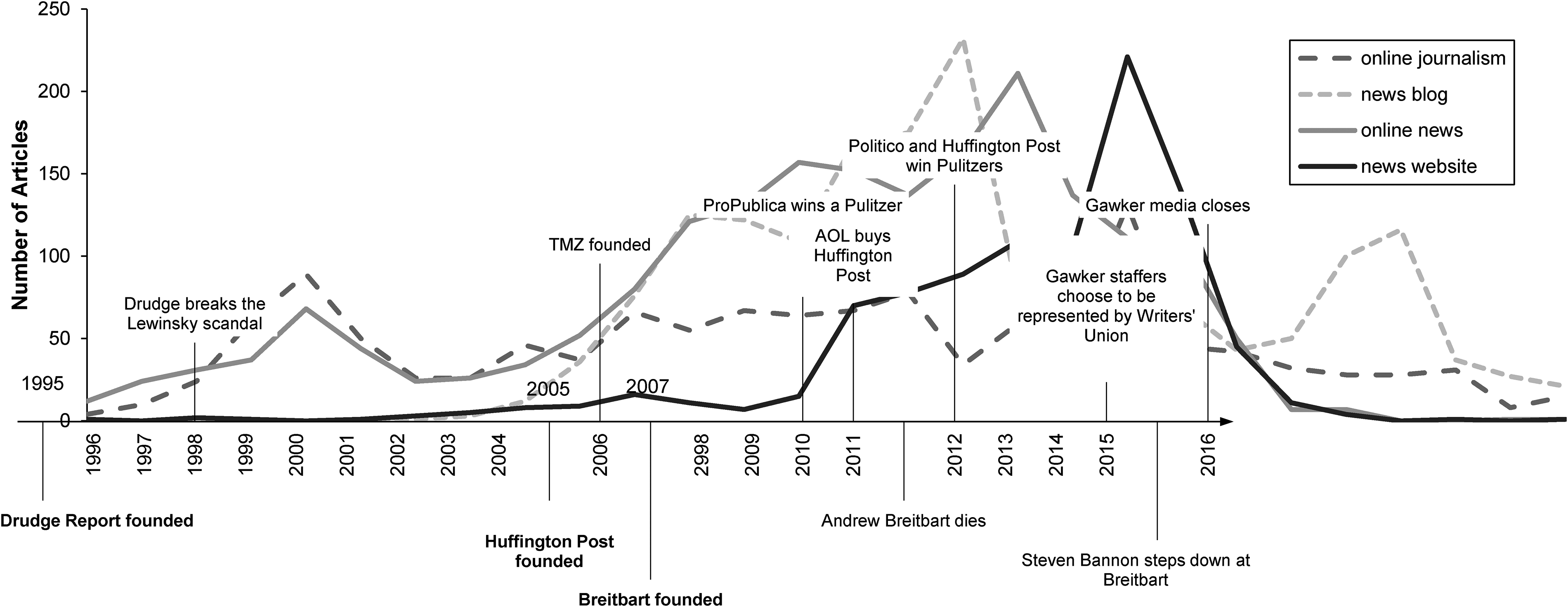
Market Keywords and Timeline.
Several individuals qualify as person brands within this early market. Matt Drudge, who founded the popular online news blog Drudge Report in 1996, became a key influence on the U.S. political narrative in 1998 by breaking the story of President Clinton's affair with Monica Lewinsky. In 2005, Arianna Huffington founded the Huffington Post as a “Democratic doppelgänger to Drudge” (as stated by one of our informants). Two years later, in 2007, Andrew Breitbart, who had worked alongside Drudge during the early years of his website and then with Huffington on an earlier iteration of what eventually became the Huffington Post, founded Breitbart. While there are other, less prominent candidates who may qualify as person brands that shaped the market (e.g., Josh Marshall at Politico), many accounts of the emergent industry center these three individuals as important early players (Allan 2006; Jacobson 2025; Wall 2018). We therefore chose to examine exactly how these three person brands shaped the emergent market for online news.
Data and Methodology
Research Process
To examine how person brands shape emergent markets, we employed an extended case study approach (Eisenhardt 1989; Maciel and Fischer 2020), which emphasizes understanding contextual dynamics before selecting cases (Eisenhardt 1989, 2021). This method has been used in marketing to explore topics like market orientation (Gebhardt, Carpenter, and Sherry 2006), organizational improvisation (Moorman and Miner 1998), collective market driving (Maciel and Fischer 2020), and institutional logics (Ertimur and Coskuner-Balli 2015). We began with ethnographic research across offline and online news organizations and then selected three focal organizations, continuing to collect data pertaining specifically to those firms (Phase 1). In Phase 2, we gathered archival data to assess how these organizations shaped broader industry perceptions (see Table 1).
Data Table and Phases of Research.
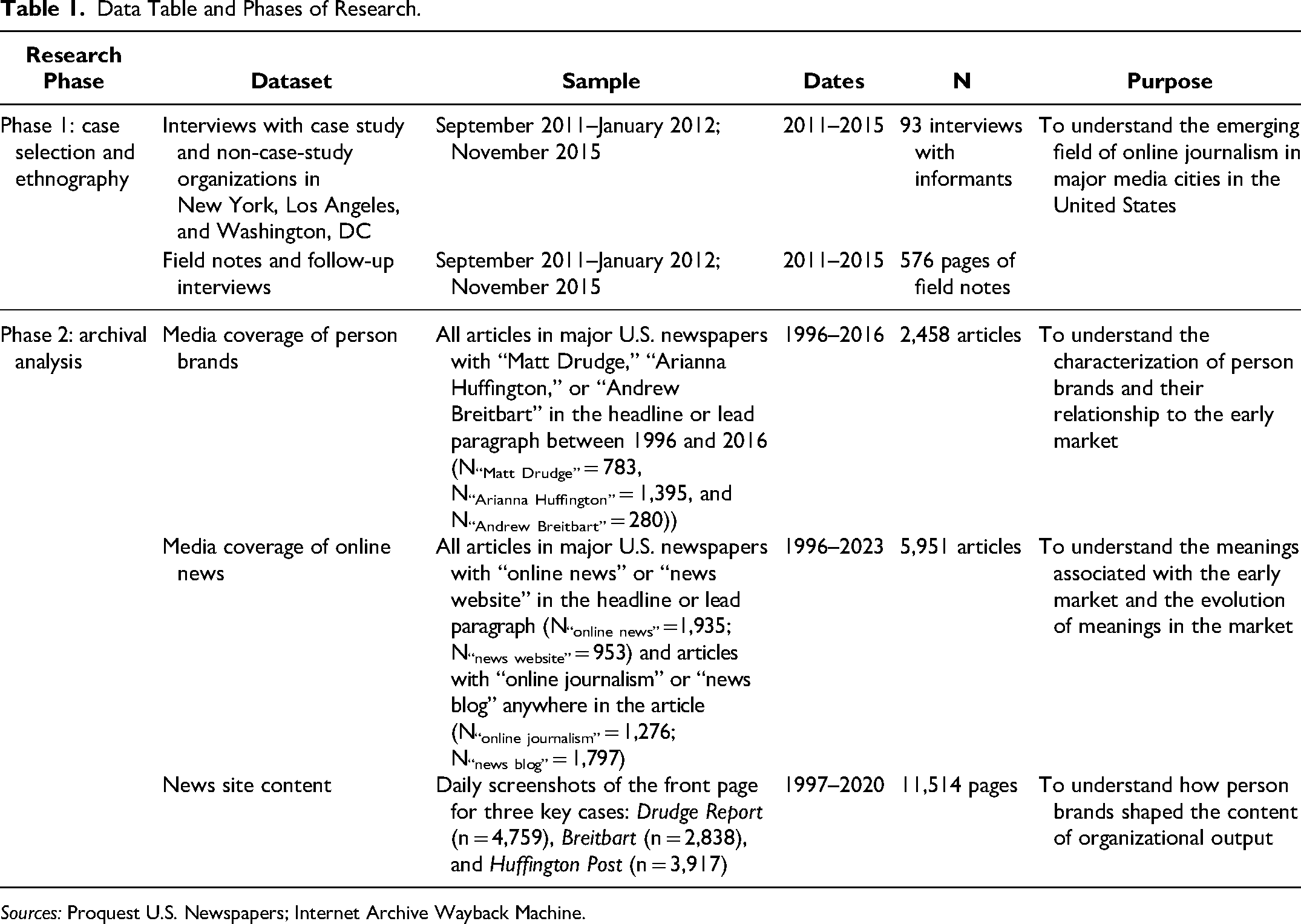
Sources: Proquest U.S. Newspapers; Internet Archive Wayback Machine.
Case Selection and Ethnographic Data Collection (Phase 1)
We began by broadly investigating the existing news industry in the United States, interviewing key players who had worked for organizations such as the Washington Post, the New York Times, Gawker, Vanity Fair, the Daily Beast, ProPublica, and the White House (see Web Appendix B). These informants, who were active during the shift from offline to online journalism, frequently cited Breitbart, Drudge, and Huffington as influential figures—leading us to select Breitbart, the Drudge Report, and the Huffington Post as focal cases for exploring how person brands shaped the emerging market of online journalism.
The first author conducted ethnographic research in Los Angeles, New York, and Washington, DC, including site visits, interviews, informal conversations, and archival research (e.g., daily Google Alerts). Interviews included employees at both digital-only and traditional news outlets, as well as industry experts. In Los Angeles, the author also interviewed Andrew Breitbart and his editorial team. A full list of organizations is provided in Web Appendix B.
Formal interviews followed a structured and semistructured format with a consistent set of questions, while informal interviews were unstructured and conducted during spontaneous, observational moments. Interviews were guided by four protocols: (1) case study organizations, (2) non-case-study organizations, (3) political players, and (4) field experts, with a focus on changing industry norms, values, practices, and key actors (see Web Appendix B). Data were collected over four years (September 2011–November 2015), including 93 interviews, 576 pages of field notes, and 1,433 days of press coverage via Google Alerts (October 30, 2010–October 1, 2013) for the three case study organizations. The press coverage served as a secondary resource and was not coded as part of our grounded theory procedures. Instead, the alerts served as an auxiliary resource used primarily for sampling and contextual awareness—for example, helping us identify informants such as James Boyce, whom the first author contacted after a 2011 Vanity Fair article surfaced through the alerts, and providing real-time awareness of events and controversies that informed the timing and focus of fieldwork. We intentionally excluded this dataset from the ethnographic analysis because it functioned as a tool to support and guide fieldwork, not as a source from which we derived conceptual categories.
Ethnographic Data Analysis (Phase 1)
During the initial stages of data collection, we followed a grounded theory approach (Corbin and Strauss 1990), moving through open, axial, and selective coding. In the open coding phase, we identified emergent concepts such “fast,” “unverified,” “POV,” and “direct audience relationship.” Axial coding enabled us to specify how concepts related to one another and to cluster them into the higher-order analytic categories—namely, person-brand resources and attributes, organizational-level effects, and market-level effects (Figure 2). For example, we found that codes capturing normative cues (e.g., “unverified,” “POV”) were systematically connected to market norms and the retelling of key founding myths (e.g., Breitbart’s Monica Lewinsky story, Huffington’s Brentwood Brunch), a link that informed our abstraction of these patterns into the relationships between person-brand resources, organizational-level effects, and market-level effects. During selective coding, we compared such relational patterns across the full dataset, which allowed us to consolidate initial codes into broader thematic categories aligned with the three higher-order groupings. As patterns reappeared, we refined the coding to reflect the core mechanisms that translated social effects from the person brand to the organizational level (e.g., cultivate high-status connections) and from the organizational level to the market level (e.g., shape category identity) to refine their significance (Web Appendix C).
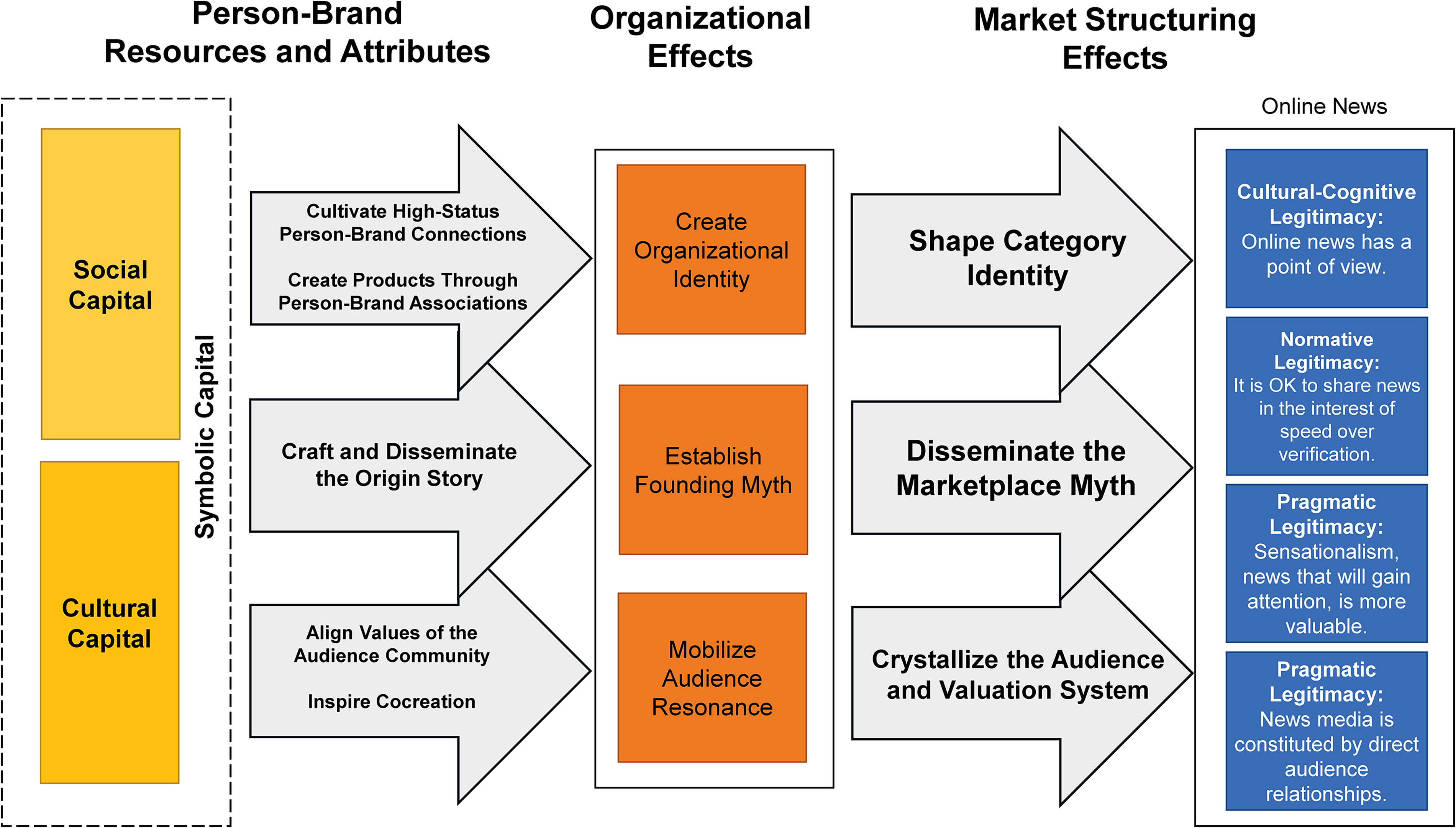
How Person Brands Shape Organizations and Emergent Markets.
Archival Data (Phase 2)
Media coverage of person brands and online news
In the second phase, we collected and analyzed three archival datasets (see Web Appendix D). This sequencing allowed the conceptual categories generated in Phase 1 to inform and structure the coding of the archival datasets. Specifically, the core codes and analytical framework derived from the interview phase were incorporated into a shared codebook, which guided the systematic analysis of the archival materials. First, to trace public perceptions of person brands over time, we gathered all U.S. newspaper articles from 1996 to 2016 in which “Matt Drudge,” “Arianna Huffington,” or “Andrew Breitbart” appeared in the headline or lead paragraph (N“Matt Drudge” = 783, N“Arianna Huffington” = 1,395, and N“Andrew Breitbart” = 280) from the ProQuest Newspapers database. Second, to examine changing perceptions of the online news industry, we compiled a dataset of articles from 1996 to 2023 (see Gamson and Modigliani 1989; Humphreys 2010; Mimoun, Trujillo-Torres, and Sobande 2022). Selecting appropriate search terms was challenging, as industry labels shifted over time. Some queries yielded too few articles (N“news blog” = 2,171; N“online journalism” = 4,067), while others were too broad (N“news site” = 21,710; N“news website” = 15,548). Figure 1 shows the frequency of these terms over time along with key dates in the market emergence timeline (see also Web Appendix D).
After preliminary analysis of these queries to ascertain both completeness and conciseness, we settled on fully analyzing all articles with “online news” or “news website” in the headline or lead paragraph (N“online news” =1,935; N“news website” = 953) and “online journalism” or “news blog” anywhere in the article (N“online journalism” = 1,276; N“news blog” = 1,797). This set of articles reflects discourse where “online news” was the primary topic and covers the evolution of terms. We also conducted a robustness check of articles from different alternative sets or subsets (e.g., with “online news” anywhere in the article; full set = 15,127; with only “news blog,” only “news website,” etc.; Web Appendix D). Example publications include the Washington Post, Tampa Bay Times, and Oakland Tribune.
The final dataset includes 5,951 articles on online news. As shown in Figure 1, public discourse gradually increased from 1996 to 2016 before declining—a common legitimation pattern, where attention peaks during emergence and fades after mainstream adoption (Johnson, Dowd, and Ridgeway 2006; Humphreys 2010; Schneiberg and Clemens 2006).
Site content
Finally, as a secondary source, we collected site content to understand how person brands shaped content. We collected all posts from the Drudge Report, the Huffington Post, and Breitbart since 1997 to assess the percentage of posts by person brands and examine their role in shaping the organization's final product.
Archival Data Analysis (Phase 2)
In Phase 2, we analyzed patterns of market emergence, both applying codes developed in Phase 1 and looking for new codes. We qualitatively analyzed all 2,458 person brand articles and a subsample of 800 online news articles (200 randomly selected from each keyword) to identify themes and market-shaping effects (Humphreys and Wang 2018). Some codes duplicated existing codes from Phase 1 (e.g., unverified sources) while others pointed to new concepts (e.g., attention economy) that more directly informed the market-shaping process. After identifying key concepts, we searched the full dataset for additional examples and tracked key events to understand market development (Giesler and Thompson 2016; Maciel and Fischer 2020). We made limited use of automated text analysis (Humphreys and Wang 2018) to highlight key patterns in the data. Notably, the evolution of norms, values, and practices in the industry was best understood from the qualitative analysis rather than quantitative word counts. For example, description of a norm like “fast and unverified” varied to such an extent that a dictionary was not reliable (e.g., Humphreys and Wang 2018). Details for the text analysis are in Web Appendix D.
Findings
How Person Brands Shape Market Emergence
We identify three interrelated ways in which person brands shape markets (Figure 2). First, they leverage social capital to establish organizational identities and market positions, which, in contexts of limited prior knowledge, generate early market attributions and define category identity, thereby building cultural-cognitive legitimacy. Second, person brands draw on social and cultural capital to construct founding myths that circulate through meta-field discourse—narratives about the market's backstage rather than its outputs. Amplified by symbolic capital, these myths encode norms and values that, through repetition and broad dissemination, normalize expectations for the emergent market. Third, person brands mobilize cultural and symbolic capital to mobilize audience resonance and inspire cocreation. These forms of engagement routinize attention and participation, leading to the creation of distinct market segments that provide pragmatic support through monetization. As these dynamics consolidate, a value system centered on attention and sensationalism emerges, conferring both pragmatic and normative legitimacy. In the following sections, we show how person brands shape organizations and subsequently build legitimacy for the broader market. Although person brands directly deploy their capital to create organizational assets, over time the establishment of market legitimacy becomes a more social process, as multiple stakeholders (media, experts, consumers, competitors) interpret and disseminate meaning and practices of the organization and consumers when viewed collectively as a market (Humphreys 2010). Our analysis focuses on how specific organizational resources built by person brands translate into different forms of legitimacy.
Social Capital, Organizational Identity, and Cultural-Cognitive Market Legitimacy
First, person brands use their social capital to shape organizational identity and create distinct market positions. They strategically build elite networks not only for connection but also for meaning and influence. These networks establish oppositional yet parallel brand identities, leading to cultural-cognitive attributions—such as the perception that organizations reflect specific political viewpoints.
Person brands cultivate high-status connections
Person brands use their social capital to cultivate high-status connections, which give their organizations a strong identity. One illustration of this process is how the social world cultivated by Huffington translated to the organizational identity of the Huffington Post. “She is the ultimate networker, constantly connecting people. I mean not connecting me [with anyone],” explained a technology reporter at the Huffington Post's New York office (HPM9, October 5, 2011, New York),
1
“but connecting the ones that make sense. You know—the ones that work with her. Not for her, but with her.” Constructing and maintaining ties with high-status players has been at the core of Huffington's work. James Boyce, a political consultant, further explains, “She created a network of influencers in the lead-up to the launch [of the Huffington Post in 2005], positioning herself as the key connector between the East and West Coasts” (November 18, 2011, New York). In this way, Huffington built organizational identity through her personal connections, creating a unique brand position that is strategically placed within the new field (“key connector between the East and West Coasts”). Collectively, her connections have meaning that is socially recognized, and social capital is constituted not only by the quantity but also the quality of these connections. An early mention of Huffington in the media dataset explains: The Observer has learned that Warren Beatty … will likely join a lineup of liberal all-stars who will “group blog” on a Web site to be launched next month by columnist Arianna Huffington. … it will also feature such boldface bloggers as Senator Jon Corzine, David Geffen, Viacom co-chief Tom Freston, Barry Diller, Tina Brown and Gwyneth Paltrow. If the name seems to echo that of the Drudge Report, the mega-site operated by the rightward-tilting unofficial editorial director of America's news cycle, Matt Drudge, well, it's supposed to. (New York Observer [Hagan 2005]) She [Huffington] had turned the Huffington Post into one of the most recognizable media brands of our time. Within a decade, the site became part of the media firmament and Huffington became a global brand unto herself … and the keeper of one of the more prodigious Rolodexes in the industry. She counted among her friends everyone from Charlie Rose to Ann Getty and Henry Kissinger to Barbara Walters. (Cohan 2016)
In opposition to this social world, Andrew Breitbart cultivates his own elite social network. Reporting on a day with Breitbart, a 2010 article in Wired magazine notes: Breitbart arrives at the offices of Fox News on Sixth Avenue. Host Sean Hannity greets him with a fist-bump and calls him “bruthah.” Doug Schoen, Bill Clinton's former pollster waves hello. … Afterward, Breitbart heads downstairs to visit Greg Gutfeld, who hosts the Fox overnight show Red Eye. Then they meet up with Felix Dennis, the high-flying founder of Maxim magazine. (Shachtman 2010)
These opposing person brand identities can also be mapped in media discourse about them. Figure 3 shows a map of word co-occurrences in all articles about Drudge, Huffington, and Breitbart in our person brands media dataset. The distance between words is determined by how often they are used together within the same paragraph (see also Coskuner-Balli 2020).
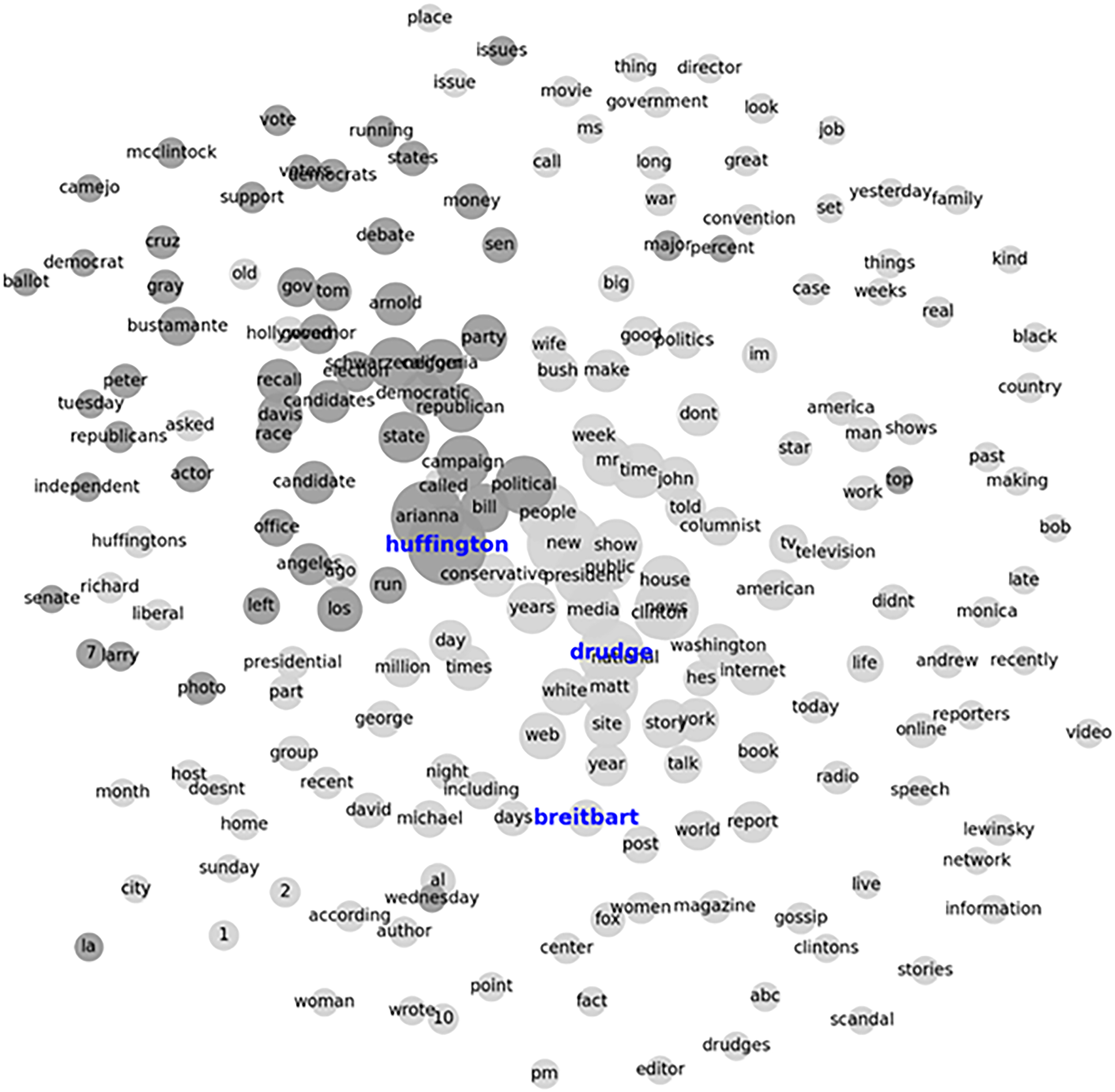
Cluster and Network Map of Word Co-Occurrences in Articles About Huffington, Drudge, and Breitbart.
As Figure 3 illustrates, two clusters emerge: one that includes Huffington, and one that includes both Drudge and Breitbart. Huffington is used most often in the context of words like “California,” “Kerry,” and “Democrats,” while Breitbart is part of a separate cluster of words that include “scandal,” “website,” and FOX.” Notably, Drudge exists within the Breitbart cluster, meaning that his name co-occurs more with Breitbart's. Drudge is associated with words like “Internet,” “gossip,” “Newsweek,” “Clinton,” and “Lewinsky.” Web Appendix C contains methodological details for developing the cluster and network graph in Figure 3.
Person brands create products through high-status connections
The social capital of person brands also directly shapes the product, which further reinforces organizational identity. For example, in July 2011, the Huffington Post published a series of videos about female friendships with contributions from many “Hollywood wives” in Huffington's inner circle (field notes, December 12, 2011, Los Angeles). The series included notable women including Kathy Freston, former wife of Tom Freston, who served as CEO of Viacom and played a major role in the growth of networks like MTV and Nickelodeon (Heilpern 2011), and Wendi Murdoch, former wife of Rupert Murdoch, famous for building one of the largest and most influential media empires in the world, including News Corporation and Fox News (Ong 2013). In this way, Huffington deploys social capital to gain exclusive interviews, receive invitations to elite parties, and invite guest contributors. Regular contributors to the Huffington Post included Alec Baldwin, Tom Hanks, Rita Wilson, Gwyneth Paltrow, and many other celebrity A-listers. Editor-in-chief and vice president of the Center for American Progress Faiz Shakir, who was one of our informants, explains how social capital translates to the product: There are a lot of people who are looking for exposure and not money, and most of them tend to have a strong opinion about things, so I think that is part of what has helped make Huffington successful. She has collected a somewhat interesting group of contributors and material that she doesn’t have to pay for, including some of our own initially. (November 14, 2011, Washington, DC)
In contrast to Huffington's public network, Drudge relies on a more hidden form of elite social capital. Though to many he appears to work alone, informants revealed his strong insider connections in Washington, DC, and Los Angeles, which provide him with early access to emerging stories. Citing Drudge's extensive network, Breitbart explained: “You’ll never find out how he gets his news, he just gets it” (December 1, 2011, Los Angeles). As Drudge emphasizes in his Manifesto: “It comes late in the night. An urgent email. A juicy goodie from a source who's been on the money in the past, helping me to pull off … world exclusives” (Drudge 2000, p. 51). He also notes, “Most of my sources are concerned citizens, in and out of government, who don’t like the direction of the White House Press Office” (p. 201). While Drudge portrays his sources as “concerned citizens,” his Manifesto reveals they are more elite than suggested.
In sum, person brands mobilize social capital that is embedded in a world of ideological affiliation to help establish the organizational identity. As both biographical persons and as brands, person brands cultivate high-status connections and use these connections to create the product, both of which create distinctive organizational identities in the emergent market. Yet these also have a “brand” component in that they form a network of affiliations that have meaning to others—and bestow that meaning on the organizational identity of early entrants. In the cases of Huffington and Breitbart, the founders’ social capital among a particular elite group of people gave the organizations a unique identity vis-à-vis others in the burgeoning field.
Organizational identities shape category identity and build cultural-cognitive legitimacy in the emergent market
Person brands create organizational identity through parallel but opposing social capital. But do these organizational identities shape the overall market? We find that, viewed collectively by the media and peers, these organizations shape market attributions about the category—online news—thereby building cultural-cognitive legitimacy. Individual organizational identities, as prototypes, help shape the boundaries of the category and define some of its central aspects (Durand and Paolella 2013). In this case, the ideological opposition between organizations prompts online news to be identified as having a point of view, specifically, a political point of view. This contrasts meaningfully with norms of traditional journalism, which stress objectivity (Lippmann 1931; Schudson 1978; Tuchman 1980). Category identification is shaped not just by person brands or organizations but by a wider set of stakeholders—as media and industry leaders interpret and define emerging category boundaries and criteria (Glynn and Navis 2013; Navis and Glynn 2010; Rosa et al. 1999).
We find that category identity, and thus cultural-cognitive legitimacy, developed from a broad, preliminary set of possibilities to a more specific subset of realities after these organizations became widely known. In both the interview and media data, the boundaries between blogs, online news, and traditional news are initially blurry, but over time cultural categories take shape (e.g., Navis and Glynn 2010). For example, a research analyst explains, “There are certainly sites like … the Huffington Post, where we don’t call them blogs, we call them ‘online-only news sites,’ because I guess another factor about blogs … is their budget or staff. [These sites] have paid staff reporters, so ‘online-only news’ would be their category” (Kenneth Olmstead, September 29, 2011, Washington, DC). There are emergent categorical boundaries between a “blog” and “online news” using the criterion of employing staff, and this transition occurs along with the evolution of the organizations. Steven Mufson, the opinions editor at the Washington Post, explained in our interview: You have things that started as blogs and they are expanding and adding staff, and they are starting to resemble small news magazines, so I think [of] Josh Marshall, who started as a one-person blog and he is now talking about going up to 60 people. Even our own Ezra Klein, who came here as a single blogger and has convinced the Post to hire three people to do what he was doing. So those things are starting to look more like newspapers and they are doing their own reporting. At the same time, newspapers are trying to react faster to acquire some of the characteristics of blogs while retaining some other measure of depth and independence, because a lot of blogs don’t have to be independent; they can wear their opinion on their sleeves. (September 22, 2011, Washington, DC)
In the media data, as central early-market organizations become more popular, initial unformed market perceptions shift from a space of open possibility to more specific category-level association with topics like politics. A 2011 New York Times article quotes a media researcher as saying, “‘There has been a distinct increase in the number of Americans getting online news from sites that share their own political views, particularly among those with strong ideological leanings,’ said Aaron Smith, senior research specialist for PEW” (Wayne 2011). As noted, readers now get news from an online source that is not just personalized but politically personalized, one that “share[s] their own political views.” Another article says, “The boom in online news arguably has helped polarize the American political scene, but it has also given readers access to far more data and viewpoints than they had under the system of editors and reporters that make up the traditional American newsroom” (Christian Science Monitor [Jonsson 2013]). “Far more data and viewpoints” acknowledges the open initial possibilities, but the article also recognizes that these viewpoints have become increasingly political.
In this way, the market identity of “online news” shifts from an initially open and unsettled understanding of personalization to more politically defined meanings. As our data show, these category perceptions are shaped by multiple actors, including area experts (e.g., Pew Research Center), journalists who select sources and frames, editors who set reporting agendas, and organizations themselves, which articulate category boundaries and evaluative criteria.
Cultural Capital, Founding Myths, and Normative Market Perceptions
The second way that person brands shape early markets is by establishing founding myths. Myths help establish and institutionalize norms in society (Malinowski 1926). Person brands leverage social and cultural capital to craft culturally resonant stories that fit the moment, establishing founding myths not only for their organizations but, as early market successes, for the market as a whole. At the collective level, origin stories disseminated through meta-field commentary and news coverage help instill industry norms, reinforced through peer-to-peer narratives and discussions. As a marketplace myth (Thompson 2004) based on the origin stories of these organizations, a consensus emerges that online news is based on speed and salaciousness over verification. The symbolic capital of person brands, then, enables the dissemination of myth through continual media coverage of them and the “backstory” of their organizations through reporting on the field itself (Rindova et al. 2005).
Founding myths support and explain organizational identity but are not identical to it. Organizational identity is shaped through social connections and content, while founding myths rationalize and normalize that identity, aligning it with broader norms rather than merely signaling brand or organizational positioning. In our case, organizational identities are grounded in founding myths but can evolve beyond them.
Person brands craft founding myth
One prominent illustration of how founding myths shape market norms comes from the Drudge Report. In 1998, the Drudge Report was the first to break the story of President Clinton’s affair with Monica Lewinsky, but it did so with the headline “NEWSWEEK KILLS STORY ON WHITE HOUSE INTERN; BLOCKBUSTER REPORT; 23-YEAR OLD, SEX RELATIONSHIP WITH PRESIDENT” (Russell 1998; capitals in original). The story behind the headline, however, was that Drudge had discovered the story by hanging around the Newsweek offices (field notes, September 21, 2011, Washington, DC). The story, and the meta-field discourse that followed, cemented Drudge's name in the world of online news and subsequently elevated his status in the field through peer recognition. As Michael Isikoff, the journalist at Newsweek who was scooped by Drudge, explained in an interview with us, [The Clinton-Lewinsky] scandal was a sweet, generous gift to Drudge. … Obviously it was the information that mattered, what appeared online was not the substance; when it came out online, he didn’t have it, he was just picking up gossip and repeating it, and then when mainstream news organizations reported it and explained the evidence, that was the story. (September 29, 2011, Washington, DC) Drudge was the first to realize that what went on in newsrooms was a get-able story in itself…. That is how he got the Lewinsky story. The key thing for him was finding out that Newsweek—where I was working at the time—was covering the story. (September 21, 2011, Washington, DC)
The founding myth of the Huffington Post also illustrates how person brands shape normative legitimacy of markets through founding myths. Many informants referenced the “Brentwood brunch” as a key founding moment for the Huffington Post: The morning after John Kerry lost the 2004 election, Huffington hosted a gathering at her estate located in the neighborhood of Brentwood in Los Angeles, at which she urged the group to join her publication, which was intended to be the “liberal Drudge” (field notes, November 18, 2011, New York). This story unites social and cultural capital to encode meanings of celebrity news and political action that carry forward in the market. In these examples, founding myths craft compelling stories that reinforce organizational and market norms, emphasizing norm-breaking, scandal, and political activation. They are enabled by the founders’ social capital—Drudge through newsroom access and Huffington via her political network—and guided by their taste in story selection. Leveraging social, cultural, and symbolic capital, these myths are institutionalized through meta-field commentary, as other outlets retell them and solidify their meaning for audiences. We next turn to how founding myths shape market perceptions and underlying norms in the emergent field.
Founding myths shape the marketplace myth and establish normative legitimacy
Person brands cultivate founding myths about their organizations, and these origin stories evolve into broader marketplace myths (Thompson 2004) that legitimize shifts in journalistic norms. As they are disseminated through meta-field commentary and media reporting, these myths offer cosmological rationalization (Suddaby and Greenwood 2005), framing such changes as inevitable outcomes of technological progress. As late as 2025, the myths are being retold and linked to industry norms: [What was] less obvious at the time was what Drudge had changed. … He proved that rumor, gossip and partial information could drive the news cycle if the story was salacious enough. It opened the door to “it's out there” journalism, where the existence of a rumor could become the story itself. (Jacobson 2025) On Jan. 17, 1998, something seismic happened. Drudge, a … blogger known for his anti-Clinton scoops and a fast-growing email list, broke the story himself … a rumor bouncing around D.C. newsrooms became a global story. … He hit publish, and editors … had a decision to make: Ignore the rumor and risk irrelevance, or chase it and risk their standards. Suddenly, the rumor itself became the story. (Jacobson 2025)
The founding myth of the Huffington Post has also been extensively retold. For example, a December 2005 Vanity Fair article titled “Arianna Calling!” reads: A woman who has become famous for her gold-plated Rolodex, Huffington put out calls to her friends … asking them to contribute to her site. And because they “adore Arianna,” or owe her a favor, or ‘could not resist her,’ about 300 of them said ‘yes’ … mainly liberals but a few from the right. (Andrews 2006) He [James Boyce] showed his proposal for the “liberal Drudge” … to Huffington, his friend with the Hollywood connections. … They agreed that the website should highlight Huffington's personality more effectively than her then-existing website at ariannaonline.com. They spoke about getting “scoops” and “exclusives” from their contacts in the media and the Democratic Party and recommended that “luminaries and public figures should be invited to blog on the planned liberal website.” (Cohan 2011)
Traditional reporting on online news often defines the emerging industry through its founding myths, using them to explain new norms and practices. These myths—like those of the Drudge Report and Huffington Post—frame the industry as fast-paced, unverified, and driven by engagement and provocation. One article reports, Sites such as Huffington Post and Drudge Report don’t care where it came from, just that it's interesting, says [Jupiter Research analyst Barry Parr]. Traditional newspapers, if they are going to survive, need to follow Huffington's model, he says: “If they don’t point them to interesting stories that are elsewhere, Arianna will.” (USA Today [Jefferson 2007])
In this way, the stories of Drudge (and Huffington and, later, Breitbart) prompt a conversation about reporting standards in this new market vis-à-vis the traditional market, further illustrating how certain organizations are reshaping its norms (e.g., Green Bay Press-Gazette [Wasserman 2009]). A quantitative overview of articles about Drudge, Huffington, and Breitbart reflects their associations with different reporting topics and norms. The word “scandal” is highly and uniquely associated with Drudge and Breitbart; 25.4% of stories about Drudge and 19.3% of stories about Breitbart contain the word “scandal” (vs. Huffington's, 3.9%; χ2 = 214.6). On the other hand, Huffington is uniquely identified with the word “celebrity” or “celebrities” (Huffingtoncelebrity = 12.6%, Drudgecelebrity = 10%, Breitbartcelebrity = 5%, χ2 = 14.03).
Symbolic Capital, Mobilizing Audience Resonance, and Pragmatic Market Support
The final way that person brands shape emergent markets is by mobilizing audience resonance—engaging early, enthusiastic consumers by virtue of their cultural and symbolic capital that is the hallmark of person brands as parasocial entities (Aggarwal and McGill 2012). Person brands serve to align values and inspire cocreation among a like-minded set of consumers who shape and support the product produced by the organizations. As prior work has shown, person brands can serve as a cultural touchstone for emerging social movements, crystallizing an audience who regularly engage with the new market (Wieser, Luedicke, and Hemetsberger 2021). Their cultural and symbolic capital can bring together a previously unrecognized crowd culture, which may eventually form a viable market segment (Fourcade and Healy 2017; Holt 2016; Klein 2009). Based on this new valuation model and cocreative practices, attention and audience engagement become recognized as a valuable resource, thereby providing pragmatic legitimacy in the emergent market.
Person brands align values of the audience community
Person brands leverage cultural and symbolic capital to inspire early enthusiasts who rally around particular values embodied by the person brand. Once aligned, the three online news organizations mobilize audience resonance in their own way: Breitbart with partisan rage, Drudge with prurient curiosity, and Huffington with celebrity charisma.
For example, using her own astute cultural taste, Huffington recognized prior to starting her website that she needed to move from the periphery to the center of liberal culture. An interviewee refers to this strategy: Everyone knew Drudge and what he could do for a [political] campaign. But she [Huffington] did something different. She really understood the California electorate … and she knew what she wanted [to do]. So, she made it happen, and everyone won out in the end. (HPM7, October 4, 2011, New York)
By “really [understanding] the California electorate,” Huffington deployed cultural capital—her sense of taste and intuition for cultural fit—to appeal to a specific audience and align with what that audience might find interesting (e.g., left-leaning celebrity content).
Similarly, Breitbart created audience resonance by aligning values with an early partisan audience, an outlet for antiestablishment, right-leaning online readers. Breitbart's mainstream success emerged with BigJournalism and BigGovernment, which he created around oppositional values to the status quo institutions (field notes, November 11, 2011, Los Angeles). As a result of his affiliation with this emerging movement and as an outspoken critic of the Left, Breitbart began receiving tips from readers, whom he refers to as “foot soldiers” or “new media warriors.” He writes: I love finding allies. Three years ago, I was mostly a behind-the-scenes guy who linked to stuff on a very popular website. I always wondered what it would be like to enter the public realm to fight for what I believe in. I’ve lost friends … But I’ve gained hundreds, thousands—who knows?—of allies. (Breitbart 2011, p. 6)
Person brands inspire audience cocreation
Person brands are well-known for creating connections with their audience through parasocial relationships (Thomson 2006). Here, the symbolic capital that they cultivate also helps inspire cocreation on the part of consumers and other allies who contribute to the product. Figure 4 illustrates one way that all three sites engage with their audience. To be sure, technology enables many forms of audience engagement (Baym 2015; Martinviita 2016). However, while reader comments have been technically possible since at least around 2000, we find that the cultural and symbolic capital of person brands supercharges this possibility, motivating people to use this technology and fulfilling its technical promise (Orlando Sentinel [Ritchie 2011]). While Breitbart and the Drudge Report solicit user tips and encourage the audience to be part of the story, the Huffington Post creates a community of comments, providing content that is published to the site directly. In this way, all three early entrants shape practices for integrating content from the audience itself, who are actively involved in creating it.
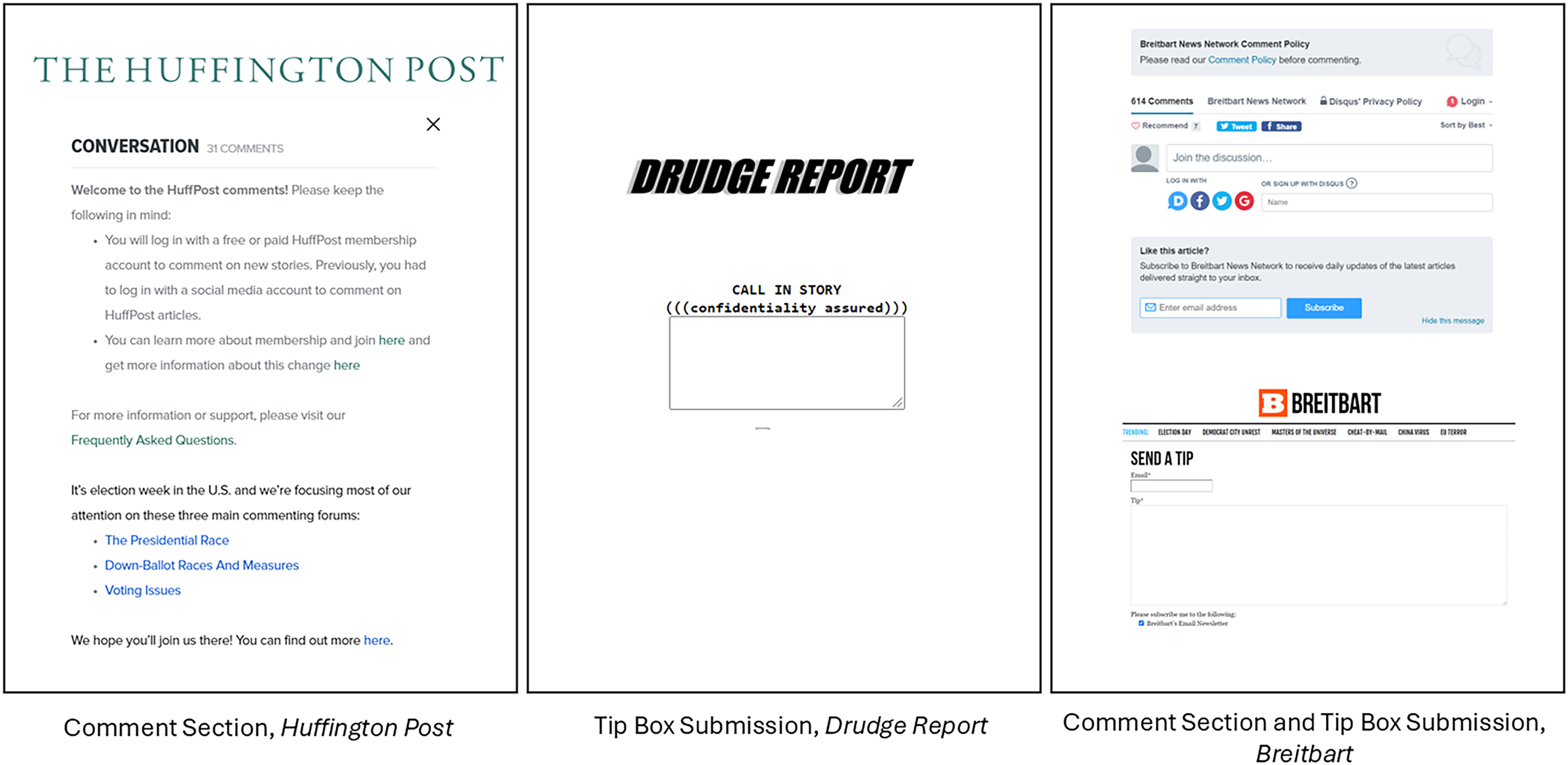
Examples of Calls for Audience Engagement.
Breitbart provided a platform for content from his readers, solicited story tips and leads, and, at times, actively assisted investigations. For example, the Anthony Weiner scandal was broken by BigJournalism, a key site under the Breitbart umbrella, and Breitbart “foot soldier” James O’Keefe was inspired to go undercover to investigate ACORN, a left-leaning organization that fell under scrutiny of those aligned with the Tea Party. Breitbart played a key role in publicizing the videos, saying, “My e-mail tip box was filled with questions from readers asking ‘What are we going to do about ACORN's Census involvement?’” (Breitbart 2011, p. 4). Breitbart's reference to his e-mail tip box and readers asking “What are we going to do” illustrate the importance of his network of sources, audience resonance, and value alignment in fueling cocreation.
Similarly, the Huffington Post offers a space for comments and discussion after each post. While these are now commonplace tools of online news, publications like the New York Times did not offer them when they first entered the market (Lichterman 2016). Many of our industry informants commented on the success of online news to cultivate audience engagement. The Huffington Post, for example, was reported to attract “6,000 bloggers who write for free” (Gainesville Sun 2011). In this way, the audience aligned behind Huffington's values eagerly contributed to appear alongside A-listers who also count themselves among Arianna's “friends.”
Audience resonance and cocreation establish pragmatic legitimacy in the emergent market
The audience engagement engendered by these organizations translates to practical support for the market by creating identifiable market segments and by clarifying the value of the product for that segment. Industry leaders and the media cite online news, and particularly these organizations, as a place for “conversation.” As one article notes: The site [Huffington Post] does not want to risk losing its robust culture of reader dialogue. Visitors have authored more than 260 million comments since [the site] was launched. … On Wednesday, for example, a story on the site's homepage about … Obama's unchanged opposition to legalizing marijuana drew more than 1,700 comments. (Boston Globe [Borchers 2013]) One of the things that makes the Huffington Post unique is … that we are the hybrid of a news site and a social networking site. We were the first to understand that combination and nobody else does what we do. We are a little bit of Google, we are a bit of Facebook, we are a bit of Twitter, but we are a news site. But we are so aggressive about pumping out about all we do and connecting all that we do to social networking sites, that we are really a social networking site, we are a news community. … [N]o other site has that rich level of commentary—supervised commentary with little merit badges for super-commenters. It is genius. (September 21, 2011, Washington, DC)
Once established as shared practice, audience resonance and cocreation shift conceptions of value and valuation in the new market, as reported by industry peers and media. Some industry informants described to us their “Drudge moment,” when the Drudge Report linked to one of their stories, leading to a huge increase in traffic to their site (field notes, September 29, 2011, Washington, DC). As one informant explains, I remember seeing a post on Twitter, linking to a Politico story that read: “Hey Matt Drudge, look over here!”
He added that many news organizations write content that they hope will be used as a source for Drudge, thus increasing their online traffic (field notes, September 30, 2011, Washington, DC). An informant explains, For Politico, their profit model is entirely based on web traffic. That isn’t true of the Washington Post or the New York Times, whose percentage margins are much smaller and whose profits aren’t determined the same way. There is no question that if you are Politico, the difference between getting X amount of Drudge links a month and 2X the amount of Drudge links is actually a lot of profit. We are talking of an uptick or downtick of 10% in your total traffic, which is directly correlated to your overall profit. Nobody knows for sure, [but] it would be almost bad business for them not to take into account whether a story or headline would be linked to Drudge. (HPM16, November 11, 2016, New York)
The observation that audience resonance is a meaningful part of the new value system in the market is also made in reporting about online news in general. For example, one article says, Nearly all online news organizations are using some variation of the most-popular list. In essence, it gives the readership a greater role in shaping what is considered most newsworthy. We journalists are constantly making decisions on what stories should be given the most prominence on the site. The most-popular list, which is generated from tracking information we have on which stories are getting the most visitors, is our readers’ opportunity to tell us—and everyone else—what they think is most interesting. (Salt Lake Tribune 2007) Traditionally, people follow a news organization because it is reputable and does a good job. Now, with online news, people go to a Web site because it is the easiest to use or because it has the most interesting content. This is a much different way of thinking and habits will need to be broken in order for news organizations to succeed online. (Raleigh News & Observer 2009)
In sum, person brands shape emergent markets by creating organizational identities, founding myths, and resonance with early adopters. Drawing on social, cultural, and symbolic capital, they attract and retain supporters, whose collective recognition by media and peers establishes category identity, marketplace myths, and new valuation systems. We next turn to the implications for marketing theory and practice.
Discussion
A key issue in market driving is creating meaningful, unique, and valuable assets that yield a competitive advantage to the firm and build a strong space for the market in the long term. We find that person brands can powerfully shape the norms, values, and practices in an emergent market. Overall, we find that person brands use their social, cultural, and symbolic capital to effectively establish organizational identity, disseminate founding myths, and create audience resonance. These assets, in turn, establish cultural-cognitive, normative, and pragmatic legitimacy in the emergent market. When early organizations are viewed collectively by the general public and others in the industry, their identity, myth, and resonance shape perceptions of what the new market is, acceptance for how it should function, and practical support for its existence going forward.
These three elements—organizational identity, founding myth, and audience resonance—underscore the role of person brands in constructing core symbolic marketing assets at an early stage. Namely, strong brand positioning comes from the differentiated organizational identity that person brands provide. Brand myths create beliefs that help normatively support marketplace practices (e.g., speed over verification), and audience resonance creates legitimate brand practices for relating to and serving consumers.
Our results underscore the importance of people in driving markets. While firms, consumers, and intermediaries can all shape markets (Dolbec and Fischer 2015; Humphreys and Carpenter 2018; Maciel and Fischer 2020; Martin and Schouten 2014; Scaraboto and Fischer 2013, 2015), these groups are all constituted of individual people. As we have shown, when a person has social, cultural, and symbolic capital, these resources grant them an outsized influence over the market, particularly in early stages. Complementing previous work, our research shows that person brands can be powerful levers not only for consumers (Thomson 2006) but also for other stakeholders. Their work can have a profound effect on the nature of emergent markets, not just established markets (Parmentier, Fischer, and Reuber 2013). Organizational research recognizes institutional entrepreneurs—actors who drive institutional change (Battilana, Leca, and Boxenbaum 2009; DiMaggio 1988)—but has largely overlooked the distinct influence of person brands. Beyond shared traits like social ties and capital, person brands provide symbolic resources that shape market perceptions, build organizational identity, propagate compelling myths, and attract aligned audiences, serving as a source of legitimacy and advantage for firms and emerging markets. Person brands work in tandem to structure an emergent market—defining the field by both their commonalities and differences. These oppositions may appear as contests (Bothner, Podolny, and Smith 2011) or through other tournaments of value (Appadurai 1986; Mauss [1925] 1990) in which people compete for status, contests that inspire interest from a broader public (Rindova, Pollock, and Hayward 2006) and support among specific constituencies.
The Role of Person Brands in Shaping Other Emergent Markets
Person brands in other markets
Although our focal study is the market of online news, we believe that this pattern can be observed in other industries as well. Elon Musk, Steve Jobs, and Mark Zuckerberg's personalities have all appeared to shape the markets they enter (Ball, Kluger, and de la Garza 2021; Isaacson 2014; Marwick 2013). History also provides examples where person brands vie to define early markets. Thomas Edison squared off against Nikola Tesla, for example, over early electrical systems, and perceptions of the technology were shaped by their personalities—Edison as the dependable workaholic and Tesla as the brilliant “high voltage” personality (Jones 2004). Yet exactly how person brands shape early markets has not been previously examined, despite their potential importance in imprinting new industries (Johnson 2007; Stinchcombe 1965).
The markets for personal computing, electric vehicles, and electricity have all been indelibly shaped by the person brands that are early entrants. Table 2 shows three case examples where emergent markets have been shaped by person brands. For example, oppositional identities for the PC market were famously created by the personalities of Steve Jobs and Bill Gates, who shaped marketplace meanings and attracted high-status talent to the organizations through their social capital (Cringely 1996a, 1996b). Early founding myths around both figures circulated in the popular press, television commercials, books, and movies as they leveraged their cultural and symbolic capital to shape the stories of their organizations (Isaacson 2011; Manes and Andrews 1994). These myths encoded meanings around the person brands involved such as Gates’s legendary competitiveness and Jobs’s inspiring norm-breaking. These myths shaped the market even though, as historians have noted, Xerox actually laid the groundwork for the early PC market. As Gates famously remarked to Jobs, “Well, Steve … I think it's more like we both had this rich neighbor named Xerox and I broke into his house to steal the TV set and found out that you had already stolen it” (Weinberger 2017). The cultural and symbolic capital of Jobs and Gates also attracted loyal supportive followings, early adopters who cocreated products (Jensen Schau and Muñiz 2006) and provided avid early consumer support through computer clubs and brand communities (e.g., Campbell-Kelly 2001; O’Guinn and Muñiz 2005). In our case, supportive constituencies may have been the product of increasing political polarization (Iyengar et al. 2019; Pew Research Center 2014), but person brands in other industries may benefit from crowd cultures (Holt 2016) that emerge from other societal shifts such as changes in diet (e.g., vegans), newly legal product (e.g., cannabis), new technologies (e.g., AI), or sports (e.g., mixed martial arts) that are not necessarily related to political ideology (Hsu, Koçak, and Kovács 2018; Huff, Humphreys, and Wilner 2021).
Person Brands in Emergent Markets.
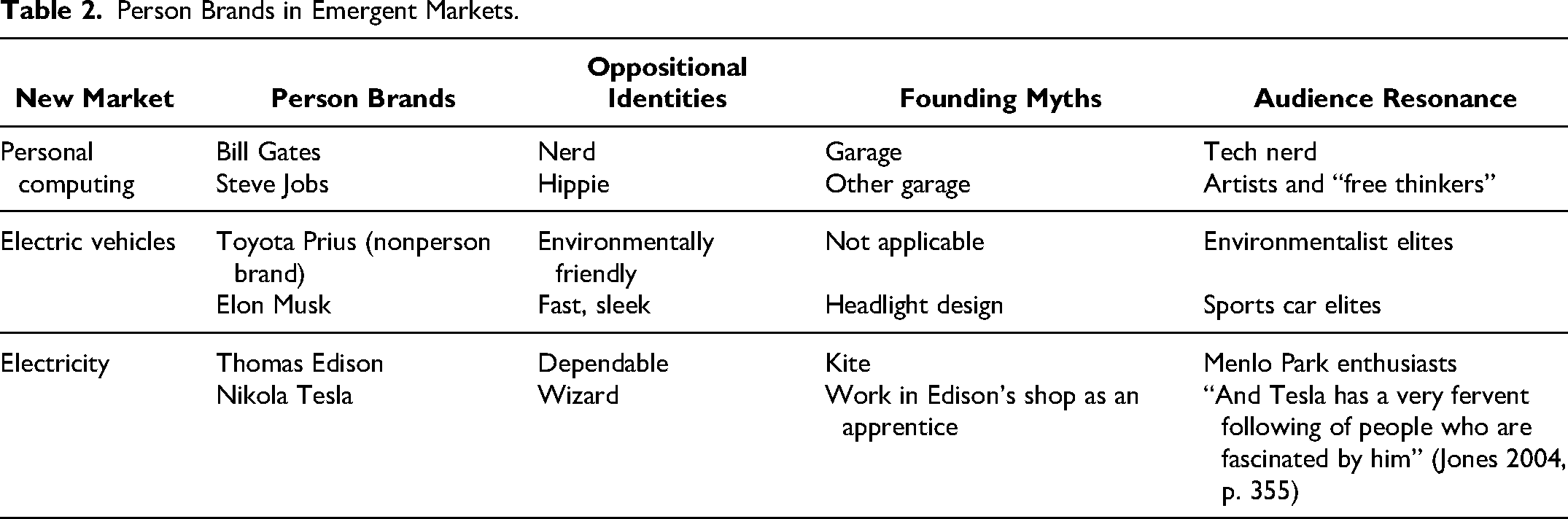
Person brands need not be the original founders. Elon Musk entered the electric vehicle market as an early financial backer at Tesla, noting, “Nobody wants to buy a $60,000 electric Civic. But people will pay $90,000 for an electric sports car,” designing the headlights (Higgins 2021; Isaacson 2011), and inspiring early adopters to preorder vehicles (Fleming and Masunaga 2016). Compared with the non-person-branded Prius, Musk's influence has been highlighted in industry accounts, further spreading the founding myth of luxury electric vehicles (McKenzie 2019), a market in which consumers spent $219.31 billion in 2025 and every major luxury brand from Ferrari to Porsche produced an electric vehicle (Mordor Intelligence 2025). This shows that even when they are not founders or first movers, person brands can exert outsized influence by attracting resources and shaping market ideas.
Similarly, person brands shape emergent markets today. Sam Altman of OpenAI has become a prominent figure in the emerging AI market, with his personal brand and OpenAI's origin story widely disseminated through podcasts, industry reporting, opinion pieces (Brooks 2023), and long-form accounts (Hagey 2025; Hao 2025). These narratives—forms of meta-reporting—connect Altman to the norms, values, and practices of AI as both a product and a technology (Honan 2025). As Brooks (2023) asks, “Can one organization, or one person, maintain the brain of a scientist, the drive of a capitalist and the cautious heart of a regulatory agency?” In a field where cultural-cognitive and normative legitimacy remain limited, these initial representations and the people shaping them can strongly influence public perception.
Boundary conditions
The mechanisms we identify, driven by social, cultural, and symbolic capital, highlight aspects of our work relevant to other emergent industries. Person brands in our context attract more media coverage than other entrepreneurs, with journalists reporting on behind-the-scenes organizational activity—a term we call meta-field discourse. Similar patterns appear in industries like fashion and technology, where lead users seek insights into influential personalities. Oppositional person brands also emerge over time, further reinforcing marketplace myths. Two intuitive examples are the PC wars between Bill Gates and Steve Jobs and the electricity wars between Edison and Tesla. Notably, there are books, documentaries, and feature-length reporting (meta-field discourse) about these dueling personalities (Jones 2004). These are effective in building legitimacy with external audiences only to the extent that stories about person brands are covered in broader, mass media outlets. While exposure to niche audiences through trade publications and other market-specific outlets may help build internal knowledge about market practices, broader legitimacy may be limited without larger exposure to a broader public.
Transmission of organizational assets by person brands can be limited by industry context. Intermediaries—media, experts, and others—play a key role in conveying identity, founding myths, and audience resonance. If these intermediaries are absent, or the industry resists easy categorization and storytelling, person-brand capital is less likely to achieve broad legitimizing effects. Niche trade coverage may reach a limited audience, but without broadly narrativizable person brands, societal impact is constrained.
Broader social norms can limit person brands’ ability to build normative legitimacy. For example, Hugh Hefner, Bob Guccione Jr., and Larry Flynt increased public awareness and cultural-cognitive legitimacy for soft porn, or “gentleman’s” magazines, in the late 1970s (Fraterrigo 2009), but their influence on normative legitimacy was constrained by prevailing social norms (Becker 1963). Similarly, some industries remain stigmatized and may even benefit from their outsider status, as shaped by leading person brands (Helms and Patterson 2014; Helms, Patterson, and Hudson 2019).
Person brands draw power from symbolic capital, shaping markets where meaning influences organizational identity, founding myths, and audience resonance. In luxury and fashion, for example, Coco Chanel defined women's leisurewear aesthetics (Garelick 2014; Picardie 2017), Madame Clicquot Ponsardin reinforced Champagne's mythic status (Guy 1997), and Ferdinand Porsche embodied the “rebel apprentice” myth, akin to Andrew Breitbart or Nikola Tesla (Ludvigsen 2009). In symbolic markets, person brands define identity, structure brand meaning, craft enduring myths, and attract early followers. Similar dynamics appear in technology, automotive, and aviation, where myths like the American Dream or David vs. Goliath can sustain brand value for decades (Holt 2004; Isaacson 2011; Rindova, Pollock, and Hayward 2006; Stone 2013).
Person brands have limited influence in markets where social, cultural, and symbolic capital matter less. In low-symbolic or highly technical markets, organizational identity, myth, and audience resonance play a smaller role—for example, mRNA vaccines, which are complex, non-consumer-facing, and less tied to brand meaning. While person brands often shape norms and values through biographies and associations, their impact is context-dependent.
Even strong person brands cannot guarantee organizational success. Adam Neumann's eccentric persona and founding myth helped WeWork attract early consumers, secure $17 billion in investment, and build a devoted community of over 600,000 members, yet the company ultimately failed due to business-model flaws and overexpansion (McBride 2021). Similarly, Elizabeth Holmes leveraged her personal brand to secure vast capital for Theranos, but operational constraints prevented success. These cases highlight a potential downside: Person brands can mobilize cultural power and attract resources even when their underlying businesses are unsound. Although they may initially shape the market, their long-term influence may not be felt or collectively memorialized due to their early exit.
Managerial Implications
Understanding how person brands shape early markets helps managers leverage the social, cultural, and symbolic assets they create to build competitive advantage. Early on, managers can articulate these assets, mitigate risks associated with the person brand, and carry the capital forward after their departure. As markets mature, embedding assets such as social connections, origin stories, and audience resonance into organizational practices and values ensures sustained legitimacy, while planning for the brand's evolution beyond the individual reduces risks of overreliance. Our findings also highlight a key tension: While strong person brands provide advantages, firms and markets tied closely to them face inherent vulnerabilities.
Extending the value of person brands
As we show, both the person and the brand aspects of person brands are critical to building the social capital needed to create strong networks, the cultural capital to make decisions with cultural fit, and the symbolic capital to attract early followers. However, the capital built by the person brand is cultural and can therefore be expressed, extended, and embodied in cultural objects such as stories, rituals, and objects. Organizational and market actors can work to create fixed, enduring meanings by embodying them in material forms. For example, the luxury company Hermès, founded in 1837 (Chua 2022), produces a limited quantity of its highly coveted Birkin bag every year (Taylor 2022). These purses are so rare that they are handcrafted by one craftsman, adding to the mystique of owning this prized cultural object. Levi Strauss, similarly, has built a museum enshrining its products, not just for the firm but for the market as a whole (Downey 2016).
Developing and delegating person brands
As previous studies have shown, person brands can become overtaxed (Parmentier and Fischer 2012). Our study similarly finds that the work performed by person brands is extensive and stretches the resources of a single person. It may therefore be important both to cultivate other person brands within the organization who can perform some of the social and cultural work initiated by the originating person brand and to broaden the organization’s mission to become less dependent on the person brand over time.
Although our cases feature founders as person brands, our managerial recommendations do not assume that managers hire or directly control them. Rather, our recommendations target leaders and brand managers who operate alongside, around, or after the founder. Founder person brands catalyze early organizational identity by leveraging social, cultural, and symbolic capital to articulate founding myths, engage audiences, and spark cocreation in emergent markets. They need not be CEOs or celebrities; what matters is their ability to mobilize credibility, networks, and symbolic resonance. Our findings show that the cultural and social work of founder person brands exceeds what a single individual can sustain. As the organization scales, managers can cultivate additional person brands and broaden the mission, reducing dependence on the founder. The managerial task, then, is not to manage the CEO but to steward and extend the brand-level capacities initially concentrated in the founder.
Founders draw on cultural capital by embedding their values, worldview, and cultural fluency into the brand, creating resonance with specific audiences. Over time, they may accumulate symbolic capital, becoming emblematic figures who represent broader movements, ideologies, or cultural shifts. Crucially, person brand founders invite audiences into cocreation, transforming consumers into active participants who help shape organizational identity and direction.
Organizations can extend this dynamic by cultivating additional person brands whose identities and communication styles align with the mission and resonate with key audiences. For example, Glossier developed early employees and community members into recognizable “editor” person brands, Peloton elevated instructors such as Robin Arzón and Cody Rigsby into central brand figures, and restaurant groups often position chefs as public-facing person brands who embody organizational values and cultural meaning.
Rather than severing ties with the founder's identity, organizations can strategically adapt elements of their brand to preserve this affiliation while simultaneously broadening their appeal to support long-term growth and stability. For example, following Arianna Huffington's exit, the Huffington Post began to rebrand itself more informally as HuffPo, a move that retained symbolic links to its founder while signaling a shift toward a more flexible, scalable brand identity (USA Today [Bowerman 2017]).
Managing founder transition
An important consideration for managers and stakeholders in emergent markets is what happens when a founding person brand departs—through death, exit, or declining relevance. Such transitions entail not only leadership change but also the reconfiguration of a person brand that had become symbolically intertwined with the organization (Parmentier and Fischer 2021). The reaction to Steve Jobs's death, which was framed as a loss for both Apple and the broader technology sector, illustrates how tightly founder identities can anchor market expectations. During our analytical period, two comparable founder transitions occurred: Arianna Huffington's sale of HuffPost to AOL in 2011 and Andrew Breitbart's death in 2012. Prior research shows that founders often function as cobranded partners whose departure can create identity- and resource-based tensions, threatening symbolic capital, narrative continuity, and cultural distinctiveness (Parmentier and Fischer 2021). Our analysis, however, suggests that founding myths can endure beyond a founder's exit, continuing to serve as organizational resources. That said, organizations may still face public concern over weakened identity and the loss of the social and symbolic work performed by person brands. Following Andrew Breitbart's death in 2012, for example, his successor, Steve Bannon, redirected the organization toward his own political aims (Green 2015). Our findings show that some of this work can be redistributed across a constellation of related person brands. The Huffington Post, for instance, cultivated celebrities who deployed their own charisma and cultural capital to extend Arianna Huffington's influence. As with the British royal family, designated members perform symbolic and charismatic functions when the monarch is unavailable.
Gaining attention and approval for the new market
Our analysis also yields market-level insights that can aid firms or other stakeholders who want to shape the early market as a whole. For companies seeking to enter early markets, competing with a person brand is difficult. We find that the meaning of organizations in these markets is greatly enhanced by a person brand and that these person brands derive their meaning from others in the field. Firms should cultivate these assets at an early stage of development and strategically position them in relation to other person brands in the market if they exist. Aligning with a person brand—as Prius did early on when it was endorsed by actor Leonardo DiCaprio in 2001—is one potential option for gaining early attention and approval. Awards, contests, and rankings other ways to gain collective attention and solidify conceptualization of value in a field, especially at the market level (Anand and Watson 2004).
Shaping the market toward social good
Stakeholders interested in driving the market toward prosocial ends may want to align with particular person brands to harness their influence over cultural-cognitive and normative legitimacy in the market. For example, if government or mental health stakeholders had partnered earlier with person brands in social media, perhaps the platforms would have taken a different shape. Consider again the case of Sam Altman and OpenAI, in which questions of the market's evolution toward social good (or ill)—and the alignment with Altman as a person brand with those ends—has been hotly debated both within and outside the organization (Allyn 2023). Organizations interested in driving toward social good should make strategic decisions about which person brands best embody those goals (Table 3).
Managerial Recommendations for Leveraging the Market-Shaping Potential of Person Brands.
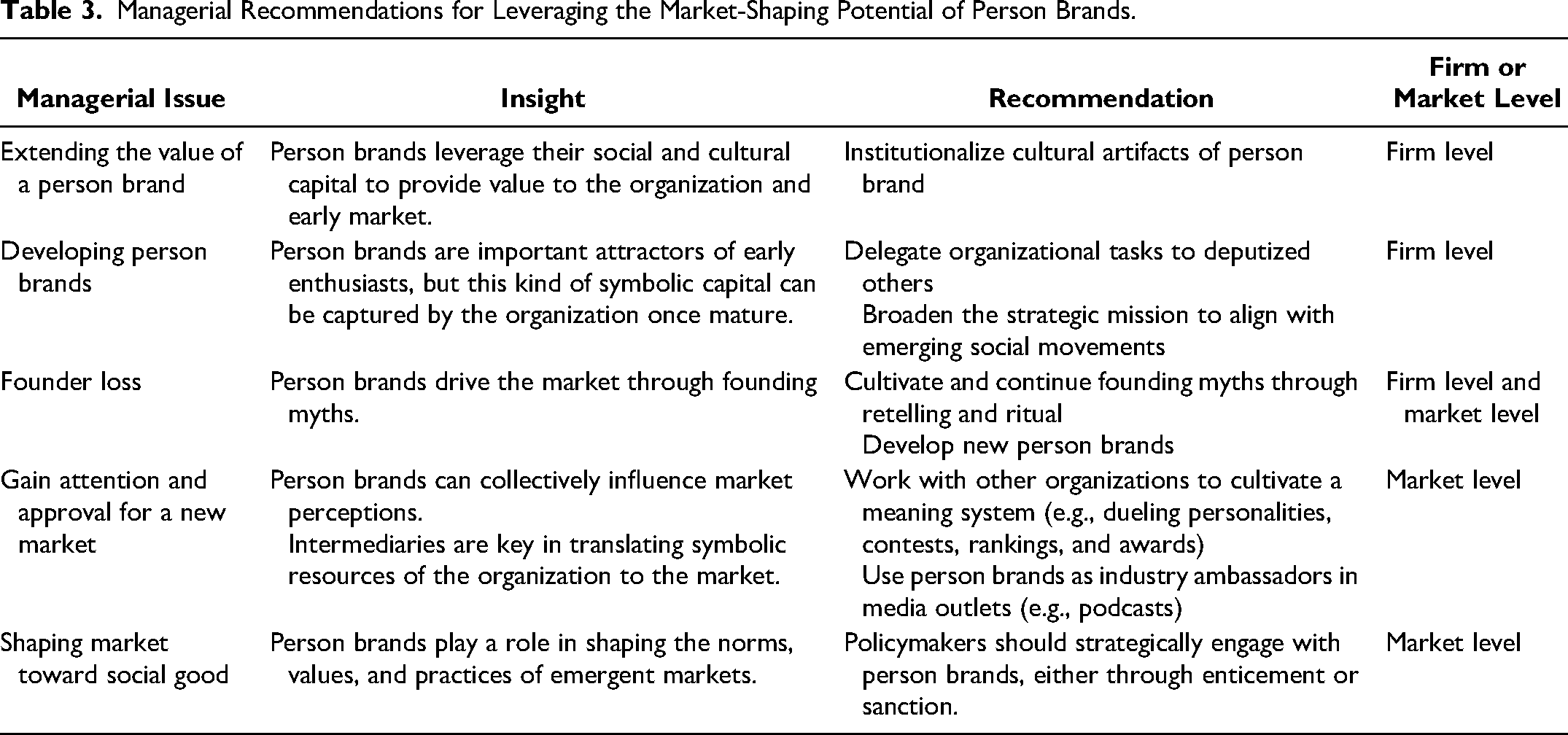
Conclusion
Finally, in considering the role of person brands in shaping early markets, one might consider the degree to which person brands create and shape early markets and the degree to which early markets shape person brands. Are these individuals drivers of market formation or instruments of broader technological and social forces? Understanding and leveraging person brands in early markets therefore requires attention to both individual agency and the social and cultural contexts from which it emerges.
Supplemental Material
sj-pdf-1-jmx-10.1177_00222429261433005 - Supplemental material for All the News That's Fit to Capitalize: How Person Brands Shape Emergent Markets
Supplemental material, sj-pdf-1-jmx-10.1177_00222429261433005 for All the News That's Fit to Capitalize: How Person Brands Shape Emergent Markets by Gillian Brooks and Ashlee Humphreys in Journal of Marketing
Footnotes
Acknowledgments
The authors would like to thank Amber Epp, seminar participants at ESSEC Business School, participants at London Business School Marketing Camp, Wharton Marketing Camp, the Brand Camp hosted by University of Innsbruck, Tianhua Zhu, Eileen Fischer, and Giana Eckhardt for their feedback on the article.
Coeditor
Cait Lamberton
Associate Editor
Cait Lamberton
Declaration of Conflicting Interests
The authors declared no potential conflicts of interest with respect to the research, authorship, and/or publication of this article.
Funding
The authors received no financial support for the research, authorship, and/or publication of this article.

Notes
References
Supplementary Material
Please find the following supplemental material available below.
For Open Access articles published under a Creative Commons License, all supplemental material carries the same license as the article it is associated with.
For non-Open Access articles published, all supplemental material carries a non-exclusive license, and permission requests for re-use of supplemental material or any part of supplemental material shall be sent directly to the copyright owner as specified in the copyright notice associated with the article.
