







Abstract
Many leading retailers have introduced AI-driven autonomous stores, sparking a trend that others are eager to follow. Although prior research has emphasized consumer acceptance of these formats and their operational advantages (e.g., reduced costs, improved efficiency), their broader societal consequences remain underexplored. Across nine online and field experiments, this research demonstrates that consumers engage in less prosocial behavior after interacting with AI-driven autonomous (vs. human-operated) stores. This effect stems from a diminished sense of social connectedness caused by the absence of human interaction at key service touchpoints (e.g., reception, checkout) and persists across both nonembodied and embodied humanlike AI systems. Three boundary conditions specify when this adverse effect can be mitigated, spanning the consumer context (joint consumption), firm context (consumer-welfare AI framing), and charitable organization context (self-benefiting prosocial appeal). Together, these findings provide the first empirical evidence of the social costs associated with autonomous retail formats and offer actionable insights for marketers, charitable organizations, and policymakers seeking to balance technological efficiency with societal well-being in an increasingly automated world.
Keywords
The retail industry is being rapidly transformed by technological advances, particularly the introduction of AI-driven autonomous stores that eliminate human interaction at key service touchpoints (e.g., reception, checkout). By replacing human employees with automated systems, these stores streamline transactions, extend opening hours, and improve efficiency for customers (Benoit et al. 2024). Major retailers (e.g., Amazon, 7-Eleven, Carrefour) have launched their own autonomous stores, contributing to a market that is projected to grow at a compound annual growth rate of 50.2% through 2030 (Dharmadhikari 2024).
Researchers have begun to examine how consumers respond to the growing prevalence of such stores, documenting outcomes such as heightened arousal, more favorable store evaluations, and increased purchase intentions (e.g., Benoit et al. 2024; Cui, Van Esch, and Jain 2022). These findings highlight the commercial benefits of autonomous retail formats, but what are their broader societal implications? In particular, does experiencing AI-driven autonomous stores influence consumers’ social behaviors—most notably, their willingness to act prosocially?
At first glance, the link between shopping in an AI-driven autonomous store and consumers’ willingness to engage in prosocial behavior may appear tenuous. Indeed, in a pilot survey we conducted with 79 consumers, 76% reported that their willingness to donate to a charity would remain unchanged regardless of whether they shopped in an AI-driven autonomous or a human-operated store. However, substantial research demonstrates that individual prosocial behavior is highly context-dependent (e.g., Dion, Sabri, and Guillard 2014; Ekström 2012), being influenced by subtle situational cues such as mood (Weyant 1978), temperature (Belkin and Kouchaki 2017; Schneider, Lesko, and Garrett 1980), and lighting (Zhong, Bohns, and Gino 2010). This reveals an important but overlooked research question: Does shopping in an AI-driven autonomous store, where transactions can occur without human interaction, serve as a contextual cue that alters consumers’ prosociality beyond the immediate shopping context?
Our research addresses this question directly. Across nine online and field experiments, we find that consumers exhibit lower prosocial tendencies after experiencing AI-driven autonomous stores versus traditional human-operated ones. The effect is driven by a reduced sense of social connectedness induced by environments that lack human interaction. Importantly, however, our findings do not suggest that eroded prosociality is an inevitable consequence of the rise of AI-driven autonomous stores, since three boundary conditions related to the consumer context (joint consumption), firm context (consumer-welfare AI framing), and charitable organization context (self-benefiting prosocial appeals) can mitigate the negative effect.
This research contributes to the literature on three fronts. First, it extends prior work on AI-driven autonomous stores by moving beyond operational outcomes and consumer responses (Benoit et al. 2024; Lin 2022) to highlight reduced prosociality as a broader social consequence of these stores. Second, it contributes to the literature on human–AI interaction by identifying diminished social connectedness as a novel psychological outcome of automation, complementing research on emotional reactions (Longoni, Bonezzi, and Morewedge 2019; Mende et al. 2019; Stein and Ohler 2017). Third, it advances prosociality research by introducing the retail environment as a new contextual antecedent of prosocial behavior.
Our findings also offer actionable insights for practitioners: Businesses can balance efficiency with social connection, charitable organizations can design more effective donation appeals in increasingly automated environments, and policymakers can recognize and address the unintended societal costs of widespread adoption of AI-driven autonomous systems.
Conceptual Development
Prosocial Behavior
Prosocial behavior refers to actions that benefit others rather than the self, such as charitable giving, donations, and ethical consumption (Eisenberg and Fabes 1998; White, Habib, and Dahl 2020). Research has explored factors that promote prosociality, including individual characteristics such as religious beliefs (Reed and Selbee 2000), cultural values (Winterich and Zhang 2014), education and income levels (Wilson and Musick 1997), and gender (Reed and Selbee 2000). But situational and environmental cues also play a critical role. For example, subtle cues that increase perceived social observability, such as images of “watching” eyes or enhanced lighting, can promote prosocial behavior (Ekström 2012; Zhong, Bohns, and Gino 2010), as can tidy environments (Dion, Sabri, and Guillard 2014) and clean scents (Liljenquist, Zhong, and Galinsky 2010). Conversely, raised temperatures reduce helping behavior due to heightened fatigue and diminished positive affect (Belkin and Kouchaki 2017).
The contextual nature of prosocial behavior means that it can be influenced by subtle emotions and perceptions elicited by the surrounding environment, an insight that is particularly relevant to charitable organizations soliciting donations near retail outlets (Bower 2020). As AI-driven autonomous retail formats increasingly supplement traditional human-operated stores, an important question arises: How does the nature of the retail environment, whether AI-driven autonomous or human-operated, shape consumers’ prosocial tendencies?
AI-Driven Autonomous Stores
AI-driven autonomous stores are physical retail and service environments that operate without human workers, employing technologies such as AI-powered cameras, computer vision, sensors, and machine learning to track customer movements and purchases in real time (Benoit et al. 2024). Customers check in via QR codes, smartphone apps, or biometric verifications, and their purchases are automatically charged upon exit, eliminating the need for traditional checkout processes. Unlike partially automated retail stores (e.g., those using self-checkout kiosks), AI-driven autonomous stores operate without visible staff oversight (Cui and Van Esch 2022).
Since Amazon launched its first fully autonomous store in 2018 (Metz 2018), AI-driven autonomous stores have attracted substantial practical and academic interest. Most research, as summarized in Table 1, has emphasized the operational benefits of these stores, especially in underserved regions (Benoit et al. 2024; Wu, Ai, and Cheng 2019). They are perceived as offering convenience and autonomy (Cui and Van Esch 2022; Park and Zhang 2022), as well as innovation, which heightens consumer excitement, leading to more positive evaluations and increased purchase intentions (Cui, Van Esch, and Jain 2022). However, consumers also express concerns about privacy, financial risks, and potential operational failures (Benoit et al. 2024; Sohn 2024).
Summary of Current Research on AI-Driven Autonomous Stores.
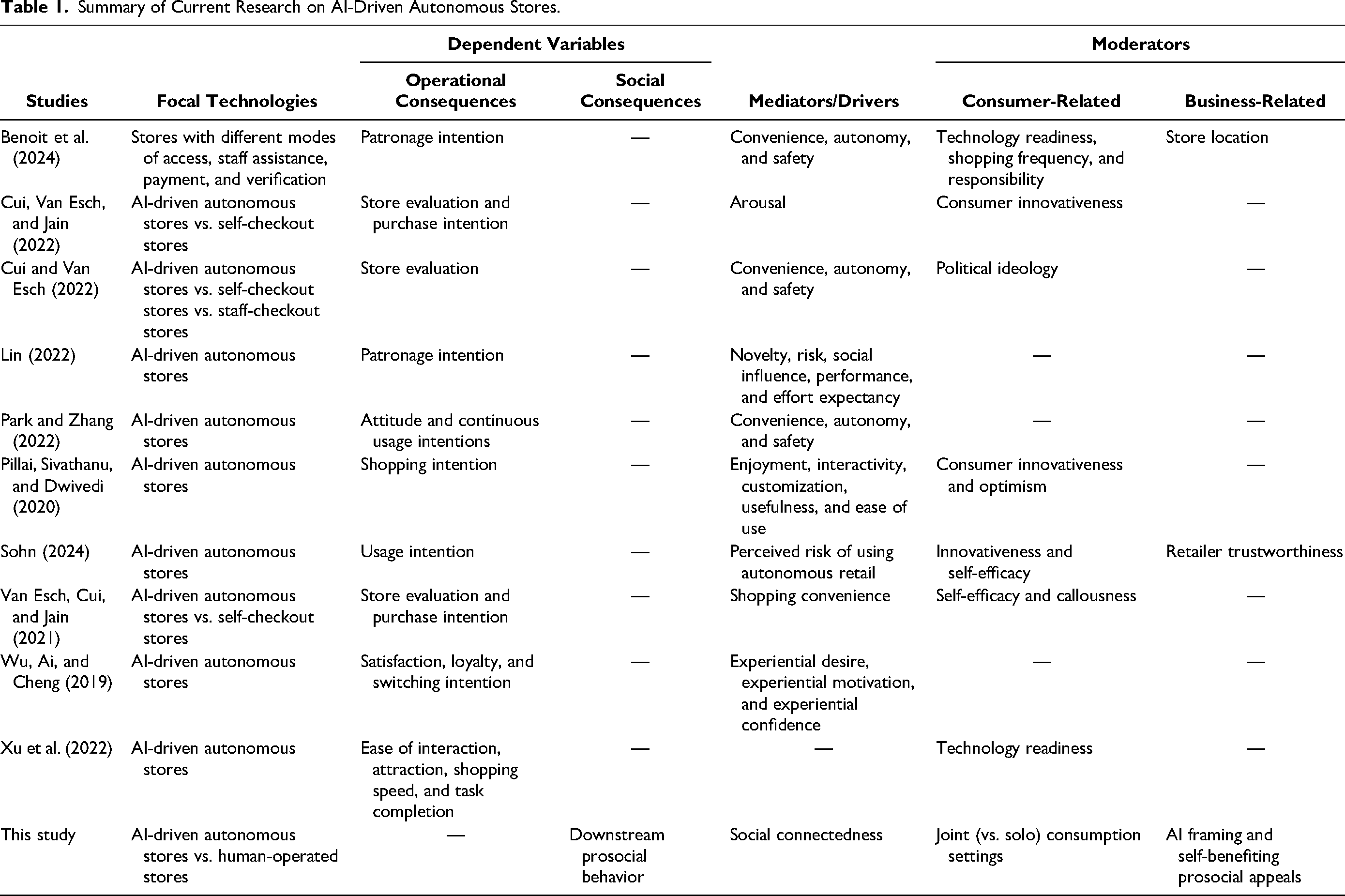
While the operational effects of AI-driven autonomous stores are well-documented in prior research, the broader social implications of eliminating human interaction from the retail environment remain underexamined. In traditional retail settings, human interaction plays a crucial role in shaping the overall service experience (Cui, Van Esch, and Jain 2022). Service encounters, however brief, are inherently social (De Bellis and Johar 2020; McCallum and Harrison 1985; Van Esch, Cui, and Jain 2021), being collective processes in which consumers and service staff cocreate experiences (Helkkula, Kelleher, and Pihlström 2012). These service encounters are central to the brick-and-mortar retail experience, serving as valuable social touchpoints that foster reciprocity and connection between retailers and customers (Blut, Teller, and Floh 2018; Bock et al. 2021; Giebelhausen et al. 2014). AI-driven autonomous stores eliminate these touchpoints from the consumption experience. In this research, we argue and show that the increase in AI-driven autonomous stores may therefore have unintended social consequences.
AI-Driven Autonomous Stores and Prosocial Behavior
We propose that experiencing AI-driven autonomous (vs. human-operated) stores may reduce consumers’ prosocial behavior by diminishing their sense of social connectedness. “Social connectedness” refers to the emotional bond that individuals feel with others, often cultivated through direct social interactions and shared collaborative experiences (Lee and Robbins 1995). As a fundamental human drive, social connectedness supports well-being and motivates people to form and maintain positive relationships with others (Baumeister and Leary 1995).
Research shows that social connectedness can be nurtured even through brief face-to-face interactions (Festinger, Schachter, and Back 1950; Goffman 1967). Short exchanges or small talk with strangers can foster feelings of connection and well-being to a greater extent than people typically expect (Kardas, Kumar, and Epley 2022; Sandstrom and Dunn 2014). Similarly, collaborative activities among unacquainted individuals (e.g., randomly assigned teammates) can strengthen social bonds and promote well-being (Ang, Madsen, and Wang 2021; Henrich 2014; Johnson and Johnson 2009).
Traditional retail environments exemplify this dynamic, serving as everyday arenas where social interactions naturally occur. Exchanges with cashiers and conversations with sales staff provide subtle yet meaningful touchpoints that foster a sense of community (McCallum and Harrison 1985; Rook 1985). Neighborhood grocery stores, often described as “third spaces” or social infrastructures, help residents sustain social connections and enhance overall well-being (Mayfield 2024; Pettersen et al. 2024), a role that became especially apparent during the COVID-19 pandemic (Cheek 2020; Grimmer 2023). Moreover, the collaborative nature of a human service encounter often elicits reciprocity between customers and service staff, further reinforcing their social bonds (e.g., Bock et al. 2021; Giebelhausen et al. 2014).
AI-driven autonomous stores fundamentally disrupt this social fabric. By replacing human service encounters with automated systems (e.g., eliminating the momentary yet meaningful interactions that typically occur during checkout; Giebelhausen et al. 2014), these stores alter the social and collaborative nature of the brick-and-mortar retail experience. Instead, customers experience an independent, self-sufficient journey devoid of social interaction. Consequently, AI-driven autonomous stores reduce opportunities to foster social connections.
We argue that this erosion of social connectedness may have important social consequences, including a reduction in people's prosocial behavior. From an evolutionary perspective, social connectedness fosters reciprocity and cooperation, thus enhancing group survival (Brewer 2004; Brown and Cialdini 2015). Social identity theory similarly suggests that when individuals feel connected to a group, they derive self-esteem from the group's identity and status, which in turn fosters greater empathy and prosociality toward in-group members (Batson et al. 1997; Turner, Brown, and Tajfel 1979). Even brief inductions of social connectedness—for example, encouraging lenders to join a lending team or informing participants that they share a birthday with a confederate—can boost prosocial engagement (Ai et al. 2016; Walton et al. 2012). Likewise, feelings of social connectedness have been shown to increase charitable giving (Charness and Holder 2019). Together, these findings demonstrate that social connectedness is a pivotal driver of prosocial behavior.
Accordingly, environments that minimize or remove interpersonal contact are likely to diminish social connectedness, subsequently suppressing prosociality. AI-driven autonomous stores do this by eliminating many routine human interactions, such as brief conversations with service employees. These seemingly minor exchanges serve as cumulative cues of social connection, reminding individuals of their ties to a broader community. When such touchpoints are absent, consumers experience less social connectedness and fewer psychological prompts to relate to others. Thus, we propose that in AI-driven autonomous (vs. human-operated) environments, the diminished sense of social connectedness translates into lower prosocial tendencies.
Mitigating the Negative Effect of AI-Driven Autonomous Stores on Prosocial Behavior
If AI-driven autonomous stores reduce consumers’ sense of social connectedness, which dampens prosocial behavior, how can this adverse effect be mitigated? As autonomous retail formats continue to proliferate, strategies for preserving social connection become critical to balancing technological progress with societal well-being. We consider interventions across three key contexts—consumers, firms, and charitable organizations—that represent distinct stakeholders in the ecosystem. The consumer context (joint vs. solo consumption) shows how interpersonal settings can buffer the effect; the firm context (consumer-welfare AI framing) shows how strategic communication can shape perceptions of AI-driven autonomous technology; and the charitable organization context (self- vs. other-benefiting appeals) shows how prosocial messaging can be adapted to sustain prosocial engagement. Collectively, these interventions offer a cohesive framework for understanding and mitigating the broader social consequences of AI-driven autonomous stores. Next, we elaborate on each of these boundary conditions.
Joint (vs. solo) consumption settings
If the absence of human service encounters in AI-driven autonomous stores diminishes consumers’ feelings of social connectedness and, in turn, their prosocial behavior, then consumption settings that naturally foster social connectedness may buffer this effect. One such context is joint consumption, in which consumers share a retail or service experience with close others, as opposed to solo consumption, in which individuals shop or consume alone (Goodwin and Lockshin 1992; Khoa and Chan 2024). In joint consumption, interaction with companions provides relational and collaborative cues that strengthen social connectedness. This is distinct from merely being surrounded by unfamiliar shoppers, whose presence does not involve communication or shared experience and therefore does not generate the same sense of social connection (Chen, Kassas, and Gao 2021; Merrilees and Miller 2019).
Our proposition draws from research showing that joint (vs. solo) consumption produces a range of positive outcomes, including longer shopping duration and increased purchase volume (Granbois 1968; Guido 2006; Matzler et al. 2005). Companions provide purchase advice (Wang et al. 2007; Ward 2006), enhance shopping enjoyment, facilitate social interactions, and boost purchase confidence (Goby 2006; Kiecker and Hartman 1994). In digital contexts, sharing the same screen with other online shoppers has been found to strengthen shoppers’ feelings of collaboration and social bonds (Roten and Vanheems 2021).
Given that joint consumption fosters social and collaborative interactions (Chen, Kassas, and Gao 2021; Roten and Vanheems 2021; Wong et al. 2012), we expect that engaging in joint consumption within AI-driven autonomous stores will allow consumers to maintain a sense of social connectedness, thus buffering them against the stores’ negative effect on prosocial behavior.
Consumer-welfare AI framing
Can businesses take active steps to mitigate the negative consequences of AI-driven autonomous stores? One promising approach is to reframe the purpose of such technologies by emphasizing that they are implemented to enhance consumer welfare rather than simply to improve operational efficiency. For instance, AI-driven autonomous stores offer 24/7 access to customers who work unsociable hours (FairPrice Group 2024), and they expand access to essential goods for vulnerable populations in remote or underserved areas (Benoit et al. 2024). Advantages such as convenience and time savings are particularly meaningful for time-constrained and chronically stressed modern consumers (McKinsey & Company 2025). However, these benefits are often poorly communicated, leading consumers to perceive AI-driven autonomous systems as primarily serving business interests (e.g., reducing labor costs, increasing operational efficiency) instead of as technologies that enhance consumer experience or well-being (Castelo et al. 2023).
We propose that by explicitly linking AI-driven autonomous systems to consumer benefits, firms can shift consumers’ perceptions of these technologies to be more consumer-centric and, in turn, foster prosocial responses in AI-driven autonomous environments. Specifically, when consumers believe that an AI system is designed with their welfare in mind, they are more likely to feel valued and cared for during the AI interaction, thus reinforcing a sense of social connectedness. Supporting our argument, research suggests that perceiving care from a service provider can elicit feelings of reciprocity and a moral obligation to support others (Bock et al. 2021). This notion also aligns with broader findings that prosocial behavior increases when individuals feel cared for or when their personal needs are recognized (Barasch et al. 2014; Eisenberg and Miller 1987; Mogilner 2010). These effects can also manifest in “paying it forward” behaviors, by which individuals reciprocate kindness by extending it to others (Nowak and Sigmund 2005). Accordingly, we argue that explicitly framing AI-driven autonomous systems as technologies designed to enhance consumer welfare, rather than merely to maximize operational efficiency, can help mitigate their negative effect on prosocial behavior.
Emphasizing self-benefits in prosocial appeals
We argue that charitable organizations can take proactive steps to mitigate the negative effect of AI-driven autonomous stores on prosociality. By strategically designing their prosocial appeals, these organizations can directly influence the effectiveness of their campaigns. Prosocial behaviors, though typically motivated by concern for others, provide meaningful benefits to the donor, such as emotional satisfaction and social recognition (Carlson and Zaki 2018; Critcher and Dunning 2011), and a “warm glow” (Barasch et al. 2014, p. 393). Charitable organizations thus face a strategic tension in framing prosocial appeals: Should they emphasize benefits to others (e.g., feeding unhoused individuals) or the self (e.g., emotional reward, tax benefits) (Bendapudi, Singh, and Bendapudi 1996; Brunel and Nelson 2000)?
Although research finds other-benefiting prosocial appeals to be more effective (Edinger-Schons et al. 2018; Fisher, Vandenbosch, and Antia 2008), there has been a recent rise in self-focused prosocial messaging, driven by heightened individualism (Santos, Varnum, and Grossmann 2017) and the tendency of consumers to be more time-pressed, transactional, and self-oriented (McKinsey & Company 2025). Thus, contemporary donation campaigns increasingly highlight personal benefits, such as emotional well-being (e.g., “Giving makes you feel good”), social recognition (e.g., “Be a hero in your community”), and financial incentives (e.g., tax deductions, matching gifts). This raises an important question: Could self-benefiting prosocial appeals be more effective than other-benefiting prosocial appeals in today's increasingly prevalent AI-driven autonomous environments?
As already argued, AI-driven autonomous stores suppress social connections and foster a sense of independence and self-sufficiency. In such settings, self-benefiting prosocial appeals may be more effective than those emphasizing communal incentives or benefits to others. Research supports this notion, showing that self-benefiting prosocial appeals are more persuasive when self-focus is heightened, such as under ego depletion (Jin et al. 2021), low public self-awareness (White and Peloza 2009), or independent self-construal (Duclos and Barasch 2014; White and Simpson 2013). Accordingly, we propose that in AI-driven autonomous settings, where social connectedness is reduced and self-orientation is heightened, prosocial appeals emphasizing self-benefits may prove more effective than traditional other-benefiting appeals, and they may help offset the prosociality-inhibiting effects of AI-driven autonomous stores.
Overview of Studies
We test our conceptual framework across nine online and field experiments. Studies 1a–1c show that AI-driven autonomous stores reduce prosocial behavior in a range of retail and service contexts, for embodied and nonembodied AI systems, and in online and field environments. H1 is therefore supported. Studies 2 and 3 demonstrate that diminished feelings of social connectedness underlie this effect, supporting H2. Studies 4–6 examine three boundary conditions—joint consumption settings, consumer-welfare AI framing, and self-benefiting prosocial appeals—and find that these mitigate the negative effect of AI-driven autonomous stores on prosocial behavior, lending support to H3–H5. Table 2 provides an overview of the studies.
Overview of Studies.
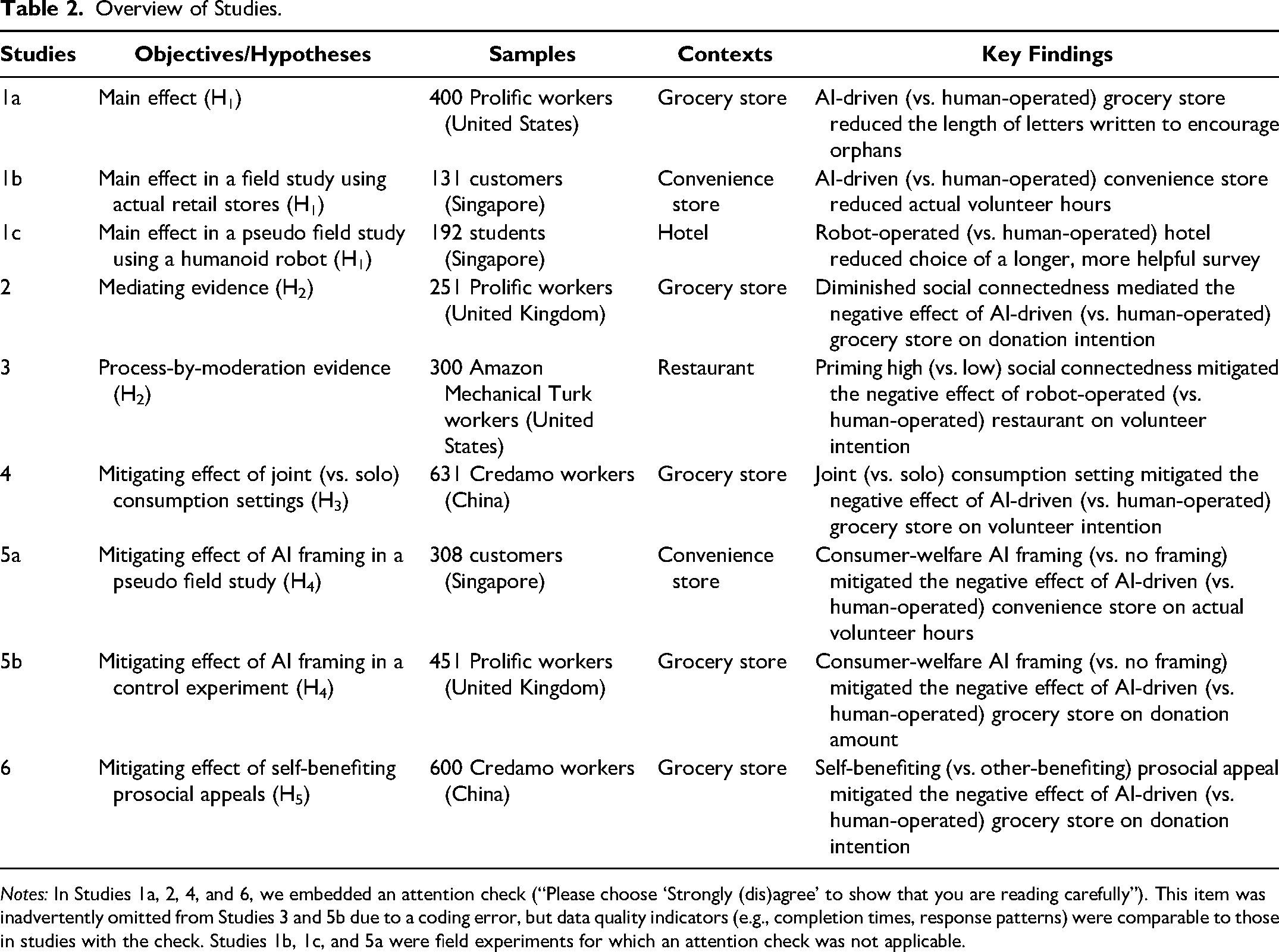
Notes: In Studies 1a, 2, 4, and 6, we embedded an attention check (“Please choose ‘Strongly (dis)agree’ to show that you are reading carefully”). This item was inadvertently omitted from Studies 3 and 5b due to a coding error, but data quality indicators (e.g., completion times, response patterns) were comparable to those in studies with the check. Studies 1b, 1c, and 5a were field experiments for which an attention check was not applicable.
Study 1a: Grocery Store
Study 1a is an online experiment intended to test H1, which posits that AI-driven autonomous (vs. human-operated) stores inhibit consumers’ prosocial behavior. We modeled our scenario after real-world autonomous grocery stores, such as Aldi, 7-Eleven, and Carrefour.
Method
We recruited 400 U.S. residents from Prolific for this study. Participants were randomly assigned to one of three conditions: an AI-driven autonomous store, a human-operated store, or a control condition. After excluding nine participants who failed the attention check and one who indicated they did not understand the questions, the final sample consisted of 390 participants (47.9% female, 50.8% male, 1.3% other; Mage = 37.69 years).
In the AI-driven autonomous store condition, participants read an article about a grocery store equipped with AI-driven facilities (e.g., smart shelves, smart shopping carts, autonomous checkout systems). Those in the human-operated store condition read about a store staffed by human employees. The two descriptions were matched in length and style, and they emphasized the same store attributes (i.e., modernity and efficiency; see Web Appendix A1). Participants were asked to imagine shopping in the described store and to record their thoughts and feelings about the experience. In the control condition, participants described their most recent grocery shopping experience (with no emphasis on AI-driven autonomous systems or human staff), 1 serving as the baseline for prosocial behavior. All participants then evaluated the store on a six-item, seven-point bipolar scale (1 = “bad,” and 7 = “good”; 1 = “negative,” and 7 = “positive”; 1 = “not favorable,” and 7 = “favorable”; 1 = “not new,” and 7 = “new”; 1 = “not innovative,” and 7 = “innovative”; 1 = “not novel,” and 7 = “novel”; α = .88).
After completing the store evaluation, participants were informed that the main study had concluded and that the next task was optional. They were invited to write an encouraging letter to orphans being supported by a partner charity, with instructions stating that longer and more caring messages would provide greater comfort to the recipients. This task was unrelated to their compensation, allowing participants to decide freely whether and how much effort to contribute. The length of the letter (excluding punctuation; nonparticipation was coded as 0) served as the measure of prosocial behavior. Finally, participants reported their age and gender.
Results
Because letter length represented count data (0–333 words), we conducted a Poisson regression with the store condition (AI-driven vs. human-operated vs. control) as the independent variable. Results revealed a significant effect of the store condition (χ2 = 54.48, p < .001), 2 with participants in the AI-driven autonomous store condition writing significantly shorter letters (Mautonomous = 28.73 words, SD = 35.12) than those in the human-operated (Mhuman = 32.48 words, SD = 44.93; χ2 = 29.48, p < .001) and control (Mcontrol = 33.54 words, SD = 42.09; χ2 = 50.04, p < .001) conditions. The control and human-operated conditions exhibited no significant difference in letter length (χ2 = 2.15, p = .143). 3 These findings support H1.
Study 1b: Real-Life Convenience Store
Study 1b aimed to test whether the effect observed in Study 1a would hold in a real-world retail setting. To this end, we conducted a field experiment on a university campus in Singapore, using two adjacent convenience stores of the same retail brand (see Web Appendix B). The stores had similar layouts and pricing but entirely different operational models: One was fully autonomous, with AI-driven checkouts and no human staff, and the other was staffed by two human employees. The proximity and similarity of the two stores created a natural setting for a field experiment that allowed us to examine whether AI-driven autonomous versus human-operated stores would lead to different levels of prosocial behavior.
Method
A total of 131 store customers (47.3% female, 51.9% male, .8% other; Mage = 23.60 years) participated in this study. We recruited 60 participants outside the AI-driven autonomous store and 71 outside the human-operated store. The field experiment was conducted in conjunction with an ongoing student buddy program at the university. Research assistants were stationed outside the two stores, and as customers exited, these assistants approached the customers and invited them to sign up for the buddy program. Participants were asked to indicate how many hours per month (0–10 hours) they would be willing to volunteer for the program (nonparticipation was coded as 0). The number of volunteer hours served as the measure of their prosocial tendencies. Participants provided demographic information (age, gender) and stated whether they had previously visited only the AI-driven autonomous store (3.1%), only the human-operated store (5.3%), or both (91.6%). This variable served as a control for differences in participants’ shopping habits.
Results
Because volunteer hours represented count data (0–10 hours), we conducted a Poisson regression with the store condition (AI-driven vs. human-operated) as the independent variable. Results showed that participants who exited the AI-driven autonomous store volunteered significantly fewer hours (Mautonomous = 1.60 hours, SD = 1.98) than those exiting the human-operated store (Mhuman = 2.79 hours, SD = 2.70; χ2 = 19.96, p < .001). Because this study was a nonrandomized field experiment and individual differences might affect participants’ store choice on the day, we ran further analysis, including their past shopping habits and demographics (age and gender) as covariates. The negative effect of the AI-driven autonomous store on volunteer hours remained significant (χ2 = 11.92, p < .001), providing field evidence supporting H1.
Study 1c: Hotel Context
Studies 1a and 1b showed that AI-driven autonomous systems, such as smart shelves and autonomous checkouts, led to lower prosocial behavior. These AI systems are nonembodied, lacking any humanlike physical form. However, AI technologies span a continuum, from nonembodied systems to humanoid robots (Reuben 2025). The question is, Do our findings extend to stores that use AI with humanlike embodiment?
It might be assumed that using embodied humanlike AI systems (e.g., humanoid robots) would mitigate the negative effect on prosociality, because these systems replicate the “human” element of the traditional retail experience. However, findings from past research are mixed (Grewal et al. 2020). While humanoid robots have been found to foster social presence, potentially reducing the social disconnectedness associated with AI technologies (Davis et al. 2023; Kim, Schmitt, and Thalmann 2019; Nakanishi et al. 2019), research in retail contexts shows that they often fail to facilitate positive human–AI connections (Zehnle, Hildebrand, and Valenzuela 2025). Despite their anthropomorphic features, humanoid robots can evoke feelings of eeriness (Khoa and Chan 2024), threat (Mende et al. 2019), or a sense of being socially judged (Holthöwer and Van Doorn 2023). Although humanoid robots can simulate human cues, consumers frequently perceive their interactions as artificial and lacking the empathy and spontaneity that characterize genuine social encounters (Kim, Schmitt, and Thalmann 2019). Thus, humanoid robots are unlikely to evoke a genuine sense of social presence that fosters true connectedness. Given our focus on frontline retail and service settings, where interactions with AI systems are typically brief, we expect that using embodied humanlike AI will not alleviate the diminished sense of social connectedness in AI-driven autonomous environments. Thus, our proposed effects should extend to environments featuring AI technologies with humanlike embodiment.
To test this in a realistic setting, we selected the hotel context, an environment in which embodied humanlike AI systems, specifically humanoid robots, are increasingly deployed in frontline roles traditionally performed by human staff (e.g., the Henn na Hotel in Japan). Unlike retail settings, where robots currently supplement rather than replace human employees (Workers Union 2025), hotels provide a more ecologically valid example of full-service automation enabled by embodied humanlike AI. Therefore, we conducted a pseudo field experiment in which participants interacted with either a humanoid robot or a human hotel receptionist.
Method
We recruited 192 students (55.7% female, 44.3% male; Mage = 21.54 years) from a university in Singapore to participate in this study. Participants were randomly assigned to either a robot-operated hotel condition or a human-operated hotel condition. Upon arrival, participants (who did not know each other) attended a small-group presentation led by Edgar, the receptionist at the campus hotel, which was undergoing renovation during the study period. In the robot-operated hotel condition, Edgar was presented as a humanoid robot with a male voice and appearance that was capable of responding to questions and synchronizing gestures with speech (see Web Appendix C1 for a photo of Edgar). In the human-operated hotel condition, Edgar was portrayed by a male confederate. The presentation highlighted features of the hotel's newly renovated facilities, which were identical across conditions; however, to reinforce the manipulation, key service touchpoints (e.g., reception) were described as staffed by humanoid robots in the robot-operated hotel condition and by human employees in the human-operated hotel condition. The interaction with Edgar was designed to give participants a realistic impression of the hotel service experience.
After the presentation, Edgar (robot or human) invited participants to complete either a shorter (5-minute) or a longer (15-minute) survey about the hotel, with the longer survey described as being more helpful for the hotel's service improvement. In reality, the two surveys contained identical content. The surveys were accessed via QR codes, and participants were asked to scan only one. Importantly, the choice did not affect the participants’ payment, and it was not visible to Edgar, because participants completed the survey on their own phones. Choosing the longer (ostensibly more helpful) survey served as the key measure of participants’ prosociality.
After choosing and scanning the survey QR code, participants evaluated the hotel using the six-item scale detailed in Study 1a (e.g., 1 = “bad,” and 7 = “good”; α = .82). 4 To account for potential confounds, we included two covariates. First, because the Edgar robot had been showcased at prior university events and the confederate was an undergraduate from the same university, we controlled for possible effects of prior exposure by measuring participants’ familiarity with Edgar (“Have you ever seen Edgar before this study?”; 1 = “yes,” and 0 = “no”). Second, we assessed participants’ emotional state, because interacting with a humanoid robot versus a human could influence participants’ mood (Zehnle, Hildebrand, and Valenzuela 2025), which may affect their prosocial responses. Emotional state was measured using a pictorial scale (“Please select the picture that best describes how you feel right now”; 1 = frowning face, and 5 = happy face; Bynion and Feldner 2020). Finally, participants reported their age and gender. 5
Results
We conducted a binary logistic regression to examine the effect of the robot-operated (vs. human-operated) hotel on participants’ choice of the longer, more helpful survey (1 = longer survey, and 0 = shorter survey). Results showed that participants in the robot-operated hotel condition (44.9%) were less likely than those in the human-operated hotel condition (60.6%) to choose the longer survey (χ2 = 4.73, p = .030), supporting H1. The effect remained significant (χ2 = 3.89, p = .049) after controlling for participants’ hotel evaluation, familiarity with the robot or human receptionist, and emotional state.
Discussion (Studies 1a–1c) and Supplementary Study
Studies 1a–1c provide convergent evidence that AI-driven autonomous environments dampen consumers’ willingness to engage in prosocial acts, independent of the consumption context or operationalization of prosocial behavior. In addition, Study 1c shows that our effect extends to AI technologies with (vs. without) humanlike embodiment.
However, because the field setting in Study 1c did not include a nonembodied AI condition, we were unable to disentangle the effect of AI adoption per se from the effect of humanlike embodiment. To address this, we additionally conducted a preregistered supplementary study (see Web Appendix D) in a hotel context that incorporated three service formats: autonomous check-in/out systems (nonembodied AI), robot-operated services (embodied AI), and traditional human-staffed services. We replicated our effect and found that participants in the human-operated condition donated significantly more than those in both the autonomous and robot-operated AI conditions, with no difference in donation amount between the two AI formats. These results indicate that the negative effect of AI-driven autonomous environments does not depend on whether the AI is embodied or nonembodied. Having established the effect, we next examine the psychological mechanism driving it.
Study 2: Mediating Effect of Social Connectedness
Study 2 aimed to examine whether diminished social connectedness underlies the negative effect of AI-driven autonomous stores on prosociality. We also tested perceived threat as a competing account (Mende et al. 2019), given research findings that threat can increase (Zheng et al. 2021) or suppress (Mancini, Bottura, and Caricati 2020) prosocial behavior depending on the context. Study 2 was preregistered (https://aspredicted.org/tz2de.pdf).
Method
We recruited 251 U.K. residents from Prolific for this study. Five failed the attention check and were excluded from all analyses, leaving 246 participants in the final sample (61.4% female, 38.6% male; Mage = 43.30 years). Participants were randomly assigned to either an AI-driven autonomous store or a human-operated store condition. The study's procedure closely followed that of Study 1a: Participants were randomly assigned to read about a fully autonomous, AI-driven grocery store or one staffed by humans, which they evaluated on the six-item scale from Study 1a (e.g., 1 = “bad,” and 7 = “good”; α = .80). 6 To test the proposed mechanism, participants reported their perceived social connectedness while imagining shopping in the store, using a five-item, seven-point Likert scale (e.g., “Shopping in [store name] made me feel connected with the world at large,” “I caught myself losing all sense of connectedness with society while shopping in [store name]”; 1 = “totally disagree,” and 7 = “totally agree”; α = .87; Lee and Robbins 1995). To assess perceived threat as an alternative explanation, participants completed a two-item, seven-point Likert scale (i.e., “Shopping in [store name] made me feel a sense of threat,” and “Shopping in [store name] made me feel anxious about my future”; 1 = “totally disagree,” and 7 = “totally agree”; r = .84; Yogeeswaran et al. 2016). Participants then moved on to a seemingly unrelated second task. We told them that we were collaborating with a local charitable organization, and that local orphans had created felt flowers for a fundraising initiative. Participants were asked to indicate their willingness to purchase a flower for £1 (1 = “very unlikely,” and 9 = “very likely”). Finally, participants reported their age and gender.
Results
Willingness to donate
Results from a one-way ANOVA showed that participants in the AI-driven autonomous store condition were significantly less willing to purchase a felt flower to support the orphans (Mautonomous = 4.75, SD = 2.95) compared with those in the human-operated store condition (Mhuman = 5.77, SD = 2.88; F(1, 244) = 7.41, p = .007, η2 = .03).
Potential mediators
Two separate one-way ANOVAs revealed that participants in the AI-driven autonomous store condition reported significantly lower social connectedness (Mautonomous = 2.83, SD = 1.38 vs. Mhuman = 4.64, SD = 1.03; F(1, 244) = 135.46, p < .001, η2 = .36) and higher perceived threat (Mautonomous = 3.65, SD = 1.82 vs. Mhuman = 1.55, SD = .97; F(1, 244) = 126.66, p < .001, η2 = .34) than those in the human-operated store condition.
Mediation analysis
To test which mechanism was driving the effect on willingness to donate, a parallel mediation analysis (PROCESS Model 4; Hayes 2013) was conducted. Results revealed a significant indirect effect of the store condition on willingness to donate, mediated by diminished social connectedness (indirect effect = −.91, SE = .32, 95% CI = [−1.56, −.30]), supporting H2. However, the indirect effect via perceived threat was not significant (indirect effect = −.20, SE = .31, 95% CI = [−.79, .45]; see Figure 1).
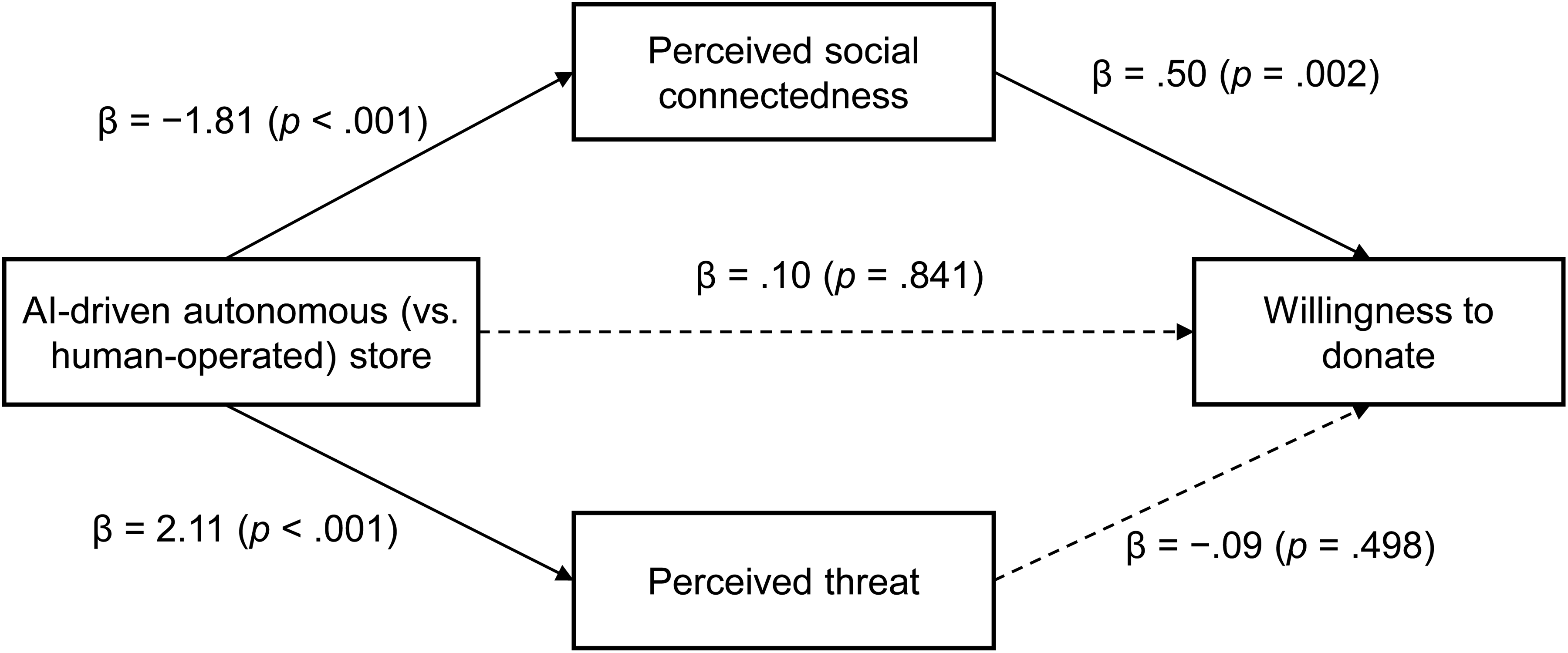
Indirect Effect of Store Format on Willingness to Donate (Study 2).
Discussion and Additional Study
Study 2 shows that diminished social connectedness mediates the negative effect of AI-driven autonomous stores on prosocial behavior, whereas perceived threat does not. An additional preregistered supplementary study reported in Web Appendix D further validates this mediation in a hotel context, comparing embodied and nonembodied AI with human-operated services. In that study, both nonembodied and embodied AI systems elicited lower feelings of social connectedness than human service encounters, which in turn reduced prosocial behavior (indirect effect = −1.09, SE = .39, 95% CI = [−1.80, −.42]). Together, these findings support H2 by demonstrating that reduced feelings of social connectedness underlie the negative prosocial effect across AI-driven autonomous formats, whether embodied or nonembodied.
Study 3: Process via Moderation
In Study 3, we used a process-by-moderation design to provide further evidence for the mediating role of social connectedness (H2). If diminished social connectedness underlies the negative effect of AI-driven autonomous stores on prosocial behavior, then enhancing individuals’ sense of connectedness should mitigate the effect (Pavey, Greitemeyer, and Sparks 2011). Accordingly, we predicted that participants primed with high (vs. low) social connectedness would exhibit comparable levels of prosocial behavior across AI-driven autonomous and human-operated stores. Study 3 also broadened our inquiry into a new service setting: a robot-operated restaurant modeled on real-world examples (Frazier 2025). By focusing on autonomous store formats in an experiential and socially oriented context, where consumers typically expect human interaction as part of the service encounter (Yuan et al. 2023), we provide further evidence that the identified effect generalizes across service environments.
Method
We recruited 300 U.S. residents (44.0% female, 56.0% male; Mage = 35.81 years) from Amazon Mechanical Turk. Participants were randomly assigned to one of the four conditions in a 2 (restaurant: robot-operated vs. human-operated) × 2 (social connectedness: high vs. low) between-subjects design. Participants were asked to complete three ostensibly unrelated tasks. The first was a sentence-unscrambling task designed to induce high or low social connectedness. Research has shown that individuals tend to feel more socially connected when they rely on others for survival or support (Ang, Madsen, and Wang 2021; Henrich 2014; Talhelm et al. 2014). Thus, in the high connectedness condition, participants unscrambled eight sentences emphasizing dependence on others (e.g., “I rely on others most of the time,” “Pleasure is spending time with others”). In the low connectedness condition, the eight sentences highlighted independence from others (e.g., “I rely on myself most of the time,” “Pleasure is spending time without others”). Web Appendix E1 lists all items and a successful pretest of the manipulation.
Participants then moved on to the second task, in which they read an excerpt about a restaurant. In the robot-operated restaurant condition, human service staff were replaced by robot waiters at key service touchpoints (e.g., reception, ordering, checkouts). In the human-operated condition, these touchpoints were handled by human employees (see Web Appendix E2). Participants then shared their thoughts and feelings about the restaurant and evaluated it using the six-item scale detailed in Study 1a (e.g., 1 = “bad,” and 7 = “good”; α = .84).
In the final part of the study (ostensibly conducted in collaboration with the Salvation Army), participants were shown an appeal from the Salvation Army seeking volunteers for a fundraising event scheduled for the following weekend. They were asked to indicate how likely they were to volunteer (1 = “very unlikely,” and 7 = “very likely”), which served as the measure of prosocial behavior. To account for potential confounds, we recorded participants’ familiarity with the Salvation Army (1 = “not at all,” and 7 = “extremely”) and whether they had volunteered with it previously (0 = “no,” and 1 = “yes”). Finally, participants reported their age and gender.
Results
Results from a two-way ANOVA on volunteer intention revealed nonsignificant effects of the restaurant (F(1, 296) = 1.65, p = .200, η2 = .01) and social connectedness conditions (F(1, 296) = 1.17, p = .280, η2 = .004), but a significant interaction effect (F(1, 296) = 3.98, p = .047, η2 = .01). Participants primed with low social connectedness reported significantly lower volunteer intention in the robot-operated (vs. human-operated) restaurant condition (Mrobot = 2.75, SD = 1.86 vs. Mhuman = 3.53, SD = 2.12; F(1, 296) = 5.26, p = .023, η2 = .02), replicating previous findings. In contrast, volunteer intention did not differ across the restaurant conditions for participants primed with high social connectedness (Mrobot = 3.49, SD = 2.12 vs. Mhuman = 3.32, SD = 2.12; F(1, 296) = .26, p = .611, η2 = .001). Priming high social connectedness significantly boosted volunteer intention in the robot-operated restaurant condition (F(1, 296) = 4.60, p = .033, η2 = .02), but not in the human-operated restaurant condition (F(1, 296) = .43, p = .512, η2 = .001; see Figure 2). 7
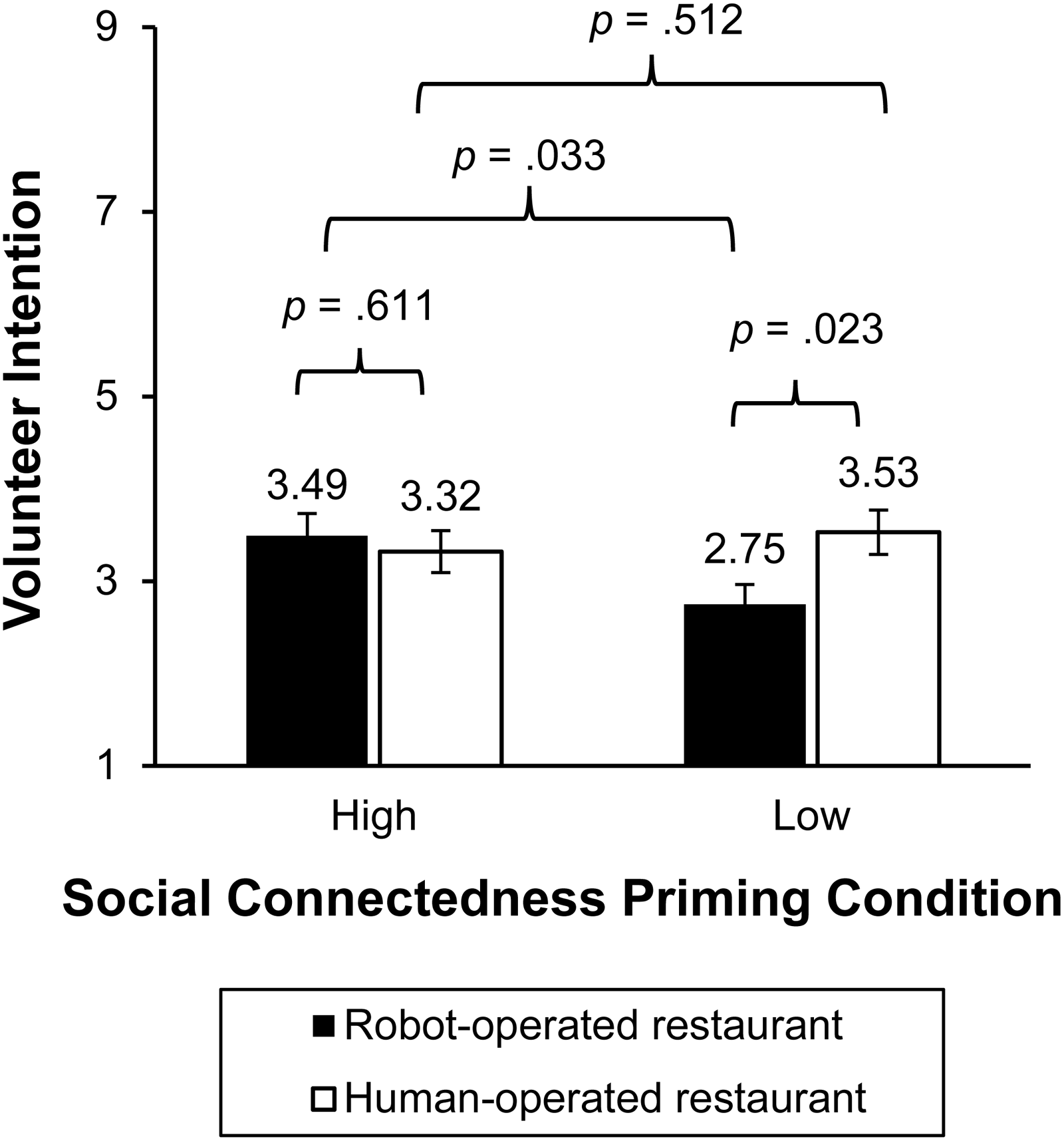
Interaction Between Restaurant Format and Social Connectedness Priming (Study 3).
Discussion
Study 3 shows that the negative effect of AI-driven autonomous stores on prosocial behavior can be mitigated by reminding participants of their existing social connections, further supporting H2. Thus, the next set of studies explored potential interventions for sustaining prosociality in AI-driven autonomous environments.
Study 4: Moderating Effect of Joint Consumption Settings
Study 4 aimed to test the moderating role of joint (vs. solo) consumption settings (H3). If reduced social connectedness drives the effect of AI-driven autonomous stores on prosocial behavior, then shopping with close others—a joint consumption context that naturally fosters greater connectedness—should buffer this effect (Pavey, Greitemeyer, and Sparks 2011).
Method
We recruited 631 Chinese participants from Credamo for Study 4. After excluding 38 participants who failed the attention check, the final sample consisted of 593 participants (58.0% female, 42.0% male; Mage = 31.58 years). Participants were randomly assigned to one of the four conditions in a 2 (store: AI-driven autonomous vs. human-operated) × 2 (consumption setting: joint vs. solo) between-subjects design. Participants read a description of a grocery store that was either fully autonomous and AI-driven or staffed by human employees. They were asked to imagine shopping in the store alone (solo consumption condition) or with family (joint consumption condition; see Web Appendices F1 and F2). To reinforce the manipulation, participants wrote about their thoughts and feelings during the imagined shopping experience.
Next, participants evaluated the store using the six-item scale from Study 1a (e.g., 1 = “bad,” and 7 = “good”; α = .74) and completed the social connectedness scale from Study 2 (α = .88). Because the presence of another person might cause participants to feel that their actions were being watched and thus affect their prosocial responses in the joint consumption condition, we used a five-item, seven-point Likert scale to measure the extent to which participants felt like they were being watched while shopping (e.g., “I felt like I was being watched,” “I felt that my actions were being observed or judged”; 1 = “totally disagree,” and 7 = “totally agree”; α = .89; Nettle et al. 2013). It might also be argued that AI-driven autonomous stores could activate an efficiency mindset that discourages time-consuming prosocial acts (Li, Chen, and Huang 2015); thus, we measured efficiency mindset using a three-item, seven-point scale (e.g., “I prefer things that can be done fast”; 1 = “totally disagree,” and 7 = “totally agree”; α = .91; Li, Chen, and Huang 2015).
Participants then proceeded to a second, ostensibly unrelated task, purportedly conducted in collaboration with China Young Volunteers Association. They were shown a recruitment poster calling for volunteers to assist elderly residents in their communities and then asked to indicate their willingness to volunteer (1 = “very unlikely,” and 9 = “very likely”), which served as the measure of their prosocial behavior. To account for potential confounds, we recorded whether they had previously volunteered with the organization (0 = “no,” and 1 = “yes”). Finally, participants reported their age and gender.
Results
Volunteer intention
A two-way ANOVA on volunteer intention revealed a nonsignificant effect of the consumption setting condition (F(1, 589) = .02, p = .898, η2 < .001) but significant effects of the store condition (F(1, 589) = 8.98, p = .003, η2 = .02) and the interaction (F(1, 589) = 7.09, p = .008, η2 = .01). When shopping alone, participants in the AI-driven autonomous store condition reported lower volunteer intention than those in the human-operated store condition (Mautonomous = 7.08, SD = 1.61 vs. Mhuman = 7.69, SD = 1.01; F(1, 589) = 15.73, p < .001, η2 = .03), replicating previous studies. However, in the joint consumption setting condition, this difference was not observed (Mautonomous = 7.38, SD = 1.22 vs. Mhuman = 7.42, SD = 1.33; F(1, 589) = .06, p = .812, η2 < .001). Moreover, in the AI-driven autonomous store condition, joint (vs. solo) consumption boosted volunteer intention (F(1, 589) = 3.93, p = .048, η2 = .01); in the human-operated store condition, consumption settings did not alter volunteer intention (F(1, 589) = 3.19, p = .075, η2 = .01; Figure 3). 8 Thus, H3 was supported.
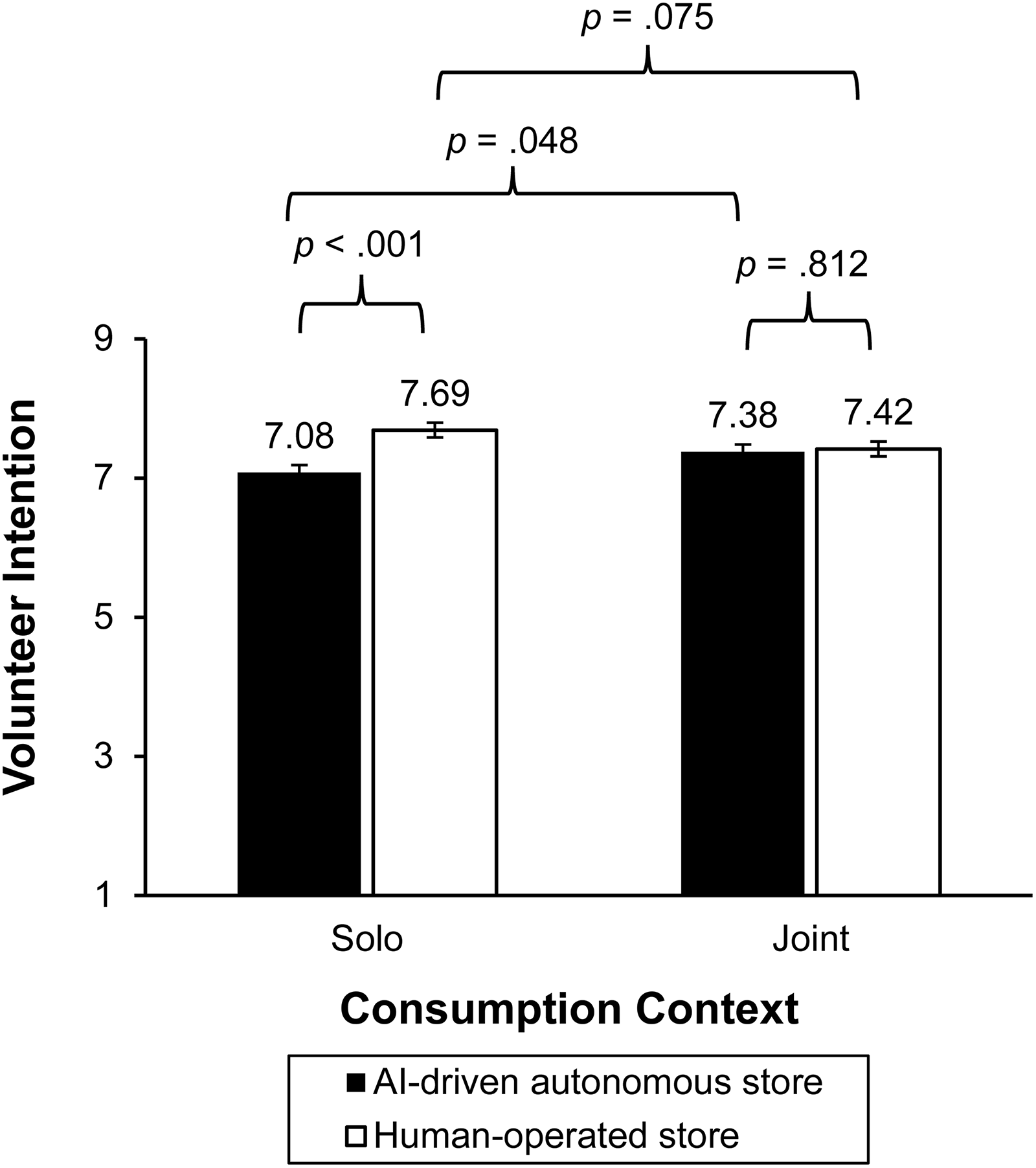
Interaction Effect of Store and Consumption Setting on Volunteer Intention (Study 4).
Potential mediators
A two-way ANOVA testing whether there were differences in perceived social connectedness across the store and consumption setting conditions revealed significant effects of the store condition (F(1, 589) = 250.08, p < .001, η2 = .30), consumption setting condition (F(1, 589) = 5.38, p = .021, η2 = .01), and their interaction (F(1, 589) = 6.02, p = .014, η2 = .01). Participants reported significantly lower perceived social connectedness after experiencing the AI-driven autonomous (vs. human-operated) store in both the solo (Mautonomous = 4.17, SD = 1.35 vs. Mhuman = 5.78, SD = .81; F(1, 589) = 163.85, p < .001, η2 = .22) and joint (Mautonomous = 4.59, SD = 1.29 vs. Mhuman = 5.77, SD = .71; F(1, 589) = 90.91, p < .001, η2 = .13) consumption settings. Importantly, joint consumption enhanced a sense of social connectedness for participants in the AI-driven autonomous store condition (F(1, 589) = 11.49, p < .001, η2 = .02), but not for those in the human-operated store condition (F(1, 589) = .01, p = .924, η2 < .001).
We next examined if there were differences in participants’ perception of being watched and efficiency mindset across the conditions. An ANOVA on the perception of being watched revealed a significant effect of the store condition (F(1, 589) = 119.19, p < .001, η2 = .17), but nonsignificant effects of the consumption setting (F(1, 589) = .02, p = .895, η2 < .001) and the interaction term (F(1, 589) = 1.19, p = .276, η2 = .002). Joint (vs. solo consumption) did not alter the perception of being watched across the AI-driven autonomous (F(1, 589) = .46, p = .496, η2 < .001) and human-operated (F(1, 589) = .74, p = .389, η2 < .001) store conditions. An ANOVA on efficiency mindset also showed nonsignificant effects of the store condition (F(1, 589) = .25, p = .617, η2 < .001), the consumption setting condition (F(1, 589) = .12, p = .734, η2 < .001), and their interaction (F(1, 589) = 1.03, p = .312, η2 = .002).
Moderated mediation
We conducted a moderated mediation analysis (PROCESS Model 7, with 5,000 bootstrap resamples; Hayes 2013) on volunteer intention, with the store condition as the independent variable and the consumption setting as the moderator. Social connectedness, perception of being watched, and efficiency mindset served as parallel mediators. Results revealed a significant moderated mediation via social connectedness (indirect effect = .13, SE = .06, 95% CI = [.022, .264]), but not via perception of being watched (indirect effect = −.02, SE = .02, 95% CI = [−.074, .018]) or efficiency mindset (indirect effect = .03, SE = .03, 95% CI = [−.023, .106]).
Discussion
Study 4 supports H3 by showing that joint (vs. solo) consumption buffers the negative effect of AI-driven autonomous stores on prosocial behavior. This happens because shopping with close others enhances the feelings of social connectedness that drive prosocial behavior. The study also ruled out alternative accounts based on a heightened perception of being watched and activation of an efficiency mindset.
Study 5a: Mitigating Effect of Consumer-Welfare AI Framing in a Field Experiment
Study 5a adopts the firm perspective and examines whether framing AI-driven autonomous formats as technologies designed to promote consumer welfare can mitigate their negative effect on prosocial behavior. Although reduced wait times and increased convenience are widely recognized operational benefits of autonomous store formats (e.g., Benoit et al. 2024; McLean, Krey, and Barhorst 2025; Wu, Ai, and Cheng 2019), such benefits are seldom framed as directly addressing consumers’ core needs or prioritizing their well-being (Castelo et al. 2023). We argue that explicitly connecting AI technologies to consumer benefits can shift how consumers perceive them, from primarily business-oriented to more consumer-centric. If consumers believe that AI systems are designed with their interests in mind, they may feel less socially disconnected and exhibit greater prosociality (H4). To test this, we conducted a pseudo field experiment in the convenience stores (one fully autonomous, one staffed by two human employees) described in Study 1b.
Method
A total of 308 undergraduate students from a university in Singapore (46.1% female, 52.6% male, 1.3% other; Mage = 20.49 years) participated in this study for course credits. Participants were randomly assigned to one of three conditions: a human-operated store, an AI store without AI framing, or an AI store with consumer-welfare AI framing. All participants were informed that the study was being conducted in collaboration with the store owner to gain a deeper understanding of how customers perceived the store. They were instructed to shop solo at either the human-operated or the AI-driven autonomous store. To encourage natural shopping behavior, they were informed that they could purchase anything they wanted, with purchases reimbursed up to SGD 2.
After completing their shopping, participants were asked to scan a QR code to access a postshopping survey. In the AI store with consumer-welfare AI framing condition, the survey began with a brief message stating that the AI-driven autonomous systems had been introduced as part of the retailer's commitment to making shopping faster and more convenient for customers (see Web Appendix G1). To enhance its ecological validity, this framing message was adapted from the retailer's recent press release in Singapore (FairPrice Group 2024) and had been successfully pretested (see Web Appendices G1 and G3). Participants in the human-operated and AI store no-framing conditions did not see this message. Consistent with the cover story, all participants then rated the store on a five-item, seven-point bipolar scale (e.g., 1 = “bad,” and “7 = “good”; α = .86). They reported the amount of money spent in the store and were reimbursed up to SGD 2. 9
After completing the store evaluation, participants were informed that the main study had concluded but that we were inviting them to participate in a university volunteer initiative in which students served as guides for prospective applicants. Because this opportunity was tied to a real program, it provided a realistic measure of prosocial behavior. Participants indicated the number of hours per month (0–10 hours) they would be willing to volunteer, with nonparticipation coded as 0. Finally, they provided demographic information (age and gender), reported their past shopping habits, and completed the efficiency mindset scale from Study 4 (α = .86).
Results
Of the 308 participants, 271 made a purchase in their assigned store and received a refund. Regarding their past shopping experience, 53.66% reported having shopped at both stores before, 14.94% had visited neither store, 2.50% had visited only the AI-driven autonomous store, and 28.90% had visited only the human-operated store.
Results from a Poisson regression revealed that participants in the AI store no-framing condition pledged fewer volunteer hours (Mautonomous_no framing = .28 hours, SD = 1.14) than those in the human-operated store (Mhuman = .48 hours, SD = 1.58; χ2 = 5.29, p = .021) and AI store with AI framing (Mautonomous_framing = .59 hours, SD = 1.82; χ2 = 10.64, p = .001) conditions. Volunteer hours did not differ between the latter two conditions (χ2 = 1.17, p = .279). The pattern of results remained consistent after we controlled for participants’ store evaluation, past shopping preferences, in-store spending, and efficiency mindset (χ2autonomous_no framing vs. human = 5.12, p = .024; χ2autonomous_no framing vs. framing = 14.35, p < .001; χ2autonomous_framing vs. human = 2.42, p = .120). These results show that firms can mitigate the negative impact on prosocial behavior by highlighting the consumer-welfare benefits of AI technologies, supporting H4.
Study 5b: Mitigating Effect of Consumer-Welfare AI Framing in a Control Experiment
The field experiment nature of Study 5a required participants to be presented with the framing message after completing their shopping experience, thus, immediately before providing their store evaluations and prosocial responses. Although this sequence enhanced the ecological validity of the field setting, presenting the consumer-welfare AI framing before the prosocial measure may have induced a demand effect, potentially inflating the observed impact on prosocial behavior. To address this concern, we conducted Study 5b, in which the AI framing manipulation was introduced prior to the shopping experience.
Method
We recruited 451 U.K. residents (60.5% female, 38.6% male, .9% other; Mage = 42.73 years) from Prolific for this study. Participants were randomly assigned to one of three conditions: a human-operated store, an AI store without AI framing, or an AI store with consumer-welfare AI framing.
In the first part of the study, participants were told that we were interested in understanding people's shopping opinions and were asked to read a news article about grocery stores in the United Kingdom. In the human-operated store condition, the article described traditional grocery stores staffed by human employees. In the two AI store conditions, one article provided a neutral description of how autonomous stores typically operate (i.e., AI store no-framing condition), whereas the other emphasized how such technologies enhance consumer well-being by saving time, reducing stress, increasing autonomy, and offering 24/7 access to healthy options (i.e., AI store with AI framing condition) (see Web Appendices G2 and G3 for manipulation texts and pretest). After reading the assigned article, participants indicated the extent to which the described store formats enhanced consumer welfare using a three-item, seven-point scale (i.e., “They make everyday life more convenient for consumers,” “They are designed to serve consumers’ best interests,” and “They contribute to improving consumer well-being”; 1 = “totally disagree,” and 7 = “totally agree”; α = .88). Although we administered this measure across all three conditions for comparability, our primary interest was in whether perceptions of the AI-driven autonomous format differed across the two AI store conditions.
Next, participants completed what was described as an unrelated study on social issues. They were asked to imagine shopping in either a traditional human-operated grocery store or an AI-driven autonomous store (depending on their assigned condition). At the store exit, they saw a poster soliciting donations to support food provision for low-income families in the United Kingdom, which was presented as a relevant social issue in their community. Consistent with the cover story, participants were asked to indicate how much (£0–£10) they would be willing to donate to this social cause. The donation amount served as the measure of prosocial behavior. Finally, participants reported their age and gender.
Results
Manipulation check
We assessed the effectiveness of the consumer-welfare AI framing by participants’ ratings of the extent to which the AI store format was perceived as enhancing customer welfare across the two AI store conditions. Participants in the AI framing condition (Mframing = 4.63, SD = 1.49) rated the AI-driven autonomous store format as more consumer welfare–oriented than those in the no-framing condition (Mno framing = 3.98, SD = 1.54; p < .001), confirming successful AI framing manipulation. Additionally, participants in the human-operated store condition perceived traditional stores as contributing significantly more to consumer welfare than their AI-driven autonomous counterparts (Mhuman = 5.74, SD = 1.01; ps < .001).
Donation amount
A one-way ANOVA on donation amount revealed a significant effect of the store condition (F(1, 448) = 7.14, p < .001, η2 = .03). Participants in the AI store no-framing condition reported a significantly lower donation amount (Mautonomous_no framing = £1.88, SD = 2.45) than those in the human-operated store condition (Mhuman = £3.05, SD = 2.89; p < .001) and the AI store with AI framing condition (Mautonomous_framing = £2.69, SD = 2.95; p = .032). The donation amount did not differ significantly between the latter two conditions (p = .812). These results replicated findings from Study 5a, further supporting H4.
Discussion (Studies 5a and 5b)
Together, Studies 5a and 5b demonstrate that framing AI-driven autonomous formats as technologies designed to enhance consumer welfare can mitigate their negative effect on prosocial behavior, in both hypothetical and real-life settings. This finding is important for several reasons. Theoretically, it shows that the social costs of AI adoption are not inevitable but can be attenuated through relatively subtle shifts in how AI technologies are communicated to consumers. It also highlights a low-cost, scalable intervention for managers: By framing AI-driven formats in terms of consumer benefits rather than operational efficiency, retailers can preserve the advantages of automation while reducing their unintended social drawbacks. This is especially critical as AI technologies become more prevalent in retail and service environments.
Study 6: Moderating Effect of Self-Benefiting Prosocial Appeal
Study 6 investigated whether charitable organizations can mitigate the negative effect of AI-driven autonomous stores on prosociality by adjusting how their donation appeals are framed. Specifically, we examined whether prosocial appeals emphasizing self-benefits (e.g., personal well-being) versus other-benefits (e.g., helping the broader community) would be more effective in encouraging prosocial behavior in AI-driven autonomous environments, testing H5.
Method
We recruited 600 Chinese residents from Credamo and randomly assigned them to one of the four conditions in a 2 (store: AI-driven autonomous vs. human-operated) × 2 (donation appeal: self-benefiting vs. other-benefiting) between-subjects design. We excluded nine participants who failed the attention check, resulting in a final sample of 591 participants (65.3% female, 34.5% male, .2% other; Mage = 28.52 years). Participants first read a description of either an AI-driven autonomous grocery store or a human-operated grocery store, as in Study 4 (see Web Appendix F1). They detailed their thoughts and feelings about shopping at the imagined store before evaluating it using the scale from Study 1a (e.g., 1 = “bad,” and “7 = “good”; α = .81). Participants were then informed that upon leaving the store, they would encounter a donation appeal supporting the “First Aid Kit” project by the Red Cross Society of China. In the self-benefiting prosocial appeal condition, the project highlighted the participant and their family as target beneficiaries (e.g., “Benefits for you and your family”); in the other-benefiting prosocial appeal condition, the community was highlighted as the beneficiary (e.g., “Benefits for all residents”). See Web Appendix H for full details. Participants indicated their willingness to donate to support the project (1 = “very unwilling,” and 9 = “very willing”), which served as the measure of prosocial tendencies. Finally, we collected participants’ age, gender, and whether they had previously donated to the charity.
Results
Results from a two-way ANOVA revealed a nonsignificant effect of the donation appeal condition (F(1, 587) = 1.09, p = .297, η2 = .002), but significant effects of the store condition (F(1, 587) = 4.71, p = .030, η2 = .01) and the interaction (F(1, 587) = 4.59, p = .033, η2 = .01). When the appeal emphasized benefits for others, participants in the AI-driven autonomous (vs. human-operated) store condition indicated significantly lower donation intention (Mautonomous = 6.79, SD = 1.93 vs. Mhuman = 7.39, SD = 1.46; F(1, 587) = 9.29, p = .002, η2 = .02), replicating previous findings. However, when the appeal emphasized self-benefits, participants’ donation intention did not differ across the two store conditions (Mautonomous = 7.23, SD = 1.65 vs. Mhuman = 7.24, SD = 1.72; F(1, 587) < .001, p = .984, η2 < .001). Furthermore, the self-benefiting (vs. other-benefiting) prosocial appeal significantly enhanced donation intention in the AI-driven autonomous store condition (F(1, 587) = 5.02, p = .025, η2 = .01), but not in the human-operated store condition (F(1, 587) = .61, p = .435, η2 = .001; Figure 4). 10 These results support H5.
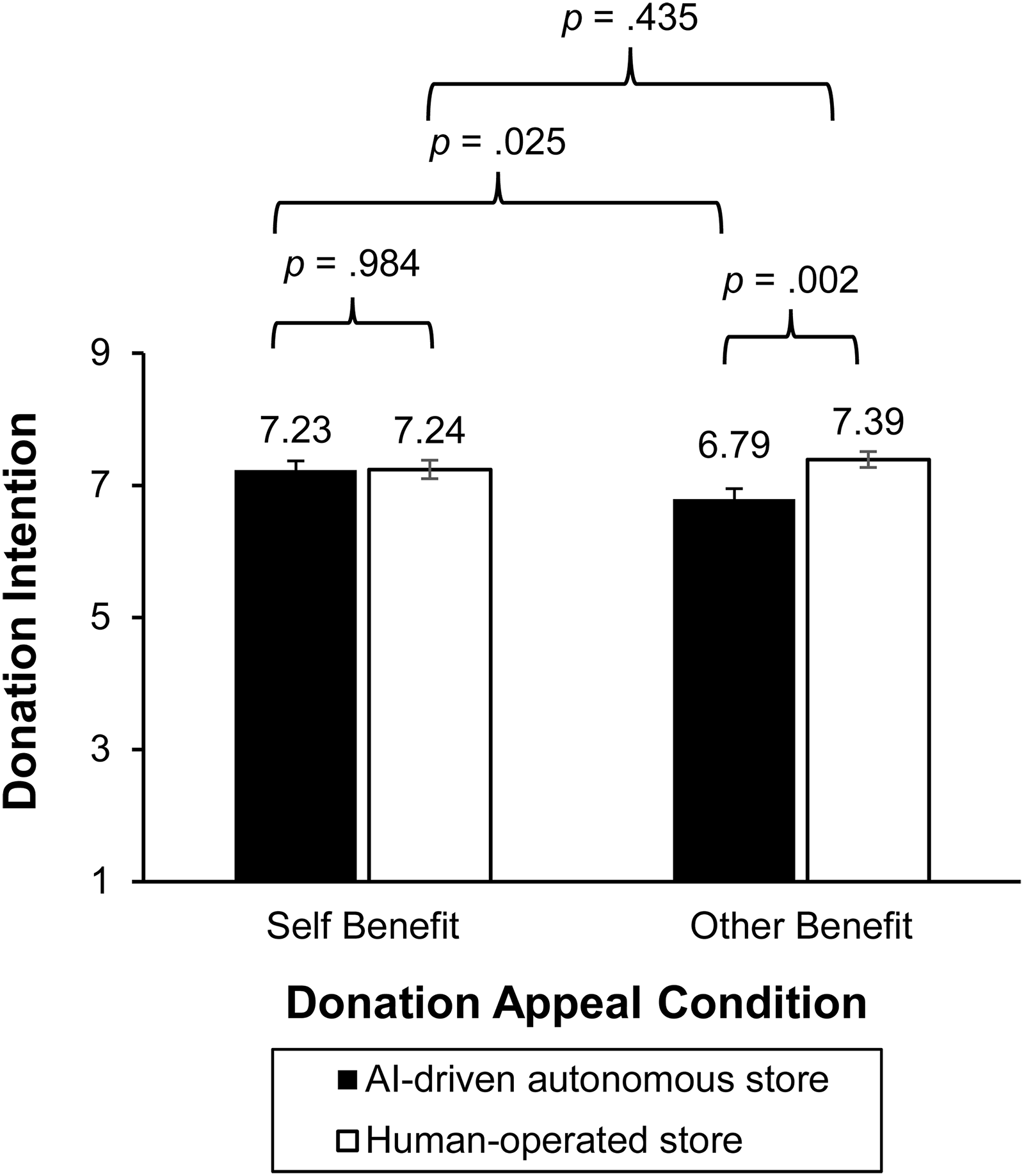
Interaction Effect of the Store and Donation Appeal on Donation Intention (Study 6).
Discussion and Additional Study
Study 6 demonstrated that framing a prosocial activity in terms of self-benefits (vs. other-benefits) alleviated the negative effect of AI-driven autonomous stores on prosocial behavior, supporting H5. These results suggest a practical approach for how charitable organizations can sustain donations in increasingly prevalent automated retail environments.
Beyond this intervention, we also conducted a study to explore whether encouraging greater perspective-taking in prosocial appeals could serve as another pathway for charitable organizations to mitigate the effect. The study is reported in Web Appendix I, and its results show that perspective-taking (vs. control) appeals helped restore prosocial behavior in AI-driven autonomous environments. These findings suggest that thoughtfully designed prosocial messaging can counteract the decline in prosociality that arises when consumers experience reduced social connectedness in AI-driven autonomous environments.
General Discussion
Across nine field and online experiments, we demonstrate a robust inhibiting effect of AI-driven autonomous (vs. human-operated) stores on consumers’ prosocial behavior. This effect generalizes across consumption contexts (grocery/convenience store, hotel, and restaurant), AI formats (nonembodied and embodied), populations (Singapore, United States, United Kingdom, and China), and measures of prosociality (intentional and behavioral). A single-paper meta-analysis (see Web Appendix J) confirms the robustness of these findings. We show that diminished social connectedness underlies the observed effect, whereas alternative explanations (AI-induced threat, efficiency mindset, perceptions of being watched) do not. More importantly, we identify practical strategies for how consumers, retailers, and charity organizations can preserve prosociality in AI-driven autonomous environments: (1) foster joint (vs. solo) consumption, (2) frame AI-driven autonomous systems as consumer-welfare-enhancing, and (3) emphasize self-benefits (vs. other-benefits) in prosocial appeals.
Theoretical Contributions
First, this research broadens the scope of inquiry in the AI-driven autonomous stores literature, which has primarily focused on operational outcomes such as consumer acceptance, perceived innovativeness, operational efficiency, and cost savings (e.g., Benoit et al. 2024; Lin 2022). We introduce a new perspective by showing that these stores can also shape consumers’ social tendencies by dampening their prosocial behavior. This finding highlights an overlooked consequence of automation: AI-driven autonomous formats optimize transactional efficiency but may simultaneously erode the subtle social bonds that underpin prosocial engagement. Conceptually, this moves the discussion of AI in retail beyond the typical “technology adoption” or “service innovation” lens and toward one that integrates psychological and sociocultural consequences of retail automation. It underscores that technological advancements do not operate in a social vacuum: How consumers feel in retail environments can have a meaningful influence on their behaviors beyond the consumption context. By identifying prosociality as a downstream social outcome of AI-driven autonomous stores, our research links two literatures that have rarely intersected: technology-enabled retailing and prosocial consumer behavior.
Second, we contribute to the broader literature on human–AI interactions by identifying theoretically grounded interventions that can shape how consumers perceive and respond to AI technologies. While research has documented a range of unintended social consequences of AI in the workplace (e.g., shifting individuals’ political identification, escalating aggression toward immigrants; Anelli, Colantone, and Stanig 2019; Frey, Berger, and Chen 2018; Gamez-Djokic and Waytz 2020; Jackson, Castelo, and Gray 2020), scant attention has been given to interventions that address these negative effects. As such, our research tests three conceptually distinct yet complementary interventions: engaging consumers in joint (vs. solo) consumption, framing AI technologies as enhancing consumer welfare, and emphasizing self-benefits (vs. other-benefits) in prosocial appeals. Together, these interventions demonstrate that the social downsides of automation are not inevitable. Psychological and contextual factors can buffer the effects of reduced human interaction in AI-driven autonomous environments. Thus, our findings enrich existing frameworks of human–AI interaction by identifying the boundary conditions under which automation may be socially adaptive rather than socially alienating.
Third, we extend prior research by identifying reduced social connectedness in the context of AI-driven autonomous versus human-operated stores as the key mechanism underlying diminished prosocial behavior. Studies on human–AI interaction have largely focused on negative individual-level emotional responses to automation (e.g., eeriness, threat, feelings of uniqueness neglect; Longoni, Bonezzi, and Morewedge 2019; Mende et al. 2019; Stein and Ohler 2017), but our work highlights a relational mechanism: AI-driven autonomous environments diminish consumers’ sense of social connection to others, which subsequently dampens prosocial motivation. Doing so, we identify store context as a novel and important antecedent influencing consumers’ feelings of social connectedness.
Our research also extends recent work on anthropomorphic AI by distinguishing between social rapport with anthropomorphic robots (Khoa and Chan 2024) and social connectedness with other humans. We introduce social connectedness as a distinct, deeper construct that reflects emotional bonds formed through genuine human interaction (Lee and Robbins 1995). AI-driven autonomous environments reduce this sense of human-to-human connection by replacing interpersonal touchpoints with self-sufficient, tech-driven systems. Importantly, our results show that not even embodied humanlike AI systems can fully reproduce this form of connectedness. By differentiating between connection with machines and connection among people, our research adds conceptual nuance to the study of social dynamics in automated environments and broadens the theoretical conversation on the societal implications of human–AI interaction.
Lastly, this research contributes to the prosociality literature by identifying AI-driven autonomous stores as a novel antecedent. Research on prosocial behavior has focused on the impact of individual traits (Bekkers 2006), social norms (Grant and Mayer 2009), and environmental cues (e.g., scents, lighting, temperature; Liljenquist, Zhong, and Galinsky 2010). We present store technology as a novel and important contextual cue that may shift consumers’ prosocial behavior beyond the immediate consumption context.
Managerial Implications
Our findings carry important implications for retailers, charitable organizations, and policymakers. As retail and service environments become increasingly automated, the human element of consumption is being quietly redesigned. While AI technologies deliver clear operational benefits, our results caution that they may also have unintended social costs, specifically, a subtle erosion of consumers’ willingness to engage in prosocial acts.
For retailers, this highlights the importance of designing AI-driven autonomous environments that encourage social connection. Simple design and communication strategies such as fostering joint consumption (e.g., group discounts, co-shopping options, communal seating), emphasizing the consumer-welfare benefits of AI technologies in press releases or in-store messaging, and reintroducing light-touch human interaction at key service touchpoints (e.g., Booths bringing back human cashiers in U.K. stores; Ross 2023) can help mitigate the social disconnection typically associated with AI-driven automation.
For charitable organizations, the findings suggest that donation and volunteer drives may be less effective near AI-driven autonomous stores, but that strategic prosocial message framing can restore prosocial engagement. Specifically, prosocial appeals that emphasize self-benefits or encourage perspective-taking can counteract the dampening effect of autonomous environments.
On a broader scale, our research also provides valuable insights for policymakers. Governments eager to promote technological innovations across businesses (e.g., AI-driven autonomous stores, hotels, or restaurants) and social contexts (e.g., rescuing bots, AI counseling) should be cautious about their potential social costs. The proliferation of AI-driven autonomous systems may erode social connectedness and reduce prosocial behavior, eventually undermining social collectivism (Clarkson 2014) and sustainability (Furnham et al. 2016). Regulations and policy frameworks that encourage more balanced human–AI integration and socially responsible AI adoption will help mitigate unintended social harms associated with AI technologies.
Future Research Directions
Future research could explore whether the inhibiting effect of AI-driven autonomous stores on prosocial behavior varies across brands or service providers. For example, familiar brands may foster feelings of security and psychological belongingness (Dunn and Hoegg 2014), potentially buffering the social disconnectedness induced by AI-driven autonomous stores. It is therefore possible that strong (vs. weak) brand–consumer ties could serve as a protective factor against the reduced prosociality in AI-driven autonomous environments.
Future research could further examine which store features can restore consumers’ sense of social connectedness in AI-driven autonomous stores. Our findings indicate that merely giving AI systems a human-like appearance is insufficient. Future work could explore whether digitally mediated forms of human interaction (e.g., live chat support with human employees) or AI-enabled personalized communication (e.g., tailored greetings, customized offers based on consumers’ shopping history) can simulate human attentiveness in the absence of physical staff. Testing the effectiveness of such store design interventions would provide valuable insights into how technology itself can be leveraged to counteract the alienating effects of retail automation.
Finally, studies could explore additional boundary conditions for the observed effect. For example, research shows that consumers exhibit stronger social withdrawal tendencies in crowded environments (Andrews et al. 2015), which enhances their acceptance of service robots (Hou, Zhang, and Li 2021). Therefore, in crowded environments, autonomous technologies may help alleviate perceived congestion and paradoxically facilitate social interactions, thus mitigating the negative effect of AI-driven autonomous stores on prosocial behavior.
Supplemental Material
sj-pdf-1-jmx-10.1177_00222429261445436 - Supplemental material for Automated Versus Human-Operated: Impact of AI-Driven Autonomous Stores on Prosocial Behavior
Supplemental material, sj-pdf-1-jmx-10.1177_00222429261445436 for Automated Versus Human-Operated: Impact of AI-Driven Autonomous Stores on Prosocial Behavior by Xiaoyan (Jenny) Liu, Chi Hoang and Sharon Ng in Journal of Marketing
Footnotes
Acknowledgments
The authors would like to extend their special thanks to Dr. Wong Choon Yue and Dr. Pang Wee Ching for their invaluable assistance in the data collection of an experiment conducted at Nanyang Technological University.
Author Contributions
Xiaoyan Liu, Chi Hoang, and Sharon Ng contributed equally to this work.
Coeditor
Vanitha Swaminathan
Associate Editor
Donna L. Hoffman
Declaration of Conflicting Interests
The authors declared no potential conflicts of interest with respect to the research, authorship, and/or publication of this article.
Funding
The authors disclosed receipt of the following financial support for the research, authorship, and/or publication of this article: This research was supported by the research grants awarded by the National Natural Science Foundation of China (grant number 72302191) to the first author, by ESCP Business School (grant number 2021-40) to the second author, and by Nanyang Business School, Nanyang Technological University (grant number NTU-ACE2020-06) to the third author.

Data Availability
Notes
References
Supplementary Material
Please find the following supplemental material available below.
For Open Access articles published under a Creative Commons License, all supplemental material carries the same license as the article it is associated with.
For non-Open Access articles published, all supplemental material carries a non-exclusive license, and permission requests for re-use of supplemental material or any part of supplemental material shall be sent directly to the copyright owner as specified in the copyright notice associated with the article.
