






Abstract
Despite research on clustering strategies in franchised systems, little is known about its impact on outlet survival during times of economic adversity. In this research, the authors identify two governance mechanisms used by franchisors that vary at a cluster or outlet level—franchisee ownership fragmentation and franchisor on-site supervision—and develop a framework to suggest the efficacy of these mechanisms in mitigating the negative effect of economic adversity on the survival of franchised outlets operating in a cluster. They test this framework using a novel clustering algorithm and survival analysis on a uniquely constructed dataset of 8,677 outlets across 18 franchisors over 14 years. They find that when economic conditions deteriorate, franchisee ownership fragmentation, which reflects greater diversity in cluster composition and knowledge sources, reduces franchised outlet failure hazard within denser clusters. In contrast, franchisor on-site supervision, which denotes lower franchisee autonomy, intensifies outlet failure hazard in such clusters. This research offers actionable insights for franchisors on managing in-cluster outlets during economic adversity and introduces FranClusterer, a practical app-based tool for cluster identification and governance.
Keywords
Economic adversities, or downturns, pose a significant challenge to the retail and distribution sector because declining demand, rising expenses, and supply disruptions erode outlet-level revenue and profitability and jeopardize their survival. Consider the case of the business-format franchising sector that is prevalent in a wide variety of industry sectors, including food and beverages, real estate, hospitality, health and wellness, accounting services, automotive, education. This sector contributes approximately 3% of the total U.S. gross domestic product (GDP), with an economic output of $936 billion in 2025, while supporting more than 9 million jobs (International Franchise Association [IFA] 2025). It is estimated that almost 20% of the franchisees in 2022 reported profit declines because of a 7.5% surge in food and labor costs (IFA 2023). More severely, the COVID-19 pandemic caused widespread store closures, resulting in losses of $185.3 billion in revenue and 1.4 million jobs (IFA 2020). Such an impact can be devastating because many franchise owners finance their businesses by mortgaging personal assets and investing heavily in franchise fees, real estate, equipment, training, and so on. Given the significant stakes involved in store insolvencies and closures and their impact on the broader economy, it is important to understand whether certain organizational structures can prevent outlet failures during times of economic adversity.
In this research, we focus on how the governance of franchised outlet clusters influences the survival of an outlet in that cluster. Clustering outlets enhances management efficiency because outlets located within the cluster share common economic imperatives, allowing them to be managed collectively (Lu and Wedig 2013). Specifically, clustering provides two key benefits: (1) fostering communication, knowledge-sharing, and resource exchange among colocated outlets, and (2) reducing supervision and oversight costs through collective management (Butt et al. 2018; Ingram and Baum 1997; Kim and Jap 2022; Shane 1998). Despite these advantages, managing the success of clustered units is challenging under adverse economic conditions, where shrinking market capacity may fail to cover the outlet's overhead and operating costs and pose a real threat to their survival. As such, the benefits of knowledge-sharing and efficient supervision provided by the cluster may not be sufficient to address the unique challenges posed in such conditions that necessitate the outlets to continuously interpret market conditions and react with agility (Das et al. 2021; Kalaignanam et al. 2021; Srinivasan, Lilien, and Sridhar 2011). In these circumstances, could particular franchisor-deployed governance mechanisms complement the effects of clustering and improve the likelihood of outlet survival?
The core goal of our research is to systematically address this question in the context of business format franchising. This, however, poses a key challenge. Note that franchised systems operate under the “fair treatment” protocol, where key governance instruments like royalty rates, franchise fees, training, contractual completeness, and so on remain invariant at the outlet level. Hence, to address our question on how franchisor governance could help clustered outlets seek local solutions and adaptations that address their problems, we need feasible governance mechanisms that can vary across outlets without violating the core fairness principles. We identified two such governance tools that franchisors implement at the cluster or outlet level without leading to a perception of unfairness: franchisee ownership fragmentation, defined as the number of unique franchisees (not outlets) within a cluster, which represents the regional ownership arrangement within the franchised system (Kaufmann and Dant 1996), and franchisor on-site supervision, defined as the level of monitoring of individual outlets by the franchisor (e.g., Antia, Mani, and Wathne 2017; Michael 2000).
Building on the existing literature in franchise clustering and marketing agility (e.g., Kalaignanam et al. 2021) and insights from our in-depth interviews with franchisors and franchisees (see Web Appendix A for details), we develop a theoretical framework that shows the effectiveness of these two governance tools on the survival of franchised outlets within a cluster when regional economic conditions deteriorate. In particular, we argue that under economic adversity, a more fragmented franchisee ownership introduces diverse know-how and ideas that strengthen the knowledge-sharing within a franchise cluster, enabling the franchisees to reduce their outlet failure rate by rapidly adapting to market conditions and developing creative solutions. In contrast, a higher level of franchisor on-site supervision under economic adversity stifles flexibility and hinders the franchisee's ability to act with agility, thus increasing the outlet failure rate. Both effects are stronger for clusters with higher density. We test our framework by conducting a survival analysis on a uniquely constructed dataset of 35,911 observations (8,677 outlets across 18 franchisors including Buffalo Wings & Rings, Decor & You, Famous Dave’s, Steak ’n Shake, and TCBY) over 14 years (2008–2021) across all 50 U.S. states. Our findings reveal how these governance structures impact the survival of clustered franchised outlets under economic adversity.
Addressing our core goal also requires us to tackle another challenge: identification of franchise clusters. Specifically, an appropriate firm-specific clustering algorithm should be able to not only identify clusters that are irregularly shaped but also account for differences in the market potential of the area in which the cluster is located. Prior techniques for clustering have not accounted for these effects jointly. For instance, previous studies have either (1) identified clusters using a fixed radius (e.g., 25 miles) or administrative boundaries such as states or counties (e.g., Bell 2005; Butt et al. 2018; Lu and Wedig 2013) or (2) used a combination of radius and density threshold (DT)—the number of same-brand outlets within a boundary (e.g., Alcácer and Zhao 2016; Stallkamp et al. 2018). These clustering techniques, however, do not reflect key micro-level features that vary across firms and regions. We build on Alcácer and Zhao’s (2016) technique and develop a new algorithm-based clustering approach that incorporates a firm-specific, local-demand-adjusted DT to define and identify same-brand franchise clusters. We derive each firm's DT from its average number of outlets within a given area (hence, firm-specific) and weigh this measure by county-level GDP to account for differences across regions in population size and individual income (hence, local-demand-adjusted). This enables us to not only account for firm-level variations in cluster density (e.g., Famous Dave’s vs. Rita's Italian Ice) but also incorporate variations in local market conditions (e.g., the GDP of densely populated markets like New York City vs. sparsely populated markets like the rest of New York state). Furthermore, the approach permits the identification of irregularly shaped clusters.
Our research makes three key contributions to the literature. First, we contribute to the interorganizational governance literature by identifying two novel franchisor-deployed governance devices that vary at the cluster or outlet level: namely, franchisee ownership fragmentation and franchisor on-site supervision, which enable the outlets to operate more effectively and lower their failure hazards in the face of significantly adverse, exogenous shocks. We not only address Tracey, Heide, and Bell’s (2014) call for research on the interaction between clustering and governance but also show that the impact of this interaction is dependent on a crucial third factor: the economic environment. Our findings reveal that under adverse economic conditions, these two governance devices enable franchisors to balance the need for consistency in brand reputation with the need for adaptation and agility to address local problems.
Second, we contribute to research on business clusters by examining how external, macro economy-wide shocks influence the role of clustering on the survival of individual outlets. While prior research has highlighted the benefits and risks of clustering (e.g., Butt et al. 2018; Kim and Jap 2022; Zheng, Ji, and Su 2020), we show that this effect of clustering on outlet survival depends critically on the governance mechanisms that can be deployed by the brand. Specifically, we find that under adverse conditions, clusters with greater ownership fragmentation and lower on-site supervision improve outlet survival because they enable these clusters to amplify their knowledge-sharing benefits that foster more rapid and innovative responses and mutual learning while maintaining local adaptability. Our work contributes to the research on franchise cluster management (Antia, Mani, and Wathne 2017; Butt et al. 2018; Zheng, Ji, and Su 2020) and to a broader discussion on how firms can navigate adverse economic environments (e.g., Das et al. 2021; Srinivasan, Lilien, and Sridhar 2011).
Third, we introduce a practical app-based tool for franchisors and manufacturing brands to identify and manage clusters and to run geotargeted marketing campaigns within the delineated cluster boundaries. Our method accounts for variations in local economic conditions as reflected by local GDP and outperforms previously used cluster detection techniques on key predictive accuracy metrics (e.g., Akaike information criterion [AIC], Bayesian information criterion [BIC], area under the curve [AUC], precision). To facilitate the use of this technique and permit the detection and identification of store clusters and tailor governance mechanisms accordingly to optimize outlet survival, we have made our app, FranClusterer, accessible at https://franclusterer.com. Note that both our technique and app are generalizable to all chain-store settings where managers seek to improve store efficiency and effectiveness through cluster governance.
Conceptual Framework
The central argument in our theses is that when economic conditions deteriorate, key franchise governance mechanisms that vary across franchised outlets—franchisee ownership fragmentation and franchisor on-site supervision—significantly affect the survival of a franchised outlet located within a cluster, and that the effect is stronger for clusters with higher density. Figure 1 provides our conceptual framework.
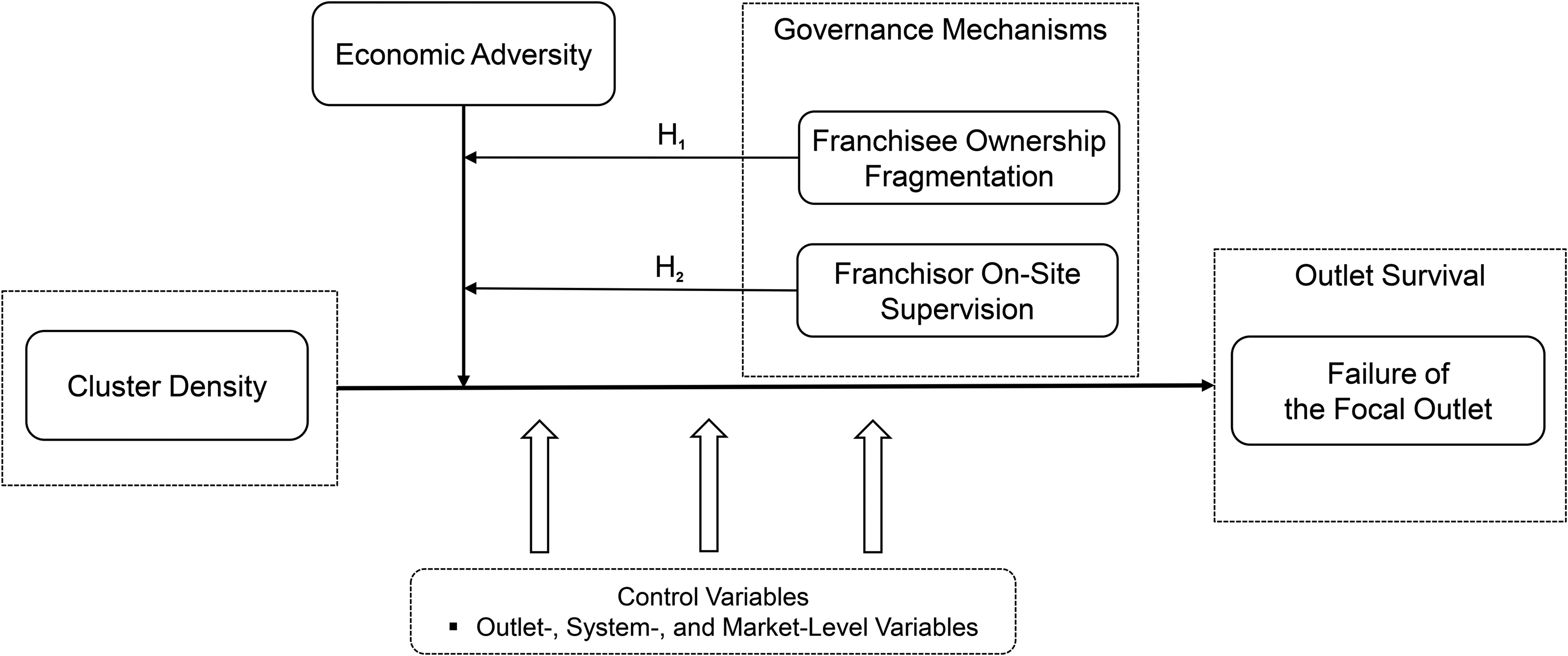
Conceptual Framework.
Franchise Clustering
Franchise clustering refers to the territorial arrangement of same-brand outlets in geographically proximate regions. Building on Porter's (1998, 2000) seminal concept of business clusters (i.e., groups of interconnected, proximate firms with a shared regional identity; Romanelli and Khessina 2005), recent research (e.g., Butt et al. 2018; Kalnins 2004) logically extends this concept to same-brand franchised outlets, which inherently share geographic proximity, interdependence, and brand identity (Zheng, Ji, and Su 2020).
Clustered franchised outlets benefit in two primary ways. First, clustering facilitates frequent communications, enabling the exchange of operational experiences and local knowledge (Ingram and Baum 1997; Kalnins and Mayer 2004; Kim and Jap 2022). Such communication facilitates exchange of resources and operational experiences that expands the pool of know-how, thereby enhancing their ability, adaptability, and creativity to interpret evolving market conditions and also creates a common bond due to shared risks and goals. For instance, our in-depth interviews revealed that clustered outlets share excess inventory, borrow labor, and share information on availability of “quality labor and supplies” during times of operational difficulty. Such sharing serves as a survival mechanism that is critical when market conditions are challenging. Second, clustering allows franchisors to coordinate on-site supervision and lowers the average oversight cost associated with managing each individual outlet (Lu and Wedig 2013; Shane 1998)—another vital survival mechanism because it helps ensure maintaining the “brand quality” at each franchised outlet (Heide, Wathne, and Rokkan 2007; Kidwell, Nygaard, and Silkoset 2007). This benefit, however, comes as a cost: Intensified supervision lowers the outlet's autonomy, thereby restricting its ability to respond to evolving market demand with agility (Kalaignanam et al. 2021).
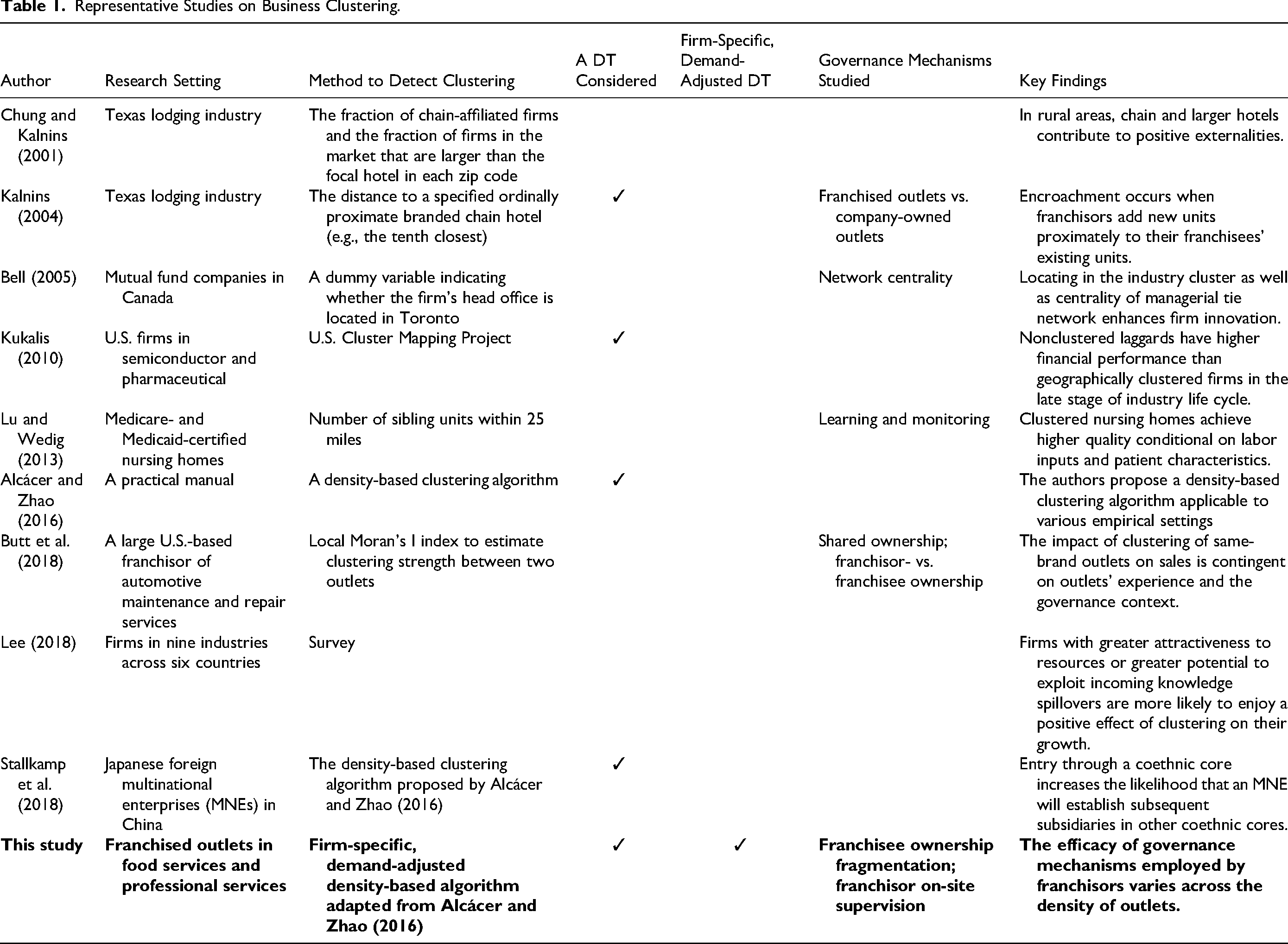
Existing literature predominantly uses two methods to define clusters. The first relies on using a fixed geographic radius (e.g., 25 miles) or an administrative boundary like a state or a county but ignores DT—the number of same-brand outlets within the boundary—to define a cluster (e.g., Bell 2005; Butt et al. 2018; Lu and Wedig 2013). As such, this approach generates clusters that differ significantly in the number of outlets. For example, a franchised outlet located along a highway may have just one same-brand outlet within its 25-mile radius, whereas another situated in downtown Manhattan might have 15 within the same distance. The second method incorporates both radius and DT in defining a cluster (e.g., Alcácer and Zhao 2016; Stallkamp et al. 2018) but applies a uniform DT across all regions and firms, ignoring differences in market capacity (e.g., New York City vs. upstate New York) and the need for franchisor-specific DTs. Table 1 summarizes the representative studies. To accurately capture outlet dynamics, we hence need a more precise method for accurately identifying which outlets are part of or outside a cluster as well as identifying the boundaries of that cluster.
Representative Studies on Business Clustering.
Economic Adversity and the Need for Agility
Macroeconomic shocks such as 2008–2009 financial crisis and the COVID-19 pandemic pose significant challenges to franchised systems, which must adapt and respond to the dynamically evolving economic conditions (Das et al. 2021; Srinivasan, Lilien, and Sridhar 2011). Changing market conditions and consumer preferences can be disruptive, and firms’ practices that work well during normal times might no longer be effective. In particular, adverse market conditions and the resulting possibility of store closure compel firms to adapt and develop innovative solutions—in essence, practice “marketing agility” where they have to “rapidly iterate between making sense of the market and executing marketing decisions to adapt to the market” (Kalaignanam et al. 2021, p. 36) to continue to succeed (Homburg, Theel, and Hohenburg 2020). By prioritizing adaptability and rapid response, agile marketing helps organizations align more closely with consumer demand and help cultivate deeper engagement and loyalty (Metcalf 2024).
We contextualize marketing agility within franchise cluster governance by examining how franchisor-deployed governance tools impact the franchisee's ability to construct local, innovative solutions that enable it to survive economic adversity. Specifically, we focus on franchisee-team-level factors, because colocated franchised outlets are not independent organizations but, instead, operate collectively as a team and address common problems (Gill and Kim 2021). As one of our franchisee interviewee put it, “While we [franchisees] usually compete over clients and talents, when the number of clients declined overall, everybody had to fight together to attract clients rather than compete for them. We were bonded to survive. If one store fails, it my spill over to mine.” In a similar vein, another franchisee explained that “during the pandemic, franchisees became more closely connected because everyone needs to survive, leading to more frequent communication. This includes supporting each other, discussing work arrangements, how to cope with difficulties, and planning strategies.” Consistent with this sentiment, we argue that certain governance characteristics of a franchisor's cluster can impact outlet survival during adversity by (1) enabling the generation of diverse ideas that get shared within the cluster (i.e., team diversity) and (2) implicitly empowering the outlets to undertake autonomous decisions (i.e., team empowerment). We turn to the discussion of these governance mechanisms next.
A Franchisors’ Governance Tool Kit
Unlike governance structures such as royalty rates, upfront franchise fees, initial training, and so on that are fixed and common across the franchised system, franchisee ownership fragmentation and franchisor on-site supervision operate primarily at the regional and outlet levels. While they may exhibit some historical path dependence and be constrained by factors such as labor agreements, union rules, or franchisor resource limitations, franchisors have the discretion to adjust these governance tools across regions and outlets. Crucially, franchisees themselves do not control these governance tools; rather, their actions manifest through the day-to-day operational responses within the boundaries set by franchisor governance. This distinction underscores that adaptation occurs primarily through the adjustments accorded by existing franchisor-led governance structures and franchisee-level operational reactions, rather than fundamental changes to the governance structure itself. As Table 1 shows, neither of these governance mechanisms have received systematic examination in the literature on either franchise clustering or resilience during economic adversity.
Franchisee ownership fragmentation refers to the extent to which ownership is distributed across multiple unique franchisees within a region (either in or out of cluster). Franchisors usually have complete discretion over the number of unique franchisees in a given area. For instance, TCBY's 2019 franchise agreement notes, “You are not granted an exclusive area or protected territory around the premises within which we or our affiliates agree not to issue franchises,” while Tropical Smoothie's 2022 franchise agreement states, “We will grant you a protected area consisting of a geographical area within one-mile radius around the site of your Tropical Smoothie Cafe Restaurant.” Ownership fragmentation expands the knowledge pool within the cluster by bringing in a diversity of ideas and solutions that complement the information sharing within a cluster and enhances the outlet's ability to adapt and create valuable solutions (Argote, Gruenfeld, and Naquin 2001; Carton and Cummings 2013; Van Knippenberg et al. 2004). A fragmented ownership structure, however, may constrain the franchisor support and resources given to each individual franchisee (Combs and Ketchen 2003; Dant, Kaufmann, and Paswan 1992; Massimino and Lawrence 2019) and increase market saturation (Kalnins 2004; Kim and Jap 2022) under normal conditions.
Franchisor on-site supervision refers to the degree of on-site monitoring and guidance franchisors provide to ensure compliance with their established business model. On-site supervision is a critical mechanism for maintaining operational standards (Brickley and Dark 1987; Combs and Ketchen 2003; Perryman and Combs 2012). While modern technologies enhance the franchisors’ ability to oversee operations remotely, on-site supervision, through the use of regional offices, remains indispensable for ensuring compliance (Bradach 1997; Dutta et al. 1995; Shane 1998; Wang et al. 2024). Enforcing compliance, however, reduces the franchisee autonomy and inhibits their ability to adapt and undertake innovative solutions. We proxy a franchisor's on-site supervision ability of an outlet by the distance of the outlet from the franchisor's regional office and investigate how such on-site supervision differentially impacts in-cluster outlets when economic conditions deteriorate.
Research Hypotheses
While franchise clustering offers both advantages and disadvantages for in-cluster franchised outlets, we posit that under conditions of economic adversity, the negative effects of clustering outweigh the advantages and, as such, are likely to increase the franchised outlet's failure hazard. Economic downturns typically reduce consumer spending that disproportionately affecting clustered franchised outlets. The proximity of same-brand outlets intensifies competition for a shrinking market, and price wars or aggressive marketing (e.g., Kukalis 2010) may not sustain all outlets, thus diminishing clustering benefits. The higher the cluster density, the stronger the likelihood of this effect (Ingram and Baum 1997; Kalnins 2004; Nishida 2017; Pancras, Sriram, and Kumar 2012). While clustering lowers franchisors’ monitoring costs, this advantage weakens during downturns, as heightened enforcement of brand standards raises compliance costs and restricts adaptive responses, thereby worsening franchisees’ financial strain. Therefore, we expect that, under more adverse economic conditions, clustering density increases failure hazard of franchised outlet.
The Role of Franchisee Ownership Fragmentation
Effective governance mechanisms can help firms mitigate the detrimental effect of cluster density on franchised outlet survival under economic adversity. Specifically, we propose that greater franchisee ownership fragmentation, where clustered outlets are owned by a larger number of unique franchisees, mitigates this joint negative impact. Each store owner entrepreneur brings in unique ideas, business know-how, and experience, enriching the cluster's knowledge diversity. This mirrors the logic in research on board of director networks, where well-connected boards aggregate diverse external knowledge to navigate uncertainty and improve innovation performance (Chang and Wu 2021). Similarly, organizational research suggests that diverse members share unique frameworks that facilitate learning and tackle complex tasks (e.g., Argote, Gruenfeld, and Naquin 2001; Carton and Cummings 2013; Van Knippenberg, De Dreu, and Homan 2004). Extending this logic, we argue that higher franchisee ownership fragmentation increases knowledge diversity within a franchise cluster, providing an information advantage that is especially valuable for denser clusters under economic adversity.
Specifically, under deteriorating economic environments, past practices may not address the evolving market demands, and franchisees are forced to continuously interpret the evolving market conditions and seek innovative, out-of-the-box solutions (Kalaignanam et al. 2021). While a denser cluster enables better communication and knowledge-sharing among the outlets, what also matters is the diversity of know-how within that cluster that enables a faster interpretation of the evolving market conditions and agile generation of feasible solutions. Compared with a cluster with low level of ownership fragmentation, a cluster with high level of ownership fragmentation has more franchisees with unique know-how, experience, and operational acumen that increases the diversity of know-how within the cluster, allowing them to pool ideas and strategies to navigate adversity (Carton and Cummings 2013). This increase in knowledge diversity, in turn, complements the knowledge-sharing ability of a denser cluster and enables the franchisees to make valuable and agile adaptations. Consequently, this reduces the outlet failure rate. Thus,
The Role of Franchisor On-Site Supervision
Conversely, we propose that during economic adversity, a high level of franchisor on-site supervision amplifies the impact of cluster density on franchised outlet failure. While supervision normally ensures brand compliance and operational effectiveness (e.g., Agrawal and Lal 1995; Antia, Mani, and Wathne 2017; Zheng, Ji, and Su 2020), particularly for denser clusters, during economic downturns strict oversight hinders franchisees from making critical local adaptations. For example, during the COVID-19 pandemic, a franchisee avoided closure by temporarily sourcing ingredients from an unauthorized supplier to overcome severe supply disruptions. This survival tactic was only possible due to minimal franchisor supervision at the time. As economic adversity increases, franchisees require operational flexibility to adjust to market conditions, and on-site supervision restricts this adaptation in two main ways: First, enforcing rigid compliance erodes decision-making autonomy and slows response times; second, mandating standardized procedures prevents franchisees from innovating tailored solutions to local challenges. Ultimately, these local challenges—and solutions—are likely to differ across clusters with varying densities.
In sum, centralized franchisor-designed policies bolstered by on-site supervision, which are beneficial in normal times, exacerbate the misalignment of interests among parties during adverse economic conditions by stifling flexibility, innovation, and collaboration. While larger clusters improve monitoring efficiency during normal times, during times of economic adversity, more intense supervision is detrimental to the survival of the franchisee outlet. As one franchisee interviewee stated, “[During times of economic adversity,] we do not count on the franchisor for much operational guidance because they are not familiar with the local market. But we hope that they can provide an exchange platform for us to talk and exchange ideas.” Therefore, we propose the following hypothesis:
Method
Empirical Context and Data Sources
We focus on the business format franchising sector in the United States, where rich and reliable sources of archival information exist on franchisor–franchisee governance. We focused on two major industry sectors that require direct customer contact and have been significantly influenced by economic adversity: Accommodation and Food Services (two-digit North American Industry Classification System [NAICS] 72) and Professional, Scientific, and Technical Services (NAICS 54). We constructed our database using multiple sources, including the franchise disclosure documents (FDDs), the U.S. Census Bureau, and the Bureau of Economic Analysis. Specifically, we used FDDs to identify and record the geographic locations of franchised outlets from their exhibits and convert the text information (addresses) to geographic coordinates (longitude and latitude) using the Bing Maps application programming interface, together with R packages “RCurl” and “RJSONIO.” We delineated the contours of franchise clusters using our proposed algorithm after mapping the outlets. The franchised systems in our dataset included familiar brands like American Leak Detection, Buffalo Wings & Rings, Decor & You, Famous Dave’s, Fastsigns, Pancheros Mexican Grill, Property Damage Appraisers, Schlotzsky's Deli, Steak ’n Shake, TCBY, and Tropical Smoothie Cafe.
As our research focuses on franchised outlet survival, we checked whether an individual outlet was operating in a particular year and recorded its survival longitudinally. We then match-merged these location and survival data with other outlet-, system-, and market-level variables, including governance mechanisms and control variables obtained from FDDs and company websites. Economic and demographic data were acquired from the U.S. Census Bureau and the Bureau of Economic Analysis. To ensure the accuracy of our analysis, we included only those outlets for which we could determine their years of inception within our examination window. Compiling and merging those data sources yielded 35,911 observations (8,677 franchised outlets across 18 franchisors) located in all 50 states over a 14-year time window (2008–2021).
Unit of Analysis and Dependent Variable
Our unit of analysis was an individual outlet i (i = 1 … n) observed across t years since its inception (t = 1 … T). All the outlets in our sample started their franchised operation within our observation window of 2008–2021. Given the distinctive characteristic of survival analysis that the dependent variable be measured as the time duration until the failure event occurs (i.e., the inverse of franchised outlet survival; Cleves et al. 2010; Del Rio Olivares et al. 2018), our dependent variable was the outlet-specific Failure, which we coded as 1 if the outlet i was terminated in year t, and 0 otherwise (Kalnins and Mayer 2004; Winter et al. 2012).
Delineation of Clusters
To test the joint impact of cluster density and governance on outlet survival under different economic conditions, we first delineated the contour of the same-brand franchise clusters. There are several factors to consider when selecting an appropriate identification method. First, the method must incorporate a DT (i.e., a minimum number of franchised outlets) in defining a cluster. Second, it should allow us to delineate the contours of franchise clusters which are often irregular in shape. Third, outlet density varies considerably across franchises; hence, a firm-specific DT is necessary to define and identify franchise clusters. Fourth, market capacity also varies by region and fluctuates with the economic environment; hence, the DT for defining and identifying clusters should vary with market capacity. For example, if a firm-specific DT is set at 5, then an area with a higher market capacity warrants a higher threshold (e.g., DT = 10), requiring an adjustment to the DT.
Based on these considerations, we adapted a density-based algorithm for cluster detection proposed by Alcácer and Zhao (2016), which uses a uniform DT but allows for clusters with irregular shapes. To incorporate firm-specific heterogeneity in outlet density and local market capacity in defining and constructing clusters, we modified the algorithm by adding a firm-specific and demand-adjusted DT to our clustering approach. Specifically, we calculated the firm-specific average number of outlets per area as the base for that firm's DT and then used GDP at the county level as a weight to adjust the DT. This enabled us to capture the influence of both the population size and individual income (i.e., GDP per capita). Web Appendix B provides the details of this method.
Figure 2 provides an intuitive illustration of the clustering process. First, the algorithm selects a random outlet A and calculates the number of outlets (density) within a given neighborhood radius (NR), e.g., 25 miles (Figure 2, Panel A). If the density exceeded the DT, all outlets within the NR received a cluster ID. Next, the algorithm moved to another arbitrary outlet B within the identified cluster for A (i.e., within 25 miles of A) and assessed whether the number of outlets within the given NR of B was equal to or larger than the DT (Figure 2, Panel B). If yes, the two clusters merge, expanding the original cluster's boundaries and sharing its ID. This iterative expansion continues until the cluster stops growing. This usually forms an irregular contour (Figure 2, Panel C). Finally, the algorithm evaluates the remaining unvisited outlets to form new clusters (Figure 2, Panel D) and repeats the process until no unassigned outlets meet the DT criteria.
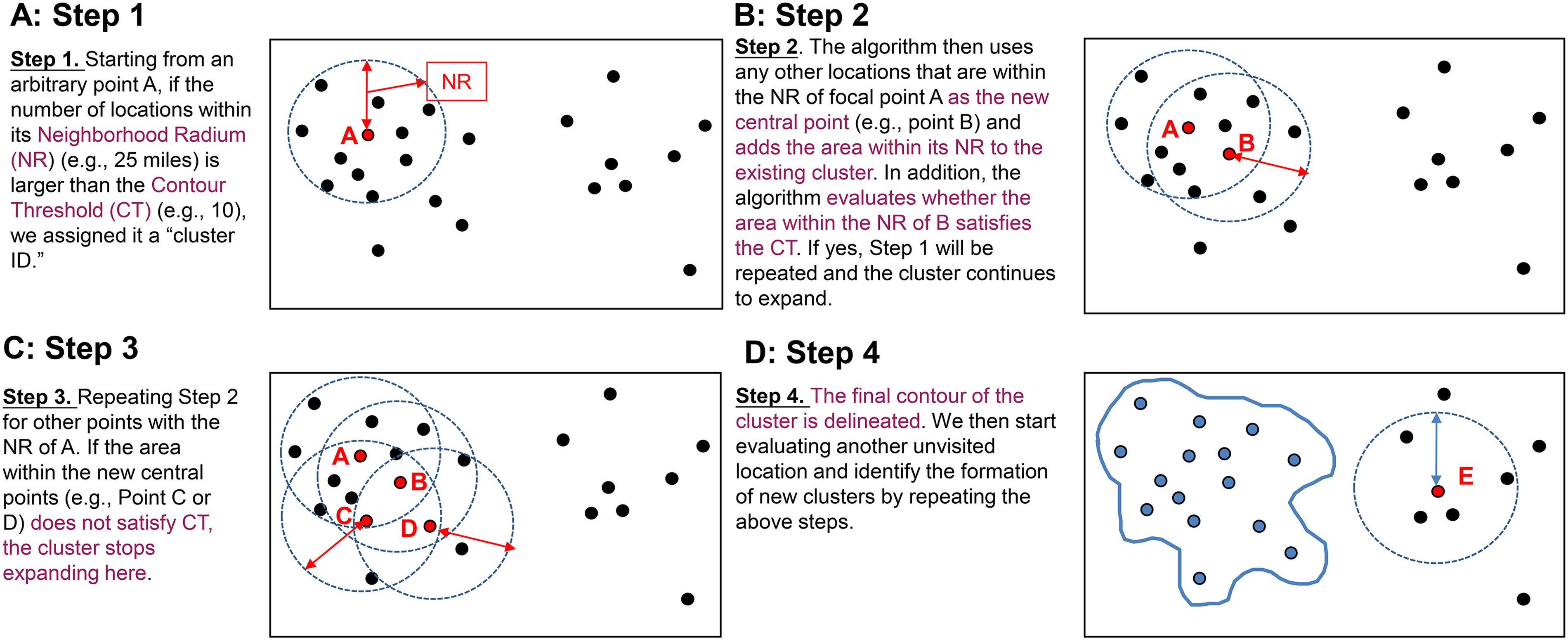
The Process of Cluster Detection.
Note that this technique also enables us to track the historical pattern of expansion of the franchise system. Hence, the clusters in our analysis are not static. Web Appendix C shows the evolution of the average number of franchised outlets per cluster and the average distance between two outlets within store clusters over the examination window. Specifically, the average cluster size across all franchise firms in our sample, as defined by our technique, peaked at around 120 in 2013–2014. During the COVID-19 pandemic, the average size of those clusters dropped to around 90 (Figure C1 in Web Appendix C). Across the United States, some states had multiple clusters for the same franchised brand, whereas others had none. For example, using our technique, we identified more than one cluster of Tropical Smoothie Cafe in Oklahoma in 2021 but none in Colorado that year (Figure C2 in Web Appendix C).
Independent Variables and Moderators
Cluster density
Following prior research (Butt et al. 2018; Lu and Wedig 2013), we measured cluster density (CLUSTERit) by the number of outlets located within our constructed cluster. If an outlet was not located within any cluster as identified by our technique, we assigned it a value of 1 because the outlet itself is a mini cluster.
Economic adversity
We measured economic adversity (EAst) for county k in year t using the decline in GDP, defined as −(GDPk,t − GDPk,t−1). This metric was directly related to the severity of adverse economic conditions (Steenkamp and Fang 2011). The higher the decline in GDP, the greater the degree of economic adversity.
Franchise governance
Our model had two types of franchise governance mechanisms. The first was franchisee ownership fragmentation (OWNFEit), measured by the number of unique franchisees in a cluster. If an outlet was located outside a cluster, we measured it using the number of franchisees in state s that were not part of the cluster. Empirically, ownership fragmentation exhibited a high degree of correlation with cluster density. Therefore, we orthogonalized them prior to estimating the model. The second governance mechanism was franchisor on-site supervision (FRSUPit), which reflects the extent to which the franchisor supervises and monitors an outlet. As monitoring and on-site supervision are usually conducted by the franchisor's regional offices (Nishida and Yang 2020), we measured it as the logarithm of distance between an outlet and the nearest regional office (Perryman and Combs 2012). The greater the distance, the more difficult it is for franchisors to offer on-site supervision.
Control variables
We controlled for a variety of outlet-, system-, and market-level variables that might simultaneously affect a franchised outlet's survival. First, at the outlet level, we controlled for outlet age (AGEit) to capture the potential effect of a franchisee's experience on its likelihood of failure (Kalnins and Mayer 2004). We also controlled for outlet embeddedness of the focal outlet because it affects knowledge exchange among outlets. Specifically, building on the concept of tie strength from network literature, we measured the embeddedness using the inverse average distance between the focal outlet and other outlets within the same cluster (or within the same counties for out-of-cluster outlets) as the shorter distance indicates greater tie strength with other outlets (Rowley, Behrens, and Krackhardt 2000; Zhang and Guler 2020).
Second, at the franchise system level, we controlled for franchisor age (FRAGEjt), as franchisor experience may affect outlet performance (Ingram and Baum 1997). Franchise system size (FRSIZEjt), measured as the total number of outlets in a given year t, was included in the model as larger franchise systems have scale advantages and greater resources, which may impact the closures of outlets within the system (Ingram and Baum 1997; Kalnins and Mayer 2004; Shane 1998). We controlled for royalty rate (ROYALjt), as it directly impacts franchisee returns, in turn affecting the likelihood of outlet closure (Michael and Combs 2008). We also controlled for total assets (TOTASSjt) and system net income (SYSINCjt), which indicate the operational efficiency of the franchise system, thus influencing the outlet failure. The inclusion of SYSINCjt ensures that the failure-risk-reducing role of governance mechanisms does not come at the expense of reduced franchise system performance. Franchisor-provided services (SERVICEjt), measured as the number of services provided by franchisor j in a given year t, and contract completeness (CONTRACTjt), measured as the number of clauses specified in the contract of franchisor j in a given year t, were also controlled for in our model. These variables reflect an outlet's access to resources that can influence their survival rate (Antia, Mani, and Wathne 2017; Butt et al. 2018; Kalnins 2004; Kashyap and Murtha 2017).
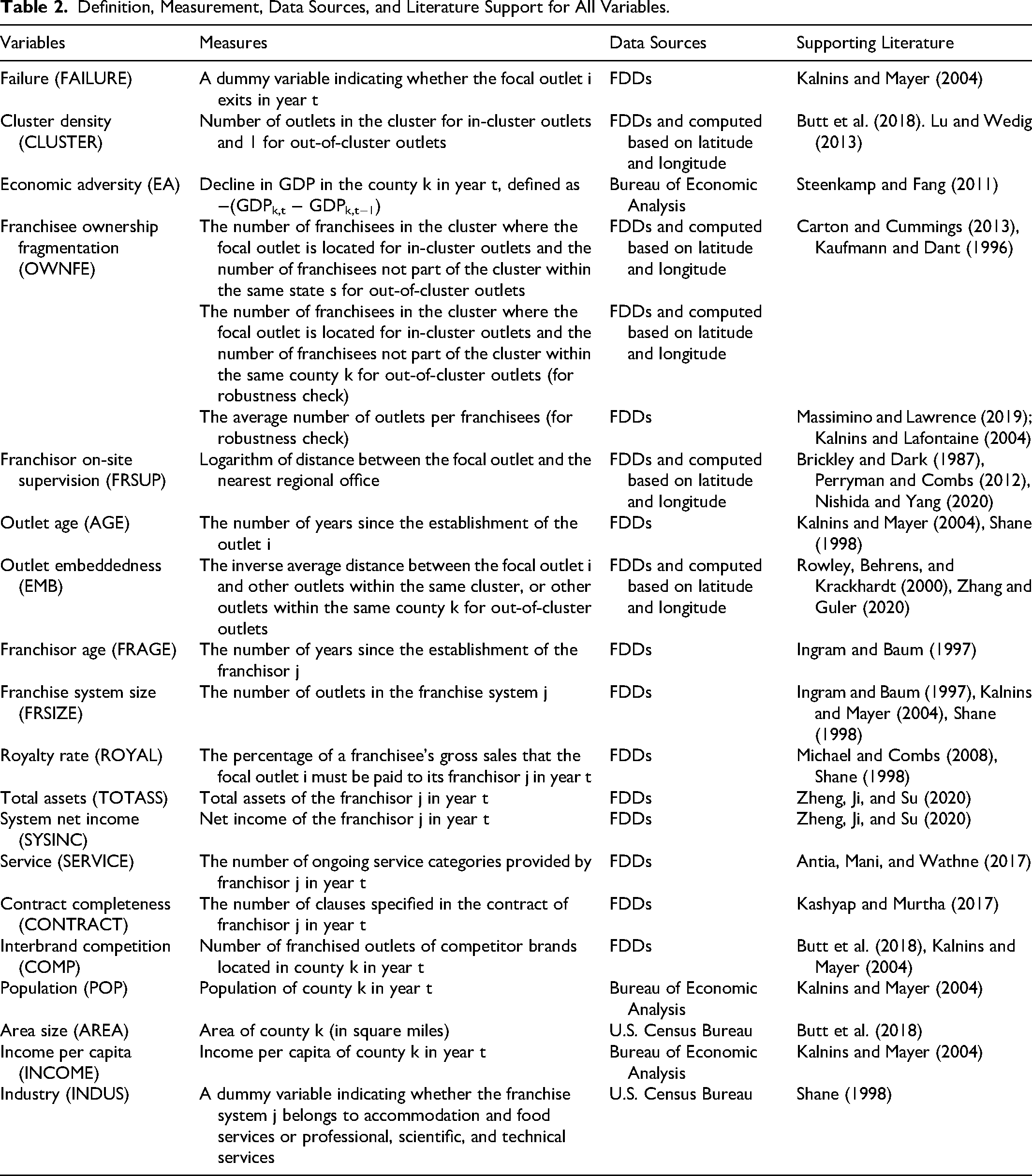
Third, at the market level, we accounted for interbrand competition intensity (COMPkt), as the number of outlets owned by other franchisors in the same industry and the same county, to control for potential competitive effects on outlet failure (Kalnins and Mayer 2004). We also controlled population (POPkt), area (AREAkt), and per capita income (INCOMEkt) in year t of county k in which the focal outlet is located (Butt et al. 2018). Finally, we added the industry dummy (INDUSit) to control for industry-specific effects (Shane 1998). The variance inflation factors range from 1.06 to 2.32, which were all lower than the cutoff benchmark (10.0), indicating that multicollinearity was not a concern (Hair et al. 1995). Table 2 provides the measures and data sources for all variables, and Table 3 provides the descriptive statistics and correlation matrix for all variables included in the study.
Definition, Measurement, Data Sources, and Literature Support for All Variables.
Descriptive Statistics and Correlation Matrix.
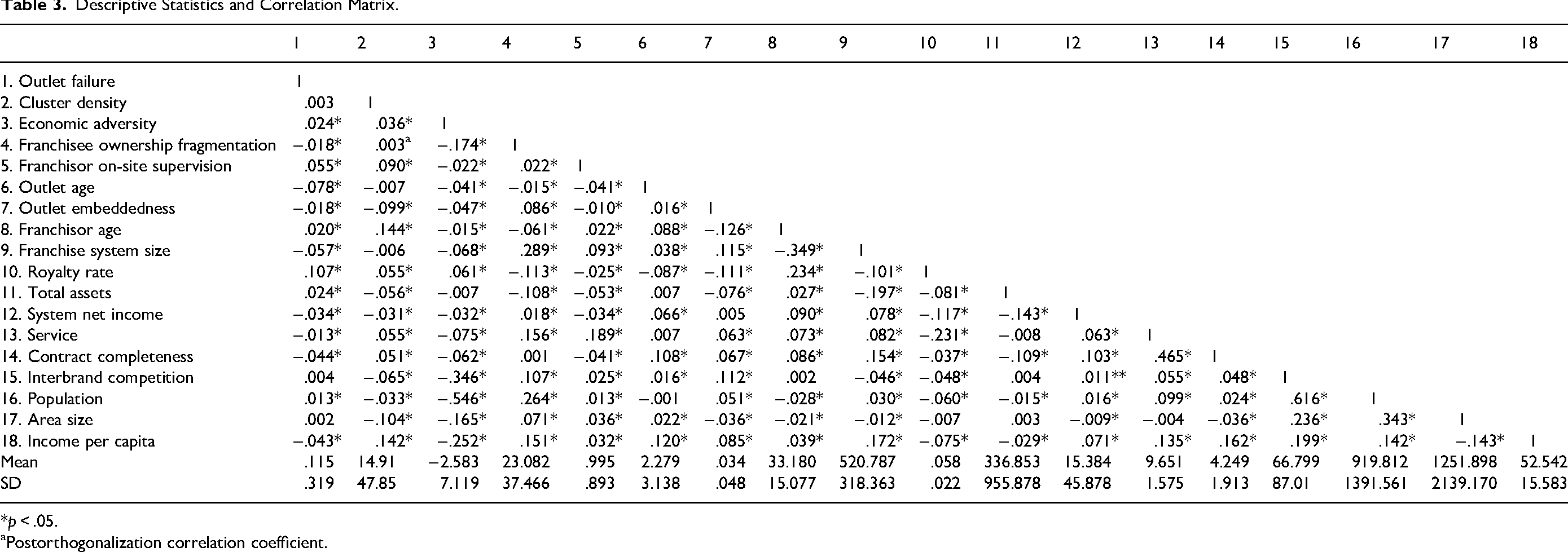
*p < .05.
Postorthogonalization correlation coefficient.
Model Specifications
Our dependent variable was the failure of a franchised outlet; hence, we employed survival analysis as our estimation approach. To address the endogeneity of cluster density, as well as our two governance variables, franchisee ownership fragmentation and franchisor on-site supervision, we employed an instrumental variable (IV) approach in our main analysis as well as an IV-free approach as a robustness check. In the main analysis, we used a control function approach and specified a two-stage model (Danaher et al. 2015; Del Rio Olivares et al. 2018; Mani, Astvansh, and Antia 2024; Risselada, Verhoef, and Bijmolt 2014; Terza, Basu, and Rathouz 2008) to capture the endogenous part of the error term so that the independent variables no longer correlated with the error term in the survival equation (Sande and Ghosh 2018). Following prior research (Petrin and Train 2010; Sridhar and Srinivasan 2012), we first performed an auxiliary estimation with the endogenous variable as the dependent variable and IVs related to the endogenous variable but not to the focal dependent variable as independent variables. We then added the “residual” obtained from the auxiliary equation as an additional control variable to the second-stage main regression equation. We provide the model specifications for these two stages next.
First-stage regression
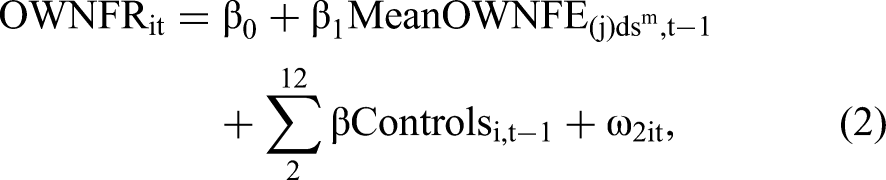
The first endogenous variable was cluster density. Strategically, franchisors will likely open more outlets in areas with larger populations. Therefore, we instrumented cluster density by the number of public hospitals in state s (HOS) because it correlates with the size of the local population but was beyond the control of any franchisors and therefore not likely to be correlated with the error term of the equation. Hence, this instrument met both the relevance criterion and exclusion restriction. The second endogenous variable was franchisee ownership fragmentation. We generated the instrument for this endogenous variable by measuring the corresponding peer franchisee ownership fragmentation (MeanOWNFE) across all franchise systems in the focal franchisor's industry d, excluding the focal franchisor j, averaged across its neighboring counties km, where m is the number of counties adjoining the focal state, and lagged the measure by one year as our instruments (Antia, Mani, and Wathne 2017; Germann, Ebbes, and Grewal 2015). The rationale for this instrument was that the focal outlet experienced similar market conditions as outlets in the adjoining counties and in the same industry (Germann, Ebbes, and Grewal 2015); as such, franchisors can be expected to demonstrate mimetic and isomorphic behavior (DiMaggio and Powell 1983; Kumar, Sunder, and Leone 2014), making similar decisions in their choice of franchisee ownership arrangement. The instrument also satisfied the exclusion restriction because those decisions by competing franchisors in the adjoining states were beyond the control of the focal franchisor, and those competing outlets did not directly compete with the focal outlet. It was therefore unlikely to be associated with the error term of the equation.
For franchisor on-site supervision, we used the number of direct flights (FLT) between the county where the focal outlet operated and the county where the headquarters were located as an instrument. The continuous nature of the instrument aligned with the continuous nature of the endogenous variable. The instrument was relevant because the number of direct flights between the focal outlet and the headquarters is negatively correlated with the likelihood of the franchisor providing on-site supervision to outlets, prompting franchisors to set up a regional office near the focal outlet (at a shorter distance to the focal outlet). It also satisfied the exclusion restriction because the availability of airline routes is determined by airline companies rather than the franchisor or franchisee, making it unlikely to correlate with the error term in the equation.
We estimated the first-stage models using ordinary least squares, where we regressed the three endogenous variables on their instruments and control variables (Controls), respectively.
Equations 1–3 show the model specifications:

Second-stage regression
We tested our hypotheses by employing the hazard function regression method. Since our data were grouped into discrete time intervals (i.e., yearly observations) and ownership arrangements, and because economic conditions and some of our control variables were time-varying, a discrete-time model that allowed for time-varying variables was appropriate in our research setting (Nikolaeva 2007). Following Nikolaeva (2007), Shmargad and Watts (2016), and Van den Bulte et al. (2018), we used the discrete-time hazards model in a complementary log-log parametric form to estimate the hazard of failure of outlet i in year t, given by 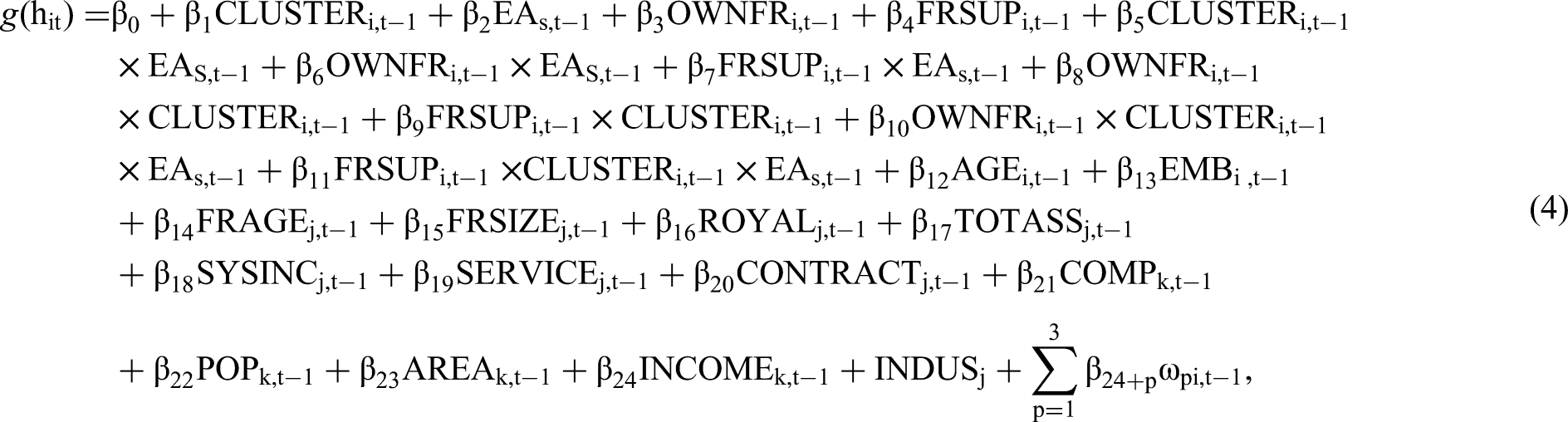
Results
Table 4 reports the first-stage regression results for the set of three endogenous variables. First, it shows that each of the instruments significantly predicts the corresponding endogenous regressor. Second, the F-statistics for the first-stage regressions are significant in all models. Third, the Cragg–Donald F-statistics for each of the first-stage equations were well above the Stock–Yogo 10% critical value, rejecting the null that the instruments were weak. Because the system was just-identified, we could not perform a Sargan–Hansen overidentification test (Huang and Dev 2020; Shankar and Kushwaha 2021). The results provide strong support showing that our instruments are valid.
Results of First-Stage Regression.
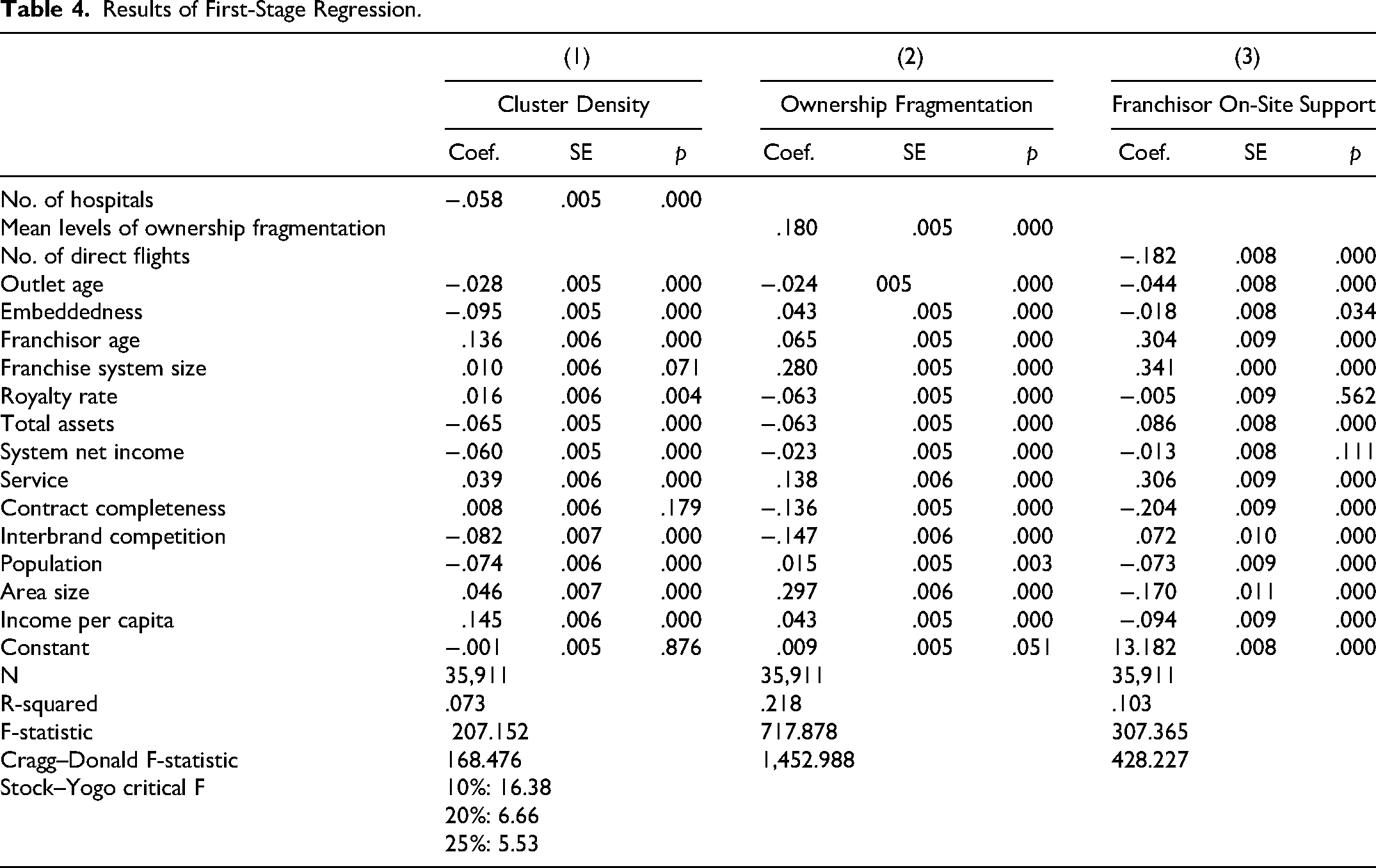
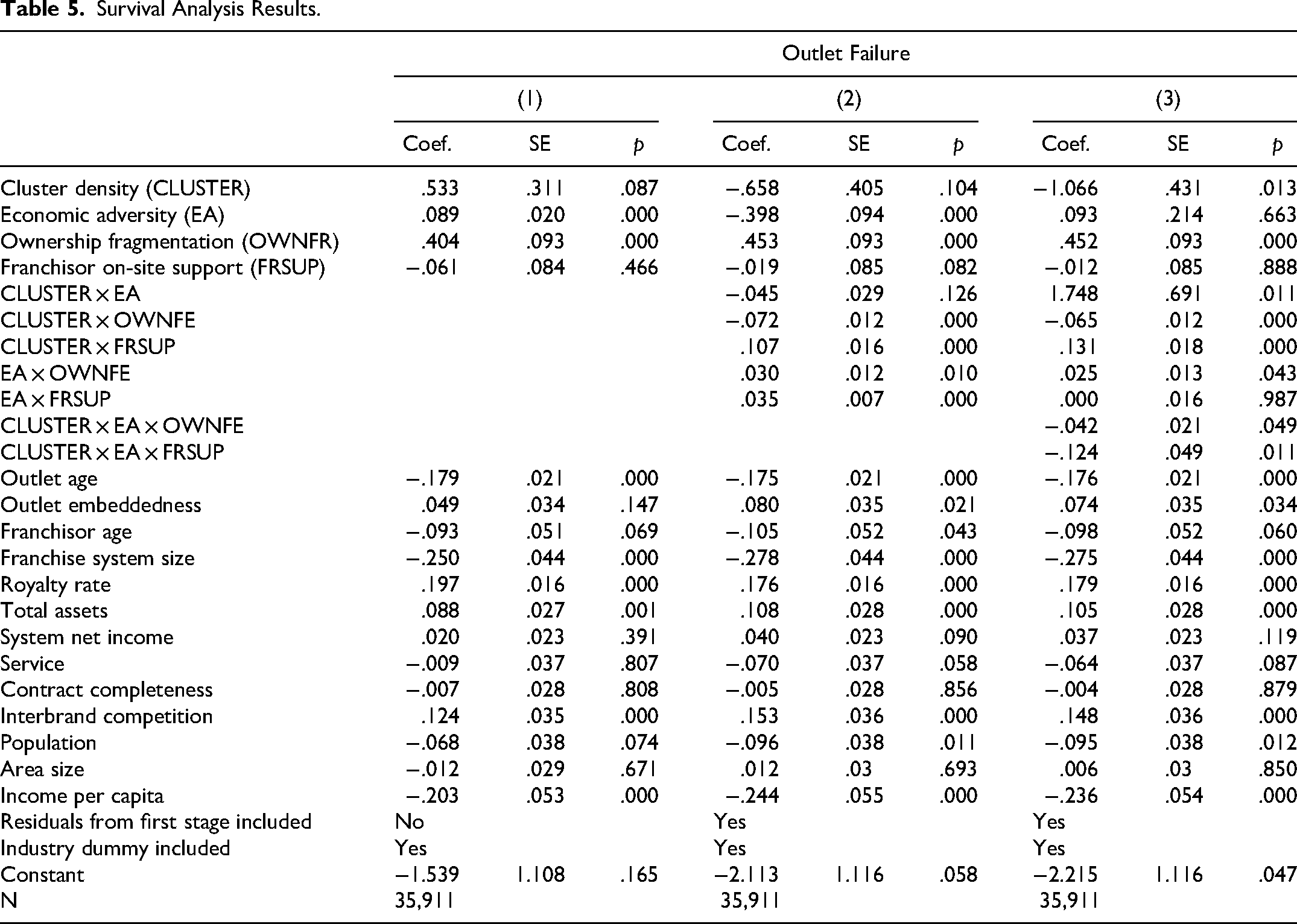
Table 5 reports the results of our survival analysis. Models 1 and 2 present the results of main analysis and two-way moderating effects, respectively, while Model 3 shows the results of our hypothesized three-way moderating effects. In support of H1, we find that the higher the cluster density and the more adverse the economic conditions, higher level of franchisee ownership fragmentation lowers the outlet failure rate (β = −.042, p = .049). Likewise, we find that the higher the cluster density and the more adverse the economic conditions, a greater distance between the focal outlet and the franchisor's regional office (an inverse measure of franchisor on-site supervision) lowers the outlet failure rate (β = −.124, p = .011), providing support for H2. Crucially, note that we obtained this effect of the two governance forms on outlet failure rate after controlling for measures of franchise system performance such as system net income and total assets.
Survival Analysis Results.
Robustness Checks
We conducted several analyses to verify that our results were robust to alternative measures, techniques, and model specifications. First, consistent with extant literature, we used a predetermined value of NR to be 25 miles. Alternatively, we constructed clusters with different values of NR by replacing the predetermined 25-mile radius with other odd numbers between 20 and 30 (i.e., 21, 23, 27, and 29). The firm-specific and demand-adjusted DT, as well as the rest of the model specifications, remained the same as in the main analysis. Models 1–4 of Table D1, Web Appendix D, show that the results remain largely consistent, suggesting that our results were not susceptible to our choice of NR.
Second, we used alternative measures for franchisee ownership fragmentation. In our original measure, if a focal outlet is not part of any cluster, we measured it by the number of franchisees not part of any cluster within the same state s for out-of-cluster outlets. We then replaced it by the number of franchisees not part of any cluster within the county k. The three-way interaction term among cluster density, economic adversity, and ownership fragmentation remained consistent with our main findings (β = −.033, p = .002; see Model 1, Table D2, Web Appendix D). Additionally, we used the average number of outlets per franchisees as a reverse proxy for franchisee ownership fragmentation, as the larger number of outlets owned by each franchisee indicates a lower level of ownership fragmentation. The results remain consistent with the main results (β = .235, p = .053; see Model 2, Table D2, Web Appendix D).
Third, we used an alternative instrument—driving time from the headquarters to the focal outlet—in the first-stage regression for franchisor on-site supervision because supervisory travel typically occurs by road rather than by air. The driving time was computed using the Open Source Routing Machine, an open-source routing engine that calculates shortest paths based on OpenStreetMap road network data (Luxen and Vetter 2011). The results remain consistent with our findings (see Model 1, Table D3, Web Appendix D).
Fourth, we changed the model specification. Specifically, we used multilevel mixed-effects complementary log-log regression to allow the intercept to be random for each firm. Given the nested structure of our data (i.e., outlets are nested in firms), this specification captured unobserved heterogeneity and within-firm correlation by allowing outlets in the same firm to share common random effects (Karniouchina, Uslay, and Erenburg 2011; Lindstrom and Bates 1990). The results remain consistent with our findings (see Model 2, Table D3, Web Appendix D).
Fifth, to mitigate potential biases introduced by the COVID-19 pandemic, we excluded data from the year 2020 and conducted the analysis based on the subsample. The findings remain consistent with our hypotheses (see Model 3, Table D3, Web Appendix D).
Lastly, we assessed the robustness of our results by adopting a Gaussian copula approach to account for the endogeneity concerns (Burchett, Murtha, and Kohli 2023; Haschka 2022; Park and Gupta 2012). The Shapiro–Wilk tests showed that cluster density (W = .610, p = .000), franchisee ownership fragmentation (W = .812, p = .000), and franchisor on-site supervision (W = .781, p = .000) were nonnormally distributed. Additional skewness tests likewise rejected normality for cluster density (skewness = 4.143, p = .000), franchisee ownership fragmentation (skewness = 1.750, p = .000), and franchisor on-site supervision (skewness = −2.852, p = .000), satisfying the requirement of the Gaussian copula approach (Becker, Proksch, and Ringle 2022). The results remain robust (see Model 4, Table D3, Web Appendix D).
Additional Analyses
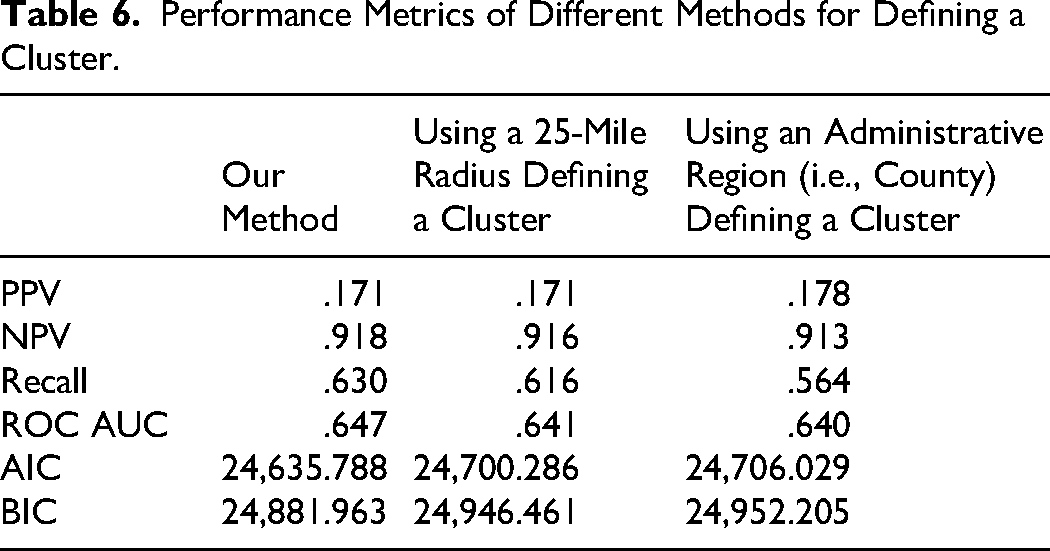
To better understand the advantage of our firm-specific, demand-adjusted, density-based clustering algorithm, we compared our method with clustering methods proposed in previous studies—the number of outlets within 25 miles and the number of outlets in predetermined geographic units (e.g., a county). We then estimated the full model using these alternative measures, maintaining the same model specification as in our main analysis. Table E1 in Web Appendix E shows the results. We find that only the three-way interaction hypothesis of franchisee ownership fragmentation is supported if we use the number of outlets within 25 miles as our measure of a cluster, whereas neither of the two hypotheses receive support if we use number of outlets in an administrative region as our measure of a cluster, suggesting that how clusters get identified and measured is crucial for understanding the effects of governance on outlet survival in a cluster. Furthermore, we compared our method with the other two approaches on key model performance metrics like positive predicted value (PPV), negative predicted value (NPV), recall based on the optimal threshold inferred from the receiver operating characteristic (ROC) curve, the area under ROC curve (ROC AUC), AIC, and BIC (Lee, Yang, and Anderson 2026; Homburg, Koschate, and Hoyer 2005). As Table 6 shows, our firm-specific, local-demand-adjusted, density-based algorithm provided a better fit than the other approaches on most criteria, suggesting that our clustering procedure represents a better fit and an improvement over existing approaches. Particularly, our method yields consistently lower AIC/BIC values, which indicates that our approach provides a more accurate and efficient explanation of the data. Moreover, the results suggest that the effects of our focal governance mechanisms are underestimated using existing clustering approaches compared with the results obtained by our proposed clustering method. In sum, our clustering technique not only provides better fit but also yields different implications regarding the role of our particularistic governance tools in helping clustered outlets survive under economic adversity.
Performance Metrics of Different Methods for Defining a Cluster.
In addition, we split the data by the median distance to the nearest regional office and reran our model for the two subsamples to test if excessive franchisor monitoring impedes local adaptation despite high franchisee ownership fragmentation. As shown in Table E2, Web Appendix E, for the high-monitoring group, the three-way interaction is insignificant (
Lastly, we assessed whether the deployment of these two governance tools to reduce outlet failure comes at the expense of other crucial measures of franchisee performance (e.g., outlet sales). To that end, we conducted an analysis using outlet sales as the dependent variable. We utilized SafeGraph Spend data, which comprises anonymized debit and credit card transactions from approximately 10.6 million consumers, covering more than 1.1 million business locations in the United States since January 2019 (Chiong, Kim, and Kim 2025). Merging this with the FDD data based on business names and locations yielded a subsample of 4,107 observations from 1,785 outlets over the period of 2019–2021. We applied a Heckman selection approach to address potential concerns about selection bias. Table E3 in Web Appendix E shows the results. We see that the determinants of outlet survival differ substantially from those of outlet sales. More importantly, the three-way interaction effect of economic adversity, cluster density, and our two governance tools has no impact on outlet sales, suggesting that franchise managers do not have to worry that the deployment of these governance tools creates a trade-off between survival and sales.
App Implementation
Based on our algorithms and findings, we developed an app, FranClusterer, to provide a predictive tool for both the franchisor and franchisees, both current and prospective, in delineating the contours of outlet-store clusters. This, in turn, assists them in assessing the hazard ratio of individual franchised outlets and informs them of their key decisions regarding store locations, the deployment of governance mechanisms (e.g., to have a new outlet owned by a “new” franchisee owner) by the franchisor, and the franchisee's decision to join the franchise system. This app supplements the contributions of our article in the following ways.
First, one of our core contributions is to suggest governance mechanisms that franchisors could deploy to manage franchise clusters during economic downturns. A challenge in implementing this idea in business practices is that franchisors might fail to accurately identify which outlets form a cluster given concurrent local market conditions. FranClusterer incorporates a firm-specific, local-demand-adjusted DT in the clustering algorithm and provides a tool for franchisors to demarcate their contours that is specific to their franchised system. Specifically, based on the location information (i.e., addresses) submitted by the franchisor, FranClusterer calculates the franchise system-specific DT, adjusted by GDP in the corresponding areas, based on which it delineates the boundaries of franchise clusters, which are often irregularly shaped. Importantly, note that such an assessment can be conducted both for existing and prospective outlets.
Second, FranClusterer allows the franchisor as well as existing and prospective franchisees to compare the hazard ratio across individual outlets. Hence, FranClusterer helps the franchisor and the franchisees visualize how the hazard ratio of the outlet can change depending on a particular, or alternative, location choice. The franchisor can compare the hazard ratios of different outlet locations to better understand how outlet failure could be minimized by making adjustments by introducing a new franchisee owner or not, or by modulating the franchisor's on-site supervision. In turn, in their communication with franchisees, franchisors can use FranClusterer as an effective tool to showcase the best locations for a new outlet.
To accelerate dissemination, a secure, anonymous, relatively permanent link to the app is available at https://franclusterer.com. We have also provided open-source access to the app. A sample data file and user instructions can be downloaded directly from the app.
Discussion
Aligning transactional attributes with governance mechanisms through frameworks such as transaction cost analysis (Williamson 1985) has long been a central question in marketing and economics. A large body of research in interorganizational relationships has examined how the effectiveness of governance structures depends on contextual factors such as relationship life cycle (Chmielewski-Raimondo et al. 2022; Heide 2003), power asymmetry (Dong, Zeng, and Su 2019), firm size (Massimino and Lawrence 2019), identity orientation (Heide, Bell, and Tracey 2023), and the institutional environment (Bai, Sheng, and Li 2016). Tracey, Heide, and Bell (2014) note that one significantly understudied aspect that needs attention is the interplay between a firm's place strategy and governance choices. Our research responds to this call. Specifically, we propose a cluster-based governance approach that explores the effectiveness of two novel governance instruments in reducing franchisee outlet failure rate within a cluster when the external economic conditions deteriorate. Using a unique dataset of 35,911 observations (i.e., 8,677 outlets across 18 franchisors over 14 years [2008–2021] in all 50 U.S. states) and a novel algorithm-based clustering technique to identify franchise clusters, our findings reveal that when economic conditions deteriorate, franchisee ownership fragmentation reduces the failure hazard of franchised outlets within a cluster, whereas franchisor on-site supervision increases such hazard. Our findings offer fresh insights into franchise cluster governance during economic downturns and provide implications for marketing theory and practice.
Theoretical Contributions
Our work makes three key contributions to research. First, we identify two novel governance mechanisms that vary at the cluster or outlet level—namely, franchisee ownership fragmentation and franchisor on-site supervision—which enable the outlets to operate more effectively and lower their failure hazards in the face of significantly adverse, exogenous shocks. We show that the effectiveness of the interplay between a firm's place strategy (here, clustering) and governance is contingent on a key third factor: the external, macro-economic environment. Specifically, we provide evidence that franchisee ownership fragmentation, a hitherto underexplored and novel governance tool, can be crucial to lowering the failure hazards of outlets especially under economic adversity. A more fragmented ownership structure reflects a greater diversity in team knowledge and ability, and this diversity enables the creation of ideas and solutions that complement knowledge-sharing within larger clusters to adapt better and avoid store failure. Likewise, we show that under economic adversity, lower on-site supervision provides better autonomy to the franchisees, enabling them to adapt to local conditions, and thereby reduces the likelihood of outlet failure. Both results suggest a core dynamic—the need to balance the franchisor's authority to maintain consistency in brand reputation with the franchisee’s need to adapt and be agile to address local conditions.
Second, our research represents a novel effort to explore how external, macro-economy-wide shocks influence the role of franchise clustering on the survival of franchised outlets. Although prior research has suggested that changes in the economic environment can profoundly impact the effectiveness of marketing activities and result in a “permanent realignment in the marketplace” (Srinivasan, Lilien, and Sridhar 2011, p. 49), there remains a significant gap in understanding how adverse economic conditions that disrupt market dynamics affect a firm's “place” strategy, especially when outlets are clustered within geographically proximate regions. Existing research has documented both the benefits and drawbacks of clustering under normal circumstances; yet it remains unclear whether clustering aids or hinders franchised outlet survival during periods of economic adversity. The effect is complex because economic downturns, whether global or regional, disrupt market dynamics by simultaneously intensifying competition among franchisees and fostering cooperation among them to collectively address external challenges. Employing survival analysis and a unique, extensive dataset, we find that under adverse economic conditions, the effect of clustering on individual outlet survival is contingent on franchisor governance. These findings provide new insights into the nuances regarding the effect of clustering strategies and highlight the need for franchisors to properly govern franchise clusters under adverse economic conditions, which joins the broader discourse on how firms navigate economic challenges (e.g., Das et al. 2021; Srinivasan, Lilien, and Sridhar 2011).
Finally, our research provides an accessible method for detecting franchise clusters. Building on Alcácer and Zhao (2016), we construct a firm-specific, local-demand-adjusted DT in identifying cluster formation. Incorporating such a threshold is important because DT by definition should correlate with a region's market capacity. Two factors determine a region's market capacity: its population size and its individuals’ disposable income, which collectively yield the local GDP. Therefore, we use local GDP as a weight to reflect the role of market capacity in identifying cluster formation and to capture varying economic conditions across time periods. To our knowledge, we offer the first firm-specific, local-demand-adjusted clustering technique for business cluster detection, complementing the existing literature and providing an accessible tool for identifying outlets located within clusters that should be managed collectively.
Managerial Implications
Enabling franchisors to Enhance Governance Efficiency
Segmenting franchise networks into geographical clusters enables franchisors to improve the efficiency and effectiveness of franchise network management. Although many franchisors establish area developers or regional offices to oversee specific regions, our interviews reveal that they typically do not conceptualize outlets operating in similar market environments as clusters, and neither do they explicitly adopt “cluster management” practices. Our research provides a direct and accessible tool to help firms pursue effective cluster management. Specifically, our app (FranClusterer) allows firms to construct and delineate franchise cluster boundaries based on local market capacity and economic conditions, enabling them to tailor governance mechanisms to the unique needs of outlets located within and outside these clusters. For example, our findings suggest that, when the economy deteriorates, franchisor on-site supervision can unintentionally increase the failure hazard of individual outlet within a cluster. With our app, they can appropriately modulate their level of supervision to outlets within the algorithm-defined cluster boundaries. Likewise, we find that when the economy deteriorates, a more concentrated ownership structure within a cluster can also unintentionally increase the failure hazard of individual outlet within the cluster. With our app, franchisors can at least identify this potential problem and see if there are other ways they could support those franchised outlets during trying times.
Enabling Geotargeted Promotion
Our app also supports a broader range of promotional efforts by enabling geographical segmentation and localization. By defining the cluster boundaries more precisely, FranClusterer can help firms engage with local franchisees and execute geotargeted marketing campaigns tailored to their neighborhood's characteristics. As clusters form in areas with higher store density and stronger brand visibility—what we term “active neighborhood”—understanding the demographic and competitive landscape (e.g., the number of schools, hospitals, or rival stores) of these areas enables firms to customize marketing strategies. For example, franchisors can schedule localized campaign during micro time windows, such as school hours or dinner time, to maximize engagement within the hyperlocal community. This would not be possible without delineating the boundary of the store clusters.
Aiding Franchisors and Franchisees in Site Selection
A distinctive feature of our app lies in its ability to rank the survival probability for each franchised outlet, including both existing and prospective sites, based on its location and other algorithm inputs. This functionality provides both parties with a clear understanding of the relative viability and long-term sustainability of store locations. For example, when deciding between two sites, FranClusterer can estimate and predict which location yields a higher survival ranking, enabling a data-driven, evidence-based site-selection decision. This is particularly valuable during phases of franchise system expansion, when multiple potential store locations must be evaluated and compared. Notably, our app allows users not only to better capture the dynamics of same-brand outlets but also to visualize how outlets of a rival franchise system interact within the same market geography. This feature facilitates a deeper understanding of cluster dynamics that extend beyond the focal brand, allowing firms to assess competitive intensity, identify untapped markets, and strategically position new outlets for optimal performance.
Assisting Franchisors and Franchisees in Responding to Economic Adversity
Our app helps franchisors and franchisees navigate economic adversity by clarifying the effectiveness of different governance tools under varied economic conditions. Our results suggest that fostering a diverse and fragmented ownership structure can be a valuable strategy during adverse economic conditions because it enhances diversity in team composition and knowledge sources. Our model shows that an increase in the number of unique franchisees in a cluster by only one lowers the hazard of a clustered outlet's failure by 4.11%. Franchisors should hence encourage collaboration among franchisees within clusters and leverage their varied perspectives and experiences to collectively address local market challenges. Likewise, our findings highlight the role of franchisor on-site supervision in shaping the resilience of clustered outlets. Reduced on-site supervision can lower the risk of outlet failure during economic downturns by allowing greater autonomy to the franchisee. Specifically, we find that a one-unit decrease in monitoring is associated with a 11.66% reduction in the clustered outlet's failure hazard as the economic condition deteriorates. This suggests that franchisors should consider incorporating flexibility into franchised provisions—provisions that are valuable for maintaining brand consistency and reputation during normal times, and hence balance oversight with sufficient autonomy so that franchisees can make localized, agile decisions. Empowering franchisees to adapt their operations to their market's specific needs can improve the overall performance of clustered outlets under adverse conditions.
Of the two governance mechanisms we investigate, franchisor on-site supervision can be adjusted more easily (i.e., dialed up or down), compared with franchisee ownership fragmentation. Our cross-sectional analysis does not show the changes franchisors made to these two governance structures as economic conditions changed; however, it does show that franchisees, and hence the franchised system as a whole, can benefit from the knowledge generated from interacting with other parties in the cluster. To understand whether knowledge and information from diverse sources help managers make better operational decisions during trying times, we conducted additional in-depth interviews with senior executives in various sectors with specific focus on the issues they faced either during the 2008 global financial crisis or the COVID-19 pandemic.
Consider the case of a medium-sized franchise for desserts (e.g., cakes, ice cream, tarts). During the COVID-19 pandemic, franchisee outlets had difficulty accessing/getting core ingredients and products from authorized vendors because many of these vendors had themselves shut down production for a variety of reasons. As a consequence, sales at individual outlet stores plummeted. Fortunately, one of the franchisees knew the owner of a large, privately owned, multistore smoothie brand who was able to direct them to ingredient vendors that could supply the franchisees with most of their essential ingredients. A group of franchisees quickly conducted a concept test to assess whether these ingredients could be feasibly used as substitutes for the authorized vendors’ products. Having qualified the suppliers, these franchisees approached the franchisor to seek approval for these new vendors. The franchisor agreed, and supplies from these vendors were formally implemented. In essence, the franchised systems’ supplies were stabilized due to the additional diversity of information (here, knowledge and access to these new vendors) that was brought into the franchise system. Indeed, in gratitude, the owner of the smoothie brand was offered his own set of three franchised stores in the region, changing the level of ownership fragmentation in the area.
In Web Appendix F we provide additional insights from three nonfranchised systems about cooperation between agents working in a geographic cluster. Consistent with the case of the franchise system depicted above, we see that these firms indeed benefited from new knowledge that was created by bringing diverse agents together. They also show that these firms continued to pursue and refined the structural changes they made during those times of economic adversity.
Limitations and Future Research
As with any research effort, our study has limitations that indicate avenues for future work. First, although our hypothesis development builds on interaction dynamics among franchisees, such as knowledge-sharing and collaboration, the underlying mechanisms are not directly tested. Future researchers can examine dynamic relationships among franchisees under different economic conditions by observing their online and offline interactions and formally testing these mechanisms. Second, franchised outlet failure hazard is a downside risk aspect of performance; investors, such as franchisees, may seek to balance the risks and rewards as trade-offs. Our study does not consider this additional trade-off. Future researchers can consider rewards such as profits and sales to reflect their role in firms’ location decisions. Third, our study considers only two governance instruments: franchisee ownership fragmentation and franchisor on-site supervision. Although those two are common mechanisms that can vary at the regional and outlet levels, they do not represent an exhaustive list. Future researchers can explore additional governance mechanisms, particularly those related to the benefits and costs of clustering (Tracey, Heide, and Bell 2014). Finally, we conducted our study in two specific industries; future researchers can explore whether our findings are generalizable beyond their current context.
Supplemental Material
sj-pdf-1-jmx-10.1177_00222429261460011 - Supplemental material for Surviving Economic Adversity: Governance of Franchise Clusters
Supplemental material, sj-pdf-1-jmx-10.1177_00222429261460011 for Surviving Economic Adversity: Governance of Franchise Clusters by Xu (Vivian) Zheng, Yajing Fan and Mrinal Ghosh in Journal of Marketing
Footnotes
Acknowledgments
The authors thank the review team for their highly valuable guidance. The authors also thank Yongchao Ma for his support for the app development.

Funding
The author(s) disclosed receipt of the following financial support for the research, authorship, and/or publication of this article: This work was supported by the City University of Hong Kong (grant number 7006160, 7020060), Hong Kong Research Grant Council (grant number 11509321), National Natural Science Foundation of China (grant number 72562001), Guangxi Natural Science Foundation (grant number 2026GXNSFBA00640200), and the Eller College Small Research Grant at the University of Arizona.
Declaration of Conflicting Interests
The author(s) declared no potential conflicts of interest with respect to the research, authorship, and/or publication of this article.
Supplemental Material
Supplemental material for this article is available online.
Author Biographies
References
Supplementary Material
Please find the following supplemental material available below.
For Open Access articles published under a Creative Commons License, all supplemental material carries the same license as the article it is associated with.
For non-Open Access articles published, all supplemental material carries a non-exclusive license, and permission requests for re-use of supplemental material or any part of supplemental material shall be sent directly to the copyright owner as specified in the copyright notice associated with the article.
