






Abstract
Territorial restrictions long have been the subject of intense policy debate. The central issue in this debate has been whether such distribution arrangements are deployed for efficiency or anticompetitive purposes. The authors add to the debate by broadening the existing conceptualization of business efficiency and providing evidence of the importance of efficiency considerations in the decision to deploy restrictions. In the past, efficiency often has been viewed narrowly, in terms of giving distributors incentives to provide free-rideable services. The authors show that information asymmetry and transaction costs also represent important efficiency-based explanations of territorial restrictions. With regard to anticompetitive concerns, their results show that manufacturers are more likely to use territorial restrictions when they face competition ex ante. Ultimately, this may reduce interbrand competition. From a public policy perspective, their pattern of results supports the current rule of reason treatment of territorial restrictions in the United States. At the same time it questions the current European policy of per se illegality.
One area of public policy in which marketing has contributed less is that of vertical restrictions. The particular focus of this research is on territorial restrictions. Such restrictions, which are initiated by a manufacturer, assign distributors to a particular geographical area or sales territory with the objective of restricting intrabrand competition (Cady 1982; Katz 1989; U.S. Justice Department 1985). These restrictions have been the topic of intense debate in the law, economics, and public policy literature in the United States for a long time (Klein and Murphy 1988; Mathewson and Winter 1984; Scherer and Ross 1990; Telser 1980).
Interestingly, territorial restrictions often receive differential treatment in the United States and abroad. In the United States such restrictions have received relatively favorable treatment following the Continental TV, Inc. v. GTE Sylvania, Inc. (1977) case. Specifically, they currently are viewed under a rule of reason principle. In contrast, in Europe these arrangements are often per se illegal. The European view is expressed in The Economist's (1997, p. 80) recent observation that “there is one form of vertical restraint which the commission has consistently opposed, and which it remains determined to quash. That is territorial protection.”
The marketing literature has been strangely silent in the debate on territorial restrictions. The existing marketing literature on this topic is not only small but generally limited to informing marketers about the outcomes of existing policy debates, rather than informing the debate itself. Marketers tend to treat the laws, regulations and public policy on vertical restrictions as given and simply prescribe marketing strategies that are based on them (Sands and Posch 1982). 1
Consistent with the theories underlying the policy debate (Mathewson and Winter 1984; Rey and Stiglitz 1995; Scherer and Ross 1990), our focus is on situations in which an agreement exists between a manufacturer and a distributor that limits the distributor to a specific geographical area. This is distinct from the notion of distribution intensity or selectivity, which has been studied frequently in the past (e.g., Aspinwall 1962; Bucklin 1962; Copeland 1923; Corstjens and Doyle 1979; Fein and Anderson 1997; Frazier and Lassar 1996; Miracle 1965; Rangan 1986, 1987; Webster 1976). Essentially, restrictions speak to the actions that a distributor is allowed to take, whereas intensity describes the number of distributors in a given area. In some instances, however, the two will coincide, such as when restrictions are imposed on a single distributor (i.e., exclusive coverage or intensity).
Although it is important to keep abreast of existing public policy regulations, it is not enough for marketers to be reactive, because the outcome of these debates can significantly restrict managerial choices and firms’ ability to compete. In the case of territorial restrictions, the policy debate is between (1) those who suggest that firms use such arrangements to improve distribution channel efficiency and (2) those who suggest that they are used to enhance monopoly positions. The key issue from a marketing perspective is the extent to which efficiency considerations play a role. If channel efficiency considerations are important determinants of territorial arrangements, regulations that limit a firm's ability to use them can seriously undermine its competitive position. One of our objectives here is to articulate what the possible sources of efficiency are and to show how they are linked with the use of restrictions.
What is known currently about the role of business efficiency in the decision to use territorial restrictions? In theory, quite a lot is known, due to many theories and models that address the issues. In practice, however, very little is known. Rey and Stiglitz (1995, p. 446) state that “in our perusal of the literature on efficiency-enhancing effects of vertical restraints, we have been impressed with the almost total reliance on theoretical arguments showing the possibility of such effects, and the paucity of cases providing persuasive evidence of their importance.” This lack of systematic evidence also was noted in a prior study by Sass and Sauerman (1993). Some critics complain that even court decisions have been based more on theoretical arguments than on empirical evidence (Scherer and Ross 1990).
To make matters worse, the evidence that does exist on territorial restrictions is limited almost entirely to one source, namely, legal case studies involving firms whose distribution practices have been challenged under antitrust law. Although these data have generated important insights, they also possess inherent limitations. Perhaps most significant, legal case studies, by definition, only involve firms that have actually used distribution restrictions. As such, these data preclude comparisons between users and nonusers with respect to the antecedent conditions suggested by the extant theories. We could argue that the current rule of reason principle was adopted and continues to be applied without a strong empirical foundation.
The primary contribution of this research is to fill a void in the literature by empirically testing the various theories of territorial restrictions using primary survey data. In doing so we respond to the frequently voiced request for “micro-level” data (Calfee and Rubin 1993; Williamson 1985), and can assess directly the role of the antecedent conditions suggested in the literature. We find strong support for a variety of efficiency-related considerations and thus provide direct evidence regarding many of the factors that have been suggested in the literature.
Our second contribution is to broaden the existing conceptualization of business efficiency. Historically, the primary dimension of efficiency that has been attributed to territorial restrictions is the ability to control free-riding on distributor services. We add to this literature by suggesting that transaction costs associated with maintaining the integrity of the arrangement affect channel efficiency and consequently should influence the deployment decision. Furthermore, consistent with newer theories (e.g., Rey and Tirole 1986), we suggest that when distributors have superior market information, using territorial restrictions enables them to make marketing decisions in accordance with local conditions and thereby improve channel efficiency.
In total, our results suggest that business efficiency considerations take a variety of forms and that they are important determinants of the use of restrictions. As such, our results suggest that efficiency arguments should play an important role in the public policy debate on vertical restraints. At the same time, public policy cannot ignore anticompetitive concerns. Our data also show that manufacturers are more likely to use restrictions when they face higher ex ante competition. Ultimately, interbrand competition may suffer.
The remainder of the article is organized as follows: In the next section, we present the theories of territorial restrictions and our empirical predictions. We then describe the research method used and the results. In the final section, we provide a discussion of the results and their policy implications. We also identify the study's limitations and offer suggestions for further research.
Theories of Vertical Territorial Restrictions
The public policy debate on territorial restrictions reflects two general theoretical perspectives: The first consists of theories that address business efficiency motivations, such as reducing free-riding on distributor services; and the second focuses on anticompetitive considerations, such as reducing manufacturer competition and increasing the cost of market entry. In general, these two bodies of theory address actions that either (1) enhance a focal firm's competitive effort or (2) inhibit the efforts of other firms. Both of these theoretical perspectives have suggested antecedent conditions that, if relevant in firms’ deployment decisions, would support their respective positions. These conditions are discussed in the following sections.
Business Efficiency Considerations
Business efficiency considerations, as discussed in the extant literature (e.g., Rey and Stiglitz 1995), include factors that either (1) improve customer service (i.e., “effectiveness” in marketing terms) or (2) enhance distribution channel efficiency through reduced distribution costs or improved pricing flexibility.
Free-rideable services
Distributors frequently provide services that can benefit other distributors of the same product. For example, selling situations that involve technical or complex products (Bucklin 1962; Miracle 1965) require that customers be given extensive presales services in the form of product information (Lilien 1979; Webster 1976) or actual demonstrations (Blair and Kaserman 1983; Cady 1982). Although such services are important to customers, they also represent potential problems in that a distributor that does not offer the services can free-ride on full-service distributors (Lafferty, Lande, and Kirkwood 1984). For example, a discount dealer that does not provide technical advice will have lower costs and can offer the product to end users at a lower price. In many situations, the discount dealer can pursue a low-cost strategy because there are full-service distributors available that perform the necessary customer services. However, to the extent that buyers can unbundle these presale services from the sale of the product itself or that the services cannot be charged for separately by the distributor, a free-riding potential exists (Bork 1978; Mathewson and Winter 1984).
Territorial restrictions are designed to solve this problem. In effect, the goal of such restrictions is to make a distributor a local monopolist for the brand in question, which increases the probability that the focal distributor will receive the full benefit of the service provision (Mathewson and Winter 1984; Stern, Agodo, and Firat 1976). On the basis of the previous discussion, we suggest the following proposition:
H1: The greater customers’ need for free-rideable distributor services, the higher the likelihood that territorial restrictions will be deployed.
Information asymmetry
The services hypothesis presented in the preceding section constitutes the traditional efficiency-based argument for the use of territorial restrictions. Recently, Rey and Tirole (1986) have expanded on this argument by suggesting that restrictions also may promote efficiency by virtue of enabling manufacturers to capitalize on distributors’ superior information about local market conditions. As shown in previous studies (e.g., Heide and John 1988), distributors frequently have extensive knowledge about the downstream market for a manufacturer's product. In particular, they are often better informed than the manufacturer about the nature of consumer demand, the costs required to serve a given market, and the nature of downstream competition. Authors like Simon (1976) have made similar observations in intraorganizational settings and argued that employees are often better informed than their supervisors on many issues.
To the extent that such information asymmetries exist, deploying territorial restrictions may enhance overall channel efficiency by enabling the better informed party (in this case, the distributor) to make marketing decisions on the basis of its superior information. Consider a distributor's ability to set prices in a market. If a manufacturer does not provide territorial restrictions (i.e., allows unfettered intra-brand price competition among distributors), it essentially sets the market price because dealer competition drives prices down to the manufacturer's level. In effect, the manufacturer ends up setting market prices despite having less information about market conditions than the distributors. If, however, the manufacturer grants territorial restrictions that buffer distributors from intrabrand competition, it has the flexibility to tailor its pricing to local conditions. Thus, the core of this argument is that the party with the better market information should be setting the market price. Territorial restrictions can accomplish this objective.
A classic example of this scenario is a car dealer's ability to learn information from a customer at the point of sale. Only the dealer can evaluate accurately the true value of a car to the customer, the value of a trade-in, or the customer's ability to negotiate. If a highly competitive dealer network is established, the dealers will compete away any margins the salespeople could obtain. As a consequence, the manufacturer loses the ability to segment customers, and the market price is set by the uninformed manufacturer, rather than by the informed dealer. If, however, the manufacturer assigns restrictions, the salespeople are given the ability to price correctly on the basis of local market conditions.
Thus, according to Rey and Tirole (1986), when distributors have superior information about the downstream market, both manufacturers and distributors benefit from the use of territorial restrictions, because there is a better match between the institutional arrangement and the environment. This argument represents an extension of the traditional efficiency explanation of territorial restrictions and suggests that they may be deployed even in situations when service provision is relatively unimportant. On the basis of the preceding discussion, we suggest the following proposition:
H2: The greater the distributor's information superiority relative to the manufacturer, the higher the likelihood that territorial restrictions will be deployed.
As noted previously, deploying territorial restrictions under conditions of information asymmetry is beneficial from both a manufacturer's and a distributor's perspective. Moreover, the deployment decision in Rey and Tirole's (1986) model is not motivated by anticompetitive considerations per se. However, it also must be noted that the scenario underlying H2 need not produce consumer benefits, because increased local flexibility may permit price discrimination, which causes higher prices for some consumers. We return to this issue in the “Discussion” section.
Transaction costs
Historically, the literature on territorial restrictions has implicitly assumed that restrictions, when deployed, can be enforced costlessly. Although some authors have challenged this assumption (Cady 1982; Zusman and Etgar 1981), the specific nature of the relevant costs and their effects on a firm's deployment decision are not well established. Recent evidence suggests that manufacturers may incur costs as a consequence of distributor violations of assigned restrictions. As noted by Banerji (1990), Cross, Stephans, and Benjamin (1990), and Cespedes, Corey, and Rangan (1988), such “gray market” activity is a considerable problem in many industries. In transaction cost terminology, violations of restrictions represent a form of opportunism, because they take place deceitfully or with guile (e.g., Williamson 1985). The risk of violations imposes costs on a manufacturer in two different ways: the need to (1) detect opportunistic behavior and (2) craft enforcement mechanisms that reduce the likelihood of opportunism in the first place.
Because transaction costs directly influence a firm's profits, they are part of the efficiency perspective on territorial restrictions. 2 Caves (1984, p. 455) makes the point that “transaction cost considerations are simply part of the market failure or business efficiency approach to vertical restraints.” Consider next how detection and enforcement considerations influence the decision on territorial restrictions.
The link between costs and business efficiency considerations also has been made by Sass and Gisser (1989) and Kaufmann and Lafontaine (1994).
Detection ability
As noted by Lal (1990) and Zusman and Etgar (1981), many aspects of distributors’ activities are not observed costlessly by a manufacturer. For example, a manufacturer may need to undertake on-site visits at customer and distributor sites to verify whether violations of agreements are taking place. Although firms in principle could rely on other distributors to provide information about violations, such a scenario creates antitrust concerns about’ collusion and requires the manufacturer to rely on its own information system (e.g., Halebian v. Roppe Rubber Corp. 1990). In transaction cost terms, a particular form of a performance ambiguity problem exists (Alchian and Demsetz 1972).
Detection difficulty creates a disincentive to deploy territorial restrictions in the first place, because it makes it difficult for the manufacturer to assess whether a distributor is adhering to the focal restrictions. According to transaction cost theory (e.g., Masten, Meehan, and Snyder 1991; Williamson 1991), the choice among organizational forms turns on their respective transaction costs. All else being equal, the higher the expected costs of collecting information, monitoring, or generally documenting whether restrictions are adhered to, the higher the transaction costs, and the less desirable such restrictions are to a manufacturer (Heide, Dutta, and Bergen 1998). In hypothesis form,
H3: The greater the difficulty of detecting distributor violations, the lower the likelihood that territorial restrictions will be deployed. 3
As suggested by a reviewer, it is conceivable that transaction cost considerations may ultimately have anticompetitive effects. For example, to the extent that there are differences in performance ambiguity across distributors, a manufacturer that attracts distributors with inherently lower degrees of performance ambiguity in relation to their activities has a cost advantage over later entrants. In other words, heterogeneity in performance ambiguity across distributors may create entry barriers. We are unable to test this explanation with our current due data, which were collected to test the traditional transaction cost argument (Caves 1984). However, as noted in the “Discussion” section, this is a topic for further research.
Enforcement ability
Even if violations of territorial restrictions can be detected, enforcement is often costly because of time lags and the difficulty of producing evidence that can be used in a court of law (North 1990; Rubin 1990). This is consistent with the transaction cost notion that contracting parties rely on “private ordering” or self-enforcing agreements of various kinds (Telser 1980). Klein and Murphy (1988) suggest that manufacturers can ensure compliance through private enforcement mechanisms such as requiring distributors to make investments that are manufacturer-specific in nature. For example, distributors often invest in facilities or train employees specifically for a particular product line (Heide and John 1988). In the event of violations of assigned territories, the manufacturer can terminate the agreement, and the distributor loses the quasi–rent stream on the specific investment. Thus, the presence of manufacturer-specific investments serves as an enforcement device that discourages opportunism. In turn, an incentive is created for using territorial restrictions.
Distributor investments can serve multiple purposes. For example, because of their specialized nature they may improve channel performance over time. For our present purposes, an important role of distributor investments is to create an enforcement device that facilitates the deployment of territorial restrictions. The preceding discussion suggests the following hypothesis:
H4: The greater the distributor's investments in manufacturer-specific assets, the higher the likelihood that territorial restrictions will be deployed.
Anticompetitive Considerations
The anticompetitive perspective on territorial restrictions has focused on a manufacturer's motivation to (1) reduce inter and competition among existing manufacturers or (2) increase the costs of entry for new firms. We consider each in turn.
Manufacturer competition
Rey and Stiglitz (1995) propose that manufacturers can use territorial restrictions as a means of reducing competition from other manufacturers. Recall that the effect of assigning territorial restrictions is to eliminate intrabrand competition in a particular area. The resulting increase in market power makes a distributor less sensitive to price competition. In particular, it makes the distributor less likely to pass on manufacturer price reductions, which in turn means that price competition between manufacturers will have a reduced impact at the distributor level. Manufacturers that know that price competition across manufacturers will have a reduced impact at the distributor level tend to rely less on interbrand price competition. Ultimately, a lower sensitivity to price competition at the distributor level may lead to reduced interbrand price competition at the manufacturer level. 4
As noted by one of the reviewers, many of the theories in the policy debate have tended to focus on price competition. However, consistent with H1, vertical restrictions also could lead to nonprice competition, for instance, based on services that meet the needs of particular market systems.
An implication of Rey and Stiglitz's (1995) logic is that if a manufacturer faces ex ante competition from other manufacturers at the end-user level, it represents an incentive to deploy territorial restrictions, because by dampening price competition at the distributor level they dampen the intensity of interbrand competition at the manufacturer level. Conversely, if a manufacturer already enjoys a monopoly position, competitive considerations are smaller by definition and using restrictions should be less important.
The role of territorial restrictions at the distributor level in reducing manufacturer competition is similar in spirit to the marketing literature on vertical integration. This literature has suggested that when manufacturers are more competitive, they can reduce the intensity of competition by relying on independent agents rather than using direct channels (Coughlan 1985; McGuire and Staelin 1983; Moorthy 1988).
The preceding argument represents a new perspective on territorial restrictions. The perspective in the literature prior to the Sylvania case was to view such restrictions as mechanisms for promoting, or at least not lessening, interbrand competition at the distributor level (Cady 1982; Scherer and Ross 1990; Stern and Eovaldi 1984). This older literature never assessed the impact of distributor restrictions on the intensity of interbrand competition at the manufacturer level. Presumably, this was because the theoretical models on which these arguments were based examined vertical restrictions in the context of extreme market structures such as perfect competition or pure monopoly (Scherer and Ross 1990). In contrast, Rey and Stiglitz (1995) examine the use of restrictions in the more common context of monopolistic competition, in which each manufacturer has some market power. Specifically, they suggest that territorial restrictions at the distributor level may be used purposively to reduce manufacturer-level competition. This discussion suggests the following proposition:
H5: The greater the intensity of competition across manufacturers ex ante, the higher the likelihood that territorial restrictions will be deployed.
A reverse scenario to the preceding could also be hypothesized. The literature on Resale Price Maintenance (RPM) suggests that manufacturers that face less competition are more likely to use RPM to facilitate price fixing (e.g., Scherer and Ross 1990, p. 550). Extending this logic to the question of territorial restrictions, it could be hypothesized that firms are more likely to deploy restrictions when there are few competing manufacturers, which then can allocate the market among themselves. 5 We return to this issue in the discussion of our results.
This scenario was suggested by one of the reviewers.
Entry costs
Territorial restrictions also may be used for the purpose of increasing the costs of entry for new competitors. This can happen in the following way: By providing territorial protection to distributors, a manufacturer makes it more costly for new firms to enter a given market, because they also will need to offer territorial restrictions or similar incentives. As such, a firm's decision to deploy restrictions serves as an entry barrier in a similar fashion to expenditures on advertising or other marketing tools (e.g., Porter 1980).
It is noteworthy, however, that the need to offer incentives such as territorial restrictions will exist only to the extent that there are differences among the available distributors. As noted by Stern, El-Ansary, and Couglan (1996) and Rangan (1987), distributors often vary considerably in terms of their marketing skills. According to Scherer and Ross (1990, p. 558), assigning territorial restrictions permits manufacturers to attract dealers of “superior ability.” Although a manufacturer may take on a garden-variety distributor and, over time, work with it to develop an effective channel, markets with distributor heterogeneity motivate manufacturers to use territorial restrictions for entry-deterrence purposes (Scherer and Ross 1990). This suggests the following hypothesis:
H6: The greater the ex ante heterogeneity among available distributors, the higher the likelihood that territorial restrictions will be deployed.
Other Considerations
In addition to the variables suggested in the policy debate that constitute our main hypotheses, two other measures were included in our study. Although not of focal interest in terms of the policy debate, they should be accounted for in testing our focal hypotheses.
Exclusive dealing
Territorial restrictions may be assigned in situations in which distributors limit their product choices to the lines of the manufacturer in question. In Anderson and Weitz's (1992) terminology, a territorial arrangement represents a manufacturer “pledge” to a distributor that agrees to not carry competing product lines. Thus, exclusive dealing should increase the likelihood of using territorial restrictions. Specifically,
H7: The use of product restrictions will increase the likelihood that territorial restrictions will be deployed. 6
It is possible that territorial and product restriction are determined simultaneously. Our present research design does not permit us to rule out this possibility. Similarly, we cannot eliminate the possibility that in H2 manufacturers that want to ally with information-laden distributors concede territorial restrictions to get their cooperation. The correlations in our data are consistent with the causality expressed in the underlying theories, but given the nature of our research design, they are viewed conservatively as “stylized facts” (Schmalensee 1989).
Product newness
When a manufacturer requests a distributor to carry a new product line, it exposes the distributor to a certain amount of risk. For example, risk may exist with respect to the necessary market development effort (Cady 1982). By deploying territorial restrictions, the manufacturer may be able to reduce the risk faced by the distributor (Cady 1982; Sands and Posch 1982). In contrast, selling an established product involves less risk, and the need for territorial protection is lower. The preceding discussion suggests the following hypothesis:
H8: The newer the product line offered to the distributor, the higher the likelihood that territorial restrictions will be deployed.
Research Method
Research Context
We tested the research hypotheses presented in the preceding section empirically in the context of distribution decisions made by manufacturers in two industry categories. Specifically, manufacturers in two two-digit Standard Industrial Classification (SIC) codes, 35 (industrial machinery and equipment) and 36 (electronic and electric equipment), were chosen, for two reasons. First, we wanted to capture a sufficient amount of variation in our sample to test our substantive hypotheses. Second, we purposely restricted the sample to keep extraneous sources of variance to a minimum (Cook and Campbell 1979). Restricting the research setting in this fashion also helped in developing grounded measures that were meaningful to all of the study participants.
Unit of Analysis
The unit of analysis for the study is a particular product and a particular distributor relationship. We asked all of the questions pertaining to the dependent and independent variables with reference to this particular distributor and product.
In addition, through the survey questions and instructions we tried to capture the relevant conditions as they existed at the time when the manufacturer's distribution decision was being made. Specifically, the general instructions for the questionnaire stated that “the main focus of this study is on how your company initially organized the distributor relationship for this product.” Moreover, the instructions accompanying each set of questions reminded the informants to “consider the situation as it existed when this distribution decision was being made.” These instructions were designed to ensure that our measures captured the initial decision regarding the structuring of the manufacturer–distributor relationship. Finally, to minimize the risk of retrospective biases, we required the informants to identify a distributor relationship that had been established within the past two years.
Questionnaire Development
Initially, we conducted a series of personal interviews with marketing and sales managers representing firms in the two chosen SIC categories. Using these interviews and previous measures, we developed a draft of the questionnaire. Subsequently, we conducted three rounds of pretesting. First, the initial draft of the questionnaire was administered personally to a set of marketing and sales managers and refined on the basis of the feedback received. Second, we personally administered the revised questionnaire to a new set of marketing and sales managers and corrected a few remaining ambiguities. Third, we conducted a mail pretest. No problems with the questions or response formats were revealed at this time.
Measures
Recall from the previous discussion that the focus of the policy debate and its underlying theories (e.g., Cady 1982; Katz 1989; Rubin 1990; Scherer and Ross 1990) is on whether agreements exist that limit distributors’ resale activities. Consistent with this, our dependent variable (DEPLOY) is a dichotomy that describes whether an explicit agreement has been established that a priori imposes geographical restrictions on a distributor. This information was obtained by first asking the following question:
Does your agreement with this distributor include geographical restrictions? 7
As is explained subsequently, the agreements in this data set are ones that allocate only a single distributor to a particular territory.
() Yes (distributor's sales are limited to a specific geographic area)
() No (this distributor may sell this product in any area he wants).
As discussed previously, the focus of our research is to inform the policy debate. Thus, from a conceptual point of view our dependent variable is a “true dichotomy” (Kerlinger 1986, p. 27), because the theories underlying the debate only specify whether agreements exist regarding restrictions. This is distinct from studies that have focused on the strategic issue of distribution intensity or selectivity (e.g., Fein and Anderson 1997; Frazier and Lassar 1996; Rangan 1986, 1987). In addition, unlike most of our independent variables, which are latent constructs and approached through a set of indicators (Bagozzi and Fornell 1982), the presence or absence of an agreement is a readily observable aspect of a distributor relationship. Thus, the usual approach of “sampling facets” (Bollen and Lennox 1991) of an unobservable construct is not relevant here. 8
Our situation here is analogous to the extant studies of channel choice (e.g., Anderson 1985) and market entry strategy (e.g., Anderson and Coughlan 1987).
As a follow-up to the question regarding the existence of territorial restrictions, we asked the survey participants to indicate the specific nature of the restriction used. As noted in the literature, these agreements can be either “strong” or “weak” in nature (Areeda 1986; Cady 1982; Stern, El-Ansary, and Coughlan 1996). In the industry contexts at hand, strong restrictions are described as absolute confinement agreements. Such agreements prohibit a distributor from selling outside the focal territory coupled with the reciprocal agreement by the manufacturer not to allow any other distributor to sell within the designated geographic area. Weak agreements allow the distributor to sell outside its geographic area subject to a profit pass-over arrangement 9 (Areeda 1986; Cady 1982; Scherer and Ross 1990). The analysis of these subsamples is discussed next.
In some industries, weak agreements also may exist in the form of areas of “primary responsibility” and location clauses (Stern, El-Ansary, and Coughlan 1996). In the industries studied here, the only distinction is between absolute confinement and profit pass-over agreements.
Most of the independent variables were measured by multi-item scales. The final item sets and response formats are shown in Table 1. The correlation matrix and descriptive statistics for the variable set are shown in Table 2. The measurement approach for each variable is described in the following sections.
Multi-Item Scales

Correlation Matrix And Descriptive Statistics a
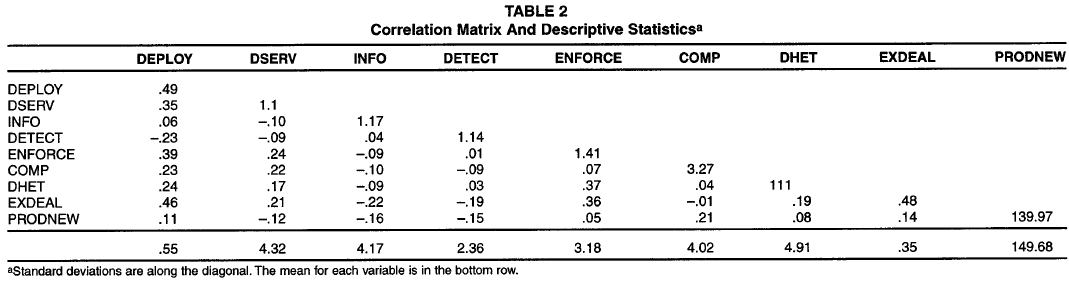
Standard deviations are along the diagonal. The mean for each variable is in the bottom row.
Free-rideable services (DSERV)
The free-rideable services scale measures the extent to which distributor services are needed in a given situation that could benefit other distributors of the same product (Blair and Kaserman 1983; Cady 1982; Rubin 1990). We developed the specific items that constitute the scale using past research (e.g., Cady 1982; Scherer and Ross 1990; Webster 1976) and modified them on the basis of field interviews. For example, products that are technical or difficult to use (Bucklin 1962; Miracle 1965) require higher levels of distributor support and hence are free-rideable in nature.
Information asymmetry (INFO)
The information asymmetry scale describes the extent to which the distributor in question is better informed than the manufacturer about the downstream market for the focal product line (Rey and Tirole 1986). Specific items include information about customer demand, pricing strategies, and the marketing strategies of competitors. We developed and refined the items and response formats using pretests.
Detection ability (DETECT)
The detection ability scale describes the difficulty faced by the manufacturer in evaluating the geographic area covered by the distributor. The items that constitute the detection ability scale are based on the performance ambiguity items developed by Anderson (1985) and Heide and John (1990), and refined using pretests, so as to ground the measure in our research context (i.e., ability to evaluate violations of territorial restrictions).
Enforcement ability (ENFORCE)
The enforcement ability scale describes the investments made by the distributor in specialized procedures, equipment, and training (Cady 1982; Corey, Cespedes, and Rangan 1989) at the time when the manufacturer was deciding on the relationship with that distributor. The specific items used were generated on the basis of prior research (Anderson 1985; Heide and John 1990) and field interviews.
Manufacturer competition (COMP)
The manufacturer competition measure is a count of the number of major competitors faced by the manufacturer at the time when the relationship with the distributor was being established. As Scherer and Ross (1990, p. 71) argue, the intensity of competition in a given industry is driven by the number of competing firms. An increase in the number of competitors reflects a move toward a market structure of perfect competition, with a resulting decrease in the differentiation ability of any individual competitor and an increase in the level of price competition.
Distributor heterogeneity (DHET)
The distributor heterogeneity scale describes ex ante differences among available distributors in terms of marketing capabilities. As Scherer and Ross (1990) discuss, such differences create incentives for the use of restrictions that may increase entry costs for other firms. The specific items used were generated during field interviews.
Exclusive dealing (EXDEAL)
Similar to our dependent variable, the exclusive dealing scale was a dichotomous measure that indicated whether an agreement exists that requires the distributor to carry only the manufacturer's product in a category (1) or whether competing products are allowed (0). The specific question was as follows:
Does your agreement with this distributor restrict him from carrying competing products from other manufacturers?
() Yes (restrictions apply)
() No (this distributor may carry any product).
Product newness (PRODNEW)
The product newness measure asked the informant to indicate the number of months during which the product in question had been sold previously by the company. The specific question used was “At the time when this distributor started selling this product, it had already been sold by our company (through our distributors or company salespeople) for_____months.”
Data Collection
We purchased two commercial mailing lists from the American List Council that contained names of marketing managers or vice presidents of marketing for companies in SIC 35 and 36, respectively. Initially, we drew a systematic random sample of 500 names from each list representing the respective SIC codes and subsequently contacted each personally by telephone to locate an appropriate key informant within each company.
Key informant selection
According to Campbell's (1955) criteria, appropriate key informants are those who are knowledgeable about the phenomenon and are willing and able to communicate with the researcher about the phenomenon being studied. Because the quality of a given informant is not necessarily correlated with formal job titles or organizational positions (Seidler 1974), the names from the mailing list were contacted personally by telephone with the objective of locating a person within each firm who met the knowledge and motivation criteria in the context at hand.
Specifically, the telephone contacts were designed to establish (1) whether the company used independent distributors, (2) whether the company had established a new distributor relationship within the past two years, (3) whether the person in question was knowledgeable about how the relationship with a particular distributor was established, and (4) whether the distributor in question resold the manufacturer's product without restrictions (i.e., full intra-brand competition) or whether territorial restrictions were deployed and there was no authorized intrabrand competition within the focal geographic area. As discussed previously, the latter criterion follows from the nature of our research propositions and the theories from which they are drawn. In many instances, multiple telephone calls were required to locate informants and firms that met our criteria and were willing to participate in the study.
In total, we identified 460 persons using this procedure. Forty-four firms were eliminated on the basis of the telephone call because, though they had territorial restriction agreements, they permitted multiple distributors to sell the product in a given territory. Because our focus was on territorial restrictions in which there was one distributor in each territory, we did not include these firms in the sample. In the remainder of the 1000 companies contacted, 104 refused to participate in the study, 241 had not established a new distributor relationship within the past two years, and 151 did not use independent distributors and were inappropriate given the scope of the study. The formal titles of the informants within the manufacturers’ firms were either sales or marketing manager.
Response rates and final sample
After call-backs and second mailings, the final sample consisted of 156 firms. Nine questionnaires were eliminated on the basis of a key informant check (see the section “Key Informant Quality”), yielding a final sample of 147 firms (32% of 460). The response rate compares favorably with those obtained in other industrial marketing studies. Of the 147 firms in the final sample, 69 used territorial restrictions. Thirty-six of these restrictions were of the strong (absolute confinement) form and 33 were of the weak (profit pass-over) form. Seventy-eight firms did not use restrictions.
Nonresponse bias
To evaluate the possible presence of nonresponse bias in our data, we compared the final sample with a random sample of 100 nonrespondents from the mailing list, with respect to annual company sales volume and number of employees. No significant differences were found, which suggests that nonresponse bias may not be a problem.
Key informant quality
Although we made a deliberate effort to identify appropriate key informants through the presurvey contacts, we also administered a post hoc check on informant quality as part of the questionnaire. Specifically, we included two questions at the end of the questionnaire that asked “How involved are you personally in your company's dealings with this distributor?” and “How knowledgeable are you in general about your company's dealings with this distributor?” We eliminated nine questionnaires that showed insufficient levels of involvement and knowledge (Heide and John 1990). On seven-point scales, the mean responses to the involvement and knowledge questions were 5.7 (standard deviation = 1.3) and 6.3 (standard deviation =. 9), respectively, providing evidence of the quality of our key informants.
Results
Measure Validation Procedure
For the multi-item scales, we initially subjected the set of items that corresponded to each theoretical construct to an examination of item-to-total correlations and exploratory factor analysis. Two items were deleted as a result of this evaluation process. The first item, which was part of the original item pool for distributor services, did not pertain clearly to free-rideable services. The second item was hypothesized originally to belong to the performance ambiguity scale, but in retrospect failed to describe clearly performance ambiguity as it applies to the distributor's sales area.
After this initial analysis, we subjected the remaining set of items to confirmatory factory analysis to verify unidimensionality. Specifically, we estimated a model in which every item was restricted to load on its a priori specified factor, and the factors themselves were allowed to correlate (Gerbing and Anderson 1988).
We estimated the measurement model by maximum likelihood using EQS (Bentler 1989). The overall fit of the model is good (χ2 [109] = 123.85, p = .16; Bentler's comparative fit index [CFI] =. 96; Average off-diagonal standardized residual [AOSR] =. 056).
The results for the measurement model (standardized solution) are reported in Table 3. As can be seen, each of the relevant factor loadings is significant (t-values > 2). In summary, the measurement model provides evidence of unidimensionality.
Measurement Model
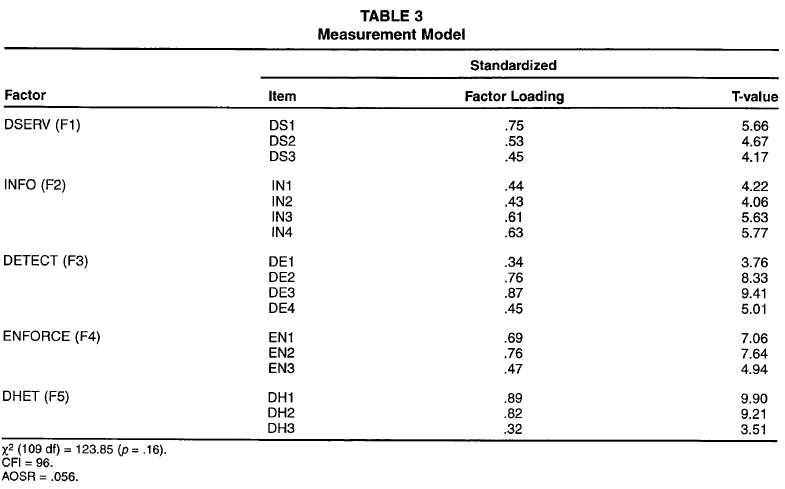
χ2(109 df) = 123.85 (p =. 16).
CFI = 96.
AOSR = .056.
We estimated an additional series of models in which we restricted the individual factor correlations, one at a time, to unity. Subsequently, we compared the fit of the restricted model with that of the original model. The relevant chi-square difference tests are all significant, providing evidence of discriminant validity. For example, the comparison involving distributor services and specific investments provided a χ2(1) = 37.56 (p < .001), which suggests that these measures are distinct.
The final step in the measure validation involved computing reliability for each item set using Jöreskog's (1971) formula. As can be seen in Table 1, some of the measures have somewhat low levels of reliability, which suggests that some caution should be used in interpreting the results.
Test of Hypotheses
To test our hypotheses, the following logistic regression model was estimated using maximum likelihood procedures:

where
DEPLOYi = 1 if firm i deploys territorial restrictions, and 0 if intrabrand competition is allowed;
Xi1 = Free-rideable services (DSERV);
Xi2 = Information asymmetry (INFO);
Xi3 = Detection ability (DETECT);
Xi4 = Enforcement ability (ENFORCE);
Xi5 = Manufacturer competition (COMP);
Xi6 = Distributor heterogeneity (DHET);
Xi7 = Exclusive Dealing (EXDEAL); and
Xi8 = Product newness (PRODNEW).
The estimation results presented next are based on the entire sample (i.e., strong and weak forms of restrictions combined). Although no a priori theoretical reasons exist to expect differences, we also estimated the model separately in the subsamples for strong and weak forms. The results for the subsamples are virtually identical, justifying the use of the full sample for hypothesis testing purposes.
The estimation results for the deployment model are shown in Table 4. The chi-square statistic for the model (χ2(8) = 64.68) suggests that the null hypothesis of all the coefficients being zero can be rejected. Furthermore, the model correctly classifies 80% of the observations, which compares favorably with the proportional chance criterion of 50%.
As can be seen from the Table 4, most of the key predictions are supported. Free-rideable services (t = 2.51, p < .01), information asymmetry (t = 2.56, p < .01), enforcement ability (t = 2.04, p < .05), manufacturer competition (t = 2.00, p < .05), and product restrictions (t = 3.72, p < .01) all increase the likelihood that territorial restrictions are deployed. As we predicted, higher levels of detection difficulty lower the likelihood that manufacturers will deploy restrictions (t = −1.66, p = < .05). We found no significant effect for distributor heterogeneity or product newness. We discuss these findings in the next section.
Logistic Regression Model: Deployment (Deploy)

χ2 (8 df) = 64.68.
Correct classification rate = 80%.
p < .05 (1-tailed test).
p < .01 (1-tailed test).
Discussion
Territorial restrictions have been the subject of intense debate for a long time. The central issue in this debate has been whether such distribution arrangements are deployed to (1) enhance a given firm's ability to compete in a market or (2) inhibit the abilities of the firm's competitors. As discussed previously, a substantial body of literature has evolved on this topic (e.g., Bork 1978; Culbertson and Bradford 1991; Jordan and Jaffee 1987). Unfortunately, the existing literature possesses two important limitations, namely, a narrow conceptualization of what business efficiency constitutes and a general lack of empirical evidence regarding the hypothesized antecedent conditions. We consider each in turn.
The Nature of Business Efficiency
Historically, the primary aspect of efficiency that has been attributed to territorial restrictions is the ability to control free-riding on distributor services. Our data provide support for this hypothesis. However, our results also suggest that the deployment of restrictions is influenced by transaction cost and information considerations. Regarding transaction costs, we show that difficulties with detecting violations of assigned territories are negatively related to the use of restrictions and that the availability of an enforcement mechanism (e.g., specific investments) has a positive effect. Considered in combination, these results are consistent with the general transaction cost argument that choices among institutional arrangements turn in part on their respective costs (e.g., Dutta, Bergen, and John 1994; Masten, Meehan, and Snyder 1991). To the best of our knowledge, however, this research is the first to suggest the influence of transaction costs on the deployment of territorial restrictions.
Regarding information asymmetry, our data suggest that firms are more likely to deploy territorial restrictions when their distributors have better information about downstream market conditions. This result is consistent with Rey and Tirole's (1986) hypothesis that deploying restrictions, rather than allowing intrabrand competition, may increase a distributor's flexibility to set prices in accordance with local market conditions. This finding extends the traditional efficiency rationale for territorial restrictions and suggests that they may enhance channel efficiency even when service provision per se is relatively unimportant.
Empirical Evidence
Another main limitation of the past literature on territorial restrictions is a general lack of empirical evidence (Sass and Saurman 1993). Interestingly, the policy view of vertical restrictions has changed dramatically in the United States from the early categorical principle of “per se” illegality to the “rule of reason” approach adopted following the Continental TV, Inc. v. GTE Sylvania, Inc. (1977) case. It is noteworthy, however, that these policy views have not been based on strong empirical evidence. Indeed, both the efficiency and monopoly views have been based either on case studies (e.g., Bork 1978) or on indirect empirical evidence (e.g., Culbertson and Bradford 1991). This study provides the first direct evidence of the influence of the antecedent conditions on which each view is based.
Policy Implications
From a policy perspective, our results suggest that business efficiency considerations play a significant role in the decision to use territorial restrictions. Specifically, minimizing free-riding, allowing pricing under flexibility under conditions of information asymmetry, and economizing transaction cost considerations all influence the deployment decision. This broader conceptualization of business efficiency strongly suggests that a firm's use of territorial restriction may be consistent with business efficiency goals.
It should be noted that, though the preceding scenarios enhance business efficiency for both the manufacturer and the distributor, the effects on consumers are not universally clear-cut. On the one hand, controlling free-riding is clearly beneficial to consumers, because it ensures that consumers receive necessary services. Similarly, economizing on transaction cost reduces the cost of doing business, which ultimately may be passed on to consumers through lower prices. At the very least, consumer welfare is not reduced. On the other hand, in contrast to the preceding results, allowing pricing flexibility under conditions of information asymmetry may not necessarily benefit consumers, because it permits price discrimination, which may require some consumers to pay a higher price.
Our results for the various anticompetitive considerations warrant some discussion. We found no support for the hypothesized relationship between distributor heterogeneity and the use of territorial restriction. Unlike the assumption in the extant literature on entry barriers (e.g., Scherer and Ross 1990), it is conceivable that using territorial restrictions with the objective of attracting superior distributors has a limited effect on entry costs. Furthermore, to the extent that attracting superior distributors enhances a manufacturer's ability to provide high-quality services, the resulting effects would actually be procompetitive in nature.
However, consistent with Rey and Stiglitz's (1995) study, our results did suggest that manufacturers are more likely to assign territorial restrictions when they face competition ex ante. Ultimately, this may lead to reduced inter-brand competition. It is noteworthy that this result contradicts the market power argument from the literature on RPM. Extending the logic from the RPM debate to the territorial restrictions context, we might hypothesize that manufacturers that face less competition are more likely to assign restrictions. Our present results suggest that the RPM arguments may not be readily transferable to the question of territorial restriction.
Taken together, from a prescriptive public policy perspective, our results support the current rule of reason treatment of territorial restrictions in the United States. We note, however, that we have expanded on the range of factors that can be used to create a code for reasonableness (i.e., information asymmetry and transaction costs). We also provide empirical evidence that to date has been lacking and that permits applying the rule of reason principle with greater confidence. Finally, our results suggest that the current policy of per se illegality in Europe may not be warranted. Specifically, it may be more appropriate to adopt a rule of reason approach until systematic evidence gathered in those markets suggests otherwise. Thus, our conceptualization and findings highlight the important role that marketers can play in informing the public policy debate.
Limitations and Further Research
Our results should be interpreted in light of the limitations of the research design used. Some of these limitations represent opportunities for further research. First, though the restriction on our sample provides a degree of homogeneity that is desirable for theory testing purposes, it limits our ability to generalize our results to other industries. On the topic of design, we also note that the reliabilities of some of our measures are low and that additional work is needed to establish the robustness of our results
Second, we do not claim to have captured an exhaustive list of determinants of restrictions. Researchers in the future may develop a richer conceptualization of anticompetitive motivations. As noted previously, it is conceivable that there are transaction cost considerations that have anticompetitive implications. Specifically, if there is variation in performance ambiguity across distributors, a manufacturer that manages to attract distributors with inherently lower degrees of performance ambiguity in relation to their activities may have a cost advantage over later entrants. As such, entry barriers may be elevated.
Furthermore, though much of the economics literature on vertical restrictions implicitly assumes that resellers are atomistically competitive, it is likely that power or dependence considerations may play a role in the deployment decision. For example, manufacturers that have little choice among distributors ex ante may have greater incentives to offer territorial protection. To explore this possibility, we included a measure in our model of the number of competing distributors available to the manufacturer at the time when the focal relationship was being established. In our data this variable did not have a significant effect on the deployment decision (t = .84, p > .10). We recognize, however, that this particular measure most likely underrepresents the dependence construct, and we encourage researchers in the future to continue to explore the role of dependence.
Third, some researchers have suggested that using territorial restrictions provides firms with some of the control and incentive properties of ownership (e.g., Rubin 1990). In some situations, however, deploying territorial restrictions may be insufficient to provide the right incentives, and firms may consider forward integration. Another possible strategy, which Bergen, Dutta, and Shugan (1996) suggest, is for manufacturers to offer variations of their branded products to distributors, so that distributors carry nonequivalent forms of the manufacturer's product. This product variation helps reduce intrabrand competition among distributors, by virtue of making it more difficult for consumers to undertake comparison shopping. By offering different variations of their branded product, manufacturers also can help reduce free-riding on services.
Notice, however, that deploying territorial restrictions, engaging in forward integration, and offering branded variants represent fundamentally different strategies. An important topic for further research is to specify the relative costs and benefits of the different strategies and to identify their antecedent conditions.
Another interesting topic for further research is the role of distribution restrictions in light of the increasing growth in internet marketing. For example, to the extent that electronic markets facilitate consumers’ information acquisition (Alba et al. 1997), they would diminish the need for conventional service provision from distributors and, as a consequence, the need for territorial restrictions. However, Alba and colleagues (1997) also note that electronic markets are best suited for search goods or for buying situations in which consumers can evaluate attributes before making a buying decision. Other situations may require a different form of service provision and make restrictions more important. For example, electronic channels may be less appropriate in situations that require customization of services to the needs of individual buyers. Such situations may require a more conventional channel design and possibly territorial restrictions.
The process by which decisions regarding territorial restrictions are made also warrants further research. Notice that most of the predictor variables in our model (free-ride-able services, information asymmetry, detection problems, manufacturer competition, distributor heterogeneity, and product newness) describe extant market or firm characteristics that precede the decision on territorial restrictions. In contrast, distributor investments and exclusive deals may be more appropriately viewed as structuring decisions, which are made at the time of the deployment decision, but which nevertheless impact the nature of the distribution agreement in question. However, what actually influences the deployment decision at a given time is the distributor's willingness to invest in manufacturer-specific assets and the manufacturer's insistence on exclusive dealing.
Further research also can be directed toward exploring the dynamics of distribution relationships. For example, to the extent that deploying territorial restrictions increases a supplier's dependence on a distributor, we may expect suppliers to engage in dependence-balancing strategies (e.g., Heide and John 1988) of various kinds. Another interesting question is whether distributors that enjoy territorial protection will increase their investments in manufacturer-specific assets over time.
Finally, an interesting topic for further research is how firms manage their territorial arrangements after they have been deployed. As previously noted, distributors frequently violate assigned restrictions by “bootlegging” into other territories (Banerji 1990; Cespedes, Corey, and Rangan 1988). An interesting research question is how manufacturers can achieve compliance with their territorial restrictions after the deployment decision has been made. Some hypotheses have been advanced about the enforcement tactics available to firms (Dutta, Bergen, and John 1994), and empirical evidence is starting to accumulate (e.g., Bergen, Heide, and Dutta 1998). However, more research is needed on this topic.