






Abstract
We shall not cease from exploration,
And the end of all our exploring
Will be to find ourselves where we started
And to know the place for the first time.
—T. S. Eliot
This is the topic for the three articles in this section that explore the question: “What are the contributions of marketing to organizational performance and societal welfare?”
Marketing, Business Processes, and Shareholder Value
In their article titled “Marketing, Business Processes, and Shareholder Value: An Organizationally Embedded View of Marketing Activities and the Discipline of Marketing,” Rajendra K. Srivastava, Tasadduq A. Shervani, and Liam Fahey present a conceptual framework that describes how three business processes—new product development, supply chain management, and customer relationship management—are linked to three key drivers of shareholder value—accelerating cash flows, enhancing cash flows, and risk reduction (by reducing the vulnerability and volatility of cash flows). Their article provides a neat theoretical linkage between the emergent conversation on business process design and management and the dominant paradigm of corporate finance. Couching their arguments in a future-oriented portrayal of marketplace changes, they argue for a strong cross-functional management perspective with cash flow metrics for performance measurement.
Customer Connections
The article titled “The Role of Marketing,” by Christine Moorman and Roland T. Rust, provides a nice complement to the preceding article. In this empirical piece, the authors suggest that going beyond the implementation of a market orientation in a firm will involve the management of three key interfaces: between customers and products, between customers and service delivery, and between customers and financial accountability. Akin to Srivastava, Shervani, and Fahey's, this article makes a dual argument. First, business processes (such as supply chain management, service delivery, and customer/product knowledge management) are critical contributors to the “value of marketing” to the organization. Second, financial accountability issues must be integrated fully into the management of customer interfaces, especially those of customer acquisition, satisfaction, and retention. Their empirical study builds on the notion that the marketing function will continue to have a key contribution to make, even within a firm that is so market-oriented as to have such a culture disseminate across the organization, and that this links the customer and the business processes.
Marketing and Its Societal Impacts
In their article “Marketing's Contributions to Society,” William L. Wilkie and Elizabeth S. Moore broaden the vision to a more systemic perspective of how marketing has affected the macroeconomic and social benefits experienced by consumers and countries. To do this, they use a 100-year historical overview, provide an input–output model of an aggregate marketing system at work, and show the several benefits that marketing has provided to society. Wilkie and Moore are not apologists for marketing, by any means. Often-heard criticisms of marketing are detailed to balance the discussion of its benefits. This is significant because this article develops an argument that might be lost in the rest of this special issue: that the aggregate marketing system is composed of many more participants than just for-profit organizations. In this important sense, this article broadens understanding of how marketing contributes to (or negatively affects) societal welfare and enables the realization that “marketing performance” must deal with more than cash flow and shareholder value issues.
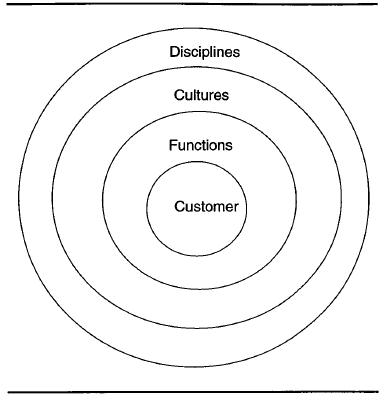
These three articles have a common focus—“customer-centricity.” Making the customer the core of the enterprise (whether for-profit or not-for-profit) is the foundation of the marketing concept, as well as the basic idea behind much theorizing and, especially, recent measurement of market orientation (Deshpandé and Farley 1998). Making an organization customercentric allows for focused attention within a specific cultural context on the marketing processes (such as supply chain, customer relationship, or market knowledge management) that are needed to deliver organizational performance, as well as to affect society (see Figure 1).

Building “Customercentric” Organizations
To understand the future, it is helpful to explain the past. This Special Issue of the Journal of Marketing is cosponsored by the Marketing Science Institute (MSI). Since MSI was founded in 1961 as a nonprofit think tank, bringing together corporate funds to encourage academic research, it has helped shape the conversation on the most important problems facing the marketing discipline. It has done this through a series of biannual Research Priorities, a set of rank-ordered research problems in marketing based on a survey of the corporate membership of MSI that began in 1974. To this day, it remains the only systematic, continuous assessment of the major problems (phrased as research needs) of senior executives in some of the world's leading organizations. These rank-ordered marketing problems establish funding priorities for MSI, but more important, they provide a mirror for the discipline on what the intellectual agenda has been over the years.
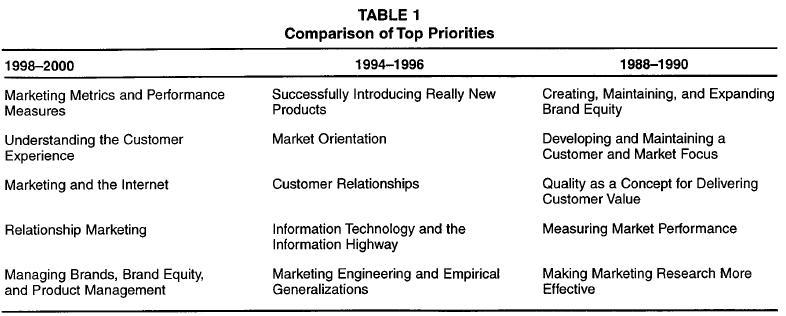
What can be learned by going back in MSI's history to look at the trends in the Research Priorities? Table 1 shows a comparison of the top five priorities (of the fifteen or so from each survey) from 10 years ago, 5 years ago, and the most recent priority-setting process. What is remarkable and interesting is not what has changed so dramatically but rather what has stayed the same. Ten years ago (and this was true going even farther back in the MSI priorities), the top-ranked research questions were, as they are today, “big picture” or strategic marketing issues, not tactical ones. Topics such as developing and maintaining a market orientation, customer relationship management, managing market knowledge, and leveraging brand equity have dominated the rankings. Plus ça change, plus c'est la même chose. Despite common sense intuition to the contrary, the top research problems facing the marketing discipline have been, are, and, I would argue, will continue to be not the 4Ps but what I refer to as the “4Cs” problems: issues that deal with cross-functional and cross-cultural problems of a customercentric nature that are best addressed through cross-disciplinary lenses.
Comparison of Top Priorities
Yet a quick perusal of the supply side of scholarly research shows a dramatically different pattern. The majority of research articles published in scholarly journals deal with quite mundane issues, frequently of a tactical sort, and increasingly focus on narrower and narrower definitions of problems. It is not just the healthy cynic who wonders whether what marketing is about is the publication of Type II errors. And this pattern of the nature of the supply side is reinforced by studying MSI's own research funding history. Despite the continued high ranking of the bigger picture 4Cs types of problems, only a few research proposals submitted to MSI deal with such issues. Is it any wonder that, at the end of the millenium, marketers are concerned with a marginalization of the discipline, as Day and Montgomery forcefully argue in their preface to this Special Issue? Or as Lehmann (1997, p. 135) puts it in his scenario for the future of corporate departments, “marketing loses control [of the important research agendas] … and becomes solely an implementer of the 4Ps … essentially the department of cents-off coupons and blue-light specials.”
An Agenda for Increasing Marketing Knowledge Use
So what can, or should, be done? Perhaps a start is a better understanding of the nature of 4Cs scholarship, its consequences for what is being done in marketing, and divining implications for where marketing should go from here.
Cross-Disciplinary Focus
If the marketing discipline is studied from a sociology of science perspective, it is clear that intellectual cross-pollination always has been the principal source of theoretical innovation (Deshpandé 1983). The marketing science theoretical tradition has evolved from fundamental work in mathematics, statistics, economics, and operations research. The behavioral science/consumer behavior theoretical tradition has its parentage in social psychology, sociology, and, more recently, anthropology. Rather than retreating from such cross-disciplinary borrowing, marketers must invite more of it. If anything, marketers must cast their nets wider to consider more disciplines as sources of rich constructs, models, and technologies. Folklore, poetry, sociobiology, and theater are all fields that can provide new ways to understand how markets develop, how consumers experience retail settings, and how the Internet stitches together communities of customers. A recommendation? Make friends with scientists in other disciplines. Read more widely in journals from disparate fields (a thought encouraged by Buzzell's observation in this Special Issue that some authors have heeded this advice already). Consider developing at least one research program that is collaborative with a scientist from another discipline so that Kinnear's reference to the double-edged sword of cross-disciplinary research can be avoided. Take a neuroscientist to lunch.
Cross-Cultural Focus
Many of the most interesting marketing problems are global, not local. Multinational corporations are extremely interested in issues such as the transferability of brand equity across cultural geographies, the standardization of pricing as border tariffs disappear, and the management of global positioning and communications programs. Yet there has been little interest in the generalizability of marketing concepts, models, and theories to non–U.S./non–Western contexts, even though such concepts and models might be theoretically inappropriate for emerging markets and transitional economies. More to the point, how many marketers can read a marketing journal or understand the copy of an advertisement in a language other than English? A recommendation? Use sabbatical or leave away from campus time to develop research that is explicitly cross-cultural in nature.
Cross-Functional Focus
It is ironic that universities have become the last bastions of intellectual siloism. In reading and teaching about business management, marketers may observe that firms increasingly have developed cross-functional processes, decisionmaking mechanisms, and organizational structures. New product development comes from engagement by a cross-functional business team. Yet the scholarship and teaching about new product development comes from faculty working within a single field. But business problems know no functional parent. Thus, it behooves marketers to complement their functional perspective with those from other functions. Most company market research is being used by nonmarketing managers, yet within-function phenomena continually are researched. A recommendation? Work on at least one major research project each year that is founded in a cross-functional research center or institute so that multifunctional perspectives are aired explicitly. Universities, colleges, and departments must be encouraged to celebrate interdisciplinary, cross-functional research, not to straitjacket it.
Customercentric Focus
Day and Montgomery in their preface to this Special Issue are correct in wondering about the very real fundamental issue of what distinguishes marketing from other related fields and contributing disciplines. What are the boundaries of inquiry, permeable though they should be? The answer is customercentricity. Whether marketers are dealing with for-profit or not-for-profit organizations, examining marketing science or consumer behavior issues, concerned with companies or competition, they are, in the final analysis, engaged in a conversation about the centrality of the customer. As Peter Drucker (1954, p. 39) wrote, “Marketing is the whole business seen from the customer's point of view.” As Webster (1997) points out, this is the bedrock of marketing's most taken-for-granted ideology, the marketing concept. Customercentricity is what makes the field so intellectually vibrant with potential for further inquiry, brings in collaborators from other disciplines and sciences, and demarcates the discipline. A customercentric focus, as Figure 2 indicates, also helps integrate the other three Cs of disciplines, cultures, and functions into a single field of intellectual inquiry. It draws together “Big M Marketing” (the corporate function) with “small m marketing” (business processes such as customer acquisition, satisfaction, and retention).
Broadening the Target of Inquiry
In summary, this is a wonderfully interesting time. The intellectual challenges facing marketers are quite clear. The territory is easy to see, or “foresee,” if marketers were to use the 4Cs framework suggested here for corralling the agenda. It is time to start work on the big issues.