







Abstract
This article explores how intercompetitor licensing between an incumbent and an entrant affects market competition and the entrant’s optimal product quality. In the model, the incumbent has a noncore technology that is used for the noncore attribute of the final product, and the entrant has a new core technology to introduce a new, higher-quality product. For the noncore technology of its product, the entrant can either license it from the incumbent or develop it in-house. The authors show that a royalty licensing contract of the noncore technology between the incumbent and the entrant has a competition-alleviating effect. More important, the effect of such licensing on the entrant’s optimal quality depends on whether its core technology can significantly or only incrementally increase its product quality over the incumbent’s product quality. The royalty contract will tend to increase the entrant’s optimal quality when the entrant’s core technology can offer a significant quality improvement over the incumbent’s. By contrast, if the entrant’s technology can raise its product quality only incrementally over the incumbent’s product quality, the royalty contract will tend to reduce the entrant’s optimal quality. A wide range of royalty licensing contracts are mutually acceptable; the incumbent (entrant) can benefit from such a contract even when the entrant pays a total royalty fee that is lower (higher) than its alternative research-and-development cost. These results hold even when the incumbent endogenously chooses its royalty licensing fee. The main results are robust to several alternative modeling assumptions (e.g., alternative game sequence, endogenous quality decision by the incumbent, alternative licensing contract).
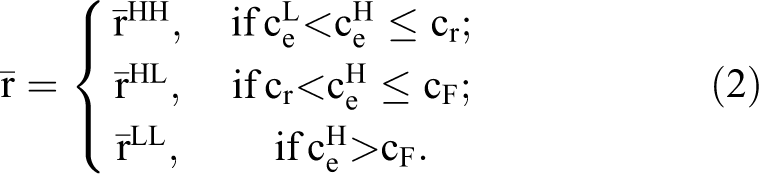
Products typically have core attributes that serve as the main determinants of the products’ value in consumers’ minds and also noncore attributes that are necessary for the products but are not the main value drivers or product differentiators. When an innovating entrant has some innovative core technology that allows it to introduce a higher-quality product than the incumbent’s, it still needs noncore technologies, even though these technologies or product attributes do not exert a high differential impact on consumers’ perceived quality (i.e., their valuation) of the product. Overall, the entrant needs to decide not only what quality level of its new core technology to use for its new product but also whether to self-develop the noncore technology in-house or license it from the incumbent.
In practice, firms may often license noncore technologies to or from their direct competitors. For example, Procter & Gamble frequently licenses its manufacturing know-how to competitors (Parhankangas, Holmlund, and Kuusisto 2003). Many Android device manufacturers (e.g., Samsung, HTC) are direct competitors with Microsoft in product markets such as mobile computing devices and their operating systems but still pay Microsoft a licensing royalty per Android device for some mobile operating system features (Hoffman 2014). Similarly, Ford licenses its Diesel Fuel Conditioning Module and Passenger-Side Air Bag Deactivation Switch IP and Technology to its competitors (Fradkin 2014). Ford also licenses its electric car patents to other manufacturers in the industry (Arce 2015). In 2014, Tesla Motors made its electric vehicle technology patents available to other automakers. Note, however, that such licensing contracts are not typically public information, and their existence or details of terms are usually private information between the firms. Part of the reason for such intercompetitor licensing may be the benefits of network effects or enhanced corporate social responsibility to promote sustainability causes. Our study provides a potential alternative explanation for why firms may be incentivized to license their noncore technologies to direct competitors.
We focus on the situation when the entrant’s product needs a noncore technology (e.g., a patent) that the incumbent firm has already developed, even if the noncore technology does not offer a great deal of differentiation between the incumbent’s product and the entrant’s product. Instead, the entrant’s product is differentiated from the incumbent’s product mainly on the core technology, which requires some marginal cost of production. In our context, the quality level of the product’s core technology represents the level of innovation by the entrant. We examine two related lines of inquiry in this licensing and product innovation context. First, should the entrant license the noncore technology from its competitor even if it can self-develop it in-house? Assuming that licensing will not shorten the time to market for the product, conventional wisdom suggests that firms should avoid helping competitors. For example, a firm should not help strengthen its competitor’s financial well-being by licensing from it if the firm can develop its own alternative at the same or lower cost. A firm should also not license its technology to a competitor, and definitely not at a lower cost than its competitor’s alternative, if not licensing it would raise the competitor’s cost and reduce its ability to compete in the market. Anecdotal evidence reveals that many companies use an intuitive decision-making rule: reject a contract or proposal if the alternative cost is lower. Some firms also base the success of contracts or proposals on the ex post realized costs rather than the ex ante alternative costs. We show that such intuitively sound decision making and performance-evaluating rules can be suboptimal when competing firms’ strategic behaviors are taken into account.
Second, how does licensing of the noncore technology from the incumbent affect the equilibrium prices and the entrant’s optimal quality of its core technology? We consider the entrant’s quality choice of its core technology as a measure of its product innovation. Although both firms should benefit if a licensing contract is mutually acceptable, it is not immediately clear how such a licensing contract will affect the entrant’s optimal quality for its core technology as compared with the case when the entrant develops the noncore technology itself. We identify the conditions under which the intercompetitor licensing contract increases the entrant’s optimal product quality and the conditions under which it decreases the entrant’s optimal product quality.
To address our research questions, we analyze a model in which an incumbent has already developed a noncore technology that is used for the noncore attributes of the final product, while an entrant has a new core technology that enables it to introduce a new, higher-quality product (e.g., with a new feature or core attribute) to compete with the incumbent in a market in which consumers are heterogeneously willing to pay for product quality. To develop and produce the new product, the entrant needs the undifferentiated noncore technology and must decide whether to incur a fixed research-and-development (R&D) cost to self-develop the technology or license it from the incumbent by paying a per-unit royalty fee. To ensure analytical closed-form solutions, our main model assumes that the entrant can choose between two quality levels for its core technology representing the high strategy and the low strategy in real-world situations. Both firms will simultaneously set prices to compete for customers in the market. As we show subsequently, our main findings remain qualitatively the same even when quality is a continuous decision variable, when the incumbent optimally decides its royalty fee after the entrant’s product quality decision, when the incumbent can also endogenously decide its product quality in anticipation of the entrant’s entry, or when the licensing contract is a two-part tariff.
Our analysis shows three main findings. First, a royalty licensing contract leads to higher equilibrium prices for both firms. Price competition is softened because the royalty fee paid by the entrant (1) directly increases its own marginal cost and induces its price increase and (2) reduces the incumbent’s incentive to compete aggressively on price because it will collect a royalty for every sale made by the entrant. Extant literature (e.g., Buehler and Haucap 2006; Cachon and Harker 2002) indicates that price competition can be alleviated if a firm sources its product components from an efficient competitor in a horizontally differentiated market. Our research shows that the competition-alleviating effect of intercompetitor contracts will persist even in a quality-differentiated market and even when the entrant’s product quality and the incumbent’s royalty fee are endogenously determined.
Second, how licensing of the noncore technology affects the entrant’s optimal quality depends on whether its core technology can significantly or only incrementally improve its product quality over the incumbent’s quality. If the entrant can significantly improve its quality over the incumbent’s (i.e., at least one of the entrant’s quality levels is significantly higher than the incumbent’s quality), an intercompetitor licensing contract on the undifferentiated noncore technology tends to increase the entrant’s optimal product quality. That is, the licensing contract increases the parameter region in which choosing the high strategy is optimal for the entrant. The intuition is as follows: If the entrant’s quality levels are higher than that of the incumbent and if the entrant’s marginal cost of producing the high-quality product is in a middle range, choosing the low strategy in the absence of any licensing contract for the noncore technology will be optimal for the entrant. Under a licensing contract, even when the entrant also chooses the low strategy, the alleviated price competition will benefit it by increasing its net profit margin, but the entrant will benefit even more from the licensing contract if it instead chooses the high strategy, due to the larger differentiation and its associated higher net profit margin.
By contrast, if the entrant’s core technology can only incrementally or marginally improve the entrant’s quality over the incumbent’s (i.e., with no quality levels significantly higher than the incumbent’s quality), an intercompetitor licensing contract on the undifferentiated noncore technology tends to decrease the entrant’s optimal product quality. That is, the licensing contract increases the parameter region in which choosing the low strategy is optimal for the entrant. The intuition is as follows: If the entrant’s marginal cost of producing the high-quality product is in the middle range, in the absence of any licensing contract the entrant will optimally choose the high strategy, even though producing the high-quality product is fairly inefficient in terms of cost, because if the entrant chooses the low strategy (which is more cost-efficient), the differentiation of the entrant’s product from the incumbent’s product will be so incremental that intense price competition will ensue. However, when the entrant licenses the noncore technology from the incumbent, price competition will be alleviated so the entrant can focus more on cost efficiency to choose the low strategy over the high strategy. That is, the intercompetitor licensing of the noncore technology will expand the parameter region in which choosing the low strategy is optimal for the entrant. As such, with a royalty licensing contract, the entrant will likely produce a lower quality level than it will without licensing when its core technology can only incrementally improve its product quality over the incumbent’s quality.
Third, we find a wide range of mutually acceptable licensing contracts. For example, the incumbent may offer a royalty licensing contract even when the entrant pays a total royalty fee lower than its alternative R&D cost, and the entrant may also accept a royalty licensing contract even when it pays a total royalty fee higher than its alternative R&D cost. The incumbent’s benefit from the licensing contract comes from the total licensing fee it collects from the entrant and its higher profit margin due to alleviated price competition. Thus, any contract with a positive royalty that is acceptable to the entrant will make the incumbent strictly better off than no contract. For the entrant, even when it pays a total royalty fee higher than its alternative R&D cost, it may still strictly prefer accepting the contract because of the higher net profit margin it receives from the alleviated price competition. This result as well as the effects of licensing on the entrant’s optimal quality decision still holds when the incumbent endogenously decides its royalty fee.
This article is related to three streams of literature. First, our research complements the work examining firms’ make-or-buy decisions, including a monopoly firm’s outsourcing problem (e.g., Elmaghraby 2000), outsourcing in competitive settings with a common supplier (e.g., Arya, Mittendorf, and Sappington 2008a,b; Buehler and Haucap 2006; Cachon and Harker 2002; Chen, Dubey, and Sen 2011; Feng and Lu 2012; Liu and Tyagi 2011; Shy and Stenbacka 2003; Wu and Zhang 2014), outsourcing between two competing firms (e.g., Baake, Oechssler, and Schenk 1999; Cai and Chen 2011; Gayle and Weisman 2007; Sappington 2005; Spiegel 1993), and sharing of inventory between competitors in markets with demand uncertainty (e.g., Guo and Jiang 2018). This literature on component sourcing focuses on firms’ make-or-buy decisions of physical components of their products, in which both make-or-buy alternatives entail different levels of marginal costs of production. Conversely, we investigate the licensing of an incumbent’s noncore technology to a competing entrant, which can either accept the incumbent’s licensing contract or incur a fixed cost to self-develop it. More important, we examine how the intercompetitor licensing of the noncore technology affects the entrant’s optimal product quality in addition to market competition.
Second, our study contributes to the broad literature on firms’ licensing decisions, which include an outside patent holder licensing its patent to other firms competing in the final market (e.g., Hernadez-Murillo and Llobet 2006; Kamien, Oren, and Tauman 1992; Katz and Shapiro 1986; Moldovanu and Sela 2003; Muto 1993; Saracho 2001) and the patent holder being one of the established firms in the industry (e.g., Fauli-Oller and Sandonis 2002; Gallini 1984; Gallini and Winter 1985; Katz and Shapiro 1985; Kitagawa, Masuda, and Umezawa 2014; Rockett 1990; Wang 1998, 2002; Wang and Yang 1999). Gallini (1984) considers one entrant and shows that licensing can serve as a means of entry deterrence. Gallini and Winter (1985) and Katz and Shapiro (1985) examine a producer’s incentive to license a cost-reducing process innovation to a competing producer. Rockett (1990) examines licensing as a way to choose competitors and focuses on the equilibrium in which the weak firm enters as a licensee for the sole purpose of crowding the market to deter entry by the strong firm. Kitagawa, Masuda, and Umezawa (2014) and Kamien, Oren, and Tauman (1992) assess an incumbent’s licensing of a new technology to its potential competitor, with which it engages in a Cournot competition; they show that the optimal two-part tariff licensing contract can have a positive royalty rate. This broad stream of licensing literature has mainly focused on licensing cost-reduction technology—that is, process innovation. By contrast, in our study, the licensing of an incumbent’s noncore technology provides an undifferentiated attribute for the final product, and the entrant can strategically choose the quality level of its core technology to differentiate itself from the incumbent. We expand this stream of literature to explore the effect of licensing of noncore technology on an entrant’s optimal quality in addition to the effect on price competition.
Third, we contribute to the stream of literature on firms’ quality innovation, especially in a competitive context. For example, Moorthy (1998) shows that duopoly firms should differentiate their products from each other, with the higher-quality firm choosing a higher margin. Aghion et al. (2005) show an inverted U-shaped relationship between competition and innovation and empirically test it. Bloom, Draca, and Reenen (2016) find empirical evidence that competition from Chinese imports leads to increases in R&D. Ofek and Turut (2008) explore how an entrant’s innovation-imitation decision depends on the incumbent’s R&D level. This literature mainly focuses on how competition affects firms’ product innovation. Research also examines how factors such as consumer regret (Jiang, Narasimhan, and Turut 2017) and consumer-to-consumer product sharing (Jiang and Tian 2018) affect a firm’s optimal quality. We complement these streams of literature by investigating how intercompetitor licensing of undifferentiated noncore technology affects an entrant’s product quality decision and the price competition in the market.
Model
An incumbent (firm i) sells product i of quality qi in the market. The incumbent has already developed a noncore technology that is used for the noncore attribute of the final product. An entrant (firm e) has a new core technology that enables it to introduce a new and higher-quality product, which has a new feature or a core attribute. Let qe denote the quality of the entrant’s product. To develop and produce its new product, the entrant needs the noncore technology for its noncore attribute. We assume that the noncore technology is not a differentiator between the two firms, so we normalize the quality of that technology to zero for both firms. The entrant can either incur an R&D cost of F to self-develop the noncore technology or license it from the incumbent by paying a royalty of r per unit of the product sold.
The entrant can choose the quality level for its product’s core technology. Because we normalize the quality of the noncore technology to zero, hereinafter we refer to the quality of the core technology as the quality of the product. To examine how licensing of the undifferentiated noncore technology influences the entrant’s optimal quality decision, we consider the stylized case in which the entrant can choose between two quality levels
In practice, a firm typically decides on both the noncore and core technologies to develop prototypes for testing before putting the new product on the market. In our context, the full product development involves decisions on the noncore technology (license or self-development) and the core technology (quality choice). As the decision to license or self-develop is less flexible than the quality decision for the core technology, the entrant decides on its noncore technology first and then on the core technology quality. Accordingly, the game proceeds as follows: First, the incumbent determines the royalty licensing fee (r per unit) for the noncore technology. Second, the entrant decides whether to accept or reject the royalty licensing contract. If it accepts it, the entrant will pay a royalty fee of r for each unit of the product it sells; if it rejects it, it can incur a fixed cost F to develop its own noncore technology. Third, the entrant chooses the quality
Analysis
Benchmark with No Licensing
We first analyze the subgame in which the entrant rejects the incumbent’s licensing contract with a royalty fee r. This case effectively serves as the benchmark with no licensing contract between the incumbent and the entrant. Here, the entrant can invest a fixed cost F to self-develop the noncore technology for its product. Given pi, qi, pe, and qe, the consumer who is indifferent between buying from the entrant and buying from the incumbent is characterized by
Thus, the entrant’s profit under the high strategy (i.e.,
Pricing Decisions
Suppose that the entrant accepts the royalty licensing contract with a royalty fee
With backward induction, we first analyze the firms’ pricing decisions under the royalty licensing contract. Simultaneously solving the first-order conditions
Comparing each firm’s price under the licensing contract with its price in the no-licensing benchmark, we obtain Proposition 1: Given the entrant’s product quality, any mutually acceptable royalty licensing contract between the two firms will result in higher equilibrium prices in the market.
Compared with the no-licensing case, under a licensing contract, the royalty fee paid to the incumbent directly increases the entrant’s marginal cost, inducing it to raise its price. The entrant’s and the incumbent’s prices are strategic complements; that is, the increase in the entrant’s price also induces the incumbent to raise its price. Furthermore, with the licensing contract, the incumbent can collect a royalty fee r for each sale the entrant makes, which raises the incumbent’s opportunity cost for aggressive price competition. Thus, together, the intercompetitor licensing contract of the noncore technology will have a competition-alleviating effect. This result is consistent with the findings from the component-sourcing or make-or-buy literature (e.g., Buehler and Haucap 2006; Cachon and Harker 2002) that show that the sourcing of product components between competitors (i.e., horizontal subcontracting) can lead to higher prices in the market. In that literature, a firm can buy components for its product from a competitor or manufacture the components itself at different marginal costs. In our technology licensing context, an entrant can either incur a fixed R&D cost to self-develop the noncore technology for its product or pay a royalty fee (a marginal cost) to an incumbent under the licensing contract. We complement extant literature by showing that in a quality-differentiated market, the intercompetitor royalty licensing of the noncore technology can also soften price competition, even when product quality and the royalty fee are endogenously determined.
Entrant’s Quality Decision
To obtain the entrant’s optimal quality strategy, we need to determine which quality–cost pair yields more profit for the entrant. Let
Lemma 1: If
Lemma 1 implies that when
In the ensuing analysis, we refer to the condition
The case of the entrant’s highly differentiated core technology
Anticipating its optimal quality decision, the entrant will accept the licensing contract only if it makes a (weakly) higher profit when accepting than rejecting the contract. In the Appendix, we show that the entrant prefers accepting to rejecting the royalty licensing contract only if

To establish the range of royalty fee r acceptable to the incumbent, we need to ensure that the incumbent makes at least as much profit with the royalty contract as without it. If r is zero, the incumbent will make the same level of profit as in the no-licensing case, as zero royalty has no direct effect on the firm’s optimal pricing decision for its product. If r is too high, the entrant will reject the contract, in which case the incumbent will also make the same profit as in the no-licensing case. We can easily show that for any licensing contract with Proposition 2: When the entrant can significantly improve its product quality over the incumbent’s quality, a mutually acceptable royalty licensing contract on the noncore technology will have
In the unshaded regions on the right-hand side of Figure 1, the royalty fee r is too high to be acceptable to the entrant, so the market outcome is the same as in the no-licensing case, in which the entrant will choose the high strategy if
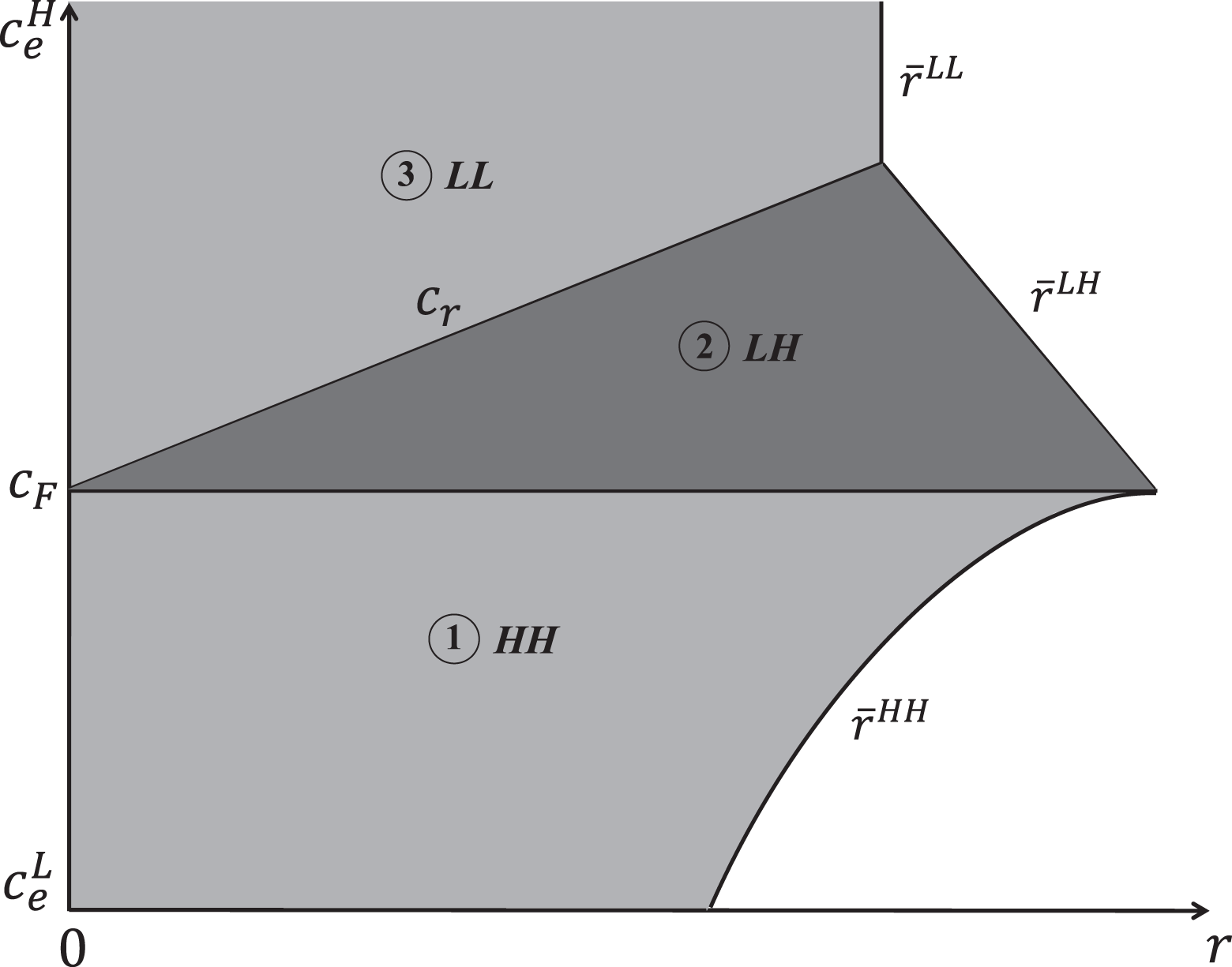
Entrant’s optimal quality: the case of the entrant’s highly differentiated core technology.
In addition, we show that the threshold cr increases in r, which implies that as the royalty fee increases, the parameter region of
The case of the entrant’s incrementally differentiated core technology
We show that with an incrementally or marginally differentiated core technology, the entrant will prefer accepting to rejecting the royalty licensing contract only if
As explained previously, any royalty contract with Proposition 3: When the entrant can only incrementally improve its product quality over the incumbent’s quality, a mutually acceptable royalty licensing contract on the noncore technology will have
Figure 2 illustrates how licensing the noncore technology affects the entrant’s optimal quality decision for its core technology when it can only incrementally improve its product quality over the incumbent’s. Again, the first letter of each region label specifies the entrant’s optimal quality strategy when it has no licensing contract with the incumbent, and the second letter indicates the entrant’s optimal quality strategy under a mutually acceptable royalty licensing contract. In the

Entrant’s optimal quality: the case of the entrant’s incrementally differentiated core technology.
Our analysis reveals that for the entrant’s incrementally differentiated core technology, there is an
Note that this intuition is consistent with the explanation of Proposition 2. In particular, in the
In addition, we show that the threshold cr decreases in r, which implies that as the royalty fee increases, the parameter region of
So far, we have shown a wide range of parameter values and royalty fees (see Figures 1 and 2) for which a royalty licensing contract between the incumbent and the entrant is mutually beneficial compared with the case of no licensing contract. In practice, the royalty fee agreed on in licensing contracts may fall anywhere within the range of mutually acceptable fees, depending on the relative bargaining power of the two firms. We might intuit that if the total royalty fee (the per-unit royalty fee r times the entrant’s unit sales) is much lower than the entrant’s alternative R&D cost, the incumbent will not want to license its noncore technology to the entrant, because such a contract would help the entrant save costs and perhaps become more competitive. Similarly, it may also be intuitive that the entrant will prefer accepting to rejecting the licensing contract only if the total royalty fee it will pay is lower than its alternative cost. Proposition 4 shows that in the licensing context we study, such sound decision rules may not be optimal if the strategic effects of royalty licensing are taken into account. Proposition 4: (a) The incumbent will benefit from the royalty licensing contract even when the entrant pays a total royalty fee that is lower than its alternative R&D cost, and (b) the entrant will benefit from the royalty licensing contract even when the entrant pays a total royalty fee that is higher than its alternative R&D cost.
Both firms can benefit from a royalty licensing contract in wide parameter regions (shaded areas in Figures 1 and 2). The incumbent benefits from the contract from two main sources: the total licensing fee it collects from the entrant and its higher profit margin due to alleviated price competition. Without a licensing contract, although its competitor (the entrant) may need to incur a higher cost, the cost is a fixed R&D cost and will have no effect on the entrant’s optimal pricing and quality decisions or on its price competitiveness. Any contract with a positive royalty that is acceptable to the entrant, even when the total fee paid is lower than the entrant’s alternative cost, will make the incumbent strictly better off than no contract.
For the entrant, it will clearly benefit from a royalty licensing contract if it pays a total royalty fee lower than its alternative R&D cost. However, even when it pays a total royalty fee higher than its alternative R&D cost, it may still strictly prefer accepting the licensing contract. The intuition is as follows: When the licensing contract does not affect the entrant’s optimal quality decision (Regions 1 and 3 in Figures 1 and 2), it benefits from the contract from its higher net profit margin due to the alleviated price competition with only a relatively slight drop in unit sales. This benefit from royalty licensing can more than offset the total fee the entrant pays, even when that fee is higher than its alternative fixed cost of developing the noncore technology in-house.
Incumbent’s Royalty Fee Decision
Using backward induction, we can now determine the incumbent’s optimal royalty fee in anticipation of the entrant’s optimal quality and pricing decisions. The two firms’ profit functions are given by Proposition 5: (a) When the entrant can significantly improve its quality over the incumbent’s product, if
According to Proposition 2, royalty licensing of the noncore technology can increase the entrant’s optimal quality for some range of r. Proposition 5(a) posits that the incumbent’s optimal royalty fee (see Figure 3, Panel A) can fall in this range, such that the quality-increasing effect of royalty licensing occurs in equilibrium of the full game. We provide Illustrative Example 1 in which the entrant can significantly improve its quality over the incumbent’s quality and royalty licensing increases the entrant’s optimal quality in full equilibrium:
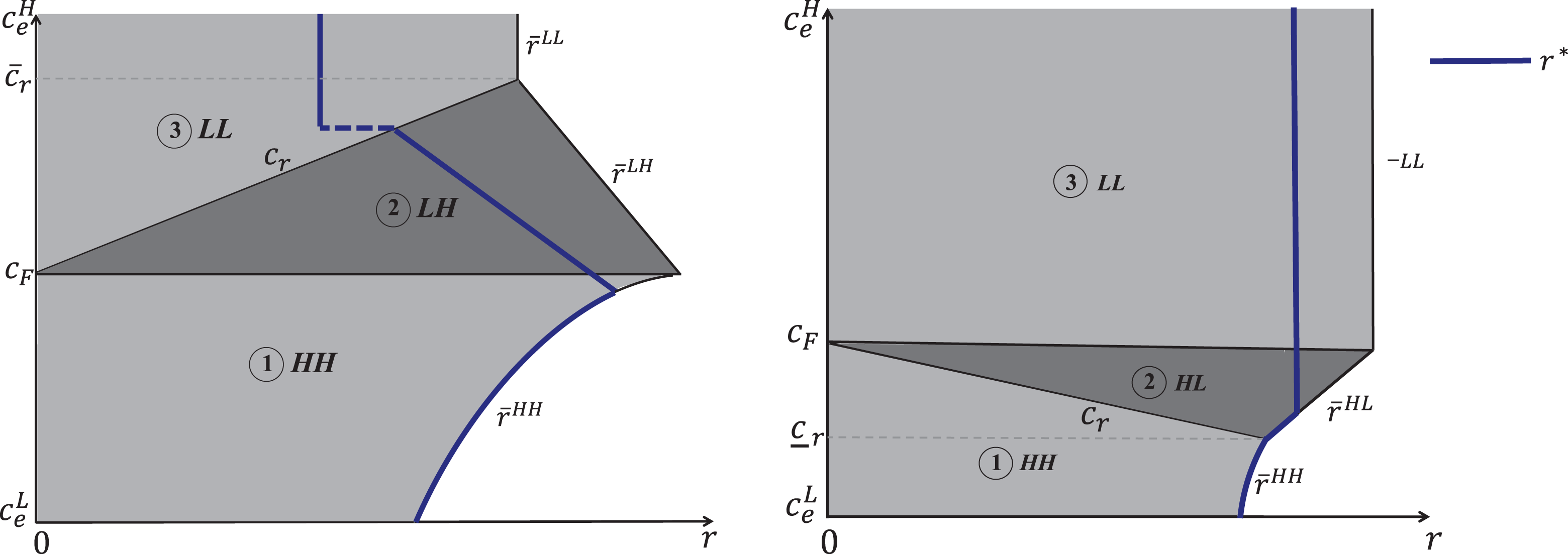
The incumbent’s optimal royalty fee r*.
Illustrative Example 1:
Under no licensing contract, in equilibrium,
According to Proposition 3, when the entrant can only incrementally improve its quality over the incumbent’s quality, royalty licensing of the noncore technology decreases the entrant’s optimal quality for some range of r. Proposition 5(b) posits that the incumbent’s optimal royalty fee (see Figure 3, Panel B) can fall in this range, such that the quality-decreasing effect of royalty licensing occurs in equilibrium of the full game. We provide Illustrative Example 2 in which the quality-decreasing effect of royalty licensing under the full equilibrium occurs when the entrant has a core technology that can only incrementally improve its quality over the incumbent’s quality.
Illustrative Example 2:
Under no licensing contract, in equilibrium, Proposition 6: When the incumbent endogenously decides its royalty fee, (a) it can benefit from the royalty licensing contract even when the total royalty fee paid by the entrant is lower than its alternative R&D cost, and (b) the entrant can benefit from the royalty licensing contract even when the total royalty fee it pays is higher than its alternative R&D cost.
Recall that Proposition 4 shows that a royalty licensing contract can be mutually beneficial even when the entrant pays a total royalty fee lower or higher than its alternative R&D cost of developing the noncore technology by itself. Proposition 6 shows that this result holds even when the incumbent endogenously and strategically chooses its royalty fee r. Illustrative Examples 3 and 4 show the results when the total royalty fee in equilibrium is higher than the entrant’s alternative R&D cost. (It is also easy to illustrate the results when the total royalty fee in equilibrium is lower than the R&D cost.)
Illustrative Example 3: The case of the entrant’s highly differentiated core technology:

In equilibrium,
Illustrative Example 4: The case of the entrant’s incrementally differentiated core technology:

In equilibrium,
Robustness Check and Discussion
In this section, we show that our main results and intuitions are robust to several alternative model settings or assumptions. First, we allow the entrant’s quality choices to be such that one is higher than the incumbent’s product quality and the other is lower than the incumbent’s product quality. Second, we allow the incumbent to decide its royalty licensing fee after the entrant decides its product quality. Third, we allow the incumbent to endogenize its quality decision in anticipation of its competitor’s entry in the market. Fourth, we consider a two-part tariff licensing contract.
Entrant’s Quality Choices Are Such That
Our main model assumes that the entrant’s product quality choices are both higher than the incumbent’s product quality; that is,
Under no licensing, the entrant will in equilibrium choose the high strategy
The insight of these findings is also qualitatively similar to that from our main model, where
In summary, we find that, regardless of whether the entrant’s quality choices are both higher than the incumbent’s quality or one is higher and the other is lower than the incumbent’s quality, our main result remains the same—the royalty licensing contract of noncore technology between the two firms can increase or decrease the entrant’s optimal quality for its core technology. We also find that these results continue to hold when the incumbent endogenously determines the royalty fee. Furthermore, we confirm the previous result that the incumbent (entrant) can benefit from a licensing contract even when the total royalty fee the entrant pays is lower (higher) than its alternative R&D cost. As we did in the main model, for
Royalty Fee Decision After Entrant’s Quality Decision
In our main model, the incumbent sets its licensing fee for its noncore technology before the entrant chooses the quality of its core technology; this assumption is reasonable because the entrant needs to have the noncore technology to develop and test its core technology and the decision to license or self-develop is less flexible than the quality decision for the core technology. Nevertheless, in this extension we consider an alternative game sequence in which the incumbent sets its licensing fee after the entrant chooses the quality of its core technology. Other aspects of the model setting are the same as in our main model. To examine the effect of licensing on the entrant’s optimal quality decision, we compare the entrant’s optimal product quality in anticipation of an acceptable licensing contract with its optimal product quality when self-developing the noncore technology. The analysis for the latter decision is the same as the benchmark case in the main model, in which we show that if
Next, we compare the entrant’s profits in these two cases to determine its optimal quality decision:
Incumbent’s Quality Is Endogenous
Our main model assumes that the incumbent’s quality is exogenous. In an extension, we allow the incumbent to endogenously decide its product quality qi in anticipation of the entrant’s entry in the market. We examine the effect of the licensing contract on both firms’ optimal quality decisions by comparing each firm’s optimal quality under a licensing contract with its optimal quality under no licensing. Under no licensing, the incumbent first decides qi, then the entrant self-develops the noncore technology and chooses product quality qe, and, finally, both firms set their prices pi and pe, respectively. Under licensing, the incumbent first decides r and
We analyze two distinct cases. First, the entrant’s production of its core technology has significant improvement over the incumbent’s (i.e., ke is much smaller than ki). That is,
Furthermore, our numerical studies reveal that licensing lowers the incumbent’s optimal quality. Intuitively, with a licensing contract, the incumbent has an incentive to reduce its quality to increase its differentiation from the more efficient entrant, allowing the entrant to charge higher price and, thus, be more willing to pay the incumbent a higher royalty fee. We acknowledge that these results are not analytically proven for all parameter regions, but we do find that the results hold for all the numerical examples analyzed.
Two-Part Tariff Licensing Fee
In this study, we focus on royalty fee licensing, but in practice, licensing fees may sometimes be a two-part tariff, containing both a fixed fee and a royalty fee (e.g., Fauli-Oller and Sandonis 2002; Kamien and Tauman 1986; Kitagawa, Masuda, and Umezawa 2014). Suppose that in our main model, the incumbent can choose a two-part tariff licensing contract instead of a royalty contract. Let rt denote the royalty fee and ft denote the fixed fee, with the total licensing fee being
Conclusion
This article investigates the economic and strategic implications of intercompetitor licensing of noncore technology in a vertically differentiated product market. The entrant has a core technology innovation that allows it to introduce an improved product with higher quality than the incumbent’s product. To develop and produce the products, the entrant also needs noncore technology, which it can either license from the incumbent on a royalty contract or self-develop by incurring fixed R&D cost in-house. We examine the effects of the intercompetitor licensing of the noncore technology on market competition and the entrant’s optimal quality decision. Our analysis reveals that a royalty licensing contract has a competition-alleviating effect, inducing both firms to raise their prices. Furthermore, we show that royalty licensing can either increase or decrease the entrant’s optimal quality, depending on whether the entrant’s core technology can significantly or only incrementally improve its product quality over the incumbent’s product quality. If the entrant can significantly improve its product quality, royalty licensing of the noncore technology will tend to increase the entrant’s optimal quality. If the entrant can only incrementally improve its product quality, royalty licensing will tend to reduce its optimal quality. These findings provide guidance for an entrant’s optimal quality decision when it has a royalty licensing contract with an incumbent firm.
Conventional wisdom suggests that the incumbent should not license its noncore technology to the entrant if licensing will help the entrant save costs and become more competitive and that the entrant should not accept the licensing contract if it will be paying a total royalty fee higher than its alternative cost of developing the noncore technology on its own. Our analysis shows that the royalty licensing contract can be mutually acceptable even when the entrant will pay a total licensing fee higher or lower than its alternative R&D cost. This result has important managerial implications. It shows that the intuitively sound decision-making rule of rejecting a contract when the alternative cost is lower may not be optimal. Managers should consider the strategic implications of licensing on market competition and optimal quality design. We also demonstrate that our main findings hold under four alternative assumptions: (1) when the entrant can produce quality levels either above or below the incumbent’s product, (2) when the incumbent can strategically choose the royalty fee after the entrant decides the quality level for its core technology, (3) when the incumbent can also endogenously decide its quality in anticipation of the entrant’s entry, and (4) when the licensing contract is a two-part tariff.
We conclude with several caveats about our model and possible directions for further research. First, our model assumes that the noncore technology has no significant differences whether it is licensed from the incumbent or developed in-house by the entrant. If there is a vertical difference (e.g., the licensed one is better), the entrant may be incentivized to accept the licensing contract and the parameter regions for the quality-increasing and quality-decreasing effects of licensing may change; however, our main findings and insights should hold as long as the main difference in quality between the two firms’ products comes from the entrant’s core technology rather than the baseline noncore technology. If there is a horizontal difference (i.e., consumers have different preferences for the licensed and in-house developed noncore technology), the entrant’s licensing incentive may decrease, which may reduce the parameter regions for the mutually acceptable licensing contract and also affect the quality-increasing and quality-decreasing effects of licensing. Thus, if the noncore technology attribute is also a differentiator between the firms, we conjecture that our main findings will still qualitatively hold, even though the parameter regions will change. Further research could systematically examine the additional managerial insights into intercompetitor licensing from such multidimensional differentiation models. Second, we assumed that licensing is unidirectional (i.e., the entrant licenses from the incumbent but not the other way around). In practice, licensing can go both ways—the incumbent can also license technology from the entrant. In this cross-licensing context, the main competition-alleviating effect will be enhanced; as such, our main findings and insights should remain qualitatively similar, but the analytical expressions will become much more cumbersome. Third, our model assumes that royalty fees are a fixed amount per unit of sales. This is a reasonable assumption for licensing of noncore technology, in which the licensed technology is not a key part of the product’s total value. However, when the licensed technology is a crucial core component of the product, firms may sometimes license the technology on a royalty fee that is some percentage of the final product’s retail price. If we model the royalty fee as a percentage of retail price (i.e., revenue sharing), the mathematical complexity will dramatically increase in our multistage, multidecision setting, and no closed-form analytical solutions can be obtained for the full game. We expect that the main driving forces for our findings will likely survive, but more careful study on such revenue-sharing contracts in the licensing context is warranted. Fourth, we assumed that licensing would not shorten the product’s time to market. In practice, R&D is often more time-consuming than buying a license. In a model in which the entrant may also be able to shorten the time to market for its new product, we expect the entrant to be more incentivized to license from the incumbent. This will likely increase the parameter region in which licensing will occur in equilibrium, but it will also likely induce the incumbent to raise its royalty fees. Investigation of the effect of licensing on the timing of product introduction is worth a separate study and is beyond the scope of our article. Finally, it would also be of practical and theoretical interest to examine how uncertainties in market demand or R&D costs affect firms’ licensing, pricing, and quality decisions.
Supplemental Material
Supplemental Material, jmr.16.0331-web-appendix - Intercompetitor Licensing and Product Innovation
Supplemental Material, jmr.16.0331-web-appendix for Intercompetitor Licensing and Product Innovation by Baojun Jiang, and Hongyan Shi in Journal of Marketing Research
Footnotes
Acknowledgments
The authors thank the three anonymous reviewers for their helpful suggestions, which significantly improved the article. They also thank the participants at the INFORMS Marketing Science Conference and the seminar participants at Fudan University and Washington University in St. Louis for their helpful comments on previous versions of the article.
Associate Editor
Wilfred Amaldoss served as associate editor for this article.
Author Contribution
Baojun Jiang and Hongyan Shi contributed equally.
Declaration of Conflicting Interests
The author(s) declared no potential conflicts of interest with respect to the research, authorship, and/or publication of this article.
Funding
The author(s) received no financial support for the research, authorship, and/or publication of this article.

Notes
References
Supplementary Material
Please find the following supplemental material available below.
For Open Access articles published under a Creative Commons License, all supplemental material carries the same license as the article it is associated with.
For non-Open Access articles published, all supplemental material carries a non-exclusive license, and permission requests for re-use of supplemental material or any part of supplemental material shall be sent directly to the copyright owner as specified in the copyright notice associated with the article.
