







Abstract
If consumers believe that stores offering price-matching guarantees (PMGs) charge low prices, high-search-cost consumers will purchase from PMG stores. This leads PMG stores’ demand to be less price sensitive, which drives these stores to charge higher prices. The belief that PMG stores charge low prices paradoxically leads them to charge high prices. For this reason, the literature finds that PMGs can only signal low prices when firm heterogeneity is sufficiently large. Because PMGs are offered by retailers that purchase the same product from the same producer, large firm heterogeneity may be a strong assumption. This article proposes a theory that explains how homogeneous firms may signal their low prices through PMGs: consumers perceive PMG stores to have lower prices not because they expect them to have low marginal costs or service quality, but simply because they offer a PMG.
A price-matching guarantee (PMG) is a firm’s promise to reimburse its consumers if they find a lower price elsewhere. Most PMG promises are advertised together with a statement that the firm offers low prices, such as, “In the unlikely event that you find an identical item that you purchased here for a lower price at another store, we promise to refund the difference,” 1 and “We are so confident that our prices are the best in the industry we are willing to back them with a price match guarantee.” 2
There is evidence that, at least in some markets, PMGs are offered by firms that charge lower prices (e.g., Mañez 2006; Moorthy and Winter 2006). 3 Moreover, a large body of experimental literature has found that consumers perceive stores that offer PMGs to have lower prices (Dutta, Biswas, and Grewal 2007; Jain and Srivastava 2000; Srivastava and Lurie 2001, 2004; White and Yuan 2012).
Whereas firms change prices frequently, their decision to offer a PMG is more stable. Once a store adopts a PMG policy, it sticks with it for a long period of time. This makes it easier for firms to advertise their PMG policies than to advertise their prices. It is then natural that more consumers are likely to be informed about firms’ PMG policies than about their prices. The aforementioned experimental findings suggest that consumers who are informed about PMG policies but uninformed about prices infer that PMG stores charge lower prices. Thus, PMGs may act as a signal of low prices, which attracts consumers to stores that offer such promises.
The economics and marketing literature finds that a PMG may act as a signal of low price only if firm heterogeneity is sufficiently large. For example, Moorthy and Winter (2006) show that if the heterogeneity in marginal costs among two firms is sufficiently large, in equilibrium only the firm with low marginal cost offers a PMG, and it optimally charges the lowest price in the market. The firm with high marginal cost does not offer a PMG because, if it did, it would sell to its consumers at a suboptimal price. Moorthy and Zhang (2006, p. 162) assume heterogeneity in service levels and find that PMGs signal low prices “when the service differential between the retailers is large enough.” Jain and Srivastava (2000, p. 359) allow for various sources of heterogeneity and find that PMGs signal low prices “when stores are sufficiently asymmetric.”
Even though firms may be differentiated, it is not easy to quantify whether such differentiation is large enough so that the conditions of the aforementioned models hold. Because PMGs apply to retailers that sell the exact same product, which they purchase from the same producer, large firm heterogeneity may be a strong assumption.
An interesting question, from a managerial standpoint, is whether it is possible for otherwise identical firms to differentiate themselves by their PMG strategies. Whereas the previous literature has found that, if firms are differentiated, a PMG may serve to communicate such differentiation to consumers, this article aims to analyze whether it is possible for a PMG to be, on its own, a differentiation factor.
In standard models, it is not possible for homogeneous firms to use PMGs as a credible signal of low prices (in the Web Appendix, I show this for the the setup of Varian [1980]). This follows because if consumers believe that PMG stores charge low prices, high-search-cost consumers will purchase from a PMG store. This leads the demand of PMG stores to be less price sensitive 4 than the demand of non-PMG stores, which drives PMG stores to charge a higher price than non-PMG stores. This is against consumers’ belief that PMG stores charge lower prices.
In this article, I show that PMGs may act as a signal of low prices even when firms are homogeneous, owing to consumer heterogeneity. In the model proposed here, PMGs act as a direct signal of low prices: consumers perceive PMG stores to have lower prices not because they expect them to have lower costs or low service quality, but simply because they offer a PMG.
Two features of the model in this article enable PMGs to act as a signal of low prices under firm homogeneity. First, consumers may have different search costs pre- and postpurchase. This feature is also present in the model of Jiang, Kumar, and Ratchford (2016). The fact that consumers who have high search cost prepurchase may have low search cost postpurchase captures the idea that some consumers may be time constrained at the moment of purchase but may have some free time later to search for a better deal. A PMG allows consumers a grace period in which they can search after purchase. As Jiang, Kumar, and Ratchford (2016) argue, a grace period to exercise the PMG enables consumers to defer search to when their search costs are low.
Second, while some consumers know which firms offer PMGs, others are uninformed about firms’ PMG policies. 5 This assumption is consistent with the literature on advertising (e.g., Butters 1977; Grossman and Shapiro 1984; Robert and Stahl 1993), which typically assumes that advertisements do not reach the entire population. If consumers believe that PMG stores charge low prices, consumers who know which firms offer PMGs go directly to a PMG store, whereas consumers who do not know which firms offer PMGs search at random. 6
The existence of these two types of consumers generates a trade-off for firms that offer PMGs. On the one hand, PMGs enable firms to attract consumers who know which firms offer a PMG. Without a PMG, the firm does not sell to these consumers. On the other hand, the purchase decisions of consumers who search at random do not depend on firms’ PMG policies. The firm would sell to these consumers even if it did not offer a PMG. By offering a PMG, the firm allows these consumers to search after purchase and may have to offer refunds in case they find a lower price. The firm would avoid these refunds if it did not offer a PMG.
When the listed price is low, the refunds are also low, and firms benefit from offering PMGs. In particular, the firm that charges the lowest price in the market benefits from offering a PMG: by offering such policy, the firm attracts consumers who know which firms offer PMGs without refunding consumers who search at random. A firm that lists a high price, however, would have to give large refunds to consumers who search at random and would find it more profitable not to offer a PMG. By not offering a PMG and charging a high price, the firm does not attract consumers who go directly to a PMG store, but extracts a larger surplus from consumers who search at random. The promise to reimburse consumers is, then, a credible signal that the firm offers a low price.
The model predicts that the higher the extent to which consumers search postpurchase, the stronger the role of PMGs as a signal of low prices. This prediction is consistent with experimental evidence from Srivastava and Lurie (2004, p. 117), who find that “the effectiveness of PMGs as a signal of low store prices depends on individuals’ beliefs about the degree to which other consumers in the market engage in price search and enforce PMGs.”
I also analyze an extension that allows for firm heterogeneity based on the firm’s marginal costs, similar to Moorthy and Winter (2006). I find that the model presented here generates the same results as the previous literature in presence of firm heterogeneity (i.e., firms with low marginal costs offer PMGs more often and charge lower prices). However, contrary to previous literature, in the model presented here, firm heterogeneity is not necessary for PMGs to act as a signal of low prices.
Related Literature
The literature on PMGs is extensive. In addition to the signaling role of PMGs, other explanations have been proposed—most notably their use as a collusion-facilitating mechanism (Doyle 1988; Hay 1982; Hviid and Shaffer 1999; Salop 1986) and as a price-discrimination device (Corts 1996; Chen, Narasimhan, and Zhang 2001; Png and Hirschleifer 1987). Hviid (2010) provides a comprehensive literature review. In this section, I discuss the most recent articles on this topic.
Janssen and Parakhonyak (2013) consider a model with exogenous postpurchase search. Consumers who purchase from a PMG store may later receive a price quote from another store. Whether they receive this information is outside their control. Consumers do not know which firms offer PMGs prior to search, so they visit firms randomly and observe both prices and whether a PMG is provided. When a firm offers a PMG, there is a probability that consumers will pay less than the listed price, as they may receive a better price quote afterward. It follows that PMGs increase consumers’ reservation values, which implies that PMG stores charge higher prices than non-PMG stores. Thus, their model is not compatible with the role of PMGs as a signal of low prices.
Jiang, Kumar, and Ratchford (2016) develop a model to explain why PMGs are often implemented offline but not online, and why the practice of PMGs varies considerably across retail categories. In their model, consumers differ in their search cost pre- and postpurchase, which leads to the existence of three types of consumers: “shoppers,” who have zero search costs and go directly to the store with the lowest price; “nonshoppers,” who have high search costs and go to the store where they expect prices to be lower (the price expectation depends on whether a firm offers PMGs, as consumers know which firms offer them); and “refundees,” who have high search cost prepurchase and zero search cost postpurchase. Refundees purchase at a PMG store and search after purchase for a refund. Their model does not allow for PMGs to act as a signal of low prices. If consumers believe PMG stores to offer low prices, both “nonshoppers” and “refundees” would purchase from PMG stores. Non-PMG stores would only be able to sell to “shoppers,” who purchase from the store with the lowest price. This would drive non-PMG stores to charge low prices to attract such consumers, which would counter the belief that PMG stores charge low prices. Instead, in their model PMGs act as a signal of high prices: “nonshoppers” expect PMG stores to charge higher prices and choose to purchase from a store that does not offer PMGs. 7
Yankelevich and Vaughan (2016) propose a model where all consumers know which firms offer PMGs. Some of them have zero search costs, whereas others have to search sequentially facing a cost for each search they perform. Zero-search-cost consumers do not necessarily purchase at the firm with the lowest price. Some of them may use a PMG to obtain the lowest price at a firm listing a higher price, if they prefer to shop at that store, as stores may be horizontally differentiated. Yankelevich and Vaughan find that consumers with high search cost will, in equilibrium, purchase from the first store they visit. In their model, PMGs cannot work as a signal of low prices. If they did, consumers with high search cost, expecting PMG stores to have low prices, would all purchase at a PMG store. Thus, PMG stores would sell to consumers who are uninformed about prices, whereas non-PMG stores would only sell if they offered the lowest price in the market. This would push non-PMG stores to charge lower prices, which would counter consumers’ belief that PMG stores charge low prices. In their model, the expected price of PMG and non-PMG stores is the same, and high-search-cost consumers are indifferent between visiting any store, regardless of whether or not it offers a PMG.
Whereas Janssen and Parakhonyak (2013) assume that no consumer knows which firms offer PMGs, Jiang, Kumar, and Ratchford (2016) and Yankelevich and Vaughan (2016) assume the opposite: all consumers know which firms provide a PMG. In either case, PMGs cannot act as a signal of low prices. The model presented in this article is more flexible and allows for both types of consumers. The coexistence of consumers who know and who do not know which firms offer PMGs is fundamental for PMGs to act as a signal of low prices.
Model
Consider a market where n firms compete to supply a homogeneous product. They face the same marginal cost, denoted by c. Firms simultaneously set prices and decide whether to provide a PMG. 8
There is a unit mass of consumers, each demanding, at most, one unit of the product if their valuation of v is not exceeded. Consumers search stores sequentially, and they have perfect recall. To ensure full participation, I make the standard assumption that the first search is for free. These assumptions—sequential search, perfect recall, and the first search for free—are common in the consumer search literature (e.g., Benabou and Gertner 1993; Kuksov 2004; Stahl 1989). They have also been used in models that study PMGs, such as Janssen and Parakhonyak (2013), Jiang, Kumar, and Ratchford (2016) and Yankelevich and Vaughan (2016).
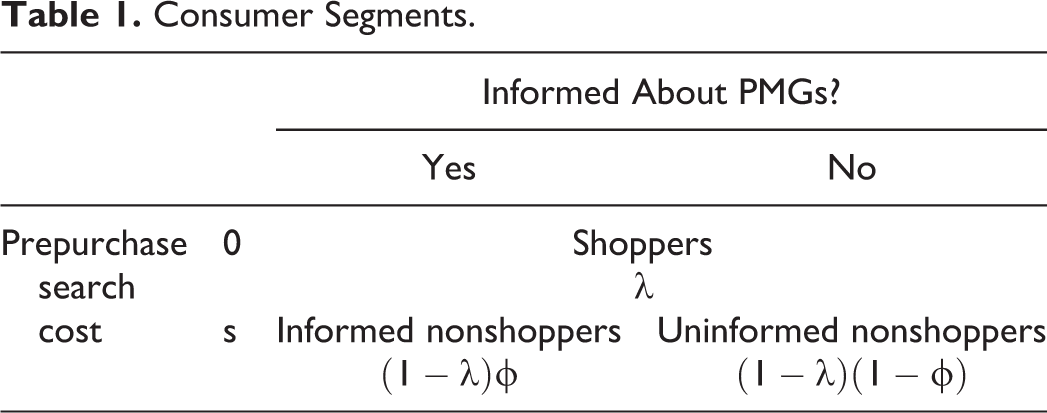
Similar to Jiang, Kumar, and Ratchford (2016), I allow for heterogeneity in search costs before and after purchase. A fraction λ of consumers have zero prepurchase search cost (“shoppers”). The remaining consumers (“nonshoppers”) have a prepurchase search cost of
Consumers who purchase from a PMG store may search after purchase for a lower price. I assume that the postpurchase search cost is either zero or s. A consumer who has a prepurchase search cost of s will have zero postpurchase search cost with probability q. 9 The assumption that consumers are uncertain about their postpurchase search costs is also made by Chen, Moorthy, and Zhang (2005) and Lu and Moorthy (2007) in models to study rebates.
As Jiang, Kumar, and Ratchford (2016) argue, it is realistic to expect that search costs may vary over time and that consumers may have lower postpurchase search costs. If a tire bursts or a TV breaks down, the cost of doing without the product while search is being conducted may be very high. In case of unplanned purchases, these sometimes happen when the consumer is very time constrained. A PMG allows consumers a grace period in which they can search after purchase. A grace period to exercise the PMG allows consumers to defer search to when their search costs are low. As Lu and Moorthy (2007) argue, a PMG allows consumers to search for several days after purchase, and a consumer may experience several draws of low and high search costs during this period. The consumer is able to postpone his or her search to the nonbusy periods. The probability of having a low postpurchase search cost can be interpreted as the probability of having a low search cost at some point during the grace period of the PMG. Thus, it is not unreasonable that q may be large. In fact, Jiang, Kumar, and Ratchford assume that some consumers who have high search cost prepurchase will have zero postpurchase search costs with probability one.
The key part of this assumption is that some consumers are able to learn prices after purchase at a very small cost. While this is captured in the model by assuming that search costs vary over time, other reasons can explain this feature. For instance, after purchase, consumers may be more attuned to rival prices presented to them. Indeed, Dutta and Biswas (2005) find that consumers who have “high value consciousness” are prone to conduct postpurchase search. Moreover, consumers may passively learn firms’ prices through advertising (Headen, Klompmaker, and Teel 1977) or peer communication (Godinho de Matos, Ferreira, and Belo 2018). In this spirit, Janssen and Parakhonyak (2013, p. 3) assume that after the consumer has bought the good, there is an exogenous probability that (s)he observes the price of another firm. They argue that such information “can come either from friends or just accidentally because [the consumer] noticed the price in another store.”
Consumers also differ in the information they have regarding which stores provide PMGs. A fraction ϕ of each consumer-type knows which firms offer PMGs. 10 The remaining consumers learn the PMG policy of a firm only after visiting it. I refer to nonshoppers who are informed (uninformed) about firms’ PMG policies as informed nonshoppers (uninformed nonshoppers). In summary, there are three consumer segments, which are depicted in Table 1. Note that whether shoppers know which firms offer PMGs is not relevant because, as they can learn all prices for free, their shopping decisions do not depend on firms’ PMG policies. These consumers can go directly to the store that offers the lowest price.
Consumer Segments.
Equilibrium Search Strategies
Shoppers
Shoppers learn all prices at no cost, so they simply purchase the product from the store with the lowest price.
Informed nonshoppers
Informed nonshoppers hold rational beliefs regarding the price distribution of PMG and non-PMG stores. They visit the store where their expected costs (which include price and search costs) are minimized. Note that if consumers believe that PMG stores offer lower prices, it is straightforward that informed nonshoppers will visit a PMG store. By doing so, consumers will not only be offered a lower price (vs. the price of non-PMG stores) but also have the opportunity to search for a refund after purchase.
Uninformed nonshoppers
Because uninformed nonshoppers do not know which firms offer PMGs, they search stores at random. When they visit a PMG store, as long as its price is not higher than v, they always purchase the product. By doing so, they can delay search to after purchase, when they may have zero search costs.
Let
Suppose that the first (random) store that an uninformed nonshopper visits does not offer a PMG, and charges price z. The consumer will search one more store if the benefits of doing so are higher than his search cost.
Let α denote the equilibrium probability that a store offers a PMG, and let
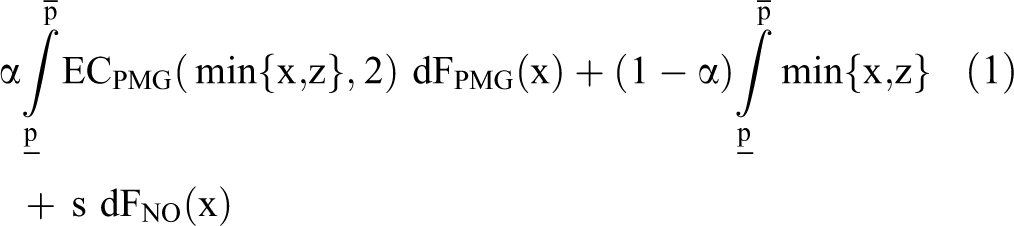
If the consumer purchases at the first store (s)he visits, (s)he pays the listed price z. There exists a unique z such that the expected total cost incurred when searching a second store is equal to z. I denote this unique price threshold as
Let
Lemma 1 states that, in equilibrium, non-PMG stores never charge a price higher than consumers’ reservation value. This implies that, in equilibrium, uninformed nonshoppers purchase in case the first (random) store they visit does not offer a PMG. As previously discussed, these consumers also purchase in case the first store they visit offers a PMG. This leads to the following corollary:
Next, I characterize consumers’ optimal postpurchase search strategy. When they purchase from a non-PMG store, there is no scope for postpurchase search, as consumers cannot get refunds. If, however, consumers purchase from a PMG store, their optimal postpurchase search strategy depends on their postpurchase search costs.
Trivially, consumers with zero search cost postpurchase optimally search all stores and get a refund for the difference between the price they paid and the lowest price in the market.
When they have high search cost postpurchase, consumers search one more store when the benefits of doing so are higher than their search cost. In particular, it follows from Kohn and Shavell (1974) that consumers follow a cutoff rule, such that they will stop searching either when they find a price lower than some threshold or when they exhaust all stores.
Let
Whereas uninformed nonshoppers must search at random, informed nonshoppers can choose to search another PMG store. It then follows that informed nonshoppers search more intensively postpurchase than uninformed nonshoppers.
The intuition behind Lemma 3 is that the benefit of searching prepurchase, after getting a price quote from a non-PMG store, is higher than that of searching after purchasing from a PMG store. This follows because, prepurchase, consumers still have a probability q of having zero search cost postpurchase. Thus, when consumers are searching prepurchase after getting a price quote from a non-PMG store, they take into account that performing one more search may enable them not only to find a lower price but also to find a PMG store, in which case they may be able to search postpurchase at no cost. In contrast, consumers who have high search cost postpurchase search only to find a lower price.
To understand the intuition behind Lemma 4, suppose, by contradiction, that
By definition of
As Lemma 2 indicates, informed nonshoppers have more incentives to search than uninformed nonshoppers, as they can go directly to a PMG store where prices are expected to be lower. To facilitate exposition, I assume that the search cost s is large enough such that informed nonshoppers only search after purchase when they have zero postpurchase search costs. In the Web Appendix, I show that the main result holds when this assumption is relaxed. Table 2 summarizes consumers’ purchasing strategies.
Consumer Search Strategies.

Equilibrium Firm Strategies
The equilibrium concept I use herein is a rational expectations equilibrium, in which consumers’ expectations of prices for PMG and non-PMG stores are correct. Because I am interested in showing how PMGs can act as a signal of low prices, throughout this article I focus on equilibria under which consumers believe PMG stores to charge lower prices.
In a celebrated article, Diamond (1971) shows that when consumers search sequentially and face positive search costs, in equilibrium all stores charge the monopoly price. To overcome the so-called “Diamond Paradox,” I assume the existence of shoppers (i.e., consumers with zero search cost). This assumption is standard in the search literature (e.g., Stahl 1989; Varian 1980). The existence of shoppers implies that there is price dispersion in equilibrium.
I now analyze for what set of prices it is beneficial for firms to offer a PMG. Consider a firm that is deciding on its pricing strategy. Let k denote the number of the remaining firms offering PMGs. Because PMGs and prices are chosen at the same time, when the firm is making pricing decisions it does not know k; it only knows the equilibrium probability that each store offers PMGs. This induces a probability distribution over k, which I denote by g.
Suppose the firm chooses price p and does not offer a PMG. The firm will sell to shoppers in case it has the lowest market price. The probability that the firm has the lowest price in the market depends not only on the firm’s price, p, but also on the number of remaining firms offering PMGs, k. I denote by

Next, suppose the firm chooses price p and offers a PMG. The firm will sell to shoppers in case it has the lowest market price, which happens with probability

It follows that

Offering a PMG presents a trade-off. On the one hand, a firm that offers a PMG attracts informed nonshoppers. Selling to these consumers constitutes the upside of offering a PMG.
On the other hand, a firm that offers a PMG may have to give refunds to uninformed nonshoppers. Such consumers purchase at the first random store they visit, so their purchasing decision does not depend on firms’ PMG policies. The firm would sell to these consumers even if it did not offer a PMG. However, if the firm offers a PMG it will have to give refunds to those who search postpurchase. The refunds given to uninformed nonshoppers are the downside of offering a PMG.
Both the benefit and the cost of offering a PMG are increasing in the firm’s listed price. However, because

Cost and benefit of offering a PMG.
The intuition behind why the cost (vs. the benefit) of offering a PMG is more sensitive to the firm’s price is better understood if we consider the extreme case where
It follows that the benefit from offering a PMG is higher than its cost only for firms that charge low prices. The following proposition characterizes the equilibrium firm strategies. As firms are identical, I focus on symmetric equilibrium.
If
The equilibrium is, indeed, a rational expectations equilibrium. Consumers believe that PMG stores charge lower prices and PMG stores find it optimal to charge lower prices. Thus, PMGs act as a signal of low prices even though firms are homogeneous.
P1 requires q to be “large” for PMGs to act as a signal of low prices. How large q must be depends on the other market parameters (λ, ϕ, n).
For PMGs to act as a signal of low prices, the model introduces two features: (1) consumers with high search cost prepurchase may have low search cost postpurchase and (2) some consumers are able to go directly to a PMG store and others search at random. The first feature is present when
Lemma 6 shows that, standing alone, neither of the two features allows for PMGs to act as a signal of low prices. Indeed, if we do not allow for consumers with high search cost prepurchase to have low search cost postpurchase (by setting
Whether PMGs can be used to signal low prices depends on the extent to which consumers are informed about firms’ PMG policies (measured by ϕ) and on the extent to which consumers search postpurchase (measured by q).
As stated in P1, there exists a price threshold,
The effect of ϕ on the signaling role of PMGs is ambiguous. The benefit for a firm to offer PMGs is that it can attract informed nonshoppers. The drawback is that the firm has to give refunds to uninformed nonshoppers. The lower ϕ, the lower the share of consumers that a firm can attract by offering a PMG. When ϕ is low, because the benefit of offering PMGs is small, firms are only willing to offer PMGs in case the expected value of the refunds is also small, which happens when the firm lists a low price. It follows that, as ϕ decreases, PMGs become a better signal of firms’ prices. However, ϕ measures the extent to which consumers take into account PMGs before deciding where to purchase. Thus, when ϕ is small, PMGs are a good signal of firms’ prices, but few consumers are able to use such signal.
In the other extreme case,
The signaling role of PMGs is strongly related to the extent to which consumers search postpurchase. As previously discussed, if consumers never search postpurchase (
When q is high and a firm offers a PMG, it communicates to its consumers the following message: there are some consumers who purchase at a random store because they have high search costs and do not know which firms offer PMGs; the firm is willing to give those consumers a refund in case they find a lower price after purchase, even though the firm knows that they will actually search for a lower price because they are likely to have zero search costs postpurchase. If the firm’s price was high, it would not be profitable to give refunds to such consumers. Thus, a PMG is a credible signal that the firm offers a low price.
The higher the extent to which consumers search postpurchase (measured by q), the stronger the role of PMGs as a signal of low prices. This explanation for why PMGs signal low prices is consistent with experimental evidence from Srivastava and Lurie (2004), who find that the effectiveness of PMGs as a signal of low store prices depends on individuals’ beliefs about the degree to which other consumers in the market engage in price search and enforce PMGs.
Because PMGs are indeed offered by firms that list low prices, consumers who purchase from PMG stores and search after purchase are unlikely to find a lower price. Thus, PMGs are not frequently redeemed in equilibrium. This prediction is consistent with a survey conducted by Moorthy and Winter (2006), who find that the average redemption rate is around 5%. A natural question is, then, why would consumers search after purchase if they are unlikely to find a lower price? In the model presented here, consumers may have zero postpurchase search costs, so they search even if the benefits of doing so are marginal. If, instead, postpurchase search costs were always strictly positive, consumers would refrain from searching postpurchase if they did not expect to find a lower price. These considerations, however, do not change the main result, as the following example demonstrates. 16
Firms play mixed strategies over the set A firm offers a PMG if and only if it chooses a price in the set Shoppers purchase from the firm that lists the lowest price, uninformed nonshoppers purchase from a random store, and informed nonshoppers purchase from a PMG store (when it exists). Consumers never search postpurchase, even if they have postpurchase search cost
Robustness
The model presented here relies on some simplifying assumptions to facilitate exposition. In the Web Appendix, I show that the results are robust to several other plausible assumptions. First, the main model assumes that firms choose prices and PMG policies simultaneously. However, the literature is not in agreement regarding this aspect: whereas Png and Hirshleifer (1987), Jain and Srivastava (2000), and Janssen and Parakhonyak (2013) use the simultaneous timing, Moorthy and Winter (2006), Moorthy and Zhang (2006), and Jiang, Kumar, and Ratchford (2016) assume that firms first decide on whether to offer a PMG and only choose prices after observing which firms offer PMGs. The argument to model the decision of PMG policies and prices as sequential is that prices are more flexible than PMGs, and usually firms stick to their PMG policy for a long period of time.
In the Web Appendix, I analyze a two-stage game where PMG policies are chosen before prices. Even though the simultaneous setting provides cleaner results, I find that the underlying intuition of the model and the main results do not change under this alternative timing. Second, whereas the main model assumes that consumers have exogenous information regarding firms’ PMG policies, I find that the results hold when consumers can choose whether to learn PMG policies, at a cost. Third, in the model presented here, it is assumed that if consumers decide to search postpurchase, they face the same prices that firms set prepurchase. This assumption is consistent with empirical evidence suggesting that prices are sticky (e.g., Bils and Klenow 2004; Blinder et al. 1998; Kashyap 1995). Whereas firms’ prices are fixed for somewhat long periods of time, the postpurchase search period is typically small: Arbatskaya, Hviid, and Shaffer (2004) document that, in a sample of 515 PMGs, 89% of the guarantees have a postpurchase search period of either 7 days or 30 days.
The assumption made in this article is that firms are able to commit to the prices they set for the duration of the postpurchase search period. Such commitment is done, for example, by using mail-order catalogs that advertise prices for a long period. The existence of menu costs also prevents firms from changing prices too frequently. 17
Finally, I have assumed that firms face the same production cost. This assumption was made to highlight that, in this model, PMGs can act as a signal of low prices in absence of firm heterogeneity. In this section, I analyze an extension in which firms are heterogeneous in their production cost, and I show that, in the model presented here, firm heterogeneity also leads PMGs to act as a signal of low prices.
Heterogeneous Costs
The assumption that firms face the same production cost is reasonable because retailers—not producers—are the ones offering PMGs, so it is plausible that, as they all purchase the product from the same producer, they are paying the same price for it. However, as Moorthy and Winter (2006) point out, in some markets there may be firms that have a higher bargaining power and can purchase the product at a lower price. They find that, when that is the case, firms that have low marginal costs offer PMGs and charge low prices. In this section I show that, in presence of firm heterogeneity, the model presented here generates the same results as the previous literature.
I make the simplifying assumption that nonshoppers purchase at the first store they visit, as long as the price of such store provides them with nonnegative consumer surplus. Effectively, this is an assumption that the search cost of visiting another retailer is larger than the consumer surplus they expect to get by doing so. Jain and Srivastava (2000), Moorthy and Winter (2006), and Moorthy and Zhang (2006) also make similar assumptions. 18
Similarly to Moorthy and Winter (2006), I assume that firms face simultaneous, independent draws on unit costs of production: c with probability γ and
Firms with low marginal cost have a higher margin and are more willing to reduce their price to generate a higher demand. The existence of PMGs does not revert the standard result that firms’ prices are increasing in their production cost (e.g., Reinganum 1979).
Regarding the incentives to offer a PMG, the intuition is the same as in the model with homogeneous firms. By offering a PMG, a firm is able to attract informed nonshoppers. Note that firms of type L benefit more from attracting these consumers than do firms of type H, as they have a higher profit margin.
The cost of offering a PMG is the expected value of the refunds that the firm gives to uninformed nonshoppers. These consumers would purchase from the firm even if it did not offer a PMG. Refunds depend on posted prices only, and not on firms’ marginal costs. Thus, the expected value of the refunds is the same for both types of firms.
As in the model with homogeneous firms, there is a price threshold such that firms offer a PMG only if they choose a price lower than the threshold. The two types of firms have different thresholds. Because the cost of offering a PMG is the same for both types and the benefit of offering it is greater for firms of type L, the threshold of firms of type L is higher. Figure 2 illustrates this point. I denote by

Incentives to offer PMGs for both types.
Not only do firms of type L charge lower prices, they also have a higher price threshold for offering the PMG policy. It then follows that firms of type L offer PMGs more often than firms of type H. Indeed, P2 implies that if firms of type H offer a PMG with positive probability (which happens when
If If
Similar to the model with homogeneous firms, it follows that PMGs act as as signal of low prices provided that q is large enough. Moreover, it follows from point (3) of Lemma 8 that, in the model presented here, cost heterogeneity also leads PMGs to act as a signal of low prices. The intuition is as follows. As the marginal cost of firms of type L decreases (i.e., as Δ increases), the price charged by firms of type L also decreases. It then follows that firms of type H have lower benefits from offering a PMG, as consumers would use the PMG to pay the much lower prices charged by firms of type L. Figure 3 provides a numerical example to illustrate that cost heterogeneity enlarges the set of parameters under which PMGs act as a signal of low prices.

Set of parameters under which PMGs act as as signal of low prices.
Managerial Implications
PMGs as a Differentiation Strategy
Previous literature suggests that when firms are differentiated (for example, based on their marginal costs or service level), they can use a PMG to communicate such differentiation to consumers. In contrast, the present article proposes that a PMG can be, on its own, a differentiation factor. In a market where all firms are otherwise identical, a firm that offers a PMG differentiates itself from its competitors, and attracts the consumer segment informed about firms’ PMG policies and with high search costs.
As an illustrative example, consider a market composed of six firms, three of which offer a PMG. Consumers expect that PMG firms offer lower prices. Because half of the firms in the market offer a PMG, consumers rationally anticipate that PMG firms offer prices below the median, whereas non-PMG firms offer prices above the median. By visiting a PMG firm, a consumer is assured to pay a price below the median, but not necessarily the lowest price in the market. For consumers with high search costs, this is good enough: they prefer to go directly to any of the PMG stores and pay a price below the median, than to search the prices of all PMG stores so that they can pay a lower price. In contrast, consumers with low search costs want to make sure to pay the lowest price in the market. Thus, whereas consumers with low search costs search all stores to be sure to pay the lowest price in the market, consumers with high search costs are happy to go directly to a PMG store and pay its listed price.
Experimental evidence from Srivastava and Lurie (2001, p. 296) supports the consumer segmentation proposed in the present article. They find that “when search costs are low, the number of stores searched increases in the presence versus absence of a price-matching policy. When search costs are high, consumers appear to accept the price-matching signal at face value and search less in the presence of a refund.”
The Role of the Postpurchase Search Period
The present research focuses on PMGs that allow consumers a grace period in which they can search after purchase. Whereas Arbatskaya, Hviid, and Shaffer (2004) find that, in many instances, PMGs do not allow for postpurchase search, more recently Jiang, Kumar and Ratchford (2016, p. 2) collect data on 150 retailers and conclude that “PMGs with a grace period after purchase are the mainstream form.”
Although the classic economics literature predicts that PMGs are a collusion device (see, e.g., Salop 1986), the role of PMGs as a signal of low prices was sparked by experimental literature that finds that consumers perceive PMG stores to have lower prices. To the best of my knowledge, all such experimental studies have considered PMGs that allow for postpurchase search. Whereas the more common postpurchase search periods in the experimental literature are 30 days (Borges and Babin 2012; Dutta 2012; Dutta and Bhowmick 2009; Dutta, Biswas, and Grewal 2007, 2011; Estelami, Grewal, and Roggeveen 2007; Kukar-Kinney and Walters 2003; Kukar-Kinney, Xia, and Monroe 2007; McConnell et al. 2000) and 90 days (Jain and Srivastava 2000; Srivastava and Lurie 2001, 2004; Kukar-Kinney 2005, Lurie and Srivastava 2005), PMGs with a postpurchase search period of 14 days (White and Yuan 2012) and 45 days (Lim and Ho 2008) have also been used.
Moreover, the experimental literature supports the prediction of the present research that consumers value the existence of a postpurchase search period. McConnell et al. (2000) find that PMGs serve to reduce anticipated regret, as they assure consumers that if they find a lower price after purchase they will be refunded. Lim and Ho (2008, p. 6) find that PMGs induce consumers to “make purchases immediately and postpone price search till after purchase.”
When advertising their PMGs, it is typical for firms to highlight that consumers have the opportunity to search after purchase. For example, 19 Walmart promotes its Christmas PMG by advertising, “Find a lower advertised price on a gift after you’ve bought it? No problem. We’ll give you the price difference.” Fry’s Electronics labels its PMG as a “30-Day Price Match Promise.” Target advertises the following: “If you find a current lower price within 14 days after purchase, just bring in the proof and we will adjust your payment to the lower price.”
Some firms explicitly encourage consumers to search postpurchase. LMC Marine Center advertises, “We guarantee you won’t find a better price even after you buy a boat from us! That’s right—buy today, and keep shopping for up to 90 days, and if you find a better price, we will cut you a check back for the difference. No one else offers this peace of mind, so ‘buy now and shop later’ since you have nothing to lose!”
In the tire market, many retailers call their PMG a “30-day price match guarantee.” Imperial Cars advertises, “Buy now, match later with our 30-day, lowest-price guarantee.”
Conclusion
In this article, I have focused on PMGs. However, these promises sometimes take the form of “price-beating guarantees,” in which firms refund more than the difference between the listed price and a lower price found elsewhere. The more common forms of price-beating guarantees are a percentage of the difference (e.g., refund 120% of the difference) and the difference plus a fixed amount (e.g., refund the difference plus $10). In the model presented here, the downside of offering a PMG is measured by the refunds that firms have to give to consumers who do not know which firms offer PMGs and, by chance, end up visiting a PMG store. When firms offer price-beating guarantees, the refunds are larger. Thus, the firm is only willing to offer such policy if it is likely that, indeed, consumers will not find a lower price elsewhere. Therefore, price-beating guarantees may send an even stronger signal of low prices. A complete discussion of the role of price-beating guarantees on equilibrium prices implies solving a model with a larger strategy space, where firms can choose to offer price-beating guarantees. Because this model does not allow for such strategies, the proof of the conjecture that price-beating guarantees may provide an even stronger signal of low prices remains an open question. Moorthy and Winter (2006) and Moorthy and Zhang (2006) make a similar conjecture.
Finally, it should be pointed out that the present research assumes away other retail strategies that may interact with a PMG, such as automatic price protections (Gourville and Wu 1997) and money-back guarantees (Moorthy and Srinivasan 1995). This is the traditional approach in the literature, as analyzing the impact of simultaneous retail strategies comes with substantial complexity. A notable exception is the work by Hviid and Shaffer (2010) who analyze the joint implementation of a PMG and a most-favored-customer clause.
Appendix: Proof of P1
In this Appendix, I present the proof of the main result stated in P1. All remaining proofs are relegated to the Web Appendix.
To show that an equilibrium exists, I use the results in Reny (1999). Because the sum of the players’ profits is continuous in prices, it follows from Proposition 5.1 in Reny (1999) that the game is reciprocally upper semicontinuous.
I will now show that the game is payoff secure, as defined in Reny (1999).
Let
Because the game is both reciprocally upper semicontinuous and payoff secure, it follows from Corollary 5.2 in Reny (1999) that there exists a Nash equilibrium. Through an argument similar to Varian (1980), it follows that there exists no equilibrium in pure strategies. By contradiction, suppose there exists an equilibrium where all firms charge the same price. If such price is higher than marginal cost, any firm has an incentive to charge a slightly lower price and sell to all shoppers. If such price is equal to marginal cost, any firm can increase its profit by charging a price slightly higher that assures that the firm sells to uninformed nonshoppers and makes strictly positive profits. Thus, the equilibrium must involve mixed strategies. Moreover, by a standard argument (e.g., Stahl 1989; Varian 1980), the price distribution must be atomless.
Next, define

First, note that Δ is continuous and strictly concave. Moreover, because
Suppose
I now show that there is no equilibrium under which firms offer PMGs with probability 1. I do this by contradiction. Suppose that in equilibrium all firms offer PMGs with probability 1. Let
Let

We can then conclude that, for
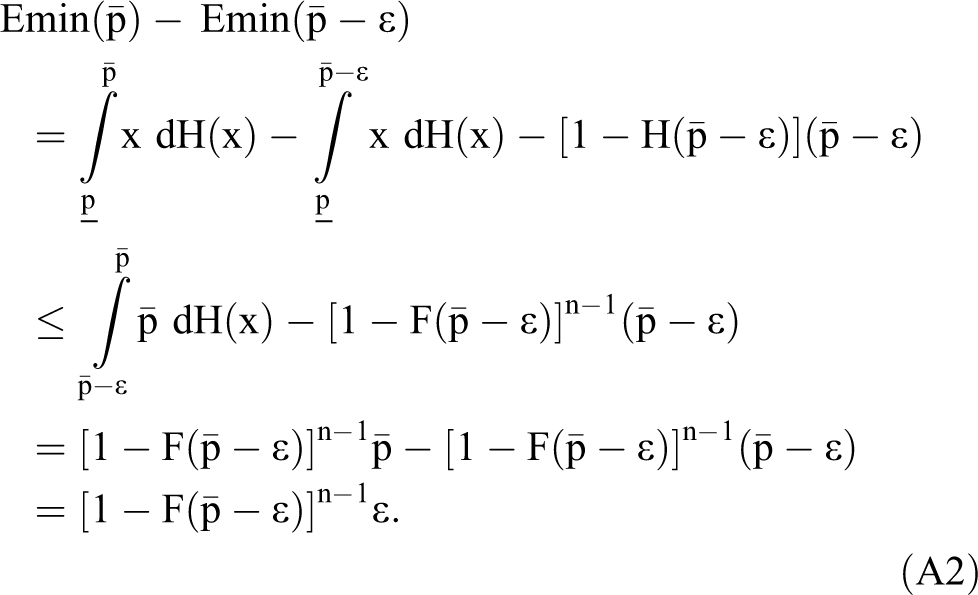
Because the price distribution is atomless, it follows that


Let

where the weak inequality follows from Equation A2 and the strict inequality follows from the fact that
It then follows that, if
Supplemental Material
Supplemental Material, jmr.17.0541-web-appendix - Price-Matching Guarantees as a Direct Signal of Low Prices
Supplemental Material, jmr.17.0541-web-appendix for Price-Matching Guarantees as a Direct Signal of Low Prices by Samir Mamadehussene in Journal of Marketing Research
Footnotes
Acknowledgments
I am grateful to Jeff Ely for many discussions that greatly improved the article. For their helpful comments, I also thank Chris Li, Wojciech Olszewski, Ricardo Pique, Tiago Pires, Robert Porter, Francisco Silva, and seminar participants at Northwestern University, University of California, Los Angeles, Católica Lisbon School of Business & Economics, Universidad Carlos III, California State University Fullerton, European Association for Research in Industrial Economics 2016, and International Industrial Organization Conference 2017. I thank the JMR review team for their helpful suggestions and comments on previous versions of this article. All errors are my own.
Associate Editor
Anthony Dukes served as associate editor for this article.
Declaration of Conflicting Interests
The author(s) declared no potential conflicts of interest with respect to the research, authorship, and/or publication of this article.
Funding
The author(s) disclosed receipt of the following financial support for the research, authorship, and/or publication of this article: I acknowledge the support from FCT Portuguese Foundation of Science and Technology for the project UID/GES/00407/2013.

Notes
References
Supplementary Material
Please find the following supplemental material available below.
For Open Access articles published under a Creative Commons License, all supplemental material carries the same license as the article it is associated with.
For non-Open Access articles published, all supplemental material carries a non-exclusive license, and permission requests for re-use of supplemental material or any part of supplemental material shall be sent directly to the copyright owner as specified in the copyright notice associated with the article.
