







Abstract
Colorism, or discrimination based on skin tone, has been widely documented as privileging lighter and disadvantaging darker skin tones in personal and professional contexts. In contrast, the current research uncovers a novel and positive “dark is hardworking” association in India. This association is theorized based on sociological accounts linking dark skin to outdoor labor, personal accounts of dark skin–toned individuals overcoming discrimination to achieve success, and widespread media cues featuring dark skin–toned achievers in arduous career pursuits. Darker skin tone thus cues perceived competence of service providers, driven by perceptions of being more hardworking. Evidence from six studies, including five experiments and a behavioral field study, demonstrates that although lighter skin continues to be advantageous in attractiveness-favoring professions (such as beauty consulting), darker skin offers a distinct advantage to service providers in competence-favoring fields (such as financial and technical services). Furthermore, highlighting competence can increase the preference for darker skin–toned professionals, even in attractiveness-favoring domains. This research contributes to the literature on stigmatized groups, specifically colorism and its effects on stereotyped evaluation of service providers. The findings provide strategic insights for service providers and have implications for social policy.
I’m a hotel management graduate who specialized in front office operations. While studying, the department professor discouraged me from pursuing front office as a career, because of my complexion. To him, I was a dark, very unattractive and repulsive “Madrasi” student. —Post on “Dark Is Beautiful” Facebook page (2016)
To shine like the sun, you must first burn like the sun.
If four things are followed—having a great aim, acquiring knowledge, hard work, and perseverance—then anything can be achieved. —Attributed to A.P.J. Abdul Kalam
Colorism, or discrimination based on skin color, is a long-standing, pernicious global phenomenon (Arsel, Crockett, and Scott 2022; Hunter 2007). Although colorism is associated with race and ethnicity in the West, it has unique origins and implications in monoethnic Asian cultures such as India, China, Japan, and Korea. In India, as in other Eastern cultures, a light skin tone is considered a marker of beauty and status (Li et al. 2008). Abundant Bollywood songs pay homage to the gori (“fair” or light skin–toned) heroine, while equally abundant derogatory descriptors (synonymous with dirty or ugly) are reserved for dark skin–toned individuals in virtually every Indian language. It is no surprise that there is a large market for products and services that promise skin-lightening benefits and the ability to remove the social stigma associated with darker skin (Nadeem 2014). 1
Abundant research has shown persistent negative stereotypes of dark skin around the world. In the West, darker skin tones (whether based on race or within the same race) foster negative stereotypes such as being perceived as more unintelligent, lazy, and associated with criminal and immoral acts (Maddox and Gray 2002; Monk 2015; see the “bad is black” effect Alter et al. 2016). As such, a darker skin tone is universally shunned or derided (for a review of the literature on colorism, see Table W1 in Web Appendix A). In contrast to this prevailing narrative, we identify a novel positive “dark is hardworking” (DHW) association in India. Specifically, this positive association accords a distinct advantage to darker skin–toned service providers in professional contexts.
We contend that the DHW association evolved due to the unique historical and sociocultural influences in India. Based on sociological accounts of occupational pursuits in India, dark skin has historically been associated with effortful outdoor labor. In addition, there is a widespread recognition that dark skin–toned individuals need to overcome their attractiveness deficit through diligence and effort to attain social worth. We posit that over time this frequent co-occurrence and implicit recognition have calcified into a DHW lay belief, akin to how gender stereotypes form based on distinct social roles (Eagly and Steffen 1984).
We hypothesize that the DHW association enhances the perceived efficacy or competence of professional service providers in India. Competence is defined as the ability (and effectiveness) to achieve work-related goals (Fiske et al. 2002; Kirmani et al. 2017; Kirmani and Campbell 2004; Wang et al. 2017). Competence is a multifaceted construct that includes perceptions of skill or ability as well as diligence or hard work (or, relatedly, determination, grit, and industriousness; McCrae and Costa 1987). We propose that a darker skin tone influences the perceived hardworking aspect of competence, which thus accrues an advantage to dark skin–toned service providers in domains that emphasize competence over other attributes such as attractiveness (e.g., financial or technical services vs. personal grooming or beauty services). Furthermore, making the importance of hard work salient can even help dark skin–toned service providers overcome their traditional disadvantage in attractiveness-favoring domains.
In six studies (five controlled experiments and a behavioral field study) we provide evidence for the DHW association and its positive downstream effects for service professionals in India. To the best of our knowledge, positive effects of a darker skin tone on consumer perceptions of service providers have not been studied in any global context of colorism (for a comparison of our research with related literature, see Table W1 in Web Appendix A). In our research that includes participants across different geographical regions in India, we show that a lighter skin tone remains advantageous in attractiveness-favoring service domains, but a darker skin tone is advantageous in competence-favoring professions.
Our findings contribute to the extensive literature on the role of stereotypes in consumer perceptions of service providers and other professionals (Hoegg and Lewis 2011; Kirmani et al. 2017; Peng et al. 2020). Specifically, we add to the research on stereotyped judgements of service providers based on facial cues (e.g., smile intensity Wang et al. 2017), attractiveness (e.g., Wongkitrungrueng et al. 2020), gender (Matta and Folkes 2005), and ethnicity (Gill, Kim, and Ranaweera 2017). In addition, contributing to the research on stigmatized groups (e.g., Harmeling et al. 2021; Krishna and Orhun 2022) we show that the universally derided dark skin–toned individuals have acquired a significant unique positive connotation in India. Although the DHW association, akin to other stereotypes, is based on subjective perceptions, it does affect downstream consumer attitudes and preferences in the marketplace.
Substantively, our research provides insights for service professionals who work for established firms or are self-employed on popular gig-work platforms (e.g., Urban Company, Fiverr, Upwork, and Freelancer; for some examples, see Web Appendix B). Our findings suggest that although customers may prefer light skin–toned professionals in attractiveness-related services, they are likely to favor dark skin–toned professionals for services where hard work and competence is more critical. In addition, strategic brand communications that highlight the “hard work” aspect of competence (e.g., a diligent work ethic) can not only enhance their advantage but also attenuate the disadvantage faced by dark skin–toned professionals in certain domains.
In the sections to follow, we first theorize about the origins of the DHW lay belief in India and develop our propositions about its effects on service provider assessments. We then describe our empirical studies and findings, their implications, and future research avenues.
Theory and Hypotheses
What Is Skin Tone?
Skin color, or skin tone, refers to gradations of a physical characteristic ordered from light to dark, determined by the amount of pigmentation (melanin) in the skin, which varies by sun exposure and geographic location (Dixon and Telles 2017; Jablonski 2012). Although objective scales to measure skin tone gradations exist (e.g., the Fitzpatrick skin type scale and the Monk scale; Monk 2019; see Web Appendix C), we focus on the subjective assessment of skin tone. This is important as it is subjective, rather than objective, assessments that drive social perceptions, preferences, and discrimination based on skin tone (Dixon and Telles 2017; Monk 2015), much like the effects of height and weight. For instance, studies have shown that being tall is associated with power and achievement (Jackson and Ervin 1992), and it is the perceived (rather than actual) height that leads to these judgments. 2
We define skin tone as the subjective perception of skin color as relatively light versus dark. Whereas the color of a person's skin is objectively determined by biological melanin levels, subjective perceptions are affected by a perceiver's personal contextual experiences. For instance, the geographic region where they grew up (e.g., in the north vs. south of India where the average skin tones are relatively light vs. dark, respectively), the perceiver's own and their family members’ skin tones, and their lived experiences (such as being praised versus disparaged for their skin tone; see footnote 5). Accordingly, in our studies we controlled for these contextual factors to the extent possible and obtained subjective assessments of skin tone. 3
The Sociocultural Underpinnings of Skin Tone Preferences in India
Colorism is understood to have distinct origins (therefore, distinct manifestations) in different regions of the world (Dixon and Telles 2017). There are some similarities in present day manifestations of colorism— for example, the preference for lighter skin–toned partners and advertising endorsers— in the West and the East (Jha and Adelman 2009; Watson, DeJong, and Slack 2009; see Table W1, Web Appendix A). However, whereas colorism is rooted in race and othering in North America, structuring socioeconomic hierarchies (Telles 2014), in India, skin tone preferences have been shaped via external conditioning based on unique historical and sociocultural factors. Early evidence from the ancient Vedic scriptures (dated 5,000–3,000 BCE) suggests no presupposed notions of superiority associated with light skin (Mishra 2015; Pattanaik 2016; Utley and Darity 2016; for examples from Indian mythology that depict dark skin as celebrated, divine, beautiful, and powerful, see Figures W1 and W2 in Web Appendix D). The long period of Western colonialism (by the lighter skin–toned Turks, Mughals, Europeans, and British) appears to have sown the seeds of colorism in India, wherein light skin gradually became associated with superiority, power, status, and beauty (Shevde 2008). British administrators were known to have actively championed lighter skin–toned Indian rulers over darker skin–toned ones (Bose and Jalal 2017; Dirks 2011; Nadeem 2014). The preference for light skin subsequently became deeply embedded in India'-s cultural norms, manifesting in overt prejudice and discrimination. Entertainment media and commercial enterprises have reinforced this preference by blatantly promoting skinlightening products and procedures as antidotes to the stigma of dark skin (e.g., Nadeem 2014). 4
Even though the light skin preference remains deeply ingrained in the Indian zeitgeist, there are certain historical and sociocultural influences that point to an alternative lay association with a dark skin tone. This alternative perspective has not been explicated in extant literature and forms the basis for our theorizing around the positive association of dark skin with hard work.
The “Dark Is Hardworking” (DHW) Lay Belief in India
Lay beliefs reflect common-sense explanations people use to understand their environment (Haws, Reczek, and Sample 2017). It is understood that lay beliefs may arise from personal experiences, assumptions, or the observation of co-occurrences of two phenomena (Haws, Reczek, and Sample 2017; Zane, Smith, and Reczek 2020). We describe four distinct accounts of how a DHW lay belief or association may have become prevalent in India.
First, extant sociological and historical accounts of Indian society suggest that dark skin may entail an association with hard work because of laborers (e.g., farmers, construction workers, and porters) and professionals (e.g., civil engineers and field supervisors) observed working outside under constant exposure to the sun (Leong 2006; Pattanaik 2016). We posit that this widespread co-occurrence of dark skin–toned individuals engaged in physically demanding outdoor labor (hard work) can form one basis for the DHW association in India. This is consistent with Eagly and Steffen's (1984) theory that stereotypical beliefs often stem from social roles occupied by groups. Further, based on implicit personality theories (Ashmore and Del Boca 1979; Eagly et al. 1991), over time this “dark skin–toned individuals do hard work” lay belief may become unconsciously (implicitly) linked to related personality traits such as grit, hardworking, diligence, industriousness, and conscientiousness (i.e., “dark is hardworking”).
Second, according to the compensatory adaptation theory, disadvantaged people are perceived to work harder to overcome their shortcomings (Kock 2003; Peng et al. 2020). This includes those perceived to be less attractive (Peng et al. 2020). Empirical and anecdotal evidence suggests that dark skin–toned individuals in India are often ridiculed and face discrimination. 5 There is also evidence for an explicit recognition that people with a dark skin tone need to work hard to overcome this deficit. In Studies 2a and 2b, we tested participant agreement with a single statement: “Men (women) with darker skin tones have to put in more effort to be successful compared to men (women) with lighter skin tones” (1 = “strongly disagree,” and 9 = “strongly agree”). The mean agreement score was significantly higher than the scale midpoint (5) for both dark-skinned men and women (men: M = 5.87, SD = 2.68; t(232) = 4.95, p < .001; Cohen's d = .33; women: M = 6.59, SD = 2.63; t(202) = 8.58, p < .001; d = .60).
Direct evidence for this compensatory process exists in the qualitative study by Mishra (2015).A female participant shared that after her relatives lamented about her dark skin tone limiting her marital prospects, she decided to focus on working harder (in academics) and became a professional architect. Another participant, a legal professional, recounted, “Even inside a courtroom I had to try harder to get the same orders which a fairer skinned female will get much easier” (p. 746). This also aligns with research that consumers are strategic and forward-looking (Kopalle, Lehmann, and Farley 2010), and when they sense a personal weakness in one domain, they preemptively work hard to compensate in a different domain to attain future success.
Third, dark skin–toned individuals who succeed in environments where systemic barriers exist are often perceived as having overcome significant obstacles. Their visibility and prominence may reinforce the belief that their success is mainly the result of hard work and effort, even if other factors such as opportunity, mentorship, or talent may have also played a role. As the struggles of those who failed are less visible, such success stories may create an exaggerated link between dark skin tones and hard work based on the survivorship bias. Historical and contemporary societal narratives also highlight the struggles and resilience of marginalized groups with darker skin tones, such as Dalits and other lower castes in India (e.g., Dutt 2024). 6
Fourth, lay associations are further amplified by environmental cues that accord with these beliefs (Raghunathan, Naylor, and Hoyer 2006). Widespread advertising pairing dark skin–toned individuals with professional pursuits that require effortful, persistent, and focused work, be it physical or mental, would be such a cue. In India, for example, getting into the elite Indian Institutes of Technology (IITs; with acceptance rates between .5%–2%, which are among the lowest in the world) requires several years of dedicated effort and preparation for the challenging entrance exams. There is a flourishing coaching industry (valued at more than $500 billion in 2022 [Yadav 2022]) that prepares high school students in India for admission into these prestigious colleges (the “Indian dream”). These coaching institutes widely advertise their success all over India, prominently displaying images of individuals who succeeded in the IIT entrance exams (for some recent ads, see Web Appendix F). We conjectured that if the individuals featured by these IIT coaching institutes tended to be darker skinned, this would amplify the DHW association in India and indicate that this lay belief is prevalent even in academic pursuits that entail mental efforts (rather than physical labor). In a prestudy (for full details, see Web Appendix F), we indeed found that individuals prominently displayed as successful candidates on the websites of IIT engineering coaching institutes (vs. those from modeling coaching institutes) were significantly darker in skin tone (M = 5.73, SD = 1.90 vs. M = 7.08, SD = 1.60; F(1, 4,142) = 614.41; p < .001; d = .77; higher is lighter). Supporting the DHW lay belief, the IIT coaching students were also perceived as more hardworking than those training to be models, an attractiveness-focused domain (M = 6.50, SD = 1.82 vs. M = 6.33, SD = 1.81; F(1, 4,126) = 8.73; p = .003; d = .09; raters were blind to coaching domains; for details, see Web Appendix F).
Overall, these four accounts based on (1) historical associations of dark skin with toiling in the sun, (2) compensatory adaptation theory of disadvantaged dark skin–toned individuals working harder to overcome their attractiveness deficit, (3) societal recognition that marginalized dark-skinned groups have had to overcome barriers through perseverance, and (4) environmental cues reinforcing these sociocultural forces support our proposed DHW association in India.
The DHW Association Cues Perceived Competence of Dark Skin–Toned Service Providers
We contend that skin tone (dark vs. light) acts as an observable cue impacting the perceived competence of service providers. It is well known that observable cues such as physical attractiveness (Peng et al. 2020; Wongkitrungrueng et al. 2020), facial structure (e.g., baby faces; Gorn, Jiang, and Johar 2008), and facial expressions (e.g., smile intensity; Wang et al. 2017) impacts perceptions of professionals such as service providers. Similarly, a darker skin tone, being associated with hard work, can cue perceived competence of service professionals.
Competence is a multifaceted construct comprising capability, skill, intelligence, hard work/diligence, and a fundamental dimension of social perception (along with warmth per the stereotype content model Fiske et al. 2002). Hard work and determination are understood to be essential qualities for achieving professional goals and demonstrating competence (Kirmani et al. 2017; Kirmani and Campbell 2004; McCrae and Costa 1987; Wang et al. 2017). “Hardworking” is defined as a dispositional tendency to exert high levels of effort and persistence in tasks (adapted from Duckworth et al. [2007] and Roberts et al. [2014]). In professional contexts, hardworking aligns with qualities such as diligence, industriousness, perseverance, and grit (Duckworth et al. 2007; Roberts et al. 2014). Furthermore, diligence (synonymous with hardworking; Barrick and Mount 1991; Digman 1990) is a facet of conscientiousness (one of the big five personality traits; Borgatta 1964; Norman 1963), which has been shown to predict professional success independently of intellectual ability or intelligence (Barrick and Mount 1991; Duckworth et al. 2007; McCrae and Costa 1987).
Although universally valued, 7 hard work as a cue for competence is particularly relevant in the Indian context. Scholars have argued that a societal preference for hard work particularly emerges during periods of high economic growth and modernization (Schilpzand and de Jong 2021). India experienced two significant periods of economic growth: postindependence (1950s–1970s) and, more significantly, postliberalization and economic reforms in the 1990s, which led to the rise of a new consuming middle class (Fernandes 2006). For a vast majority of middle-class Indians, working hard and relentlessly persevering through failures is the primary means to maintain livelihood and attain success, given the population pressure (over 1.4 billion in 2024) and structural constraints (Banerjee and Duflo 2008). This “work hard and persevere through hardships” ethos is exemplified in quotes of successful Indian industrialists and leaders (see epigraph). Thus, hard work is an exalted value in India and a critical factor underlying the perceptions of competence of service providers.
To provide direct empirical evidence for the importance of hardworking as a basis for service provider competence in India, we conducted an exploratory study. Being hardworking and being skillful were rated as the top two most important qualities for determining professional competence (importance rating vs. scale midpoint [4]: Mhardworking = 6.36, SD = 1.14, t(169) = 25.72, p < .001; Cohen's d = 1.97; for details, see Web Appendix G).
Based on our theorized DHW association and the importance of hard work as a cue for competence in India, we propose that all else being equal:
Although traits such as intelligence, skill, ability, and expertise are also important facets of competence, we do not have a theoretical basis or empirical evidence for whether skin tone can impact these aspects. For instance, in our preliminary study on coaching institutes in India (reported in the “The ‘Dark Is Hardworking’ (DHW) Lay Belief in India” section) we found that although the pictures of successful candidates at IIT exams were rated darker and more hardworking than those in modeling institutes, there was no difference in their perceived intelligence (p > .50; Web Appendix F). That said, for completeness, we measure multiple facets of competence (including hardworking, capable, intelligent, and skillful) in our studies, but we do not find consistent effects of skin tone on these other facets. Our focus is thus on diligence-based competence, as cued by skin tone, which is theoretically based on the DHW lay belief.
In contrast to our novel DHW association, the “light is attractive” association is well-documented across different global contexts of colorism, including in India (e.g., Jha and Adelman 2009), China, Korea, other Asian countries (e.g., Dixon and Telles 2017; Li et al. 2008), and in the West (e.g., Watson, DeJong, and Slack 2009). We thus expect that light skin–toned service providers in India will be perceived to be more attractive compared with dark skin–toned ones.
Note that we do not propose or expect competence and attractiveness to be opposing or dichotomous constructs. As such, there is mixed evidence linking perceived attractiveness to competence. Although some research in the Western context suggests that attractive people are perceived to be more intellectually competent than less attractive ones (Eagly et al. 1991; Jackson, Hunter, and Hodge 1995), recent research has shown that both attractive and unattractive sellers are perceived to be more competent compared with average-looking salespeople (Peng et al. 2020). A service provider can be judged as both highly attractive and competent and, conversely, can also be perceived as neither attractive nor competent. We propose that skin tone can influence the relative judgements of competence versus attractiveness in India (akin to how stereotypes about ethnicity can skew the judgments of numerical versus communication skills, even though the latter two skills are not opposing constructs; Gill, Kim, and Ranaweera 2017). We also expect that the “dark cues competence” (and “light cues attractiveness”) association will manifest both implicitly and explicitly, similar to the stereotypes observed for gender and race.
The Domain-Specific Effects of Skin Tone on Service Provider Assessments
Service professionals often receive biased judgments based on how their stereotyped characteristics fit a given professional domain (Zeithaml, Berry, and Parasuraman 1993). For instance, Matta and Folkes (2005) found that women were stereotyped to be superior in jobs requiring interpersonal skills, such as human resource management, whereas men were perceived to be superior in jobs requiring analytical skills, such as financial advising. Gill, Kim, and Ranaweera (2017) found that people expected Chinese and South Asian service providers to be superior in numerical skills compared with white service providers, whereas they expected white service providers to have better communication skills than Chinese or South Asian providers. Similarly, dark versus light skin tones will differentially affect perceptions of service providers in different domains. Given our proposed DHW association, domains that place relatively greater importance on hard work and industriousness (e.g., computer science, engineering, and accounting) will consider dark skin tone to be a positive indicator of professional competence. Thus, we propose:
In contrast, given the “light is attractive” belief, professional domains that place relatively greater importance on attractiveness (e.g., modeling, beauty consulting, and front desk services) will consider light skin tone to be a favorable characteristic for service providers. These domain-specific effects of skin tone on service provider preferences are consistent with the match-up hypothesis (Kamins 1990; Kang and Herr 2006), wherein attractiveness increased endorser credibility only in products related to attractiveness (e.g., beauty products) and not in unrelated categories (e.g., computers). Note that our classification of competence- versus attractiveness-favoring domains is based on the relatively greater importance placed on competence versus attractiveness, respectively, in these domains. For instance, competence (based on capability, diligence, and hard work) will be deemed relatively more important than attractiveness in financial services, whereas attractiveness may be deemed relatively more important in modeling.
That said, we expect that these advantages and disadvantages of dark versus light skin tone can be altered through specific brand communication interventions. Salience and accessibility theory (Higgins 1996) suggests that information that is more accessible in memory due to recent exposure or attention is more likely to influence judgements and decision-making. For instance, an aspect made salient a-priori will be weighted more in subsequent decision-making tasks (Tversky and Kahneman 1981). Accordingly, we expect that making the importance of competence salient, with an emphasis on diligent or hardworking as a valued attribute in a professional domain, should enhance the perceived effectiveness of a dark skin–toned service provider. Although this salience-based intervention should further enhance the advantage of a dark skin–toned service provider in a competence-favoring domain, it can also attenuate the disadvantage of a dark skin–toned service provider in an attractiveness-favoring domain. In contrast, increasing the importance of attractiveness in a professional domain should enhance the effectiveness of a light skin–toned service provider. Formally, we propose:
We tested our proposed hypotheses in six studies, using both laboratory and field experiments in diverse contexts and with different measures to provide converging evidence (as recommended by Grewal [2017]). In a pilot study, we first examined social judgments and beliefs associated with dark versus light skin tone in the Indian context, providing direct evidence for the DHW lay belief. Subsequently, in Study 1, we verified our proposal that dark skin tone cues competence in service providers using manipulated pictures of professionals. Then, in Studies 2a and 2b, we used implicit association tests to show that the “dark skin cues competence” and “light skin cues attractiveness” associations manifest as implicit and automatic biases. In Study 3 we assessed whether dark skin–toned individuals were more likely to be associated with professions that place relatively more value on competence, whereas lighter skin–toned individuals are associated with professions that give more emphasis to attractiveness. Subsequently, in a field study on Facebook (Study 4) we investigated the differential behavioral effects (consumer engagement) for ads featuring dark (vs. light) skin–toned service providers in domains that favor competence (financial advising) versus attractiveness (personal grooming). Finally, Study 5 provides causal evidence for the competence-driven effects of dark skin tone on perceived service provider effectiveness. Specifically, we tested whether emphasizing the importance of competence enhances the preference for dark skin–toned service providers in a competence-favoring domain and attenuates their disadvantage in an attractiveness-favoring domain. For an overview of our studies, measures, and findings, see Appendix A.
Pilot Study: The DHW Association and Skin Tone–Based Perceptions in India
We first examined how skin tone influences fundamental social judgments, including perceived competence and warmth (per the stereotype content model of Fiske et al. [2002] and Fiske, Cuddy, and Glick [2007]), in India. We also investigated whether the effects of skin tone vary by gender, as prior research suggests that women are more affected by colorism than men (Dixon and Telles 2017; Mady et al. 2023). Four hundred adults (130 women, average age = 34.5 years), panel members of an Indian market research agency (Knowledge Intercept), residing across the four geographic regions in India, were randomly assigned to evaluate one social group based on a 2 (skin tone: dark/light) × 2 (gender group: male/female) between-subjects design. For this in-person study, the agency solicited panel members at their residence to complete a paper-and-pencil study (83% response rate). We paid the agency $4 per participant.
Following prior research (e.g., Fiske et al. 2002; Fiske, Cuddy, and Glick 2007; Wade, Romano, and Blue 2004), we used text-based labels for the four target groups based on the 2 (gender) × 2 (skin tone) design. Participants rated different aspects of perceived competence (skillful, capable, intelligent, hardworking, efficient) of the members of their assigned group only (e.g., dark skin–toned women) and also rated perceived attractiveness, warmth (sincere, kind, friendly, honest, trustworthy), and affective reactions toward the group (pity, admiration, envy, sympathy, like, and dislike) on seven-point scales (1 = “not at all,” and 7 = “extremely”) (details of the procedure, questions and additional analyses are presented in Table W2 in Web Appendix H).
The interaction of skin tone and gender was not significant across analyses, so we present simple mean comparisons between dark and light skin–toned groups. Analyses on the overall competence index (α = .85) revealed that people with a dark skin tone were perceived as significantly more competent than those with a light skin tone (Mdark = 5.59, SD = .95 vs. Mlight = 5.39, SD = .87; t(398) = 2.16, p = .032; Cohen's d = .21). On individual items, dark skin–toned people were perceived to be more hardworking (Mdark = 5.92, SD = 1.19 vs. Mlight = 5.61, SD = 1.19; t(398) = 2.56, p = .011; d = .26) and intelligent (Mdark = 5.33, SD = 1.22 vs. Mlight = 5.06, SD = 1.17; t(398) = 2.26, p = .024; d = .23) than light skin–toned people. As expected, people with a light skin tone were perceived as significantly more attractive than those with a dark skin tone (Mlight = 5.64, SD = 1.21 vs. Mdark = 5.31, SD = 1.35; t(398) = 2.57, p = .01; d = .26; see Figure 1). There was no difference in warmth perceptions. Affectively, light skin tone was associated with more like and admiration, whereas dark skin tone garnered more dislike and pity (for all statistics, see Figure W5 in Web Appendix H).
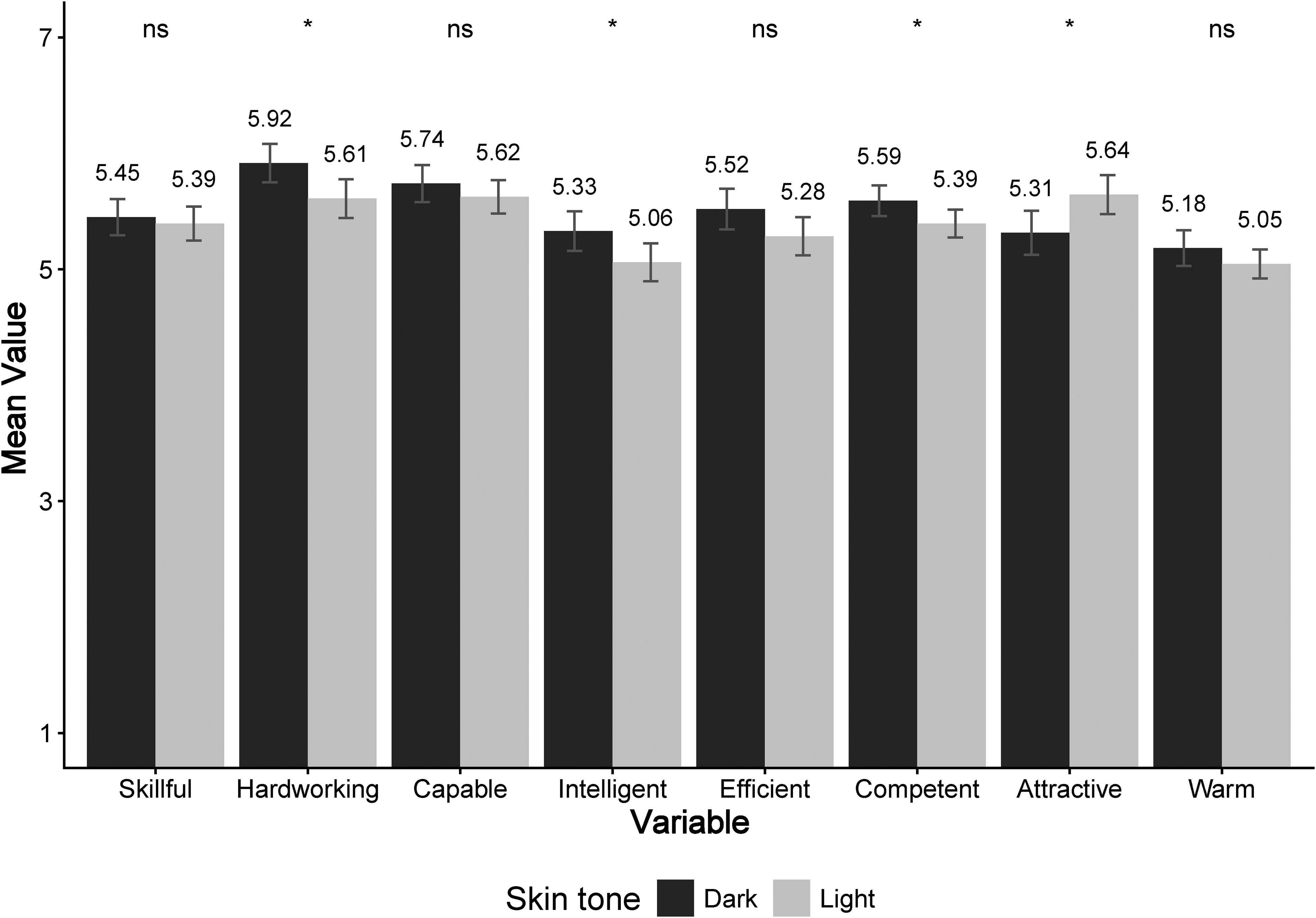
Prevailing Skin Tone–Based Beliefs in India.
Thus, the pilot study revealed prevailing skin tone–based beliefs in India, specifically our proposed DHW lay belief (and the association of dark skin with competence), along with the established light skin–tone association with attractiveness. Note that even though the effect sizes of these beliefs were small, they were obtained with text labels alone. Given the contentious nature of these beliefs, and the in-person nature of data collection, they are likely prone to a social-desirability bias. Our subsequent five main studies were conducted online to reduce the likelihood of social desirability bias, and we used more ecologically valid picture-based stimuli to test our proposed skin tone–based beliefs and their effects on perceptions of service providers.
Study 1: Dark Skin Tone and the Perceived Competence of Service Providers
Participants and Procedure
We instructed an international research agency (Eyes4Research) to recruit 400–450 (online) panel participants to allow sufficient power to detect small effect sizes (as indicated in our pilot study), evenly distributed across the north, east, west, and south regions of India to ensure a broad geographic representation. Participants in this preregistered study (https://aspredicted.org/c2ns-qqt7.pdf), were paid $3.50 each. To prepare the stimuli, we selected six Indian faces (three female, three male) from the FERET database (Phillips et al. 2000) and edited the skin tone to yield dark and light versions of each face (see Figure B1, Appendix B). All participants were randomly shown either a light or a dark skin–toned version of each of these six faces, 8 and all faces were described as working professionals (to assess service provider perceptions). Participants rated each face on seven-point scales (1 = “not at all,” and 7 = “very much so”) measuring perceived attractiveness (two items: attractive and good-looking), competence (capable and hardworking), and warmth (kind and friendly) (all measures adapted from Fiske, Cuddy, and Glick [2007] and Wang et al. [2017]). Subsequently, participants evaluated the skin tone of the six faces on a seven-point scale (1 = “very dark,” and 7 = “very light”), which was a manipulation check. Finally, they completed demographic questions related to age, gender, and their hometown region in India. There were six attention checks: One in each block of photo ratings (e.g., pseudo items like “choose two”).
Results and Discussion
The final delivered sample from the agency was 458 participants (51% female, Mage = 30.39 years), and none failed three (50%) or more attention checks, which we indicated as the cutoff in the preregistration. We thus conducted our analyses on the full sample. We tested all our predictions with multilevel linear models, using the package lme4 (Bates et al. 2015; Bryk and Raudenbush 1992) in R. This was a necessary deviation from the preregistered mixed ANOVA analysis, as skin tone (dark/light) and gender (male/female) were both operationalized as within-subjects rather than between-subjects. Additionally, photo (six levels) was also a within-subjects variable. Thus, a multilevel mixed, including fixed and random effects, linear model analysis was appropriate for our design. In all our analyses, we included random intercepts for subject (participant) and photo.
Manipulation checks
For the skin tone manipulation check, the model used skin tone ratings (higher = lighter) as the dependent measure and manipulated skin tone (light = 0, dark = 1), gender of photo (male = 0, female = 1), and a gender and skin tone interaction as predictors, with subject (participant) and photo as random factors. All the statistical tests for our mixed models were calculated using Satterthwaite's degrees of freedom. Results revealed the predicted significant negative effect of manipulated skin tone (β = −2.48; t(2,477.29) = −58.62; p < .001) and a significant interaction with gender (β = −.32; t(2,488.39) = −3.72; p < .001). To probe the interaction, we estimated simple slopes of the skin tone factor for the two genders. For both genders, measured skin tone (higher indicates lighter) was negatively associated with the manipulated skin tone factor (1 = dark, 0 = light) (male: β = −2.32; t(2,488.39) = −38.74; p < .001; female: β = −2.64; t(2,488.39) = −44; p < .001). Thus, for both genders, average rated skin tone for the light skin–toned faces was higher (indicating lighter) than for the dark skin–toned ones, attesting to the success of the manipulation. This was also the case for each of the six faces individually (see statistics reported in Web Appendix I).
Perceived competence
This mixed model used ratings on perceived overall competence (capable and hardworking; r = .67) as the dependent measure, manipulated skin tone (light = 0, dark = 1), gender of photo (male = 0, female = 1) and a gender and skin tone interaction as predictors, and subject (participant) and photo as random factors. Results revealed only a significant positive effect of skin tone (β = .14; t(2,371.90) = 4.25; p < .001) and a nonsignificant interaction with gender (p = .12), indicating a positive association between perceived competence and darker skin tones. Skin tone had a significant effect individually on both hardworking (β = .184; t(2,410.42) = 4.65; p < .001) and capable (β = .09; t(2,394.92) = 2.42; p = .01), albeit a stronger effect on hardworking (detailed analyses in Web Appendix H). In other words, dark skin–toned service providers were perceived to be more competent compared with light skin–toned providers, supporting H1.
Discussion
Study 1 results supported our assertion that dark (vs. light) skin–toned professionals (service providers) are perceived to be more competent (both harder working and more capable). Conversely, replicating prior research, the results also showed that light (vs. dark) skin–toned professionals are perceived to be more attractive (male faces: β = −.10; t(2,391.31) = −1.67; p = .10; female faces: β = −.40; t(2,391.31) = −7; p < .001); the effect was stronger for female versus male professionals. The latter finding is consistent with extensive prior research showing that beauty is gendered, with the “light is attractive” effect being stronger and more consequential for women than for men (e.g., Dixon and Telles 2017; Jha and Adelman 2009; Mady et al. 2023; Utley and Darity 2016). Finally, the results were not affected by geographic region (for details, see Web Appendix I). Overall, as we proposed, skin tone cued professional competence of dark (vs. light) skin–toned service providers in India.
Studies 2a and 2b: The Implicit Nature of Skin Tone–Based Associations
In the final step of theoretically establishing our predicted hypothesis that dark skin tone cues competence, we examined whether this association also manifests implicitly. Prior research has shown that implicit (vs. explicit) measures, such as the implicit association test (IAT), provide stronger evidence of stereotyped beliefs, especially those based on race and gender (Greenwald, McGhee, and Schwartz 1998; see also Hagen 2021; Raghunathan, Naylor, and Hoyer 2006). Following Amodio and Devine (2006), we conducted a stereotyping IAT for independent constructs, measuring the specific, dual implicit associations of light skin tone with attractiveness and dark skin tone with competence.
Method and Procedure
We conducted four IATs using the online software by Carpenter et al. (2019): Study 2a used male faces (two Qualtrics survey versions manipulating the order of explicit vs. implicit measures of skin tone associations), and Study 2b used female faces (two versions as in Study 2a). We report the full procedure and the main results for the male IATs (see details in Web Appendix J) and only the main results for the female IATs (see full details in Web Appendix K).
We administered the male IATs to 233 online panel participants (registered with Qualtrics) based in four major region-specific metropolitan cities of India (Delhi, Kolkata, Mumbai, and Chennai located in the north, east, west, and south of India, respectively) (38% female, average age = 34.6 years). Participants were paid $5.50 each, and participation was restricted to users with computers. Following the standard IAT procedure, participants were informed that their task was to correctly categorize the target stimuli (words or images) that appeared in the middle of their screens. Target stimuli belonged to one of the following four categories: (1) dark skin–toned faces, (2) light skin–toned faces, (3) words associated with competent, and (4) words associated with attractive. Following the standard procedures for IATs examining race or gender, we used unidentifiable, digitally morphed male faces (five faces; original photos were from the FERET database Phillips et al. 2000), edited to be dark or light, for a total of ten faces. We used six words each, representing competent (competent, capable, intelligent, hardworking, skilled, and reliable) and attractive (attractive, good-looking, appealing, lovely, beautiful, and handsome) (see Web Appendix J).
Per standard IAT protocol, participants were instructed to categorize words as competent or attractive and to categorize faces as dark or light as quickly and accurately as possible. If people implicitly associated two concepts (e.g., dark with competent), they would categorize a target stimulus (e.g., the word “hardworking”) as part of that compatible category pair (e.g., dark/competent) more quickly, compared with an incompatible category pair (e.g., light/competent). The difference in average response time between compatible and incompatible blocks measures the strength of the implicit association, represented as difference scores (D-scores). Carpenter et al. (2019) automated online software replicates standard IAT protocols (Greenwald, Nosek, and Banaji 2003) of eliminating outliers (trials with excessive reaction times (>10,000 ms; about 3% of all trials) and participants with too short reaction times (<300 ms; about 6% of participants who completed the two IATs; see Web Appendix J) and computing a standardized D-score for each participant.
Participants additionally indicated their agreement with a set of statements (explicit beliefs) regarding skin tone and associations with different aspects of competence and attractiveness (e.g., “Men with darker skin tones are more hardworking than men with lighter skin tones;” 1 = “strongly disagree,” and 9 = “strongly agree”). For half the participants, the explicit measures were administered before the implicit testing (thus, the two separate IAT surveys programmed in Qualtrics). As the explicit beliefs are not central to the IAT, those analyses are presented in detail in Web Appendix J. Participants also reported their age, gender, and hometown and evaluated their own skin tone (1 = “very dark,” and 9 = “very light”).
Results and Discussion
The order effect (of explicit vs. implicit measures first) was not significant, but we report the results of these two IATs individually to avoid averaging the D-score metric (a ratio variable). For the two male IATs, there was an overall significant and strong implicit association (D-score significantly greater than 0; Dimplicit first = .254, SD = .433; t(96) = 5.78, p < .0001, Cohen's d = .59; Dexplicit first = .313, SD = .348; t(99) = 8.99, p < .0001, Cohen's d = .90). That is, participants responded significantly faster to the compatible block (categorization of “is [target] dark/competent or light/attractive?”) compared with the incompatible block (categorization of “is [target] dark/attractive or light/competent?”), revealing strong implicit skin tone associations.
The results from the two female IATs, administered to 203 separate online panel participants (54.6% female; average age = 34.09 years) at a cost of $5.50 per participant, mirrored the results of the male IATs. There were strong implicit “dark cues competence” and “light cues attractiveness” associations (Dimplicit first = .222, SD = .339; t(89) = 6.21, p < .001, Cohen's d = .66; Dexplicit first = .302, SD = .396; t(97) = 7.56, p < .001, Cohen's d = .76). Matching explicit beliefs were also observed in the sample (see detailed results in Web Appendix K).
Overall, the IATs across male and female stimuli revealed strong implicit skin tone–based associations in India, further supporting H1 that dark skin tone (implicitly and explicitly) cues competence. Notably, we found stronger effect sizes for the implicit than explicit associations measured in our studies (see Web Appendix K). This difference in effect sizes is similar to that observed in other race- or gender-based stereotyping studies, suggesting that, like racial bias in the West, the skin tone–based associations in India may be much stronger than is revealed in self-reported explicit measures. It is important to note that deconditioning strong implicit biases generally requires robust interventions that are information-rich and provide opportunities for deliberation (Hagen 2021). We tested this in Study 5.
Study 3: Perceptions of Domain-Specific Fit of Professionals Based on Skin Tone
Having theoretically established that dark skin tone cues competence (based on the DHW association) using both explicit and implicit measures, we next examined the downstream implications for service providers in different professional domains. We devised a skin tone-to-occupation matching task to test whether dark (vs. light) skin–toned professionals are considered a better fit for occupations that favor competence (vs. attractiveness; an indirect test of H2). Participants were asked to match a set of dark versus light skin–toned professionals with competence-favoring occupations (e.g., financial advising) versus attractiveness-favoring occupations (e.g., beauty consulting). We ran this study in two cycles, using male professionals in the first cycle and female professionals in the second cycle, with separate participants for each cycle. 9 For the sake of brevity, we report the combined analysis in this article and the summary analyses separately by gender in Web Appendix L.
Participants and Procedure
Participants residing in India (N = 1,036; 47% female, Mage = 28.2 years) and registered with a global research agency’s online panel (Eyes4Research) took part in the study for a monetary compensation ($3.50 per participant). We selected six male and six female Indian faces from the South Asian FERET database (Phillips et al. 2000) and edited the skin tones to create dark versus light skin pairs for each (for all stimuli, see Web Appendix L). Participants were informed that the study was about first impressions of professionals based on pictures, and they were asked to match each professional with one of six occupations. They randomly saw either the light or the dark version of the six individual faces (overall, N = 485–523 saw dark faces and N = 517–550 saw light faces; individual N for each face/version is reported in Tables W3a–W3b in Web Appendix L). They also saw a list of six occupations: three competence-favoring (computer engineer, financial advisor, and sales agent) and three attractiveness-favoring (beauty consultant, model, and receptionist). Participants indicated what they believed was the most likely occupation of each target professional they saw. They were instructed to choose a different profession for each, but this was not enforced in the Qualtrics survey.
Subsequently, participants indicated to what extent competence, warmth, and attractiveness were important in each of the six occupations (1 = “not at all,” and 7 = “extremely important”). These were our occupation-specific manipulation checks to verify our two categories of competence- versus attractiveness-favoring professions. Participants then evaluated each of the six previously viewed pictures on perceived skin tone (manipulation check), attractiveness, and age (controls). Next, we measured their explicit beliefs about whether light or dark skin–toned Indian individuals were more hardworking, more intelligent, more attractive, better at science and math, better at arts and humanities, and so on (for the full list of measures, see Web Appendix L). These measurements were on seven-point semantic differential scales ranging from “definitely those with dark skin tones” (left) to “definitely those with light skin tones” (right) (these labels were counterbalanced). Participants then indicated their demographics and hometown in India. They also self-reported their own skin tone on a nine-point scale (1 = “very dark,” and 9 = “very light”), their own attractiveness (1 = “not at all,” and 9 = “very attractive”), and whether they had experienced ridicule or derision because of their skin tone (for results, see footnote 5).
Results and Discussion
Manipulation checks
Our skin tone manipulation checks were successful for all six faces for both genders; the dark skin–toned versions of the faces were rated significantly lower (darker) on the scale compared to the light skin–toned versions (all ps < .01; see Tables W3a–W3b in Web Appendix L). The domain-specific association of each occupation with competence versus attractiveness was also verified. Specifically, the importance of competence for the competence-favoring occupations of computer engineer, financial advisor, and sales agent (combined; M = 5.95, SD = 1.23) was rated higher than the importance of attractiveness (M = 4.82, SD = 1.43; within-subjects paired comparisons: t(1,035) = 22.90, p < .001; d = .85). Conversely, the importance of attractiveness was rated higher than that of competence for the attractiveness-favoring occupations of beauty consultant, receptionist, and model (combined; M = 5.92, SD = 1.20 vs. M = 5.18, SD = 1.43; within-subjects paired comparisons: t(1,035) = 15.57, p < .001; d = .56) (for the analyses for each individual occupation, see Tables W4a and 4b in Web Appendix L).
Fit of professionals with occupations based on skin tone
A participant's response to “what is the most likely occupation of this individual?” was coded as 1 if the occupation indicated was competence-favoring (i.e., computer engineer, financial advisor, or sales agent) and as 0 if it was attractiveness-favoring (i.e., beauty consultant, receptionist, or model). This was the dependent variable. Skin tone was used as the between-subjects factor in a difference in proportions (chi-square) analysis of these occupation predictions. We found that professionals with a light skin tone were significantly more likely to be assigned to an attractiveness-favoring occupation compared with dark skin–toned individuals (45% vs. 38%). Conversely, dark skin–toned professionals were significantly more likely than light skin–toned professionals (62% vs. 55%) to be assigned to a competence-favoring occupation. This pattern was observed for both manipulated and measured skin tone ratings (for detailed results and statistics, see Figure 2). 10
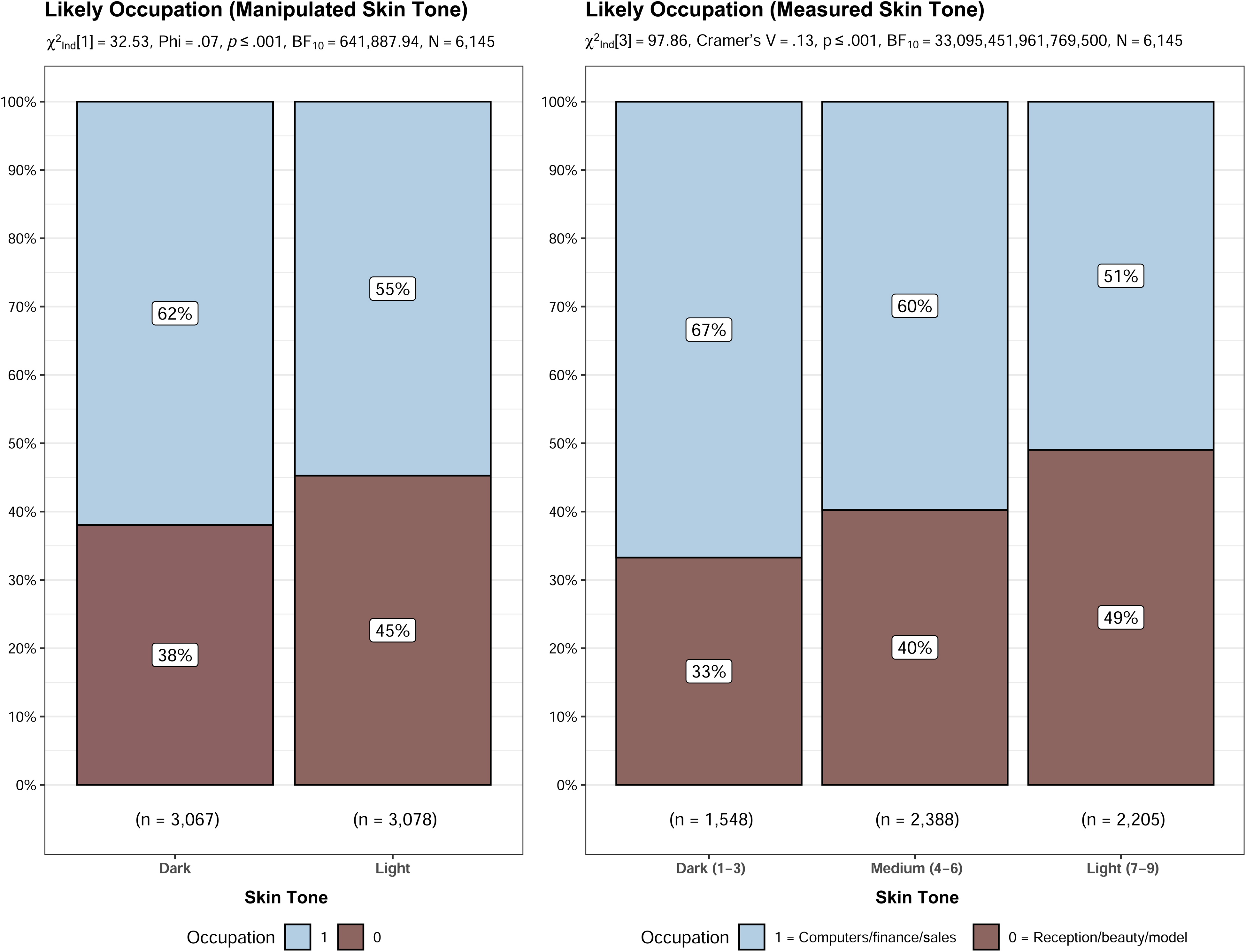
Predicted Occupation (Competence- vs. Attractiveness-Favoring) Based on Skin Tone.
We also conducted logistic regressions on the predicted occupation type (competence- vs. attractiveness-favoring) based on skin tone of the professionals. As before, we found that dark (vs. light) skin–toned professionals were more likely to be placed in a competence-favoring occupation than an attractiveness-favoring one (β = .297; SE = .052; Wald χ2(1) = 32.76; p < .001; odds ratio = 1.35). These results were similar after controlling for participants’ self-rated skin tone and attractiveness, attractiveness, and perceived age of professional. These findings provide preliminary support for H2 that dark skin–toned professionals are preferred in competence-favoring domains.
The explicit beliefs mirrored previous findings regarding perceptions of dark versus light skin–toned individuals. Specifically, individuals with dark skin tones were perceived as harder working (M = 3.57, SD = 1.79; significantly lower than the scale midpoint [4]; t(1,032) = 7.70; p < .001; d = .34; one-tailed test), but there were no skin tone–based differences in perceptions of intelligence or reliability. Meanwhile, individuals with light skin tones were perceived to be more attractive than those with dark skin tones (M = 4.94, SD = 1.85; higher than the midpoint [4]; t(1,034) = 16.30; p < .001; d = .50) (for results for other measures, see Web Appendix L).
Overall, this study showed that competence (and attractiveness) cued by skin tone may differentially affect the perception of professionals’ fit and effectiveness in different domains. Specifically, dark skin–toned professionals are associated with domains that favor competence over attractiveness.
Study 4: Effect of Skin Tone on Perceived Service Provider Effectiveness by Domain (Field Study)
Next, we examined whether the skin tone–based beliefs we identified impacted real-world consumer preference toward service providers in different domains, further testing H2. Specifically, we set out to determine whether, in a realistic setting, dark skin–toned service providers were preferred (over light skin–toned ones) in competence-favoring domains, and in contrast, whether light skin–toned service providers were preferred in attractiveness-favoring domains. We conducted a field study on Facebook to measure behavioral outcomes in terms of user engagement (including clicks, likes, comments, and shares), which is a key measure of the effectiveness of social media marketing (Cascio Rizzo et al. 2023; Lee, Hosanagar, and Nair 2018).
Method and Procedure
Our procedures for the field study followed Study 2 of Castelo, Bos, and Lehmann (2019). We created eight versions (four male, four female) of advertisements for service providers, each featuring a male or female professional with either a dark or light skin tone and promoting either an attractiveness-favoring professional service (grooming specialist) or a competence-favoring professional service (financial consultant) (for sample ads, see Figure B2, Appendix B; for all versions, see Web Appendix M). We worked with a professional digital agency, which was paid approximately $200 in fees, to run the ads in the four largest cities in India across the four regions (i.e., Delhi, Mumbai, Chennai, and Kolkata). The ads were posted from a Facebook page we created titled “Smart Living.” The male and female ads ran in two separate cycles, with each cycle running for five days. In each cycle, a light skin–toned or dark skin–toned version of the same ad was served on the Facebook feeds (also on Messenger and Instagram feeds to boost reach) of participants residing in two separate but comparable geographic regions within the same city in India (e.g., Noida and Gurgaon in Delhi). Each participant was served only one version (e.g., light male, grooming consultant), and each version was served to more than one geographical location (e.g., Delhi in North India and Kolkata in East India; see Table W5 in Web Appendix M) to circumvent any potential region-specific effects. Participants could like the ads, click on them to learn more about the service, or comment on the ads. Those who clicked on the ad were taken to a web page where they were fully debriefed about the research. Per Institutional Review Board requirements, the page was deleted after the two campaign cycles were completed.
Results and Discussion
The data obtained from Facebook included the number of unique users reached and the total number of engagements (clicks, likes, comments, and shares) per execution (for a sample screenshot of these measures, see Web Appendix M). Overall, the four male ads were seen by a total of 244,436 Facebook users (18%–34% women across the four cities; age > 18 years; 55% sample < 35 years). The four ads were engaged with a total of 33,531 times (13.72%). 11 Our dependent measure was the engagement rate for each ad: The total number of engagements as a proportion of the total number of unique users (reach) who were served the ad.
As predicted, in the competence-favoring domain (financial consulting), user engagement for the ad with the dark skin–toned male service provider was significantly higher than for the light skin–toned male (11.61% vs. 2.20%, z = 66.49, p < .001). Conversely, engagement for the light skin–toned male service provider in the attractiveness-favoring condition (grooming specialist) was directionally higher than for the dark skin–toned male (21.05% vs. 20.76%, z = 1.25, p = .10).
The four ads featuring female service providers were seen by 212,623 Facebook users (15%–36% women across four cities; age > 18 years; 50% < 35 years). Here too, engagement for the ad with the dark skin–toned female in the financial consulting condition was significantly higher than for the ad with the light skin–toned woman (9.71% vs. 2.98%, z = 41.99, p < .001). Conversely, engagement for the ad with the light skin–toned female service provider in the grooming consulting condition was significantly higher than for the dark skin–toned one (20.36% vs. 16.76%, z = 16.03, p < .001). Overall, these results (summarized in Table 1) support H2 by showing that a dark skin tone advantaged service providers in a competence-favoring domain. In contrast, a light skin tone advantaged service providers in an attractiveness-favoring domain (note, the light skin advantage is weaker for male service providers consistent with Study 1 and prior research findings discussed previously).
Average Engagement Rates for Facebook Ads for Dark Versus Light Skin–Toned Service Providers Across Different Professional Domains.
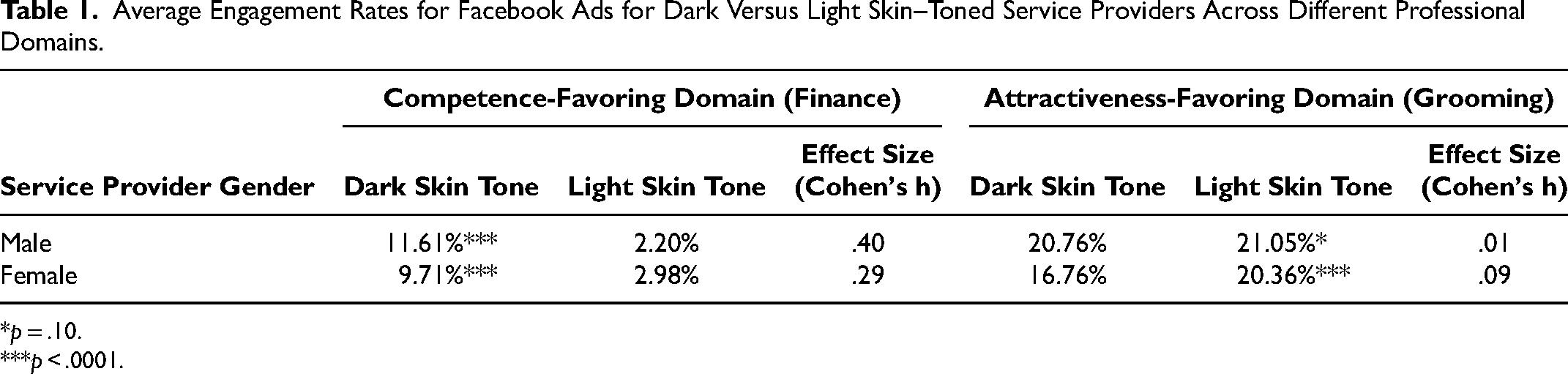
*p = .10. ***p < .0001.
The results of Study 4 provide real-world behavioral evidence for our proposition that skin tone acts as a domain-specific cue for perceived service provider effectiveness across domains (dark for competence-favoring and light for attractiveness-favoring). Note that in Study 3 we found that, overall, dark skin–toned professionals were more likely to be associated with competence-favoring occupations. But in Study 4 the dark skin–toned service providers had higher overall engagement metrics in the attractiveness-favoring profession. As such, this is not a discrepancy. First, the two studies had very different tasks. Study 3 had a within-subjects design in which participants compared different faces and professions simultaneously. In contrast, Study 4 had a between-subjects design where participants saw only one version of an ad (one face, one profession) while using social media in the real world and could choose to engage with it if they wished. Second, both industry evidence (Irvine 2025) and academic research (Cascio Rizzo et al. 2023; see p. 814) suggest that beauty-related categories typically generate more engagement compared with other categories, which is consistent with our observed engagement rates (see Table 1). However, as we proposed, within both domains we find that the relative preference for the dark (light) skin–toned professional is higher than the light (dark) skin–toned one in the competence- (attractiveness-) favoring domain.
Study 5: Making Competence Salient Can Benefit Dark Skin–Toned Service Providers
We next examined whether an intervention that makes the importance of competence (with an emphasis on hardworking) salient in a professional context can benefit dark skin–toned service providers (per H3a). In so doing, we use the process-by-moderation approach to provide causal evidence that the preference for dark skin–toned professionals is driven by perceptions of their greater competence. Although this marketing-relevant intervention (communicating the importance of competence) would be particularly effective in domains that value competence, it should also help dark skin–toned service providers attenuate their handicap in attractiveness-favoring domains. An analogous portion of the study was to test H3b: Whether making the importance of attractiveness salient would benefit light skin–toned service providers.
Participants and Procedure
The study was preregistered (https://aspredicted.org/FBT_DM8). A G*Power analysis for a t-test comparing two independent means (light vs. dark), assuming a small effect size of d = .20, revealed a minimum sample size of 542. To maintain sufficient power, we aimed for 600–700 responses, and our final sample size was 656. We used an international research agency (CloudResearch) to recruit online participants based in India at a cost of $3.50 per participant.
After indicating their age, gender, and location (this information was used to set quotas for an even distribution across different regions in India), participants were randomly assigned to one of two conditions (salience: importance of competence vs. importance of attractiveness) in a between-subjects design. 12 The first part of the study, presented as a reading comprehension task, had participants read a paragraph that highlighted the key attributes of a successful professional (competence vs. attractiveness) (see Table B1, Appendix B). To ensure participants paid attention, and before they could progress, we asked them to indicate whether competence or attractiveness had been mentioned in the paragraph they had just read. 13 As a manipulation check, participants then indicated “How important is it for a professional to be (warm and friendly, attractive and charming, competent and hardworking)?” on three scales measuring warmth, attractiveness, and competence (1 = “strongly disagree,” and 7 = “strongly agree”).
Subsequently, participants read a scenario in which they imagined they were under financial stress and needed to consult a financial advisor to manage their investments (this was the competence-favoring domain). They were informed that a Google search revealed two finance professionals in their local area who were equally qualified and experienced and had similar good reviews. Next, they were shown a nine-point semantic differential scale anchored at the by pictures of the two male financial consultants (professional a and professional b). One professional was presented with a light skin tone and the other with a dark skin tone. The target (dark) professional (a or b) and scale position (left or right end) were counterbalanced (for details, see Web Appendix N). Participants indicated their relative preference to hire one professional over the other (our dependent variable) by selecting a circle closer to their preferred professional.
Next, using two similar nine-point semantic differential scales and by choosing a circle accordingly, participants indicated which of the two professionals they considered more hardworking (our skin tone–based cue for competence) and more attractive. Finally, they indicated the relevance of the described scenario to them (1 = “not at all,” and 7 = “very much so”).
Participants then read another imaginary scenario in which they had to prepare for an important job interview and consult a personal stylist (this was the attractiveness-favoring domain). They were shown two female grooming consultants (professional a and professional b), one presented with light skin and the other presented with a dark skin tone, each at either end of a nine-point sliding scale (anchored by −4 and +4). As before, the main dependent variable was their relative preference to hire one professional over the other (see Web Appendix N). Participants then indicated the relative hardworking (competence) and attractiveness perceptions of the two professionals and the relevance of the described scenario to them. Finally, they indicated their hometown region and were thanked and debriefed. There were four attention checks spread across the study (all pseudo items; for example, “Please choose ‘disagree’ for this option”).
Results and Discussion
Data preparation
Overall, 68 participants failed more than two out of four (>50%) attention checks, resulting in a sample of 588 responses. For the sake of completeness, we report the analyses on the entire sample of 656 (50% female, Mage = 32.5 years) and include the analyses on the reduced sample (N = 588; 48.5% female, Mage = 32.84 years) in Web Appendix N. The pattern of results was similar. In further data processing, the key scales used to assess relative preference for hiring (also for perceived attractiveness and the hardworking attribute) were carefully recoded across all four counterbalanced versions, such that 1 indicated preference for the light skin–toned professional and 9 indicated preference for the dark skin–toned professional. Thus, values (means) significantly greater (lower) than the scale midpoint (5) could be directly interpreted as relative preference for the dark skin–toned (light skin–toned) service provider.
Manipulation checks
As expected, the perceived importance of competence was significantly higher in the competence-salient condition than attractiveness-salient condition (M = 6.28, SD = 1.42 vs. M = 5.42, SD = 1.93; t(654) = 6.54; p < .001; Cohen's d = .51). Similarly, the perceived importance of attractiveness was significantly higher in the attractiveness-salient condition than competence-salient condition (M = 5.26, SD = 1.89 vs. M = 3.48, SD = 2.07; t(654) = 11.45; p < .001; d = .89). Thus, the manipulation of salience of competence versus attractiveness was successful. Importance of warmth was not significantly different in the two conditions (p > .40), further attesting to the success of the intended manipulations. Although there were no manipulation checks for skin tone alterations of the two professionals, these eight stimuli had been previously used and verified in Studies 1 and 3 (for ratings of skin tones, see Web Appendices I and L [Tables W3a–W3b]).
Dependent measure
Per the preregistration, we analyzed the data separately for the two domains. For each professional domain, we first conducted a 2 (salience: competence-salient vs. attractiveness-salient) × 2 (target [dark] professional: a vs. b) × 2 (position of target [dark] professional on scale: left vs. right) between-subjects ANOVA on the key dependent measure of relative preference to hire (dark vs. light skin–toned professional). The results were similar when the target and scale position were used as covariates (see Web Appendix N).
In the financial domain, the ANOVA revealed a significant main effect of our key manipulation of salience (competence vs. attractiveness; F(1, 648) = 16.42, p < .001). In addition, there was a significant main effect of scale position (F(1, 648) = 11.67, p < .001); there was a right-position bias (for the full results, including the significant interactions that were not central to our hypotheses, see Web Appendix N). The proposed main effect of salience remained significant when controlling for age, gender, region, and personal domain relevance.
To test our main hypotheses, H3a and H3b, and following our preregistration, we collapsed the data across all scale-position and target-professional conditions. The results, shown in Figure 3, revealed that when competence was made salient, the relative preference to hire the dark skin–toned service provider was significantly higher than when attractiveness was salient (Mcompetence-salient = 5.60, SD = 2.61 vs. Mattractiveness-salient = 4.67, SD = 2.98; t(654) = 4.24; p < .001; d = .33; all two-tailed comparisons). In addition, in the competence-salient condition, the relative preference for the dark skin–toned professional (M = 5.60) was significantly higher than the scale midpoint (5; t(326) = 4.17; p < .001; d = .23). This supports H3a that when competence was emphasized, consumers preferred a dark (vs. light) skin–toned professional. In contrast, when attractiveness was made salient, relative preference for the dark skin–toned professional (M = 4.67) was significantly lower than the scale midpoint (5; t(328) = 1.98; p = .049; d = .11), indicating a relatively higher preference to hire the light skin–toned service provider in the finance domain, supporting H3b.
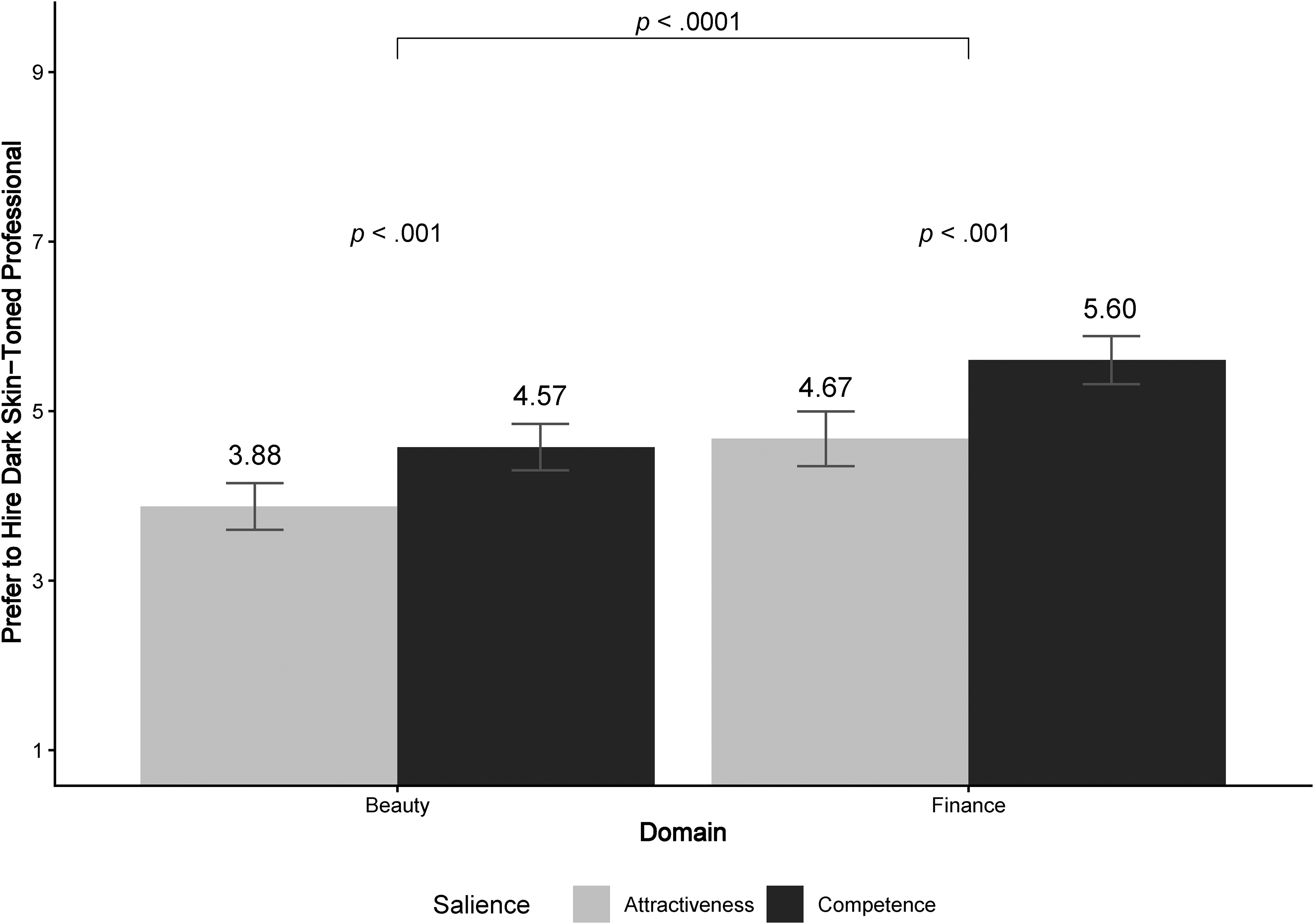
Intention to Hire Dark Skin–Toned Service Provider by Professional Domain and Salience.
In the beauty domain (personal grooming), the ANOVA also revealed a significant main effect of our key manipulation of salience (competence vs. attractiveness; F(1, 648) = 13.02, p < .001). Here too, there was a significant main effect of scale position (F(1, 648) = 11.67, p < .001; again, a right position bias). None of the interactions were significant (for details, see Web Appendix N). As before, we conducted further analyses collapsing the data across all scale-position and target-professional conditions. When competence was made salient, the relative preference to hire the dark skin–toned service provider was higher compared with the attractiveness-salient condition (Mcompetence-salient = 4.57, SD = 2.51 vs. Mattractiveness-salient = 3.88, SD = 2.53; t(654) = 3.56; p < .001; d = .28), replicating the results in the finance domain. However, as evident from the previous results, both the means (in the competence- vs. attractiveness-salient conditions) were significantly lower than the scale midpoint (5), indicating that the preference to hire remains skewed toward the light skin–toned service provider, which is expected in this beauty-related domain (supporting the results from Studies 3 and 4). When attractiveness was salient, the relative preference is further skewed toward the light skin–toned professional (M = 3.88 [significantly lower than the scale midpoint of 5]; t(328) = 8.04; p < .001; d = .45), supporting H3b. In the competence-salient condition, relative preference for the dark skin–toned provider (M = 4.57) was still significantly lower than the scale midpoint (5; t(326) = 3.06; p = .002; d = .17). Although this does not support H3a, it shows that even in a domain where attractiveness is relevant (personal grooming), emphasizing competence can attenuate the bias against dark skin–toned service providers (as the preference for the dark skin–toned professional increased significantly when competence vs. attractiveness was salient; Mcompetence-salient = 4.57 vs. Mattractiveness-salient 3.88; p < .001; see Figure 3).
Discussion
In this study we provided causal evidence (process by moderation) for our proposed “dark (light) skin tone cues competence (attractiveness)” mechanism for skin tone–based service provider preferences. We also demonstrated the efficacy of a marketing-based intervention to enhance the preference for dark skin–toned service providers. Namely, emphasizing competence increased preference for dark skin–toned providers in a competence-favoring domain and helped reduce the negative bias in an attractiveness-favoring domain.
General Discussion
Summary and Theoretical Contributions
Contrary to the prevailing narrative that “dark skin is bad or inferior,” we uncovered a novel and positive “dark is hardworking” (DHW) association in India. Based on this we proposed that dark skin tone cues professional competence for service providers in India. Consequently, dark skin–toned service providers are preferred in competence-favoring domains. Furthermore, we tested and verified a positioning or communications intervention, highlighting the importance of competence, that enhances the dark skin advantage in competence-favoring domains and attenuates their long-standing disadvantage in attractiveness-favoring professions.
Our six studies used both explicit and implicit measures to demonstrate the proposed DHW association and how dark skin tone cues competence of service providers. We used multiple dependent measures such as matching dark versus light skin–toned professionals to competence- versus attractiveness-favoring occupations, measuring real-world ad engagement, and causal effects for perceived competence driving dark skin–toned service provider preferences. Notably, our stimuli included different operationalizations of light versus dark skin tones including verbal descriptions, digitally morphed faces (for the IATs), and manipulated photos of professionals.
Our research contributes to several streams of literature, including research on colorism, judgments of service providers, and, particularly, the role of facial cues on stereotyped evaluations of professionals. First, we uncover a novel positive DHW association in India that contrasts with extant global research on colorism generally showing dark skin tone as a liability (e.g., in Asia Ha and Park 2024 and the United States Maddox and Gray 2002). The DHW lay belief originated in the unique sociocultural (e.g., dark skin tones associated with outdoor labor) and historical context in India. Dark skin was not originally abhorred in India as is evident in mythological and religious texts. Distinct from colorism that was born out of race and othering in the West, colorism in India arose through external conditioning and exposure to Eurocentric beauty ideals imposed by light skinned colonial rulers. Importantly, skin tone does not structure social hierarchies in India as it does in other global contexts (Telles 2014).
Some recent research also points to a positive or neutral association with darker skin tones in India. In a study based in Delhi (North India), Daga, Magan, and Mathur (2022) find that dark skin–toned individuals are perceived to have better leadership skills compared with light skin–toned professionals. And in a study based in Bangalore (South India), Vijaya and Bhullar (2022) show that dark skin–toned (compared with light skin–toned) professionals are not disadvantaged in hiring decisions. However, these studies do not provide the underlying theoretical reason for this effect. We uncover a positive DHW association that can parsimoniously explain these findings. Although not a familiar stereotype, such as those related to gender and race, the DHW association we uncovered was robust across six studies spanning all geographical regions in India.
Second, we contribute to the literature on stereotyped judgments of service providers, such as those based on gender (Matta and Folkes 2005) and ethnicity (Gill, Kim, and Ranaweera 2017). We identify skin tone as another basis for stereotyping and evaluations of service professionals. Whereas the “light is good” belief has prevailed across commercial contexts that value attractiveness (e.g., in choosing advertising endorsers; Krishnan and Dighe 1990), the DHW association has positive equity in domains that value competence over attractiveness (e.g., services related to science, technology, engineering, and mathematics [STEM]). Building on research identifying factors that influence perceived effectiveness of service providers (e.g., Güntürkün, Haumann, and Mikolon 2020; Kirmani et al. 2017), we show that dark versus light skin tone is differentially advantageous in competence- versus attractiveness-favoring domains. In doing so, we add to the research on the inferential role of observable cues—such as facial structure (Gorn, Jiang, and Johar 2008), expressions (Wang et al. 2017), and attractiveness (Peng et al. 2020; Wongkitrungrueng et al. 2020)—in evaluations of professionals. We show that skin tone is an observable facial cue impacting perceived competence of service providers in India.
Finally, our research also contributes to the paradigm of stigmatized consumers (Harmeling et al. 2021; Krishna and Orhun 2022). We show that groups that are stigmatized due to their long-standing social roles in society may acquire some positive associations in the process of striving to overcome these biases. Although the DHW lay belief originates in physical labor, we find darker skin tone cues competence in the contemporary society of knowledge work and for services requiring sustained mental effort and acumen (e.g., financial and STEM services).
Substantive Implications for Service Professionals and for Social Policy
Substantively, this research has implications for service providers in India. This includes professionals on popular gig-work platforms such as Upwork, on professional social media websites such as LinkedIn, or those acting as the face of the firm in conventional media channels. Such service providers (and organizations that feature such professionals) should be cognizant of and benefit from the novel skin tone–based beliefs we discovered. Our findings suggest that although the DHW association will benefit dark skin–toned professionals in competence-driven services, highlighting the importance of competence can help attenuate their handicap in attractiveness-focused domains.
Our findings also have broader social and policy implications. We found strong implicit effects for our skin tone–based beliefs, and our pilot study revealed an overall explicit dislike for dark skin (Web Appendix H). This suggests the need for strong public policy efforts and interventions to override these negative associations (Hagen 2021). The findings of Mady et al. (2023) show that women in contexts of colorism are gradually pushing back against skin tone–driven beauty standards, but they are still subject to rampant societal discrimination. Research has shown that the mere presence of female professors in STEM-related fields enhances the performance of female students (Krishna and Orhun 2022). This suggests that public service campaigns countering anticolorism in India may benefit by featuring success stories of prominent dark skin–toned professionals, highlighting their hard work in overcoming prejudices and attaining competence.
A caveat, important for social policy, is to ensure is that the DHW association does not invoke a counter “light is less hardworking/competent” association. Across our studies we found that although dark skin–toned individuals were perceived as relatively more hardworking and competent, the assessments of light skin–toned individuals remained positive and above the midpoints of these scales (e.g., see Figure 1). Thus, any public policy campaigns using our findings should be cognizant of and preempt any negative implications of highlighting the DHW association.
Limitations and Future Research
Being among the first to explore skin tone effects on a range of social judgments and downstream service provider assessments, this research does have limitations. First, we conceptualized the formation of our DHW lay belief within the unique sociocultural context of India. We theorized that this belief became calcified in India through the sociocultural context in which dark skin–toned individuals were historically associated with effortful outdoor jobs, compensatory persistence of dark skin–toned individuals, salient accounts of successful dark skin–toned individuals, and widespread advertising featuring dark skin–toned achievers in cognitively demanding STEM fields. In India, there is no data linking skin tone to social markers like education, wealth, or hierarchy (Vijaya and Bhullar 2022). But in American and Latin American contexts, researchers suggest that (gradations of) skin tone may be a better predictor (rather than race) of social factors such as educational qualification (pigmentocracy; Telles 2014). Meanwhile, research by Leong (2006) supports the existence of a continuum of whiteness, loosely defined by a “Caucasian white ideal” in Hong Kong, that is integrally linked to social hierarchy. We cannot speak to whether a similar DHW association also exists in other global contexts where skin tone is integrally linked to social hierarchy, and we leave this for future researchers (see Table 2).
Future Research Questions and Propositions Based on the DHW Association.
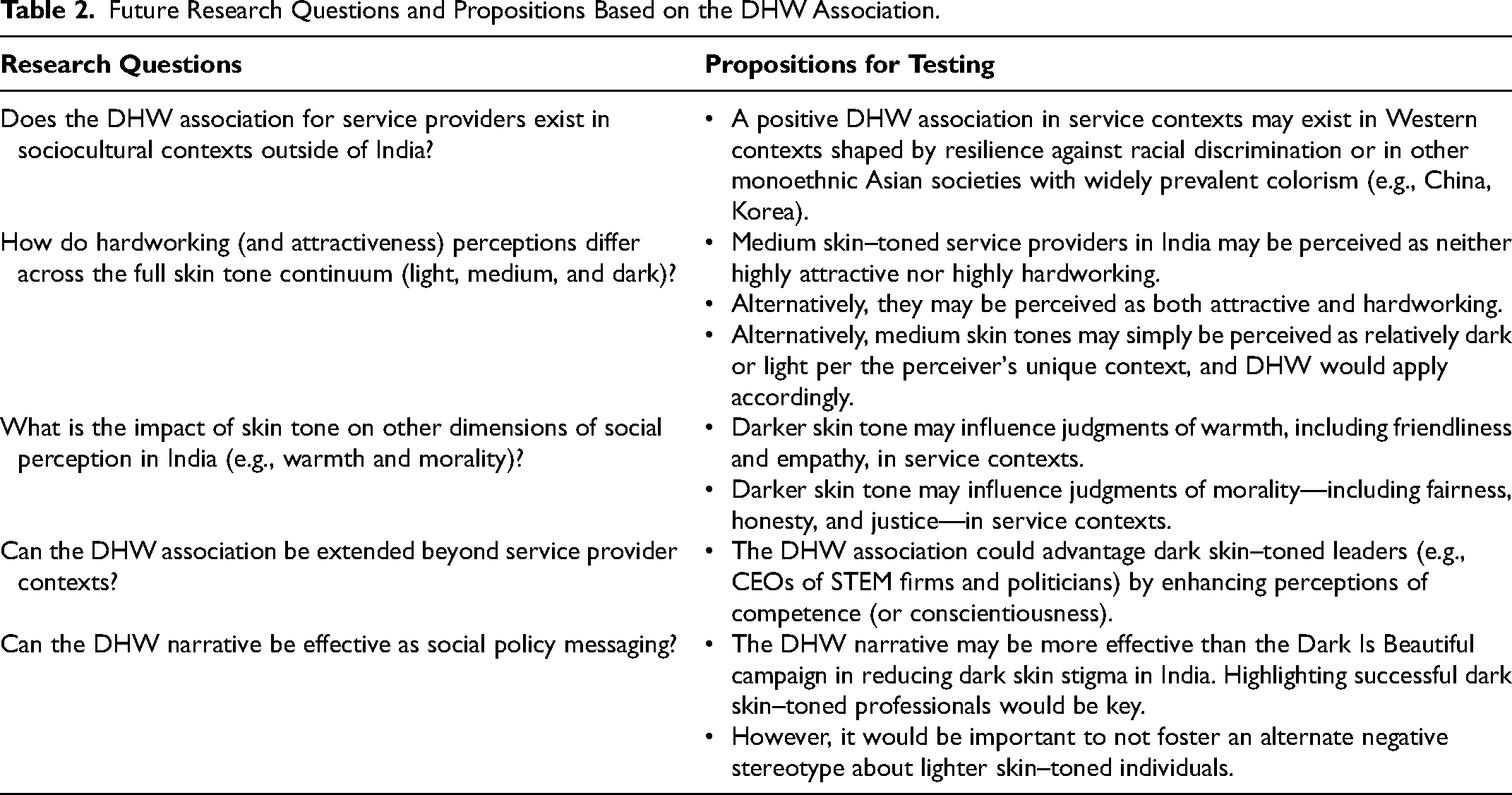
Second, in our studies we focused on the relatively extreme ends of the skin tone continuum (light vs. dark) and did not assess skin tone effects in the middle of the scale. Subjectively, a vast number of individuals and service providers would be perceived as medium skin–toned (neither light nor dark). Would professionals who are medium skin–toned be perceived as both (neither) attractive and (nor) hardworking (Table 2)?
Third, our focus was solely on competence assessments based on the hardworking aspect. We did test other facets of competence (e.g., intelligence) but did not find consistent effects of skin tone on these aspects. Although our results are founded on the underlying DHW lay belief, future research could more closely examine the effects of skin tone on other facets of competence. In addition, the effects of skin tone on other aspects of social judgments, such as perceived warmth, should be examined. Although competence is considered more pertinent for service provider evaluations, perceived warmth is also diagnostic in specific service contexts (Güntürkün, Haumann, and Mikolon 2020; Kirmani et al. 2017). Future research could examine the impact of skin tone on different subfacets of warmth such as perceived sociability and morality (Güntürkün, Haumann, and Mikolon 2020; Kirmani et al. 2017) of service providers.
Finally, we proposed and verified that the “dark cues competence” message can be a potent intervention to amplify the advantages of and counteract the stigma against dark skin tones in the context of service providers. Future research should examine the efficacy of this intervention across other contexts and as a social policy initiative (for a list of some propositions, see Table 2).
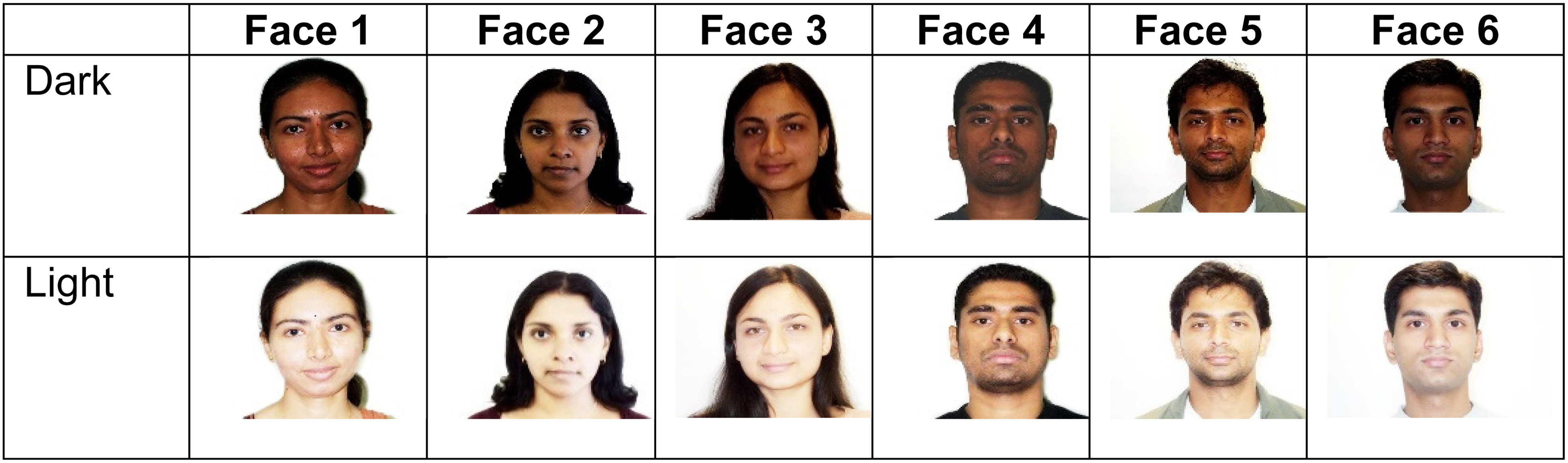
Study 1 Stimuli.

Study 4 Sample Ads Posted on Facebook.
Supplemental Material
sj-pdf-1-mrj-10.1177_00222437251409096 - Supplemental material for The “Dark Is Hardworking” Association: How Skin Tone Affects Perceptions of Service Providers in India
Supplemental material, sj-pdf-1-mrj-10.1177_00222437251409096 for The “Dark Is Hardworking” Association: How Skin Tone Affects Perceptions of Service Providers in India by Tanuka Ghoshal and Tripat Gill in Journal of Marketing Research
Footnotes
Acknowledgments
The authors would like to thank Sankar Sen for his invaluable feedback on previous versions of the manuscript and Pragati Singh for her assistance with stimuli preparation and data collection. The authors also thank the JMR review team for their insightful comments and suggestions throughout the review process.
Coeditor
Rebecca Hamilton
Associate Editor
Maura L. Scott
Declaration of Conflicting Interests
The authors declared no potential conflicts of interest with respect to the research, authorship, and/or publication of this article.
Funding
The authors disclosed receipt of the following financial support for the research, authorship, and/or publication of this article: The first author would like to gratefully acknowledge funding from the Eugene M. Lang Junior Faculty Research Fellowship at Baruch College for the period 2021–2022. The second author would like to gratefully acknowledge grant funding from the Social Sciences and Humanities Research Council of Canada (SSHRC).

Data Availability
The data that support the findings of this article are not publicly available due to ethical restrictions and Institutional Review Board policy.
Notes
References
Supplementary Material
Please find the following supplemental material available below.
For Open Access articles published under a Creative Commons License, all supplemental material carries the same license as the article it is associated with.
For non-Open Access articles published, all supplemental material carries a non-exclusive license, and permission requests for re-use of supplemental material or any part of supplemental material shall be sent directly to the copyright owner as specified in the copyright notice associated with the article.
