






Abstract
Recent studies indicate that strategic nonviolent campaigns have been more successful over time in achieving their political objectives than violent insurgencies. But additional research has been limited by a lack of time-series data on nonviolent and violent campaigns, as well as a lack of more nuanced and detailed data on the attributes of the campaigns. In this article, we introduce the Nonviolent and Violent Campaigns and Outcomes (NAVCO) 2.0 dataset, which compiles annual data on 250 nonviolent and violent mass movements for regime change, anti-occupation, and secession from 1945 to 2006. NAVCO 2.0 also includes features of each campaign, such as participation size and diversity, the behavior of regime elites, repression and its effects on the campaign, support (or lack thereof) from external actors, and progress toward the campaign outcomes. After describing the data generation process and the dataset itself, we demonstrate why studying nonviolent resistance may yield novel insights for conflict scholars by replicating an influential study of civil war onset. This preliminary study reveals strikingly divergent findings regarding the systematic drivers of nonviolent campaign onset. Nonviolent campaign onset may be driven by separate – and in some cases, opposing – processes relative to violent campaigns. This finding underscores the value-added of the dataset, as well as the importance of evaluating methods of conflict within a unified research design.
Keywords
Decades of rigorous scholarship have produced a wealth of knowledge concerning the onset of revolutions, civil wars, and protest cycles. One blind spot has been episodes of nonviolent resistance, such as those observed in the Middle East and North Africa in 2011. 1 Substantively, with very few exceptions (Chenoweth & Stephan, 2011; Lawrence, 2010; Pearlman, 2011), most conflict scholarship focuses exclusively on violence to the neglect of conflicts waged by unarmed civilians. Yet, as the Arab Spring demonstrates, nonviolent resistance is a ubiquitous form of conflict in the world, and important questions remain about its causes and dynamics. For instance, why are some campaigns nonviolent whereas others are violent? Why do some nonviolent campaigns turn to violence, whereas others do not? Why do some armed campaigns embrace nonviolent resistance? How does repression affect the outcome of nonviolent resistance? What factors increase or decrease levels of participation in nonviolent campaigns?
Data on nonviolent resistance are inadequate in several respects, limiting scholarly progress in important ways. First, existing data lack detailed information about how features of campaign composition, intracampaign unity, intergroup competition, the presence of radical flanks, and regime responses affect campaign outcomes. Second, current data on nonviolent campaigns involve only aggregate values, which obscure temporal variation within campaigns.
In this article, we introduce a new dataset focused on annual attributes of nonviolent and violent movements for regime change, anti-occupation, and secession from 1945 to 2006. This dataset can help scholars to begin to answer questions about how nonviolent resistance works compared with violent resistance. We discuss our inclusion criteria, present global trends in the onset of nonviolent and violent campaigns, and summarize key variables. We then use the data to replicate a prominent study of civil war onset, conducted by Fearon & Laitin (2003). Our analysis reveals that nonviolent campaigns may be driven by distinct processes relative to violent campaigns, and implies the need for improved theory and empirics on nonviolent resistance.
Introduction to NAVCO 2.0
Schweingruber & McPhail (1999: 459) identify a number of units of analysis that contentious politics scholars typically examine, ranging from individualized actions, gatherings, and events, to campaigns, waves, and macro trends. The Nonviolent and Violent Campaigns and Outcomes (NAVCO) data project is an attempt to provide researchers with data to understand the causes, dynamics, and outcomes of nonviolent mass campaigns. NAVCO 1.0 is an aggregate campaign-level dataset documenting the outcomes of nonviolent and violent campaigns for regime change, anti-occupation, and secession (Chenoweth, 2008). These data have been useful to establish aggregate associations regarding the onset and outcomes of nonviolent and violent campaigns, but temporal overaggregation makes causal processes difficult to establish (Shellman, 2004). Additionally, NAVCO 1.0 did not differentiate between ‘ideal types’ of conflict (i.e. nonviolent or violent), further limiting researchers’ ability to identify precise causal mechanisms related to campaign strategy and organization.
Whereas NAVCO 1.0 focused on the campaign, NAVCO 2.0 focuses on the campaign-year. 2 It contains yearly data on 250 nonviolent and violent insurrections between 1945 and 2006 (100 nonviolent, 150 violent). 3 These campaigns constitute the full population of known cases between 1945 and 2006 that held ‘maximalist’ goals of overthrowing the existing regime, expelling foreign occupations, or achieving self-determination at some point during the campaign. NAVCO 2.0 also expands data on campaign strategy, organization, and internal dynamics. For example, it reports the number of participating organizations, political goals, leadership structure, demographic composition, and tactical strategies, such as the building of parallel institutions and use of communications.
Campaigns as the units of analysis
A ‘campaign’ is a series of observable, continuous, purposive mass tactics or events in pursuit of a political objective. Campaigns are observable, meaning that the tactics used are overt and documented. A campaign is continuous and lasts anywhere from days to years, distinguishing it from one-off events or revolts. Campaigns are also purposive, meaning that they are consciously acting with a specific objective in mind, such as expelling a foreign occupier or overthrowing a domestic regime. Campaigns have discernable leadership and often have organizational and operational names, distinguishing them from random riots or spontaneous mass acts. Analyzing campaigns has a well-established precedent in the literature, as most datasets on violent conflict examine ‘campaigns’, such as wars, which are comprised of numerous linked battle events. 4
Analyzing the overall campaign rather than discrete events is useful, since such events are not always independent from one another, nor are they always the sole method by which actors pursue political aims. Looking solely at events obscures strategic coherence and the fact that protests are often part of wider coordinated campaigns of resistance, which may involve many hundreds of tactics (Tarrow, 2011). Analyzing such events would be akin to trying to analyze particular battles rather than the onset of a civil war.
But campaigns are also more than the sum of their events; they involve planning, recruiting, training, intelligence, and other operations as well as their most obvious disruptive activities.
At another level of abstraction, then, some scholars identify specific organizations, such as the Palestine Liberation Organization, as the most important analytical units. Yet organizations may spend much of their time engaging in a variety of activities that are important to organizational survival but are fundamentally distinct from prosecuting a conflict against their primary opponents. Moreover, organizations often become dormant or inactive, as the Irish Republican Army did during the middle of the 20th century, only to emerge as relevant actors later. Most importantly, organizations often interact with other groups in collective campaigns – as did those affiliated with the United Democratic Front, a coalition of 400 civic organizations opposing apartheid in South Africa – to seek shared outcomes. 5
Campaigns can also involve multiple organizations, although campaigns can precede or outlast organizations as well. The anti-Milosevic campaign, for example, began in the mid-1990s, but the Otpor student organization did not emerge until 1998. Analyzing campaigns rather than events or organizations allows us to capture the broader spectrum of collective activities as a whole, as well as the intra-organizational coordination processes necessary for collective action. Finally, in terms of political importance, campaigns are the most consequential units of analysis. Protest events alone rarely threaten the stability of regimes, and social movements are not always interested in overturning the system within which they operate (McAdam, Tarrow & Tilly, 2001; Schweingruber & McPhail, 1999).
For the NAVCO 2.0 dataset, campaign inclusion rests on two criteria: participation and goals. First, campaign onset occurs when there is a series of coordinated, contentious collective actions with at least 1,000 observed participants. 6 To qualify as a campaign, a contentious event with 1,000 or more participants must be followed within a year by another contentious event with 1,000 or more observed participants claiming the same goals and there must be evidence of coordination across those events. 7 Once participation during peak events no longer reaches 1,000, we consider the campaign effectively concluded.
Second, to ensure conflict conditions and generate a conservative test of the efficacy of nonviolence, we include only major campaigns that claimed ‘maximalist’ goals at some point during their lifespan. These include goals of regime change, secession, or the removal of a foreign occupier. Actions that never do more than call for policy change or canvas for a candidate during a democratic election would not meet these criteria, because they do not at any point espouse maximal goals. Actions calling for the irregular removal of a national ruler or the establishment of a new kind of government would meet the criteria.
Comparison to existing datasets
The Correlates of War data project is perhaps the best-known attempt to catalogue international and domestic wars (Gleditsch, 2004). To qualify as a war, the conflict must involve at least two armed groups and involve at least 1,000 battle deaths (Gleditsch, 2004: 233). Additional datasets on conflict typically focus exclusively on violent conflict (UCDP/PRIO, Lyall & Wilson, 2009), even though they sometimes include violent conflicts with a reduced threshold (25 battle deaths) for inclusion (Harbom, Melander & Wallensteen, 2008). Datasets of repression (e.g. Eck & Hultman, 2007) document violence against unarmed or nonviolent communities, but these targeted communities are not necessarily employing nonviolent direct action in a conflict dyad.
In terms of nonviolent action, scholars from numerous disciplines have spent decades collecting data on protest, demonstrations, strikes, and other forms of mass nonviolent action (see, for instance, Schweingruber & McPhail, 1999; Schrodt & Gerner, 1994; Shellman, 2008; Banks, Overstreet & Muller, 2004). Yet existing data are not satisfactorily developed to answer the research questions identified above, because they are not limited to comparable ‘conflict’ conditions of strategic nonviolence. Additionally most protest datasets are temporally limited, with the exception of Banks, Overstreet & Muller’s (2004) cross-national time-series data on strikes, protests, and riots ranging back to 1945.
Third, most existing global events data on nonviolent substate actions rely on either single sources (e.g. Banks, Overstreet & Muller, 2004) 8 or automated machine-coding, limiting their temporal and substantive scope. Automated datasets (e.g. KEDS, IDEAS, WHIV, or the DARPA-funded IQEWS project) are extremely useful in their own right but suffer from considerable under-reporting of the kinds of nonviolent events we are most interested in. Since automated coding was initially focused on state actors and interstate relations, many substate actors and actions are not captured in the data (Schrodt & Gerner, 1994; Schrodt, 2011, private communication). The problem of underreported events in automated coding programs may be especially pronounced for nonviolent tactics, which are highly context-specific and may not be included in the title or lead sentence of a news article. For example, in Morocco, tying Western Saharan flags to the tails of stray cats is an important demonstration tactic that machine-coding programs would never capture as a consequential ‘event’, both because newswires generally would not include this as a lead story and because the political significance of the event is so subtle. Additional events data may improve upon the comprehensiveness of nonviolence data but may be proprietary (Shellman, 2008).
The only dataset with global coverage of nonviolent campaigns is the Global Nonviolent Action Database (GNAD) at Swarthmore, released in 2012 by a team of researchers directed by George Lakey. Although comprehensive and detailed in its description of campaigns and movements using unarmed methods of struggle, the database does not possess any particular sampling strategy, inclusion criteria, or overarching quantitative research design. Rather it is more of an encyclopedia of nonviolent action and includes cases ranging from the Color Revolutions to Sri Lankan veterinarian strikes. As such, it contains an impressive breadth of cases extremely useful for corroboration of NAVCO 2.0 but not as comparison against most violent insurgencies.
Finally, the Minorities At Risk–Organizational Behavior (MAROB) dataset looks at nonviolent and violent behavior of ethnic groups in the Middle East and most closely approximates our research. However, this dataset is temporally limited to the 1980–2004 period and substantively limited to religious or ethnic minority groups in the Middle East. NAVCO 2.0 expands on these data by including a broader range of conflicts, global coverage, and a much longer time span (1945–2006).
Distinguishing nonviolent and violent methods of resistance
Scholars typically characterize campaigns as nonviolent or violent based on the primacy of resistance methods employed (Chenoweth & Stephan, 2011). To qualify as a nonviolent campaign, the campaign must have been prosecuted by unarmed civilians who did not directly threaten or harm the physical well-being of their opponent. Sharp (1973) has identified nearly 200 nonviolent resistance tactics, such as sit-ins, protests, boycotts, civil disobedience, mass noncooperation, and strikes. When a campaign relies almost uniformly on nonviolent methods such as these (as opposed to violent or armed tactics), we characterize the campaign as primarily nonviolent. The First Intifada, for instance, is often remembered to have been violent, due to youths’ rock-throwing and the bloody intra-Palestinian infighting that characterized the Intifada’s final two years (1992–94) and those afterward. However, the IDF’s figures on the First Intifada report that over 97% of Palestinian activities through 1992 were nonviolent or ‘unarmed’ (Pearlman, 2009). As such, it would be empirically accurate to call the 1988–92 phase of the First Intifada primarily nonviolent.
Campaigns prosecuted by armed persons or otherwise involving the regular and deliberate use of violence by civilian or guerrilla challengers are classified as armed or violent campaigns. Violent campaigns involve the use of force to physically threaten, harm, and kill the opponent. When a campaign relies almost uniformly on violent methods, we characterize the campaign as primarily violent.
NAVCO 2.0 also allows for mixed characterizations. It reports data on changes in primary resistance method, which codes whether nonviolent campaigns adopted violence in certain years (as the Defiance Campaign did in the 1960s in response to repression from the South African apartheid regime), and whether violent campaigns began to rely on mass civil resistance (as the Second Defiance Campaign later did in the early 1990s). We also identified years where nonviolent campaigns coexisted with, tolerated, or adopted armed wings for self-defense or offensive purposes. These variables allow researchers to further investigate the role of strategic choice and identify periods in a campaign where the movement relied on both nonviolent and violent resistance, which occurs in about 30% of the campaign years.
Distinguishing campaign goals
We limit the current study to three major types of maximalist campaigns: regime change, anti-occupation, and self-determination. Claims related to wages, labor rights, corporate responsibility, environmental protection, etc. are often significant for policy change, but do not demand a radical reshaping of the existing political order. Because some campaigns start out with limited reformist goals and evolve into maximalist campaigns, we code a campaign onset date as the date of the first observed event associated with the overall campaign meeting the 1,000 participant threshold. 9 However, we exclude campaigns that remain solely reformist in nature, never escalating demands to maximalist ones. Future studies might incorporate campaigns with exclusively reformist goals.
Data collection process
The inclusion of campaigns and coding of their beginning and end dates are based on consensus data produced by multiple sources. Data on nonviolent campaigns were initially gathered from an extensive review of the literature on nonviolent conflict and social movements. The primary sources were encyclopedias, case studies, and sources from a comprehensive bibliography on nonviolent resistance by Carter, Clark & Randle (2006). Cases were corroborated using additional sources, such as Karatnacky & Ackerman (2005) and Schock (2005). We validated the resulting data by subjecting them to review by approximately a dozen experts in nonviolent conflict. These experts were asked to assess whether the cases were appropriately characterized as major nonviolent conflicts, whether their outcomes had been appropriately characterized, and whether any notable conflicts had been omitted. Where the experts suggested additional cases for inclusion, the same corroboration method was used.
Violent campaign data are primarily derived from Gleditsch’s (2004) updates to the Correlates of War database on intrastate wars (COW), Clodfelter’s (2002) encyclopedia of armed conflict, and Sepp’s (2005) list of major counterinsurgency operations for information on conflicts after 2002. We also added about a dozen cases to our sample based on data on insurgencies collected by Lyall & Wilson (2009), who synthesized the COW dataset, the Uppsala Dataset on Armed Conflict, Fearon & Laitin’s (2003) dataset on civil wars, and encyclopedic entries from Clodfelter (2002).
As a final robustness check, research assistants conducted a detailed, year-by-year study of each campaign to confirm onset and end dates, as well as whether participant actions were properly characterized as nonviolent, violent, or mixed. Researchers used this archival work to code variables related to intracampaign dynamics, campaign strategy, and international and domestic support.
This process identified 100 civil resistance campaigns and 150 violent campaigns that began between 1945 and 2006. In our coding scheme, the date of onset is the date at which the campaign reached 1,000 active participants. Figure 1 illustrates variation over time in the incidence of campaign onsets during this period. As the figure shows, the onset of violent campaigns peaked in the 1970s, largely associated with onsets in Latin America, Asia, and Africa in so-called proxy conflicts related to Cold War rivalries. The onset of nonviolent campaigns peaked in the 1980s, wherein 12 onsets were associated with the decline of the Soviet bloc in 1989. Notably, nonviolent campaign onsets were far more common from 2000 to 2006, largely reflecting the influence of the ‘color revolutions’ of the early 2000s.
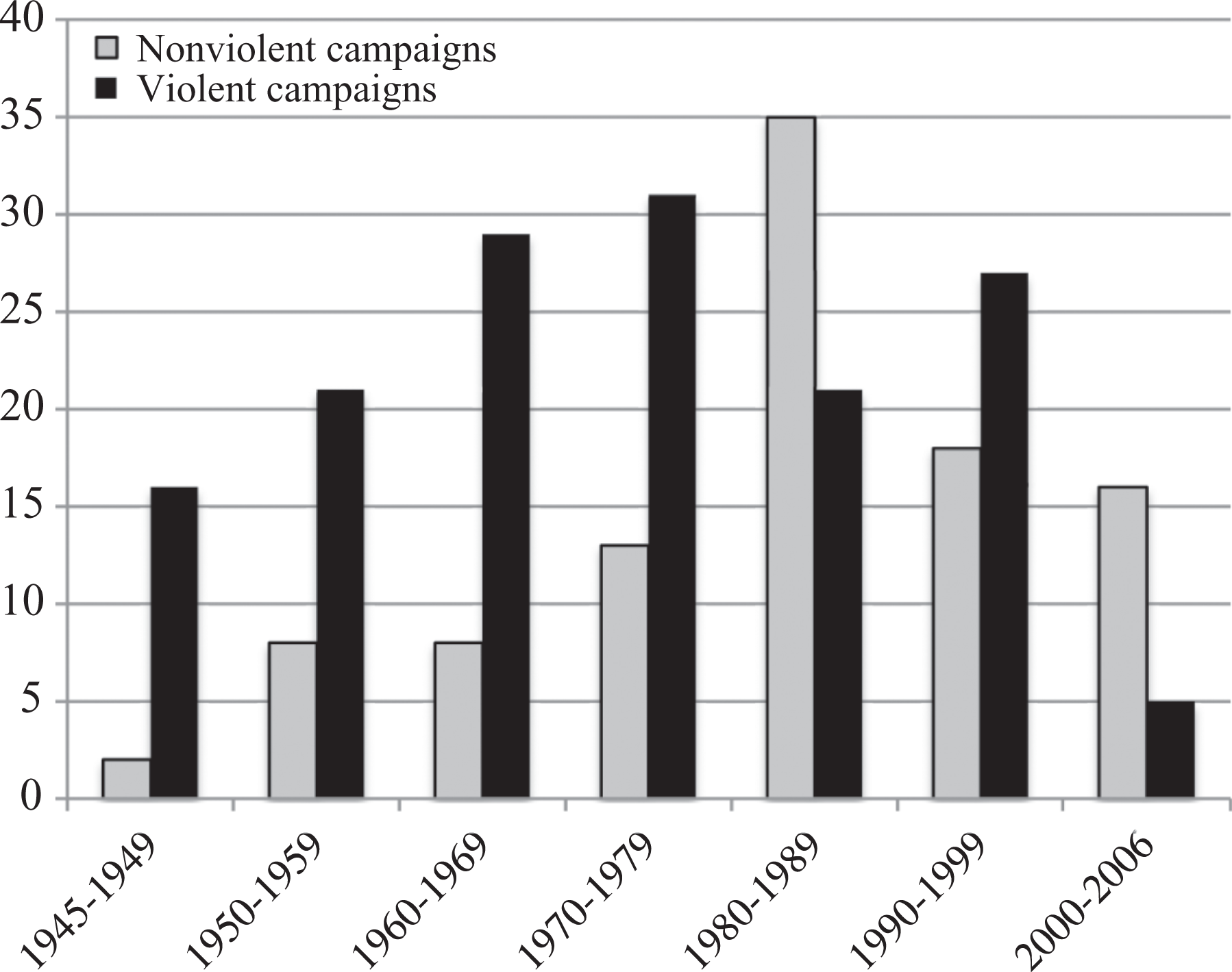
Distribution of campaign onsets worldwide, 1945–2006
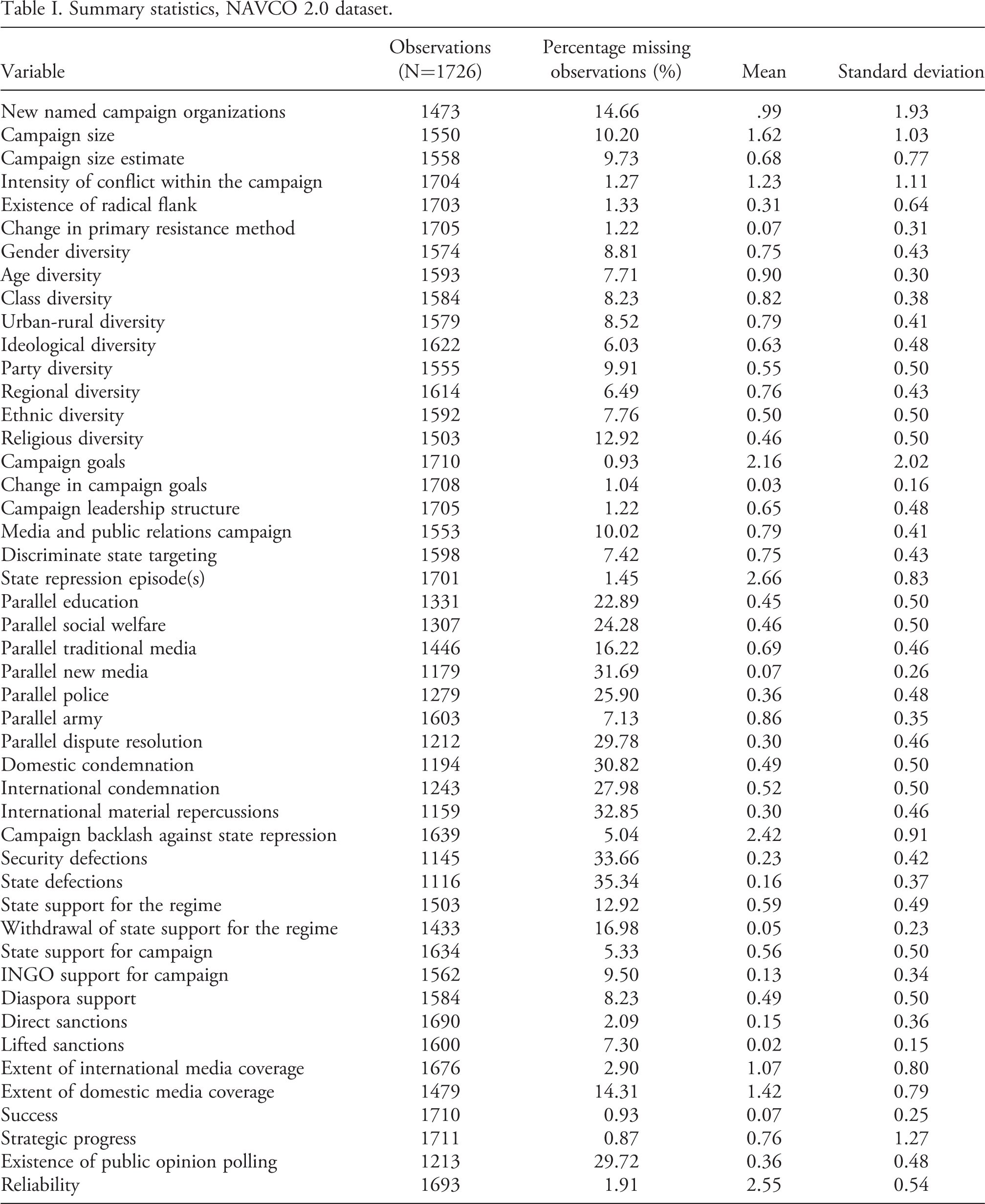
Table I reports the summary statistics of each variable. Variables deal with the campaign’s composition (size and diversity of participants), intracampaign unity (levels of disagreement about goals and methods within the campaign), campaign structure (number of named organizations and leadership structure), the presence of radical flanks, regime responses and backfire effects, external support to the campaign or the regime from a variety of sources, and the annual outcome of the campaign.
Due to space limitations, we cannot discuss each of these variables here, but the online appendix contains detailed descriptions.
Confronting underreporting bias
Some may be concerned that the sample is biased toward successful campaigns. Would-be campaigns that are crushed in their infancy (and therefore fail) will not be included in this dataset; however, this is true for both armed and unarmed campaigns.
We emphasize that the dataset reflects a consensus sample, circulated among the world’s leading authorities with efforts to ensure we accounted for known failed nonviolent campaigns. Unknown failed nonviolent campaigns are necessarily omitted from the dataset, just like unknown failed violent campaigns. 10 Indeed, there are many ‘non-starters’ among violent campaigns too, so a similar underreporting bias exists within the study of violent civil conflict.
Hence, when using the NAVCO 2.0 dataset, researchers should qualify findings as applicable only to ‘major’ campaigns with maximal goals and a high level of sustained participation over time. Empirical findings therefore should not imply claims of universal validity with respect to all types of contentious politics.
A preliminary test: Comparing the determinants of nonviolent and violent campaigns
As a demonstration of the utility of NAVCO 2.0, we explore the hypothesis that nonviolent campaigns have different causes relative to violent campaigns. This section replicates Fearon & Laitin’s (2003) study of civil war onset between 1945 and 1999. If typical views of nonviolent resistance as a precursor to violent conflict are correct (e.g. Regan & Norton, 2005), then we should expect to see roughly identical causes of both nonviolent and violent resistance. For the sake of brevity, we refer readers to Fearon & Laitin’s (2003) article for a detailed discussion. We present simple summary findings in Table II. 11
Fearon & Laitin (2003) find robust evidence that insurgencies emerge where resistance opportunities converge. They find higher probabilities of civil war onset in countries with largely mountainous terrain, neighboring countries that were experiencing a civil war, or weak states unable to effectively defeat a nonstate opponent. Ethnic and religious grievances have little influence in their analysis, which instead finds that countries with rising populations, declining GDP per capita, and rising aggregate oil revenues were more likely to experience civil war onset (Fearon & Laitin, 2003). The results for violent campaigns from the NAVCO 2.0 data are largely consistent with Fearon & Laitin’s (2003) results, except for the loss of significance of ongoing war and war in a neighboring state. 12
Summary statistics, NAVCO 2.0 dataset.
The determinants of violent and nonviolent resistance campaigns

A minus (–) sign indicates a negative association. A plus (+) sign indicates a positive association. (NS) following the direction indicates the variable is not statistically significant (p
Although this replication deals with the onset of campaigns rather than their dynamics or outcomes, these findings should motivate continued theory-building and empirical study of nonviolent resistance in future scholarship on conflict.
Conclusion and implications
The NAVCO 2.0 dataset makes three significant contributions that will provide more nuanced and compelling pictures of the causes, dynamics, and consequences of different forms of resistance. First, it contains a much broader range of cases than existing datasets. Second, it adds a temporal dimension to NAVCO 1.0, allowing researchers to track annual changes in key factors. Third, it incorporates a much broader array of strategic variables than NAVCO 1.0, including data on intracampaign dynamics, strategic choice, and support.
Several research questions emerge immediately. First, why do nonviolent campaigns emerge where resistance is hard, whereas violent campaigns emerge where resistance is easy? Second, under what conditions do nonviolent campaigns adopt radical flanks – or turn to violence altogether? Third, how do the organizational structure and unity affect the campaign’s outcome? How do these organizational features affect the post-conflict trajectory (e.g. transition to democracy, civil peace, etc.)? Fourth, how does the composition of a campaign in terms of size and representativeness affect its outcome? Finally, NAVCO 2.0 is easily merged into other existing conflict datasets. Combining it with the One-Sided Violence dataset (Eck & Hultman, 2007), for example, researchers may begin to understand how extreme violence affects the trajectory of nonviolent resistance campaigns. Do they remain resilient in the face of such violence, or not? Scholars may begin to systematically address these and many other questions through the variables contained in the NAVCO 2.0 dataset.
Footnotes
Replication data
The data and codebook can be downloaded from the JPR replication data site (http://www.prio.no/jpr/datasets), as well as from the NAVCO Data Project’s website ( ).
).
Acknowledgements
Equal authorship is implied. The authors gratefully acknowledge comments from Kanisha Bond, Page Fortna, Kathleen Cunningham, Stathis Kalyvas, and David Laitin. We thank Nicholas Miller, Evan Perkoski, Nicholas Quah, Bingxin Wu, Yvonne Lin, Sam Plapinger, Julia Jonas-Day, Elsie Smith, Miranda Berry, Jourdan Hussein, Mari Saakjan, Leonid Liu, Aletta Brady, Sarah Cassel, Erica Solari, Lo-Ching Chow, Anthony Hinds, Evan Schnoll, Evan Carmi, Lydia Tomkiw, Dan Tofan, Kevin Donohue, Meg Vasu, Zaheena Rasheed, Tara Hughes, Nicholas Yulinsky, Max Livingston, Christopher Inzerillo, AJ Hinds, and Anil Menon for excellent research assistance.
Funding
This research received financial support from Wesleyan University and the International Center on Nonviolent Conflict.
Notes
References
Supplementary Material
Please find the following supplemental material available below.
For Open Access articles published under a Creative Commons License, all supplemental material carries the same license as the article it is associated with.
For non-Open Access articles published, all supplemental material carries a non-exclusive license, and permission requests for re-use of supplemental material or any part of supplemental material shall be sent directly to the copyright owner as specified in the copyright notice associated with the article.
