






Abstract
Critiques of China’s ‘oil diplomacy’ center on its alleged disregard for transparency and human rights, yet such claims ignore that the problematic relationship between resource extraction and human rights precedes Chinese market entry. This article explores whether human rights implications are more serious for states exporting oil to China compared to another major oil importer, the United States. Contrary to the conventional wisdom, we argue that oil export dependence on the USA affects human rights more negatively than dependence on China because of differences related to the timing of market entry. The United States established stable relationships with oil supplier states decades ago, creating dependencies that are sufficiently long-term for the implications of the resource curse to take hold, and taking place before human rights became part of the US foreign policy agenda. In comparison, China’s late entry into global oil markets in the early 1990s meant that market access often required the provision of generous loan packages, which may help counteract the detrimental effects of oil dependence. Our empirical analysis examines the impact of oil export dependence on China versus the USA on human rights in supplier states for the 1992–2010 period. Results show that oil producing states dependent on exports to the USA exhibit lower human rights performance than those exporting to China. We also demonstrate that lower human rights performance for US exporters stems from long-term trends rather than short-term fluctuations in oil export dependence.
Introduction
China’s growing demand for oil is frequently argued to come at the expense of human rights in supplier states. For instance, international human rights organizations have pointed to China’s role in the Darfur conflict since early escalations in 2003, asserting that strong Chinese interest in Sudan’s oil sector undermines human rights. To illustrate, after the International Criminal Court (ICC) issued an arrest warrant for Sudan’s President Omar al-Bashir in July 2008, the Chinese government rejected punitive resolutions that could threaten Sudan’s leaders and insisted that economic sanctions would complicate the crisis more than they would resolve it (Cheng & Shi, 2011: 110). The Chinese government helped convince al-Bashir to agree to the deployment of UN peacekeeping troops in Darfur only after it faced increasing international pressure in the lead-up to the 2008 Olympics in Beijing (Cheng & Shi, 2011; Large, 2009).
Sudan is one of several cases where China has been criticized for acting as a patron of dictators and repressive regimes. Since China became a net oil importer in 1993, its reliance on autocracies for its energy needs and its ‘oil diplomacy’ alleged to disregard transparency and human rights have attracted heated criticism (Halper, 2010: 44; Taylor, 2006). Particularly its pursuit of oil in states such as Iran, Myanmar, Angola, Nigeria, Venezuela, and Russia has been seen as turning a blind eye to human rights violations in these states (Chen, 2007). Some observers therefore warn that international initiatives promoting transparency and human rights in the oil sector could be threatened by the role of China and other non-Western actors (Chen, 2007: 51; Gillies, 2010). Similarly, China and its national oil companies (NOCs) have been accused of operating ‘in ways which OECD countries have spent decades working to prohibit’, especially since they are willing to ‘indulge corruption, ignore human rights issues, offer soft loans and make investments in unrelated sectors and infrastructure projects as part of these initiatives’ (Vivoda, 2009a: 27).
Yet these claims remain speculative and ignore that the negative effects of oil dependence on suppliers’ human rights have been established in scholarship on the resource curse long before Chinese companies entered the market. Two Hong Kong based scholars, for example, criticize a Human Rights Watch report for wrongly singling out Chinese foreign direct investment as the root of human rights violations in Zambia and see ‘racialist essentialism’ on the rise (Hairong & Sautman, 2013). Comparing China’s oil diplomacy with the behavior of Western oil corporations and governments, others suggest that the deleterious impact of China’s NOCs is greatly exaggerated (Pegg, 2012). Indeed, dependence on natural resource exports has been found to correlate with human rights violations in a sample of African states, regardless of their destination (Meyersson, Padró i Miquel & Qian, 2008).
By investigating whether oil export dependence on China has more pernicious effects on suppliers’ human rights than dependence on other large importers, our article makes two contributions. First, we provide the first systematic and global empirical analysis of the alleged negative implications of China’s oil diplomacy. Critics have argued that China’s entry in the energy market has undermined efforts by Western oil corporations to enforce more binding commitments to transparency and human rights, yet systematic assessments of such a ‘race to the bottom’ argumentation are lacking (Chen, 2007: 42; Pegg, 2012). We advance this debate by comparing the human rights performance of states dependent on exports to China to those dependent on exports to the United States, another major oil importer. Our results question claims regarding China’s deleterious effects on suppliers’ human rights practices, and also show that states dependent on exports to the United States have lower human rights protections. Our results thus complement other systematic studies of China’s role in international relations that support a more nuanced assessment (de Soysa & Midford, 2012; Bader, 2015).
Second, our article contributes to work on the resource curse by examining whether the destination of oil exports can mediate the effect of oil dependence on human rights. Consistent with the literature’s emphasis on the long-term negative repercussions of oil dependence (Andersen & Ross, 2014), we expect more consistent and negative implications of resource dependence for US suppliers because the United States created long-term historical relationships with oil-exporting states many decades ago. Additionally, US relationships with major oil exporters such as Saudi Arabia, Kuwait, Angola, Libya, Nigeria, or Iraq precede concerns with human rights as a high-level foreign policy goal. In contrast, China’s late entry into global oil markets has come with strong pressures to provide generous investments in non-oil and infrastructure sectors in exchange for market access, which could help compensate for the negative implications of the research curse in the short term. China’s more recent entry into global oil markets in the 1990s also suggests that the long-term negative implications of Chinese oil extraction may yet have to materialize. Our empirical findings support these expectations, showing that imports to China have no statistically discernible effects on human rights in export-dependent countries, whereas states dependent on exports to the USA perform worse on physical integrity rights. Our findings suggest that the temporal dimension of resource extraction and policies accompanying resource investments have implications for the severity of the resource curse.
The article proceeds as follows. We first review the literature on the resource curse and human rights. Our theoretical discussion compares China’s role as an oil importer to the USA in order to explore diverging effects of oil dependence on human rights in producing states. We illustrate our argument with a comparison of US and Chinese involvement in Angola. Our empirical analysis of oil export dependence for the 1992–2010 period demonstrates that export dependence on the USA exerts more negative effects on supplier states’ human rights records than dependence on China.
Natural resources and human rights
Scholars have long studied the nexus between natural resource wealth and economic development, democratization, and civil conflict. 1 Theoretical arguments on the resource curse suggest that resource wealth leads to the creation of rentier states with abundant funds to finance repression and buy off dissent. A lack of incentives to tax citizens inhibits the emergence of a middle class important for institutional development and results in states with weak administrative capacity that are vulnerable to rent-seeking and corruption (Ross, 2001; Herb, 2006; Blattman & Miguel, 2010). 2 Administratively weak states are also less capable of preventing rebellion, and the presence of resource wealth increases the value of capturing the state (de Soysa, 2002; Le Billon, 2005). Frequently focusing on oil, empirical results have shown that resource-rich states lag in economic growth and development, experience low levels of democracy, have weak institutions, and suffer from a higher risk of civil war (Sachs & Warner, 2001; Ross, 2001; Collier & Hoeffler, 2005; Fearon, 2005). 3 Recent work has extended the negative implications of the research curse to poor human rights performance (Conrad & DeMeritt, 2013; DeMeritt & Young, 2013). Focusing on the state as the main agent when examining human rights violations, unearned revenue flows from oil wealth are argued to reduce the cost of repression for the government (DeMeritt & Young, 2013; Conrad & DeMeritt, 2013). Leaders of oil-rich states are less constrained in using repression because fuel rents protect them from having to rely on compliant taxpayers. Empirical analyses show that oil wealth increases violations of physical integrity rights (DeMeritt & Young, 2013). Importantly, the implications of oil wealth for the use of repression are likely exacerbated by other consequences of the resource curse, such as state weakness, authoritarianism, and corruption, all of which are also associated with greater human rights violations (Davenport, 2007; Englehart, 2009).
While research on oil wealth and human rights has focused on the state as the primary agent, ample anecdotal evidence links corporate actors more directly to human rights violations in host countries. Reports by advocacy networks and NGOs document how Western and Chinese oil corporations triggered or spurred social conflict over land use, the distribution of oil rents, or the management of environmental disasters (Human Rights Watch, 1995; Earth Rights International, 2010; Juhasz, 2010). Oil corporations have also contributed to human rights violations when security forces or the military were employed to evict locals from their lands, to repress local resistance, or to secure exploitation sites and pipelines. For example, contamination of farmlands and the environment and the unequal distribution of oil revenues in Nigeria’s Ogoni region led to local opposition against Shell’s presence. Shell became complicit in human rights violations when it financed Nigerian security forces to protect its investments against sabotage and to break local resistance against the construction of a pipeline. These militaries raided dozens of local villages and engaged in killing, raping, and looting in the early 1990s (Human Rights Watch, 1995). Human rights organizations also claim that Shell discredited the local Ogoni movement in a public relations campaign, orchestrated a trial against activists resulting in executions, and bribed witnesses to give false testimony (Center for Constitutional Rights, 2009). Shortly after the executions of the ‘Ogoni Nine’, Shell invested another $4 billion in Nigeria (Center for Constitutional Rights, 2009).
Other cases reveal similar dynamics. In Colombia, British Petroleum reportedly relied on a 3,000 strong brigade of the Colombian army to protect its assets, and the same forces were involved in killings and beatings of local protesters concerned about environmental damages (Beder, 2002). Evidence from Myanmar suggests that both Western and Chinese oil corporations are intimately linked to repressive behavior because extraction projects cannot materialize ‘without the direct involvement of Burma’s state security forces and this involvement per se leads to widespread and systematic human rights abuses’ (Earth Rights International, 2010: 8). Human rights activists have reported increases in military presence and human rights abuses such as forced labor, torture, rape, and murder by Burmese military forces in oil exploitation areas and along pipelines (Earth Rights International, 2011, 2008: 17). In Sudan, the China National Petroleum Corporation asked the Sudanese government for troops to defend its oil installations and it is alleged that the Chinese government sent 400 of its own troops. Moreover, the oil company’s airstrips were reportedly used by the Sudanese government to conduct bombing raids on villages and hospitals (International Crisis Group, 2008: 30; Enuka, 2011).
The literature on resource abundance and anecdotal evidence of the failure of Western and Chinese companies to consider human rights practices suggest that the oil dependence has potentially negative effects on human rights regardless of the export destination. Given the negative perceptions of China’s oil diplomacy in the public debate, the following section examines more systematically whether these claims are warranted.
A Chinese resource curse?
Research on the resource curse suggests that oil importing states support repressive regimes in supplier states diplomatically and economically (Watts, 2005; Azarvan, 2010), but has not considered whether the identity of importing states has implications for the effect of resource wealth on human rights violations. Consequently, claims regarding the potentially detrimental consequences of China’s entry to global oil markets typically rely on anecdotal accounts rather than solid theorizing and evidence that would suggest more negative effects of Chinese resource extraction. We contend that a systematic assessment of the human rights implications of the behavior of Chinese actors in comparison to the behavior of other major importers provides the most fruitful avenue for research. Since China and the USA are now the world’s largest oil importers with a 2013 daily consumption of 10.3 and 19 million barrels, respectively, a comparison of Chinese versus US incentives can help move the debate beyond speculation. 4 Our theoretical analysis examines whether the behavior of China versus US government and corporate actors suggest different effects of oil dependence on human rights in supplier states. Our argument emphasizes two implications stemming from China’s belated involvement in global oil markets. First, the long-term implications of resource dependence are likely less fully materialized when resource dependence is more recent, as in the case of exports to China. Second, Chinese access to resources requires more generous loan or infrastructure packages because of the limited number of extraction opportunities. In addition to market entry, the theoretical discussion below highlights the role of strategic versus normative interests.
China is a latecomer to international oil markets. Its first investment in overseas oil reserves dates to 1992 (Dannreuther, 2011: 65). China’s highly energy-intensive growth model means that energy security is an increasingly important issue for Chinese leaders, in particular since domestic political stability relies heavily on strong economic performance (State Council, 2011a). Domestic incentives to secure and maintain access to oil regardless of the human rights situation in suppliers are therefore strong. And stemming from its authoritarian nature, the guiding principles of China’s foreign policy, the five principles of peaceful coexistence, explicitly dismiss human right considerations. These principles are frequently reiterated in statements and white papers of the Chinese government (e.g. Wen, 2004; State Council, 2011b), although interpretations have been stretched in recent years (see e.g. Large, 2009). Chinese emphasis on non-interference also means that human rights abusers may specifically seek investment from China’s NOCs as a strategy to insulate themselves from international pressure by more norm-committed actors. 5
However, compared to importers with decades-long involvement in oil extraction, China’s late entry into global oil markets in the early 1990s has potentially benign effects on human rights. Since most oil reserves and oil fields are already owned by national oil companies or international corporations, market access often requires the provision of soft loans and investments in other sectors and infrastructure projects (Jiang & Sinton, 2011). While this could erode existing standards on export financing, transparency, and other good-governance criteria (Vivoda, 2009a: 27; Gillies, 2010: 119), Chinese investments in non-oil sectors and infrastructure could actually be beneficial from a human rights perspective since improvements in economic development have been shown to contribute to better human rights protection (Poe & Tate, 1994; Hill & Jones, 2014). The public goods nature of such infrastructure projects could allow governments to successfully co-opt dissenters rather than having to use intimidation. For example, China provided Angola with an extraordinarily generous 17-year, 1.5% interest loan for infrastructure projects in 2004 (Evans & Downs, 2006). During the height of the global financial crisis, the China Development Bank provided $65 billion in energy-backed loans to NOCs and governments in Russia, Brazil, Venezuela, Turkmenistan, and Ecuador, and many of these credit lines were provided with generous terms and some included infrastructure projects (Downs, 2011). Despite some problematic features of China’s ‘Angola mode’ of providing investment and aid provision in return for access to natural resources, it has been argued that by providing hard infrastructure such as roads, railways or hydropower stations, China ‘releases untapped or underexploited resources’ and is thus ‘making an important contribution towards alleviating poverty’ (Alden & Alves, 2009: 17). Indeed, the vast majority of Chinese infrastructure investments in Africa are not directly linked to China’s resource exploration activities on the continent (Alden & Alves, 2009). We thus expect that Chinese investments can produce welfare gains that compensate for the detrimental effect of resource extraction.
Additionally, although China’s oil imports are steadily increasing, it remains a junior player in comparison to the USA. In 2010, the volume of Chinese crude oil imports still amounted to only half of American oil sales. And even though China’s total energy consumption has reached that of the USA, oil still accounts for only 19% of overall energy consumption, as opposed to 36% in the USA (US Energy Information Administration, 2010). 6 The long-term negative implications of the resource curse may not yet have fully unfolded for Chinese supplier states. 7
With regard to Chinese corporations, the authoritarian nature of China’s regime implies little sensitivity to normative concerns stemming from consumer behavior, such as self-regulating practices in the form of corporate social responsibility (CSR) (Gillies, 2010). Chinese corporations were not part of the community from which CSR standards emerged, although they quickly emulated Western strategy. 8 However, while Chinese corporations are no less committed to human rights than Western ones on paper (Pegg, 2012; Andrews-Speed & Dannreuther, 2011), Chinese companies do not need to fear that they are held accountable to their own standards by Chinese consumers since domestic civil society actors and media are tightly controlled (Jiang, 2009). 9 An additional implication for human rights relates to risk tolerance. China’s NOCs are often portrayed to be more risk-taking than other investors because of their access to cheap state loans. As latecomers to a limited market, China’s NOCs may have to establish themselves in countries that were abandoned by Western corporations because of significant political or economic risks (Dannreuther, 2011). 10 These risks could result in worse human rights performance for states dependent on exports to China. Yet, with the exception of Sudan, Libya, and Iran, Western oil corporations have been reluctant to withdraw and terminate long-term relationships with suppliers. 11 In line with this, Gupta’s (2008: 1200) assessment of risk-taking behavior shows that compared to China, the USA is dependent on imports from suppliers that are on average more politically risky.
In comparison, the dominant economic and political position of the USA and the accompanying interest in oil has produced a long-standing engagement with repressive oil producers. Energy security is a key US foreign policy goal, which it tries to enhance by diversifying oil import sources, establishing good relations with supplier states, and fostering close ties with major oil companies (Vivoda, 2010: 74). US oil corporations have been key players in international oil markets since the 1920s. Oil security became a strategic objective in US foreign policy after World War II and became even more crucial when the USA became the world’s largest oil importer during the Cold War (Watts, 2005; Vivoda, 2009b). While global oil markets experienced significant changes over time, most notably the partial or complete nationalization of oil industries in many developing countries in the 1960s and 1970s, these changes do not necessarily imply that importing patterns were reversed. Oil production often means long-term contracts outlining responsibilities for exploration, development of oil fields, and purchase of the crude, meaning that reversing decisions to import oil from states with questionable human rights records is difficult and costly. In line with this expectation, observers note a long history of US support for repressive regimes in oil producing countries, including Saudi Arabia and Kuwait (Bellin, 2004; Watts, 2005; Vivoda, 2009b; Forsythe, 2012).
While the US commitment to democracy suggests that foreign policy is also driven by normative aspirations, empirical studies linking normative considerations to actual policy decisions have found mixed or no evidence for their relevance (Lai, 2003; Demirel-Pegg & Moskowitz, 2009; Braaten, 2014). 12 Moreover, the establishment of long-term relationships with oil-rich states many decades ago predates the emergence of ideational foreign policy goals such as human rights. Dating back to the early post-WWII period, the emerging human rights agenda was eclipsed by Cold War prerogatives, only to re-emerge in the post-Cold War period (Sikkink, 1993). The USA may thus inadvertently have chosen to create long-term relationships with states that had the most promising reserves, but also poor human rights records. Immense investments by US oil companies in Saudi Arabia, Iraq, and Kuwait date back to the 1940s (Little, 2008: 48).
Aside from normative concerns in government policy, US oil corporations have shown increased sensitivity for reputational concerns since the 1990s. Yet rather than indicating a sincere commitment to human rights, these CSR strategies are better understood as attempts by a highly controversial industry to mute bad publicity and regain legitimacy in their home markets, while simultaneously increasing their business opportunities (Du & Vieira, 2012).
While finding that acquiring and maintaining access to oil is crucial for both states, our theoretical discussion suggests empirical implications that do not warrant the pessimistic conclusions on China’s impact drawn by many observers. On the contrary, differences in the timing of market entry have implications for the effect of oil dependence on human rights that run counter to speculative accounts of China’s deleterious effects. With regard to the United States, long-term relationships with repressive oil producers suggest that the implications of the resource curse are likely to have fully materialized, which is consistent with the resource curse literature’s emphasis on the long-term implications of resource dependence (Andersen & Ross, 2014). Moreover, these relationships were formed at a time when normative considerations were absent from the US foreign policy agenda. With regard to China, research has shown that the provision of resource-for-infrastructure deals has contributed to growth (Alden & Alves, 2009; Meyersson, Padró i Miquel & Qian, 2008; Habiyaremye, 2013), which may counteract the detrimental effects of the resource curse. Empirical work confirms a positive effect of economic development on human rights protection (Poe & Tate, 1994; Hill & Jones, 2014). In addition, the long-run negative implications of these resource windfalls may yet have to materialize in states benefiting from recent Chinese resource extraction (Zafar, 2007). This discussion results in the following hypothesis:
Hypothesis: Ceteris paribus, states dependent on oil exports to the United States are expected to have lower human rights performance than states dependent on oil exports to China.
Angola mode revisited
Before we test our argument systematically, we illustrate it with a discussion of US and Chinese involvement in Angola’s oil industry. By selecting a case in which both countries have major oil investments, we can assess whether US involvement produces the hypothesized negative long-term implications for human rights, but also contrast them with the effects of the more recent engagement of China’s NOCs.
Angola is a highly oil-dependent country with crude oil accounting for more than 90% of exports (Burgos & Ear, 2012: 355). Oil was first discovered during the 1950s and became its main export product in 1973 (Sopetroleum, 2012). During a decades-long civil war that started after independence in 1975, Angola’s national oil company Sonangol emerged as the ‘only competent state institution’ and enabled the government to use oil rents as collateral for arms deals (Vines et al., 2009: 33). While the USA formally supported the anti-Communist UNITA rebels, American Chevron continued to invest in Sonangol and the government is estimated to have received 48 oil-backed loans from Western banks until the end of the civil war (Bräutigam, 2009: 274). Attempts to settle the conflict after the end of the Cold War failed because of the prospect of losing access to resource revenues. When the USA increased its oil imports from Angola during the 1990s, it not only helped fill the government’s coffers, but close relations between US oil corporations, their security subsidiaries, and the US military greatly helped ‘the MPLA government to procure military services and intelligence’ (Reno, 2000: 226). 13 Together with Angolan army units, private security firms of US oil corporations also helped to keep an independence movement in the oil rich Cabinda enclave at bay (Reno, 2000: 226).
China’s engagement in Angola’s oil sector is much more recent with its first investments dating to the early 2000s. In 2002, China provided Angola with a US$2 billion oil-backed loan designed for public investment in the country’s devastated infrastructure, telecommunication, and agribusinesses. Sinopec acquired its first stake in Angola’s oil industry shortly thereafter (Vines et al., 2009: 42). Angola’s oil exports to China have rapidly increased since then and more loans and acquisitions followed. Between 2004 and 2008, Angola’s total oil production almost doubled to 1.9 million barrels per day. In 2007, China overtook the USA as the biggest importer of Angolan oil with almost 30% of total oil exports (Vines et al., 2009: 41). Oil rents dramatically increased with growing production, resulting in real growth rates of approximately 20% (Burgos & Ear, 2012).
Because resource-backed Chinese loans allowed the Angolan government to reject a credit with governance conditionality from the International Monetary Fund, China’s ‘packaging’ of access to resources and infrastructure investment was widely criticized in the Western development aid community. Observers also attributed the strengthening of President dos Santos’s position to China’s oil-backed credits (Taylor, 2006; Alden & Alves, 2009; Schubert, 2010: 658). While oil-backed loans predate China’s emergence in Angola, China’s loans were unique in that they were larger and offered better conditions (Vines et al., 2009: 55). Moreover, infrastructure reconstruction provided in China’s package deal has been praised for being of good quality, cheap, and quickly delivered (Taylor, 2006; Burgos & Ear, 2012: 359). In addition, the fact that infrastructure rather than cash was provided may also have helped to prevent embezzlement by corrupt elites since corruption is endemic in Angola (Vines et al., 2009; Alden & Alves, 2009: 9). Recent research supports this account, finding that China’s infrastructure-for-resource loans have resulted in higher growth rates in African recipients than other modes of funding (Habiyaremye, 2013). As a result, it is possible that China’s resource backed loans have indirectly improved human rights in Angola through a welfare effect.
Since the end of the civil war in 2002, the human rights situation in Angola has improved somewhat. Observers note a rentier-state dynamic at play where violence and intimidation against dissenters is partly replaced by co-optation: Oil revenues make it is easy to buy support, and because of the difficult economic conditions and exorbitant costs of living, civil society can simply be bought off. The intelligentsia are often co-opted into special party committees and thus made ineffective. Many informants told stories of representatives of civil society organisations, or churches who, after a phase of vocal criticism attracted the attention of the state. They were not threatened, but were rather made director of ‘the department of whatsoever’, equipped with a new 4x4, and had their children’s school fees paid for. (Schubert, 2010: 665)
Data and methods
This section examines the impact of oil export dependence on China and the USA on the human rights practices of exporting states. Our dataset consists of 162 countries and covers the post-Cold War period from 1992 to 2010. We begin our analyses in 1992 since China was not a significant participant in global oil markets before then (Andrews-Speed & Dannreuther, 2011). The unit of analysis is the country-year.
Dependent variable
We use the CIRI physical integrity rights index to create our dependent variable (Cingranelli & Richards, 2010). Physical integrity rights include protections against physical torture, political imprisonment, and extrajudicial killings or disappearance. We focus on physical integrity rights because they are considered the most fundamental human rights. Our dependent variable uses the ordinal physical integrity index, which ranges from 0 (most repressive) to 8 (least repressive). We use ordered logistic and generalized ordered logistic regression to examine the relationships between independent and dependent variables.
Independent variables
Our theoretical section develops expectations regarding the diverging effect of oil export dependence on China and the USA on suppliers’ human rights. To measure the per capita size of fuel rents, we use the UN’s Comtrade statistics to measure oil exports (in 2005 constant US dollars) by all countries to China and the USA and then adjust exports by the size of the exporting state’s population (Ross, 2006). 14 Our key independent variables thus indicate the per capita value of oil exports to China and the USA for exporting states. Notably, only 19% of cases in the data export to both states simultaneously, which appears in line with recent research showing that the USA imports less or no oil from political opponents, including several states trading extensively with China (Mityakov, Tang & Tsui, 2011). We take the natural log of fuel rents because values are left-skewed. 15 In addition, we lag these variables by one year to avoid simultaneity bias. We show several robustness tests with alternative measures of independent variables.
We follow earlier research on the determinants of human rights practices when selecting control variables (de Soysa, Jackson & Ormhaug, 2010; Poe & Tate, 1994; Davenport, 2007). 16 One major factor is the type of political regime, with democracies (particularly those with highest levels of democracy) providing greater protections of human rights. We measure democracy with a dummy variable coded 1 for states with polity scores of six or higher, 0 otherwise (Marshall, Gurr & Jaggers, 2013). Ongoing domestic conflict correlates strongly with human rights violation and we include a variable coded 1 for country-years with ongoing armed internal conflict based on data from the UCDP/PRIO Armed Conflict Dataset, 0 otherwise (Gleditsch et al., 2002). We also control for population size and economic development by including states’ logged population and GDP per capita (PPP) (World Bank, 2013). Descriptive statistics for variables are shown in Table AII in the online appendix.
Two methodological concerns remain. First, oil export dependence (and values of other independent variables) may increase or decrease over time as a result of unobserved factors, and we correct for that by including time dummies for each year. Second, we control for serial correlation by including a lag of the dependent variable.
We subject our results to an extensive number of robustness tests, including accounting for changes in oil export dependence rather than levels, alternative specifications of oil export dependence, alternative estimation methods, changes in the sample, omitted variables that could affect oil exports and human rights, conditional relationships between key independent variables, and other control variables. Results for additional tests are presented in Table I and Table AI in the online appendix.
Descriptive illustrations
Before we present our results using inferential statistics, we present descriptive illustrations of the relationship between oil exports and suppliers’ human rights policies in two figures presented below. The figures present temporal trends in the relationship between oil export dependence and physical integrity rights for the 12 suppliers with the greatest dependence on exports to China (Figure 1) and the USA (Figure 2), respectively. 17 In Figure 1, increases in export dependence on China coincide with decreases in human rights levels in Qatar and Equatorial Guinea, but also correlate with increases in human rights performance in Oman, Angola, and Kuwait (with no clear pattern in remaining countries). Figure 2 shows increases in export dependence on the USA and coinciding decline in human rights levels for Saudi Arabia, Trinidad and Tobago, Equatorial Guinea, and Venezuela, and no apparent trends for remaining countries. These illustrations do not support the notion that suppliers to China experience deteriorating human rights policies.
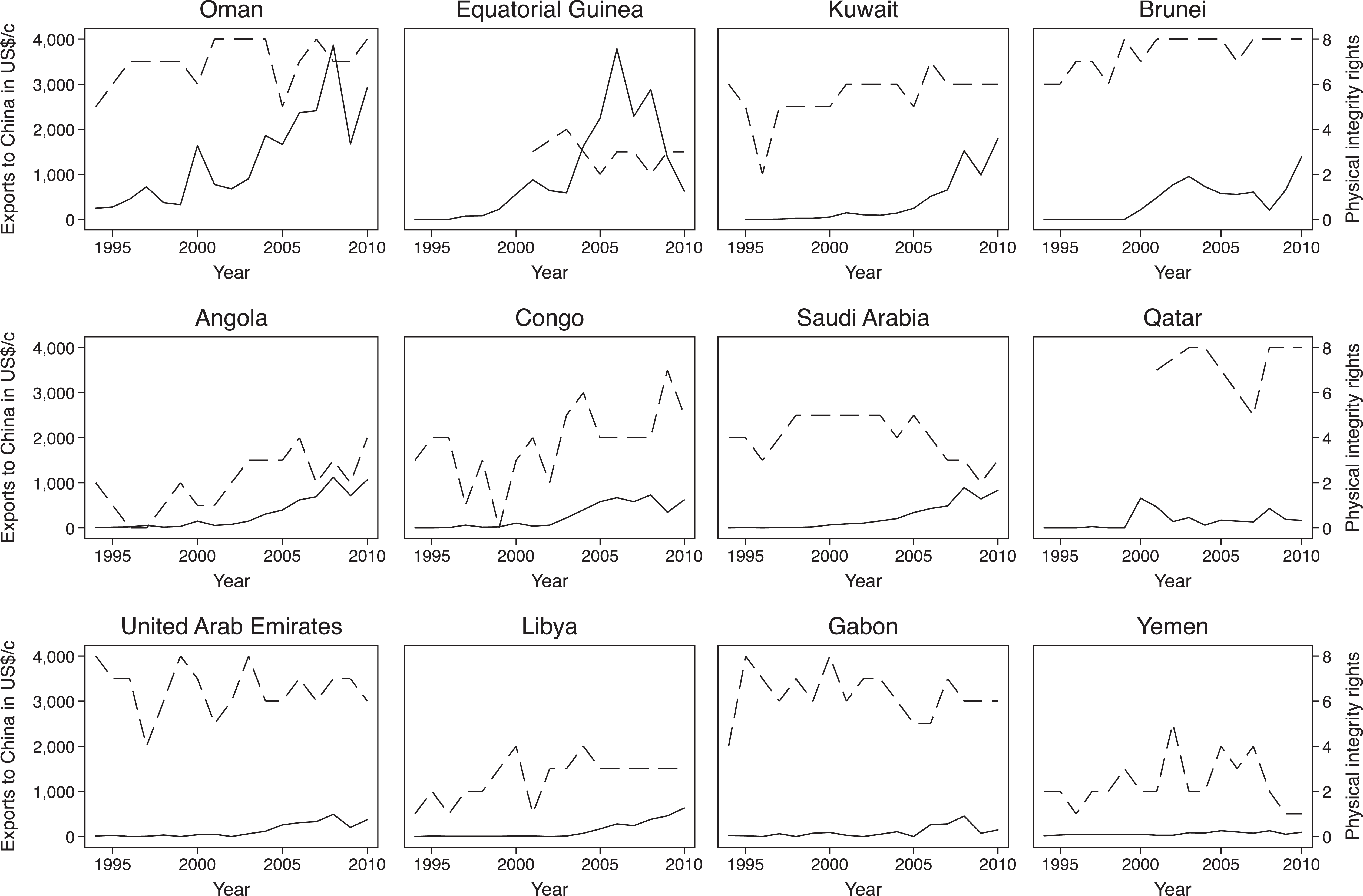
Per capita oil exports and physical integrity rights for China’s 12 largest oil suppliers, 1992–2010
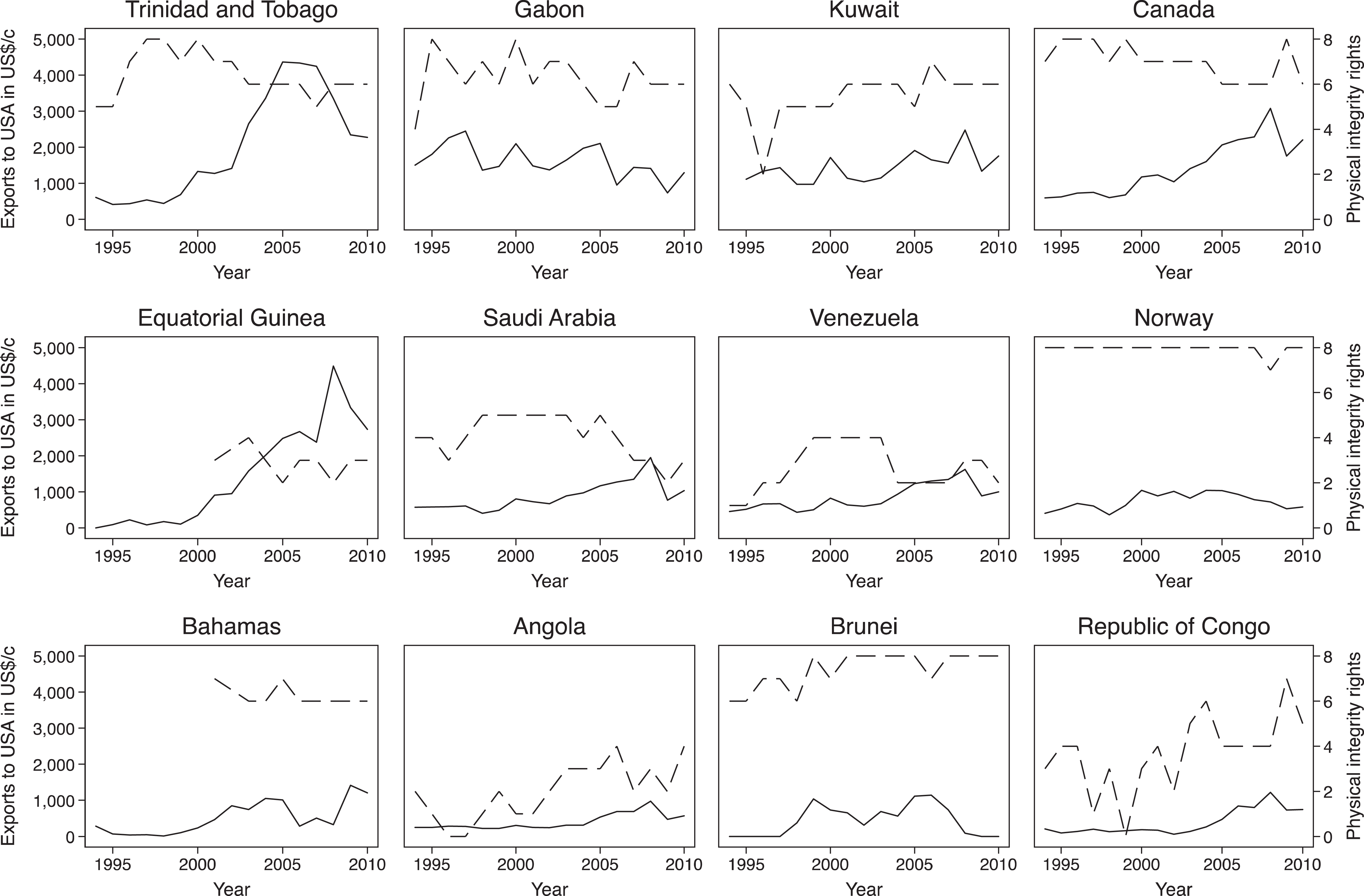
Per capita oil exports and physical integrity rights for the United States’ 12 largest oil suppliers, 1992–2010
Results
Table I presents results for our main model and a number of additional robustness tests. The first model supports our challenge to the conventional wisdom regarding the effect of exporting relationships with China. The coefficient for per capita exports to China is positive and insignificant, indicating no effect on the human rights practices of states exporting to China. The coefficient for exports to the USA, however, is negative and significant (z = –1.95), showing that oil export dependence on the USA is associated with decreases in exporting states’ human rights. Claims about the effects of Chinese energy imports thus indeed appear exaggerated, whereas US oil imports produce results in line with expectations from the resource curse.
Ordered logit regressions of oil exports to China and the USA, 1992–2010
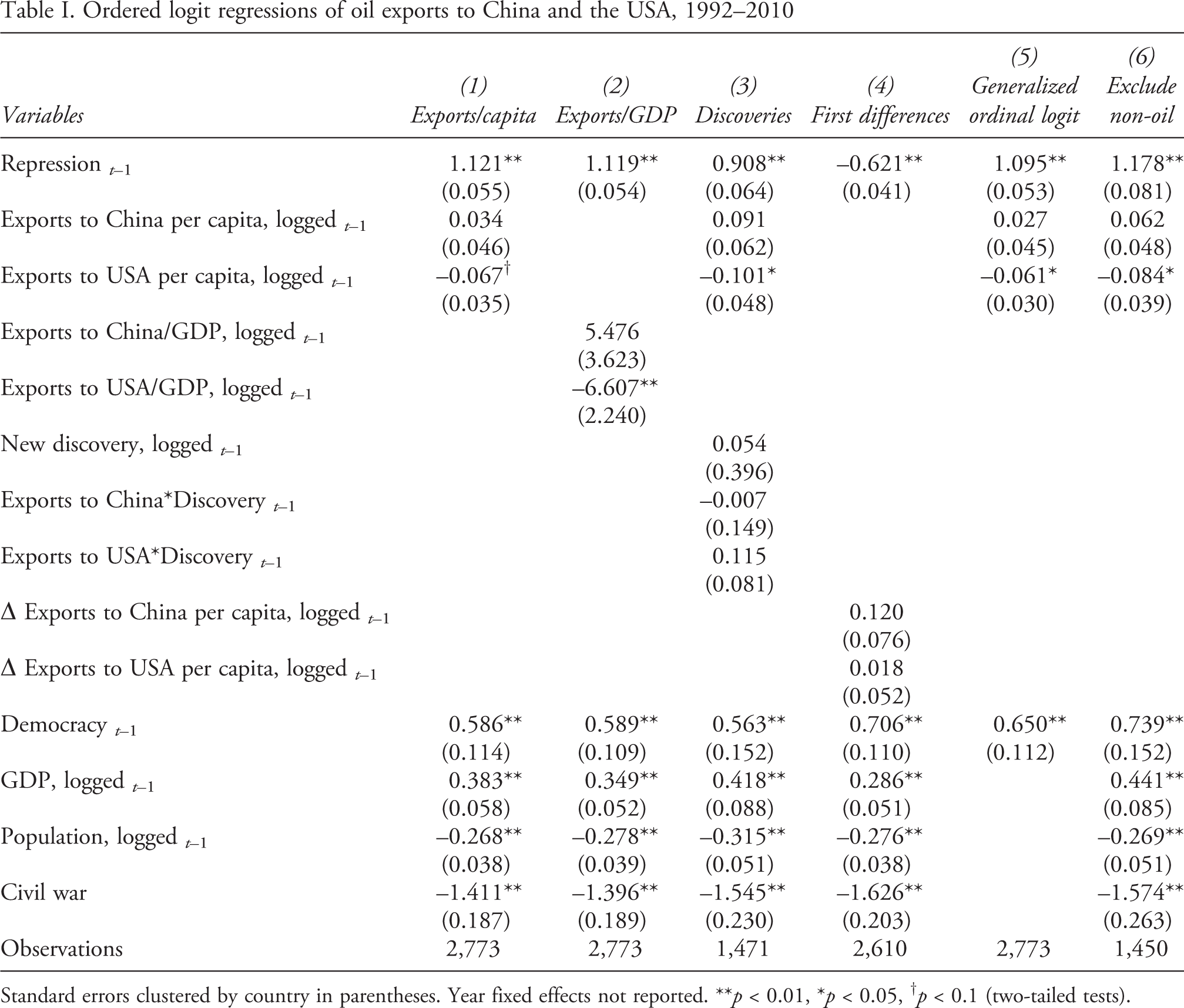
Standard errors clustered by country in parentheses. Year fixed effects not reported. **p < 0.01, *p < 0.05, † p < 0.1 (two-tailed tests).
Since significant coefficients in ordinal logistic regression are difficult to interpret, we present Figure 3, showing the effect of oil export dependence on the probability of physical integrity rights taking the value 7. The figure on the left shows the negative and significant effect of oil export dependence on the USA on suppliers’ human rights. On the right-hand side, we plot values of oil export dependence on China, which shows that there might be a slight positive effect on human rights for low levels of dependence, but wide confidence intervals document the insignificant effect for higher levels of export dependence on China.
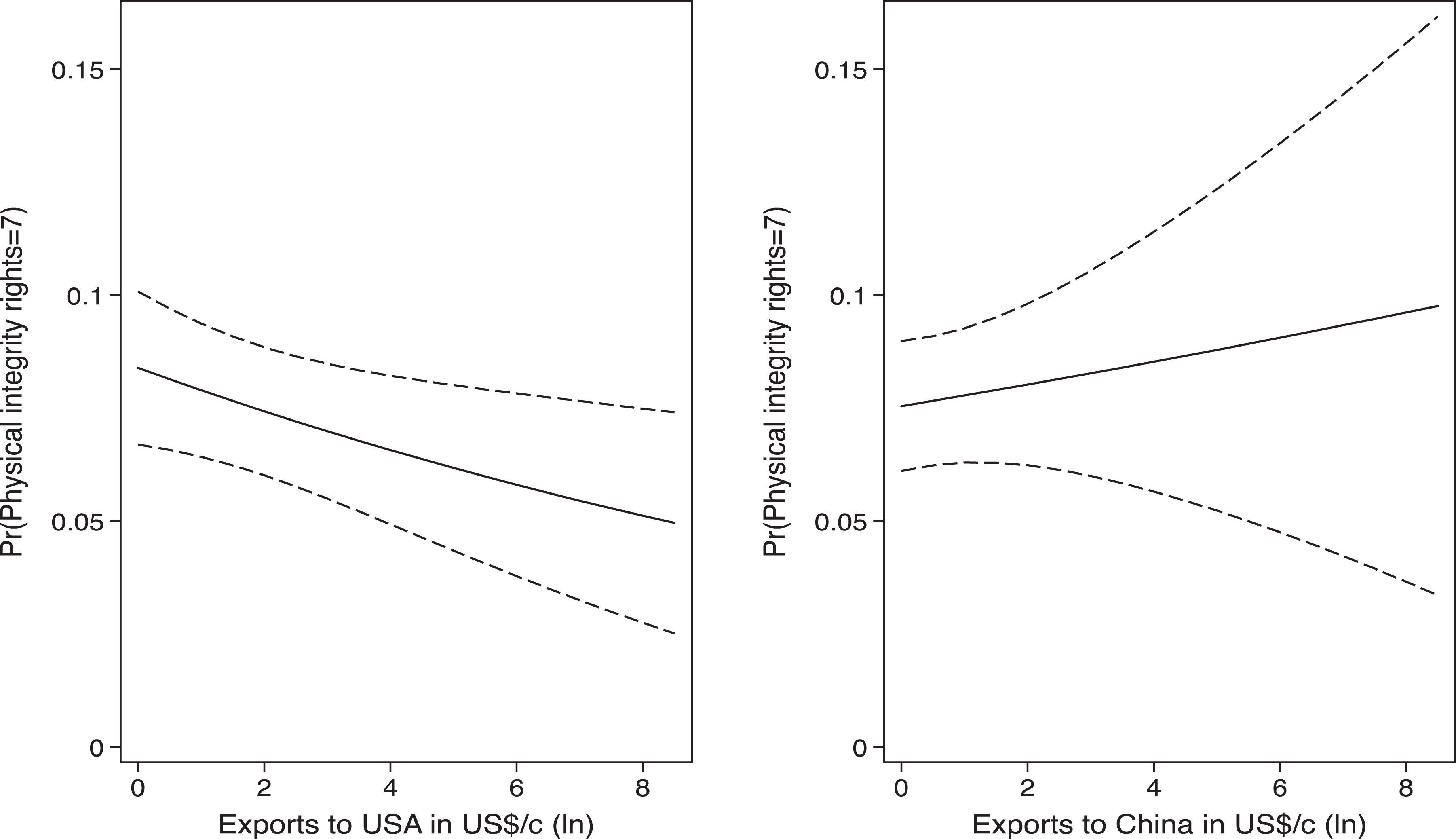
Marginal effect of oil export dependence to USA and China, Model 1, Table I
Results for control variables confirm findings from earlier research. Physical integrity rights in the previous year are a robust predictor of future human rights performance. We also find that democracy has a significant and positive effect on physical integrity rights, which is unsurprising given the strong correlation between both indicators. States with higher per capita GDPs have better human rights records. The presence of ongoing civil war strongly reduces the probability of substantial human rights protections.
Model 2 presents results for an alternative operationalization of oil export dependence. In this model, we adjust oil export values by exporter GDP, which captures the economic importance of exports to suppliers. Results in the model are very similar to Model 1, showing a negative and significant coefficient for exports to the USA (z = –2.95) but insignificant results for China.
The next two models explore whether theoretical expectations regarding the long-term implications of oil export dependence are supported in the data. As discussed, we argue that the USA’s long-term involvement in global oil markets could be responsible for more consistently negative implications of export dependence on the USA rather than China, which only recently became a global player in oil markets. Model 3 thus includes oil discoveries as a short-term (and more plausibly exogenous) source of variation in resource extraction rates (Cotet & Tsui, 2013). Using data from the Association for the Study of Peak Oil available for 1992–2003, we re-estimate our models with a variable for new oil discoveries, and interactions between the lagged discovery variable and our export measures for China and the USA. 18 Significant coefficients for the interactions would establish a short-term causal effect of exports on human rights violations because exports resulting from recent discoveries are unlikely to stem from pre-existing conditions. Yet the interactions do not attain significance, while the constituent term for US export dependence remains negative and significant. Results in this model seem to support our expectations regarding selection effects and long-term dependence for the USA, demonstrating the influential role of powerful states in sustaining the detrimental effects of resource reliance in the long run. In Model 4, we also examine short-term effects of oil dependence on physical integrity by including first-differences of oil dependence and human rights measures rather than overall levels. 19 Results in this model show that the negative effect of export dependence on the USA disappears when considering how changes in oil dependence affect changes in physical integrity rights, thus representing more short-term effects. These findings are consistent with recent work on the resource curse finding negative long-term implications of oil wealth, but no consistent effect for short-term changes in levels of resource wealth (Andersen & Ross, 2014).
Model 5 presents results using generalized ordinal logistic regression that accounts for violations of the proportional odds (or parallel regression) assumption in some of the independent variables (Williams, 2006). A global test for Model 1 showed that the proportional assumption was violated for the model as a whole, but tests for individual variables showed that only some of the control variables (GDP per capita, population, and civil war incidence) and not key independent variables were responsible for the violation. We thus re-specify the model using a generalized ordinal logit model with partial proportional odds, which constrains variables without problems to the proportional odds assumption, but relaxes it for the problematic ones. Since this model estimates separate coefficients for each level of physical integrity rights for variables violating the proportional odds assumption, Model 5 presents only the remaining coefficients, which include our key independent variables. The results again show a negative and significant effect of export dependence on the USA, but no effect for those exporting to China.
In Model 6, we exclude countries that have no oil endowments and can therefore not export to either China or the USA. 20 Our findings for this restricted sample are consistent with earlier models, showing a negative and significant coefficient for exports to the USA, whereas exports to China have no significant effect on human rights.
Additional models in robustness tests in the online appendix (Table AI) show results using export values in constant US dollars and values adjusted by the size of all exports to China and the USA. Robustness tests also present results with additional control variables, interactions between export dependence and democracy, excluding outliers, and without the lagged dependent variables. Our main result showing a long-term effect of oil export dependence on the USA remains consistent across these additional specifications.
Conclusion
While the detrimental consequences of oil wealth for governance are well established in the literature on the resource curse, China’s emergence as an investor in and consumer of oil has resulted in a wave of ‘China bashing’. Our aim is to provide a more objective assessment of the human rights implications of China’s thirst for oil. Theoretically, we find few reasons to expect more detrimental effects of Chinese oil consumption in comparison to the USA. While Chinese foreign policy rejects human rights criteria, US long-term relations with oil exporters predate its normative human rights agenda. At the same time, industry self-regulation to address reputational concerns seems to be cheap talk for both US and Chinese corporations. We find no effect of export dependence on China on suppliers’ human rights, but a negative relationship between oil export dependence on the USA and human rights. These results remain consistent across a large number of model specifications and we additionally establish that they appear to be driven by the long-term effects of oil export dependence. 21 Our results therefore challenge journalistic and scholarly speculation that Chinese oil exploration is ‘gravely weakening international human rights’ (Chen, 2007: 42; Vivoda, 2009a). Empirical findings also highlight a disconnect between long-term resource relationships and normative foreign policy goals for the USA (de Soysa & Midford, 2012). Our results therefore point to a more nuanced assessment that is more cognizant of the USA’s longstanding and problematic relations with large exporters, puts the extent of Chinese engagement in perspective, and acknowledges the possibility of short-term positive effects of China’s entry (Taylor, 2006; Pegg, 2012; Meyersson, Padró i Miquel & Qian, 2008). 22
However, our findings do not imply that Chinese oil imports are beneficial for human rights, or that US imports have uniquely pernicious implications. Our expectations for the effect of China’s engagement on human rights in the long run are rather bleak. In fact, the surplus welfare-effect produced by Chinese infrastructure provision could disappear once the need for infrastructure is saturated or outweighed by more complex governance problems that emerge from resource wealth. Moreover, Chinese corporations are now more active abroad, but thus have also become exposed to increased local opposition. Chinese outward investments, including those by its NOCs, have increasingly been confronted with local resistance against environmental damage or inferior labor standards. In more extreme instances in Ethiopia, Sudan, and Nigeria, Chinese NOCs have become targets of militarized conflicts and attacks (Percival, Valk & van Geuns, 2009; Jiang, 2009; Hess & Aidoo, 2010). When facing such threats, Chinese investments are likely to be supportive of, or participate in, the same repressive tactics that Western corporations have been accused of in the past. Regarding the USA, negative implications stem from its long-term involvement in oil markets and we would expect similarly negative implications for other long-term oil importing states. Finally, while increasing reliance on domestic reserves from the shale oil boom has reduced US dependence on foreign oil and could potentially reduce negative implications of US imports, these developments are too recent to matter in our analyses.
Footnotes
Replication data

Acknowledgments
We are grateful to Brian Burgoon, Andreas Fuchs, and Andrea Ruggeri for comments and suggestions. Earlier versions of this article were presented at the International Studies Association’s Annual Convention, San Francisco, 3–6 April 2013, the PETGOV research group meeting at the University of Amsterdam, 13 June 2013, and the European Network for Conflict Research meeting, Istanbul, April 2014. We thank participants for helpful comments.
Notes
References
Supplementary Material
Please find the following supplemental material available below.
For Open Access articles published under a Creative Commons License, all supplemental material carries the same license as the article it is associated with.
For non-Open Access articles published, all supplemental material carries a non-exclusive license, and permission requests for re-use of supplemental material or any part of supplemental material shall be sent directly to the copyright owner as specified in the copyright notice associated with the article.
