







Abstract
What accounts for low-intensity intergroup violence? This article explores the determinants of low-intensity sectarian violence in Northern Ireland, which has marked the post-1998 peace agreement period. Low-intensity violence comprises a variety of events from riots to attacks against other civilians as well as against homes and symbolic buildings such as churches. We argue that this violence is more likely and prevalent in interface areas where similarly sized rival communities are geographically in contact with each other. Parity and contact spur intergroup competition and threat perception, and they increase the viability of violence. We use original cross-sectional time-series violence data for the 2005–12 period at a disaggregated subnational level, the ward, and a wide variety of social and economic indicators to test our hypotheses. In particular, we assess the impact of within-ward ethnic composition, on the one hand, and the ethnic composition of neighboring wards, on the other. We find that the number of intergroup violent events peaks in wards where there is parity between groups, and in predominantly Catholic (Protestant) wards that border predominantly Protestant (Catholic) wards. The article makes two main contributions: it shows that micro-level dynamics of violence can expand beyond local territorial units, and it suggests that ethnic segregation is unlikely to prevent intergroup violence.
Introduction
In July 2013, 15 years after peace was agreed in Northern Ireland, riots broke out following traditional Protestant parades. Local police could not contain the spiraling violence and Protestants living in predominantly Catholic districts of Belfast said mob violence directed at their area was the worst they had seen since the early 1970s, the most severe years of Northern Ireland’s civil war (Rutherford, 2013). In the same year, two Protestant young men were sentenced to life imprisonment for having murdered a teenager, attacked because he was a Catholic (BBC, 2013). Sectarian violence is still an important problem in Northern Ireland. The end of the conflict in 1998 entailed a sharp change in the nature of violence, but did not end it. While paramilitary activities and fatalities mostly ceased, confrontations between Catholics and Protestants persisted and even increased in the first years after the agreement. As one leading expert puts it, ‘the end of the Troubles has not led to an end of violence in Northern Ireland’, where apart from some residual paramilitary activity, there is ‘recurrent low-level sectarian disorder’ (Jarman, 2004: 421).
This article analyzes this second type of violence, which we call low-intensity intergroup violence. Low-intensity violence is non-militarized, is rarely fatal and, hence, does not reach the levels of lethality that characterize civil wars. Such violence in Northern Ireland comprises attacks against individuals or groups using physical force, threats, verbal abuse, or intimidation; it also includes riots, public disorder, and damage to property. Intergroup (or sectarian) violence consists of violence between members of different ethnic or religious groups. In Northern Ireland, the sectarian cleavage divides Protestants and Catholics. 1 Other cases of low-intensity intergroup violence at the subnational level include, for example, riots in India (Wilkinson, 2004; Urdal, 2008), armed confrontations in South Africa (Amodio & Chiovelli, 2014), indigenous conflict in Bolivia (Mähler & Pierskalla, 2015), urban violence in the United States (Olzak, Shanahan & McEneaney, 1996), and local violence in Kenya (Kasara, 2015).
Scholarly work on Northern Ireland has mainly concentrated on deaths during the conflict period. Ongoing sectarian violence is often viewed as just a legacy of the armed conflict or, according to some journalist accounts, the result of a ubiquitous enmity between Catholics and Protestants that periodically erupts into violence (Cage, 2013; Shapiro, 2014). However, the current existing violent events do not take place in exactly the same areas where the conflict was prevalent (Poole, 2004), and enmity is endogenous and cannot explain spatial variation in violence levels.
This article explores the micro-level dynamics of low-intensity sectarian violence in order to understand its determinants and spatial distribution. We theorize that ethnic groups use low-intensity violence where they have both motive and opportunity. Motive arises from threat perceptions, which become more salient in interface areas where groups face each other. Segregation and parity introduce security concerns and increase intergroup competition, which creates incentives to exercise and protect control over territory and seek dominance. Opportunities are most prevalent in areas where communities are in contact with each other, making it feasible to attack outgroup members, homes, or symbolic buildings.
Using new data on sectarian crimes at the ward level and census data from Northern Ireland for the period 2005–12, we show that understanding the spatial distribution of violence not only requires considering ethnic composition within territorial units but also the influence of neighboring units’ composition, something often neglected in subnational studies of conflict. Areas of intergroup contact can be found both within and across units in Northern Ireland: some territorial units, despite being relatively homogeneous, can experience high violence levels if their neighboring territorial units are also relatively homogeneous but populated by members of the other group.
Understanding the dynamics of low-intensity violence is important because these events prevent the building of interethnic trust and are socially and economically disruptive. Most importantly, low-level violence retains the potential to escalate into more severe confrontations, which might increase the incentives for the re-emergence of armed groups. 2 Our article speaks to the literature on ethnic violence, and it has macro-level implications that are relevant beyond the Northern Irish case. For example, segregation and partition are sometimes assumed to be possible solutions for ethnic conflict because they reduce the opportunities for direct intergroup contact (Kaufmann, 1998; Weidmann & Salehyan, 2013; Bhavnani et al., 2014). We show that this is not necessarily the case at the micro level. 3
The article is organized as follows: the next section summarizes the conflict in Northern Ireland and the origins of sectarian violence. We then present the theoretical framework and our main hypotheses. Next we introduce the novel dataset we have built with data from police records, censuses, and other sources. We then discuss the main results of our empirical tests and the robustness checks. The final section concludes.
Conflict and post-conflict violence in Northern Ireland
Violence between Catholics and Protestants in Northern Ireland has deep roots in a conflict that has lasted for more than three centuries (Farrell, 2000). The antagonism started with the settlement of British colonists in Northern Ireland, which led to the economic marginalization of the Catholic Irish, who by 1703 held less than 5% of the land (Darby, 1995). An Irish revolt against British rule over Ireland led to independence for the southern part of Ireland in 1921. However, an exception was made for the northeast of the island, where Protestants were a majority. Northern Ireland remained united to the United Kingdom, with its own devolved institutions.
Protestant control of Northern Ireland was marked by sectarian violence against Catholics, notably in 1921, when Irish independence took place, and again during the economic depression of the 1930s. The Protestant majority also maintained political control through gerrymandered electoral boundaries and strong emergency police powers (Darby, 1995). Following the 1921 independence of Ireland, the Irish Republican Army orchestrated recurrent violent campaigns against the British state aimed at ending the separation status for Northern Ireland. Calls against social and political discrimination increased, and a rising Catholic middle class began to press for civil rights, with high-profile marches in 1968. Violence between Protestants and Catholics spiraled. In response to violence local vigilante groups were set up, which then became formalized paramilitary groups and the key actors of the conflict (Fitzduff & O’Hagan, 2009). After the UK government sent in the army to regain control, a new insurgent group, the Provisional IRA (PIRA), emerged. The conflict that followed was not only between the PIRA and the UK state, but also between Protestant and Catholic paramilitary groups – and at times between different paramilitary groups within the same ethnicity. The conflict (known as ‘the Troubles’) lasted from 1969 to 1998, and resulted in around 3,200 deaths and about 42,000 people injured. 4
Sectarian violence was an important feature during the Troubles. It motivated the emergence of armed groups, which often chose targets based solely on their membership of the other ethnic group. 5 However, sectarian violence was not limited to actions perpetrated by these groups, and included many incidents carried out by civilians in a highly localized way (Sullivan, Loyle & Davenport, 2012).
In 1994, the PIRA proclaimed a ceasefire, followed shortly afterwards by the Combined Loyalist Military Command, and peace negotiations led to the 1998 Good Friday Agreement, which formally ended the civil conflict. Membership of paramilitary groups is now illegal, and most former armed organizations are committed to peace, which has led to a sharp decrease in the number of deaths. 6 While violence and fatalities driven by armed groups have mostly ceased, low-intensity intergroup violence has persisted in post-conflict Northern Ireland (Jarman, 2005; Shapiro, 2014). 7
Studies of ethnic violence in Northern Ireland have concentrated on analyzing the Troubles and lethal violence. Existing studies overlook low-intensity violent events, principally due to a lack of systematic data for that period. Spatial variation in levels and timing of lethal violence during the Troubles has been attributed to state repression, mixed ethnic settlements, proximity to the border with the Republic of Ireland, and territorial paramilitary control (Kaufmann, 1998; Sullivan, Loyle & Davenport, 2012; Mueller, Rohner & Schoenholzer, 2013). With the peace agreement, most of these factors have lost explanatory relevance. The (almost total) absence of fatalities and paramilitary activity in the new post-conflict scenario, plus the new availability of data (starting in 2005) on low-intensity sectarian violence at the local level, allow us to investigate the specific determinants of this enduring phenomenon.
Contemporary low-intensity violence comprises a variety of events from riots to attacks on other civilians as well as on homes and symbolic buildings. Specifically, the vast majority (93%) of sectarian crimes are victim-based crimes. Of these, around half the crimes are against the person (45%), while most of the rest are criminal damages (44%), for example against a person’s home or significant buildings such as churches. Crimes against society, namely riots and public disorder, are a small part of total sectarian crimes (7%) (PSNI, 2013).
Again, the nature of current sectarian violence is quite different from the violence that characterized the Troubles: as Shirlow & Murtagh (2006: 3) state, in Northern Ireland ‘the nature of violence has shifted away from paramilitary and state assaults towards a more sectarianized and repetitive violence of interface rioting and attacks upon the symbols of tradition such as Orange Halls, GAA [Gaelic Athletic Association] property and churches’. Current violence is generally low-intensity and is not carried out by paramilitary groups, but rather is perpetrated in a non-militarized manner by some members of both communities in localized areas, so tensions are not salient beyond these small areas, as segregation hinders the spread of conflict (Klašnja & Novta, forthcoming). Consequently, violence takes place in areas that do not fully coincide with those where militarized fatal violence took place during the conflict (Jarman, 2004, 2005; Poole, 2004). 8
Understanding low-intensity intergroup violence
Building on the existing literature on geographical settlements, intergroup contact, and ethnic conflict, we posit that ethnic balance and settlement help us explain spatial variation in local levels of violence in Northern Ireland. In particular, we expect low-intensity sectarian violence to be more likely and prevalent in interface areas where rival communities are geographically in contact with each other. It is in these localized areas, we argue, where both motives and opportunities for low-intensity violence exist.
Concerning motive, proximity and geographical contact at the local level breed competition over territory and disputed space, which is often viewed as a zero-sum game. Existing studies on ethnic violence posit that group concentration and segregation increase the risk of violence by reducing positive intergroup interactions and, consequently, interethnic trust (Kasara, 2015), while at the same time creating stronger attachment to territory (Toft, 2003). This, in turn, boosts threat perceptions about the ingroup’s security and relative status, leading to a security dilemma that creates incentives for violence in a context of zero-sum intergroup competition motivated by contested space (Posen, 1993).
Such ethnic competition over territorial control manifests principally at the local level (Cunningham & Weidmann, 2010; Klašnja & Novta, forthcoming). It is within limited interface areas that rival groups resort to violence with the aim of dominating territories demographically and controlling borders, as well as out of fear of losing pre-eminence to other groups (Lim, Metzler & Bar-Yam, 2007; Smith et al., 2012). Establishing (and asserting) control of contested territory is expected to bring benefits for the ethnic ingroup, which vary across contexts. For example, in some places territorial dominance can imply access to scarce material benefits such as jobs, housing, or even natural resources, while in others dominance can bring electoral advantage in the long term, and control of decisionmaking concerning public budget and policy (Olzak, Shanahan & McEneaney, 1996; Esteban & Ray, 2008; Field et al., 2008; Cunningham & Weidmann, 2010; Amodio & Chiovelli, 2014; Mähler & Pierskalla, 2015). In other contexts, such as Northern Ireland, competition over territorial control mostly involves not only enhancing individual physical safety but also collective security by establishing areas where groups can safely express their identity, symbols, and traditions (Bollens, 2000; Toft, 2003, 2014).
In contexts of ethnic heterogeneity and localized intergroup tensions, violence caused by proximity can take place both within subnational units and between units. Within territorial units, motives for violence are more forceful in situations of ethnic parity or polarization, that is, when there are two groups with similar sizes (Horowitz, 1985). 9 The literature on ethnic conflict finds a positive relationship between polarization and outbreak and intensity of violence at the country level (Esteban & Ray, 2008; Montalvo & Reynal-Querol, 2010). The mechanisms linking both can be transported to the subnational level and help us explain spatial variation in levels of local low-intensity violence. Within units, parity deepens threat perceptions in both groups and creates numerous interface areas where territorial disputes concentrate. A bigger presence of outgroup members and symbolic displays is perceived as more threatening to the ingroup’s identity and status. When relative sizes are similar such threat is maximized for both groups as both risk becoming a minority. Violence in this situation is likely to be bidirectional, with both groups becoming more willing to take the gamble of violent confrontations aimed at protecting their status and consolidating borders. Small changes in demographic composition may result in one of the groups dropping below a tipping point, which in turn leads to this group progressively leaving an area (Card, Mas & Rothstein, 2008). In contrast, when an ethnic group already overwhelmingly dominates an area, its threat perceptions are minor and there are fewer reasons for members of that group to perpetrate violence: violence, which is costly, has lower marginal returns for the majority group in terms of territorial control and dominance. Conversely, for the minority group, although threat perceptions are high, violence is less beneficial to them since it is unlikely to generate any significant change in the control of disputed areas. Further, minority status may deter group members from using violence since perpetrators are more likely to get caught and any incident may trigger retaliation from the majority group. Thus, violence has a lower expected utility for the minority group too.
Groups might be confronting each other within territorial units and, as said, across units. Local territorial units are not isolated: an ethnically homogeneous area can easily be located next to another homogeneous but rival area. Thus, contested contact spaces between sizable, polarized communities can also be found across units. Again, these are disputed areas, where security and status concerns that motivate violence are extremely salient. This is often overlooked in micro-level studies of ethnic violence, and we argue that accounting for the composition of neighboring territorial units is essential for capturing segregation and geographical contact and, thus, understanding the spatial distribution of sectarian violence.
These insights and mechanisms are all clearly present in Northern Ireland, where country-level polarization is very high and so is local-level polarization in many areas, while other areas are homogeneous but often in contact with segregated rival communities. 10 Additionally, residential segregation – especially in urban areas – deeply intensified as a result of violence during the Troubles and still continues today (Doherty & Poole, 1997; Jarman, 2004). Proximity and segregation result in the existence of numerous disputed spaces in the interface areas where threat perceptions, status concerns, and competition are particularly salient. Interfaces are ‘spaces that lie between these highly segregated neighbourhoods’, which ‘remain sites of contestation and antagonism’ between Catholics and Protestants (Cunningham & Gregory, 2014: 64). These are spots where the motives above are found and, hence, where most of the violence concentrates. Survey evidence on Northern Ireland confirms that lack of intergroup contact due to segregation leads to low interethnic trust and increases negative outgroup perception (Tam et al., 2009). In turn, distrust and prejudice increase the perception of threat that the other group poses as well as the propensity for violence (Hewstone et al., 2008; Hughes et al., 2008; Schmid et al., 2008). In the Northern Irish context, perceived threats stemming from outgroup close presence normally take the form of fears for personal (and community) security. Importantly, outgroup proximity and size also raise identity-based (or symbolic) threats where the outgroup’s presence, symbols, and expressions of identity are seen as detrimental and, hence, threatening to the ingroup’s status and own identity (Jarman, 2001; Hewstone et al., 2008; Schmid et al., 2008). Territorial control in this zero-sum context implies ‘claiming and exercising rights over public space through local demographic dominance and denying, or limiting, those same rights to the “other”’ (Bell, Jarman & Harvey, 2010: 13). Control of an area entails the ability to block manifestations of the other side’s identity, while establishing and preserving one’s own, but it can also mean access to immediate material goods, such as a park or more housing for ingroup members. 11
Low-intensity violence is an instrument that is actively used to claim control over disputed areas and associated resources in the interface. ‘Segregation leads inevitably to contest over access to public space and social resources’ (Bell, Jarman & Harvey, 2010: 13). Areas where both communities meet are the place where most violence occurs since ‘they continue to operate as the battlegrounds for ongoing, indeed intensifying demographic disputes’ (Cunningham & Gregory, 2014: 76). Attacks and intimidation can induce people to move out from specific areas, and are used as a long-term tactic to make people feel threatened and unwanted. Indeed, violence caused profound population changes during the Troubles and deepened segregation, and part of the current violence retains that goal. A significant number of people – a yearly average of almost 1,400 since 1998 – still request rehousing in Northern Ireland due to intimidation and threats (Jarman, 2004: 426; 2005: 24–25). 12 On the other hand, violence can also be aimed at protecting the status quo and used as a reaction to demographic shifts that create new interfaces and threaten the viability of rituals and other symbolic displays, and so collective identity. Flashpoint events (such as parades) can activate groups’ fear of losing territory and power, and make the need of preventing incursions and asserting control of certain areas extremely prominent. ‘Many of the disputes over parades are therefore at heart part of the dispute over the nature and identity of territory. They occur in areas that were once Protestant or mixed but are now perceived as Catholic’ (Jarman, 2001: 37). 13
Localized disputes between polarized communities in interface areas in Northern Ireland occur within and across units (i.e. wards). Wards with a high degree of parity normally show a high degree of segregation as well, especially in urban areas. For example, Ballymacarrett, in east Belfast, is the ward that registers the second highest level of sectarian incidents, with 66 incidents in 2011. The ward has a Catholic population of 51% and a Protestant population of 47%, hence one of the highest levels of parity. The two groups are strongly segregated into separate areas within the ward, kept apart by five peace-lines. 14 Violence takes place in flashpoint areas between the two communities (BBC, 2011). The ward of Water Works, in north Belfast, also presents some of the highest incidence of sectarian violence, reaching 45 incidents in 2008. By contrast with Ballymacarrett, Water Works is very homogeneous, with a Catholic population of 91% and a Protestant population of just 7%. However, the ward is bordered by wards that have a very different hue – Crumlin, which is 94% Protestant; Shankill, also 94% Protestant; and Duncairn, 90% Protestant; The border areas between these neighboring wards are flashpoints for sectarian violence. These two cases match our theory as we predict that, within territorial units, violence will reach a peak in areas where there is parity between ethnic groups, and that, between territorial units, violence will also be highest in areas where segregated communities are in contact with each other.
Again, we argue that low-intensity violence is the product of the conjunction of motive and opportunity. Opportunity influences viability. At the local level, interface areas – both within and between units – not only create incentives for violence, but also ample opportunities for carrying out low-intensity violent acts. Firstly, group concentration facilitates collective action by allowing the existence of denser social networks (Toft, 2003; Weidmann, 2009). Secondly, geographical contact raises the risks of low-intensity violent actions because it increases the prospects of random or even premeditated encounters of individuals or groups belonging to rival communities. In those areas where similarly sized communities interface, contested areas are more numerous or bigger, and encounters more frequent. At the same time, interface areas lead to an increased visibility and vulnerability of potential (non-human) targets such as homes, symbols, and significant buildings (e.g. churches, clubs, flags, and monuments). Proximity thus increases the viability of attacks by increasing accessibility, as potential targets are located within the reach of members of the rival group and can be more easily attacked. Additionally, costs of violence for perpetrators are lower since proximity allows escaping and finding safety within their own community after committing a violent action (de la Calle, 2007). In Northern Ireland, visual and verbal contact facilitated by proximity may evolve into assaults, riots, and other violent actions. As Jarman & O’Halloran (2001: 2–3) explain, ‘violence often begins with little more than abusive banter among relatively young children, but may easily escalate to involve stone throwing and the participation of older youths and adults in more serious full-scale rioting’. Furthermore, communities closer to interface areas in Northern Ireland are reported to be much more likely to experience stone throwing, paint or petrol bombing, vandalism, and intimidation (Shirlow & Murtagh, 2006). In sum, ‘the close physical proximity of opposing areas has meant that at times of intense conflict it has been relatively easy to carry out attacks on the other side’ (Jarman, 2001: 36).
Overall, group proximity and similar size create the conditions for both motives and opportunities to work together. It is in these areas where observed violence will be higher both within and across territorial units. Our hypotheses are then:
Hypothesis 1: Incidents of intergroup violence will be more frequent in areas where there is demographic parity between groups.
Hypothesis 2: Incidents of intergroup violence will be more frequent in areas populated by majorities of one group that have neighboring areas dominated by majorities of the rival group.
Data
In order to test these hypotheses we use an original dataset of incidents of sectarian violence in Northern Ireland from 2005 to 2012. 15 The data are collected by the Police Service for Northern Ireland, which codes as sectarian ‘any incident which is perceived to be sectarian by the victim or any other person’. 16 The police define sectarian as ‘bigoted dislike or hatred of members of a different religious or political group’ (PSNI, 2013: 6). In the context of Northern Ireland this refers to the ethnic groups (Catholic/Protestant) or political groups (Nationalist/Unionist or Republican/Loyalist) (PSNI, 2013: 6).
The information is collected at the ward level, which allows for a fine-grained subnational analysis given the highly localized nature of intergroup tensions. Wards are administrative units comprised of a number of townlands or parts of townlands, themselves a historic form of land division. They are the smallest administrative level for which data are available. Ward boundaries are occasionally reviewed, but the last change took place in 1993, before our period of study. There are a total of 582 wards in Northern Ireland and the time period for which data on sectarian violence are available is 2005–12; our balanced dataset consists of 4,656 ward-year observations.
Our dependent variable measures the recorded number of incidents of sectarian violence in a given ward and year. Figure 1 shows the temporal evolution of the
Sectarian violence in Northern Ireland (2005–12)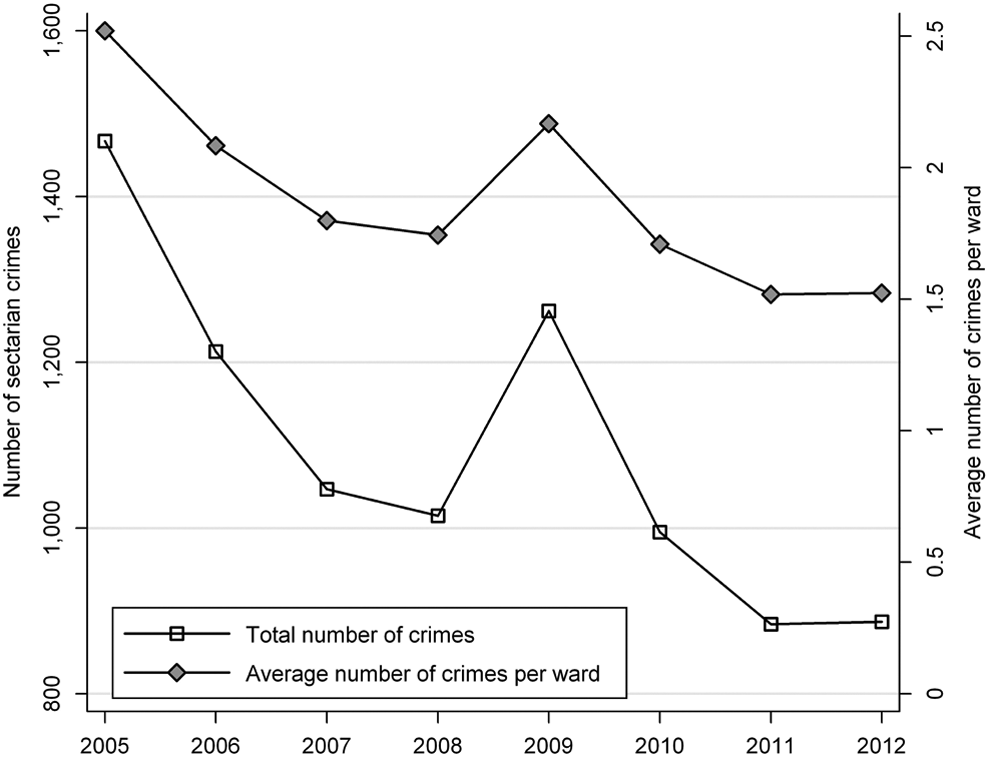
We use two sets of independent variables: the first set includes social, economic, and ethnic variables at the ward level; the second set includes variables with information about neighboring wards.
18
To measure the ethnic composition of each ward, we use census data, which has two major advantages: the first is that the fully adjusted counts cover 100% of the population;
19
the second is that responses are self-generated, so we use self-identification into the different ethnic groups and not measures estimated by others.
20
Census information
Distribution of sectarian violence in Northern Ireland (2005–12)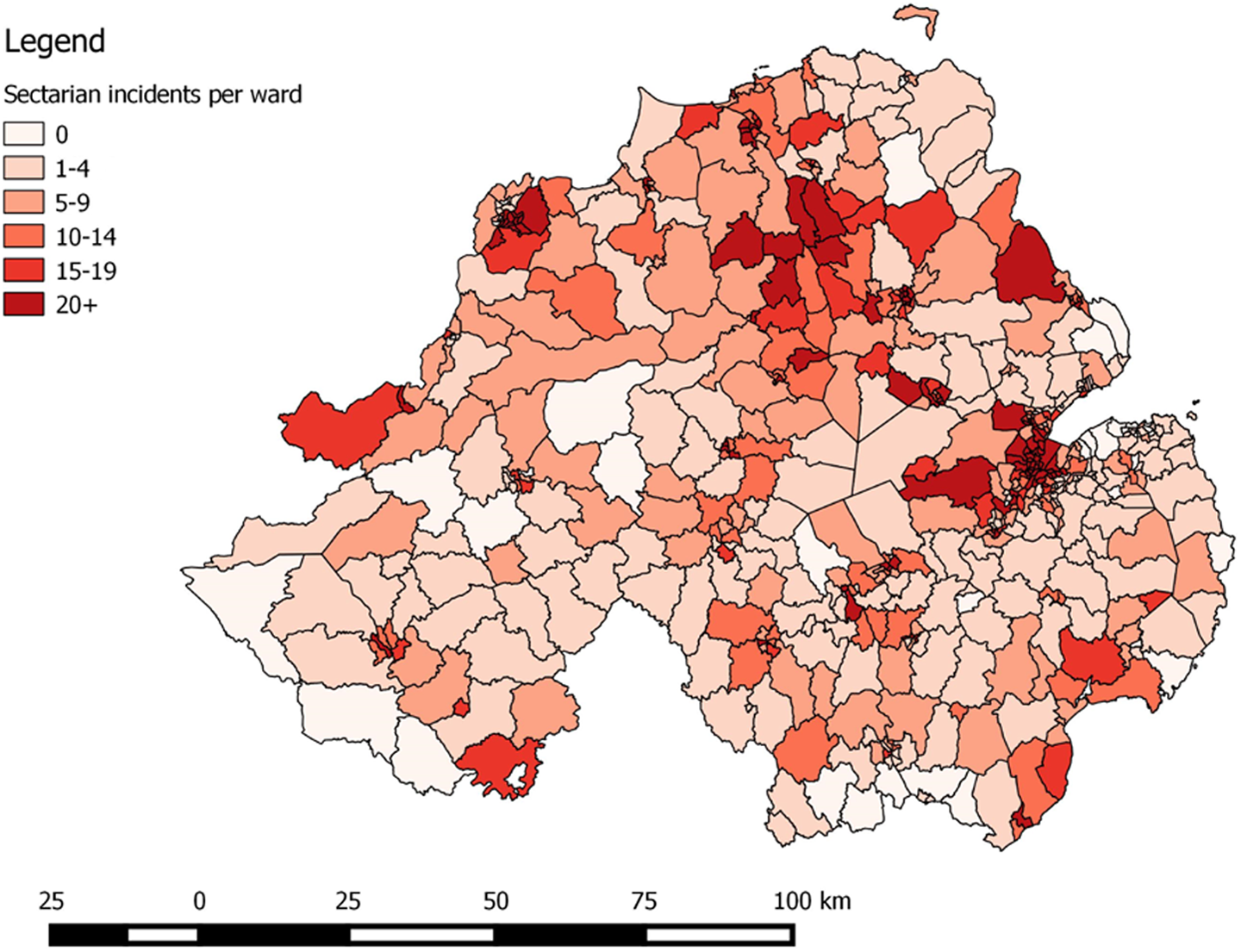
We include a number of control variables in the analyses to account for alternative explanations and other confounding factors that might be more prevalent in contact areas. First, we control for the impact of past conflict intensity, measured by the (logged) number of deaths during the Troubles (1969–98) that took place in each ward. 22 This variable allows us to test if low-intensity violence is a simple legacy or continuation of the civil war at the local level. Second, we control for unemployment (percentage of people claiming welfare assistance over the ward’s population), 23 which is a proxy for deprivation and lower opportunity costs (Humphreys & Weinstein, 2008; Dancygier, 2010), because interface areas are generally more disadvantaged (Jarman & O’Halloran, 2001). We also control for the percentage of men aged between 16 and 39 to test the influence of so-called ‘youth bulges’ (Urdal, 2006). According to some accounts, young men are mostly responsible for current sectarian violence in Northern Ireland (Jarman, 2004; Shapiro, 2014), while, simultaneously, interface areas are usually frequented by youngsters. The (logged) number of other crimes committed in a ward is also included in some models to account for the possibility of sectarian crimes just being the result of increased crime (Jarman, 2004).
We also control for total population (logged) and geographical size in square km (logged). 24 Finally, we also include the (logged) number of so-called ‘peace-lines’ existing within or on the border of a given ward in some of our models. 25 Peace-lines are walls, fences, road barriers or other constructions that have been placed to separate or protect the different groups. Peace-lines are a feature of some interface areas. We obtain the information on a total of 53 peace-lines from the UK Ministry of Justice, 26 supplemented by information from the BBC (2009). 27
To create the second set of variables and test Hypothesis 2, we identified and coded the corresponding neighboring wards for each of the 582 wards. We consider wards as ‘neighbors’ if contact is possible between their populations. Hence, neighbors must share a border and should not be divided by large bodies of water (unless there is a bridge). We then get relevant information about neighboring wards. In particular, we look at: the average percentage of Catholics and Protestants in all neighboring wards; the maximum percentage of Catholics or Protestants among all the neighboring wards, and the number of neighboring wards. Further, to correct for spatial autocorrelation, our models include a spatial lag consisting of the weighted average number of incidents in a given year of a given ward’s neighbors, which are identified using a first-order queen criterion.
Given the count nature of our dependent variable, the models are estimated using negative binomial regressions with errors clustered at the ward level. To control for unobserved common shocks we include year fixed effects in all our models. Given that our main independent variables (almost) do not vary over time because census data are only collected every ten years (2001 and 2011), we do not use ward-based fixed effects. Yet, in order to control for shared characteristics of wards and mitigate unobserved heterogeneity, we do employ local government districts (LGD) fixed effects. Wards within the same LGD share such characteristics as geography and history, along with economic patterns and level of public services.
Results
In Table I we first report the results of models that focus on wards’ internal characteristics. Model 1 shows the effect of the percentage of Catholics, which is negative and significant. The percentage of Protestants has the opposite impact (Model 2). Yet, after including the squared percentage of population of each group, the effect of the percentage of both groups is actually curvilinear (Models 3 and 4). According to this, more ethnically homogeneous wards are more peaceful.
Model 5 presents the results using the parity index and shows that its impact on the number of violent events is positive and significant, which supports our first hypothesis. 28 Figure 3 plots the simulated impact of parity on the number of incidents using the estimates in Model 5 (and 95% confidence intervals). A ward with maximum levels of parity is predicted to experience more than four violent incidents in one year.
The control variables perform generally as expected. More populated wards experience more sectarian incidents; so do smaller (in square km) wards. Unemployment has a strong and positive impact on violence. This suggests that sectarian violence is mostly an urban phenomenon, tending to concentrate in denser and poorer urban wards. Interestingly, the percentage of young males does not have a robust effect. 29 The number of deaths during the Troubles has a positive and significant effect. The fact that the inclusion of this variable and LGD fixed effects does not alter our findings constitutes strong evidence that there is not an omitted variable bias connected to past violence.
Intraward dynamics: Sectarian incidents (2005–12) and wards’ characteristics
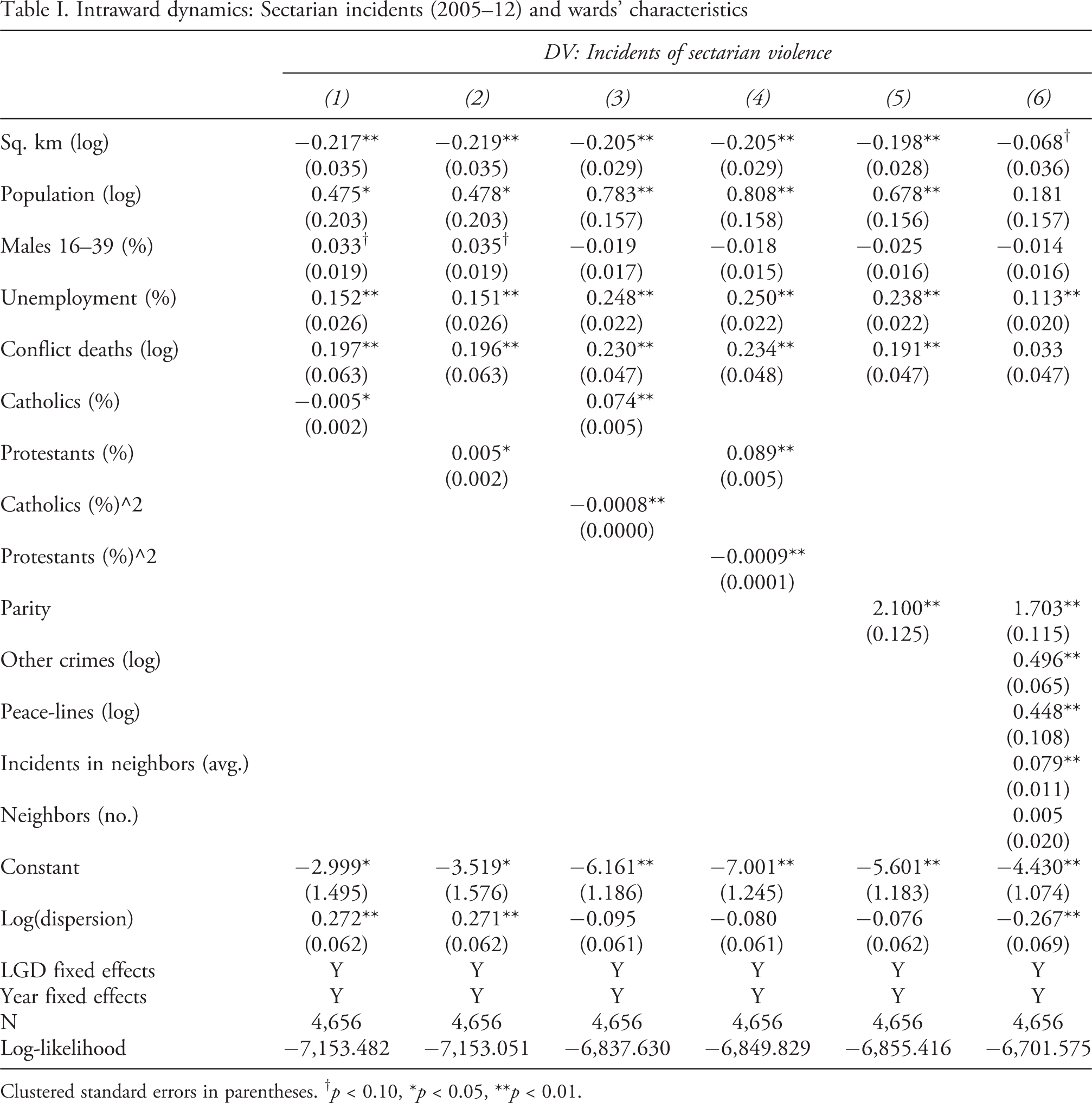
Clustered standard errors in parentheses. † p < 0.10, *p < 0.05, **p < 0.01.
Diverse wards with high parity are usually highly segregated in most parts of Northern Ireland (especially urban centers). To capture within-ward interfaces and test that parity and segregation increase incentives for violence, we include an interaction between parity and two proxies of internal segregation: the number of peace-lines existing in a ward and the number of deaths during the Troubles. Peace-lines are thus a proxy for interfaces and, hence, for more intense segregation. The same is true for conflict deaths. Lethal violence during the conflict caused deep population changes and segregation with more violence leading to further segregation. The coefficients of the interactions are positive in both cases (see Table A4).
According to these results, one could argue that homogeneous wards are more peaceful. However, contested interface areas between segregated communities can also be found where homogeneous wards are adjacent to homogeneous but rival wards, as stated in
The impact of parity on the predicted number of incidents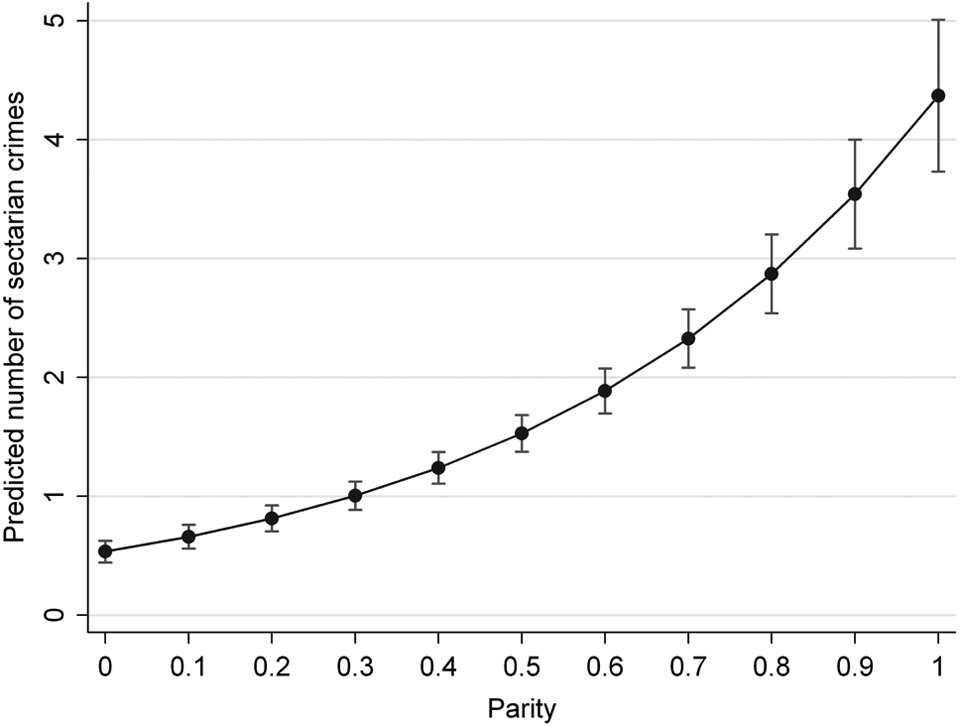
Figures 4 and 5 illustrate the impact of interward segregation on sectarian violence using the results in Model 1. Figure 4 shows how the marginal effect (and 95% CI) of the average percentage of Protestants in neighboring wards changes with the percentage of Catholics in a given ward. The marginal effect becomes positive as Catholics come close to being majoritarian: as the percentage of Catholics grows, the marginal effect on violence intensity of an increase in the percentage of Protestants in neighboring wards becomes stronger. Conversely, the smaller the percentage of Catholics, the stronger the negative effect of the average percentage of Protestants is. In those wards where Catholics represent about half of the population the ethnic composition of neighboring wards has a negligible impact. In this situation violence levels may be mainly occurring due to intraward parity and segregation, proving the existence of intraward dynamics as well as interward dynamics.
Figure 5 shows the predicted number of violent events as a function of the two variables interacted in Model 1. The darker contours on the upper-right and lower-left areas clearly reveal that more violent events are predicted to occur where an overwhelmingly Catholic ward has neighboring wards that are overwhelmingly Protestant – and vice versa. Conversely, the lowest predicted number of incidents is found in homogeneous Catholic (Protestant) wards surrounded by homogeneous Catholic (Protestant) wards (upper-left and lower-right areas). The evidence in Figure 5 manifests that interward tensions have the potential for generating more predicted violent events than within-ward parity since they better capture segregation.
To further probe Hypothesis 2, we use two alternative measures of neighboring wards’ ethnic composition. First, we use the maximum observed percentage of Protestants among all the neighboring wards instead of the average percentage of Protestants in neighboring wards (Model 3). Hence, if a ward has two neighbors and one has 60% Protestants and the other has 40% Protestants, here we take 60% (instead of the average, 50%). The results are consistent with those in Model 1 though weaker. Second, we run a model in which the number of neighboring wards with a majority of Protestants is interacted with a dummy that indicates whether a ward has a Catholic majority (Model 4). A ward is considered to be mostly Catholic or Protestant if the percentage of Catholics is higher than 50%. This gives us a proxy for the number of interface areas. The results are consistent with our expectations: the number of incidents increases in wards that are mostly Catholic and that have a higher number of neighboring wards that are mostly Protestant. 31
Interward dynamics: Sectarian incidents (2005–12), wards’ and neighboring wards’ characteristics
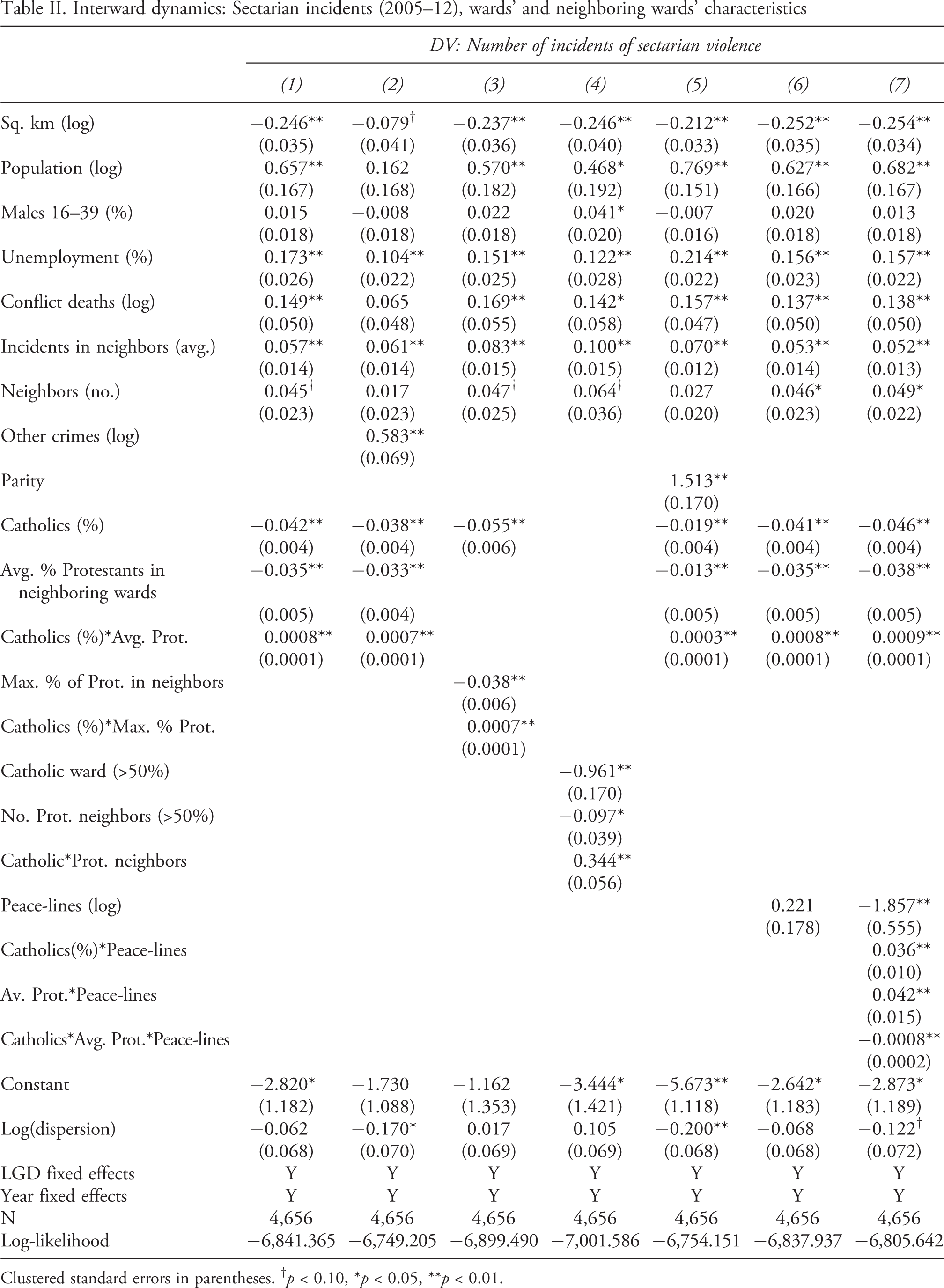
Clustered standard errors in parentheses. † p < 0.10, *p < 0.05, **p < 0.01.
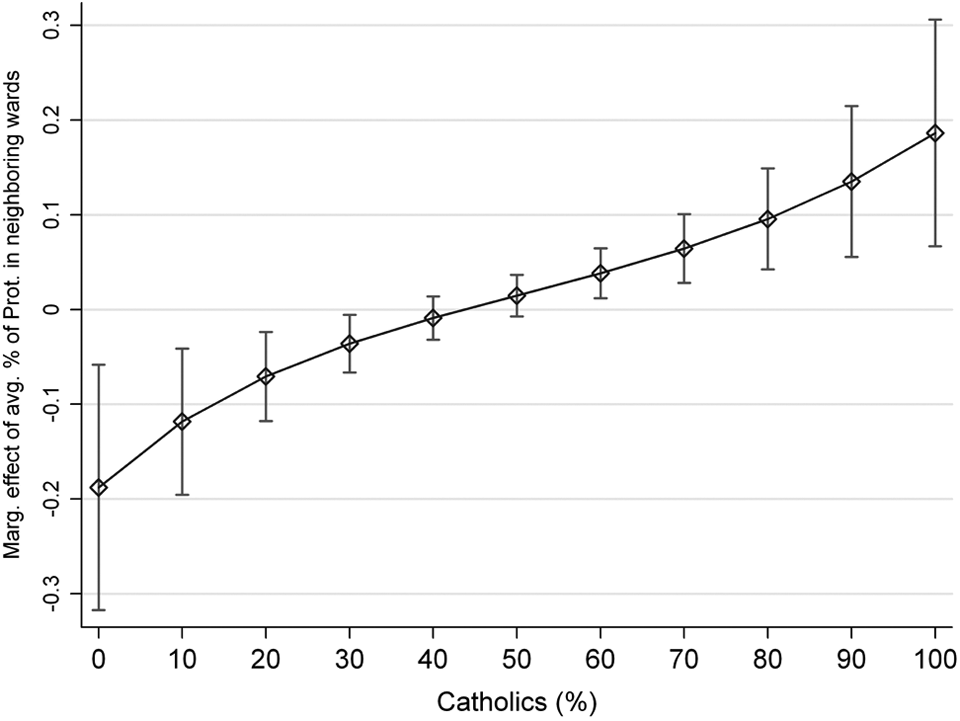
Marginal effect of the average percentage of Protestants in neighboring wards conditional on the percentage of Catholics in a given ward
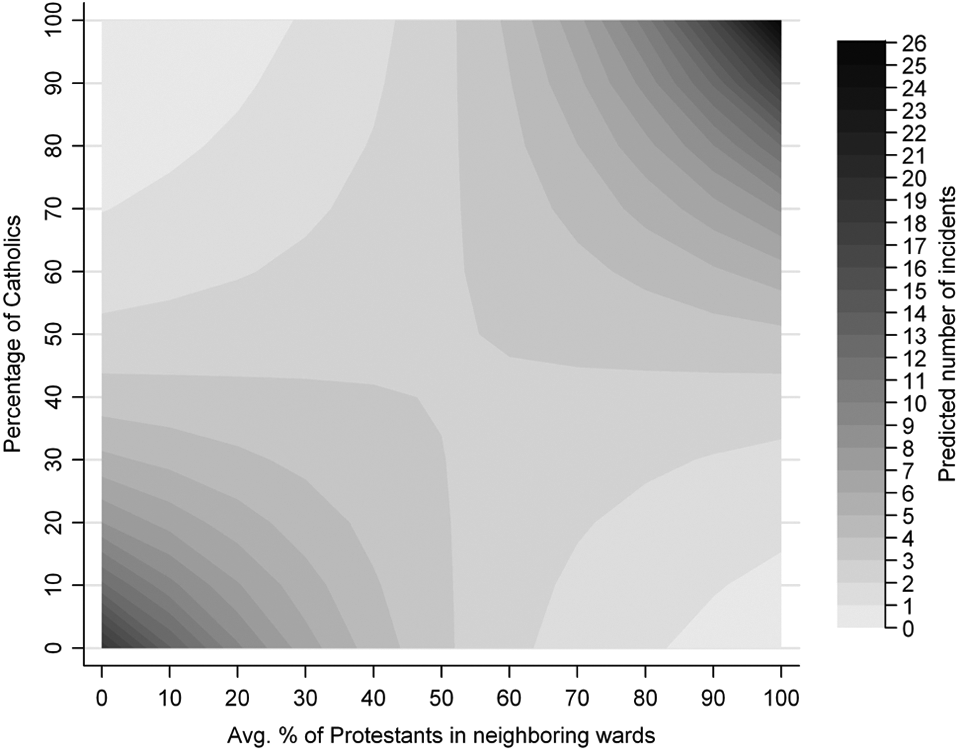
Predicted number of sectarian incidents: the effect of ward ethnic composition and neighboring wards’ composition
We control for the number of peace-lines in a ward in Model 6. After controlling for neighbors’ characteristics, the coefficient for peace-lines becomes insignificant. To further test if peace-lines reduce the number of incidents, in Model 7 we include a three-way interaction between percentage of Catholics, average percentage of Protestants in neighboring wards, and the number of peace-lines in a ward. Earlier on, we observed that peace-lines are related to more violence in wards with ethnic parity. Peace-lines might also serve to separate segregated rival wards thereby decreasing or hindering intergroup negative contact and establishing clear (physical) territorial borders. The results in Model 7 suggest this might be the case. The coefficient of the triple interaction is negative and significant. These results should be interpreted with caution though; since the number of wards with peace-lines is small (29), peace-lines are endogenous to past violence, and most of them are in Belfast. 32
Our main findings were subjected to multiple robustness checks (reported in the online appendix). Checks include: (i) models that exclude all controls and (year and LGD) fixed effects; (ii) the inclusion of additional control variables (namely, a urban ward dummy, the percentage of people claiming assistance for housing, a dummy for wards that border the Republic of Ireland, and the electoral results of sectarian parties); (iii) the exclusion of potentially influential cases (i.e. Belfast and Derry); (iv) re-estimating our baseline models using zero-inflated negative binomial regression; and (v) running our baseline models using negative binomial models for panel data with ward random, fixed effects, and with ward dummies.
Conclusions
Violence in Northern Ireland has not ended after the 1998 peace agreement. This article explores the local determinants of low-intensity intergroup violence in post-conflict Northern Ireland. We find that violence is more frequent in wards where there is ethnic parity between groups and in homogeneous wards that border wards with a large proportion of members of the rival community. Interface areas are contested and the presence and identity displays of the outgroup are perceived as threatening. In these local contexts, groups have incentives to compete for territory, maintain an area cleansed, and consolidate borders, which may lead to intentional violence against symbols and individuals from the other group. Proximity also makes perpetrating violent acts less costly, that is, it creates opportunities.
This article shows that the link between ethnic settlement patterns and violence can be extended beyond civil war settings. We develop a theoretical framework of low-intensity intergroup conflict, where threat perception breeds on segregation, proximity, and group size, which can be applied to other cases where groups are in contact and compete for local dominance. In the case of Northern Ireland, violence is low-intensity because armed groups have agreed to peace and violence is not perpetrated by militarized actors but rather by individuals or small groups that act in a decentralized fashion. These conflicts are very localized, so they are generally not salient beyond limited areas. As in other cases, a peace agreement has not ended all violence. Low-intensity violence not only persists but implies the constant risk of escalation, since it could give incentives for paramilitary groups to step in to protect their communities again, opening the possibility of a civil war relapse.
Recent scholarly work on ethnic and political violence is focusing on the subnational level to identify more accurately the conditions under which violence occurs. In the case of Northern Ireland, our data reveal that there is much spatial variation in the incidence of low-intensity sectarian violence. However, analyzing violence at the ward level without taking into account the interaction between different units would miss half the story. A key contribution of this article is showing that neighboring dynamics are a critical determinant in explaining this variation.
Our results have some noteworthy policy implications: there is a commonplace perception that relocation and segregation are ways to prevent intergroup violence. Yet, Northern Ireland is a clear case of widespread and persisting segregation as a response to violence. We observe that segregation may reduce spread but does not solve the problem of intergroup violence if communities are still in contact with one another in localized areas. On the contrary, lack of interpersonal positive contact strengthens ingroup bias and perceptions of the outgroup as a threat. In fact, our findings suggest that sectarian violence reaches higher levels when it takes place across segregated units; thus, segregation could be perpetuating mistrust and sectarian violence rather than promoting collective safety.
Footnotes

Acknowledgments
Authors are listed in alphabetical order. We thank Juan Tellez and Phillip Parnell for valuable research assistance. We also thank the journal’s reviewers and editor, Summer Lindsey, Jonathan Blake, Kyle Beardsley, Edmund Malesky, Juan Pablo Micozzi, Stephen Gent, Macartan Humphreys, Jared Daugherty, and the participants at workshops at Columbia University, ITAM, IPEG, and Duke University for their valuable feedback on previous versions of this article.
Notes
References
Supplementary Material
Please find the following supplemental material available below.
For Open Access articles published under a Creative Commons License, all supplemental material carries the same license as the article it is associated with.
For non-Open Access articles published, all supplemental material carries a non-exclusive license, and permission requests for re-use of supplemental material or any part of supplemental material shall be sent directly to the copyright owner as specified in the copyright notice associated with the article.
