Abstract
Does violent repression strengthen the state? In this article we explore the legacies of repression by the Mexican government on subsequent patterns of state consolidation. We investigate how a particular form of state repression, forced disappearances of alleged leftist dissidents during the ‘Dirty War’, had path-dependent consequences for different dimensions of state capacity nearly 50 years later. To do so, we rely on data gathered from suppressed Mexican human rights reports of forced disappearances which, to our knowledge, have not been analyzed by social scientists before. Controlling for a rich set of pre-disappearances covariates we find that forced disappearances are positively correlated with contemporary measures of fiscal, territorial, and bureaucratic capacity. However, historical forced disappearances do not help the state to provide security, to consolidate its monopoly over the use of force, or to provide welfare-related public goods in the long run. Moreover, disappearances are negatively correlated with various measures of trust in the government. Forced disappearances committed by the state appear to have long-term yet heterogeneous effects on state consolidation.
Introduction
What are the long-term effects of state repression? Authoritarian regimes facing organized political challengers frequently resort to violence to maintain their rule, intending both to punish past behavior by challengers and deter future potential threats. While the short-term effects of such repression have been amply studied (e.g. Davenport, 2007), the long-term effects of state repression have been explored far less. 1 Moreover, research is still in nascent stages regarding the effects of specific repertoires of repression and violence, especially those that are less visible and for which data are difficult to collect (Sullivan & Davenport, 2018).
This article explores the long-term effects of one form of state repression, forced disappearances of alleged dissidents, common in authoritarian states and civil war. We assume that the state’s decision to forcibly disappear citizens is likely to persistently affect local communities and their attitudes towards the state and to affect various dimensions of state capacity. Drawing on three literatures on state consolidation, political violence, and the legacies of historical events, we argue that forced disappearances likely have negative consequences for long-term security and welfare outcomes while consolidating the bureaucratic-rational aspects of state functioning in the long run.
We focus on the long-term consequences of forced disappearances in Mexico during the 1970s and 1980s and their effect on contemporary state strength. In Mexico, the hegemonic party regime of the Partido Revolucionario Institucional (PRI) commonly used forced disappearances during the so-called Dirty War. An estimated 800 people were disappeared by Mexican government forces between 1969 and 1988, among them members of peaceful student movements, rural armed groups, urban militias, and workers’ parties. While in absolute terms 800 victims in a country of 58 million in 1973 (the beginning of the period under study) may seem small, we argue and provide evidence that the local dynamics of forced disappearances unleashed path-dependent processes of state consolidation that endure today.
The next section develops our argument about how state repression can produce variation in contemporary levels of state consolidation across five core functions: exercising control over territory; maintaining a monopoly on violence (Weber, 1968); and developing legal, collective, and fiscal capacity to govern (Besley & Persson, 2014). We argue that the impact of forced disappearances is likely to be heterogeneous, affecting different pillars of state capacities in distinct ways. We then discuss the Mexican case, especially dynamics of contestation during the 1960s and 1970s and different forms of repression the Mexican state employed in response. The empirical section relies on data gathered from Mexican intelligence reports of forced disappearances which, to our knowledge, have not been analyzed by social scientists before. Created by the Mexican intelligence, military, and police agencies, these records offer a number of advantages over more commonly used media-based event data in conflict research. We concur with Balcells & Sullivan (2018) that sources such as these typically contain better information than most other systematic collections of material.
Our empirical results indicate that forced disappearances are positively correlated with contemporary measures of fiscal, regulatory, and territorial capacity. However, historical forced disappearances appear to undermine, rather than strengthen, the state’s ability to provide security over the long term, and to consolidate its monopoly over legitimate violence, while their relationship with the contemporary provision of welfare-related public goods is mixed. Taken together, these results demonstrate that the legacy of state repression is not homogeneous across spheres of state consolidation, and that locally applied state violence can produce ‘schizophrenic’ states that demonstrate poor consolidation in some areas and strong consolidation in others.
This article makes several contributions to the literature, in terms of substance and method. First, we show that forced disappearances during the 1970s and 1980s in Mexico had lasting effects on diverse features of state consolidation in the contemporary period. This indicates that moments of unrest, such as Mexico’s Dirty War, have the capacity to transform state functions over the long haul. While we cannot claim causal identification, we include a rich set of pre-disappearances covariates – measuring, for example, prior episodes of violence and state penetration – many of which we digitized from a diverse set of historical sources. Moreover, Rosenbaum sensitivity analysis indicates robustness to moderate to very high levels of unobserved confounding.
Second, while the classical literature on state capacity tends to focus on either ‘strong’ or ‘weak’ states, our theoretical arguments unpack state consolidation and approach it as a multidimensional concept. Our empirical analysis likewise indicates that state repression has heterogeneous effects on different dimensions of state capacity.
Third, we apply these insights to contemporary Mexico, a criminal conflict in which the state faces security challenges emanating principally from drug trafficking organizations. This move broadens the literature’s focus on cases of either state-strengthening through external war or state-weakening through civil war. Distinguishing whether long-term effects of state repression travel to non-civil war contexts is important for two reasons: first, because criminal conflicts appear to be increasing in frequency and lethality (Lessing, 2015), and second, because the Mexican case allows us to see whether state repression during an earlier political conflict (the ‘Dirty War’) produced effects many years later amidst a criminal conflict. This contribution should help scholars begin to explore the connection between different forms of violence and repression over long stretches of time and different conflict ‘states’.
Fourth, we explore a relatively overlooked yet frequently used repertoire of violence: forced disappearances, which are important because of their global prevalence and the psychological trauma that they inflict on families of the disappeared (Quirk & Casco, 1994), and because they frequently produce important social mobilizations in favor of human rights (Bosco, 2001). Only a few rigorous studies of the causes and consequences of forced disappearances exist (e.g. Meadowcroft et al., 2017; Phillips, 2017). In this sense, the article should be of interest to conflict scholars more broadly, as forced disappearances are used not only by authoritarian regimes, but also in the context of civil wars. In Colombia, for example, more than 25,000 people have been forcibly disappeared in that country’s armed conflict (CNMH, 2013: 33)].
Finally, the article underscores the utility of exploiting historical data to study substantively important questions in conflict studies. Our measure of forced disappearances helps overcome common challenges in measuring political violence, which tend to overrepresent easily observable acts of violence (Balcells & Sullivan, 2018; Sullivan & Davenport, 2018). At the same time, the particularity of our data makes it imperative to explicitly define the universe of events to which our findings speak. We do not imply nor can we test whether our findings apply to other forms of state repression, to other countries facing state-led repression, or to cases of civil war. We believe our findings would hold in authoritarian settings, and less so in cases of full-blown civil wars, an issue to which we return in the conclusion. Regardless of external validity, the methods we use to generate quantitative measures from historical sources are relevant to scholars of conflict studies more broadly, and should motivate the use of similar techniques in the future.
Forced disappearances and state consolidation
The classic literature on state formation, principally drawn from historical Europe (e.g. Tilly, 1992), traces variation in state capacity to territorial expansion through war, which tends to produce stronger states over the long haul. Yet recent scholarship has shown that at least for conflict taking place within the boundaries of a state, violence may not be an essential driver of state consolidation. For example, Besley & Persson (2008) argue that in contrast to external wars, internal conflicts fail to generate a common interest in strengthening fiscal state capacity, an argument supported by cross-national data. Several studies have investigated mechanisms underlying this relationship subnationally. Using data from Colombia, for example, Cardenas, Eslava & Ramirez (2016) find that violent events that make citizens feel insecure undermine their willingness to pay taxes, weakening state fiscal capacity, while events that signal the strength of illegal armed groups undermine state willingness or ability to provide public goods. Ch et al. (2016) argue that internal conflict allows competing actors with de facto power to capture local institutions; in Colombia, tax institutions were reshaped by left- and right-wing armed groups in divergent and patterned ways. Steele, Paik & Tanaka (2017) look to early modern Japan, showing that peasant-led organized resistance restricted the growth of the state by extracting tax concessions from samurai rulers. Dell (2012) argues that the insurgency during the Mexican Revolution had important long-term effects on public policy and patterns of economic development, while Dell & Querubin (2017) show that historical norms of governance in Vietnam continue to shape living standards today.
A parallel literature on violence offers theoretical arguments and empirical tests regarding the long-term effects of violence at both the individual and community levels, showing how violence affects voting behavior (Berrebi & Klor, 2006), community participation (Bateson, 2013), civilian mobilization (Schubiger, 2013; Osorio, Schubiger & Weintraub, 2017), and attitudes towards former perpetrators across generations (Balcells, 2012; Lupu & Peisakhin, 2017). We draw on these strands of the literature to ask how disappearances affect state consolidation over the long run.
We begin with the assertion that authoritarian governments seek to neutralize political threats while minimizing the potential costs of doing so. Repressive acts – ‘actions taken by authorities against individuals and/or groups within their territorial jurisdiction that either restrict the behavior and/or beliefs of citizens through the imposition of negative sanctions […] or that physically damage or eliminate citizens through the violation of personal integrity’ (Davenport, 2005: 122) – can appear in various forms and be categorized according to whether they are carried out openly or covertly, or a combination of both (e.g. Sullivan, 2016). Overt forms of repression, such as public crackdowns against dissidents, send deterrent signals to allies and opponents alike, while at the same time – if not used selectively and proportionately – also potentially alienate opponent sympathizers and increase their incentives to radicalize and fight back (Kalyvas & Kocher, 2007). Covert forms of repression such as infiltration via informants or other methods of surveillance are difficult to implement yet may successfully disrupt dissident activities indirectly while delivering key intelligence and, if undisclosed, may help avoid or at least delay costly backlash effects associated with more open state-led repressive acts (Sullivan & Davenport, 2018). Moreover, violence that is executed covertly can send powerful deterrent signals, as when individuals are killed and disappeared for supposedly engaging in dissident activity and accountability for such repressive acts is avoided.
Forced disappearances – here defined as the unlawful detention and/or abduction of an individual by agents of the state, or those working with state authorities, and the subsequent concealment of the whereabouts of the disappeared individual (UN, 2006) – have been extremely prevalent, particularly in Latin America in the 20th century and have been employed during armed conflicts and in repressive regimes that do not face sustained armed challenges. During El Salvador’s civil war, for example, between 5,500 and 10,000 people were forcibly disappeared, the vast majority by government forces (Arteaga, 2016). In Peru, over 15,000 cases of forced disappearances from the conflict remain unresolved, many of which were allegedly perpetrated by agents affiliated with the state (AUWCL, 2010). In authoritarian regimes, forced disappearances have likewise been common: 485 were recorded in Paraguay (1958–88); 979 in Chile (1973–90); and nearly 9,000 in Argentina (1976–83) (CNMH, 2013).
The removal of ‘unwanted’ elements and the desire to intimidate the population are mentioned as motives for disappearances. For example, a secret US Department of State memo from 1986 reports that Guatemalan security forces and right-wing paramilitary groups used disappearances to ‘intimidate the left and to convince potential guerrilla supporters to remain neutral’ (US Department of State, 1986: 1). This may be particularly important for vertically organized movements and militant organizations, given their vulnerability to targeting critically important members (e.g. Davenport, 2015: 54). Forced disappearances may also be aimed at increasing state capacity to induce fear-based compliance among larger segments of the society. Yet to what extent are such aspirations of authoritarian regimes actually met? What are the effects of forced disappearances in the long run?
Most studies of forced disappearances take a legal perspective (exploring the international mechanisms for legal redress for victims) or an anthropological one (exploring the lived experience of victims’ family members). The only political science study of which we are aware that assesses the consequences of forced disappearances is Phillips (2017), which assesses the short-term effects of forced disappearances on terrorism. Yet violence is likely to have long-term consequences for communities that have been targeted, and state institutions that wield such violence, at the local level. In particular, we argue that, even if relatively few individuals are targeted, forced disappearances will have a disruptive and long-run effect on social relations and affected networks’ relationships to the state. Given that most disappearances are never resolved, social networks are permanently altered by such disappearances, while the grievances they create among those left behind tend to persist.
Of what does state capacity consist? Recent work challenges the unidimensional conception of state capacity and consolidation inherited from Tilly. A new wave of scholarship instead stresses the multidimensional capacity of the state, divided into legal, collective, and fiscal capacities (e.g. Besley & Persson, 2014: 932 f.), each of which we describe below. This literature demonstrates that violence can either undermine or reinforce state capacity, depending upon how it is wielded and by whom. We broaden even further the conceptual scope of state consolidation. We extend the Besley & Persson (2014) approach, incorporating additional components from other scholars, including a monopoly on large-scale violence and territorial control (Gutiérrez et al., 2011).
Here we develop theoretical expectations about how forced disappearances might produce observable effects on long-term state consolidation.
Security capacity
We consider security capacity the ability of the state to exert a monopoly on violence, and to deploy sufficient state security agents in the entirety of its territory in order to deter criminal and political armed activity. What is the likely effect of forced disappearances on state security capacity? In the short term, forced disappearances by the government are likely to produce local resistance to government rule. While the literature on repression shows that in some cases state repression quells resistance and in other cases encourages it (Davenport, 2007), we expect that forced disappearances will increase local dissent by instilling outrage, by eroding trust in the government, and by fostering lasting grievances among targeted groups and affiliates, leading to the formation and consolidation of networks of resistance and new loci of contestation within civil society. Over the medium to long term, by creating the conditions for alternative political and social orders to form and articulate opposition to government, the state’s ability to provide public goods will be reduced, including its ability and willingness to provide security.
Two other plausible mechanisms suggest a negative relationship between forced disappearances and state security capacity. In places where forced disappearances occurred, if they are perceived to be successful, state security agents will come to believe in the strategic use and normative acceptability of violence. These values and ‘lessons learned’ during moments of upheaval – a form of positive feedback – are likely to be passed down through processes of institutional reinforcement, incentivizing human rights abuses in the future. Beyond state-committed human rights abuses, a similar normalization of violence through generations can occur within civil society, convincing members of the community of the utility of using violence as a legitimate conflict resolution tool, given that peaceful means have in the past led to unjust victimization. A final and related mechanism suggests that in places where forced disappearances occurred in the past, citizens in the contemporary period have less faith in the state to arbitrate and equitably resolve disagreements, and to impartially enforce contracts. The lack of an impartial third-party enforcer is likely to inefficiently but predictably produce increased levels of violence as citizens rely on private violence – or form and collaborate with non-state armed actors – to guarantee enforcement (Gambetta, 1996).
Fiscal capacity
The state’s ability to raise revenue, principally through the extraction of taxes from the populace, is considered its fiscal capacity. What is the likely effect of forced disappearances on state fiscal capacity? The state’s tax collection capacity benefits from citizens who trust authorities. As Levi (1998: 91) argues, citizens who believe the government will act in their interests, with fair and transparent procedures, will cooperate in paying taxes, while those who do not have trust in the government are less likely to pay. Given that we expect forced disappearances to locally undermine trust in the government over the short term, and given that attitudes towards repressive governments tend to be passed down even across generations (e.g. Rozenas, Schutte & Zhukov, 2017), we expect forced disappearances to reduce state capacity for tax collection.
Collective capacity
The state’s ability to provide public goods, including education, health care, and targeted support for the poor, is understood as ‘collective capacity’ (Besley & Persson, 2014). What is the likely effect of forced disappearances on collective capacity? Similar to the negative effect of forced disappearances on security and the fiscal capacity of the state, we expect this type of repression to undermine the capacity and willingness of the government to provide public goods in affected areas in the long run. Where trust in state authorities is low and state–society relations weak, citizens are more likely to rely on informal arrangements for social and financial support, and to be less informed about access to public services, assistance, and support. Moreover, state agents will face higher barriers to providing such services and be less equipped to reach out to those in need.
Legal capacity
The state’s capacity to support markets, including but not limited to securing property rights, and its ability to issue and enforce regulations represents its legal capacity. What is the likely effect of forced disappearances on state legal capacity? To stem the growth of effective resistance by challengers, local and national governments need to effectively coordinate to undermine potential challenges to their authority. This is especially true where forced disappearances have occurred, given the potential for the development of alternative political and social orders that could definitively undermine the state’s legitimacy. In the short term, such coordination between the center and periphery should reduce monitoring costs (informational asymmetries) by the central government regarding local government behavior. In the long term, we expect that such oversight will endure, leading to increased compliance with national-level regulations in the contemporary period when compared to locations where forced disappearances did not occur.
Territorial capacity
The state’s territorial capacity is its ability to establish and sustain government presence, including the ability to navigate and assert its physical presence throughout a given locale. What is the likely effect of forced disappearances on state territorial capacity? From state agents’ perspective, forced disappearances might effectively remove unwanted elements, physically eliminating dissidents and deterring or displacing those left behind. 2 Such actions give state actors and their allies room for local capture, paving the way for the implementation of forms of local governance that these actors desire (e.g. Ch et al., 2016). This, in turn, results in increased state willingness and ability to expand and consolidate physical presence in areas to be ‘cleaned’ of rebellious elements. Disappearances therefore neutralize rivals as a form of ‘state making’ from within, which should strengthen state territorial capacity.
A number of caveats are due. The effect of forced disappearances may depend on the selectiveness with which they are carried out, which social groups are targeted, and other forms of repression and accommodation deployed by the state. Moreover, the type and level of state repression may be a function of local state capacity itself, as disorganized and poorly informed authorities will not be able to infiltrate challenger organizations to effectively disrupt them from within (Sullivan, 2016). Finally, different dimensions of state capacity are interrelated, further complicating theoretical and empirical investigations of the causal chain (Besley & Persson, 2014). While we cannot respond to each of these theoretical and empirical challenges, below we provide what is to our knowledge the first effort to investigate the long-term legacies of forced disappearances on state capacity and the first study of the long-term effects of forced disappearances in Mexico.
Empirics
To test our hypotheses, we use cross-sectional municipal-level data from Mexico. To build many of our measures we rely on repositories of old information, in some cases digitizing maps to create actionable data from these sources. Our research therefore modernizes historical research by processing a treasure trove of information and rendering it more accessible to quantitative researchers.
State repression during Mexico’s Dirty War
We focus on Mexico, and specifically forced disappearances committed by the state in the 1970s and 1980s. During this period PRI single-party rule, once comfortably sustained by electoral fraud, targeted assassinations, and co-optation of workers and civic organizations, began to falter, leading to increasing popular contestation from Mexican society. Student marches, worker strikes, and road blockades became the order of the day, constantly met with state repression. Dissent peaked in 1968 with the student movement and the notorious massacre of Tlatelolco; official reports indicate that 300 students were killed by Mexican armed forces in this event, yet the actual number remains unknown. The so-called Corpus Christi massacre (‘El Halconazo’) in Mexico City in 1971, in which US-trained special forces killed 25 students and injured scores more, inaugurated a period of violent crackdowns against organized opposition to the PRI – known as ‘the Dirty War’ – and a concomitant rise in the use of forced disappearances and kidnapping (e.g. Castellanos & del Campo, 2007). Arrest without trial, torture, and indefinite imprisonment, in addition to targeted killings, were common in rural and urban areas. While large counterinsurgency operations pursued guerrilla forces in the highlands of Guerrero, the state used other covert tactics in cities, including the infiltration of both peaceful social organizations and armed groups, while also surreptitiously inciting violence to justify state repression (Pensado, 2013).
Throughout this period, the leftist movement remained fragmented. Castellanos & del Campo (2007) find no fewer than 30 armed groups in Mexico, to say nothing of peaceful groups advocating for change. Electrical workers, railroad workers, teachers, miners, farmers, doctors, communists, and others each had their own organizational vehicles for articulating claims and mobilizing supporters, making it easier for the Mexican government to contain these ‘threats’ via repression and co-optation. The PRI commonly used forced disappearances to impose social and political control, ultimately ending in success – the defeat of the leftist challenge to PRI hegemony – albeit at tremendous cost to human rights and political freedom.
What, then, is the long-term effect of forced disappearances on state consolidation? We face a number of inferential challenges. State repression is itself partially a function of state strength, affected by many potential determinants of state capacity that remain unobserved. Given the absence of a real or natural experiment, or even time-series data allowing us to alleviate some obvious concerns, our empirical strategy relies on selection on observables: we include as many covariates as possible that could plausibly explain both local ‘selection’ into disappearances and variation in state consolidation. As it would be implausible to claim that not a single confounding variable remains unobserved, the estimates we provide cannot be interpreted as causal effects. Importantly, though, Rosenbaum sensitivity analysis (Rosenbaum, 2002; Keele, 2010) based on genetic matching shows that for many of our outcomes, and specifically with regards to unobserved confounding, the results are robust.
Forced disappearances
Our core independent variable measures forced disappearances at the municipal level, taken from a report prepared by Mexico’s Office of the Special Prosecutor, Ignacio Carrillo Prieto, named by President Vicente Fox
Geographic distribution of forced disappearances in Mexico, 1972–88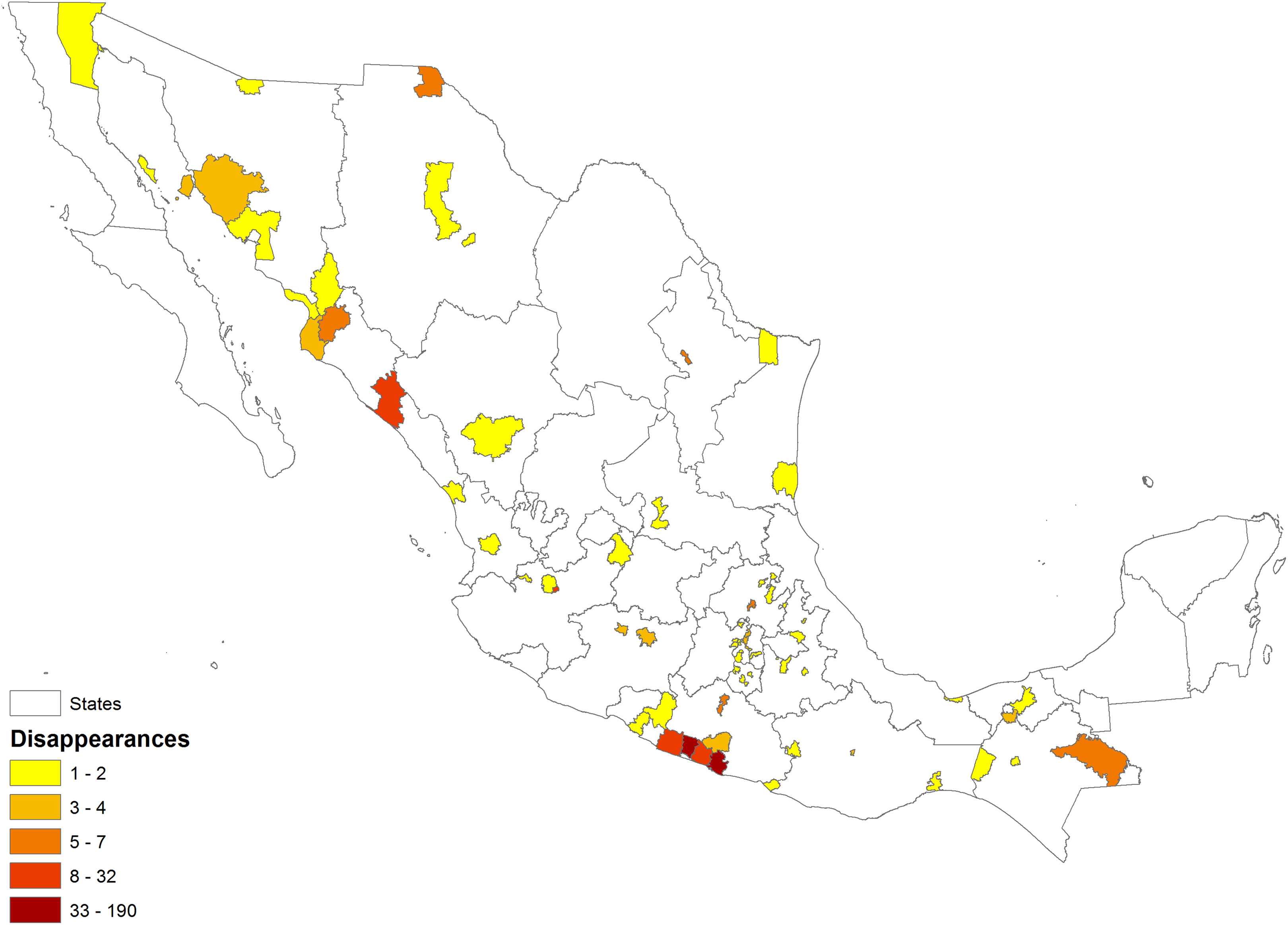
We use these detainee registries to develop our disappearances data, coded as follows: When an individual was detained by security officials, a DFS official filled out a biographical sketch. The document included socio-economic information such as the prisoner’s religion, languages, political affiliation, and ideological affinity. The back of the document contained general observations, as well as the date and motivation of detention. (Doyle, 2006)
We acknowledge these data are not without problems. It is impossible to know if these data represent the
Temporal distribution of forced disappearances in Mexico, 1972–88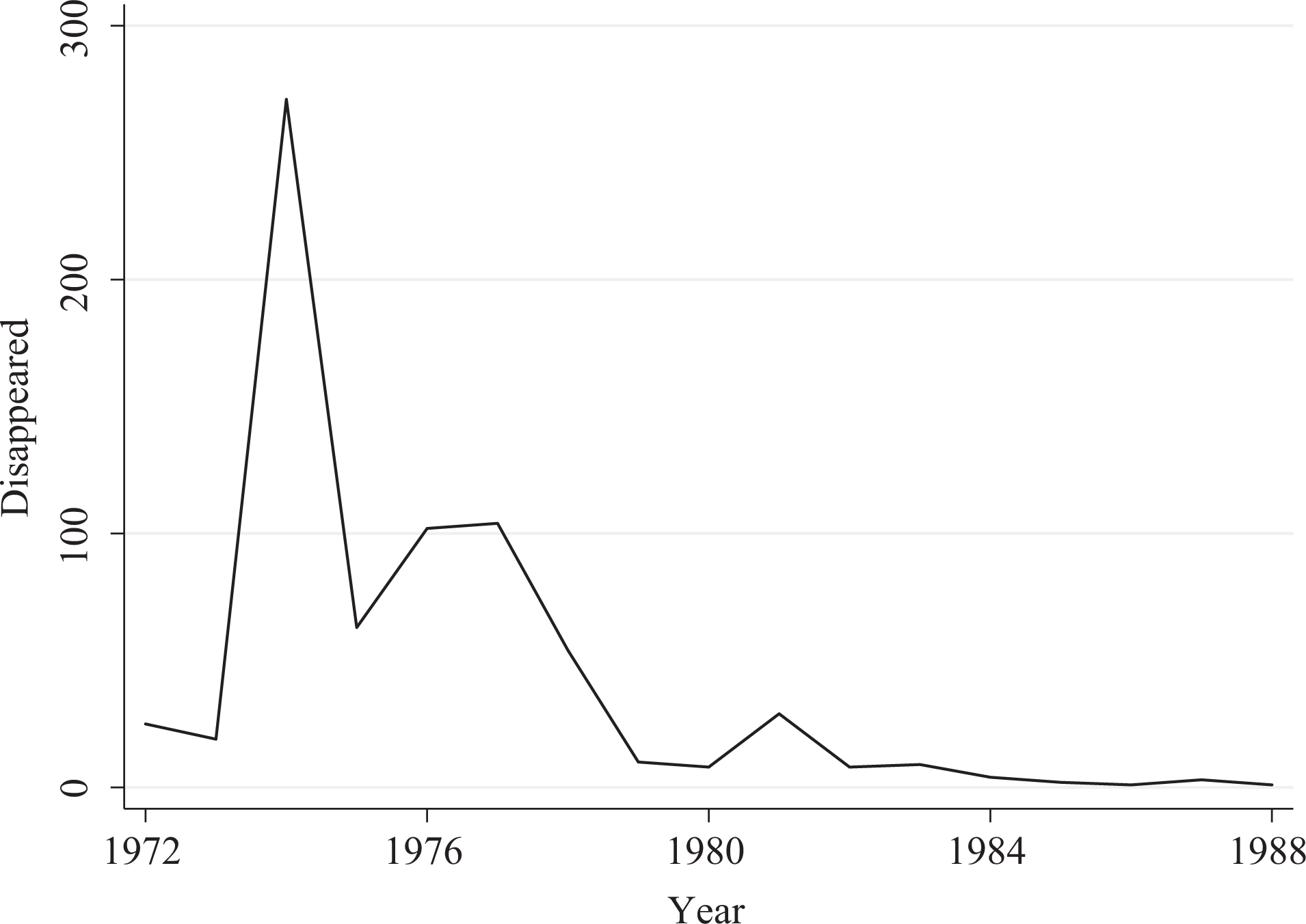
Dependent variables: Measuring state capacity
Our dependent variables capture our conceptual categories of state capacity: collective, legal, fiscal, territorial, and security. 5 Since we test our hypotheses about the impact of disappearances on multiple measures for most outcome types, we also note which results are stable to adjustments for multiple testing using the Bonferroni correction. 6
Collective capacity
We consider three indicators. First, following Lee & Zhang (2013), Myers is an indicator of state capacity based on the prevalence of incorrect age reporting (Myers, 1940), using municipal-level population data from the 2010 census (INEGI, 2010). 7 The Myers score indicates deviations from the naturally occurring smooth age distribution, detectable in data clustering for ages that end with the digits 0 and 5. The assumption is that these digit preferences arise from a lack of knowledge about one’s true age, indicative of poor public goods provision, in particular schooling (Lee & Zhang, 2013). A high Myers score indicates weak collective state capacity, while a low score suggests strong collective state capacity. Second, Welfare is an indicator of collective capacity that measures the percentage of the population living in poverty in each municipality that receives any federal welfare assistance, with data taken from Mexico’s Development Ministry (SEDESOL, 2016) and measured in 2015–16. High values indicate strong state capacity to deliver welfare goods, while low values indicate feeble capacity. The third indicator of collective capacity is Prospera, a measure of municipal coverage of Mexico’s conditional cash transfer program. This variable measures the percentage of a municipal population living in poverty that benefits from this cash transfer program. Similar to Welfare, high values indicate high state capacity to deliver benefits to vulnerable populations, while low values reflect poor capacity.
Legal capacity
We use two measures to assess state legal capacity. First, Regulation captures the extent of development of local legal frameworks. These data come from a 2012 Mexican Ministry of the Interior study (Secretaría de Gobernación, 2014) measuring how many of the 17 regulations mandated by the Mexican Constitution each municipality has in place, which include public works, street cleaning, waste disposal, public security and safety, and so forth. High values are indicative of strong legal capacity of municipal institutions, while low values reflect weak legal capacity.
The second measure of legal capacity is captured in Plans. This metric captures the extent to which the municipal public administration operates according to strategic planning and evaluation elements as part of its regular activities, with data from the National Census of Municipal and Delegation Governments, created in 2012 by the Mexican census bureau (INEGI, 2013). Plans is a weighted index of strategic planning. High scores indicate strong planning capacity, while low scores indicate weak planning capacity.
Fiscal capacity
Our operationalization for tributary capabilities depends on a single measure of Taxes. Municipalities in Mexico have limited tax collection authority, mainly restricted to levying property taxes and charging for water provision. Taxes captures the percentage of total municipal income generated from the sum of property and water taxes in 2014, using data from INEGI (2016). A high percentage indicates strong fiscal capacity, a small percentage weak fiscal capacity.
Territorial capacity
We rely on three measures to assess the territorial reach of the state. First, Roads indicates the density of the paved road network at the municipal level, in kilometers per square kilometer of territory, measured in 2015. High values indicate strong state territorial capacity, while low values indicate weak state territorial capacity. We consider two additional measures for this concept. Federal offices and Municipal offices refer to the number of buildings that host offices of federal or municipal government agencies, measured in 2014, using data from INEGI (2014). The catalog of federal and municipal government offices covers the full range of government activities, ranging from public theaters to fire stations to the National Archive building and military barracks. A high value on the government offices variables indicates strong territorial capacity, while a low score indicates low state territorial presence.
Security capacity
In order to assess the capacity of the state to provide security, we consider four different measures. The first, Police, reflects the number of municipal police officers per capita on active duty at the municipal level in 2012, drawn from INEGI (2013). We advise caution when interpreting the measure of police officers: large numbers of police officers need not mean high state capacity to provide security. This is the case in violence-ridden locations such as Acapulco, Guerrero or Ciudad Juárez, Chihuahua, which concentrate large numbers of police officers without necessarily providing much security. For this reason, we interpret the number of officers as the capacity of municipal governments to engage in or threaten coercion.
The second variable measures the number of alleged Human rights violations per capita conducted by security forces – including the army, navy, police, and prosecutor’s office – in 2015, with municipal data taken from the Mexican Human Rights Commission (CNDH, 2016). High values indicate state use of coercive violence, while low values reflect its absence.
The third measure relates to the number of drug trafficking organizations (DTOs) active in a municipality in 2010, with data from Osorio (2015). We interpret this variable in a Weberian manner, as a failure to monopolize the use of legitimate violence. High values indicate municipalities with poor state capacity to provide security, ravaged by multiple criminal groups, while low values indicate a state monopoly on violence.
Finally, Homicides captures the number of intentional homicides per 100,000 inhabitants at the municipal level, measured in 2013 using data from Mexico’s Sistema Nacional de Seguridad Pública (SNSP, 2015). We interpret this measure as a lack of security provision. High values refer to municipalities in which government authorities cannot provide public security, whereas low values indicate strong state security capacity.
Control variables
The analysis below includes several pre-disappearances variables. 8 We use these variables to control for factors that could influence both the occurrence of forced disappearances and state capacity in the long run, hence biasing our results if omitted. We refrain from including post-disappearances data to prevent post-treatment bias (Montgomery, Nyhan & Torres, 2017). As noted above, many of our control variables were built by applying modern research techniques to process historical information, or were excavated from old databases. 9
We group pre-disappearances variables into six categories. First, to control for the ‘supply’ of dissident groups, we include Leftist organizations, both peaceful and armed, active prior to 1972. Because state repression may have been endogenous to the supply of local contestation by leftist groups – the principal challengers to state authority – it is important to control for such activity. Ours is the first attempt to construct a quantitative dataset of leftist activity in Mexico during this period.
Second, to capture legacies of violence that might affect both dissent and state repression and local state capacity, we include dummies for the presence of prior rebellions and external invasions. Overlaying old maps from García de Miranda & Falcón de Gyves (1972) and Vanderwood (1992: 123) onto municipal shapefiles, we include data on independence campaigns from the early 19th century: Hidalgo and Allende (1810–11), Morelos (1810–15), Mina (1817), and Guerrero insurgencies (1816–21). We also include activities during the War of the French Intervention, and the presence of rural police forces (Los Rurales) in 1910, at the beginning of the Mexican Revolution.
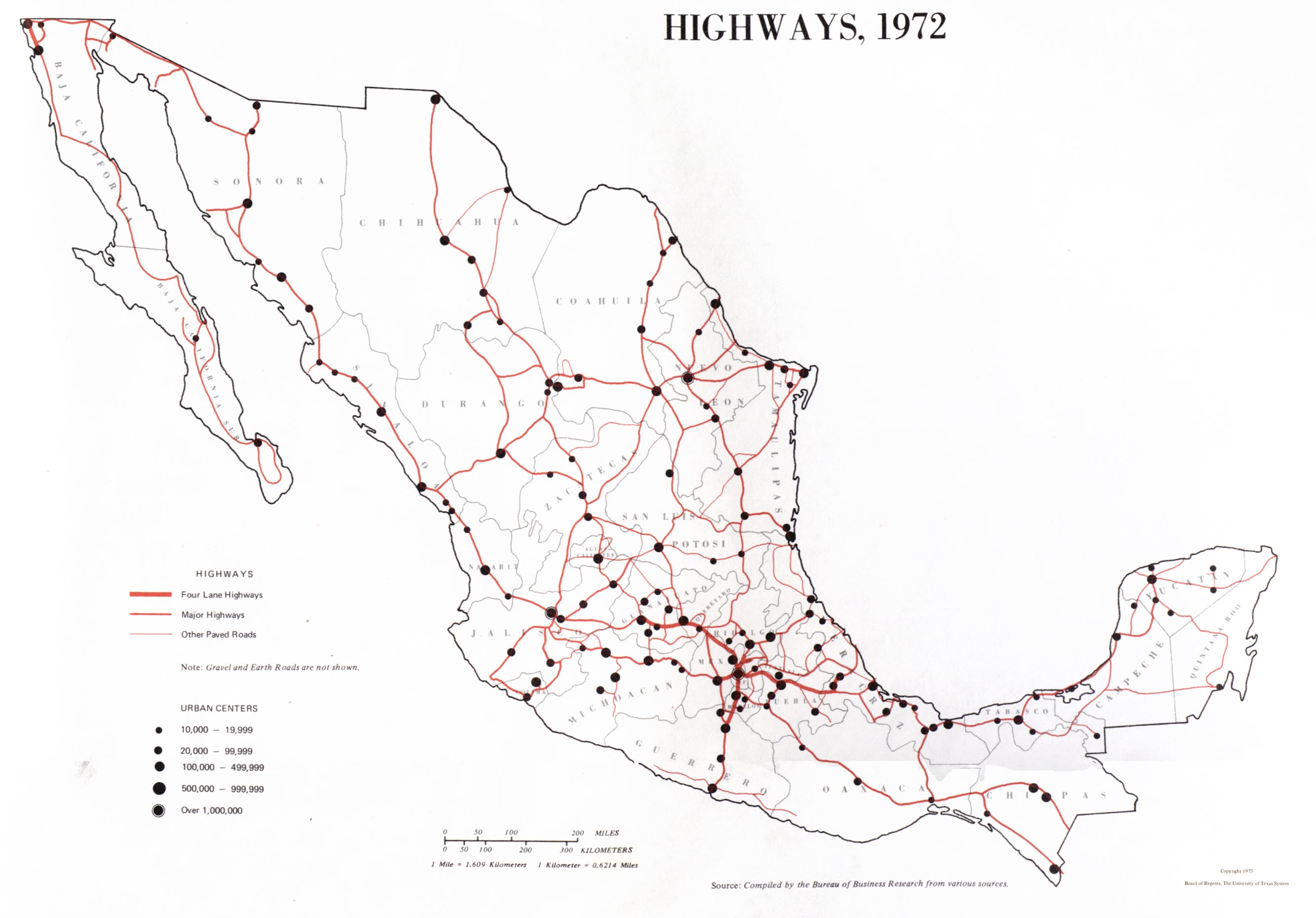
Third, we include data on infrastructure, which proxies for historical patterns of state reach, likely to confound the relationship between forced disappearances and state capacity. We include Railways, a dichotomous variable measuring municipalities crossed by railroads in 1919, and Telegraphs, coding municipalities that had telegraph lines in 1919, both drawn from Great Britain Naval Intelligence Division maps that we digitized and geo-referenced (Naval Intelligence Division, 1919). Digitizing a map from Research Bureau of Business (1975), we also create a measure of Road density in 1972 at the municipal level, providing another measure of the state’s ability to reach populations outside of state capitals.
Fourth, we include sociodemographic data from 1960, prior to the Dirty War. These variables include Population size, percentage of Youth (ages 18–35), percentage of Rural population, percentage of Illiteracy, and Unemployment rates with data from the Mexican census bureau (INEGI, 1960).
Fifth, we include disaggregated gross domestic product (GDP) in 1970 from a variety of economic sectors, with data from INEGI (1970), helping to capture demographic and economic characteristics that might shape the propensity for armed contestation, state willingness to repress, and state capacity in the long run.
Finally, we include geographic information such as Elevation and Distance to Mexico City, which help express the state’s ability to reach individual municipalities, as well as regional dummy variables, with data from INEGI (2011), to accommodate heterogeneity between regions.
Results
Table I tests the relationship between forced disappearances and state capacity using an ordinary least squares (OLS) estimator on municipal-level cross-sectional data. To facilitate interpretation, we discuss the findings in terms of marginal effects. First, Models 1–3 explore the effects of disappearances on state collective capacity. After controlling for confounders, forced disappearances are associated with fewer PROSPERA welfare disbursements. According to estimates from Model 3, increasing Disappearances from its minimum (0) to maximum (5.25) reduces PROSPERA coverage by 16.6 percentage points. In contrast, there appears to be no effect on either state collective capacity, measured by the Myers score (Model 1), or the overall welfare measure (Model 2). While the sign on Myers indicates a positive effect of disappearances on state collective capacity – which runs against our expectations – the lack of a statistically significant relationship between Disappearances and that variable, as well as with Welfare, renders these results inconclusive. Moreover, results for the collective security measures are not significant once the Bonferroni correction for multiple testing is applied.
Focusing on the legal dimension of state strength (Models 4 and 5), the results suggest that forced disappearances enhance the government’s regulatory capacity and increase the use of strategic planning and program evaluation. Increasing Disappearances (log) from its minimum to its maximum increases the extent of municipal compliance with constitutional regulations by 48.2 percentage points, and increases the adoption of strategic planning in local government activities by 23.7 percentage points. Consistent with theoretical expectations, past forced disappearances strengthen the bureaucratic structure of government agencies. These results are robust if we apply the Bonferroni correction for multiple testing.
Contrary to our expectations, results from Model 6 indicate that disappearances tend to increase the state’s extractive capacity: increasing forced Disappearances from its minimum to its maximum is associated with an increase of 9.6 percentage points in the share of municipal income derived from local taxes. This is surprising: we anticipated that lower levels of trust would inhibit tax collection. While the magnitude of the effect seems small, due to the centralized character of the Mexican fiscal system, municipalities are only allowed to collect taxes from property and water provision, which constitute a comparatively small fraction of municipal income.
Effect of disappearances on state capabilities
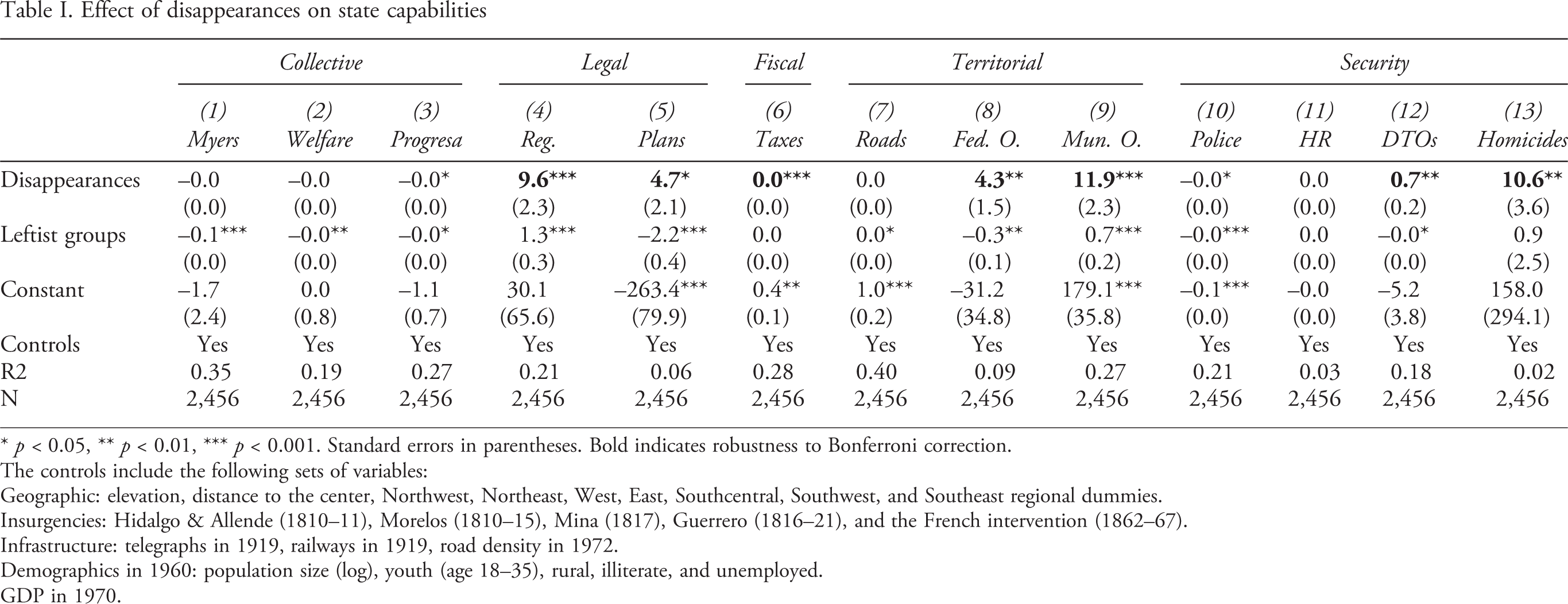
* p < 0.05, ** p < 0.01, *** p < 0.001. Standard errors in parentheses. Bold indicates robustness to Bonferroni correction.
The controls include the following sets of variables:
Geographic: elevation, distance to the center, Northwest, Northeast, West, East, Southcentral, Southwest, and Southeast regional dummies.
Insurgencies: Hidalgo & Allende (1810–11), Morelos (1810–15), Mina (1817), Guerrero (1816–21), and the French intervention (1862–67).
Infrastructure: telegraphs in 1919, railways in 1919, road density in 1972.
Demographics in 1960: population size (log), youth (age 18–35), rural, illiterate, and unemployed.
GDP in 1970.
Finally, the analysis of security capabilities in Models 10–13 indicates that forced disappearances do not improve state capacity to provide security in the long run. Model 11 suggests that historical forced disappearances have no effect on the rate of state human rights violations. In contrast, Model 10 indicates that past disappearances seem to reduce the number of police officers per capita at the municipal level. Increasing Disappearances from its minimum to its maximum reduces by 0.0018 the number of police officers per capita, a drop of about three standard deviations. Model 12 indicates that forced disappearances tend to increase the number of drug trafficking organizations (DTOs) at the municipal level. Moving Disappearances from its minimum to its maximum is associated with an increase of 3.5 DTOs in a given municipality in the long run. In addition, Model 13 shows that locations that suffered intense state repression tend to experience more homicides in the present. Increasing Disappearances from its minimum to its maximum is related to an increase of 53 homicides per 100,000 inhabitants. This is substantively an extremely large effect. Our results for the DTO and homicide outcomes are robust to Bonferroni adjustments as well.
Matching and sensitivity analysis
One concern with our main results is unobserved confounding: what if some variables influencing both disappearances and state consolidation have been left out? We address this issue by conducting Rosenbaum sensitivity analysis (Rosenbaum, 2002; Keele, 2010) based on 1:1 genetic matching without replacement, using a binary indicator of the disappearances variable and the same covariates as listed above (Sekhon, 2011). 11 Sensitivity analysis allows us to assess the impact an excellent unobserved predictor of the dependent variables would need to have on the odds of a unit being assigned to forced disappearances in order to explain away our results in terms of statistical significance. The results of both the genetic matching and the sensitivity analysis can be found in the Online appendix. To summarize, our main substantive findings are reasonably robust to non-parametric estimation with a binary indicator, as well as moderate to very high levels of unobserved confounding.
Survey evidence on trust and political participation
An observable implication of our argument is that forced disappearances undermine individuals’ trust in the government and political participation, thereby hobbling the state’s ability to improve its capacity across different dimensions. Using the Encuesta Nacional sobre Cultura Política y Prácticas Ciudadanas, ENCUP (Secretaría de Gobernación, 2012), we look for indications that respondents living in municipalities with more historical forced disappearances tend to have less trust in state institutions and lower social mobilization capacities. The results, found in the Online appendix, suggest that levels of trust in the president, the police, and political parties are significantly lower in municipalities with more historical forced disappearances compared to those with fewer disappearances. Results also suggest that respondents living in areas affected by forced disappearances consider it to be more difficult to self-organize in order to solve a common problem than respondents living in localities not affected by disappearances. This suggests that forced disappearances undermine citizens’ trust in the government and social mobilization capacity over the long term.
Conclusion
This article has argued that state repression, particularly forced disappearances, has lasting effects on state consolidation. In contrast to the traditional literature on state-building, and in line with more recent studies that disaggregate by types of violence, we contend that repression is not likely to have purely positive or negative effects on state consolidation. Our results suggest that the number of forced disappearances of alleged leftist dissidents is positively correlated with various forms of state consolidation in Mexico over the long term, yet we also find that this partial consolidation comes at the cost of undermining the contemporary provision of security and potentially also welfare-related public goods. Such a nuanced approach to understanding the historical roots of contemporary state consolidation is necessary: approaches that interrogate the conditional role and heterogeneous effects of state repression – buttressing some aspects of state consolidation while eroding others – will help scholars understand the contentious legacies of human rights abuses perpetrated by repressive governments.
Our study is the first to examine the long-run effects of disappearances in Mexico, and we rely on historical data not accessed by social scientists before. More research is needed, however, to assess the internal and external validity of our findings. In terms of internal validity, our results may not be indicative of causal effects. Future efforts should be dedicated to research designs that enable researchers to make strong causal claims. The same holds true for causal mechanisms. For example, while we suggested that reduced trust in state authorities represents one key mechanism through which forced disappearances weaken state capacity, weak state capacity itself is likely to undermine trust; future research should explore these dynamics in greater depth. In terms of external validity, we assume our findings are potentially generalizable to other episodes of forced disappearances and their aftermath in authoritarian states, but much more research is needed to evaluate whether our claims here are likely to travel to cases of full-blown civil war.
We envision a number of specific additional paths for future research. Because of data scarcity, we are unable to conclude to what extent other forms of state repression used alongside forced disappearances are responsible for the correlations we demonstrate. While it is unlikely that data on targeted killings, forced displacements, sexual violence, and other forms of repression from this period in Mexico’s history will be released, and while we have been prevented from accessing data in Mexico that could potentially help to answer such questions, looking to other cases could help clarify whether the results we present here are driven primarily by forced disappearances and/or other forms of state repression that accompanied disappearances.
Our measures of state capacity could be further scrutinized, expanded, and refined, as well. Legal capacity as measured here, for example, does not necessarily imply strong rule of law or low levels of corruption, which would be important outcomes to explore.
Finally, our study adds to a growing literature that relies on the quantitative analysis of data initially presented in cartographic or qualitative form, demonstrating that archival research need not mean exclusively relying on traditional approaches. We encourage a combination of ‘new’ and ‘old’ techniques such as machine-coding, manual coding of human rights reports, and digitizing cartographic depictions of political and economic phenomena, as fruitful avenues for gathering, analyzing, and interpreting existing archival data. As with all careful social scientific work, however, it is incumbent upon researchers to engage in source criticism, to triangulate data sources, and to understand the latent or overt biases reflected in such sources. We have begun that process here, but more steps are necessary, beyond providing access to source documents, allowing others to judge for themselves whether coding decisions were appropriate and the original documents sufficiently trustworthy. Researchers ought to hew to what we hope will become an accepted set of best practices for archival research (Balcells & Sullivan, 2018). We are confident that social science, and in particular peace and conflict studies, will be better off with the incorporation of advanced quantitative methods for archival work on violence, increasing our knowledge of complex political phenomena such as the legacies of state repression.
Replication data
Replication data - Disappearing dissent? Repression and state consolidation in Mexico
Replication data for Disappearing dissent? Repression and state consolidation in Mexico by Javier Osorio, Livia I Schubiger & Michael Weintraub in Journal of Peace Research
Replication data
Replication data, JPR751035_appendix - Disappearing dissent? Repression and state consolidation in Mexico
Replication data, JPR751035_appendix for Disappearing dissent? Repression and state consolidation in Mexico by Javier Osorio, Livia I Schubiger & Michael Weintraub in Journal of Peace Research
Footnotes

References
Supplementary Material
Please find the following supplemental material available below.
For Open Access articles published under a Creative Commons License, all supplemental material carries the same license as the article it is associated with.
For non-Open Access articles published, all supplemental material carries a non-exclusive license, and permission requests for re-use of supplemental material or any part of supplemental material shall be sent directly to the copyright owner as specified in the copyright notice associated with the article.