







Abstract
How does large-scale land reform affect electoral stability and the prospects for election violence? While scholars have theorized elite-level logics of land distribution, few studies analyze the effects of land reform on the attitudes of ordinary citizens, and the implications such reforms have for electoral violence. The article uses an original survey and qualitative interviews in coastal Kenya to examine the effects of the Kenyan government’s recent land titling campaign, the most ambitious and extensive since independence. It theorizes and tests the micro-mechanisms through which the selective distribution of land rights in the pre-electoral period heightens or lowers the stakes of an electoral outcome by altering levels of political trust and perceived threat. Results indicate that title deed beneficiaries are more likely to trust political institutions than non-beneficiaries. Yet, while title deed recipients are more likely to trust state institutions, they are also more likely to fear the electoral process compared to non-beneficiaries. The findings reveal how the perceived stakes of an election can vary across local spaces. Where political trust is low and threat is high, citizens may view elections as particularly high-stakes events and, thus, may be more willing to take on the costs of participation in violence to ensure their preferred political outcome, or to defend themselves against anticipated attacks.
Introduction
In recent years, scholars of democratization and political violence have turned to the phenomenon of electoral violence, focusing on the broad institutional and ethnic configurations that make violence more likely (Birch & Muchilinski, 2017). Existing theories tend to emphasize the strategic calculations of national elites (Hafner-Burton, Hyde & Jablonski, 2013; Wilkinson, 2004), constitutional design, electoral rules and election type (Fjelde & Höglund, 2016; Daxecker & Rauschenbach, 2019), state capacity (Brancati & Snyder, 2011), ethnic polarization and exclusion (Eifert, Miguel & Posner, 2010; Brosché, Fjelde & Höglund, 2020), and the role of international observers (Daxecker, 2012). Many of these studies suggest that election violence is more likely where the perceived stakes of an election are high (Boone, 2011). Yet aside from a few notable studies on electoral systems (Fjelde & Höglund, 2016) and party competition (Wilkinson, 2004), scholars know very little about how local-level factors affect perceived electoral stakes. This article addresses this question by examining how state-led distributive policies mitigate or exacerbate such stakes. It examines one potentially powerful distributive good: the selective allocation of title deeds to individuals. As existing research on electoral violence observes, in contexts where tenure institutions are weak and land provides a source of livelihood and identification, the distribution and enforcement of land rights can be a highly contentious and divisive political process (Boone, 2011; Dercon & Gutiérrez-Romero, 2011; Klaus, forthcoming). Yet rather than predict the likelihood of election violence, the article examines the micro-mechanisms through which the distribution of land rights alters the stakes of an election, raising or mitigating the likelihood for violent conflict. It does so by focusing on how the acquisition or loss of land rights in the pre-electoral period shape an individual’s level of political trust and perception of election-time threat.
A large literature in political economy considers the logics of distribution, focusing on the strategic targeting of social services and material goods. Scholars of African politics, for example, emphasize the role of ethnic identity in shaping both the provision of public goods and voter expectations of distributive returns (e.g. Nathan, 2016). Other studies analyze how elites grant or withhold property rights to consolidate political support or suppress rebellion (Boone, 2014). Yet, while theories of distributive politics and election violence provide insight into the incentives of political elites, few studies specify how such strategies shape the attitudes and beliefs of ordinary citizens and how these changes can alter the possibilities for electoral violence.
Drawing on studies of land politics, electoral violence, and clientelism, I examine the mechanisms through which the distribution of land rights affects political trust and perceived threat. Observing changes in trust and threat can have implications for predicting the local spaces that are more vulnerable to electoral violence. Broadly, I argue that gaining or losing land rights alters the perceived stakes of an election by changing an individual’s level of political trust or perceived threat. By ‘stakes’, I refer to the ways that individuals link elections with their ability to secure property, resources, services, and livelihood. Elections in much of Africa are particularly high stakes events due to the persistence of patron–client politics, whereby citizens believe that the electoral loss of their political patron translates into their inability to secure essential goods and services (e.g. Posner, 2005; Söderberg Kovacs & Bjarnesen, 2018). As Fjelde & Höglund (2016) observe, the ‘winner takes all’ structure of majoritarian elections heightens this zero-sum view of elections. The possibilities for election violence are thus higher where elites and citizens alike view elections as high-stakes moments (e.g. Höglund, 2009; Daxecker, 2012).
To evaluate this argument, I examine the effects of a highly ambitious title deed distribution program carried out by the Kenyan government between 2013 and 2017. Rather than test a set of predictions, this article serves as a plausibility probe to explore a set of micro-mechanisms that may alter the stakes of an election. The analysis draws on data from an original survey that I conducted in Kenya’s Coast region in the month preceding the country’s August 2017 general election. As the 2017 general election approached, the Jubilee Administration claimed to have issued 3.2 million title deeds across the county (Kenya Land Alliance, 2018). This number compares to the 5.6 million title deeds that the government issued over the preceding 50 years since gaining independence (1963–2013). This surge in land titling in the lead-up to Kenya’s 2017 election offers a critical moment to analyze the effects of this program by comparing the attitudes of title deed beneficiaries with non-beneficiaries. I sampled respondents in three sites across Kwale county: (1) those where the state expropriated land rights; (2) where the state issued title deeds; and (3) where there no significant change in tenure status. In addition, because Kwale county is ethnically homogenous, sampling within the county enables me to better observe the independent effects of title deed allocation or eviction. I find that title deed beneficiaries are, overall, more likely to trust state and electoral institutions compared to non-beneficiaries and those who have lost land rights. Yet, while title deed recipients are more trusting of state institutions, they are nonetheless more likely to see elections as moments of threat compared to non-beneficiaries.
This article aims to contribute to scholarship on elections and violence. Some of these studies examine the effects of vote-buying and electoral violence on voter behavior (e.g. Bratton, 2008; Gutiérrez-Romero, 2014; Höglund & Piyarathne, 2009), focusing primarily on how the exchange of gifts or the threat of violence alters vote choice and turnout. Gutiérrez-Romero & LeBas (2020), for example, find that for most voters, the use of election violence erodes rather than bolsters support for a given candidate. 1 A related set of studies examines elite decisions to use electoral fraud, vote-buying, or intimidation (e.g. Mares & Young, 2016). For instance, Gonzales-Ocantos et al. (2020) find that parties may rely on intimidation where the cost of buying votes is prohibitively high. This article departs from these studies in important ways. First, rather than focus on vote-buying as the exchange of money or gifts, it analyzes the effects of land titling, which represents a distinct form of political exchange. In theorizing this exchange, it engages with a set of studies focusing on the power of patronage networks (Berenschot, 2020) and, more specifically, the use of land distribution as a patronage good (Boone, 2014; Onoma, 2010). Second, rather than explain the form of electoral manipulation that elites use, or decisions on how and whether to vote, this article focuses specifically on the determinants of political trust and perceived threat that can alter the stakes of an election.
Further, the article theorizes the mechanisms through which pre-electoral campaigns around land titling affect electoral stability, either by increasing people’s trust in the state and the rules of the game, or by increasing one’s perception of a ‘rigged game’ in which an individual may continue to lose. While there was not widespread election violence during Kenya’s 2017 election, particularly in the region where I locate my analysis, a focus on these micro-mechanisms is key for identifying spaces that may be vulnerable to future violence.
The article is organized as follows. I begin by presenting a set of hypotheses about the potential effects of gaining or losing land on trust in political institutions and threat perception. I then provide a brief background on land distribution and electoral violence in Kenya and proceed to present the research design and methodology, followed by a discussion of key results.
Changing land rights, political trust, and perceived threat
In the discussion that follows, I outline a set of predictions about how changes in land rights in the pre-electoral period can alter political trust and perceived threat. I begin with the proposition that where individuals gain land rights in advance of an election, these individuals should be more likely to trust state institutions compared to individuals who experienced no change in their land rights. While title deed beneficiaries should have greater trust in the state’s ability to fulfill key mandates, this trust does not inoculate citizens from fears of losing land to rival players, be they jealous neighbors, political opponents, or other ‘specialists in violence’. Title deed beneficiaries become more risk-sensitive compared to individuals whose land rights remain unchanged. Beneficiaries are thus more likely to see elections as a potential threat to their newly acquired tenure gains. Further, land rights are often distributed unevenly within or between communities. This uneven distribution of land rights can exacerbate within- and between-group inequality, igniting grievances among non-beneficiaries (Albertus & Kaplan, 2013). Cognizant of these grievances, recipients of land titles may see themselves as more likely targets of violent land expropriation during elections.
By contrast, individuals who lose land rights in a pre-electoral period are less likely to express trust in political institutions compared to those who have not experienced a change in tenure status. They are also more likely to view elections as high-stakes moments compared to those whose land rights remain unchanged. The prospects for electoral violence may thus increase as non-beneficiaries exploit the electoral period to forcibly redistribute land rights in their favor, or as title deed beneficiaries use violence to defend newly acquired gains.
While political trust and perceived threat are the main outcomes of interest, observing such changes has important implications for the ways in which citizens view the stakes of a given election. Specifically, where political trust is low and threat perception is high, citizens may be more likely to view an upcoming election as high-stakes. Yet where there are higher levels of political trust and threat perception – as should be the case among title deed recipients – political trust may moderate perceived electoral stakes. Where citizens are more trusting in state institutions, they should be more willing to accept the results of an election, and less willing to engage in violent forms of collective action to protest election results. Where trust is low, violent protest can provide participants with a means of demanding a desired political outcome such as a recount or a power-sharing agreement, or protecting ‘a reliable patron’ (Taylor, Pevehouse & Straus, 2017). Violence can also provide a means of defending property or forcibly re-allocating land rights. The stakes may be lowest, meanwhile, where there is some degree of political trust and low threat perception – as should be the case among citizens who have not experienced a change in their land rights in the pre-electoral period.
Trust in political institutions
This section theorizes the effects of losing or gaining land rights on political trust. Political trust matters because it can bolster state legitimacy (Miller & Listhaug, 1990). Yet, where citizens do not trust formal political institutions to implement or provide desired policies or services (e.g. free and fair elections), individuals may turn to ‘non-institutionalized’ forms of political participation, including violent protests, to advocate for their preferred political or policy outcome (Birch, 2010).
A growing literature examines the factors influencing political trust and, in particular, trust in the electoral process (e.g. Birch, 2008; Norris, 2013). Many of these studies focus on how factors at the macro level shape individual-level perceptions, including regime performance (Hutchison & Johnson, 2011), quality of the election dynamics (Frank & Martínez i Coma, 2017), and electoral management institutions (Kerr, 2013). Other studies focus specifically on land rights and political trust. For example, Bezabih, Kohlin & Mannberg (2011) find that that the Ethiopian government’s land certification program bolstered political trust among a previously skeptical public.
Few studies, however, specify the more micro-level factors that can help explain why citizens within the same subnational space might interpret elections differently. One explanation is that partisanship affects political trust. Yet, while partisanship may explain variation in trust across groups nationally, it is less clear why variation in trust emerges among citizens who have shared the same party preferences historically. In such contexts, partisanship is most likely endogenous to receiving or losing land rights. This is partly because the state’s recognition of one’s land rights is a politically powerful act and form of political recognition. For the recipient, this act of political recognition – of being fully incorporated into the state – should bolster political trust. Further, while the enforcement of property rights is a political process that occurs over time, voters are likely to make inferences about the commitment and capacity of the state based on provision of the title deed. Hence, political trust should increase for title deed beneficiaries, not simply because they have received something from the state, but because the formalization of land rights signals the state’s capacity and political commitment. Title deed beneficiaries should thus be more likely to trust in the state’s capacity and incentive to conduct elections fairly (Mozaffar & Schedler, 2002). Conversely, citizens who have experienced eviction may interpret such acts as a form of political betrayal – a signal of the state’s ambivalence toward their rights to land and livelihood. These citizens may thus be more likely to see state institutions as biased and untrustworthy and, by extension, may be less likely to accept the defeat of a preferred candidate (Kerr, 2013). These individuals may also be more likely to rely on violence to demand a desired political outcome. This leads to the following observable implication:
H1: Citizens who receive title deeds from the state will be more likely to express confidence in state institutions and the electoral process compared to non-beneficiaries and individuals who have been evicted by the state.
Threat perception
This article also evaluates the effects of gaining or losing land rights on the degree of threat – to one’s land or livelihood – that individuals associate with an upcoming election. Analyzing variation in threat perception is particularly important in light of research suggesting that fear shapes ethnic conflict (Petersen, 2002), and that individuals have a stronger motive to participate in violence where they believe that electoral outcomes threaten their land security (Klaus & Mitchell, 2015).
Existing research provides a number of potential pathways through which the uneven allocation of land might heighten perceived threat. First, where there is sharp inequality between groups along with a majoritarian electoral system, title deed beneficiaries may be more fearful of elections because they see the legitimacy of the titling program as contingent on the incumbent remaining in power. Meanwhile, evictees will see electoral turnover as essential to reclaiming rights. Second, because the allocation of title deeds is often selective and localized, any distributive program is likely to generate or exacerbate local grievances and political cleavages between beneficiaries and non-beneficiaries (Østby, 2008). Albertus & Kaplan (2013), for example, find that where land reforms in Colombia were uneven, insurgent support increased among those excluded from land reforms. Where inequality in land rights is particularly sharp, non-beneficiaries may use violence to ‘re-allocate’ land rights. Individuals who view elections as a threat to their own land or livelihood may also be more likely to use violence defensively, striking out at potential rivals as a means of pre-empting violence targeted at their own household or community (Klaus, forthcoming). Political candidates can also exploit changes in land inequality to polarize communities, framing the out-group as benefiting through political favoritism at the expense of supporters. Hence, differentiation in land tenure may exacerbate ethnic tensions, particularly if non-beneficiaries view beneficiaries as ethnic or political rivals. This leads to the following hypothesis:
H2: Title deed beneficiaries and those who have been evicted will be more likely to see elections as moments of threat compared to those whose have neither gained nor lost land rights.
In sum, title deed recipients are likely to have fewer incentives to participate in contentious or violent forms of political action in the pre- or post-electoral period. Yet, as I note above, the uneven allocation of title deeds creates the potential for violence between beneficiaries and non-beneficiaries.
Land and violence in Kenya
Since British colonial rule, the allocation of land in Kenya has been highly centralized, meaning that political elites have had the power to allocate land to followers while undermining the land rights of challengers (Boone, 2014). Shortly after independence from Britain in 1963, the newly formed Kenya Africa National Union (KANU), led by President Jomo Kenyatta, created a land resettlement program that aimed to create a free market in land. The distribution of land plots and title deeds provided a valuable patronage source for political elites and disproportionately favored co-ethnic Kikuyus. This process fueled an enduring political narrative that frames Kikuyus as ‘migrants’ who have ‘invaded’ the ancestral land of less powerful groups. While the salience of this narrative varies temporally and spatially, it is nonetheless a dangerous one, providing a powerful tool for leaders to organize violence.
Election violence escalated before and after the re-introduction of multiparty elections in 1992 and again in 1997. In both elections, the incumbent party (KANU), led by Daniel arap Moi, used violence to ensure electoral victory. Political parties employed dangerous anti-outsider narratives that encouraged ‘natives’ to remove ‘outsiders’. Thousands of people were killed and hundreds of thousands displaced from contested political territory. Following the 2007 elections, violence escalated when the Electoral Commission of Kenya (ECK) declared Mwai Kibaki of the governing Party of National Unity (PNU) the winner of the presidential elections. 2 The main opposition party, the Orange Democratic Movement (ODM), disputed the results, citing massive vote fraud and encouraging supporters to take to the streets. Within minutes of the ECK announcement, violence had escalated across many regions of the country. Anger and frustration over the disputed elections provided the necessary trigger for violence. This collective anger over vote-rigging also underscores why the question of trust in electoral institutions – including EMBs, the police, and the courts – remains a critically important issue for future electoral stability. However, deeper-rooted narratives around rights to land offered a key strategy around which elite and ordinary citizens coordinated the use of violence (Klaus, forthcoming).
Fast forward: Land titling under the Jubilee government (2013–17)
Five years after Kenya’s post-election violence, the Jubilee government gained power. The party, a strategic coalition of former rivals (Kikuyu and Kalenjin), was elected through well-orchestrated appeals to restore peace and promote stability. Uhuru Kenyatta, a Kikuyu, pulled in former PNU voters, while William Ruto, a Kalenjin, gained the votes of many former ODM supporters.
Whether to maintain fragile political comprise, to broaden zones of political support, or to prevent future violence, the Jubilee government initiated the most extensive land titling program in the country’s history. In total, the government claims to have issued 3.2 million title deeds over a five-year period, although public records are available for only 1 million (Kenya Land Alliance, 2018). 3 The state’s decision to enforce or allocate land rights has worked to undercut the appeals of political opponents while expanding support beyond a coethnic core. Specifically, the Kenyatta administration’s decision to allocate title deeds has enabled the party to ‘reclaim’ the land issue from the opposition. In the post-Moi era, the opposition, led by Raila Odinga, gained moral authority over the lands issue, accusing the government of failing to address enduring landlessness. Yet, by conducting such a high-profile titling campaign across core and opposition zones, the government has arguably gained the upper hand.
The map in Figure 1 shows the number of titles issued during the first Jubilee administration (2013–17) at the county level, illustrating the spatial patterns of allocation. 4 Several counties received upwards of 200,000 title deeds while many others received less than 1,000. As the map indicates, the government issued a significant number of title deeds across core and swing counties (e.g. Machakos, Kitui), in addition to opposition strongholds in the western region of the country (e.g. Kisumu, Siaya), making it difficult to infer a single political or economic motivation shaping tile deed allocations.
Empirical strategy
The research design of this study aims to assess the independent effects of Kenya’s land titling program on individual-level political attitudes in the run-up to the Title deeds issued by Kenyan government (county level)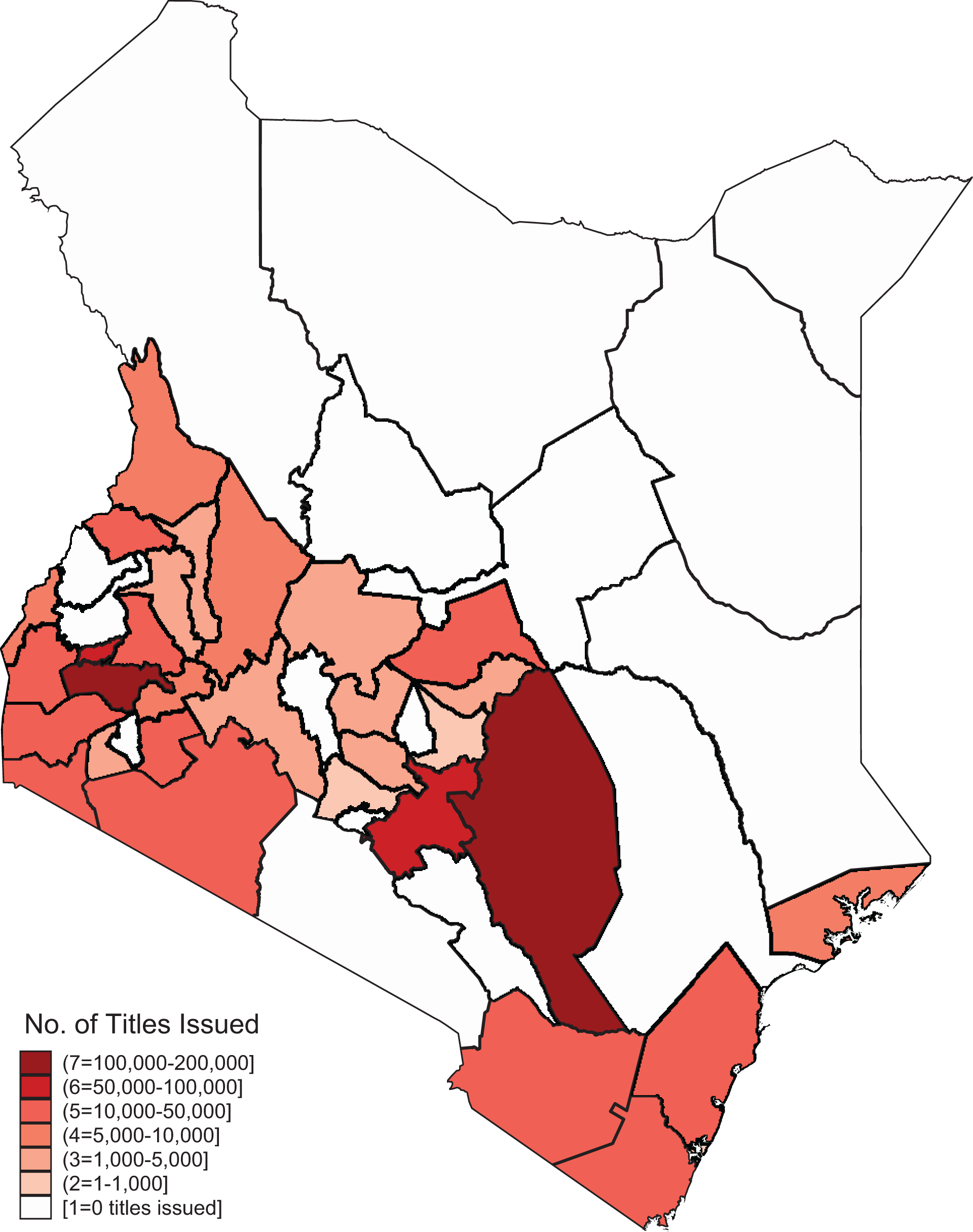
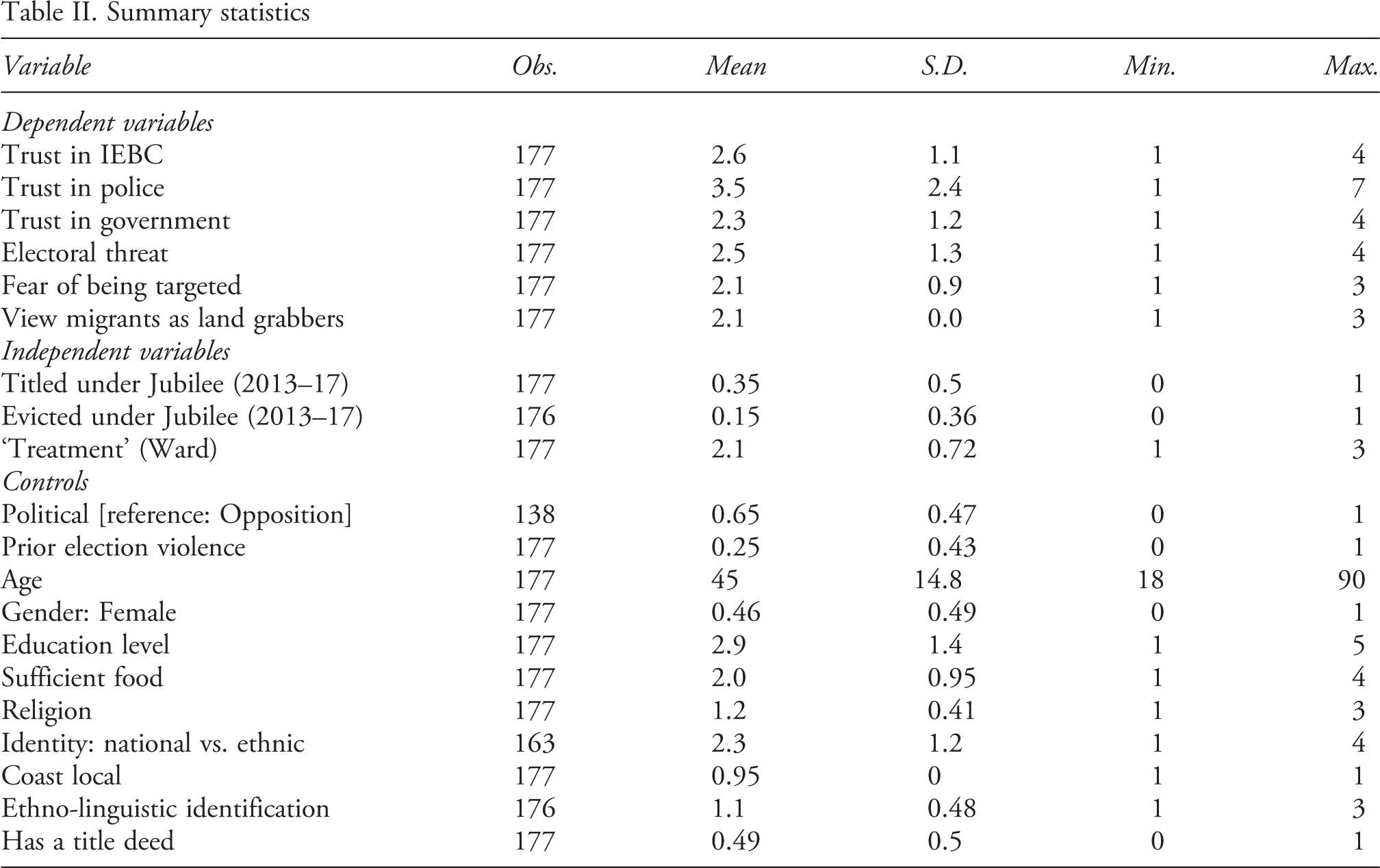
To analyze variation in exposure to land titling, I employed an observational survey with 177 respondents that purposefully stratified the sample into three distinct categories based on an area’s exposure to the Government’s land titling program (2013–17). Specifically, I compare responses across three electoral wards located in three of the county’s five electoral constituencies. In Ramisi ward, the government has facilitated the expropriation of residents’ land rights, largely as a way to clear land for a titanium mine and sugar company. In Kasemeni, most residents have received title deeds. Yet in Waa, there has been little change in the tenure status of residents. I summarize this case selection in Table I.
This comparative case design enables me to compare the varying effects of losing or gaining land on levels of political trust and perceptions of threat related to the election. At various points in the analysis that follows, I refer to the expropriation or distribution of land rights as ‘treatments’, which I compare to Waa, where the absence of titling and expropriation serves as a de facto ‘control’ group. Figure 2 illustrates the three case study sites. Table II provides the descriptive statistics, providing a profile of the sample population across several relevant dimensions.
Kwale county, the most southeast county in Kenya, provides an ideal geopolitical unit from which to select cases. First, there is little variation in ethnic or political identification across local electoral spaces. I outline these similarities in Table III. The table indicates that the majority of residents in each county identify as Mijikenda, the largest ethnic group along the Coast. Hence, because ethnic identity does not vary, I can be relatively confident that ethnic identity is not driving variation in the dependent variable. 7
Case selection

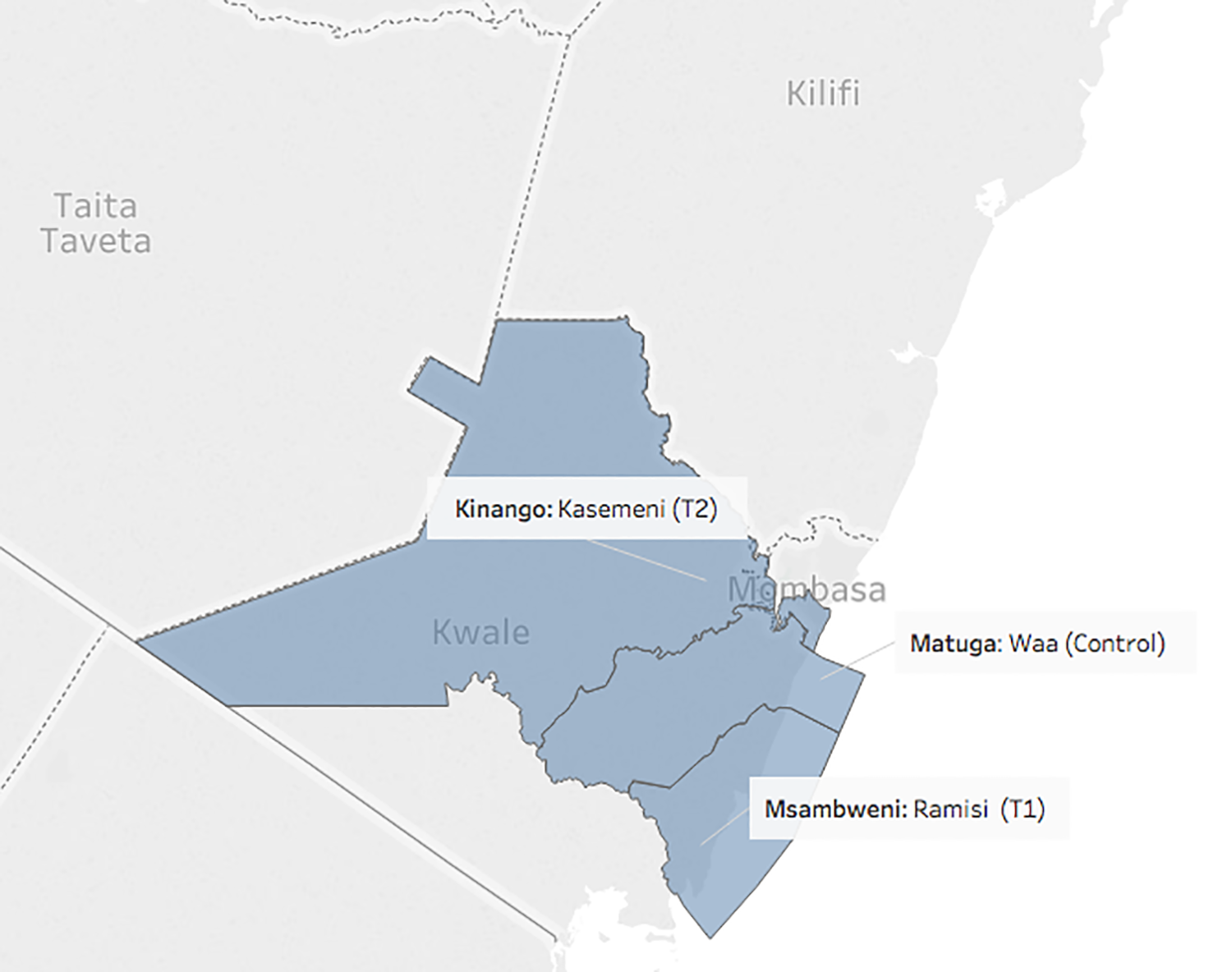
Map of case study areas
Summary statistics
Comparison of treatment and control groups
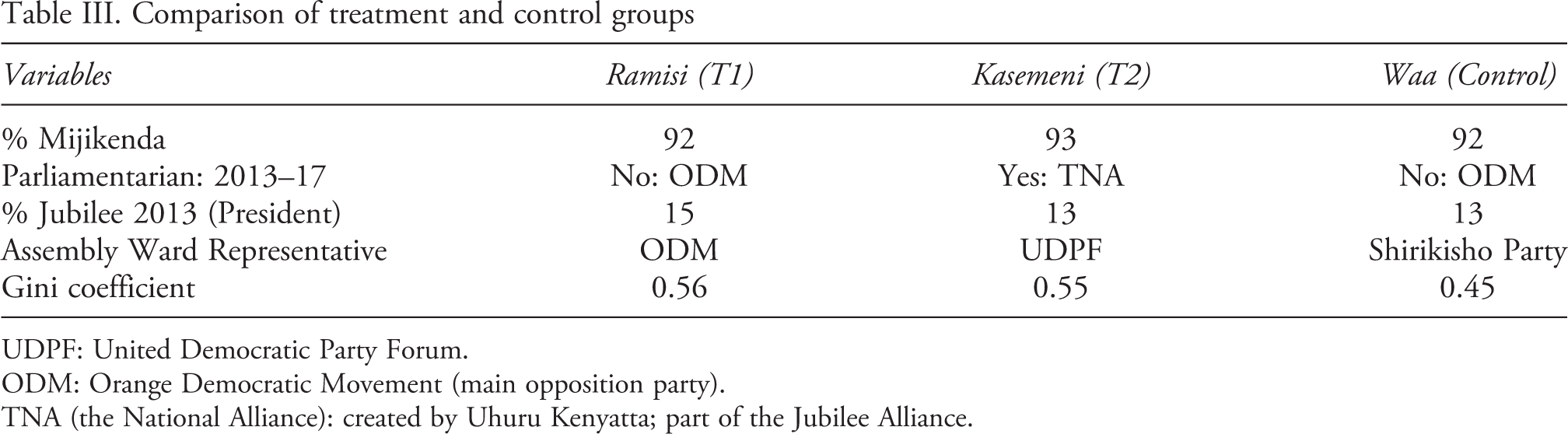
UDPF: United Democratic Party Forum.
ODM: Orange Democratic Movement (main opposition party).
TNA (the National Alliance): created by Uhuru Kenyatta; part of the Jubilee Alliance.
Dependent variables
I analyze two main outcomes: political trust and threat perception. I measure a respondent’s level of political trust along two dimensions. The first variable measures a respondent’s trust in Kenya’s electoral management body, the Independent Electoral and Boundaries Commission (IEBC). This variable comes from responses to the following survey question: ‘The IEBC is responsible for observing and monitoring the election process to ensure free and fair elections. On a scale from 1 to 7, where 1 means no trust and 7 means a lot of trust, how much do trust the IEBC to ensure free and fair elections?’ Second, I measure the degree to which a respondent trusts the current government to resolve land issues in their particular community. 9 For measures of threat, I rely on two survey questions. The first asks: ‘On a scale from 1 to 7, how much do you see this election, or the outcome of the election, as a threat to your livelihood, security, or well-being of your family and community?’
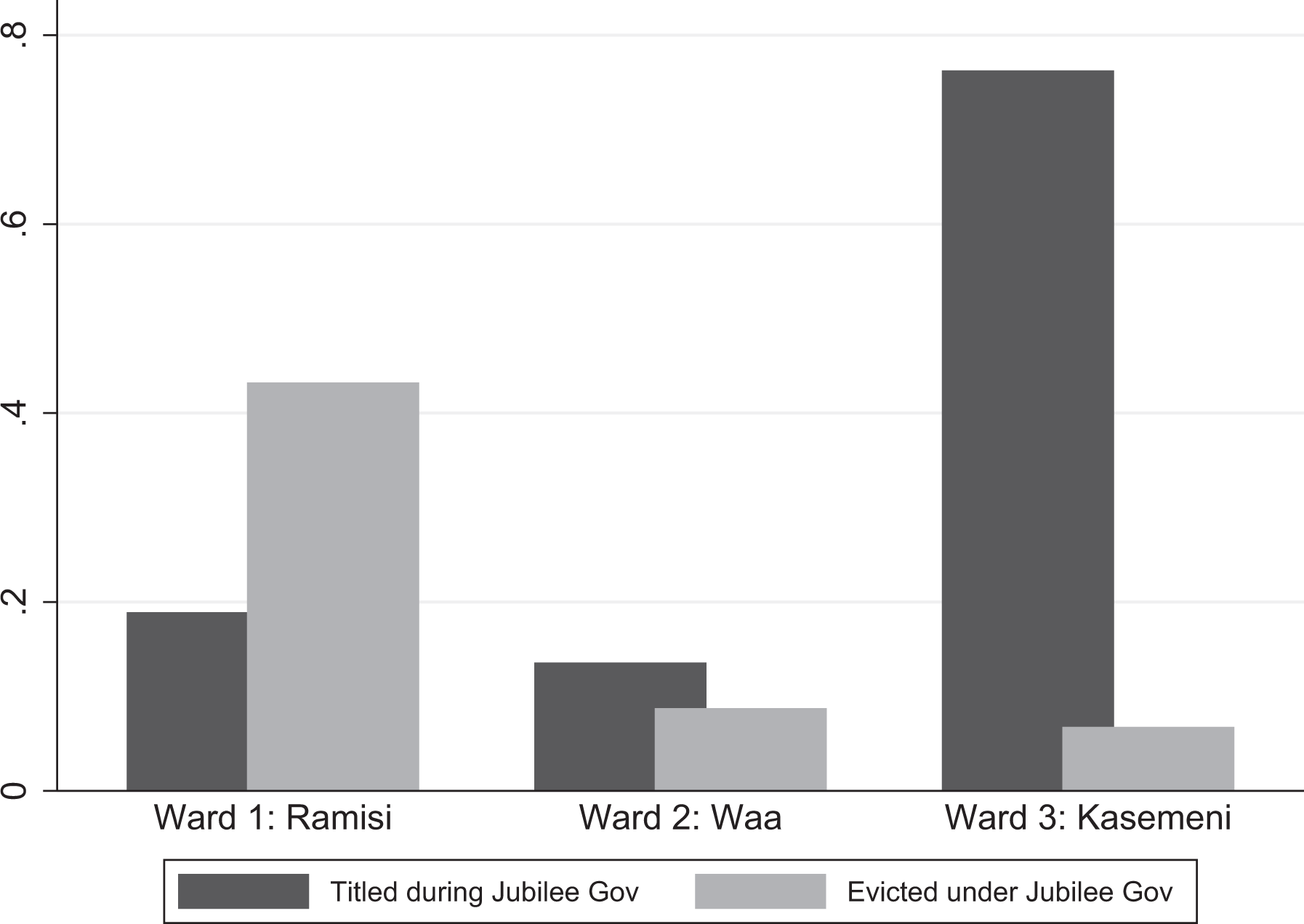
Mean number of respondents who received or lost land rights during the first Jubilee Administration (2013–17), by electoral ward
Independent variables
The key independent variables measure an individual’s experience with losing or gaining land rights. Specifically, I measure whether an individual has personally experienced eviction under the Jubilee government or whether the respondent received a title deed during this same period. Figure 3 shows the distribution of responses across each ward. In addition, because an individual’s experience with land titling is largely a function of the electoral ward in which she resides, I also include a ward-level variable that accounts for the mean change in title deeds acquired within each community between 2013 and 2017 (see column 2, Table I). In the model estimations that I present below, this variable is represented by the electoral ward in which a resident resides. 10 Analyzing the ward in addition to individual-level exposure to titling or expropriation helps account for the possibility that an individual may not necessarily need to benefit or lose land rights directly. Rather, it may also be the case that living in a community affected by land titling or eviction produces individual-level effects.
An additional question concerns the assignment of title deeds within groups selected for title deed allocation. In theory, any individual or household residing within a targeted area has an equal likelihood of receiving a title deed from the government. This is because the Ministry of Lands issues title deeds at the level of the adjudication area or settlement scheme. Where the government seeks to establish a new adjudication area, local actors may contest boundaries and, hence, certain households may be excluded from the titling process due to boundary disputes (NLC, 2016).
I also include a number of control variables. These include a binary variable for a respondent’s partisan status, 11 whether a respondent has experienced election violence in the past, age, gender, education level, a measure of lived poverty, 12 religious identification, the degree to which a respondent identifies with their ethnic or national identity, whether the respondent was born in the Coast region, and whether she holds a title deed.
Results
This section presents my findings based on two methods of analysis. For each dependent variable of interest, I present estimation results based on a series of ordered logit models. In each of these estimations, my primary unit of analysis is the individual, but I control for the individual’s location (i.e. ward) and cluster standard errors at the level of the ward. 13 In addition to these individual-level estimations, I also test for average treatment effects using OLS regression models. In analyzing average treatment effects, I act as if each of the three communities I analyze has received a different treatment, with Ramisi receiving ‘Treatment 1’ (exposure to expropriation under the Jubilee government), Kasemeni receiving ‘Treatment 2’ (exposure to land titling under the Jubilee government), and Waa receiving the control (no change in land tenure status). Importantly, these results provide only suggestive evidence given that I cannot ensure random assignment to each treatment group. I present these findings graphically, and report the full results in the Online appendix (Tables A2–A4). Table A5 in the Online appendix shows that that treatments are fairly well balanced across covariates. The results for Treatment 1 (site of land expropriation) are less precisely estimated due to the smaller sample size. Thus, I focus my discussion around those findings in which I have greater confidence.
Predictors of individual-level trust in the Independent Electoral and Boundaries Commission (IEBC)
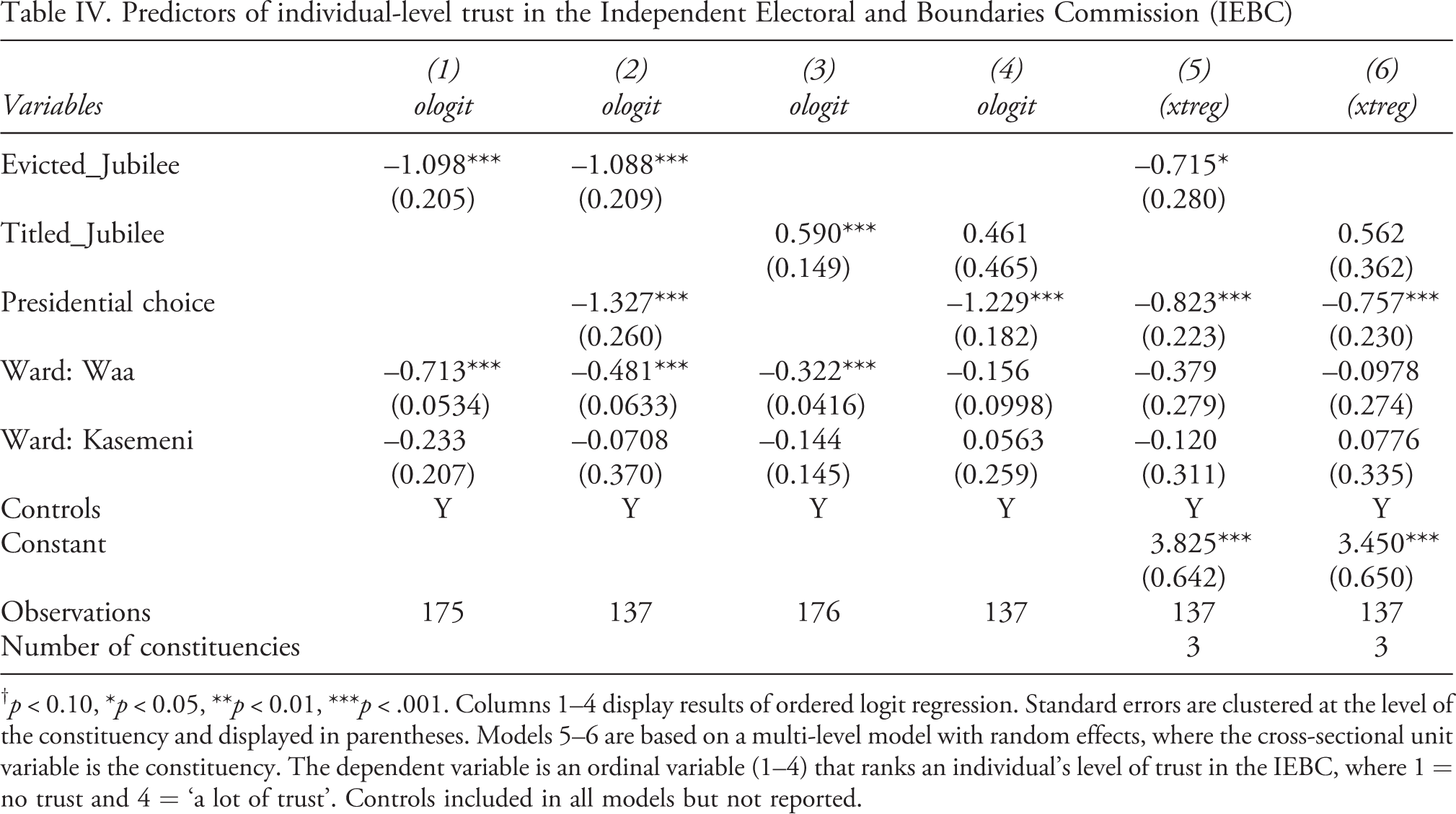
† p < 0.10, *p < 0.05, **p < 0.01, ***p < .001. Columns 1–4 display results of ordered logit regression. Standard errors are clustered at the level of the constituency and displayed in parentheses. Models 5–6 are based on a multi-level model with random effects, where the cross-sectional unit variable is the constituency. The dependent variable is an ordinal variable (1–4) that ranks an individual’s level of trust in the IEBC, where 1 = no trust and 4 = ‘a lot of trust’. Controls included in all models but not reported.
Receiving land increases trust in state institutions
I begin by examining Hypothesis 1, which predicts that individuals who received title deeds will have greater trust in state institutions than non-beneficiaries or those who lost land rights. I analyze two measures of trust: trust in the IEBC and trust in government to solve land issues. 14 Table IV presents a set of models that estimate the predictors of trusting in the IEBC, Kenya’s electoral management body. Models 1 and 2 provide evidence for this first hypothesis: there is a negative but statistically significant relationship between losing land (i.e. being evicted) and trusting the IEBC. 15 Specifically, Model 1 indicates that respondents who experienced eviction are 20% more likely to express ‘no trust at all’ compared to respondents who were not evicted. These individuals are also 18% less likely to indicate ‘a lot of trust’ in the IEBC. 16 Results in Model 3 also provide evidence that receiving a title deed during the first Jubilee administration increases one’s likelihood of trusting the IEBC, with title deed beneficiaries being 12% more likely to express ‘a lot of trust’ in the IEBC.
As a second measure of political trust, I estimate the effects that receiving or losing land rights has on one’s trust in the government to ‘resolve local land issues’. Table V summarizes these results. In contrast to the other two measures of political trust, I find that the experience of eviction has no statistically significant effect on one’s trust in the government to resolve land issues. However, results do indicate that receiving a title deed increases one’s likelihood of trusting in the government. Notably, Model 2 indicates that a person who has received a title deed is 12% more likely to have ‘complete trust’ in the government (32%) compared to someone who has not received a title deed (20%). A title deed recipient is also 12% less likely to indicate ‘no trust’ than an individual without a title deed.
Predictors of individual-level trust in the government
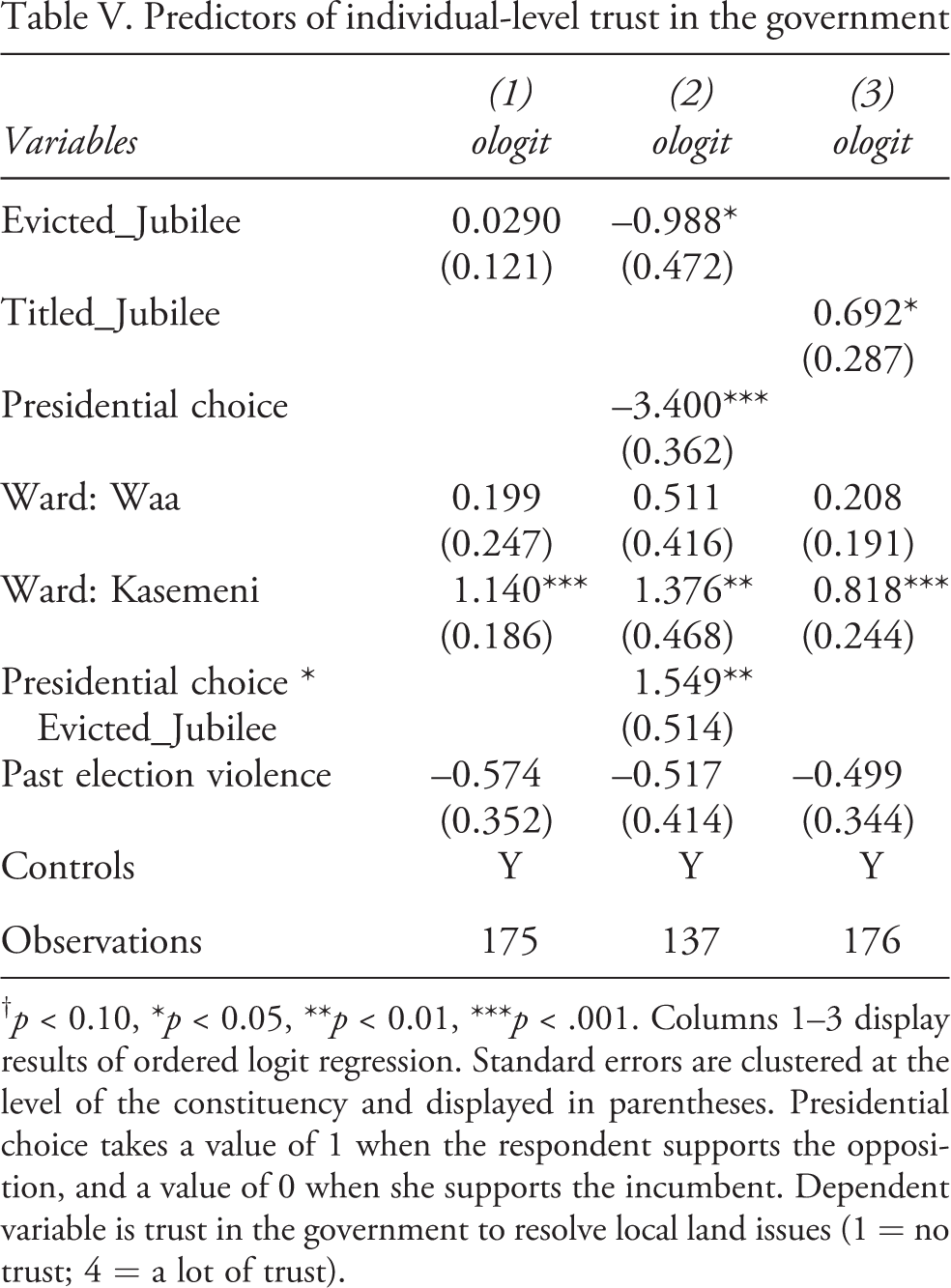
† p < 0.10, *p < 0.05, **p < 0.01, ***p < .001. Columns 1–3 display results of ordered logit regression. Standard errors are clustered at the level of the constituency and displayed in parentheses. Presidential choice takes a value of 1 when the respondent supports the opposition, and a value of 0 when she supports the incumbent. Dependent variable is trust in the government to resolve local land issues (1 = no trust; 4 = a lot of trust).
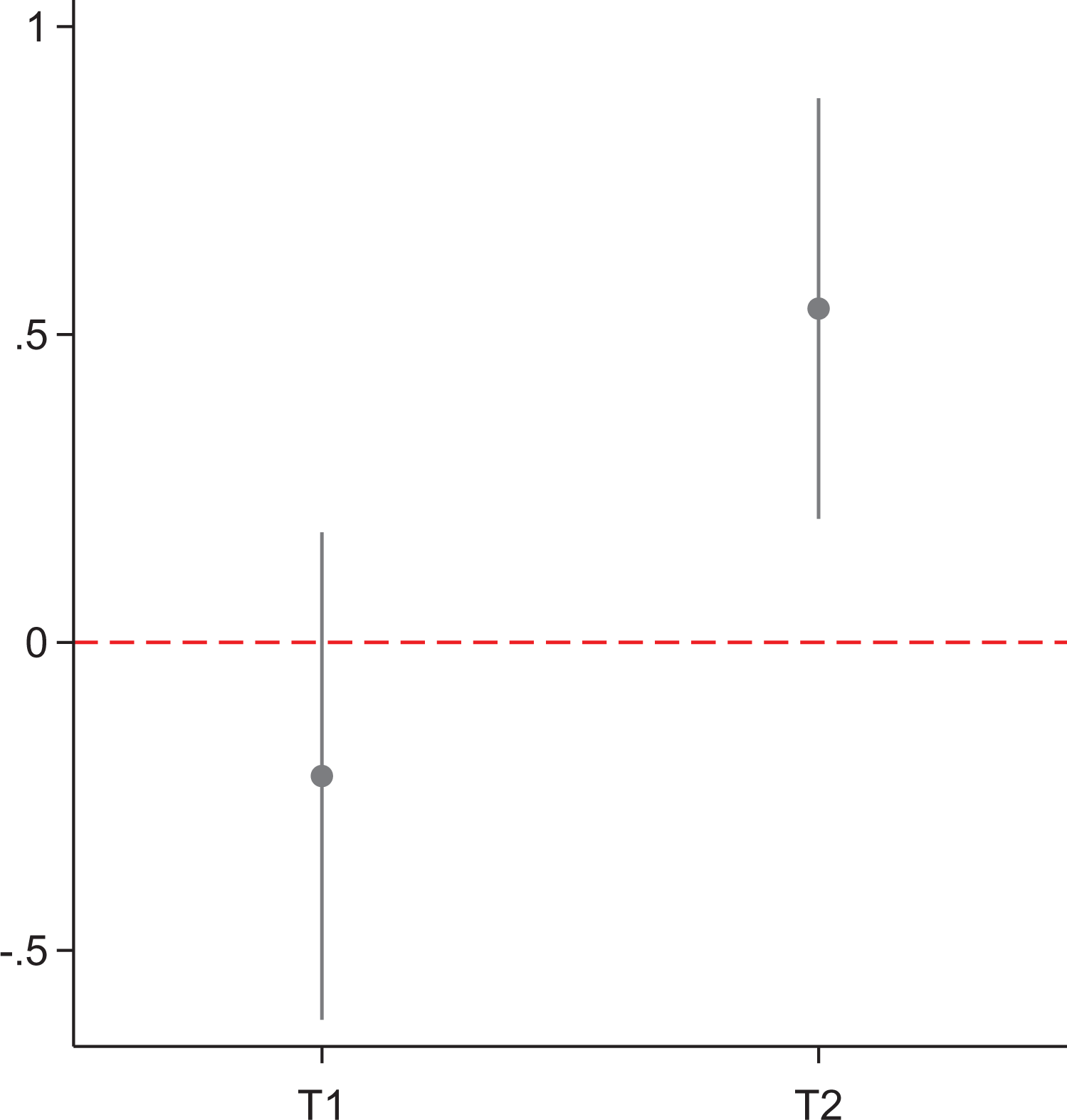
Results also point to the power of location-area effects. That is, the community in which a resident resides can influence political trust, even if an individual has not personally acquired or lost land. As an additional way of observing the effects of land titling, Figure 5 shows average treatment effects. Specifically, the figure indicates that individuals who reside in Kasemeni (Treatment 2) are more likely to indicate trust in the government compared to residents living in Waa (the ‘control’ community).
Alternatively, political partisanship may drive political trust. Several of the models provide evidence for this possibility, indicating that support for the opposition party (ODM) decreases a person’s political trust. I suggest, however, that that while partisanship influences trust, partisanship is largely an outcome, rather than an Average marginal effects of key independent variables on individual-level trust in the government (where 1 = trust, and 0 = no trust). Trust in local government: average treatment effects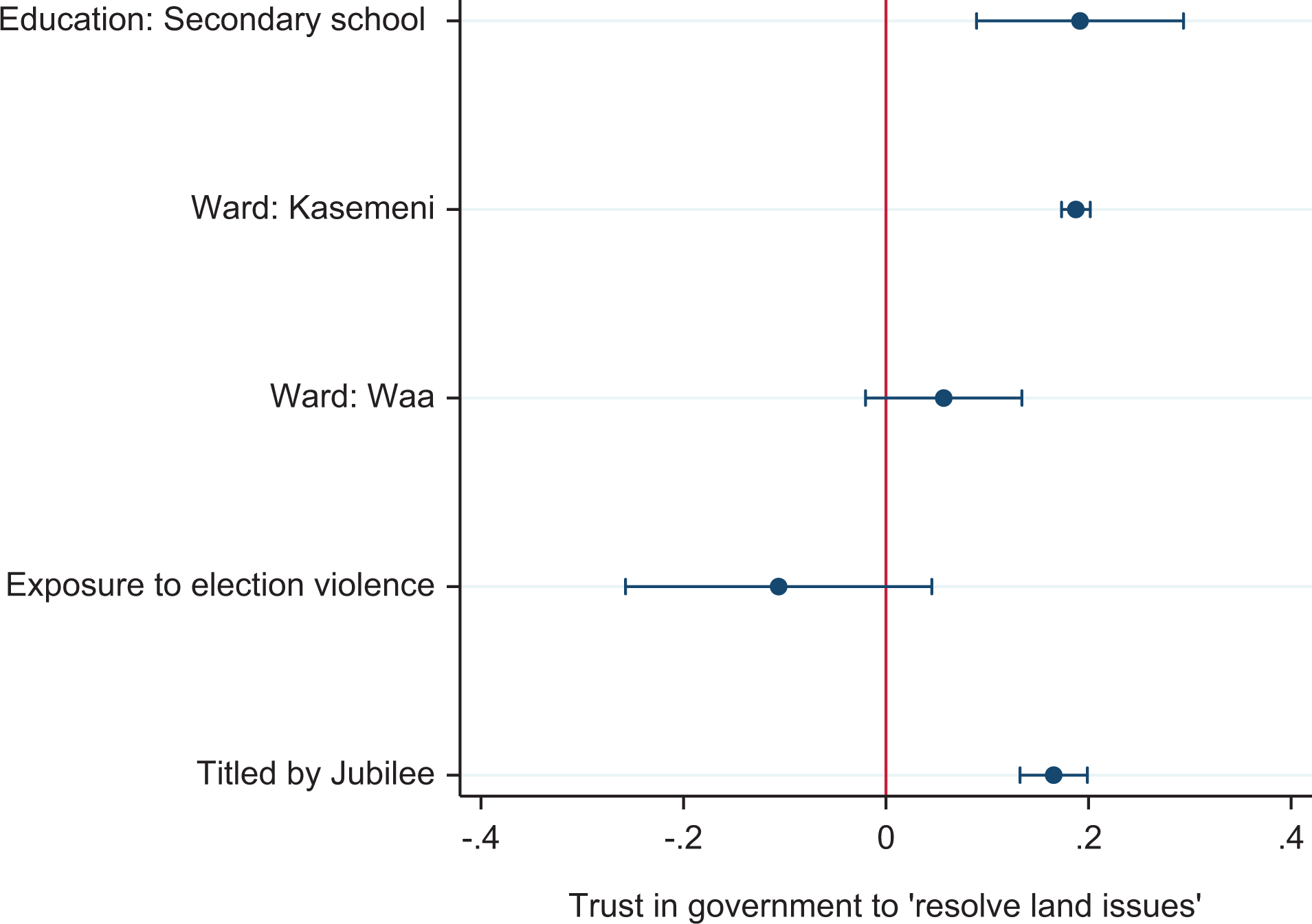
Predictors of perceiving threat related to an upcoming election
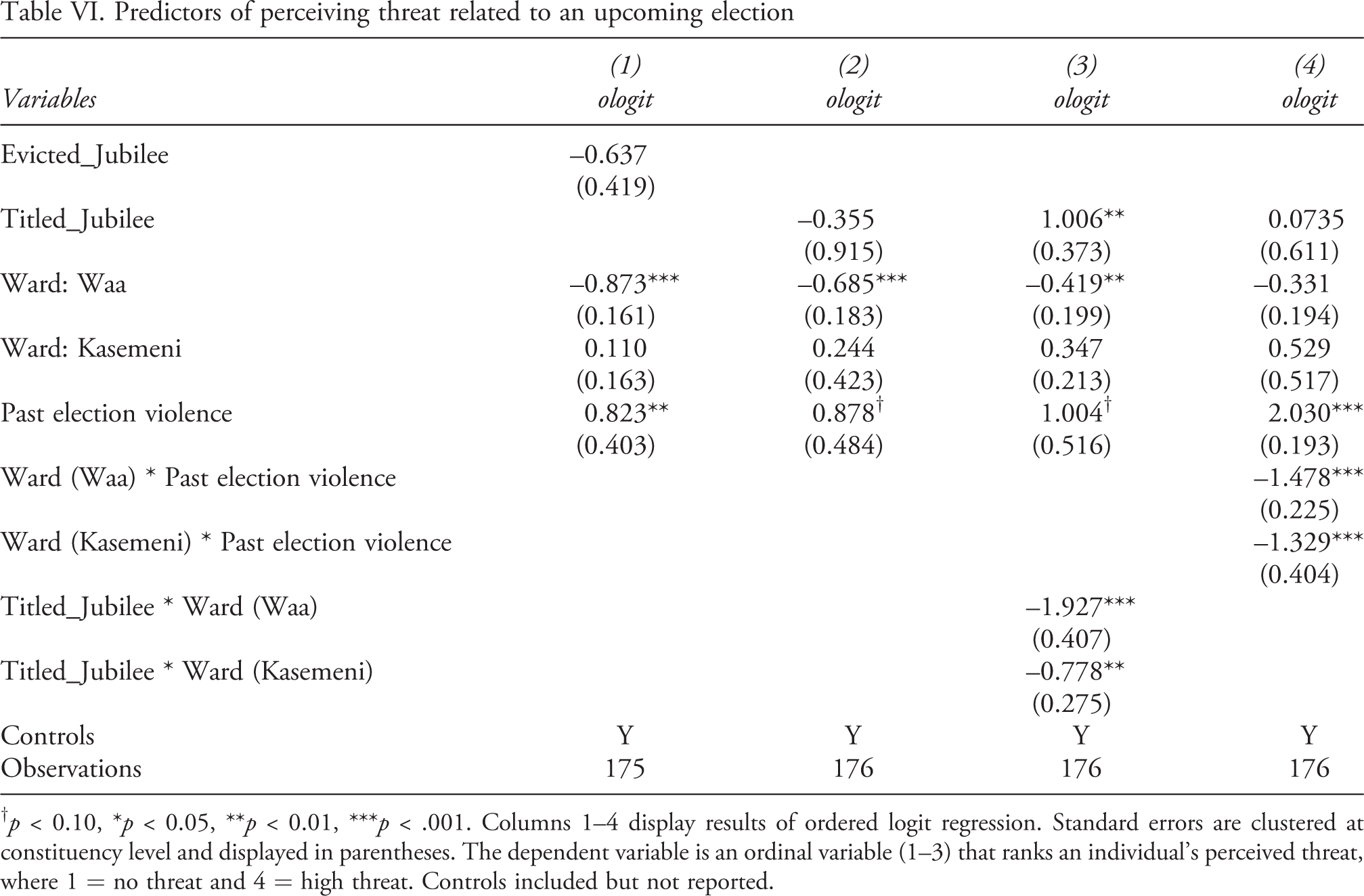
† p < 0.10, *p < 0.05, **p < 0.01, ***p < .001. Columns 1–4 display results of ordered logit regression. Standard errors are clustered at constituency level and displayed in parentheses. The dependent variable is an ordinal variable (1–3) that ranks an individual’s perceived threat, where 1 = no threat and 4 = high threat. Controls included but not reported.
Effects of gaining or losing land on threat perception
I also hypothesize that gaining a title deed should affect a person’s level of perceived threat related to the impending election. Results point to an important though counter-intuitive finding: that gaining land tenure rights in the four years preceding a national election heightens an individual’s fear of elections. Table VI shows the effects of key independent variables on election-time threat. Importantly, I do not find evidence that eviction affects a person’s threat perception. Model 2 suggests that receiving a title deed during the Jubilee government does not have strong or robust effects on perceptions of threat. Yet in model estimations that include an interaction between an individual’s location and receipt of a title deed, there are interesting, though varied effects. The most dramatic appear in Ramisi ward, where many residents have faced eviction and very few have managed to obtain a title deed. Here, a respondent who has not received a title deed has a 38% probability of reporting that elections present a ‘significant threat’. This likelihood increases to 61% for Ramisi residents who have received a title deed. In Kasemeni ward, where many residents have received a title, those who have gained a title deed have a slightly higher likelihood of perceiving threat (46% vs. 51%).
An individual’s ward appears to have strong effects on threat perception. While this may relate to unobserved differences across each site, I suggest that a key point of variation across the three sites is exposure to change in tenure status. This would help explain why residents living in areas that lost or received land rights perceive higher levels of threat compared to areas where there have been few changes in tenure. Specifically, respondents from Ramisi (evicted) and Kasemeni (title deed beneficiaries) have a 46% and 48% probability, respectively, of feeling ‘significant threat’. By contrast, a resident from Waa, where there were no changes in land tenure, has only a 25% probability of perceiving such threat.
When examining average treatment effects (Figure 6), I find a similar result: exposure to either treatment – losing land (Treatment 1) or receiving land (Treatment 2) – increases an individual’s likelihood of perceiving threat relative to respondents in the control group. As outlined above, this may be because both sets of individuals are more likely to see elections as high-stakes moments that could alter their land tenure, further weakening modes of land access or nullifying newly acquired titles. However, in light of the large confidence intervals around both of these results, I treat these results as only suggestive. Finally, all model estimations in Table VI indicate that past experience with election violence strongly affects perceived threat, regardless of location or change in tenure status.
In analyzing the predictors of perceived threat, qualitative evidence provides additional evidence. Among interviews with those who lost land rights, respondents emphasize their fear of upcoming elections. For example, a respondent who had been issued with an eviction notice remarks, ‘we fear that whoever issued these eviction threats might get into power [in the August election] and come back with eviction threats’.
21
The Perception of election-time threat: average treatment effects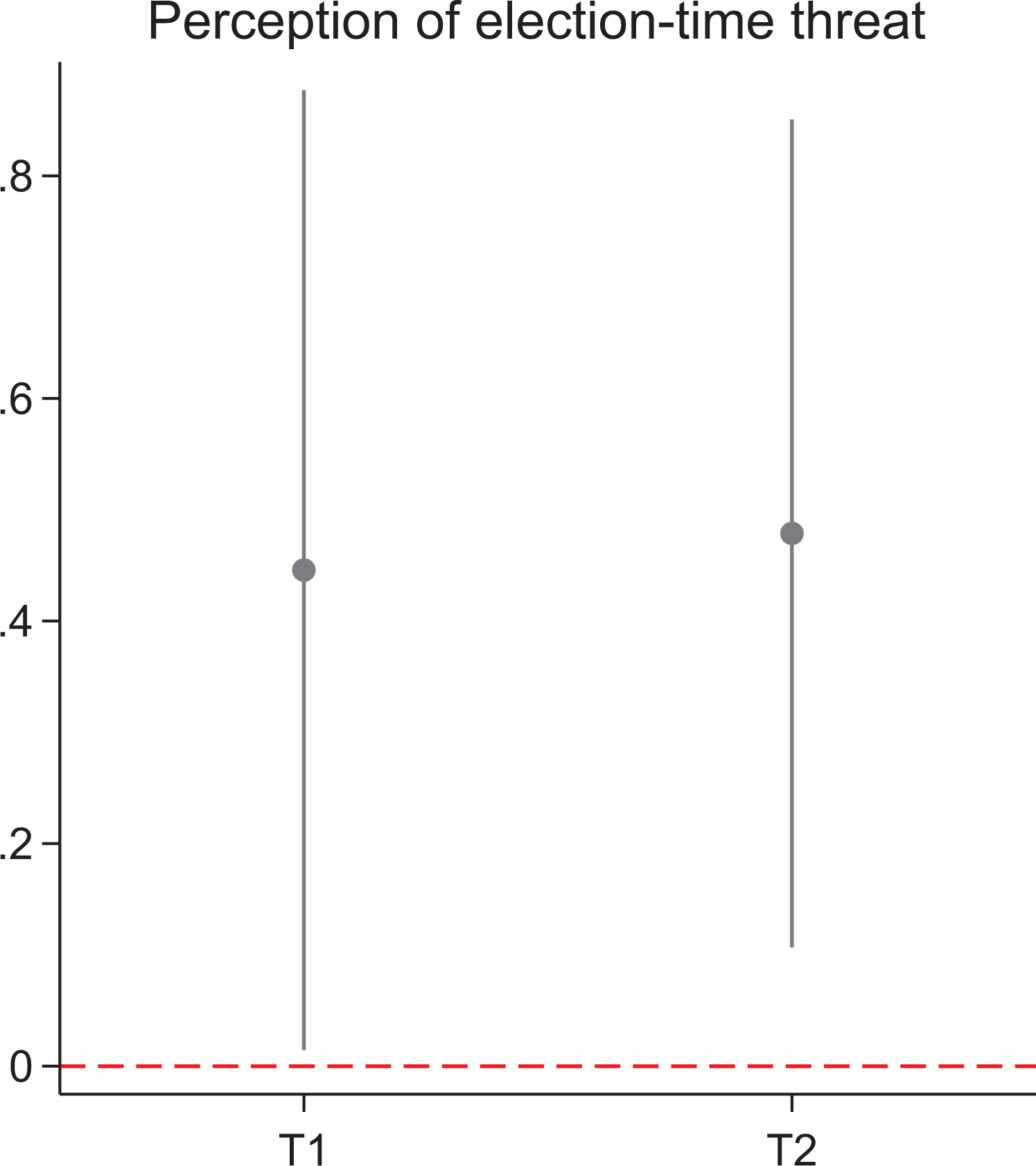
Title deed recipients also express a level of anxiety associated with impending elections that I do not observe among people whose land rights have remained stable over time. For example, despite receiving a title deed, a respondent in Kasemeni fears election violence because she lives near the main road, where, she explains, ‘most of the election campaign events happen’. 25 For the respondent, holding a title deed has little bearing on her own sense of safety and security if violence were to escalate nearby. Another respondent in Kasemeni explains, ‘[a] title deed is a paper showing you have something somewhere […] I trust my title deed, but not 100 […] For now, someone can easily invade and do anything they wish.’ 26 As I mentioned previously, these remarks illustrate how individuals evaluate their risk of experiencing electoral violence separate from their broader trust in state institutions. That is, citizens can trust the government, while also questioning the power of their title deed to guarantee their security and protect their property.
Discussion and conclusion
Seven days after I conducted this study, Kenyans went to the polls. Yet in response to alleged electoral irregularities, the Supreme Court later annulled the results of these 8 August election. In fresh elections held on 26 October, the IEBC declared the incumbent candidate, Uhuru Kenyatta, the president-elect. 27 The pre-electoral period was marked by growing ethnic and political polarization, including hate speech and intimidation. The majority of reported deaths, however, occurred in the interim period between August and October (HRW, 2017). The 2017 elections were also far less violent compared to earlier elections. Whereas over 1,300 people died in the 2007–08 post-election violence, human rights reports indicate that around 100 people died in the pre- and post-electoral period of 2017. This is not to diminish the significance of violence in 2017, but to suggest that the scale and scope were far more contained compared to previous elections. Most of the violence occurred between opposition protestors living in poor neighborhoods of Nairobi and Kisumu and the police and security forces, with security forces being responsible for the majority of deaths (HRW, 2017).
One question, then, is whether the theory I’ve presented here can explain the dynamics of election violence in 2017. Importantly, the article’s main theory is not meant to predict election violence. Election violence is a rare event. Its occurrence relies on multiple factors. Among these, politicians must have the incentive and capacity to select violence over or in addition to other strategies. Further, violence is only possible where a select group of supporters believes that participation in violence may advance their interest or well-being (Klaus, forthcoming). This article, rather, aims to identify the factors that can raise the stakes of an election, either by eroding trust in the state or heightening perceived threat.
Where ordinary actors have little trust in the political process, they may interpret an electoral defeat as an outcome of state bias or corruption. Violent protest provides a mechanism for demanding a different political outcome (Höglund, 2009). We see evidence for this logic playing out during the 2017 elections and, in particular, across informal settlements in Nairobi and Kisumu. Here, violent protest was a way to express outrage and disappointment with the IEBC, but also to demand that the IEBC implement reforms before new elections.
Equally, where people see elections as threatening, violence can take on a defensive logic, with violence providing a means to defend one’s property, household, or larger group (Straus, 2015). Viewing elections as a threat to livelihood presupposes existing narratives that frame one group as a threat, where for example, ethnic outsiders threaten the political power and land rights of ‘insiders’. This defensive logic of violence was on clear display across urban and rural spaces in 2007. And in 2017, leaflets and messages circulated in the informal settlements of Nairobi, warning of impending evictions. 28 In Laikipia County, for example, politically instigated attacks by herders, which aimed at grabbing land and displacing political opponents, heightened fears among small-hold farmers, and Kikuyu farmers in particular (Mutiga, 2017).
A key question, then, is how uneven land titling affects political trust and threat perception. The article shows that title deed recipients are more trusting in certain state institutions than non-recipients or those who lost land. Conversely, respondents who experienced eviction are much less likely to trust the state. As for changes in threat perception, one reasonable expectation is that citizens who received land would be less likely to fear elections because having a title deed would insulate them from the ‘whims of electoral change’. Drawing on existing studies of uneven land reform (Albertus & Kaplan, 2013), however, I predicted that recipients would feel more, rather than less, vulnerable to the electoral process and any changes it might bring. My analysis supports this hypothesis. Despite being more likely to trust the state, title recipients are also more likely to fear elections compared to non-beneficiaries. While changes in trust and threat worked to raise the stakes of the 2017 election, the role of land titling and eviction is less clear. One challenge in identifying its causal role is that there were far more spaces affected by titling or eviction nationwide than there were incidents of election violence.
This article builds on theories of land politics and electoral violence to examine how the allocation or revocation of land rights in a pre-electoral period affects political trust and fear. These outcomes matter, I suggest, because they reveal how perceived stakes of an election can vary across local spaces. Where political trust is low and threat is high, citizens may interpret elections as particularly high-stakes events and, thus, may be more willing to take on the costs of participation in violence to ensure their preferred political outcome, or to defend against an anticipated attack or eviction.
I expect the theory to generalize to hybrid or democratizing regimes where land serves as a key livelihood source, where political elites have the authority to assign or re-allocate land rights, and where there is a history of election-related violence. Here we can think of countries such as Zimbabwe and Côte d’Ivoire, where high-ranking political elites have used land titling or displacement to build political coalitions. In each case, we are likely to find that patterns of titling and eviction correlate with changing levels of political trust or threat. And while there are many reasons why ordinary citizens engage in election violence, leaders may be able to exploit heightened political distrust and fear in order to organize election-time violence. One implication, then, is that where land reform or land titling programs are large-scale and precede an election, the subsequent changes in trust and threat that such reforms provoke may heighten the likelihood of electoral violence.
Footnotes
Replication data

Acknowledgments
Many thanks to Rebecca Munga, Eunice Odhiambo, and Goodluck Mbaga for their invaluable research assistance and to Ryan Sheely, Peter Penar, and Eric Kramon for excellent feedback.
Funding
Funding for this research was provided by the Buffett Institute for Global Studies, Northwestern University.
Notes
References
Supplementary Material
Please find the following supplemental material available below.
For Open Access articles published under a Creative Commons License, all supplemental material carries the same license as the article it is associated with.
For non-Open Access articles published, all supplemental material carries a non-exclusive license, and permission requests for re-use of supplemental material or any part of supplemental material shall be sent directly to the copyright owner as specified in the copyright notice associated with the article.
