







Abstract
Uncertainty about capabilities or resolve is a prominent explanation for war between states. However, we know comparatively little about uncertainty as a cause of armed conflict between domestic actors. This article proposes that irregular leader change in a neighboring country generates uncertainty about third-party resolve and thus increases the likelihood of intrastate armed conflict. I argue that domestic actors take potential third parties’ capabilities and resolve into account when bargaining, that neighboring countries are important potential third parties, and that irregular leader change among these potential third parties results in uncertainty because there is an increased risk of foreign policy change combined with limited access to information. With uncertain estimates of third-party resolve, the risk of bargaining failure and armed conflict increases. Global spatial analyses spanning 1946–2014 corroborate the argument. As expected, I find that irregular leader change in one or more neighboring countries increases the probability of intrastate armed conflict onset. The results are robust across three different distance thresholds for neighboring countries, using time and country fixed effects and several alternative model specifications. Overall, this article advances our knowledge about uncertainty as a cause of civil war and sheds new light on the adverse consequences of irregular leader change.
Introduction
Uncertainty about the resolve or capabilities of an opponent or a third party is a prominent explanation for war between states, both theoretically and empirically (Blainey, 1988; Morrow, 1989; Fearon, 1995; van Evera, 1999; Fortna, 2003; Reed, 2003; Slantchev, 2003; Bearce, Flanagan & Floros, 2006; Rauchhaus, 2006; Fey & Ramsay, 2011; Slantchev & Tarar, 2011; Bas & Schub, 2016; DiLorenzo & Rooney, 2018). Some scholars argue that uncertainty also causes intrastate armed conflict 1 (e.g. Walter, 2009). However, only a few studies have investigated this, specifically pointing to opposition fragmentation (Cunningham, 2013) and third-party signals (Thyne, 2006) as sources of uncertainty.
In this article, I uncover another major source of uncertainty affecting the likelihood of intrastate armed conflict: irregular leader change in a neighboring country. The theoretical argument is laid out in three parts. First, I argue that domestic actors include potential third parties’ capabilities and resolve when bargaining, similar to the logic of interstate bargaining (e.g. Blainey, 1988; van Evera, 1999; DiLorenzo & Rooney, 2018). Second, I point to neighboring countries as important potential third parties, since they often have opportunities and motives to intervene in intrastate armed conflicts (e.g. Regan, 1998; Kathman, 2010). Third, I argue that political turnover among potential third parties, specifically irregular leader change, generates uncertainty about third-party resolve. Since political turnover increases the risk of foreign policy change (e.g. Leeds, Mattes & Vogel, 2009; Pilster, Böhmelt & Tago, 2015; Smith, 2016), turnover among potential third parties prompts domestic actors to reassess third-party resolve. In the specific case of irregular leader change, this assessment is likely to turn out uncertain estimates, because access to information is limited. Irregular leader changes such as coups and assassinations do not follow the rules and norms of leader change in a given country (Goemans, Gleditsch & Chiozza, 2009: 273) and they are often followed by a period of consolidation or even in-fighting. This makes it difficult for domestic actors to prepare for, and assess the consequence of, irregular leader change among potential third parties. With uncertain estimates of third-party resolve, the risk of bargaining failure and intrastate armed conflict increases.
I test the argument in global spatial analyses spanning 1946–2014. To minimize the risk of endogeneity from conflict spillover, I exclude all irregular leader changes in neighboring countries that occur in the same year as an intrastate armed conflict, and I include a spatially lagged dependent variable. As expected, I find that irregular leader change in one or more neighboring countries significantly and substantially increases the probability of intrastate armed conflict onset. This holds across three different distance thresholds for neighboring countries, using country and year fixed effects, and in multiple robustness checks.
Overall, this article makes the following contributions. First and foremost, the article contributes to research on uncertainty as a cause of civil war (Thyne, 2006; Cunningham, 2013) by uncovering irregular leader change in a neighboring country as a source of uncertainty. Second, the article contributes to the broader literature on civil war (e.g. Hegre, 2001; Fearon & Laitin, 2003; Cederman, Weidmann & Gleditsch, 2011) by adding a more proximate explanation of conflict onset. Finally, the article contributes to research on the relationship between potential third-party intervention and the risk of civil war, where prior studies have produced mixed results (Gleditsch, 2007; Cunningham, 2016).
Uncertainty as a cause of war
Uncertainty about capabilities or resolve is a prominent rationalist explanation for war between states (Blainey, 1988; Morrow, 1989; Fearon, 1995; van Evera, 1999; Slantchev, 2003; Fey & Ramsay, 2011; Slantchev & Tarar, 2011). 2 The theoretical starting point is to view armed conflict as a bargaining problem, that is, fighting ensues when two actors in a dispute fail to locate a peaceful settlement that both prefer over war (e.g. Fearon, 1995; Powell, 1999). Under full information, actors can locate peaceful settlements, because they know each other’s capabilities (material resources such as manpower, weapons, technology, funds, etc.) and each other’s resolve (willingness to fight). From these factors, actors can derive their relative strength and divide the disputed issue accordingly (Powell, 1999). However, actors often bargain under incomplete information. For example, states may have private information about their own capabilities and resolve, and they may have incentives to withhold and misrepresent this information to get a better deal (Fearon, 1995: 390 ff.). When actors have scarce or flawed information about each other’s capabilities or resolve, their estimates of these parameters become uncertain, in other words, actors are more likely to be wrong about each other’s capabilities or resolve. This increases the risk of bargaining failure and armed conflict since actors are more likely to hold divergent views on their relative strength making them less likely to locate a peaceful settlement that both prefer over war (e.g. Fearon, 1995; Powell, 1999). Van Evera argues that such divergent views on relative strength, to a greater or lesser extent, have preceded all major wars since 1740, as well as many minor and ancient wars (van Evera, 1999: 16). Prominent examples include Russia underestimating Japan’s capabilities before the Russo-Japanese War in 1904 (Reed, 2003: 634f.), Germany underestimating Soviet and American capabilities and resolve in WWII, several Arab states underestimating Israel’s capabilities preceding the 1948 Arab–Israeli War, and the Saddam Hussein regime underestimating US resolve to protect Kuwait before the Gulf War in 1991 (van Evera, 1999: 21 ff.).
A substantial amount of quantitative evidence supports the notion that uncertainty affects the risk of interstate war. Studies show that uncertainty-reducing factors such as information-sharing in military alliances (Bearce, Flanagan & Floros, 2006), third-party mediation (Rauchhaus, 2006), and certain types of peace agreements (Fortna, 2003), decrease the risk of interstate conflict. Meanwhile, uncertainty-inducing factors such as power parity (Reed, 2003), secret alliances (Bas & Schub, 2016), and political turnover among allies (DiLorenzo & Rooney, 2018), increase the risk of interstate conflict.
Despite the prominence of uncertainty in research on interstate war, we know comparatively little about uncertainty as a cause of civil war. Some scholars have argued that uncertainty is indeed a likely cause of civil war (e.g. Walter, 2009); however, only few studies have investigated this systematically. Cunningham (2013) argues that opposition movement fragmentation generates commitment problems and uncertainty, and finds that this increases the probability of civil war. Thyne (2006) argues that cheap hostile third-party signals are a source of uncertainty, and finds accordingly that such signals increase the risk of civil war. Beyond these two specific sources of uncertainty, our knowledge about uncertainty as a cause of intrastate armed conflict is limited. 3
Looking at research on civil war onset more generally, studies have tended to focus on structural factors related to opportunities and motives for organizing armed rebellion (for reviews, see Dixon, 2009; Cederman & Vogt, 2017). For example, prominent studies show that low state capacity, poverty, large populations, certain natural resources, hybrid political regimes, ethnic heterogeneity, and horizontal inequality all increase the risk of intrastate armed conflict (Gurr, 1993; Hegre, 2001; Fearon & Laitin, 2003; Collier & Hoeffler, 2004; Humphreys, 2005; Cederman, Weidmann & Gleditsch, 2011). In consequence, there has been little focus on proximate explanations, that is, factors that explain why intrastate armed conflicts break out at certain points in time across structurally similar countries (Walter, 2009: 244). The source of uncertainty presented in this article, irregular leader change in a neighboring country, is such a proximate factor and thus compliments the wider literature on civil war onset.
Potential third parties and intrastate armed conflict
Research on interstate conflict finds that uncertainty may concern main actors’ capabilities or resolve as well as third parties’ capabilities or resolve (e.g. Blainey, 1988; van Evera, 1999; DiLorenzo & Rooney, 2018). For example, the Saddam Hussein regime likely underestimated US resolve to aid Kuwait in 1991, as mentioned above, while the United States likely underestimated Chinese resolve to aid North Korea during the Korean War in 1950 (van Evera, 1999: 22 f.; Bas & Schub, 2016: 552).
A similar logic is likely to apply in intrastate settings. For example, the Gaddafi regime may have underestimated the resolve of the West to support the Libyan opposition in 2011, and thus falsely believed it would win an intrastate armed conflict, while the Syrian opposition may have overestimated the resolve of the West to support its fight against the Assad regime in 2011–12. It seems reasonable to expect that domestic actors take potential third parties’ capabilities and resolve into account in their prewar bargaining, since third-party support in intrastate armed conflicts is both frequent and influential. Foreign states have provided direct military or financial support to one or more actors in around 70% of all intrastate armed conflicts since WWII (Regan, 1998; Högbladh, Pettersson & Themnér, 2011; Cunningham, Gleditsch & Salehyan, 2013). Such support substantially affects the course and outcome of intrastate armed conflicts; in particular, it makes conflicts longer and more violent and increases the supported actors’ chance of winning (Regan, 2002; Balch-Lindsay, Enterline & Joyce, 2008; Gent, 2008; Aydin & Regan, 2012; Sullivan & Karreth, 2015; Jones, 2017).
Existing research supports the expectation that domestic actors take potential third parties’ capabilities and resolve into account. For example, Thyne’s (2006) finding that third-party signals affect the risk of civil war, as discussed above, clearly indicates that domestic actors pay attention to the resolve of potential third parties. Studies by Gleditsch (2007) and Cunningham (2016) show that the probability of third-party intervention affects the risk of civil war, also indicating that domestic actors pay attention to potential third parties. However, Gleditsch (2007) finds that a higher likelihood of third-party intervention due to ethnic ties, little trade, and autocratic neighbors increases the risk of intrastate armed conflict, while Cunningham (2016) finds that a higher likelihood of third-party intervention due to a close security relationship with the United States decreases the risk of intrastate armed conflict. These mixed results could be explained by a lack of focus on uncertainty. From a bargaining standpoint, it should not matter for the risk of conflict how strong potential third parties are nor how willing they are to intervene (e.g. Cetinyan, 2002: 648ff.); what matters is whether there is uncertainty about these parameters, since uncertainty increases the risk that domestic actors hold divergent views on their relative strength and fail to locate a peaceful settlement. Thus, the reason why Gleditsch (2007) finds a higher risk of intrastate armed conflict when there are more potential third parties might be because having more potential third parties makes it more likely that uncertainty exists about one of these third parties’ capabilities or resolve. Meanwhile, the reason why Cunningham (2016) finds a lower risk of intrastate armed conflict in countries with a high likelihood of third-party intervention from the United States might be because a higher risk of intervention in this case means less uncertainty about third-party resolve, specifically the United States’ resolve. Nevertheless, both studies still support the expectation that domestic actors take potential third parties’ capabilities and resolve into account.
Neighboring countries
This leaves the question: who are the relevant potential third parties? In their study of interstate conflict, DiLorenzo & Rooney (2018) argue that alliance partners are important potential third parties, while Thyne’s (2006) study of civil wars includes all politically relevant dyads as potential third parties. I expect neighboring countries to be a particularly important group of potential third parties to domestic actors, since neighboring countries often have both motives and opportunities to get involved in case of intrastate armed conflict. Neighboring countries often have ample opportunities to intervene in intrastate armed conflicts, because it is less costly to plan and carry out interventions nearby (Boulding, 1962; Regan, 1998: 766). This holds for most types of support, from providing safe havens, training, or weapons to deploying large contingents of troops – with the possible exceptions of providing funds or diplomatic support. Neighboring countries also often have motives to intervene, since they typically have cultural, political, and economic ties to, and interests vested in, each other (see e.g. Regan, 1998: 765f.). Further adding to these motives, neighboring countries are usually most directly affected by the negative externalities of intrastate armed conflicts. Intrastate armed conflicts frequently spill over into neighboring countries (Salehyan & Gleditsch, 2006; Buhaug & Gleditsch, 2008; Braithwaite, 2010; Maves & Braithwaite, 2013), and also hurt their economies (Murdoch & Sandler, 2002, 2004). Studies of third-party intervention in civil war confirm that geographical proximity is indeed a strong and robust predictor of third-party intervention (e.g. Regan, 1998; Findley & Teo, 2006; Bove, Gleditsch & Sekeris, 2016), and furthermore that the risk of contagion increases neighboring countries’ likelihood of intervening (Kathman, 2010, 2011).
Political turnover as a source of uncertainty
In their study of interstate conflict, DiLorenzo & Rooney (2018) argue that political turnover among potential third parties (opponent allies) is a source of uncertainty about third-party resolve, because political turnover often results in foreign policy changes, and such policy changes are often unclear to outsiders at first (DiLorenzo & Rooney, 2018: 448). Based on this, DiLorenzo and Rooney expect that a specific type of political turnover will generate uncertainty, namely turnovers where a new ruling coalition takes power, since these turnovers are most likely to cause foreign policy change (DiLorenzo & Rooney, 2018: 448).
In the following, I develop DiLorenzo & Rooney’s (2018) argument further by nuancing the role of foreign policy change, focusing more on access to information, and applying the argument to an intrastate setting. In brief, I argue that the increased risk of foreign policy change among potential third parties caused by political turnover is an important prerequisite for uncertainty, since it prompts domestic actors to reassess third-party resolve. However, whether domestic actors develop uncertain estimates of third-party resolve depends on their access to information. If domestic actors have little access to information about the foreign policy of a new leader in a potential third-party state, then domestic actors’ estimates of resolve become uncertain. Such limited access to information is likely after irregular leader changes specifically, because such leader changes are difficult to predict and prepare for, and they are often followed by periods of consolidation or even infighting.
Foreign policy change
Political turnover increases the risk of foreign policy change because different leaders have different personal characteristics and because different leaders may represent different societal interests. Studies confirm that leadership turnover increases the probability of foreign policy change in several key areas including trade and economic policies (McGillivray & Smith, 2004; Bobick & Smith, 2013), participation in alliances and military interventions (Leeds, Mattes & Vogel, 2009; Pilster, Böhmelt & Tago, 2015), UN voting behavior (Mattes, Leeds & Carroll, 2015; Smith, 2016), international treaty ratification (Böhmelt, 2019), resolution of territorial disputes (Chiozza & Choi, 2003), and war termination (Stanley & Sawyer, 2009; Quiroz Flores, 2012). In addition, studies show that leader characteristics like culpability (Croco, 2011), military experience (Chiozza & Choi, 2003; Horowitz & Stam, 2014), and job security (Wolford & Ritter, 2016) affect leaders’ probability of engaging in military disputes, forming alliances, and terminating conflicts.
Foreign policy change among potential third parties, in this case neighboring countries, can be crucial for domestic actors. For example, the major shifts in foreign policy that followed when Fidel Castro replaced Batista in Cuba in 1959 and when Ayatollah Khomeini replaced the Shah in Iran in 1979 had large impacts on the relative strength of domestic actors in neighboring countries. The new regime in Cuba not only broke longstanding bonds to the United States and other allies in the region and became a Soviet ally; it also engaged in a new activist foreign policy of support to socialist regimes and insurgent groups in the region and beyond (see e.g. Erisman, 1985; Högbladh, Pettersson & Themnér, 2011). The leader change in Iran caused a similar drastic shift in foreign policy, where ‘Iran changed overnight from being a status quo regional actor to a revolutionary and disruptive player in the Middle East, challenging in practice and example the legitimacy of practically all of its Arab neighbours’ (Ehteshami & Hinnebusch, 1997: 41). More recent leader changes such as the election of Viktor Yanukovych in Ukraine in 2010, who shifted the foreign policy orientation of Ukraine from the West to Russia (Kudelia, 2014), illustrate that leader changes still can matter greatly for foreign policy towards neighboring countries.
The increased risk of foreign policy change among potential third parties following from political turnover is an important prerequisite for uncertainty, because it motivates domestic actors to reassess third-party resolve. Questions such as how willing a new third-party leader is to get engaged in case of an intrastate armed conflict, what side the new leader would support in such a conflict, and how much support the new leader would provide, are all pertinent for domestic actors after a leader change in a potential third party.
Access to information
Whether political turnover in a potential third party generates uncertainty about third-party resolve depends on domestic actors’ access to information. If actors only have scarce and potentially flawed information about the foreign policy of a new leader of a potential third party, their estimates of that potential third party’s resolve will be uncertain. I expect this to be the case for irregular leader change specifically, because these leader changes are difficult to predict and prepare for, and they are often followed by a period of consolidation or infighting.
Irregular leader change is when a leader is removed from office ‘in contravention of explicit rules and established conventions’, such as via coups and assassinations (Goemans, Gleditsch & Chiozza, 2009: 273). This stands in contrast to regular leader change, where a leader loses office ‘according to the prevailing rules, provisions, conventions, and norms of the country’, such as term limits, voluntary retirement, and election defeats (Goemans, Gleditsch & Chiozza, 2009: 273). Irregular leader changes are difficult to predict and prepare for, because they are typically planned in secret and carried out using the element of surprise. This means that outside actors rarely have credible information about the new leader’s foreign policy preferences readily available. Coup plotters want to keep their operation secret and execute the coup speedily to avoid countermeasures from the sitting leader and his or her supporters (see e.g. Luttwak, 2016: 54, 113f.). Failed attempts at overthrowing leaders, such as the Bay of Pigs invasion, where several leaks of information most likely alerted Fidel Castro about the invasion beforehand (Loeb, 2000; Dallek, 2011), and the failed coup attempt by Hugo Chávez in Venezuela in 1992, where the sitting president (Pérez) was tipped off about the coup attempt and escaped (Baburkin et al., 1999: 148), illustrate why plotters try to keep their plans secret. Consequently, irregular leader changes often come as a surprise to outside actors. For example, the irregular leader change in Iran in 1979 surprised most of world (Milani, 1988: 1), including otherwise well-informed intelligence agencies such as the CIA (Jervis, 2010). The sitting Shah had been in power for 37 years at the time, was supported by the United States, controlled an army of half a million, and was protected by an extensive secret service, while opposition to him seemed fragmented and weak (Milani, 1988: 1, 7). One year before the leader change, US President Jimmy Carter said that Iran was an ‘island of stability and tranquility’ in a troubled region (Milani, 1988: 1).
After an irregular leader change, the new leader often has to consolidate his or her power and potentially engage in power struggles with other leader contestants. In this period, credible information about foreign policy to the outside world is often scarce. This further limits outside actors’ access to information. For example, after the aforementioned irregular leader change in Iran in 1979, even though there were many indications that Iran’s foreign policy would change, it was unclear for a long period in what specific direction the policy would change and who actually was in charge of it (see e.g. Ramazani, 1981). This was not least because ‘factional infighting among members of the “liberal” Islamic revolutionary coalition, which continued until mid-1981, prevented the emergence of a recognizable set of policies and foreign policy objectives’ (Ehteshami & Hinnebusch, 1997: 41).
Hypothesis
I have argued that domestic actors take potential third parties’ capabilities and resolve into account when bargaining, that neighboring countries are important potential third parties, and that political turnover, specifically irregular leader change, among potential third parties generates uncertainty about third-party resolve. Following the arguments of uncertainty as a cause of war introduced earlier, this leads me to expect that irregular leader change in a neighboring country makes domestic actors more likely to hold divergent views on their relative strength, less able to locate a peaceful settlement, and thus more likely to end up in armed conflict. For example, after the aforementioned irregular leader change in Iran, two intrastate armed conflicts broke out in neighboring Saudi Arabia (the Qatif Uprising and the Grand Mosque Seizure) between the Saudi government, Shia groups, and radical Islamists (Gleditsch et al., 2002; Jones, 2006). It seems likely that domestic actors in Saudi Arabia may have held uncertain estimates of the new Iranian regime’s resolve. Parts of the new regime in Iran were very hostile towards the Saudi monarchy and openly declared support to Shia groups in the region as well as to radical Islamists (see e.g. Byman, 2008: 170–171; Chubin & Tripp, 2014). Thus, Shia groups and radical Islamists in Saudi Arabia may have overestimated the willingness of the new regime in Iran to support them. Iran did not provide such support at the time, but it might not have been a gross misjudgment to expect it, since Iran actually began supporting similar groups across the Middle East after the new leadership had consolidated its power (see e.g. Ehteshami & Hinnebusch, 1997: 31; Byman, 2008: 170–171). Based on the theoretical arguments laid out above, I form the following hypothesis:
H1: Irregular leader change in a neighboring country increases the probability of intrastate armed conflict onset.
An alternative mechanism linking irregular leader change in a neighboring country to the risk of intrastate armed conflict is uncertainty about third-party capabilities. Irregular leader change in a neighboring country might lead to changes in that neighboring country’s capabilities, for example through changes in defense policy. If these changes in third-party capabilities are difficult to assess for domestic actors, then actors’ estimates of third-party capabilities may become uncertain, thus increasing the risk of intrastate armed conflict. Although this alternative mechanism is plausible and supports the overall expectation, I expect it to be secondary to uncertainty about third-party resolve for two reasons. First, changes in capabilities such as the size of the armed forces, the type of military equipment, the size of the economy, etc. typically take longer than changes in foreign policy such as switching allegiances between domestic actors in neighboring countries. Thus, substantial changes in third-party resolve seem more likely than substantial changes in third-party capabilities in the short term after an irregular leader change in a neighboring country. Second, due to the material character of capabilities, changes in capabilities may generally be easier for outside actors to assess than changes in resolve, making estimates of capability changes less uncertain.
Research design
I test the argument in spatial analyses of all independent countries in the world covered by the UCDP/PRIO Armed Conflict Dataset (Gleditsch et al., 2002) in the period 1946–2014, using logistic regression and linear probability models with country and year fixed effects. The unit of analysis is the country-year.
Dependent variable
I use the UCDP/PRIO Armed Conflict Dataset (Gleditsch et al., 2002; Pettersson & Wallensteen, 2015) 4 to identify the Onset of intrastate armed conflict. Armed conflict is defined as an ‘incompatibility that concerns government or territory or both where the use of armed force between two parties results in at least 25 battle-related deaths. Of these two parties, at least one is the government of a state’ (Gleditsch et al., 2002: 619). An armed conflict is considered intrastate (internal) when it occurs between the government of a state and internal opposition groups (Gleditsch et al., 2002: 619). 5 This definition and data on intrastate armed conflict are the most commonly used in the conflict literature (see e.g. Dixon, 2009: 723). 6
The dependent variable takes on a value of 1 in country-years where a new intrastate armed conflict Irregular leader change in a neighboring country (ILCINC) within 500 km, 1946–2014; countries with missing data not shown on map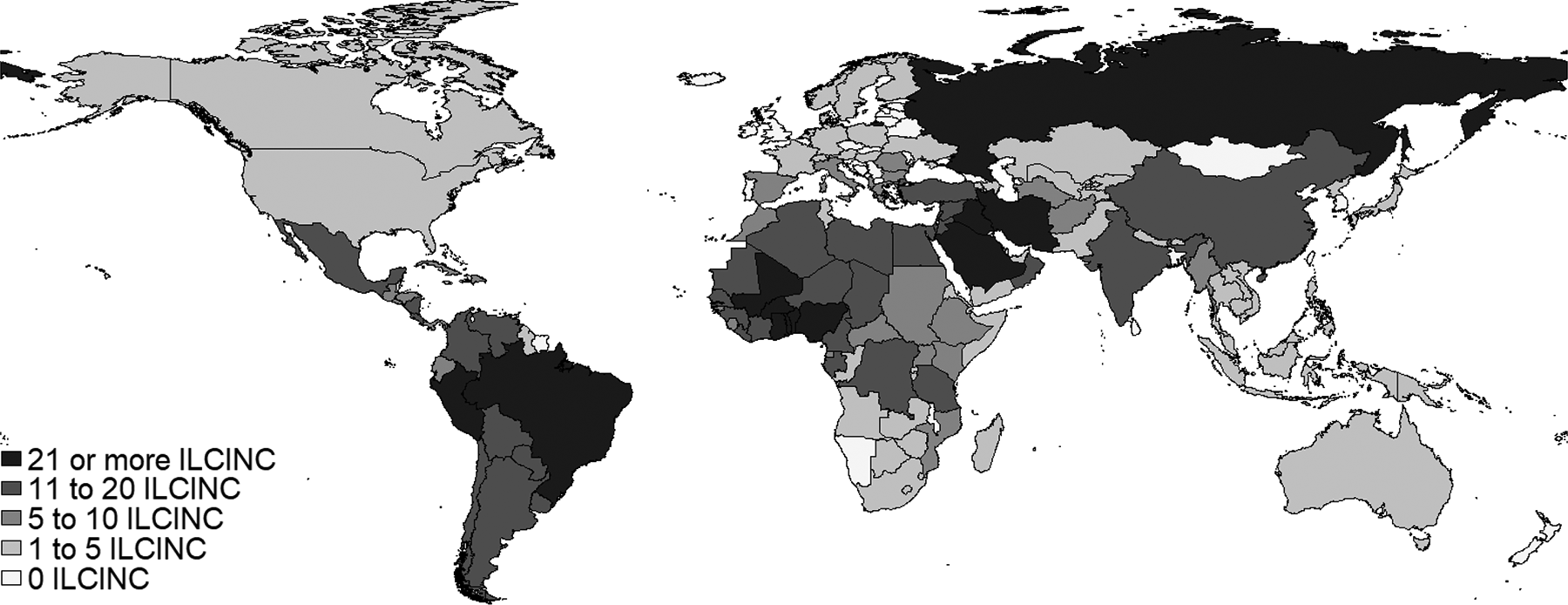
Independent variable
The independent variable, Irregular leader change in a neighboring country, takes on a value of 1 in years where an irregular leader change takes place in one or more neighboring countries and 0 otherwise. I use the CShapes dataset (Weidmann, Kuse & Gleditsch, 2010) to identify three samples of neighboring countries: within 50 km, 500 km, and 1,000 km, measured between borders at the closest point. I present separate results for each sample. The 50 km threshold captures adjacent neighboring countries, that is, countries with common borders or countries that are only separated by narrow stretches of water, such as Denmark and Sweden (21 km apart). The 500 km threshold includes all neighboring countries in the close region, such as China and Taiwan (131 km apart) and Saudi Arabia and Iran (147 km apart), while the 1,000 km threshold includes all neighboring countries in the wider region, such as Cuba and Nicaragua (712 km apart) and Mali and Libya (866 km apart). Figure 1 illustrates the geographical distribution of the independent variable.
Choosing a specific distance threshold for neighboring countries involves striking a balance between including as many important potential third parties as possible while not causing too much noise in the models. Using a low distance threshold for neighboring countries might lead to the models underestimating the effect of irregular leader change, because many important potential third parties are excluded. However, using a high distance threshold for neighboring countries might lead to less valid estimates, because more irrelevant neighbors, that is, countries which domestic actors do not consider to be potential third parties, are included. It is difficult to predict where this balance tips. Most close neighbors should be relevant, but studies of civil war diffusion show that neighboring countries in the wider region up to 950 km away are affected by negative externalities of civil war (Murdoch & Sandler, 2002, 2004; Salehyan & Gleditsch, 2006; Buhaug & Gleditsch, 2008; Braithwaite, 2010; Maves & Braithwaite, 2013). Investigating three different distance thresholds thus allows for a more nuanced picture. If a country does not have any neighbors within the specific distance threshold in a given year, I code the independent variable as 0 (no irregular leader change). This keeps all countries in the analysis, and thus seems the most conservative test. As a robustness check, I provide results in the Online appendix where these cases are coded as missing instead.
I use the Archigos dataset on leaders (Goemans, Gleditsch & Chiozza, 2009) 7 to identify irregular leader change, which is defined as the removal of a leader in contravention of explicit rules and established conventions (Goemans, Gleditsch & Chiozza, 2009). The majority of irregular leader changes occur during peacetime (66% in the investigated period), but a sizeable share coincide with intrastate armed conflict (34% in the investigated period). These latter leader changes are problematic because intrastate armed conflict may spill over into neighboring countries, and thus potentially confound the effect of irregular leader change. To counter this, I exclude from the sample all irregular leader changes that take place in countries with intrastate armed conflict in the same year. Furthermore, I include a spatially lagged dependent variable, Intrastate armed conflict in a neighboring country, to control for other potential endogeneity from conflict spillover.
To reduce the risk of endogeneity from reverse causality, I lag the independent variable one year in all models so that irregular leader change in a neighboring country is measured the year before intrastate armed conflict onset. With this lag, I expect the risk of reverse causality to be relatively low, since it is difficult for most actors, not least domestic actors in other countries, to foresee the exact timing of an intrastate armed conflict onset, and, more importantly, it is unclear why this would motivate coup plotters or assassins in neighboring countries to carry out irregular leader change.
Irregular leader change in one or more neighboring countries within 50 km occurred in 692 country-years out of 9,615 country-years in the sample (7.2%), while irregular leader change in one or more neighboring countries within 500 km occurred in 1,216 country-years (12.6%), and irregular leader change in one or more neighboring countries within 1,000 km occurred in 1,870 country-years (19.4%). Of the 180 countries in the full sample, 168 had at least one irregular leader change in a neighboring country within 1,000 km, 139 had at least one irregular leader change in a neighboring country within 500 km, and 107 had at least one irregular leader change in a neighboring country within 50 km.
Control variables
As mentioned earlier, research on civil war has identified a number of primarily structural factors affecting the likelihood of civil war onset. Based on literature reviews (Dixon, 2009; Cederman & Vogt, 2017), sensitivity analyses (Hegre & Sambanis, 2006), and my own reading of the literature, I have chosen the following well-known factors as control variables: population size, wealth (GDP per capita), natural resources (oil production), ethnic fractionalization, and political regime type. These factors are important controls because they might correlate with the likelihood of irregular leader change and, at the same time, they could be spatially clustered – in particular wealth and regime type. For example, countries in the same area could have high levels of both irregular leader change and intrastate armed conflict because they have low levels of wealth and democracy.
I measure wealth as GDP per capita in constant US dollars (logged) using Gleditsch’s Expanded Trade and GDP Data (Gleditsch, 2002). 8 Population size in millions (logged) is from the same source. I measure Ethnic fractionalization using Fearon’s aggregate ethnic diversity measure (Fearon, 2003), 9 which describes ‘the probability that two individuals selected at random from a country will be from different ethnic groups’ (Fearon, 2003: 208), thus ranging theoretically from 0 to 1. Political regime type (Polity) is measured using the 21-point revised polity2 scale from Polity IV (Marshall, Gurr & Jaggers, 2017), 10 ranging from fully autocratic (–10) to fully democratic (+10). I operationalize natural resources as Annual Oil production (logged) using Ross & Mahdavi’s (2015) Oil and Gas Data. 11
To further reduce the risk of endogeneity from omitted variable bias, I also control for the Number of neighboring countries (logged). Having more neighboring countries increases the likelihood of experiencing irregular leader change in a neighboring country and it might correlate with the risk of intrastate armed conflict through correlation with geographical features such as country size or mountain ranges. However, one might argue that this control is too conservative, removing some of the ‘real’ effect of irregular leader change in a neighboring country, and therefore, I also present results in the Online appendix without this control.
As mentioned earlier, all models include a spatially lagged dependent variable, Intrastate armed conflict in a neighboring country, indicating whether there was an ongoing intrastate armed conflict in any of the neighboring countries in the previous year (1) or not (0), to account for endogeneity from conflict spillover. Finally, to control for the effect of time, I include three time polynomials: years since last conflict, squared, and cubed, as recommended by Carter & Signorino (2010).
Modeling choices
I use cross-sectional logistic regression models as well as linear probability models with country and year fixed effects. Traditionally, most studies of civil war onset have used cross-sectional logistic regression models. This is also the case for the studies of civil war related to the topic of this article (Thyne, 2006; Cunningham, 2013; Gleditsch, 2007; Cunningham, 2016). Thus, using logistic regression models increases comparability to previous studies. However, I also use linear probability models with country and year fixed effects, which provide a stronger test of the causal argument. These models remove the risk of omitted variable bias from unit-specific time-constant unobserved factors such as deep historical, demographic, or cultural variables, as well as unobserved global factors affecting all countries equally in a given year (see e.g. Green, Kim & Yoon, 2001; Wooldridge, 2013: 484ff.). In other words, omitted variables that cause specific countries to have constantly higher or lower levels of irregular leader change in a neighboring country and intrastate armed conflict onset across the period of investigation, and omitted variables that cause all countries to have higher or lower levels of irregular leader change in a neighboring country and intrastate armed conflict onset in a specific year, cannot bias the results.
Spatial factors 12 such as ethnic or political ties might affect the relationship between irregular leader change in a neighboring country and the risk of intrastate armed conflict onset. One possibility is that such ties act as information channels and thus moderate uncertainty. If a domestic actor, either the government or an opposition group, has strong ties to a new leader in a neighboring country, then this particular actor likely has better access to information about the new neighboring leader’s resolve than other domestic actors, generating information asymmetry and thus a higher risk of intrastate armed conflict. In contrast, if all domestic actors have strong ties to a new leader in a neighboring country, then they may all have better access to information about the new neighboring leader’s resolve, hereby reducing uncertainty and the risk of intrastate armed conflict. Unfortunately, investigating these potential effects of ties empirically would require a large data collection effort, since detailed data on ties between leaders of government and opposition groups in neighboring countries do not exist currently. Thus, I have to leave this investigation for future research.
The risk of endogeneity
To summarize, I address the risk of endogeneity from omitted variable bias in four ways. The first is by including well-known domestic covariates of civil war onset as control variables, since some of these might be correlated with irregular leader change and be spatially clustered. The second is by excluding all irregular leader changes in neighboring countries occurring in the same year as intrastate armed conflict, and by including a spatially lagged dependent variable – both of which reduce the risk of bias from conflict spillover. The third is by controlling for the number of neighboring countries. The fourth is by using fixed effects estimation to remove the risk of bias from time constant unit-specific omitted variables and annual time trends. I address the risk of endogeneity from reverse causality by lagging the independent variable one year, that is, measuring irregular leader change in a neighboring country the year before intrastate armed conflict onset.
Results
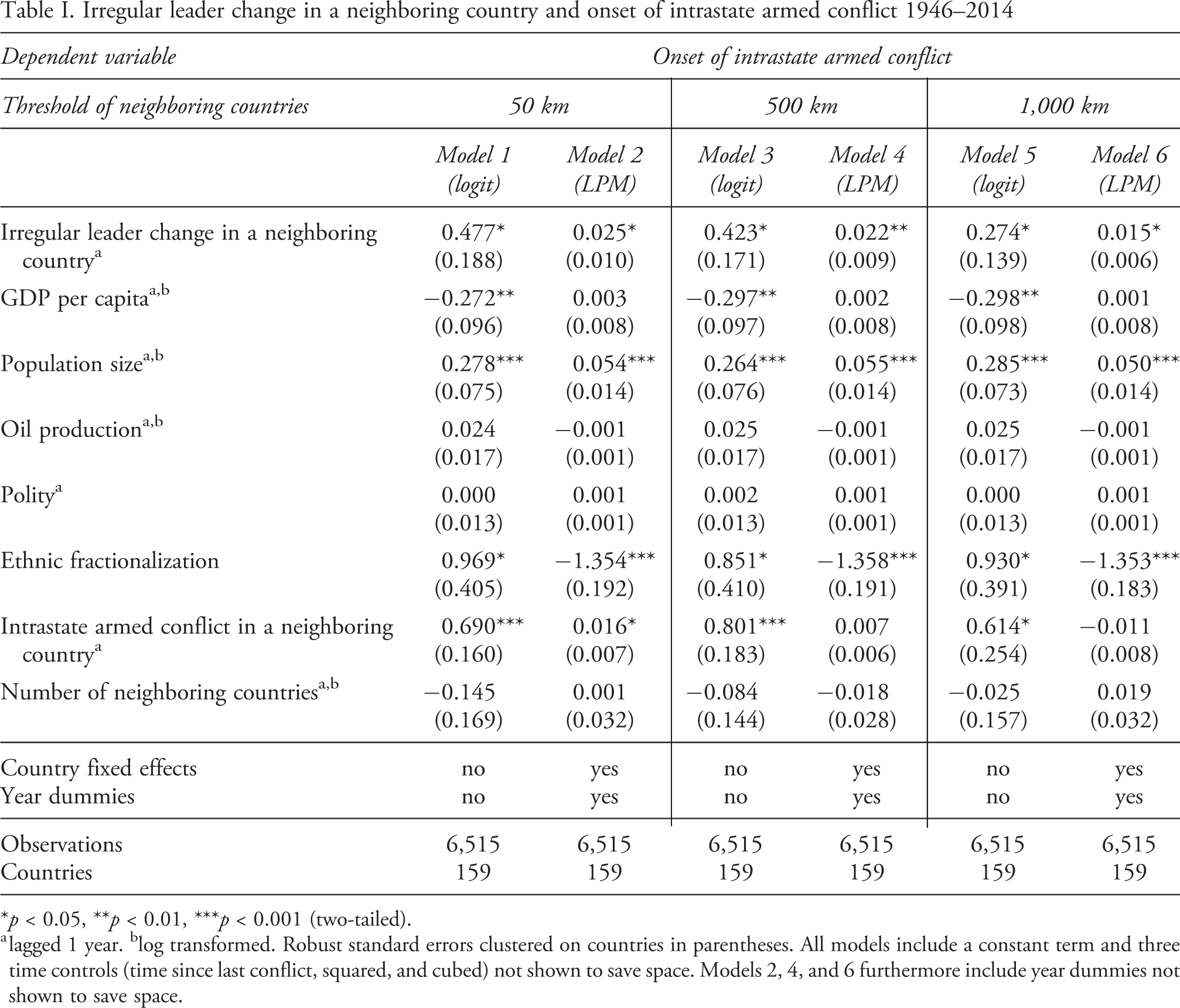
Table I reports the main results. Across all three distance thresholds, in logistic regression models as well as linear probability models with country and year fixed effects, the results show that irregular leader change in a neighboring country significantly and substantially increases the probability of intrastate armed conflict onset, as expected.
Irregular leader change in a neighboring country and onset of intrastate armed conflict 1946–2014
* p < 0.05, ** p < 0.01, *** p < 0.001 (two-tailed).
a lagged 1 year. blog transformed. Robust standard errors clustered on countries in parentheses. All models include a constant term and three time controls (time since last conflict, squared, and cubed) not shown to save space. Models 2, 4, and 6 furthermore include year dummies not shown to save space.
A similar significant and substantial effect of irregular leader change in a neighboring country within 50 km is found when using a linear probability model with country and year fixed effects in Model 2. The results show that when each country is compared to itself over time and controlled for annual time trends, irregular leader change in a neighboring country increases the probability of intrastate armed conflict onset with 2.5 percentage points on average. This is again a substantial increase. In comparison, another typically strong predictor, intrastate armed conflict in a neighboring country, increases the probability of intrastate armed conflict onset by 1.7 percentage points in the same model. Since the fixed effects estimation reduces the risk of omitted variable bias as discussed earlier, the results in Model 2 increase our confidence in the causal impact of irregular leader change in a neighboring country within 50 km on the probability of intrastate armed conflict onset.
The results in Models 3 and 4 show that irregular leader change in a neighboring country within 500 km also increases the probability of intrastate armed conflict onset substantially and significantly. However, the effect sizes in Models 3 and 4 are slightly smaller compared to Models 1 and 2. This trend continues when all neighboring countries within 1,000 km are included in Models 5 and 6. Thus, irregular leader change in a neighboring country within 1,000 km still increases the probability of intrastate armed conflict onset substantially and significantly as shown in Models 5 and 6; however, the effect sizes are smaller. This continuously decreasing effect size of irregular leader change in a neighboring country as the distance threshold for neighboring countries increases, suggest that more irrelevant countries become included in the sample, that is, countries which domestic actors do not consider to be important potential third parties. Thus, the results support the expectation that the share of relevant potential third parties decreases as distance increases. However, there are still enough relevant third parties in the sample even at 1,000 km distance to detect a substantial and significant effect of irregular leader change.
The control variables in the logistic regression models (Models 1, 3, and 5) turn out results similar to those of many previous studies of civil war. Wealth significantly decreases the probability of intrastate armed conflict onset, while population size, ethnic fractionalization, and intrastate armed conflict in a neighboring country increase it. Polity, oil production, and the number of neighboring countries are not statistically significant. Across the linear probability models with fixed effects (Models 2, 4, and 6), population size significantly increases the probability of intrastate armed conflict onset while ethnic fractionalization decreases it, though it should be noted that ethnic fractionalization has very limited within-country variation.
In sum, the results show a significant and substantial effect of irregular leader change in a neighboring country across three different distance thresholds for neighboring countries and using two different estimation methods, thus strongly supporting H1.
Robustness
To assess the robustness of the findings, I analyze several alternative model specifications, all of which are presented in the Online appendix. I investigate three other types of leader change in a neighboring country and compare these with irregular leader change. The results show that only irregular leader change in a neighboring country significantly affects the likelihood of intrastate armed conflict onset, while regular leader change, foreign-imposed leader change, and leader change due to natural death, illness, or suicide, in a neighboring country, have no statistically significant effect. Since several leader changes in a neighboring country may happen in the same year, I also present models where I code the different types of leader change in a neighboring country hierarchically into mutually exclusive categories. These models show slightly stronger and more significant effects of irregular leader change in a neighboring country, except for irregular leader change in a neighboring country within 1,000 km using logistic regression, where the effect is marginally significant (p = 0.067).
An alternative specification discussed previously is to code observations with no neighboring countries as missing instead of zeros on the independent variable. Since relatively few countries don’t have neighboring countries, the sample sizes only decrease moderately, and the results remain similar to the main analysis across all models. I also present results with ongoing intrastate armed conflict coded as 0 instead of missing on the dependent variable, which turns out more significant effects.
As discussed earlier, controlling for the Number of neighboring countries might inadvertently suppress some of the effect of irregular leader change in a neighboring country. However, the results stay very similar when this control is excluded. In this regard, it should also be mentioned that the effect of irregular leader change in a neighboring country is substantial and significant in all models without control variables, although irregular leader change in a neighboring country is marginally significant (p = 0.052) when using the 1,000 km threshold in the linear probability model with fixed effects.
The results are also robust to including regional dummies, excluding the most influential individual observations (country-years), and excluding the most influential countries (clusters of country-years), based on DBETA values in the logit models and DFBETA values in the linear probability models. Although it should be mentioned that the logit models using the 1,000 km distance threshold becomes marginally significant in two of the specifications. Overall, these tests show that no individual regions, countries, or country-years, are driving the results.
Finally, to assess comparability with recent civil war research, I use data and model specifications from a recently published study of civil war onset (Cunningham, 2016), to which I add irregular leader change in a neighboring country. The results of this robustness check show slightly stronger and more significant effects of irregular leader change in a neighboring country. In sum, the auxiliary analyses all indicate that the relationship between irregular leader change in a neighboring country and intrastate armed conflict onset is robust.
Conclusion
Uncertainty about capabilities or resolve is a prominent explanation for war between states. This article has demonstrated that uncertainty also increases the risk of intrastate armed conflict. It has done so by identifying a major source of uncertainty about third-party resolve: irregular leader change in a neighboring country. This is also a more proximate explanation of intrastate armed conflict onset, which advances our understanding of why civil wars break out in some structurally prone countries but not in others.
In terms of policy implications, the article shows that actors seeking to prevent intrastate armed conflict should be particularly active and vigilant when irregular leader change happens in neighboring countries. A further policy implication is that political actors in general should be aware that seemingly unrelated political events abroad can affect the risk of civil war inadvertently through uncertainty. Finally, regarding future policies of civil war prevention, policymakers might consider targeting uncertainty directly, for example by providing credible information to governments and opposition groups in disputes. Such potential uncertainty-reducing efforts also form an important topic for future research to investigate.
Another important topic to investigate in future studies is whether and how different kinds of ties between potential third parties and domestic actors affect uncertainty. Ethnic or political ties might improve actors’ access to credible information and thus potentially reduce uncertainty; however, they might also increase information asymmetry, and thus increase the risk of conflict. In addition to ties, regional norms or institutions might also affect the level of uncertainty by facilitating or hindering the flow of information. Finally, it will also be important to further investigate the underlying causal mechanism of the argument. In particular, uncovering the empirical pathway(s) that lead from actors’ misjudgments of other actors’ resolve to bargaining failure and conflict escalation. Overall, I hope this article will inspire an increased focus on uncertainty as a cause of intrastate armed conflict in research as well as in policy.
Footnotes
Replication data

Acknowledgements
I thank Henrikas Bartusevičius, Jacob Gerner Hariri, Svend-Erik Skaaning, Jakob Tolstrup, Kristian Skrede Gleditsch, Scott Gates, David E Cunningham, Tobias Böhmelt, Michael Colaresi, Scott Wolford, Robert Schub, Bertel Teilfeldt Hansen, Suthan Krishnarajan, workshop participants at Aarhus University and the University of Essex, associate editor Kristin M Bakke, and two anonymous reviewers, for helpful comments and suggestions.
Funding
This research was supported by a grant from Innovation Fund Denmark (4110-00002B).