







Abstract
Authoritarian regimes frequently attempt to justify repression by accusing their opponents of violent behavior. Are such claims successful at persuading the public to accept state-sponsored violence, and can these claims be contested effectively by human rights organizations seeking to publicize evidence contradicting the regime’s narrative? To evaluate these questions, we conducted a survey experiment in Egypt using Facebook advertisements to recruit respondents safely. The experiment evaluates the persuasiveness of competing information provided by a human rights organization and the Egyptian security forces in shaping attitudes toward an incident of state-sponsored violence in which security forces killed several leaders of the opposition Muslim Brotherhood. We find evidence for the ability of Egyptian security forces to increase support for this repression when they control the narrative about why violence was used. However, we also find that the effects of this propaganda disappear when paired with information from Human Rights Watch that counters the security forces’ justifications. These findings provide experimental evidence that propaganda can help authoritarian regimes to increase public support for repression, but they also indicate that human rights organizations can play some role in mitigating this support when they succeed at disseminating countervalent information in these contexts.
Introduction
Six weeks after the July 2013 coup that ousted Egypt’s first freely elected president, security forces violently dispersed a sit-in of the president’s supporters, likely killing over 1,000 nonviolent protesters. Local media trumpeted the government’s propaganda, 1 which justified the massacre by alleging that protesters were terrorists who had tortured civilians, killed policemen, and threatened state security. Governments and their security forces routinely use misleading or false claims about their victims’ violent behavior to justify state-sponsored violence, and the problem is particularly severe in authoritarian regimes, where repression is more common (Davenport, 2007) and government influence over the media is stronger (Whitten-Woodring & Van Belle, 2017). To what extent does this propaganda shape public attitudes toward repression in these political systems? On the one hand, authoritarian institutions frequently appear to lack credibility, suggesting they may struggle to influence public perceptions of state-sponsored violence; on the other hand, biased communications sources can often be effective at shaping public attitudes (DellaVigna & Gentzkow, 2010).
Because authoritarian regimes dominate the press, independent human rights organizations frequently provide one of the few sources capable of challenging the regime’s narrative. These organizations attempt to gather evidence of rights violations and to disseminate that information to the public. In Egypt, for instance, NGOs collected and published information that disproved the government’s claims that state-sponsored violence was triggered by the opposition’s use of force. To what extent can these activities constrain authoritarian regimes by reducing support for repression? The literature on human rights is generally optimistic about the ability of human rights organizations to mobilize public opinion against violators, but scholars have often overlooked the possibility that human rights narratives may not resonate in certain contexts (Hafner-Burton, 2014; Risse & Ropp, 2013), especially when governments can wield state security narratives effectively (Jetschke, 2011).
We address these questions by investigating the effects of competing information from Egyptian security forces and a human rights organization on Egyptians’ attitudes toward state-sponsored violence. The experiment used an actual incident of repression against the Muslim Brotherhood in July 2015, leveraging real accounts of the event for our treatments. The results indicate that information from the security forces increased support for violent police tactics significantly, while information from the human rights group did not strengthen opposition to this repression. However, when respondents were exposed to a competitive information environment with both accounts, the large effects from the security forces treatment disappeared, suggesting that human rights investigations have some capacity to neutralize the effects of authoritarian propaganda.
This article makes several contributions to the study of authoritarianism and human rights. First, it builds on a growing literature on the persuasive capacity of propaganda in authoritarian regimes (e.g. Adena et al., 2015; Huang, 2018; Peisakhin & Rozenas, 2018; Stockmann & Gallagher, 2011; Truex, 2017). We extend this research by focusing on attitudes toward state-sponsored violence, and by testing the robustness of propaganda to competing information. Second, this article contributes to literature on the effectiveness of human rights messaging, which includes relatively few experimental studies, especially outside the United States (Ausderan, 2014; McEntire, Leiby & Krain, 2015). Third, we recruited respondents using Facebook advertisements, which provide a relatively new and important source of data for experimental research in authoritarian regimes and conflict settings. Fourth, the findings shed light on political developments in an important case of authoritarian rule (Blaydes, 2011; Brownlee, 2007), suggesting that propaganda assisted the violent reconstitution of Egyptian autocracy following the failed democratic transition. Finally, a practical implication of this article is that practitioners interested in promoting human rights should assist human rights organizations with the dissemination of their messages in authoritarian regimes, especially since these regimes have increasingly sought to limit space for such organizations to operate (Carothers & Brechenmacher, 2014).
The article proceeds as follows. We first discuss theoretical expectations of how competition between authoritarian regimes and human rights organizations shapes attitudes toward repression, and we then provide additional context on these dynamics in Egypt. The next section reviews the study’s research design and ethics, which is followed by the presentation of results. We conclude with a brief discussion of implications for human rights in authoritarian regimes.
Repression and persuasion under autocracy
There are few actions a government can take that are more unpopular than the unjustified use of force; as a result, state-sponsored violence is risky, since repression can backfire and increase anti-regime mobilization (Davenport, 2007). Because of this risk, governments often attempt to minimize backlash by leveraging propaganda, especially in authoritarian contexts where control over the media is greater. In some cases, this propaganda may be intended to reinforce repression by demonstrating the regime’s strength and further intimidating the public (Wedeen, 1999; Huang, 2015), but this approach may undermine support for the regime over time (Huang, 2018). As a result, authoritarian regimes have strong incentives to use propaganda to persuade as many people as possible that repression was justified.
Repression is more likely to be perceived as justified when it occurs in response to violent behavior (Gitlin, 2003; McLeod & Detenber, 1999). While the unprovoked use of force violates expectations of fair conduct by the state’s coercive agents, a forceful response to violent acts is more likely to be seen as consistent with procedural fairness (Mazerolle et al., 2013; Tyler, 2003). Furthermore, when the targets of repression use violence themselves, their actions can generate feelings of threat and fear, which may convince the public that the targets do not deserve legal protections or human rights (Hetherington & Suhay, 2011; Jetschke, 2011; Simpson, Willer & Feinberg, 2018; Young, 2019). It follows that if authoritarian regimes can persuade their citizens that opposition forces have behaved violently, they may be able to strengthen popular acceptance of repression. There are countless examples of authoritarian regimes referring to their opponents as ‘terrorists’ and ‘criminals’, accusing them of (often) false acts of violence in an effort to justify the use of force against them. On the other hand, if countervalent sources provide information that undermines the regime’s claims, citizens may be convinced that the violence was unjustified. Because of the controlled media environment in authoritarian political systems, this task often comes down to human rights organizations, which investigate and then publicize rights violations (Keck & Sikkink, 1999; Risse, Ropp & Sikkink, 1999; Simmons, 2009).
How might individuals respond to information about state-sponsored violence provided by the regime or human rights organizations? The vast literature on persuasion suggests that responses will be influenced by the perceived credibility of the messenger, and by the content and strength of recipients’ priors about a given issue (DellaVigna & Gentzkow, 2010). There are reasons to expect that these factors could work for or against authoritarian regimes and human rights groups seeking to shape attitudes toward state-sponsored violence. However, existing research does not provide empirical tests of the persuasive capacity of these sources, particularly on the issue of state-sponsored violence and in competition against each other.
Traditionally, many scholars in political science, not to mention popular accounts in the media, have been skeptical of the persuasive capacity of authoritarian propaganda (Stockmann, 2013). Authoritarian regimes – and especially their security forces – are often corrupt, abusive, and inefficient. Their primary goal is the perpetuation of their own power, regardless of the truth. Such characteristics imply that these institutions will not be trusted as impartial sources and therefore lack the credibility to influence public opinion (Mishler & Rose, 2001; Morris & Klesner, 2010). As a result, information they provide to justify the use of repression may be dismissed as self-serving and likely false by most individuals who receive it, in which case attitudes are unlikely to shift significantly. This dynamic may be reinforced if many of the public oppose the regime strongly and are motivated to resist updating their beliefs in a way that would absolve the regime for using violence (Taber & Lodge, 2006).
Yet, the weak credibility of authoritarian regimes may be overstated. Polling data from many autocracies suggest that trust in institutions is often high (Rossteutscher, 2010). People may be particularly likely to trust the security forces as a credible source on matters of national security, since these issues fall within their purview and supposed expertise. This credibility may be enhanced further if elements of the opposition have actually used violence previously, granting the regime a plausibly realistic claim to be defending national security with its repressive acts (Jetschke, 2011). In addition, individuals in authoritarian regimes often have less structured political views or are unaware of important political dynamics (Pan & Xu, 2018; Reuter & Szakonyi, 2015), in which case motivated reasoning is less likely to forestall attitude changes in response to information from the authorities (Taber & Lodge, 2006). These dynamics imply that propaganda from authoritarian regimes and their security forces may be effective at persuading the public that repression was justified.
The literature on human rights organizations has generally been optimistic about their ability to undermine public support for rights abuses, in part by releasing information that shames the violators (Davis, Murdie & Steinmetz, 2012; Keck & Sikkink, 1999; Risse, Ropp & Sikkink, 1999). As independent groups motivated by the desire to protect vulnerable individuals, it might be assumed that their credibility would be high, and that the public would be inclined to trust information they provide about repression. To the extent this assumption is correct, citizens who encounter reporting from human rights groups about incidents of state-sponsored violence should update their attitudes to become more opposed to the regime’s use of force. This dynamic may be reinforced by motivated reasoning as well if most citizens oppose the regime and are open to information that portrays the authorities negatively.
However, the credibility of human rights organizations in authoritarian contexts may be overstated. Authoritarian regimes often invest substantial effort in discrediting these groups, and it is plausible that such campaigns have some success in defining them as biased promoters of a threatening, foreign agenda (Carothers & Brechenmacher, 2014). Furthermore, motivated reasoning may constrain the persuasive capacity of human rights organizations significantly, particularly in countries where fear of instability is widespread and citizens want the government to maintain order. In these contexts, individuals who encounter information from human rights groups may be motivated to dismiss it, in which case their attitudes toward state-sponsored violence are unlikely to become more negative. Consistent with this more pessimistic expectation, studies of human rights messaging find mixed effects, and the few experimental tests of their persuasive capacity do not find significant results (Ausderan, 2014; Krebs, 2017).
The above discussion considers how and why we might expect attitudes toward repression to shift in response to information from either the regime or a human rights organization. However, it is also important to evaluate how attitudes might change when individuals are exposed to information from both sources. Human rights groups in particular are unlikely to have a captive audience; rather, the people they reach in these contexts will have been exposed first to the regime’s claims. In this scenario, two dynamics are possible. First, the credibility of one message may be so much stronger that public opinion instinctively shifts in its direction (Chong & Druckman, 2007). If the public inherently trusts the reporting of human rights organizations, opposition to the use of force may increase even in this competitive information environment; on the other hand, if citizens are wary of these organizations and inclined to trust the regime, then exposure to the government’s propaganda may still increase support for repression despite access to the human rights messaging.
Second, the presence of the competing messages may reinforce respondents’ pre-existing beliefs about state-sponsored violence, in which case the public’s attitudes will not shift significantly one way or the other. With the ability to process both sets of information, citizens may decide to believe the source that reaffirms the views they already hold (Chong & Druckman, 2007; Sniderman & Theriault, 2004; Taber & Lodge, 2006). Such a scenario could still demonstrate the importance of human rights messaging if citizens would – in the absence of information from the human rights groups – be persuaded by the regime’s propaganda to become more supportive of repression. In other words, by puncturing the regime’s dominant message, these organizations would help to create space for opposing attitudes to re-emerge (Zaller, 1992).
Our study evaluates these dynamics in Egypt. The next section provides important background information and defines our expectations in this context.
Contesting repression in Sisi’s Egypt
Egypt provides a useful case in which to study how authoritarian propaganda and human rights messaging shape attitudes toward state-sponsored violence. Since coming to power through a coup that ousted president Mohammed Morsi in July 2013, the military-dominated regime of Abdel Fattah El-Sisi has relied heavily on violent repression to crush mass opposition. Security forces have killed hundreds of people and arrested tens of thousands more (Dunne & Williamson, 2014). The regime has sought to justify this violence to the public, and these efforts have been contested wherever possible by international and domestic human rights organizations.
To justify its actions, the regime has always claimed that security forces used deadly force following violent provocations by the opposition. For instance, when security forces killed more than 50 protesters outside the Republican Guard Club in Cairo just one week after the coup, they claimed to have been responding to an armed attack. Six weeks later, the security forces killed at least 817 and likely more than 1,000 protesters when clearing sit-ins at the Rabaa and Nahda Squares in Cairo (Human Rights Watch, 2014). Again, the government justified the violence by claiming that protesters had fired first when security forces began to clear the squares (Fick & Nasralla, 2014). The government also worked hard to portray the sit-in participants as violent in the weeks before the operation began. According to the New York Times, ‘The authorities have painted the squares as hotbeds of “terrorism” […] Officials have also said that the Islamists are storing weapons, and have accused them of other abuses, including the fatal torture of at least 11 people in the two squares’ (Fahim & Gladstone, 2013).
Human rights groups have investigated and disproved these justifications. Regarding killings outside the Republican Guard Club, Human Rights Watch provided evidence that, ‘protesters were peacefully praying or gathering when the military and police moved in to break up the sit-in’ (Human Rights Watch, 2013). They also documented how the forceful clearings of the Rabaa and Nahda sit-ins were premeditated, while cases of protesters firing back at security forces were marginal (Human Rights Watch, 2014). In recent years, a similar dynamic has occurred with extra-judicial killings of detainees. Since 2015, security forces claim to have killed hundreds of alleged militants in gun battles during counterterrorism operations. Yet, investigations strongly suggest that such battles are often invented to cover up and justify executions of prisoners suspected of Islamist connections (Greene & McManus, 2017; Reuters, 2019).
Perceptions of Egyptian security forces and media
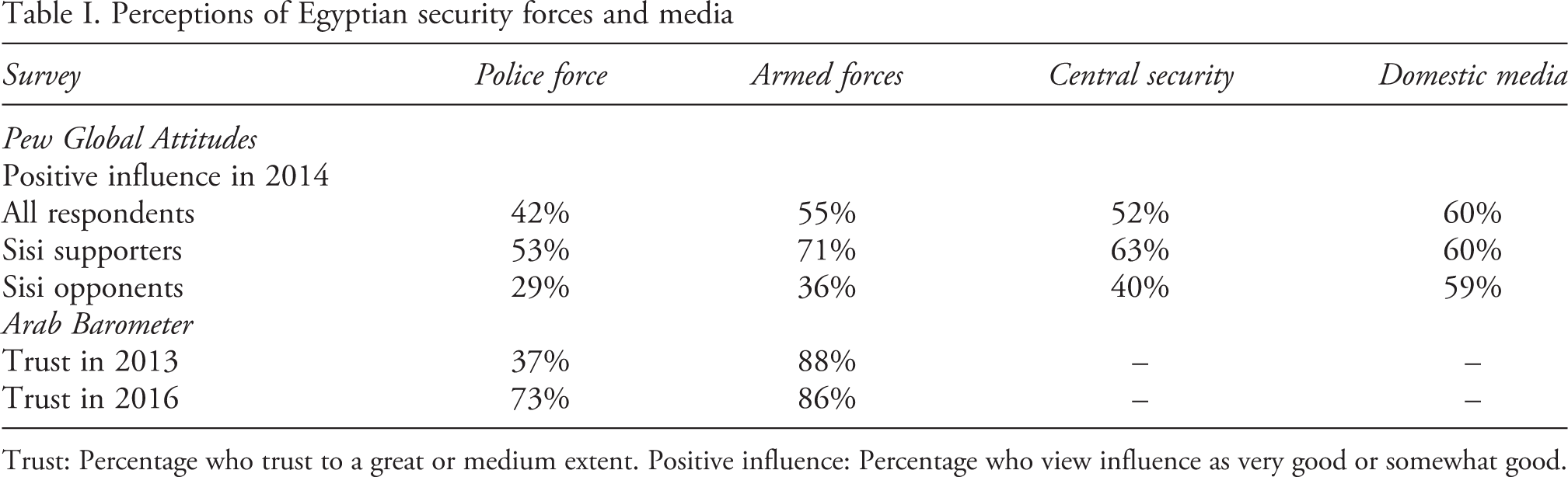
Trust: Percentage who trust to a great or medium extent. Positive influence: Percentage who view influence as very good or somewhat good.
The intensity of Egypt’s political divide following the revolution might plausibly make it difficult for the regime and human rights organizations to shift attitudes toward repression. Supporters of Sisi are convinced that the Muslim Brotherhood coddles terrorists, while opponents of the coup believe that Morsi’s ouster marked the tragic end of Egypt’s democratic experiment. With such strongly held beliefs dividing the country, many Egyptians may resist or ignore information that contradicts their priors about the righteousness or injustice of the regime. Nonetheless, much of the public remains disconnected from political developments. In the 2013 Arab Barometer survey, only 11% of respondents claimed to be ‘very interested’ in politics. Furthermore, many Egyptians continue to have low levels of educational attainment. Individuals with less political interest and less education tend to be more susceptible to persuasion (Geddes & Zaller, 1989; Truex, 2017; Zaller, 1992), suggesting the potential for Egyptians’ views of repression to shift in response to information received from either the regime or human rights organizations.
Polling data displayed in Table I also suggests Egypt’s security forces and media retain greater public trust than might be assumed of authoritarian regimes. The data come from the 2013 and 2016 Arab Barometer surveys and the 2014 Pew Global Attitudes Survey. 2 Majorities approved of the armed forces in all three surveys, and the Central Security Forces – responsible for many of the regime’s most violent acts – likewise received majority approval. The police forces initially received lower ratings, but their reputation appears to have strengthened over time. As might be expected, Egyptians who approve of Sisi in the Pew survey (54% of respondents) viewed these institutions more favorably than respondents who disapproved, but it is notable that non-trivial percentages of Sisi’s opponents still expressed positive attitudes toward the state’s coercive apparatus. The media also received relatively high marks in the full Pew sample and across the partisan divide. These responses suggest that the institutions responsible for coercion and propaganda possess enough credibility to shift public attitudes effectively. As a result, we expect that Egyptians will demonstrate greater acceptance of state-sponsored violence when exposed to the security forces’ justifications for repression.
Polling data about Egyptians’ attitudes toward human rights organizations is unavailable, but as in other authoritarian political systems, the regime has worked hard to discredit them. Human rights defenders are smeared with accusations that they are serving a ‘foreign agenda’, engaging in corruption, committing treason, and defending terrorists (Elmasry, 2019). As a result, these groups may lack the credibility to undermine the regime’s justifications for state-sponsored violence. Nonetheless, it might be assumed that they would retain credibility because of their independence from the state and the popularity of their mission – most Egyptians endorse human rights. In the 2013 Arab Barometer, 64% of Egyptian respondents said that human rights violations were not justified by national security threats, and 62% answered this way in 2016. We therefore expect that Egyptians will become less supportive of state-sponsored violence against the opposition when confronted with information from human rights organizations.
When Egyptians encounter narratives about repressive incidents from both the security forces and human rights organizations, it is possible that one of these sources possesses enough of a credibility advantage to shift the public’s attitudes in their direction. However, the data above suggest that such a clearcut advantage is unlikely to exist. Furthermore, even if many Egyptians do not hold strong political preferences, most appear to lean one way or the other. In the 2014 Pew survey, for instance, fewer than 1% of respondents answered ‘don’t know’ when asked to rate their attitudes toward Sisi, and fewer than 2% said the same about Morsi. As a result, we expect that a competitive information environment will reinforce Egyptians’ pre-existing attitudes toward state-sponsored violence, thus blocking significant shifts from occurring. Such a dynamic would imply that human rights organizations can help to mitigate the effects of regime propaganda justifying repression.
Experimental design
We designed an experiment to test these expectations in Egypt. The experiment asked about a repressive event and assigned respondents with equal probability to a control group or one of three treatments: a security forces treatment using a statement from the security forces; a human rights treatment with a statement from Human Rights Watch; and a contested treatment with both accounts.
This research is complicated by the fact that all Egyptian respondents would have been exposed to regime communications about state-sponsored violence prior to the survey. Such pre-treatment exposure can limit subjects’ responsiveness to experimental vignettes (Druckman & Leeper, 2012). On the one hand, repeated exposure to messaging from the regime may lead respondents to ignore the security forces treatment because it provides little new information. On the other hand, more limited exposure to human rights messaging may result in a situation where exposure to a single human rights message within the survey cannot outweigh exposure to security forces messaging pre-treatment. While we cannot mitigate this issue entirely, we attempt to minimize its impact by focusing on a specific case of repression against the Muslim Brotherhood, since attitudes toward individual events may be more responsive to the contextual information received about these events. This approach should enable us to learn about the effects of propaganda and human rights messaging more broadly by focusing on how they affect attitudes toward this case of state-sponsored violence. To that end, the experimental vignette addressed a specific incident in which Egyptian security forces killed nine members of the Muslim Brotherhood.
Prompt
The event in the vignette occurred on 1 July 2015, two years after Sisi’s coup and 14 months before our experiment. Sisi had been elected president approximately one year prior to the event, and by this point the regime’s opponents were no longer able to mobilize mass street protests. However, the security forces continued to pursue the Muslim Brotherhood, and also faced a growing Islamist insurgency.
The details of the event are as follows: Egyptian security forces raided an apartment in which nine leaders of the Muslim Brotherhood had been meeting. All nine of the men were killed. The security forces justified the deaths by portraying the men as violent terrorists: they said they had been fired upon as they entered the apartment; the government released photos showing weapons in the apartment; and the men were said to be responsible for terrorist attacks in Egypt. However, Human Rights Watch investigated the incident and concluded that the deaths were likely extra-judicial killings. Witnesses suggested the men had been arrested before they were killed, and lawyers who saw the bodies said their wounds supported this conclusion. The apartment also showed no signs of a shootout (Human Rights Watch, 2015).
The survey was conducted in Arabic. The English translation of the vignette is below. 3 All participants read the initial control statement. They were then randomly assigned to receive no additional information or one of the three treatment conditions. 4
The security forces statement was an actual quote taken from an article in the major Egyptian newspaper Al-Masry Al-Youm (Shalabi, Dabash & Al-Qamash, 2015). Similar statements were reported in most other newspapers. The Human Rights Watch statement was quoted from the investigation of the incident released by Human Rights Watch (2015). 5 The control group is intended to capture pretreatment attitudes toward repression of the Muslim Brotherhood when no context is included, while the contested information permits evaluation of whether one or the other sources of information is relatively more persuasive.
Outcomes
Following the prompt, respondents were asked two outcome questions designed to assess attitudes toward this specific incident: if they thought the police tactics were justified, and if the police should be held accountable for killing the nine men. Respondents could answer both questions on a five-point Likert scale. For ease of interpretation, we condense these responses to binary variables for the analysis. For the question about whether the police tactics were justified, responses were coded as 1 if the respondent said they were definitely or probably justified and as 0 otherwise. We call this variable Tactics-justified. For the question about whether the police should be held accountable for the violence, responses were coded as 1 if the respondent said the police should definitely or probably not be held accountable and as 0 otherwise. We call this variable No-accountability.
Hypotheses
As discussed previously, we expected that Egyptians’ attitudes toward the repressive incident would respond on average to the contextual information they received, such that the security forces’ portrayal of the Brotherhood members as violent would increase acceptance of the killings, while evidence that the Brotherhood members were nonviolent would strengthen opposition to the police tactics. In the case of contestation, we expected that attitudes toward police violence would revert to pretreatment attitudes captured by the control group, with respondents choosing to trust the information that aligns with their general views of state-sponsored violence against the Muslim Brotherhood.
Recruitment and sample
Summary statistics and covariate balance
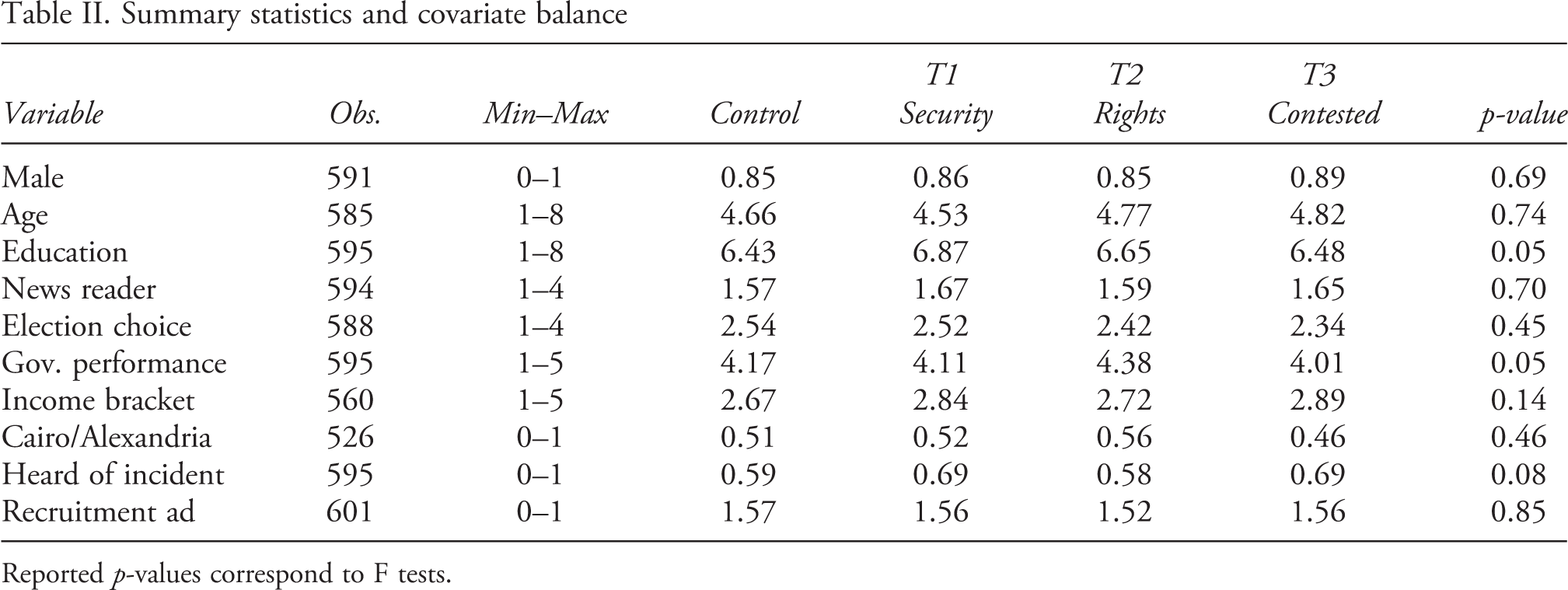
Reported p-values correspond to F tests.
Selection effects create potential issues for generalizability, because only a small percentage of profiles exposed to the ads ever click on them. In our case, the ads were displayed to 4,057,249 profiles, of which 10,237 clicked through. This click-through-rate of 0.25% falls within the standard range (Jäger, 2017). Of these individuals, approximately 600 began the survey after reading the consent form and completed the experiment. Facebook samples tend to be educated and more interested in politics (Samuels & Zucco, 2013; Rife et al., 2016), and that was true of our sample as well. These characteristics suggest that respondents may hold particularly strong political beliefs, which could reduce the likelihood that they update their attitudes in response to our treatments. The sample was also heavily male, as in other Facebook surveys, but it was not noticeably younger, as has often been the case (Samuels & Zucco, 2013; Rife et al., 2016). Politically, the respondents were evenly split between individuals who voted for Sisi in the 2014 election and those who voted for his challenger or boycotted the election, suggesting a reasonable degree of political diversity in the sample. Table I in the Online appendix compares our sample to the nationally representative data from the 2013 Arab Barometer survey, and we consider the sample composition when discussing our results.
In addition to the questions discussed above, respondents were asked about government performance, income, governorate of residence, and if they thought they had heard about the incident in the vignette. Table II reports summary statistics for the covariates. There are slight imbalances for education and perceptions of government performance. However, the substantive differences are fairly small, and the primary results are robust to the inclusion of controls.
Safety and ethics
One advantage of using Facebook for recruitment is that it protects the identities of the respondents. Given the political environment in Egypt, researchers are not able to guarantee the anonymity or safety of their research subjects, and researchers are also at risk. Once an Egyptian Facebook user clicked on our ads, however, they were redirected to Qualtrics and could not be connected to their profile.
7
We also took extra precautions by disabling Qualtrics tracking of IP addresses and using Mean responses by treatment group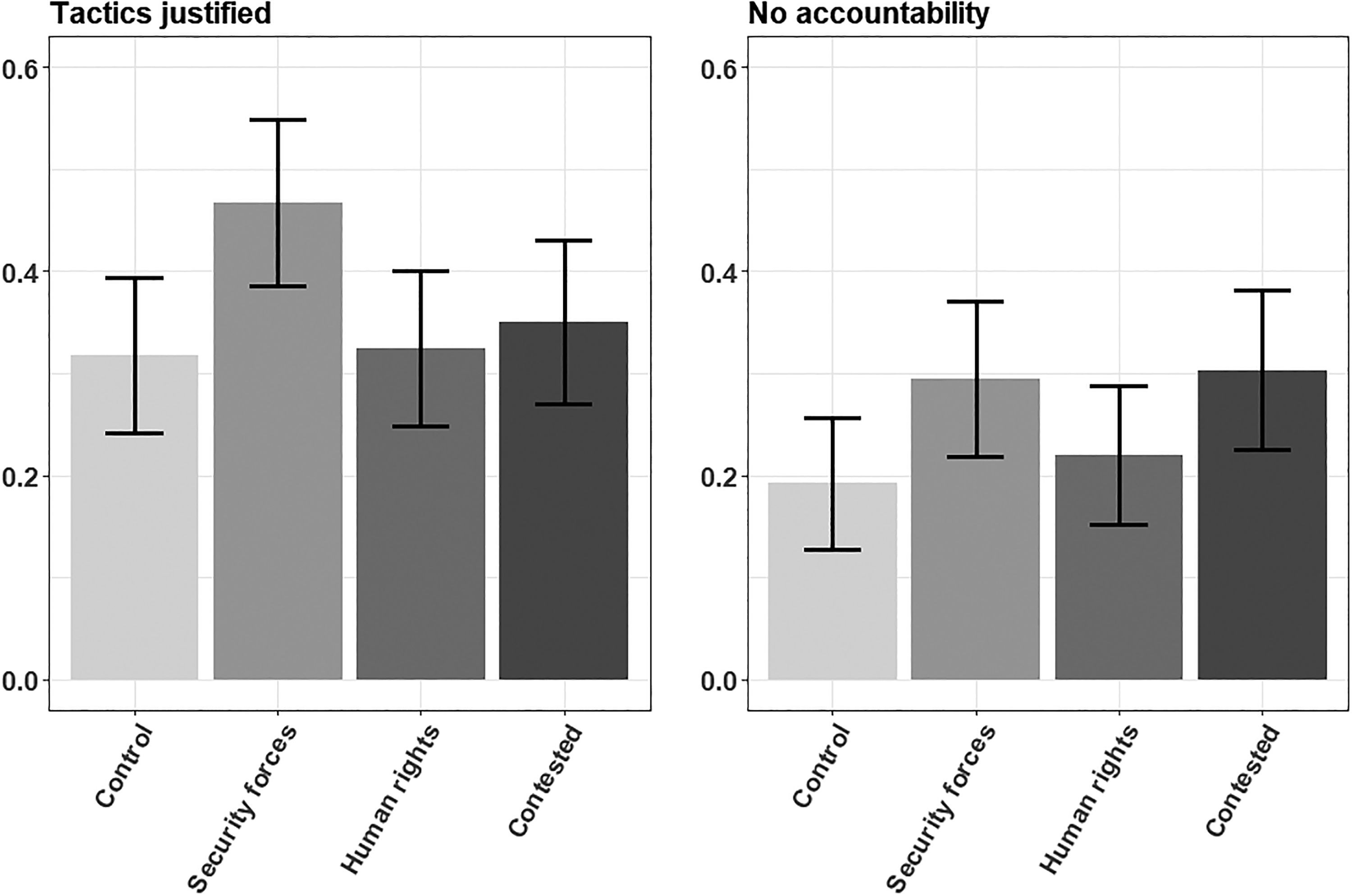
We also attempted to mitigate ethical concerns related to the use of information from the Egyptian security forces. First, the general information in this treatment has been a regular feature of Egyptian politics since 2013. Second, we clearly attributed the security forces’ statement to the article rather than the researchers. Thus, the survey neither injected new content into Egypt’s political environment nor endorsed justifications for political violence. At the end of the survey, respondents saw a debriefing statement which noted that human rights organizations had documented extensive human rights violations by the Egyptian security forces. The statement included a link to the Arabic-language Egypt page of Human Rights Watch.
Results
Main effects
The results indicate that Egypt’s security forces can be successful at shaping attitudes toward specific incidents of repression when they are able to portray the targets as violent, and they provide mixed evidence for the ability of human rights organizations to contest these claims effectively. For both outcomes, Figure 1 displays the difference in means across the control and treatment groups. In Figure 2, we then show the treatment effects when estimated using three OLS models with robust standard errors: the first with no covariates, the second with pretreatment covariates only, and the third with additional covariates acquired post-treatment in the survey. 8 Online appendix Section 3 also provides results for additional robustness checks, including different models and different constructions of the dependent variables.
As shown in Figure 1, approximately 32% of respondents in the control group felt that the police tactics were justified, and approximately 20% of respondents in the control group claimed that the police should not be held accountable for killing the nine men. These results suggest that a non-trivial percentage of Egyptians were willing to endorse state-sponsored violence against the Muslim Brotherhood without detailed information on the circumstances in which the violence was used.
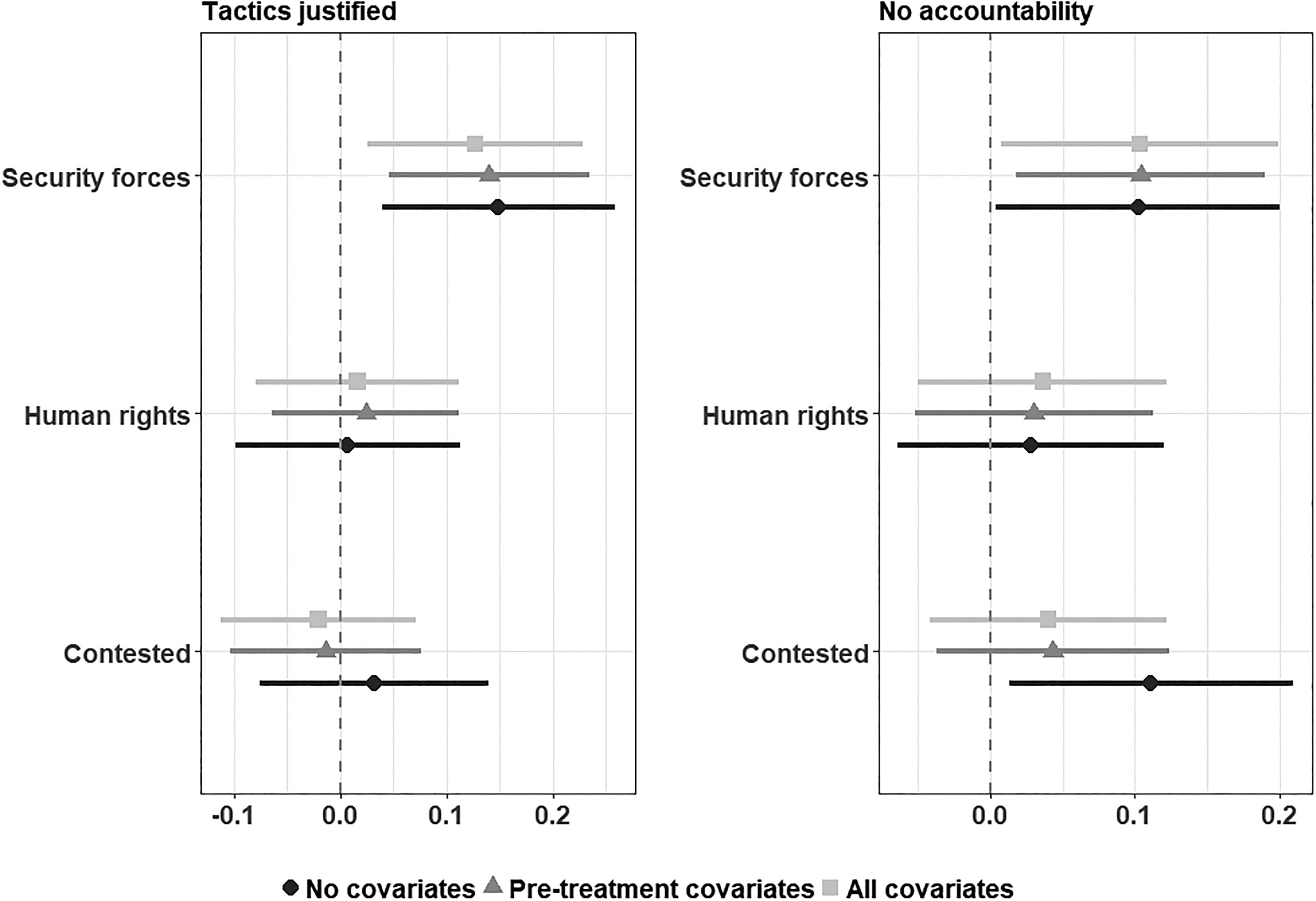
Coefficient plots of ATEs
The percentage of respondents willing to support the police tactics and oppose accountability increased substantially in the security forces treatment group. For Tactics-justified, support rose by 14.9 percentage points (p = 0.008), meaning that nearly half of respondents in this group endorsed the violence. This effect is substantively large, resulting in a 47% increase. Likewise, opposition to accountability rose by 10 percentage points for No-accountability (p = 0.040), an increase of 50%. As shown in Figure 2, these effect sizes are consistent across the different OLS specifications. We interpret these results to indicate that some Egyptians who generally oppose the use of state-sponsored violence are responsive to the specific circumstances in which repression occurs – they can be convinced to support repression when the security forces control the narrative and are able to portray their victims as violent, threatening terrorists.
By contrast, the additional information from Human Rights Watch did not decrease support for the police tactics or reduce opposition to accountability, relative to the control group. In fact, the coefficients for both outcomes point in the other direction, though the magnitude is small. These non-effects are consistent across the three OLS specifications, as shown in Figure 2. This result could reflect a dynamic in which respondents who were willing to endorse violence against the Muslim Brotherhood even in the absence of contextual information were also distrustful of human rights organizations and motivated to view repression of the group as justified regardless of the circumstances. As a result, they resisted updating their attitudes when confronted with information establishing the extra-judicial nature of the specific killings in question.
For the contested treatment, results demonstrated no statistically significant difference from the control group. For Tactics-justified, these results were consistent regardless of the OLS specification used, as shown in Figure 2. For No-accountability, the results were less clear. Without covariates, the contested treatment group was 10 percentage points more likely than the control group to oppose accountability for the police, similar to the security forces treatment group. However, this effect disappeared with the inclusion of covariates, indicating that it may have been an artifact of the imbalances on income and education. These results suggest that individuals reverted to their pretreatment attitudes toward repression against the Muslim Brotherhood when provided with competing claims about the incident.
Given the substantively large effects of the security forces treatment, we interpret results from the contested treatment to provide some evidence for the ability of the human rights messaging to counter propaganda justifying state-sponsored violence. When the security forces were not challenged, their account of the victims’ violence significantly increased support for repressive tactics and decreased opposition to accountability; however, when respondents were also exposed to the information from Human Rights Watch, the security forces’ account no longer had these effects. In other words, the information from Human Rights Watch appears to have neutralized the ability of the security forces to increase respondents’ acceptance of repression in this incident. 9 While some Egyptians became more accepting of repression in cases where the security forces were unchallenged in portraying their victims as violent, they reverted to disapproval when also exposed to countervalent information indicating the falsity of the regimes’ claims.
Alternative explanations
Social desirability bias constitutes a potential alternative explanation for the security forces effect if respondents only revealed their support for a controversial position after the treatment suggested it was acceptable. While this explanation cannot be ruled out completely, we believe it unlikely. First, research suggests that online, anonymous surveys are less susceptible to this type of bias (Kreuter, Presser & Tourangeau, 2008). Second, expressing support for repression against the Muslim Brotherhood does not appear to be a socially unacceptable position. Following the coup, many Egyptians proclaimed publicly that violence against the Brotherhood was justified (Black & Kingsley, 2013). Demand effects are also possible if respondents tried to reflect the researchers’ preferences, but research suggests these effects are unlikely to occur (Mummolo & Peterson, 2019). In addition, the survey did not identify the researchers or the institution, which should limit this concern.
Another possibility is that respondents in the security forces treatment may have been more likely to suspect the survey of being conducted by the regime. However, we believe this explanation is unlikely, because only a small number of respondents viewed the treatments and then did not answer the outcome questions. If respondents in the security forces treatment were suspicious of the survey, we would expect to see relatively large numbers drop out once they had read the treatment. This pattern did not occur. 10
It is also possible that treatment effects for the security forces were driven by the specific mention of Al-Masry Al-Youm, if respondents perceived this paper as particularly credible. 11 However, while it is true that Al-Masry Al-Youm developed a reputation for independence prior to the revolution, the paper has staunchly supported the regime’s war against the Brotherhood since the 2013 coup (Lindsey, 2017). Given this positioning, it is unlikely that its name lent additional credibility to the statement by the security forces.
External validity
This section considers threats to external validity. First, it is possible that our results would have differed with a more representative sample. However, we believe that these differences should bias against our findings on the security forces treatment. The vast majority of our respondents (75.5%), including half of Sisi voters (50.2%), rated the government’s performance as somewhat unsuccessful or very unsuccessful. While it seems likely that a majority of Egyptians disapproved of the government at the time of the survey, this sample is probably biased toward opposition opinions, suggesting the potential for a higher degree of skepticism about government institutions like the security forces.
Relatedly, one consequential way in which our sample diverges from the population is in educational attainment: 72.1% of our respondents had completed university, compared to just 20.5% in the fourth wave of the nationally representative Arab Barometer. Prior research indicates that less educated individuals are more vulnerable to propaganda in authoritarian settings (Geddes & Zaller, 1989; Truex, 2017), so we weighted the data by university education and reran the analysis. These results are shown in Figure 3.
12
Consistent with prior research, the magnitude of the security forces effect increased Results weighted by university education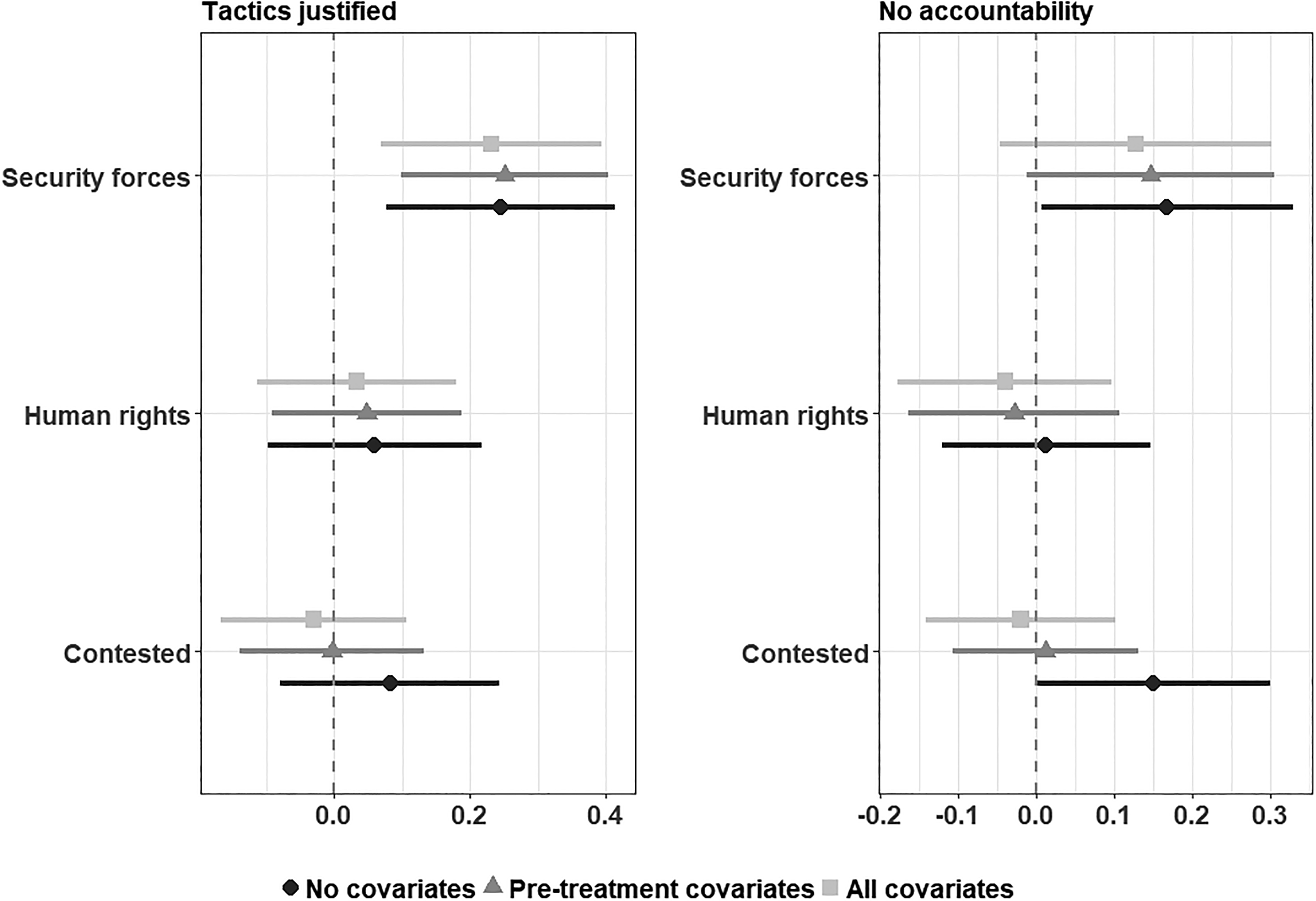
Another concern with external validity relates to the content of the treatment messages and the incident they addressed. As with most survey experiments, it is possible that different language about the opposition’s use of violence would have produced different results, due either to the treatment strength or the persuasiveness of certain language (Chong & Druckman, 2007). Relatedly, we use a specific incident involving extrajudicial executions that may differ from other cases of state-sponsored violence. Indicative of these issues, we also ran a significantly shorter experiment in the survey that addressed hypothetical repression of protests, and the results did not demonstrate any attitudinal shifts. This may have occurred because the messaging was much weaker relative to the experiment reported in the article, or because protests have been so frequent in Egypt that public attitudes may have become entirely divorced from contextual information about the use of state-sponsored violence against specific demonstrations. For the sake of transparency, a discussion of these results is reported in Online appendix Section 6. Thus, while our article provides evidence that Egyptian security forces can exert relatively substantial influence on the public’s attitudes toward state-sponsored violence in some circumstances, and that human rights organizations possess some capacity to mitigate these effects when their countervalent information reaches the public, we are limited in our ability to say when these outcomes are more or less likely to occur.
It is also important to note that our findings may be influenced by specific characteristics of the Egyptian context. The regime resembles the modal authoritarian government in many ways, but a key difference is the dominance of the armed forces. Militaries are often relatively popular with the public, particularly in periods of instability; as a result, military-led regimes and the security forces that support them may possess more capacity than other authoritarian regimes to sway public opinion on the use of force. In addition, the revolutionary fervor, instability, and very real terrorism threat in Egypt during the period in which the experiment was conducted may also have increased Egyptians’ willingness to trust state institutions on national security matters. These dynamics might plausibly have strengthened the security forces treatment relative to what we would find in other authoritarian regimes. For instance, in more stable autocracies like China or Hungary where opposition has been primarily peaceful and relatively muted, citizens may be more skeptical of claims that targets of repression acted violently. As a result, it is also important for future research to consider whether our findings apply in other authoritarian contexts.
Finally, the results may be influenced by our focus on print sources distributed online through social media. This mode of information transmission has become increasingly important for politics in the Arab world and globally, but we have already noted that only a minority of Egyptians consume news in this way, which likely applies to many other authoritarian political systems as well. However, to the extent that the results would change, our expectation is that television and radio sources would benefit autocrats and their security forces over human rights organizations. Not only can they control these outlets more fully, but the visual images and sounds associated with violence might plausibly inspire greater fear among the public, further increasing acceptance of repression. Notably, other studies of authoritarian propaganda on television and radio find substantively large effects on attitudes and behaviors (e.g. Adena et al., 2015; Peisakhin & Rozenas, 2018).
Conclusion
In their review of empirical evidence on persuasion, DellaVigna and Gentzkow (2010) write that, ‘[v]irtually all the evidence is from the United States or other democracies. Yet one of the original motivations for studying persuasion is its role in autocracies and dictatorships.’ While recent studies increasingly support the claim that authoritarian propaganda can be persuasive, more experimental evidence is needed. Our article contributes to this growing literature by demonstrating that Egypt’s security forces can have some success at justifying their use of violence when they control the narrative and are able to portray the opposition as violent terrorists. This finding illustrates how autocrats can use their control over the media to insulate themselves from potential backlash against repression. However, we also find that the persuasive capacity of the security forces is diminished when a human rights organization challenges the regime’s claims. This finding underscores the need for further research on competitive information environments in authoritarian regimes, particularly since liberalizing media markets and growing internet access mean that individuals living in these political systems are increasingly able to access nongovernmental sources of information.
Despite these changes, it remains the case that authoritarian regimes like Egypt’s exercise extensive control over information flows. Most Egyptians still receive their news from television, radio, or newspapers – all of which are strongly influenced by the government. As a result, the security forces treatment is most representative of the information environment experienced by the majority of Egyptians when they receive political news. The findings therefore suggest that Egypt’s security forces may be relatively successful in justifying specific cases in which the opposition is repressed violently, even if the public generally holds negative views of state-sponsored violence.
Nonetheless, it remains important that when the human rights information was paired with the security forces account of the raid, it counteracted the ability of the security forces to increase support for repression. This finding has important implications for practitioners interested in promoting human rights in authoritarian regimes. In recent years, autocrats around the world have increasingly moved to close space for human rights organizations operating in their countries (Carothers & Brechenmacher, 2014). This reduced ability to maneuver means that even less countervalent information will reach people living in these political systems, suggesting that authoritarian regimes will be better situated to justify repression of their opponents. Policymakers committed to human rights can push back against this trend by offering these groups additional training and funding, as well as technical support for online platforms through which to disseminate their message and stronger diplomatic protections against targeted repression. These resources would provide a useful investment for helping to limit the pernicious effects of authoritarian propaganda and its ability to increase support for state-sponsored violence.
Footnotes
Replication data

Acknowledgements
We thank the Center for International Security and Cooperation (CISAC) at Stanford University for funding this project. We thank Beatriz Magaloni, Kenneth Scheve, Lisa Blaydes, and David Laitin for their comments and support, and we thank participants at APSA, MPSA, and the Stanford Center for International Conflict and Negotiation for helpful feedback. Any opinions, findings, and conclusions or recommendations expressed in this material are those of the authors and do not necessarily reflect the views of the National Science Foundation.
Funding
This material is based upon work supported by the National Science Foundation Graduate Research Fellowship Program under Grant no. DGE-114747.