







Abstract
Does state weakness increase support for ethnic violence? This study proposes individuals who feel insecure due to state weakness are more likely to support interethnic violence conditional on exposure to chauvinist messaging. Support for interethnic violence is evaluated through a survey experiment in Southern Kyrgyzstan. The results show random assignment of chauvinist nationalist rhetoric only induces support for interethnic violence among respondents who trust informal non-state actors from their ethnic group to provide them security. The findings suggest state weakness leads individuals to view their ethnic group as an alternative provider of security and that when primed by chauvinist rhetoric, these individuals become more supportive of violence on their group’s behalf. A case study of the 2010 riots in the Southern Kyrgyz city of Osh illustrates how underlying support for violence may escalate to actual violence as a result of state breakdown, examining events in the months after the Kyrgyz state lost authority following the April 2010 revolution. Jointly, the survey findings and case study illustrate pathways for violence in ethnically divided low-capacity environments and potential drawbacks from protest-oriented revolutions.
Introduction
Kyrgyzstan experienced revolutions in March 2005, April 2010, and October 2020. Two months after the 2010 Revolution, a large brawl broke out between Kyrgyz and Uzbek youth in the Southern city of Osh (Temirkulov, 2010). Amid rumors of further violence, thousands of Kyrgyz from rural areas flooded into Osh and attacked Uzbek neighborhoods. After three days, hundreds, if not thousands, of civilians were killed and hundreds of thousands were displaced. The pattern seen in Kyrgyzstan is not unusual. The Russian Revolution led to pogroms against Jews (Miliakova, Rozenblat & Elenskaia, 2006), Egypt’s 2011 revolution was followed by greater violence against Coptic Christians (Brown, 2013), and even low-scale unrest led to the formation of ethnic gangs and communal violence in Timor-Leste (Scambary, 2009). While research has broadly linked state capacity to the onset of conflict (Fearon & Laitin, 2003), the way in which either state weakness or breakdown relate to public support for violence is not well understood. This study provides an answer for societies where ethnic divisions are relevant: support for ethnic violence is more likely when citizens rely on their ethnic group, rather than the state, to provide them with security, but conditional on exposure to chauvinist nationalist rhetoric. 1 In times of state breakdown, mutual insecurity and status threats among ethnic security actors are more likely to lead to actual interethnic violence.
What occurred in Osh was an ethnic riot – ‘an intense, sudden, though not necessarily wholly unplanned lethal attack by civilian members of one ethnic group on civilian members of another group’ (Horowitz, 2001: 1). Ethnic riots differ from other forms of political violence through broad participation of ordinary citizens and a relatively short and contained period of violence. Research on ethnic riots has focused on the extent politicians either directly influence (Brass, 1997; Toha, 2017) or indirectly foment or exacerbate riots (Wilkinson, 2004), as opposed to the role of larger structural factors, such as horizontal inequality (Horowitz, 2001), urbanization (Van Klinken, 2007) or insecurity (Scacco, 2021).
This study takes a different approach by looking at why certain contexts are prone to communal violence, rather than when riots occur or which individuals participate in violence. While ethnic riots may be short outbreaks of violence, their regularity and dependence on triggering events suggests non-participants in riot-prone environments have underlying support for violence that goes unexplained when research focuses on riot participation. Moreover, the reasons for support cannot be assumed to be the same as the reasons driving participation. As such, understanding societal support for interethnic violence is crucial to understanding ethnic riots.
State weakness – a lack of undisputed authority over state territory (Krasner, 2004) – plays a key role in fomenting underlying support for interethnic violence. Lacking a monopoly over the use of force within a country’s borders can encourage the proliferation of independent security actors, such as militias (Reno, 2002) and rebel groups (Fearon & Laitin, 2003). State weakness manifests as perceived insecurity at the individual level. Perception that the state is incapable of defending citizens from harm encourages individuals to join ad hoc groups that may carry out violence against others (Scacco, 2021). As such, insecurity stemming from macro-level state weakness may lead individuals to rely on ethnically oriented non-state actors as security providers.
However, reliance on ethnic security organizations does not guarantee individuals will associate their personal safety with their ethnic group’s welfare. The study proposes that an additional condition – chauvinist nationalism – is sufficient for inducing support for violence in weak states. Chauvinist rhetoric convinces individuals that threats to their ethnic group are also threats to their well-being. Chauvinist rhetoric emphasizes in-group superiority, which convinces individuals relying on ethnic security organizations that maintaining their group’s status is vital to their personal interests. As a result, violence to eliminate status threats becomes equitable to self-defense.
In weak states, this process operates in the background without major episodes of violence. State breakdown fosters uncertainty for non-state ethnic security providers. Uncertainty increases potential threats to ethnic group status and decreases accountability for committing violent acts from state actors, increasing the likelihood interethnic violence occurs.
The study applies a multimethod approach to test the theory in Southern Kyrgyzstan. First, respondents are randomly primed with a chauvinist message emphasizing in-group superiority in a survey. Receiving the message only makes respondents more likely to support ethnic violence if they trust informal community leaders or friends and family members to provide them security. Second, interviews and independent reports describing the 2010 Osh ethnic riots illustrate how state breakdown created mutual insecurity and salient status threats among ethnic security providers, contributing to the risk of actual ethnic violence.
The findings clarify the process through which state weakness and subsequent breakdown may increase the likelihood of ethnic conflict: chauvinist rhetoric induces greater support for ethnic violence among individuals that trust informal sources of security. State breakdown makes informal ethnic sources of security more relevant, creating uncertainty about future group status and making actual interethnic violence more likely. The results contribute to work linking political institutions to the salience of ethnicity, as well as work on the micro-foundations underpinning ethnic violence (i.e. Scacco & Warren, 2018; Shesterinina, 2016). They also suggest sudden declines in state capacity, particularly after protest revolutions, may expose or foment support for interethnic conflict.
State weakness, insecurity, and chauvinist nationalism
The main contention of this article is that chauvinist nationalist rhetoric induces greater support for interethnic violence among only those who feel insecure due to state weakness. The theoretical mechanism rests on two assumptions and two testable claims.
The first assumption is that weak state capacity fosters perceived insecurity. By definition, a state that no longer has undisputed authority over a territory cannot provide security to at least some of its citizens. However, to act on this loss of authority individuals need to believe the state cannot provide them with security. Thus, the study assumes that individuals must believe themselves to be insecure to support violence as a result of state weakness. 2 It is also assumed that ethnicity – a feeling of identity with a particular descent-based characteristic (Chandra, 2006) – must be salient for individuals to seek out ethnic security providers. In seeking security from the ethnic groups they ascribe to, individuals build on existing networks, rather than having to forge new connections. Jointly, the assumptions suggest the hypothesized effect should occur in ethnically divided weak states where informal ethnic security organizations can serve as plausible alternatives for any ethnic group.
The study does not, however, assume that individual preferences are deterministically linked to the security position of their ethnic group, or that, as posited by the ethnic security dilemma (Posen, 1993), mutual insecurity between ethnic groups under anarchy automatically increases the likelihood of conflict (Kaufman, 1996). Even with an external threat to one’s ethnic group, an individual should not automatically accept violence in response. Instead, the study proposes chauvinist nationalism is a sufficient tool for ethnically oriented non-state groups to link threats to group status to the welfare of their supporters. By establishing such a link, ethnically oriented non-state actors can foment support for interethnic violence among those that rely on them for security.
Why is ethnic chauvinism a relevant factor? Ethnic chauvinism is the perception that one’s ethnic group is superior to other groups (Nagel, 1998). Feelings of group identity and pride are necessary, but not sufficient for feeling chauvinism (Huddy & Del Ponte, 2019). Group identity signifies an attachment to one’s group or sense of belonging (Sniderman, Hagendoorn & Prior, 2004) and group pride reflects positive feelings about the accomplishments of co-ethnics (Hjerm, 1998). Chauvinism not only includes these ‘positive’ in-group sentiments, but also ‘denigration’ of out-groups to further elevate the in-group (de Figueiredo & Elkins, 2003). 3 Scholars have found ethnic chauvinism to be correlated with xenophobia (Cashdan, 2001), prejudice (Brewer, 1999), and a greater preference for violence against out-groups (Bar-Tal, 1990).
What specifically about chauvinist nationalism makes exposure to it more likely to produce support for interethnic violence? Most relevant is the inflated sense of group status. When individuals believe their group deserves higher status in society because of their inherent superiority, challenges are not just perceived as threats to the well-being of the group, but to the well-being of those that view deserved group status as equitable to their own.
Challenges are most likely in times of state weakness, when group status is more uncertain. Groups in advantageous positions may feel threatened, while excluded groups may sense an opportunity. Chauvinist rhetoric can then motivate individuals that trust ethnic security organizations to see threats to their group’s status as equitable to challenges to their personal security. Specifically, chauvinist nationalism ingrains the current or aspired status of a group to individuals’ consciousness as an extension of themselves. With this extension, any perceived negative consequence of status loss for the group extends to the individual. Thus, status loss becomes a loss of personal safety because it costs individuals the advantages they believe they are receiving through their deserved group status. Individuals who identify with chauvinist nationalism then support violence against other groups as a response not only to possible losses for their group, but to losses of their own deserved status in society. It then follows that:
Hypothesis 1: Individuals exposed to chauvinist nationalism that trust informal actors for security should be more likely to support violence against another ethnic group.
A meso-level claim follows: support for violence as a result of exposure to chauvinist rhetoric conditional on trust in informal organizations organized around ethnicity can result in actual violence during episodes of state breakdown – the complete absence of state authority in the whole country or one of its regions (Laitin, 2002). It is important to note that individuals may support interethnic violence as a result of exposure to ethnic chauvinism conditional on trust in informal sources of security at any time. However, only with state sources of security gone,
4
do informal ethnic security groups operate in an environment of mutual insecurity that Kyrgyz oblasts (first level administrative regions): proportion Kyrgyz in blue, Uzbeks in green, other groups in gray.
Hypothesis 2: State breakdown is more likely to produce intergroup violence under the condition of mutual use of chauvinist narratives by informal ethnic security actors.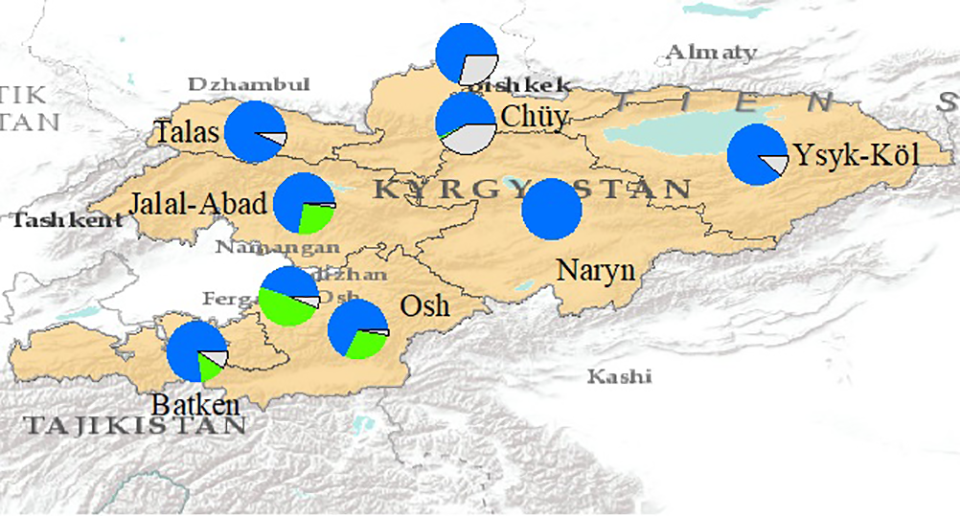
Hypothesis 1 is tested using a survey experiment, as individual support for violence should still exist in times of relative peace but continuing weak state capacity. Following the survey experiment, a case study of Kyrgyzstan’s 2010 Osh riots illustrates Hypothesis 2.
Survey design
To evaluate support for violence against another ethnic group, 1,000 respondents were surveyed in second-level administrative regions of Kyrgyzstan located in the Ferghana Valley. Kyrgyzstan’s portion of the Ferghana Valley includes the majority of its three Southern regions, Jalal-abad, Osh, and Batken, and is separated from the rest of the country by several mountain ranges. Kyrgyzstan’s first-level administrative divisions and their ethnic compositions are shown in Figure 1. The South, home to approximately half of the country’s population, is demographically distinct from the North, 7 with ethnic Uzbeks making up about 30% of the Southern population and half of the population of the largest city, Osh (Kyrgyz Respublikasynyn uluttuk statistika komiteti, 2009). Although from the same ethnic group, there is also a somewhat salient cleavage between Northern and Southern Kyrgyz (i.e. Radnitz, 2010).
The case of Southern Kyrgyzstan
Tensions between Kyrgyz and Uzbeks in Southern Kyrgyzstan trace back to the early Soviet period. Central Asian peoples did not clearly fit into separate nationalities before the region’s conquest by Tsarist Russia (Haugen, 2003: 31–33, 42). Soviet rule brought about reorganization of now-Soviet Central Asia into five separate republics, elevating Uzbeks and Kyrgyz to ‘titular nationality’ status (Haugen, 2003: 148). Elites from ‘titular’ nationalities mobilized co-ethnics to retrench their positions and lobbied Soviet authorities to expand their republics’ territories. It was through such lobbying that several majority-Uzbek towns, including Osh and Jalal-Abad, were included in the Kara-Kirghiz Autonomous Oblast (Haugen, 2003: 188–192).
The relative economic and political positions of Uzbeks and Kyrgyz in the new Kyrgyz Soviet Socialist Republic contributed to tension. By living in cities, Uzbeks retained housing and employment that was not available to Kyrgyz (McGlinchey, 2014: 378). On the other hand, Kyrgyz were able to monopolize access to top political positions, especially in the Brezhnev era (McGlinchey, 2014: 379), and education (Martin, 2001: 175), by virtue of their titular nationality status. Commercio (2018) suggests the concentration of economic influence among Uzbeks and political and institutional power among Kyrgyz led to mutual resentment – the perception that another ethnic group occupies an undeserved position relative to one’s own (Petersen, 2002) – among elites from both groups. By the late 1980s, Kyrgyz migrating into cities increasingly clashed with Uzbeks over housing and employment (Liu, 2012: 22–23).
One such clash in June 1990 triggered violence that resembled the June 2010 events. Spurious rumors in Kyrgyz communities about anti-Kyrgyz violence by Uzbeks inflamed tensions, while local security forces failed to adequately react, with some even joining the participants (Tishkov, 1995: 139, 145). During the riots, chauvinist ‘myths’ promoted ‘suspiciousness, anxiety, fear and hatred’ among both Kyrgyz and Uzbeks (Tishkov, 1995: 147).
In contrast to the events of 2010, many perpetrators of the 1990 violence were prosecuted by the post-independence government of Askar Akayev, which practiced policies of ethnic harmony (see Megoran, 2013). Over time, however, Akayev, a Northerner, grew authoritarian and was challenged by both other Northern and Southern Kyrgyz politicians. In 2005, he was deposed in the ‘Tulip Revolution’, and replaced by a North–South unity government (Radnitz, 2006). Soon after, the state grew to be dominated by Southerners led by Kurmanbek Bakiyev, leading to tension between Uzbeks and Southern Kyrgyz (Khamidov, 2013). Neither violence nor tension was limited to the period immediately following the 2010 revolution. Violence occurred between Kyrgyz and Tajiks in the town of Andarak in 2011 (White Sail, 2011), and harassment and discrimination against Uzbeks has increased since the 2010 events, especially by the state security agency, the GKNB (General Committee for National Security) (Rickleton, 2015), 8 accordingly heightening the relevance of informal security providers in Uzbek neighborhoods (Kutmanaliev, 2015).
The post-2010 security situation, as described to the author in interviews with well-connected individuals in Kyrgyzstan’s Kyrgyz and Uzbek communities in June 2014 and August 2016, 9 represented an uneasy peace. The peace was born of increased oppression of Uzbeks by the GKNB, which served as the arm of Southern Kyrgyz nationalism and was de facto independent from the central GKNB office in Bishkek. While the national government advocated ethnic peace and civic nationalism, quashing any visible interethnic disputes, its ability to affect security policy in the South was limited. Thus, while the sorts of informal ethnic security formations seen in 2010 were no longer active, a strong underlying tension remained between Kyrgyz and Uzbeks in the South and would have been observed in a representative survey. As such, Southern Kyrgyzstan provides a case where underlying support for ethnic violence persists and the theorized relationship can be examined.
Measuring support for ethnic violence
The outcome variable of interest – support for violence against another ethnic group – is assessed through a question asked at the end of the survey: ‘To what extent do you agree with people, who believe that it is justified to use force in defense of one’s ethnic group 10 against external threats?’ Respondents were then asked whether they agreed or disagreed on a five-point Likert scale (from ‘Strongly agree’ to ‘Strongly disagree’).
Support for ethnic violence as a way of defending one’s ethnic group against an external threat reflects what both Kyrgyz and Uzbeks believe occurred in 2010. In the Kyrgyz community, the 2010 violence is thought to have been carried out to defend against secessionist aspirations by Uzbeks, who are seen as having attacked first. The narrative has been advanced by Kyrgyz nationalists, including the mayor of Osh during the 2010 events, Melis Myrzakmatov, who stated that ‘Uzbeks had encroached on Kyrgyzstan’s sovereignty. But, we repulsed them’ (Gullette & Heathershaw, 2015: 127). Uzbeks, suffering most in 2010, adopt a similar self-defense posture according to interviews. Given perceptions about past episodes of ethnic violence, it is then likely that individuals will perceive future episodes of ethnic violence in terms of defending one’s ethnic group against external aggression, regardless of the judgment of external observers.
Measuring insecurity and chauvinist nationalism
Two questions test Hypothesis 1, linking trust in informal sources of security, chauvinist nationalism, and support for ethnic violence. Immediately before the randomly assigned components, respondents were asked about their confidence in various institutions as providers of security. The measure dichotomously evaluates respondents’ willingness to trust informal sources of security that, in Kyrgyzstan, are very likely to be associated with their ethnic group. Respondents were read: ‘Who do you trust when it comes to defending your family against acts of violence?’ and then a piece of paper with six potential sources of security was read and shown to them. Three were formal: the Kyrgyz Central government, the regional government, and the police, and two were informal: local leaders from the respondents’ area, 11 friends and family. 12 Respondents were asked to name those that they trusted. Support for a particular source of security is operationalized in two ways: through a dichotomous variable on whether respondents trusted an informal source of security, and multiple dichotomous variables on whether respondents trusted one of five specific sources. 13 It is assumed that trust in informal actors to provide security signals perceived state weakness. The logic underpinning this assumption is explained in Online appendix 11.
Immediately before being asked about support for ethnic violence, respondents were randomly assigned a question that included a chauvinist nationalist statement. Through random assignment, the variation in being assigned a chauvinist nationalist prime can be seen as exogenous, preventing contamination from previous exposure to similar narratives, especially before earlier episodes of interethnic violence. The narrative randomly primes respondents on the economic development of Southern Kyrgyzstan in a way that elevates their ethnic group above others, reflecting chauvinist nationalist logic.
The prime reflects narratives on ethnic economic superiority relayed to both the author and other scholars by Kyrgyz and Uzbek nationalists. Kyrgyz nationalists claim that Uzbeks are mere ‘guests’ and that Kyrgyz are the only truly native group in Southern Kyrgyzstan (Megoran, 2013: 903). Uzbek nationalists claim that Uzbeks are the economically and numerically dominant group in the whole Ferghana Valley, while the Kyrgyz are an irrelevant and incompetent group of nomads undeservedly empowered by the Soviets (Liu, 2012: 69).
The prime sought to either remind respondents of a chauvinist narrative that they may have heard or introduce them to a narrative that is already present among elites from their ethnic group. 14 This element of persuasion should mirror the persuasion that is theorized to take place among individuals who rely on their ethnic group to provide security. The priming question is randomly alternated with a neutral control question without ethnic overtones:
Treatment
To what extent do you agree that the only reason for the economic development of Southern Kyrgyzstan is the effort of Kyrgyz(if respondent is Kyrgyz)/Uzbeks(if respondent is Uzbek)?
Control
To what extent do you agree that the only reason for the economic development of Southern Kyrgyzstan is the remaining influence of the former Soviet Union?
The treatment was received by 43% of respondents. 15 They were asked to respond to the prompt on a five-point Likert scale from ‘strongly agree’ to ‘strongly disagree’. Substantive agreement with the treatment condition is uncorrelated with trust in informal sources of security, suggesting chauvinist nationalist sentiment is unrelated to perceived insecurity. Balance tests are reported in Online appendix 3.
Alternative explanations for support for ethnic violence
Testing Hypothesis 1 requires interacting a randomly assigned prime and observed covariates. There is thus potential for omitted variable bias (Green & Kern, 2012) and a need to evaluate alternative explanations. To do so, respondents were asked several questions about their age, income, level of education, political party support, social networks, grievances, and other forms of identity. The full survey instrument is presented in Online appendix 14.
To evaluate the role of both the number of social ties and the number of cross-cutting ties, respondents were asked if they had three friends and to list those friends’ genders and ethnic groups (see Burt, 1984). Greater in-group network density – more social connections with a greater number of homogeneous ties – may facilitate the spread of rumors (Larson & Lewis, 2017) and participation in violence itself (McDoom, 2014). On the other hand, out-group connections, such as business ties between non-coethnics, could defuse rumors and build affinity for members of an out-group (Varshney, 2003).
Respondents were also asked how often they received financial assistance from influential people in their community. Financial incentives for key members of the community, or ‘riot tenders’, could be crucial in mobilizing the community toward violence (Brass, 1997); Radnitz (2010) linked financial aid from influential community members to protest mobilization in Kyrgyzstan.
The survey also asked respondents to compare their ethnic group to others in Southern Kyrgyzstan in terms of either economic situation or the extent to which their group’s interests are represented in the Kyrgyz Parliament. The questions evaluate theories linking ethnic violence with perceived intergroup inequality, with both the 1990 and 2010 ethnic riots in Southern Kyrgyzstan serving as examples (see Dave, 2004; McGlinchey, 2014). The responses to the questions were highly correlated and loaded onto a single factor using principal component factor analysis.
The survey included three questions on non-chauvinist types of nationalism, gauging the strength of either one’s identity (Mael & Ashforth, 1992) or civic nationalism (Kohn, 1961), that may also predict support for ethnic violence. Two of the three questions were loaded onto a single factor using principal component factor analysis. Online appendix 5 includes more detail about factor loading. There were also three questions about respondents’ religion. As respondents were all Sunni Muslims, shared religiosity could have a pacific effect. Respondents were asked about how frequently they prayed, Friday prayer attendance, and secularism.
Survey design and implementation
The survey was carried out between 28 June and 10 July 2017 by M-Vector, a local survey firm. The author hired research assistants to accompany enumerators and monitor compliance. Research assistants observed 193 interviews. As the interest of the study is in areas where Uzbeks and Kyrgyz interact with one another, the sample was confined to only the districts (raions) in Kyrgyzstan’s three Southern oblasts – Jalal-abad, Osh, and Batken – and Osh City that geographically include some part of the Ferghana Valley. 16
One thousand adults from Kyrgyzstan’s portion of the Ferghana Valley were interviewed. The sample blocked (Imai, King & Stuart, 2008) on ethnicity, sampling 700 Kyrgyz and 300 Uzbek respondents, proportional to each group’s respective population in the sampled raions. The division was made because some questions differed based on respondent ethnicity and because blocking incorporated the structure for test for within-group effects into the design of the survey. The survey was administered in the respondents’ native Map of sampling points: Uzbek points in green, Kyrgyz in blue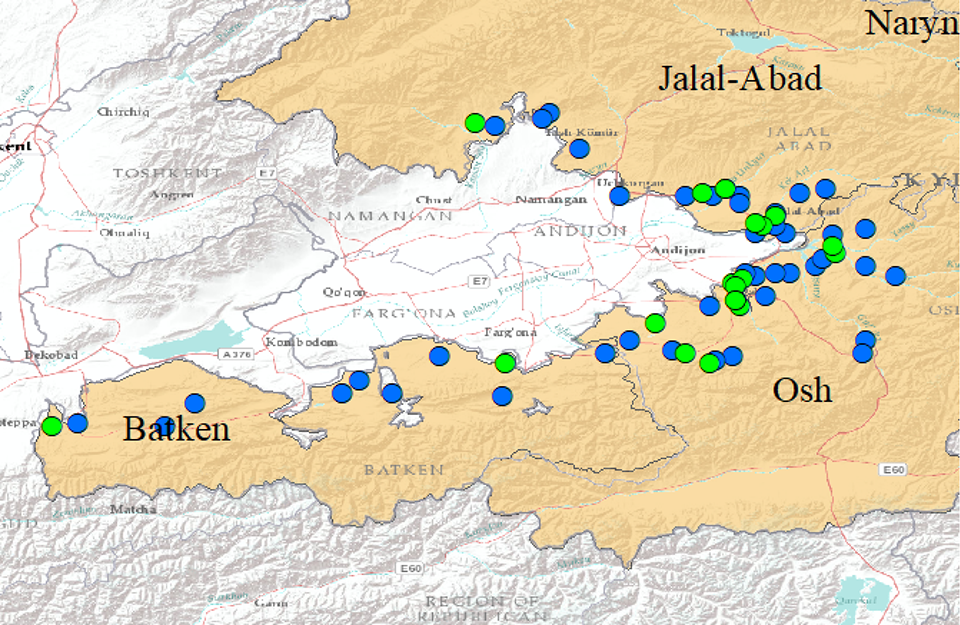
The survey was conducted in a total of 68 sampling points – 47 in Kyrgyz villages or neighborhoods and 21 in Uzbek villages or neighborhoods. Generally, 15 respondents were interviewed in each point. A designated number of sampling points was assigned to each raion based on its population of Kyrgyz and Uzbeks. The villages or neighborhoods were then randomly selected from a population-weighted list of all municipal areas from Kyrgyzstan’s census. Maps of sampled areas and sampling points are shown in Figure 2. More detail on within-sampling point and within-household sampling is provided in Online appendix 3.
Results
Descriptive statistics of key variables across region and ethnicity
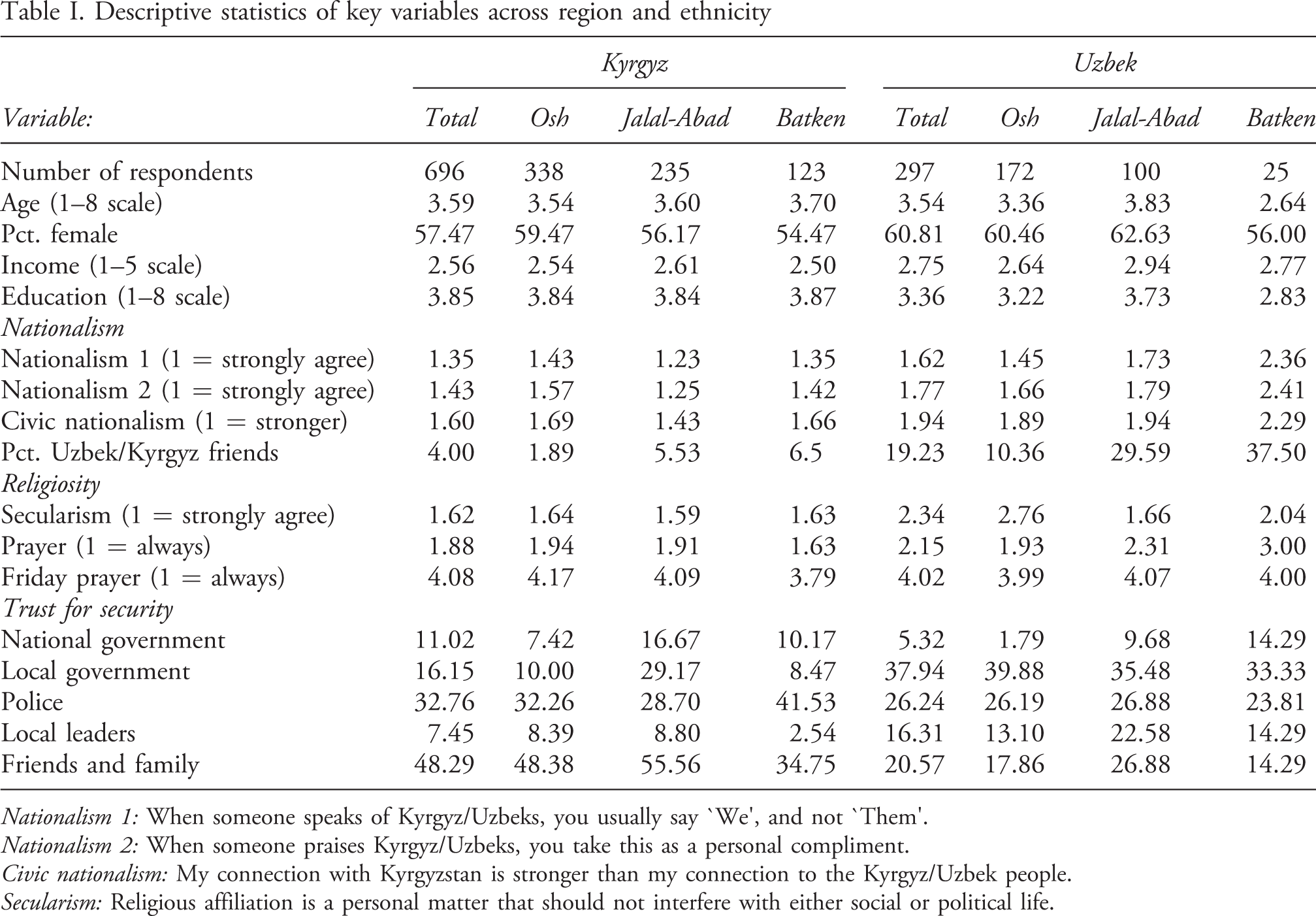
Nationalism 1: When someone speaks of Kyrgyz/Uzbeks, you usually say ‘We’, and not ‘Them’.
Nationalism 2: When someone praises Kyrgyz/Uzbeks, you take this as a personal compliment.
Civic nationalism: My connection with Kyrgyzstan is stronger than my connection to the Kyrgyz/Uzbek people.
Secularism: Religious affiliation is a personal matter that should not interfere with either social or political life.
Assessing support for interethnic violence
Figure 3 reports the distribution of responses to whether it is justified to defend one’s ethnic group through the use of force. Notably, Kyrgyz are much more likely to support this notion than Uzbeks, but members of both ethnic groups express some support for violence. A caveat is that Figure 3 does not show how either group responded to the treatment.
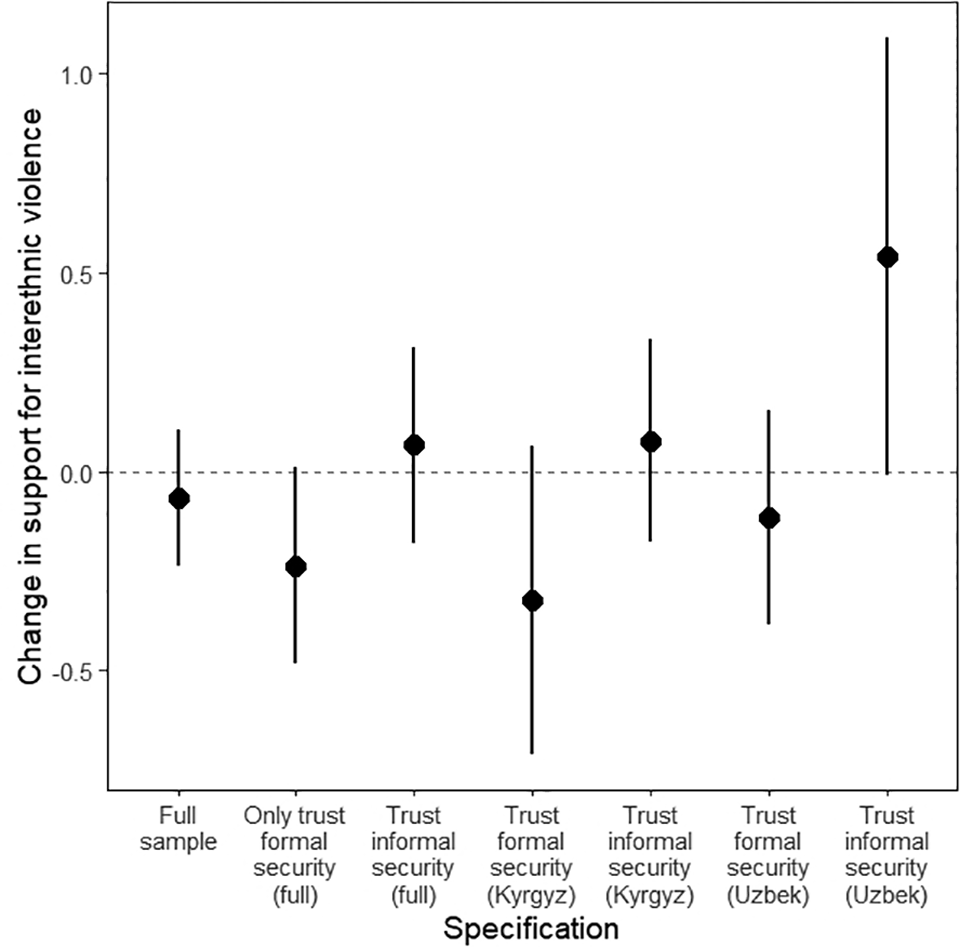
Figure 4 shows the difference in mean responses for supporting interethnic violence across administration of the chauvinist nationalist treatment.
20
In the aggregate, the treatment has no significant effect. Disaggregating across those individuals that only trust formal and Responses to whether it is justified to defend one’s nation through force across ethnicity: 858 of 993 respondents answered the question Differences in means: Effect of chauvinist nationalism on support for interethnic violence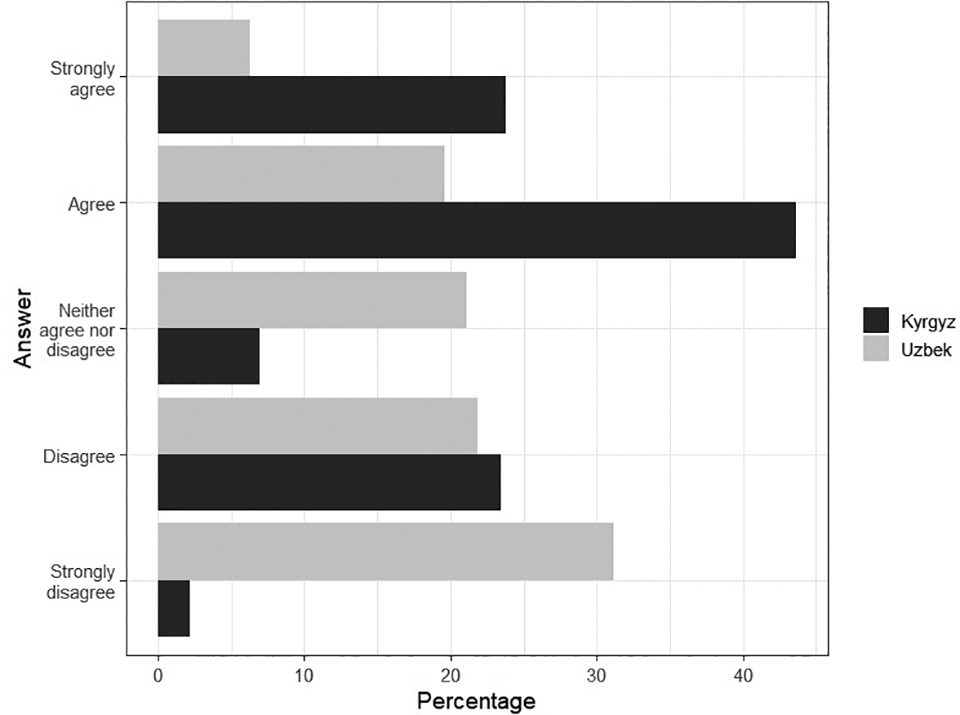
Multivariate analysis of heterogeneous treatment effects
Figure 4 only offers suggestive evidence of a heterogeneous treatment effect. To test Hypothesis 1, a multivariate specification is needed to show there is a significant increase in support for violence among those who trust informal sources of security and received the chauvinist nationalist treatment. For the multivariate test, the answer to the question on whether it is justified to defend one’s nation through violence is dichotomized based on the distribution of responses, shown in Figure 3. This distribution appears to pool around ‘Agree’ and ‘Disagree’ for both groups, suggesting two categories of underlying responses to the question. In the dichotomous measure, those that agreed with the statement are given a 1 and those that did not agree are given a 0. A logistic regression tests the joint effects of covariates and the chauvinist nationalism treatment on support for interethnic violence. Each model includes both individual covariates and an interaction term of the covariates and treatment administration, consistent with the standard method of evaluating heterogeneous treatment effects (i.e. Vivalt, 2015). As such a design is subject to omitted variable bias (Green & Kern, 2012), all pre-treatment covariates are included and interacted with treatment assignment. Each model also includes fixed effects for whether the respondent is Uzbek and the oblast where the interview was conducted, reflecting the blocking design. Standard errors are clustered at the population point, assuming interdependence in responses at the lowest geographic sampling level.
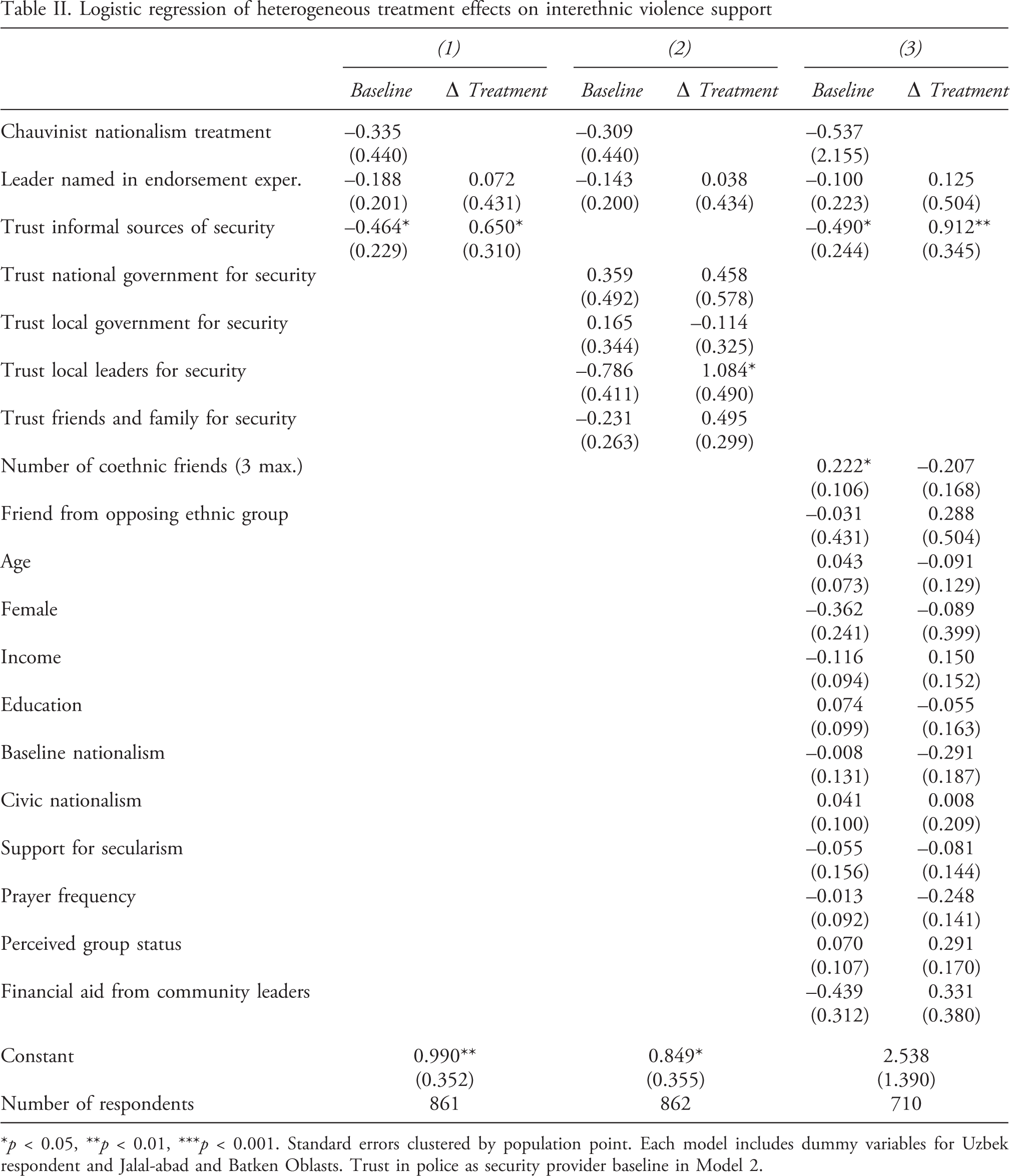
Results of the multivariate analysis of heterogeneous treatment effects are shown in Table II. Model 1 reports the basic finding: without administering the chauvinist nationalism rhetoric, those who trust informal sources of security are less likely to support violence. Once the treatment is administered, the effect is reversed, and individuals who trust informal sources of security are significantly more likely to support interethnic violence. When covariates are added in Model 3, this net positive effect nearly reverses from the control group. Figure 5 illustrates this contrast. Without chauvinist nationalist rhetoric, respondents that trust informal sources of security are about 50% less likely to support violence. Random assignment of the treatment reverses the effect and being primed with chauvinist nationalism makes respondents that trust informal sources of security about 50% more likely to support violence – a 91% shift from the baseline. Taken together, these findings support the first hypothesis that chauvinist nationalism induces support for violence among those that feel personal insecurity.
Model 2 on Table II breaks down both informal and formal security measures across their constituent parts with trust in the police as the baseline. Both those who trust local community leaders and those who trust friends and family are significantly more likely (at p < 0.05 and p < 0.1, respectively) to support violence when randomly assigned the chauvinist nationalism prime. Thus, the effect observed in Models 1 and 3 remains consistent when disaggregating the security categories to their original component parts. There is no corresponding or contrasting effect for formal sources of security. Those who trust formal sources of security are neither more supportive of violence in the control group nor less supportive of violence when given the treatment.
Alternative explanations are tested in Model 3 in Table II. Respondents with more coethnic friends report greater support for interethnic violence – potentially validating the rumor-sharing mechanism from Larson & Lewis (2017). There is little support for other alternative explanations.
Logistic regression of heterogeneous treatment effects on interethnic violence support
*p < 0.05, **p < 0.01, ***p < 0.001. Standard errors clustered by population point. Each model includes dummy variables for Uzbek respondent and Jalal-abad and Batken Oblasts. Trust in police as security provider baseline in Model 2.
The finding is robust to numerous alternative specifications. Online appendix 8 includes additional specifications using a full five-point scale for support for interethnic violence and the Horowitz & Manski (1998) technique to account for non-response bias. The effect observed in Figure 5 remains unchanged. Online appendices 9 and 12 include tests for two alternative predictors of support for violence that required different model specifications: support for nationalist leaders and prior exposure to violence. Neither factor consistently predicts support for interethnic violence. Online appendix 10 reports that treated Uzbeks who trust informal sources of security were significantly more likely to support interethnic violence than treated Kyrgyz who trust informal sources of security. Online appendix 11 separates respondents who trust both formal and informal sources of security from those who just trust informal sources; the effect remains consistent for both measures. Online appendix 13 examines whether the findings are driven by extant feelings of chauvinist nationalism. Support for chauvinist nationalism among the treated conditional on trust in informal sources of security is not associated with support for interethnic violence, accentuating that random assignment of chauvinist nationalism is responsible for the observed effect.
To what extent are the mechanisms underlying the theorized relationship also validated? The study is somewhat limited as no question about the relevance of perceived group status to individual well-being was asked after treatment assignment. Nevertheless, indirect tests reveal bounded support for intergroup status as a mechanism. Online appendix 6 shows that respondents who trust informal sources of security were more likely to perceive their group as deprived relative to others. As such, a prime on chauvinist nationalism conceivably activated either concern about further status loss or the feeling of deserving status gain and made interethnic violence more acceptable to respondents trusting informal sources of security. Additionally, Model 3 in Table II shows that respondents who feel their group is better off are more likely to support interethnic violence if assigned the treatment, significant at p < 0.1. Even though this effect lacks a perceived insecurity component, it suggests there is a conditional relationship between chauvinist nationalism perceived group status in shaping support for violence.
State breakdown, nationalism and the ‘events’ of June 2010 21
The survey shows that random assignment of chauvinist nationalism increases support for ethnic violence among both Kyrgyz and Uzbeks that trust informal sources of security. According to Hypothesis 2, state breakdown creates the conditions for mutual uncertainty about group status among ethnic security organizations that use chauvinist narratives and increases the likelihood of actual ethnic violence. This section describes such an episode during the period between Kyrgyzstan’s April 2010 revolution and ethnic riots in Southern Kyrgyzstan in June of that year. These two months illustrate greater uncertainty about group status in Southern Heterogeneous treatment effects of chauvinist nationalism (Table II, Model 3)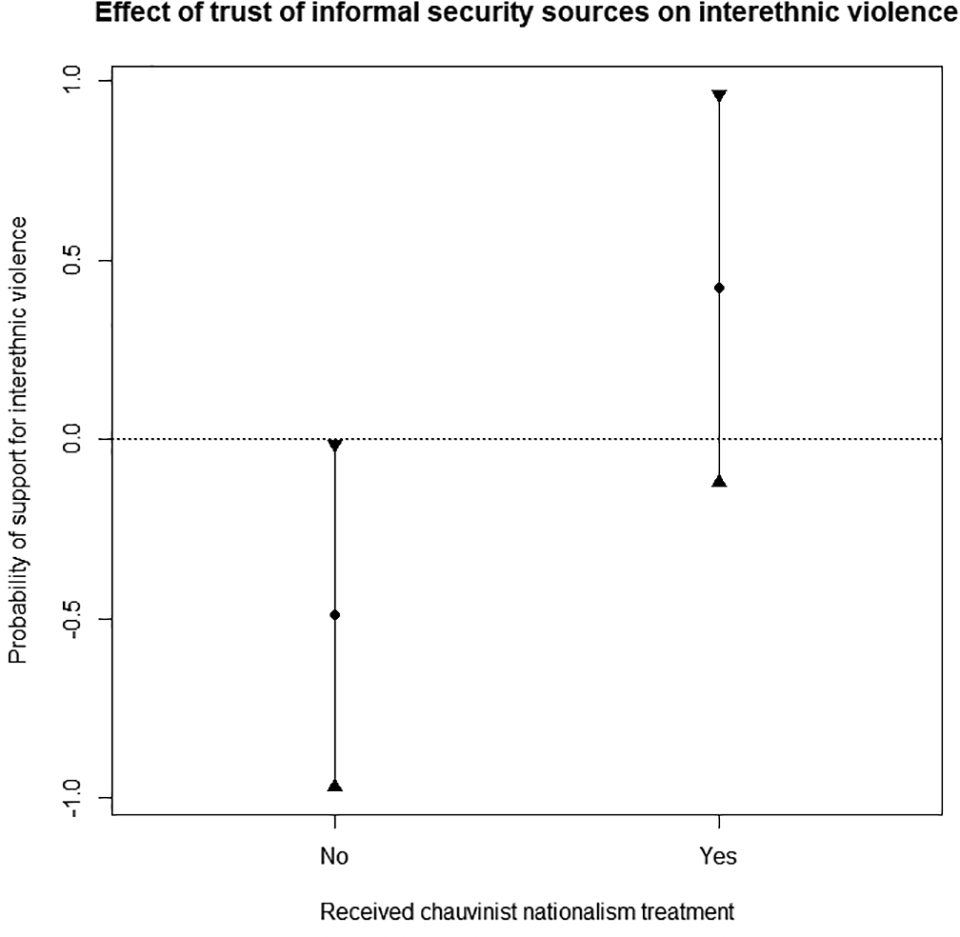
The narrative of the 2010 events is built on secondary sources and previously described semi-structured interviews (see Online appendix 1). Interviews evaluated what occurred in 2010 and what narratives were employed by both Kyrgyz and Uzbek elites prior to the violence. The description is not intended to provide a definitive explanation for the events. As mentioned, factors such as intergroup inequality could have fueled elite tension and increased the likelihood of violence. The goal of the narrative is to examine how state breakdown may have also contributed to the outbreak of conflict in Osh. 22
Both truth commission reports and interviews suggest violence between Kyrgyz and Uzbeks in Osh was tied to the April 2010 Kyrgyz revolution. The April 2010 revolution differed sharply from the 2005 ‘Tulip Revolution’. In 2005, President Askar Akayev was removed through largely peaceful protests and a unity government formed shortly thereafter (Radnitz, 2006). In 2010, Kurmanbek Bakiyev, Akayev’s successor, was forced from power in a more violent uprising led mostly by politicians from the North. Over 100 protesters were killed around the country and an unelected interim government composed of Northerners stepped in after Bakiyev’s ouster. Unlike 2005, when all of the country’s major power-brokers supported regime change, pro-Bakiyev elements challenged the interim authorities for months after the 2010 Revolution.
What most contributed to state breakdown, however, was the ineffectiveness of the military and police forces. Security forces largely scattered after carrying out violence against protesters in April. As a result, disorder broke out throughout the country. In the Northern city of Talas, ad hoc militias seized power. On 19 April, Kyrgyz youths attacked a small community of Meskhetian Turks in Mayevka, a village outside of Bishkek, to seize land and property (Marat, 2010). In the South, Uzbek nationalists began to organize politically just as pro-Bakiyev Kyrgyz nationalists rejected the interim government (Matveeva, Savin & Faizullaev, 2012: 12–14).
Public mobilization of ethnic security groups began in the South after 29 April, when a group of Kyrgyz attempted to extort protection money from Uzbeks importing Korean cars to Osh. The confrontation precipitated a fight between ethnically polarized groups (Freedom House, 2012: 14–15). Further attacks on Uzbeks occurred in the ensuing days and drew little police response. As a result, starting in early May, young Uzbek men began nighttime patrols en masse to prevent attacks by Kyrgyz criminal groups (Abashin & Savin, 2012: 40).
A confrontation in Jalal-Abad further deepened ethnic tensions. On 13 May, Bakiyev supporters attempted to seize Jalal-Abad’s regional administration building. In response, Kadyrzhon Batyrov (see Online appendix 9), a prominent businessman and Uzbek nationalist, gathered a group of mostly Uzbek supporters at the behest of the interim government and removed pro-Bakiyev elements from the regional administration building through non-lethal force. Batyrov’s crowd then marched to Bakiyev’s home village and burned down houses belonging to the former president (Kyrgyz Inquiry Commission, 2011: 12).
After the Jalal-Abad confrontation, amid growing uncertainty about the future political status of Uzbeks in the South, the already mobilized ethnic security groups used chauvinist rhetoric about either deserved status for Uzbeks or threats to existing status for Kyrgyz to drum up antagonism for the opposing group. Batyrov stepped up demands for Uzbek political rights in public speeches televised across the country. Batyrov’s demands, despite being ostensibly moderate, 23 sparked outrage among Southern Kyrgyz, who believed Batyrov was a separatist and the interim government was aiding marginalization of Southern Kyrgyz. Subsequent Kyrgyz-led gatherings in Osh and Jalal-Abad called for Batyrov’s arrest and the governor’s resignation. Rumors spread that Uzbeks intended to secede and scuffles throughout late May and early June led to deaths and injuries among both Kyrgyz and Uzbeks (Freedom House, 2012: 23). A warrant was issued for Batyrov’s arrest on 4 June causing him to flee the country; pro-Bakiyev politicians were also arrested (Kyrgyz Inquiry Commission, 2011: 16).
The arrest of leaders of ethnic security groups did not deter continued mobilization. By the beginning of June, Osh saw mass gatherings of both Uzbeks and Kyrgyz, the former to defend against perceived threats from Kyrgyz criminals and the latter to protest against the rise in ethnic consciousness among the Uzbek population. On 9 and 10 June, the previously small scuffles between Osh’s ethnic Kyrgyz and Uzbek youths escalated, with large street fights involving hundreds of people on both sides (Freedom House, 2012: 29). Interviewees reported that such scuffles were not unusual, but usually did not escalate due to intervention from either police or elders from both ethnic groups. 24 Speaking to the popular support for ethnic violence among both Kyrgyz and Uzbeks in Osh, such interventions were either not effective or absent in early June.
Lacking any state or informal intervention, popular support for interethnic violence and mobilized ethnic security actors led to actual violence. On the night of 10 June, several independent scuffles broke out between large groups of ethnic Kyrgyz and Uzbek youth, the most notable in front of the Alay Hotel, not far from Osh’s central Frunze market. The brawl escalated to encompass thousands of young men on each side. Some ethnic Uzbeks broke off and attacked a nearby university dormitory and Kyrgyz-owned businesses with rocks and Molotov cocktails (Freedom House, 2012: 33–46). The police did not intervene, leading Kyrgyz youth to mobilize in response. Tension was fanned by unsubstantiated rumors ethnic Uzbeks had broken into the dormitory and raped and murdered Kyrgyz women. As news of the violence spread, one interviewee described a scene where a mixed group of Uzbeks and Kyrgyz quietly went their separate ways – Kyrgyz walking away with other Kyrgyz and Uzbeks with other Uzbeks – upon hearing about the violence.
What spoke to broad support for violence among Kyrgyz in the South was the subsequent influx of ethnic Kyrgyz from surrounding rural areas into Osh. These roving bands ostensibly sought to defend relatives against violence. 25 Some came from as far as the capital, Bishkek – about a 12-hour car ride away. The flood of rioters overwhelmed already weakened security forces, who either stood down or joined the rioters, setting off days of attacks on Uzbek neighborhoods that included murder, sexual violence, looting, and arson. 26 After three days, greater intervention from the army and rumors of an invasion by Uzbekistan’s armed forces quelled the violence (Kyrgyz Inquiry Commission, 2011: 44–46).
The progression from state breakdown – demonstrated by the withdrawal of formal security forces from many cities and the formation of ad hoc ethnic bands to restore order – to ethnic violence is clear in the case of the June 2010 events. The revolution weakened the armed forces to such an extent that criminal elements attempted to take advantage in the South. In response, both Uzbeks and Kyrgyz organized around ethnicized formations that previously existed under the surface of society, with ad hoc patrols taking over security in the six weeks preceding the violence. The absence of state security also led to uncertainty about group status. For Uzbeks, Kadyrzhon Batyrov emerged as a new voice for Uzbek consciousness. Informal ethnic Kyrgyz security organizations became virulently more anti-Uzbek in response. By the time violence erupted, the lack of intervention on the part of usual societal stopgaps, such as traditional elders, spoke to the underlying popular support for interethnic violence on both sides. Thus, state breakdown following the 2010 revolution was instrumental in turning that underlying support into actual violence.
Discussion and conclusion
This article examines the process by which state weakness may create support for interethnic violence in divided societies. Results from an experiment embedded into a survey in Southern Kyrgyzstan show that random assignment of chauvinist rhetoric induces greater support for violence among respondents that trust informal sources of security. The case of the 2010 ethnic violence in Osh then illustrates how state breakdown accelerates the relevance of this process through the increased prominence of informal security organizations and increases the likelihood of actual ethnic violence.
The results speak to research on nationalism, ethnic violence, and state capacity, illustrating a process that links the three disparate concepts to one another. Extending the findings, they suggest that strong state institutions can mitigate tensions between ethnic groups, even when the salience of ethnicity is relatively high. A strong central government may even prevent violence from breaking out when the power dynamics between groups are unbalanced or one group is overrepresented at the center.
Additionally, the link between state weakness, chauvinist rhetoric, and violence is particularly salient for research on the aftermath of revolutions. Interethnic tension may operate below the surface of weak states, which may also be more likely to experience protest revolutions. Thus, while nonviolent overthrows of autocratic governments are seen as desirable means for democratic transition in both policy and scholarly circles (i.e. Chenoweth & Stephan, 2011), their results may produce violent outcomes, especially if there are power vacuums that lead to state breakdown. The mechanism seen in Kyrgyzstan in 2010 may very well explain separatist movements in Ukraine in 2014 or violence against Egypt’s Coptic Christians in 2011. Given the divergent outcomes that could follow a revolution, a more unified research program is needed to explain the consequences of revolution-induced state breakdown.
The findings also have implications for the study of ethnic riots. While the literature on ethnic riots has primarily focused on riot participation and the role of politicians, evaluating public support for riots is also important as riots occur in environments where tensions often simmer before events trigger actual riots. This study finds divergences between the rationale given for participation in ethnic riots and support for interethnic violence. Namely, while insecurity plays a role in shaping popular support for violence, its role is conditional on chauvinist rhetoric.
There are additional implications for the Kyrgyz case. Descriptive statistics suggest a high preference for violence in both the Kyrgyz and Uzbek communities and that homogeneous social networks can be used to spread rumors and foment further violence. Instability in the country, especially following an event similar to the 2010 revolution, likely exposed an underlying preference for violence in Southern Kyrgyzstan that continues to exist. To decrease the likelihood of a resurgence, policies must be tailored to fostering trust in formal sources of security and breaking apart homogeneous ethnic networks, rather than forming what may be peripheral cross-ethnic ties. 27
Footnotes
Acknowledgements
The author thanks Andrew Boutton, Adrian Florea, Nick Obradovich, M Stephen Powell, Caitlin Ryan, Gunes Murat Tezcur, Jaclyn Johnson, Zachary Steinert-Threlkeld, participants of a panel at the Meeting of the ISA – Southern Region, JPR editors Gudrun Østby and Scott Gates, and three anonymous reviewers for their helpful comments on this article. The author also thanks Andy Janusz, Nazita Lajevardi, Matthew Nanes, John Porten, Phil Roeder, and the participants of the UCSD Race, Ethnicity and Politics Workshop for their assistance in constructing the survey instrument and Meerim Baktybaeva, Meerim Nurbekova, and Guzelia Raimzhanova for their invaluable research assistance on the project. Human subject research was approved by the University of Central Florida’s Internal Review Board (IRB number SBE-16-12430).
Replication data

Funding
The survey underlying this research was funded by the Peace Research Grant Program of the International Peace Research Association Foundation.