







Abstract
Much ado has been made about the specter of unconventional weapons in the hands of militant groups. Despite the alarmism of the policy community, the pursuit of chemical, biological, radiological, and nuclear capabilities by non-state actors is rare. What explains why some violent non-state organizations pursue chemical, biological, radiological, and nuclear weapons while most do not? Using new data on organizational behaviors and attributes from the Big Allied and Dangerous 2 Insurgency project, we analyze 140 insurgent actors, from 1998 to 2012. We expand previous work by Asal, Ackerman & Rethemeyer by studying the phenomenon longitudinally and attending to organizational behavior rather than only to structural and environmental factors. We find that organizations that attack cultural sites are more likely to pursue and use chemical, biological, radiological, and nuclear weapons. We interpret the latter as a willingness to transgress upon accepted mores, for the sake of sensationalism and shock value, which coheres with a willingness to pursue unconventional weapons. Our results reflect that chemical, biological, radiological, and nuclear pursuit and use is part of a larger strategy for some violent non-state organizations, one predicated on generating mass fear and exacting a psychological toll.
Introduction
In 2018, the White House released a strategy calling for ‘new aggressive steps to counter the growing threat posed by WMD terrorism’ (White House, 2018), a concern that has been echoed in almost all United States national strategy documents post-911. In fact, all administrations since Clinton have aimed to dampen the risk of so-called Weapons of Mass Destruction (WMD) terrorism (Mauroni, 2018). The specter of chemical, biological, radiological, and nuclear (CBRN) weapons in the hands of terrorists and other violent non-state actors (VNSAs) also figured in debates and prognostications about the possible resurgence of ISIS. To some extent, this concern has been shared internationally, as evidenced by such multilateral efforts such as United Nations Security Council Resolution 1540 and the Global Initiative to Combat Nuclear Terrorism.
The alarmism of the security establishment may, however, seem puzzling in light of the empirics. On the nuclear weapons side of things, in the last 25 years, there have only been around 20 incidents where stolen weapons-grade nuclear material was seized by terrorist groups (Bunn & Roth, 2017). Depending on how one CBRN events, 1990–2017, N = 517 CBRN uses, 1990–2017, N = 224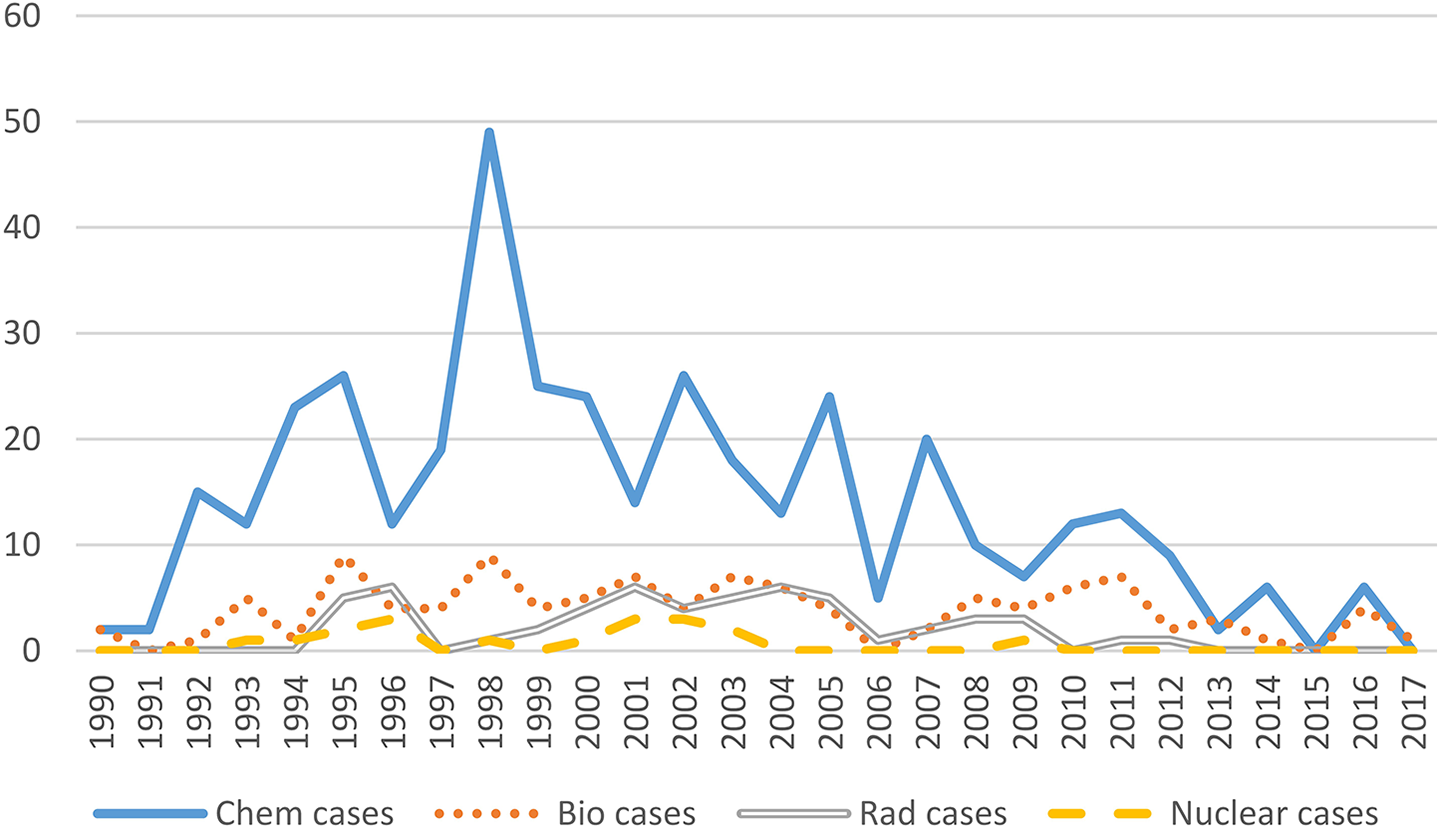
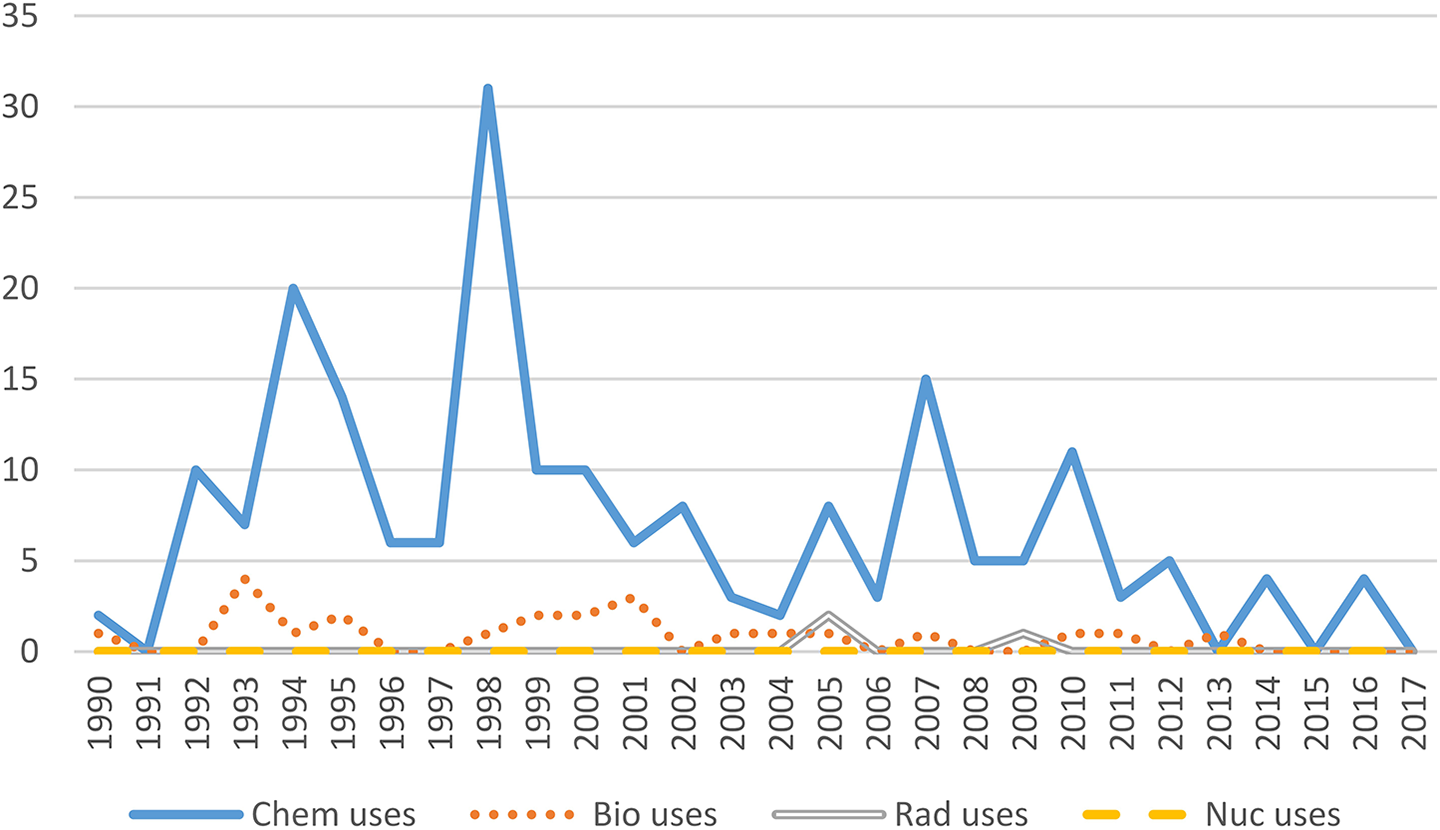
Yet, while the employment of CBRN technology by VNSAs is a low-probability event, its consequences could be so devastating that the scenario arguably justifies hypervigilance on the part of the security community (Bunn & Roth, 2017). Additionally, the broader patterns displayed in the GTD miss plots to use CBRN weapons. For example, there are estimates of 40 cases of radiological materials pursuit by non-state actors (Campbell & Murdie, 2018; James Martin Center, 2016), more than 60 high-threat attacks or plots against nuclear facilities (Ackerman & Halverson, 2016), and several expressions of interest by terrorist groups in acquiring nuclear weapons. For the period of 1990 to 2017, the POICN Database records a total of 224 uses and 517 total cases of CBRN pursuit (Binder & Ackerman, 2021). Moreover, Figures 1 and 2 here show that, although CBRN cases have diminished since a peak in the latter 1990s, there are still periodic cases of both pursuit and use.
Our article offers several interlinked contributions to the state of knowledge in this area. Our analysis highlights that the majority of CBRN attacks tend to be smaller scale and not highly lethal. Nonetheless, we maintain that the preoccupation with event magnitude may mask the psychological impetus to seek out unconventional weapons simply for the sake of sowing fear and intimidation. Indeed, our article is timely insofar as the global coronavirus pandemic has brought the potency of biological weapons into sharp relief. While SARS COV-2 is a natural disaster, the economic devastation wrought by the outbreak may animate VNSAs to ramp up their pursuit of biological weapons, or more generally CBRN technology. The ineptitude of even economically developed states to stymie the spread of the virus has exposed the numerous weaknesses of global public health systems. The allure of paralyzing advanced democratic states and instilling disorder may thus impel the more strategically adept groups on the cusp of pursuing bioterrorism past the ‘tipping point’ and ‘across the Rubicon’ (Ackerman & Peterson, 2020: 64). Some may contend that the international community’s focus should now be on biological weapons above all other types of CBRN, but we believe this to be too narrow in focus. Only by analyzing all CBRN weapons under one umbrella, are we able to exploit sufficient cases to generate insights about incentives that would be directly fungible for professionals concerned with just biological weapons.
Even while we stress the important distinction between WMDs and CBRN technologies, we alert readers to the significance of studying the latter. We enlarge the scope of the discussion beyond highly fatal weapons that may remain out of reach for technologically limited groups. We likewise do not remain tethered to solely successful deployment of CBRN weapons but study pursuit and use under the same theoretical framework. In so doing, we generate insights that are also applicable to pursuit and use of weapons that fall on the highly lethal end of the CBRN spectrum. Thus, our study notably informs scholars and pundits alike on the potential perpetrators for major catastrophic attacks using CBRN technology. A key takeaway we offer is that tying likelihood of CBRN pursuit and use solely to militant groups’ capabilities would be akin to judging a book by its cover. There is more to militant groups than their size and membership. Organizations’ behaviors offer important clues on the beliefs and practices that propel the pursuit of unconventional weapons.
Beyond its theoretical relevance, our findings are of policy importance insofar as practitioners can heed certain types of behaviors as early-warning signs of groups’ goals to seek out these weapons. On that note, a behavioral metric that we scrutinize in this article is whether groups attack sites of cultural and symbolic value. Anecdotal and news stories treat these cases as abhorrent incidents that violate a cherished heritage, but we hold that these attacks also spotlight groups’ incentives to think outside the box in a manner that breaks taboos. Put differently, attacks upon cultural sites may be indicative of the same belief systems as well as strategies that compel groups to pursue CBRN weapons.
CBRN weapon usage by non-state actors
From 2014 on, ISIS launched a chemical warfare campaign, and was responsible for 37 chemical attack incidents in Iraq and Syria, including using self-produced mustard agent, some of which led to injuries and deaths (Binder, Quigley & Tinsley, 2018). ISIS is the most recent and notorious example of chemical weapons pursuit and use by a violent non-state actor. Other groups have launched CBRN attacks against security forces. For example, in Colombia the FARC utilized cyanide and tear gas in its guerrilla war against Bogota (O’Grady, 2002). Yet, why did these violent actors pursue and utilize CBRN weapons, while so many others do not?
To date, the topic has been explored mainly through anecdotal accounts and case studies that point to the real and imagined dangers of CBRN use by non-state actors, with only a handful of large-sample work on the topic. Many of these quantitative studies have emphasized the role of environmental factors, uncovering how state level traits affect the likelihood of CBRN incidents. Asal, Ackerman & Rethemeyer (2012) deviate from the environmental focus by showing that organizational attributes significantly shape whether or not VNSAs pursue CBRN technology. In a similar vein, we study how characteristics of organizations link to CBRN pursuit.
However, we argue that organizations’ choices are guided more directly by what organizations do rather than what they are. Our study makes a further empirical contribution by expanding beyond Asal, Ackerman & Rethemeyer’s (2012) cross-sectional design and bringing in temporal dynamics to the study of weapon choice. By using new, yearly data contained within the Big Allied and Dangerous 2 Insurgency (BAADI2) project, which covers 140 insurgent actors from 1998 to 2012, we are able to harness information about organizational behavior over time. 1
It behooves us to study how behavior affects decisions to pursue and use CBRN because some group attributes such as ideology are fairly invariant across time whereas other attributes such as size and strength change slowly. In contrast, organizations are innovative; they learn and adopt new tactics and may shift strategies over time. These tactical choices may serve as indicators of change in the propensities of groups to pursue CBRN weapons beyond what such proxies for capabilities as size and strength offer. There is also cross-organizational and temporal variation in CBRN pursuit that a focus on organizational attributes and environmental conditions may miss. For instance, Palestinian Islamic Jihad (PIJ) has pursued CBRN while another organization of similar size and age, also operating on the same territories in Israel, the Popular Resistance Committees, has not. Moreover, PIJ changed tack in 2001 to pursue CBRN and then abandoned the cause in subsequent years (Post, Sprinzak & Denny, 2003).
It should be noted at the outset that, while common in popular parlance, labeling CBRN weapons as WMDs is a misnomer. A common shortcoming in the literature on CBRN terrorism is the failure to clearly distinguish between CBRN weapons able to generate only a handful of casualties from those rare WMDs that exact catastrophic harm (see Ackerman & Rethemeyer, 2009). There is a vast spectrum of consequences, depending on the scale, delivery method, sophistication and choice of CBRN agent. Additionally, CBRN pursuit is not the sole province of large and formal organizations. Looser cadres and lone actors have pursued these weapons but typically engaged in cruder, smaller scale, and less frequent CBRN plots and attacks (Ackerman & Pinson, 2014).
In this article, we are concerned with the basic decision by a VNSA to pursue unconventional weapons, irrespective of whether the weapon constitutes a true WMD or merely a small-scale use of CBRN agents. Therefore, it would be erroneous to assume that all CBRN technology is aimed at generating mass casualties. By this logic, broader group lethality on its own cannot comprise a compelling explanation for CBRN pursuit and use. Lethality is a poor determinant of organizational choice also because groups may be driven by the quest for publicity, more so than they are by the desire to generate mass casualties. More generally, arguments about group capabilities often fall short not only because CBRN technology that qualifies as WMDs is unattainable for most groups, but also because not all groups seek true WMDs. Moving beyond capabilities, we offer an alternative explanation hinging on motivations. One of our core findings is that organizations that attack highly symbolic targets that embody ‘sacred values’ are more likely to embrace CBRN weapons. We posit that this stems from a similarity in motivations for attacking highly symbolic targets and using CBRN weapons. More importantly, it serves as confirmation that at least part of the puzzle as to which subset of VNSAs is most likely to select CBRN can be answered by examining the actors’ prior and concurrent behavior.
Aside from a handful of exceptions, there is limited large-sample empirical inquiry into why groups pursue mass casualty CBRN weapons, largely due to paucity of data. Most initial work in this area is case-study focused, with little thought to tying the cases together into a broader theoretical framework (Allison, 2004a, 2004b). Tucker’s comparative case study (2000) is an exception and concludes that organizations with an apocalyptic ideology, that possess charismatic leadership, and ones that are insular are more likely to pursue CB weapons.
A strictly motivational story misses the mark because while ideology and leadership style may render CBRN appealing, organizations weigh the pursuit of unconventional weapons against conventional weapons. Unconventional weapons may not be any more effective and the consequences of wielding them are often indeterminate (Sinai, 2005), for example, organizations that pursue them can run the risk of alienating supporters. Contrary to popular wisdom, except in the most extreme cases, conventional weapons kill more people on a per incident basis than CBRN weapons (Rapoport, 2004).
Empirical scholarship follows two trajectories. The first focuses on country level determinants, looking at state level characteristics that facilitate the acquisition and use of CB weapons by groups (Ivanova & Sandler, 2006, 2007; Early, Fuhrman & Li 2013; Campbell & Murdie, 2018). The relatively more recent second stream shifts focus to organizational traits, with the social networks in which violent groups operate bridging these two tracks (Asal, Ackerman & Rethemeyer, 2012). In order to foreground our theoretical argument, we briefly survey and outline these two strains of literature.
Looking at the first stream, we find that the environments in which organizations function shape their choices. Ivanova & Sandler (2006, 2007) find that a strong rule of law, democracy, wealth, and corruption are all predictors of CBRN incidents. Economic globalization heightens the likelihood by facilitating skill and personnel transfer across borders (Asal, Ackerman & Rethemeyer, 2012; McComb, 2013). At the same time, civil turmoil imposes logistical costs on groups, impeding their effective functioning. Other scholars stress that corruption also raises the likelihood that organizations will pursue CBRN technology (Ivanova & Sandler, 2007; Early, Fuhrmann & Li, 2013) by making it easier for illicit actors to pay to get their hands on CBRN material. Campbell & Murdie (2018) argue that state repression can expose countries to the threat of CBRN acquisition by hindering intelligence gathering and counter-terrorism efforts, and that countries with better human rights records have a lower likelihood that CBRN material will make it into the hands of non-state actors (Campbell & Murdie, 2018).
The second strain of the literature shifts focus to the organizational level. Asal, Rethemeyer & Anderson (2009) and Asal, Ackerman & Rethemeyer (2012) argue that organizational behavior is dictated to a large extent by capabilities, in addition to threat environments, rather than by ideology. Ivanova & Sandler (2007) also explore the impact of terrorist organization ideology and conclude that non-fundamentalist groups are just as likely to stage CBRN attacks as fundamentalist networks. The key plank of Asal, Ackerman & Rethemeyer’s (2012) argument is that network ties and resources pay dividends: wider alliance networks elevate the probability that groups will pursue and develop CBRN technology, by providing more access to materials and expertise and allowing for the diffusion of justifications for otherwise taboo behavior.
We contribute primarily to the second strain, focusing on those factors that prompt VNSAs to seek out these weapons, rather than seeking to uncover factors that lead to their successful use. We extract several insights from the broader scholarship before proceeding to our hypotheses. First, ideology presents a partial story insofar as many organizations of different ideological stripes have considered acquiring or using CBRN weapons (Asal, Ackerman & Rethemeyer, 2012). In a related vein, contrasting conceptual and empirical accounts exist on how religious ideology relates to the propensity of organizations to pursue unconventional weapons (Post, Sprinzak & Denny, 2003; Blum, Asal & Wilkenfeld, 2005; Campbell & Murdie, 2018).
Second, pursuing CBRN weapons is a strategic as well as tactical decision. Possessing CBRN may shift the bargaining range outside the bounds of previously available options on the table (Fearon, 1995). High-casualty attacks aid VNSAs by wresting coercive leverage through the civilian costs of ongoing conflict (Pape, 2003). To reiterate, CBRN weapons are not necessarily WMDs, but for those that do have the potential to cause catastrophic levels of damage, they could potentially exert a high degree of coercive leverage. At the same time, since the pursuit and threat of CBRN weapons by groups is likely to incite wide-scale reprisals, organizations may jettison CBRN as a riskier and on average less successful way to achieve lethal outcomes. Also, insofar as CBRN weapons collide with prevailing norms, they arouse social apprehension and disapproval and may cost the organization the support of the populace. In short, organizations face tradeoffs when weighing CBRN against conventional weapons (Gressang, 2001; Palfy, 2003).
Third, terrorists often think beyond the tangible effects of their actions. That is, decisions do not simply reflect tactical concerns with event magnitude, immediate damage, or fatalities. Given that most CBRN attacks involve lower-level agents and toxins such as ricin, tear gas, and cyanide (Koehler & Popella, 2018), it is plausible that many organizations who pursue them are drawn to their psychosocially disruptive effects, beyond the casualty metric. As Stern (1999: 48) notes, CBRN weapons ‘…are inherently terrorizing. They evoke moral dread and visceral revulsion out of proportion to their lethality’. Moreover, although the probability that an organization will successfully wield a true WMD may be small, the anticipated destruction and disruption that would ensue from a WMD attack involving CBRN is so immense that merely the pursuit of these weapons can exact a psychological toll on potential victims. Faced with small probability events of high magnitude, people become preoccupied with the consequences and forget that these events are unlikely to transpire (Sunstein, 2002).
Fourth, beyond their purely strategic or tactical appeal to VNSAs, the pursuit of CBRN weapons can be driven by individual psychology, status-related or internal group dynamic factors. For example a leader displaying an affinity for innovation or even an idiosyncratic ‘technofetishism’ (Bale, 2017) can be drawn to one or more types of unconventional weapons, as demonstrated by Shoko Asahara, the leader of the Japanese doomsday cult Aum Shinrikyo who went so far as to produce odes to the nerve agent sarin, which his group subsequently used on the Tokyo subway in March 1995 (Danzig et al., 2012; Revill, 2017).
Fifth, organizational connectedness plays an important role in affecting tactics (Asal & Rethemeyer, 2008). We know that tactical diffusion is facilitated by alliance networks such that VNSAs adopt and modify tactics they deem to be successfully employed by other violent organizations in their network (Asal, Ackerman & Rethemyer, 2012). VNSAs in the same network can also transfer skills, resources and the legitimacy of certain actions by cooperating logistically, such as training each other’s operatives.
Variables and hypotheses
The preceding discussion suggests that we can categorize potential determinants of CBRN pursuit and use into four broad categories: (1) environmental factors (usually at the country level), (2) structural organizational attributes, (3) organizational behavior and (4) connections between the organization and other actors. It is upon the third category – the prior or concurrent behavior of the VNSA organization – which we focus here, especially the effects of organizational tactics such as target selection, and tactical effectiveness. We do so for two reasons. The first is that factors within this category have not received much attention in past research. While previous studies have included some variables that reflected the behavior of the organization, they have focused primarily on either the environmental variables (Ivanova & Sandler, 2006; Early, Fuhrmann & Li, 2013; Campbell & Murdie, 2018) or organizational attributes (Asal, Ackerman & Rethemeyer, 2012). Second, organizational behavior is both specific to the group (unlike the breadth of country-level factors that apply to all organizations in the same country) and is often more observable than other types of organizational attributes, such as the size or leadership structure. If such factors can be shown to be correlated with CBRN pursuit, then they can serve as particularly useful indicators for counterterrorism authorities, in that they can both be easily observed and can discriminate between different organizations in the same country.
It should be noted here that a major methodological advance over previous quantitative analyses of CBRN terrorism is the ability to test organizational variables yearly. Therefore, we explicitly retest some of the variables analyzed by Asal, Ackerman & Rethemeyer (2012). We add to the theoretical arguments underlying some of the previously hypothesized variables’ effects on CBRN pursuit or use, especially those in the fourth category (networks), and test several completely new variables. In addition, we include variables that represent the other two categories (environment and organization attributes) as control variables, for which we simply reference the previous study’s rationale for their inclusion rather than enter into detailed discussion.
Organizational behavior
Targeting cultural sites
The link between attacking cultural sites on the one hand, and CBRN weapons pursuit on the other is based on a hypothesized similarity in motivational impetus. On one level, this similarity reflects merely one manifestation of the search for publicity, a goal inherent to terrorists but cherished by various violent organizations the world over. Jenkins (1974) aptly refers to terrorism as theater, a metaphor which reflects the symbolic nature of violence. Perpetrators engage in violence to communicate with an audience. In an increasingly desensitized media environment, novel and distinct signals are needed to garner the attention that VNSAs crave. While several decades ago timing attacks with important events (Aksoy, 2014) or attacking a well-known personage might have been all that was required to guarantee the media spotlight, over time this requires more novel or outlandish attacks to attain high levels of publicity.
To illustrate how attacking cultural sites might achieve this, in 2015 ISIS destroyed ancient ruins at Palmyra, triggering international outrage at the destruction of invaluable artifacts. In the same year, ISIS released a video depicting the demolition of Hatra, an ancient Greco-Roman city that was declared a World Heritage site in 1985. These attacks served as part of the group’s larger religiously motivated propaganda and cultural cleansing campaign to vilify pre-Muslim civilizations and other Muslim sects (Curry, 2015). Previously, in 2001, the Taliban destroyed the Bamiyan Buddha statues in Afghanistan, triggering international condemnation and outrage at the destruction of invaluable cultural artifacts. These symbolic acts simultaneously capture imaginations and elicit considerable media coverage, which in turn sensationalizes the event (Picard, 1993).
The pursuit of CBRN by itself carries a taste of the sensational. Groups that are able to successfully launch CBRN attacks can disrupt governance, undercut trust in government agencies, and thereby further exacerbate a sense of doom or helplessness. In addition, the sometimes gruesome effects of CBRN agents have long been ingrained in a variety of popular culture media, from techno-thriller novels to science fiction movies. Thus, if ‘[t]errorists want a lot of people watching’ (Jenkins, 1974), both attacking sites with monumental and sentimental value and pursuing CBRN weapons are guaranteed to grab headlines.
On another level, however, these behaviors do not represent just a greater ‘volume’ or diffusion potential of the perpetrators’ message but a specific qualitative character that is embodied within the message. Both attacking highly symbolic targets and pursuing CBRN weapons are in and of themselves psychologically potent strategies. Cultural targeting is an attack against often deeply held societal intangibles. ‘By undermining the cultural identity of local communities, destruction of religious monuments in political violence and theft of national collections hold tactical value for insurgencies and terrorist groups’ (Nemeth, 2010: 10). These organizations are willing to go the extra mile by overtly trampling upon cherished treasures. As in the case of ISIS, violent actors gain notoriety by targeting heritage sites.
Similarly, CBRN weapons are qualitatively distinct from conventional weapons and thereby lend a greater psychological edge to organizations (Ackerman & Pinson, 2014). The public imagination is captivated by the notion of an ‘excruciating and horrible death and secondary effects like the creation of uninhabitable spaces’ (Koehler & Popella, 2018: 4), which also renders CBRN agents effective in delivering impact with comparable low casualty rates. Insofar as the coercive effectiveness of terrorism, including that carried out during an insurgency, pivots on the ability to foment and disseminate fear to wider audiences than the immediate victims (Braithwaite, 2013), CBRN weapons lend organizations a stronger psychological edge. Moreover, the pursuit of WMD weapons is widely characterized as a normative taboo (Tannenwald, 1999) and the common conflation among both VNSA’s supporters and targeted publics of CBRN with WMD can result in any CBRN pursuit having a similar effect. Early, Fuhrmann & Li (2013) write that simply by plotting nuclear and radiological attacks, terrorists amass notoriety.
The specter of CBRN weapons in the hands of a militant organization therefore evokes a sense of dread and awe and exacts a psychological cost, while guaranteeing high levels of publicity, independent of casualties, just as the violation of sacrosanct assets by targeting cultural heritage sites does. While most VNSAs strive for publicity, terror and breaking taboos (Schmid, 2011), both of the modalities considered here arguably break taboos beyond ‘normal’ terrorist attacks and in doing so, evoke fear and achieve sensationalism without necessarily exacting a high death toll. Such behavior can up the ante so to speak, in order to jar publics that are relatively inured to ‘ordinary’ VNSA violence. Therefore, we expect cultural targeting to be in lockstep with the pursuit of CBRN technology.
Our variable for cultural targeting comes from the BAADI2 project. The variable tracks insurgent attacks on heritage sites designated by the UNESCO World Heritage List or clearly identified in existing sources as having a cultural or symbolic value. The list of attacks contains targeting of any cultural, natural, or mixed site in a given country, by a VNSA. 2 The original data identifies 832 cultural sites and 206 natural sites. The variable codes for any attacks in a year by an organization that were either directly aimed at the site according to the Global Terrorism Database GTD (START, 2018) or were geographically identified (based on longitude and latitude) as being in the boundaries of the heritage site and then externally validated from newspapers that the attack was directed at the site. The indicator reports 1 if the heritage site was the intended target of the insurgent group and 0 otherwise. When insurgent groups are considered, we have 11 organization-years with explicit heritage site targeting, attributed to eight groups, two of whom have attacked the same site more than once. Table A1 in our Online appendix lists these cases, including names of World Heritage-designated attack sites.
H (Culture): Organizations that target heritage sites are more likely to engage in pursuit of CBRN capabilities.
Criminal activity
Insurgent organizations often engage in organized criminal activity (outside of their ideologically motivated violence), usually for purposes of raising funds to support the organization (Shelley & Picarelli, 2002; Hutchinson & O’Malley, 2007; O’Neil, 2007; Williams, 2009). Groups which persist in criminal activities for some time invariably become adept at moving goods and finances illicitly within and across country borders. They also tend to make contacts with networks of middlemen and illicit suppliers in the criminal underworld who can act as key nodes in the identification and procurement of a wide variety of materials and expertise. The greater the number and diversity of criminal activities the organization is involved in, the greater this effect is likely to be, lending greater confidence in successful acquisition and deployment of CBRN weapons-related materials and thus encouraging pursuit. We draw on BAADI2 for an ordinal variable counting up the types of distinct criminal activity each organization was engaged in, from zero to five.
H (Crime): The greater the number of different criminal activities an organization is involved in, the more likely it is to pursue CBRN weapons.
Connections between the organization and other actors
State sponsorship
In their previous analysis, Asal, Ackerman & Rethemeyer (2012) posited two factors that might make state-sponsored terrorist organizations more likely to engage in CBRN terrorism: (a) the greater technical and material-related resources that state sponsorship often bestows on a terrorist organization and (b) such organizations are less beholden to a wider popular constituency and thus would experience fewer strategic constraints. The cross-sectional data did not show any significant relationship in this regard, leading the authors to speculate that state sponsors would exert just as many restraints, if not more so, on their protégés’ tactical choices, with a particularly cautious attitude when it comes to CBRN weapons (Asal, Ackerman & Rethemeyer, 2012). We retest the original hypotheses by constructing a binary variable capturing whether an organization received foreign state support in the year in question.
H (State sponsor): Organizations known to receive some form of state sponsorship will be more likely to engage in CBRN terrorism.
Alliances
We add to Asal, Ackerman & Rethemeyer’s (2012) prior theoretical argument the insight that VNSA networks might not only assist in the provision of capability-related goods, but might also augment the motivation to pursue CBRN. If any element of the network, such as an ideologue or strategist in a connected group, becomes interested in CBRN weapons or promotes or justifies their use, then the existing trusted connections can facilitate the spread of these ideas to the organization itself. Therefore, all else being equal, those organizations with multiple alliances are more likely to be exposed to motivating influences for CBRN weapons and therefore are more likely to themselves make the decision to pursue. To measure alliances that each organization has we use a variable in BAADI2 that is a count of allies that each organization has in a year.
H (Alliances): The more VNSAs that an organization is allied with, the more likely it is to pursue CBRN.
Control variables
In order to test the effect of organizational behavior relative to other types of factors, we include in our analysis a number of environmental and organizational attribute variables as controls. We incorporated environmental variables related to the country in which the VNSA is based, that either have been tested by other scholars in connection with terrorism or are commonly examined in the literature on political violence. These include: economic wealth, as measured by Gross Domestic Product per capita (GDP/capita in USD at PPP) derived from the Quality of Government dataset (Teorell et al., 2011); levels of civil conflict (Asal, Ackerman & Rethemeyer, 2012), proxied by the number of battle deaths drawn from UCDP/PRIO data (Pettersson & Eck Pettersson, 2018); and three variables linked to the behavior of the state. These latter variables measure the amount of host country repression (Avdan & Uzonyi, 2017) for the country and year in question through the inferred Polity IV score (fh_ipolity2) as defined by the Quality of Government Project (Marshall, Jaggers & Gurr, 2011; Dahlberg et al., 2020), the Political Terror Scale ( Henschke & Legrand, 2017), and a binary variable for whether the state has embraced a repressive counterinsurgency (COIN) strategy, including routine police work, investigating crimes, arresting members, bringing cases to courts and any military actions against the group. This indicator, labeled ‘sticks’, is sourced from the BAADI2 project (Asal, Rethemeyer & Schoon, 2018). The last environmental control variable is related to CBRN directly and tests the impact of the presence of a state-level nuclear weapons program by coding a binary variable based on information obtained from the Bulletin of the Atomic Scientists (2019). 3 Arguably, while the link between a nuclear weapons program and groups’ pursuit of CBRN may be tenuous, terrorist groups have championed existing nuclear weapons programs in order to gain political influence (Joshi, 2020).
We also considered several variables previously tested by Asal, Ackerman & Rethemeyer (2012), mainly related to organizational attributes. First, we include an indicator for total fatalities, incorporated from the Global Terrorism Database (GTD), which records all terrorist attacks on a yearly basis. Our variable is matched to BAADI2 groups and represents attacks orchestrated by these groups in a given year. In an alternative model, we disaggregate the total fatalities indicator into two components: (1) a sum of total fatalities aimed at civilians and (2) a sum of total police and military deaths. We are motivated to disaggregate the fatalities counts given the conjecture that the targeting of civilians conveys that groups have far-reaching aims (Abrahms, 2006). If this argument is correct, then organizations with extreme preferences may be more predisposed to pursue unconventional weapons, in an effort to turn the tide in their favor, at all costs. As another group-level facet, we account for organizational ideology, by including dummy variables for three ideological categories: religious, far left and separatist, 4 with categories drawn from BAADI2. The other variables retested were size, age, and a binary variable for territorial control, all drawn from BAADI2.
Data
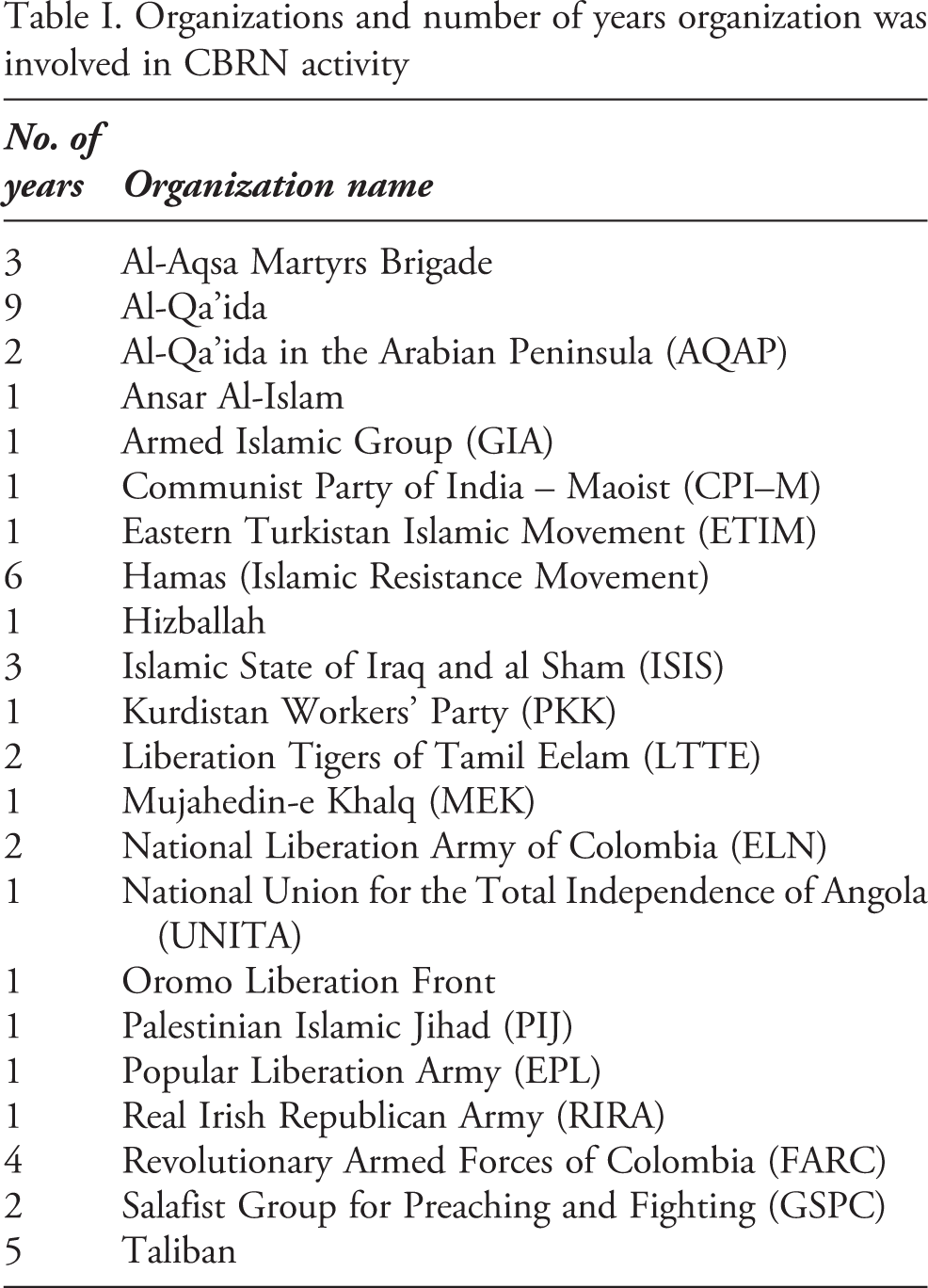
Organizations and number of years organization was involved in CBRN activity
Descriptive statistics
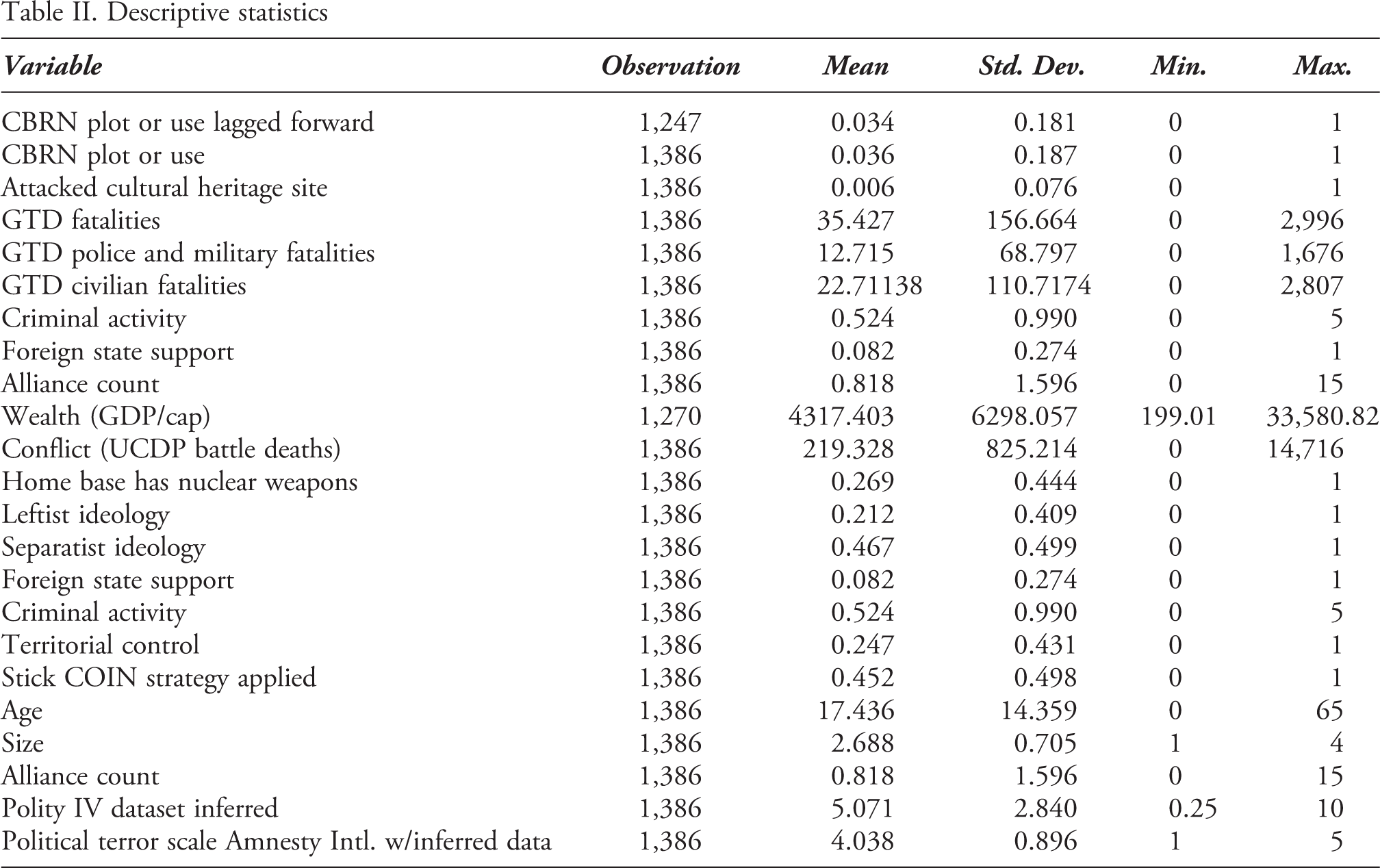
Table II provides descriptive statistics for our variables.
Analysis and findings
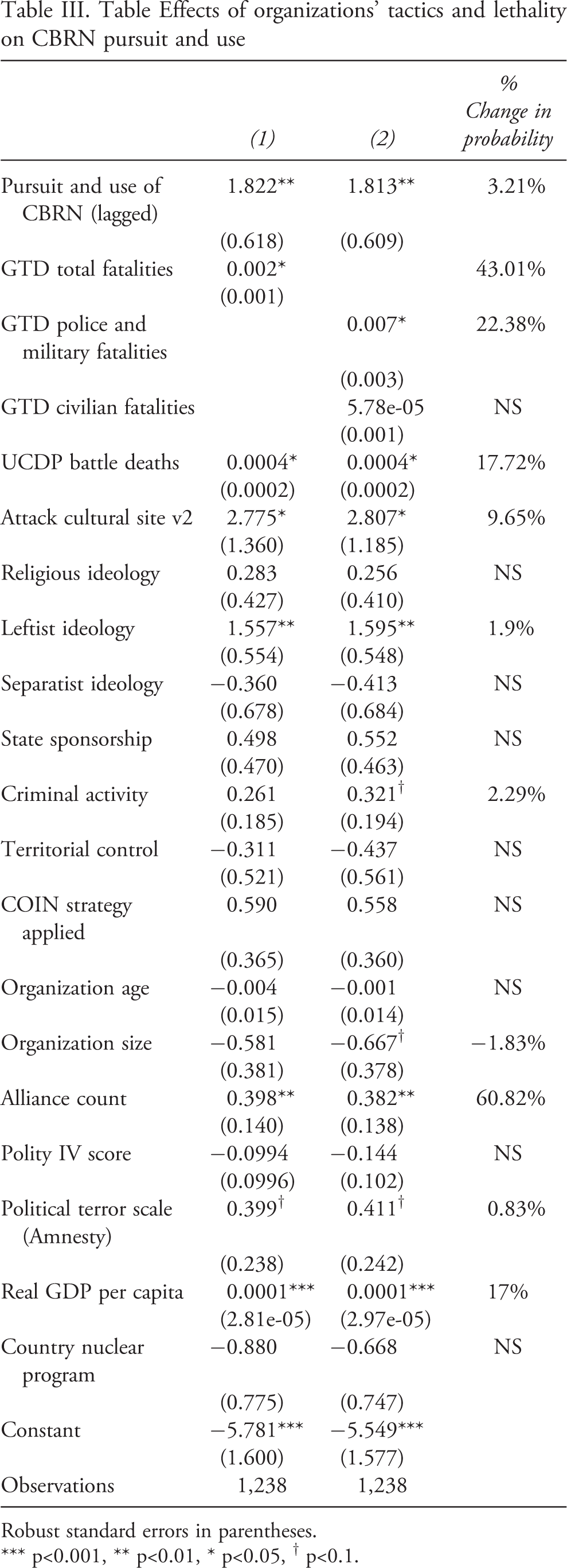
Because our dependent variable is a binary variable, we use logistic analysis; and to interpret the impact of the variables, we provided discrete changes in predicted probabilities (Long & Freese, 2006). To control for the possible impact of previous CBRN behavior we lag our dependent variable forward one year and include the dependent variable from the year before as one of our independent variables. We also cluster on the organizational identifier to account for non-independence of observations within each organization. Table III presents the logistic regression along with percentage changes in probability from their minimum value to their maximum value. Model 1 presents the main model including total GTD fatalities whereas Model 2 disaggregates GTD fatalities by police/military, and civilian fatalities.
Table III shows that only seven of the variables in Model 1 and seven variables in Model 2 have a statistically significant impact on the dependent variable. First, and unsurprisingly, if the organization is engaged in the behavior the year before, they are more likely to continue to do so the following year, though this effect is quite small (3.15%).
Turning to the organizational behavior variables, there are several interesting results.
Table Effects of organizations’ tactics and lethality on CBRN pursuit and use
Robust standard errors in parentheses.
*** p<0.001, ** p<0.01, * p<0.05, † p<0.1.
Second, the diversity of criminal activity was not significant, perhaps because the suspicion and compartmentalization that is the hallmark of criminal activity does not in practice allow for many of the hypothesized network effects to operate. Third, when considering more direct network effects – that is, the connections with other actors – aligning with past research on the impact of alliance connections on VNSA behavior, organizations with more alliances are more likely to engage in CBRN behavior with a 25% impact on the likelihood from a minimum to a maximum value of alliance counts. State sponsorship assumes significance only in Model 2 but even then, only increases the probability of CBRN pursuit and use by less than 1%.
Turning to the control variables, first, neither the overall fatality rate in Model 1, nor its components in Model 2 register significant effects. Although group lethality indicators were not shown to be significantly related to CBRN pursuit, they might still be linked to WMD pursuit and use, which was not testable given the (fortunate) paucity of WMD cases. Moreover, the actual number of fatalities is often more closely related to the efficacy with which an attack is conducted, rather than the intention of the attacker (for instance, when an organization seeks to kill hundreds but only ends up injuring a few individuals). Perhaps a better variable to test in future analyses, if data describing it can be obtained, is the intended number of casualties, rather than the actual number of fatalities.
Second, organizations in richer countries are much more likely to engage with CBRN by over 26%. Also, the greater the level of conflict that an organization is involved in (i.e. the greater the number of battle deaths on all sides), the more likely they are to engage with CBRN, having a 23.5% change from minimum to maximum probability.
With respect to organizational attributes, as in previous empirical analyses and challenging much of the literature on CBRN pursuit and use by VNSAs, the religious ideology variable does not have an impact (nor does the separatist ideology control). This draws attention back to the discussion in Asal, Ackerman & Rethemeyer (2012) regarding the potential subsuming of the ideology variable in other variables like alliances, as well as the possible mischaracterization of ideology using simple one-dimensional labels (see also Ackerman & Burnham, 2021). However, somewhat surprisingly, having a leftist ideology does have a positive impact, albeit a very small one (1.88%). There are no theoretical reasons for why leftist organizations should be more interested in CBRN than organizations espousing alternative ideologies, so one might speculate that the observed effect is potentially capturing an unmeasured covariate that is more often seen among leftist groups.
As for the remaining control variables, the analysis confirmed the lack of significance of several variables found in Asal, Ackerman & Rethemeyer’s (2012) study, including territorial control, organization size, and age. Moreover, none of the additional environmental variables related to the actions and type of the host country regime tested (political terror, or a repressive counterinsurgency strategy) proved to be significant. Last, the nuclear weapons status of the host country showed no significant association with CBRN pursuit, although this factor might still affect the pursuit of RN weapons specifically. Possibly, as well, there may be a stronger link between a civil nuclear power program, rather than a nuclear weapons program, and the pursuit of RN. The number of RN weapons’ pursuit cases on their own is too small to test for statistical significance.
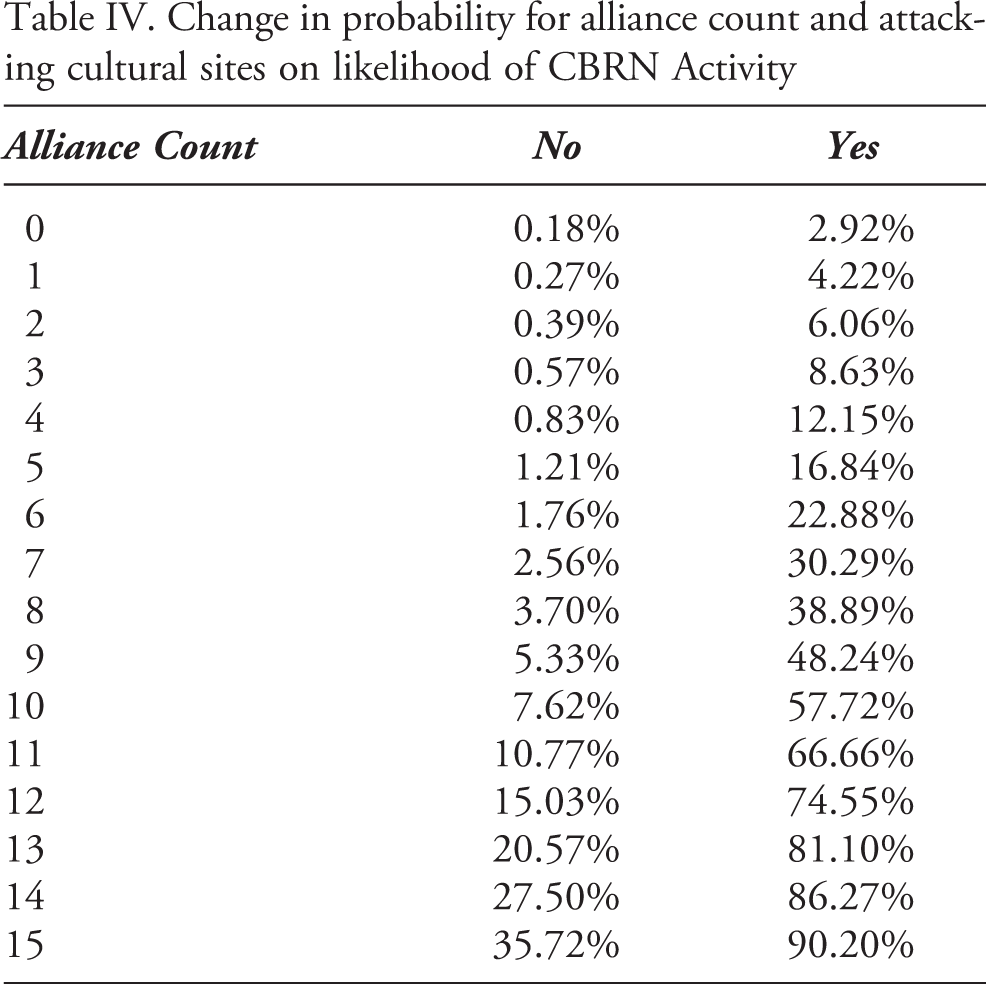
In addition to the changes in probability from minimum to maximum for each significant variable in Table III, in Table IV we present the changes in probability from minima to maxima by alliance connections as this variable interacts with the organization attacking cultural sites. As one can see, the combination is very powerful. Organizations that have no connections and have not attacked a cultural site in the previous year have less than a 1% probability of engaging in CBRN activity. If they have no alliances but have attacked a cultural site their probability jumps up to almost 6% and if they have done so and have more than ten network connections the likelihood of doing so jumps to nearly 50%.
Change in probability for alliance count and attacking cultural sites on likelihood of CBRN Activity
Conclusion
The theoretical contribution of our article is to shift the focus from what organizations are to what organizations do. Rather than focusing on static organizational traits that pertain to capabilities, we uncover the effects of prior tactics and target choice on propensities to pursue CBRN.
Our article is the first to empirically re-evaluate the results of previous scholarship (Asal, Ackerman & Rethemeyer, 2012) on organizations’ attributes on CBRN pursuit and use by using longitudinal data. We show that some of the keystone findings obtain statistical support when modeling organizations’ decisions over time. Notably, we confirm that network connectedness significantly shapes the probability of CBRN pursuit over time. To this finding we add the expected organizational attribute of prior pursuit of CBRN weapons and the more surprising choice to attack cultural sites, as important indicators of CBRN pursuit.
Unlike Asal, Ackerman & Rethemeyer (2012), we also find substantially more support for environmental factors, primarily the wealth of the country in which the organization is based and the severity of overall conflict occurring in the country. Our results showcase that groups that do pursue CBRN are not necessarily larger or older or more fatal organizations. But rather, these are organizations that are ensconced in alliance networks. In fact, the effects of alliance ties trump the effects of state sponsorship, which provides a trivial boost to the probability of CBRN pursuit. Policy-makers should thus keep abreast of the broader strategic environment in which organizations operate, not necessarily vis-à-vis state actors, but with respect to allied VNSAs.
A further insight that our findings yield concerns venue choice. Our data comprise eight organizations that chose to attack heritage sites. While the corresponding organizational years constitute only a small proportion of the data, the results do suggest that the same hunger for publicity that compels violent groups to attack sites of symbolic and cultural value may also fuel them to pursue CBRN technology. Beyond being publicity stunts, both strategies strive for sensationalism and arguably break taboos beyond even those that VNSAs (especially terrorists) flout using their usual forms of violence. This opens up an interesting future research question on the roles of actor reputation and legitimacy in CBRN pursuit. Previous work underscores that organizations may compromise legitimacy in order to establish reputations for brazenness (Asal & Rethemeyer, 2008; Asal, Ackerman & Rethemeyer, 2012; Tokdemir & Akcinaroglu, 2016). Perhaps organizations willing to be defined by negative reputations and are willing to engage in certain odious acts – such as child recruitment and sexual enslavement – are more likely to pursue and use CBRN weapons. In any event, the door has been opened to exploring behavioral (rather than only structural or environmental) aspects of VNSA behavior as forward indicators of CBRN pursuit.
Footnotes
Replication data

Acknowledgements
We would like to thank Karl Rethemeyer and Suzan Wheedon Levy, participants at the panel on terrorism at the International Studies Association 2019 meeting in Toronto, ON, the three anonymous reviewers, and the editor of JPR for their helpful feedback on previous drafts.
Funding
The authors disclosed receipt of the following financial support for the research, authorship, and/or publication of this article: this research was supported by the Defense Threat Reduction Agency Basic Research Award HDTRA1-10-1- and by the Department of Homeland Security Science and Technology Directorate’s Office of University Programs through award no. 2012-ST-061-CS0001, made to the National Consortium for the Study of Terrorism and Responses to Terrorism.