







Abstract
What explains the great variation in the adoption, timing, and duration of government policies made in response to the COVID-19 pandemic? In this article, we explore whether government incentives to repress domestic dissidents influence their responses to the COVID-19 pandemic. We argue that COVID-19 containment policies are observationally equivalent to those that abusive governments use to limit domestic dissent – that is, policies that restrict citizens’ freedom of movement. This creates an opportunity for abusive governments to engage in repressive behavior without countervailing pressure from citizens and the international community. Following this logic, we expect abusive governments to be more likely to adopt restrictive policies, adopt them earlier in the course of the pandemic, and take longer to relax restrictions. Empirically, we find that governments that have recently engaged in state violence against civilians or abused citizens’ human rights were about 10% more likely to enact lockdown and curfew policies. Compared to less repressive countries, these policies were implemented approximately 48 days earlier in the pandemic and kept in place for approximately 23 days longer. Overall, our results advance our understanding of how the repressiveness of state institutions can shape policy responses to a global health crisis.
Introduction
Emergency powers should not be a weapon governments can wield to quash dissent, control the population, and even perpetuate their time in power.
— Michelle Bachelet, UN High Commissioner for Human Rights, 27 April 2020
Governments around the world have adopted a variety of policies to limit the spread of the COVID-19 virus, many of which restrict citizens’ rights and civil liberties. By late April 2020 in the Philippines for example, over 120,000 people were cited for quarantine violations and over 30,000 were arrested over COVID-19 related breaches. Instead of issuing citations to alleged violators, the Philippine police threatened to arrest them immediately. In Peru, President Martín Vizcarra mobilized the army and policy to enforce one of the earliest COVID-19 lockdowns in Latin America on 16 March 2020. In contrast, far from enforcing a strict lockdown, the Swedish government, as well as other Scandinavian governments, allowed the vast majority of their populations to engage in voluntary social distancing. What explains the great variation in the adoption, timing, and duration of policies made in response to the COVID-19 pandemic?
We argue that the global COVID-19 pandemic has created a scenario that impairs the international community and citizens’ capacity to exert pressure on states to limit violent actions against civilians. Policies implemented to fight against the spread of the disease are observationally equivalent – or sufficiently observationally similar to be distinguished only with great uncertainty – to policies commonly used to fight domestic dissent, including curfew and lockdown policies. This observational equivalence or similarity limits the capacity of the international community and citizens to exert pressure over repressive regimes. Hence, governments that have underlying incentives to oppress their citizens can take advantage of the global health crisis to strengthen repressive measures to control domestic dissidents without bearing the costs of greater international and domestic pressure.
Following this logic, we hypothesize three connected processes. First, in the wake of the global pandemic, governments with a history of repressing citizens are more likely to order restrictive preventive measures at all compared to governments that do not. Similarly, repressive governments also have greater incentives to embrace restrictive policies earlier because such policies not only allow them to achieve public health objectives, but also allow them to respond to domestic dissent. And, finally, governments with a history of repressing citizens are also more likely to impose these policies for longer periods compared to governments that do not.
To evaluate our hypotheses, we make use of the CoronaNet Government Response Dataset (CoronaNet) with data collected until 31 August 2020 (Cheng et al., 2020). We complement this dataset with geo-located information on violence against civilians reported in the Armed Conflict Location and Event Dataset (ACLED) (Raleigh et al., 2010) and the Latent Human Rights Protection Scores (e.g. Fariss, Kenwick & Reuning, 2020).
Based on a variety of statistical models and model specifications, we find that abusive governments are between 10% and 15% more likely to restrict citizens’ freedom of movement through stay-at-home orders compared to non-abusive governments. Furthermore, abusive governments are more likely to implement restrictive policies earlier in the pandemic by approximately 48 days and to keep them in place by an additional 23 days compared to non-abusive governments.
Our results have implications for understanding how the repressiveness of state institutions shapes policy responses to a global health crisis, which speaks to several strands of literature. First, it builds on the rich literature studying the behavioral and institutional causes and consequences of various forms of political violence, including wartime violence, terrorist attacks, rioting, and state repression (Balcells & Stanton, 2020). In a recent contribution, Aksoy, Menger & Tavits (2020) specifically evaluate the political consequences of curfews in Turkey, showing that curfews increase support by the majority group for the ruling party, while having the opposite effect on the minority group. Closer to this article, Grasse, Pavlik & Matfess (2020) show that African countries have intensified their repressive campaigns after imposing lockdowns. Our research complements this work by arguing that the COVID-19 public health emergency has opened a window of opportunity for governments to engage in repressive behavior without countervailing pressure from citizens and the international community. Additionally, our empirical evidence showing that abusive governments are more likely adopt stay-at-home orders is fully consistent with Grasse et al.’s (2020) results showing that lockdowns, once adopted, serve to intensify state violence in areas of dissent.
Second, it speaks to the literature on the dynamics of political violence in the context of natural disasters. Some work considers when and how droughts, floods, earthquakes, and other disasters impact political violence with no clearcut consensus (e.g. Koubi, 2019; Lehrs, 2020). Other work on disasters has looked at their effects on violence with evidence showing that disasters reduce conflict in the short term (Haer & RezaeeDaryakenari, 2022), and increase the chances of rebel groups seeking negotiations with the government (Nemeth & Lai, 2022). Similarly, Koehnlein & Koren (2022) show that COVID-19 prevalence increases the likelihood of attacks against civilians by pro-government non-state actors. We specifically contribute to this literature by showing that states’ response to a global health disaster depends on their pre-existing incentives to repress domestic dissent.
This article also contributes to the emerging literature of the causes and consequences of the COVID-19 pandemic. Social scientists have, thus far, provided a wealth of research on the social and political correlates of COVID-19 policy responses. Some have focused on explaining what has driven citizens’ reaction to the pandemic and the associated policies, including partisanship (e.g. Kubinec et al., 2021), political polarization (e.g. Allcott et al., 2020), institutional trust (Goldstein & Wiedemann, 2020), institutional messaging (e.g. Arriola & Grossman, 2020), and social norms (e.g. Barceló & Sheen, 2020). Other scholars have uncovered the cross-national determinants of the policy response to the pandemic, including democratic institutions (e.g. Frey, Chen & Presidente, 2020), federal institutions (Buthe et al., 2020), and state capacity (e.g. Frey, Chen & Presidente, 2020). Our study contributes to this literature by emphasizing the role of incentives to repress and, more specifically, by demonstrating that a recent history of political violence and a lack of human rights protection is associated with cross-country variation in government responses to the COVID-19 pandemic.
Repression and dissent amid a global pandemic
Dissent takes place when non-state actors collectively do, or threaten to, impose costs on their government to encourage a change in the status quo (Ritter & Conrad, 2016). Violent and nonviolent acts, such as strikes, boycotts, riots, and nonviolent protests taken by dissenters can endanger the government’s hold on power. One way in which states can respond to these challenges to their power is to repress the dissidents (Ritter & Conrad, 2016).
State repression ‘involves the actual or threatened use of physical sanctions against an individual or organization, within the territorial jurisdiction of the state, for the purpose of imposing a cost on the target as well as deterring specific activities and/or beliefs perceived to be challenging to government personnel, practices or institutions’ (Davenport, 2007, drawing on Goldstein, 1978: xxvii). Repression can be targeted toward individuals or particular groups (e.g. arrests) or indiscriminately applied toward entire collectives (e.g. curfews or lockdowns). Lockdowns and curfews, which are imposed on everyone within a geographical area and, thus, apply equally to political dissenters and apolitical civilians, are one common form of indiscriminate repression (Aksoy, Menger & Tavits, 2020). Though most have nonviolent enforcement mechanisms (e.g. fines), in some cases, violations can be punished, lead to imprisonment, and, in extreme cases, even death (Brass, 2006).
Why do governments choose to repress dissenters as opposed to give in to their demands? Scholarly consensus suggests authorities repress their citizens to control dissent (e.g. Davenport, 2007). States are more likely to use collective repression, as opposed to agree to dissenters’ demands, when the state’s capacity to survive a widespread rebellion is weak, when cross-group polarization is strong, and when there are grievances across the entire society (Rozenas, 2020). Repression and dissent are, however, endogenous (Ritter & Conrad, 2016). Governments often respond to threats to their authority with repressive behavior. At the same time, state repression strongly raises the likelihood of dissent. That is, though governments engage in repressive behavior in the hopes that forceful action will deter further dissent, repression often provides incentives for the very behavior governments intend to deter (Hill & Jones, 2014; Siegel, 2011). 1 Nonetheless, the same literature also suggests that violent collective repression is at best ineffective and at worst counterproductive when responding to dissident challenges (Valentino, 2014).
The literature identifies two major arguments as to why states still use collective repression despite potential backfire effects: state capacity and signaling. With regard to state capacity, states often do not have the resources to apply targeted repression and therefore must use low-cost collective repressive measures. To repress individual citizens, the state must obtain costly intelligence about their behaviors. As such, only states that have the resources to control, monitor, and collect taxes from the population will have the capacity to selectively crack down on domestic dissidents. Even states with high capacity may choose to engage in relatively low-cost collective repression. Indeed, Hitler was quoted as saying, ‘I shall spread terror through the surprising application of all means. Why should I deal otherwise with all my political opponents? These so-called atrocities save me hundreds of thousands of individual actions against protesters and discontents’ (Hitler, quoted in Gurr (1986: 46–47)). In general, then, while states with low capacity cannot apply selective repression and must therefore rely on less efficient forms of collective repression (Kalyvas, 2006), all states may plausibly choose collective repression over targeted repression because of its lower costs.
Second, states may also intentionally use collective repression as a signaling device. In an environment of incomplete information with repeated interaction, strategic actors have incentives to engage in a reputation-building strategy (Kreps & Wilson, 1982). By indiscriminately repressing more civilians, states send a strong signal of resolve that they will maintain the status quo. This unwavering message to enemies that policy concessions will not be granted allows them to build a domestic reputation of steadfastness (Acemoglu & Robinson, 2000). In these settings, even if the state has the capacity to selectively repress, it can choose not to. For instance, executors of state violence in El Salvador were instructed to indiscriminately repress the indigenous population even in the absence of evident disloyalty (Lauria-Santiago & Gould, 2008).
While its theoretical logic is sound, the signaling argument is wanting on the grounds of empirical consistency. In many instances, states not only abstain from publicizing their repressive measures, but also attempt to obfuscate them (Gruffydd-Jones, 2019; Shadmehr & Bernhardt, 2015), particularly when applying large-scale indiscriminate repression. Abusive states may believe that the expected political benefit of repressing domestic challengers is positive only if it remains hidden from the international community (Afesorgbor, 2019). Indeed, repressive measures can be costly if they become publicly reported as they could damage a country’s international reputation or legitimacy and lead to significant consequences in the form of breaking clauses in preferential trade agreements (Hafner-Burton & Tsutsui, 2005), economic sanctions (Afesorgbor, 2019), and even military interventions (Conley & Hazlett, 2021).
International pressure can directly reduce the likelihood and severity of state repression. By calling attention to repressive state behaviors, external actors such as international organizations (DeMeritt, 2012), other states (Terman & Voeten, 2018), human rights tribunals (Appel, 2018), international media (Krain, 2012), and human rights NGOs (Murdie & Davis, 2012) can pressure repressive governments to align with global norms and reduce their abusive behavior.
Beyond its direct influence on state repression, public criticism may trigger further external action that makes it costly for states to continue behaving repressively. This may work through several pathways. First, repressive states may be excluded from international treaties if systematic human rights abuses come to light. Some scholars demonstrate that adding human rights clauses to economic agreements effectively reduces state repression, especially among countries that depend on foreign aid (Donno & Neureiter, 2018; Hafner-Burton, 2005). Second, foreign aid may be withdrawn as a result of state abuses. Lebovic & Voeten (2009) show that multilateral institutions (e.g. the World Bank) punish countries that violate human rights by reducing their allocated amount of foreign aid. Third, regardless of their actual effectiveness in preserving human rights, stopping state repression constitutes one of the major explanations for imposing economic sanctions (Hufbauer, Schott & Elliott, 1990). At an extreme, public knowledge of ongoing large-scale state violence may lead to foreign military intervention to end mass atrocities (Conley & Hazlett, 2021).
The global pandemic opens a window of repression
External states and citizens are willing to sanction countries if they engage in repressive action (McLean & Roblyer, 2017). International pressure can deter or mitigate state repression against civilians through several mechanisms, including international treaties, aid, sanctions, and even foreign interventions to stop large-scale violence. While collective repression itself has relatively low operational costs compared to targeted repression and may additionally provide domestic signaling benefits to its users, external pressure may raise international reputational costs enough to overcome a repressive government’s cost--benefit analysis. However, international pressure crucially depends on the ability of external actors to observe repressive state actions, and such actions can only be observed imperfectly through indirect sources. As such, since sanctions are costly, international actors only impose sanctions if both the degree of a government’s domestic repression and certainty that the repression is unjustified are high.
In the past, sovereign states have commonly made use of stay-at-home orders, in the form of lockdowns or curfews, as an important collective repressive tool to quell politically motivated violence from domestic challengers (Brass, 2006). The government of Sri Lanka, for instance, has implemented several nationwide curfews to reduce ethnic violence since 1983, the Indian national government has made use of curfews and lockdowns to tackle potential unrest in Kashmir, and the Egyptian government imposed a curfew during the 2011 uprising, just to mention a few examples. Across most cases, stay-at-home orders have had significant implications for the safety and well-being of those who live within its bounded areas, including food shortages, limited access to health and education, and even severe violations of the right to physical integrity and life (Brass, 2006).
Whereas curfews and lockdowns typically characterize repressive action by abusive governments against civilians in ordinary times, these policies have become essential components of most governments’ policy toolbox amid the COVID-19 global pandemic (Flaxman et al., 2020). The majority of national governments have Timeline of stay-at-home orders around the world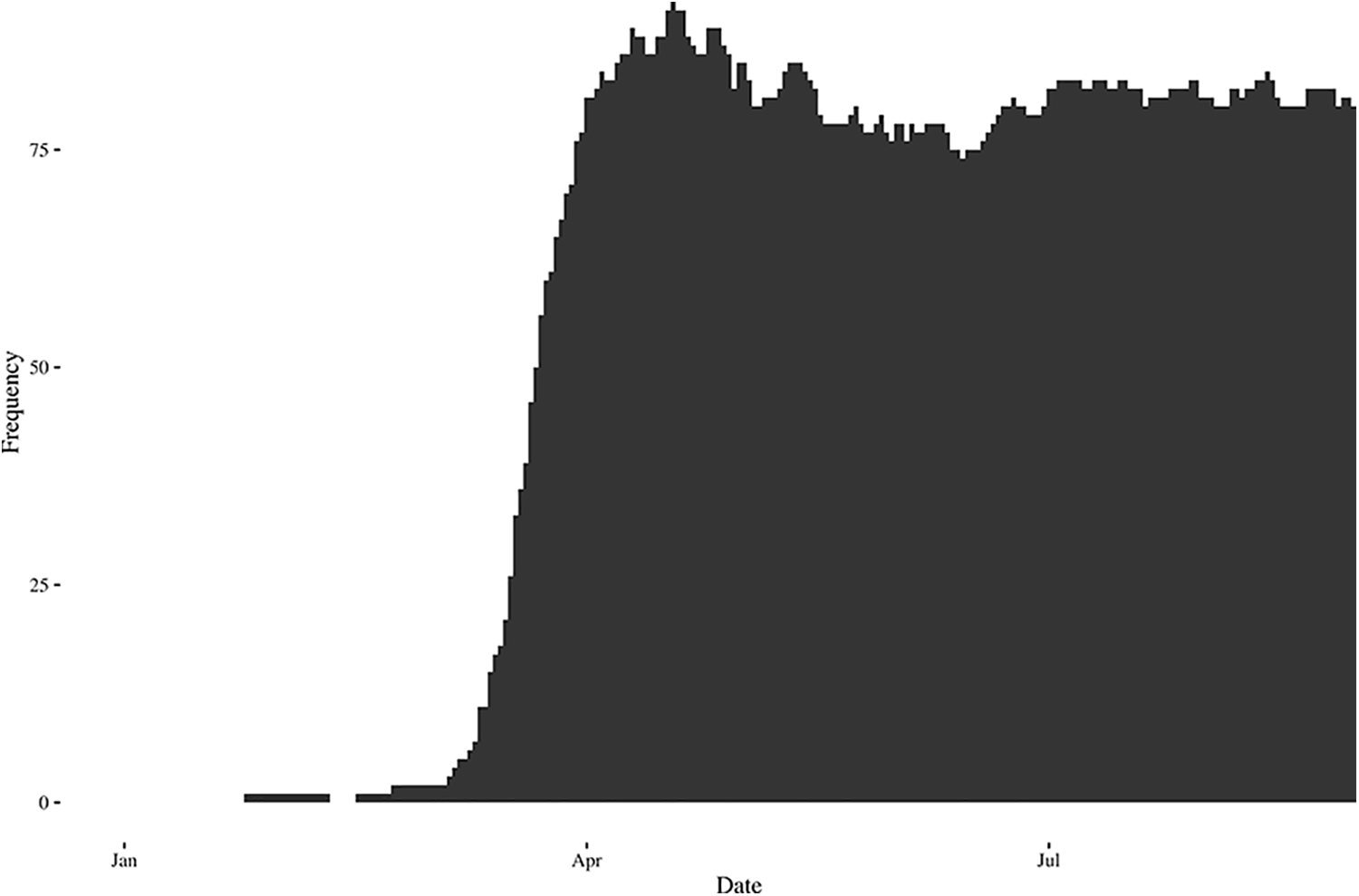
In the wake of the COVID-19 pandemic however, distinguishing between measures taken to limit the spread of the virus and those to address dissent against the government has become difficult. Governments have contained the spread of the virus by adopting stay-at-home orders, internal border restrictions, restrictions of mass gatherings, which, in appearance, are often observationally equivalent to repressive policies adopted to fight domestic dissent. In this scenario, even if some countries employ these policies to repress rather than prevent the spread of the virus, citizens or external actors cannot intervene or exert pressure because they are ignorant of the true reason behind those policies.
In some instances, containment and repressive policies might be not completely observationally equivalent but are nevertheless so sufficiently similar that there is too much potential for error to object. Whereas external states and citizens are willing to sanction countries if they engage in repressive action, doing so is costly. Citizens may find it difficult to mobilize against governments if the repression measures are for an apparently legitimate public health purpose, which may have helped stall protest movements in Hong Kong and Algeria. 3 Besides the obvious economic costs of sanctioning and foreign intervention, in the context of the pandemic international actors are particularly risk averse in interfering in domestic affairs given that a false step can send mixed signals about the efficacy of containment policies in general. Thus, international actors are unlikely to raise objections, let alone intervene over a country’s stay-at-home order if there is sufficient uncertainty about the true intentions of the government. Even if such policies were merely observationally similar, as opposed to observationally equivalent, international actors would still be impaired in their ability to constrain the use of such policies.
Governments with underlying incentives to oppress their citizens thus may find a window of opportunity in the global pandemic to strengthen their repressive measures to further control domestic dissent without bearing the costs of greater international or domestic pressure. Specifically, a public health crisis increases uncertainty about the reason for repression and permits abusive governments to repress without facing international pushback.
While we cannot directly observe the sincere intentions of specific governments, we test and evaluate three observable implications consistent with our logical argument. Due to the uncertainty about the reason for the adoption of restrictive policies, we first expect abusive governments to be, on average, more likely to adopt restrictive policies at any point in time compared to governments that have no record of state violence or a record of human rights respect and protection. This leads to our first hypothesis:
Hypothesis 1: Governments that abuse human rights or those with a recent history of violence against civilians are more likely to impose restrictive measures earlier in the pandemic than governments that protect human rights or have no recent history of violence against civilians.
Second, we also expect that abusive governments may readily embrace the imposition of restrictive policies more quickly than non-abusive governments, even controlling for public health drivers. Following this intuition, we hypothesize:
Hypothesis 2: Governments that abuse human rights or those with a recent history of violence against civilians are more likely to adopt restrictive measures earlier than governments that protect human rights or have no recent history of violence against civilians.
In a scenario where repressive policies may receive little or no pushback, not only do abusive governments have incentives to impose more restrictions, but they should also be more reluctant to lift restrictions once the pandemic wanes. This logic leads to our third empirical hypothesis:
Hypothesis 3: Governments that abuse human rights or those with a recent history of violence against civilians are more likely to impose restrictive measures for longer periods than governments that protect human rights or have no recent history of violence against civilians.
Data
Our main data source is the CoronaNet Government Response Dataset (CoronaNet) (Cheng et al., 2020). CoronaNet is an ongoing data collection project, which covers systematic information on the multitude of policy responses governments have taken to address the spread of the COVID-19 virus. At the time of writing, CoronaNet includes more than 100,000 separate policy announcements made in reaction to COVID-19. For each policy announcement, CoronaNet collects information on the governmental initiator of a policy, the type of policy being implemented, its duration, the geographic and demographic targets of the policy, the compliance mechanism, and the way in which a policy is enforced, among other attributes. We choose to use CoronaNet over other existing datasets because it has greater coverage (over 190 countries), a rigorous and systematic data validation procedure, provision of portable document formats with the information source, and fine-grained information about the initiator, target, and enforcement mechanism of the policy. However, we limit our analysis to the first wave of the pandemic as this is the time when all countries had to quickly react to an unexpected global crisis. As such, the time span of our analysis goes to 31 August 2020 because by this time, most countries experienced the first wave of the pandemic.
We measure the timing of implementation of stay-at-home orders, either in the form of a ‘curfew’ or a ‘lockdown’, for at least one first-level administrative unit in the country (i.e. state, region). In the CoronaNet dataset, a curfew is documented if there are ‘government policies that limit domestic freedom of movement to certain times of the day’ and a lockdown is documented if there are ‘government policies that force citizens to stay at home all the day except for essential activities’. 4 See Cheng et al. (2020) for further details on the definitions of policy types.
We complement the CoronaNet data with two datasets that separately capture governments’ predisposition to repress domestic dissent. First, we use geo-located information on observed violence against civilians provided in near-real time from the Armed Conflict Location and Event Dataset (ACLED) before the COVID-19 outbreak (Raleigh et al., 2010). ACLED collects fine-grained data on the locations, dates, and actors of all reported political violence across most countries around the world. For our empirical analyses, we use the ACLED data on ‘violence against civilians’, which is defined as ‘violent events where an organised armed group deliberately inflicts violence upon unarmed non-combatants’ (ACLED). By definition, the perpetrators of such acts can only be state forces and their affiliates such as rebels, militias, and external forces. Any event in which the perpetrator of violence was not the state, for example, rebel groups against unarmed civilians or civilians against civilians is excluded from our measure of state repression. 5 Importantly for our coding strategy, we include any attempts at inflicting harm (e.g. beating, rape, mutilation) against civilians or forcibly disappearing (e.g. kidnapping) civilian actors as state repression. 6 The main explanatory variables from ACLED in the models is the number of events involving violence against civilians per one million population in the country. 7 The time window for counting the number of events is the entire year 2019. However, none of our findings are sensitive to this time window (see Online appendix E).
While ACLED provides fine-grained data on political violence around the globe, it comes with two major limitations as a measure of state repression. First, ACLED only records repressive events that are realized, publicly observed, and documented. That is, ACLED does not capture the uncertainty associated with count data of difficult-to-observe events. Hence, an accurate measure of a comprehensive repressive behavior is, following our own logic, complicated by the fact that governments have reasons to conceal these events from the international community. Second, while ACLED collects information from nearly every country in Africa, Asia, Latin America, and the Caribbean, as well as Eastern Europe, countries from Western Europe, North America, and Oceania are not available in the dataset. In total, our analysis includes 135 countries (see Online appendix A for a list of countries and Online appendix C for descriptive statistics). We evaluate the potential impact of this non-random missingness in Online appendix G.
We further bolster our analysis with data from the Latent Human Rights Protection Scores (Version 4). These scores measure the physical integrity rights protection in each country-year by using a dynamic item response model that aggregates a bundle of hard-to-observe repressive indicators (e.g. torture, ill-treatment, imprisonment, violence) in a summary score (Fariss, 2014; Fariss, Kenwick & Reuning, 2020; Reuning, Kenwick & Fariss, 2019). Fariss et al. create a single latent measure of repression for countries in a given year drawing on 16 different sources of human rights information, including the CIRI Human Rights Data Project (Cingranelli & Richards, 1999), the Ill-Treatment and Torture (ITT) Country-Year Data (Conrad, Haglund & Moore, 2013), the Political Terror Scale (Gibney et al., 2019), and the UCDP One-Sided Violence Dataset, 1989–2015 (e.g. Eck & Hultman, 2007), among others.
The Latent Human Rights Protection Scores has major benefits that complement our above-mentioned ACLED indicator of actual violence against civilians and make it preferable to alternative approaches. First, it assesses states based on their aggregate level of performance on physical integrity rights across an extensive bundle of indicators. Therefore, this indicator is not just dependent on observed violence against civilians but it also incorporates other forms of state repressive behavior such as torture, ill-treatment of prisoners, unlawful imprisonment of citizens, and state-led threatening events. Second, the latent human rights protection scores cover more countries (e.g. 194 countries in 2019) than any individual data source by combining information from all other data sources. For instance, another frequently used alternative dataset of human rights protection, the CIRI dataset, was discontinued in 2011 (Cingranelli & Richards, 1999). The Latent Human Rights Protection Scores, thus, enables us to evaluate our main hypotheses using a global sample of 182 countries. Finally, we include three sets of controls to our models: political, economic, and public health controls that we describe in detail in Online appendix B.
Research design
In what follows, we give an overview of our research design for testing each of our three hypotheses. First, we build a cross-sectional dataset to assess whether countries with a lower human rights record or a recent history of repression against civilians are more likely to implement restrictive measures such as stay-at-home orders. To evaluate our first hypothesis, we create a binary variable that takes the value of 1 if the country implemented a stay-at-home order anytime between 1 January 2020 and 31 August 2020, and 0 otherwise. We then implement a set of logistic regressions where the adoption of a stay-at-home order in the country is regressed on the level of protection of human rights or the repression against civilians immediately before the beginning of the pandemic together with our extensive set of control variables and region fixed-effects.
For our second hypothesis, the outcome variable is the timing of implementation of stay-at-home orders in the country. The outcome variable is operationalized as the number of days between the first confirmed case of COVID-19 in a country and the adoption of a stay-at-home order, either a lockdown or a curfew. We run a set of proportional hazard models to evaluate whether those countries with a lower protection of human rights or greater state repression against civilians before the outbreak implement restrictive measures more quickly than countries with no such background or record. Our extensive set of control variables and region fixed-effects are included in these models.
Finally, we evaluate our third hypothesis by creating a variable that captures the number of days, either consecutive or not, that a country had a stay-at-home order in place between 1 January 2020 and 31 August 2020. We then employ OLS regression models where the number of days with a stay-at-home order in the country during our time period is regressed on the level of protection of human rights or the repression against civilians immediately before the beginning of the pandemic, as well as our extensive set of control variables and region fixed-effects.
Results
In this section, we provide our evaluation for our three hypotheses in three separate subsections.
Are repressive states more likely to impose stay-at-home orders?
We first examine whether countries that used greater violence against civilians in 2019 are more likely to implement stay-at-home orders compared to countries with no recent history of using violence against civilians. We also re-estimate the model using a measure of human rights as opposed to state violence.
Table I reports a set of logistic regressions that model whether a stay-at-home order was adopted in the country as a function of the recent record of violence against civilians in the year preceding the outbreak or a country’s human rights protection score. Both models sequentially incorporate region fixed effects and political, economic, and health control variables.
Columns 1 through 4 show that the estimated effect of recent state repression is positive and significant at the 99% confidence level for the unadjusted model and significant at the 90% level in the fully adjusted model, indicating that countries with a recent history of violence against civilians are more likely to adopt stay-at-home orders. Figure 2 illustrates the size of the effect. A one-unit increase in the logged number of ACLED violent events 8 – for example, going from the mean of 6 violent events to 16 violent events – increases the expected probability of a stay-at home order by approximately 10% when averaged over the sample values of control variables.
Similarly, Columns 5 through 8 also indicate that the estimated effect of human rights score before the beginning of the pandemic is significantly associated with the adoption of a stay-at-home order with a negative coefficient that is significant at the 99% confidence levels across all models. The negative coefficients indicate that countries whose human rights scores are lower are more likely to adopt stay-at-home orders. Figure 2 also shows that this effect is sizable. Countries whose human rights score increases by one unit, or approximately 1-SD, have a 10–20% lower chance of having a stay-at-home order imposed when averaged over the sample values of control variables.
The empirical patterns provide support to the argument that abusive governments, as measured by either observed violence in the preceding year or combined human rights scores before the pandemic, are more likely to implement restrictive policies against COVID-19 compared to non-abusive governments.
Are repressive states quicker in imposing stay-at-home orders?
Logistic regressions on the effect of state repression and human rights scores on adopting stay-at-home orders
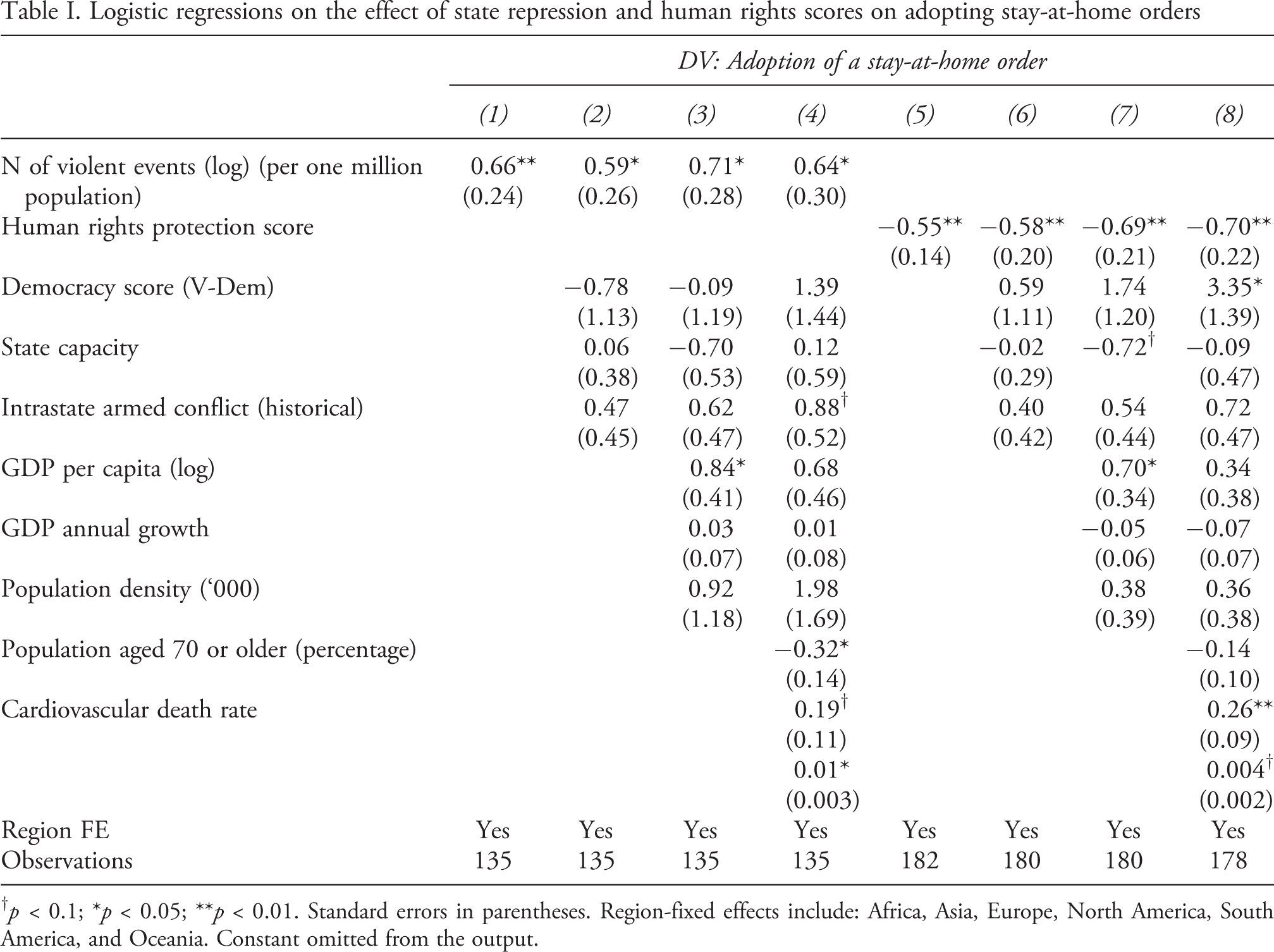
† p < 0.1; *p < 0.05; **p < 0.01. Standard errors in parentheses. Region-fixed effects include: Africa, Asia, Europe, North America, South America, and Oceania. Constant omitted from the output.
The difference in slopes between countries that are below versus above the median in terms of a history of repressing their citizens or violating basic human rights suggests that there is a relationship between using violence against civilians or a poor record of human rights and the timing of imposing restrictive measures in responding to the pandemic. Abusive governments implemented a stay-at-home order on average 25 days after the first confirmed case, when measured as an above-the-median number of violent events against civilians in 2019, and 35 days when measured as a below-the-median human rights score. In contrast, countries that had a below-the-median level of violence against civilians in 2019 take an average 35 days to implement a stay-at-home order, while countries that had an above-the-median protection of human rights score take an average of 95 days. 10
It is clear from this descriptive evidence that countries that have used violence against civilians in the months preceding the occurrence of their first COVID-19 case or score low in the protection of human rights have implemented restrictive measures more quickly than similar countries that have had no recent history of using violence against civilians or a record of violating human rights. However, this evidence is only suggestive given that it relies on a crude measure of violence – a simple dummy based on above and below the median of events and human right scores – and does not control for potential confounders. For a more robust analysis, Table II reports Cox proportional hazards models that estimate the number of days from the first COVID-19 confirmed case in the country to the adoption of a stay-at-home order given the number of events involving violence against civilians and the number of fatalities in these events. We note that in Cox proportional hazards regression models, coefficients indicate the hazard rate, that is the Change in marginal probabilities of stay-at-home orders given history of repression and human rights protection scores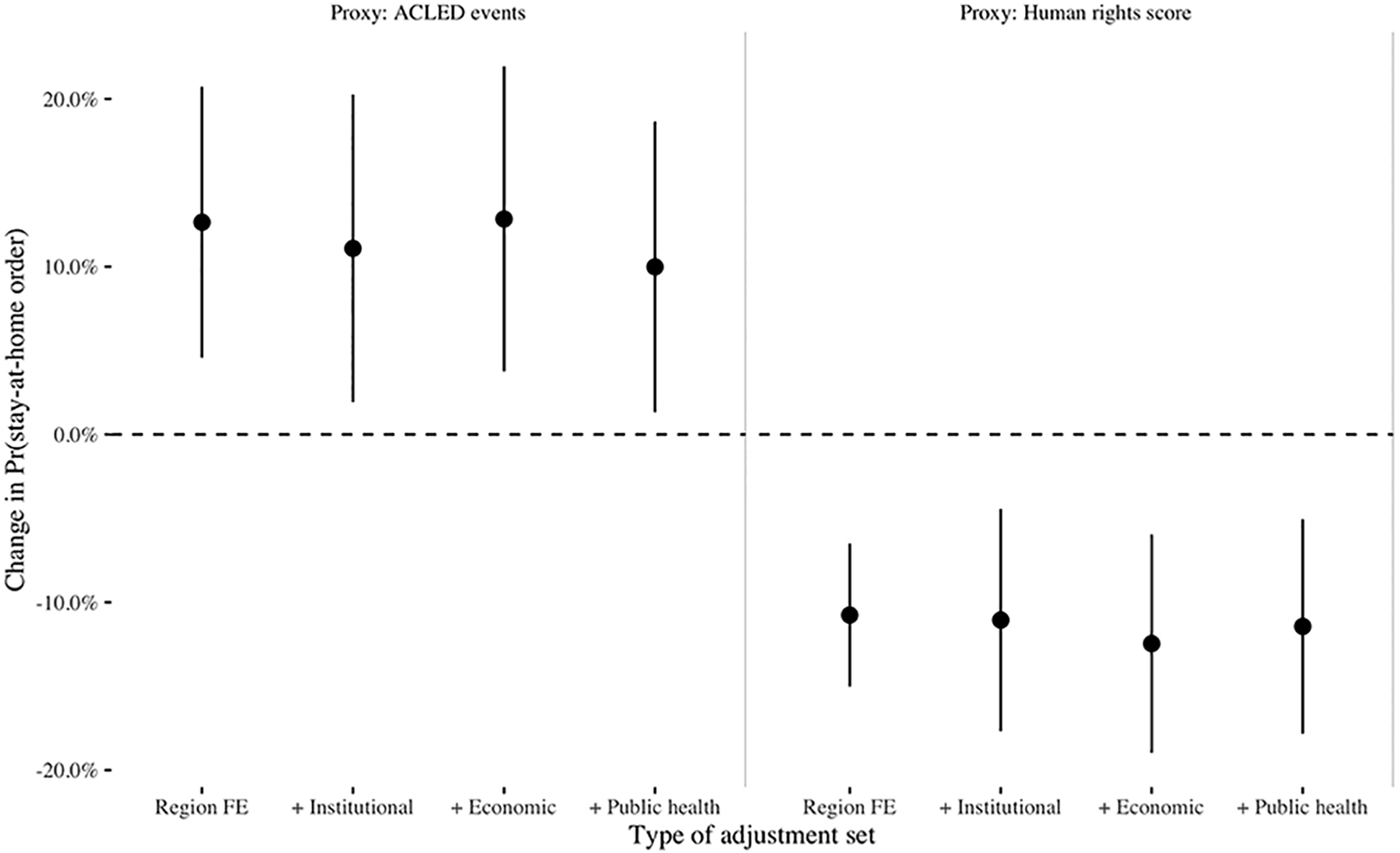
The Cox models show that countries that experienced a greater number of fatalities from violence against civilians in the months immediately preceding the pandemic are more likely to implement stay-at-home orders earlier than those with no recent record of violence against civilians. Table II consistently indicates a positive and statistically significant effect at the 99% confidence level with and without adjusting for control variables (columns 1 through 4). These estimated effects are also substantively sizable. We can interpret these numbers by calculating expected duration – that is, the average number of days until a policy is implemented holding the covariates constant (Harden & Kropko, 2019). Using our saturated model, we calculate that the average time until adoption of a stay-at-home order varies from 120 days after the first COVID case for a country with a prior history of only 1.4 violent events in 2019 (the 25th percentile) to 72 days after the first COVID case for a country with a comparatively higher history of 5.5 violent events in 2019 (the 75th percentile). In short, stay-at-home orders by repressive states are 48 days longer than those in non-repressive states.
Table II also reports a consistent negative effect of the latent human rights protection score on the adoption of a stay-at-home order, indicating that countries that often violate human rights adopted stay-at-home orders earlier in the pandemic compared to otherwise similar countries with better scores in the index of human rights protection. Based on our saturated model, we calculate that an increase in the human rights protection score from –0.37 to +1.88, which corresponds to the 25th and 75th percentiles, is associated with an increase of 50 days between the the time of the first COVID-19 case and the announcement of the first stay-at-home order, from 86 days (25th percentile) to 136 days (75th percentile).
Are repressive states more likely to impose longer stay-at-home orders?
Lastly, we evaluate whether countries that had used violence against civilians in the months preceding the beginning of the pandemic and countries that have a poor record of human rights are more likely to impose longer stay-at-home orders than countries with no recent history of using violence against civilians or with a better record of human rights.
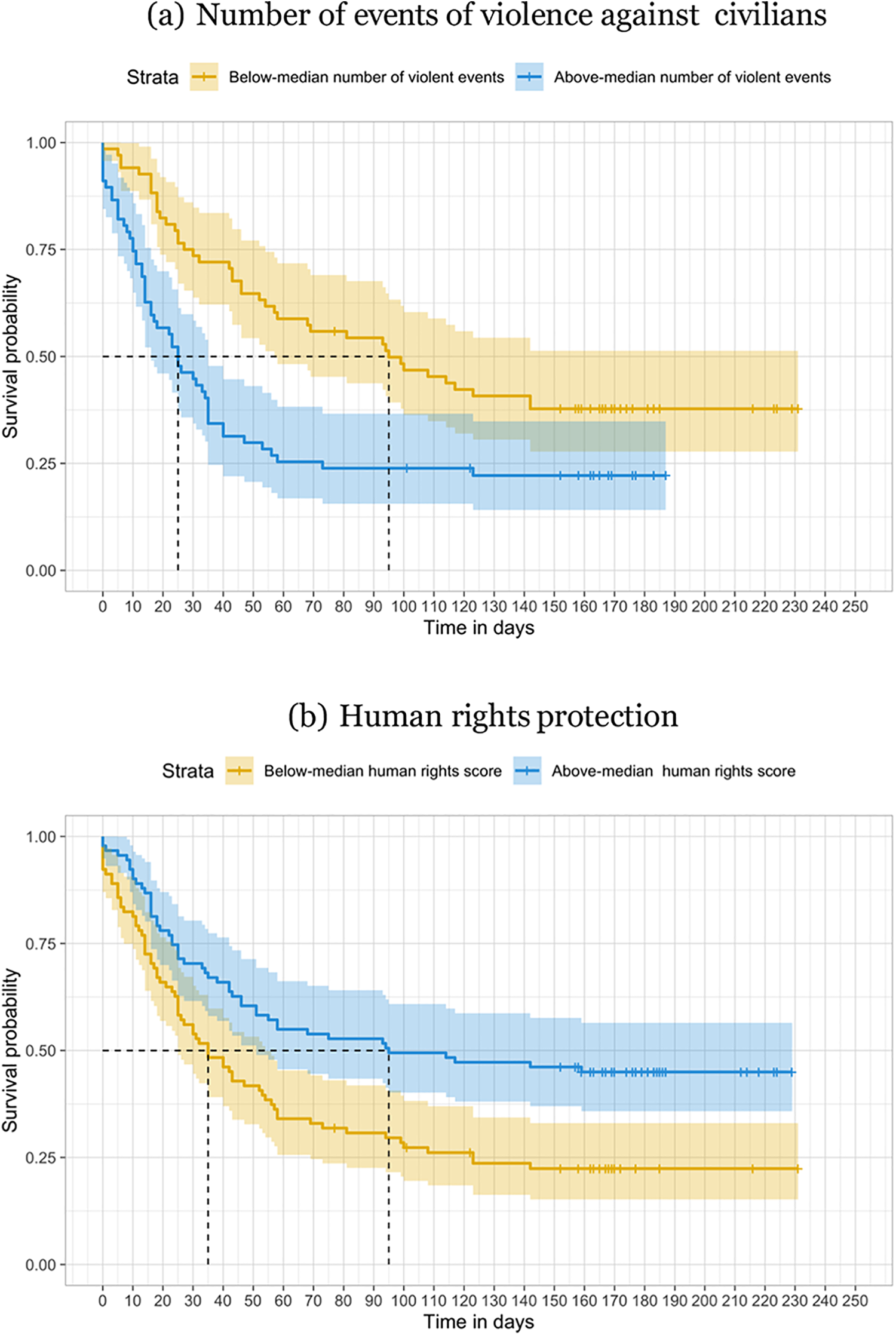
Survival probability plots of COVID-19 policy response by preceding violence against civilians and human rights protection scores
Cox proportional hazards models of estimating the effect of state repression in 2019 and human rights scores on the time to adopting a stay-at-home order
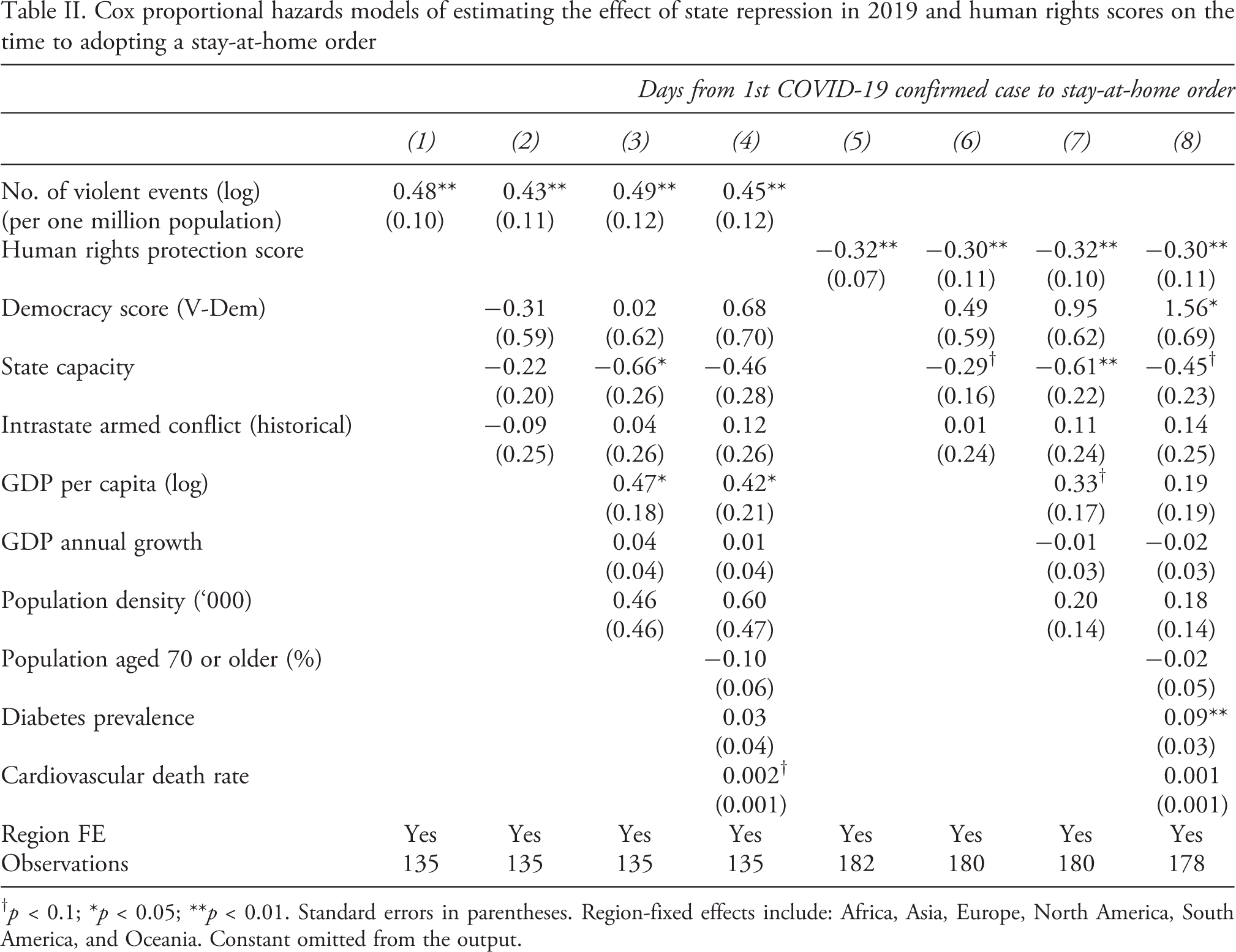
† p < 0.1; *p < 0.05; **p < 0.01. Standard errors in parentheses. Region-fixed effects include: Africa, Asia, Europe, North America, South America, and Oceania. Constant omitted from the output.
The results in Table III indicate that the log of the Number of events per one million population is associated with the imposition of longer stay-at-home orders during the pandemic across all models with a 99% confidence level. In the unadjusted model, column 1 shows that a 10% increase in the Number of fatalities per one million population would be associated with an increase in the length of stay-at-home orders of 4.7% (e 0 . 48· log ( 1 . 1)). Model 4, which adjusts for all control variables, shows that a 10% increase in the number of fatalities leads, on average, to an expected increase of the duration of a stay-at-home order in place of 4.4% (e 0 . 45· log ( 1 . 1)). Simulating the extreme values in the interquantile range, our coefficient in the fully adjusted model indicates that a number of ACLED violent events of 1.4 (25th percentile) leads to an expected stay-at-home order of 25 days long, which is 23 days shorter than the 48-day-long stay-at-home order expected in a country with 5.5 ACLED violent episodes (75th percentile).
Table III also shows a negative association between the latent human rights protection scores and the imposition of longer restrictive policies against COVID-19, which indicates that countries that better protect human rights are likely to impose restrictions for shorter periods relative to countries that have worse human right protection scores. Using the unadjusted model (column 5), the coefficient indicates that a 1SD increase in the latent human rights protection score from the average – an increase from the average score of 0.77 to 2.44, equivalent to 1SD above the mean – would imply an expected decrease in the length of stay-at-home orders of 24 days – from 49 to 25 days of a stay-at-home order policy in place. After adjusting for all covariates, Model 8 shows a similar effect in which a 1SD increase in the latent human rights protection scores from the mean would lead to a stay-at-home order 28 days shorter – from 48 to 20 days of a stay-at-home order policy in place.
OLS regressions on the effect of recent violence against civilians and human rights score on the length of stay-at-home orders
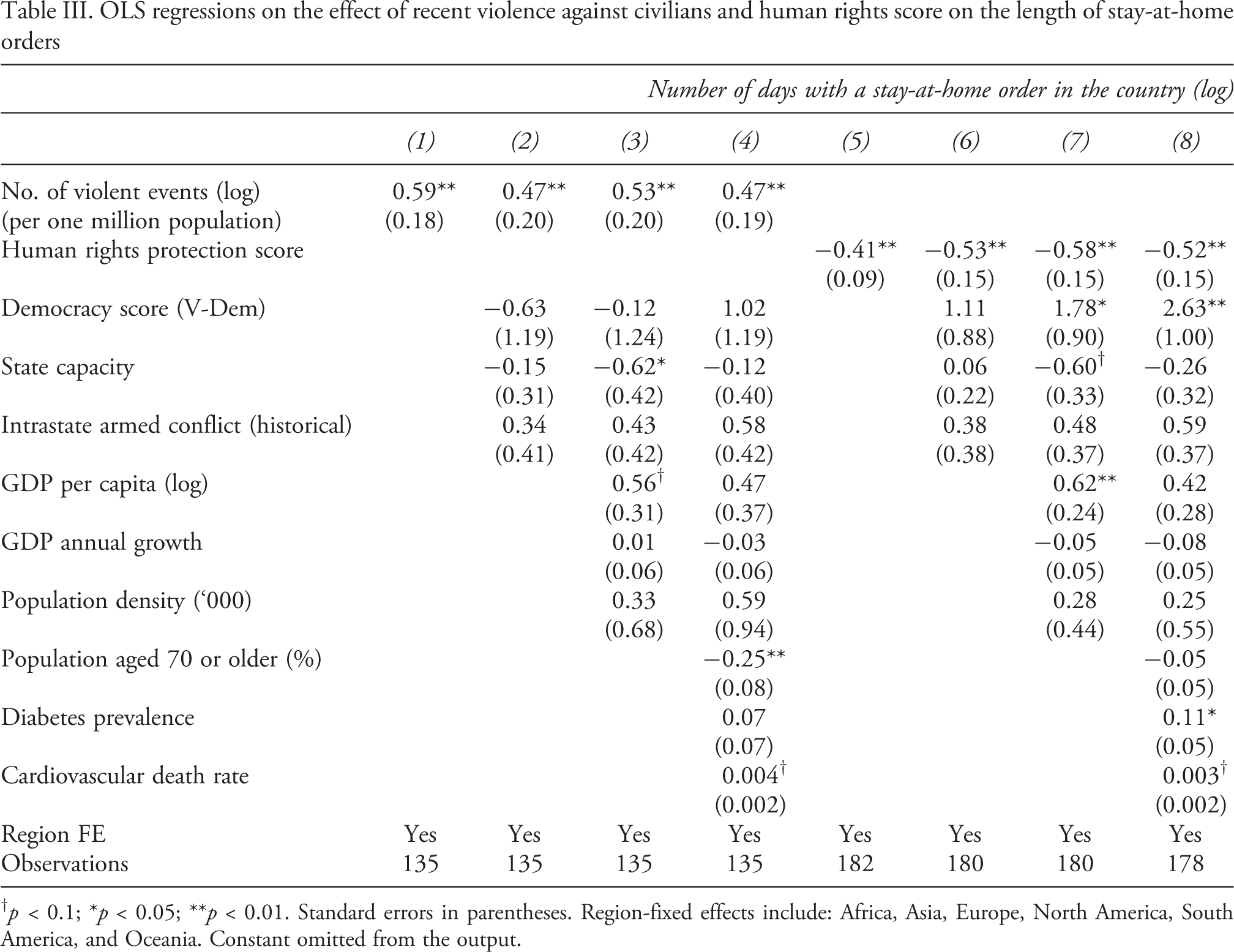
† p < 0.1; *p < 0.05; **p < 0.01. Standard errors in parentheses. Region-fixed effects include: Africa, Asia, Europe, North America, South America, and Oceania. Constant omitted from the output.
We can illustrate the size of these effects using the country of Moldova. 11 Moldova experienced six violent events against civilians in 2019, which is equivalent to 1.49 violent events per one million population. In this country, we observe that the stay-at-home order was in place for 95 days during our period of study. Using the fully adjusted model in column 4, we predict that if the number of violent events against civilians had been 12 rather than 6 – from 1.48 to 2.96 per one million population – the expected length of the stay-at-home order would be 131 days – 36 days longer than its observed value. At the same time, if Moldova’s human rights protection score in 2019 – 0.23 – were as high as Moldova’s score back in 2015 – 0.77 – we would expect a reduction of the length of stay-at-home order in place by 23 days – from 95 days to 72 days.
Discussion and conclusions
This study has investigated whether countries with a recent record of state-led violence against civilians or worse protection of human rights have been more likely to impose severe restrictions on the freedom of movement, impose them earlier, and impose them for longer periods during the COVID-19 pandemic. We argue this may be the case because abusive governments may see restrictive preventive measures not only as a tool to achieve public health objectives but also to control domestic challengers. While an empirical test of the true intentions of governments is not possible, we have generated and empirically examined three observations that are consistent with our theoretical argument. We find that abusive governments have been more likely to restrict citizens’ freedom of movement through stay-at-home orders at any time during our period of study. Further, we also find that abusive governments have been quicker to restrict citizens’ freedom of movement through stay-at-home orders. Lastly, we also observe that abusive governments have kept restrictive measures in place for longer.
We acknowledge that several methodological decisions have been made in the analysis and some concerns might remain. Consequently, we have subjected our empirical models to several robustness checks by: (1) varying time-to-policy thresholds (see Online appendix D); (2) time windows of the pre-outbreak measure of the ACLED violence against civilians (see Online appendix E); (3) the actors involved in the ACLED violence against civilians (see Online appendix F); (4) using an expanded ACLED country coverage (see Online appendix G); (5) using an alternative indicator for state capacity (see Online appendix H); (6) adding two controls to capture countries’ capacity to enforce a stay-at-home order, namely (i) the Number of military personnel available to the national government as a share of the total population and (ii) the Number of active police officers per 100,000 population (see Online appendix I); and (7) controlling for Trust in government (see Online appendix J). The rationale for each of the robustness checks can be found in its corresponding Appendix. Our conclusions remain unaltered across all measurement decisions and model specifications.
The present article has significant practical implications. International organizations such as the United Nations have raised concerns about how governments may use the COVID-19 pandemic as a pretext to repress and violate fundamental civil liberties. 12 Human rights organizations have also expressed similar concerns, warning how state of emergency policies may be adopted by some governments with the intention to undermine civil and political rights (Hammadi, 2020). Echoing these concerns, Sam Brownback (2020), Ambassador at Large for International Religious Freedom from the US Department of State, warned that autocratic governments may be using the COVID-19 policies as a tool for political repression, ‘impos[ing] additional restrictions on already marginalized ethnic communities’.
While international organizations, governments, and pundits alike have raised concerns about the unwarranted use of extraordinary measures, their statements have lacked high confidence or clear evidence because many of the large-scale non-pharmaceutical interventions implemented during this health crisis are indistinguishable from repressive campaigns. This article opens the black box by providing positive and systematic evidence consistent with the misuse of COVID-19 policies as a tool for political repression. Overall, our findings indicate that the international community should closely monitor the adoption of stay-at-home orders to ensure that they follow the standards of necessity and proportionality.
Whereas the empirical scope of this article is limited to establishing these associations in the context of the COVID-19 pandemic, our theoretical logic could travel to situations beyond pandemics. The general logic of our argument is that international actors only impose sanctions if both the degree of a government’s domestic repression and certainty that the repression is unjustified are high. Hence, disasters that call for policies that are similar to policies commonly used to deter domestic dissent might create uncertainty about the reasons of the policy adoption. Contexts that create such uncertainty open windows of opportunity for abusive governments to repress their citizens. For instance, we expect abusive governments to be more likely to embrace restrictive policies when environmental conditions predict disasters such as hurricanes, volcanic eruptions, and storms, which usually require residents to shelter at home. Additionally, abusive authorities may also use events like significant air pollution (e.g. wildfire smoke) and radioactivity hazards to implement restrictive measures. Though further research will be required to ascertain whether our logic extends to other types of disasters, given that climate change-induced disasters are only likely to increase over time, the importance of understanding state reponses to crises cannot be overstated.
Footnotes
Authors’ note
Authors are listed in order of contribution.
Replication data
Acknowledgments
We are grateful to the guest editors of the special issue, Gina Yannitell Reinhardt and Carmela Lutmar, and the feedback provided by the participants of the special issue workshop. We thank the CoronaNet co-PIs, Allison Hartnett Spencer, Caress Schenk, Timothy Model, and Vanja Grujic, and all the research assistants (RAs) who contributed to the CoronaNet dataset (see a list of them here:  ).
).
Funding
We acknowledge funding support from the TUM Chair of International Relations, the Hochschule für Politik at the Technical University of Munich (TUM), New York University Abu Dhabi (Covid-19 Facilitator Research Grant), the Leibniz Research Alliance Group ‘Crises in a Globalised World’, and the European Union’s Horizon 2020 research and innovation programme under grant agreement no. 101016233.