







Abstract
Why do people risk their lives fighting in wars? This article looks beyond group grievance and material benefits to add another psychological mechanism explaining why people choose to fight or not to fight – perceived collective action. An individual is much more likely to fight when they perceive that others will also fight. Contrary to the expectations of social identity theory and social pressure theory, the effect of perceived collective action is stronger among those who have a weaker national identity because they are more likely to rationally calculate the chance of winning by accounting for others’ decisions. To mitigate the endogeneity in post-conflict cross-sectional surveys, we conduct a survey experiment (n = 1,001) in Taiwan manipulating perceptions of others’ willingness to fight in a potential China–Taiwan military conflict. Experimental evidence supports the hypotheses that perceived collective action works only on weak Taiwanese identifiers. The result holds in robustness checks and in another nationally representative survey.
Keywords
Introduction
Why are people willing to risk their lives fighting in a war? Understanding individual-level motivations to high-risk collective action, such as fighting for the weaker side in an asymmetric war, represents a significant strand in the literature on interstate and civil conflict. Following Collier & Hoeffler’s (1998, 2004) well-known greed vs. grievance argument, much of this literature has focused on rebels’ economic motivations and identity-based grievances in pursuing this seemingly irrational action (Collier, Hoeffler & Rohner, 2009). For example, Humphreys & Weinstein (2008) point to individual poverty as a driver of war participation, while Kalyvas & Kocher (2011) show that participants benefit from the protection of the rebel group, which motivates their participation. Tezcür (2016: 248) finds that Kurdish rebels in Turkey are motivated by a sense of ‘collective identity threat’ gained through political activism.
In this article, we look at a sociopsychological motivation that forms a key component of the concept of collective action: the relationship of the individual to the collective. Examining collective action at the individual level employs the assumption that individuals will behave in the same way whether they are alone or in a group. However, Olson’s (1965) work challenges this assumption and demonstrates its fallibility. Instead, individuals examine the actions of the collective, for example protest, and rationally choose to free ride whenever they are not pivotal. That choice is derived from perceptions of others’ actions. Similarly, social psychology research has found much evidence that people behave differently when they are with others (Zajonc, 1965), and political science research has shown that people in dictatorships falsify their preferences when they are not sure how many others agree with them (Kuran, 1987).
A stronger test of collective action must therefore operationalize the link between group and individual behavior by asking: When are the actions of others more influential for one’s own decision when deciding to participate in collective action? Much of the literature that examines collective action and conflict focuses on the group-level perceived grievance or interests (Maher, 2010; Humphreys & Weinstein, 2008), or on individual perceptions but without establishing a causal mechanism between that and perceptions or actions of others in the group (Kalyvas & Kocher, 2011; Koehler, Ohl & Albrecht, 2016; Tezcür, 2016; Klandermans et al., 2002; Masters, 2004). Additionally, while some research acknowledges that individuals have different perceptions based on different group identifications (Kalyvas, 2006; Hornsey et al., 2006; McLauchlin, 2015), most does not.
We seek to address this gap in the literature by examining the role of collective action in war participation, focusing specifically on Olson’s collective action problem by operationalizing perceptions of collective behavior. We present a methodological contribution to this literature by providing experimental evidence manipulating a sample of Taiwanese respondents’ perceptions of others’ behavior in the context of war. This allows us to examine the causal mechanism more directly because it reduces the potential effect of social projection, a psychological mechanism wherein one imagines that others are doing the same as oneself (Krueger, 2007). Our results show that perceptions of others’ actions matter differently depending on the strength of a person’s national identity. When people do not have a strong national identity, they will be more likely to rationally calculate the costs of participation, rather than be driven by automatically generated emotions regarding war participation (Kahneman, 2011). These people are more likely to look to others’ behaviors before deciding on their own action. Thus, perceptions of collective action are more impactful to those with weak national identity compared to those with a strong identity. This finding has particular implications for studies of secessionist movements.
In this article, we first review the literature on collective action and participation in conflict, as well as the role identity is theorized to play in such interactions. Second, we formalize the theory with a game-theoretical model. Third, we explain our methodological approach, and then we demonstrate and discuss our results. We then conduct robustness checks on our analysis and replicate our findings from the experiment with another nationally representative survey. We conclude with a discussion of how our findings fit within the prevailing literature.
Literature review
Fighting and collective action
While some research on collective action cites moral preferences (Ginges & Atran, 2011) or perceived effectiveness of the action (Hornsey et al., 2006) as motivating factors, the most prevalent literature on war participation explains the rationale of fighters in two ways: group grievance and material benefits. 1 Fighters can be motivated by a sense of collective threat towards a group with which they identify, most commonly an ethnic identity which differentiates them from other groups (Maher, 2010). In this context, fighters may perceive that their ethnic group is being exploited or oppressed by other groups, making identity salient in motivating political action including violence (Koehler, Ohl & Albrecht, 2016). 2 Alternatively, fighters may be motivated by the material benefits made available to them through their participation in rebel groups or militias. These groups may be able to provide resources, including protection and pay, that participants would otherwise be unable to access (Parkinson, 2013; Kalyvas & Kocher, 2011).
If these two reasons are the most relevant motivations for participation, then all members of the group have a rational reason to join the fight. If an ethnic group is under threat, then everyone from that group is also threatened and would benefit by uniting in the face of their adversary. If militias are better positioned to provide safety and security, everyone should seek them out. Thus, even though the risk to an individual in taking up arms is high, it is mitigated by other critical factors. However, we never observe mass participation in any civil war, even ethnic rebellions.
One explanation of non-participation lies in the nature of war as a form of collective action. Success in war is often contingent, or perceived to be contingent, on the number of the people on either side and their willpower. Even in an asymmetric war where the chance of winning is low, the will of the people is crucial for a weak state to defend itself (Arreguín-Toft, 2001). Because of this, a potential participant would not only consider group grievances and material benefits, but also account for whether other people will fight. Indeed, some studies suggest that an individual whose friends or relatives choose to fight is also much more likely to fight (Atran, Sheikh & Gomez, 2014; Parkinson 2013), and they are also less likely to desert their unit (McLauchlin, 2015). Additionally, social structures, including kinship networks, can frame the concept of collective threat and influence the choice of individuals to fight or flee (Shesterinina, 2016; Tezcür, 2016).
Aside from interpersonal networks (Siegel, 2009), individuals can also observe the actions of others outside their direct circle. Examining participation in the Arab Spring protests, Steinert-Threlkeld (2017) writes that many individuals were encouraged to participate by the sight of other protesters in the streets. Individuals may also be inspired by the conviction of ‘devoted actors’ when they would otherwise approach the choice to join a fight more rationally (Atran 2016; Atran, Sheikh & Gomez, 2014). In sum, individuals who might otherwise not take violent action can be motivated to do so at the behest of others, and they may look to the actions of others before deciding to participate in collective action.
Fighting, identity, and collective action: A theoretical model
Conventional wisdom holds that shared identity removes collective action problems in several ways. First, groups are often better positioned to observe and sanction non-contributors (Blattman & Miguel, 2010). Second, social projection is strongest for people with a strong group identity (Krueger, 2007). When people have a group identity, that group has a positive connection to their self-image, which in turn serves as a cognitive heuristic when they want to make inferences as to others’ behavior. For example, US voters with stronger partisan identifications are more likely to exaggerate the level of political polarization because they assume that others share similar attitudes (Van Boven, Judd & Sherman, 2012; Westfall et al., 2015). Additionally, when a person joins an action, they are much more likely to observe that others also participate, whereas if one simply stays home, they are less likely to observe participation. Indeed, many studies equate collective action with a group or ethnic identity, assuming that those with a stronger identity will be more influenced by the mechanisms of collective action that rely on perceptions of others’ behavior, since they will be more likely to observe it. However, we argue that the effect of these perceptions should be strongest among those who do not have a strong group, national, or ethnic identity. When a person is mobilized by a group identity, their calculation of their own utility is biased by the potential gain of the whole group after the conflict, and the reality of others’ behavior becomes less important to them. By contrast, individuals who are not mobilized by identity or nationalism are more likely to pay greater attention to the expected costs and benefits of participation to themselves, while paying less attention to the outcome for the whole group.
Hypotheses
We formalize this argument into a simple formal model. 3 Assume that the perceived likelihood of a weak state or a rebel group winning in an asymmetric conflict is q, which is a monotonically increasing function of the level of collective action by its people. 4 In this conflict, if the collective action succeeds, everyone in the weak state will receive a benefit B > 0, while the participants in the successful action will receive an additional selective benefit S > 0 (e.g. money, loot, land, or political power. See Lichbach, 1998). Similarly, participants in an unsuccessful collective action would receive a punishment −P < 0. People with a strong group identity receive an additional expressive benefit E > 0 if they participate in the collective action, no matter its chance of winning. The utility of participation and non-participation for people with different identities is shown in Table I.
For people with a strong identity, they will participate in the war if q(E + B + S) + (1 − q) (E − P) > qB. Hence, the threshold of the perceived chance of winning is q* ≥ (P − E)/(S + P). In other words, a large self-expressive value (E) or a large selective benefit (S) will motivate people with strong identity to participate in a war with a low chance of winning. If E > P, such as for the ‘devoted actors’ mentioned earlier, they will always participate. Meanwhile, a higher punishment for losing will increase the threshold of participation.
Utility functions for participation in war for different levels of group identity
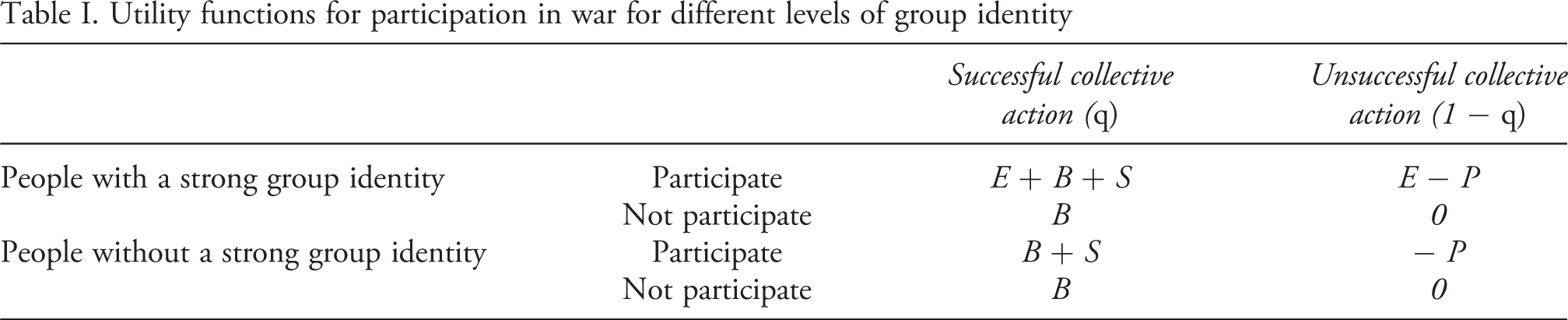
For people without a strong identity, however, they will participate in the war if q(B + S) + (1 − q) (− P) > qB. Hence, the threshold of the perceived chance of winning is q** ≥ P/(S + P). Given E > 0, q** > q*, people without a strong identity tend to have a higher threshold (i.e. perceived chance of winning) for participation. Therefore, when people’s perceived level of collection action q is manipulated, people without a strong identity will be much more susceptible to that change of perception.
Following Table I, the relationships between identity, collective action, and the willingness to fight can be summarized in the following two hypotheses:
H1: People who perceive that others will fight are more likely to fight.
H2: The effect of the perception of others’ willingness to fight is greater among people with weaker national identity compared to people with strong national identity.
It is worth noting that the collective action mechanism we raise here is different from social pressure theory on turnout rate (Gerber, Green & Larimer, 2008; Bond et al., 2012) in several respects. Social pressure theory assumes that turnout is the social norm, so that people are afraid that their absence will be noticed by their neighbors. In this scenario, however, they are not achieving something together with their neighbors, and the election outcome is not decided by the number of participants; instead, the outcome is decided by the vote share of candidates. Moreover, the experiment designed by Gerber, Green & Larimer (2008) did not provide subjects with information as to whether their neighbor will vote, but merely warned them that their voting record would be publicized to others. The neighbors here serve as judges, not comrades, and do not face the same costs as the participant, whereas in wartime, everyone faces a considerable cost. Therefore, social pressure theory relies heavily on the moral value of voting in one’s mind. If the impact of collective action is driven by social pressure theory, then we should observe that people with a stronger group identity are more influenced by the information of collective action because the judgment of their group will have greater salience to them.
Data and methods
Context
Many studies on identity and war participation rely on cross-sectional surveys and data collected post-conflict (e.g. Humphreys & Weinstein, 2008; Tezcür, 2016). Psychologically and methodologically, post-conflict surveys make it hard to distinguish the effect of group identity and collective action from self-projection, as discussed earlier. Therefore, to test our hypotheses while avoiding these methodological issues, we conducted a national survey experiment in Taiwan to investigate whether Taiwanese people would be willing to fight against Chinese forces in the event of an invasion.
After the Chinese Civil War, the nationalist Kuomintang government retreated to Taiwan in 1949, and China’s Communist government (PRC) has considered Taiwan a breakaway province since then. Even though the last direct military conflict between China and Taiwan was in 1958, the PRC continues to consider reunifying Taiwan by force and has used various intimidation tactics against it, including conducting missile tests in the Taiwan Straits and sending fighter jets, bomber flights, and warships around the island (for a review, see Wang, 2017; Wu et al., 2020). Notably, these actions often occur when support for Taiwanese independence gains political traction. For example, after the first pro-independence Taiwanese president, Chen Shui-bian, was reelected in 2004, the PRC established the Anti-Secession Law indicating reunification by military attack (‘Text of China’s Anti-Secession Law, 2005‘).
There are four advantages to using Taiwan as a generalizable case to test the relationships between nation-building, willingness to fight, and collective action. First, the military threat from the PRC is real, and previous survey studies show that fear of military invasion is the main reason why the majority of Taiwanese people do not support independence; without the threat of war, the level of support increases from 40% to 80% (Wang et al., 2015). The magnitude of this effect on public opinion shows that war is still salient to Taiwanese people when they are making political decisions.
Second, Taiwan is a fully-fledged democracy and enjoys a high degree of freedom of speech and academic freedom. Academic institutions have conducted surveys regarding Taiwanese people’s willingness to fight against China since 2002 (e.g. Taiwan National Security Surveys (TNSS)), 5 so Taiwanese people are familiar with such items in surveys. Hence, when they are answering questions about their willingness to fight, they are more likely to answer them honestly without fearing punishment by Taiwanese authorities.
Third, all male Taiwanese citizens must serve in the military from four months to two years. Defending against a Chinese invasion has been the main scenario of military training since 1949. Military training and its spillover effects increase the likelihood that Taiwanese people’s response to the willingness to fight questions is rooted in a realistic conception of what such a fight might entail. A recent study shows that Taiwanese people who perceive military training as useful are more likely to say that they would defend against an invasion by China (Yeh et al., 2019). The compulsory military training in Taiwan also allows us to use a sample of ordinary and representative citizens to explore the psychological mechanism linking collective action and willingness to fight, rather than being restricted to sampling former militants as in previous studies.
Fourth, the diverse national identity of Taiwanese people offers an opportunity to examine how national identity moderates the effect of perceived collective action on willingness to fight. Nation-building is the ‘process through which governing elites make the boundaries of the state and the nation coincide’ (Gellner, 1983: 4). After Taiwan began to democratize in 1987, an exclusive Taiwanese identity emerged rapidly, with many Taiwanese citizens changing their identity from an exclusive Chinese identity or ‘both Taiwanese and Chinese’ dual identity to an exclusive Taiwanese identity. According to TNSS 2018, about 55% of Taiwanese people describe themselves as Taiwanese exclusively, while about 38% ascribe to a ‘both Taiwanese and Chinese’ dual identity, and only 3% identify as exclusively Chinese.
One methodological challenge of studying the willingness to fight is the validity of respondents’ answers. People may behave differently from their responses in surveys, and they may also change their attitude toward participation if war becomes a reality (Althaus, Bramlett & Gimpel, 2012). However, recent studies find a strong correlation between survey responses and real-world behaviors on contested issues (e.g. Hainmueller, Hangartner & Yamamoto, 2015; Enos & Gidron, 2018), and long-term cross-national surveys (including in Taiwan) reveal that an individual’s willingness to sacrifice for their country reasonably relates to changes in value systems and improved life opportunities (Inglehart, Puranen & Welzel, 2015). Yeh & Wu (2021) show that war support in Taiwan reasonably correlates with economic rationality including family experience of war, the perception that the USA will support Taiwan in a China–Taiwan conflict, and improved life opportunities. Considering these recent findings within the political context of the Taiwan Strait discussed earlier, we can reasonably expect that a survey on the willingness to fight can capture how Taiwanese people will behave if war occurs.
Operationalization of dual identity
We hypothesize that Taiwanese people who claim a dual Taiwanese-Chinese identity are more susceptible to the effects of collective action compared to those with an exclusive Taiwanese identity. Social identity theory argues that the group to which one is attached is the source of self-esteem and pride (Tajfel & Turner, 2001). When one has a strong connection between their self-image and exclusive national identity, their behavior is much more likely to be driven by group grievance or emotional arousal. Therefore, exclusive Taiwanese identifiers will be motivated to fight to protect their self-image and preserve their pride, as is formalized by a high E in Table I. If a person identifies as both Taiwanese and Chinese, however, their identity cannot serve as a heuristic for them to make a decision, especially in a zero-sum game scenario like a war between China and Taiwan. Unlike those who identify exclusively with one side or another, an individual who identifies with both sides in a war cannot see any outcome as a source of pride. They are therefore more likely to account for other objective factors and how they relate to their personal affairs in the conflict, such as the chance of either side winning and whether others will fight on a specific side.
It is possible that one identifies strongly with both Taiwan and China, and that their identification with Taiwan still influences their willingness to fight. However, existing literature on Taiwanese politics suggests that this is not the case, especially in the last decade. After Taiwan had its first direct presidential election in 1996, a national identity began emerging but was not necessarily related to how Taiwanese people thought of China. However, these two dimensions gradually converged after the first presidential turnover in 2000 (Chen, 2012). Taiwanese people who claim a dual identity are much more likely to choose ‘maintaining the status quo’ on the issue of cross-strait relationships than those who choose an exclusively Taiwanese or Chinese identifier (Lin, 2012). Moreover, choosing a dual identity also positively correlates with perceived economic benefit and military threat from China; in contrast, those who identified themselves as Taiwanese exclusively are less influenced by China’s carrot-and-stick policies (Wang, 2017). This suggests that the choice between Taiwanese and Chinese identity can be formalized as a single dimension. When an individual chooses to have a dual identity in this context, their strength of national identity would be lower than that of exclusive identifiers. Their dual identity cannot serve as a heuristic cue to draw the boundary of imagined community. Therefore, when they are deciding to fight or not, they will rationally consider the additional selective benefit (S) and whether the chance of winning, driven by the perceived level of collective action (q** ≥ P/(S + P)), is high enough. Thus, we argue that Taiwanese people who report a dual identity have a weaker national identity, and therefore are more likely to be influenced by information about how others will behave in the war. They should also have a lower tendency to participate in the war in the control group.
In-depth interview and pre-registration
An in-depth interview was conducted with six respondents from various backgrounds before the survey experiment to determine whether lay Taiwanese people understand the item descriptions and treatments in the questionnaire. All subjects understood most of the questions and options, and did not feel any discomfort answering questions. The procedure can be found in Online appendix B. After the in-depth interviews, the survey was pre-registered before implementation at Open Science Framework (https://osf.io/3gcp8/).
Data collection and experimental design
Between 6 and 9 July 2018, 1,003 subjects were recruited through PollcracyLab, an online questionnaire platform maintained by NCCU in Taipei, Taiwan (hereafter Pollcracylab, 2018. For the details, see the Online appendix). PollcracyLab built and maintained the subject frame based on the Taiwan government’s household registration records. Because PollcracyLab is established under NCCU, a top research university in Taiwan, it has access to official household registration records for academic purposes. Therefore, all Taiwanese citizens have a non-zero probability of being invited for registration by PollcracyLab, which is crucial for establishing the representativeness of the survey.
PollcracyLab sent invitation letters to recruit subjects, asking them to participate in a survey titled ‘Survey of public opinion and political participation.’ Subjects were informed that they could skip any question they found difficult or that they did not want to answer, and their answers would be kept anonymous. PollcracyLab was responsible for both recruiting respondents and sending gift cards as compensation, and all identifiable information was cleaned before the dataset was sent to the researchers.
The questionnaire included 31 items. Subjects were first asked to report their news consumption, level of political interest, and partisanship. They were then randomly assigned to one of the three groups below:
○ I will choose to resist ○ I will choose not to resist
○ I will choose to resist ○ I will choose not to resist
○ I will choose to resist ○ I will choose not to resist
There are two reasons for designing two treatments and one control group. First, if the theory of collective action applies to the case of a Chinese invasion, we should expect that the treatments will strongly influence Taiwanese people’s willingness to fight. Second, by comparing the two treatments and the control group, we can observe what people usually believe by default when there is no additional information. That is, if the respondents in the control group behave similarly to those in the 18% group, we can tell that Taiwanese people generally believe that fighting against China has that same level of public support.
The 18% and 82% treatments were not chosen arbitrarily. In the 2012 World Values Survey, 81.1% of Taiwanese respondents answered YES to the question ‘Of course, we all hope that there will not be another war, but if it were to come to that, would you be willing to fight for your country?’ 6 Meanwhile, in the 2016 TNSS, only 22.8% of respondents said that they would fight for Taiwan in the open question ‘If China attacked Taiwan after Taiwan independence, what would you do next?’ 7 Admittedly, people’s answers toward this question are largely influenced by the design and the format of the item. But this wide distribution also indicates that the manipulation may be plausible to the respondents since they are the numbers they may see in the media. 8
We also chose the verb ‘resist’ intentionally. In previous surveys, Taiwanese people were asked about their willingness to fight after Taiwan’s independence, so Taiwan was perceived as the instigator in the conflict. Also, before 1987, the Chiang government wanted to retake mainland China, but the goal of reunification is less relevant today. Hence, ‘fight’ may have multiple interpretations by different generations and by partisanships. In contrast, ‘resist’ re-enforces the idea that Taiwan is under invasion by China, which would better fit the theoretical argument of this article.
After the items on collective action and willingness to fight, respondents were then asked a series of questions about Taiwanese politics and their military training experience. Finally, subjects were debriefed and compensated NTD100 (about USD3) by PollcracyLab. The full text of the debriefing can be found in Online appendix A1. All subjects were informed that the survey result they read had been fabricated by the researchers. Since the poll numbers in the treatments are very close to real ones taken from previous surveys, we believe that the deception in this experiment would not cause noticeable harm to the respondents.
The survey experiment did not ask the respondents about their sociodemographic background, including their national identity. Instead, PollcracyLab recorded these variables when the respondents were recruited into the frame in previous surveys. To measure Taiwanese identity, respondents were asked ‘In our society, some people call themselves Taiwanese, some call themselves Chinese, and some others call themselves both Taiwanese and Chinese. How about you? Are you Taiwanese, Chinese, or Both?’ Respondents were categorized based on their answer to this question, and those who answered Chinese only were dropped from the analysis (2.8% of all cases).
Overall, out of the 1,003 respondents given to us by PollcracyLab, 1,001 started and completed the survey (99.8%), and two dropped out during the survey. 9 The low dropout rate implies that the length of the questionnaire did not create a substantial cognitive burden on the subjects. Moreover, the research assistant at PollcracyLab told us that they did not receive any complaints during this survey implementation. This positive report enhances our confidence in the validity of this experimental design.
Representativeness and randomization check
The background information of our subjects recruited by PollcracyLab can be found in Online appendix H. Compared with the population of Taiwan, our sample is younger and has more Pan-Green supporters (who tend to support independence), fewer non-partisans, and more males. Even though all Taiwanese people have a non-zero probability of being recruited by PollcracyLab, frequent Internet users are more likely to participate in online surveys, and those who are interested in politics are more likely to accept our invitation. According to the PollcracyLab establisher’s report in 2012, the subjects are still nationally representative among those who are below 50 (Yu, 2013).
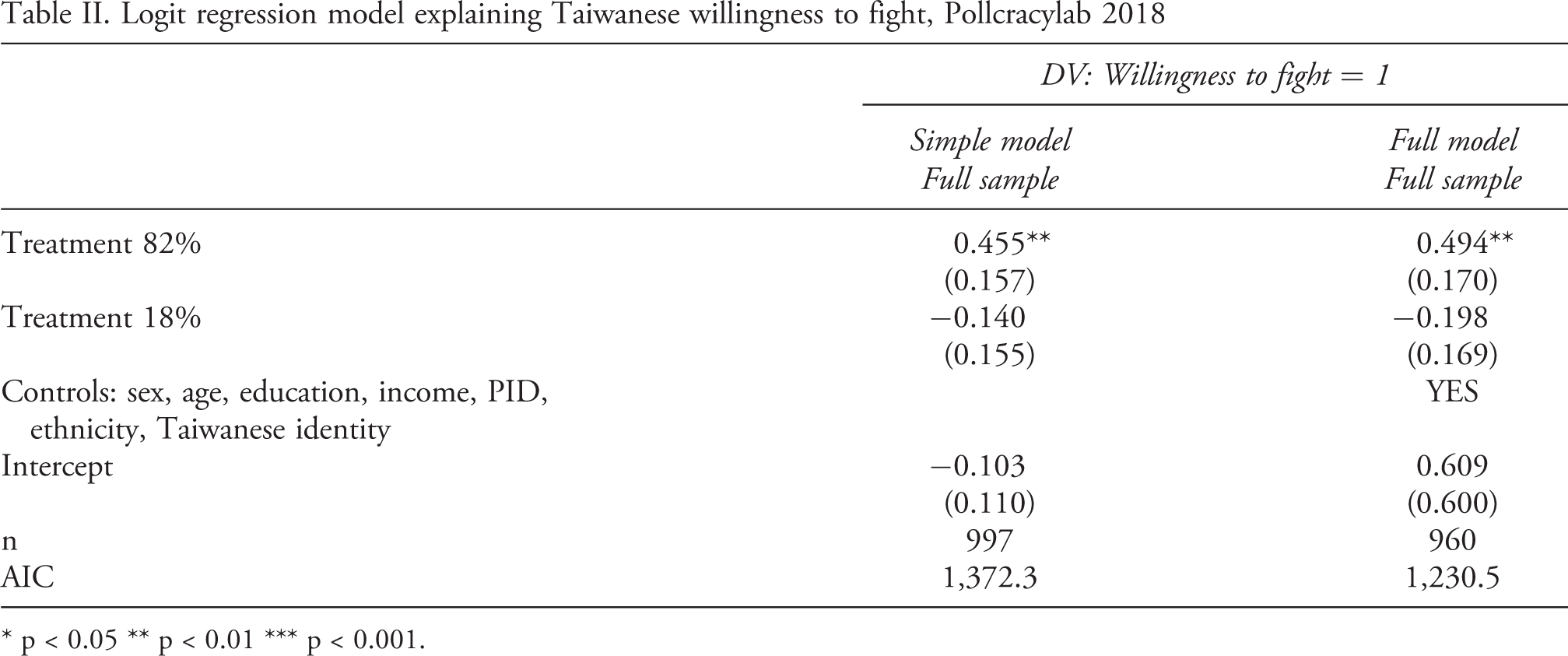
Logit regression model explaining Taiwanese willingness to fight, Pollcracylab 2018
* p < 0.05 ** p < 0.01 *** p < 0.001.
Before the analysis, we conducted randomization checks to see if our respondents were evenly assigned to the treatment and control groups. The one-way ANOVA analysis shows that the background of respondents is not significantly different between the two treatment and control groups in gender (F = 0.153, p = 0.86), age (F = 1.6, p = 0.19), level of education (F = 0.84, p = 0.43), level of income (F = 1.88, p = 0.15), father’s origin (F = 1.45, p = 0.23), exclusive Taiwanese identity (F = 1.09, p = 0.34), and partisanship (F = 1.03, p = 0.36). Therefore, we assume that the Pollcracylab respondents among the three groups share the same characteristics.
Results and discussion
Collective action and willingness to fight
Since the randomization test yields no differences among groups, we then simply compare the mean between groups. The chi-squared test shows no difference between Treatment 18% group and Control group (p = 0.41); in the former, 44% of subjects chose to resist, while in the latter, 47.4% chose to resist. In the Treatment 82% group, 58.7% chose to resist. The chi-squared test shows that the difference between Treatment 82% group and Control group is statistically significant (p < 0.005). This supports the hypothesis that the perception of others’ actions would motivate citizens to engage in risky behaviors.
To control the potential influence of confounding variables, Table II presents the average treatment effect of the two treatments estimated by logit regression models. The dependent variable is binary coded as the respondent’s willingness to resist the invasion. The simple model only includes the two treatments, while the full model controls for a series of sociodemographic variables. In both models, the 82% treatment significantly increases one’s willingness to fight. With the controls, a Taiwanese respondent who is exposed to the 82% treatment will increase their willingness to fight by 12.1% on average (Online appendix D). The 82% treatment effect estimated by the logit model provides further evidence of how the perception of collective action influences one’s decision to risk their lives fighting in a war. Since the treatment only manipulates the respondent’s perception of how other Taiwanese people will behave, this experimental design can provide causal evidence that the perception of other’s behavior alone may change an individual’s risk-taking behavior, rather than the behavior affecting perception as suggested by social projection theory. The result indicates that citizens indeed take other people’s actions into account when they are making such risky decisions.
The 18% treatment, however, has no significant impact on the respondent’s willingness to fight. Among exclusive identifiers, their decision to fight is motivated by their identity, and their psychological attachment usually beats rational calculation (Stern, 1995). Hence, whether others will fight may not impact their willingness. Among the dual identifiers, however, the lack of significance may be because 18% participation fits the respondents’ prior expectations, so their belief is not updated (as shown in the TNSS mentioned earlier). Since this treatment fails to provide further information on the perception of others’ behavior, it does not change those dual identifier’s willingness to fight. In the next section, we provide the empirical test for both exclusive and dual identifiers.
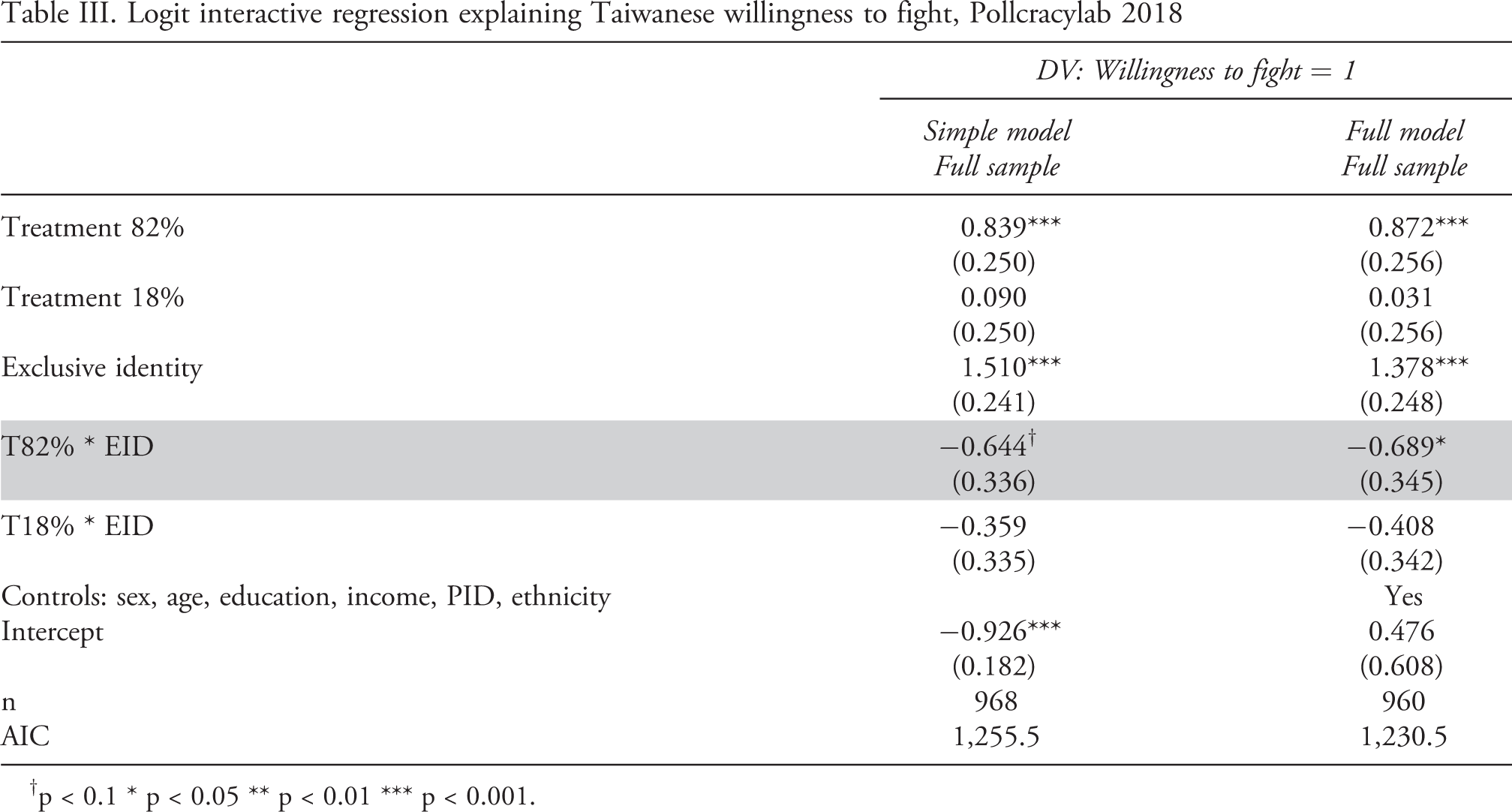
Logit interactive regression explaining Taiwanese willingness to fight, Pollcracylab 2018
†p < 0.1 * p < 0.05 ** p < 0.01 *** p < 0.001.
National identity, collective action, and willingness to fight
Among the 1,001 subjects, 52% exclusively identified as Taiwanese, while about 45% reported a dual Taiwanese-Chinese identity. Therefore, we run a regression analysis interacting identity with the two treatments while controlling for all covariates in Table III (see the full model in Online appendix E). Once again, the two simple models only include the two treatments as dummy variables, while the two full models contain the same sociodemographic variables except for national identity (which has been used for categorization).
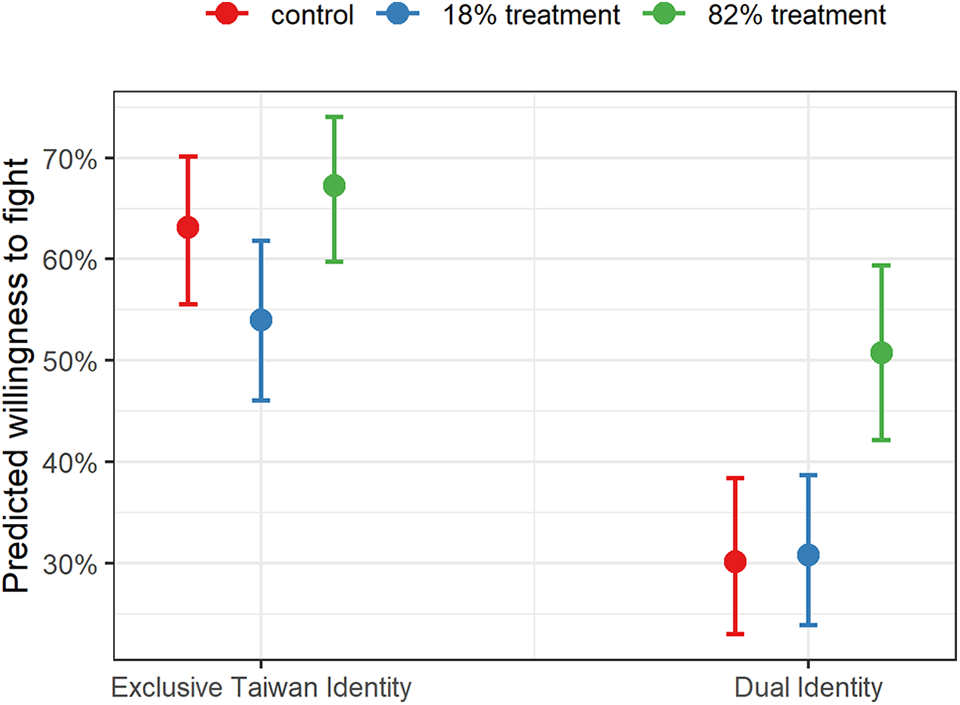
Table III clearly shows the heterogeneous treatment effect between Taiwanese identity and the two treatments. The 82% treatment enhances willingness to fight, but the effect is largely moderated among the exclusive identifiers. Figure 1 further shows the simulated willingness to fight among exclusive Taiwanese identifiers and dual identifiers based on the full model in Table III, controlling for all other variables at the mean. The marginal effect plot of the two treatments can be found in Online appendix G. Exclusive Taiwanese identifiers are twice as likely to say they will fight than dual identifiers. However, exclusive Taiwanese identifiers’ willingness is not significantly changed after they receive the information that others will or will not fight. By contrast, even though the dual identifiers are less willing to fight in general, their willingness is boosted when they believe others will also join the fight. We also
Collective action, national identity, and willingness to fight, simulated result from the full model in Table III
Robustness check: Military service experience
One psychological mechanism linking rational calculation with the willingness to fight may be previous military training experience. In Taiwan, all adult male citizens are required to serve in the military from four months to two years, with exceptions for health or religious reasons; adult female citizens can also volunteer to join the military. In our dataset, 97.1% of the male subjects had served in the military before, while none of the female subjects had. Since service experience and gender are highly correlated, the robustness checks for these variables are conducted separately.
First, the gender dummy variable is statistically insignificant in all models in Tables II and III. The insignificant result shows that there is no gender bias in Taiwanese participants’ willingness to fight. When the interaction term between gender and the two treatments are put into the regression, the interaction terms are both insignificant in all models. Hence, there is no evidence that gender (a proxy for military service) moderates the effect of collective action or national identity.
Similarly, when we replace the gender dummy with a dummy for previous military service experience into the regression models, the effect of military service experience is also insignificant. When the interaction terms between military service and the two treatments are put into the model, the interaction terms are also not significant. Additionally, the patterns shown in Table III do not change at all – the 82% collective action treatment only works for dual identifiers regardless of their military experience. We can thus conclude that the perception of collective action and national identity are still the two driving forces in Taiwanese people’s willingness to fight, while previous military training experience does not moderate this linkage.
Robustness check: External validity
If the perception of others’ behavior during wartime has heterogenous impacts on exclusive and dual identifiers’ willingness to fight, as our experiment shows in Table III and Figure 1, we should observe a similar pattern in representative surveys. Specifically, the effect of the perception of other’s behavior should be stronger among dual identifiers with regards to their decision to fight in war.
To test the external validity of our survey, we exploit a nationally representative TNSS conducted in 2016. 10 This telephone survey was sponsored by Duke University and was conducted by NCCU between 18 and 22 November 2016. We choose this wave because Taiwan underwent its third presidential turnover early that year. Moreover, China significantly increased its naval activities in late 2016, including the militarization of several islands and rocks in the South China Sea and the sailing of China’s first aircraft carrier through the Taiwan Strait. 11 Therefore, Taiwanese people responding to the survey would be naturally primed to think of the cross-strait military conflict.
In TNSS 2016, 1,069 respondents were asked the open-ended question, ‘Q18. When China and Taiwan come into conflict, what will you do?’ We used this question to create a binary variable where respondents who answered ‘fight’, ‘join the military,’ ‘resist,’ and ‘support our own government’ are coded as ‘willing to fight,’ 12 while others are coded 0. Among the 823 respondents who answered this question, 29.6% were coded as willing to fight.
In the same survey, respondents were asked, ‘Q19. When China and Taiwan go to war, do you think most Taiwanese people will resist’ with responses of ‘Certainly not,’ ‘Probably not,’ ‘Probably will,’ and ‘Certainly will.’ The responses were coded from -2 to +2. Respondents were also asked about their national identity. Exclusive Taiwanese identifiers were coded as 1, and dual Taiwanese-Chinese identifiers were coded as 0.
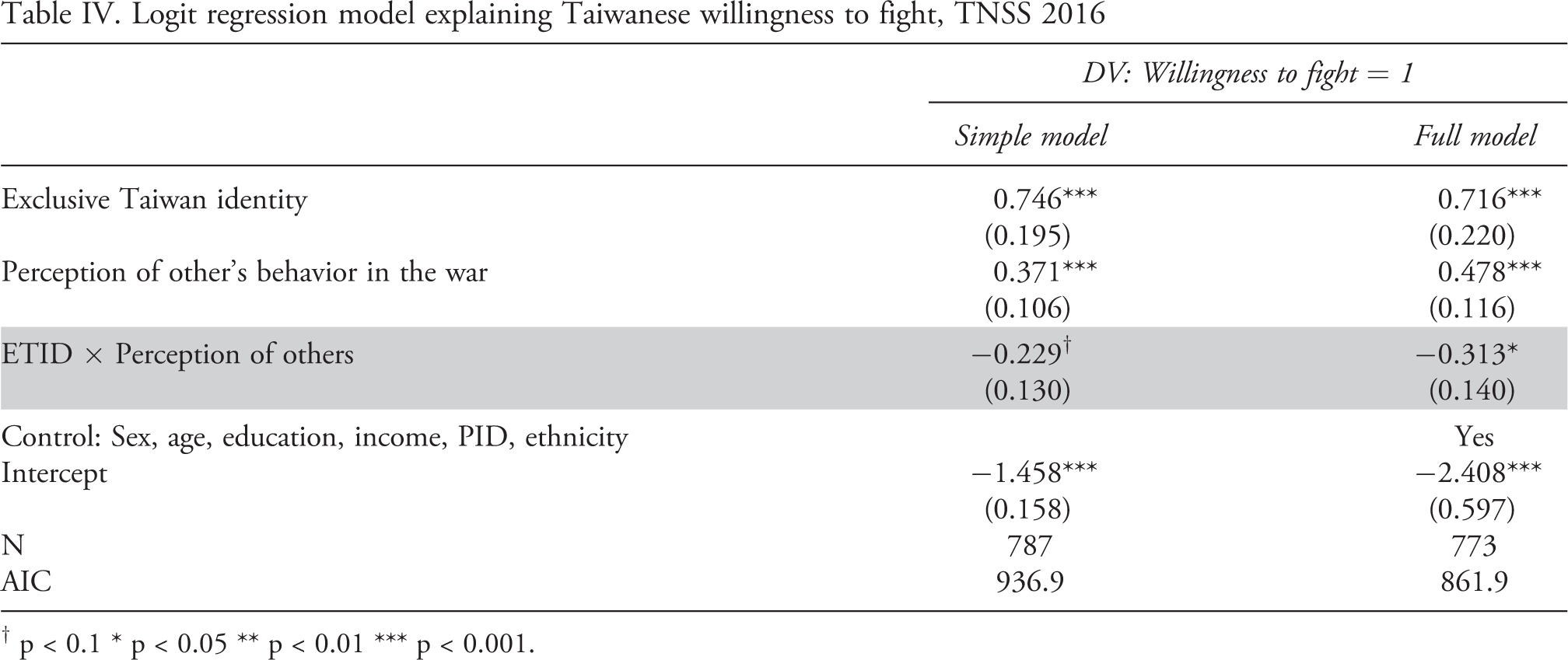
We used a logit regression model with interaction terms to analyze the interactive effect between national identity and perception of others’ behavior on the willingness to fight, as shown in Table IV. Here, the partial coefficients of both exclusive Taiwanese identity and perception of other’s willingness to fight are positive, indicating their positive impact on one’s willingness to fight. However, the interaction term between these two variables is significantly negative, indicating that, among exclusive identifiers, the effect of perceptions of others is weaker. In other words, exclusive identifiers’ willingness to fight was less influenced by the perception of others’ behaviors, compared with dual identifiers. These results thus reflect the pattern we identified in our survey experiment.
Logit regression model explaining Taiwanese willingness to fight, TNSS 2016
† p < 0.1 * p < 0.05 ** p < 0.01 *** p < 0.001.
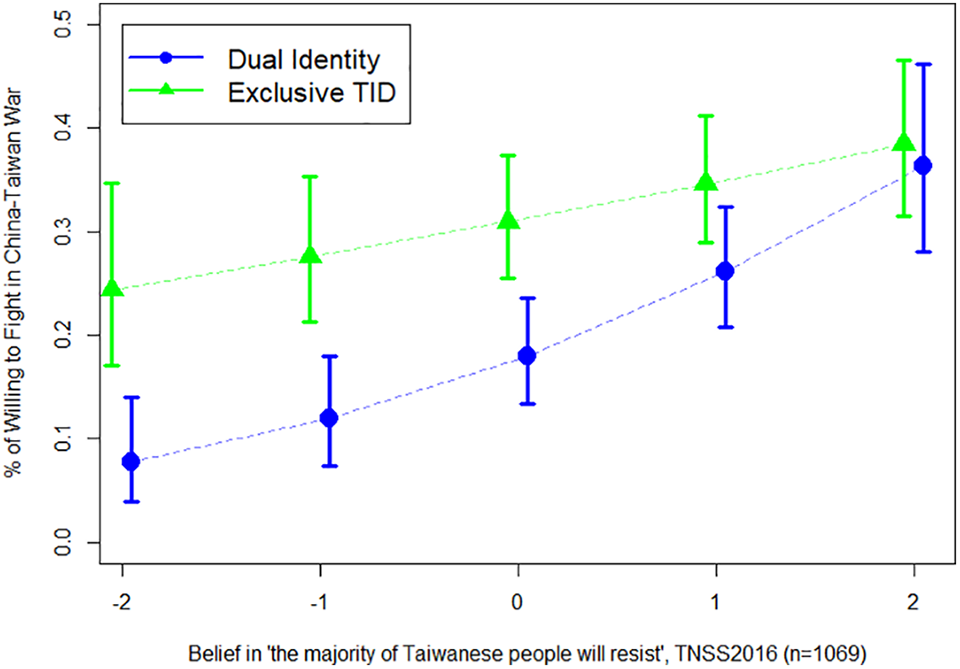
Collective action, national identity, and willingness to fight, TNSS 2016
Therefore, the TNSS 2016 survey demonstrates the pattern that we expected to see based on our experiment – dual identifiers are much more likely to be influenced by their perception of others when they are deciding to fight or not. Meanwhile, exclusive identifiers are mainly driven by their national identity. Once again, the results suggest that perceptions of others’ behavior play a distinguishable role with the function of national identity on the willingness to fight.
Discussion and future work
Our survey experiment in Taiwan shows that the perception of others’ behavior matters when a citizen is deciding whether to risk their life in a war. Using an experimental design, we provide causal evidence that people increase their willingness to fight after they perceive that others will also fight. This result demonstrates the individual-level psychological mechanism through which cell phone access and social media may be used to coordinate people to join a revolution against an invasion or dictator (e.g. Pierskalla & Hollenbach, 2013). The experimental design also helps mitigate the social projection problem and provides a clearer estimation of the effect of collective action information. The results remain robust in several robustness checks, and the same pattern demonstrated by the experiment can be found in another nationally representative survey, the TNSS 2016.
Moreover, our evidence shows that the psychological mechanism of collective action is stronger among people who do not have a strong group identity. These people engage in a rational estimation of the collective action because they are not ‘worked up’ by the group identity. Therefore, we suggest that the mechanism of collective action is distinct from that of group grievance (Humphreys & Weinstein, 2008) and collective threat (Maher, 2010). Both group grievance and collective threat highlight in-group and out-group differences, so people with a stronger group identity are much more likely to sacrifice themselves for the group, as is predicted by social identity theory. By contrast, perceived collective action plays a much more important role in mobilizing those who do not have a strong group identity. These people care more about how others around them behave, and they take others’ actions into account before deciding what risks they are willing to take.
We also argue that the findings in this article are not driven by social pressure theory (Gerber, Green & Larimer, 2008). If social pressure is the mediator linking information about other’s behavior to one’s decision, then the effect should be stronger among the exclusive Taiwanese identifiers – others in your group fight, why don’t you? However, our empirical evidence does not support such a mechanism – weak identifiers clearly demonstrate greater susceptibility to the behavior of others.
Similarly, our results are distinct from preference falsification theory in two ways. In Kuran’s (1987) classic model, individuals face group pressure in deciding whether to stand alongside the group; the individual’s expressed preference will be influenced by the perceived collective action of others. Even though preference falsification may explain the behaviors of dual-identifiers in our dataset, it does not explain its insignificance among the exclusive identifiers. Instead, our results can help explain variation under preference falsification theory. Specifically, preference falsification theory should predict a strong decline in the willingness to fight among the exclusive identifiers when they were assigned to the 18% group: when the majority of the group you are psychologically attached to choose not to fight, why should you? Hence, peer pressure alone does not explain the heterogeneous effect in this case. It can better be explained by the content of the group identity and the embedded political context (Huddy, 2001). Moreover, our theory relaxes the assumptions of preference falsification. In our theoretical model, we do not assume that dual identifiers prioritize the willingness to fight. Instead, they rationally calculate the cost and benefit of fighting because their dual identity fails to offer enough psychological motivation.
There are two other alternative explanations for our findings. The first is that these weak identifiers adopt a dual Taiwanese-Chinese identity because they care more about social norms and traditional values – they do not want to give up their motherland identity easily. However, this explanation is not adequate, because those who value their motherland identity should choose not to fight even if they know that others will fight. A second explanation is that dual identifiers may choose to support Taiwan as the victim of Chinese aggression due to a rally-around-the-flag effect. If this were the case, we would expect the dual identifiers to exhibit greater willingness to fight regardless of what others choose to do. However, this is not what we observe: instead, dual identifiers in the control group exhibit low levels of fighting intention, and it is the treatment effect that raises their likelihood of participation. Therefore, we dismiss these alternative explanations and argue that collective action theory plays an essential and distinct role in explaining why some people choose to fight.
Our findings have implications for studies of secession movements and mobilization. Specifically, our findings echo previous studies showing that different people may be mobilized by different psychological mechanisms. In many independence-seeking regions, people tend to have both the ‘motherland’ identity as well as the new national identity. For example, since 1980 about 40% of Catalans consider themselves both Catalan and Spanish, whereas in 2012 about 50% identified as more Catalan than Spanish (Serrano, 2013); in Quebec, about 30% consider themselves as both Quebecois and Canadian, while another 50% identify more strongly with Quebec (Mendelsohn, 2003). Dual identity in Taiwan is therefore far from a unique case. Our findings suggest that while nationalist campaigns may mobilize exclusive Quebec and Catalan identifiers, the actions of the dual identifiers in these regions are more likely to be influenced by how they perceive the actions of others in their regions.
One weakness in the experimental design is that it does not measure respondents’ perceived chance of winning. We assume that when an individual perceives that others will fight, they also believe that the chance of winning is higher, but we do not verify this assumption. It is possible that dual identifiers follow the behavior of others without further consideration or out of guilt, rather than a rational calculation of the chance of winning. We also do not have a direct measure of grievance or material benefit for the respondent. Future work should explore linkages within the collective action mechanism.
Another theoretical issue is the mechanism behind the perceived collective action. This article theorizes that one incentive to participate in war is the selective benefit after winning (S). However, it may be that instead, people are afraid of being punished for not participating after the collective action succeeds. In this case, S may still be able to capture relative selective benefit, so the hypotheses derived from the model still hold, but the underlying considerations are different. As Olson (1965) argues, however, an individual may be less likely to be monitored when there are many players. Therefore, this alternative explanation is less convincing. Nevertheless, future work can focus on distinguishing these two types of selective benefit for participation after winning.
In addition, our theory and the experiment do not address the type of network within the collective action (Siegel, 2009). In the scenario of China–Taiwan conflict, it is likely that the fight will be mobilized by the government. We therefore believe that the network in this case would be more centralized and top-down. Nevertheless, future work may focus on whether an uneven distribution in the signal of cooperation may influence the willingness to fight.
Another important future research agenda is whether collective action may further form an exclusive national identity. In this article, we assume that national identity is a long-term psychological attachment that serves as an unmoved mover. However, in regions seeking secession or independence, the change in the distribution of national identity usually cannot be explained by generational replacement. From 1980 to 2012, the proportion of those identifying more with Catalonia than with Spain increased by around 40% (Serrano, 2013); from 1992 to 2014, the proportion of those identifying as Taiwanese exclusively rather than Chinese increased from 18% to 60% (Wang, 2017), but dropped to 50% after 2014; from 2008 to 2018, the proportion of people identifying more with Hong Kong than with China increased by around 20%. 13 Therefore, it is likely that a successful collective action coordinated by the people can further form the boundary of the image of ‘who we are’ – the crucial element of national identity formation. Future work can pay more attention to the relationship between collective action and the nation-building process.
Footnotes
Replication data

Acknowledgements
We appreciate the helpful comments provided by the three anonymous reviewers and thank the editor of JPR for facilitating the review process.
Funding
The authors disclosed receipt of the following financial support for the research, authorship, and/or publication of this article: We gratefully acknowledge support from the Society for the Study of Peace, Conflict and Violence at the American Psychological Association, the Global Taiwan Institute, and the University of Nevada, Las Vegas.