







Abstract
Since the Cold War ended, foreign support has been identified as an important factor in facilitating democratization. However, in certain parts of the world Western enthusiasm for democratization has been highly uneven, particularly when regime change has been achieved through nonviolent revolutionary mobilization. This article introduces the concept of ‘ambivalent allies’ and argues that ambivalence may be highly detrimental to new democracies emerging from nonviolent resistance. Ambivalent allies signal public support for a democratic transition while remaining quietly skeptical about the desirability or viability of the new regime. These misleading signals cause democratic leaders to deprioritize the maintenance of their diverse coalitions, choosing instead an exclusivist approach that alienates their domestic partners. They therefore end up doubly exposed to counterrevolutionary threats, lacking both a broad domestic support base and strong foreign backers. The article illustrates this argument through an examination of Egypt’s 2011 revolution and 2013 coup, drawing on approximately 100 interviews with Egyptian political leaders and foreign diplomats. It shows that the USA’s ambivalence toward the transition contributed to the coup by giving the elected government headed by Mohamed Morsi a false impression that it had strong foreign backing, and that it could afford to marginalize the secularist wing of the original revolutionary coalition. Egypt’s experience is then compared to two cases in which new governments survived counterrevolutionary threats: Burkina Faso in 2014 and Madagascar in 2009. The study contributes to our understanding of how international support may facilitate or undermine democratic consolidation following nonviolent revolutions.
Introduction
Though for much of the 20th century the United States and its Western allies proactively supported dictatorships globally, after the collapse of the Soviet Union there was a marked shift in the West’s attitude toward democratization. With the Soviet threat gone, Western governments were suddenly free to follow their ideals, promoting democracy in countries around the world. Many scholars have argued that this geopolitical shift contributed to a surge in democratic transitions, which became known as the ‘Third Wave’ (Huntington, 1991; Whitehead, 1996; Carothers, 1999; Diamond, 1999; Levitsky & Way, 2006). Yet, while it is undoubtedly true that Western support was influential in a number of Third Wave democratization episodes, this scholarship may have somewhat overstated the extent of this shift. Subsequent research has pointed out that, in fact, Western governments’ pro-democratic positions have been more uneven, and that in certain parts of the world little has changed since the end of the Cold War.
Building on these critiques, this article develops the concept of ‘ambivalent allies’, and argues that this foreign policy stance is highly detrimental to the fates of new democratic governments – particularly those that emerge from revolutionary processes. Ambivalence describes a particularly form of non-support for democracy: an ambivalent ally is one that, in its official public positions and statements, expresses support for a new democratic regime, but that privately harbors misgivings about the desirability or viability of democracy in that country. Western powers have adopted this policy position toward a number of transitions since the Cold War, especially in regions where they have deep strategic interests and/or when new democratic leaders are seen as radical or incompetent.
I argue that foreign ambivalence can be especially harmful to new democracies because of how it affects the domestic politics of democratic transitions. New democratic regimes, particularly those brought to power through nonviolent revolutions, are typically based on negative coalitions of diverse actors with different ideologies and interests. The leaders of these new governments therefore face an immediate dilemma: do they incorporate weaker members of their revolutionary coalitions, or do they cut these partners out and pursue a more exclusivist governance approach. On the one hand, a broad and inclusive government that draws from the entire coalition can be helpful in guarding against the risk of counterrevolution (i.e. the return of the former regime). On the other hand, it also undermines the ability of new leaders to govern effectively and impose their agenda. The position of foreign allies affects how leaders weigh these trade-offs. If new leaders believe that a strong ally stands behind them, they may deem the risk of a counterrevolution unlikely, and adopt the more exclusivist approach. Conversely, if they know that the international community opposes them, they will double down on their revolutionary base and work to maintain their coalition’s unity. But if the foreign power takes an ambivalent stance this new government may find itself doubly exposed. Operating under the belief that the international community has their back, democratic leaders may cut out their domestic partners, only to discover too late that this international support was more tenuous than originally imagined. These governments therefore find themselves facing counterrevolutionary threats with limited support on both domestic and international fronts.
I evaluate this argument with a qualitative research strategy that combines process tracing in a single paradigmatic case and controlled comparisons with two other cases. My main case is Egypt’s 2011 revolution and 2013 counterrevolution, which I analyze with approximately 100 interviews that I conducted with Egyptian politicians and foreign diplomats. These interviews reveal that the USA’s ambivalent stance toward the revolution and subsequent transition fatally weakened the new government, whose members erroneously believed that they had a strong foreign power at their back and that they could afford to govern without the support of the full 2011 coalition. I then briefly compare Egypt to two other cases – the uprisings in Burkina Faso in 2014 and Madagascar in 2009 – to demonstrate how alternative foreign policy stances can contribute to different outcomes in democratic transitions. In Burkina Faso strong foreign support helped to reverse a counterrevolutionary coup, and in Madagascar foreign opposition to the new government generated unity among the revolutionary coalition, which helped it to fend off multiple coup attempts.
The study demonstrates one important way in which foreign actors may influence the domestic politics of democratic transitions and consolidation. It also sheds light on why democratic revolutions that are the product of nonviolent resistance may struggle to effect long-lasting change, and how old regime forces can return to power through counterrevolution. In this sense it is relevant not only to scholars of international relations, democratization, and civil resistances, but also to government officials and policymakers interested in supporting new democracies.
Literature: Democracy promotion and democratic transitions
Foreign support for democratization
Scholars mostly agree that, under the right conditions, international actors can both facilitate and bolster processes of democratization. This argument became common after the end of the Cold War, when researchers found clear evidence that Western support had contributed to democratic transitions during the so-called ‘Third Wave’ (Whitehead, 1996; Carothers, 1999; Diamond, 1999; Dunning, 2004; Levitsky & Way, 2006; Narizny, 2012). Whereas during the Cold War the United States and its allies had propped up myriad autocratic regimes, after the Soviet Union fell the West was able to more directly align its geopolitical priorities with its stated commitments to liberal democracy. According to Huntington, the United States played a ‘critical’ or ‘contributing’ role in roughly half of the transitions that comprised the Third Wave (Huntington 1991: 98). In subsequent research, scholars have shown that post-Cold War programs of ‘democracy aid’ (i.e. foreign aid that is conditioned on implementing liberal reforms) do indeed have a small but meaningful impact on their targets’ democratization trajectories (Finkel, Pérez-Liñán & Seligson, 2007; Wright, 2009; Scott & Steele, 2011).
Often in this scholarship the West’s support for democracy is taken as a given – what matters is not so much the degree of Western enthusiasm for democracy, but rather structural variables that determine how effective that support may be. For example, in one of the best-known studies of the international system and democratization, Levitsky & Way (2006) argue that democracy promotion strategies will be most effective on regimes over which the West has greater ‘leverage’ – that is, those with small economies and weak states. Subsequent works have identified a host of additional factors that condition the effectiveness of Western democracy promotion, including regime type (Cornell, 2013), military size (Savage, 2017), world region (Bosin, 2012), and the nature of the aid provided (Scott & Steele, 2011).
However, other scholars have pointed out that, in practice, Western democracy promotion has been less consistent than many of these studies suggest – even in the post-Cold War era. For example, in his research on the use of political conditionality in foreign aid, Crawford found ‘a clear pattern of subordination of human rights and democracy to other dominant foreign policy concerns, especially economic self-interest’ (Crawford, 1997: 70–71). Scholars focusing on certain regions, like the Middle East, have also called attention to the unevenness of Western support for democracy since the Cold War (e.g. Brownlee, 2012; Jamal, 2012; Carapico, 2014). In sum, the scholarship on democracy promotion has shown that though Western policies have helped in a number of democratic transitions since the Cold War, the consistency and strength of the West's commitments to democracy have been highly uneven.
The domestic politics of democratic transitions
Most of the research on democracy promotion has focused on relations between foreign powers and the incumbent autocrat – that is, whether or how foreign actors exert pressure on a dictator to loosen his grip. But the stances that these governments take are also important because they impact relations and dynamics between domestic political actors during periods of transition. The politics of these transitions are typically highly charged, particularly following democratic revolutions waged through nonviolent resistance. 1 The reason is that these revolutions are almost always achieved through the coming together of diverse parties and movements in what scholars call a ‘negative coalition’ (Dix, 1984; Beissinger, 2013) – so-named because they agree on very little but their antipathy for the autocrat. However, when the incumbent falls, these coalitions often break up and find themselves engaged in a ‘bloody scramble for power’ (Foran & Goodwin, 1993: 210). Transition periods normally entail establishing new institutions, holding founding elections, writing a constitution, and establishing the policy priorities of the new regime – all of which may be major sources of discord among former allies (Rule & Tilly, 1972; Goldstone, 2014; Beck, 2015; Lawson, 2019). As other articles in this special issue make clear, these divisions are likely to be particularly acute in societies with high levels of polarization, where the members of ‘negative coalitions’ may truly disagree on everything but their shared goal of regime change. Indeed, because the politics of these transitions are so fraught, many scholars have noted that their outcomes are often tenuous, disappointing, or short-lived (Nepstad, 2011; Goldstone, 2014; Bayat, 2017; Beissinger, 2022).
One of the main reasons that nonviolent revolutions tend to fall short in achieving their aims is the threat of counterrevolution. Unlike violent social revolutions, nonviolent revolutions leave most of the former regime intact. At first, these lingering old regime actors are cowed and weakened by the experience of being thrust from power by a revolutionary movement. But eventually they begin to regain their confidence, biding their time on the margins of the new democratic arena and waiting for an opportunity to launch a counterrevolution (Kuran, 1997: 281–284). New democratic governments that come to power through nonviolent revolutions therefore face a difficult balancing act – on the one hand, managing divisions within the original revolutionary coalition and, on the other, dealing with these lingering counterrevolutionary threats.
Foreign actors can play an important role in these transition periods, a fact that has often been underappreciated in the scholarship on nonviolent resistance and revolution. Indeed, like the scholarship on democracy promotion, these works mostly focus on whether and how foreign powers help movements topple autocrats and seize power (Lawson, 2005; McKoy & Miller, 2012; Ritter, 2015). But foreign actors may also influence the political dynamics of post-revolutionary transitions (Lawson, 2019). Parties or movements favored by a foreign power may perform better in founding elections, have more leverage in negotiations over a new constitution, or enjoy the political capital to form an initial government. And whether or not counterrevolutionary actors attempt to restore themselves in office depends in part on their relations with foreign powers. I now turn to these intersections between foreign policy and transition politics, as I develop an argument about how foreign ambivalence may be particularly deleterious to these fledgling governments.
Ambivalent allies during democratic transitions
Ambivalence describes a foreign policy stance in which a foreign government makes a public commitment to support a new regime, while privately holding misgivings or doubts about the prospect of democracy in the allied country. Why might a Western power with a stated commitment to democracy take such a position? Ever since World War II, the United States and its Western allies have claimed to be the world’s champions of liberalism. In reality, of course, Western governments have often weighed these lofty goals against their strategic interests – typically with the latter taking precedence. These interests have pushed the West into alliances with a host of quite brutal autocratic regimes. But if or when these client dictatorships start to move, on their own accord, in more liberal directions, Western governments tend to find themselves facing a conundrum. 2 Openly opposing democratic changes makes them look deeply cynical and undermines the credibility of any future democracy promotion efforts. As a result, they may end up taking an ambivalent position – publicly claiming to back the democratic transition, while privately holding reservations or skepticism.
Here it is important to distinguish ambivalence from other forms of non-support for new democracies. Ambivalence implies that Western governments are truly torn about whether or how much to support a democratic project. While they may believe that there is some risk that democratization could jeopardize their interests, they also feel bound to uphold and defend political change that reflects their ideals. Often these conflicting pressures take the form of divisiveness within a single foreign policy team, with doves claiming that the democratizing regime should be given benefit of the doubt, while hawks advocate a tougher line. Concretely, then, ambivalence does not prompt overt efforts to undermine a transition. Instead, it usually manifests itself in mixed messaging, incoherence, and dithering. For example, foreign powers may release public messages and take official positions that are subsequently only weakly backed up by concrete actions. Further, these public statements may be undermined or contradicted by the private messages of skeptical foreign policy team members communicating through back-channels with their various interlocutors.
In some ways, ambivalence resembles other concepts from international relations scholarship, like credible commitment problems and information uncertainties. However, unlike a credible commitment problem, where actors seek to demonstrate that they are genuinely committed to an agreement or position, ambivalence entails that the foreign power has not yet determined how much to commit to supporting a new government. There is more overlap with the problem of information uncertainties, where one partner to an agreement must infer from a set of noisy signals what the other partner’s true preferences are. Ambivalence generally results in information uncertainty, because the public signals of ambivalent allies are either difficult to interpret or at odds with the private signals of key foreign policy team members.
What are the conditions under which ambivalence toward a new democracy is more likely? The first and perhaps most obvious condition is when democratization has the potential to threaten Western interests. For example, democratic movements during the Cold War were often given a frosty reception by Washington, and when they did come to power their regimes typically received only token support (McKoy & Miller, 2012). In the post-Cold War era, there are certain regions of the world where pro-democracy movements have been given the cold shoulder. Just as Western policymakers once worried that elections might give leftist parties a back door into power, they have expressed the same concerns about Islamist parties in Muslim-majority countries. A second condition that is especially likely to produce Western ambivalence is when a democratic government comes to power through revolution. In this type of democratization process, everyday citizens force an incumbent from power through mass mobilization and civil resistance. Not only do these revolutions often take foreign governments by surprise (Kuran, 1997), but their rapid and spontaneous nature also affords these powers few opportunities to shape their trajectory and outcome. In contrast, when transitions occur through elite negotiations and pacts foreign powers may be able to influence the negotiations, or at least familiarize themselves with the new democratic leaders. Third, ambivalence may emerge due to the actions of democratic leaders themselves. If new governments outline a policy agenda that threatens foreign interests, governments that were initially supportive of a transition may begin to backtrack. Ambivalence may also emerge if the new leaders are seen as unreliable or incompetent. For these reasons, the position of a foreign power may change over the course of a transition as the true colors of the new democratic government become clear.
To understand how ambivalent allies might undermine the ability of new democracies to consolidate their rule we must look at the main problems facing these governments when they first come to power. Here I focus especially on transitions following democratic revolutions, for two reasons. First, as noted in the literature section, the negative nature of these democratizing coalitions makes the politics of their transitions particularly charged and polarized. Second, because these transitions are surprising and messy, they are the types of democratization episodes that are most likely to be met with foreign ambivalence.
As explained above, the leaders that take the helm of government during these transitions face a tricky balancing act, as they must simultaneously guard against the lingering threat of counterrevolution while also setting up a well-functioning government. Here, they face a difficult choice. On the one hand, they can establish a government with broad representation from their revolutionary coalition. Such a government can be effective as a bulwark against counterrevolutionary threats because it signals that the new regime has the backing of most of the key parties and movements. However, governing effectively with such a diverse coalition can be challenging, given inevitable ideological and programmatic differences. Some leaders will therefore pursue a second strategy, opting to govern with a smaller and more ideologically aligned set of partners. The risk, of course, is that such a government may be more exposed to counterrevolutions particularly if the parties and movements left out of the new government decide, either through spite or fear, to form an alliance of convenience with these counterrevolutionary forces.
Foreign allies may shape these strategic calculations. If the new leaders believe that a powerful ally stands firmly behind their government, then they will be more likely to pursue the second, exclusivist strategy. They logically calculate that the foreign power will use its influence with old regime forces to deter them from attempting a counterrevolution, allowing the new government to get away with some loss in domestic support. Even if counterrevolutionaries ignore the foreign pressure and decide to strike, the new leaders surmise that the foreign power will back them over these former incumbents. The logic is similar to the one identified by Jenne (2004) in dynamics of ethnic claims-making, where public signals of international support cause ethnic minorities to take more maximalist positions toward majority-dominated governments.
But if the foreign power is ambivalent towards the new democracy, rather than truly supportive, then these democratic leaders may find themselves doubly exposed to a potential counterrevolution. Having pushed away members of their revolutionary coalition, they find themselves with few domestic allies and a narrow base of support. But they also discover – all too late – that the encouraging statements of support from their supposed ally abroad were little more than words. In fact, they learn, this ally was doing little to deter a counterrevolutionary attack and is similarly unwilling to take meaningful action to prevent one from succeeding. Ultimately, then, foreign ambivalence can leave a new democratic regime even more vulnerable to a counterrevolution than if the foreign power had openly expressed opposition – which at least makes clear to new leaders where they really stand.
Data and methods
I evaluate these arguments through a qualitative research strategy that combines process tracing within a representative case, and comparison across strategically selected cases. Qualitative methods are often ideal for analyzing variables like foreign ambivalence, which are difficult to operationalize with quantitative measures (Brady & Collier, 2004). They are also well suited to evaluating more processual types of arguments (Beach & Pedersen, 2013; Gerring, 2017). Moreover, scholars have pointed to the effectiveness of combining techniques of within-case process tracing with controlled comparisons to other cases (Slater & Ziblatt, 2013; Falleti & Mahoney, 2015), which allow researchers both to demonstrate a causal process at work and to probe the generalizability of their arguments.
For the process tracing component of the article I analyze the 2011 democratic revolution in Egypt. Egypt’s revolution is one of the most well-known of the last decade, not only because it occurred in a major regional power but also because it ended in such spectacular failure. The uprising that toppled Hosni Mubarak in February 2011 ushered in, first, a provisional military government and then, following founding elections, a
Cases mapped to argument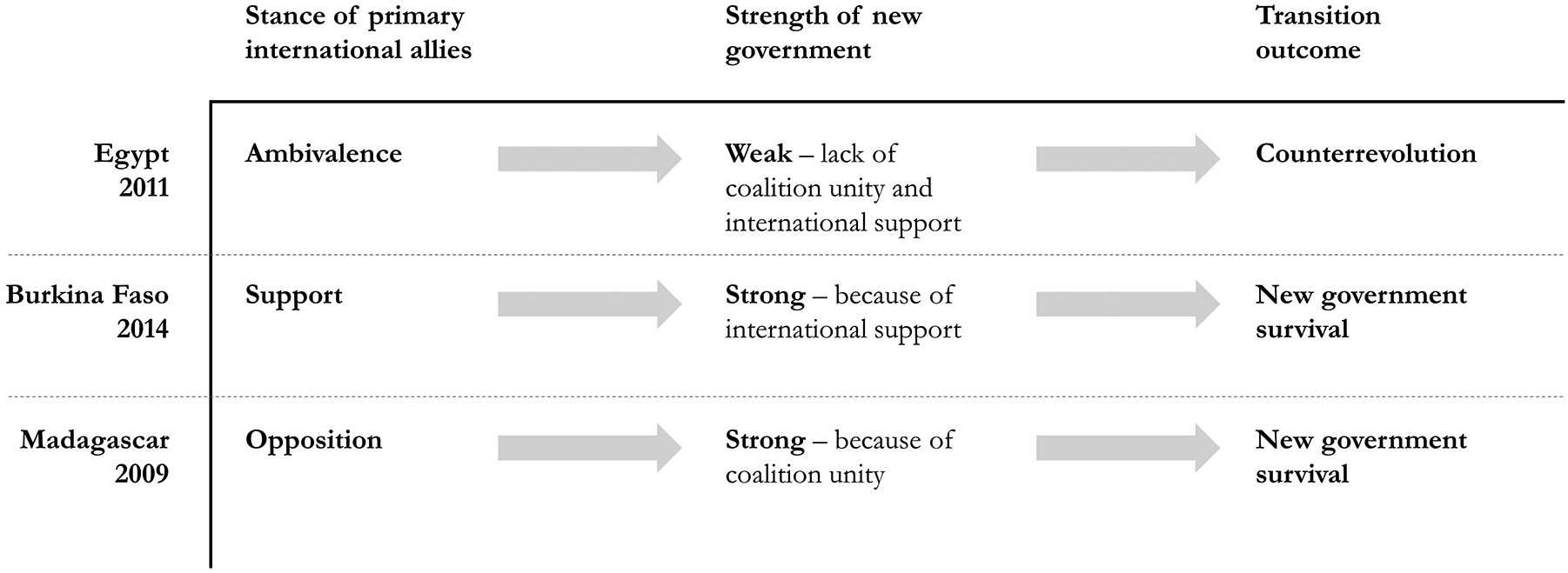
For evidence I draw on 93 interviews that I conducted between 2016 and 2019 with political leaders from the various parties and movements that participated in the 2011 revolution, members of the former Mubarak regime, and diplomats from the United States and Europe. In Appendix B of the Online appendix I discuss my interview strategy in full. Here I merely note that because of the sensitivity of the material being discussed, I keep the identities of these interviewees confidential and anonymous. In the text, I simply refer to interviewees with codes (e.g. E.01, E.02). In Appendix A of the Online appendix I include the full list of interviewees by code, along with key information about the individual (e.g. occupation) and the interview (e.g. length).
To analyze these interview data, I use best practices of process tracing, which entails demonstrating that a hypothesized causal sequence is supported by causal process observations within a case. 3 I therefore present evidence that supports the following inferences: first, Egypt’s most important foreign ally, the United States, adopted an ambivalent stance toward the revolution and subsequent transition; second, the public expressions of support from this ambivalent ally caused the new government to embrace a more exclusivist approach than it might have if it had known the extent of foreign officials’ misgivings; third, the combination of this exclusivist style of rule and the ambivalent ally’s lack of conviction rendered this government highly susceptible to a counterrevolutionary coup.
Finally, I compare Egypt’s trajectory to two other cases, which are selected to demonstrate how variation in the key independent variable (the stance of foreign powers) affects the outcome of interest (new regime survival). 4 In selecting these cases I was guided by Mill’s method of difference (Lijpjhart, 1975; Slater & Ziblatt, 2013), and selected two democratic revolutions from the same world region and historical period as Egypt’s but where foreign allies took a non-ambivalent stance. The first is Burkina Faso’s 2014 democratic revolution, where strong support from the international community helped to reverse a counterrevolutionary coup. The second case is Madagascar’s 2009 uprising, which was condemned by the international community. Interestingly, rather than weakening the fledgling government, this opposition prompted the new leader to double down on his revolutionary coalition, allowing him to weather multiple counterrevolutionary coups. The causal process in each case, and the coding of the key variables of interest, are laid out schematically in Figure 1.
There are some important caveats to these claims. First, I do not argue that the stance of foreign powers was the only decisive factor in the outcome of these transitions. Whether a transition succeeds or fails is, after all, the product of many variables, both domestic and international. I do, however, hope to demonstrate that the position of foreign powers in these cases was a key contributing factor to the outcomes they experienced. Second, for simplicity, in the analyses below I focus on the stances of the most important foreign powers in each case. Egypt’s main foreign patron was, without question, the United States. Though European and Gulf states also played a part in the transition, the importance of the USA’s historical relationship with Egypt gave it outsized influence. The United States was also a major foreign player in Burkina Faso and Madagascar, though in these cases regional actors like the African Union were also influential, particularly in leading negotiations and exerting pressure on domestic governments.
US ambivalence and Egypt’s 2013 counterrevolution
When in late January 2011 Egyptians began amassing in streets and squares around the country, calling for an end to police violence, authoritarian rule, and other injustices, the international community watched in shock. Hosni Mubarak had been seen as one of the Middle East’s strongest dictators and, even as protests had swept through neighboring Tunisia in the weeks before, most foreign analysts had argued that Egyptian society was too weak to mount a similarly fierce challenge (El-Ghobashy, 2011; Clarke, 2014). The protests were particularly surprising – and concerning – to the United States, which for over three decades had been Egypt’s most important foreign ally and a strong backer of its authoritarian governments. As noted above, the Middle East has been somewhat exempt from Washington’s post-Cold War pivot toward democracy promotion. Instead, the United States has continued to be a major sponsor of authoritarianism in the region, both in an effort to shield Israel from potentially antagonistic foes and to guarantee the stability of international oil markets (Vitalis, 2007; Jamal, 2012; Carapico, 2014). Egypt was, in this respect, a poster child for US policy in the region. As Brownlee (2012) has documented in meticulous detail, ever since Washington’s rapprochement with Egypt in 1978 following the signing of the Camp David Accords, it has consistently privileged authoritarian stability over democratic change in the country. No wonder, then, that when a democratic uprising suddenly placed that stability under threat Washington’s response was hardly enthusiastic.
Throughout the revolution Washington was persistently several steps behind events on the ground. Publicly, of course, prominent US leaders like Secretary of State Hillary Clinton and President Barack Obama expressed support for the protesters and sympathy with their demands. But according to Brownlee (2012), who interviewed a large number of US officials involved in policymaking at the time, the USA’s actions during the revolution were geared primarily toward preserving as much of the authoritarian status quo as possible. My own interviews confirmed that this characterization was accurate. Senior US diplomats said that the Obama administration kept proposing solutions that might have been feasible days earlier but that had since been surpassed by protesters’ escalating demands. 5 This was especially true of Obama’s military advisers. According to one of these diplomats, ‘the ultimate goal of [Chairman of the Joint Chiefs of Staff Mike] Mullen and the Joint Chiefs was to preserve the integrity of the relationship with the Egyptian military’. 6 In another interview, a senior member of Mubarak’s ruling National Democratic Party, who was with Mubarak throughout the revolution, also confirmed that Washington exerted only mild pressure for reform and was happy to accept half-measures intended to placate the protesters (e.g. transitioning power to Mubarak’s spy chief, Omar Suleiman). 7
But, of course, these half-measures failed. Mubarak resigned after 18 days of protest, and Obama’s foreign policy team, flailing to come up with a new stance toward Egypt, ended up adopting an ambivalent position toward the ensuing democratic transition. On the one hand, the administration could hardly justify opposing such an inspirational experiment in democracy. And, in fact, some members of Obama’s team had been genuinely impressed by the activists leading the protests, and argued that the experiment should be a given a real chance to succeed. 8 But other members of the team were more skeptical. They invoked the time-worn Washington canard that Egypt was not ‘ready’ for democracy, and argued that elections would bring to power dangerous Islamists like the Muslim Brotherhood, who could not be trusted to protect key US interests. These debates raged within the foreign policy team, and initially the pro-democracy camp won out, as Obama himself came to believe that the Egyptian revolution offered a unique opportunity to allow democracy to take root in the Middle East (Kirkpatrick, 2018: 24–52). Washington endorsed the transition plan laid out by the military council that had taken over from Mubarak and encouraged Egypt’s domestic actors to engage each other through the country’s emerging democratic institutions.
Later on, the concerns aired by the hawks on Obama’s team would seem to be validated, as Islamists swept both parliamentary and presidential elections and came to dominate Egypt’s new democratic bodies. But officially Washington maintained its stance, airing statements of support for the new government headed by the Brotherhood leader, Mohamed Morsi. Indeed, some Washington representatives, like the US Ambassador to Egypt, Anne Patterson, worked assiduously to shore up Morsi’s administration and to defuse tensions with his secularist opponents – to such an extent that many of these secularist politicians who I interviewed argued that Patterson was something of a Brotherhood stooge. 9 Yet, others on Obama’s team were privately far less enthusiastic about Morsi and his government. They distrusted the Brotherhood’s senior leaders, many of whom were unknown entities, having spent considerable time in Egyptian prisons over the previous years. 10 These skeptics argued that it was only a matter of time before the Brotherhood did away with the newly established democratic institutions and set up their own authoritarian regime – one that would be far less friendly toward the United States than Mubarak’s had been.
Though these conflicts between the idealists and realists on Obama’s team were the main driver of Washington’s ambivalence toward the transition, it is also true that Egypt’s own political actors did not do themselves any favors. Early in his presidency, Morsi managed to impress the international community. For example, in November 2012 he leveraged the Brotherhood’s relations with Hamas to mediate a ceasefire between the Palestinian group and Israel. But Morsi’s hubristic style of rule, and his inability to manage some of the more basic tasks of governance, led many US officials to sour on him – even those who wanted his administration to succeed. For example, according to one senior US diplomat, he offended the new Secretary of State, John Kerry, by insisting that, as president, he would only speak to Obama. 11 In another incident, in January 2013, a delegation of US Senators led by John McCain met with Morsi, who implied in defending himself against accusations of anti-Semitism that he had been targeted by the US media because it was controlled by Jews (Rogin, 2013). 12 This incident did considerable damage to Morsi’s credibility in Washington. 13 Ultimately, this same senior US diplomat told me that by the spring of 2013, ‘Morsi had no strong backers in the administration; he had alienated everyone and nobody was impressed with him’. 14 Moreover, it was not just Morsi who failed to impress Washington’s representatives. Morsi’s main opponents in the secularist opposition also came to be seen as politically immature, vain, and incompetent, making the argument for continuing to support the transition even harder to sustain. 15
Ultimately, then, Washington’s stance towards Egypt’s transition was publicly one of support and encouragement, while privately there remained a number of vehement skeptics in the administration. How did this inconsistency affect the domestic politics of the transition? I interviewed a number of senior Morsi aides who were involved in shaping his government’s strategic decisions, and they explained to me that they largely took Washington’s statements of support at face value. They believed that the United States would use its deep ties to the Egyptian military to ensure that the generals stayed out of politics for good. One Brotherhood leader, who served as a minister in Morsi’s government, said that they ‘were getting very supportive messages from [Ambassador] Anne Patterson. She was giving Morsi lots of support […] the consensus among the Brotherhood and the party [the FJP] was that the US would not allow a coup to take place’. 16 Another interviewee, a senior Morsi adviser, elaborated on this point. He said that not only did Morsi's team think that the US stood behind them, but they thought, more deeply, that the era of US-sponsored coups in the Middle East was over. He said: ‘Morsi had a lot of faith in the US and Obama. This was largely my fault. I thought that the US would not tolerate a bloody coup. I thought that public opinion in Western countries would not allow relations to be normalized with a regime like that’. 17 This was also the assessment of one senior US diplomat on the ground, who was in frequent touch with Morsi’s team: ‘Morsi did not think that a coup was possible. He thought the US government would back him and that the military wouldn’t dare. This is true right up until the end’. 18
Perhaps it was naïve of Morsi to take these statements at face value, given Washington’s historical support for authoritarianism in Egypt. I did push his advisers on this but they all insisted that they thought Washington’s support was real – though they admitted it was sometimes challenging to infer positions from the actions of the US officials. Moreover, unlike the military, the Muslim Brothers did not have their own private backchannels to US officials, meaning they had few options for determining Washington’s true stance other than these noisy public signals. In the end, it was not so much that they believed in the genuineness of the administration’s normative commitments, but that they could not imagine that in the early 21st century Washington could get away with accepting a counterrevolutionary coup. In fairness, this was also the conventional wisdom in non-Brotherhood circles: interviewees in the secularist opposition, 19 SCAF’s governments, 20 and even the military itself 21 all said that their impression during the transition was that Washington backed the Morsi government (also Kirkpatrick, 2018). Even European diplomats told me that the USA developed a reputation for being biased toward the Brotherhood. 22
Morsi’s faith in Washington’s willingness and ability to shield him from a coup affected his strategy vis-à-vis other domestic political players. The revolutionary coalition that had toppled Mubarak comprised a wide range of parties and movements, including not only the Muslim Brotherhood, but also various groups with secularist ideologies ranging from liberalism to leftism, Arab nationalism, and Nasserism (Clarke, 2014). However, during the founding elections that followed the revolution these secularist groups proved to be organizationally far weaker than the Brotherhood. When Morsi came to power, his administration had a difficult decision to make: should it reach out to and include these secularist groups, despite their poor performance in elections? Early in his tenure Morsi did seem to be considering this option, and he held several productive meetings with secularist leaders and appointed a handful of advisers representing other groups. But these efforts at inclusion were viewed by the opposition as little more than token, and their shrill denouncements ultimately led Morsi to conclude that he was better off ruling with an all-Brotherhood team and relying on his own base. 23 Crucially, this decision was also informed by his erroneous belief that Washington had his back, which meant that he could get by without the support of these secularist parties and movements. Such support would only be necessary, he calculated, if the military attempted a return to power, and Washington had supposedly taken that threat off the table. Even if a coup did materialize, his advisers told me, they believed that a combination of Washington’s influence and the Brotherhood’s own mobilizational strength would be enough to head it off. 24 Secularists I interviewed also correctly intuited that they had been pushed away because Morsi thought that he didn’t need their support with Washington as a shield. As one activist put it: ‘They thought that the army couldn’t stage a coup. They thought that the US wouldn’t let it happen’. 25
But ultimately a coup did emerge and force Morsi from power. How did Washington’s ambivalence contribute to this outcome? First, it left Morsi’s administration far more exposed than it might have been had his team known the full extent of Washington’s misgivings. The decision to rule with a narrower coalition, comprising Brotherhood members and allied Islamist parties, left Morsi’s government with a shallower domestic base and fewer political allies. When Sisi launched his coup, the popular response in the streets was therefore limited. Brotherhood members did mobilize in support of Morsi, staging a massive sit-in in front of the Rabaa al-Adwiyya Mosque in Cairo, but they were not able to muster the same popular momentum that had characterized the January 2011 revolution. In fact, the Brotherhood had so alienated the secularist wing of the revolutionary coalition, that many of these activists and politicians mobilized in support of the coup, rather than against it. 26 Had the Brotherhood pursued a more inclusive governance strategy, they might have been able to call on these secularist allies for help, mustering a truly revolutionary response to the coup. Indeed, at several moments earlier in the transition, before the Brotherhood and the secularists decisively fell out, these groups had come together in the streets to oppose the repressive actions and authoritarian overreach of their shared opponents in the military.
The second way that foreign ambivalence contributed to the success of the coup was by giving the Egyptian military subtle encouragement to launch it in the first place. In private, Egypt’s generals received a very different set of signals than those the Obama administration was delivering in public. These messages were passed on by the various hawks on Obama’s team, who began to deviate from the administration’s official policy line. Communicating with their interlocutors in the military, they voiced concerns about the Brotherhood and subtly signaled that Washington might actually be open (or at least not overly hostile) to a return of military rule. These communications have been meticulously documented by David Kirkpatrick, the New York Times Cairo bureau chief during the transition, who identified at least six senior Obama officials who sent these types of signals: Secretary of State John Kerry, Secretary of Defense Chuck Hagel, CENTCOM Commander James Mattis, DIA Director Michael Flynn, National Security Adviser Tom Donilon, and acting CIA Director Mike Morrel. Kirkpatrick further documents two meetings in spring 2013, one between Sisi and Kerry and one between Sisi and Hagel, in which Sisi hinted that he might need to step in if the Morsi government continued to founder, as though testing to see what the Americans’ responses might be (Kirkpatrick, 2018: 211–214). 27 He may have been reassured when their reactions were not strongly negative.
Moreover, those on the Obama team who did genuinely support the transition never proposed backing up Washington’s statements of support with meaningful actions. For example, in contemplating the possibility of a coup, they never considered imposing real sanctions on the Egyptian military. The most obvious way to do this would have been to withhold the roughly $1billion in annual military aid that the United States has sent to Egypt since 1978. But when I asked a senior US diplomat if they ever considered using this aid as leverage, I was told that this ‘would have been taking a very radical step’. 28 In the end, then, the United States’ ambivalence toward the transition meant that Sisi could stage his counterrevolutionary coup without needing to worry either about any serious diplomatic blowback or about a broad-based revolutionary response from the original 2011 coalition.
New government survival in Burkina Faso and Madagascar
Strong allies and counterrevolutionary defeat in Burkina Faso
In late 2014 the president of Burkina Faso, Blaise Compaoré, who had ruled the country for 27 years, attempted to amend the constitution so he could run for yet another term in elections the following year. The decision triggered a fierce response from the political opposition, civil society groups, trade unions, and student organizations. Following a week of nationwide protests and riots, and under pressure from members of his own military, Compaoré resigned and fled the country. After some initial jockeying between the political opposition and the military, a transitional government was formed comprising opposition party leaders, civil society members, and military officers, which was charged with steering the country to elections a year later.
Unlike in Egypt, the uprising in Burkina Faso was immediately embraced by the international community, including key players like the United States, France, and the African Union. Though France and the United States had some strategic interests in Burkina Faso, which was an important zone in the fight against militants in the Sahel, they had come to see Compaoré as a source of instability. They were confident that his opponents in the military and the revolutionary coalition would continue to protect their interests and assist in the fight against these militants; it did not hurt that Michel Kafando, who became president of the transitional government, had served as Burkina Faso’s representative to the UN for 13 years (Chouli, 2015: 331). As a result, both of these powers, along with the African Union, provided strong support to Kafando’s government. For example, at several points during the transition they worked behind the scenes to ensure that military officers did not step in or try to retake power (ICG, 2015: 4). Indeed, unlike in Egypt, there was never any question among these civilian leaders that their country’s most important foreign allies stood behind the transition.
Nearly a year after the uprising the extent of this foreign support was put to the test when the transitional government was threatened by a counterrevolutionary coup. It was staged by the Regiment of Presidential Security (RSP), an elite military unit formed by Compaoré to protect his regime. There were two major triggers for the coup (Ohayon, 2015). First, the government passed a law that banned prominent members of Compaoré’s ruling party from running in the upcoming elections. Second, the government had recently announced plans to disband the RSP and integrate its members into the regular army. The coup initially appeared to be successful; the leaders of the transitional government were placed under arrest and a new administration was announced. But a week later the coup leaders handed power back to the transitional government, and elections went ahead the following month.
One of the most important reasons for the coup’s reversal was the strong negative reaction of the international community (Tansey, 2017: 145). The African Union immediately condemned it and suspended Burkina Faso’s membership. It labeled the coup leaders ‘terrorists’, imposing sanctions and a travel ban and freezing their assets (PSC Reports, 2015). The relevant AU regional body, ECOWAS, quickly stepped in to mediate a resolution. Other foreign powers echoed this response: the United States ‘strongly condemned’ the coup; the UN Secretary General expressed ‘outrage’; and the French President François Holland told the coup leaders to ‘immediately lay down arms and hand over power to the legitimate authorities or face the consequences’ (BBC, 2015). Coupled with a strong domestic response – the original revolutionary forces returned to the streets in mass mobilization – this international opposition was sufficient to force the coup leaders to return power to civilians. In Burkina Faso, unlike in Egypt, clear and unwavering international support, including a willingness to credibly threaten sanctions and other punitive measures, helped to reverse a counterrevolutionary coup and stabilize the nascent democratic regime.
Foreign opposition and coalition unity in Madagascar
Madagascar’s 2009 uprising toppled President Marc Ravalomanana, who had himself come to power in a popular uprising in 2002. Ravalomanana had initially been seen as a democrat, but after election to a second presidential term in 2006 he took an autocratic turn (Ploch & Cook, 2012: 10; Ratsimbaharison, 2017: 58–59). In January 2009 the mayor of Antananarivo, Andry Rajoelina, effectively channeled the diverse pockets of opposition to Ravalomanana into a mass protest movement. The uprising triggered a mutiny of military officers, and eventually the resignation of the defense minister. In March, Ravalomanana resigned, fled the country, and handed power to a military committee, who in turn granted, executive power to Rajoelina. He formed a government, called the High Transitional Authority (HAT), to run the country, comprising a range of political leaders who had supported the uprising, including both long-time opponents and former supporters of Ravalomanana.
Because Ravalomanana had been democratically elected in 2006, the international community strongly condemned the uprising and refused to recognize the HAT government. On 20 March, days after Rajoelina took power, the United States issued the following statement: ‘This series of events is tantamount to a coup d’état, and the United States will not maintain our current assistance partnership with Madagascar’ (BBC, 2009). It suspended all non-humanitarian assistance to the country. The African Union (AU) and the Southern African Development Community (SADC) followed suit, also denouncing the takeover as a coup and suspending Madagascar’s membership in their organizations. The IMF suspended its aid programs and the World Bank scaled back its support (Ploch & Cook, 2012: 13). According to the International Crisis Group, after the uprising ‘Madagascar became an international pariah, deprived of critical foreign budget support’ (ICG, 2014). As a way to resolve the crisis, the international community empowered SADC to mediate a set of negotiations between the HAT government and its rivals, including Ravalomanana, who was now living in exile in South Africa (Cawthra, 2010; Ratsimbaharison, 2017). The international pressure was so strong that Rajoelina had little choice but to participate in these negotiations, though he did his best to drag them out and offer as few concessions as possible. Eventually, after two years, they did result in agreement on a roadmap to new elections, which ultimately occurred at the end of 2013.
Though international pressure was successful in forcing Rajoelina to negotiate with his political rivals and eventually to accept a transition to new elections, it also had the unintended effect of unifying his domestic political coalition. At first there was little holding together this diverse group of elites; it was, as one analyst put it, a ‘spontaneous and heterogeneous “coalition of circumstance”’ (Witt, 2017: 8). While there was plenty of factionalism and in-fighting within this group during the four and a half years in which HAT ruled the country, it never experienced the kind of fissuring that Egypt’s 2011 coalition did. Part of the reason for this unity, it turns out, was the pressure exerted by the international community. Members of the HAT feared that the international mediation process would result in Ravalomanana’s return, and that he would then stage a crackdown (ICG, 2010: 4). According to one analyst: ‘the Rajoelina camp’s principal aim has been to retain [power], and to keep Ravalomanana from being restored to his position as president’ (Cawthra, 2010: 17). They therefore put heavy pressure on Rajoelina to take a hard line in these negotiations. And Rajoelina, knowing he could not afford any defections, usually acceded to these demands; on multiple occasions he was forced to walk back a concession because it had been rejected by certain HAT members (ICG, 2010: 4; Ratsimbaharison, 2017: 114–115; Witt, 2017: 8). Unlike Mohamed Morsi, who cut out his domestic allies because he thought he did not need them, Rajoelina knew that with no international backers his survival depended on maintaining as broad a domestic coalition as possible. In this sense, international pressure led an otherwise fractious and diverse coalition to close ranks and unify.
Rajoelina’s government came under threat from at least three coups – in May 2010, November 2010, and July 2012 – some of which were linked to Ravalomanana’s supporters (ICG, 2010: 6). However, all three of these efforts were easily and decisively put down by segments of the military loyal to Rajoelina. Perhaps more importantly, unlike in Egypt, they failed to garner support from any members of Rajoelina’s original coalition, nor did they induce any defections from the HAT government. In Madagascar, then, strong international opposition to the 2009 uprising generated a defensive but unified revolutionary coalition, whose government weathered multiple counterrevolutionary coups and survived intact for four and a half years.
Conclusion
International actors can play a crucial role in processes of democratic transition. After the Cold War, scholars pointed to the West’s more consistent pro-democracy stance as a factor that contributed to the Third Wave transitions. In this article, I have complicated this story, arguing that the West’s shift toward democracy support after the Cold War may have been overstated. In fact, Western governments’ positions toward many democratic transitions have been marked by ambivalence, not support, particularly in certain regions of the world and when those transitions have been effected through democratic revolutions. Ambivalence entails that a foreign power is publicly and officially supportive of a new democracy, but that its officials privately hold misgivings or doubts about how viable or desirable that regime really is. Using interviews and process tracing in the case of Egypt’s 2011 revolution, paired with comparisons to the cases of Burkina Faso and Madagascar, I have demonstrated the particularly detrimental impact that ambivalent allies can have on democratic consolidation. By falsely signaling support for the new government, ambivalent allies prompt democratic leaders to narrow their coalitions and pursue a more exclusive style of rule, which can leave them doubly exposed to the threat of counterrevolution.
This study has focused on three cases in which democracies emerged from nonviolent revolutions, and in which counterrevolutions took the form of military coups. These dynamics beg the question of how far this argument may travel. Above I argued that the problem of ambivalent allies is most likely to emerge following democratic revolutions because of the highly fractious and polarized nature of their transitions, and because they are more difficult for Western powers to control. But the theory might also work to explain the breakdown of transitions effected through elite pacts or negotiations, which do sometimes produce conditions similar to those of democratic revolutions (i.e. polarized politics and ambivalent foreign powers). Another question is whether the theory only applies to countries with traditionally strong militaries, who are well-positioned to take advantage of ambivalent allies. Though, as I show in broader research (Clarke, 2020), counterrevolutions do often emerge in such cases, they are not limited to these types of regimes – making the theory potentially relevant to democratic transitions in a range of settings.
The study has implications for a number of scholarly debates. For scholars of international relations and democracy promotion, it suggests that future work should not only study whether foreign actors help to initiate democratization episodes but also how their actions impinge on the charged politics of these transitions. It also speaks to the literature on nonviolent revolution and democratization, demonstrating one important path by which these regimes break down and shedding light on why these modes of resistance often yield limited transformations. Of course, the study also has clear implications for government officials and diplomats interested in helping fledgling democracies. As I explained, ambivalence often does not arise from malicious intent – it is typically the product of indecision, internal disagreement, and crossed lines. Policymakers should therefore do their utmost to ensure that private misgivings do not undermine the strength or consistency of public messages, and that all members of a foreign policy team are aligned behind the official stance. And, if it comes to it, these governments must be prepared to back up their public statements with actual actions to support new democracies and resist the agents of counterrevolution.
Footnotes
Replication data

Acknowledgments
For helpful feedback on the article I thank Erica Chenoweth, Kathleen Cunningham, Sooyeon Kang, and three anonymous reviewers. I also thank four excellent research assistants: Abrar Amjad, Asal Amjad, Lily Erickson, and Alaa Mahmoud.
Funding
This research was supported by the Social Science Research Council’s International Dissertation Research Fellowship and by a Doctoral Dissertation Research Improvement Grant from the National Science Foundation (AWD1005800).