







Abstract
How does crime influence democratic attitudes and behaviors? Existing research offers conflicting answers: some argue that crime fosters antidemocratic preferences, while others suggest it increases democratic engagement. To reconcile this paradox, we conceptualize democracy as a multidimensional system with distinct components that can be decoupled. We distinguish between different (anti)democratic preferences tied to core democratic principles and argue that contextual exposure to crime may heighten support for undemocratic enforcement measures without eroding commitment to procedural democracy. To test this, we conducted a large online survey (N = 3108) in Brazil – a country profoundly affected by various forms of crime – using two embedded experimental protocols. Our findings show that crime exposure increases support for unlawful enforcement practices, such as police overreach and vigilante justice, while leaving attitudes toward military coups, executive aggrandizement and support for democracy as the best form of government largely unaffected. Understanding this nuanced relationship is especially important in contexts where crime is pervasive and politically instrumentalized. That exposure to crime leads citizens to tolerate breaches of the rule of law in the name of public safety is deeply concerning. Yet, our results offer cautious optimism: support for undemocratic enforcement does not necessarily undermine broader democratic commitments.
Introduction
How does exposure to crime affect democratic attitudes? Existing research offers mixed findings. Some studies show that crime fosters authoritarianism, leading people to favor authoritarian leaders, endorse ‘mano dura’ (i.e. iron fist) measures, and support the militarization of security (Bateson, 2012; Blanco, 2013; Carreras, 2013; Hiskey et al., 2020; Holland, 2013; Krause, 2014; Merolla et al., 2013; Visconti, 2020). Such transformations, often driven by criminal organizations, have contributed to democratic stagnation or backsliding in several countries (Mainwaring and Pérez-Liñán, 2023). Conversely, crime has also been shown to activate democratic engagement, with victims becoming more politically active in discussions, marches and elections (Bateson, 2012; Berens and Dallendörfer, 2019; Dorff, 2017; Krakowski, 2022; Nussio, 2019)
El Salvador exemplifies this tension. Historically one of the world’s most dangerous countries, its political trajectory shifted under President Nayib Bukele, elected in 2019 on a populist, authoritarian platform promising a harsh crackdown on gangs. While Bukele has systematically eroded checks and balances, civil liberties and constitutional norms, public perceptions of democracy have paradoxically improved. According to surveys from the Latin American Public Opinion Project (LAPOP, 2018 and 2021 waves), support for democratic governance increased under his leadership. Bukele’s popularity remains exceptionally high, and his landslide re-election in 2024, with record voter turnout, underscores the appeal of his ‘mano dura’ approach.
How can crime simultaneously breed authoritarian preferences and stimulate greater democratic participation and support for democracy? We argue that this disjunction reflects the phenomenon of democratic decoupling – a scenario in which a distinct gap emerges between the constitutive features of democracy (Ding and Slater, 2021). We address this apparent contradiction by distinguishing between two types of (anti)democratic preferences: support for unlawful enforcement and support for procedural democracy.
These preferences correspond to different core dimensions of democracy. Support for unlawful enforcement relates to the rule of law and civil rights, typically associated with the liberal dimension of democracy. In contrast, support for procedural democracy pertains to the electoral process and the balance of powers, often linked to democracy’s electoral and institutional dimensions (Chu et al., 2024). We conceptualize democracy as a complex institutional assemblage in which the erosion of one constitutive feature does not necessarily lead to the erosion of others. Accordingly, we argue that exposure to crime can increase public support for anticrime strategies that weaken the rule of law without diminishing commitment to procedural aspects of democracy or democracy as a whole.
While high-quality democracies encompass numerous attributes (Dahl, 1972, 2000; Diamond and Morlino, 2004), we focus on two critical dimensions consistently valued by citizens across countries and regimes (Chu et al., 2024; Hernández, 2016, 2025). Exposure to crime can influence preferences toward these dimensions through instrumental and emotional channels, leading individuals to support undemocratic responses. These include unlawful state actions, such as police overreach, and non-state actions, like vigilante justice, both of which are often perceived as seemingly effective ways to fight crime and punish offenders (García-Ponce et al., 2023; Visconti, 2020). However, such measures undermine the rule of law, a cornerstone of democratic governance (Diamond and Morlino, 2004; O’Donnell, 2004).
However, support for unlawful enforcement does not necessarily imply diminished support for other fundamental tenets of democracy, such as the procedures by which representatives are elected and held accountable. On the contrary, exposure to crime may reinforce support for these procedures, as citizens need them precisely to demand elected officials to prioritize security and adopt tough-on-crime policies (Bateson, 2012; Trelles and Carreras, 2012). Furthermore, the activities of criminal organizations may heighten the perceived importance of these democratic procedures, as their erosion could facilitate a criminal takeover of democratic institutions (Feldmann and Luna, 2023; Schedler, 2014).
To empirically examine this argument, we conducted an extensive online survey in Brazil (N = 3,108), a country heavily impacted by crime. Our sample captures a large proportion of individuals exposed to crime or for whom crime is likely to be a particularly salient issue. The analysis focuses on contextual exposure to crime, which, although distinct from personal victimization, has been shown to significantly influence political preferences and behaviors (Dorff, 2017; Ley, 2017). To address the inferential limitations of prior research, we incorporated two experimental protocols into our survey. First, we manipulated crime salience by randomly assigning participants to answer a block of questions about their exposure to crime either before or after responding to questions about their (anti)democratic preferences. Second, we conducted a vignette experiment, presenting some respondents with information about the prevalence of either petty crime or organized crime in their local area.
As theorized, our analyses reveal that exposure to crime increases support for unlawful enforcement without undermining people’s support for fundamental democratic procedures. Consistent with the democratic decoupling thesis, this highlights a divergence in attitudes toward these two features of democracy. Specifically, crime exposure enhances support for both state and non-state actors engaging in extralegal measures to combat crime, as well as for harsher punitive policies. However, it does not increase support for practices that threaten basic democratic procedures, such as military coups or executive aggrandizement, nor does it reduce endorsement of democracy as the preferred form of government.
This study contributes to the literature on the political effects of crime and violence. By incorporating conceptual insights from research on democracy and democratic backsliding (Bermeo, 2016; Diamond and Morlino, 2004; Ding and Slater, 2021; O’Donnell, 2004), it provides a more nuanced understanding of the relationship between crime and (anti)democratic preferences. In doing so, it helps reconcile the contradictory findings of previous studies. Methodologically, we innovate by focusing on contextual exposure to crime and capturing a broader and more diverse population affected by crime, thus providing a more comprehensive assessment of its political effects compared to studies that rely solely on experiences of personal victimization. Additionally, while the experimental protocols introducing exogenous variation in crime salience do not replace analyses of real-life exposure, they replicate politicians’ strategies of exploiting crime for electoral gain, while isolating crime effects from exposure to different socio-economic backgrounds that also shape political attitudes.
Crime and its effects on political attitudes
More than a decade ago, Bateson (2012) published a groundbreaking study on the political effects of crime. Analyzing survey data from all over the world, she found that crime victimization ranked among the most influential predictors of democratic participation. However, her study also indicated that the relationship between crime and democracy was more complex. In some regions, such as Latin America, crime victimization was also associated with increases in authoritarian preferences.
Since then, several studies have explored this relationship, producing mixed results and reinforcing the tension. With few exceptions (e.g. Ley, 2018; Trelles and Carreras, 2012), the consensus is that crime and violence, be it petty crime, organized crime, civil war, terrorism or state repression, increase democratic participation (Bali, 2007; Bellows and Miguel, 2009; Blattman, 2009; Hager and Krakowski, 2022; Michavila, 2005; Robbins et al., 2013; Voors et al., 2012). This pattern holds for both electoral and non-electoral participation (Bateson, 2012; Berens and Dallendörfer, 2019; Dorff, 2017; Nussio, 2019).
However, other studies have consistently found that crime breeds antidemocratic and authoritarian preferences, including support for iron-fist policies, harsher punishment and even extrajudicial measures to deal with crime (Bateson, 2012; Cruz and Kloppe-Santamaría, 2019; García-Ponce et al., 2023; Gerber and Jackson, 2016; Holland, 2013; Johnson, 2009; Krause, 2014; Pérez, 2003; Visconti, 2020). This holds for direct and indirect exposure to crime. For example, examining attitudes in Argentina and Brazil, Laterzo (2023) found that individuals who perceive their neighborhoods as insecure are more supportive of punitive candidates. Similarly, Krause (2014) found that exposure to news about crime increased support for authoritarian crime control strategies in Guatemala.
How can exposure to crime lead to greater democratic engagement while breeding people’s antidemocratic and authoritarian preferences? We argue that this seeming contradiction is an expression of democratic decoupling (Ding and Slater, 2021). Democratic decoupling is one form of democratic backsliding. Grounded on a multidimensional understanding of democracy in which the deepening or regression of one dimension does not necessarily go hand in hand with the regression of others (Dahl, 1972, 2000; Diamond and Morlino, 2004), it stresses that not all democratic institutions erode in a parallel fashion and, therefore, gaps emerge between the quality and stability of these institutions (Ding and Slater, 2021).
When proposing the term, Ding and Slater (2021) approached democratic decoupling as a process of institutional change and, therefore, focused on gaps between the quality of the different institutions that uphold a democratic system. We emphasize decoupling at the level of public opinion: gaps in the importance that individuals attach to different dimensions of democracy. Looking at decoupling from this angle is particularly important, as the endurance of democracy hinges to some extent on people’s preferences and popular support (Booth and Seligson, 2009; Claassen, 2020; Easton, 1965; Fearon, 2011; Lipset, 1959). 1
Consequently, we treat (anti)democratic preferences as constituted by multiple dimensions that are not necessarily isomorphic. This could include support for, for example, free and fair elections, checks and balances, civil liberties, presidential limits, and military coups, among others. Seen this way, some authoritarian measures that undermine crucial tenets of democracy can sometimes be popular among a plurality of voters who, at the same time, strongly support other tenets of democracy and stick firmly to the idea that democracy is the best form of government. Moreover, voters might accept trade-offs between dimensions of democracy, supporting some at the expense of others (Bakke et al., 2025; Breitenstein and Hernández, 2025; Chu et al., 2024; Lu and Chu 2021).
This conceptualization, we contend, helps us to start reconciling some of the contradictory findings of previous research, which have implicitly or explicitly treated (anti)democratic preferences as zero-sum. Concretely, we contend that exposure to crime can make people more supportive of unlawful, authoritarian responses to deal with crime without leading them to question the democratic procedures by which representatives are elected, powers are balanced and/or decisions and laws are made.
The dominant explanation for why personal victimization or contextual exposure lead to support for tough-on-crime approaches is instrumental retribution: concerned about becoming victims of crime, people exposed to crime support tougher enforcement, particularly harsher punishment for criminals, to reduce future crime in general and personal harm in particular. Given this logic, it is not surprising that the association between crime and support for tough-on-crime approaches cuts across ideology, income, attributions of the causes of crime, and the distribution of the costs of punitive measures (Gunderson, 2022; Laterzo, 2023; Tiscornia and Pérez Bentancur, 2024). In Latin America, even progressives, who otherwise would be unlikely to support iron-fist approaches, have been found to support punitive candidates when they are exposed to crime and feel insecure in the areas where they live (Laterzo, 2023). Exposure to crime makes people perceive certain solutions as more appropriate and effective to combat crime and punish offenders (Tyler and Weber, 1982).
The desire for retribution is often further amplified by the emotions elicited by crime. Drawing on foundational insights from classical sociology (Durkheim, [1893] 2013) and informed by research in political psychology and criminology, scholars examining the determinants of punitiveness have consistently found that crime provokes intense emotional reactions, such as fear, moral outrage and anger (Chancer and Donovan, 1994; Karstedt, 2002). These emotions play a critical role in shaping punishment preferences (Costelloe et al., 2002; Dowler, 2003; García-Ponce et al., 2023; Hartnagel and Templeton, 2012; Johnson, 2009; Langworthy and Whitehead, 1986; Singer et al., 2020; Vidmar et al., 2001). 2 Notably, such emotional responses can drive support for highly repressive measures, even at the expense of eroding civil rights and bypassing legal constraints (García-Ponce et al., 2023; Visconti, 2020). Although people generally value procedural legality under normal conditions, crime often increases their tolerance for unlawful enforcement as a means to restore security and punish offenders (Bateson, 2012; Krause, 2014).
In light of insights from both instrumental and emotional perspectives, we propose our first hypothesis:
Hypothesis 1. Exposure to crime increases people’s support for unlawful responses to combat crime and punish criminals.
Unlawful enforcement poses a serious threat to democracy by undermining the rule of law, often involving the suspension of civil liberties, arbitrary arrests, prolonged detention, and even the mistreatment or death of detainees. However, understanding democracy as a system with multiple dimensions that can be decoupled implies that support for unlawful enforcement does not necessarily erode support for other core democratic institutions or democracy as a whole. People exposed to crime may favor undemocratic measures they perceive as effective in combating crime, but they will not necessarily adopt antidemocratic preferences universally. Support for unlawful enforcement can coexist with support for core democratic procedures, such as the inviolability of elected representatives or checks on executive power.
Enforcement specifically relates to security policy, a domain directly tied to crime. Measures that may push the boundaries of the law to combat crime, such as states of emergency or executive ordinances, are often temporary. In contrast, procedural democracy encompasses broader political and social domains, with less direct connections to crime. Disruptions to procedural democracy, such as military coups, self-coups or executive takeovers, tend to be longer-lasting and entirely exclude public participation. Thus, while exposure to crime may lead some to tolerate breaches of the rule of law through unlawful strategies to fight crime, it might not weaken their support for procedural democracy. This is because procedural democracy might not be perceived as directly linked to immediate crime concerns, and the costs of tolerating its disruption are higher.
Moreover, for individuals who view crime as a particularly pressing issue, preserving procedural democracy may hold even greater importance. Allowing the military or executive to seize full government control could severely undermine, or even eliminate, their ability to demand tough-on-crime policies and hold those who pledge to implement them accountable. Democratic elections, in fact, often serve as platforms for advancing punitive and other illiberal agendas (Bateson, 2012; González, 2020; Trelles and Carreras, 2012).
Individuals exposed to crime may also be more aware of the severe threat that criminality poses to political stability. In the absence of strong democratic procedures, organized criminal groups can exploit weakened institutions through infiltration, co-optation and violence (Albarracín, 2018; Alesina et al., 2019; Feldmann and Luna, 2023; Schedler, 2014; Snyder and Duran-Martinez, 2009; Trejo and Ley, 2020). The 2024 crisis in Haiti starkly illustrates these risks: armed gangs freed thousands of prisoners, burned government buildings, forced the prime minister to resign and took control of the capital city, underscoring the real possibility of criminal subversion of the state. Recognizing these dangers, those exposed to crime might advocate for stringent state enforcement measures against criminal actors (Holland, 2013; Kloppe-Santamaría, 2020; Visconti, 2020) while remaining cautious about undermining core democratic procedures. They understand that such actions could inadvertently lead to the ‘criminal subversion of democracy’ (Schedler, 2014).
This leads to our second hypothesis:
Hypothesis 2. Exposure to crime does not undermine people’s support for other core democratic procedures.
Criminal violence and democracy in Brazil
Brazil transitioned to democracy in the mid-1980s. Since then, criminal violence has been a central threat to public security. Although crime is prevalent throughout the country, it is mostly concentrated in large and midsize cities, including those we oversampled in this study: Fortaleza, Rio de Janeiro, São Paulo and Salvador. Probably no country in the world has more cities plagued by violent crime than Brazil (Rapoza, 2016). With worldwide known criminal factions, such as the prison-based Primeiro Comando da Capital and Comando Vermelho operating in hundreds of favelas (slums) and peripheral neighborhoods, Brazil dramatically exemplifies the threat that crime represents to public security.
For more than 30 years, iron-fist approaches and unconditional crackdowns have been the staple of the country’s effort to combat crime, including harsh punishment and unlawful enforcement by both state and non-state actors. To combat crime, national and state governments have regularly deployed elite special forces and the military (Samset, 2014; Soares, 2000), and non-state militias and vigilante groups have been formed in various cities (Arias and Barnes, 2017; Cano and Duarte, 2012; Cano and Loot 2008). Examples of unlawful police conduct abound, including unwarranted searches, beatings, torture and even extrajudicial and summary executions (Arias and Rodrigues, 2006; GENI/IPPUR, 2021; Huguet and Szabó de Carvalho, 2008; Magaloni et al., 2020). In Rio de Janeiro alone, the police killed 1814 people in 2019, an average of five people per day (Trudeau, 2022).
Despite costing thousands of lives and not necessarily curbing crime, these forms of enforcement enjoy strong popular support (González, 2020; Masullo and Morisi, 2024a; Visconti, 2020). Moreover, authoritarianism has become more appealing to citizens precisely when responses to reducing crime have failed (Bitencourt, 2007; Caldeira, 2001; Caldeira and Holston, 1999). In 2016, 60% of Brazilians agreed with ‘A good bandit is a dead bandit’ (‘Bandido bom é bandido morto’, in Portuguese), a phrase made popular by far-right politicians denoting support for harsh punishment (Fórum Brasileiro de Segurança Pública, 2024). 3
Several local and national politicians have exploited insecurity, successfully campaigning on iron-fist platforms and promoting reforms that openly threaten the rule of law. Noticeable examples include Marcello Alencar, former Mayor (1983–1986, 1989–1993) and Governor (1995–1998) of Rio de Janeiro, who provided semi-automatic weapons to the police and implemented a ‘bravery bonus’ to officers who engaged in violent confrontations. Similarly, Jair Bolsonaro was elected president (2019–2022), proposing an extensive list of iron-fist initiatives, including the loosening of gun legislation, the use of lethal force against suspected criminals, stricter penalties for criminals, the reduction of the age of legal responsibility, and even police impunity for those accused of abuse.
Although Latin America has been at the center of research on the relationship between crime and political attitudes, most research has taken a cross-national approach or focused on Central American countries and Mexico. Relatively few studies have explored the case of Brazil. Those who have done so, while making crucial contributions, have focused on direct personal victimization, used data from only a few cities and/or relied on standard survey data with generic dummy victimization questions (Rosen and Cutrona, 2021; Visconti, 2020). In contrast, we have designed a tailored survey with two embedded experimental protocols, fielded on a national sample and oversampling violent cities. Moreover, we focus on contextual exposure to crime, which increases the number of people affected by crime. As such, our study complements existing work on the topic, offering a helpful comparative reference to assess the validity of previous studies.
Research design
Our data come from a large original survey of the Brazilian population conducted in 2022 using an online panel provided by Netquest. We collected a quota sample of adults living in Brazil, mirroring the national distribution of the country’s population regarding gender, age and geographic area of residence (N = 1,995). In addition, we oversampled residents of four main Brazilian cities – São Paolo, Rio de Janeiro, Fortaleza and Salvador – reaching an additional 1,113 respondents. We oversampled these cities to explore the attitudes of people for whom crime was more likely to be a particularly salient issue, as well as to increase the likelihood that we captured a large segment of people exposed to crime. In total, we reached 3,108 Brazilian adults. 4
Outcome measures
(Anti)democratic preferences
To measure unlawful enforcement, we asked respondents whether they find it acceptable for state (the police) and non-state actors (community vigilante groups, grupos de vigilância comunitária armada in Portuguese) to overstep the law while trying to fight crime. Our questions read: ‘To catch criminals, do you believe that
We also asked for agreement with the phrase ‘A good bandit is a dead bandit’. Respondents replied on a 1–7 scale, ranging from ‘totally disagree’ to ‘totally agree’. We rescaled responses from 0 to 1, excluding those who preferred not to reply. This measure taps into the theorized retributive logic more directly. Moreover, it allows us to check that what we observe with our primary outcome measure is not an artifact of question formulation and was interpreted by respondents as we intended. While ‘respecting the law’ might be interpreted in multiple ways, this complementary measure explicitly refers to alleged criminals being killed. Yet, this measure is highly context-specific and, as specific politicians have openly promoted it, it surely comes with baggage. Consequently, we treat it as a complementary measure.
To measure support for democratic procedures, we used two questions from LAPOP surveys. We asked respondents whether they think it is justifiable for the military to take power via a coup d’etat and for the president to close the Congress and govern alone in the face of widespread crime. 6 Answer options included: ‘Would be justifiable’, ‘Not justifiable’ and ‘Don’t know’. These questions tap into people’s support for two core tenets of democracy, which would be abolished if the military or the executive seized power: electoral procedures and the separation/balance of powers. Given that the items are strongly correlated (Cronbach’s alpha = 0.71), we averaged the responses into a single item ranging from 0 (for those who believe that neither a military nor an executive coup is justifiable) to 1 (for those who believe that both types of coup are justifiable), excluding ‘Don’t know’. 7
Lastly, we used a measure of general commitment to democratic government, also used in LAPOP surveys. We asked respondents to what extent they agree or disagree with the following statement: ‘Democracy may have problems, but it is better than any other form of government’. Respondents replied on a 1–7 scale, ranging from ‘totally disagree’ to ‘totally agree’. We inverted the responses so that higher values indicate more disagreement and rescaled them from 0 to 1. Online Appendix Table A4 shows the summary statistics for all the variables, including controls.
Exposure to crime
To estimate the effect of crime on (anti)democratic preferences, we focused on ‘contextual exposure’ using both observational and experimental data. This focus captures attitudes across a broader and more diverse population than those who have personally been victims of crime. 8 This focus also reduces social desirability bias associated with personal victimization, pervasive especially in contexts like Latin America, where victims are often associated with criminal activity (Masullo and Morisi, 2024b; Schedler, 2015; Zizumbo-Colunga, 2020) and, thus, may fear stigmatization.
We measure contextual exposure to various forms of crime: homicides, armed robberies, shootouts, stray bullets, drug-selling, and the public carrying of arms. These crimes were identified as the most prevalent during exploratory fieldwork conducted in São Paulo and Rio de Janeiro and have been extensively studied in related literature (Barnes, 2022, 2017; Lessing, 2019; Masullo and Morisi, 2024a). The only other widely prevalent crime we did not include was police violence, particularly significant in cities like Rio de Janeiro. We chose to exclude police violence because it overlaps with our primary outcome of interest, as it can itself be an expression of unlawful enforcement.
A key inferential problem when studying exposure to crime with observational data comes from the fact that people are not randomly exposed to crime. Rich criminological evidence has documented that people who experience crime or live in areas affected by high levels of crime may differ significantly from non-victims or people who are less exposed (Peterson and Krivo, 2009; Sampson and Lauritsen, 1994). Thus, underlying observable and unobservable differences, rather than exposure to crime, may explain possible differences in political preferences, including differences in our outcome measures. We address this inferential problem by experimentally manipulating exposure to crime in two ways.
First, we used a priming experiment in which we randomized the order of the questions concerning crime exposure and the outcome questions. In the treatment condition, participants responded to a battery of questions about exposure to crime first and then replied to the outcome questions. The exposure to crime questions asked participants about the prevalence of crime in their neighborhoods. Concretely, we asked them how often (daily/once a week/once a month/once a year/never) they witness the different types of crime mentioned above in their neighborhoods. Those assigned to the control condition answered the outcome questions first and then moved on to the battery of crime questions. This protocol is based on research by Alesina and Miano (2023), Callen et al. (2014), Daxecker et al. (2025) and Zaller and Feldman (1992) and aims to exogenously raise, in a subtle way, the salience of crime among a random segment of our sample. Salience refers to the perceived prominence of an issue in individuals’ minds while sharing information about their political attitudes toward democracy. Consistent with prior studies, we posit that salient issues, such as crime, capture significant attention, influence decision-making, and are prioritized over other issues as a basis for forming attitudes.
This approach offers several advantages. Beyond its utility in isolating the effects of interest and addressing endogeneity concerns, raising the salience of the crime issue mirrors real-world settings in which such topics dominate public discourse, particularly ahead of key events like elections due to increased media coverage or related political campaigning strategies. Ultimately, the real-world importance of our study is understanding how crime could influence democratic decision-making, including voting behavior, and how the salience of the crime issue – when emphasized by certain political actors – affects these processes.
Second, we included a vignette experiment in which we randomly provided some respondents with information about the levels of petty or organized crime in their area right before answering the outcome questions. In treatment conditions, people read information about the prevalence of petty or organized crime, while those assigned to the control condition did not receive any information. This manipulation enables us to test the effect of information about crime among people who might not have been fully aware of the scale of the crime problem and to explore the differential effects of different types of crime. The short vignettes read as follows (the type of crime was set in bold for further emphasis): [Control Group] In the following screens, we will ask your opinion about how to maintain law and order in your city. [Experimental Condition 1] In the following screens, we will ask your opinion about how to maintain law and order in your city in the face of widespread [Experimental Condition 2] In the following screens, we will ask your opinion about how to maintain law and order in your city in the face of widespread
Method
To test our hypotheses, we used ordinary least squares models to regress the outcomes of interest on assignment to treatment. To evaluate the effect of the priming experiment, we compared individuals who answered questions about crime before reading the outcome measures to those who read the crime questions after the outcome measures (the control condition). To evaluate the effects of the vignette manipulation, we included indicators for whether the respondents had been assigned to information about petty crime, information about organized crime, or no information (our reference category, corresponding to the control condition). Balance checks indicate that there are no substantial differences between treatment conditions regarding the distribution of covariates (Online Appendix Table A1). Yet, to increase the precision of the estimates (Angrist and Pischke, 2009; Gelman et al., 2020), we included sociodemographic covariates (gender, age, level of education, main religious denomination, quartiles of household income) and indicators for the city/region of residence in our main models. 10
We designed the experimental manipulations as independent of each other. Yet, there is a possibility of joint effects in which the two experiments mutually reinforce (or undermine) each other. For instance, it is possible that receiving information about the type of crime in a respondent’s area of residence will have no effect if the respondents were already primed to think about crime before answering the outcome questions. To test for this possibility, we conduct additional analysis in which we interact treatment conditions and analyze the effect of each condition by categories of the other condition (e.g. the effect of information by presence or absence of priming). We do not find statistically significant interactions, apart from a slightly differential effect of the priming manipulation on people’s support for unlawful enforcement (Section A.3 in the Online Appendix). This indicates that the effects of the priming manipulation and the vignette experiment are largely independent of each other.
Results
Experimental results
The results of our two experimental manipulations consistently support our argument that the salience of crime increases support for unlawful enforcement without diminishing support for procedural democracy. By highlighting an empirical gap between two core features of democracy, these findings further support the idea that democratic decoupling is a discernible pattern in specific contexts (Ding and Slater, 2021), occurring not only at the institutional level but also in public opinion.
In line with Hypothesis 1, we observe that priming participants to think about crime increases their belief that police and vigilante groups can overstep the law to catch criminals – an increase of 7 percentage points (0.17 standard deviations). Receiving information on the presence of crime in the respondents’ place of residence also has a positive effect: an increase of 4.3 percentage points (0.10 standard deviations) (Figure 1(a)). 11
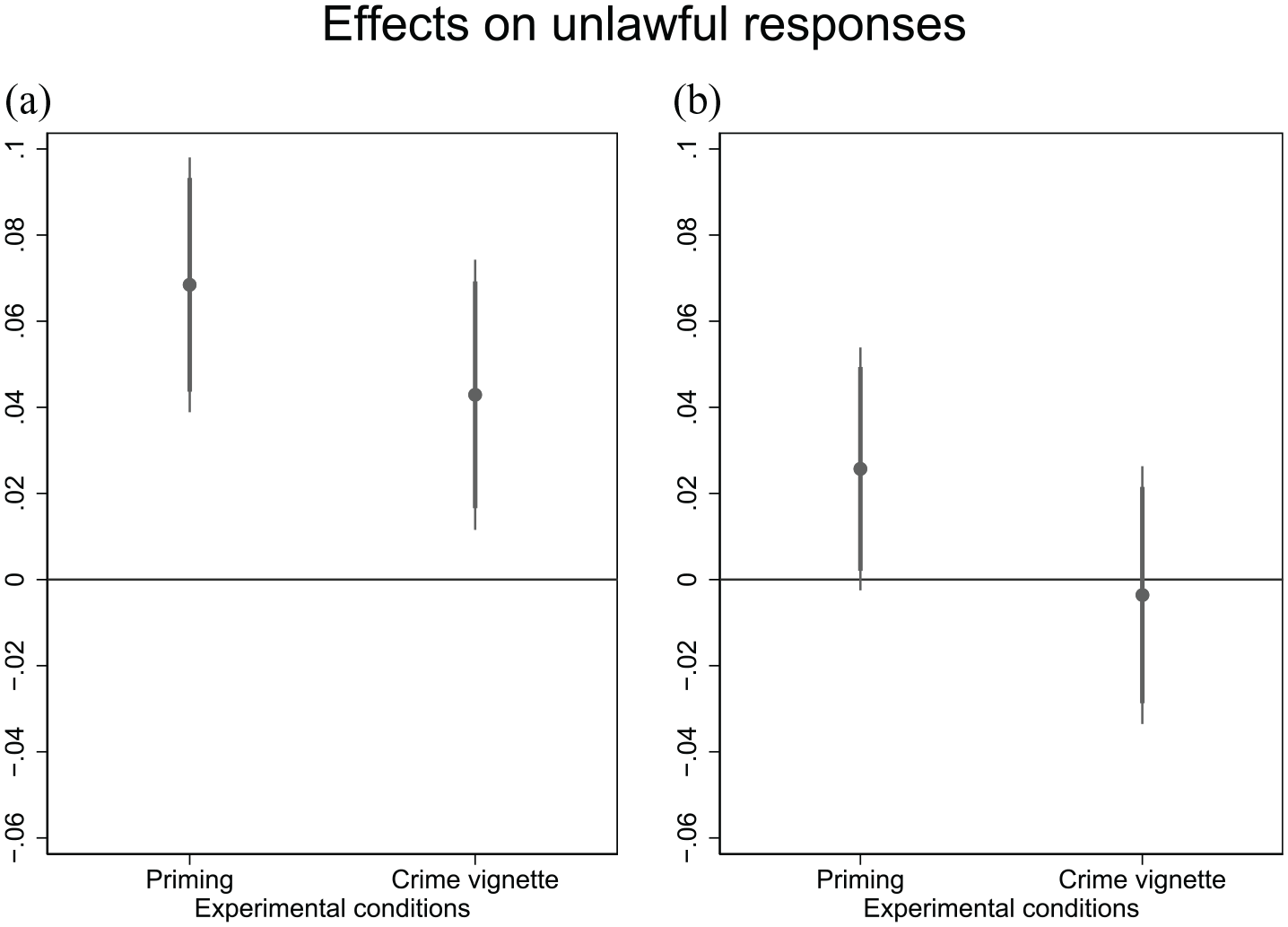
Experimental effects on unlawful enforcement: (a) police/vigilante can overstep the law, and (b) ‘A good bandit is a dead bandit’.
Furthermore, the salience of crime also seems to increase people’s support for harsh punishment. Participants primed to think about crime more strongly support the statement ‘A good bandit is a dead bandit’ – an increase of 3 percentage points (0.06 standard deviations). While this effect is marginally significant at the 90% level (Figure 1(b)), if we focus on those who read the crime questions first but did not receive any explicit information in the vignette experiment, the effect is larger – an increase of 6 percentage points (0.14 standard deviations), and statistically significant at the 95% level (See Table A9, column 2 in the Online Appendix). We do not find significant effects of our vignette manipulation on the ‘bandit’ outcome (Figure 1(b)). While this singular result departs from our expectations, overall, the experimental results support our first hypothesis that exposure to crime – manipulated through two different techniques – increases people’s support for unlawful responses to combat crime and punish criminals.
Manipulating the salience of crime does not affect support for procedural democracy. Neither priming individuals to think about crime nor providing them with information about crime prevalence in their area leads them to view military or executive coups as justifiable in the context of high crime (Figure 2(a)). This aligns with Hypothesis 2, which posits that exposure to crime does not weaken people’s support for core democratic procedures. However, this result does not support the idea that those exposed to crime might be more committed to preserving democratic processes as a means to influence policy and hold politicians accountable for their tough-on-crime promises.
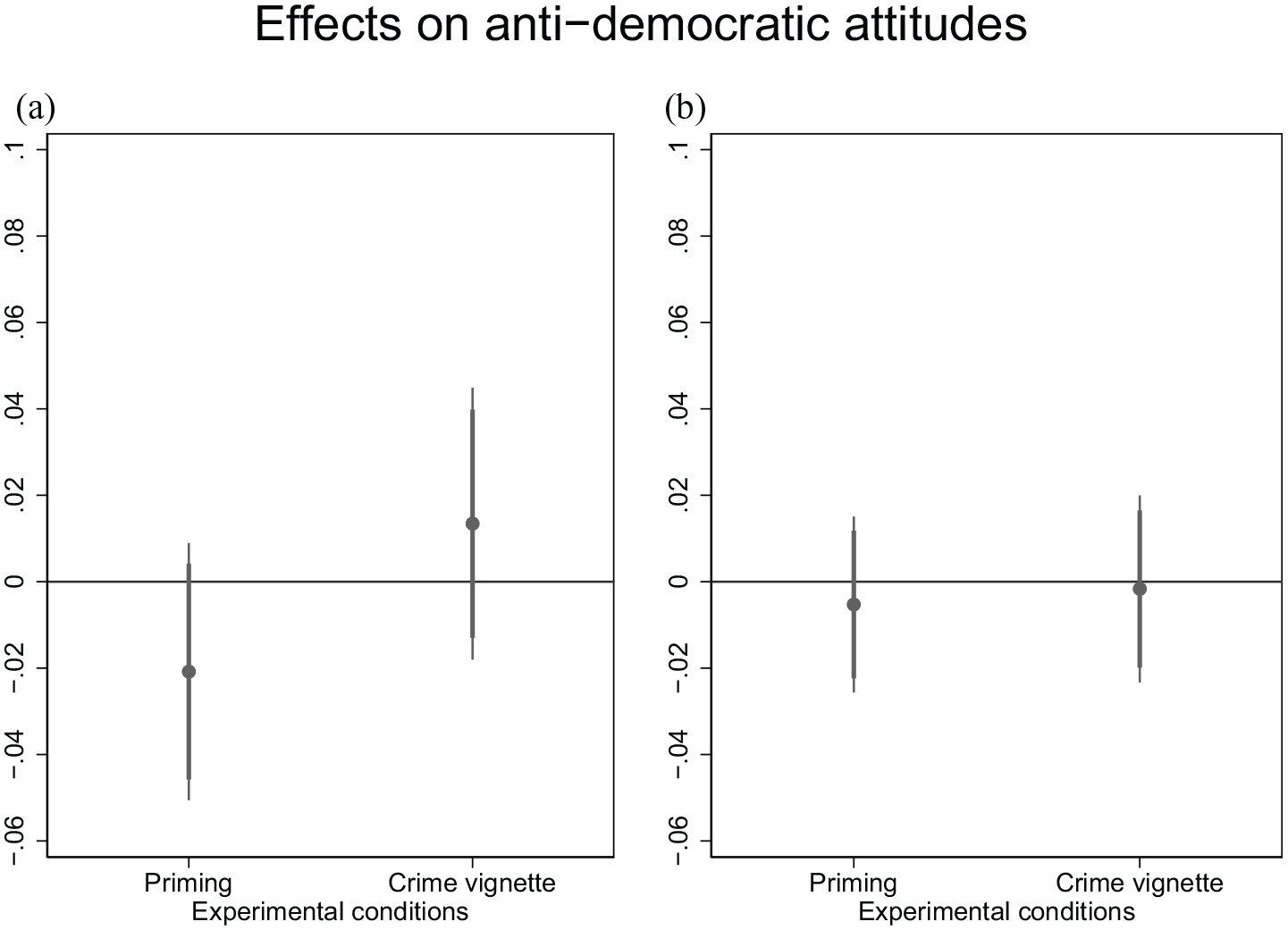
Experimental effects on antidemocratic principles: (a) military/executive coup justified, and (b) democracy NOT best form of government.
To further explore our claim that, via democratic decoupling, supporting a measure (unlawful enforcement) that undermines one important dimension of democracy (the rule of law) does not necessarily imply that people are less supportive of democracy across the board, we examine whether our manipulations shape support for democratic governance in general. As shown in Figure 2(b), exposure to crime does not make people less supportive of the idea that democracy is the best form of government. These null effects further support Hypothesis 2. 12
One might reasonably expect that the observed effects are influenced by political affiliation, with supporters of ‘tough-on-crime’ candidates driving the support for unlawful enforcement. To investigate this, we disaggregate the results of the informational treatments, distinguishing between supporters of then-president Jair Bolsonaro and those backing other candidates or parties (Figure A3 in Online Appendix). Interestingly, our findings reveal that the priming primarily influenced non-Bolsonaro supporters, while Bolsonaro supporters remained unaffected. This could be due to a ceiling effect, as Bolsonaro supporters probably already strongly supported unlawful enforcement, leaving little room for further shifts in their attitudes.
Observational results
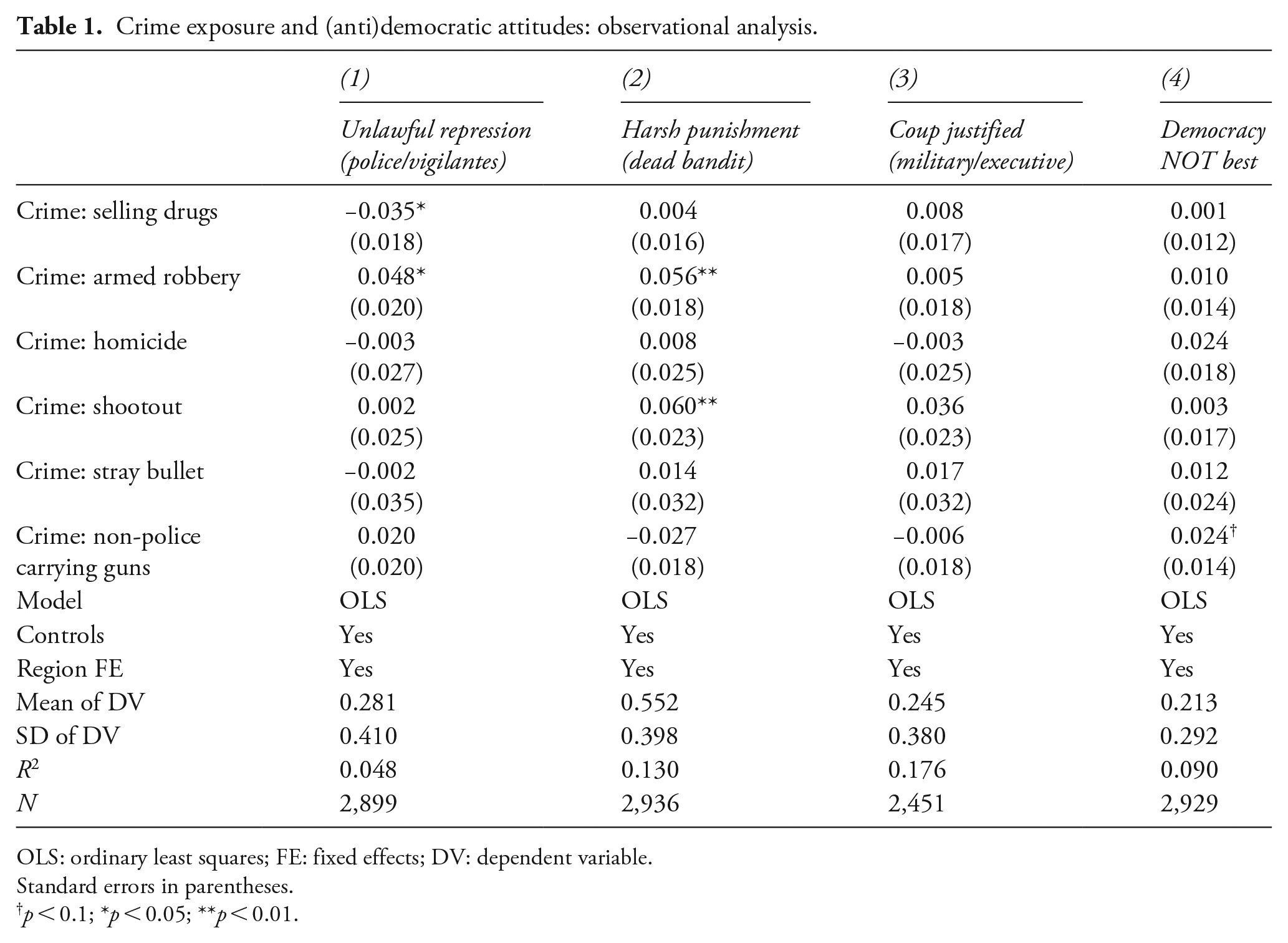
We supplement the above evidence with observational analysis. In line with Hypothesis 1, we observe that individuals who report often witnessing some form of crime in their neighborhoods support unlawful enforcement by state and non-state actors more than those who rarely or never do so. Furthermore, they also tend to agree more strongly with the phrase ‘A good bandit is a dead bandit’ (see Table 1; each column corresponds to a separate outcome measure). 13
Crime exposure and (anti)democratic attitudes: observational analysis.
OLS: ordinary least squares; FE: fixed effects; DV: dependent variable.
Standard errors in parentheses.
p < 0.1; *p < 0.05; **p < 0.01.
Our observational analysis also reveals a clear pattern of democratic decoupling: people often exposed to crime in their neighborhood and who support anticrime measures that undermine the rule of law are not necessarily less supportive of procedural democracy or democracy in the abstract. They are not more likely to justify a military or executive coup in light of widespread crime (see column 3 of Table 1) and are no less supportive of the idea that democracy is the best form of government (see column 4 of Table 1). These results lend further support to Hypothesis 2.
However, as Table 1 shows, our observational data indicate that not all crimes matter equally. Specifically, exposure to armed robberies is uniquely associated with greater support for both unlawful enforcement and harsh punishment. This is unsurprising, as armed robberies are a particularly shocking form of violence that is both deliberate and relatively widespread, affecting the broader population more directly. While other forms of criminal violence – such as homicides, open shootouts and stray bullets – can also be shocking, they tend to be less intentional, less frequent and more geographically concentrated. These incidents often occur in specific areas, such as favelas in Rio de Janeiro, and primarily affect individuals closely connected to those contexts, limiting their broader societal impact compared to armed robberies. This finding aligns with recent studies showing that Brazilians are particularly concerned about forms of violence that intentionally target large segments of the population and, consequently, are more willing to support repressive strategies to reduce them (Masullo and Morisi, 2024a).
Furthermore, our data reveal that exposure to open shootouts is associated with support for harsh punishment but not for unlawful repression. This may be because, although open shootouts rarely target the general population – as they arisie primarily from clashes between criminal organizations or between these groups and the police – they severely disrupt residents’ daily lives when they occur (Barnes, 2017, 2025). It is, therefore, reasonable that individuals exposed to such violence would demand severe punishment for those responsible. However, the lack of an association between shootouts and support for unlawful repression is puzzling and warrants further investigation.
Finally, we also see that witnessing drug retail is associated with less support for unlawful repression. This might be the case because, unlike armed robberies or open shootouts, people do not see this criminal activity as a central threat and, therefore, might deem unlawful enforcement unnecessary or disproportionate. Cracking down on low-level drug dealers, often seen as relatively less threatening and reliant on dealing for subsistence, could be perceived as counterproductive, potentially escalating violence or pushing them to engage in more serious crimes (Lessing, 2017). This conjecture is supported by the fact that, unlike armed robberies, there is no positive association between drug-selling and support for harsh punishment. 14
These observational analyses enabled us to examine correlations between outcomes and actual exposure to crime, thereby validating our experimental results against self-reported crime exposure data. We also combined these data on crime exposure with the ordering experiment to explore whether priming crime exposure has different effects depending on individuals’ actual exposure to crime. Doing so is important as, on the one hand, individuals with greater real-life exposure might experience amplified fears when primed to think about crime; on the other, for those exposed to crime on a daily basis, crime may already be so salient that additional priming has little to no effect. Interestingly, we find that salience increases support for unlawful enforcement even among individuals who are not directly exposed to crime but are prompted to think about the crime problem more broadly (see Online Appendix A.4). This pattern carries important implications for understanding the potential effects of various campaign strategies and how some political actors can manipulate fears of crime.
Does the type of crime matter?
Recent scholarship has begun to examine how different types of crime affect people’s social and political attitudes and behaviors (Berens and Dallendörfer, 2019; Berens and Karim, 2024; Nussio, 2019). Similarly, research on the determinants of punitiveness has highlighted that the type of crime significantly shapes citizens’ preferences for punitive responses (Bonner, 2019; Laterzo, 2023; Martinez Barahona and Linares Lejarraga, 2011; Rueda and Stegmueller, 2016). However, the findings within this emerging body of work remain somewhat mixed.
We use our vignette manipulation, which distinguishes between petty and organized crime, to explore these potentially differential effects. 15 Our results show that exposure to organized crime does not increase support for unlawful enforcement more than exposure to petty crime. Receiving information on both types of crime makes people more supportive of state and non-state unlawful enforcement (Figure 3(a)). Support increases by 4 percentage points (0.10 standard deviations) when information is about petty crime and 4.5 percentage points (0.11 standard deviations) when it is about organized crime. This small difference between the effects of petty and organized crime is not statistically significant. Similarly, we do not see differential effects on support for harsh punishment. Information about either type of crime does not significantly affect agreement with the statement, ‘A good bandit is a dead bandit’ (Figure 3(b)).
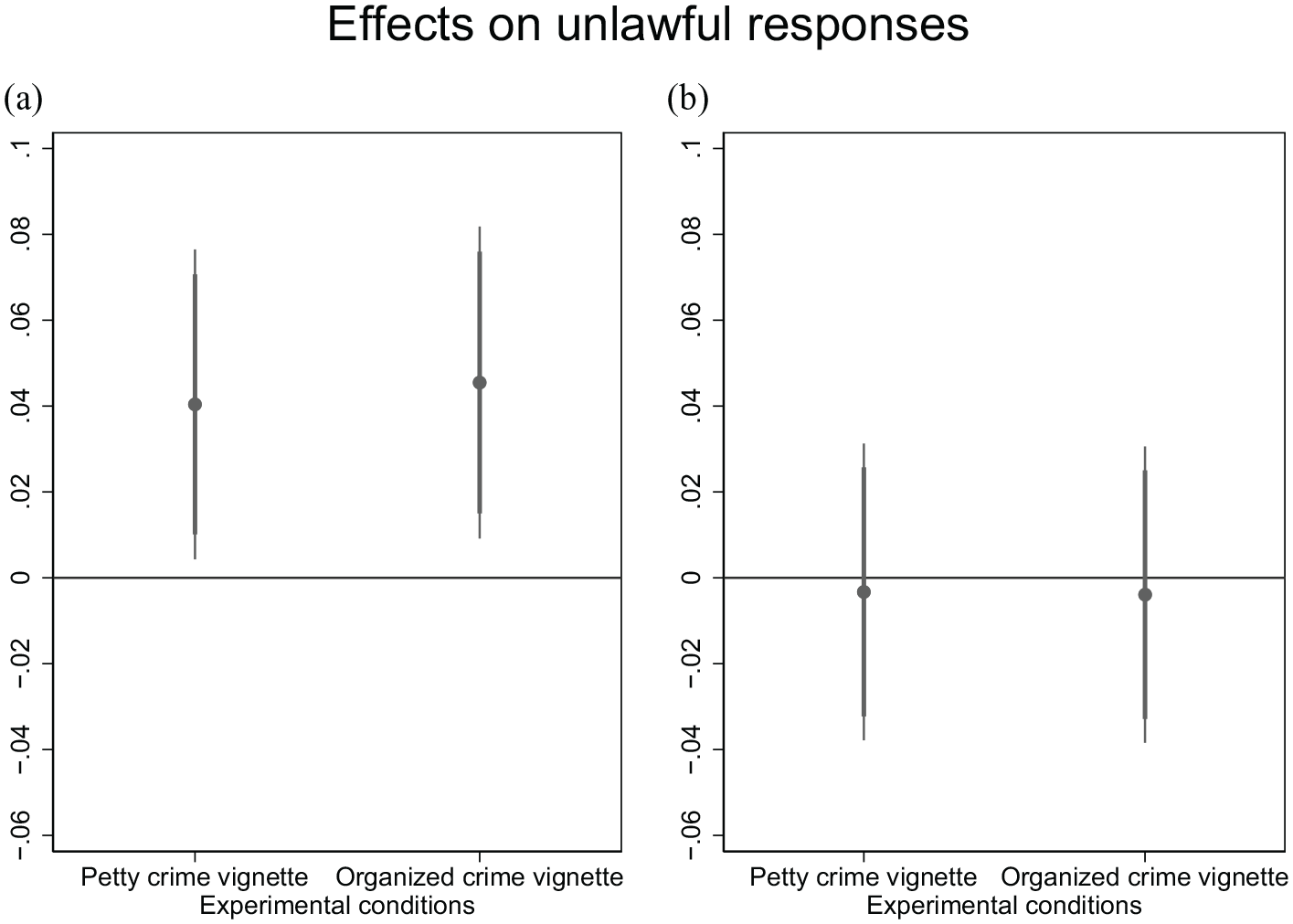
Experimental effects on unlawful enforcement. Disaggregated types of crime: (a) police/vigilante can overstep the law, and (b) ‘A good bandit is a dead bandit’.
In line with our main argument, while exposure to information about the prevalence of either petty or organized crime increases support for unlawful enforcement, it does not affect people’s support of fundamental democratic procedures or democracy in the abstract (see panels A and B in Figure A1 in the Online Appendix). Overall, this analysis strongly suggests that the effects of both petty crime and organized crime on political preferences are largely comparable. These results are further confirmed by focusing on a subsample of subjects assigned to the control condition in the question-ordering manipulation. Among respondents who read the outcome questions before the crime questions, information about petty or organized crime in their neighborhoods has a comparable effect on support for unlawful enforcement without affecting other democratic preferences (see Online Appendix A.3).
Our observational analysis also challenges the differential effects hypothesis, as the evidence regarding the impact of petty versus organized crime remains mixed. We asked respondents to identify whether they believed petty criminals or organized criminal groups were responsible for the types of crime they witnessed in their neighborhoods. This provided a measure of how individuals perceive and associate different crimes with either petty or organized criminal activity (see Online Appendix Figure A6). We find that witnessing crimes that a majority of our respondents associate with organized crime (e.g. open shootouts) is correlated with some measures of support for unlawful enforcement. But so is exposure to armed robberies, the crime that a majority of our respondents associate with petty crime.
In Online Appendix A.6, we explore an alternative approach to categorizing crimes – by their monetary consequences – and again find evidence suggesting that this difference does not influence the effects on (anti)democratic preferences. Figure A4 in the Online Appendix, in turn, disaggregates the effect of our experiment by Brazilian cities where the nature of crime plausibly differs. Again, we find little evidence of heterogeneity. Online Appendix A.7 attempts to disentangle the effects of the severity of crime from its perceived perpetrator using observational data. The perceived perpetrator does not seem to affect the results.
Conclusion
We studied the complex interplay between crime and democratic attitudes. The conflicting findings in existing research prompted us to take a more nuanced approach to the potential effects of exposure to crime on (anti)democratic preferences. Embracing an understanding of democracy as a system comprised of various dimensions that can advance or retrench independently of each other (Dahl, 1972; Diamond, 2015), and building on the idea of democratic decoupling as a form of backsliding (Ding and Slater, 2021), we distinguished between two dimensions of (anti)democratic preferences that could be affected by exposure to crime: support for unlawful enforcement and support for democratic procedures.
Through an extensive online survey in Brazil, we found that exposure to different forms of crime increases support for unlawful enforcement measures, such as police overreach, harsh punishment and vigilante justice, which can seriously undermine the rule of law and, consequently, profoundly weaken democracy. In the Introduction to this special issue (Ruggeri et al., 2025), following a long tradition of democratic thought, the editors rightly stress that the only form of legitimate violence in a democracy is that exercised by governmental actors within the confines of the rule of law. Our study, concerningly, shows that under certain conditions, there is popular support for state violence that exceeds these legal boundaries. Yet, we also find that popular support for unlawful enforcement does not translate into greater backing for military coups or executive aggrandizement, nor does it undermine support for democracy in general. As Bakke et al. (2025) find for wartime, exposure to crime does not undermine support for democracy across the board. People might well support measures that undermine the rule of law, while sticking to other core democratic principles and procedures. By documenting this nuanced relationship between crime exposure and (anti)democratic preferences, we make a valuable contribution to the debate on the effects of violence on democracy.
Democratic backsliding has become a defining trend in global politics (Carothers and Press, 2022). In Latin America, partly due to the presence of criminal organizations and emboldened security forces, democracy is at its weakest since the late 1980s (Mainwaring and Pérez-Liñán, 2023). Understanding the effects of crime exposure on democratic preferences is, thus, urgent. Crime fuels support for policies that weaken democratic governance, politicians exploit insecurity to boost electoral performance, and elected officials expand executive powers and empower security forces to fight crime. While Brazil exemplifies these dynamics well, there is evidence of similar democratic decoupling across the region (see Online Appendix A.11), where voters have supported antidemocratic candidates, including ex-dictators and military figures accused of human rights abuses, driven by promises to combat crime at any cost (Bateson, 2022; Daly, 2022; Seligson, 2002; Wolf, 2017). The democratic decoupling observed in Brazil is deeply concerning. It suggests that people might be happy to either accept limited forms of democracy or remain primarily committed to its label, as long as crime is aggressively addressed. If we accept that managing conflict through nonviolent means is a fundamental role of democracy (Przeworski, 2019), seeing people using democratic channels (e.g. elections and referenda) to call for more – and extralegal – violence to deal with crime, makes it clear that we are undergoing a serious crisis of democracy.
Weak commitment to the rule of law reflects the fragility of democracy’s institutional guardrails and constraints on power, key aspects of contemporary democratic erosion (Carothers and Hartnett, 2024). However, our findings also offer a glimmer of hope, particularly when compared to studies claiming, explicitly or implicitly, that crime fosters authoritarian preferences across the board. A citizenry that still values core democratic procedures and democracy as a system in the face of high crime, may help prevent further democratic decline. Educating the public on the harms of iron-fist, militarized and unlawful enforcement (Flores-Macías and Zarkin, 2024; Masullo and Morisi, 2024b), the frequent collusion between state armed actors and criminal organizations in the name of “fighting” crime (Córdova and Tiscornia, 2025), and the long-term risks to democratic stability (Masullo and Morisi, 2025) could reduce support for short-term security measures and tough-on-crime politicians that threaten democracy.
Supplemental Material
sj-pdf-1-jpr-10.1177_00223433251347792 – Supplemental material for Does crime breed authoritarianism? Crime exposure, democratic decoupling and political attitudes in Brazil
Supplemental material, sj-pdf-1-jpr-10.1177_00223433251347792 for Does crime breed authoritarianism? Crime exposure, democratic decoupling and political attitudes in Brazil by Juan Masullo, Krzysztof Krakowski and Davide Morisi in Journal of Peace Research
Footnotes
Acknowledgements
We are grateful to the editors of Journal of Peace Research and three exceptional reviewers for their excellent comments. We also thank Ursula Daxecker, Andrea Ruggeri, and Neeraj Prasad for inviting us to the workshop ‘Political Violence in Democracies’ at the University of Amsterdam (February 2024), for including us in this special issue and for their guidance during the revision of this paper. Participants in seminars at the University of Amsterdam, University of Cartagena (Colombia), and University of Bologna, and members of the Amsterdam Conflict Research Network provided valuable feedback on earlier versions of this article.
Replication data

Funding
The authors disclosed receipt of the following financial support for the research, authorship, and/or publication of this article: This research received generous financial support from the Institute of Political Science, Leiden University.
Notes
JUAN MASULLO, b. 1985, PhD in Political Science (European University Institute); Assistant Professor, Leiden University (2020
KRZYSZTOF KRAKOWSKI, b. 1988, PhD in Social and Political Science (European University Institute); Assistant Professor, King College London (2024–present); research interests: intergroup conflict and cooperation, organized crime.
DAVIDE MORISI, b. 1983, PhD in Political Science (European University Institute); Associate Professor, Southern Denmark University (2023–present); research interests: political behavior, public opinion, and democratic representation.
References
Supplementary Material
Please find the following supplemental material available below.
For Open Access articles published under a Creative Commons License, all supplemental material carries the same license as the article it is associated with.
For non-Open Access articles published, all supplemental material carries a non-exclusive license, and permission requests for re-use of supplemental material or any part of supplemental material shall be sent directly to the copyright owner as specified in the copyright notice associated with the article.
