







Abstract
Keywords
Introduction
Most of the criminological research on employment and crime has examined the impact of acquiring stable or quality employment among individuals who are traditionally difficult to employ, such as those with criminal records or have little human capital. Theoretically, employment can engender conformity and serve as a “turning point,” or deflection, in one's criminal career by structuring one's routine activities and strengthening conventional social bonds (Sampson and Laub 1993; Uggen 2000). However, when individuals engage in workplace crime, these arguments become insufficient, revealing a narrow conceptualization of the employment and crime relationship. In fact, rather than suppressing criminal behavior, employment may provide unique opportunities to engage in crime. Understandably, the focus on uncovering the more nuanced relationship between employment and crime has deep roots in criminological theory and is attractive for informing policy and re-entry programming. However, the focus on work as a “turning point” has led scholars to overlook crime that occurs at the workplace, which can be defined as “offenses committed by individuals for themselves in the course of their occupations and the offenses of employees against their employers” (Clinard and Quinney 1973). As such, studying workplace crime provides an opportunity to contribute to two key streams of literatures: employment and crime and the generality of criminal behavior.
To the degree that employment can provide unique opportunities to engage in criminal conduct, assessing its characteristics can add commentary on the generality of criminal behavior. Blumstein et al. (1988) argued that the extent to which offenders display generality or specificity in crime types has important theoretical and policy implications. Considerable attention has been devoted to assessing crime-type generality: determining whether individuals primarily engage in one particular type of crime (e.g., violence) over others (e.g., theft) or if instead, individuals have a tendency to engage in a general repertoire of criminal activity (Osgood et al. 1988). Less attention has been devoted to assessing whether individuals engage in crime across a variety of different settings, what we call contextual generality in criminal behavior. Theoretically, some of the most seminal theories in the field of criminology make predictions about the extent to which generality exists (i.e., Gottfredson and Hirschi 1990; Moffitt 1993; Sutherland 1947) as it pertains to both offending across types of crime and offending across types of contexts. For example, a handful of theories would suggest that workplace crime is a behavioral manifestation of a set of relatively stable characteristics that should also reveal themselves in crime both inside and outside the workplace (e.g., Gottfredson and Hirschi 1990; Moffitt 1993). Other theories provide explanations on why individuals would only engage in crime in a specific setting (e.g., Agnew 1992; Sutherland 1947; Warr 2002).
We use data from the National Youth Survey (NYS) and supplement with the Youth Development Survey (YDS) and the Pathways to Desistance Study (Pathways) to answer three research questions. First, to what extent is there an overlap between workplace crime and street crime? Second, do certain individuals have a greater tendency to engage in workplace crime relative to street crime? Third, if so, what factors are related to a greater tendency to engage in workplace crime relative to street crime? We are guided by several theoretical traditions, including trait-based perspectives and socialization perspectives related to the contextual generality of criminal behavior. Using multinomial logistic regressions, item response theory, and ordinary least squares (OLS) regression models, we find most people who commit work crimes also commit a street crime but not vice versa. As a latent trait, we find that there is a tendency for some respondents to specialize in workplace crime relative to street crime.
Workplace Crime and the Generality of Crime
The workplace is an especially important setting for the study of crime and deviance. In the most basic sense, understanding the nature of workplace crime contributes to prevention and reduction efforts. Workplace crime results in billions of dollars annually lost for industries from fast food restaurants, retail shops, and hospitals (Hollinger 1986; Hollinger et al. 1992). Estimates in prior literature demonstrate that over two-thirds of workers engaged in some form of employee theft, unnecessary sick leave, or use of substances while at work (Green 1997; Hollinger and Clark 1983). The precise impact of workplace crime can be difficult to identify due to a lack of records or the inclusion of workplace and street offenders in the same offense categories in official data (Benson and Chio 2019). However, research has made clear that employee workplace deviance incurs significant costs in both productivity and profit (Bennett et al. 2018)—the U.S. Department of Commerce identifies workplace deviance as a cause of approximately one-third of U.S. organizational bankruptcies (Marasi et al. 2018).
There is a small criminological literature that has investigated workplace crimes, but most often this has been done in insolation from street crime. In a series of studies, Hollinger and colleagues draw from classic theoretical perspectives such as social control (Hollinger 1986), deterrence (Hollinger and Clark 1983), and techniques of neutralization (Hollinger 1991; see also Miller and Gaines 1997) to examine the correlates of what they term “production of deviance” (misbehavior at the workplace) and workplace crime (crimes against the property or assets of the employer) with a sample of over 9,000 adults employed in the retail, hospital, and manufacturing industries. Overall, Hollinger found that measures from traditional criminological perspectives are correlated with workplace crime, suggesting that the underlying processes leading to workplace crime overlap with those leading to street offending. Huiras, Uggen, and McMorris (2000) analyzed data from the YDS through the lens of career stakes in conformity, or investment in the workplace, and engagement in workplace deviance. The authors found that the lack of both stakes in conformity and job satisfaction increased the probability of workplace misconduct. Huiras et al. (2000) control for street deviance in their models but do not investigate the extent to which there was an overlap of workplace crime and street crime. Wright and Cullen (2000) examine workplace crime among a sample of high school students and find that workplace crime was related to deviant co-workers, which is amplified by criminal propensity. Jaynes et al. (2022) look at the direction and magnitude of the relationship between workplace crime and street crime and find a moderate and positive relationship between workplace crime and street crime, which is moderated by job quality. Still, the relative dearth of research on workplace crime and the general tendency to consider it in isolation from more common forms of offending raise several questions about the unique anatomy of workplace deviance, its overlap with street crime, and whether the factors related to crime in the workplace are similar to those of street offending. Of particular interest is the extent to which there is overlap among individuals who engage in workplace and street crime—that is, whether individuals tend to be contextual “generalists” in their offending or if some individuals have a unique proclivity for engaging in workplace deviance, and whether the factors that promote offending at work are similar to those that promote street offending.
Research into the generality of crime has been a cornerstone of inquiry in criminal career research (Blumstein et al. 1986; Piquero et al. 2003) Piquero et al. 2003), which can serve as a platform to test key theoretical ideas (Thomas 2016; Thomas et al. 2020) and helps inform policies surrounding incarceration and correctional treatment (Sullivan et al. 2006). Predominant examinations of the generality of criminal behavior have focused almost entirely on the generality of criminal behavior across crime types—for example, violence versus property offenses (Osgood and Schreck 2007). Indeed, scholars have worked hard to unpack the extent to which specialization in specific types of crime exist, and the correlates associated with variation in the tendency to specialize in offending (Osgood and Schreck 2007; Sullivan et al. 2009). Although the focus on crime-type generality/specialization has provided considerable insights into the etiology of offending, we argue that much can be gained by moving beyond just the tendency to specialize in crime types to assessing the tendency to specialize in offending across contexts, as this can provide additional commentary on the nature of criminal behavior.
The theoretical debates between theories of population heterogeneity (Gottfredson and Hirschi 1990; Wilson and Herrnstein 1985) and theories that allow for specific types of offending such as illicit drug use, instrumental crimes, or violence are also applicable when examining contextual generality (see also Moffitt 1993). Several theories would suggest that workplace crime is a behavioral manifestation of a set of relatively stable characteristics that should also reveal themselves in crime outside the workplace (e.g., Gottfredson and Hirschi 1990; Moffitt 1993). From this view, individuals who engage in workplace deviance should commit crimes on the streets, and vice versa. Other theories, especially theories deriving from learning and strain traditions, offer explanations that allow individuals to exhibit contextual specificity as it pertains to offending (e.g., Agnew 1992; Anderson 2000; Warr 2002). As we will detail further below, a central idea in both differential association (Sutherland 1947) and strain (Agnew 1992) theories is that primary risk factors for crime (e.g., definitions favorable to crime and negative emotionality) can be context-specific and thus some individuals may be particularly inclined to engage in crime in some contexts but not others. To date, most research has tested these competing explanations by assessing whether individuals have a specific proclivity towards engaging in types of crime. Extending empirical analyses beyond crime types to assess contextual generality provides an opportunity to add direct commentary to the veracity of these theoretical propositions.
Beyond the potential contributions to theory, assessing the contextual generality of crime is a line of inquiry that can be used to inform reentry employment policies and programs. Finding a job is one of the most difficult challenges associated with individuals with a criminal record (Agan 2017; Pager 2003). Considerable consternation exists among employers to hire individuals labeled as an “offender.” One of the reasons for this is the risk of repetition of future misconduct and employer liability related to such misconduct (Holzer et al. 2006; Sugie et al. 2020). Recently, Sugie et al. (2020) conducted an experimental employer survey to evaluate fictitious applicants with criminal records compared to applicants without criminal records but with risk-taking behaviors, conveyed through social media. Sugie et al. (2020) found evidence for employers’ reluctance to hire individuals with a criminal record due to fear of continued risky behavior at the workplace and the stigma associated with a criminal record. We argue that understanding the extent to which crime at the workplace is part of a larger repertoire of antisocial behaviors, or if it is contextually specific, can supplement the extant literature on the barriers to employment and the assessment of the risk of hiring individuals with a criminal record (e.g., Blumstein and Nakamura 2009; Bushway et al. 2011; Denver et al. 2017). To be sure, if there is evidence of contextual specificity, that can assuage some fears of the risk of antisocial or criminal behaviors at the workplace; hence reducing risk and liability for employers who are deterred from hiring individuals with a criminal record.
Explanations for Contextual Generality and Specificity
Some of the criminology's seminal theorists have explicitly discussed generality across contexts (e.g., Gottfredson and Hirschi 1990; Moffitt 1993) while other theorists provide explanations that are conductive to (or at least allow for) contextual specificity (Sutherland 1947; Warr 1993).
Contextual Generality
The concept of behavioral coherence or heterotypic continuity is one of the cornerstones of trait-based theories. Heterotypic continuity is the idea that a latent attribute underlies a diverse but conceptually similar set of behaviors (Caspi and Bem 1990). For example, Caspi et al. (1987) assert that personality characteristics in childhood (e.g., ill-tempered behavior) will not only appear across time but will be manifested in a number of diverse situations. Similarly, Moffitt (1993) argued that life course persistent offenders (LCP)—whose offending is primarily a result of a stable underlying trait—tend to demonstrate cross-situational continuity in their antisocial tendencies. Moffitt argued that antisocial behaviors express themselves in various ways, as individuals gain new opportunities for criminal and antisocial behavior. Moffitt (1993) wrote, “LCP antisocial persons lie at home, steal from shops, cheat at school, fight in bars, and embezzle at work” (p. 679). 1 Thus, from these theoretical perspectives we should expect there to be a high-level of generality across contexts—individuals who offend on the “streets” should also commit crimes at work when the opportunity is present. Continuity across contexts has a theoretical import for the current study because it suggests that the positive correlation between workplace crime and street crime is due to a cluster of characteristics that manifest themselves through multiple ways, across many contexts.
In their self-control theory, Gottfredson and Hirschi (1990) argued that a person's level of self-control predisposes them to engage in a variety of criminal behavior and analogous acts. For Gottfredson and Hirschi (1990), offenders have little control over their impulses and “seem to do just about everything they can do; they do not specialize in … crime” (p. 190). They note that “there is a general tendency to engage in a wide variety of offenses, including legal and illegal drug use, to manifest behavioral problems in school and occupational settings, to have difficulty making and retaining friends and to be involved in a variety of accidents” (Hirschi and Gottfredson 1995:134, emphasis added). Workplace crime and street crime share commonalities that appeal to individuals—they can be done rapidly, are pleasurable, and require minimal effort. Work simply provides opportunities and access to engage in crime at the workplace and theoretically differentiating crimes at the workplace from street crime is of little value (Hirschi and Gottfredson 1987).
There exists some empirical evidence in developmental psychology demonstrating support for the idea of heterotypic continuity (e.g., Chen and Jaffee 2015; Patterson 1993; Petersen et al. 2015), but this work has focused predominately on antisocial behaviors committed in and outside of school. Developmental research on bullying behaviors finds that bullying significantly predicts involvement in general delinquency (Farrington et al. 2011; Walters and Espelage 2018) and that bullying and low self-esteem predicts delinquency among both boys and girls (Rigby and Cox 1996). Humphrey and Vaillancourt (2020) find evidence for the heterotypic continuity hypothesis in that bullying behavior remains stable throughout grades 5–11 and predicts later engagement in sexual harassment, homophobic taunting, and dating violence. Basile et al. (2009) link bullying perpetration to sexual violence, attributing both behavioral manifestations to individual-level factors such as personality and learned behavior. Research on cyberbullying also finds significant continuity in bullying behaviors across the school and cyber contexts among adolescents (Gradinger et al. 2009), and that these behaviors share many of the same predictors (Casas et al. 2013). Altogether this research supports heterotypic continuity in antisocial behaviors during the early stages of development.
While we do not directly assess the correlates posited to be manifested by criminal behavior across contexts, such as personality traits and self-control, we invoke trait-based theories to acknowledge that some scholars argue that there is no qualitative difference in what context an individual commits a crime. Simply, a cluster of traits manifest through multiple ways and therefore we should expect there to be generality across contexts.
Contextual Specificity
Some theoretical perspectives either explicitly or implicitly suggest that there likely is some degree of contextual specialization in the manifestation of antisocial acts. Consider, for example, Sutherland's (1947) differential association theory. A core concept in Sutherland's perspective is that behaviors are a function of one's definition of the situation. The central idea is that individuals interact in and interpret contextual environments when determining the appropriateness of behavior. In this way, the learning process outlined by Sutherland can be context specific such that individuals can come to hold definitions, or attitudes, favorable to crime in some contexts (e.g., work) but generally hold definitions unfavorable to crime in others (Warr 2002).
Most tests of the differential association have examined delinquent peer influences and have generally found that associations with deviant peers are one of the most robust and persuasive correlates of crime (McGloin and Thomas 2019; Pratt et al. 2010). Deviant peer influence has been extensively studied in a number of domains but less examined, and particularly relevant for this study, is that it is at least implied in the learning tradition that individuals learn attitudes and justifications for specific situations, rather than generalized attitudes and rationalizations across all situations (Thomas 2019). Indeed, as Cressey (1986) noted, “People also promote a whole host of ideas which justify and thus encourage criminality under certain circumstances [emphasis added]” (p. 196), yet with exceptions, most research testing learning tradition ideas have simply assessed “social influence” and “attitudes” generally and without specifying the reference groups and contexts in which behavior occurs. Still, there is some evidence to suggest that the differential association process might be context specific. Thomas (2018) assessed individuals’ attitudes towards violence and theft and found that the degree of approval of behavior was highly contingent on situational and contextual factors (see also Pogarsky and Herman 2019). A central characteristic of deviance in this tradition, then, is the idea that it depends on the social context, namely, on a reference group, that provides the norms to which a person's behavior either is compliant or deviant. Individuals can have multiple reference groups that emphasize different normative standards (Thomas and O’Neill 2021). Indeed, Warr (1993) described deviant peers as providing a potentially alternate moral universe where moral codes and acceptable behaviors are relative to each specific group. Warr (1993) argued that there is a recognition that what is permissible in one group (e.g., stealing) may not be appropriate in another. Thomas and O’Neill (2021) drew on symbolic interactionist principles to assess how competing identities across reference groups influences individuals’ behavioral tendencies. They found that when individuals had competing views of themselves in different reference groups—for example, identities as “conforming” with parents but a “rule violator” with friends—people offended less frequently when compared to individuals who held identities consistent with rule violation across both reference groups. From the learning and interactionist traditions, then, it is possible that co-workers provide one reference group and friends provide another reference group and individuals have differential influences in the workplace and elsewhere.
The general strain perspective has also been invoked to explain why individuals may have a unique tendency to engage in crime at work. This view highlights job stress as a factor that can motivate workplace crime, but likely to be unrelated to crime outside of work (e.g., Douglas and Martinko 2001; Fox et al. 2001; Lee and Allen 2002; Omar et al. 2011). Job stress is defined as an emotional experience that is connected with anxiety and uneasiness that stems from a job or occupation (Cooke and Rousseau 1984). General strain theory (Agnew 1985, 1992) posits that stresses and strains produce negative affect and some individuals use crime is a corrective action taken to relieve the negative affect. In line with the original propositions in general strain theory, research demonstrates that the type and context of crimes are specific to the types of stress experienced. De Coster and Kort-Butler (2006) study “domain determinacy,” which is the extent to which specific conditions determine the specific form of deviant adaptations. They conducted a survey with a sample of middle schoolers about stress and delinquency and found that stress occurs in specific contexts—family, peer, and school—and exert the strongest influence on delinquency in those respective contexts. Felson et al. (2012) considered whether specific crime types were associated with specific sources of stress. Using a sample of incarcerated males, the authors found that criminal behavior is a focused response to specific types of problems rather than a general response to stress. These studies suggest that individuals who experience more stress at the workplace are more likely to engage in workplace crime.
Hypotheses
The literature reviewed above lends itself to four hypotheses. First, there are a handful of theories that directly suggest that crime is a behavior that is general across contexts (e.g., Gottfredson and Hirschi 1990; Moffitt 1993). From this perspective, one would hypothesize:
H1: Respondents who engage in workplace crime will engage in street crime, and vice versa.
Alternatively, other theoretical perspectives allow for context specificity (e.g., Sutherland 1947; Warr 1993). These theorists would hypothesize:
H2: There is a tendency to specialize in workplace crime over street crime, and vice versa.
Moreover, these theories discuss specific mechanisms that encourage context-specific offending:
H3a: Perceived deviant coworker/peer disapproval and definitions will be negatively related to workplace crime and the tendency to engage in workplace crime relative to street crime (i.e., workplace specialization in offending).
H3b: High workplace stress will be positively related to workplace crime and the tendency to engage in workplace crime relative to street crime.
Data and Measures
For our main analyses, we analyze data from two waves of the NYS, a longitudinal survey administered to youths in the United States and their parents beginning in 1976 (Elliott 1993). The NYS sample was selected using a multistage cluster sampling design of households in the continental United States. 1,725 youths were recruited for the first wave of the survey and their demographic characteristics are comparable to that of the 11 to 17-year-old population in the United States at the time (Elliott 1993). The scope of the survey encompasses events and behavior in the lives of youth in the United States to inform their conventional and deviant behavior. Sociodemographic characteristic data are included for each participant as well as workplace characteristics, workplace crime, street crime and other deviant behaviors. The survey also includes questions on several theoretically relevant covariates such as percieved coworker/peer disapproval and context specific deviant definitions. The investigators report low levels of sample attrition across waves; while there are some consistencies in ethnicity, class, and place of residence among those who did not continue participation, there is no selective loss relating to self-reported delinquency (Elliott and Huizinga 1983). The data are collected through personal interviews with each participant. These interviews were conducted yearly from 1976–1980 to collect Waves 1–5 and Waves 6 and 7 were collected every three years in 1983 and 1987, respectively. We conduct supplemental analyses with the YDS and the Pathways study and discuss them below.
In the current study, we analyze data from Waves 6 (1983) and 7 (1987) of the NYS. These waves are selected because they are the only waves that measure the same instances of workplace and street crime among the sample. Wave 6 data were collected when respondents were aged 17–26 years old and has data from 1,496 respondents (87 percent of the original sample). Wave 7 data were collected when respondents were aged 20–29 and has data from 1,324 respondents (77 percent). There was a total of 2,877 observations across 1,547 individuals. A total of 433 observations across 368 individuals (15.05 percent) were not employed during the year prior to the interview. We retained only individuals who report having a job given that our key interest is workplace crime 2 and after listwise deletion due to missing values on the covariates, our analytic sample includes 2,356 observations within 1,315 people.
It is important to note that the nature of employment has changed since the NYS was conducted in the 1980s, which can have implications for workplace crime. Beginning in the 1990s, there have been emerging changes in the organization of production and growing technological advances in the workplace. This created less need for certain low-skill jobs and increased the skill level required by employers. At the same time, the service sector has experienced tremendous growth, with many local labor markets transitioning out of low-skilled labor towards service occupations (Autor and Dorn 2013). Although we conduct sensitivity analysis with the YDS and the Pathways, it is important to bear in mind that the changing labor market on workplace crime could impact the types of jobs and opportunities for crime at the workplace.
Measures
Consistent with the classic approach to measuring the prevalence of criminal behavior (Thornberry and Krohn 2000), we have two binary measures of context-specific offending—workplace crime and street crime.
Workplace crime
Workplace crime is a binary indicator “1” if a respondent reports damaging employer property, stealing money from their employer, or hitting someone at the workplace in the past year. The measure is coded “0” if the respondent did not report participation in the workplace crimes listed above.
Street crime
Street crime is a binary indicator “1” if a respondent reports damaging property, stealing something worth > US$50 or worth between US$5 and US$50, buying stolen items, carrying an illegally hidden weapon, attacking another person, using checks illegally, selling drugs, or hitting another person. The measure is coded “0” if the respondent did not report participation in the street crimes listed above.
We have four context-specific measures that tap into the learning perspective—perceived coworker/peer disapproval and work/peer definitions. To the extent that coworkers/peers form context-specific reference groups, each reference group should be important and be related to actions in their specific context. Similarly, individuals learn definitions specific to work and peers and these definitions should be most salient in their respective contexts.
Perceived coworker disapproval
Respondents rated on a five-point Likert scale (1 = strongly approve, 5 = strongly disapprove) how their coworkers would react if they: sold hard drugs, used marijuana, stole something worth more than US$5, hit someone, destroy property, or break into a vehicle. A principal components factor score from the items was constructed for each wave (eigenvalue = 4.03 [W6], factor loadings > .68) (eigenvalue = 3.89 [W7], factor loadings > .63). Higher values are indicative of higher disapproval of the act.
Perceived peer disapproval
Respondents were asked how their friends would react if they: sold hard drugs, used marijuana, stole something worth more than US$5, hit someone, destroy property, or break into a vehicle (1 = strongly approve, 5 = strongly disapprove). A principal components factor score from the items was constructed for each wave (eigenvalue = 3.90 [W6], factor loadings > .67) (eigenvalue = 4.25 [W7], factor loadings > .68). Higher values are indicative of higher disapproval of the act.
Work definitions
Respondents were asked to rate from a scale of 1 to 5 (1 = strongly disagree, 5 = strongly agree) how much they agree or disagree with these statements: At work it's sometimes necessary to break the rules in order to get ahead, if you want your fellow workers to like you, you may have to cover up for them, sometimes you need to lie in order to get a job, and you can make it at work without having to cheat or lie. A factor score was created (eigenvalue = 1.83 [W6], factor loadings > .76) (eigenvalue = 1.79 [W7], factor loadings > .74). Higher values suggest more deviant work definitions.
Peer definitions
Respondents were asked to rate from a scale of 1 to 5 (1 = strongly disagree, 5 = strongly agree) how much they agree or disagree with these statements: You have to be willing to break some rules if you want to be popular with your friends, in order to gain the respect of your friends, it's sometimes necessary to beat up on other people, it's okay to lie if it keeps your friends out of trouble. A factor score was created for each wave (eigenvalue = 1.71 [W6], factor loadings > .70) (eigenvalue = 1.78 [W7], factor loadings > .70). Higher values suggest more deviant peer definitions.
Job stress
We have one item that taps into stress derived from the workplace. Job stress is measured by asking respondents, “How much pressure or stress have you been under at work?” Respondents rated their answers on a 5-point Likert scale (1 = very little, 5 = a great deal). Higher values suggest greater stress at the workplace.
Job satisfaction
Individuals who are satisfied with their job or have higher job quality should be less likely to engage in workplace crime (Jaynes et al. 2022). Job satisfaction is measured by one item that asked respondents how “satisfied you are at their major job.” The answers were based on a Likert scale ranging from 1 to 5 (1 = very dissatisfied, 5 = very satisfied). Higher values indicate greater job satisfaction.
Work commitment
Individuals who have stronger bonds to the workplace as an institution are, theoretically, less likely to engage in workplace and street crime (Huiras et al. 2000; Sampson and Laub 1993). Work commitment is a principal factor score consisting of three items that asked respondents if it was important to have: “success,” “get ahead,” and have “a good job,” (eigenvalue = 1.81 [W6], factor loadings > .71) (eigenvalue = 1.92 [W7], factor loadings > .76). Higher values suggest higher work commitment.
Job instability
According to Laub and Sampson (1993), “job stability, commitment to work, and mutual ties binding workers and employers that should increase social control and, all else equal, lead to a reduction in criminal behavior” (p. 304). We measure job instability by the self-reported total number of jobs in the previous year.
Job type
The type of job can provide differential opportunities to engage in workplace crime (Mars 2019). The NYS uses the Hollingshead occupational codes (Hollingshead 1975) to classify job types. There is a total of seven job types in the NYS: 1 = Executive, proprietor of large businesses, major professional, 2 = Managers, 3 = Administrators, lesser professionals, proprietor of a medium-sized business, 4 = Clerical/sales, small business owners, 5 = Skilled labor, craftsmen, 6 = Semi-skilled labor, machine operator, 7 = Unskilled, service. We combined the first two types (executive, proprietor of large businesses, major professional, and managers) due to few executives/professionals in the sample and retained the other job types.
Perceived neighborhood unemployment
Individuals who perceive fewer opportunities to obtain a job might be less willing to risk losing their job and refrain from workplace crime. Perception of unemployment in the neighborhood was elicited by the question: “Please tell me whether you think each was a problem in your neighborhood or area where you lived for most of last year … unemployment.” Answers were provided based on a 3-point scale (1 = not a problem, 2 = somewhat of a problem, 3 = big problem).
Partying behaviors
One of the key perspectives we invoke to explain contextual generality is Gottfredson and Hirschi's (1990) self-control theory. Unfortunately, the NYS does not contain traditional measures that tap into self-control (e.g., impulsivity, future orientation, etc.). We, therefore, conceptualize partying behaviors as acts analogous to workplace and street crime. 3 We conduct a principal components factor score from three items: respondents reported being “loud or rowdy,” “been drunk,” and “bought liquor for minors” (eigenvalue = 1.68 [W6], factor loadings > .66) (eigenvalue = 1.62 [W7], factor loadings > .64). Higher values suggest greater partying behaviors. 4
Demographic information
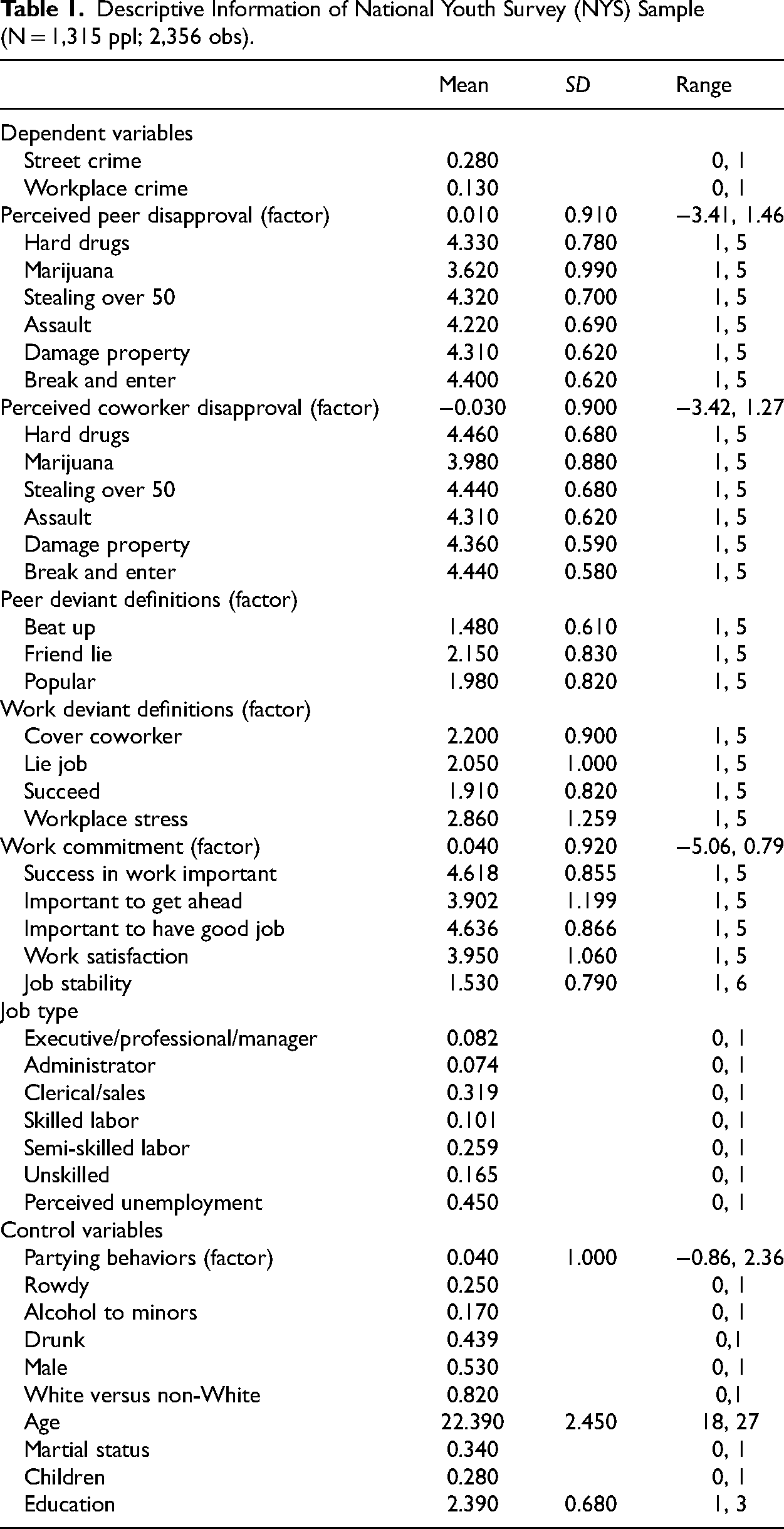
We account for individual respondent demographics including age, sex, and race/ethnicity. Age is a continuous measure whereas sex, marital status, and children are binary variables. Education is measured as three categories indicating whether a respondent's highest level of education is less than high school, a high school degree, or education beyond high school. Table 1 displays the description of the NYS sample.
Descriptive Information of National Youth Survey (NYS) Sample (N = 1,315 ppl; 2,356 obs).
Analytic Plan
Our plan of analysis proceeds in several stages. To answer our first research question, to what extent is there overlap between workplace crime and street crime, we simply examine the prevalence of respondents who report engaging in any workplace crime P(W) and any street crime P(S). This produces joint probabilities of engaging in workplace crime and engaging in street crime P(W∩S). In addition to joint probabilities, we consider the conditional probability of engaging in workplace crime given a respondent engages in street crime P(W|S) and the probability of engaging in street crime given a respondent engages in workplace crime P(S|W). This sheds light on the overlap between contexts of offending and whether offending in one context is related to the probability of offending in the other.
Our second research question focuses on the tendency to engage in workplace crime relative to street crime, which can be thought of as one's proclivity to “specialize” in workplace crime (Osgood and Schreck 2007; Thomas 2015). This question departs from our first research question in that, instead of looking at the prevalence of workplace and street crime, we use an item response theory-based (IRT) model to estimate the latent trait in the tendency to engage in workplace crime relative to street crime. Specifically, we rely on an IRT model developed by Osgood and Schreck (2007)
5
to assess variation in the degree of specialization in specific types of crimes. Mathematically, the framework we employ is identical to the specialization introduced by Osgood and Schreck (2007). But whereas Osgood and Schreck (2007) designed their model to estimate variation in the tendency to specialize in violence, we estimate a model that predicts variation in one's tendency to engage in workplace crime relative to street crime. The Osgood and Schreck (2007) model assessing one's tendency to specialize in violence estimates the odds that individual i endorses crime c through the equation:
Our last research question asks: What factors are related to participation in workplace crime and street crime and a greater tendency to engage in workplace crime relative to street crime? To address this question, we estimate multinomial logistic regression models and ordinary least squares regression models. We pool, or combine, both waves so that each respondent has potentially two observations. Pooling the waves can result in correlation among the error terms, which we correct by clustering the standard errors.
The outcome of our multinomial logistic regression models is coded into four mutually exclusive categories: (1) workplace-only crime (individuals who committed a crime at work but not on the street); (2) street-only crime (individuals who committed a crime on the street but not at work); (3) both crimes (individuals who committed both a workplace crime and a street crime) and; (4) no crime. When estimating this model we include several predictors that may help distinguish respondents in the contexts in which they offend. To estimate our ordinary least squares regression models, we use the saved empirical Bayes mean (
Results
Prevalence, Joint and Conditional Probabilities of Workplace and Street Crime
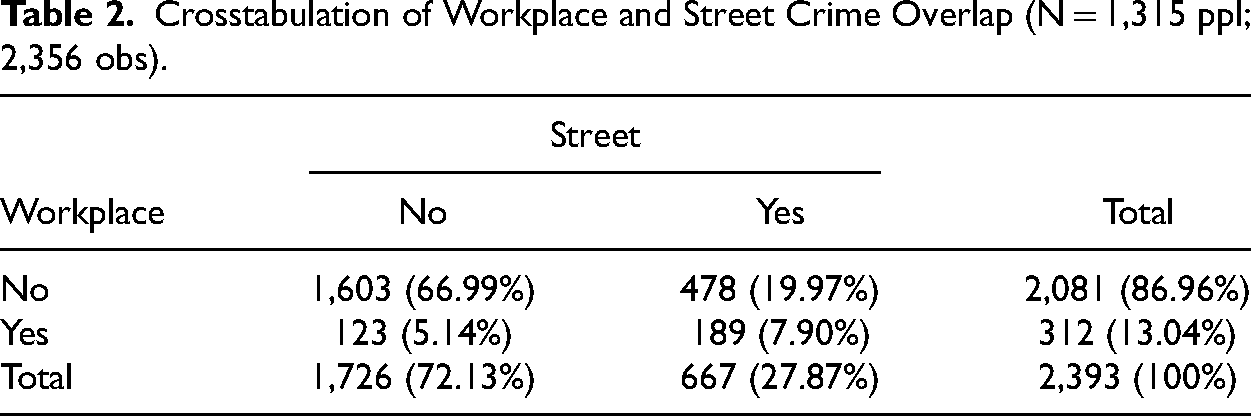
Table 2 shows the prevalence of participation in workplace crime and street crime. As expected with a general sample of this age (17–26), the largest category is neither workplace crime nor street crime (67 percent). Approximately 20 percent of participants in the analytic sample reported engaging in only street crime whereas only 5 percent reported engaging in only workplace crime. The joint probability of engaging in both workplace crime and street crime is 8 percent, suggesting that the tendency of individuals to engage in crime in both contexts is relatively rare. When we calculate the conditional probabilities, the probability of workplace crime conditional on street crime, or P(W|S), is .28, and the probability of engaging in street crime conditional on workplace crime, or P(S|W), is .61. These descriptive results do not support our first hypothesis, which states that respondents who engage in workplace crime will engage in street crime and give us preliminary evidence that workplace crime is less common than street crime. In line with Bayes’ theorem, street crime is more prevalent among individuals who engage in workplace crime compared to workplace crime among individuals who engage in street crime. Given that there is some indication that individuals tend to restrict their offending either to the workplace or the street, we now turn to models that assess individuals’ offending.
Crosstabulation of Workplace and Street Crime Overlap (N = 1,315 ppl; 2,356 obs).
Pooled Multinomial Logistic Regressions: Correlates of Context-Specific Offending
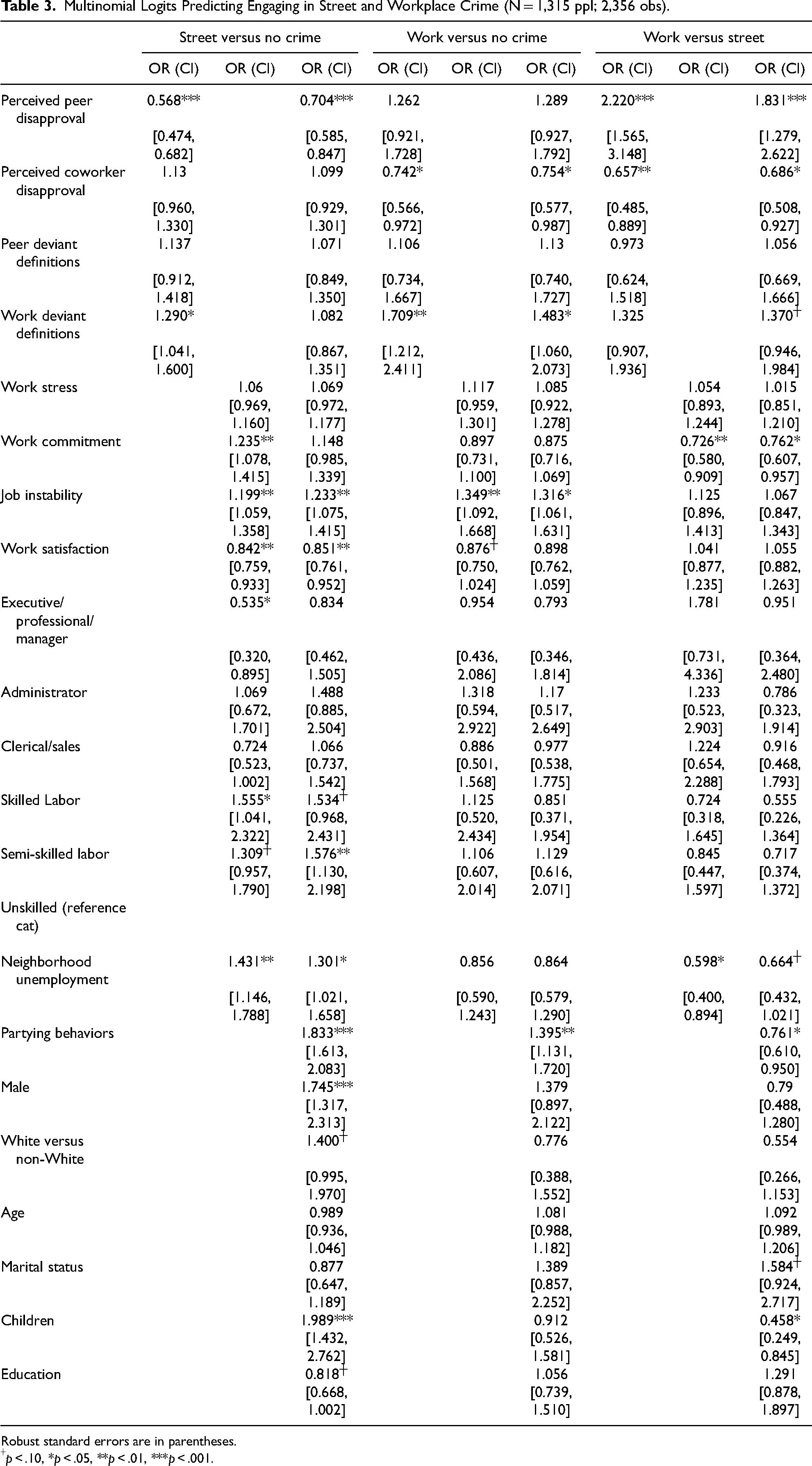
Table 3 displays the results of a series of multinomial logistic regression models, predicting membership in one of the four mutually exclusive categories: only workplace crime, only street crime, both workplace and street crime, and no crime. For each comparison, we first include the perceived coworker/peer disapproval and pro-workplace/street definitions, then we examine our workplace variables, and finally estimate fully adjusted models including all the control variables. Perceived peer disapproval and perceived coworker disapproval are inversely related to engaging in street crime compared to no crime (OR = .70, p < .001) and workplace crime compared to no crime (OR = .76, p < .05), respectively. In terms of engaging in workplace crime compared to street crime, perceived peer disapproval of street crime increases the odds of engaging in workplace crime compared to street crime (OR = 1.83, p < .001) and perceived coworker disapproval reduces the odds of engaging in workplace crime compared to street crime (OR = .69, p < .05). Put simply, context-specific perceived disapproval is inversely related to committing a crime in that context. Deviant definitions regarding work are positively related to workplace crime regardless of the reference category, whereas deviant definitions regarding peers are not related to the odds of engaging in street crime. These results suggest that context-specific measures are important correlates of engaging in context-specific crime and lend support to the first part of hypothesis three, which states that deviant coworker/peer approval and definitions will be positively related to workplace crime.
Multinomial Logits Predicting Engaging in Street and Workplace Crime (N = 1,315 ppl; 2,356 obs).
Robust standard errors are in parentheses.
p < .10, *p < .05, **p < .01, ***p < .001.
The first part of hypothesis four stated that high workplace stress will be positively related to workplace crime. We did not find support for this hypothesis—workplace stress is not statistically related to workplace crime (OR = 1.07, n.s.) or street crime (OR = 1.09, n.s.). Our findings also suggest that greater commitment to work is associated with an increase in street crime compared to no crime (OR = 1.24, p < .01) but is not related to the odds of workplace crime compared to no crime. However, the findings indicate that commitment to work reduces the odds of engaging in workplace crime compared to street crime (OR = .76, p < .05). Job instability increases street crime compared to no crime (OR=1.23, p < .01), and workplace crime (OR = 1.32, p < .05). Job satisfaction also reduces the odds of street crime compared to no crime (OR = .85, p<.01). Being in a semi-skilled occupation is more criminogenic than being in an unskilled occupation on street crime compared to no crime (OR = 1.58, p < .01). These varied relationships suggest that different elements of workplace characteristics function differently across contexts.
Partying behaviors are positively related to both street crime compared to no crime (OR = 1.83, p < .001), workplace crime compared to no crime (OR = 1.40, p < .01), and inversely related to workplace crime compared to street crime (OR = 0.76, p < .05). This latter finding indicates that partying behavior suppresses workplace crime when compared to street crime. Males (OR = 1.76, p < .001) and respondents with children (OR = 2.00, p < .001) have higher odds of engaging in street crime. However, respondents with children have lower odds of engaging in workplace crime compared to street crime (OR = 0.46, p < .05). This may be explained by the potential negative consequences to employment, and thus livelihood, that can be compromised when engaging in crime at work that can be particularly salient when an individual has children.
Item Response Theory: Variation in Workplace “Specialization”
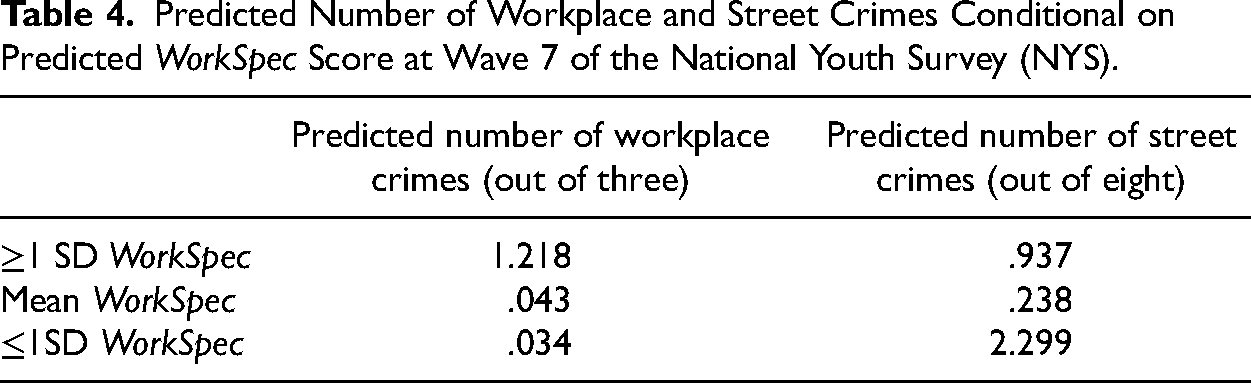
We next employ IRT models to estimate the latent tendency to engage in workplace crime relative to street crime which allows us to assess Hypothesis 2 by examining the extent to which there is variation in the tendency to “specialize” in workplace crime. The results of the IRT model indicate that the variance component of the random slope on the WorkSpec parameter is statistically significant (p < .01). This indicates that there is a statistically significant variation in the tendency to engage in workplace crime relative to street crime. To demonstrate this more substantively, Table 4 displays the probability of engaging in a workplace crime and a street crime based on one's location on the empirical Bayes mean of WorkSpec from Wave 7 of the NYS. Individuals scoring one standard deviation above the mean or higher on WorkSpec were predicted to engage in, on average, 1.22 (out of three) workplace crimes, but only .94 (out of eight) of the street crimes. Simply put, these individuals have a much greater tendency of engaging in crime at work than they do engaging in crime outside of work. Conversely, individuals who score one standard deviation or lower below the mean of WorkSpec on average engage in 2.30 (out of eight) of the street crimes and only .03 (out of three) of the workplace crimes. These results together support hypothesis two and indicate that there is important variation in the tendency to “specialize” in workplace crime, and that there are individuals who at a given time tend to limit their antisocial tendencies primarily to the workplace. Thus, we now move on to regression models that examine the variation in such tendencies.
Predicted Number of Workplace and Street Crimes Conditional on Predicted WorkSpec Score at Wave 7 of the National Youth Survey (NYS).
Pooled OLS Regressions: Correlates of Variation in Workplace “Specialization”
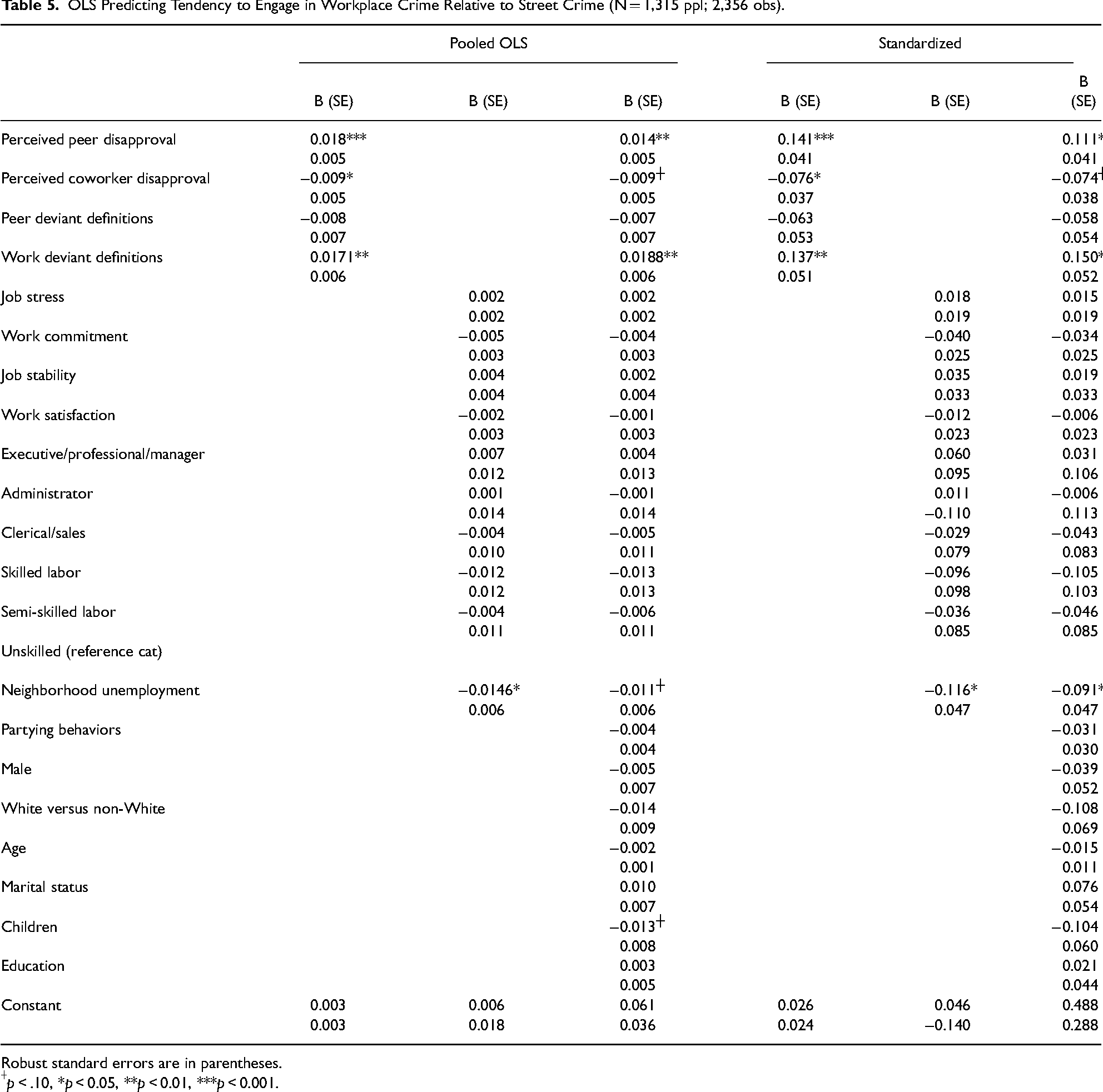
Table 5 displays the results of pooled OLS models, standardized coefficients with robust standard errors, displaying the tendency to engage in workplace crime relative to street crime. Similar to our multinomial logit models we first include the perceived coworker/peer disapproval and pro-workplace/street crime definitions, then we examine our workplace variables, and finally estimate fully adjusted models including all the control variables. The results show that perceived peer disapproval of street crime is positively related to the tendency to engage in workplace crime relative to street crime (b = .11, p < .01) and perceived coworker disapproval of workplace crime is inversely related to the tendency to engage in workplace crime relative to street crime (b = −.07, p < .10). In other words, a one-unit increase in perceived peer disapproval of street crime is related to a .11 standardized deviation change in the tendency to specialize in workplace crime relative to street crime and perceived coworker disapproval of workplace crime is related to a .07 standard deviation change in the tendency to engage in workplace crime relative to street crime. Deviant definitions regarding work are positively related to the tendency to engage in workplace crime relative to street crime (b = .15, p < .01), whereas deviant definitions regarding street crime are not. That is, a standard deviation increase in deviant definitions regarding work is related to a .15 standardized deviation increase in the tendency to specialize in workplace crime. These results suggest partial support for the explanations that would support contextual specificity. Recall the second part of hypothesis three stated that deviant coworker/peer approval and definitions will be positively related to the tendency to engage in workplace crime relative to street crime. Interestingly, none of the workplace factors nor our measure of partying behaviors are related to the tendency to engage in workplace crime relative to street crime. The second part of hypothesis four stated that high workplace stress will be positively related to the tendency to engage in workplace crime relative to street crime and we do not find support for this hypothesis.
OLS Predicting Tendency to Engage in Workplace Crime Relative to Street Crime (N = 1,315 ppl; 2,356 obs).
Robust standard errors are in parentheses.
p < .10, *p < 0.05, **p < 0.01, ***p < 0.001.
Supplemental Analyses: The YDS and Pathways Study
To assess the robustness of the extent of the overlap between workplace crime and street crime, and the latent tendency to engage in workplace crime relative to street crime, we supplement our analyses with the NYS with the YDS (Mortimer 2009) and the Pathways study. Similar to the NYS, the YDS is a representative sample of a panel of teenagers randomly selected from a list of 9th graders attending St. Paul (Minnesota) Public Schools. We use Wave 10 of the YDS, which includes a number of questions related to workplace and street crime (n = 528). The YDS provides a nice comparison to the NYS in a number of ways; firstly, the respondents were approximately 25 years of age during the 10th wave and they were originally randomly selected from public high schools. The demographics of the YDS sample are similar to the NYS sample (see Appendix Table A1). One main difference is that the 10th wave was conducted in 1997–1998, about a decade later than when Waves 6 and 7 of the NYS were collected.
The Pathways a longitudinal examination of the transition from adolescence to young adulthood in a sample of adolescents convicted of serious offenses in Maricopa County, AZ, or Philadelphia, PA. A total of 1,354 juveniles aged 14 to 18 at the time of their offense were interviewed between 2000 and 2003 then followed over an 84-month period. We use the seventh to 10th-month interviews because Pathways researchers administered a new version of the survey in which participants were asked to provide details about deviant behavior in the workplace. The analytic sample for these analyses consists of 3,025 person-wave observations across 1,120 unique subjects. Similar to the NYS and the YDS, the Pathways participants were in their mid-twenties, with the main difference being the data were collected in the early 2000s. It is important to note that given that the Pathways sample is comprised of individuals who were convicted of a serious offense, respondents in the Pathways sample report less employment compared to the respondents in the NYS and the YDS. Appendix Table A2 displays the descriptive information of the Pathways sample.
Unfortunately, neither the YDS 7 nor the Pathways 8 contain context-specific measures as the NYS so we are not able to conduct the full multivariate analyses with these data. However, we examine the extent to which the prevalence of the joint and conditional probabilities of workplace crime and street crime are remarkably similar across the three data sets.9 The largest category is neither workplace crime nor street crime for both the YDS and the Pathways (67 percent and 63 percent). Approximately 17 percent of participants in the YDS and 27 percent of the participants in the Pathways reported engaging in only street crime whereas only 7 percent and 4 percent reported engaging in only workplace crime in the YDS and Pathways, respectively. The joint probability of engaging in both workplace crime and street crime is 9 percent in the YDS and 6 percent in the Pathways. When we calculate the conditional probabilities, the probability of workplace crime conditional on street crime, or P(W|S), is .35 in the YDS and .18 in the Pathways, and the probability of engaging in street crime conditional of workplace crime, or P(S|W), is .55 in the YDS and .49 in the Pathways (see Table 6). Taken together, the prevalence and joint probabilities of workplace and street offending demonstrate similar patterns as to what was observed in the NYS.
Crosstabulation of Workplace and Street Crime Overlap – YDS (N = 528) and Pathways (N = 1,120 ppl; 3,025 obs).
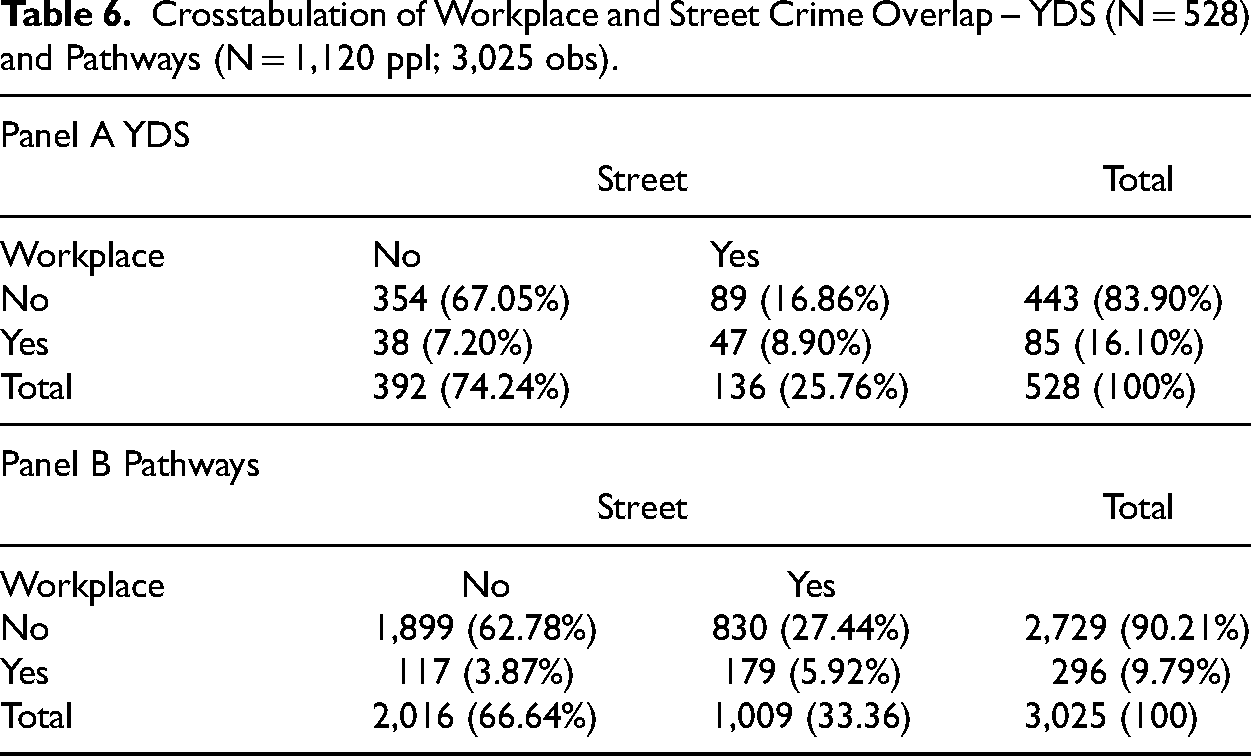
Like with the NYS, we also examine the extent to which individuals in the YDS tend to engage in workplace crime relative to street crime through IRT models. We find evidence that there is statistically significant variation in the tendency to “specialize” in workplace crime relative to street crime (p < .05). Further, there is clear evidence that individuals who score high on the WorkSpec measure have a greater tendency of engaging in workplace crime relative to street crime. On average, individuals who score one standard deviation or greater above the mean in WorkSpec are predicted to engage in 1.48 (out of four) of the work-related crimes, but only .41 (out of five) of the street crimes. Conversely, individuals who score one standard deviation or lower below the mean of WorkSpec are predicted to commit only .02 of the workplace crimes but 1.38 of the street crimes. Again, this provides evidence that some individuals tend to limit their antisocial behavior to the workplace and not offend on the street, while others have a tendency to commit crimes on the street but not at work (see Appendix Table A3).
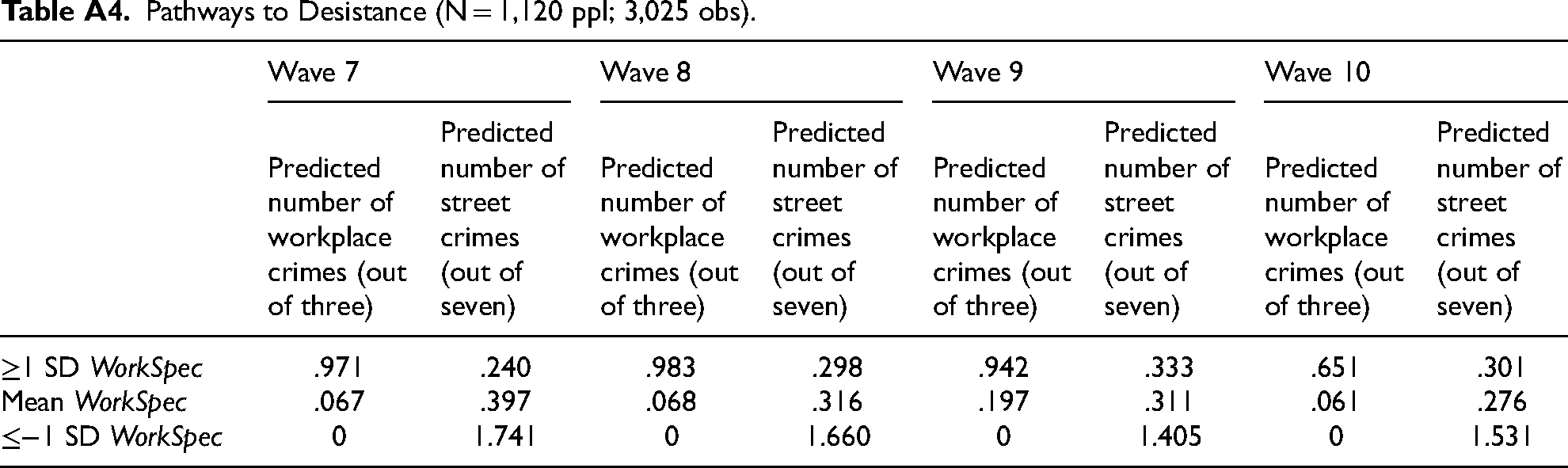
The results observed in the Pathways data, which are presented in Appendix Table A4, parallel those from the NYS and YDS. The variance component of the random slope WorkSpec is statistically significant across each wave analyzed at an alpha level of at least .01. This suggests that there is an important variation in one's tendency to engage in workplace crime relative to street crimes and vice versa. Further, when we estimate the predicting context-specific offending variety scores across different levels of the estimated latent trait WorkSpec we see that estimated variety scores across each wave reflect what one would expect. For example, at Wave 7 of the Pathways data individuals who score one standard deviation above the mean or greater in WorkSpec commit, on average, about one out of three of the workplace crimes captured in the data, but commit only 24 out of seven of the street crimes. Conversely, individuals who were estimated to score one standard deviation or below on the mean level of WorkSpec committed zero workplace crimes but were predicted to have engaged in nearly two (out of seven) of the street crimes. These findings together suggest that there is some evidence of contextual specialization in the Pathways, just as was observed in both the NYS and YDS.
Discussion
Our study focused on the relationship between workplace crime and street crime to add to the literature assessing the generality of criminal behavior. While the generality of crime types has long been a key topic of inquiry in criminological discourse (Eker and Mus 2016), few have studied the “generality” of offending across contexts. We argued that studying contextual generality can extend our understanding of the work and crime relationship by conceptualizing work as a specific context in which individuals can engage in criminal behavior, rather than narrowly conceptualizing it as a catalyst that moves individuals away from a life of crime, as traditionally studied (Lageson and Uggen 2013). We drew from competing theories regarding the generality of criminal behavior. Specifically, we were guided by ontogenetic theories arguing for heterotypic continuity (e.g., Gottfredson and Hirschi 1990), which posit that workplace crime and street crime are both manifestations of relatively stable traits, such as impulsivity, and thus predict little contextual specificity. We were also guided by theories of learning (Sutherland 1947; Warr 2002) and strain (Agnew 1992), which predict that criminal behavior is a consequence of context-specific factors, such as context-specific peers and stress.
We analyzed waves six and seven of the NYS, a representative sample who were originally interviewed as adolescents but in their mid-twenties by waves six and seven, and supplemented part of our analyses with data from the YDS and Pathways study. Our findings provide preliminary evidence regarding the degree and correlates of contextual specificity. First, we examined the extent to which there was overlap in self-reported engagement in workplace crime and street crime. We found that workplace crime was less commonly reported—and considerably so—than street crime and that this was observed in both the NYS, YDS, and Pathways. While prior research has estimated that nearly two-thirds of employees engage in workplace deviance (Green 1997; Hollinger and Clark 1983), their estimates encompassed relatively minor things like unnecessary sick days, which are of only negligible harm to employers and broader society. Still, we did observe approximately 10 percent of respondents in the NYS and Pathways and 16 percent in the YDS report engaging in an illegal activity at work.
Our findings suggest that the threshold of engaging in workplace crime appears to be higher than the threshold for engaging in street crime. Put another way, the probability that one reports engaging in crime at the workplace given that they report engaging in street crime is much lower than the probability that one reports engaging in street crime given that they report workplace crime. This has policy implications for employers who are reluctant to hire individuals who have experienced criminal justice contact due to the threat of workplace malfeasance (see Giguere and Dundes 2002; Sugie et al. 2020). The lower conditional probability of workplace crime given street crime suggests that street criminal behavior may not translate/present in the workplace. This observation can be viewed as analogous to Robins’ (1978) famous observation that, “adult antisocial behavior virtually requires childhood antisocial behavior … yet most antisocial children do not become antisocial adults” (p. 611). Here, most respondents who engage in workplace crime also engage in street crime yet most respondents who engage in street crime do not engage in workplace crime. Our research suggests that prior history with a street crime does not necessarily mean that the individual will engage in crime at the workplace, and in fact, the overwhelming majority of individuals who reported engaging in street crime refrained from crime at the workplace.
Beyond simply looking at reported engagement in workplace crime and street crime, we considered to what extent there is “specialization” in workplace crimes relative to street crimes. We adopted an item response theory approach, which conceptualizes this tendency as a latent trait and takes into account the base rates of each crime context (Osgood and Schreck 2007). We found that there was significant variation in workplace “specialization” in both the NYS, YDS, and Pathways. That is, our analyses of self-reported workplace crime and street crime found more variation in individual specialization in workplace crime than would be expected based on chance, which contrasts with theories that contend that workplace crime and street crime are manifestations of stable between person traits. In fact, our findings undermine the argument that even if there are patterns of “specialization” it would be random and erratic (Felson et al. 2008; Gottfredson and Hirschi 1990; Sampson and Laub 2003).
Studying contextual generality provides a good complement to the literature on the generality of types of crime. To be sure, the issue of versatility versus specialization in offending has been a hot-button topic in criminology, as it directly has implications for competing theoretical perspectives of crime (Gottfredson and Hirschi 1990; Hirschi and Gottfredson 1993; Sutherland 1937, 1947). And while the research assessing the extent to which individuals specialize in types of crime addresses the heart of this debate, the underlying processes outlined in the competing perspectives also have implications for the contexts in which crimes occur. Gottfredson and Hirschi's (1990) idea that individuals low in self-control have difficulty foregoing the immediate benefits from crime and analogous acts implies that individuals should be diverse in the types of crime they commit, but also that they should not be particularly inclined to engage in crime in specific contexts—that is, such individuals should demonstrate cross-contextual continuity in offending as well as diversity in the types of crimes they commit. Meanwhile, Sutherland (1937, 1947) explicitly outlined a learning process that suggests offending may be limited to specific contexts. For example, in The Professional Thief Sutherland noted that thieves tend to associate with both other criminals and conforming others and that the behavior of the thieves tend to be context dependent—when associating with other thieves such individuals tend to steal, but they tend to refrain from crime when with their non-criminal associates. Thus, while Sutherland offered a model of behavior that suggested crime-specific learning as it pertains to crime types (see Thomas 2015), he also suggested that there can be context-specific behavior patterns strongly influenced by one's “definition of the situation.” Thus, we believe that further work examining cross-contextual continuity/specificity in behavior can shed some important insights into the etiology of crime and into the empirical validity of different perspectives.
On this note, we believe that our findings also speak to the literature on specialization in offending. Early research in the criminal careers paradigm found little to no evidence of specialization as it pertains to crime types, and although more recent work has suggested that individuals have a tendency to specialize in crime to a greater extent than previously thought (Osgood and Schreck 2007; Sullivan et al. 2006; Thomas 2015), the general consensus still appears to be that individuals are generalists as it pertains to offending behavior (Hirschi and Gottfredson 1993; Pratt and Turanovic 2019). Ultimately, this has supported notions that individuals possess some person-level trait that makes them inclined to deviate across a range of crime types (Donovan and Jessor 1978; Gottfredson and Hirschi 1990; Moffitt 1993; Osgood et al. 1988). One concern with this strong emphasis on personality traits that promote heterotypic continuity is that it substantially overpredicts crime (Matza 1964). Our findings offer a novel way of thinking about the qualitative nature of offending that can potentially make sense of the existing specialization literature, as it suggests that individuals may not necessarily have a strong proclivity to engage in specific offense types, but they are also not as prone to deviance as trait-based theories suggest, but rather individuals make conscious choices to offend (or not) based on situational-contexts. Put simply, while much of the specialization literature has stressed special crime-type motivation that leads individuals to commit some criminal acts and not others (Clarke and Cornish 1985; Sutherland 1947), it may the case that the motivation leading to crime is situationally dependent rather than crime-type dependent (Osgood et al. 1996; Piliavin and Briar 1964), which opens up a number of interesting puzzles.
We focused on the learning perspective and the strain perceptive to guide our analyses; however, scholars should also look to other theoretical perspectives that are applicable to contextual generality. For example, the rational choice perspective posits that people will commit a crime if the expected marginal benefit of allocating time to crime exceeds the marginal cost of doing so (Becker 1968; Ehrlich 1973). Workplace crime and street crime could have separate and differing threats of formal and informal sanctions, as well as differences in the potential benefits. There is relatively strong support for a rational choice model of offending (Loughran 2016) and some tangential support that corporate crime can be studied through a choice framework (Paternoster and Simpson 1996). However, to date, the overlap between workplace crime and street crime has not been studied through a choice perspective. We encourage scholars to examine contextual generality through various theoretical lenses.
We considered whether the same factors were related to the probability of self-reported participation in workplace crime and street crime in the NYS, which was the only data source that has context-specific measures of key theoretical predictors. Specifically, we invoked trait-based theories and theories of learning (Anderson 2000; Gottfredson and Hirschi 1990; Sutherland 1947; Warr 1993) and the literature on workplace strain (Agnew 1985, 1992). To capture the learning perspective, we examined context-specific perceived coworker and peer disapproval and context-specific deviant definitions. In general, we found support for context-specific factors deriving from the learning perspective—respondents were less likely to report a crime in the context if they believed their coworkers/peers would disapprove, and more likely to engage in crimes in a context in which they perceived coworkers/peers would be less disapproval for offending. Deviant definitions or attitudes associated with violating the law at the workplace was also significantly associated with workplace crime. This suggests that individuals appear to be sensitive to the evaluations of their co-workers and operate consistently with those expected evaluations. It is possible that coworker/peer approval and context-specific deviant definitions can aid in developing context-specific morals and attitudes. While the processes are similar, the individual has varying moral contexts, which can constitute whether crime can be a viable option in each situation (Warr 2002; Wikstrom 2012).
Conversely, workplace stress was not related to engaging in neither workplace nor street crime. This contrasts with organizational research and their emphasis of workplace-specific stressors as an explanation for workplace deviance (Douglas and Martinko 2001; Fox et al. 2001; Lee and Allen 2002; Omar et al. 2011) and prior research that demonstrates “domain determinacy” (De Coster and Kort-Butler 2006; Felson et al. 2012). It is possible that individuals who experience workplace stress are also likely to experience stress in other dimensions of life and if we had a measure of multiple stresses, we might see that individuals who experience multiple strains might cope through criminal behaviors (Agnew 2006; Slocum et al. 2005).
Our findings underscore the need to expand the way scholars traditionally study employment and crime, which is how employment can serve as a catalyst away from a criminal lifestyle. For example, Sampson and Laub (1993) clearly convey their stance on the relationship between employment and crime by stating “We believe that adults, regardless of delinquent background, will be inhibited from committing crime to the extent they have social capital invested in their work and family lives” (p. 141). Interestingly we did not find that our workplace commitment measure was related to the probability of engaging in workplace crime compared to street crime but not workplace/street crime compared to no crime. In fact, despite the fact that we conditioned our analytic samples on individuals who reported having a job, there was considerable self-reported street crime across the three samples. Almost forty years ago, Sviridoff and Thompson (1983) described three main types of relationships between work and crime: Work that averts crime, discouraged workers, and work that is concurrent with a crime. They urged researchers and program developers to “acknowledge the extreme variety that remains regardless of attempts at simplification … the concept of an automatic opposition between employment and crime is a false one” (1983:208; 212). We encourage scholars to extend the study of employment and crime to encompass all combinations.
Our study is one of the few to illuminate the overlap between workplace crime and street crime. However, our results should be interpreted in light of the limitations of our study. Although we were able to supplement the NYS with the YDS and the Pathways to look at the extent there is contextual generality, our analyses assessing the correlates of generality were limited to the NYS. Because of the three-year gap between Wave 6 and Wave 7 in the NYS, we limited our analysis to pooled cross-sectional models. While the NYS contains detailed context-specific measures that tap into our theoretical constructs, we would ideally have multiple waves with shorter spans across each wave. Therefore, our results should be interpreted as strictly correlational and not generalizable beyond the analytic sample. Nonetheless, we see tremendous value in drawing attention to the notion of contextual generality and urge scholars to collect data on deviant behavior across multiple contexts and context-specific theoretical measures.
The labor market has shifted over the past few decades—since the 1980s, organized labor jobs have declined and increased in service-oriented industry, precarious work and the “gig” economy (De Stefano 2015). At the same time, young adults are delaying entry into traditional life transitions, such as stable employment, and are more likely to attend post-secondary school (Mortimer 2015). These labor market changes can have an impact on the opportunities that individuals have to engage in workplace crime. For example, since the Covid-19 pandemic, younger adults are driving a structural shift in the labor market, such as lower labor market participation and more opportunities to work remotely (Vyas 2022). These factors can have direct and indirect implications on the types of opportunities individuals have to engage in workplace crime. Given that we found consistent evidence across three data sources for the overlap between workplace crime and street crime and evidence for a tendency to engage in workplace crime relative to street crime, we encourage scholars to collect and assess workplace crime in contemporary samples.
In sum, while it was relatively rare for respondents to engage only in workplace crime, we observed a tendency for some respondents to commit crimes at the workplace to a greater extent than they engaged in street crime. Similarly, most respondents who engage in street crime did not engage in workplace crime. Taken together, our results show some support for contextual specificity. The theoretical measures that tapped into the socialization perspectives, coworker/peer approvals and context-specific definitions, were related to the probability of engaging in the context-specific crime. We were limited in the potential data sources that contain parallel items for both workplace crime and street crime, thus scholars should look for additional ways to study contextual generalities such as designing vignettes or online surveys. Future research should also consider the contextual generality of crime with other contexts such as school-based crimes and cybercrimes. We see our study as a modest step in presenting the concept of contextual generality as a fruitful avenue of inquiry.
Footnotes
Author's note
Rachel McNealey, Michigan State University School of Criminal Justice, East Lansing, MI, USA.
Declaration of Conflicting Interests
The author(s) declared no potential conflicts of interest with respect to the research, authorship, and/or publication of this article.
Funding
The author(s) received no financial support for the research, authorship, and/or publication of this article.

Notes
Author Biographies
Appendix A
Pathways to Desistance (N = 1,120 ppl; 3,025 obs).
| Wave 7 | Wave 8 | Wave 9 | Wave 10 | |||||
|---|---|---|---|---|---|---|---|---|
| Predicted number of workplace crimes (out of three) | Predicted number of street crimes (out of seven) | Predicted number of workplace crimes (out of three) | Predicted number of street crimes (out of seven) | Predicted number of workplace crimes (out of three) | Predicted number of street crimes (out of seven) | Predicted number of workplace crimes (out of three) | Predicted number of street crimes (out of seven) | |
| ≥1 SD WorkSpec | .971 | .240 | .983 | .298 | .942 | .333 | .651 | .301 |
| Mean WorkSpec | .067 | .397 | .068 | .316 | .197 | .311 | .061 | .276 |
| ≤−1 SD WorkSpec | 0 | 1.741 | 0 | 1.660 | 0 | 1.405 | 0 | 1.531 |