







Abstract
Objective: Recent contributions have highlighted the compatibility of choice- and structural-based perspectives of crime. Drawing on those insights, this study examines the mechanisms that may link neighborhood disadvantage to individual differences in subjective expectations of the risks, costs and rewards from crime. We also evaluate the extent to which subjective expectations may account for the relationship between neighborhood disadvantage and individual offending. Methods: Using data from the Pathways to Desistance study and structural equation modeling, we decompose how experiences and interactions with others mediate the relationship between neighborhood disadvantage, subjective expectations and offending. Results: The impact of neighborhood disadvantage on perceived arrest risk is mediated by direct and vicarious arrest experiences. Social capital and commitment to conventional values partially mediate the relationship between neighborhood disadvantage and anticipated social costs, and peer delinquency and peer attitudes partially mediate the association between disadvantage and perceived social rewards. Finally, we find that subjective expectations account for about one-third of the relationship between neighborhood disadvantage and individual offending. Conclusions: Our study illuminates the value of integrating rational choice and sociological perspectives and highlights the utility of advancing multilevel rational choice theories of offending.
Introduction
Contemporary scholarship linking community characteristics at the “macro” level to offending at the individual level has drawn almost exclusively on theories of social control (Bursik and Grasmick, 1993; Sampson et al., 1997; see also Sampson, 2012) or differential association (Sutherland, 1947; Thomas, O’Neill, and Vogel, 2024). This literature has acknowledged a variety of community structural conditions that may be relevant, but a predominant focus in both classic and contemporary studies has been on concentrated socioeconomic disadvantage, a feature of communities commonly conceptualized as encompassing persistently high rates of economic disadvantage, limited economic opportunities, widespread family disruption, and pervasive physical and social disorder (Brooks-Gunn, Duncan, and Aber, 1997; Ohmer, Coulton, and Freedman, 2018). The typical theoretical emphasis in criminological research is that concentrated disadvantage may foster a breakdown of institutions of social control, deplete levels of social capital, or increase exposure to delinquent associates which, in turn, increases individual crime and delinquency. While these arguments have been influential, they largely neglect the possibility that subjective expectations of the risks, costs, and rewards associated with offending may also play an integral proximal role in linking neighborhood disadvantage to individual offending, an insight consistent with sociological conceptions of rational choice theory (Hecther and Kanazawa, 1997; Matsueda, 2013). 1
From a rational choice perspective, both private signals in the form of direct experiences and interactions with others (e.g., arrest experiences and intimate associations) and public signals conveyed via the external social context in which individuals are situated (e.g., the communities in which they reside) may influence perception formation regarding the risks, costs, and rewards from crime (Altikriti et al., 2022; Anwar and Loughran, 2011; Barnum and Pogarsky, 2022; Matsueda, Kreager and Huizina, 2006; McCarthy and Chaudhary, 2014; McGloin and Thomas, 2016; Wilson et al., 2017). The latter possibility implies not only that neighborhood disadvantage could influence offending by shaping subjective expectations but also that features such as a breakdown of social controls, reduced social capital, and heightened exposure to delinquent associates may influence offending through their impact on subjective expectations. These implications have not been examined explicitly in prior research.
This paper aims to bring a sharper and more explicit focus to the integration of themes from structural and choice-based perspectives by examining (1) why differential exposure to high levels of concentrated neighborhood socioeconomic disadvantage alters subjective expectations associated with criminal behavior, and (2) whether subjective expectations subsequently play a role in explaining why individuals who live in disadvantaged neighborhood contexts tend to exhibit higher levels of crime. Our approach builds on Thomas et al.'s (2022) assessment of a multi-level rational choice perspective by examining key mechanisms through which neighborhood socioeconomic disadvantage may influence subjective expectations at the individual level, and it further extends that work and other research by examining the utility of rational-choice inputs for explaining links between structural conditions and individual offending (e.g., Han, Piquero, and Bersani, 2023).
We begin by briefly reviewing the central propositions of rational choice perspectives of criminal behavior and describing a general rationale for how neighborhood conditions may be associated with subjective expectations. We then draw on classic and contemporary theories of crime to elaborate several specific pathways through which residence in a socioeconomically disadvantaged neighborhood may shape the perceived formal risks, informal costs, and social rewards individuals attach to crime, and in turn how this may help account for the often-observed positive association between neighborhood disadvantage and offending. After summarizing the data used in the study, we present results from structural equation models (SEMs) that assess the hypothesized pathways. We conclude by identifying important next steps that could further increase knowledge about the sources of individual differences in subjective expectations and criminal behavior.
Theoretical Background and Hypotheses
The Rational Choice Perspective
Rational choice theories of crime differ from most sociological theories of offending in that the emphasis is on the individual's internal calculus regarding the (dis)utility of criminal behavior (Becker, 1968; Matsueda et al., 2006; Nagin, 2007). The central idea is that individuals hold perceptions of the risks, costs, and rewards associated with criminal conduct and consider these consequences when deciding whether to engage in a criminal act (Cornish and Clarke, 1986). Although there are a wide range of rewards, risks, and costs that may be relevant, scholars have taken steps to illuminate those most salient for offending decisions (Loughran et al., 2016; Matsueda et al., 2006; Thomas and Vogel, 2019). One's perceptions of the likelihood of being arrested is an important consideration, as some individuals view the chances of arrest when offending as high while others perceive arrest to be relatively unlikely (Anwar and Loughran, 2011). The costs of crime are typically conceptualized as informal social costs that derive from arrest, such as disappointing others, losing respect from friends, getting kicked out of school, or a loss of job prospects (Thomas and Vogel, 2019). Finally, because crime typically yields limited financial gains (Levitt and Venkatesh, 2000), in adolescence and young adulthood the rewards from crime are commonly conceptualized as the social rewards that may be derived from peer reactions to anti-social conduct (Matsueda et al., 2006; see also Akers, 1998; Sutherland, 1947). Overall, the extant research has provided considerable empirical support in favor of rational choice predictions, finding that rational choice perspectives have the potential to partially account for the criminality among a wide-range of offenders (Loughran et al., 2016), and account for several key features of crime including the types of crimes individuals commit (Thomas, Loughran, and Hamilton, 2020), desistance from crime (Thomas and Vogel, 2019) and differences in crime by gender (Neissl et al., 2019) and immigrant generational status (Han et al., 2023).
While there have been important advances in the contemporary literature on rational choice and crime, most of the focus has been on assessing alternative strategies for measuring subjective expectations and on modeling the relationship between subjective expectations and different measures of offending (Loughran et al., 2016; Matsueda et al., 2006; Piliavin et al., 1986; Thomas et al., 2020). Much less attention has been devoted to explicating the myriad factors that may give rise to individual differences in perceptions of the risks, costs, and rewards from crime (Apel, 2022; McCarthy, 2002), with especially little focus on examining the potentially important role of structural factors often emphasized in sociological theories (Matsueda, 2013). This may be a product of the roots of choice-based theories in economics and the classical school of criminology that are, on the face, seemingly at odds with sociological theories in their emphasis on human agency and an individual's “tendency to reflect on himself and his setting, and his periodic struggles to transcend rather than succumb to the circumstances that allegedly shaped and constrained him” (Matza, 1969: 7, emphasis added). Whatever its source, there is a growing recognition in contemporary scholarship that choice-based perspectives are not inherently incompatible with the idea that structural factors influence behavior. In fact, some scholars have asserted that “rational choice principles offer a parsimonious microfoundation for macrosociological concepts and causal mechanisms” (Matsueda, 2013: 285; see also McCarthy, 2002). From this vantage point, the structural factors that are prominent in sociological explanations of crime may influence individual criminal behavior, in part, because such factors shape individuals’ choice-inputs (e.g., their subjective expectations).
Consistent with this notion, Thomas and colleagues (2022) recently assessed a theoretical model linking concentrated neighborhood socioeconomic disadvantage with individual perceptions of the risks, costs, and rewards associated with crime. They found that, even after controlling for a wide range of demographic, personality, individual, and social characteristics, those residing in neighborhoods characterized by higher levels of disadvantage, on average, perceived the anticipated social rewards from crime as greater and the perceived risks and informal social costs as lower. These findings provided the necessary first step in establishing the potential for a multi-level rational choice theory of offending (Matsueda, 2013), but two important issues remain unexplored. First, while Thomas and colleagues (2022) discussed several mechanisms that could account for the relationship between neighborhood disadvantage and subjective expectations, they did not directly examine those mechanisms in their study. Second, while Thomas et al. (2022a) and others (Matsueda, 2013) imply that individual differences in subjective expectations may illuminate why neighborhood disadvantage affects criminal involvement, that possibility has not been examined in prior research. The present study works to fill these gaps, first by explicating and empirically assessing the theoretical mechanisms through which differential exposure to high levels of neighborhood socioeconomic disadvantage may shape perceptions of risks, costs, and rewards, and then by evaluating the degree to which these subjective expectations mediate the positive association between neighborhood disadvantage and offending.
Neighborhood Disadvantage, Subjective Expectations, and Criminal Offending
The theoretical literature on concentrated neighborhood disadvantage suggests that such contexts often serve as a central source of variation in formal social controls, and especially direct and vicarious policing experiences, access to conventional norms and social capital, and exposure to delinquent associates (Brunson and Weitzer, 2009; Bursik and Grasmick, 1993; Harding, 2009; Sampson and Bartusch, 1998; Sampson, 2012; Sutherland, 1947). Integrating these ideas with the classic rational choice model yields a multi-level theoretical model of offending that we summarize in Figure 1. As we elaborate next, this model specifies predictions both for why exposure to socioeconomically disadvantaged residential neighborhoods may translate into individual differences in subjective expectations and why differences in subjective expectations may be germane to explaining the tendency for individuals who live in disadvantaged neighborhood contexts to exhibit higher levels of crime. Theory and research on community effects have incorporated constructs such as conventional norms and peer associations as key components when explaining higher levels of crime observed among people who reside in disadvantaged areas, but that literature has not considered the possibility that individual differences in subjective expectations may also be germane. Our attention to that possibility in the present study offers an important contribution to studies of both rational choice and communities and crime.
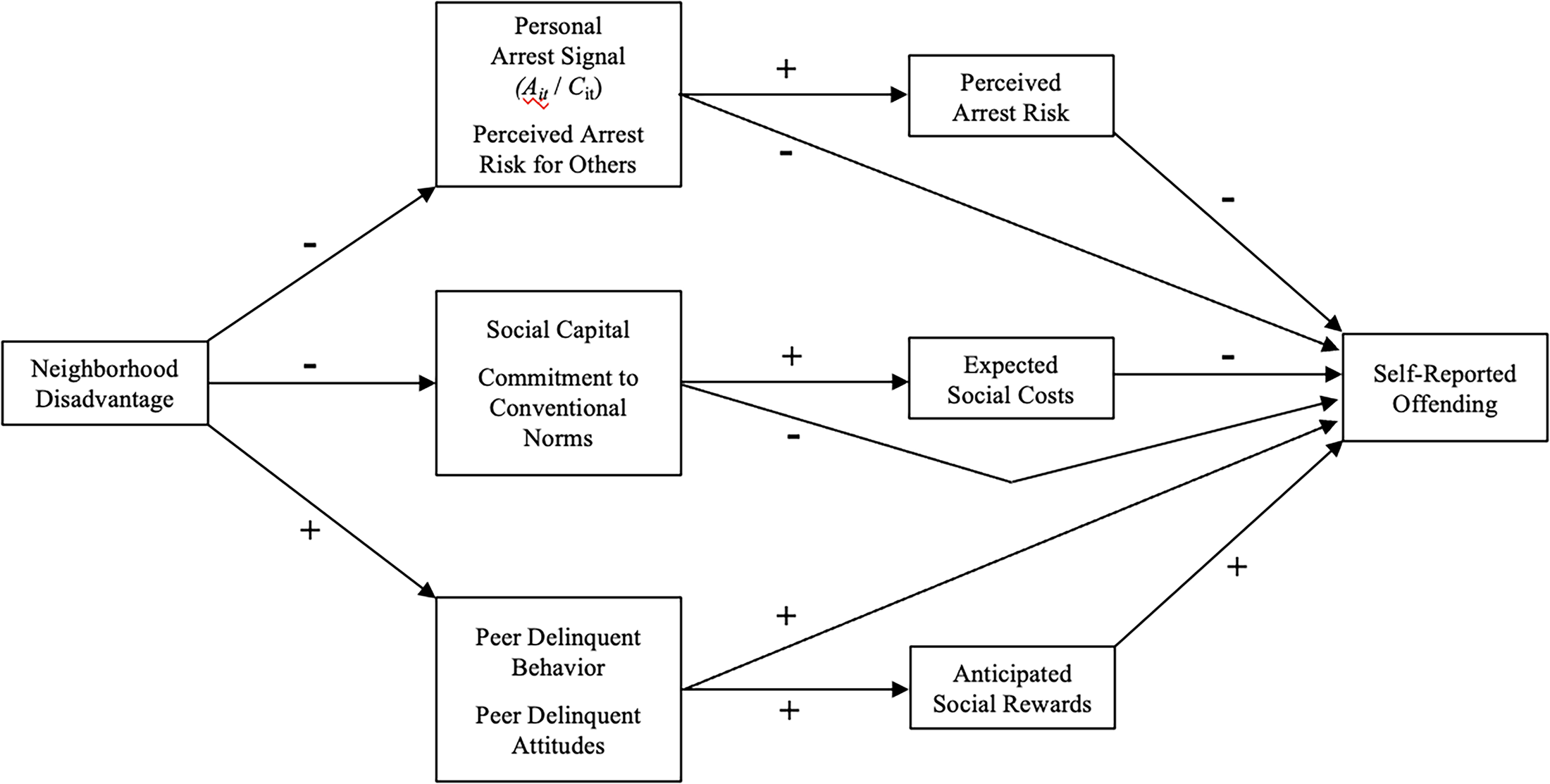
Heuristic multi-level model of the impact of neighborhood socioeconomic disadvantage on individual differences in subjective expectation and criminal behavior.
We organize our discussion of the model presented in Figure 1 around the three features of disadvantaged neighborhoods most often referenced as critical sources of variation in criminal behavior: (1) direct and vicarious policing experiences, (2) access to conventional norms and social capital, and (3) exposure to delinquent associates. We first articulate hypothesized mechanisms through which neighborhood disadvantage may affect subjective expectations (Section 2.2), followed by a discussion of how differences in subjective expectations may be relevant to individual variation in criminal offending (Section 2.3).
Direct and Vicarious Arrest Signals and the Perceived Risk of Arrest
Despite considerable research on individual differences in perceived arrest risk (Anwar and Loughran, 2011; Lochner, 2007; Nagin and Paternoster, 1993; Piliavin et al., 1986; Thomas et al., 2013) and a long tradition of studies that examine how patterns of policing differ across neighborhoods (e.g., Huff, 2021; Kirk and Matsuda, 2011; Klinger, 1997; Lum, 2011; Smith, 1986; Sun et al., 2008; Terrill and Reisig, 2003), research rarely has integrated these literatures. Some research has considered how objective punishment risk in one's residential county (e.g., the arrest clearance rate) may shape perceived risk of punishment (Kleck et al., 2005; Kleck, 2016), but others have criticized the relevance of such research to individual perception formation (Pogarsky and Loughran, 2016; Nagin, 2016). Additionally, despite claims that more localized reference groups may be instrumental in shaping individual differences in perceived arrest risk (Yu and Liska, 1993; Stafford and Warr, 1993), to our knowledge prior research has not yet considered the role of neighborhood conditions in shaping individual perceptions of arrest risk.
Theory and research on neighborhoods and social control often emphasize the heightened levels of policing experienced in many disadvantaged neighborhoods, including a larger police presence, an elevated frequency of proactive policing tactics, a greater likelihood of excessive force, and higher overall arrest rates in such areas (Kirk, 2008; Klinger, 1997; Lum, 2011; Terrill and Reisig, 2003). Yet, residents of disadvantaged neighborhoods often are cynical of the police (Kirk and Papachristos, 2011; Kirk and Matsuda, 2011), which may make them reluctant to report crimes (Baumer, 2002; Berg, Slocum, and Loeber, 2013; Slocum et al., 2010) and less likely to cooperate with the police in other ways that may facilitate apprehension (Sunshine and Tyler, 2003). Additionally, ecological theories of policing suggest that in disadvantaged neighborhoods, where crime tends to be relatively high, the police may focus their attention and resources on serious offenses at the neglect of less serious, but more common, crimes (Klinger, 1997). This could foster widespread perceptions among residents that disadvantaged communities are under-served by the police relative to the level of crime experienced (Boehme et al., 2022; Venkatesh, 2008). Integrating these themes, Kirk and Matsuda's (2011) analysis of data from the Project on Human Development in Chicago Neighborhoods Longitudinal Cohort Study demonstrates that neighborhood disadvantage is associated with a lower objective probability of arrest per crime. While Kirk and Matsuda (2011) did not consider subjective perceptions of arrest risk, framing their findings within the literature on rational choice and deterrence theory suggests that living in a neighborhood with high levels of concentrated disadvantage may reduce perceived arrest risk among individuals due to differential exposure to direct and vicarious arrest signals.
Our argument builds on Stafford and Warr (1993), who posited that assessments of the perceived risk of detection and punishment may be influenced by both direct and indirect experiences. They highlight that, while perceptions of detection and sanction risk may be impacted by whether an individual experiences arrest or punishment in response to their own illegal activity (i.e., specific deterrence or a direct “signal” about the risk of detection or punishment), indirect knowledge of the arrest and punishment experiences of others also is likely to be salient (i.e., vicarious “signals” about the risk of detection or punishment). Importantly, neighborhoods are a meaningful source of both direct experiences and vicarious knowledge about the “objective” arrest risk individuals face (see Brunson, 2007; Weitzer, 2002). Most pertinent to the present study, although police presence and overall rates of arrest often are greater in disadvantaged neighborhoods (Kirk, 2008), because crime also tends to be more prevalent in such areas the relative risk of arrest (per offense) experienced directly or indirectly through others may be lower in disadvantaged neighborhoods (Kirk and Matsuda, 2011).
Integrating these insights with themes emphasized in rational choice theory suggests two interrelated hypotheses, which are represented visually at the top of Figure 1. These hypotheses imply that the anticipated inverse association between neighborhood disadvantage and perceived arrest risk (Thomas et al., 2022b) will be explained (a) in part by individual differences in personal arrest experiences, as measured by the respondents’ ratio of arrests to offenses reported (H1a), and (b) in part by individual differences in vicarious knowledge of the arrest probabilities faced by others, as measured by respondent perceptions that others in their neighborhood would be arrested when offending (H1b). The rationale for these hypotheses is that individuals residing in areas characterized by higher levels of disadvantage will have lower personal arrest signals (arrests per crime committed) and hold lower perceptions of the risk of arrest for other individuals from their neighborhood due to vicarious learning, which in turn will translate into lower perceived arrest risk. In summary, we assess the following hypotheses as they pertain to the disadvantage, arrest risk, and offending linkages:
Hypothesis 1a: The relationship between neighborhood socioeconomic disadvantage and individuals’ perceptions of arrest risk will be partially mediated by one's personal arrest signal. Hypothesis 1b: The relationship between neighborhood socioeconomic disadvantage and individuals’ perceptions of arrest risk will be partially mediated by perceptions of arrest risk of others from one's neighborhood.
Conventional Norms, Social Capital, and Anticipated Informal Social Costs of Crime
The sociological literature identifies residential neighborhoods as a critical source of socialization and social capital that can influence individual attitudes, perceptions, and behavior. This theme is prominent in the classic social disorganization perspective (Shaw and McKay, 1942), the contemporary explications of the systemic model of neighborhoods and crime (Bursik and Grasmick, 1993), and arguments about sub-cultural adaptations to structural disadvantage (Anderson, 1999; Sampson and Wilson, 1995). Two lines of reasoning from this integrated framework are potentially relevant to understanding why people from disadvantaged neighborhoods may associate lower informal social costs with involvement in criminal behavior.
First, structural and cultural disorganization can result in barriers that impede the effective socialization of conventional values. A central process embedded within the classic social disorganization perspective is that high levels of disadvantage contribute to a breakdown in the effectiveness of pro-social institutions that instill conventional values that can regulate behavior (Kornhauser, 1978). Shaw and McKay (1942) noted that in areas with higher socioeconomic status there is general unanimity in conventional values and that institutions of social control, such as families, schools, and churches, effectively socialize residents “as to the desirability of education and constructive leisure time” and encourage them to resist “behaviors which threaten the conventional values” (pp. 164–65). In areas characterized by disadvantage, however, the effectiveness of such socialization is reduced and “traditional conventional control is either weak or nonexistent” (p. 182). Toby (1957) further suggested that individuals from disadvantaged communities come to realize that they are “fighting a losing battle” (p. 15), which may lead them to become disinterested and place less value in conventional norms such as academic and occupational success and staying out of trouble with the law. Collectively, these arguments suggest that people from disadvantaged communities may hold lower stakes in conformity and thus have less to lose from the negative consequences associated with crime.
Second, cultural disorganization that can manifest in many structurally disadvantaged neighborhoods may limit access to critical forms of legitimate avenues of success, leading residents to discount the perceived costs associated with crime. Supporting literature emphasizes how the social and economic disadvantage that occurs in such neighborhoods often translates into geographically based social isolation and alienation from conventional norms and mainstream institutions, which Sampson and Wilson (1995: 44) label “cultural social isolation.” Elliott and colleagues (1996: 394) argued that people residing in such contexts often “are far less able to access conventional means to achieve general societal goals,” which facilitates a weakened commitment to legitimate pathways of attainment and greater acceptance of criminal activities that “satisfy basic individual and social needs in the same way that stable families, prosocial peers, and legitimate employment satisfy these needs” (see also Anderson, 1999). It follows logically that in such a social context people may attach lower informal social costs to criminal involvement.
Contemporary structural social disorganization theories also highlight neighborhoods as a significant source of social capital that can influence one's perceptions and actions (Sampson, 2012). Neighborhoods with high levels of socioeconomic disadvantage often experience structural and cultural barriers that result in reduced social cohesion, constrained social ties, and fewer intergenerational connections among residents—in other words, lower levels of social capital (Shaw and McKay, 1942). These features of social organization are posited to lessen informal social control in disadvantaged neighborhoods, which in turn permits higher levels of crime to occur (Bursik and Grasmick, 1993; DeCoster et al., 2006; Kasarda and Janowitz, 1974; Sampson et al., 1997). These ideas are typically neglected in studies of rational choice, but the implication is that the depletion of social capital in disadvantaged neighborhoods may signal to residents that engaging in illicit activity is not likely to result in strong informal sanctions (Harding, 2009; Sampson and Bartusch, 1998).
Integrating these ideas with the rational choice perspective suggests two hypotheses that are represented visually in the middle section of Figure 1. First, residence in a disadvantaged neighborhood will reduce the expected informal costs associated with crime in part due to its tendency to foster weakened commitments to conventionally valued goals, such as doing well in school, getting a good job, and staying out of legal trouble (H2a), thereby lessening the opportunity costs associated with criminal involvement (Toby, 1957). Previous research suggests that neighborhood disadvantage shapes individual values, commitments, and stakes in conformity (Bellair, Roscigno, and McNulty, 2003; Elliott et al., 1996), but to our knowledge no research has directly considered whether such factors influence subjective expectations about the informal costs associated with crime. Second, this integrated perspective implies that residence in a disadvantaged neighborhood will reduce the perceived informal social costs associated with crime in part because such neighborhood environments are characterized by limited social capital (H2b). Prior research has shown that neighborhood disadvantage is associated with lower levels of social capital (Jones and Shed, 2014; Sampson and Graif, 2009), and other studies have linked diminished social capital to increased levels of violence and other forms of delinquency at the individual level (De Coster et al., 2006; see also Sampson, 2012). Yet, it remains unknown whether variation in social capital can help to explain why individuals who reside in disadvantaged neighborhoods tend to anticipate fewer informal social costs from crime (Thomas et al., 2022a). The hypotheses regarding neighborhood disadvantage and informal social costs can be summarized thusly:
Hypothesis 2a: The relationship between neighborhood socioeconomic disadvantage and expected informal social costs will be partially mediated by commitment to conventional norms. Hypothesis 2b: The relationship between neighborhood socioeconomic disadvantage and expected informal social costs will be partially mediated by social capital.
Exposure to Delinquent Peers and Perceived Social Rewards
Another idea that evolved out of the Chicago School is that neighborhoods serve as a staging ground within which young people solicit and compete for valued social rewards, especially acceptance, status, and respect from peers (Shaw, 1930; Sutherland, 1947; Thrasher, 1929). A common thread in that work was that residents of neighborhoods with high levels of socioeconomic disadvantage develop adaptive cultural codes that place value on achieving these social rewards through participation in criminal groups and involvement in crime. This is illuminated in the final version of Shaw and McKay's (1942) social disorganization theory, which incorporated the notion of “cultural transmission” as a salient explanation for the tendency of individuals in disadvantaged neighborhoods to engage in crime and delinquency at higher rates. In elaborating this process of delinquent cultural transmission, Shaw and McKay (1942) highlighted the importance of “the child's intimate associations with…forms of delinquent and criminal organization” and it is these associations that “set the pattern for… and gives rewards for crime” (p. 436). Sutherland (1947, pp. 139–140) similarly argued that [neighborhood] variation in crime can be explained by “differential association and differential social organization,” further suggesting that individuals from disadvantaged communities commit crimes at a higher rate due to their greater exposure to delinquent associates. Anderson (1999) made a similar point when he argued that the adverse structural conditions and limited economic opportunities that characterize contemporary neighborhoods with high levels of socioeconomic disadvantage may facilitate the emergence of a “street code” that defines social status and respect as valued cultural products and illuminates the projection of toughness and the willingness to use violence as means of attaining them (see also Harding, 2009; Sampson and Wilson, 1995).
Neighborhood peer groups figure prominently in both the transmission of street codes and the realization of the social rewards that accrue from exhibiting the prescribed attitudes and behaviors (Berg, Lei, and Simons, 2020). Thomas et al. (2022b) integrated these themes with Ehrlich's (1973) economic model of crime to hypothesize that individuals exposed to high levels of neighborhood socioeconomic disadvantage will perceive significantly greater social rewards from offending than those from less disadvantaged neighborhoods. They report empirical support for that prediction, but the mechanisms underlying the observed relationship remain unclear. Thomas et al. (2022b) speculated that heightened exposure to delinquent peers may represent an important mechanism explaining why persons from disadvantaged neighborhoods anticipate greater social rewards from criminal involvement. That prediction has not been examined directly, but it is consistent with prior research demonstrating a strong positive association between neighborhood socioeconomic disadvantage and exposure to delinquent peers (e.g., Haynie et al., 2006; Matsueda and Heimer, 1987; Simons et al., 1996; Zimmerman and Messner, 2013) and research findings that reveal a prominent role of delinquent peers in shaping perceived social rewards from crime (McGloin and Thomas, 2016, 2019; O’Brien et al., 2011). We contribute to existing research by integrating these ideas within a multi-level rational choice framework and examining two implied hypotheses, which are represented visually in the bottom section of Figure 1: (1) residence in a disadvantaged neighborhood will yield higher anticipated social rewards in part because of a greater exposure to peers who engage in delinquency, (H3a) and, (2) the degree to which peers encourage delinquent behavior will partially mediate the relationship between neighborhood disadvantage and anticipated social rewards (H3b). In summary, we assess the following hypotheses about the mechanisms that may link neighborhood disadvantage to subjective expectations:
Hypothesis 3a: The relationship between neighborhood socioeconomic disadvantage and anticipated social rewards will be partially mediated by exposure to peers who engage in offending behavior. Hypothesis 3b: The relationship between neighborhood socioeconomic disadvantage and anticipated social rewards will be partially mediated by exposure to peers who encourage offending behavior.
Neighborhood Disadvantage, Subjective Expectations, and Offending
Our final set of hypotheses addresses the potential role of subjective expectations in linking neighborhood disadvantage and individual self-reported offending. Although Matsueda (2013) and others have suggested that rational choice constructs can offer proximal individual characteristics linking context to individual behavior (see also Hechter and Kanazawa, 1997; McCarthy, 2002), to date such an assessment has not been conducted. Thus, this study extends prior research by assessing whether and to what extent subjective expectations mediate the relationship between neighborhood socioeconomic disadvantage and individual offending. Specifically, we assess three relevant hypotheses:
Hypothesis 4a: The expected positive association between neighborhood disadvantage and offending will be explained, in part, by individual differences in perceived arrest risk. Hypothesis 4b: The expected positive association between neighborhood disadvantage and offending will be explained, in part, by individual differences in expected social costs. Hypothesis 4c: The expected positive association between neighborhood disadvantage and offending will be explained, in part, by individual differences in anticipated social rewards.
Data and Methods
Data
We assess the hypotheses delineated above with data from the Pathways to Desistance Study (Mulvey, 2012), a longitudinal investigation of the transition from adolescence to adulthood (collected between 2000 and 2007) in a sample of adolescents (N = 1,354) convicted of a criminal offense (usually a felony) in the juvenile or adult court systems in Maricopa County, AZ (Phoenix) and Philadelphia County, PA. The fact that the Pathways respondents are an offending sample may be seen as limiting, to some extent, given that there is some selection on the dependent variable (i.e., offending). Further, research has demonstrated evidence of “experiential effects” (Paternsoter et al., 1983), whereby individuals who engage in crime tend to hold lower risk perceptions than those who abstain from offending. Nevertheless, the Pathways data represent the only available source known to us that contains both individual-level data on subjective expectations related to crime and neighborhood-level data on levels of socioeconomic disadvantage, and we believe it is well-suited to assess a multi-level rational choice theory of crime for two reasons. First, as other scholars have argued, using a sample with offending experiences may be beneficial, particularly for assessments of crime-related perception formation, as such individuals have more experiences with contexts, environments, and interactions that are of interest to both criminologists and policymakers (Anwar and Loughran, 2011). Second, research that has employed both the Pathways data and more “general” samples has found considerable similarities in the substantive and statistical significances of estimates (Thomas, O’Neill, and Loughran, 2024). Taken together, we believe that assessing our hypotheses on a sample of young people who already have justice involvement may be beneficial or, at minimum, likely does not invalidate the findings presented below.
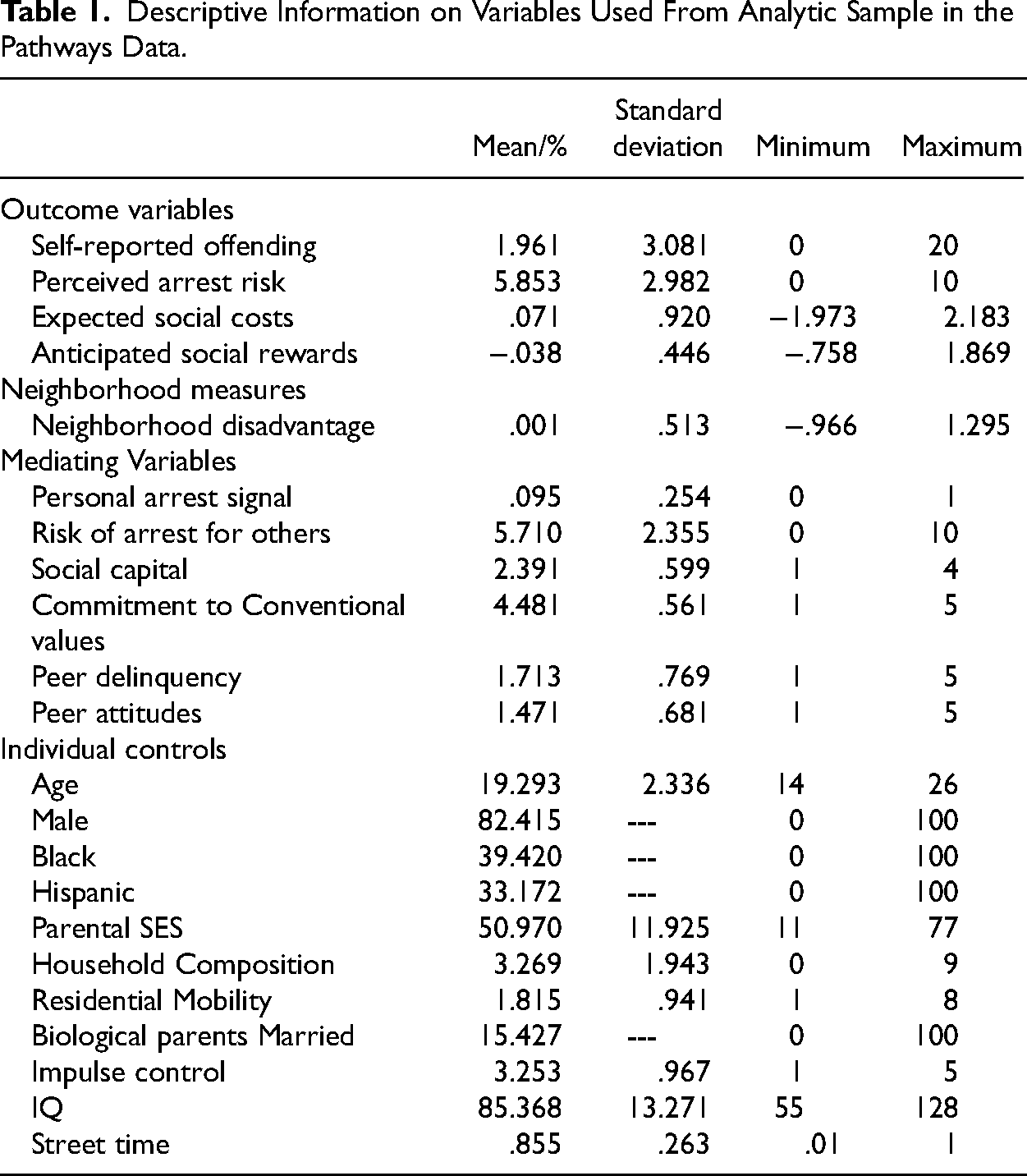
Descriptive statistics for the analytic sample are displayed in Table 1. The sample consists primarily of non-whites (40 percent Black/African American and 33 percent Hispanic) and males (82 percent) who were, on average, about 15 years old at the time of the baseline interview. We rely on data collected in the ten follow-up interviews, the first six of which were conducted at six-month intervals, and the final four of which were conducted annually. Our total pooled sample captures 9,139 N x T observations, which represents multiple observations for 1,293 individuals (95 percent of the initial baseline sample). 2 A full description of the control variables and the items comprising them are displayed in Supplemental Table S1.
Descriptive Information on Variables Used From Analytic Sample in the Pathways Data.
Measures
Outcome Variables
Self-reported Offending. We capture individual differences in self-reported offending with a scale that combines responses to items that measure respondent involvement in 20 crimes, including destroying property, breaking into a building, arson, shooting someone, shooting at someone, beating someone up, burglary, shoplifting, use of an illegal credit card, being in a physical fight, auto theft, receiving stolen property, carjacking, robbery with a weapon, robbery without a weapon, breaking into an automobile, selling marijuana, selling other drugs, carrying a weapon, and driving drunk. Following recommendations for the construction of offending scales (Sweeten, 2012; Loughran et al., 2016), we constructed a composite variety score of offending across binary indicators of involvement in these crimes. 3 The resulting scale represents the count of different crimes respondents report committing during the previous 12 months. We model offending at time t + 1 to ensure correct temporal ordering.
Perceived Arrest Risk. At each interview respondents were asked how likely it is that they would be caught and arrested if they committed each of the seven following types of crime: assault, robbery, stabbing someone, breaking into a home or store, stealing clothes from a store, destroying property, and auto theft. Response options ranged from 0 (no chance) to 10 (absolutely certain to be caught), with higher values indicative of a greater perceived likelihood of arrest. The mean score over the panel is 5.853 (SD = 2.982), indicating that across the seven crimes individuals believe there is, on average, about a 60 percent perceived chance of arrest risk when offending (alpha at baseline = .89; RMSEA < .05; CFI >= .98).
Expected Social Costs. At each interview respondents were asked how likely it is that they would experience one of the following consequences if arrested: lose respect from close friends, lose respect from family members, lose respect from a girlfriend or boyfriend, lose respect from neighbors or other adults, be suspended from school, or find it harder to get a job. Response options ranged from 1 (very unlikely) to 5 (very likely), with higher values indicative of anticipating greater informal social costs from arrest. The resulting scale demonstrated adequate levels of internal consistency (alpha = .68 at baseline) with an average value of 3.210 (SD = .928) over the panel. For the purposes of our analysis, we estimated informal social costs as a latent trait through CFA (RMSEA < .05; CFI = .96).
Anticipated Social Rewards. Although early discourse on choice theories focused predominately on material rewards from crime, Becker (1968) observed that the benefits of crime can be conceptualized more broadly and can include potential increases in social standing. Subsequently, Matsueda and colleagues (2006) observed that “social status…is a key component of decisions to offend” (p. 117). Consistent with prior work (Loughran et al., 2016; Thomas and Vogel, 2019), we captured perceived social rewards from crime through items that ask respondents their level of agreement with statements about how similarly-aged peers would react if the respondent engaged in three different crime types: stealing (e.g., If I steal things other people my age will respect me), fighting (e.g., If I beat someone up, other people my age will respect me), and robbery (e.g., If I rob someone, people my age will be afraid to mess with me). Response options ranged from 1 (strongly disagree) to 4 (strongly agree), with higher values indicating a greater tendency to view crime as eliciting social rewards. The average scale displayed high levels of internal consistency (alpha = .82 at baseline). Over the panel, the mean average social reward score for the sample was 1.826 (SD = .518). In our empirical models predicting perceptions of anticipated social rewards, we utilize a latent trait measure captured through CFA (RMSEA = .07; CFI = .95).
Explanatory Variable
Neighborhood Disadvantage. Drawing from the interdisciplinary literature on neighborhood effects (see Brooks-Gunn, Duncan, and Aber, 1997; Ohmer, Coulton, and Freedman, 2018), we constructed a comprehensive indicator of residential exposure to neighborhood disadvantage that combines objective measures of socioeconomic structural disadvantage, subjective measures of limited legitimate opportunities, and assessments of social and physical disorder. The wave-specific measure of “objective” concentrated neighborhood disadvantage encompasses four block-group characteristics drawn from the 2000 Census (proportion of individuals living in poverty, proportion of residents on welfare, proportion of households headed by a single parent, and proportion of residents that are unemployed). 4 We combined monthly estimates for these objective indicators of concentrated neighborhood disadvantage within each recall period and computed a single mean scale (across months) for each wave of the study. For respondents who resided in multiple neighborhoods during a recall period, we computed a weighted average that placed greater weight on the block group(s) in which individuals lived for longer durations. Next, for access to legitimate opportunities for success in neighborhoods, we utilize a six item scale that captures perceptions about limited access to legitimate avenues for economic success (e.g., “In my neighborhood it is easy for a young person to get good job” (reverse coded); “in my neighborhood, it is hard to make money without doing something illegal”; college is too expensive for most people in my neighborhood”; there is not much opportunity to succeed like kids from other neighborhoods”). To capture neighborhood disorder, we use a 21-item scale adapted from Sampson and Raudenbush (1999) that gauges individual perceptions of physical (e.g., “graffiti or tags” in the neighborhood, “cigarettes on the street or in the gutters”) and social disorder in one's neighborhood (e.g., “people using needles or syringes to take drugs,” “adults fighting or arguing loudly”).
We employ a comprehensive measure of neighborhood disadvantage that combines the objective measure of concentrated disadvantage with our subjective indicators of limited opportunities and disorder for both theoretical and empirical reasons. First, theoretical descriptions often highlight both objective indicators of social and economic characteristics and subjective perceptions of opportunities and disorder within neighborhoods, implying that their integration may be more reflective of one's actual experiences (Brooks-Gunn et al., 1997; O'Neil, Parke, and McDowell, 2001). Thus, integrating objective and subjective measures of neighborhood characteristics recognizes both the impact of environment and place while at the same time orienting scholars to the lived experiences of neighborhood residents. Beyond this theoretical rationale, in our data the three indicators of neighborhood socioeconomic disadvantage considered were strongly related to one another, with Pearson correlations ranging from .4 to .67, and a factor analysis indicated that these measures loaded on a single factor for each wave of the panel study. 5 The combined scale yielded good measurement properties across all waves (alpha > .68, RMSEA = .01, CFI > .98) and ranges from −.97 to 1.30, with larger values indicating higher levels of concentrated neighborhood disadvantage. 6
Proposed Mediating Variables
Personal Arrest Signal (Ait/Cit). We combine two items to measure a respondent's personal arrest signal, which we define as the ratio of arrests experienced to crimes committed (see Anwar and Loughran, 2011). The first item captures the number of arrests an individual experienced during each recall period (Ait), which is derived from official data from juvenile court databases in Maricopa County, AZ and Philadelphia County, PA when respondents were juveniles, and court record information and FBI arrest records when respondents were 18 and older. This value serves as the numerator in the arrest signal measure. The second item is a measure of self-reported offending frequency (Cit) that captures the number of crimes an individual reported committing during each recall period. At each recall, respondents were asked how many times they engaged in 20 different crime types (e.g., shot someone, stole from a store, motor vehicle theft). We summed the total number of times respondents reported engaging in these acts, and the resulting frequency serves as the denominator in our arrest signal measure. Then, following Anwar and Loughran (2011) we created a personal arrest signal value that represents the ratio of arrests to self-reported crimes committed (Ait/Cit). Values closer to 1 indicate that individuals were arrested at a relatively high rate when they offended, while values closer to 0 indicate that individuals avoided arrest when they offended. Recall that we draw on the literature showing lower levels of crime reporting and lower cooperation with police to predict that personal arrest signals would be lower in neighborhood characterized by higher levels of disadvantage (Kirk and Matsuda, 2011). This measure will serve as a mediator in our models linking neighborhood disadvantage to individuals’ perceptions of arrest risk.
Risk of Arrest for Others. Respondents were asked at each recall how likely it is that someone from their neighborhood would be arrested if they committed the same seven crimes that make up the personal perceived arrest risk outcome described above, with response options ranging from 0 (not at all likely) to 10 (absolutely certain to be caught). The resulting scale integrates responses across the seven crimes and captures how neighborhood processes may impact “public” perceptions of arrest risk because the question not only asks about the risk of arrest for others but focuses specifically on others who reside in the same neighborhood as the respondent. The scale for perceived arrest risk of others demonstrates good reliability (alpha = .82) and adequate fit (RMSEA = .09; CFI = .95), and this construct will serve as a mediator in our models predicting individuals’ own perceptions of arrest risk.
Commitment to Conventional Values. Consistent with theoretical arguments and the empirical literature, we conceptualize commitment to conventional norms as the extent to which individuals value “conventional” markers of success, such as doing well in school, getting a good job and career, and staying out of legal trouble. At each recall period respondents were asked “How important is it to you to…” “have a good job or career,” “graduate from college,” “earn a good living,” “provide a good home for family,” “have a good marriage,” “have a good relationship with your children,” and “stay out of trouble with the law.” Response options ranged from 1 (not at all important) to 5 (very important). We utilize the mean of these items at each wave as a potential mediator between neighborhood disadvantage and anticipated informal social costs. The scale demonstrated adequate levels of internal consistency (alpha = .67).
Social Capital. At each recall period respondents were asked about perceived connectedness to the community within a Social Capital Inventory (Nagin and Paternoster, 1994). We utilize two dimensions of the inventory that ask respondents about intergenerational closure as well as social supports and community involvement within their neighborhoods (e.g., How many of the parents of your friends know your parents?; If your family needed help, how many families in your neighborhood would help your family?; How many of your neighbors belong to a block group, community council, or other neighborhood association?; If someone in your family needed work, how many people in your neighborhood could help them get a job?; How many of your adult relatives live within an hour's drive of your home?). Response options ranged from 1 (none) to 4 (most). These items are consistent with social capital measures employed in previous research (Grasmick and Bursik, 1990; Nagin and Paternoster, 1994), and the resulting scale exhibits good internal consistency (alpha = .83, RMSEA = .06). We examine whether this indicator of social capital can help to account for the expected inverse association between neighborhood disadvantage and anticipated informal social costs.
Peer Delinquency. At each interview respondents were asked how many of their friends during the recall period engaged in a wide range of anti-social behaviors, including damaging property, hitting or threatening to hit someone, and stealing something worth more than $100. Response options for each of the items ranged from 1 (none of them) to 5 (all of them). The resulting multi-item scale has good measurement properties (alpha = .92) and demonstrated evidence of being a unidimensional construct (RMSEA = .09, CFI = .94). We include wave-specific scale means in the analysis to assess whether individual differences in peer delinquency exposure can account for the expected positive association between neighborhood disadvantage and perceived social rewards from crime.
Peer Attitudes. Scholars from the learning tradition have long acknowledged that there may be an important distinction between peers’ behavior and peer peers’ normative beliefs and attitudes (Warr and Stafford, 1991). We capture the delinquent attitudes of peers through the “Antisocial Influence” scale in the Pathways data. At each recall period respondents were asked seven questions about how many of their friends have encouraged drinking, selling drugs, stealing something, and hitting or beating someone up, for example. Response options ranged from 1 (none) to 5 (all of them). This scale demonstrated high levels of internal consistency (alpha = .93) and a unidimensional factor fit the data adequately well (RMSEA = .07, CFI = .96). At each period we utilize the mean of the scale for each respondent as a potential intervening mechanism between neighborhood disadvantage and perceived social rewards from crime.
Control Variables
We control for several potential confounders when examining the predictions outlined above. These include gender, age, race and ethnicity, parental SES, household size, family structure, capacity for impulse control, and IQ. We also control for individuals’ residential mobility in each recall period (the number of unique residences), and the proportion of time an individual spends outside of a correctional institution (i.e., “street time”). A summary of the scales, and the items comprising them, is presented in the Online Supplement (Appendix 1).
Analytic Plan
We estimate full information maximum likelihood SEMs that simultaneously assess the impact of neighborhood disadvantage on the proposed mediators and subjective expectations and self-reported offending and present our results in two stages. We begin by addressing our first research issue (i.e., illuminating mechanisms through which neighborhood socioeconomic disadvantage may influence subjective expectations). Specifically, our model provides a comprehensive assessment of hypotheses 1a – 3b by yielding four important pieces of information relevant to the theoretical arguments of our first research objective outlined above: (1) whether neighborhood concentrated disadvantage is statistically related to subjective expectations, revealed through the estimated total effects of disadvantage on the risks, costs, and rewards from offending; (2) the extent to which concentrated neighborhood disadvantage is associated with the proposed first-stage mediators, which reflect individual differences in arrest signals, perceived risk of arrest for others, social capital, commitment to conventional values, and exposure to delinquent others; (3) whether these proposed mediators have direct effects on subjective expectations and; (4) the estimated indirect effects of concentrated neighborhood disadvantage on subjective expectations via the proposed mediators.
We then proceed to the discussion of our second core objective, expressed in hypotheses 4a-4c: the overall effect of neighborhood disadvantage on self-reported offending and the extent to which its impact is mediated by subjective expectations. To accomplish this, we report the results of our generalized SEM regression models, using a Poisson link function to account for the count nature of the outcome, that regress offending variety (captured at time t + 1) on neighborhood disadvantage, the subjective expectation measures, and the proposed first stage mediators. The models examine if individuals residing in areas characterized by disadvantage are more prone to offending (total effects) and provide insights about the degree to which our proposed rational choice pathways—via perceived risk, anticipated social costs, and perceived social rewards—mediate the relationship between neighborhood disadvantage and offending (indirect effects). All models include all the control variables and correct the standard errors to account for interdependence among observations. Further, our equation predicting offending adjusts the error terms using a quasi-(variance adjusted) Poisson model to account for violations of the equidispersion assumption. 7
Results
Several of our hypotheses (1a – 3b) highlight theoretically informed mechanisms that may connect concentrated neighborhood disadvantage to individual differences in subjective expectations. To fully assess the implied relationships embedded within these hypotheses, we describe the relevant total, direct, and indirect effects of neighborhood disadvantage on subjective expectations. The results are presented in Tables 2 to 4, which summarize the most pertinent effects of perceived arrest risk (Table 2), social costs (Table 3), and social rewards (Table 4). The models include all of the control variables and mediators, but for brevity, we emphasize the estimates that correspond to our hypotheses. The full regression results underlying the estimates of direct effects are provided in the Online Supplemental Appendix (see Table S2) and the model demonstrates adequate fit to the data (χ2 = 6556.76, p < .001; RMSEA = .04; CFI = .93).
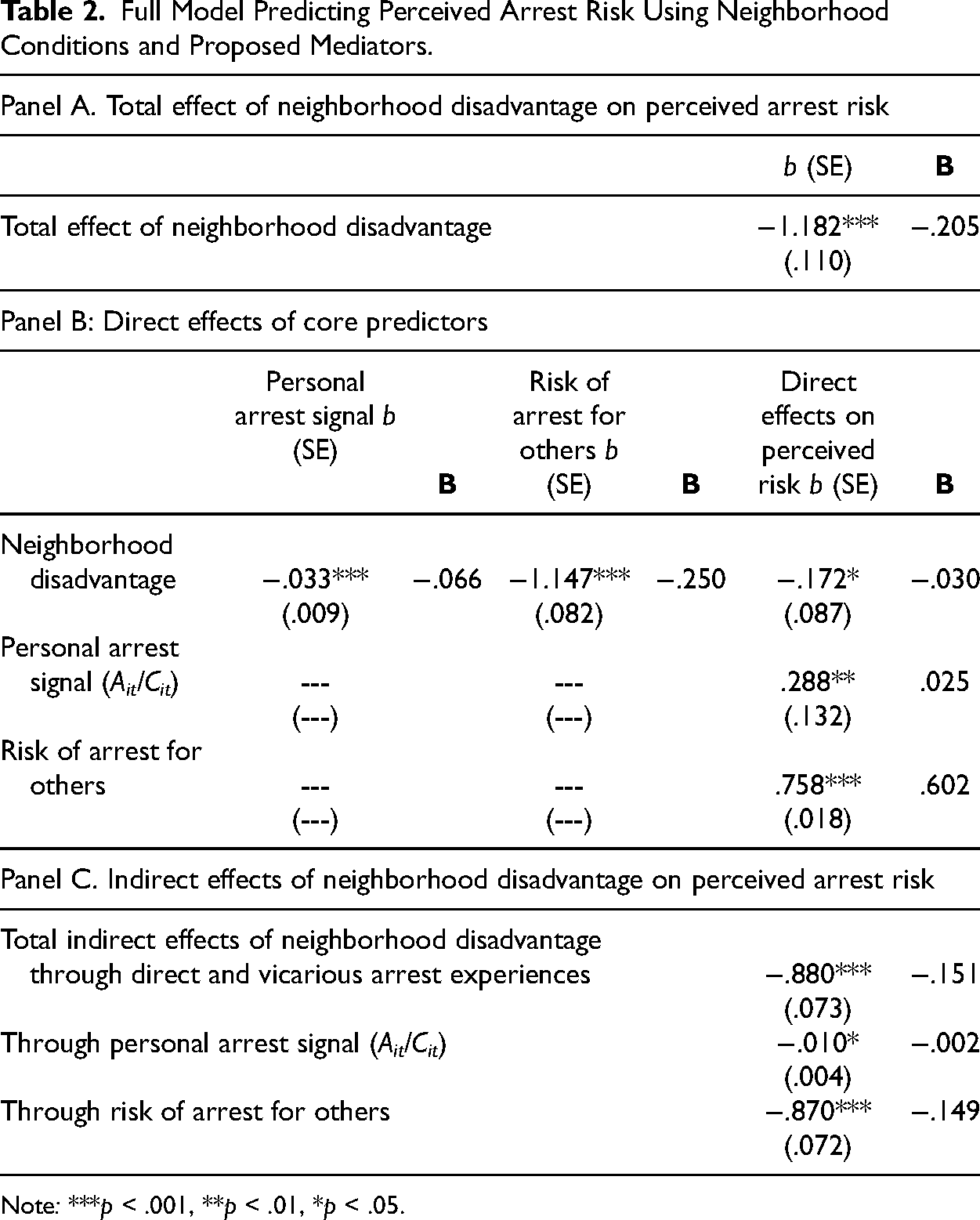
Full Model Predicting Perceived Arrest Risk Using Neighborhood Conditions and Proposed Mediators.
Note: ***p < .001, **p < .01, *p < .05.
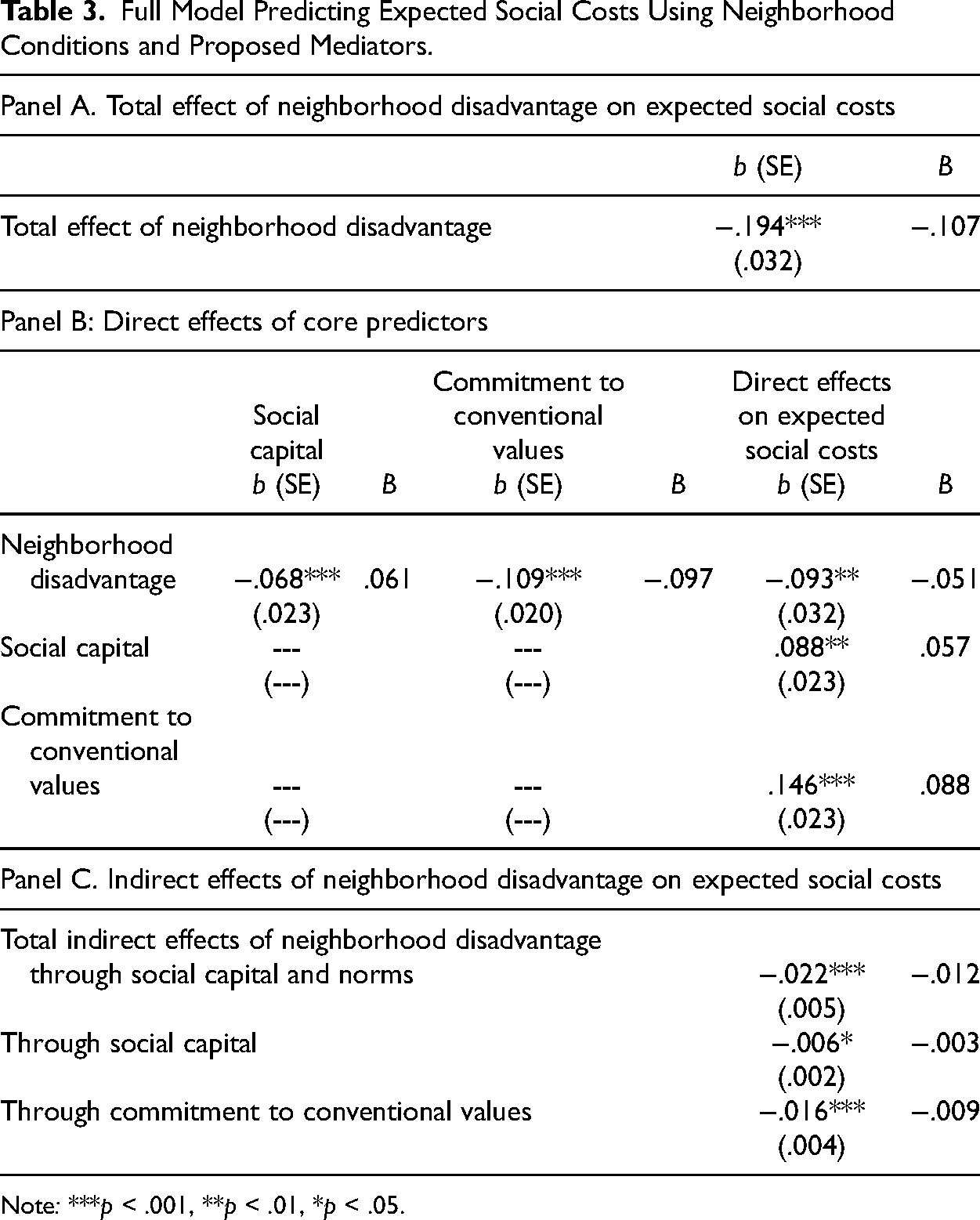
Full Model Predicting Expected Social Costs Using Neighborhood Conditions and Proposed Mediators.
Note: ***p < .001, **p < .01, *p < .05.
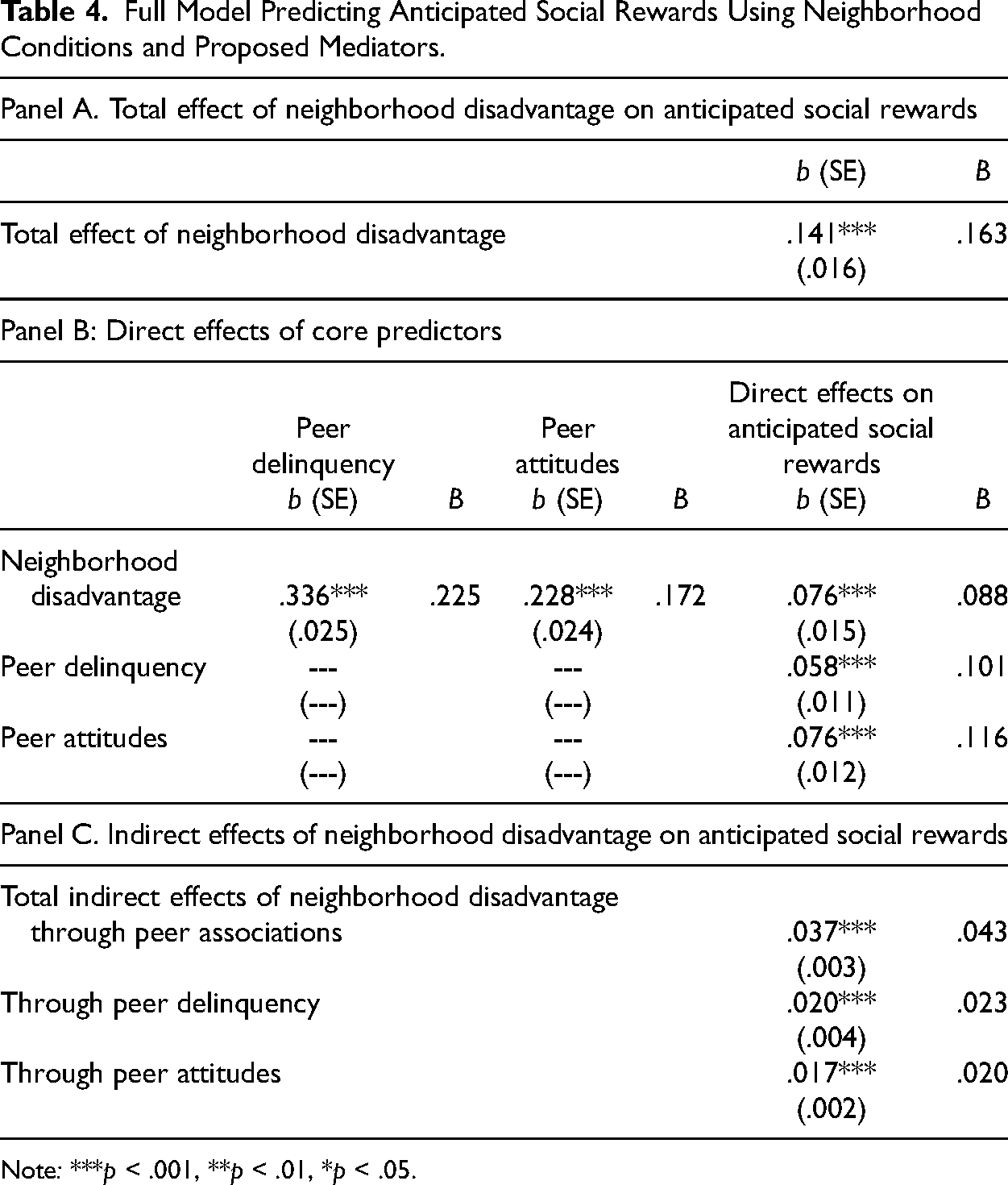
Full Model Predicting Anticipated Social Rewards Using Neighborhood Conditions and Proposed Mediators.
Note: ***p < .001, **p < .01, *p < .05.
Neighborhood Disadvantage and Subjective Expectations
Table 2 summarizes the most pertinent results for arrest risk from this model. The results indicate that the total effect of concentrated neighborhood disadvantage on perceptions of arrest risk is substantively large and statistically significant (total effect: b = −1.182, SE = .110, p < .001). Individuals residing in neighborhoods characterized by higher levels of socioeconomic disadvantage hold significantly lower perceptions of arrest risk than individuals residing in more affluent communities. The results further indicate that concentrated neighborhood disadvantage has statistically significant direct effects on both personal experiences with arrest (b = −.033, SE = .009, p < .001), which is consistent with arguments that emphasize reduced arrest signals in disadvantaged neighborhoods (e.g., Kirk and Matsuda, 2011), 8 as well as individuals’ perceptions of the likelihood that others in their neighborhood will confront arrest when engaging in crime (b = −1.147, SE = .082, p < .001). We also find that personal arrest experiences in the form of arrest signals (b = .288, SE = .132, p < .05) and perceptions of arrest risk for others (b = .758, SE = .018, p < .001) relate to individuals’ own perceptions of arrest risk in a manner consistent with the theoretical expectations outlined above. 9
Most importantly, consistent with theoretical expectations, the results show that the majority of the relationship between neighborhood disadvantage and perceived arrest risk—about 75 percent —is estimated to operate indirectly through the two mediating arrest signal variables (total indirect effect through arrest signals: b= −.880, SE = .073, p < .001). Although we find that the indirect effect of concentrated neighborhood disadvantage is statistically significant through personal arrest signal (indirect effect: b = −.010, SE = .004, p < .05), this mediating path accounts for only about 1.1 percent of the indirect effect of concentrated neighborhood disadvantage on perceived arrest risk, suggesting limited support for H1a. The remaining portion of the indirect effect of concentrated neighborhood disadvantage relationship on perceived arrest risk through arrest signals—and about 74 percent of the total effect—is due to individual differences in beliefs about the arrest risk confronted by others in their neighborhood when offending (indirect effect: b = −.870, SE = .072, p < .001), which is consistent with H1b and suggests a prominent role for vicarious learning and general deterrence (Stafford and Warr, 1993).
Table 3 summarizes the observed linkages between neighborhood concentrated disadvantage and expected informal social costs associated with offending (total and direct effects). The total effect of concentrated neighborhood disadvantage on the anticipated social costs of offending is negative and statistically significant (total effect: b = −.194, SE = .032, p < .001), indicating that individuals residing in more disadvantaged communities anticipate lower informal sanctions when offending compared to those residing in more affluent neighborhoods. The results further indicate that concentrated neighborhood disadvantage has direct and statistically significant relationships to both proposed mediators—social capital (b = −.068, SE = .023, p < .001) and commitment to conventional norms (b = −.109, SE = .020, p < .001)—in a manner consistent with the theoretical predictions we extracted from the literature. Higher levels of concentrated neighborhood disadvantage are associated with weaker commitments to conventional norms and lower levels of social capital. Finally, we find evidence that social capital and commitment to conventional norms are associated with anticipated social costs in a manner consistent with prevailing theoretical arguments (Bursik and Grasmick, 1993; Kornhauser, 1978; Toby, 1957). On average, individuals with a stronger commitment to conventional norms (b = .146, SE = .023, p < .001) and individuals who report higher levels of social capital (b = .088, SE = .023, p < .001) tend to anticipate higher levels of informal social costs associated with offending. 10
The results further provide partial support for our hypotheses about one reason why neighborhood disadvantage is relevant for perceived social costs, as there is a statistically significant indirect relationship between disadvantage and expected social costs, with about 52 percent of the total effect of neighborhood disadvantage being accounted for indirectly (total indirect effect: b = −.101, SE = .031, p < .001). More importantly, we find that about 11 percent of this total disadvantage effect and 22 percent of the total indirect effect operates through the proposed mediators of social capital and commitment to conventional norms (indirect effect through social capital and conventional norms: b = .−022, SE = .005, p < .001). Indeed, individual differences in both social capital (b = −.006, SE = .002, p < .05) and commitment to conventional norms (indirect effect: b = −.016, SE = .004, p < .001) have statistically significant mediating effects, but the majority of this attenuation due to commitment to conventional norms (H2a). Importantly, a substantial portion of the association between concentrated neighborhood disadvantage and anticipated social costs in our model is in the form of a direct effect (direct effect: b = −.093, SE = .032, p < .001), which suggests that other mechanisms not captured in this study may be driving the relationship between neighborhood disadvantage and social costs.
Table 4 summarizes the results linking neighborhood disadvantage to anticipated social rewards. The findings indicate that neighborhood disadvantage has a statistically significant total effect on anticipated social rewards (total effect: b = .141, SE = .016, p < .001). This suggests that individuals residing in neighborhoods characterized by higher levels of socioeconomic disadvantage report that offending can yield higher levels of respect and status from peers compared to residents of less disadvantaged areas. We also find that concentrated neighborhood disadvantage has a positive and statistically significant relationship with exposure to delinquent peer behavior (b = .336, SE = .025, p < .001) and exposure to peers who espouse pro-delinquent attitudes (b = .228, SE = .024, p < .001). These findings are consistent with Chicago School notions that higher levels of neighborhood disadvantage and disorder translate to increased exposure to individuals who exhibit patterns favorable to delinquency and crime (Sutherland, 1947). Further, both delinquent peer behavior (b = .058, SE = .011, p < .001) and peers’ delinquent attitudes (b = .076, SE = .012, p < .001) are significantly predictive of individuals’ perceptions of the social rewards associated with crime. That is, individuals who are exposed to behavioral patterns and attitudes conducive to crime are more likely to believe that offending yields increases in social status and respect. 11
The decomposition results are partially consistent with Hypotheses 3a and 3b, suggesting that about 46 percent of the disadvantage-social rewards relationship operates indirectly (total indirect effect: b = .065, SE = .006, p < .001), with most of this indirect effect—about 57 percent of the total indirect effect and 26 percent of the total disadvantage effect—coming from increased exposure to peers who engaged more frequently in delinquent behavior and who exhibit delinquent attitudes (total indirect effect of peer behavior and attitudes: b = .037, SE = .003, p < .001). When we consider the two measures separately, the results reveal that peer behavior (indirect effect: b = .020, SE = .004, p < .001) and peer attitudes (indirect effect: b = .017, SE = .002, p < .001) contribute about equally to the observed mediation. Thus, we find some support for the argument that individuals residing in neighborhoods characterized by higher levels of concentrated disadvantage and disorder are more likely to be exposed to associates who display criminal behaviors and espouse pro-delinquent attitudes, and this, in turn, contributes to beliefs that criminal behavior can increase status and respect.
Neighborhood Disadvantage, Subjective Expectations, and Criminal Offending
Our final research objective is to assess whether individual differences in subjective expectations are relevant to explaining the higher rates of offending often observed among people who reside in neighborhoods characterized by high levels of concentrated disadvantage. Table 5 presents the results from the SEMs designed to examine this question. The underlying model also incorporates the main effects of the control variables, but we focus on the results germane to examining the potential mediating role of subjective expectations. The full results are reported in Supplemental Table S2.
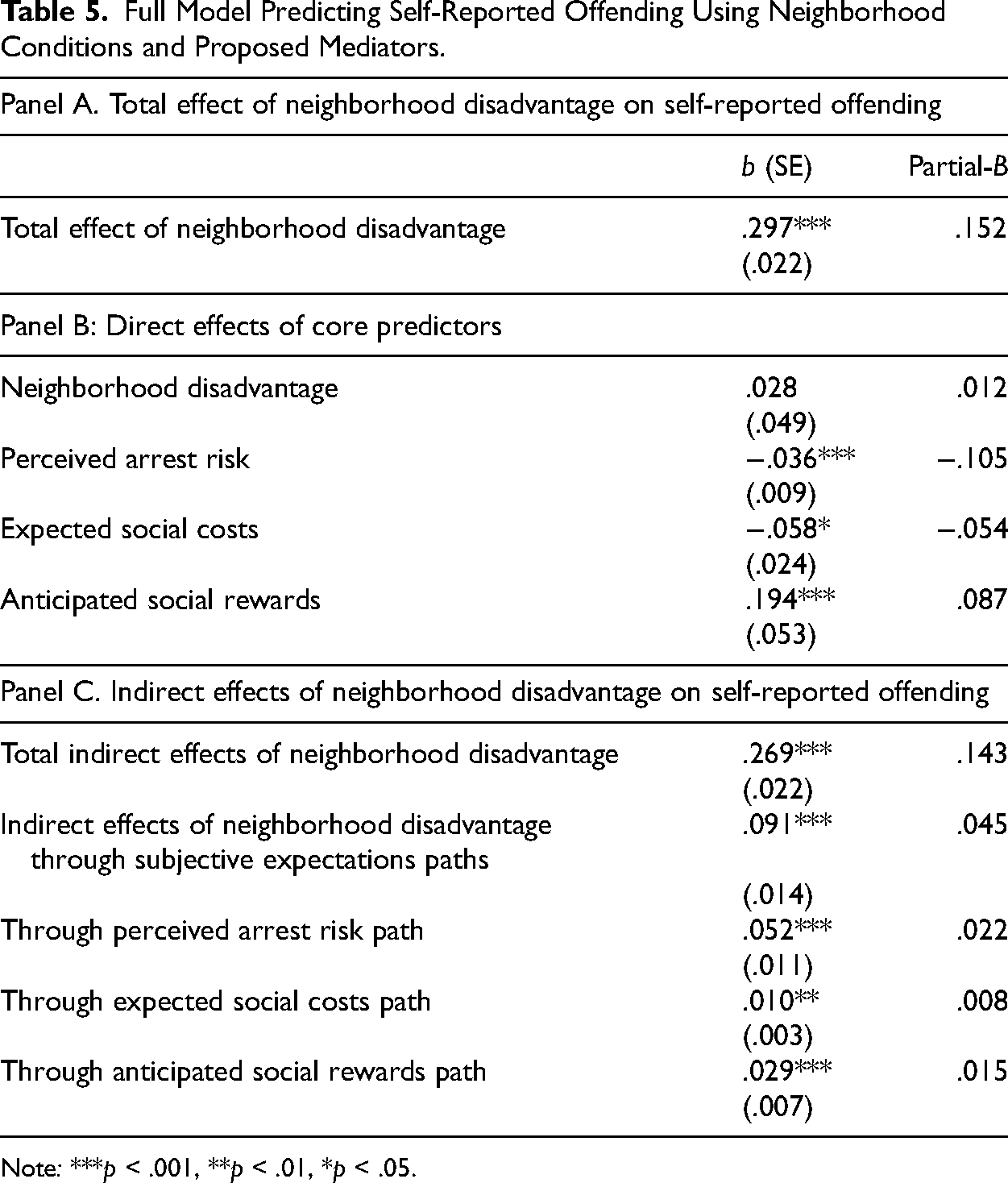
Full Model Predicting Self-Reported Offending Using Neighborhood Conditions and Proposed Mediators.
Note: ***p < .001, **p < .01, *p < .05.
The results indicate that, as expected, individuals residing in a more disadvantaged neighborhood engage in a greater variety of criminal acts than those who live in more affluent areas (total effect: b = .297, SE = .022, p < .001). Specifically, a one-unit increase in neighborhood disadvantage is associated with about a 35 percent increase in the expected count of offending variety. Additionally, perceptions of arrest risk (b = −.036, SE = .009, p < .001), expected social costs (b = −.058, SE = .024, p < .05), and anticipated social rewards (b = .194, SE = .053, p < .001) are related to offending variety in a manner consistent with rational choice predictions.
We next assess whether, and to what extent, the proposed paths linking disadvantage to offending through perceptions of the risks, costs, and rewards from crime mediate the observed relationship. Note first that neighborhood disadvantage does not have a significant direct relationship with offending variety (b = .028, SE = .049, p > .50) and that the size of the direct effect is substantially smaller than the estimated total effect of disadvantage on offending. Indeed, the findings indicate that the proposed rational choice model linking neighborhood disadvantage to offending indirectly through the perceived arrest risk, anticipated social costs, and perceived social rewards paths via the proposed mediators accounts for 31 percent of the effect of neighborhood disadvantage on offending variety (total indirect through subjective expectations: b = .091, SE = .014, p < .001). When we decompose this into the specific choice-input pathways, we find that the largest indirect effect operates through the perceived arrest risk path (indirect effect: b = .052, SE = .011, p < .001), followed by the perceived social rewards path (indirect effect: b = .029, SE = .007, p < .001), and the anticipated social costs path (indirect effect: b = .010, SE = .003, p < .05).
We summarize the results from our empirical assessment of the multi-level rational choice perspective posited in the study in Figure 2. Although we recognize that our hypotheses specify partial mediation effects which implies direct effects among more distal predictors, we present a reduced figure that shows just the most germane results for ease of interpretation. That is, the underlying model used to produce this figure includes all of the control variables, direct effects of the first-stage mediators on subjective expectations and offending, and direct effects of neighborhood disadvantage on the mediators and offending, but we omit these paths to more clearly illuminate the findings most pertinent to our hypotheses.
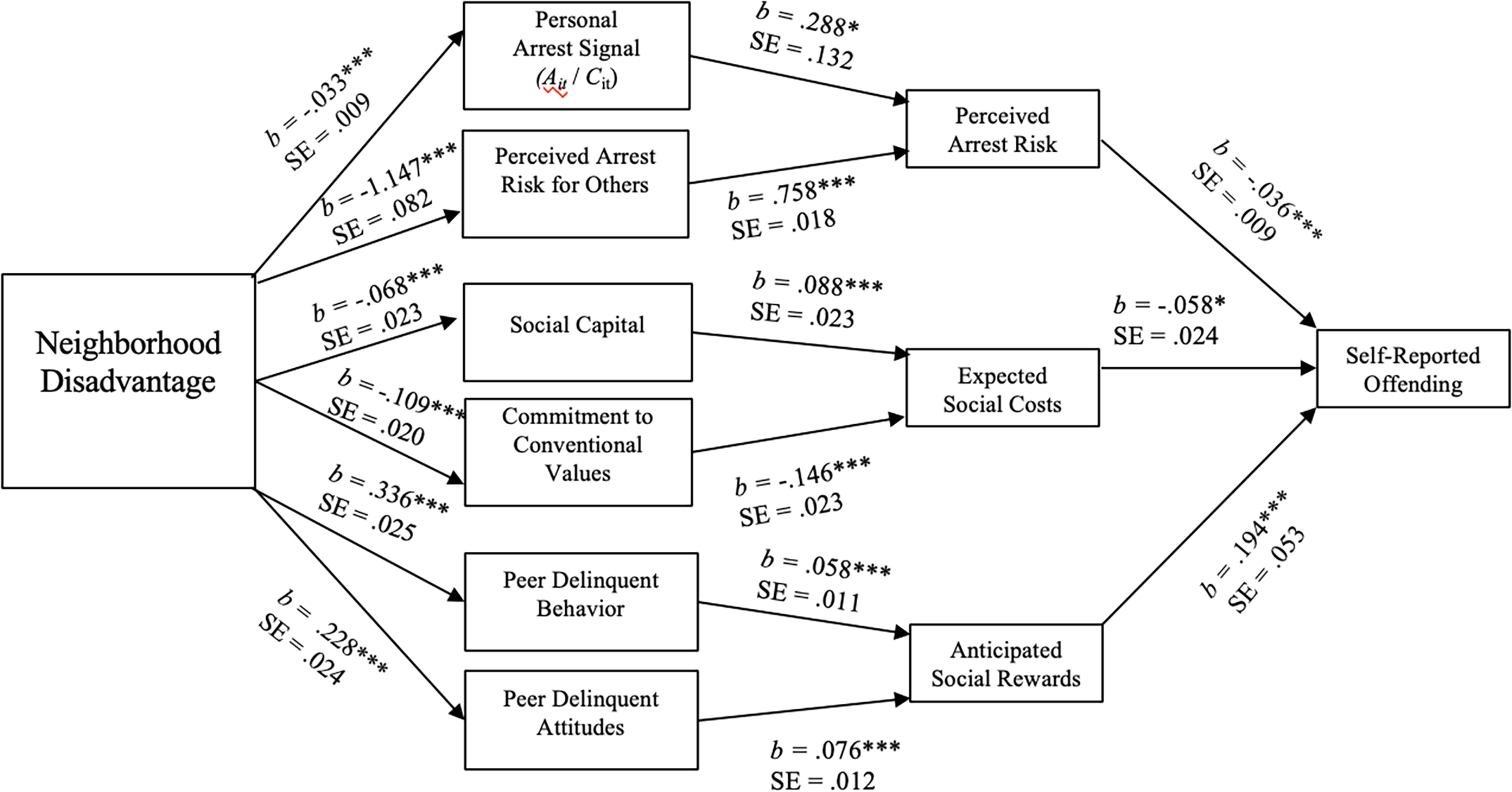
Heuristic multi-level model of the impact of neighborhood socioeconomic disadvantage on individual differences in subjective expectation and criminal behavior.
As demonstrated in Figure 2, neighborhood disadvantage is directly related to each of the theoretical mediators we identified, and these mediating factors in turn directly relate to individual subjective expectations. These subjective expectations are then subsequently related to self-reported offending in ways that are consistent with rational choice predictions. While additional research incorporating other indicators is needed, our results show that after accounting for the theoretically derived mediators, the observed relationship between neighborhood disadvantage and offending is no longer statistically significant.
Discussion
Rational choice theory and the associated empirical research on choice perspectives continue to focus predominately on individuals’ “utility calculus” and decision-making processes internal to the individual, while largely neglecting sociological structural influences that may be relevant. At the same time, studies focusing on contextual influences on offending tend to concentrate almost entirely on characteristics external to the individual and have largely failed to incorporate the potentially impactful role that choice may play in these processes (Hechter and Kanazawa, 1997, Matsueda, 2017). Motivated by the potential for theoretical and empirical gains from integrating the two perspectives, the present study examined the mechanisms through which individuals’ choice inputs are impacted by neighborhood socioeconomic disadvantage, and in turn how this may yield different levels of offending among those who reside in such areas.
Drawing on theory and prior research, we predicted that residence in a neighborhood characterized by higher levels of socioeconomic disadvantage would: (a) reduce perceptions of arrest risk because of lower direct and vicarious experiences with arrest, conditional on offending (Stafford and Warr, 1993); (b) translate into fewer anticipated social costs associated with crime due to a lowered commitment to conventional values and lower levels of social capital (Bursik and Grasmick, 1993; Toby, 1957); and (c) yield greater perceived social rewards associated with crime because of an increased exposure to peer behavior patterns and attitudes conducive to crime (Sutherland, 1947). Our results provide partial support for these processes and mechanisms.
A key finding from the study is that vicarious experiences with arrest mediated most of the inverse association between neighborhood disadvantage and respondents’ perceived arrest risk. The other mediating variables considered were less central to explaining the association between concentrated neighborhood disadvantage and individual differences in subjective expectations. About 11 percent of the association between concentrated neighborhood disadvantage and anticipated social costs was explained by individual differences in commitment to conventional values and access to social capital, and exposure to delinquent peer behavior and attitudes accounted for over 25 percent of the association between concentrated disadvantage and perceived social rewards. This suggests that, while the proposed mediators play an important role in explaining the observed link between concentrated neighborhood disadvantage and subjective expectations, it would be valuable to consider an expanded set of potential mechanisms in future studies. For example, in addition to the factors considered, the anticipated social costs of crime may be lower in disadvantaged neighborhoods due to unmeasured cultural scripts that may emerge in such areas (Sampson and Wilson, 1995) or to weakened attachments (as opposed to commitments) to pro-social institutions of social control (Hirschi, 1969). Additionally, while heightened exposure to delinquent peers is one reason that individuals from disadvantaged neighborhoods attach greater social rewards to crime, such exposure may not be necessary if broader community norms emerge in disadvantaged neighborhoods that define violence and other forms of crime as mechanisms through which one may demonstrate toughness and elicit status and respect from others (e.g., Anderson, 1999).
Our findings also speak to the potential for rational choice theories to account for the impact of structural factors on criminal behavior. Despite a long tradition of linking characteristics such as concentrated neighborhood socioeconomic disadvantage to variation in offending at the individual level, one criticism of such work has been the difficulty in linking individual theoretical processes to broader social structural perspectives in a logically consistent manner (Kornhauser, 1978). Recently, several scholars have suggested that rational choice principles are well-suited to bridge this macro-micro divide (Matsueda, 2013; Thomas et al., 2022a), linking environmental and contextual characteristics to individual perceptions of and preferences for the risks, costs, and rewards associated with offending. To date, however, little research has examined this empirically. We found that neighborhood disadvantage was associated with elevated levels of individual offending, which is consistent with prior studies (see Sampson, 2012 for a review). We advance the literature on both communities and crime and rational choice by observing that one-third of that neighborhood effect can be accounted for by individual subjective expectations of the risks, costs, and rewards associated with offending. While we caution readers about drawing comparisons across studies that use different samples and measures, we note that the indirect effects observed through the rational choice inputs in the current study are similar to, and in some cases substantially larger than, prior works that have used theoretical mediators derived from learning, control, and strain theories (Haynie et al., 2006; Intravia et al., 2017; Thomas, O’Neill, and Vogel, 2024; Warner and Fowler, 2003). This, in combination with prior findings suggesting that rational choice theories perform well when accounting for other core structural predictors (e.g., age and gender; Neissl et al., 2019; Thomas and Vogel, 2019), leads us to agree with Loughran et al.’ (2016) declaration that “rational choice theory is as general a theory of crime” as these other prominent perspectives.
Our results reveal the disutility of the historical bifurcation of economic-based theories of choice and sociological-based theories of structure by illuminating the value of integrating their unique insights into a broader model of human action (Coleman, 1990). More generally, the results suggest a multi-faceted and multi-level process impacting human action, at least as it pertains to criminal behavior. The neighborhood context in which individuals reside impacts individual experiences, interactions, and social connections that in turn impact the internal considerations of the risks, costs, and rewards associated with offending. Ultimately, this provides support for the additional development of a multi-level rational choice theory of offending, which has been championed by sociological choice theorists (Matsueda, 2013, 2017; see also Coleman, 1990).
Further pursuing the intersection of social context and individual choice has the potential to add considerable understanding to several issues related to crime and deviance. We especially encourage three extensions of the present study. First, we believe it is important to consider diverse social contexts to better understand how such environments impact offender decision-making. We believe it may be particularly important to incorporate neighborhood racial-ethnic composition into a multi-level rational choice model of crime. Although the research on the influence of neighborhood racial-ethnic composition on individual-level outcomes is mixed (see Sampson, 2012 for a review), it is possible that this contextual feature is important for the development of subjective expectations. Indeed, classic work on communities and crime has highlighted the importance of racial/ethnic heterogeneity on individuals’ perceptions of costs and rewards associated with offending (Shaw and McKay, 1942). Unfortunately, measures of racial-ethnic composition are not available in the Pathways data, but we see this as a potential opportunity for future research to test core predictions in communities and crime theorizing. In addition to other dimensions of neighborhood context, relevant social environments may also include families, peer groups, schools, and even cities. Such contexts clearly differ in their size and scope, but all may play some role in shaping individuals’ utility calculus around offending and may differentially impact different choice inputs.
Second, the role of opportunities and how they are structured by context are important to integrate into a multi-level rational choice theory of offending. Prior research has suggested that opportunities to commit crime are not uniform across geographic locations (Osgood and Anderson, 2004; Sampson and Wooldredge, 1987). At the same time, the concept of opportunities has been central in contemporary formulations of rational choice theories (Matsueda et al., 2006; Paternoster, 1989). Understanding perceptions of the risks, costs, and rewards associated with crime—and how they are impacted by neighborhood context—may not be sufficient to fully grasp individual differences in criminal behavior, as this process may be conditioned by opportunity structures (Sampson et al., 1997).
Third, the intersection between neighborhood context and choice may be important in understanding offending over the life course. Laub and Sampson (2003), for example, identified neighborhood change as a potential turning point that can promote desistance, and Giordano et al. (2002) and Paternoster and Bushway (2009) have further discussed how structural disadvantages can impact criminal desistance. Although the precise mechanisms of the proposed link between structural disadvantage and desistance have not been fully fleshed out or empirically tested, it is possible that a potential intervening relationship exists due to the impact on choice inputs, such as increased informal social costs (Laub and Sampson, 2003), changes in the perceptions of the risks associated with crime (Paternoster and Bushway, 2009), and/or changes in the exposure to delinquent others who socially reward crime (Giordano et al., 2003). Indeed, we believe that recognizing the intersection between neighborhood structure and individual choice has the potential to generate a number of novel research ideas that can advance the field.
The limitations of the current study also open potential avenues for future research. Our study relies on data from the Pathways to Desistance study, a sample of serious adolescent delinquents from Philadelphia and Phoenix. Although many findings from the Pathways data have been corroborated in other, nationally representative data sources, it is nonetheless imperative to assess the generalizability of the current findings among different individuals and in different contexts. Additionally, we want to underscore that the associations observed in the current study are correlational in nature, and do not necessarily reflect causal relationships between neighborhood disadvantage and perception formation. The observed effects could be compromised, for example, if individuals select neighborhoods for reasons that also associate with their subjective expectations associated with crime. Accounting for neighborhood selection is notoriously challenging (see Sampson, 2012 for review) and we attempted to ease such concerns by controlling for a host of familial and individual factors known to associate with neighborhood residence and other risk factors for offending, such as parental SES, family structure, race/ethnicity, household size, and a number of personality characteristics. Still, when the appropriate data exist, future work may seek to employ experimental (Sampson, 2008) and quasi-experimental (Kirk, 2009) designs to provide a “cleaner” identification of the effects of neighborhood characteristics on choice inputs.
In conclusion, although choice-based and structure-based explanations have historically been viewed as at odds with one another, criminologists are increasingly recognizing their compatibility (Matsueda, 2013). Our findings suggest that macro-level contexts can structure individuals’ experiences, interactions, and social connectedness, which subsequently impacts subjective expectations of offending and involvement in crime. This highlights the complex, multi-level nature of the etiology of crime and delinquency and emphasizes the need for additional theorizing and research that further clarifies how social context shapes subjective expectations and individual offending decisions.
Supplemental Material
sj-docx-1-jrc-10.1177_00224278241306712 - Supplemental material for Neighborhood Disadvantage, Rational Choice, and Offending
Supplemental material, sj-docx-1-jrc-10.1177_00224278241306712 for Neighborhood Disadvantage, Rational Choice, and Offending by Kyle J. Thomas and Eric P. Baumer in Journal of Research in Crime and Delinquency
Footnotes
Acknowledgments
We would like to thank Jessica Deitzer for her comments. An earlier version of this manuscript was presented at the Choice, Social Structure, and Crime workshop hosted by the Max Planck Institute in Freiburg, Germany. We thank Jean-Louis van Gelder, Dan Nagin, and Tim Barnum for the opportunity to participate in the intellectually stimulating event.
Declaration of Conflicting Interests
The authors declared no potential conflicts of interest with respect to the research, authorship, and/or publication of this article.
Funding
The authors received no financial support for the research, authorship, and/or publication of this article.

Supplemental Material
Supplemental material for this article is available online.
Notes
Author Biographies
References
Supplementary Material
Please find the following supplemental material available below.
For Open Access articles published under a Creative Commons License, all supplemental material carries the same license as the article it is associated with.
For non-Open Access articles published, all supplemental material carries a non-exclusive license, and permission requests for re-use of supplemental material or any part of supplemental material shall be sent directly to the copyright owner as specified in the copyright notice associated with the article.
