







Abstract
The effects of a positive mindset trigger word intervention on the expressive performance of individual junior high singers were tested in this study. Participants (N = 155) were assigned randomly to a control group or an experimental group. Members of the experimental group participated in a 40-min intervention while members of the control group participated in normal rehearsal. The intervention involved a pre-performance routine of breathing and silently repeating the words bold, confident, and free. It also involved practice activities for applying the technique to performance. Participants were tested individually directly before and after the intervention and 2 weeks later. Results indicated a significant positive effect on Overall Expressive Performance (p < .001) and on the subcategories Dynamics (p < .001), Performance Factors (p < .001), and Timing (p < .001). There was no significant effect on subcategories Articulation (p = .195) and Tone (p = .035). Implications were that (1) use of positive mindset trigger words in a pre-performance routine may bring immediate improvement in expressive performance for junior high age singers, (2) junior high age singers may possess higher levels of expressive performance skill than they or teachers recognize, and (3) review and repetition likely are needed for junior high age students to retain the intervention benefits.
Musicians typically spend a portion of their preparation time working to create an expressive music performance. In order to better understand how these performances are created, researchers have attempted to identify the specific work that musicians do to craft an expressive performance. Understanding not only how expressive performances are created but also how they are transmitted, taught, and understood enables musicians and music teachers to enhance the artistry in their performing and teaching.
Despite varying opinions on the elements present in an expressive performance, researchers nonetheless have studied this construct from a variety of perspectives. These perspectives include the communication of emotion through music performance, the development of computational models of expressive performance, statistical analysis of expressive elements in recorded performances, instructional strategies for teaching expressive performance, and factors that inhibit individual expressive performance. Comprehensive reviews of much of this literature have been compiled by De Poli (2004); Gabrielsson (1999, 2003); Goebl, Dixon, De Poli, Friberg, Bresin, and Widmer (2008); Juslin and Laukka (2004); Juslin and Sloboda (2001); and Widmer and Goebl (2004). Increasing amounts of research on expressive performance continue to illuminate its various components, revealing how it can be communicated, created, and taught.
Research on the communication of emotion in music performance often focuses on the use of specific music cues (e.g., tempo, dynamics, timing, and articulation) to project certain emotions (Juslin, 2000; Juslin & Laukka, 2003; Laukka, Juslin, & Bresin, 2005). Juslin (1999) found that listeners’ perceptions of emotional expression in music changed when cues were altered. Chaffin, Lisboa, Logan, and Begosh (2010) followed one cellist through five performances and 38 hours of practice on one piece, documenting how the cellist’s conscious use of expressive cues in rehearsal enhanced her ability to later write the score from memory. Other important contributions to the study of communication of emotion in music performance include Gabrielsson’s (2002) delineation of emotional perception and emotion induction, and several investigations of the connection between hearing music and emotional responses (Gabrielsson & Juslin, 1996; Gabrielsson & Lindström, 2001; Juslin & Sloboda, 2001).
Another way that expressive performance has been studied is through statistical analysis of music performances. In this line of research, authors attempt to identify and explore discrete components of expressivity, such as expressive timings and dynamics, by comparing audio recordings of expert performances. Although piano performances typically have been the primary data source for analysis (Cook, 2007; Repp, 1992), researchers also have done statistical analysis on performances by cello (Lisboa, Williamon, Zicari, & Eiholzer, 2005), trumpet (Collier & Collier, 2002), and violin (Cheng & Chew, 2008). Goebl and Widmer (2009) explained that retrieving performance data from these recordings (a process called annotation) allows researchers to compare the performance to a score or to another performance (a process called alignment), thus illuminating various aspects of an expressive performance. Johnson (1996) invited musicians and nonmusicians to assess rubato in recorded performances and found that only the more proficient musicians were able to identify the use of rubato in performance.
One extensive line of research in expressive performance involves a method known as computational modeling, in which researchers devise theories or mathematical models to explain specific aspects of expressivity (Ramirez, Hazan, Maestre, & Serra, 2008). These models usually are based on a theoretical relationship between the laws of physical motion and timing in music performance (Friberg, Sundberg, & Frydén, 2000; Honing, 2003; Sundberg, 2000). Computer programs, created by researchers, use these models to generate expressive performances (De Poli, 2004). Prominent models include the structure-level model of timing and dynamics (Todd, 1985, 1992), the rule-based performance model (Fabiani & Friberg, 2008; Friberg, 1991; Friberg & Sundberg, 1987; Sundberg, Friberg, & Frydén, 1989), the mathematical model of musical structure and expression (Mazzola, 2002; Mazzola & Göller, 2002), and machine learning models (Widmer, 2002; Widmer & Tobudic, 2003).
Authors in an emerging field of related research have investigated the teaching and learning of expressive performance. Within this field, researchers have identified and evaluated instructional strategies, studied the cognitive processing involved, and created new interventions for improving expressive performance. Broomhead (2006) identified and described seven categories of instructional techniques that three choral teachers used to teach expressive singing (student-initiated input, teacher inquiry, extra musical reference, demonstration, teacher feedback, detailing, and conducting) and concluded that (a) the teachers used many different techniques for teaching expressive singing, (b) there was a need for a more guided expressive performance observation instrument, and (c) terms often used by researchers to categorize teacher behavior (verbal and nonverbal) were insufficient terms for describing expressive performance teaching strategies. In a similar study of instrumental teaching, Karlsson and Juslin (2008) noted a “lack of clear goals, specific tasks, and systematic teaching patterns” (p. 309) in the expressive performance instruction they observed.
In a different study, Broomhead (2001) indirectly evaluated ensemble instruction by comparing individual performers’ expressive performance achievement with ensemble expressive performance achievement. Results indicated no notable relationship between the two constructs, suggesting that music educators should not assume that individuals in a highly expressive ensemble will sing expressively when singing alone. Time spent in choir and private instruction were significant predictors of individual expressivity.
Cognitive processing of expressive performance is another perspective that is gaining momentum. This research focuses on how students learn to perform expressively, with the goal of applying results to the instructional process (Sheldon, 2004; Woody, 1999, 2000, 2003, 2006a, 2006b). Rosenthal, Durairaj, and Magann (2009) analyzed musicians’ descriptions of what they were thinking and doing while preparing to perform the expressive aspects of a composition and found that musicians had a wide range of approaches to practice and used metaphors of motion and that advanced musicians made more goal oriented, less evaluative comments than less-experienced musicians. Woody (2006a) investigated college age pianists’ cognitive processing of imagery-based instruction and found that some students used a “cognitive translation process” in their practicing. The students took verbal imagery provided by the instructor and “translated” it into specific technical changes to achieve the desired performance effect.
Several pedagogical approaches have emerged based on what researchers have learned about the cognitive processing of expressive performance. Woody (2000) proposed an emotion-centered pedagogy based on connecting felt emotion with physical sound properties. Juslin (2003) created a psychological approach to learning expression based on a computational model known as the GERM model (Juslin, Friberg, & Bresin, 2002). Others have created a feedback-learning approach to musical expressivity (Juslin, Friberg, Schoonderwaldt, & Karlsson, 2004; Juslin, Karlsson, Lindström, Friberg, & Schoonderwaldt, 2006; Laukka & Juslin, 2000) and a structural communication approach to teaching expressivity (Friberg & Battel, 2002).
Broomhead (2009) explored a problem-solving approach to teaching expressive performance. In choral rehearsals, Broomhead instructed nonauditioned university choral students on the role of speech inflection and key-word emphasis in phrase shaping, provided students with problem-solving opportunities, and then evaluated the treatment as participants individually sang a familiar song. Results showed a treatment effect for both keyword emphasis and phrase shaping, indicating that instruction in speech inflection, followed by problem-solving opportunities, increased students’ abilities to perform expressively.
Performance quality also may be influenced—either positively or negatively—by a performer’s physiological state (Landers, 2003) and mindset (Dweck, 2006; Seligman, 1991). Negative states of mind such as fear of failure or lack of confidence can undermine a performer’s ability to perform at peak capacity. In the performing arts, performance anxiety has been the subject of an extensive line of research (Brandfonbrener, 1999; Kendrick, Craig, Lawson, & Davidson, 1982; Lehrer, 1987; Robinson, 2004). One intervention for managing performance anxiety that has found wide application in sports is visualization (Feltz & Landers, 1983; Murphy & Lowdy, 1992), specifically the use of cue or trigger words (Driskell, Copper, & Moran, 1994; Silva, 1982). Edmundson (1996) suggested that trigger words affect performance by minimizing distraction and focusing the performer’s attention. Hatzigeorgiadis, Zourbanos, Mpoumpaki, and Theodorakis (2009) found that motivational self-talk enhanced self-confidence and reduced cognitive anxiety during performance.
In a recent study, Broomhead, Skidmore, Eggett, and Mills (2010) explored an instructional approach for enhancing expressive performance in nonexpert adult singers. They speculated that nonexpert singers typically may perform below their capabilities in terms of expressivity and may possess related skills and understandings that usually are not put into full use during performance. The researchers predicted that a more appropriate mindset would enhance college age singers’ expressive singing and that use of positive trigger words would help singers achieve this mindset. Participants in the study were tested before and after a 50-min instructional intervention incorporating the use of a positive mindset trigger word-based pre-performance routine. Results revealed a significant treatment effect for overall expressive performance achievement (p = .015). The authors also identified specific subcategories that were affected by the treatment including timing (p = .0007), dynamics (p = .0017), physical performance factors (p < .0001), and style (p < .0001). However, in the case of style, the treatment effect was negative. The researchers found that the two item statements associated with style (“style is consistent and unified” and “style is historically appropriate”) were geared toward the evaluation of a serious or extended work and thus were not compatible with an evaluation of a brief musical moment such as singing “Row, Row, Row Your Boat,” the song used in the study.
The purposes of the present study were (1) to replicate the study just referred to in terms of the overall effect of the positive mindset trigger word pre-performance routine and (2) to investigate this phenomenon at a lower age and level of experience. For this study, we examined the effects of a positive mindset trigger word pre-performance routine on the expressive performance of junior high age singers.
Method
Sample
Participants for the study were members of the largest choirs from four suburban junior high schools in the Alpine School District, Utah Valley, Utah. The schools were selected randomly from the 10 junior high schools in that district. All students from the selected choirs were invited to participate in the study, however, in compliance with IRB requirements, only students whose parents signed and returned an approved consent form were considered eligible. With the exception of one seventh-grade student, participants included eighth (30%) and ninth graders (69%). Of the participants, 13% were currently in choir for the first time, 57% had 1 year or less of choral experience, and the remainder (43%) had more than 1 year of choral experience. Seventy-five percent of the participants had taken piano lessons for at least 1 year, and 12% had taken private voice lessons for at least 1 year. Participants from each school (NS1 = 38, NS2 = 37, NS3 = 36, and NS4 = 44) were assigned randomly to either a control group or an experimental group (N = 155, NCG = 73, and NEG = 82).
Procedures
The research design was a pretest–posttest control group design (Campbell & Stanley, 1966). All participants completed three performance tests. After completing an initial pretest, members of the experimental group received an intervention while members of the control group returned to their choral rehearsals. At the conclusion of the intervention, a second test was administered to all participants. Finally, a third test was administered to all participants after a period of 2 weeks during which no further interventions were administered.
Participants were randomly assigned to one of four testing locations within their school. In that location, they completed all three performance tests, the first two of which occurred on the first day of testing. On that first day, as soon as students assembled in the choral classroom, they were sent to their assigned testing locations where printed instructions invited control group members to return to rehearsal right after the pretest, and members of the experimental group were told where to report for the intervention after completing the pretest. Also on the first day, and after the intervention, both control group and experimental group members returned to their assigned testing locations and completed a posttest. The intervention was administered at each school by one of the researchers. The same person administered all instances of the intervention. A videotape was made of each of these instances and, upon completion of the study, was given to the respective teachers so that control group members from that school could view it.
Intervention
The intervention was designed to help students overcome unintentional self-imposed psychological boundaries that may prevent them from making full use of their preexisting expressive knowledge and skills. The intervention consisted of positive mindset trigger words and breathing exercises, and graduated expansion activities. All members of the experimental group participated in this 40-min intervention.
The positive mindset trigger words component of the intervention involved teaching singers to adopt the characteristics bold, confident, and free into their mindsets during a pre-performance routine. The term bold represented a performer’s willingness to take decisive and immediate action; confident represented a performer’s level of hope in his or her ability to execute skills necessary for the desired outcome; and free represented a performer’s being unrestrained by fear, inhibitions, or concern about the outcome. These terms were selected on the basis of their potential to help performers create an optimal performance mindset, thus liberating whatever preexisting expressive performance skills they may possess. The routine involved taking a deep, full breath and, during exhalation, saying silently to themselves, “Let it go.” Then, students breathed in gently two or three times as they repeated silently to themselves the trigger words “bold, confident, free.”
The graduated expansion activities included three exercises that gradually increased in terms of psychological difficulty. For the first activity, participants were divided randomly into small groups of five or six students and were instructed to briefly create, practice, and perform their own group composition using handheld percussion instruments. This was considered the least self-conscious activity, as it did not involve singing. After an initial performance, they were instructed to follow the breathing and positive mindset trigger word procedures of the pre-performance routine and then to repeat the performance. While following the breathing and the trigger word intervention procedures, participants also were instructed to experiment with contrasting mindsets by replacing the trigger words bold, confident, and free with the terms timid, scared, and outrageous (each term used in successive performances). This exercise gave participants practice in adopting various mindsets and applying those mindsets to performance.
For the second activity, this process was repeated in a small group singing exercise in which participants sang “Mary Had a Little Lamb.” The third activity was a solo singing exercise in which participants sang “Old MacDonald Had a Farm.” Because of time constraints, in these two exercises, participants did not practice with any other trigger words besides bold, confident, and free. At no point during the study did the researcher give music-related feedback or use music terminology to encourage musical improvement.
Songs were selected for the intervention (“Mary Had a Little Lamb” and “Old MacDonald Had a Farm”) and testing (“Happy Birthday”) based on the anticipated familiarity of these songs to the participants, ensuring that singers could focus on performance concerns such as musical expression, rather than on note accuracy or words. A second reason was that these songs were not governed clearly by any particular musical feel. For example, “Happy Birthday” did not seem to be innately fast or slow, detached or sustained, legato or marcato, and so forth. Singers would be free to apply liberally whatever expressive performance adaptations they wished. As these songs were expected to be well known to the participants, they did not require traditional music teaching before serving as intervention and testing material. Because all songs used likely were learned in childhood, the researchers recognized that traditional music instruction from the past would influence participants’ performances as well as perceived cultural expectations. However, both of these elements were considered helpful to the study because our intervention specifically was designed to help participants tap into preexisting skills wherever they may have originated (including during traditional instruction) and to help participants act on, and change, personal expectations (including cultural).
Testing
All participants completed the following individual testing procedures on three occasions: Participants were assigned randomly to one of four small rooms outside of which they gathered and were invited in one at a time for the test. In each room, there was an examiner, a camcorder, and a strip of black tape on the floor. Participants were told nothing regarding the test before entering the room. The examiner followed a scripted protocol in which participants were welcomed briefly and then instructed where to stand. The participants then were told, “In a moment you’ll perform ‘Happy Birthday’ twice in a row. You may start on any pitch you wish. Sing it as musically as you can. As soon as you’re ready, step to the black tape, wait for my signal, and then begin.” A copy of the words to “Happy Birthday” was placed on a music stand in front of the participants. No expressive markings were indicated on the word sheet. Research assistants were instructed not to make eye contact during the singing portion of the testing procedure. The examiner script varied only on Test 2. Students received no formal “welcome” as it was on the same day as Test 1, and they were asked to complete a brief written questionnaire.
Adjudication
Video recordings of all tests were combined into one computer folder and completely randomized—or “shuffled”—before judges accessed and assessed the performances. Two judges watched each video excerpt and provided ratings using the Expressive Performance Achievement Measure (EPAM; Broomhead, 1999). Since each judge scored each performance, two judges were sufficient to establish interrater reliability. Judges were two high school choral teachers with master’s degrees in choral performance. Training on using the EPAM had taken place during previous studies. As they watched the performances, the judges were blind to group (control or experimental), school, and testing occasion (1, 2, or 3). The EPAM was a Likert-style measure containing 19 item-statements in the categories of timing, dynamics, tone quality, articulation, physical performance factors, and stylistic interpretation (see Appendix A online at http://jrme.sagepub.com/supplemental). Reliability quotients from past studies were .84, .90, and .83 (Broomhead, 2001, 2009; Broomhead, Skidmore, Eggett, & Mills, 2010). Interrater reliability for the present study was .75. The stylistic interpretation category was not considered in this study because of its orientation toward longer and more serious works discussed previously.
Results
Homogeneity of Groups
Analysis of Test 1 scores for Overall Expressiveness and subcategories yielded p values between .29 and .90 for differences between treatment groups, establishing that treatment groups were not significantly different at the outset of the study. In addition to this lack of a difference between groups at Test 1, homogeneity was established by blocking on individual students to control for preexisting differences among the participants.
Statistical Analysis
The model used for analysis was repeated measures on each individual with a block on judge. The overall score from the EPAM—Overall Expressiveness—was the primary dependent variable for the study. The five subcategories (Dynamics, Performance Factors, Timing, Articulation, and Tone) were analyzed separately. The independent variables in the models were Test, Group, and Test by Group interaction. By taking into account both the changes in scores from test to test, and the differences between groups at each test occasion, the Test by Group interaction is the term that tested our primary hypothesis regarding the effects of the intervention on Overall Expressiveness as measured by the EPAM. Where the interaction was significant, post hoc Tukey-adjusted t tests were performed to identify where differences between mean scores were significant. The statistical analysis of the data was done using SAS (version 9.2) software.
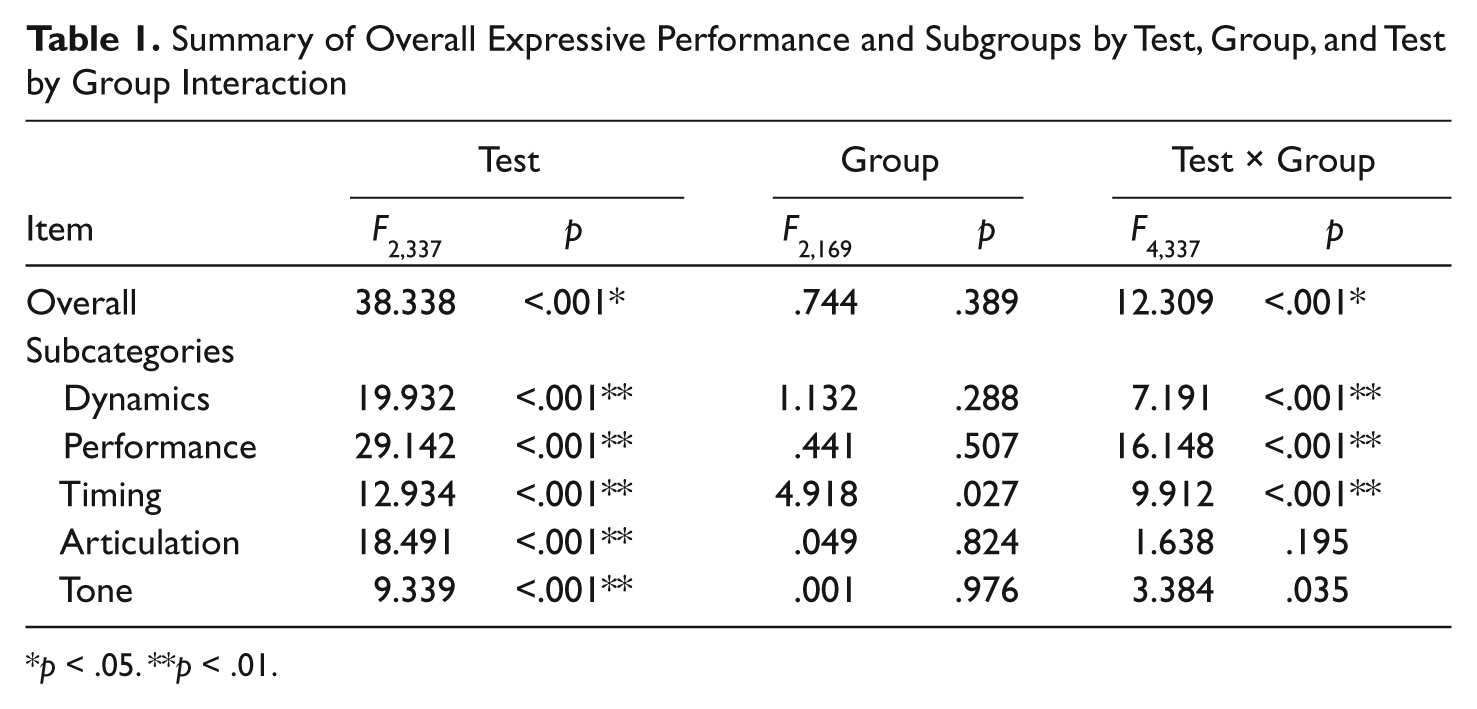
Differences in EPAM scores (Overall Expressiveness and subcategories) were examined through a mixed models analysis of variance (ANOVA). This analysis accounts for the correlations between the multiple performances for each subject and for the covariance between the two judges’ ratings of the performances. The main effects (Test and Group) were examined separately. However, the principal factor of interest was the Test by Group interaction. Table 1 summarizes the results of these three analyses. We set the alpha level to determine significant differences at p < .05 for our primary question, involving Overall Expressiveness. For the subcategories, alpha was set at p < .01 in order to compensate for testing five separate variables.
Summary of Overall Expressive Performance and Subgroups by Test, Group, and Test by Group Interaction
p < .05. **p < .01.
Overall Expressiveness Results
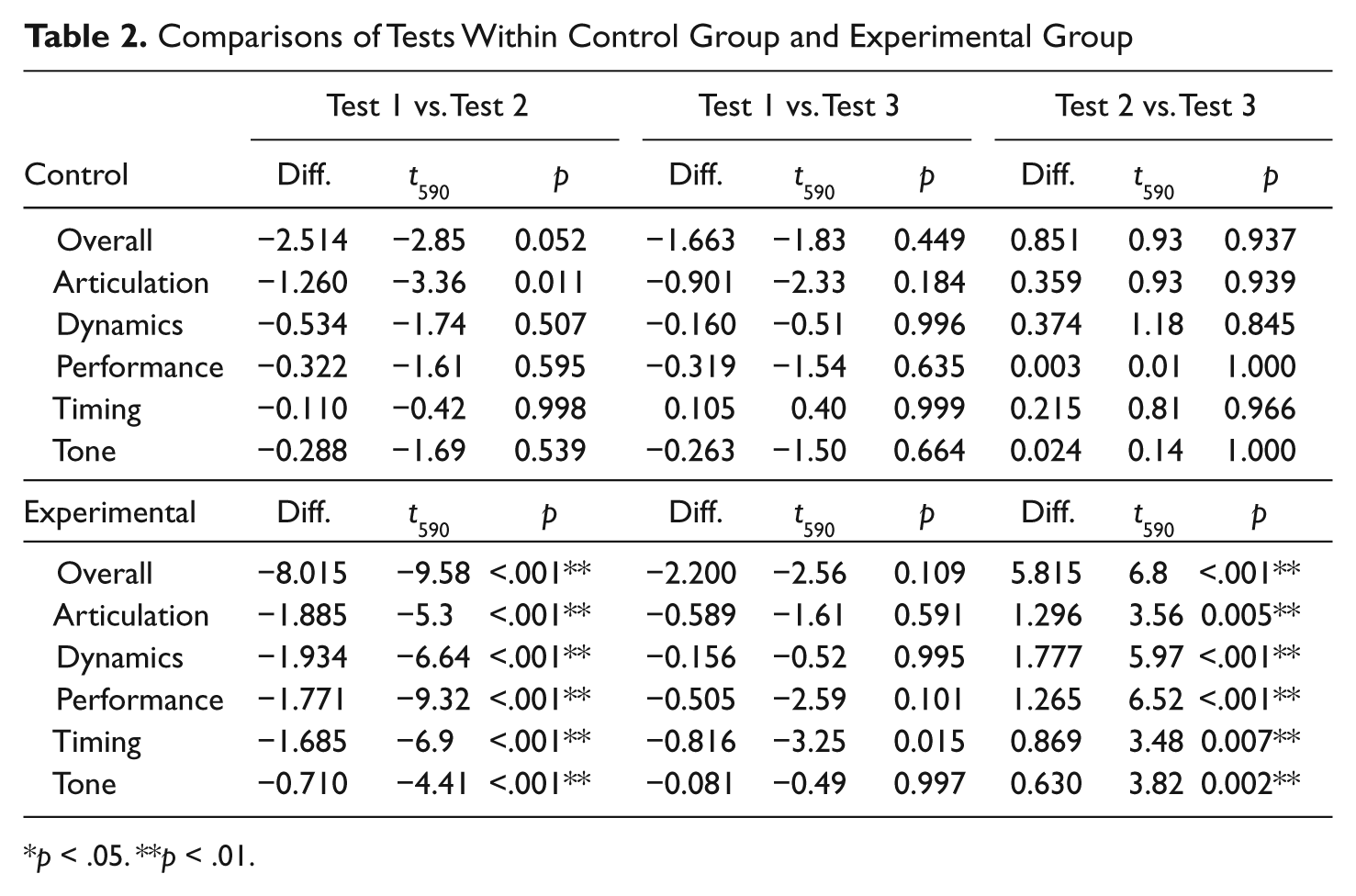
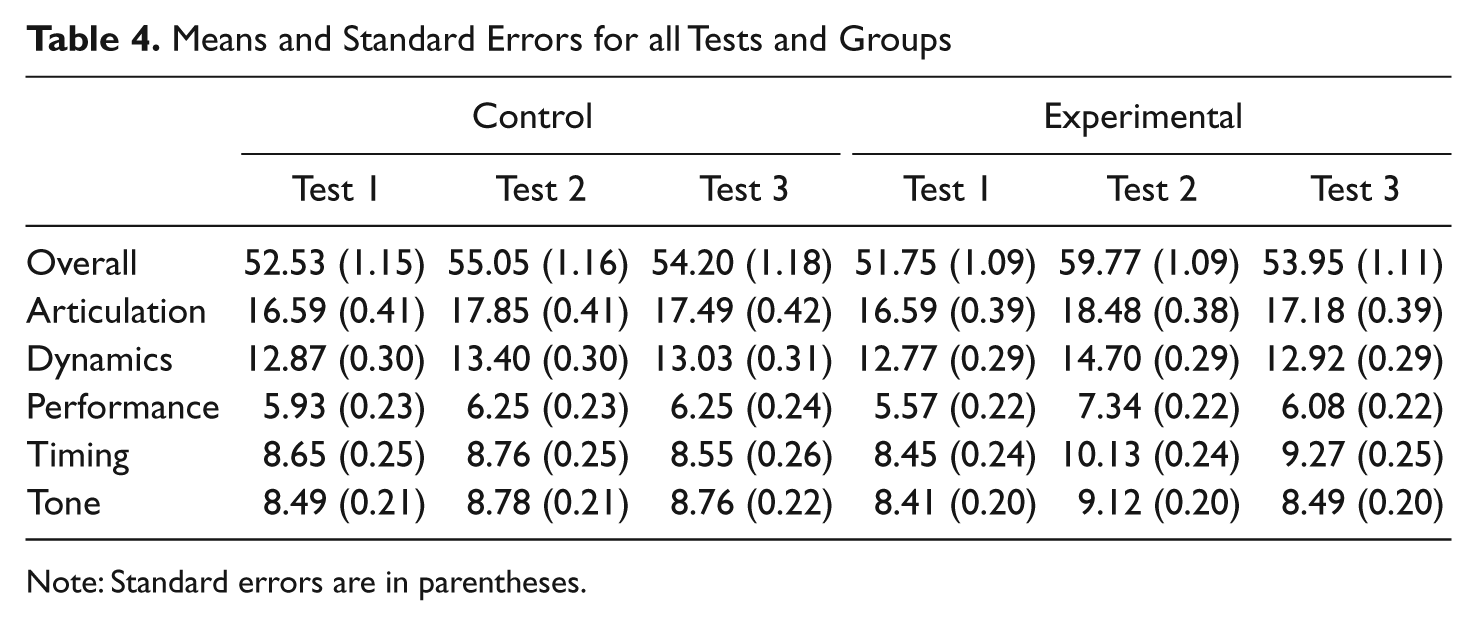
The Test by Group interaction for Overall Expressiveness was significant (p < .05) (see Figure 1). This interaction can be explained by the following specific Test and Group findings: Regarding the Test variable, for the experimental group there was a significant difference between Tests 1 and 2 and Tests 2 and 3 (p < .05 for both), with no difference between Tests 1 and 3 (p = .11). For the control group, the difference between Tests 1 and 2 came very close to being significant (p = .052), while there were no significant differences between Tests 2 and 3 or Tests 1 and 3 for the control group (p = .94 and .45, respectively) (see Table 2). Regarding the group variable, although there were no significant differences between the groups at Tests 1 and 3, at Test 2 (immediately following the intervention) there was a significant difference between the control group and the experimental group (p = .036) (see Table 3 and Table 4).
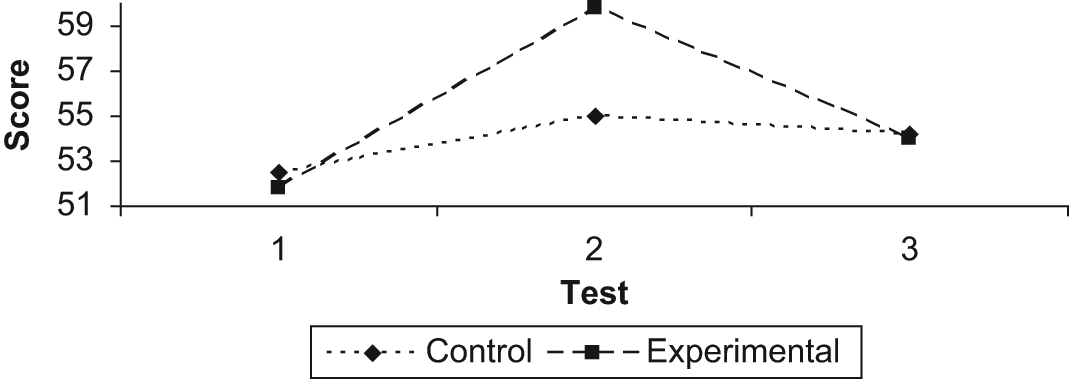
Mean Overall Expressiveness per Group
Comparisons of Tests Within Control Group and Experimental Group
p < .05. **p < .01.
Comparison of Control Versus Experimental Group Within Each Test

p < .05. **p < .01.
Means and Standard Errors for all Tests and Groups
Note: Standard errors are in parentheses.
EPAM Subcategory Results
Of the five EPAM subcategories, significant Test by Group interactions were found for three of the subcategories (see Table 1). The interactions for Dynamics, Performance Factors, and Timing were significant at the p < .01 level, while those for Articulation (p = .195) and Tone (p = .035) were not (see online supplemental material at http://jrme.sagepub.com/supplemental for graphic representations of the interactions and mean scores).
Comparisons between tests revealed significant differences between Tests 1 and 2 and between Tests 2 and 3 for the experimental group in relation to all five subcategories above. There were no significant differences for the control group for any of the subcategories. There were no significant differences between Tests 1 and 3 for any of the groups in any of the subcategories (see Table 2).
Comparisons between groups revealed no significant differences between the groups at Test 1. At Test 2, there were significant differences between the control group and the experimental group in two of the three significant subcategories (Performance Factors, p = .009; and Timing, p = .001), while the difference at Test 2 for the third (Dynamics) was not significant given the preset alpha level (p = .024). At Test 3, there were no significant differences between groups in any of the subcategories (see Table 3 and Table 4).
Discussion
This study explored the use of positive mindset trigger words as an instructional approach for enhancing expressive performance in junior high age singers. Because mindset has been found to affect performance effectiveness (Dweck, 2006; Seligman, 1991), the intervention used for this study was intended to address the mindset of the participants in such a way as to activate expressive skills possessed by the singers. The instruction provided—the use of positive mindset trigger words—was strictly psychological, targeting mindset and not musical skill. For this reason, we interpret intervention effects to mean that the musical skills demonstrated in participants’ enhanced expressivity were extant within the individuals prior to our intervention and that our intervention merely enabled singers to more freely apply these preexisting skills to their performance.
Overall Expressive Performance
Results for overall expression revealed significant effects of intervention, as indicated by the Test by Group interactions. The intervention clearly had an impact on the performance of the junior high age students in the study. Because the EPAM focused on specific musical aspects of expressive performance, these results indicate that addressing psychological aspects of performance can have a positive impact on musical aspects. Specifically, a bold, confident, and free mindset improved junior high singers’ expressive singing.
The experimental group did not retain the intervention benefit for the 2 weeks post intervention, given that scores for overall expressive performance in Test 3 were significantly lower than Test 2 scores. The mean overall score for members of the experimental group started at 61 on Test 1, went up to 69 on Test 2, and fell back to 64 on Test 3. This finding contrasts a previous finding (Broomhead et al., 2010) where college age singers, having received a similar intervention, retained the intervention benefit for 2 weeks after the study. So, although both the junior high age participants in the present study and the college age participants in the other study achieved immediate expressive improvement, the retention of the benefit differed for the two age groups. This difference may be because of the maturity level of the participants, the length of intervention (50 min versus 40 min), a difference in their normal class environment, or some other factor.
EPAM Subcategories
There were significant effects of intervention in three of the five subcategories of the EPAM: Dynamics, Performance Factors, and Timing. Articulation and Tone scores showed signs of improvement but did not meet the alpha level imposed on the subcategories. Experimental group members’ scores did improve from Test 1 to Test 2 in both areas, but control group members seemed to improve in Articulation, as well. Therefore, there was not a significant difference between the groups at Test 2. Conclusions regarding each of the subcategories follow.
Dynamics
The item statements in the EPAM referring to dynamics included reference to smaller-scale issues such as phrase shaping and dynamic shading, as well as to larger-scale issues such as dynamic contrast (see online supplemental material Appendix A at http://jrme.sagepub.com/supplemental, for specific item statements). Effects of the intervention were positive and significant. Our positive mindset trigger word pre-performance routine clearly helped singers improve the dynamic aspects of their performances.
Performance Factors
The item statements in the EPAM referring to performance factors included reference to facial expression and general embodiment of the mood and expression of the music. The effects of the intervention were positive and significant, indicating that the pre-performance routine helped singers improve visual performance factors.
Timing
The item statements in the EPAM referring to timing included reference to overall rhythmic feel, rubato, accelerando, and rallentando. Again, the intervention had a positive significant effect; it helped singers improve their use of timing in their performances.
Articulation
The item statements in the EPAM referring to articulation included reference to word/syllable emphasis, the feeling of sustain, explosiveness and duration of consonants, and use of legato, marcato, and so forth. It may be that these skills are more advanced than others represented in the EPAM or that for some other reason these skills are not as common in less experienced singers and therefore could not be “activated” by a bold, confident, and free mindset.
Tone Quality
The item statements from the EPAM referring to tone quality included reference to tone intensity and tone warmth. Our intervention did not yield an effect in this subcategory. This may be related to our use of “Happy Birthday” as testing material, in that the range of approaches to tone may defy conventional expectations because the song is belted out so commonly in party settings or, conversely, may rouse a warm, sentimental affect in singers.
Additional Implications
With this study we sought to replicate findings of a similar past study performed with college age singers to determine if the positive mindset trigger word pre-performance routine would benefit junior high age singers in the same ways and to the same degree. Our findings confirmed that our intervention had a similar degree of influence on the expressive performance of junior high students as it had on college age students. Because the intervention expressly avoids any direct music instruction, this study adds support to our hypothesis that, upon achieving more positive mindsets, these junior high students would apply preexisting expressive skills in their performances. Improvement in expressivity is explained by the idea that participants’ existing skills came more fully into use, not that they developed new musical skills. Perhaps these students possessed higher levels of expressive musical skill than they or their instructors previously had been able to draw upon. Achieving a more expressive performance may often be as much a matter of attending to mindset as attending to musical skills.
We were interested not only in the immediate effect of our intervention on individual singers; we also wanted to examine its influence on participants’ long-term ability to produce expressive performances. Waiting for 2 weeks before administering the final test was an attempt to discern the sustainability of the intervention effect. We found that, in contrast to the college age students in our previous study, the younger students in the present study did not retain the benefit 2 weeks after the intervention. This suggests that the younger students simply may have lacked the maturity to retain the change they experienced during the intervention and perhaps indicates the need for additional review and practice of the intervention activities for the younger age group. Because the positive mindset trigger word pre-performance routine intervention had a significant immediate effect on performance, future research should examine the extent to which the approach may be used to help young singers achieve a sustained improvement in expressivity. A fruitful starting point may be simply to incorporate review and practice by adding follow-up sessions.
A potential drawback of the trigger word pre-performance routine intervention in this study is the lack of direct applicability to music teachers—caused by the fact that the intervention was administered not by a music teacher but by a professional psychologist. Further research is needed in order to determine the extent to which positive mindset trigger word teaching strategies may be utilized by practitioners in music classrooms. This calls for research in which music teachers administer the interventions.
Finally, although our intervention was specific in its focus on certain mindset descriptors and in its use as a pre-performance routine, the researchers posit that a more broad application of our findings is possible. We speculate that the reason our intervention had a significant and immediate impact on expressive performance was due to the personal psychological expansion that took place in participants as they stretched their comfort zones and adopted more potent and positive aspects into their senses of identity. Such thinking may lead to the consideration of a broad array of potential approaches for addressing personal psychological expansion in the music classroom.
Footnotes
The authors declared no potential conflicts of interest with respect to the research, authorship, and/or publication of this article.
The authors received no financial support for the research, authorship, and/or publication of this article.
References
Supplementary Material
Please find the following supplemental material available below.
For Open Access articles published under a Creative Commons License, all supplemental material carries the same license as the article it is associated with.
For non-Open Access articles published, all supplemental material carries a non-exclusive license, and permission requests for re-use of supplemental material or any part of supplemental material shall be sent directly to the copyright owner as specified in the copyright notice associated with the article.
