







Abstract
The purpose of this study was to explore South Korean parents’ understanding of and desires for music education for their children. Following a constructivist paradigm and qualitative research methodology, data collection involved in-depth interviews, observations, written questionnaires, family music materials, and the researcher’s journals. The participants were 22 South Korean mothers whose children (younger than 5 years old) attended music programs in the Seoul metropolitan area. Data were analyzed by coding, description, constant comparison, inductive analysis, contextualization, negative case analysis, classification, and interpretation. Analyses revealed that these parents’ goals for their children’s participation in music programs included facilitating the child’s development, enriching the child’s life, preparing for future learning, and providing opportunities to play through music. They described the music programs according to the activities they observed or experienced but did not show deeper understanding about a program’s philosophy or history. Family music practices indicated that the primary activities were singing, listening to music, playing instruments, and dancing/movement. Participants expressed the desire to learn music skills and knowledge not only for their children but also for themselves. The findings of this study demonstrate the necessity of education for parents of young children relating to various aspects of children’s music education.
Music education during the early years is critical for young children’s development in all areas. Researchers have asserted that music positively affects young children’s emotional, social, and cognitive development (Berger & Cooper, 2003; Cardany, 2004; Hodges, 2000; Levinowitz, 1999; Trollinger, 2003) and that it enriches the lives of children and their parents (Bowman, 2002; Cardany, 2004; Elliott, 1995; Fox, 2000; Johnson-Green & Custodero, 2002; Scott, 2004). Therefore, musical interaction with parents or caregivers during the early years is essential to further these areas of development (Gruhn, 2005; Kenney, 2005).
Parent involvement is critical for young children to be nurtured musically and to develop music skills and understandings (Feierabend, 1990; Fox, 2000; Scott-Kassner, 1999), because parents are typically primary caregivers while the children are young—a critical period in the development of music aptitude. Music education scholars have emphasized the important role of parents and caregivers with regard to playful music activities for young children (Alvarez, 1993; Berger & Cooper, 2003; Flowers, 1993; Palmer, 1993; Sims, 1993). For example, Berger and Cooper (2003) discussed parental engagement in children’s free musical play, and they identified adult flexibility as important for encouraging young children’s musical play. Reid (2001) emphasized parents’ involvement with their children, stating, “Parents and teachers who provide music in their child’s life are creating the most powerful route to the child’s successful involvement in the art” (p. 24). The importance of parental involvement was stressed by Fox (2000), who recommended that music educators advocate parent involvement in music classes and offer family music classes.
Musical parenting facilitates emotional bonding between parent and child (Custodero, 2006; Custodero, Britto, & Xin, 2002; Custodero & Johnson-Green, 2003, 2008). Custodero (2006) emphasized the importance of musical parenting, suggesting that singing helps develop emotional intensity between parent and child. She studied singing practices in 10 families with 3-year-old children living in New York City and found that families used singing as routine activities, traditions, and play. She stated that parents who remember singing during their childhood continue singing as adults and pass this down to the next generation. In addition to establishing an emotional bond, musical interaction between parent and baby increases the child’s social development (de Vries, 2005). For instance, de Vries (2005) examined his 2-year-old son’s vocal improvisation process according to Vygotsky’s (1930/1978) zone of proximal development (ZPD). He described how his son moved through the ZPD in vocal improvisation and song acquisition from 24 to 36 months of age. As a parent-researcher and a participant-observer, he concluded that when young children make music, opportunities for parent–child social interactions are offered. Furthermore, de Vries suggested that when children express a desire to make music, adults should help them develop their music skills. One means to achieve this is to use scaffolding, a process whereby the adult helps a child accomplish a task (in this case, music-making) in such a way that the child focuses only on the elements that are within his or her ability (Wood, Bruner, & Ross, 1976).
According to Vygotsky’s theory, the adult’s role as a facilitator is important in order for children to accomplish challenging tasks (Berk & Winsler, 1995; Vygotsky, 1930/1978). Berk and Winsler (1995) explained this perspective, noting that children construct new cognitive abilities via interaction with teachers, parents, and other children. Therefore, parent-child play is considered a critical factor in children’s development, a learning process that is explained by the ZPD (Vygotsky, 1930/1978, p. 87). Vygotsky (1930/1978) described the ZPD as “the distance between the actual developmental level as determined by independent problem solving and the level of potential development as determined through problem solving under adult guidance or in collaboration with more capable peers” (p. 86). In other words, Vygotsky’s ZPD indicates what children potentially can achieve with the assistance of experienced adults or peers, as opposed to what they know and can do on their own. This emphasizes the crucial role of parents and teachers while children are learning.
Considering that education is an ongoing process, the optimal perspective is that music education should begin at birth. According to the National Association for Music Education (formerly, the Music Educators National Conference [MENC]) position statement on early childhood education, “Music in early childhood creates a foundation upon which future music learning is built. These experiences should be integrated within the daily routine and play of children” (MENC, 1995, p. 89). With this statement, MENC stressed that early childhood music education should be undertaken in the context of everyday life with meaningful adults, mainly parents. In addition, music educators should pay attention to children who are too young for school, because early education strongly affects the rest of their lives.
Given the importance of parents’ roles in the musical nurturing of young children, educating parents is the most effective and appropriate way to provide music education for young children. In support of this idea, Andress (1998) stated, “Certainly, music education begins in the home, where, ideally, all family members are involved in nurturing an awareness of how music enters their daily lives” (p. 1). In their content analysis of parenting magazines, Sims and Udtaisuk (2008) emphasized home music experiences, stating, “Children’s earliest and most intimate musical experiences generally take place in their homes” (p. 2), and they advocated parent education for teaching early childhood music.
Researchers have emphasized that parents feel lost when teaching music to their children: They seek direction, wanting to do something good for their children but not knowing how (Cardany, 2004; Custodero et al., 2002; Fox, 2000; Ilari, 2005; Levinowitz, 1999; Sims & Udtaisuk, 2008). Levinowitz (1999) pointed out that “some parents have found that they are at a loss trying to serve as their children’s first music teachers” (p. 18). Custodero and her colleagues (2002) also commented that parents were unsure about parent-child interaction, stating, In the U. S. today, recordings of lullabies and classical music fill the shelves of music stores and “Mommy & Me” music classes abound in most urban and suburban settings, yet little is known about what parents are doing musically with their infants, and why. (p. 41)
According to Fox (2000), parents want to know how to provide music experiences for their children in a concrete manner. Cardany (2004) found that parents whose children were preschool aged believed that music and music education had the potential to enhance their children’s social and emotional development, but most parents were unaware of their roles in their children’s music education. Sims and Udtaisuk (2008) investigated the types, quantity, and quality of music-related information from the most representative parenting magazines in the United States, performing a content analysis of 6,698 pages. They concluded that these magazines lacked clear, high-quality recommendations for parents and that there were no recommendations for parents to develop their own music interests and skills. They also suggested the need to teach parents how to participate in early childhood music education. According to these music educators’ suggestions, there must be a systematic, concrete program of parent education for early childhood music education. Levinowitz (1993, 1999) stressed parents’ roles as music teachers and emphasized the importance of providing parent education to inform parents about music development and to help them learn ways support their children with music activities.
Although teaching parents about music education for young children is an important task for music educators, little research has been published on this topic. Many studies have been conducted regarding parent involvement in preschool programs (Day, 1988; Lamb-Parker et al., 2001; Miedel & Reynolds, 1999; Peña, 2000; Powell, 1995), but they rarely have centered on parent involvement in music programs for young children. Although there is some research on music education in preschool settings that focuses on teachers and young children in South Korea (Ku, 2006; Nam, 2006; Yoo, 2005; Yun, 2006) and the United States (e.g., Sims, 2005; Young, 2002), studies focusing on parent education in music education are scarce.
A necessary first step is to determine parents’ practices and needs regarding music education for their children. In South Korea, many parents with young children are highly interested in their children’s education, and parents’ interest in music programs is increasing. Some parents have enrolled their children in music programs, but it is uncertain how knowledgeable the parents are about these programs, what they want their children to accomplish, and what they desire to learn for themselves. A few survey-based studies using written questionnaires focusing on parents’ perceptions of music education have been conducted recently in South Korea (H. G. Kim, 2006; H. S. Kim, 2007). However, few in-depth studies have researched parent-involved music programs from the perspective of parents in South Korea. Therefore, this study was designed to explore what these parents’ current practices are and what they need in order to facilitate their children’s music education.
Purpose and Research Questions
The purpose of this study was to understand South Korean parents’ goals, knowledge, practices, and needs regarding music education for their children. Thus, there were four main research questions: (1) What are the parents’ goals for their children’s music programs? (2) What do the parents know about music programs for young children? (3) What are the parents’ practices for music activities with their children? (4) What do parents need to facilitate their children’s music education?
For the purposes of this study, the term music program indicates a system of music instruction for young children that requires an enrollment fee, such as Eurhythmics, Orff Music, Yamaha Music School, or Musikgarten. Parents and their children participate together in these programs’ music classes.
Method
Research Design
This study was designed to investigate parents’ different perspectives, experiences, practices, and preferences with regard to music education for their young children. Thus, qualitative research methodology was used to examine the diverse points of view relevant to frameworks comprising the parents’ multiple realities (Campbell, 2002).
Site Selection and Participants
I chose Seoul and Kyung-Ki Do (Province) in South Korea as my research sites because the families who live in both areas have numerous educational and cultural opportunities available and because many music program centers are located there. Using purposeful sampling (Hatch, 2002), I recruited 22 South Korean parents with children 24 months to 5 years of age who had participated or were participating in a parent-child music program. Some participants introduced me to others, constituting a “snowballing” approach, in which one participant leads to another (Bertaux, 1981). I continued to collect data until I was no longer learning anything new (Corbin & Strauss, 2008; Seidman, 2006), and 22 participants provided enough data to achieve saturation. The 22 families attended 10 different music programs: Musikgarten, Dalcroze, Gymboree Music, Eurhythmics, Yamaha Music, Amadeus Class, Audi, Orff, Kindermusik, and Kodály. Some families attended multiple music programs. Most of these programs are not specifically Korean; they are internationally known and developed methods or franchises.
All parents who agreed to be interviewed were the children’s mothers, although my intention was to collect data from both mothers and fathers. Thus, when discussing my participants specifically, I use the term mothers rather than parents. However, the pseudonyms “Parent A,” “Parent B,” and so on alphabetically through “Parent V” are used to identify individual participants. The participants’ ages ranged from 31 to 38 years, and their highest education level varied: Four mothers had completed graduate school, 15 had graduated from university, 2 had graduated from community college, and 1 had graduated from high school.
Development of the Questionnaire and Interview Protocols
Referring to related literature for guidance (Brand, 1985, 1986; Cardany, 2004; Mallett, 2000), I developed my own questionnaire and interview protocols. To confirm their contents, I conducted a pilot study with a South Korean mother whose child was 30 months old and had experienced music class. In accord with the feedback and my own review, I lightly revised the written questionnaire and interview questions. In order to ensure content validity of the questionnaire and interview questions and prompts, three experts reviewed the questionnaire and interview protocol. The written questionnaire involves basic demographic information, items related to home music environment, and parents’ preferences regarding their own education in music. The questionnaire and interview protocols are available in Appendixes A and B, respectively (see online supplemental materials available at http://jrme.sagepub.com/supplemental).
Data Collection
The transcribed interviews, observations of parent–child interactions, home music materials, written questionnaire responses, and journal entries served as the sources of data for this study.
Interviews
Three interviews were conducted with each family: preliminary, in depth, and follow-up. The preliminary telephone interview was informal and included the initial meeting with the parent and confirmation of participation in this study. I then conducted an in-depth, one-on-one interview with each of the 22 mothers at her home at her convenience. I asked mothers about their goals, knowledge, practices, and needs regarding a music program for their children. I took notes and audio and video recorded the interviews. This took approximately 60 to 90 min, depending on the family. For the follow-up interview, I was able to reach all mothers by phone. In some cases, my follow-up interview required more than one call because parent responses led to more questions. To complete this phase of the study, I called 13 mothers once, 7 mothers twice, and 2 mothers three times.
Observation of Parent–Child Interaction
The parent–child music activities occurred naturally during and/or after the interview and only if the child and mother so desired. I videotaped and audio recorded these musical interactions, in addition to taking field notes. These observations helped me to understand parents’ daily practice of music activities with their children.
Home Music Materials
When I visited homes for interviews, I asked mothers whether they had musical instruments, musical toys, CDs, and/or music-related books. Mothers showed me any such materials they had and I made notes about them. This helped me to understand the family’s home music environment and connect with the families’ practices regarding home music activities.
Written Questionnaire
I gave the questionnaire to each participant at my family visit, and she completed it while I set up and tested my video and audio equipment. The responses to this questionnaire helped me to understand the family’s background and the participant’s preference regarding music education for her child before I began the interview.
Researcher’s Journal Entries
I wrote research journal entries after conducting each interview in order to reflect upon the interaction (Rubin & Rubin, 2005). Also, I summarized the main points of each interview and described my thoughts if something seemed impressive. While writing these journal entries, I was able to think about what I missed asking and what I should ask during the follow-up telephone interviews. This process helped me to think about the next interviews and to organize the contents of the interviews.
Data Analysis
I analyzed data simultaneously with data collection (Creswell, 2007; Hatch, 2002; Lincoln & Guba, 1985; Merriam, 1998) to gain knowledge and insight for further interviews and observations (Bogdan & Biklen, 2003; Hatch, 2002). As I completed each interview, I examined the information gained from the interviews, questionnaire responses, and observations. I used multiple methods of data analysis: field notes, interview transcriptions, videotapes, coding, description, constant comparison, theoretical saturation, inductive analysis, semantic relationship, substantive literature, contextualization, negative case analysis, classification, interpretation, and representation/visualization. The explanation of each type of data analysis may be found in Youm (2008).
Trustworthiness
Trustworthiness is a key to evaluating the quality of qualitative research (Denzin & Lincoln, 2000; Hatch, 2002; Lincoln & Guba, 1985). Lincoln and Guba (1985) explained that credibility, transferability, dependability, and confirmability in qualitative research are analogous to internal validity, external validity, reliability, and objectivity, respectively, in quantitative research. I tried to meet the criteria of trustworthiness for this study as described in the explanations that follow.
Triangulation
Triangulation is “a procedure used to establish the fact that the criterion of validity has been met. . . . It can involve the use of multiple data sources, multiple investigators, multiple theoretical perspectives and/or multiple methods” (Schwandt, 2007, pp. 297–298). In this regard, I used multiple methods of data collection: interviews, observation, home music materials, a questionnaire, and my journal entries. I used all these sources of information for each of the 22 families.
Reflexive Journal
A reflexive journal is “a kind of diary of information about self (hence the term ‘reflexive’) and method” (Lincoln & Guba, 1985, p. 327). The “self-reflective writing” (Marshall & Rossman, 2006, p. 110) used in my research journal helped me to gain insight and to interpret and analyze the data.
Negative Case Analysis
Rather than being construed as a rejection of the overall findings, negative cases increase credibility by showing the study involved an authentic search and results (Lincoln & Guba, 1985; Patton, 2002; Schwandt, 2007). Consequently, four negative cases in this study deepened my contemplation of the context and background of the cases, leading to rich analysis of the data. Complete presentations of four negative case analyses may be found in Youm (2008).
Member Checks
Lincoln and Guba (1985) noted that the member check is the most crucial technique for establishing credibility. Thus, I asked my participants for their reactions in order to ensure that my data, findings, and interpretations were correct. After interviews, I consulted the participants when I had questions regarding my observations and the participants’ statements, either immediately or later by telephone.
Peer Debriefings
To affirm credibility in another way, I asked three U.S. colleagues to review my study as peer debriefers. Each read my research paper and gave me feedback. Furthermore, they offered advice regarding categories and themes while I was analyzing the data. I considered their comments and suggestions and incorporated their feedback into my study. Their reviews and comments helped to improve the quality of my research.
Cross-Checking of Translation
Because I used Korean, the South Korean parents’ native language as well as my own, for interviews, I translated all necessary materials, such as the consent letter, questionnaire, and the interview prompts and transcriptions into English for readers. After I had translated the transcriptions from Korean to English, as well as the questionnaire and interview protocol from English to Korean, I asked four South Korean experts for their opinions on the translation between Korean and English. All four were proficient in both languages, and they cross-checked all my translations and gave me positive feedback overall.
Findings
The findings of this study are organized into four main categories related to parents’ goals, knowledge, practices, and needs. A master outline of the findings is available in Appendix D (see online supplemental material available at http://jrme.sagepub.com/supplemental). Space does not permit findings related to every dimension of every theme to be described here, but complete explanations may be found in Youm (2008).
Parents’ Goals for Children Attending Music Programs: Research Question 1
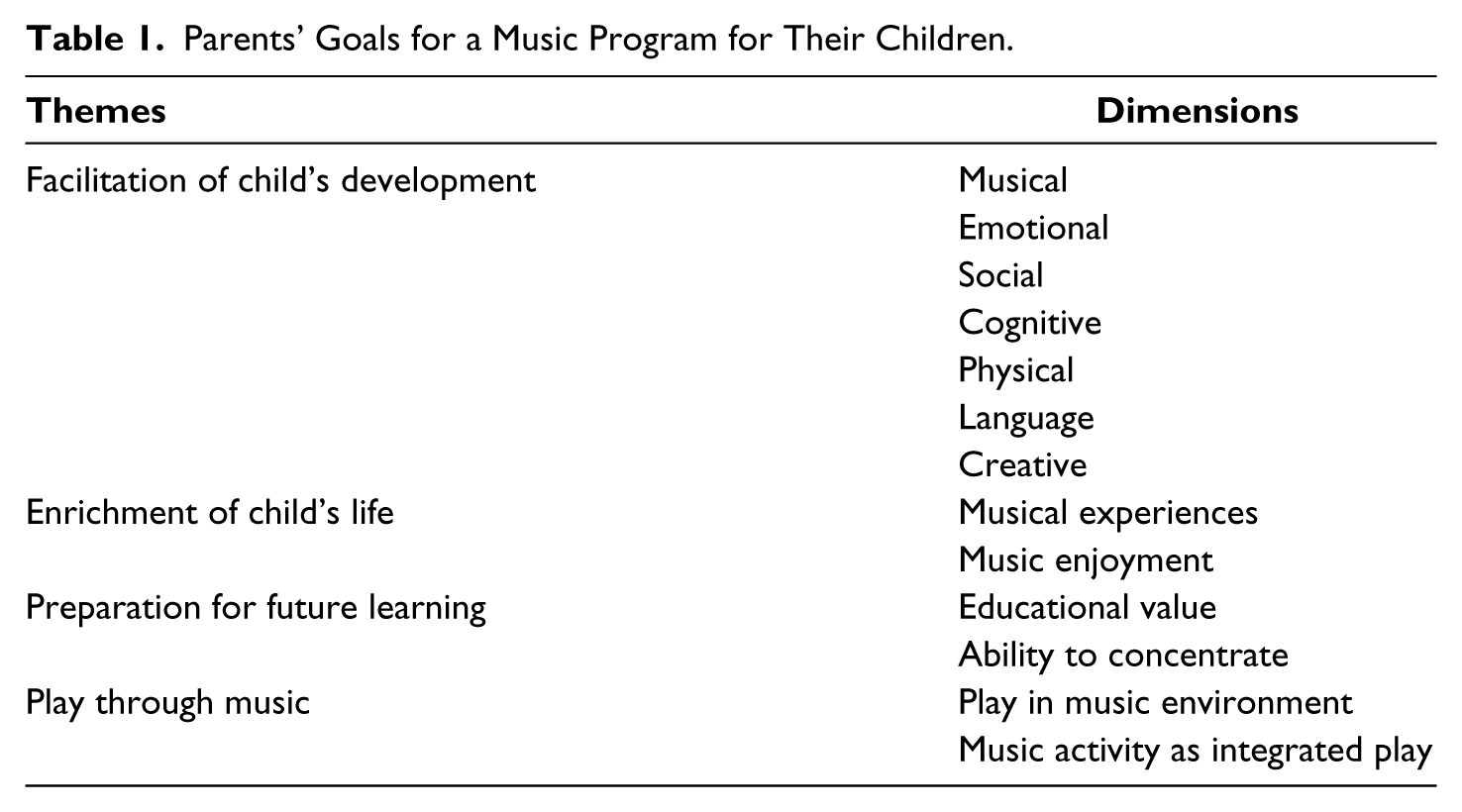
Four themes emerged regarding parents’ goals for their children’s participation in a music program: (a) facilitation of child’s development, (b) enrichment of child’s life, (c) preparation for future learning, and (d) play through music. Each theme is divided into various dimensions. Table 1 outlines these themes and dimensions.
Parents’ Goals for a Music Program for Their Children.
Facilitation of Child’s Development
An important theme that emerged during analysis of the interviews was facilitation of child’s development. One of its seven dimensions is musical development, for which there were 15 responses from 12 of the 22 mothers. These mothers’ goals for their children included learning various songs, learning musical instruments, listening to classical music, increasing musicianship, singing well, achieving music sense, improving sense of rhythm, and interacting musically with their children.
Parent C’s goals for a music program were musical, not cognitive, as was the case for some parents. As she described in our interview, Since my child likes singing and dancing, these experiences will offer opportunities to learn about music, such as pitch and rhythm concepts, in a more systematic way.
Parent P articulated her goal of having a music program teach her child music sense: I wanted [my child] to gain musical sense. I think there are some things that I can’t give to my child. I can teach English and Korean at home, but I can’t teach music and art. So, I thought I should let him start learning them [music and art] early.
Parent P emphasized that she had no ability to teach her child music, which is why she relied on the music program to help with her child’s music development.
The dimension emotional development was commented on 10 times by 9 mothers. These mothers remarked that emotional development was their primary goal for their children. They hoped the music would inspire a wider range of feelings in their children. Parent N said, “I’d like my child to have emotional stability and contentment.” Placing special emphasis on this dimension, Parent B asserted, “Although my child will not major in music, I want my child to be familiar with it. I don’t want my child to learn rhythm concepts. We don’t listen to music for the head, but for the heart.” Parent B emphasized the bond between mother and child, saying, “I think that my child feels [my] presence and emotions while we do [music] activities together. I also feel my child’s presence and emotions.” These mothers who talked about having emotional development as their goal hoped their children would gain a sense of emotional security and feel more at ease as a result of attending music classes.
Enrichment of Child’s Life
During the interviews, enrichment of child’s life emerged as a theme from 11 comments by 9 mothers. These mothers hoped to enrich their children’s lives by providing them opportunities to experience music with various sounds, instruments, and activities. Parent P described her desire for her child to experience music in various ways, saying, “My child likes to listen to music. In the music class, my child touched musical instruments; he listened to music that I didn’t listen to. So, I hope my child continues to have various musical experiences.” Parent U also expressed a goal of experiencing musical instruments, stating, “She plays by touching and shaking the musical instruments, and listening to the sounds. . . . I hope that my child, although she is young, will listen to music and experience various musical things at least once a week.” This mother valued tactile experiences with even a small musical instrument, such as castanets. Parent S shared a story about the time the teacher brought a guitar and a violin and let the children experience the instruments by seeing, touching, listening, and playing them.
Preparation for Future Learning
An analysis of the interviews revealed another theme, preparation for future learning. The mothers whose responses matched this category hoped that their children would acquire a good foundation for education through the music program; they wanted their children to have knowledge of music by the time they entered school. Parent D talked about her own childhood music experiences and hoped her child would have similar ones: To be honest, for my child’s basic education . . . In my case, I have played piano for a long time. It helped me learn music theory and also added to my basic education. Because of that, I feel confident and have a better life. Also, when I saw various instruments, I was able to learn them without fear. I’d like for my child to experience the same.
The mothers whose answers fit the category of preparation for future learning seemed to value their children meeting or exceeding the expected level of achievement in music as well as in other subjects when beginning school.
Play Through Music
Another theme that emerged was play through music. Parent L explained her intention when enrolling her child in such a program: I wanted to give an impression that learning is something joyful and fun, taking a class, learning from someone, all that is fun. Rather than having music as the primary goal, I wanted him to play through music and have fun.
Parent A was concerned about her child staying at home all the time, saying, “Because he stays at home with me, I wanted him to meet his friends there and play.” Similarly, Parent K asserted, “I think that [music activity] should be considered as an integrated play activity.” These mothers who talked about play through music as their goal for a music program hoped that their children would play naturally in a music environment. They wanted their children to have fun with music activities and relax.
Parents’ Knowledge of Music Programs: Research Question 2
Lack of Parents’ Knowledge
I asked the participants what they knew about music programs for their children. Most had not known much about the contents of the program until after they enrolled and began participating with their children; those activities seemed to provide their only source of information about the programs. Each mother described various combinations of greeting songs, movement activities, singing, playing instruments, storytelling, and other activities, depending on the particular music program. They did not, however, show deeper knowledge about the philosophy or history of the music programs.
None of the mothers knew about the contents of music programs they had not attended. Most had heard of other music programs, but they were unaware of the differences between them. Parent D remarked, “I tried to find the differences through advertisement and an open trial class, but I didn’t find any difference in the contents among the programs.” Likewise, Parent H said she did not know about Eurhythmics, Amadeus, Yamaha Music School, and Gymboree Music, although she had heard of them, stating, “I’ve heard that all the contents among the programs were similar.”
When I asked Parent B to tell me the difference between the program she attended and other programs, she answered, “I don’t know about it because I did not experience other programs.” To the question about why she did not compare music programs, Parent C replied that there were no other programs in her area for comparison. This interview provided mothers with an opportunity to think about the rationale for enrolling in the music program and their criteria for choosing the program.
Parents’ Spontaneous Comments
Because the interview protocol comprised open-ended questions with a semistructured interview style, the mothers added spontaneous comments about various issues related to the music programs they attended. The main issues that the mothers mentioned were criteria for choosing a music program, the importance of the teacher, class size and quality education, feeling of boredom, child’s style and music program, open trial class, and willingness to remain with one program. The main reasons for choosing the music program were friend’s recommendation, ease of access, time convenience, and the child’s age as it related to the reputation of the program.
During the interviews, I found that teachers were very important to these parents. Seven mentioned the importance of the teachers’ ability, skill level, experiences, and preparation. They agreed that the teacher was more important than program content. Parent U described the program she attended, saying, “In [our] program, the teachers all majored in early childhood . . . anyhow, they have learned something. They have experienced something, so I can trust them.” When I asked participants if they would recommend the program their child attended, Parent A answered, “It depends on teachers. If the teacher is good, I would recommend the program to other parents.” She wished her child had a more experienced teacher.
It is clear that many participants considered the teacher to be the most important element of a successful class. The mothers preferred experienced rather than novice teachers, and they sought competence in music skills as well as class management. The mothers did not pay attention to the contents of the program because they thought all programs were similar, but they definitely paid attention to the teachers.
Many participants (15) volunteered information regarding the size of the classes they attended, which varied from 4 to 20 parent–child pairs. Thirteen of 15 mothers who mentioned class size experienced a class with more than 10 parent–child pairs; all said that it was too crowded to do the music activities. Most mothers said that it was best to have 4 to 5 pairs in one class, but only 2 of the mothers mentioning size had a class that small. Once mothers experienced a large class size, they realized that “it was distracting when the class size was over 10 pairs. . . . I think 4 to 5 pairs are most appropriate. . . . I want [my child] to concentrate on [the music activities]” (Parent H). I found that mothers who experienced a crowded class size (i.e., more than 10 pairs in one class) were dismayed by the noise, inability to control children’s behaviors, the distracting atmosphere, and difficulty in getting a chance to experience the musical instruments. Many who experienced a large class size quit and did not want to recommend that program to others.
Parents’ Practices for Music Activities: Research Question 3
Although interviewing was my primary means of data collection, I observed mother-child musical interactions during the interviews. The musical interactions occurred spontaneously and/or by my request.
Musical Interaction Activities
Parents characterized their musical interactions with their children as singing (20), listening to music (16), playing instruments (15), and dancing/movement (13). Most families participated in singing activities together. Fifteen mothers replied that they interacted with their children by playing musical instruments; however, Parent L and Parent Q, whose children were 49 months and 36 months, respectively, at the time of the interviews, both stated that interacting by playing instruments was a more common activity when their children were younger. Parent L said they shifted from playing musical instruments to more play with friends sometime after her child’s fourth birthday: Until my child was 3 years old, I encouraged her with clapping as she played with a drum set. My husband and I took turns playing the drum set. After my child was 4 years old, [we] didn’t play with her that much, because she entered kindergarten. It was important to play there and to interact with her friends, although it was [also] important for her to play with us [mom and dad]. So, I take her to the playgrounds so that she can play with her peers and I watch them.
This mother and another, Parent G, mentioned feeling too shy to dance or participate in movement activities, so they just watched their children dancing.
Contrast these parents with Parent E, who was actively involved in all kinds of music activities and described those she did with her 41-month-old child: We play children’s songs and we dance together. My child follows my movements, and we sing together along with the music. Or, we play the musical instruments that we have at our home and sing together.
These can be considered typical kinds of musical interactions, given that many mothers responded similarly during the interviews. However, some mothers interacted only by singing and not by playing musical instruments or moving along with music.
Frequency of Parents’ Musical Interactions With Their Children
When I asked how often the mothers interacted musically with their children, the answers varied: every day to never. During interviews, it became apparent that the level of interaction depended on a mother’s willingness, her music skills, children’s ages, presence of siblings, and whether she worked outside of the home. Thirteen mothers stated that they interacted musically with their children every day, 4 reported interacting musically several times per week, 2 reported once per week, and 1 said never. The duration of daily interaction varied from 20 min to 3 hr. Parent D seemed to have much enthusiasm about her child’s education and said she had played children’s music since her child was a baby: “The first thing I do when I wake up in the morning is play songs. In the evenings, I always play [songs] as well.” Besides listening to music, this mother actively interacted musically by singing, playing instruments, and dancing/movement.
Of note, Parent S reported that she interacted musically with her daughter for about 3 hr every day. While I was interviewing this mother, I noticed that she was very interested in the music programs and very much loved music and dance. In fact, she had majored in contemporary dance and had been a dance instructor for 6 years. (Family profiles are available in Appendix C; see supplemental material available at http://jrme.sagepub.com/supplemental). She expressed her interest in music activities and the efforts she wanted to make for her child. When I did the follow-up telephone interview, Parent S said that she had been teaching finger play and body movement to other parents she knew.
In terms of musical interaction, Parent C was at the opposite end of the spectrum. Parent C was the only mother who never interacted musically with her child. This negative case caused me to review my data. Parent C described her two daughters dancing with each other but said she did not join in. She mentioned to me several times that she had no knowledge of music education. The following is an excerpt from my research journal: Throughout the interview, I felt that the mother lacked self-confidence. This mother said, “I don’t have composure”; “I don’t have any knowledge . . .”; “It is too difficult . . . .”; “I can’t sing well . . .”; “I like music, but I don’t have [any talent] in music . . .” She expressed that she cannot do well; she did not finish her answers in complete sentences, and she did not explain what she meant in long words . . . I felt anxious and wished that she would answer me in an explanatory and descriptive style rather than a short-answer response.
I inferred from my entry that the reason Parent C never interacted with her child musically is she did not have confidence with regard to music education. Although supportive of her child’s music education, this mother thought the music instructor should be responsible for it. She did not think she could be part of the teaching process due to her lack of music skill. This mother contrasted dramatically with Parent S, who interacted musically with her child for more than 3 hr every day and had enrolled her child in four music programs, as compared with only one program for Parent C’s child. This diametric contrast illustrates that the degree of musical interaction with their children differed according to the mothers’ characteristics, especially their own music experiences and capabilities. The responses of Parent C indicate the necessity of parent education in music teaching, especially for parents who lack self-confidence.
Parents’ Needs for Music Education: Research Question 4
Music Skills Parents Want to Use
Four main themes emerged from the mothers’ responses when I asked what skills they want to use when they interact with their children musically: playing instruments (21), singing (17), listening to music (16), and movement/dancing (15). Some mothers’ answers involved other skills, such as expressing their feelings with art while listening to music.
It is notable that 21 of 22 mothers answered that they desired to play musical instruments in order to interact with their children musically. Fifteen mothers already had that skill. Parent Q wistfully relayed her desire: If I played piano, cello, or violin, I would have played for my child. But I can’t play any of them, so I feel regret. So I would like to let my two children play at least one musical instrument, so they can release their stresses and become parents who raise their children in better ways in the future.
By her own report, Parent Q had no music background. According to the preceding excerpt, Parent Q wanted to compensate for her inability to play instruments and implied that it has had a negative effect on her parenting skills.
Parents’ Needs Regarding Children’s Music Education
To facilitate parents’ thoughts and to save time, six items were given in the questionnaire as examples: read appropriate books or other materials (19), take private lessons (19), go to the library (12), go to concerts (9), attend workshops (7), and attend lectures (5). Mothers mentioned two related issues: preparation for future knowledge and feelings of regret for not being allowed to take a child to a concert. Nineteen mothers remarked that they should have knowledge of music through reading so they can convey that knowledge to their children. Parent U, who previously had taught English in a middle school, said, “I think I should learn the part that I don’t know well in music through books and other materials so that I can talk to my child.” On a related note, Parent L, who is a play therapist, gave this reason for reading: “My child will ask me lots of things when she enters school in the future, and I should be able to answer when my child asks. To help my knowledge, having some reference books would be nice.” These mothers wanted to prepare for the years ahead when their children will have accumulated more knowledge.
Most mothers (19) also expressed their desire to go to concerts with their children either at the current time or in the future. Many mothers said it was regrettable that their children were too young to attend due to age restrictions at the concert venues. According to Parent I, going to concerts with her child was good for musical play because they could enjoy the music together. Likewise, Parent M said going to a concert is great because it “enhances quality of life.” These mothers’ willingness suggests that musicians and music educators should develop children’s concerts for children’s and parents’ happiness and enrichment.
Parents’ Desires for Their Own Music Education
In order to discover, in detail, the music concepts and/or skills parents would want to learn if they had the opportunity to access music education for adults, the questionnaire mothers had filled out prior to the interview included 15 items to help parents organize their thoughts in this regard as well as blank space for writing additional items. The majority of the 22 mothers indicated the following items that they would like to learn: how to interact musically (n = 19), classical music for music appreciation (n = 14), instrument lessons (n = 14), and lecture about child development (n = 14). Many of the remaining items were also of interest to almost a third or more of the mothers: Korean children’s folk songs (n = 10), children’s movement (n = 9), children’s music books and materials (n = 8), children’s songs in English (n = 8), multicultural children’s songs (n = 8), children’s songs (n = 7), and how to read music (n = 7). Fewer expressed interest in how to find children’s music resources on the Internet (n = 6), music theory (n = 4), voice lessons (n = 3), or learn how to dance (n = 2). Appendix E (available at http://jrme.sagepub.com/supplemental) provides specific information about each parent’s desires for their own music education.
Individual mothers’ desires for learning varied greatly. The number of items selected ranged from 2 (Parent B) to 13 (Parent Q) out of the 15 choices. This range illustrates the multiple realities of parents’ desires and perspectives. I was curious about the 5 mothers who chose the greatest number of items: Parent Q (13), Parent M (12), Parent L (11), Parent O (11), and Parent V (10). I wondered about their characteristics and backgrounds, so I looked at my notes and data (see Appendix C, Family Profiles, in online supplemental materials available at http://jrme.sagepub.com/supplemental). Four of these mothers had attended more than two music programs with her child, and several were engaged in arts-related or child-centered careers. As I recalled the interviews with them and reread the transcripts and my journal entries, I realized that these 5 mothers showed great willingness to learn more about music education and to support their children.
It is notable that 19 mothers desired to learn “how to interact musically.” Parent Q stressed this, saying, “I think that how to interact musically with my child is most important.” When I asked the reason, she answered, “To me, the goal of learning is to educate my child, so it should be interactive. It shouldn’t be one-way learning just for me.” This illustrates these parents’ desire to learn how to interact musically with their children and the idea that music educators should teach “child–parent musical interaction.”
In the interview, many mothers stated that there was no parent education program that dealt with music education, although they would be willing to attend specific classes. The desirability of a parent education program in music learning is supported by the data presented in Appendix E (available at http://jrme.sagepub.com/supplemental).
Necessity of Parent Education in Teaching Music to Children
As the final question of the interview, I asked what the mothers thought about the need for parents to learn how to teach music to children. Twenty-one participants answered that parent education in teaching music to children is necessary. I asked them to explain their responses. Four themes emerged: (a) to answer questions (12), (b) to improve education (12), (c) to do activities together (7), and (d) to increase parents’ learning (5).
With respect to the theme to answer questions, 12 mothers answered that they should have knowledge in order to convey information to their children, especially in response to questions. Parent C expressed her concern, saying, “My child may ask me about things she doesn’t know, and if I don’t know. . . . It would be nice if I have knowledge to some extent and answer and explain, but if I don’t know, I would be [embarrassed].” Similarly, Parent D stressed that parents should have knowledge to “answer their children’s questions so that they can discuss the topic with the child sufficiently.” The mothers whose responses indicated that they were worried about not being prepared for their children’s future questions may see good mothers as teachers and supporters of their children’s learning. They seemed to think that providing correct answers was the best way to teach their child, although educators may believe that the process of problem solving should be more important for both parents and their children.
Another theme that emerged was to improve education. Twelve mothers said they needed parent education in music to better understand and to provide better guidance for their children so their children could benefit more from music education. Parent G remarked that because she was not an expert, she needed experts’ help in order to coach her child. Parent S also stated that “mothers should be semiprofessional to teach music to their children.” This mother wanted to be an expert teacher for her child, and through her statement, she implied the necessity of parent education in music. The mothers whose answers belonged to this category seemed to have the desire to be a good coach, teacher, or supporter of their children in order to educate them properly.
The responses of 7 mothers fit the theme to do activities together. These mothers seemed to consider parent education to be more for emotional bonding and a closer relationship with their children than for education. Parent B described her needs for learning music, saying, “I can breathe with my children through music.” This mother, who engaged her children in music activities, used the word breathe to express the closeness they find through music activities. Parent F stressed taking private lessons for herself, saying, “I will be able to have empathy with my child through learning piano.” Parent V hoped to play with her child through singing and emphasized learning for herself: If parents have enough knowledge, they wouldn’t force their children [to practice or do something]. If mom knows very well, she wouldn’t force her child. . . . I’d like to play with my child. While playing together, I would be able to sing to her if I know at least a song.
This mother expressed her willingness to interact musically with her child, but she underscored her need to know relevant music activities, such as children’s songs, to do so.
The mothers whose responses belonged to this category had a desire to be one with their children through music activities, and they said in order to do so, they needed parent education. They seemed to want to be good friends with their children, at the same level with the same experiences, rather than to be good teachers for their children.
A final theme that emerged was to increase parents’ learning. Five parents’ responses were included in this category. These mothers’ reasons for parent education included a focus on their children but also their own need for a foundational education from experts for their own music learning. Parent H stated, “I should know and also I want to know for myself.” Parent N commented that she wanted to learn not only to answer her child’s questions but also to educate herself, saying, “I am also interested in learning for myself. I think it will help me become more cultured as well.” According to Parent R, the benefits of parent education are twofold: better education for her child and additional learning for herself. These mothers’ responses suggest that parent education in music education is necessary not only for children’s benefit but also for parents’ growth and happiness, which is desirable as well.
Discussion
The first research question addressed by this study was to understand South Korean parents’ goals regarding music education for their children, through qualitative inquiry. Four themes emerged regarding parents’ goals for the music programs their children attended: (a) facilitation of child’s development, (b) enrichment of child’s life, (c) preparation for future learning, and (d) play through music. Regarding the theme facilitation of child’s development, it is noteworthy that the participants’ responses constituted the domain of music development and six other areas of child development: (a) musical, (b) emotional, (c) social, (d) cognitive, (e) physical, (f) language, and (g) creative. Obviously, these mothers were interested in facilitating their children’s development through music activities. Although musical development was identified most frequently as a goal for a music program, the other six domains emerged as additional utilitarian goals. This finding about utilitarian goals is consistent with the fact that music education scholars have highlighted the utilitarian aspects of child development, such as social, emotional, or cognitive development, involved in music education (Berger & Cooper, 2003; Cardany, 2004; Custodero & Johnson-Green, 2008; Hodges, 2000; Levinowitz, 1999; Scott-Kassner, 1999; Tarnowski, 1999; Tarnowski & Barrett, 1997; Trollinger, 2003). My findings are also in accord with a recent study by Nardo, Custodero, Persellin, and Fox (2006), who surveyed 293 early childhood professionals and found that most of the responses about beneficial experiences/outcomes of music could be categorized as creativity, enjoyment, mood regulation, teaching other subjects, cognitive skills, social skills, emotional well-being, and self-esteem.
It is interesting that the theme preparation for future learning emerged as a goal of parents for music programs. College entrance is competitive in South Korea, and thus some parents tend to prepare for their children’s later academic years through music activities. The parents whose responses fell into this category wanted their children to increase their concentration skills through music class and hoped their children would transfer those skills to other learning situations. They seemed to want their children to be able to meet or exceed expected levels in music and other subjects by the time they enter school so as to prepare their children for good grades and positive outcomes in the future. During interviews for this study, some mothers mentioned that they wanted to develop the whole child rather than train their young children in specific music skills. Some music programs emphasize students’ specific music skills rather than so-called total learning within the context of a music class. De Vries (2001) pointed out this limitation and urged that “music programs should not focus on the acquisition of a limited number of musical skills to the detriment of immersion and interaction with a variety of music” (p. 27). Music educators should consider young children’s developmental stages and help them develop the whole child, in accord with de Vries, who stressed that music programs should cover everything children need for an integral education.
Although mothers stated their goals of music education from the perspectives of both child development and music development, they did not seem to have much knowledge about child development or why music would affect it. This issue applies to Research Question 2, parents’ knowledge about music programs. During the interviews, their comments were bounded by the context of the music class and its activities; therefore, I did not hear descriptions of the connection between child development and music from study participants. It could be beneficial for music educators and early childhood educators or developmental psychologists to collaborate to create a multifaceted program for early childhood music education (Nardo et al., 2006) that includes parent education.
It is surprising that none of the mothers said that listening to music was her child’s favorite music activity, although the majority of participants cited listening to music as a common daily activity the mother and child did together. This is related to Research Question 3, parents’ practices for music activities with their child. Perhaps most parents played CDs to listen to music because it was the easiest way to provide a music environment. However, parents might play the CDs without an accompanying listening activity, and thus children may not be engaged in listening to music. Active listening can affect children’s engagement and can increase the level of on-task behavior (Sims, 1985). Music educators need to develop active listening programs for young children and their parents, teaching them to how to lead such activities at home so children will engage with greater interest.
It is interesting that the mothers who participated in this study encouraged their children’s spontaneous daily music activities but left more systematic teaching to the music teachers in the music programs. At the same time, however, all these mothers desired to learn various aspects of teaching music, which pertains to Research Question 4. The most frequently mentioned desire for learning was how to interact musically, yet there was seldom an opportunity for this kind of parent education. This finding may be related to the findings of de Vries (2007), who noted that a musical parenting workshop provided parents with new ideas about making music with their children at home. In addition, the parents and their children were engaged in listening to music more closely. The findings of the current study also are consistent with researchers who have advocated parent involvement and parent education in early childhood music education (Cardany, 2004; Custodero et al., 2002; Fox, 2000; Ilari, 2005; Levinowitz, 1999; Sims & Udtaisuk, 2008).
The findings of this study indicate that although parents attend music programs with their children and engage in music activities in daily life, some parents who seemed to feel shy or lack confidence with music desired to learn how to interact musically with their children. This is similar to the findings of Nardo and her colleagues (2006), although they studied preschool teachers. They found that although music education of young children was delivered primarily by the classroom teacher, the classroom teachers “feel ill-prepared to deliver meaningful instruction” (Nardo et al., 2006, p. 289). Comparable results were found in preschool teachers’ responses to a survey conducted by Tarnowski and Barrett (1997) supporting the need for music education for both parents and preschool teachers.
The participants in this study were 22 upper-middle-class mothers whose young children attended at least 1 of 10 music programs in the Seoul metropolitan area, and they constituted a purposeful sample that does not represent parents in general. For this reason, the findings of this study cannot be generalized to a larger population. However, the music programs attended by these participants, or similar programs, are found in many countries around the world, and given the in-depth descriptions and interpretations of the parents’ thoughts and perspectives, and analysis of common findings among the participants, the results are likely to transfer to other settings and populations. Further research seems warranted to investigate these issues with parents in different countries and representing other cultural perspectives. The role, knowledge, attitude, and influence of fathers toward their children’s music education, both in Korea and elsewhere, seem to be valuable topics for future research.
The findings of this study may offer parents guidelines and suggestions for including music in their children’s daily life, and the analysis of parents’ goals for and knowledge about music programs may give music educators direction for music education aimed at parents. Consequently, these findings may guide developers of music education programs to create high-quality programs that educate parents as well as young children, with the potential to benefit young children’s music education and ultimately contribute to the enrichment of young children’s and parents’ lives.
Footnotes
Author’s Note
This article is based on the dissertation “South Korean Parents’ Goals, Knowledge, Practices, and Needs Regarding Music Education for Young Children,” completed at the University of Missouri, in 2008.
Declaration of Conflicting Interests
The author declared no potential conflicts of interest with respect to the research, authorship, and/or publication of this article.
Funding
The author received no financial support for the research, authorship, and/or publication of this article.
Author Biography
References
Supplementary Material
Please find the following supplemental material available below.
For Open Access articles published under a Creative Commons License, all supplemental material carries the same license as the article it is associated with.
For non-Open Access articles published, all supplemental material carries a non-exclusive license, and permission requests for re-use of supplemental material or any part of supplemental material shall be sent directly to the copyright owner as specified in the copyright notice associated with the article.
